
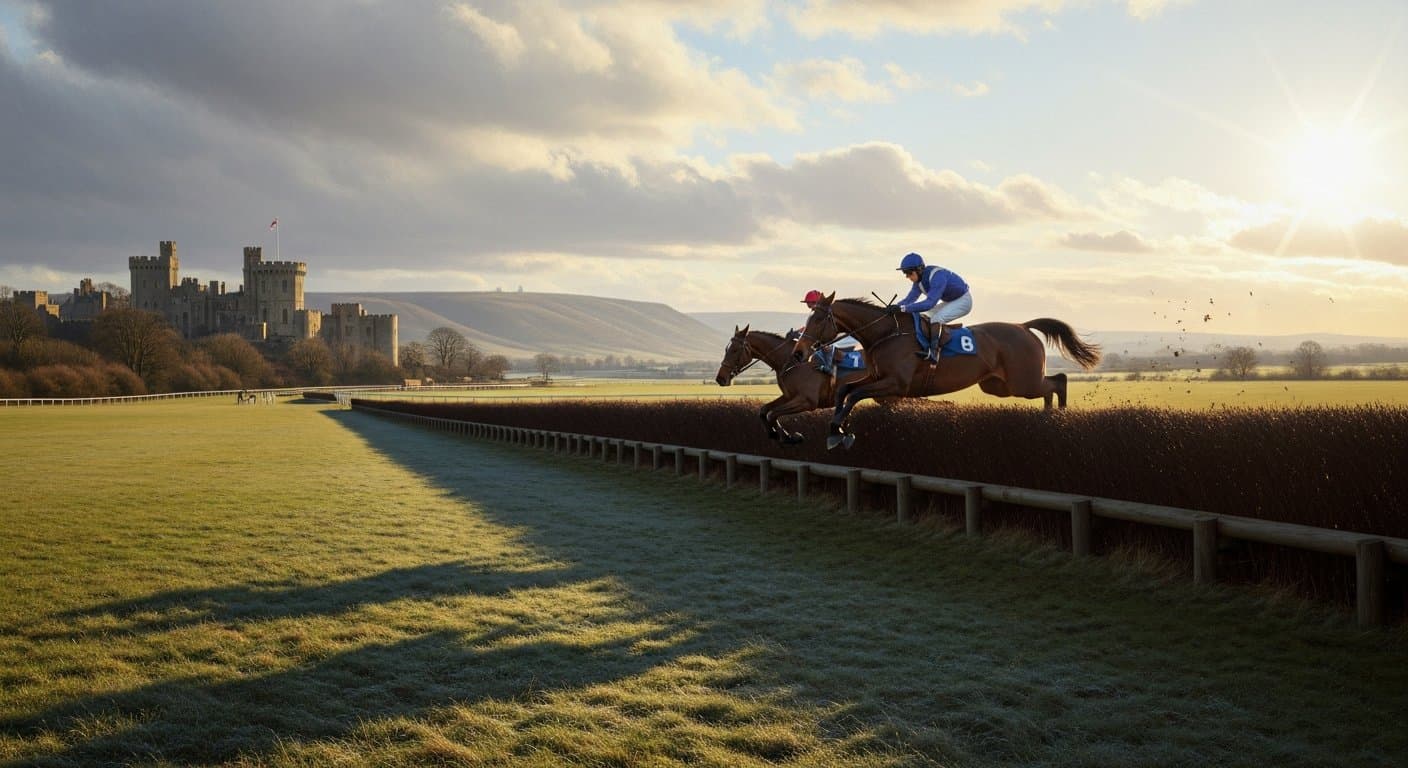
Founder & Editor · Last reviewed 2026-04-07
Fontwell Park is unlike any other racecourse in Britain. The chase course follows a figure-of-eight layout — horses cross their own path at the intersection point — and this singular design creates a racing experience that rewards specialists and punishes those with conventional jumping technique. It is quirky, it is demanding, and for those who know it well, it is completely absorbing.
The course at Arundel has served West Sussex racing since 1924 and built up a devoted following of south-east racegoers who appreciate a proper jump track within easy reach of Brighton and the coast. Fontwell is not trying to be Cheltenham — it is something altogether more individual, and that individuality is the point.
The National Spirit Hurdle is the highlight of the calendar, a Grade 2 hurdle over about two miles and three furlongs in late February or early March, and the course calls it the most valuable and prestigious race it stages. Being a hurdle race, it is run on the conventional oval rather than the figure-of-eight. The biggest chase is the Southern National in November, a Class 3 handicap over about three miles and three and a half furlongs that does use the figure-of-eight and asks staying chasers to navigate the crossing point cleanly while holding their momentum. The Christmas meeting adds further competitive racing that draws the major Sussex and Hampshire yards.
For punters, Fontwell is a gold mine of exploitable tendencies. The specialist nature of the track means trainer records here diverge wildly from the same trainers' overall statistics. Gary Moore and Seamus Mullins have exceptional records at this specific course. Course form is more predictive at Fontwell than almost anywhere else in British jump racing — and the market does not always account for it.
Bet on Fontwell Park
Place your bets on Fontwell Park races with a trusted bookmaker.

Promo code BETFRED50. New customers only. Register, deposit with a Debit Card, and place a first bet of £10+ at Evens (2.0)+ on Sports, to be settled within 7 days, to get £30 in Sports Free Bets and £20 in Bet Builder Free Bets within 24 hours of settlement. 7-day expiry. Eligibility & payment exclusions apply. Full T&Cs apply. Take Time to Think. BeGambleAware.org. 18+. Full T&Cs.

Promo code R30. New UK customers only, 18+. Register, deposit £10 or more, then place a £10 single cash bet at odds of 1/2 (1.5) or greater on any sports market (excluding Virtuals). Once the qualifying bet settles you get £30 in Free Bets (3 x £10) — the qualifying bet can win or lose. Free Bets are valid on any sports market excluding Virtuals, expire in 7 days, are non-withdrawable and must be used in full. Excluded deposit methods apply (including PayPal, Apple Pay, Skrill and NETELLER). Named bets such as Lucky 15 do not qualify. If you cash out the qualifying bet, or it is voided, you are no longer eligible for the offer. Ends 31.12.26. Full T&Cs apply. Please gamble responsibly. BeGambleAware.org. 18+. Full T&Cs.

Promo code BET40GET20. New UK customers, 18+. Register with the code and place a first bet of £40 or more at Evens (2.0) or greater. Receive 2 × £10 free bets: the first credited automatically once the qualifying bet settles, the second 24 hours later. Free bets must be placed at minimum odds of 4/1 (5.0), expire 24 hours after credit, and the free-bet stake is not returned with winnings. Debit card deposits only. Take Time to Think. BeGambleAware.org. 18+. T&Cs apply. Full T&Cs.

50% of your first-day net losses refunded as a free bet, capped at £25. New UK customers aged 18+ only. To qualify, deposit and place a first bet of £10 or more on any sport at minimum odds of evens (2.00), then place at least two further bets on different events, each worth at least 50% of your largest bet, all at evens (2.00) or greater. Losses are counted from your first settled bet until 23:59 the same day. Place a qualifying £10+ bet and you are guaranteed at least a £5 free bet. Bets placed at SP, void bets, cashed-out bets and bets struck with free bets do not count towards the offer. The free bet is credited the day after your qualifying bets settle and must be used within 7 days, after which it expires. It can be used at odds from 1/4 (1.25) up to 250/1 on singles and straight accumulators, but not on Trixie, Patent or Yankee style multiples. Free-bet stake is not returned with winnings. One offer per person, household, address, IP address and device. E-wallet deposits may not qualify, so check the cashier before depositing. Customers registered with GAMSTOP cannot claim. KYC identity verification must be completed before the free bet is credited. Take Time to Think. BeGambleAware.org. 18+. T&Cs apply. Full T&Cs.

New customers, 18+. Choose the sports bonus at sign-up, make a first deposit and receive a 100% bonus up to £50 in your Sports Bonus balance. To convert the bonus to cash, wager it 10x within 30 days. Single bets below Evens (2.00) do not qualify; accumulators do not qualify if any selection is below 1/2 (1.50). Virtual Sports, voided, cancelled, drawn, cashed-out and free-bet wagers do not count towards wagering. Only the first settled bet per event counts. Withdrawing before the wagering requirement is met forfeits the bonus balance including bonus winnings. Real-money funds are used before bonus funds. Deposits via Skrill or Neteller are not eligible. Not valid in conjunction with other promotions. Odds, bet and payment limits apply. 10bet general and promotion T&Cs apply. BeGambleAware.org. 18+. Full T&Cs.

New customers in Great Britain and Republic of Ireland, 18+. Place a £10 fixed-odds qualifying bet at minimum odds of 1/2 (1.50) — single or each-way (only the win part counts), pre-event or in-play, not cashed out early, within 28 days of opening the account. Receive up to £60 in bonuses credited over three days: 3 × £10 fixed-odds free bets (the first on settlement, then 24 and 48 hours later) plus 3 × £5 Total Goals FOOTBALL spread bets, 3 × £5 racing Winning Favourites spread bets and a £1 racing Race Index spread bet (the spread bets need a full spread-betting account). Free-bet stakes not returned with winnings; free bets valid 28 days from issue. IMPORTANT: the £5 credits are SPREAD bets — sports spread betting carries the risk that losses can exceed your stake. Sports spread-betting customers do not have Financial Ombudsman or FSCS recourse. Take Time to Think. BeGambleAware.org. 18+. T&Cs apply. Full T&Cs.

Promo code WELCOME15, entered under My Bonuses after registering. New UK customers, 18+. Place a first qualifying bet of at least £10 from your cash balance at odds of evens (2.0) or greater within 7 days of opening the account. Once the qualifying bet fully settles you receive £15 in free bets, credited as 3 x £5 tokens with set uses: one £5 accumulator free bet (minimum 4 legs, each leg at 2/5 or bigger), one £5 sports free bet (any market at evens or bigger) and one £5 Sub Cover free bet (selected football player markets at evens or bigger). Free-bet stakes are not returned with winnings. Free bets expire 7 days after they are credited. Void, cashed-out and partially cashed-out bets do not qualify. One offer per customer. Confirm the current terms on BetGoodwin's own welcome-offer page before claiming. Take Time to Think. BeGambleAware.org. 18+. T&Cs apply. Full T&Cs.

New UK customers, 18+. Minimum deposit £10. Place a £10 qualifying single at minimum odds of 1/2 (1.50), settled within 14 days. Receive £30 in free bets (stake not returned), split £20 for sportsbook use (2 x £10) and £10 for Bet Builder only (2 x £5); Bet Builder does not cover horse racing. Free bets must be accepted within 7 days and expire 7 days after acceptance. No promo code required. Best Odds Guaranteed on UK & Irish racing, subject to having staked over £25 in the previous seven days. Operated by LiveScore Betting and Gaming (Gibraltar) Ltd, UKGC 56859. Confirm the current terms on LiveScore Bet's own promotions page before claiming. Take Time to Think. BeGambleAware.org. 18+. T&Cs apply. Full T&Cs.
18+. BeGambleAware.org
Day-by-Day Guide
The Fontwell Season
Fontwell Park's jump season runs from autumn through to spring, staging around twenty meetings a year. The pattern follows the National Hunt calendar: early season meetings in October and November, the Christmas highlight, a winter programme through January and February, and the National Spirit Hurdle meeting at the turn of February into March. Each phase has its own character and attracts a slightly different mix of horses and racegoers.
Autumn Opening (October–November)
Fontwell's autumn fixtures arrive before the major venues have fully hit their stride. The October and November meetings attract trainers looking for a competitive but manageable stepping stone — Fontwell's figure-of-eight circuit is specific enough to filter out all-rounders while rewarding horses that genuinely suit the track. Early season winners at Fontwell are often horses that have been specifically planned for the track by trainers who know its demands.
The autumn crowds are modest but knowledgeable. Fontwell's loyal Sussex following turns out early, and the smaller weekday meetings have an intimacy that large-crowd days cannot replicate. If you want to understand a horse's jumping style under race conditions without the noise and distractions of a headline meeting, an autumn weekday at Fontwell is the place to do it.
Christmas Meeting (December)
The Christmas fixture is Fontwell's second-busiest day of the year and one of the most popular jump racing occasions in the south east. Families, social groups and committed racegoers all make the trip, and the course is well-prepared for the volume. The card on Christmas meeting day is typically eight races with decent prize money — competitive handicap chases over the figure-of-eight course, novice hurdle divisions, and at least one conditions chase.
The atmosphere at the Christmas meeting is genuinely festive — Fontwell leans into the occasion with seasonal decorations, themed hospitality and an afternoon that works for groups who want to socialise as well as watch racing. The betting ring is lively, the crowd is generous, and the racing quality is a cut above a standard midweek card.
Key races to watch on Christmas day: The featured handicap chase over two miles and three furlongs around the figure-of-eight tends to be the most competitive race on the card. This is a race that separates genuine course specialists from horses that have won at other tracks but haven't demonstrated they can handle the crossing point cleanly under competitive pressure.
National Spirit Hurdle Day (late February or early March)
The flagship meeting. The National Spirit Hurdle (Grade 2, about two miles and three furlongs) puts Fontwell on the national racing map for one day in late winter, attracting horses from the major yards seeking a trial ahead of the spring Festivals or a valuable Graded prize in its own right.
National Spirit day has a different energy from the Christmas meeting, more earnest and more focused on the racing. The crowd is smaller but the quality of racegoer is higher in terms of form knowledge. The parade ring before the feature is worth attending to watch how the horses and jockeys conduct themselves: you can learn something about a horse's readiness from how it walks and how calmly its jockey sits.
The support card on National Spirit day is well-constructed, typically a novice hurdle, a handicap hurdle and an intermediate chase alongside the headline event. It is a full afternoon of genuinely competitive jump racing.
Spring Closers (March–April)
Fontwell's final meetings of the season run into late March and occasionally April, as the jump season winds down and the big yards begin their summer planning. Fields are slightly thinner at the season's end, but Fontwell's regular participants stay loyal to the track long after some other courses have seen their fields dwindle. Course specialists who have been running all winter tend to produce their best form late in the season on tracks they know well.
Key Races to Watch
National Spirit Hurdle (Grade 2 Hurdle, about 2m 3f, late February or early March)
The National Spirit Hurdle is the race that defines the Fontwell season. The course calls it the most valuable and prestigious race in its calendar, and it acts as a trial for the spring Festivals. It is a hurdle race, so it is run on the conventional left-handed oval and does not use the figure-of-eight at all, which is worth knowing before transferring chase course form to it.
Southern National (Class 3 Handicap Chase, about 3m 3f, November)
Fontwell's staying chase, and the one the figure-of-eight shapes most. Repeatedly negotiating the crossing point at three-mile-plus pace asks something genuinely athletic of a horse, and Fontwell builds a raceday around the race.
Watch for: Horses that have won at Fontwell at a shorter trip and are stepping up in distance. Experience of the figure-of-eight transfers across distances, and a horse that has already learned to handle the crossing point starts with an advantage over one meeting it for the first time over three miles.
We are not publishing trainer strike rates or market angles for either race. The ones that stood here were written about the Fontwell Gold Cup, a race that does not exist, so there is nothing behind them to keep.
December Handicap Chases
The Christmas meeting's featured handicap chase over two miles and three furlongs is one of the most competitive handicap chases in the south east during December. Fields are well-constructed by the handicapper, previous course winners return reliably, and the race regularly produces tight finishes. Form from this race holds up well in subsequent starts at Sandown, Kempton and Plumpton.
Novice Hurdle Series
Fontwell's novice hurdle division through the winter features horses from both the major yards and the smaller southern trainers who appreciate a competitive but accessible venue. The hurdle course at Fontwell is a more conventional circuit than the figure-of-eight chase track, and novice winners here translate well to other venues. Watch November and December novice hurdle form for horses that may be aimed at the spring Festivals.
Betting Preview
The Figure-of-Eight Advantage
No other track in Britain creates the same course-specialist edge as Fontwell. The figure-of-eight layout requires horses to cross their own path in a confined space — an action that demands a specific jumping pattern and spatial awareness that some horses simply never acquire. Once a horse has demonstrated it handles the crossing point well, that ability is highly reliable in future visits.
The practical rule: never bet against a previous Fontwell course winner without a good reason. Return form at Fontwell is among the strongest of any jump course in the country, and the market routinely underprices horses with proven course experience in favour of better-credentialled horses that have never navigated the figure-of-eight.
Trainer Records as a Primary Filter
Before going anywhere near form or ratings at Fontwell, check the trainer statistics. Gary Moore's win rate at Fontwell is roughly double his national average. Seamus Mullins, based nearby in East Sussex, is similarly dominant at a course he can access with ease and target specifically. These trainers' horses do not simply run at Fontwell because it is convenient — they are actively trained for it.
Conversely, big-name trainers without a strong Fontwell record deserve downgrading relative to their national profile. A horse trained at Henderson's Seven Barrows coming to Fontwell for the first time faces a more significant track challenge than its form might suggest.
Approaching the Feature Races
We are not publishing a market read for Fontwell's feature races. The one that stood here described the Fontwell Gold Cup, a race that does not exist, and the favourite, the place terms and the trainer angle attached to it were invented alongside it.
What survives is a point about the track rather than any one race: course form over the figure-of-eight counts for more at Fontwell than course form does at most tracks, which the figure-of-eight guide explains.
Practical Notes
Fontwell's betting ring is competitive and well-staffed on the big days but thin on weekday meetings. Online betting is the better option for weekday fixtures. The Tote place pools at Fontwell can be generous in smaller-field staying chases — consider each-way Tote bets on the handicap chases at eight or more runners.
Visitor Information
Getting There
By train: Barnham station (Southern Railway from London Victoria, approximately 1 hour 10 minutes; also served from Brighton, approximately 35 minutes) is the closest station, around 2 miles from the racecourse. Taxis from Barnham to the course cost approximately £5–7 and are usually available outside the station. On Southern National day and Christmas meeting day, it is worth pre-booking a taxi as demand from other racegoers can be high.
By car: The A27 is the main approach along the south coast, with the course signposted between Arundel and Chichester. The A29 provides access from the north. On-site parking is available and free. The course is straightforward to reach from Brighton (approximately 25 minutes), Chichester (approximately 15 minutes) and Worthing (approximately 20 minutes).
Enclosures and Facilities
Fontwell is a compact venue and the enclosures are close to the action in a way that larger courses cannot replicate.
The Grandstand Enclosure provides covered seating along the finishing straight with access to bars, a restaurant and the parade ring. This is the best option for the big days when the course is at its most atmospheric.
The Course Enclosure runs along the inner rail of the chase course with a close-up view of horses navigating the figure-of-eight crossing point — one of the most distinctive vantage points in British racing. Very popular with regulars who want to watch jumping technique up close.
Essential Tips
- Arrive early for the parade ring. At Fontwell, understanding how horses move before racing is particularly useful because the track demands so much of their jumping. Fifteen minutes in the parade ring before the feature is well spent.
- The train from Brighton is easy. One change at Barnham or direct service to Barnham — either way it is a straightforward journey. The train is the best option from the Brighton and Hove area.
- Dress warmly for midwinter. Fontwell sits in a low-lying position near the West Sussex Downs and can be cold and damp in December and January. Waterproofs are recommended even on dry days.
- The Christmas meeting needs advance booking. Hospitality packages and even general admission tickets sell quickly for the December fixture — book through the Fontwell website as soon as dates are confirmed.
- Arundel is worth a visit. The nearby town, with its castle and cathedral, is well worth combining with a raceday for those travelling from further afield.
Share this article
More about this racecourse
All Fontwell Park guides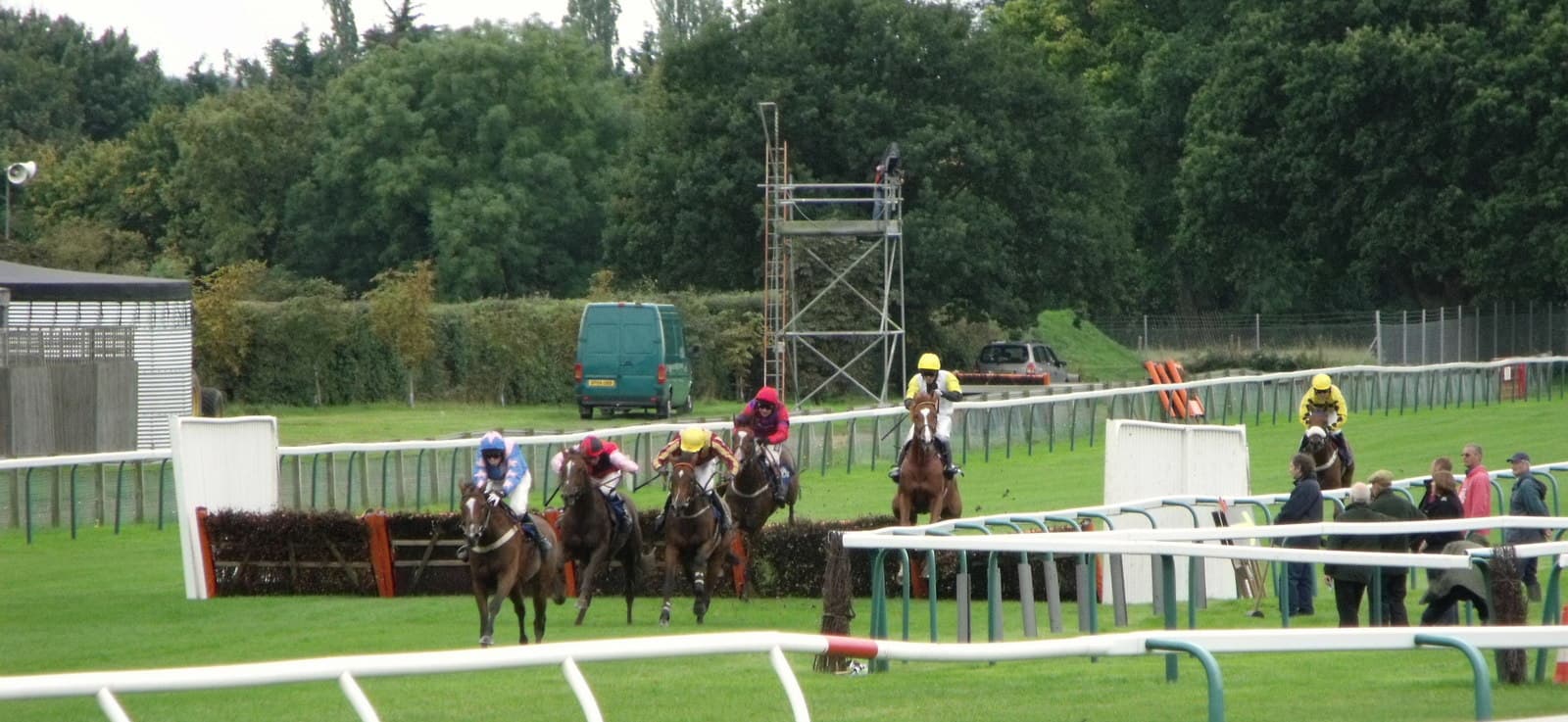
The History of Fontwell Park Racecourse
A century of racing at Fontwell Park — from Alfred Day's figure-of-eight design in 1924 to Britain's only figure-of-eight chase course.
Read more
Monaveen at Fontwell Park: The Horse That Started a Royal Racing Dynasty
On 10 October 1949, Monaveen won at Fontwell Park to give Princess Elizabeth her first winner as an owner — the race that ignited a lifelong royal passion for jump racing.
Read more
Bank Holiday Jump Day at Fontwell Park: The Complete Guide
Your complete guide to Fontwell Park's Easter Bank Holiday Monday jump meeting — Britain's only figure-of-eight circuit at its most festive, with competitive handicap chases and hurdles drawing 6,000+ from across Sussex and the South East.
Read morePhotos on this page are used under Creative Commons licences. Titles, sources and licence links for each one are on our image credits page.
Research the field with the AI Race Predictor
Our model publishes calibrated win-probability estimates for UK races — a second opinion to understand a race, not tips. It's open about its record: it doesn't beat the market, and we show exactly how it does.
Work it out & learn the basics
Gamble Responsibly
Gambling should be entertaining and not seen as a way to make money. Never bet more than you can afford to lose. If you or someone you know has a gambling problem, help and support is available.