
Founder & Editor · Last reviewed 2026-04-05
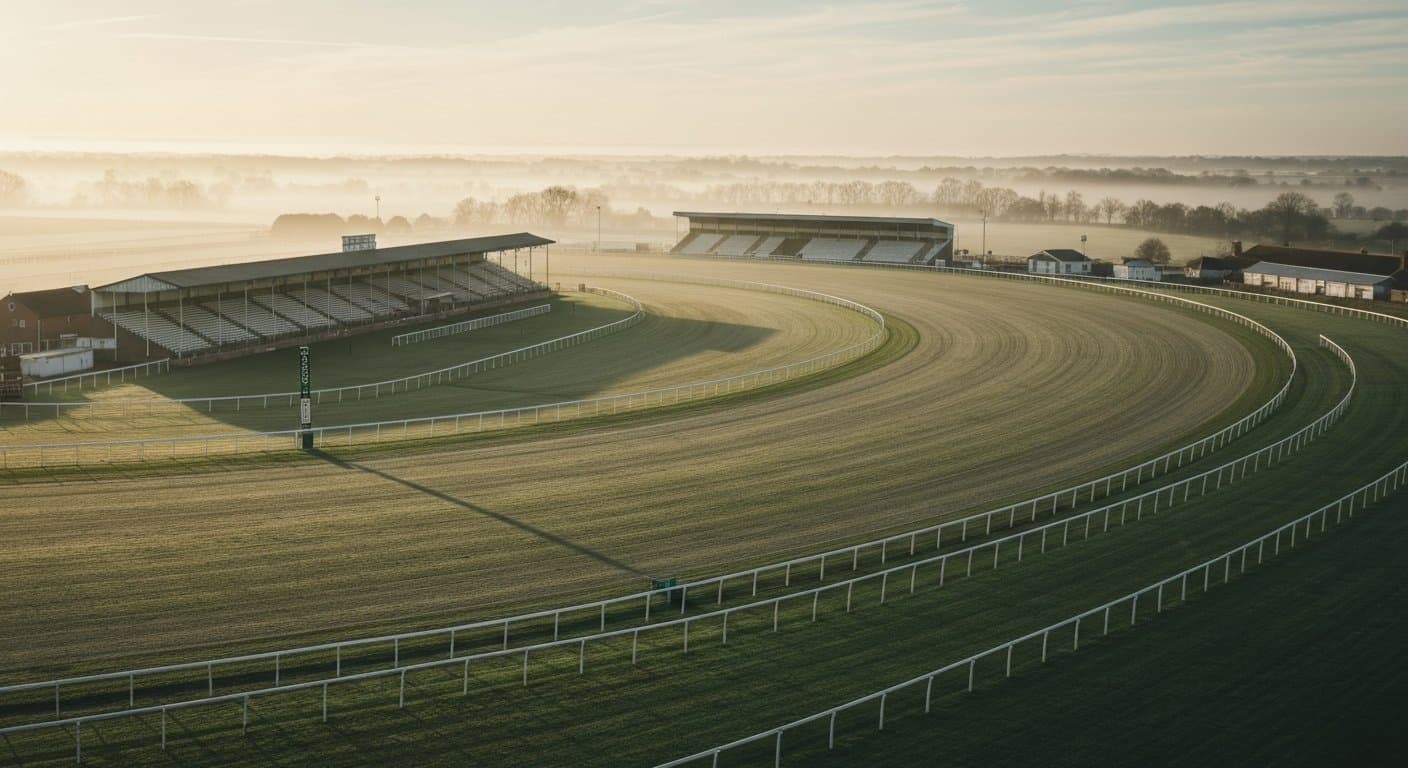
Uttoxeter Racecourse sits within the market town itself — Wood Lane, ST14 8BD — not on the outskirts but woven into the fabric of Staffordshire life. Racing in the area has roots stretching back to the early eighteenth century, and the current course on its present site has been staging National Hunt fixtures since 1881, with formal company-run meetings beginning in May 1907. That is over a century of uninterrupted jumping history, interrupted only twice — by two world wars — and each time the course came back.
The scale is modest by the standards of Cheltenham or Aintree. Uttoxeter holds around 5,000 racegoers on a normal Saturday, and the circuit runs to approximately one mile two furlongs on a left-handed, essentially flat loop. But modest scale and modest reputation are different things. The course is home to the Midlands Grand National, a Grade 3 handicap chase over four miles and two furlongs run each March — one of the longest and most demanding chases on the British calendar outside the Grand National itself. Horses that run well at Uttoxeter in March have repeatedly gone on to run well at Aintree in April.
The story of how a small Staffordshire market town came to host one of jump racing's great stamina tests is a story of local initiative, wartime resilience, local government enterprise, and eventually, commercial reinvestment. The Meynell Hunt steeplechases of the 1800s gave way to a formal course at the turn of the twentieth century. The council took over after the Second World War and rebuilt. Private capital arrived in 1988. Arena Racing Company (ARC) now operates the venue as part of a wider portfolio that includes Chepstow, Wolverhampton, and Chelmsford City.
Through all of that, Uttoxeter has kept its character. The stands sit close to the track. The Staffordshire clay gets heavy in winter and the March Midlands National is almost always run on soft or heavy going — which is exactly as it should be. The ground that looks like a problem is, for the right horse, a calling card.
The Midlands context matters too. Uttoxeter is the leading National Hunt venue in the Midlands, serving a catchment that takes in Derby fifteen miles to the north-east, Stoke-on-Trent fifteen miles to the north-west, Nottingham thirty miles to the east, and Birmingham forty miles to the south. Warwick is the only other Midlands jumping course of comparable standing. Between them they serve a region with a deep appetite for National Hunt racing and limited premium provision for it. Uttoxeter's position at the centre of that region, accessible by rail on the Crewe-to-Derby line with the station a ten-minute walk from the course, has been one of its consistent strengths.
This article traces that history from the earliest meetings at Netherwood in the 1700s through to the ARC era of the twenty-first century, examining the races, the horses, the ownership changes, and the decisions that turned a provincial jumping track into a racecourse with a signature race that truly matters.
Origins & Foundation
Origins & Foundation
Racing in the Uttoxeter area predates the current course by nearly two centuries. The earliest recorded meetings took place at Netherwood in the early 1700s — a time when organised horse racing was still finding its feet in the English countryside. These were informal affairs, tied to the local calendar rather than any national structure, and the courses were often no more than stretches of common ground marked out for the occasion. Yet they established a habit in the local population: people came to watch horses race, and they kept coming back.
The Samuel Johnson Connection
Before the racing history proper begins, it is worth placing Uttoxeter in its wider cultural context. The market town sits fifteen miles north of Lichfield, the birthplace of Dr Samuel Johnson (1709–1784), the lexicographer who compiled the first complete English dictionary. Johnson's connection to Uttoxeter is not to do with horses. It is to do with guilt and penance. As an old man, Johnson travelled from London to stand in Uttoxeter market place for an hour in the rain — bareheaded, in the spot where his father Michael had kept a bookstall decades earlier. Johnson had refused, as a young man, to tend that stall when his father was ill, and the shame of that refusal stayed with him for life. The act of public penance in the market square became one of the most cited stories of filial guilt in English literature; there is a memorial to it in Uttoxeter town centre to this day.
The story is not directly connected to the racecourse, but it tells you something about the town. Uttoxeter is a place that takes its history seriously, where the past is not forgotten, and where local identity is anchored in specific, dateable acts. That same quality runs through its racing history.
The Meynell Hunt and the Birth of Steeplechasing
In the early 1800s, the Uttoxeter area was at the heart of Meynell Hunt country. The Meynell was one of the oldest and most respected hunts in England, and its territory covered a wide arc of Staffordshire and Derbyshire. The connection between hunting and racing was, in the nineteenth century, almost total. Steeplechasing had grown out of the hunting field — originally literally a race from one church steeple to another across open country, jumping whatever the landscape provided. The riders were hunting men, the horses were hunting horses, and the fences were hedges, ditches, and timber.
The Uttoxeter area was well suited to this. The landscape between Uttoxeter and the Dove Valley offered the mix of farmland, brook crossings, and open pasture that early steeplechasing required. By the 1830s and 1840s, the Meynell Hunt was staging organised steeplechase meetings in the area, attracting local landowners and their horses. These were social occasions as much as sporting ones. Entries were restricted to horses that had been out hunting that season, and the competitors were largely the same men who rode to hounds on a winter morning.
From Hunt Chase to Formal Fixture
The shift from hunt steeplechase to formal racing fixture was gradual. By the latter half of the nineteenth century, the Jockey Club had brought National Hunt racing under regulatory oversight, and the informal meets of the hunting field were giving way to properly structured cards with weights, conditions, and declared runners. Uttoxeter was part of that transition.
Racing at the current site — Wood Lane, on the edge of the town — is believed to have begun around 1881, before the formal company structure arrived. The land was suitable: flat enough for a consistent circuit, with enough space to accommodate a proper oval layout, and close enough to the town centre and railway station to be accessible. The station had opened in 1889, serving the Crewe-to-Derby line, and from that point the racecourse was within ten minutes' walk of the platform — a connection that would prove important for decades.
The Closure of Keele Park and the 1907 Foundation
The formal origin of the modern Uttoxeter Racecourse is 1907. Keele Park, a racing venue elsewhere in Staffordshire, had ceased to operate, and its licence became available. A group of local businessmen and racing enthusiasts formed a company to acquire that licence and establish a properly constituted racecourse at the Wood Lane site. The inaugural meeting under the new company was held on 3 and 4 May 1907 — an Edwardian occasion, the reign of Edward VII, when National Hunt racing was expanding and the fixture list was filling out across the country.
The left-handed layout chosen in 1907 remains largely unchanged today. The circuit runs to approximately one mile two furlongs. The track is essentially flat, which was a deliberate choice — the emphasis was always going to be on stamina and jumping rather than on topography. The Staffordshire clay soil beneath the course was already well known in the area. It drains slowly, holds moisture, and produces the heavy and soft going that National Hunt trainers either love or dread. For horses with the constitution to handle it, the ground at Uttoxeter was an advantage. For those without, it was a trap.
The course attracted entries from trainers across the Midlands and the North. Derby is fifteen miles to the north-east, Stoke-on-Trent fifteen miles to the north-west, Birmingham forty miles to the south. The catchment was substantial, and the railway connection meant that horses could travel to the course without the long road journeys that limited so many provincial meetings. Within a few years, Uttoxeter had established itself as a workable, competitive National Hunt venue.
The First World War and Its Aftermath
Racing continued through the Edwardian and early Georgian years, but the First World War brought everything to a halt. From 1914 to 1921, there were no fixtures at Uttoxeter. The war consumed men, horses, and resources that might otherwise have sustained the sport. When peace returned, the country was exhausted and the racing industry had to rebuild from a significantly reduced base. Horses had been requisitioned for the war effort in large numbers; experienced stable staff had been killed or injured; owners who had funded racing in 1913 were no longer in a position to do so in 1919.
Uttoxeter restarted in 1922. The fixture list was modest — a handful of meetings per year — but the infrastructure was intact and the appetite for racing had not disappeared. Through the 1920s and into the 1930s, the course settled into a rhythm: a reliable provincial venue serving a large regional catchment, attracting honest horses and competitive handicaps, with the kind of atmosphere that a market town racecourse could generate when the crowds arrived.
Why this era matters: The 1907 foundation established the physical and regulatory framework that still exists today. The left-handed circuit, the Wood Lane location, the National Hunt-only licence, and the reliance on the railway connection were all decisions made in that first decade. Every subsequent development — the council takeover, the grandstand investment, the Midlands Grand National — built on what was laid down between 1907 and 1922.
Growth & Development
Growth & Development
The Interwar Years
The 1920s and 1930s were a period of quiet consolidation at Uttoxeter. Racing continued through both decades, the fixture list was modest, and the course developed the reputation for honest, testing National Hunt racing that would carry it through the rest of the century. Trainers from across the Midlands — the yards around Warwickshire, Worcestershire, and Staffordshire — found in Uttoxeter a venue that suited horses capable of handling soft ground and a fair jumping test. The track was not glamorous, but it was reliable.
The interwar period also saw the National Hunt calendar mature as a whole. The Cheltenham Festival had been firmly established in its modern form since 1924, and the Grand National at Aintree was the sport's biggest event. Uttoxeter sat below both in the hierarchy — a provincial track making its contribution to the fixtures list — but it was a working part of a working sport, and the local support sustained it through difficult economic times in the late 1920s and 1930s.
The Second World War: Silence Again
For the second time in a generation, war closed the course. From 1939 to 1945, there were no fixtures at Uttoxeter. The course itself was requisitioned, as happened at many racing venues across the country during the conflict. Stabling, open ground, and rural locations were pressed into service for training, storage, and military logistics. When the war ended in 1945, the original company structure had effectively wound down and the future of the racecourse was uncertain.
This second interruption was more serious than the first. After 1918, the company had simply restarted. After 1945, there was no functioning company to restart. The licence was in doubt, the facilities needed attention after years of neglect and alternative use, and the post-war austerity of the late 1940s made private investment difficult to find. Uttoxeter was at risk of not coming back at all.
The Council Takes Over: 1952
The rescue came from an unlikely direction. In 1952, Uttoxeter Urban District Council took over the running of the racecourse. Local authorities rarely operated racecourses — it was not a typical function of municipal government — but the council recognised that the course was an asset to the town and to the region, and that without intervention it would close.
The inaugural meeting under council ownership was held on 12 April 1952, and by any measure it was a success. Attendance on the day exceeded 12,000 spectators — a figure that demonstrated the demand had not gone away during the years of post-war austerity. The Midlands was hungry for racing, and Uttoxeter was positioned to provide it.
The council proved to be a capable operator. Facilities were improved progressively through the 1950s and into the 1960s. The fixture list was expanded. The course attracted better-quality entries as its reputation recovered, and trainers from across the region began to pencil in Uttoxeter dates with more regularity. The ground conditions — heavy Staffordshire clay producing reliably soft going in winter — suited staying chasers, and a specific type of horse started to be associated with the course: strong, durable, honest gallopers that could handle a stamina test.
The 1968 Grandstand: A Statement of Intent
The single largest investment of the council era was the opening of a new grandstand in 1968, completed at a cost of £167,000. For a local authority of the size Uttoxeter Urban District Council represented, this was a substantial financial commitment. The stand replaced the earlier, more rudimentary viewing facilities and gave racegoers proper covered accommodation with an elevated view of the track.
The timing was deliberate. By the mid-1960s it was clear that without better facilities, the course could not continue to attract competitive fields or grow its attendances. The investment was also a statement of ambition. The council was not merely maintaining what existed; it was investing in a future where Uttoxeter could compete as a proper racecourse venue rather than simply a functional fixture on the Midlands calendar.
The new stand changed the atmosphere at the course. Racegoers who had previously been exposed to the elements now had shelter and sightlines that allowed them to follow the racing properly. Catering improved. The hospitality offer, while still modest, began to take shape. A day at Uttoxeter became a day out rather than just an excuse to stand in a field on a wet March afternoon.
The Birth of the Midlands Grand National: 1969
The defining event of the entire growth era — , arguably the most important single decision in the course's history — came in 1969 with the inauguration of the Midlands Grand National Handicap Steeplechase. The race was run over four miles and two furlongs, making it one of the longest chases in the British calendar. Only the Grand National at Aintree and a small number of other specialist staying contests exceeded it in distance.
The logic behind the race was clear. Uttoxeter's track — flat, testing, with the notoriously holding Staffordshire clay underfoot — was ideally configured for a staying marathon. A race of this distance would always be run in late winter or early spring when the ground was at its heaviest, and that would filter the field to exactly the type of horse the course was built for: big, powerful, robust stayers that could handle four miles and more in the mud.
The inaugural running attracted good-quality entries and immediately established itself as a race with a defined purpose on the National Hunt calendar. Trainers preparing horses for Aintree in April began to eye the March Uttoxeter fixture as a logical stepping stone. The distances were compatible. The ground conditions were comparable. A horse that could travel strongly at the four-mile mark at Uttoxeter in deep going was a horse worth keeping in the Grand National picture.
Within a few years, the Midlands Grand National had become the course's identity. Every other fixture served its purpose and played its part, but the March chase was the event that people planned around, that trainers targeted specifically, and that produced results capable of reverberating through the rest of the season. Uttoxeter had gone from a well-run provincial course to a venue with a truly influential race on its programme.
Why this era matters: The council period between 1952 and 1988 gave Uttoxeter its modern shape. The 1952 takeover saved the course; the 1968 grandstand gave it credibility; and the 1969 Midlands Grand National gave it purpose. Every subsequent development — the private investment of the 1980s, the ARC era, the summer jumping programme — is built on the foundations laid during thirty-six years of local authority stewardship.
Famous Races & Moments
Famous Races & Moments
Rag Trade and the Aintree Connection: 1975–1976
If a single horse established the Midlands Grand National's reputation as an Aintree trial, it was Rag Trade. In 1975, trained by Fred Rimell at Kinnersley in Worcestershire and ridden by John Burke, Rag Trade won at Uttoxeter carrying 10 stone 5 pounds. The performance was authoritative — he handled the heavy Staffordshire going with the ease of a horse built for wet winter ground, and his jumping over the marathon four miles and two furlongs was clean throughout.
The following spring, on 3 April 1976, Rag Trade won the Grand National at Aintree at odds of 14/1, ridden again by John Burke. Fred Rimell thus became the only trainer to have won four Grand Nationals, a record that still stands. The sequence — Midlands Grand National to Grand National — had been completed in its most emphatic possible form. Racing correspondents of the period drew the connection explicitly, and trainers with real Aintree candidates began to assess Uttoxeter in March in a different light.
Rag Trade's Uttoxeter win was not the only factor in his preparation, but it confirmed what the course's profile suggested: that four miles on soft or heavy going in Staffordshire was a credible dress rehearsal for four miles and four furlongs on soft or heavy going at Aintree. The ground conditions and the distance demands aligned closely enough to make the form transferable.
Lord Gyllene: 1997
Two decades later, the Aintree link was reinforced by Lord Gyllene. Trained by Steve Brookshaw and ridden by Tony Dobbin, Lord Gyllene won the Midlands Grand National at Uttoxeter in March 1997, then won the Grand National at Aintree on 5 April 1997 at 14/1 — starting as one of the shorter-priced runners in the field and winning by more than twenty-five lengths in what was at the time described as one of the most authoritative Grand National victories in recent memory.
The 1997 Aintree race was run on going officially described as good to soft, faster than many years, but Lord Gyllene's Uttoxeter run had proved his ability to travel well over the distance under National Hunt conditions in the spring. His Uttoxeter performance had been noted by punters and analysts, and by the time Aintree arrived his profile as a real staying chaser was well established.
Two horses, two decades apart, completing the Uttoxeter-to-Aintree double made a statistical pattern difficult to dismiss. The Midlands Grand National was not merely a preparatory race for also-rans; it was a race capable of identifying real Grand National contenders.
The Ground as a Filter
Part of what makes the Midlands Grand National historically significant is precisely the going conditions under which it is run. The race takes place in March, when the Staffordshire clay beneath the Wood Lane circuit is almost invariably soft or heavy. This is not an inconvenient variable; it is a designed feature of the race. A horse that cannot handle heavy going will not win the Midlands Grand National. A horse that excels in it has demonstrated one of the core requirements for success at Aintree in a wet April.
In the history of the race since 1969, there have been very few runnings on ground any firmer than good to soft. In most years the going is soft or heavy throughout the card. The combination of that going and the four miles and two furlongs distance ensures that only horses with the physical constitution for sustained jumping under testing conditions can win. Lightweights and horses with fragile frames tend to disappear at the business end. The race rewards substance.
The Summer Jumping Decision
One of the less celebrated but historically significant decisions in Uttoxeter's modern history was the development of its summer National Hunt programme. When most racecourses switch entirely to Flat racing in May and do not return to jumping until October, Uttoxeter has run National Hunt fixtures through May, June, July, and August. Evening meetings and weekend cards in the summer months serve a constituency of trainers and punters who prefer jumping and do not want to follow the Flat.
The commercial logic is straightforward: Uttoxeter has no Flat licence and no ambition to acquire one. It cannot compete with Chester, Goodwood, or Ascot for summer patronage on the Flat. It can, and does, serve as a summer jumping venue for yards across the Midlands. Nigel Twiston-Davies at Naunton, fifty miles south; Dan Skelton at Alcester, thirty-five miles south-east; Tom George at Slad, fifty-five miles south-west — these trainers and others have used Uttoxeter's summer card to give horses experience, fitness, and racecourse time between the spring and autumn jumping seasons.
The decision to run summer jumping was not without risk. Attendance at summer jumping meetings is generally lower than for winter fixtures — the competition from outdoor leisure alternatives is greater, and the racing is often less competitive. But Uttoxeter has sustained the programme and built a following for it. The course's complete guide and day-out guide cover the summer fixtures in more detail.
The Atmosphere Moments
Beyond the races themselves, certain atmospheric qualities have defined Uttoxeter's identity over decades. The stands at Wood Lane sit close to the track — much closer than at many larger venues — and this proximity creates a physical immediacy that larger courses struggle to replicate. When a field of chasers passes the stands at the three-mile mark in the Midlands Grand National, the sound and weight of the horses is felt rather than merely watched.
The crowd size — around 5,000 on a normal Saturday card, rising to larger numbers for the Midlands National meeting — keeps the atmosphere human in scale. There are no extended corporate zones separating regular racegoers from the action. Enclosure divisions exist, but the differences in experience between them are matters of catering and shelter rather than proximity to the racing.
The March meeting built around the Midlands Grand National has its own character. Cold weather, soft ground, honest horses, serious punters, and a race that takes over half an hour to complete: it is not a glamorous day by the standards of Cheltenham or Ascot, but it is an honest one, and the horses that win it earn their result.
Trainers Targeting Uttoxeter
The course's history is also a history of the yards that have used it consistently. Nigel Twiston-Davies has sent horses to Uttoxeter for decades, his Naunton yard fifty miles to the south by road. His record at the course spans a range of races and conditions. Dan Skelton, based at Lodge Hill Stables in Alcester, thirty-five miles south-east of Uttoxeter, has been among the course's more active trainers in recent years, using the fixture list across seasons. Jonjo O'Neill at Jackdaws Castle in the Cotswolds, fifty miles to the south, has targeted Uttoxeter at various points. Tom George, operating from Slad, has sent staying chasers to the Midlands National with specific Aintree ambitions.
The concentration of National Hunt yards within a fifty-mile radius of Uttoxeter — Staffordshire, Warwickshire, Worcestershire, and the Cotswold fringe — gives the course a reliable supply of competitive entries. It is one of the reasons the Midlands Grand National has consistently attracted full fields and why the supporting programme across the year is competitive rather than merely representative.
The Modern Era
The Modern Era
1988: Northern Racing Arrives
The council era at Uttoxeter ended in 1988, when Sir Stanley Clarke's Northern Racing purchased the course from Uttoxeter Urban District Council. Clarke was one of the most active racecourse owners of the period — a businessman who had built a portfolio of British venues and was known for investing in facilities rather than simply managing existing assets. His acquisition of Uttoxeter was part of a wider programme of provincial racecourse development.
The sale represented a significant transition. The council had owned and operated the course for thirty-six years, and whatever the limitations of local government as a racecourse operator, it had kept the venue alive and made the investments — the 1968 grandstand, the 1969 Midlands Grand National — that shaped the modern course. Handing it to a professional racecourse company meant access to capital and expertise that municipal budgets could not provide, but it also meant the end of direct local accountability.
Northern Racing's investment at Uttoxeter was substantial. New paddocks were laid out. The Prince Edward Stand and the Staffordshire Stand were developed, with private boxes and a hospitality tier that had not previously existed at the course. The 1907 Restaurant was added — the name a deliberate acknowledgement of the course's founding year and an attempt to anchor the commercial offering in the course's history. Food and beverage facilities improved across the board.
These changes affected both the on-course experience and the commercial profile of the venue. Uttoxeter could now compete for corporate hospitality bookings alongside its traditional base of regular racegoers. Sponsors were easier to attract with a properly equipped hospitality suite than with a grandstand and a few catering vans.
From Northern Racing to ARC
Northern Racing grew through acquisition across the late 1990s and 2000s, eventually merging with Arena Leisure in 2012 to form Arena Racing Company (ARC). ARC now operates a portfolio of seventeen British racecourses, including Chepstow, Wolverhampton, Chelmsford City, Doncaster, and Newcastle, as well as Uttoxeter.
The ARC ownership structure brings both advantages and constraints. On the positive side, Uttoxeter benefits from shared infrastructure, centralised marketing and data capability, and the buying power of a large group when it comes to supplier contracts. The company has invested in digital ticketing, raceday experience improvements, and course maintenance at venues across the group, and Uttoxeter has received its share of that investment.
The constraint is that strategic decisions are made at group level rather than by a board with a singular focus on Uttoxeter. When ARC decides how to allocate investment across seventeen courses, Uttoxeter competes with venues that host Grade 1 racing, run Flat fixtures to the British Champions Series, and attract international coverage. Uttoxeter is not at the top of that list. It is, however, a consistently profitable provincial National Hunt venue with a signature race that attracts national attention once a year, and that profile is well understood within the group.
The Fixture List in the ARC Era
Under ARC, Uttoxeter stages between nineteen and twenty-five fixtures per year, all National Hunt. The Midlands Grand National meeting in March remains the headline event, typically drawing the year's biggest attendance and its most competitive card. The summer programme — May through August — continues to be one of the course's defining characteristics, with evening meetings and weekend jumping when the Flat season is at its height elsewhere.
The course does not host Grade 1 racing. Its highest-grade events are Grade 3, with the Midlands Grand National sitting at that level. The Midlands National has been reclassified at various points in the history of British racing's grading structure, but its status as one of the most demanding staying chases in the calendar has never been in question regardless of its formal grade designation.
The Physical Course Today
The track at Uttoxeter today is essentially the same circuit that was laid out in 1907, adapted and maintained across a century of use. Left-handed, approximately one mile two furlongs round, essentially flat. The fences are well maintained and are regarded as fair — not unusually demanding in terms of their construction, but placed on a circuit where the ground conditions and the distance are testing enough that the fences add to rather than define the challenge.
The Staffordshire clay soil is unchanged. The course drains slowly after prolonged rain, and in late winter the going is almost always soft or heavy. The British Horseracing Authority (BHA) going description for Uttoxeter in February and March is reliably at the softer end of the scale. On a dry summer evening, the ground can firm up to good or good to firm, which changes the character of the racing entirely. The summer card attracts different types of horse from the winter programme: lighter, quicker animals rather than the big-framed stayers who dominate in March.
Uttoxeter's Position in the Midlands NH Landscape
Uttoxeter occupies a specific position in National Hunt racing's regional structure. It is the leading jumping course in the Midlands, with Warwick the nearest competitor of comparable standard. Together they serve a large catchment: Derby fifteen miles to the north-east, Stoke-on-Trent fifteen miles to the north-west, Birmingham forty miles to the south, Nottingham thirty miles to the east. No other National Hunt venue sits at the centre of that geography.
The course's accessibility by rail — the Uttoxeter station on the Crewe-to-Derby line is approximately ten minutes' walk from the course entrance — gives it an advantage over venues that require road transport. For racegoers travelling from Birmingham, Stoke, or Derby, a train to Uttoxeter is a practical option, which broadens the potential audience beyond those with cars and helps sustain attendance at midweek and evening fixtures.
Why this era matters: The transition from council ownership to Northern Racing to ARC reshaped Uttoxeter's facilities and commercial structure without altering its essential character. The course retained its National Hunt-only identity, its left-handed flat circuit, and its signature race. What changed was the quality of the infrastructure around it and the stability of the ownership structure. Uttoxeter today is better maintained and better equipped than it was in 1988, while remaining recognisably the same racecourse that Fred Rimell targeted with Rag Trade in 1975.
Uttoxeter's Legacy
Uttoxeter's Legacy
What the Course Has Built
Uttoxeter's history since 1881 — and in its formal company-run form since 1907 — is a history of a racecourse that has always known what it is. It never tried to become a Flat track. It never lobbied for Grade 1 status. It did not attempt to replicate the festival atmosphere of Cheltenham or the international profile of Ascot. Instead, it committed to a single discipline, on a single left-handed circuit in the Staffordshire clay, and built one race that matters.
The Midlands Grand National has been run every year since 1969, with the exception of the years when foot-and-mouth disease and the Covid-19 pandemic imposed interruptions on British racing as a whole. In a history of fifty-plus runnings, the race has produced two Grand National winners — Rag Trade in 1976 and Lord Gyllene in 1997 — and a consistent stream of horses that have run well at Aintree after finishing placed at Uttoxeter. No other race outside Aintree itself has the same claim to be a direct Grand National trial by virtue of its distance and going conditions rather than simply its timing in the calendar.
That record gives Uttoxeter a significance in National Hunt racing history that its Grade 3 classification does not fully capture. The race is not a Grade 1. It does not attract the headlines that come with Cheltenham or Aintree. But trainers preparing real Grand National candidates — the kind of horses that need a competitive run at four miles-plus in heavy ground before Aintree in April — understand its value precisely.
The Resilience of the Institution
The most striking thread running through Uttoxeter's 140-year history is survival. Two world wars closed the course. The original company wound down after the second. The local council stepped in — an unusual act of municipal commitment — and kept racing alive through the 1950s and 1960s. Private capital arrived in 1988 and then again through the ARC group. Through all of those transitions, the racing itself continued.
That continuity matters in a region where other National Hunt venues have come and gone. Courses across the Midlands and the North have closed permanently at various points in the twentieth and twenty-first centuries. Uttoxeter has not. Its position — in a market town, accessible by rail, serving a large and loyal regional catchment — has proved resilient in ways that more isolated or less well-connected venues have not managed.
The town itself has a relationship with the course that is unusual for a venue of its size. Racing has been happening in Uttoxeter for three centuries in various forms, and the course's presence on Wood Lane is woven into the town's identity. The Samuel Johnson memorial in the market square and the racecourse on the edge of town are the two features of Uttoxeter most likely to be mentioned in any external reference to the place. That cultural weight — accumulated over generations of race meetings, winners' enclosures, and March afternoons in the mud — is not easily quantified but it is not nothing.
The Summer Jumping Identity
One of the decisions that most clearly defines Uttoxeter's modern identity is the sustained commitment to summer National Hunt racing. The course runs fixtures from May through August, when the majority of jumping yards have wound down for the summer and the Flat season occupies most of the racing calendar. For trainers who want to keep a horse ticking over between the spring and autumn jumping seasons, Uttoxeter in June or July is one of very few options on the British calendar.
This is a niche, but it is a niche that Uttoxeter has made its own. The summer fixtures do not produce the headline results that the March meeting generates — the fields are smaller, the horses are generally less high-profile, and the attendances are lower. But the programme serves a real need in the sport, and the consistency with which Uttoxeter has maintained it over many years has built a specific loyalty among the yards that use it regularly.
What Endures
The physical characteristics of Uttoxeter Racecourse — the flat left-handed circuit, the Staffordshire clay, the stands close to the track, the ten-minute walk from the railway station — have been constant for over a century. The institutional characteristics — National Hunt only, one signature race, a regional catchment that draws from Derby, Stoke, Birmingham, and Nottingham — have been equally stable.
What changes is the quality of the facilities around those constants, and the ownership structure that makes investment decisions. The council-funded grandstand of 1968, the Northern Racing hospitality development of the late 1980s, the ARC-era improvements of the 1990s and 2000s: each represents a layer of investment on top of an unchanged foundation.
The result is a racecourse that functions well within its defined scope, that has one race of real national significance on its programme, and that has survived everything the twentieth century threw at it without losing the character that makes it worth visiting. For the complete picture of what Uttoxeter looks like today — its enclosures, facilities, and what to expect on a raceday — the complete guide to Uttoxeter covers the practical detail. For those specifically interested in the Midlands Grand National, the dedicated race guide examines its history, its form patterns, and how to assess it as a betting event.
Uttoxeter is 140 years of Staffordshire jumping history on a flat left-handed circuit, and the Midlands Grand National is its lasting claim on the sport's broader record. That is a narrower legacy than some courses can claim. It is also a more honest one.
Share this article
More about this racecourse
All Uttoxeter guides
Summer Racing at Uttoxeter
Your guide to summer jumping at Uttoxeter — one of the few courses keeping the National Hunt flag flying through the warmer months.
Read more
The Midlands Grand National at Uttoxeter: Complete Guide
Everything you need to know about the Midlands Grand National — Uttoxeter's signature staying handicap chase.
Read more
Midlands Grand National Day at Uttoxeter: The Complete Guide
The complete guide to Midlands Grand National Day at Uttoxeter — the Midlands' premier staying chase, a key Grand National trial, and one of spring jump racing's most important form references.
Read moreGamble Responsibly
Gambling should be entertaining and not seen as a way to make money. Never bet more than you can afford to lose. If you or someone you know has a gambling problem, help and support is available.