
Founder & Editor · Last reviewed 2026-04-05
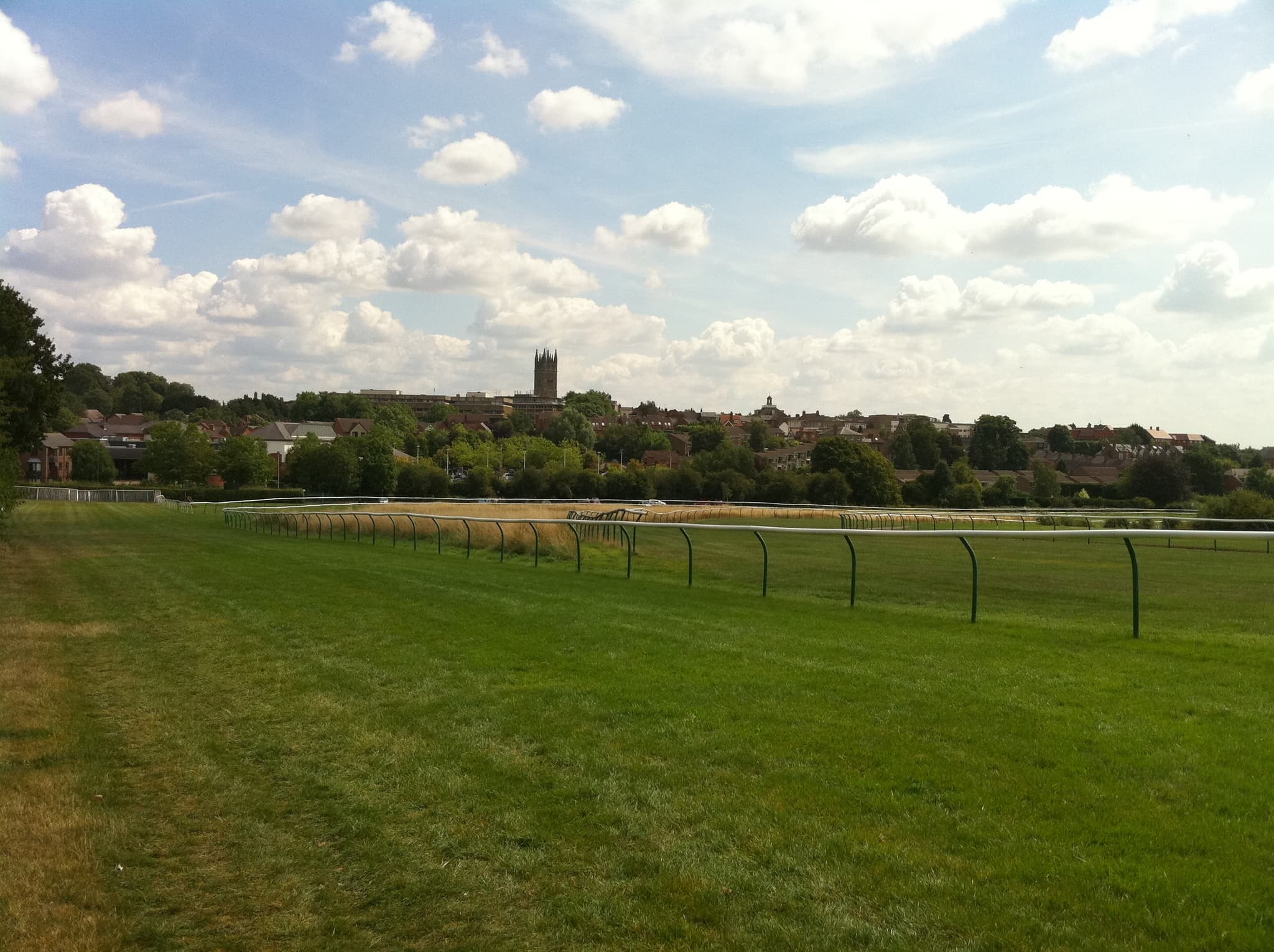
On a sharp January afternoon, with frost still on the hedgerows and the sky the colour of cold iron, Warwick Racecourse offers a view that no other British jump track can match. From the back straight, across the flat Warwickshire plain, the towers of Warwick Castle rise above the roofline — the same towers that have stood since William the Conqueror ordered a fortress built on this hill in 1068. The horses below are running a novice chase trial. The castle has been watching for nearly a thousand years.
That collision of old stone and live sport is not incidental to Warwick Racecourse. It is the place. The course sits on Hampton Street, less than half a mile from the castle walls, in the heart of a town that was already old when racing began here. The first recorded races at Warwick date to 1714 — over three centuries of continuous fixture lists — and the track has shared its postcode, CV34 6HN, with one of England's most visited medieval fortresses throughout that history.
What sets Warwick apart from the broader National Hunt circuit is a combination of track character and programme content that few courses in the Midlands can replicate. The circuit is left-handed, running approximately one mile and six furlongs, with sharp bends at each turn. The low-lying ground near the River Avon means the going can deteriorate quickly in wet winters, producing testing conditions that sort real stayers from horses that merely look the part on better ground. In a sport where most NH tracks bend right, Warwick's left-handed configuration is a variable that trainers factor into their planning.
The Kingmaker Novices' Chase defines the racecourse's standing in the modern NH calendar. Run in January or February over two miles at Grade 2 level, it has established itself as one of the most reliable Arkle Trophy trials on the circuit. The timing is deliberate: run six to eight weeks before the Cheltenham Festival, it gives trainers a live read on their best novice chasers without risking them on unfamiliar ground too close to the big day. Warwick's tight, demanding track means that a horse which jumps cleanly and maintains rhythm around these bends has already passed a significant test.
The trainer catchment reinforces the course's position. Jonjo O'Neill trains at Jackdaws Castle near Temple Guiting, roughly twenty miles to the north-west. Kim Bailey is based at Andoversford, about twenty-five miles south-west. Alan King operates from Barbury Castle, around forty-five miles to the south. Nicky Henderson, at Seven Barrows near Lambourn, is approximately sixty miles south-east. These are not incidental names on a runners list — they are among the most successful NH trainers in Britain, and Warwick sits at the centre of their geographic reach.
The town itself amplifies the experience. Warwick is compact, historic, and easy to navigate on foot from the railway station on the station approach road. The racecourse is embedded in the urban fabric rather than positioned on the outskirts of a business park, and that civic proximity gives racedays here a character that larger, purpose-built venues cannot manufacture. The castle is always there, always visible, a fixed point that links a January novice chase in 2026 to the same stretch of ground in 1714.
Georgian Origins
Georgian Origins
The first recorded races at Warwick date to 1714, the final year of Queen Anne's reign. Anne was a devoted patron of horse racing — she founded Ascot in 1711 and attended meetings at Newmarket with enough regularity that her health was said to deteriorate when racing was cancelled. Racing near Warwick in 1714, then, was not an outlier event but part of a broader flowering of organised sport across provincial England, driven by aristocratic and gentry patronage and a growing public appetite for wagering.
The town that hosted those early races was itself newly rebuilt. Warwick had been devastated by fire in September 1694 — a blaze that destroyed more than 460 houses and most of the town centre. The rebuilding that followed was ambitious and deliberate. The new Warwick was designed to project civic confidence, with wide streets, handsome houses in brick and stone, and civic buildings intended to attract wealthier residents and visitors. Horse racing fitted that ambition precisely. A regular race meeting was a mark of status for a county town, a draw for the nobility and gentry who would spend money on lodgings, food, and entertainment during the meeting days.
There is a record of Lord Brooke — a member of the Greville family, the Earls of Brooke and later Earls of Warwick — donating funds to support early racing at Warwick, a gesture that reflected the castle's role as the social anchor of the county. The Greville family had held Warwick Castle since 1604, and their patronage gave racing at Warwick a legitimacy that purely commercial ventures could not claim. The Bear and Ragged Staff, the emblem of the Earls of Warwick dating to the medieval period, hung over county affairs with considerable weight, and that included the race meetings held within sight of the castle walls.
The Coaching Town on the London Road
Warwick's geographic position gave it an advantage that went beyond its social connections. The town sat on the principal coaching route between London and Birmingham, one of the most heavily trafficked roads in Georgian England. Coaches running north from Oxford passed through Warwick before continuing to Coventry and Birmingham. This made the town accessible to London racegoers in a way that more remote courses simply were not. A meeting at Warwick in August could draw visitors from the capital who would otherwise have required a full day of arduous travel to reach more northerly fixtures.
By the 1750s, racing at Warwick was being regularly reported in the press. Bailey's Racing Register recorded results from Warwick meetings from 1739 onwards. A notable two-day card in 1754 featured £50 purses — a substantial sum at a time when a skilled craftsman might earn around £30 a year. The gentry who subscribed to these prizes were not doing so as charity. They were investing in the social infrastructure of the county, buying the right to parade their bloodstock in public and to be seen attending an event that mattered.
The Shakespeare Country Context
Warwick does not exist in geographic isolation. It sits at the centre of a cluster of towns with deep historical and cultural weight. Stratford-upon-Avon is eight miles to the south — Shakespeare's birthplace, already attracting literary tourists in the eighteenth century. Kenilworth is four miles to the north, its ruined castle the site of the famous Elizabethan entertainments of 1575 when Robert Dudley hosted Queen Elizabeth I for nineteen days. Coventry is eleven miles north-east, one of the great medieval cities of England. Racing at Warwick was embedded in a cultural landscape that attracted educated, wealthy visitors from across the country, and the race meetings benefited from that broader draw.
The fertile Feldon country to the south, stretching towards the Cotswolds, was prime agricultural land that supported the breeding of horses. The Vale of the Red Horse around Tysoe, and the broader Warwickshire hunting country, meant that horsemanship was not a novelty in this part of England. It was part of everyday life for anyone with land and means.
The First Grandstand and the Formalisation of Racing
The formalisation of Warwick as a proper racing venue accelerated in the early nineteenth century. A grandstand was erected in 1815, funded by subscription tickets from local supporters of the sport. The construction of a permanent grandstand was a signal that racing at Warwick was no longer a seasonal fair but an established institution. It also reflected a broader trend across British racing: the move from rough enclosures on common land towards purpose-built structures with regulated admission, printed programmes, and a formal race committee.
That race committee would have drawn its membership from the local gentry and the officers of the county — the kind of men who hunted through the winter, attended assizes in Warwick during the legal terms, and treated the race meeting as a natural extension of county social life. The assizes themselves were held in Warwick, at the county courthouse, and the timing of race meetings was often arranged to coincide with assize weeks when the town was full of visiting lawyers, judges, and the parties to litigation who accompanied them.
Warwick Pioneers Hurdle Racing
The most historically significant development in Warwick's early story came in 1831, when the course became the first in Britain to stage a hurdle race as part of a formal racecard. Hurdle races had existed informally before — riders jumping low obstacles over short distances, often as side-shows or private matches — but Warwick placed one on the main programme as an organised event with a prize, a starting time, and recorded results.
This was not a minor administrative footnote. It was a structural innovation that helped establish National Hunt racing as a recognised branch of the sport rather than a winter pastime for those who could not get to the flat meetings. The hurdle race at Warwick in 1831 sits near the root of a lineage that now includes the Champion Hurdle at Cheltenham and the World Hurdle, run over three miles at the Festival. Every hurdle race at every British course owes something to that day at Warwick.
The arrival of the Great Western Railway at Warwick in 1852 completed the transformation of the racecourse from a local fixture to a regional destination. Train services brought racegoers from Birmingham in under an hour, from Leamington Spa in minutes, and from Oxford in less than two hours. Crowds grew, gate receipts improved, and the prize money available to connections of the winning horses began to reflect the greater commercial scale of the operation. Warwick entered the Victorian era as a well-established, properly funded racecourse with a century of continuous racing behind it and the railway bringing new audiences to its gates.
The Victorian & Edwardian Era
The Victorian and Edwardian Era
The railway changed everything. From 1852 onwards, racegoers from Birmingham, Coventry, and the broader industrial Midlands could reach Warwick in under ninety minutes. The effect on crowds was immediate. The grandstand that had seemed adequate when racing drew the county gentry became strained on peak days when working men and their families poured off the trains. The programme expanded to meet the demand. Flat racing and jump racing ran alongside each other across an extended calendar, and Warwick's position as the leading dual-purpose course in the West Midlands was consolidated through the Victorian decades.
The Dual-Purpose Programme
Through the second half of the nineteenth century and into the Edwardian era, Warwick staged a full range of racing. Flat meetings in the summer months attracted horses from the major stables in Newmarket and the north of England, drawn by prize money that was respectable by provincial standards. The jumping programme in autumn and winter built on the ground broken by the hurdle race of 1831 and the introduction of steeplechasing in 1845. A horse trained in the Midlands or the West Country could reasonably target both summer flat races and winter chases at Warwick without the trainer needing to travel extraordinary distances.
The quality of racing during this period was real without being elite. Warwick was not Epsom, Newmarket, or York, and it did not pretend to be. But it occupied an important middle tier of British racing, offering competitive prize money and well-organised meetings that attracted owners who valued a course running its affairs properly. The local landowners and industrial magnates who had grown wealthy on the back of Birmingham's manufacturing economy invested in bloodstock, and Warwick gave them somewhere close to home to race it.
Warwick in the Interwar Years
The First World War interrupted racing across Britain. Warwick's course was requisitioned, as happened at many venues, and the fixture list was suspended. When racing resumed after 1918, the social context had changed. The old Edwardian order of aristocratic patronage was under pressure. Death duties, agricultural decline, and the reshaping of the British class system meant that the private studs and large training operations of the pre-war period were contracting. Warwick adapted by focusing more tightly on what it did best: accessible, competitive racing that served a broad audience rather than a narrow elite.
Through the 1920s and 1930s, the fixture list settled into a pattern that mixed flat and jump racing across the calendar. The interwar years were not a period of dramatic expansion for provincial racing, but Warwick maintained its programme. The Midlands offered a trainer catchment that was geographically convenient for the course — yards in Worcestershire, Gloucestershire, and the Cotswolds could reach Warwick in a morning's drive without the complexity of long-distance travel. That practical advantage kept runners coming.
Post-War Resumption and the Shift Begins
The Second World War brought a second interruption. Warwick's course was again put to non-racing uses from 1939, and the fixtures did not resume until after 1945. The resumption was welcomed by a public starved of sport, and initial attendances were strong. But the post-war decades brought structural changes to British racing that would eventually reshape Warwick's identity.
Television was one factor. As ITV Racing and later Channel 4 Racing began to concentrate broadcast attention on a smaller number of major meetings, the visibility gap between courses like Cheltenham, Aintree, and Ascot and the mid-ranking provincial venues widened. Warwick could not compete for broadcast prominence with courses that staged Classic races or Festival meetings. But it found a different path.
The Drift Towards National Hunt Specialisation
The mid-twentieth century saw a gradual but clear shift in Warwick's programming priorities. Jump racing was pulling ahead of flat racing in terms of the course's identity. The left-handed, tight circuit that wound around the edge of the town proved more naturally suited to chasers and hurdlers than to flat horses, which generally prefer wider, sweeping tracks with longer straights. The going on the flat course could be unpredictable in summer, and the prize money for flat racing at Warwick was not sufficient to attract the quality of flat horse that would generate significant public interest.
Flat racing at Warwick ended in 2014. The decision confirmed what the previous twenty years of programming had been signalling: this was a National Hunt course that happened to still stage flat racing, rather than a dual-purpose venue with equal investment in both codes. Dropping flat racing was a rational response to the economics and the geography. It freed up resources for the NH programme, allowed the course to focus its prize money on the winter and spring calendar, and gave Warwick a clear identity that it had been building towards for decades.
The Kingmaker Novices' Chase: Origin and Development
The Kingmaker Novices' Chase was first run in 1991. The name is a direct reference to Richard Neville, the sixteenth Earl of Warwick, who earned the sobriquet "the Kingmaker" during the Wars of the Roses for his role in placing Edward IV on the throne in 1461 and then attempting to restore Henry VI a decade later. For a racecourse that sits beside Warwick Castle, with medieval history embedded in the local fabric, the name was an obvious and appropriate choice.
The race gained Grade 2 status as its importance in the novice chase programme grew. Run over two miles, it was moved to February in 1996 and shortened to its current distance — a change that sharpened its identity as a trial for the Arkle Trophy at the Cheltenham Festival. The timing worked. Six to eight weeks before Cheltenham, with the ground likely to be testing, Warwick's tight left-handed circuit produced clear, verifiable form. A horse that jumped accurately at pace around these bends could go to Cheltenham with confidence. One that made mistakes or faded in the closing stages gave its trainer equally clear information.
Between 2005 and 2007, the Kingmaker was temporarily transferred to Wincanton while Warwick underwent facilities work. It returned to Hampton Street in 2008 and has remained there since. The temporary relocation was an inconvenience rather than a crisis, and its return confirmed the race's attachment to the course.
The Midlands Training Community
The Kingmaker's success as a trial owes something to its geographic position within the NH training landscape. Jonjo O'Neill's Jackdaws Castle operation at Temple Guiting in Gloucestershire is roughly twenty miles to the north-west of Warwick. Kim Bailey, based at Andoversford — also in Gloucestershire — is around twenty-five miles south-west. Alan King at Barbury Castle, near Wroughton in Wiltshire, is approximately forty-five miles to the south. These are not fringe operations: O'Neill, Bailey, and King have collectively trained hundreds of winners at the Cheltenham Festival, and all three have targeted the Kingmaker as a stepping stone.
The proximity of these yards to Warwick means that a trainer considering a January or February outing for a promising novice chaser has a practical, well-organised Grade 2 option within easy reach. Running at Warwick carries none of the logistical overhead of travelling to a more distant course for a similar grade of race, and the track's specific demands — tight bends, variable ground, a left-handed configuration that most NH horses will not encounter regularly — make it an educationally sound choice rather than just a convenient one.
By the end of the twentieth century, Warwick had made a clear transition from its Victorian dual-purpose origins into one of the most purposeful NH venues in the Midlands. The Kingmaker was its anchor race, the NH-only programme was its identity, and the training community of the west Midlands and Gloucestershire was its principal supply of runners. The golden era of flat racing had given way to a different kind of gold standard.
Famous Races & Moments
Famous Races and Moments
Some of the most significant moments in Warwick's history have involved horses that went on to achieve far greater things elsewhere, using the tight Hampton Street circuit as a proving ground before stepping up in class. Others are moments that stand alone — a single afternoon when the result at Warwick mattered beyond the immediate racecard.
Chandler at Gog Brook, 1847
In the spring of 1847, a horse called Chandler competed in the Leamington Hunt Club Steeplechase at Warwick and cleared a fence at Gog Brook that witnesses estimated at between 37 and 39 feet. The jump passed into local folklore immediately — steeplechasing in the 1840s was still sufficiently new that feats of jumping were reported with the wide-eyed excitement of a sport discovering its own possibilities. Chandler was trained by George Dockeray, and the Gog Brook jump became the signature moment of a horse already known for scope and boldness.
The following year, Chandler won the Grand National at Aintree. The connection was explicit in the racing press of the time: the horse who had cleared nearly forty feet at Warwick had gone on to conquer the world's most demanding steeplechase. It was one of the first times that a Warwick performance had been used to predict future greatness, and the pattern would repeat across the following 175 years.
The Kingmaker Roll of Honour
The Kingmaker Novices' Chase, first run in 1991, has produced a roll of honour that any two-mile Grade 2 novice chase would be proud of. Paul Nicholls has trained five winners of the race — Lake Kariba, Flagship Uberalles, Whitenzo, Armaturk, and Vibrato Valtat — a record that reflects both Nicholls's dominance of British NH racing since the late 1990s and the Kingmaker's appeal as a trial that suits horses with pace and accuracy rather than pure stamina.
Flagship Uberalles won the Kingmaker in 1999 and went on to win the Queen Mother Champion Chase at the Cheltenham Festival twice, in 1999 and 2002. He was trained by Nicholls and ridden by Carl Llewellyn for the Kingmaker victory. His subsequent career at two miles over fences confirmed the Kingmaker's validity as a trial: a horse that managed Warwick's tight left-handed bends in January was at home on the tighter-turning Chase course at Cheltenham in March.
Voy Por Ustedes won the Kingmaker in 2006, trained by Alan King and ridden by Robert Thornton. He then won the Arkle Trophy at the 2006 Cheltenham Festival, completing the trial-to-target sequence in the same season. It was the clearest possible demonstration of what the Kingmaker was for. Robert Thornton rode three Kingmaker winners in total, more than any other jockey, which underlines the connection between Alan King's Barbury Castle operation and the Warwick race.
Long Run won the Kingmaker in January 2010, trained by Nicky Henderson and ridden by Sam Waley-Cohen. He Then won the Cheltenham Gold Cup in 2011 and 2012 — an outcome that nobody was predicting on the day he won a novice chase at Warwick, but one that gave the Kingmaker a Gold Cup winner in its alumni. Finian's Rainbow also won the Kingmaker, in February 2011 under Barry Geraghty for Nicky Henderson, before winning the Queen Mother Champion Chase at Cheltenham in 2012. Henderson's Seven Barrows yard, sixty miles to the south-east, has made the Kingmaker a regular target.
The Tight Track as an Examination
Warwick's reputation for sorting real novice chasers from horses that jump adequately on wider, more forgiving tracks is not accidental. The circuit runs approximately one mile and six furlongs and is left-handed with bends that come up quickly, giving horses less time to organise themselves before the next obstacle than they would get at tracks like Kempton or Newbury. A horse that makes a mistake at Warwick is unlikely to recover ground easily. The pace rarely drops, because the flat nature of the track means there is no hill to steady the field and no sweeping bend to allow horses to coast.
Trainers who bring truly promising novice chasers to Warwick in January or February are doing so precisely because the test is real. If a horse jumps well at Warwick, it has demonstrated something. If it jumps badly, the trainer has learned that six weeks before Cheltenham, which is exactly the right time to know.
The Classic Chase and One For Arthur
The Classic Chase, run in January over three miles and five furlongs, sits alongside the Kingmaker in Warwick's NH programme. Its most celebrated moment came in January 2017 when One For Arthur, trained by Lucinda Russell at her Kinross yard in Scotland and ridden by Derek Fox, won impressively in testing ground. Russell had identified the Classic Chase as the ideal stepping stone — a long-distance, thorough examination on winter ground that would prepare a stayer for the unique demands of Aintree.
Two months later, One For Arthur won the Grand National. It was one of the most emotionally charged moments in recent NH racing, with Russell becoming only the second woman to train a Grand National winner. The race at Warwick had been part of the plan. The Classic Chase result in January had convinced connections that their horse was ready for the ultimate test, and the Aintree result in April confirmed the judgement. Warwick had placed a Grand National winner on its fixture list for the second time in its history, following Chandler in 1847-48.
Amateur Racing and the Hunter Chase Tradition
Warwick has always maintained space on its programme for amateur racing and hunter chases, a tradition that reflects the hunting country that surrounds the course. The Warwickshire Hunt is one of the oldest hunts in England, and the connection between hunting and point-to-point racing, and between point-to-point racing and hunter chases at licensed courses, has given Warwick a regular supply of horses that have proved their jumping ability across the Warwickshire and Cotswolds countryside before graduating to the racecourse.
Hunter chases attract a different kind of owner — typically farmers and landowners who campaign horses through the season rather than full-time professionals — and they give Warwick's programme a character that the purely professional NH meetings cannot replicate. An afternoon that combines a Grade 2 novice chase with hunter chases and amateur riders' contests tells you something about the breadth of Warwick's ambition. It is not only a proving ground for future Festival horses. It also serves the racing community of the West Midlands in a more immediate way.
Jonjo O'Neill and Jackdaws Castle
Jonjo O'Neill's record at Warwick deserves separate attention. As a trainer based twenty miles away at Jackdaws Castle in the Cotswold village of Temple Guiting — one of the most striking training facilities in Britain, set in a natural amphitheatre that allows horses to be trained at altitude relative to the surrounding vale — O'Neill has used Warwick as a regular starting point for novice chasers. The proximity makes it practical, and the track's demands align with the type of horse he typically produces: athletic, bold-jumping chasers that need a real test to confirm their ability.
O'Neill's training career at Jackdaws Castle has run in parallel with much of the modern Kingmaker era, and the two are connected not just geographically but in terms of the ambitions each has served. A Jackdaws Castle horse winning the Kingmaker and then going to the Cheltenham Festival is not an unusual story at Warwick. It is the expected pattern.
The Modern Era
The Modern Era
Warwick Racecourse in 2026 is a focused, well-run National Hunt venue with approximately twenty race days per year, a programme concentrated between October and May, and a single flagship meeting built around the Kingmaker Novices' Chase. The path to this position ran through a period of significant structural change — the exit from flat racing, the integration into The Jockey Club's portfolio, and the deliberate sharpening of the course's identity around its NH programme.
The Jockey Club and Investment in Facilities
The Jockey Club's ownership of Warwick brought the kind of institutional support that a mid-ranking provincial course could not generate independently. Investment in the parade ring, viewing areas, and hospitality facilities has improved the raceday experience for ordinary racegoers, while the commercial infrastructure of a major racing organisation gave Warwick access to sponsorship relationships and broadcast agreements that would have been beyond its standalone means.
The Jockey Club operates fourteen racecourses across Britain, ranging from Cheltenham and Aintree at the top of the NH hierarchy to courses like Warwick and Carlisle that operate at a lower grade but serve important regional functions. Warwick's position within that portfolio is clear: it is a course with one truly important annual race — the Kingmaker — supported by a broader programme of competitive NH racing that serves the West Midlands and its surrounding counties.
The facilities on Hampton Street reflect that positioning. The course is not attempting to replicate the scale of Cheltenham's grandstands or the theatrical presentation of Aintree's Grand National meeting. It offers a compact, well-organised raceday experience for a crowd of up to 5,000 people, with clear sightlines from the main stand across the flat circuit to the castle beyond. The intimacy is an asset rather than a limitation.
The NH-Only Programme
The abandonment of flat racing in 2014 had an immediate practical effect on Warwick's programme structure. Resources that had been split across two codes could be concentrated on the NH calendar. Prize money for jump races improved. The fixture list became more coherent, with a clear seasonal arc from October through to May that gave the course a consistent identity throughout the NH season.
The current programme of approximately twenty race days typically includes a mix of hurdle races across distances from two miles to three miles, novice and maiden chases, handicap chases, bumpers, and the hunter chase events that maintain the course's connection to the amateur and hunting community. The Kingmaker meeting in January or February is the anchor event, but the programme around it is designed to attract competitive fields at all levels of the NH hierarchy.
Warwick's position in the NH prize money rankings sits in the mid-tier. It is not competing with Cheltenham, Sandown, or Kempton for the marquee races, but it offers prize money that is sufficient to attract well-prepared horses from the major yards rather than merely the lower-grade runners that might be sent to a bottom-tier course to gain experience.
The Left-Handed Track as a Strategic Variable
One of the less-discussed features of Warwick's appeal to trainers and owners is the left-handed configuration of the circuit. The majority of NH tracks in Britain are right-handed. Cheltenham, Aintree, Ascot, Kempton, Newbury, Sandown — all turn right. Warwick, alongside Ffos Las, Plumpton, and a handful of others, turns left.
For trainers preparing a horse for a specific target, running on a left-handed track at a smaller course before a major right-handed festival can present a slight incongruity. But the practical value of Warwick's circuit runs in the other direction: a horse that handles both configurations has demonstrated a level of physical and mental adaptability that straightforward right-handed horses may lack. Nicky Henderson, whose Seven Barrows yard produces horses for the highest levels of NH racing, has repeatedly used Warwick as a prep course for horses that go on to perform at Cheltenham, which bends left at the final fence and the run-in, making left-handed experience more relevant than it might initially appear.
The going at Warwick is another variable that trainers incorporate into their planning. The course sits in low-lying ground beside the River Avon, and the drainage is not as quick as on courses positioned on chalk or limestone downland. After sustained winter rainfall, the going at Warwick can reach heavy, and occasionally the course is forced to abandon fixtures on safety grounds. When the ground rides soft or heavy, Warwick produces a different test than it does on good-to-soft — the sharp bends become more of a question of balance and confidence than speed, and horses that have the strength and jumping technique to manage heavy ground gain a specific kind of evidence that is relevant to the Festival ground at Cheltenham in mid-March.
The Training Community in the Modern Era
The yards that supply the bulk of Warwick's quality runners form a consistent geography. Jonjo O'Neill at Jackdaws Castle, twenty miles to the north-west, remains one of the most active presences at the course. Kim Bailey's Andoversford operation, approximately twenty-five miles south-west, has produced multiple Kingmaker runners and winners. Alan King at Barbury Castle, forty-five miles to the south, has been the most successful single trainer in the Kingmaker's history, with Robert Thornton's three wins for the yard spanning the early 2000s.
Nicky Henderson at Seven Barrows near Lambourn sends horses the sixty miles to Warwick for specific reasons — typically the Kingmaker itself, or early-season novice hurdles where the relatively small field sizes and competitive but not elite prize money offer a learning experience without excessive pressure. Evan Williams, based in the Vale of Glamorgan around eighty miles to the west, uses Warwick occasionally for NH horses that need a track with West Midlands character before moving to festival targets.
The diversity of yards represented in Warwick's runners is a function of the course's geographic position at the heart of the NH training belt. Within an hour's drive of Hampton Street, there are more high-quality NH training operations than at almost any comparable radius in Britain. That supply is not going to diminish, and it means that Warwick's fields — particularly for the Kingmaker meeting — regularly include horses trained by handlers who will fill the frame at Cheltenham two months later.
The January Highlight
The Kingmaker meeting has become Warwick's annual setpiece. In the weeks after Christmas, when the Cheltenham Festival is taking shape and trainers are finalising their plans for March, the late January or early February date at Warwick serves as one of the clearest statements of intent in the NH novice chase programme. A trainer who sends a horse to the Kingmaker is saying that their novice chaser is ready to be tested at Grade 2 level, on a tight left-handed track, on winter ground. The result tells the rest of the sport something useful.
That signal function — a Grade 2 race on a demanding track at the right point in the season — is what has kept the Kingmaker relevant through more than three decades and what keeps Warwick firmly on the map of NH racing despite its modest scale.
Warwick's Legacy
Warwick's Legacy
Three centuries of racing at a single venue accumulate a specific kind of weight that is not easily replicated by courses built in the twentieth century on greenfield sites. Warwick's identity is inseparable from its setting — the castle towers, the River Avon meadows, the compact West Midlands town that has been holding race meetings since Queen Anne was on the throne. That continuity is not merely sentimental. It shapes the character of racing at Hampton Street in practical ways.
The tight, left-handed circuit that riders have navigated since 1714 has not changed in its fundamental geometry. Horses still need to balance early, jump accurately, and maintain pace through the bends in a way that wider, more straightforward tracks do not demand. A novice chaser learning the trade at Warwick in 2026 is facing broadly the same examination that Chandler faced here before his Grand National in 1848. The scale is different. The prize money is different. The horses are bred to a different standard. But the course itself asks the same questions.
The Kingmaker Novices' Chase is the clearest expression of Warwick's modern legacy. Since 1991, the race has produced two Queen Mother Champion Chase winners, a Cheltenham Gold Cup winner, an Arkle Trophy winner, and a string of horses that went on to compete at the highest level of NH racing. For a Grade 2 novice chase at a mid-sized provincial course, that is an exceptional record. It reflects the quality of horses the race attracts — which in turn reflects the course's geographic position at the centre of Britain's NH training belt — and the timing that places the race at exactly the right point in the pre-Cheltenham preparation cycle.
The Classic Chase has added a Grand National dimension to the legacy. One For Arthur's victory at Warwick in January 2017, followed by his Grand National win at Aintree in April, gave the course a direct line to jump racing's most watched event. It was not the first time a Warwick winner had gone to Aintree. It was a reminder that the connection between Hampton Street and the broader NH programme is real and regularly renewed.
Warwick's place in the history of the sport extends beyond its own runners list. The hurdle race staged here in 1831 — the first on a formal British racecard — sits near the origin point of National Hunt racing as an organised discipline. That single innovation, placing a hurdle race on the programme and recording the result, contributed to the infrastructure of a code of racing that now attracts hundreds of millions of pounds in prize money annually. Warwick does not trade loudly on this history. But it is there.
For the Midlands racing public, Warwick offers something that the larger Southern courses cannot: a serious NH programme within practical distance of Birmingham, Coventry, and the broader West Midlands conurbation. Around 5,000 people attend the Kingmaker meeting on a good day, making it an intimate event compared with Cheltenham's 70,000-capacity Festival. But intimacy at a racecourse with this history and this backdrop — the castle always visible above the far hedge, the town pressing in from three sides — is not a compromise. It is the point.
Frequently Asked Questions
When was Warwick Racecourse founded?
The first recorded races at Warwick date to 1714, during the final year of Queen Anne's reign. Some earlier informal racing may have taken place before this date, but 1714 is the established origin point for organised racing on the Hampton Street site. This makes Warwick one of the oldest continuously operating racecourses in Britain, alongside Chester and Newmarket.
What is the Kingmaker Novices' Chase?
The Kingmaker Novices' Chase is a Grade 2 National Hunt race run over two miles at Warwick, typically in late January or early February. It is named after Richard Neville, the sixteenth Earl of Warwick, who was known as "the Kingmaker" during the Wars of the Roses. The race is one of the principal novice chase trials for the Arkle Trophy at the Cheltenham Festival, run six to eight weeks later. Past winners include Flagship Uberalles, Voy Por Ustedes, Long Run, and Finian's Rainbow, all of whom went on to win at the Cheltenham Festival.
Who owns Warwick Racecourse?
Warwick Racecourse is owned and operated by The Jockey Club, one of Britain's largest sports organisations. The Jockey Club holds fourteen racecourses across England, Scotland, and Wales, including Cheltenham, Aintree, and Epsom. The organisation's website for Warwick is thejockeyclub.co.uk/warwick.
How do I get to Warwick Racecourse?
By rail, the nearest station is Warwick, which is served by Chiltern Railways with direct services from London Marylebone taking approximately one hour twenty minutes. Warwick Parkway station is slightly further from the course but also accessible via a short taxi or bus ride. By road, the course is best reached via junction 15 of the M40 motorway, approximately two miles from Hampton Street. The postcode for navigation purposes is CV34 6HN.
What type of racing does Warwick stage?
Warwick is a National Hunt-only course, staging hurdle races, steeplechases, and bumpers (National Hunt Flat races). Flat racing was a feature of the programme from the course's origins in 1714 until 2014, when it was discontinued. The current programme runs from October to May, with approximately twenty race days per year. There are no flat or all-weather fixtures.
What is the track like at Warwick?
Warwick is a left-handed, roughly circular track of approximately one mile and six furlongs. The circuit is tight with sharp bends, which puts a premium on jumping accuracy and balance rather than pure speed. The back straight runs close to Warwick Castle. The ground can ride soft or heavy during the winter months because the course sits in low-lying land near the River Avon, and drainage is slower than on chalk or limestone tracks. The left-handed configuration is relatively unusual in NH racing, where most major tracks bend right.
Share this article
More about this racecourse
All Warwick guides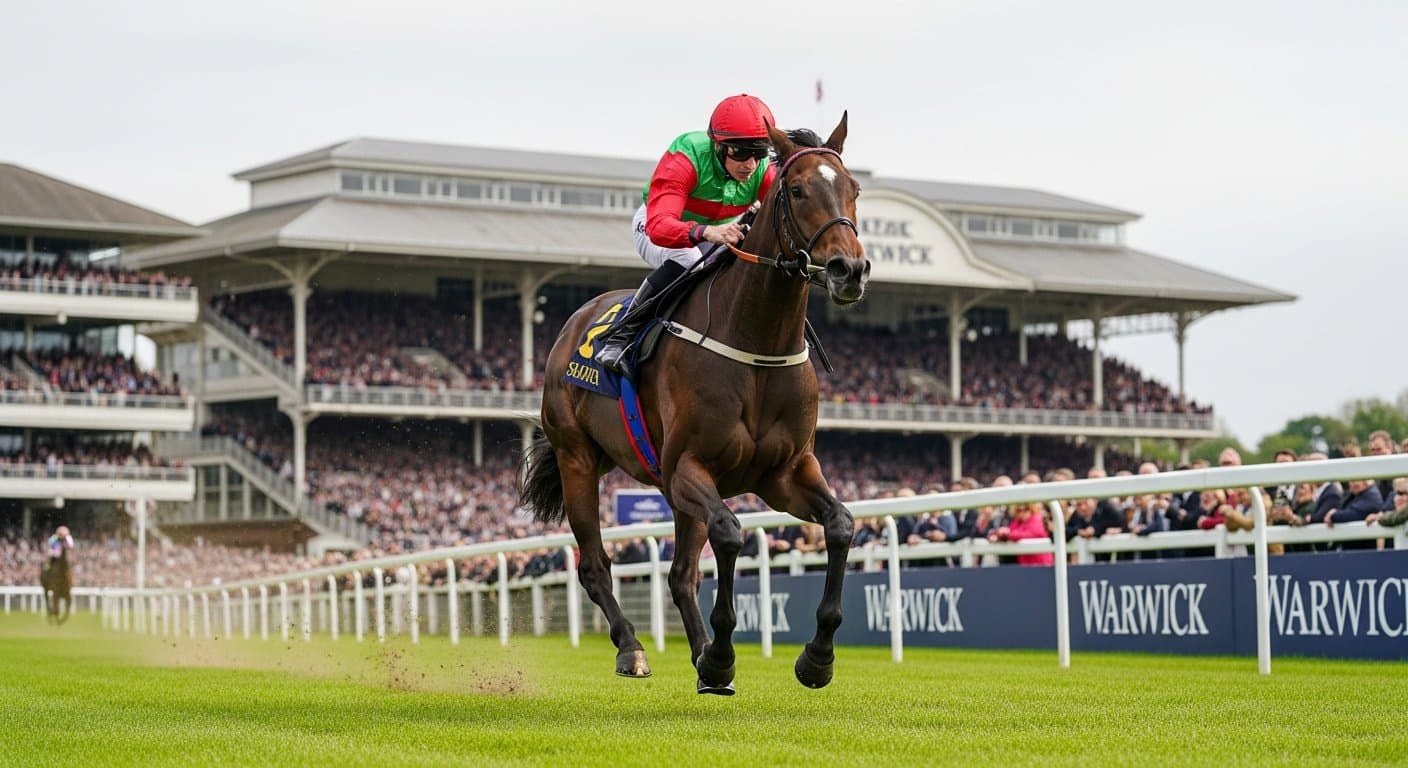
Edwardstone Horse: Warwick Win Before Arkle Glory
How Edwardstone's Kingmaker Chase victory at Warwick launched his path to Cheltenham Arkle triumph. The story behind the champion.
Read more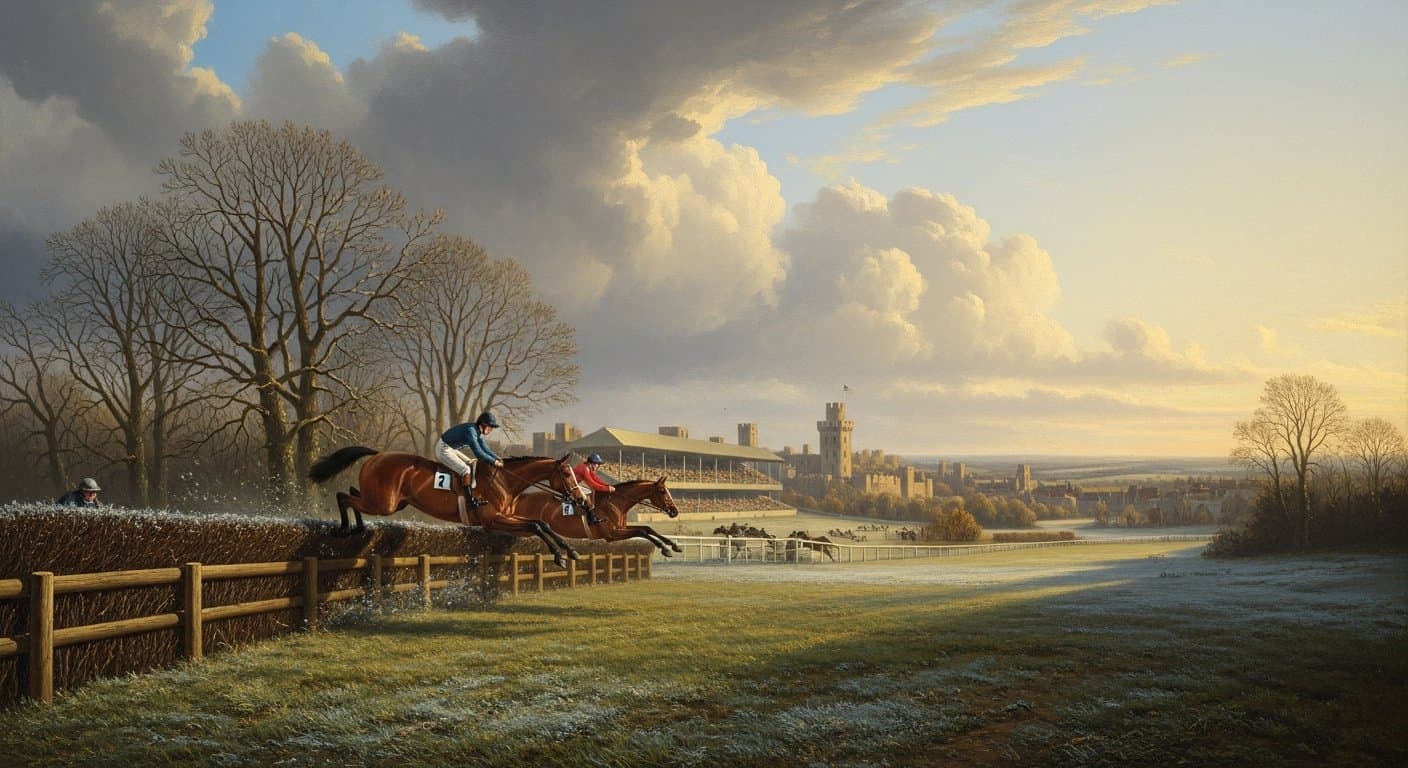
Kingmaker Chase Day at Warwick: The Complete Guide
The complete guide to Kingmaker Chase Day at Warwick — the Kingmaker Novices' Chase, the Classic Chase, and one of February's most important Cheltenham Festival pointers, set against the backdrop of Warwick Castle.
Read more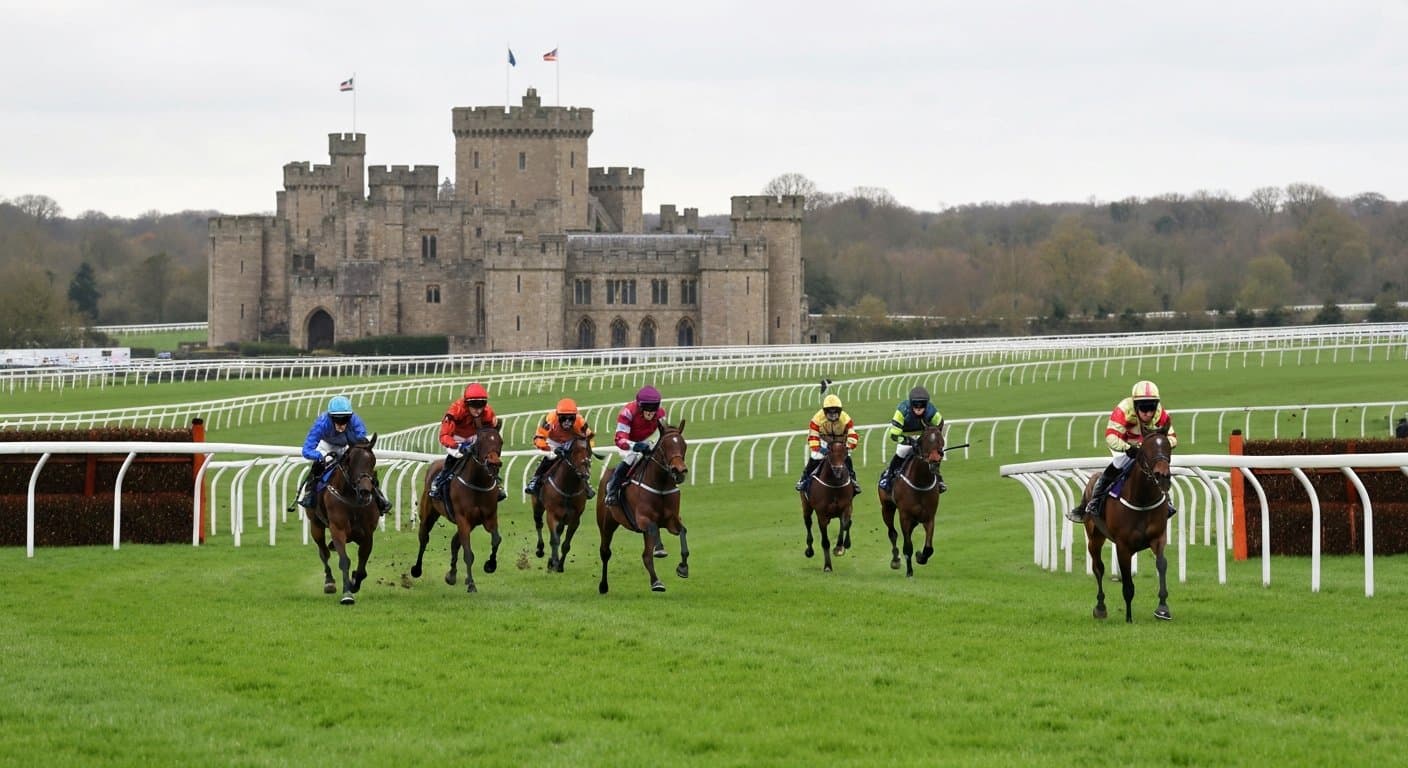
The Kingmaker Novices' Chase at Warwick: Complete Guide
Everything about the Kingmaker Novices' Chase — Warwick's prestigious Grade 2 two-mile chase.
Read moreGamble Responsibly
Gambling should be entertaining and not seen as a way to make money. Never bet more than you can afford to lose. If you or someone you know has a gambling problem, help and support is available.