
Founder & Editor · Last reviewed 2026-04-05
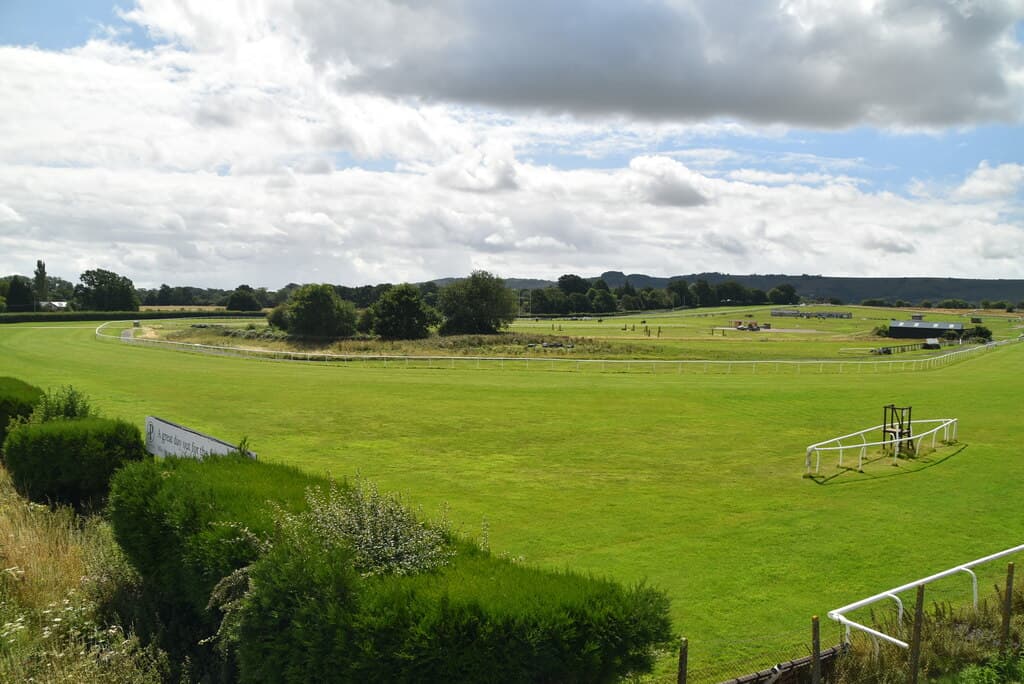
Plumpton Racecourse has been staging National Hunt racing since 1884, a run of more than 140 years that makes it one of the older dedicated jumps venues still operating anywhere in southern England. The course sits at the foot of the South Downs escarpment in East Sussex, approximately seven miles north-east of Brighton and six miles west of the county town of Lewes, at the grid reference that locals know as Plumpton Green. The postcode is BN7 3AL, and the physical setting is striking in a way that photographs rarely capture: the chalk ridge of the Downs rises steeply behind the back straight, the village church peeks above the treeline to the south-east, and on a clear January afternoon the light off the white escarpment face gives the whole place a quality you do not find at a stadium venue.
The course is left-handed, tight by any standard measure, and runs to approximately one mile in circumference. That compact circuit sits on undulating ground, where the topography of the lower chalk slopes ensures that horses are never running on a level plane. There is a descent on the far side and a gradual climb back to the home straight, where the final fence and the run-in test horses whose jumping has already been pressured by the earlier fences on the bend. The Plumpton complete course guide sets out the precise layout; what the physical shape means, in racing terms, is that stamina and jumping accuracy count for more here than outright pace. Plumpton is not a course where a flat-galloping speedster simply outruns the field. The terrain makes demands.
What has sustained the course across more than a century is its position in a transport network that has changed less than most people assume. Plumpton is modest, with a capacity of around 4,000, but Plumpton railway station sits immediately adjacent to the racecourse, on the Lewes to Haywards Heath line. Direct trains run from Brighton in approximately 20 minutes and from London Victoria in approximately 55 minutes via a change at Haywards Heath or direct services through the southern commuter network. That connection was the reason the course was built where it was in 1884, and it remains the fact that most distinguishes Plumpton from its peer group among smaller NH venues. Few National Hunt courses in England are as straightforwardly reachable by train from a major city.
The Sussex National is the course's signature race, a Class 2 handicap chase over 3m 4f 104y run in early January in the late winter, and the fixture around which the programme is structured. But the Sussex National is only part of the story. Plumpton runs roughly 20 meetings per year from October through to May or early June, placing it at the centre of the South East jumping calendar throughout winter. Brighton Racecourse, the flat course seven miles to the south-west on the Downs above the city, closes in October and does not return until spring. For racegoers in Brighton, Lewes, Haywards Heath, and the southern suburbs of London who want winter sport on horseback, Plumpton is the answer. It has been performing that function since the Victorian era, and the pattern has not changed.
This article follows Plumpton from its origins in 1884 through the decades that shaped its character: the early fixture list built around the railway, the interwar years when the course consolidated its programme, the second half of the twentieth century when local trainers began to define the form book, and the modern era in which the South Downs National Park designation of 2010 changed the planning and environmental context for everything in the landscape around it. At each stage, the course remained recognisably itself: a tight, honest, left-handed jumps track with an extraordinary natural setting and a commuter-friendly train connection that keeps drawing racegoers back.
Origins: 1884 and the Victorian Foundation
Origins: 1884 and the Victorian Foundation
Plumpton Racecourse opened in 1884, placing its birth in a specific and instructive moment in British racing history. The 1880s were a decade of expansion for the sport: the Jockey Club was codifying rules with greater consistency, the National Hunt Committee was asserting authority over jumps racing, and new courses were opening across the country at a rate that reflected both rising middle-class leisure spending and the practical transformation that railways had made to long-distance travel. A course that would have been commercially unviable in 1850 — too remote, no way to get a crowd there — could now be built at a rural junction and expect to draw several thousand racegoers on a fixture day. Plumpton is a product of exactly that logic.
The Lewes to Haywards Heath railway line, which passes immediately alongside the racecourse, was operational well before 1884. The Plumpton station, still the station used today, still a ten-minute walk from the finishing post, was opened on that line in 1863, giving the village a connection to Brighton to the south and Haywards Heath and onward to London to the north. When the course was established two decades later, the railway was already there. The track was not built in spite of the rural location; it was built because of the railway that made the rural location accessible.
The Landscape and Its Consequences
The physical setting is specific enough to deserve explanation, because it shaped everything about how the course was built and how it has raced ever since. The South Downs form a chalk ridge running roughly east-west across East and West Sussex, with a steep south-facing scarp slope dropping towards the coastal plain and a gentler north-facing dip slope falling towards the Low Weald. Plumpton sits at the spring-line, the geological boundary where the chalk meets the clay below, where water rises to the surface from the aquifer within the chalk and the soil transitions from free-draining to water-retentive. Settlements along this spring-line are ancient: communities clustered at the spring-line because the water was reliable, the ground was firmer than the Weald, and the Downs provided shelter and grazing. Plumpton Green is one of dozens of such villages strung along the foot of the Downs from Winchester to Eastbourne.
For a racecourse, the spring-line position created a practical challenge that has never entirely gone away. The chalk-based ground of the upper slopes drains quickly and produces firmer going after rain; the clay-influenced ground of the lower margins holds moisture longer. Plumpton's going in midwinter, when the jumping season is at its most active, typically ranges from soft to heavy on the lower sections of the track, while the upper slope can be closer to good to soft on the same afternoon. That variation has shaped the type of horse that succeeds here: stayers with the strength to handle soft ground, and jumpers with the technique to cope with ground that may change under foot between the first and sixth race on the card.
The left-handed circuit was determined by the shape of the available land at the foot of the escarpment. A right-handed course would have required a different orientation of the track relative to the slope; the left-handed design fitted the terrain. The approximate one-mile circumference was similarly a product of geography rather than planning preference: the flat ground at the base of the scarp, before the land either rises steeply towards the chalk ridge or drops away north towards the Weald, constrained the size of the circuit from the outset. The course built in 1884 was a tight one, and it has remained tight ever since.
The First Racegoers and Their City
The early fixtures at Plumpton drew on the population of the South East, and the dominant urban centre within reach was Brighton. The town had approximately 107,000 residents in the 1881 census, a city by most measures of the time, and it already had a flat racing course: Brighton Racecourse, established in 1783 on the Downs above the city. Brighton's racecourse was a well-known fixture of the summer season, but flat racing stops in October, and the Victorian racegoing public who enjoyed the sport were not confined to the summer months. Plumpton filled that gap. It opened in 1884 as a winter jumping venue, and Brighton's population was its natural audience.
Lewes, six miles south-east of the course, was the administrative centre of East Sussex and had its own social and commercial life built around the county town functions: the assizes, the county gaol, the market. Lewes also had a flat racecourse on the Downs to the east of the town, Lewes Racecourse, which operated from the 18th century until its closure in 1964. In the Victorian period, East Sussex therefore had two flat racing venues (Brighton and Lewes) and one jumping venue (Plumpton). That was an unusual density for a county of its population, and it reflected the strength of racing culture in the area.
The Early Programme
The race programme in Plumpton's first decades followed the standard template of late-Victorian jump racing. The fixtures consisted of two-mile hurdle races, three-mile steeplechases, hunter chases for amateur riders on horses that had spent most of the year hunting with the local packs, and the occasional National Hunt Flat Race that was then known simply as a flat race under NH rules. Prize money was modest. Sandown Park, which had opened in 1875 with an ambitious commercial model that transformed expectations about racecourse standards, operated at a level that Plumpton could not match and was not attempting to match. Plumpton's market was the racegoer who wanted a winter afternoon's jumping close enough to home to make the trip without great expense, and the prize money was calibrated to that market.
The Plumpton Race Club, a members' organisation drawn from local landowners, farmers, and racing supporters, managed the course and its fixture list through these early decades. This was a common model for smaller Victorian racecourses: a self-governing club of local interests that held the licence, employed a clerk of the course, managed the gate receipts, and set the race programme. The model gave the course its strongly regional identity. Plumpton was not a branch of a national racing enterprise; it was a local institution, owned and managed by people who lived in East Sussex and for whom the course was a community asset as much as a commercial operation.
The Template That Held
By the mid-1890s, Plumpton had established the template that it has followed, with modifications, for every decade since. A compact left-handed circuit at the foot of the South Downs escarpment. A railway connection that made the course accessible from Brighton in 20 minutes and from London Victoria in under an hour. A winter programme of hurdles and chases aimed at a regional audience that had no other jumping option within easy reach. A modest prize fund calibrated to the course's size and catchment, with no pretension to compete with Sandown or Kempton for the leading NH horses of the season. And, most importantly, a setting distinctive enough to give racegoers a reason to choose Plumpton over an afternoon in town.
That setting, in the winter light beneath the chalk escarpment, is the aspect of the course that photographs from the 1890s and the 2020s have most in common. The grandstand has changed, the fencing has been upgraded, the facilities have improved through successive generations of investment. But the backdrop, the white chalk face rising steeply above the back straight, the village in the valley below the ridge, has not changed in any material way. The course built in 1884 was building on a landscape that was already ancient, and the landscape has outlasted everything placed on top of it.
Why this period mattered: The Victorian origins determined three things that have defined Plumpton ever since: the tight left-handed layout imposed by the spring-line topography, the railway connection that made a rural valley commercially viable, and the winter identity as the South East's jumping alternative to the summer flat scene. The course has been working from that foundation for over 140 years.
The Golden Era: 1920–1970
The Golden Era: 1920–1970
The interwar and early post-war decades represent Plumpton's period of maximum consolidation. The course had survived its Victorian infancy, established a loyal regional audience, and by the 1920s was operating a fixture list that spanned the entire National Hunt season from October to April. Brighton's population had grown to approximately 147,000 by the 1921 census, and the commuter belt south of London, the towns of Redhill, Reigate, Haywards Heath, and Horsham that the Southern Railway served, was expanding rapidly as suburban development followed the railway lines outward from the capital. All of that growth meant more racegoers within reach of Plumpton station, and the course's attendance figures reflected it.
The Monday Identity
The most distinctive institutional development of the interwar years was Plumpton's establishment of Monday as its primary fixture day. The southern NH circuit in the 1920s and 1930s ran meetings across the week, and smaller courses competed for dates within the BHA's predecessor licensing system. Plumpton secured a run of Monday dates that gave it a particular identity: the Monday jumps track. This was more than administrative detail. Monday fixtures attracted a different crowd from Saturday meetings: fewer casual family racegoers, more regular punters, trainers who could assess horses in midweek without disrupting weekend preparations, and the working press who covered the sport with less competition for column inches on a Monday than on a Saturday.
The Monday identity suited Plumpton's size and character. The compact course, the intimate enclosures, and the tight programme of six or seven races fitted the atmosphere of a working-week fixture rather than a social occasion. Racegoers who came to Plumpton on a Monday tended to know what they were looking for: they were there for the racing, not the social spectacle. The Monday racing guide covers what that means in the modern era; in the interwar period it was a choice that defined the course's culture for generations.
The Programme Takes Shape
Through the 1930s, the Plumpton programme developed a structure that later decades would recognise. Novice hurdles and novice chases provided the early-season content from October onwards, when trainers were bringing horses back from their summer break and looking for educational outings over obstacles. Handicap chases filled the middle of the season. The feature race, the race that gave the meeting its headline, was the Sussex National, which by the 1930s had established itself as the course's signature event, run over approximately three miles on ground that in February or March was typically soft to heavy.
The Sussex National drew horses from trainers across the South and South East. Yards in Surrey, Hampshire, Kent, and Sussex targeted the race as a legitimate aim for their better chasers, and the prize fund, while modest, was sufficient to justify a specific preparation. Winning trainers in this era included figures from the southern NH training community whose names are less familiar today than those of the Lambourn and Newmarket establishments, but who were significant figures in the regional sport.
The Second World War interrupted racing across Britain, and Plumpton ran a reduced programme through the conflict years. Like most British tracks, it returned to its full fixture schedule after 1945, and the post-war period saw attendance recover as rationing eased and the public sought entertainment. The late 1940s and 1950s were a difficult period for British racing generally: prize money was low relative to the cost of training, and many smaller courses struggled to attract fields. Plumpton weathered this period partly because its operating costs were lower than those of grander venues and partly because the local trainer base remained loyal.
The Trainers Who Came
The geography of the South East has always shaped who trains where. The Downs provide grazing, the clay of the Weald holds moisture for all-weather work, and the proximity of small towns gives trainers access to staff and suppliers. Through the 1950s and 1960s, a cluster of NH yards operated within 30 miles of Plumpton, targeting the course as their local track in the same way that Lambourn yards targeted Newbury or Wantage.
Some of these yards were based in West Sussex, in the Horsham and Pulborough areas that sit approximately 20 miles west of the course. Others operated from Surrey, particularly around Epsom and the area south of the North Downs. The pattern of regional trainer support that characterises Plumpton's modern fixture lists has deep roots in these post-war decades, when southern NH training was a significant industry in its own right and the course was the natural local target for its output.
The relationship between trainer and course was reciprocal. Trainers who targeted Plumpton regularly built up detailed knowledge of the track's demands: the way the undulation affected horses at the far end of the circuit, the importance of the downhill fence before the home straight, the tendency for front-runners to be caught out by the stiff finish. That knowledge translated into preparation. Trainers who knew the course would work their horses over similar gradients in training, school them at obstacles set into sloping ground, and send them to Plumpton with a specific physical fitness that horses from less experienced yards might lack.
Lewes Racecourse and Its Closure
A significant date in the history of the East Sussex racing scene is 1964, when Lewes Racecourse held its final meeting. The course had operated on the Downs above Lewes since the 18th century, running flat racing through the summer months. Its closure, part of a wider rationalisation of British racecourses in the 1960s under pressure from the Jockey Club and the wider racing authorities, left Plumpton as the sole surviving racecourse in East Sussex. That shift concentrated the area's racing heritage on a single venue and reinforced Plumpton's status as the county's representative course.
The Lewes closure also meant that East Sussex racing had a more defined seasonal identity from 1964 onwards: flat racing lovers in the county now had to travel to Brighton, Goodwood, or Epsom for their summer sport. Plumpton, as the year-round local institution, benefited from a degree of consolidation of local loyalty. Racegoers who had previously divided their allegiance between Lewes in summer and Plumpton in winter now found Plumpton the only game in the county.
Course Development
The grandstand at Plumpton was improved in stages through the post-war decades. The improvements were practical rather than architectural: better roofing over the viewing areas, enclosed spaces for the winter months, better catering provision as racegoer expectations rose. The course did not pursue the redevelopment strategies that were transforming larger venues in the same period; there was no attempt to build a new parade ring or replace the basic infrastructure wholesale. The improvements were incremental, and the course retained the compact, working atmosphere that was both its limitation and its selling point.
Track drainage was a consistent management challenge. The spring-line position that created Plumpton's characteristic going also meant that sustained winter rainfall could leave parts of the track in heavy or worse condition for extended periods. The post-war generations of course management worked with the natural drainage patterns of the chalk and clay boundary rather than engineering wholesale changes to the track's water management, and the going at Plumpton remained dependent on weather in a way that the course's management and the trainers who used it simply accepted as a fact.
Why this period mattered: The interwar and post-war decades turned a Victorian-era local racecourse into an established institution with a clear identity: Monday racing, a regional trainer base, a signature race in the Sussex National, and a loyal audience drawn from Brighton, London's southern suburbs, and the Sussex countryside. The closure of Lewes Racecourse in 1964 completed that consolidation by making Plumpton the county's sole surviving course.
Famous Moments and the Characters Who Made Them
Famous Moments and the Characters Who Made Them
Plumpton does not stage Grade 1 racing. The course's prize money is not at a level that attracts the leading NH horses of any generation at the peak of their careers. What it has provided, consistently across more than a century, is the early career education of horses who went on to bigger things, the late-career victories of specialists who found the course's demands perfectly suited to what they had left to offer, and a small number of moments that have lodged in the memory of the racegoers who witnessed them. The combination makes for a different kind of racing history than the one written at Cheltenham or Sandown: smaller in scale, local in character, but no less important to the people who were there.
Super Fox and the Queen Mother
One moment in Plumpton's history crosses the boundary from regional significance to national recognition. On a February day in 1963, the Queen Mother came to Plumpton to watch Super Fox run in a steeplechase. Super Fox, trained by Peter Cazalet at Fairlawne in Kent, won the race. It was the Queen Mother's first winner as an owner at Plumpton, and the combination of Cazalet's southern training operation with the Queen Mother's ownership of NH horses was one of the defining features of jump racing in the 1950s and 1960s.
Peter Cazalet trained at Fairlawne, his family estate near Tonbridge in Kent, approximately 25 miles north-east of Plumpton. The proximity made Plumpton a natural target for his horses, and over the course of his training career Cazalet sent many runners to the course. The Queen Mother's patronage of his yard meant that Plumpton occasionally hosted a royal occasion in a way that few courses of its size could claim. The full story of the Queen Mother's association with the course is told in the royal racing article, but the February 1963 winner sits at the centre of it: a day when one of the smallest racecourses in the South East became, briefly, the focal point of British racing.
Gary Moore and the Multi-Winner Afternoons
No account of famous moments at Plumpton can avoid Gary Moore, whose record at the course from the late 1990s onwards constitutes one of the most sustained performances of targeted training in modern NH racing. Moore operates from his yard at Cisswood House Stables in Lower Beeding, near Horsham in West Sussex, approximately 12 miles west of the course. That proximity, combined with a detailed knowledge of the course's specific demands, has produced a body of work at Plumpton that stands apart from any other trainer in the modern era.
Moore has sent out three or four winners on a single Plumpton afternoon on multiple occasions. On a card of six races, winning three or four requires a combination that goes beyond preparation: the right horses, fit on the right day, in the right races, ridden by jockeys who understand the course. When Moore achieves it, the effect on the betting market is immediate and instructive. By the time the third winner crosses the line, the market on the remaining races adjusts. A stable companion at 3/1 in the opener might have a yard mate at 5/4 by the time the fifth race closes, with the compression driven partly by the visible form of the yard on the afternoon. Understanding how Plumpton markets move around Moore's strike rate is a practical component of betting at the course. His son Josh Moore, based at a yard in Pulborough in West Sussex, approximately 30 miles west of the course, has also established a record at Plumpton that reflects the family's accumulated knowledge of the track.
The Sussex National
The Sussex National itself has produced notable renewals across its history, though the records of specific years are imperfectly documented for the pre-digital era. What is clear from the surviving form books is that the race has consistently attracted competitive fields of southern-trained handicap chasers in the February or March window, and that the winner has on several occasions used the race as a platform for subsequent success at a higher level in the weeks immediately following.
The three-mile distance over the Plumpton fences, with the descent on the far side, the turn into the home straight, and the final climb to the line, is demanding enough that a horse who wins the Gold Cup impressively has usually shown something more than the bare result suggests. Trainers who have used the race as a stepping stone towards the Cheltenham Festival have generally found that the horse's performance at Plumpton gave a reliable indication of its readiness. The Gold Cup guide covers the race's history in more detail; for the history article, the significance is that the Gold Cup gave Plumpton a headline race capable of generating stories that outlasted the afternoon.
The Downhill Fence
Any honest account of Plumpton's famous moments must include the downhill fence, the obstacle positioned on the descent from the far side of the circuit before the track swings into the home straight. This fence has a higher incident rate in novice chases than the equivalent fence on a flat NH circuit, and the incidents it produces are often among the most discussed of any Plumpton card.
The geometry of the approach is the issue. Horses descend to the fence on a gradient, which compresses the approach and can cause a horse to arrive at the obstacle slightly faster and on a slightly different angle than the horse's own instincts anticipate. Jockeys who ride at Plumpton regularly tend to steady their mounts two or three strides earlier than the fence appears to require, allowing the horse to shorten and find a comfortable take-off. Jockeys from yards that rarely visit the course, brought in as last-minute bookings or as replacements for an injured regular, are disproportionately represented in the unseated-rider statistics at this fence.
The result is that the downhill fence has generated some of Plumpton's most dramatic moments: race favourites unseating their riders when well positioned, front-runners crashing out with the race apparently at their mercy, and winners produced from the pack by jockeys who had ridden the fence correctly when others had not. These are not the kind of moments that appear in racing record books, but they are the ones that racegoers standing at the fence remember for years.
The Sussex National
The Sussex National, run at Plumpton each January, is the course's feature race. It is a Class 2 handicap steeplechase over 3m 4f 104y with 22 fences, and it draws a field that reflects the January condition of the NH season: horses that have had an autumn run or two and are ready to step up in trip, trainers targeting a specific early-year objective, and the occasional lightly raced improver whose handler has identified Plumpton's demands as a good fit for what the horse offers.
The Sussex National Day guide covers the race's current form; historically, the Sussex National has provided some of the course's most competitive fields outside the Sussex National meeting. The January timing, the distance, and the handicap format combine to produce a race that is difficult to call confidently in advance, which has given it a particular reputation among southern NH punters as a race where the market is regularly wrong and the result requires close reading of the course-specific form.
The Developmental Pattern
One of the less-celebrated but historically consistent aspects of Plumpton's notable history is what might be called the developmental pattern: the horses who won a novice hurdle or novice chase at Plumpton in their first or second start over obstacles and then progressed to win at significantly higher levels. The course's demands, jumping ability combined with stamina and the ability to handle undulation, mean that a horse who wins easily at Plumpton in a novice context is usually displaying real quality rather than simply outrunning a below-par field.
Several horses who went on to win at the Cheltenham Festival had early career starts at Plumpton. The specifics vary by generation and are imperfectly captured in pre-digital records, but the pattern is consistent enough that form analysts in the South East have traditionally given Plumpton novice form more credit than a casual reading of the prize money and class would suggest. The course educates horses in a way that flat, easier circuits do not, and that education shows in subsequent performances at more demanding venues.
The common thread: Plumpton's famous moments are not the moments of high-grade racing that dominate the sport's national narrative. They are moments of local significance, practical knowledge, and the kind of history that accumulates across generations at a course where the same landscape, the same fences, and the same demands greet each new generation of horses and jockeys.
The Modern Era: 1980 to the Present
The Modern Era: 1980 to the Present
The period from 1980 onwards brought changes to Plumpton that were partly internal, including improvements to facilities, evolution of the race programme, and the emergence of the Gary Moore era, and partly external: shifts in the structure of British racing, the expansion of Sunday racing from 1992, the growth of online betting that changed who watched racing and how, and, in 2010, the designation of the South Downs as a National Park. Each of these changed something about how the course operated and was perceived.
The Arena Racing Company and Modern Ownership
Plumpton became part of the Arena Racing Company group, which provided the course with access to shared marketing, media rights negotiations, and capital for infrastructure investment that an independently managed course of its size would have struggled to fund. The ARC model brought Plumpton into alignment with the modern British racecourse operating framework: centralised booking systems, shared broadcast arrangements with Sky Sports Racing and Racing TV, the standard digital presence that racegoers now expect. The specific details of how that transition changed the course's day-to-day operation are less important than the outcome: Plumpton entered the 21st century as a professionally managed venue rather than a community-run institution in the Victorian mould.
The transition did not change the fundamental character of the fixture list. Plumpton still runs approximately 20 meetings per year, still concentrates its most significant races in the winter months, and still schedules a high proportion of its fixtures on Monday. The Monday identity survived the change of management structure because it reflected something real about the course's position in the racing calendar rather than being an administrative legacy that a new owner would discard.
The South Downs National Park
On 1 April 2010, the South Downs National Park was formally designated, covering an area of 1,627 square kilometres across Hampshire, West Sussex, and East Sussex. Plumpton Racecourse sits within the National Park boundary. The designation changed the planning context for any physical development at the course: all significant changes to the built environment require planning permission assessed against National Park criteria, which place a higher weight on landscape and visual impact than the standard local authority planning framework.
In practical terms, this has meant that the course's redevelopment ambitions are constrained by the landscape setting in a way they were not before 2010. Large new grandstands, car parks of the scale that a 10,000-capacity venue might require, or extensive floodlighting installations are difficult to gain planning permission for in a National Park. The course's relatively modest physical footprint, which has been both a limitation and a character asset throughout its history, is now partially protected by statute.
The designation also changed the language used to market the course. Plumpton sits within one of England's 15 National Parks, and that status has a real appeal to a segment of the racegoing public who value the natural setting as part of the day out. The A23 and M23 corridor, the London to Brighton road that runs approximately five miles west of the course, delivers millions of passengers along the Brighton route each year. Many of them pass within sight of the South Downs. The National Park designation gave the course a specific identity to attach to a landscape that racegoers were already familiar with from the Brighton train journey.
The Gary Moore Era in Detail
The modern history of Plumpton cannot be told without extended attention to Gary Moore, whose impact on the course's form book from the late 1990s onwards has no parallel. Moore trains from Cisswood House Stables at Lower Beeding, near Horsham, approximately 12 miles west-north-west of the course. The proximity is significant: horses from Moore's yard travel to Plumpton in approximately 25 minutes, arrive fresh, walk the track before racing, and return home the same evening without the fatigue of a long transit. Horses trained by handlers based in Lambourn, the Cotswolds, or Yorkshire arrive at Plumpton after a journey of 90 minutes or more, which is a different proposition.
Moore's strike rate at Plumpton across the period from approximately 2000 to the present is substantially above his national average. The reason is not simply proximity; it is that Moore has accumulated a detailed knowledge of the course's demands over decades and uses that knowledge to select which horses in his yard are suited to Plumpton's specific test. A horse that handles undulation well, jumps accurately at pace, and has the stamina to grind out the finish on soft winter ground is a Plumpton horse. Moore identifies these horses earlier in their careers than handlers with less familiarity with the track, and targets the course accordingly.
Moore's son Josh, trained at a yard in Pulborough, West Sussex, approximately 30 miles west of Plumpton, has continued the family tradition of targeting the course. The two yards effectively constitute the dominant southern NH operation for the Plumpton fixture list, and any serious engagement with the form book at the course needs to start with the Moore family's entries and track record.
Beyond the Moores, the modern era has seen Plumpton's fields increasingly reflect the diversity of southern NH training. Yards in Surrey, Hampshire, and Kent regularly supply runners, and the occasional raider from Lambourn or the Midlands gives some races a competitive quality above the standard regional level. The course's average field size across its 20 annual fixtures is competitive by the standards of smaller NH tracks.
Technology and the Betting Market
The growth of online betting through the 2000s and 2010s changed how Plumpton's races were traded. Betfair launched in 2000, and the exchange model, where racegoers could lay as well as back horses, created a more efficient and transparent market at all levels of the sport. At Plumpton, the effect was most visible in the way that market information about the Moore yard's form on any given afternoon was priced in rapidly. By the 2010s, a well-prepared Moore horse at Plumpton that had been 4/1 in morning trading might be 9/4 by the time the course opened, as professional punters following the yard's recent record loaded the price with their assessment.
The broadcast of all Plumpton fixtures on Racing TV and the streaming availability of races from the 2010s onwards extended the course's audience beyond the 4,000 who might physically attend. Racegoers watching from London, who might never make the trip to Plumpton on a January Monday, could now follow the racing and engage with the market in real time. That extension of the audience changed the economic model for the course in ways that supported continued investment.
The Fixture List Today
Plumpton's 20-fixture allocation sits it in the mid-tier of NH venues by volume, above the smallest tracks and well below the major venues that run 30 or more days per year. The programme runs from October to May or early June, with the most important fixtures concentrated in the January to March window. The Sussex National in January and the Sussex National meeting, typically February or early March, are the headline fixtures. Around them, the course runs a mixture of novice hurdles and chases for horses building their experience over obstacles, handicap hurdles and chases for the more exposed horses, and the occasional bumper that provides the first educational outing for unraced NH prospects.
The late-season meetings in May attract horses that have been held back from the heavy ground of midwinter and are ready to run on better going. These fixtures have their own form patterns: horses appearing for the first or second time in improved conditions, trainers whose yards have been below form in the winter and are beginning to click in the spring. The complete course guide covers the current programme in full.
Why this period mattered: The modern era consolidated Plumpton's position as a professionally managed, financially viable small NH course within the National Park landscape. The Gary Moore era gave the course a contemporary story, a dominant local trainer whose knowledge of the track's demands is priced into the market, that the Victorian foundation could not have provided. Together, the management changes and the Moore era turned a historically significant course into one that is also practically relevant to anyone following southern NH racing today.
Legacy and What Plumpton Means Today
Legacy and What Plumpton Means Today
The Oldest NH Course in the South East
Plumpton opened in 1884. Brighton Racecourse, the flat course on the Downs above the city, has older origins, tracing its history to 1783. But among dedicated National Hunt venues, Plumpton is the oldest still operating in the South East region, and among dedicated jumps courses in southern England it sits in a very small group of places that have been staging winter racing continuously for more than a century. Fontwell Park, which opened in 1924 and operates 40 miles west of Plumpton in West Sussex, is the only other dedicated NH course in the region. Between them, Plumpton and Fontwell serve the entire jumps-racing appetite of East Sussex, West Sussex, Surrey, and Kent, a combined population of several million people within the South East commuter zone.
The Accessible Course
The railway line remains the defining asset of Plumpton's legacy. When the Lewes to Haywards Heath line opened Plumpton station in 1863, it created the condition that made the racecourse viable 21 years later. In 2026, that same station, ten minutes' walk from the finishing post, delivers racegoers from Brighton in 20 minutes and from London Victoria in approximately 55 minutes. No other National Hunt course in England of comparable size has this level of public transport accessibility from the capital, and very few of any size can match it. Newbury has a station adjacent to the course, as does Windsor and Kempton, but these are courses of substantially larger scale and higher grade. Among the small NH venues, Plumpton's commuter-line connection is without equivalent.
That accessibility has shaped the course's audience in ways that distinguish Plumpton from most of its peer group. The typical Plumpton Monday racegoer is not someone who drives 90 minutes to a rural track and parks in a field. Many of them walked from the station. A portion travelled from Brighton or Lewes, both within half an hour by train. A considerable number made the trip from London Victoria. The combination produces a crowd that is more urban, more mixed in its racing knowledge, and more likely to be attending for the environmental experience as well as the racing, than the hardcore NH follower who will drive to any course within two hours. This matters for understanding the course's character: it is accessible enough to bring in the occasional visitor who has never been to a racecourse before, and that accessibility is part of its legacy.
The South Downs Setting
The designation of the South Downs National Park in 2010 formalised something that racegoers and trainers had always known: the landscape around Plumpton is one of the finest in southern England. The chalk escarpment that forms the backdrop to the course is the same chalk ridge that extends from Winchester in Hampshire to Eastbourne in East Sussex, the same ridge that features in so many accounts of the English downland landscape. Plumpton sits at the foot of the scarp, with the ridge rising steeply behind the back straight and the Weald falling away to the north.
The local geography gives the course its winter atmosphere. Lewes is six miles to the south-east, the medieval county town with its Norman castle and its famous November bonfire celebrations. The Lewes Bonfire Night on 5 November is the largest fireworks event in England and is known nationally. The A273 connects Plumpton to Brighton in seven miles to the south-west, and the A23/M23 corridor, the London to Brighton road, runs approximately five miles west. The practical world of commuting and commerce is close, but from the racecourse it is not visible. The view from the grandstand is the Downs, the village church, and the sky.
What the Form Book Remembers
Plumpton's legacy in the form book is that of a developmental venue. The course has not produced Grade 1 champions in the final stages of their careers. What it has produced, consistently, is the first serious evidence that a horse has the jumping ability and stamina to progress through the NH grades. A horse that wins a novice chase at Plumpton, clearing the undulating fences cleanly and staying on well up the final straight, has passed a test that is more demanding than the bare class would suggest. Trainers in the South East have known this for generations, and form analysts who understand Plumpton's demands have consistently given more credit to good Plumpton form than a simple reading of the prize money would justify.
That developmental role gives Plumpton a quiet but lasting contribution to the sport. The horses who passed through the course on their way to bigger things carry Plumpton form figures in their records, a small marker that, if you know what to look for, tells you something about the quality of the early work. The Sussex National guide and the complete course guide set out the current form context; the history is the foundation on which that context rests.
Frequently Asked Questions
When did Plumpton Racecourse open?
Plumpton Racecourse opened in 1884, making it one of the oldest dedicated National Hunt venues in southern England. The course was established on farmland at the foot of the South Downs escarpment in East Sussex, approximately seven miles north-east of Brighton. The railway connection, Plumpton station on the Lewes to Haywards Heath line, was already in place by the time the course opened, having been established in 1863, and was the primary reason the rural location was commercially viable from the outset.
Has Plumpton always been a National Hunt course?
Yes. Plumpton has staged National Hunt racing exclusively since it opened in 1884. The course never ran flat racing and did not pursue the mixed programme that some other southern tracks offered in the late Victorian period. That single-code identity, jumps racing only, throughout the winter season, has remained consistent for over 140 years. It makes Plumpton one of relatively few courses in England that can point to an unbroken NH-only history from its foundation.
What is the Sussex National and when did it start?
The Sussex National is a handicap steeplechase run over 3m 4f 104y, and it is the course's signature race. The race was first run in 2001 and has been the centrepiece of the Plumpton programme since. It is run in early January, when the going is likely to be soft to heavy. The full history and race details are covered in the Sussex National guide.
How does the South Downs National Park designation affect the course?
The South Downs National Park, designated on 1 April 2010, covers the landscape in which Plumpton Racecourse sits. The designation means that any significant physical development at the course requires planning permission assessed under National Park criteria, which place greater weight on landscape impact than standard local authority frameworks. In practical terms, it constrains the scale of infrastructure changes the course can pursue, but it also protects the landscape setting that gives Plumpton its distinctive character.
Why is Plumpton so popular with London racegoers?
The railway connection is the primary reason. Plumpton station, ten minutes' walk from the racecourse, is served by direct trains from London Victoria with a journey time of approximately 55 minutes. Brighton direct trains take around 20 minutes. No other National Hunt course of comparable size in England has an equivalent connection to the capital. For Londoners who want a day's jump racing in a proper countryside setting without an early start or a long drive, Plumpton is by far the most accessible option.
Who is the most successful modern trainer at Plumpton?
Gary Moore, who trains from Cisswood House Stables in Lower Beeding near Horsham, West Sussex, approximately 12 miles from the course, has been the dominant trainer at Plumpton for more than two decades. His proximity and accumulated knowledge of the course's demands have produced a strike rate at Plumpton substantially above his national average, including multiple occasions when he has sent out three or four winners on a single afternoon. His son Josh Moore, based in Pulborough, approximately 30 miles west of the course, has also established a strong record at the track.
Share this article
More about this racecourse
All Plumpton guides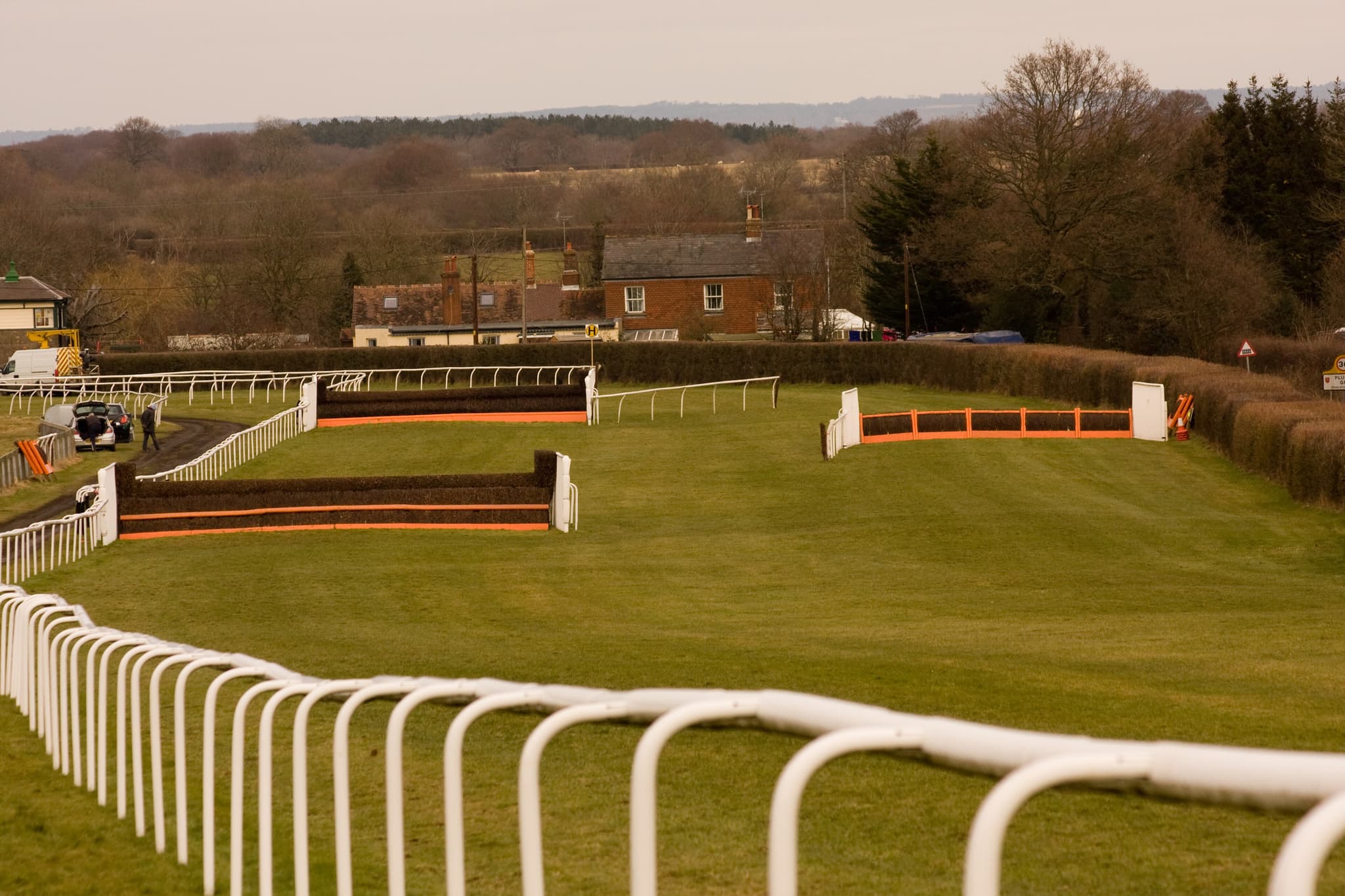
Monday Racing at Plumpton: Complete Guide
Your complete guide to Monday racing at Plumpton — the Sussex National, key meetings, and midweek jumping in East Sussex.
Read more
The Queen Mother at Plumpton: A Royal Racing Story
The Queen Mother celebrated her first winner at Plumpton with Super Fox in 1963. Here is the story of royal racing at East Sussex's National Hunt course.
Read more
Sussex National Day at Plumpton: The Complete Guide
Everything you need to know about Sussex National Day at Plumpton — the biggest fixture at East Sussex's tight, testing National Hunt course.
Read morePhotos on this page are used under Creative Commons licences. Titles, sources and licence links for each one are on our image credits page.
Gamble Responsibly
Gambling should be entertaining and not seen as a way to make money. Never bet more than you can afford to lose. If you or someone you know has a gambling problem, help and support is available.