
Founder & Editor · Last reviewed 2026-04-07
Sedgefield Racecourse is County Durham's National Hunt heartland, a tight, sharp left-handed circuit set in the rolling farmland between Darlington and Stockton. This is grassroots northern jump racing in its purest form: knowledgeable local crowds, specialist northern trainers, and a track that demands quick, accurate jumping rather than the galloping ability prized at the bigger courses. The Durham National, a Class 3 handicap chase run every October, is the biggest race the course stages and the only one it lists under its own racing highlights. There is no Sedgefield Cup, and the flagship Listed chase this page used to describe was never run.
What makes Sedgefield special — and genuinely distinct from the bigger northern courses at Catterick or Newcastle — is the intimacy of the experience and the specialised demands the track places on horses. It is a short circuit, barely a mile round at its tightest, and horses must be genuinely comfortable turning at speed. Animals bred for the wide-open galloping tracks at Cheltenham or Newbury frequently find the tight bends claustrophobic; those that relish a sharp, turning track and can jump quickly and accurately at close range are the ones who win here repeatedly.
The festival programme centres on the late autumn and winter months, when the northern jump season reaches full pace. Durham National day in October brings the biggest crowd and the most competitive fields, with the novice hurdle trials and handicap chase series providing the backbone of the season from October through to March. Brian Ellison and Michael Easterby are the trainers most consistently associated with the course, and their runners at Sedgefield warrant serious attention regardless of the price.
Sedgefield is not a destination course in the Cheltenham mould — it is something arguably more valuable: a genuine local sporting institution where the community and the racing are inseparable. Come for a proper northern jump race day, and you will not be disappointed.
Bet on Sedgefield
Place your bets on Sedgefield races with a trusted bookmaker.

Promo code BETFRED50. New customers only. Register, deposit with a Debit Card, and place a first bet of £10+ at Evens (2.0)+ on Sports, to be settled within 7 days, to get £30 in Sports Free Bets and £20 in Bet Builder Free Bets within 24 hours of settlement. 7-day expiry. Eligibility & payment exclusions apply. Full T&Cs apply. Take Time to Think. BeGambleAware.org. 18+. Full T&Cs.

Promo code R30. New UK customers only, 18+. Register, deposit £10 or more, then place a £10 single cash bet at odds of 1/2 (1.5) or greater on any sports market (excluding Virtuals). Once the qualifying bet settles you get £30 in Free Bets (3 x £10) — the qualifying bet can win or lose. Free Bets are valid on any sports market excluding Virtuals, expire in 7 days, are non-withdrawable and must be used in full. Excluded deposit methods apply (including PayPal, Apple Pay, Skrill and NETELLER). Named bets such as Lucky 15 do not qualify. If you cash out the qualifying bet, or it is voided, you are no longer eligible for the offer. Ends 31.12.26. Full T&Cs apply. Please gamble responsibly. BeGambleAware.org. 18+. Full T&Cs.

Promo code BET40GET20. New UK customers, 18+. Register with the code and place a first bet of £40 or more at Evens (2.0) or greater. Receive 2 × £10 free bets: the first credited automatically once the qualifying bet settles, the second 24 hours later. Free bets must be placed at minimum odds of 4/1 (5.0), expire 24 hours after credit, and the free-bet stake is not returned with winnings. Debit card deposits only. Take Time to Think. BeGambleAware.org. 18+. T&Cs apply. Full T&Cs.

50% of your first-day net losses refunded as a free bet, capped at £25. New UK customers aged 18+ only. To qualify, deposit and place a first bet of £10 or more on any sport at minimum odds of evens (2.00), then place at least two further bets on different events, each worth at least 50% of your largest bet, all at evens (2.00) or greater. Losses are counted from your first settled bet until 23:59 the same day. Place a qualifying £10+ bet and you are guaranteed at least a £5 free bet. Bets placed at SP, void bets, cashed-out bets and bets struck with free bets do not count towards the offer. The free bet is credited the day after your qualifying bets settle and must be used within 7 days, after which it expires. It can be used at odds from 1/4 (1.25) up to 250/1 on singles and straight accumulators, but not on Trixie, Patent or Yankee style multiples. Free-bet stake is not returned with winnings. One offer per person, household, address, IP address and device. E-wallet deposits may not qualify, so check the cashier before depositing. Customers registered with GAMSTOP cannot claim. KYC identity verification must be completed before the free bet is credited. Take Time to Think. BeGambleAware.org. 18+. T&Cs apply. Full T&Cs.

New customers, 18+. Choose the sports bonus at sign-up, make a first deposit and receive a 100% bonus up to £50 in your Sports Bonus balance. To convert the bonus to cash, wager it 10x within 30 days. Single bets below Evens (2.00) do not qualify; accumulators do not qualify if any selection is below 1/2 (1.50). Virtual Sports, voided, cancelled, drawn, cashed-out and free-bet wagers do not count towards wagering. Only the first settled bet per event counts. Withdrawing before the wagering requirement is met forfeits the bonus balance including bonus winnings. Real-money funds are used before bonus funds. Deposits via Skrill or Neteller are not eligible. Not valid in conjunction with other promotions. Odds, bet and payment limits apply. 10bet general and promotion T&Cs apply. BeGambleAware.org. 18+. Full T&Cs.

New customers in Great Britain and Republic of Ireland, 18+. Place a £10 fixed-odds qualifying bet at minimum odds of 1/2 (1.50) — single or each-way (only the win part counts), pre-event or in-play, not cashed out early, within 28 days of opening the account. Receive up to £60 in bonuses credited over three days: 3 × £10 fixed-odds free bets (the first on settlement, then 24 and 48 hours later) plus 3 × £5 Total Goals FOOTBALL spread bets, 3 × £5 racing Winning Favourites spread bets and a £1 racing Race Index spread bet (the spread bets need a full spread-betting account). Free-bet stakes not returned with winnings; free bets valid 28 days from issue. IMPORTANT: the £5 credits are SPREAD bets — sports spread betting carries the risk that losses can exceed your stake. Sports spread-betting customers do not have Financial Ombudsman or FSCS recourse. Take Time to Think. BeGambleAware.org. 18+. T&Cs apply. Full T&Cs.

Promo code WELCOME15, entered under My Bonuses after registering. New UK customers, 18+. Place a first qualifying bet of at least £10 from your cash balance at odds of evens (2.0) or greater within 7 days of opening the account. Once the qualifying bet fully settles you receive £15 in free bets, credited as 3 x £5 tokens with set uses: one £5 accumulator free bet (minimum 4 legs, each leg at 2/5 or bigger), one £5 sports free bet (any market at evens or bigger) and one £5 Sub Cover free bet (selected football player markets at evens or bigger). Free-bet stakes are not returned with winnings. Free bets expire 7 days after they are credited. Void, cashed-out and partially cashed-out bets do not qualify. One offer per customer. Confirm the current terms on BetGoodwin's own welcome-offer page before claiming. Take Time to Think. BeGambleAware.org. 18+. T&Cs apply. Full T&Cs.

New UK customers, 18+. Minimum deposit £10. Place a £10 qualifying single at minimum odds of 1/2 (1.50), settled within 14 days. Receive £30 in free bets (stake not returned), split £20 for sportsbook use (2 x £10) and £10 for Bet Builder only (2 x £5); Bet Builder does not cover horse racing. Free bets must be accepted within 7 days and expire 7 days after acceptance. No promo code required. Best Odds Guaranteed on UK & Irish racing, subject to having staked over £25 in the previous seven days. Operated by LiveScore Betting and Gaming (Gibraltar) Ltd, UKGC 56859. Confirm the current terms on LiveScore Bet's own promotions page before claiming. Take Time to Think. BeGambleAware.org. 18+. T&Cs apply. Full T&Cs.
18+. BeGambleAware.org
The Jump Season Calendar
Durham National Day (October)
The biggest and most important day on the Sedgefield calendar. The Durham National itself is the headline act, and the supporting card of novice hurdle trials and competitive handicap chases is strong, which makes this one of the best jump race days available in the north outside the major Grade One meetings.
The crowd on Durham National day is the best of northern jump racing: knowledgeable, passionate, and genuinely engaged with the racing rather than treating it as a backdrop to a social occasion. These are people who have followed the horses through the autumn, who know the trainers and jockeys, and who back their opinions with money. The atmosphere in the stands and the betting ring from the first race to the last is consistently excellent.
Give yourself time to watch the horses in the paddock before each race. At a tight track like Sedgefield, the physical characteristics of the horses — their jumping style, their attitude before the race, their muscular development for quick turning — are more relevant than on a galloping track. A horse that is visibly tense or reluctant in the paddock at Sedgefield will often not handle the tight bends; one that is relaxed and workmanlike tends to produce its best.
Autumn Opening Fixture (October)
Sedgefield typically stages its first fixture of the jump season in October, when the ground has softened after the summer and the northern jump yards have their horses ready for their first run of the campaign. This opening meeting has a particular energy — horses having their reappearance, jockeys feeling horses out over fences they know well, trainers making assessments about which horse is ready to progress and which needs another run before a target.
The October meeting at Sedgefield is an excellent opportunity to identify course specialists early in the season. Horses with good Sedgefield form that are making their reappearance here deserve particular attention — the track rewards familiarity, and a horse that has won here before and returns in good condition is a meaningful betting proposition before the market fully assesses its form.
Early season tip: Check the returning horses from Brian Ellison and Michael Easterby's stables specifically. Both yards have exceptional Sedgefield records built over many seasons, and their returning horses at the October meeting are often ready to run competitively even if they have not had a recent public run.
Spring Chase Series (February/March)
Sedgefield's spring programme in February and March provides the final significant competitive block before the season closes. The handicap chases in particular are well-contested, with horses that have been building form through the winter arriving at marks that suit their current ability and looking to take advantage of the close-season break that follows.
The spring chase series also doubles as a useful pointer for horses that will run in the Aintree and Cheltenham festivals at the end of the season. Horses that win or place prominently at Sedgefield in February sometimes appear in the competitive novice or handicap chases at the major spring festivals, and their Sedgefield form — properly understood — can provide a useful baseline for assessing their prospects at a bigger track.
Bank Holiday Meetings
Sedgefield stages Boxing Day and New Year's Day fixtures that are among the most well-attended and atmospheric race days of the entire northern jump season. The Boxing Day meeting in particular draws a large, festive crowd — a mix of committed jump racing followers and casual visitors who have been given race day tickets as Christmas presents — and the combination of good fields, good atmosphere and genuinely cold, crisp northern winter conditions makes it one of the most enjoyable race days of the calendar year.
New Year's Day at Sedgefield continues in the same spirit. The fields are competitive, the track is typically winter-heavy, and the sense of a new season beginning gives the meeting a particular energy. Both Bank Holiday fixtures are worth attending regardless of the racing — the atmosphere alone justifies the trip.
Key Races to Watch
The Durham National (Class 3 Handicap Chase, October)
The biggest race of the Sedgefield season, and a fixture at the course since 1955. It is a Class 3 handicap chase, not a Graded race and not a Premier Handicap, and the tight, turning circuit provides a test quite unlike anything the horses will encounter at Cheltenham, Sandown or Aintree. That difference is part of the race's appeal. The race guide has the conditions in full.
Winning it requires more than ability over fences — it requires an ability to jump quickly and accurately at speed through tight turns without losing rhythm or momentum. Galloping types that need time and space to measure their fences carefully are at a significant disadvantage; quick, neat, athletic jumpers who can assess a fence at pace and take off correctly without breaking stride are the horses that win here consistently.
Form angle: Previous Sedgefield chase form is the single most reliable indicator of Durham National performance. Horses that have won or run prominently at the course in the preceding 12 months — particularly over a similar trip — hold an advantage that the market does not always fully price in. Compile your course specialist list before the declarations come.
Novice Hurdle Trials (October–February)
Sedgefield's novice hurdle programme is one of the best in the north for identifying horses that will compete at a higher level later in the season. The tight, turning track sorts out jumpers very efficiently — horses that handle Sedgefield's hurdles with accuracy and confidence tend to be horses with genuine jumping ability, not just horses that are good enough to get away with imprecise jumping on a more forgiving track.
Winners of Sedgefield novice hurdles in October and November deserve particular attention when they subsequently appear at bigger tracks. The course's demands mean that a horse which has won here has already demonstrated something beyond mere ability — it has demonstrated the technical jumping skill that separates good hurdlers from great ones.
Handicap Chase Series (Throughout the Season)
Sedgefield's handicap chase programme runs throughout the winter season and produces consistently reliable form. These are competitive races with competitive fields — northern chase handicappers who know the track and arrive at marks that reflect their ability on a conventional galloping track, but who have the additional advantage (or disadvantage) of course experience at this specific circuit.
The handicap chase series is where Brian Ellison and Michael Easterby's course records are most clearly demonstrated. Both yards have exceptional returns on their handicap chase runners at Sedgefield, and their runners in these events — particularly those with previous course form — are worth treating as automatic shortlist candidates regardless of the opening market price.
The course specialist advantage: At most racecourses, course form is a modest advantage. At Sedgefield, it is a significant one. The track's tightness, the sharp bends and the quick-fire jumping demands mean that a horse who has been around the circuit three or four times has a genuine and meaningful edge over a course debutant of nominally similar ability.
Betting Preview
Betting at a Tight Circuit — The Sedgefield Specialist Premium
The single most important principle for betting at Sedgefield is this: course specialists have a larger advantage here than at almost any other National Hunt track in Britain. The tight, turning circuit — barely a mile round at its narrowest — demands qualities that differ fundamentally from those required on a galloping track. Quick, accurate jumping at pace; comfort with tight bends; a relaxed racing style that allows the horse to conserve energy through the turns. These qualities are not universally distributed, and horses that possess them have a genuine and recurring edge.
Build a course specialist file before betting at Sedgefield. List every horse that has won or run within two lengths of the winner at the track in the previous 18 months, their trainers, and the distances. When one of those horses reappears at Sedgefield at a price that suggests the market has not fully weighted the course form, that is where the value lies.
Brian Ellison and Michael Easterby — Follow the Yards
Two trainers have dominated Sedgefield betting for decades, and their records justify systematic attention. Brian Ellison, based in Malton, has an exceptional Sedgefield chase and hurdle record — his horses arrive well-prepared, his jockeys understand the track, and he targets specific races at the course rather than entering horses opportunistically. Michael Easterby's operation similarly has a long and profitable Sedgefield record built on deep familiarity with what the course demands.
When either stable enters a horse at Sedgefield that has previous course form, treat it as the automatic betting reference point. At prices of 5/1 or bigger — which happens regularly in competitive handicap chases — these horses represent long-term value that the national market consistently underestimates because it focuses on general form rather than course-specific ability.
Reading the Jumping Form
At Sedgefield more than anywhere, watching jumping replays before you bet is essential. A horse that has jumped fluently and accurately at a tight track — Sedgefield, Hexham, Cartmel — is demonstrating something specific. A horse that has had multiple jumping errors or fallen at a more forgiving galloping track may simply be a bad jumper — and bad jumpers at Sedgefield's tight fences get found out immediately.
Use Racing TV or At The Races replays to assess the last two or three chase runs of every significant contender. The five minutes spent watching jumping replays before a Sedgefield chase will save you from backing horses whose market price looks attractive but whose jumping record at tight tracks makes them risky propositions.
Visitor Information
Getting There
By train: The nearest mainline station is Darlington (LNER East Coast main line from King's Cross, approximately 2 hours 15 minutes). From Darlington, the racecourse is approximately 8 miles by taxi — allow 15–20 minutes. Pre-booking a taxi from Darlington is strongly advisable for Durham National day, when demand is high.
By car: Sedgefield is accessible from the A689 (east from the A1(M) at junction 60). The racecourse is on the northern edge of the village and well-signposted from all approaches. On-site parking is available. For Cup day, arrive early — the car park fills before the first race.
From Newcastle: The A167 southbound through Durham, then the A177 east to Sedgefield. Allow approximately 40 minutes from central Newcastle.
Enclosures and Facilities
County Stand: The premium area with the best views of the tight circuit, covered seating, and restaurant facilities. Smart attire preferred. Book in advance for Cup day.
Grandstand Enclosure: The main public area with covered grandstand views of the finish and the adjacent fences, full bar and catering, and betting ring access. The standard choice for most Sedgefield meetings.
Course Enclosure: Informal access to the running rail. At a tight circuit like Sedgefield, rail access gives you an extraordinary view of horses jumping at speed — the proximity to the fences is genuinely impressive and slightly nerve-wracking.
Essential Tips
- Durham National day sells out. Book well in advance through the Sedgefield website. The course's intimate size means that late-arriving visitors can find the car park and the standing areas genuinely full.
- Dress for northern winter. November and December at Sedgefield can be cold, wet and windy. Multiple layers, waterproofs and sturdy footwear are essential rather than optional.
- The tight circuit is best experienced from the rail. Nowhere in British jump racing are you quite as close to the action as at Sedgefield's fences. A position on the running rail before the last fence in the straight is one of the great experiences of northern jump racing.
- Sedgefield village has good post-racing options. The Dun Cow pub in the village centre is a long-established post-racing gathering point for racegoers. Book a table if you are planning to stay for the evening.
- Boxing Day at Sedgefield is a special occasion. The festive crowd, the winter conditions and the competitive racing combine to create an atmosphere that is unique to jump racing in the north. If you can only attend one Sedgefield fixture, make it this one.
Share this article
More about this racecourse
All Sedgefield guides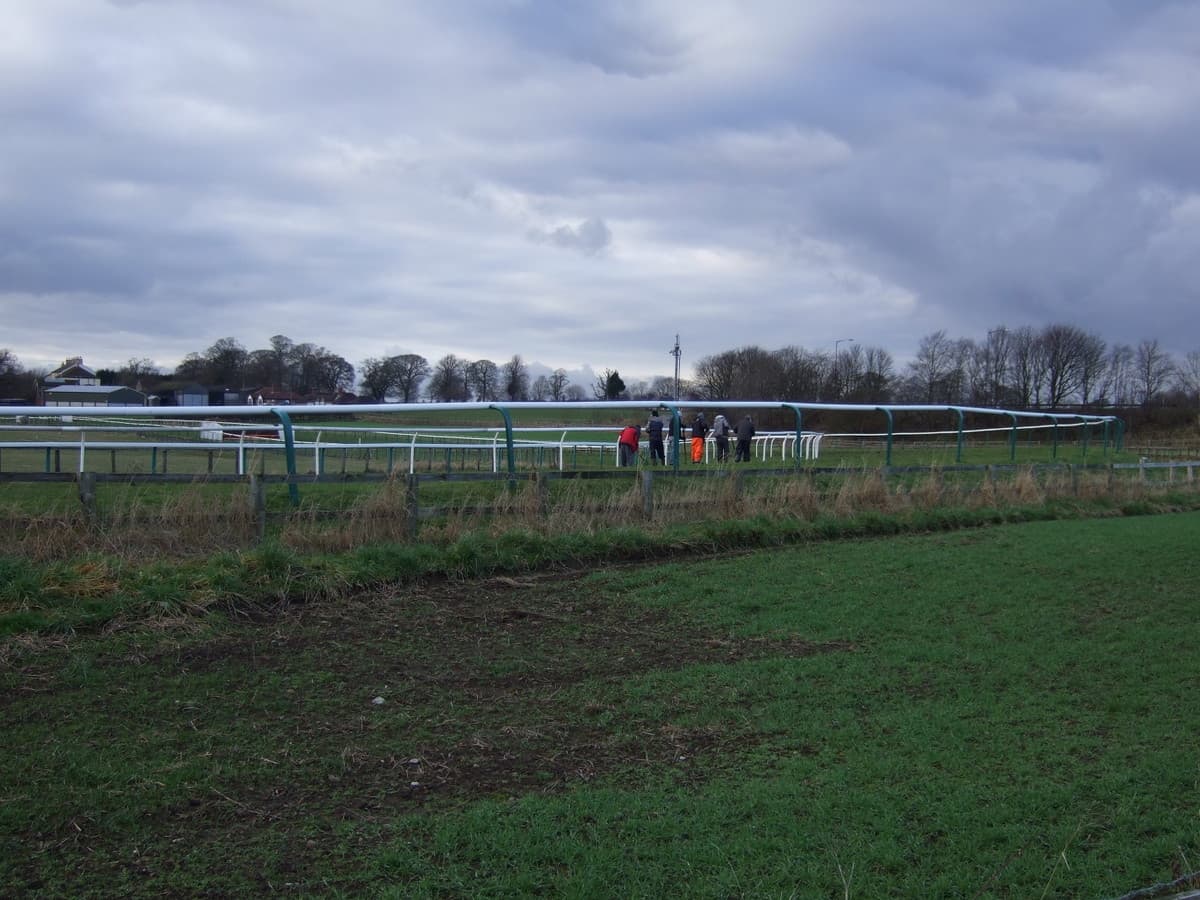
The History of Sedgefield Racecourse
Nearly 300 years of racing at Sedgefield — from the Ralph Lambton Hunt to County Durham's National Hunt venue and the Sedgefield Cup.
Read more
Winter Racing at Sedgefield: Complete Guide
Your complete guide to winter racing at Sedgefield — the Durham National, key meetings, and jumps racing in County Durham.
Read more
Fatehalkhair at Sedgefield: The Complete Story
Fatehalkhair won 13 of his 25 starts at Sedgefield — including the Durham National — making him the most prolific course winner in the venue's recorded history.
Read morePhotos on this page are used under Creative Commons licences. Titles, sources and licence links for each one are on our image credits page.
Research the field with the AI Race Predictor
Our model publishes calibrated win-probability estimates for UK races — a second opinion to understand a race, not tips. It's open about its record: it doesn't beat the market, and we show exactly how it does.
Work it out & learn the basics
Gamble Responsibly
Gambling should be entertaining and not seen as a way to make money. Never bet more than you can afford to lose. If you or someone you know has a gambling problem, help and support is available.