
Founder & Editor · Last reviewed 2026-04-05
On the afternoon of 7 November 2013, a crowd packed into a County Durham racecourse to witness something that had never happened before in the history of British racing. AP McCoy, already the most decorated jump jockey who had ever lived, guided Mountain Tunes to the winning post at Sedgefield to record his 4,000th career winner. There was no Cheltenham, no Ascot, no Aintree. The moment that redefined what was possible in National Hunt racing happened on an undulating plateau above a quiet County Durham village, in front of a crowd that had come from across the North East knowing they were watching history.
That association — Sedgefield as the place where McCoy reached 4,000 — has become the single most famous fact about this racecourse. But the course was here long before November 2013, and it will be defined by far more than one afternoon. Racing has taken place at Sedgefield since at least 1732, making it one of the older established National Hunt venues in England. Through the early Georgian period, the Victorian era, two world wars, and three separate near-closures in the twentieth century, the course has survived by being essential to the North East racing community in a way that no other single venue could replicate.
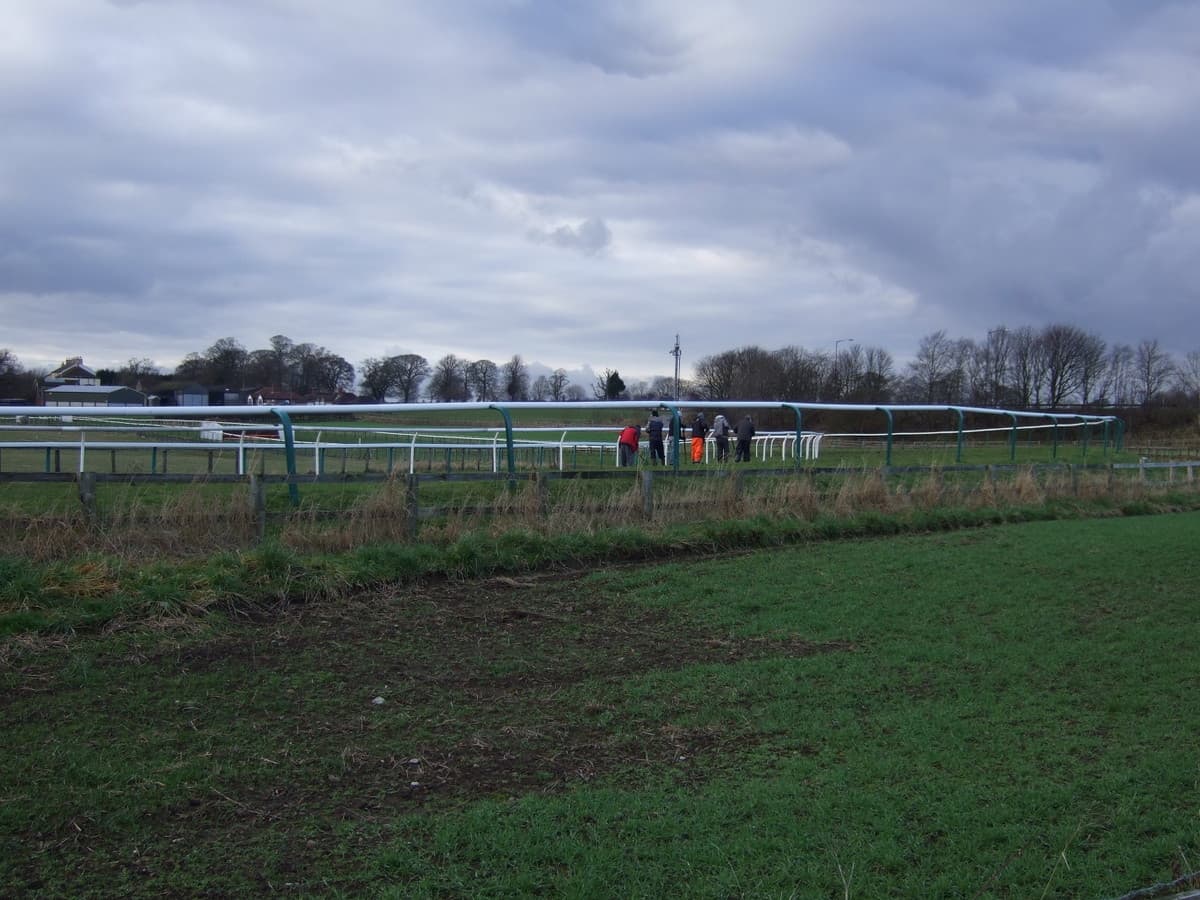
The setting matters. Sedgefield sits on a plateau above the village of the same name, in County Durham, postcode TS21 2HW. The plateau gives the course its character: the ground can be heavy in winter, the wind cuts across without the shelter of a valley, and the left-handed oval circuit of approximately one mile two furlongs demands athletic horses who can handle tight turns and an undulating run. Flat horses need not apply. This is a National Hunt track in the fullest sense — hurdles, steeplechases, and bumpers from October to May.
The course is owned by Arena Racing Company, the largest commercial racing group in Britain, which provides the operational stability that smaller northern tracks often struggle to achieve. Sedgefield hosts approximately 15 to 17 race days per year under ARC ownership, drawing on a loyal fan base from across County Durham, Teesside, and the wider North East. Darlington, 11 miles to the west, is the nearest railway station — on the East Coast Main Line — which places the course within reach of Newcastle to the north and Leeds and London to the south.
The Durham National, run in October, is the course's biggest race and gives it its biggest day of the year. But neither that race, nor the 290-plus years of fixtures, has lodged Sedgefield in the public memory quite like a wet November afternoon and a grey horse called Mountain Tunes. This is the history of how the course got there, and what it has been since.
Origins
County Durham in the Early Eighteenth Century
The year 1732 places the founding of Sedgefield Racecourse in the reign of George II, in a county that was unlike any other in England. County Durham was a palatinate — a territory where the Bishop of Durham held quasi-royal powers that Parliament in London could not simply override. The Prince-Bishops of Durham had exercised this authority since the Norman period, and as late as the early nineteenth century the Bishop retained the right to appoint his own judges, levy his own taxes, and raise his own army. This was not a quaint medieval survival; it was a functioning parallel jurisdiction that shaped the character of the county and its ruling class in ways that mattered for how horse racing developed here.
The landed gentry of County Durham in the 1730s were prosperous, connected to the aristocracy, and interested in the horse as both a working animal and a sporting one. Racing had been part of English aristocratic culture since the Restoration, and by the early eighteenth century organised meetings were spreading across provincial England. Sedgefield was a natural location. The plateau above the village offered firm, elevated ground — an advantage in a region where the low-lying Tees valley could flood. The village itself sat at a crossroads in the county, accessible from Darlington to the west and from the coastal strip to the east.
The Lambton Connection and 1804
Although racing at Sedgefield dates to 1732, the formal organisation of the course as an institution took its decisive shape in 1804, when Ralph Lambton formed a hunt club based at the Hardwick Arms in the village. The Lambtons were one of the great families of County Durham, and Ralph Lambton was among the most influential sporting figures in the North East of his era. The hunt club he established drew membership from across the Durham gentry, and Sedgefield became the headquarters of what would be known as the Ralph Lambton Hunt.
Among the founding members were Ralph Brandling, who owned Gosforth Park near Newcastle, and Robert Surtees, father of the novelist Robert Smith Surtees. The elder Surtees was a Durham antiquary; the younger would go on to create Jorrocks, the fox-hunting grocer whose adventures defined the sporting novel of the Victorian period. That a man from this particular County Durham milieu produced the most famous fictional account of English hunting is not coincidental. This was a world where field sports were central to social life, and Sedgefield sat at its heart.
The racecourse itself occupied land on the Sands Hall Estate, home of the Ord family. The estate provided the plateau ground that gives Sedgefield its distinctive character: elevated above the village, with an undulating surface and a left-handed oval layout that would remain essentially unchanged through nearly three centuries of racing. The area carried a nickname in this period — the "Melton of the North" — a comparison to Melton Mowbray in Leicestershire, which was the acknowledged capital of English fox-hunting.
The Durham Coalfield and Horse Racing
The landscape around Sedgefield is inseparable from the story of coal. The Great Northern Coalfield — stretching from south Durham northwards through Northumberland — was one of the great industrial engines of Georgian and Victorian England. By the middle of the eighteenth century, coal extraction was already transforming County Durham, and by the nineteenth century the county was one of the most heavily industrialised places on earth. The colliery owners and coal merchants who accumulated wealth from this industry were the natural patrons of horse racing in the region.
This was not the aristocratic flat racing culture of Newmarket or Ascot. The North East had its own sporting character, rooted in a working population that took horses seriously as animals of labour and as subjects of wager. The colliery communities of east Durham, many of them within ten miles of Sedgefield, produced generations of men who understood horses from the pit yard outwards. The relationship between the coalfield and the racecourse was not formal or documented but it was real: the crowds that came to Sedgefield through the nineteenth century included pitmen alongside farmers and landowners.
Durham Cathedral and the Prince-Bishops
Durham Cathedral, begun in 1093, stands 15 miles north-west of Sedgefield on a wooded promontory above the River Wear. It is one of the great buildings of Norman Europe — a Romanesque structure that UNESCO listed as a World Heritage Site in 1986. The cathedral was the seat of the Prince-Bishops, and it embodied the particular character of the Durham palatinate: ecclesiastical authority wielded with the force of secular power. The Prince-Bishops retained their palatinate powers until 1836, when the Durham (County Palatine) Act transferred most functions to the Crown.
This context matters for understanding how County Durham developed its institutions, including its sporting ones. The county was, for longer than almost anywhere else in England, a jurisdiction where local power counted for more than central government. Racing at Sedgefield existed within that framework — organised by local families, patronised by local wealth, governed by local custom rather than by Jockey Club edict.
Darlington and the Railway Age
Eleven miles to the west of Sedgefield, Darlington was already a significant market town by the early nineteenth century. The town's Quaker merchant community — the Peases, the Backhouses, the Frys — had accumulated considerable wealth from textiles and banking. It was this community that financed the Stockton and Darlington Railway, which opened on 27 September 1825 as the world's first steam-hauled public railway. The line ran from the Durham coalfield to the port at Stockton-on-Tees, passing through country familiar to anyone who had attended Sedgefield races.
The railway changed the economics of attendance. From 1825 onwards, it became progressively easier to travel between the industrial towns of Teesside and the rural interior of County Durham. Sedgefield was not on the railway — it remains without a direct station today — but Darlington's position on the developing rail network meant that the catchment for Sedgefield meetings grew. Racegoers from Teesside, from Newcastle, and eventually from further afield could reach the area with less difficulty than had been possible in the purely horse-drawn era.
The Move to Formal Racing: 1846
Meetings at Sedgefield through the first half of the nineteenth century were not always continuous. The early record is fragmentary, and there were years when no fixture was held. It was not until 1846 that officially recognised meetings were established at the current location. That date marks the beginning of Sedgefield as a properly constituted racecourse rather than an occasional gathering on suitable ground. The Sedgefield Hunt staged an annual two-day fixture in March, and this structure persisted without major alteration until the outbreak of the First World War in 1914.
The village of Sedgefield itself, a few hundred yards from the course, provided the social infrastructure that sustained the meetings. The church of St Edmund, which dates to the thirteenth century, anchors the village green that remains largely intact today. The Hardwick Arms, where Ralph Lambton had established his hunt club in 1804, continued to serve the racing community. Small as the village was, it had the character of a proper English market town — weekly markets, a grammar school, an agricultural economy supplemented by proximity to both the coalfield and the rural estates that stretched south towards the Tees.
By the late nineteenth century, Sedgefield had established itself as a fixture in the North East National Hunt calendar. It was never the most glamorous course in England, and it never pretended to be. What it offered was reliable racing on a distinctive track in a county with a deep and practical relationship with horses.
The Golden Era
The Victorian Card
The Victorian period consolidated what the Georgian foundations had established. Sedgefield's March fixture continued as the annual centrepiece, and by the late nineteenth century it was drawing trainers from across Yorkshire and Northumberland as well as from County Durham itself. The course offered modest prize money by the standards of Cheltenham or Kempton, but it offered something that the southern tracks could not: proximity to the great training yards that were developing across the North.
Yorkshire, in particular, was becoming the engine of English jumping. Malton, Middleham, and the villages of the North Yorkshire Moors produced trainers who understood northern horses and northern ground. The journey from Malton to Sedgefield was manageable, and the tight left-handed oval suited the type of athletic, well-schooled chaser that northern training methods tended to produce. Southern yards occasionally sent horses north when the prize money justified it, but Sedgefield was fundamentally a northern track serving a northern community.
Post-War Resumption and the 1927 Racecourse Company
Racing ceased at Sedgefield in 1915, as it did at almost every British course, due to the demands of the First World War. When it resumed in 1920, the sporting landscape had changed. Many of the great pre-war estates had been broken up, death duties were restructuring county society, and the horses that had been commandeered for military service were slowly being replaced. Sedgefield's revival was modest but steady, and by the mid-1920s the number of meetings had increased to three per season, including a lucrative Bank Holiday fixture.
The formation of a new Racecourse Company in 1927 was the administrative step that placed Sedgefield on more stable commercial ground. The company structure allowed for investment, coordination with the Jockey Club, and the kind of organised promotion that attracted sponsors and racegoers. Through the interwar years, Sedgefield built its programme around the winter National Hunt season, positioning itself alongside Hexham to the north and Catterick to the south-west as one of three courses that gave the North East a coherent jumping circuit.
The North East NH Triangle
Understanding Sedgefield's place in racing geography requires understanding the triangle. Hexham Racecourse, 45 miles to the north in the Tyne valley, is a right-handed track that occupies one of the most scenic positions in English racing. Catterick, 50 miles to the south-west in North Yorkshire, is a left-handed circuit with a strong dual-purpose tradition, running both flat and National Hunt. Sedgefield sits between them, completing a trio that trainers across the North can target throughout the winter months without excessive travel.
For a trainer based in County Durham, the circuit is almost domestic: Sedgefield is the home track, Hexham a manageable run north, Catterick accessible to the south. For Yorkshire trainers based around Malton — some 50 miles south of Sedgefield — the arrangement inverts but works equally well. Brian Ellison, whose yard at Malton has been one of the most productive northern operations of the modern era, has regularly targeted Sedgefield with horses suited to the tight turns and testing ground. Nicky Richards, based at Greystoke in Cumbria some 60 miles to the west, has similarly found Sedgefield useful for horses that want northern conditions.
What the Track Demands
The Sedgefield circuit is approximately one mile two furlongs, left-handed, on a plateau that sits above the village. The oval is tight by National Hunt standards — tighter than Hexham, considerably tighter than Catterick — and the turns come quickly after the fences. Horses that jump cleanly and conserve energy through the bends have a structural advantage over those that jump big and wide. A horse that jumps brilliantly at a galloping track like Haydock or Kempton may find Sedgefield an uncomfortable fit.
The going can be testing from November onwards. The plateau's drainage is better than low-lying tracks, but the County Durham winter is real: cold, wet, and often muddy by the new year. Horses that act on soft or heavy ground hold a clear edge in the back end of the season, and trainers who understand the local ground conditions — which can shift quickly after overnight rain — have consistently done well here. The undulating terrain adds an extra dimension: horses racing on a consistent flat circuit do not have to manage gradient changes, but at Sedgefield the dips and rises are built into every lap.
The Clement Freud Comment and the Subsequent Transformation
The condition of Sedgefield's facilities through the mid-twentieth century was, by any fair assessment, poor. Clement Freud — wit, broadcaster, and Liberal MP — visited the course in the 1960s and delivered the assessment that has followed Sedgefield ever since: he described it as "all field and not much sedge." The joke captured a real truth. The basic amenities on offer — tin huts for spectators, minimal hospitality, limited facilities for horses and stable staff — were below the standard expected even at modest provincial courses.
The transformation began in 1977, when Frank Scotto was appointed chairman following the death of Harry Lane. The course had been rumoured to be on the verge of closure, and Scotto's arrival was decisive. Over the following two decades he replaced the tin huts with proper bars and eating areas, built the Sedgefield Pavilion in 1991, and added the Theakston Suite in 1995. Corporate hospitality suites were developed. Stable facilities were improved — for the horses themselves, but also for the stable staff, jockeys, owners, and trainers who had previously endured conditions that did not match the effort involved in bringing horses to the course.
The Johnny Ridley Fence and the Run-In
One of the most unusual features of Sedgefield for much of its history was the length of the run-in from the last obstacle to the winning post. For many decades, this measured 525 yards — longer than the Grand National run-in at Aintree, which is itself the longest in British racing. The reason was structural: the obstacle nearest the winning post was a water jump, and under National Hunt rules a water jump cannot be the first or last fence in a race. The result was a finishing straight unlike anywhere else in Britain, where horses and jockeys had to marshal their resources for a lengthy final drive.
In 1994, the water jump was replaced by an ordinary plain fence, bringing the run-in to a conventional length. The fence is now known as the Johnny Ridley fence, named after the local bookmaker whose long sponsorship of the obstacle gave it a permanent identity in the Sedgefield record. The change altered the racing patterns at the course: horses no longer needed the stamina reserve that the old 525-yard run had demanded, and the racing became sharper in its final stages.
The Durham National
The Durham National, first staged in 1955, developed into the course's flagship race, offering a test of the complete National Hunt horse over a marathon trip and on a track that rewards jumping accuracy as much as outright speed. Its position in the October calendar has made it the focal point around which trainers plan their season at Sedgefield.
By the time Arena Racing Company took over the operation of Sedgefield in the early 2000s — following the Northern Racing acquisition of 2001 — the course had established a clear identity: a tight, testing, honest NH track on a County Durham plateau, serving a loyal northern crowd with a programme built around the winter jumping season.
Famous Moments
7 November 2013: The Day That Changed Everything
The morning of 7 November 2013 at Sedgefield was not exceptional by November standards in County Durham. Cold, grey, the kind of day the North East produces with little ceremony at the start of the winter season. But the crowd that gathered was exceptional — larger than any ordinary November midweek card would attract, swelled by racegoers who had driven from across the region and by journalists and television crews who had been tracking the arithmetic for weeks.
AP McCoy needed one more winner to reach 4,000 career winners. The figure itself required a moment of comprehension. Richard Dunwoody, the previous record holder, had retired on 1,699. John Francome had held the record before Dunwoody with 1,138. McCoy had broken Dunwoody's record in January 2002, had reached 2,000 winners, 3,000 winners, and had kept going in a way that had no precedent in the sport. The target of 4,000 had seemed, for years, a theoretical number — something that might happen if everything continued perfectly. By the autumn of 2013, with McCoy riding for owner JP McManus and trainer Jonjo O'Neill, everything had continued perfectly.
The horse was Mountain Tunes. Trained by Jonjo O'Neill at Jackdaws Castle in Gloucestershire and owned by JP McManus, Mountain Tunes was entered in what was billed as the Weatherbys 2012 Champion Bumper at Sedgefield — a National Hunt flat race, the bumper division that produces future chasers and hurdlers from among the unraced young horses. Mountain Tunes was not an equine immortal. No horse carrying McCoy to a record of this kind needed to be: the significance was in the rider, not the mount.
McCoy rode Mountain Tunes to a clear victory. The crowd that had been waiting erupted. Jonjo O'Neill, who had been champion jockey himself in the 1979-80 season and who had long been McCoy's principal trainer through the McManus operation, was there to greet them. JP McManus, the Irish businessman and one of the most powerful figures in National Hunt racing, was present. The coverage ran on the news channels, not just the racing press. A BBC cameras was trackside. This was not a racing story contained within the sport.
McCoy's Career in Context
To understand why 4,000 mattered, it is necessary to understand the scale of what McCoy had built. He was champion jockey for twenty consecutive seasons, from 1995-96 through to 2014-15 — a sequence without parallel in any British sport. He had won the Grand National on Don't Push It in 2010, fulfilling the one ambition that had eluded him for the early decades of his career. He had won the Gold Cup on Mr Mulligan in 1997. He had won the Champion Hurdle on Make A Stand in 1997 and on Brave Inca in 2006. He had broken bones, returned from falls that would have retired other jockeys, and continued riding at a pace that his contemporaries described as relentless.
The 3,000th winner had come in August 2008, also at a modest NH track — the accumulation of winners through the summer jumping season, when the big festivals are over and the circuit continues at tracks like Sedgefield, Newton Abbot, and Perth. It took five years to add another thousand. McCoy retired in April 2015, at the Sandown Park festival, having ridden 4,358 career winners. He is the only jockey in history to reach 4,000. The second-highest total in British racing history — held by Richard Johnson, who surpassed Dunwoody's record years after McCoy had already left it far behind — stands at just over 3,800. The gap is not a margin; it is a chasm.
Sedgefield is where that chasm was defined. The 4,000th winner, landed on a bumper horse on a cold November afternoon in County Durham, is the moment the sport acknowledges when explaining what McCoy was. Every racing record eventually belongs to its location, and this one belongs to Sedgefield.
The 1999 Incident and the Near-Closure
Not all of Sedgefield's defining moments have been about triumph. In 1999, the course came within a ruling of closure after a catastrophic incident in a novices' chase. Three riderless horses, having unseated their jockeys, ran back up the chase track the wrong way and collided at full pace with the remainder of the field. Three horses were killed. The British Horseracing Board investigated. The course's licence was reviewed. This was the third time in the twentieth century that Sedgefield had faced the prospect of closure — the previous instances related to financial strain rather than safety — and on this occasion the outcome was not certain.
The course survived, but the incident accelerated the need for investment and modernisation. Northern Racing's purchase of Sedgefield in 2001, at a cost of around £600,000, provided the capital that the course had been lacking. A refurbished parade ring and winners' enclosure were constructed. The drainage system was overhauled. The purchase marked the end of the course's longest period of independent local ownership and the beginning of the corporate group structure that would eventually become Arena Racing Company.
Hewick and the Durham National
The Durham National, run over three and three-quarter miles on a Saturday in October, is Sedgefield's biggest race of the year by distance and by occasion. It has a habit of producing horses who go on to bigger things. The most striking example in recent years is Hewick, trained by John Ryan, who won the Durham National in October 2021 before embarking on one of the most improbable careers of the modern NH era. In the following months Hewick won the Galway Plate, the bet365 Gold Cup at Sandown, the American Grand National at Far Hills in New Jersey, and the King George VI Chase at Kempton Park. A horse that had won a graded staying chase at a small County Durham track in October was winning a Grade One at Kempton on Boxing Day. The Durham National had launched him.
Earlier in the course's history, the race attracted horses of proven quality. Red Alligator, who won the Grand National in 1968 trained by Denys Smith, was a Durham horse before he was an Aintree hero. Rubstic, trained by John Leadbetter and the 1979 Grand National winner, also appeared at Sedgefield. The race has long carried the prestige that comes from sitting on the route to Aintree.
Fatehalkhair: A Sedgefield Legend
Among the stories that Sedgefield's regulars carry with them is that of Fatehalkhair — a horse who arrived at the course from a flat racing yard where he had failed to make the grade, and who reinvented himself entirely as a jumping specialist. Over several seasons, Fatehalkhair won twenty races in total, thirteen of them over jumps and all thirteen at Sedgefield. He never won anywhere else over obstacles. The tight left-handed oval, the particular conditions of the plateau, the specific demands of the course — whatever the explanation, Sedgefield suited him in a way that nowhere else did.
Horses like Fatehalkhair, who become identified with a single track, are among the most loved in racing. They give a course its own folklore, separate from the big race results and the famous names. Sedgefield has always produced these stories, because the type of programme it runs — consistent, modest-level NH racing over a long winter season — creates the repeated opportunities that allow a horse to find its conditions and exploit them.
The Crowd That Remembers
The 4,000th winner is the story outsiders reach for when Sedgefield is mentioned. But the crowd that returns each season carries a different set of references: the winning run that ended in dramatic fashion at the last fence, the horse that beat the odds-on favourite in the handicap chase, the young trainer who saddled a first winner on a cold Tuesday in January. These are the moments that belong to the people who were there, that never make the national press, and that are no less real for that. Sedgefield has 290-plus years of them.
The Modern Era
Northern Racing and the 2001 Turning Point
The purchase of Sedgefield by Northern Racing in 2001 was the financial event that secured the course's future after three decades of instability. Northern Racing paid approximately £600,000, a modest sum for a racecourse even in 2001 terms, but one that carried with it a commitment to investment that the previous ownership structure had been unable to sustain. The immediate programme of works addressed the most visible deficiencies: a refurbished parade ring and winners' enclosure, upgraded bars and eating areas, improved drainage across the track surface, and a better weighing room complex that gave jockeys and officials facilities appropriate for a licensed British racecourse.
Northern Racing expanded through the early 2000s by acquiring a portfolio of regional courses across Britain, and in 2012 it merged with Arena Leisure to form Arena Racing Company. ARC is now the largest commercial racing group in Britain, operating 21 racecourses from Brighton in the south to Newcastle in the north. Sedgefield sits within that portfolio as one of ARC's smaller and more specialised venues — a National Hunt-only track with a loyal regional audience, generating the kind of modest but reliable returns that a well-run winter programme can produce.
The Current Programme
Sedgefield stages approximately 15 to 17 race days per year under the current ARC programme. The season runs from October through to May, tracking the National Hunt calendar rather than the flat racing year. The core fixture is the October meeting that includes the Durham National. Around it, the season is filled with midweek afternoon meetings that provide racing for the North East community and opportunities for northern trainers to place horses at a track they know well.
Prize money at Sedgefield sits at the grassroots end of the NH scale. The BHA's minimum prize money requirements apply, and ARC supplements these with commercial sponsorship where the market allows. The Durham National attracts its own sponsorship each year and is the premium commercial event. The rest of the card is working racing — novice hurdles, handicap chases, maiden bumpers — the bread and butter of the winter NH programme that produces future stars and gives young horses their education.
The Trainers Who Come North
The North East NH community is tightly interconnected, and Sedgefield sits at its centre. Brian Ellison, based at Norton Grange near Malton in North Yorkshire — approximately 50 miles south — has been one of the most consistent senders of winners to the course over the past decade. Ellison handles a large string that includes horses spread across the ability range, and Sedgefield's level of competition suits horses that are competitive without being at the top of the northern handicap hierarchy.
Nicky Richards, whose yard at Greystoke in Cumbria is roughly 60 miles to the west, targets the North East circuit when conditions suit. Richards is a trainer of dual-purpose horses and has won at the Cheltenham Festival; Sedgefield is part of a wider strategy that uses northern tracks to build horses through the season. Sue Smith, based near Bingley in West Yorkshire around 55 miles south, has a record at Sedgefield that reflects her long experience with staying chasers who handle testing winter ground. James Moffatt, whose yard at Cartmel in Cumbria gives him a natural affinity with small northern tracks, has also featured regularly in Sedgefield results.
The jockeys who ride most at Sedgefield are predominantly from the northern freelance pool — riders based in Yorkshire, Durham, and Northumberland who make the regional circuit their livelihood. Henry Brooke, Callum Rodriguez, and Danny McMenamin have all been prominent at Sedgefield in recent seasons, alongside stable jockeys attached to the larger northern yards.
Sedgefield and the North East Identity
The village of Sedgefield carries a political association that is unusual for a racing community. Between 1983 and 2007, Sedgefield was the parliamentary constituency of Tony Blair, who served as Member of Parliament for the area before becoming Prime Minister in 1997 and holding that office until 2007. Blair held the constituency through four general elections. The constituency covered a wide area of County Durham rather than just the village, but the name "Sedgefield" became nationally known through Blair's career in a way that had nothing to do with horse racing.
The overlap between the political association and the racing identity is curious rather than profound. Sedgefield racecourse did not become a site of political pilgrimage, and Blair's connection to the constituency does not appear to have generated any particular interest in the racecourse from his circle. But it means that the name "Sedgefield" carries an additional resonance for the broader British public — a resonance that predates November 2013 and the McCoy milestone.
Facilities and the Loyal Crowd
Sedgefield's capacity stands at around 4,000 racegoers. This is not a large venue. Chester holds 17,000; Cheltenham's Festival draws 70,000 on Gold Cup day. Sedgefield's scale is intentionally modest, suited to the midweek winter programme it runs and the community it serves. The grandstand and viewing facilities are functional rather than spectacular, reflecting ARC's management approach at its smaller venues: maintain the basics, ensure the racing surface is good, keep the crowd warm and fed.
The crowd that Sedgefield does attract is, by most accounts, Of note engaged. North East racing fans have a reputation for knowledgeable attendance — people who follow specific trainers, know the form, and have often been coming to the same track for years. The betting ring at Sedgefield retains a proper on-course bookmaker presence, which is increasingly rare at smaller venues as the industry has shifted towards tote and app-based wagering. The presence of trackside bookmakers maintains an atmosphere that connects the modern meeting to the market-town racing culture from which Sedgefield originally emerged.
What ARC Has Brought
Arena Racing Company's stewardship of Sedgefield has been characterised by pragmatic maintenance rather than significant investment. The company has kept the track racing, maintained the going preparation standards required by the BHA, and run a programme that serves the northern NH community. There have been no major construction projects of the kind ARC has delivered at Newcastle — where a substantial redevelopment transformed the facility — but the basics at Sedgefield have been consistently maintained. For a course that came close to closure in 1999, consistent maintenance is not a trivial achievement.
The ARC model depends on racing programming that generates fixtures, which generate the media rights income that funds the group's operations. Sedgefield's 15 to 17 annual race days contribute to that total, and the course's position in the North East — distant enough from Newcastle to serve a different local audience, close enough to Teesside to draw a substantial crowd — makes it a commercially logical part of the portfolio.
Sedgefield's Legacy
What Sedgefield Represents
The case for Sedgefield's place in British racing is made across two registers: the historical and the atmospheric. Historically, the course has been running since at least 1732, which places it among the older continuous NH venues in England. Atmospherically, it occupies a particular role in the North East — not the grandest racing in the region, not the most prestigious, but the most consistent and the most distinctively local. Newcastle's Gosforth Park offers Grade One racing and a major flat programme. Redcar covers the flat on the coast. Hexham serves Northumberland with a right-handed track in the Tyne valley. Sedgefield serves County Durham, and it has done so through wars, near-closures, and the steady attrition that regional racecourses face in every era.
The legacy of 7 November 2013 is truly inseparable from the course's modern identity. AP McCoy's 4,000th career winner at Sedgefield is cited in almost every piece of journalism about the track, and with good reason. The moment placed Sedgefield in a sentence that will appear in every authoritative account of McCoy's career — the only jockey to ride 4,000 winners in British racing history. For a course of Sedgefield's scale, the association carries a weight that no race victory of its own could have delivered. The Durham National has produced Hewick. But the 4,000th winner belongs to the course's identity in a way that transcends the normal relationship between a racecourse and its results.
The County Durham character of Sedgefield matters as much as its racing record. The plateau above the village, the tight left-handed circuit, the winter going that can turn heavy within hours of overnight rain — these are the conditions that define what the course is for. It is not a track for every horse. It suits a specific type: athletic, sure-footed, comfortable on testing ground, willing to race off a fast pace through tight bends. The trainers who have done best at Sedgefield over the decades are those who understood this, who brought the right horses rather than the most expensive ones.
The village below the racecourse has its own continuity. St Edmund's church, which dates to the thirteenth century, still stands on the village green. The Hardwick Arms, where Ralph Lambton formed his hunt club in 1804, still operates. Durham Cathedral, 15 miles to the north-west, is still the great Norman building that the Prince-Bishops of Durham built from 1093 onwards. These are not decorative historical details. They are the context in which Sedgefield Racecourse exists — a County Durham institution in a county with a long memory and a strong sense of its own character. Sedgefield has been part of that character for nearly three centuries, and it continues to be.
Frequently Asked Questions
When was Sedgefield Racecourse founded?
Racing at Sedgefield dates to at least 1732, making it one of the older National Hunt venues in England. The course was formally established in its current location in 1846, when officially recognised meetings began on the Sands Hall Estate site. A new Racecourse Company was incorporated in 1927 to provide the commercial structure for the modern era.
What is Sedgefield most famous for in racing history?
Sedgefield is the course where AP McCoy rode his 4,000th career winner on 7 November 2013. The horse was Mountain Tunes, trained by Jonjo O'Neill. McCoy is the only jockey in the history of British racing to reach 4,000 winners; he retired in April 2015 having ridden 4,358 in total. The record was set at Sedgefield, and the association between the course and that milestone is permanent.
Who owns Sedgefield Racecourse?
Sedgefield Racecourse is owned and operated by Arena Racing Company (ARC), the largest commercial racing group in Britain with 21 courses in its portfolio. ARC's ownership of Sedgefield dates from 2012, when it was formed by the merger of Northern Racing (which had purchased Sedgefield in 2001) and Arena Leisure.
How do I get to Sedgefield Racecourse?
The nearest railway station is Darlington, approximately 11 miles to the west of the course and served by the East Coast Main Line between London King's Cross and Edinburgh. The journey from London takes around two hours and twenty minutes. Stockton-on-Tees station, roughly 8 miles to the east, provides an alternative for those travelling from Teesside. By road, the course is accessible via the A689 and A177, with the postcode TS21 2HW for navigation. There is on-site parking available on race days.
What type of racing does Sedgefield stage?
Sedgefield is a National Hunt-only racecourse. It stages hurdle races, steeplechases, and National Hunt flat races (bumpers). The season runs from October through to May, with approximately 15 to 17 race days per year. There is no flat racing at Sedgefield. The course's signature event is the Durham National in October.
What is the track like at Sedgefield?
Sedgefield is a left-handed, roughly oval circuit of approximately one mile two furlongs, situated on a plateau above the village. The track is undulating, with dips and rises built into every lap, and the turns are tighter than at most comparable NH venues. The going can become testing in the winter months, particularly from December onwards when rainfall accumulates on the plateau surface. Horses that jump cleanly, handle tight bends, and act on soft or heavy ground hold a consistent advantage at Sedgefield over those bred and trained for galloping, flat courses.
Share this article
More about this racecourse
All Sedgefield guides
Winter Racing at Sedgefield: Complete Guide
Your complete guide to winter racing at Sedgefield — the Durham National, key meetings, and jumps racing in County Durham.
Read more
Fatehalkhair at Sedgefield: The Complete Story
Fatehalkhair won 13 of his 25 starts at Sedgefield — including the Durham National — making him the most prolific course winner in the venue's recorded history.
Read more
Betting at Sedgefield Racecourse
Bet smarter at Sedgefield — track characteristics, demanding run-in, going and conditions, key trainers and jockeys, strategies for County Durham's jumps venue.
Read moreGamble Responsibly
Gambling should be entertaining and not seen as a way to make money. Never bet more than you can afford to lose. If you or someone you know has a gambling problem, help and support is available.