
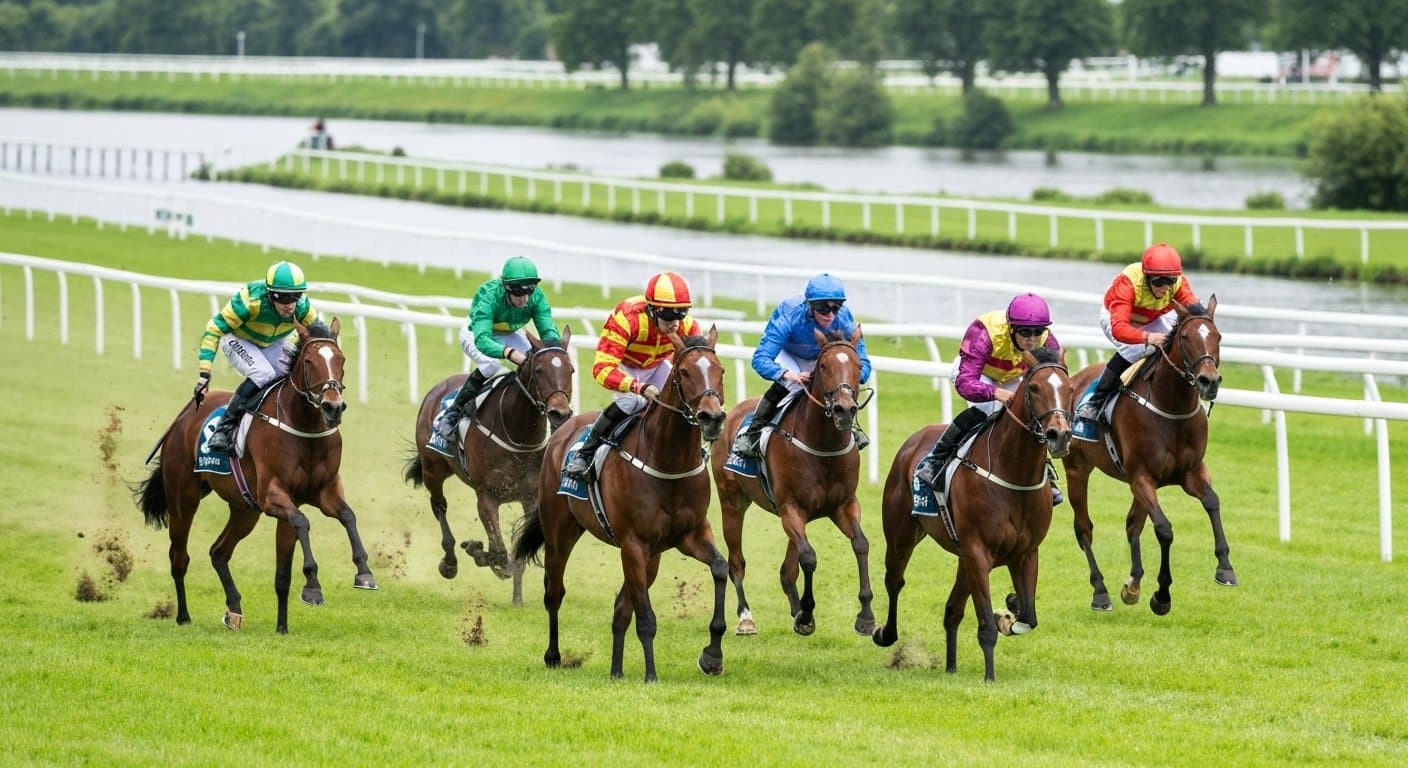
Founder & Editor · Last reviewed 2026-03-02
Stratford-on-Avon is one of the few National Hunt tracks that operates during the summer. While most jumping venues close from May to October, Stratford runs from June to September — making it one of a small group of summer NH courses alongside Newton Abbot, Worcester, and Cartmel. That calendar niche creates distinctive betting conditions that differ from the winter NH racing most punters know.
The course is left-handed, essentially flat, and rectangular in shape, measuring approximately one mile and two furlongs round. The home straight is short — about one and a half furlongs. The bends are tight enough to make position in the final turn the critical factor in most races. A horse leading or racing in the first two at the home turn wins at Newton Abbot and Stratford at a rate that consistently outperforms the national NH average.
Dan Skelton dominates this course. He trains at Lodge Hill near Alcester in Warwickshire, approximately eight miles from the racecourse. That proximity translates into a strike rate that has been above 25% in multiple seasons. When Dan Skelton sends a horse to Stratford with Harry Skelton booked, the combination should be the first thing noted on any racecard.
Summer NH at Stratford attracts Class 3 to Class 6 horses on good and good to firm ground. The going tends to be firm compared to winter NH conditions, which disadvantages horses that need soft ground and advantages those from Flat-racing backgrounds or with proven summer form. Point-to-point graduates and bumper horses from local yards sometimes make their racecourse debuts here in June. These races are worth monitoring for future form — occasionally they produce horses that go on to compete at the highest level.
The betting market at Stratford is not as tightly priced as at the major winter venues. Bookmakers allocate less resource to summer NH than to the big Flat meetings that dominate July and August. Market inefficiencies are real. A Dan Skelton runner in a six-runner novice hurdle at Stratford in July can be priced at 7/2 in the morning when its combination of form, local preparation, and track knowledge would justify a shorter price. Those gaps close by race time, but they exist long enough for prepared punters to exploit them.
Field sizes at Stratford typically run from six to twelve runners. The smaller summer NH fields at this level of competition — predominantly Class 3 to Class 5 — mean that each-way betting terms are often reduced to two places. In races of five to seven runners, win betting is usually more appropriate than each-way. In fields of ten or more, standard each-way terms make the place market attractive at prices of 4/1 and above.
The value at Stratford rewards the punter who combines course-specific knowledge with standard form assessment. This guide provides the framework to do that consistently.
Bet on Stratford-on-Avon
Place your bets on Stratford-on-Avon races with a trusted bookmaker.

Promo code BETFRED50. New customers only. Register, deposit with a Debit Card, and place a first bet of £10+ at Evens (2.0)+ on Sports, to be settled within 7 days, to get £30 in Sports Free Bets and £20 in Bet Builder Free Bets within 24 hours of settlement. 7-day expiry. Eligibility & payment exclusions apply. Full T&Cs apply. Take Time to Think. BeGambleAware.org. 18+. Full T&Cs.

Promo code R30. New UK customers only, 18+. Register, deposit £10 or more, then place a £10 single cash bet at odds of 1/2 (1.5) or greater on any sports market (excluding Virtuals). Once the qualifying bet settles you get £30 in Free Bets (3 x £10) — the qualifying bet can win or lose. Free Bets are valid on any sports market excluding Virtuals, expire in 7 days, are non-withdrawable and must be used in full. Excluded deposit methods apply (including PayPal, Apple Pay, Skrill and NETELLER). Named bets such as Lucky 15 do not qualify. If you cash out the qualifying bet, or it is voided, you are no longer eligible for the offer. Ends 31.12.26. Full T&Cs apply. Please gamble responsibly. BeGambleAware.org. 18+. Full T&Cs.

Promo code BET40GET20. New UK customers, 18+. Register with the code and place a first bet of £40 or more at Evens (2.0) or greater. Receive 2 × £10 free bets: the first credited automatically once the qualifying bet settles, the second 24 hours later. Free bets must be placed at minimum odds of 4/1 (5.0), expire 24 hours after credit, and the free-bet stake is not returned with winnings. Debit card deposits only. Take Time to Think. BeGambleAware.org. 18+. T&Cs apply. Full T&Cs.

50% of your first-day net losses refunded as a free bet, capped at £25. New UK customers aged 18+ only. To qualify, deposit and place a first bet of £10 or more on any sport at minimum odds of evens (2.00), then place at least two further bets on different events, each worth at least 50% of your largest bet, all at evens (2.00) or greater. Losses are counted from your first settled bet until 23:59 the same day. Place a qualifying £10+ bet and you are guaranteed at least a £5 free bet. Bets placed at SP, void bets, cashed-out bets and bets struck with free bets do not count towards the offer. The free bet is credited the day after your qualifying bets settle and must be used within 7 days, after which it expires. It can be used at odds from 1/4 (1.25) up to 250/1 on singles and straight accumulators, but not on Trixie, Patent or Yankee style multiples. Free-bet stake is not returned with winnings. One offer per person, household, address, IP address and device. E-wallet deposits may not qualify, so check the cashier before depositing. Customers registered with GAMSTOP cannot claim. KYC identity verification must be completed before the free bet is credited. Take Time to Think. BeGambleAware.org. 18+. T&Cs apply. Full T&Cs.

New customers, 18+. Choose the sports bonus at sign-up, make a first deposit and receive a 100% bonus up to £50 in your Sports Bonus balance. To convert the bonus to cash, wager it 10x within 30 days. Single bets below Evens (2.00) do not qualify; accumulators do not qualify if any selection is below 1/2 (1.50). Virtual Sports, voided, cancelled, drawn, cashed-out and free-bet wagers do not count towards wagering. Only the first settled bet per event counts. Withdrawing before the wagering requirement is met forfeits the bonus balance including bonus winnings. Real-money funds are used before bonus funds. Deposits via Skrill or Neteller are not eligible. Not valid in conjunction with other promotions. Odds, bet and payment limits apply. 10bet general and promotion T&Cs apply. BeGambleAware.org. 18+. Full T&Cs.

New customers in Great Britain and Republic of Ireland, 18+. Place a £10 fixed-odds qualifying bet at minimum odds of 1/2 (1.50) — single or each-way (only the win part counts), pre-event or in-play, not cashed out early, within 28 days of opening the account. Receive up to £60 in bonuses credited over three days: 3 × £10 fixed-odds free bets (the first on settlement, then 24 and 48 hours later) plus 3 × £5 Total Goals FOOTBALL spread bets and 3 × £5 racing Winning Favourites spread bets, with a £1 racing Race Index spread bet as an extra on top. The spread bets need a full spread-betting account, opened within 28 days of the fixed-odds account and subject to Spreadex's eligibility and appropriateness checks. Free-bet stakes not returned with winnings; free bets valid 28 days from issue. IMPORTANT: the £5 credits are SPREAD bets — sports spread betting carries the risk that losses can exceed your stake. Sports spread-betting customers do not have Financial Ombudsman or FSCS recourse. Take Time to Think. BeGambleAware.org. 18+. T&Cs apply. Full T&Cs.

Promo code WELCOME15, entered under My Bonuses after registering. New UK customers, 18+. Place a first qualifying bet of at least £10 from your cash balance at odds of evens (2.0) or greater within 7 days of opening the account. Once the qualifying bet fully settles you receive £15 in free bets, credited as 3 x £5 tokens with set uses: one £5 accumulator free bet (minimum 4 legs, each leg at 2/5 or bigger), one £5 sports free bet (any market at evens or bigger) and one £5 Sub Cover free bet (selected football player markets at evens or bigger). Free-bet stakes are not returned with winnings. Free bets expire 7 days after they are credited. Void, cashed-out and partially cashed-out bets do not qualify. One offer per customer. Confirm the current terms on BetGoodwin's own welcome-offer page before claiming. Take Time to Think. BeGambleAware.org. 18+. T&Cs apply. Full T&Cs.

New UK customers, 18+. Minimum deposit £10. Place a £10 qualifying single on sports (excluding virtuals) at minimum odds of 1/2 (1.50), settled within 14 days. Deposit-method exclusions apply. Receive £30 in free bets (stake not returned), split £20 for sportsbook use (2 x £10) and £10 for Bet Builder only (2 x £5); Bet Builder does not cover horse racing. Free bets must be accepted within 7 days and expire 7 days after acceptance. No promo code required. Best Odds Guaranteed on UK & Irish racing, subject to having staked over £25 in the previous seven days. Operated by LiveScore Betting and Gaming (Gibraltar) Ltd, UKGC 56859. Confirm the current terms on LiveScore Bet's own promotions page before claiming. Take Time to Think. BeGambleAware.org. 18+. T&Cs apply. Full T&Cs.
18+. BeGambleAware.org
Track Characteristics
The Stratford-on-Avon circuit is left-handed, rectangular, and essentially flat — one of the flatter National Hunt tracks in England. The full course measures approximately one mile and two furlongs round. Races begin close to the grandstand, the field proceeds down the back straight, turns left twice through the far end, and returns via a short home straight to the winning post. The absence of significant undulations means the course does not impose natural stamina demands beyond what the distance alone creates.
The Home Straight
The home straight at Stratford measures approximately one and a half furlongs. By NH standards this is short. There is no hill, no change of gradient, and no extended straight where a closing horse can produce a sustained finishing run. Races at Stratford are decided by the quality of positioning at the final bend — a horse in front when it enters the home straight is physically unlikely to be overtaken by something three or four lengths behind it.
This characteristic makes Stratford the most tactical NH course in the Midlands. Jockeys who understand the course — Dan Skelton's retained brother Harry Skelton above all others — know that the race is effectively won or lost at the final turn, not in the short straight that follows. The skill is in timing the move to reach the front just as the home turn is negotiated.
The Left-Handed Bends
The Stratford bends are left-handed and tight enough to create a racing line premium. Horses on the inner rail at the turn lose minimal ground. Horses racing wide on the outer lose several lengths equivalent to increased distance. In large fields, horses that are unable to obtain a rail position on the bends effectively race a longer track than the official distance implies.
The practical implication: in races with twelve or more runners, horses that have a clear preference for prominent racing and can obtain a rail position are even more valuable than they are at most NH courses. Horses that rely on wide-running finishes — those that need space to accelerate — are structurally disadvantaged.
Comparison to Similar Courses
Worcester is the closest left-handed summer NH comparison. Both are flat, rectangular, and require tactical positional racing. Form from Worcester on matching going transfers well to Stratford. Uttoxeter — left-handed, compact, undulating slightly — is a reasonable comparison course.
Newton Abbot shares the tactical front-runner premium but is right-handed and even smaller. Form from Newton Abbot on Good to Firm transfers to Stratford but the directional difference means horses who specifically favour one track do not always transfer to the other.
Fences and Hurdles
Stratford's fences and hurdles are maintained to a fair standard. The fences are not renowned as particularly stiff or demanding. The flat circuit means jumping errors rarely produce dramatic unseats — there is no sudden downhill approach or landing on a slope to amplify mistakes. The result is that jumping quality is less of a decisive factor than at undulating courses like Wincanton or Exeter.
This reduces the importance of detailed jumping form assessment for Stratford selections. Focus instead on tactical positioning and pace.
Distance Configuration
Stratford races from two miles to three miles two furlongs. At two miles over a flat, left-handed circuit, the race is effectively a sprint from the halfway point — pace and positional quality determine the result. At three miles, the multiple circuits add cumulative tire that distinguishes real stayers from horses relying on pace. The NH Cup at Stratford over two miles five furlongs represents the sweet spot — far enough to require stamina but short enough that positioning still matters enormously.
Going & Draw Bias
Stratford's season runs from June through September, and summer ground conditions define the betting framework for virtually every race on the calendar. The course sits on relatively free-draining soil in the Avon valley, and the typical going through June and July ranges from Good to Firm to Good. Good to Soft appears occasionally when rain interrupts a dry spell, but Heavy ground at Stratford is rare enough to be treated as an exceptional event rather than a planning assumption.
Good to Firm and Good — June to August
The peak of the Stratford season produces the fastest conditions. Good to Firm in June and July rewards horses with proven summer NH form — those that have won or placed at similar conditions at Worcester, Newton Abbot, or Cartmel. Horses that were at their best in winter conditions at Cheltenham or Haydock on Soft or Heavy are not automatically suited to Stratford in summer. Their winter form is irrelevant as a direct predictor.
The Dan Skelton stable's summer record at Stratford reflects horses specifically prepared for good-ground summer racing. Their form at Stratford in June and July is essentially independent of what they did in the preceding winter, and assessing their chances based on winter form can produce misleading conclusions.
September — Variable Conditions
September at Stratford can bring the full range from Good to Firm through to Soft depending on rainfall. British summer weather patterns make August and September more unpredictable than the core summer months. If a wet spell arrives in late August, the going for September fixtures can be markedly different from the July conditions that shaped the form book.
Check the forecast a week before any September Stratford fixture. If rainfall is expected, assess the field on their going preferences carefully. Horses with summer form only on fast ground may be less competitive than their ratings suggest when the going eases. Conversely, horses that have been running on soft ground elsewhere earlier in the year and arrive at Stratford in September on Good to Soft may find themselves in near-ideal conditions.
Going Changes on Raceday
Stratford's free-draining soil means the going can change direction quickly within a few hours. An afternoon of sun after an overnight shower can firm the ground by one category between morning and race time. The official going stick assessment, published on the morning of the meeting, is the most reliable guide. Do not rely on the going declared two or three days before the meeting if weather conditions have been variable.
Draw Analysis
Stratford does not use numbered starting stalls for National Hunt racing, so draw bias in the traditional sense does not apply. However, positional starting locations in NH races can have some bearing on early tactical positioning. Horses that start on the inner rail enter the first left-handed bend in an advantageous position. In large hurdle fields of fourteen or more runners, the horses that start on the inner and maintain position to the first bend are statistically more likely to be in a good position at the final turn.
In practice, this positional advantage is a secondary consideration at best. The quality and intent of the trainer, the horse's running style, and the going preference are all more important than starting position.
Summer Form Transfer
The most productive form sources for Stratford are races run on Good to Firm or Good at other summer NH courses. Uttoxeter on Good is a particularly good form guide because both courses are left-handed, compact, and reward similar running styles. Perth form on Good transfers reasonably, despite the right-handed direction, because the surface conditions are similar.
Form from spring Flat racing on good ground at AW tracks like Chelmsford does not transfer to NH races at Stratford. The disciplines are too different to make direct comparison useful.
Key Trainers & Jockeys
Stratford-on-Avon's trainer landscape is dominated by one yard to an unusual degree. Dan Skelton's proximity and deliberate targeting of this course has produced a training record here that stands apart from the rest of the field.
Dan Skelton
Dan Skelton trains at Lodge Hill near Alcester in Warwickshire — approximately eight miles from Stratford racecourse. This is a truly local relationship: Skelton can observe his horses' behaviour on race morning, adjust plans with minimal travel time, and build a detailed understanding of how each horse performs at this specific venue. His strike rate at Stratford has exceeded 25% in multiple recent seasons.
The range of horses he runs at Stratford is extensive. Novice hurdlers having their second or third run. Bumper graduates stepping up to hurdles for the first time. Novice chasers building experience. Handicap horses with proven course form returning to the scene of previous wins. Skelton uses Stratford throughout the summer as a development and management track — it is where his horses build confidence and learn racecraft before bigger targets in autumn.
When Skelton sends a horse to Stratford, the most useful question is not whether the horse will win but whether its price represents value. His horses here at 5/2 and above are consistently profitable backing blind. At 6/4 and shorter, the value is frequently priced away.
Harry Skelton
Harry Skelton rides the Dan Skelton stable's first string at Stratford and is the most productive jockey at the course by both volume and strike rate. His understanding of the tight left-handed circuit — specifically his ability to position horses correctly for the final turn — is superior to any other jockey at this venue. He commits to the inner rail consistently and times his position to enter the straight in front or close to front. On the short Stratford straight, that positioning almost always holds.
Bridget Andrews
Bridget Andrews is the Dan Skelton stable's second jockey and rides the lower-grade and less-fancied Skelton runners at Stratford when Harry is committed elsewhere. Her record at Stratford reflects the strength of the stable's horses here — she wins regularly, often at prices above 5/2. She understands the course layout from riding here frequently and applies the same positional tactics as Harry Skelton.
Nigel Twiston-Davies
Nigel Twiston-Davies trains at Naunton in Gloucestershire and has a consistent record at Stratford. His horses tend to be well-schooled jumpers that suit summer conditions. He targets Stratford throughout the season and his runners in Class 3 handicap chases are worth noting, particularly in August when horses that have been out of the frame through the winter may be freshened by a summer break.
Olly Murphy
Olly Murphy, who trains near Bridgnorth in Shropshire, has developed a strong record at Stratford since setting up his yard. He runs horses here regularly in the summer period, and his novice hurdlers and chasers are worth following — his stable has grown quickly and his record at Midlands NH tracks including Stratford reflects that growth.
Amy Murphy and Henry Oliver
Amy Murphy and Henry Oliver are among the trainers who have produced multiple winners at Stratford in recent seasons. Murphy's horses tend to suit summer ground, and Oliver's local knowledge of Midlands NH gives him an edge in race selection.
Sam Twiston-Davies
Sam Twiston-Davies, son of Nigel, rides regularly at Stratford for his father's yard and other stables. His familiarity with the tactical demands of tight NH circuits — he has ridden at summer venues including Worcester and Newton Abbot throughout his career — makes him a productive jockey to follow at Stratford.
Betting Strategies
The Dan Skelton Home Track Play
Dan Skelton's eight-mile proximity to Stratford creates the most bankable trainer-track relationship in Midlands NH racing. The practical strategy is this: when Skelton sends a runner to Stratford at a price of 5/2 or above, it is worth backing. Below that price, the value is usually priced away. Above it, the combination of local preparation, course knowledge, and Harry Skelton's tactical positioning produces a long-term profit.
The filter to apply: the strategy is most effective in novice events — novice hurdles and novice chases — where there is limited form to assess. The market often prices horses from distant yards at similar prices to Skelton's runners because their form looks comparable on paper. In practice, the course knowledge and tactical advantage of the local combination outweighs marginal form differences. A Skelton novice at 7/2 against a Henderson or Nicholls runner at 2/1 is frequently the better value.
The Front-Runner Selection
Stratford's short home straight makes prominent racers the highest-probability selection framework at the course. Before each race, identify the likely pace setter and prominent racers. Cross-reference their history at Stratford or similar tight summer NH tracks. If the likeliest front-runner has a record of racing prominently — and particularly if it has course form — it is a selection regardless of the market.
The front-runner strategy is most powerful in small fields of six to nine runners. In large fields, traffic on the left-handed bends can disrupt even well-positioned horses. In small fields, the pace scenario is simpler and the front-runner's advantage is cleaner.
Bumper Debut Watching
Stratford's summer bumpers — run in June and July — occasionally introduce horses that go on to become high-class NH performers. The conditions are ideal for a first bumper run: good ground, fair competition, uncrowded fields. Point-to-point graduates from Skelton, Murphy, and Twiston-Davies yards sometimes make their racecourse bumper debut here.
These races carry forward-looking value. A horse that wins a Stratford bumper convincingly in June — by four lengths or more in a competitive field — is worth tracking through its novice hurdle season. The form from Stratford bumpers is not strong enough to use directly for handicap assessment, but as a quality indicator for future NH careers it has a reasonable track record.
Summer Form Transfer From Other Courses
The most relevant form guide for Stratford is recent summer NH form on good or good to firm ground. Specifically: Worcester and Newton Abbot on Good to Firm, and Uttoxeter on similar going. Form from winter meetings at Cheltenham, Haydock, or Aintree is not directly applicable — the surface, pace, and seasonal conditions are too different to make a direct comparison.
Small Field Each-Way Play
In fields of five to seven runners at Stratford, bookmakers often pay only two or three places, reducing the value of each-way betting. In fields of eight or more runners, standard each-way terms apply and the front-runner bias creates value in the place market at prices of 4/1 and above. A horse with previous Stratford placed form, drawn on the inner, at 5/1 each-way in a ten-runner handicap hurdle is a legitimate target.
What to Avoid
Avoid backing horses at Stratford that have only turf form on soft or heavy ground with no summer NH experience. The switch to fast, compact summer NH racing from winter conditions requires adaptation that not all horses make in their first appearance at a summer venue. Also avoid horses from yards that do not specifically target Stratford — distant trainers filling a race slot rather than targeting it produce results that consistently underperform their form.
To compare place terms and each-way promotions across the major bookmakers, see our best bookmakers for horse racing guide.
Key Races to Bet On
Stratford's racing calendar does not include Graded races. The course is a Class 2 to Class 5 summer NH venue, and its key races are competitive handicaps and novice events that generate real betting interest through competitive fields and the front-runner-favouring track bias.
Horse and Hound Cup
The Horse and Hound Cup is Stratford's flagship race — a prestigious open hunter chase run at the course's June meeting. It attracts the best hunter chasers in the country and is one of the highest-profile races of the hunter chase season. The race draws large crowds and a competitive betting market.
For betting purposes, the Hunter and Hound Cup is a specialist race where hunter chase form is more relevant than conventional NH form. Horses with strong hunter chase form from Cheltenham, Stratford, and other hunter chase venues are the primary selection pool. Dan Skelton occasionally targets this race with dual-purpose horses and his involvement is worth noting.
Summer Handicap Chase Sequence
Stratford stages a sequence of handicap chases through July and August that form the backbone of the summer betting calendar. These races — typically Class 3 and Class 4 over two miles to two miles five furlongs — attract well-handicapped horses from across the Midlands and nationally. Course form is the most valuable filter. Horses with previous Stratford wins or placed efforts in similar handicap chases are consistently well-represented among the placed horses.
The August feature handicap chase is the highlight of this sequence. It attracts the strongest field of the summer and frequently produces a winner at a price of 5/1 or above. Each-way betting at 8/1 and above in this race has a positive long-term record.
Novice Hurdle Programme
The June and July novice hurdles attract horses from top yards making their hurdling debuts or having early-season runs. Dan Skelton's novice hurdlers are the primary feature. When Skelton has a horse in any Stratford novice hurdle — particularly one making its hurdling debut — it is worth including in any betting review of the race.
These races also serve as form pointers for the autumn. A horse that wins a Stratford novice hurdle by three or more lengths in June, against a competitive field of eight or more, is likely to be competitive in Class 2 or Class 3 novice hurdles from October onward.
September Closing Fixtures
The final meetings of the Stratford season in September often see conditions and field quality change from the summer peak. Going may have eased to Good to Soft, and horses from winter yards may arrive fresh. The competitive balance in September can differ markedly from July. Treat September Stratford form as a separate data set from the summer core, and be willing to back horses with proven soft-ground form that have been prepared specifically for the autumn season's opening.
Share this article
More about this racecourse
All Stratford-on-Avon guides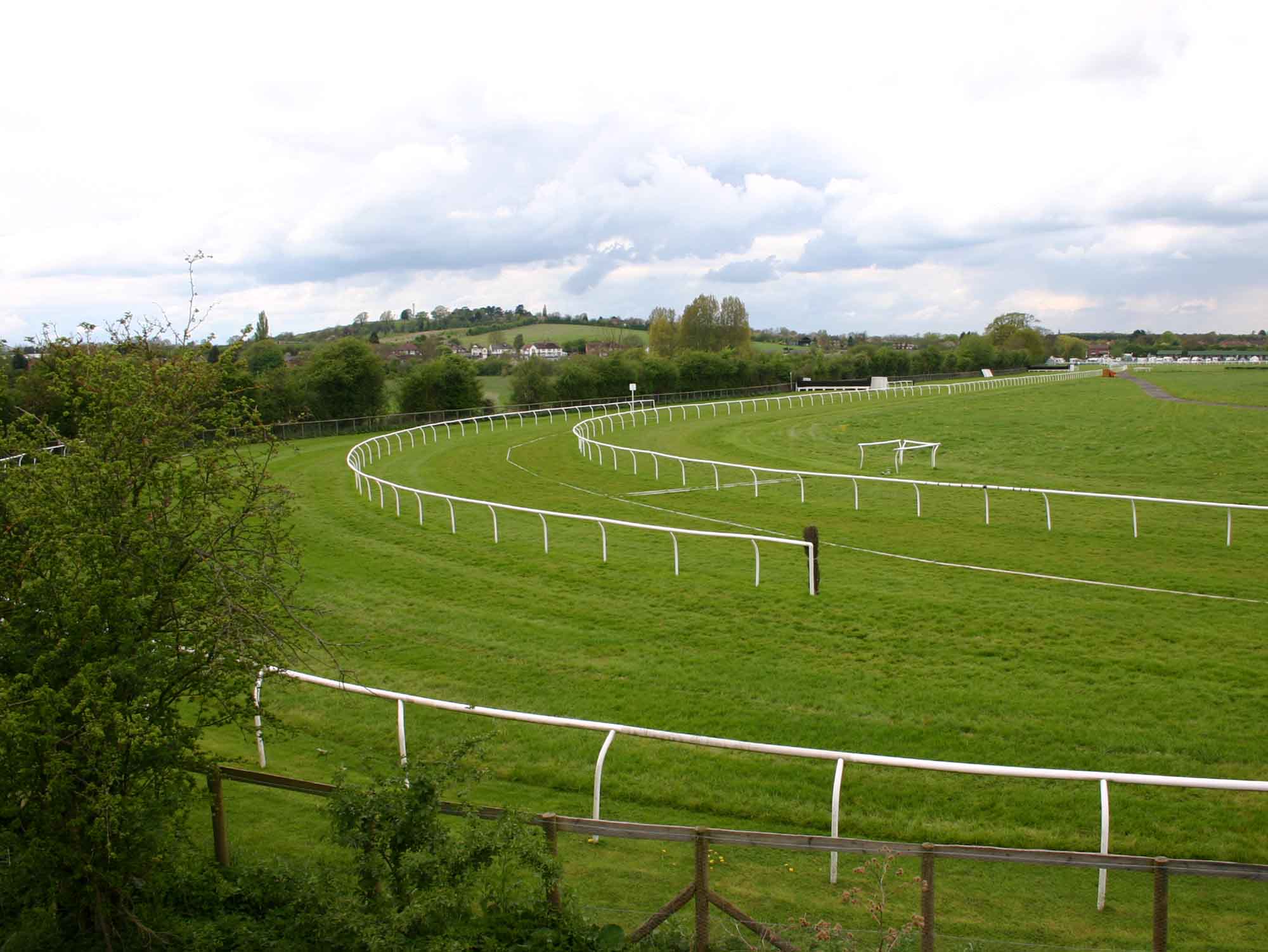
Stratford-on-Avon Racecourse: Complete Guide
Stratford-on-Avon Racecourse — Warwickshire's historic jumps venue, the Horse & Hound Cup, and over 270 years of National Hunt racing.
Read more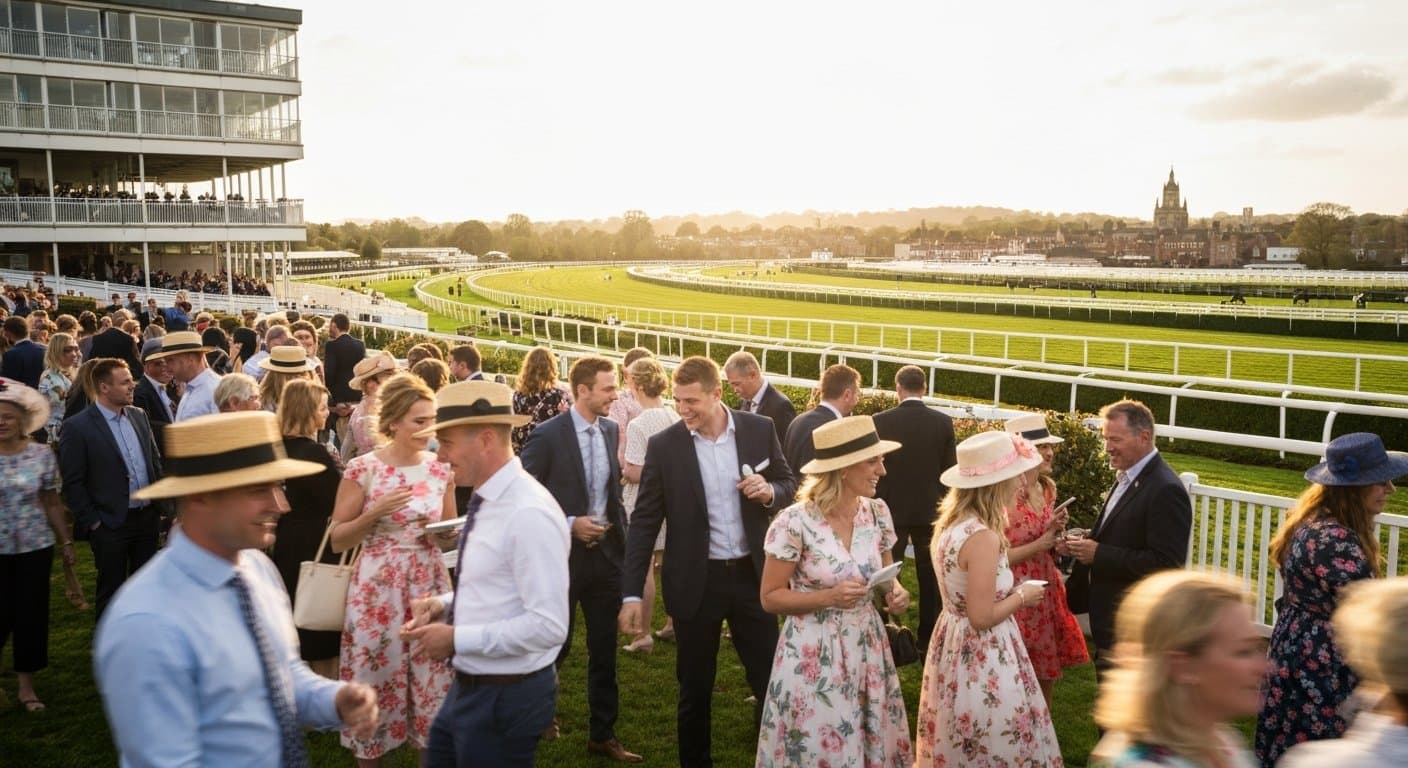
A Day Out at Stratford-on-Avon Racecourse
A day at Stratford-on-Avon — getting there, what to wear, enclosures, food and drink, and insider tips for Warwickshire's historic jumps venue.
Read moreStratford-on-Avon Festival Guide
Your complete guide to Stratford-on-Avon Racecourse — the summer jump festivals by the River Avon, the Bank Holiday meetings and what makes this Shakespeare country track one of the most picturesque in Britain.
Read morePhotos on this page are used under Creative Commons licences. Titles, sources and licence links for each one are on our image credits page.
Research the field with the AI Race Predictor
Our model publishes calibrated win-probability estimates for UK races — a second opinion to understand a race, not tips. It's open about its record: it doesn't beat the market, and we show exactly how it does.
Work it out & learn the basics
Gamble Responsibly
Gambling should be entertaining and not seen as a way to make money. Never bet more than you can afford to lose. If you or someone you know has a gambling problem, help and support is available.