
Founder & Editor · Last reviewed 2026-04-05
On a May afternoon beside the River Avon, with the smell of fresh-cut grass drifting across the parade ring and the Warwickshire countryside stretching away in every direction, Stratford Racecourse makes an argument that no fixture list or prize-money table ever could. This is summer jumping at its most unhurried and, at its best, its most atmospheric — a sport wearing short sleeves rather than overcoats, conducted in a town where William Shakespeare was born in 1564 and where the world has been coming to pay its respects ever since.
The Horse & Hound Cup, run each spring, is the race that most defines what Stratford stands for. It is one of the most prestigious hunter chases in the British calendar, drawing horses from point-to-point fields and hunting country across England and Wales. The race captures something that bigger venues struggle to replicate: the feeling that racing still belongs to the horse, the rider, and the land rather than to the television schedule. Stratford has been staging it for decades, and the event has grown into an annual checkpoint for the point-to-point community — a measure of who has produced the best horse that season.
What separates Stratford from almost every other National Hunt venue in England is its place in the calendar. Racing here runs from May to October, the months when most jumps tracks are dark and flat racing takes over the headlines. The course stages approximately 20 fixtures each year across that period, giving NH trainers a summer option that very few other venues provide. Worcester is 20 miles to the north and does similar work; Newton Abbot and Cartmel are further afield but share the summer NH identity. Stratford is part of a small and distinct group of courses that keep jumping alive when the ground firms and the evenings lengthen.
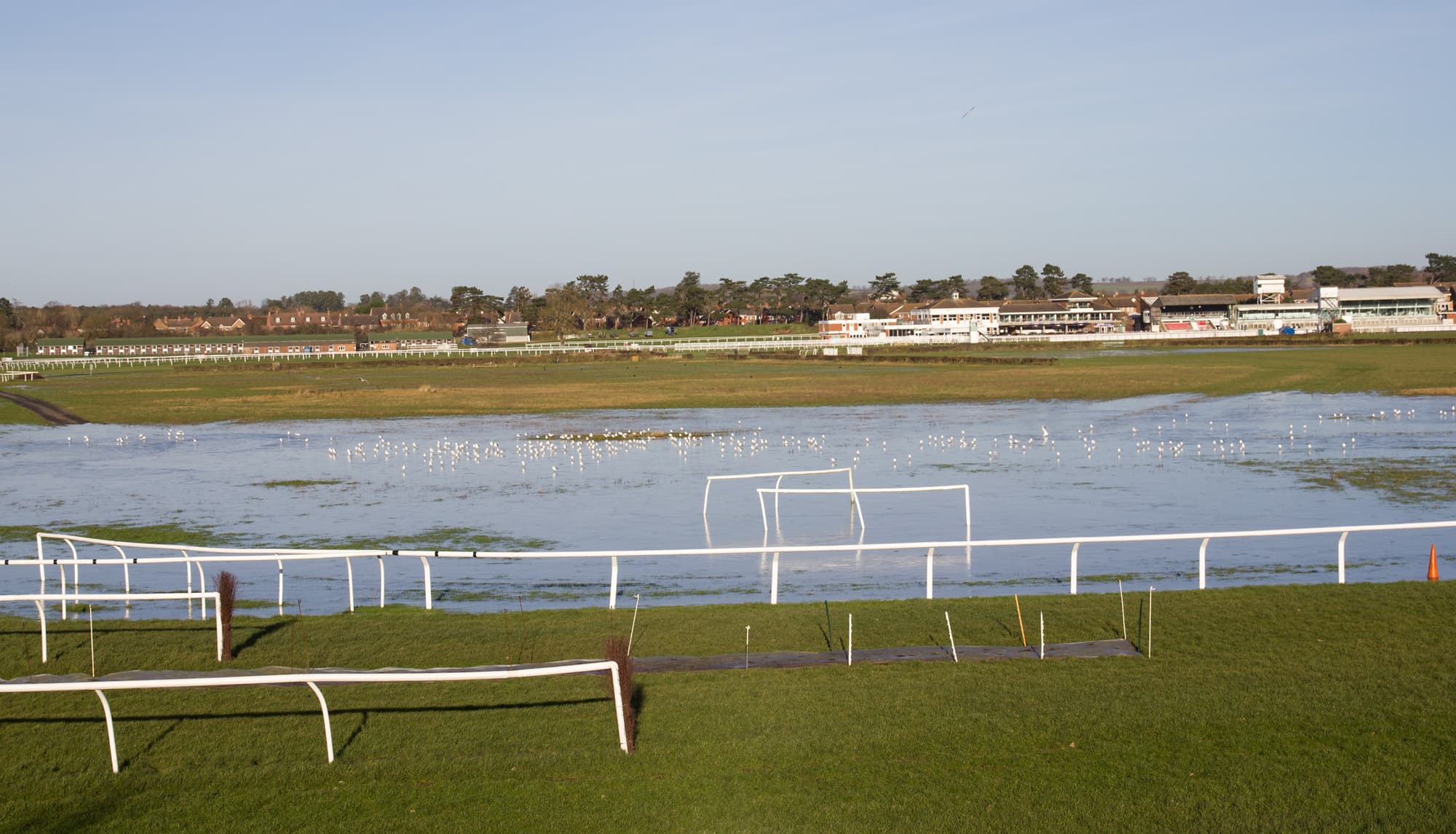
The track itself is left-handed and flat, a triangular circuit of 1 mile 2 furlongs set in the Avon flood plain on Luddington Road. The river shapes what the course can do — soft ground appears quickly when the Avon is high, and the flat nature of the terrain means horses need to sustain their effort around the entire circuit rather than finding reserves on a downhill run. It is not a track that flatters mediocrity. A horse that jumps cleanly and gallops honestly will always go well here.
Stratford-upon-Avon is, after London, the most visited town in England. The Grammar School where Shakespeare studied, Anne Hathaway's Cottage at Shottery, the Royal Shakespeare Company theatres on the riverbank — these draw millions of visitors each year from across the world. The racecourse sits about a mile from the town centre, close enough that an afternoon at the races can be part of a broader Stratford visit rather than the sole reason for the trip. That combination of cultural tourism and an afternoon's sport has given Stratford Racecourse a following that reaches well beyond the core NH racing audience.
The course was founded in 1755, which makes it one of the oldest National Hunt venues in England. That longevity is worth holding in mind as you read what follows. Most of the sport's great institutions have closed or been transformed beyond recognition in the centuries since they opened. Stratford has kept racing and kept its identity — a summer jumping course beside the Avon, in Shakespeare's town, hosting one of the finest hunter chases in the land.
Origins
Origins: Racing by the Avon from 1755
When horses first raced at Stratford-upon-Avon in 1755, the town was already known across England as the birthplace of William Shakespeare. That reputation had been building steadily since the first collected edition of the plays appeared in 1623, and by the mid-18th century Stratford had acquired the early trappings of literary tourism. David Garrick's Shakespeare Jubilee of 1769 — held just fourteen years after the racecourse opened — would cement the town's identity as a place of cultural pilgrimage, drawing visitors from London and the Continent. Racing was established on Luddington Road before all that, in a decade when Georgian England was reorganising its leisure habits and provincial towns were investing in entertainments that reflected their prosperity.
Stratford-upon-Avon in 1755 was a market town of perhaps 2,500 people, sitting at the junction of the River Avon and several important road routes through Warwickshire. The Avon was still a working commercial river at this point, navigable from Tewkesbury in the south, and the quays at Stratford handled agricultural produce from the Arden to the north and the Feldon to the south — two distinct farming landscapes that divided the county. The Arden was ancient woodland country, broken into small fields and livestock pastures; the Feldon, south of Stratford, was open champion country given over to arable farming and sheep. Both landscapes produced horses. The Feldon in particular, with its wide open strips and long-established tradition of foxhunting, created the equestrian culture that would sustain a racecourse.
The Warwickshire Hunt had been active in the county for well over a century by the time racing began at Stratford, and the North Cotswold Hunt operated across the hills to the south-west. The Atherstone Hunt, based in the north of the county, covered country that extended down toward Stratford. These hunts provided both the horses and the audience. The local gentry who turned out for the meets in November were the same men who would wager on race days in the summer, and racing in the Georgian period was as much a social occasion as a sporting one. The card would be followed by an ordinary — a set-price dinner — at one of the town's coaching inns, of which there were several given Stratford's position on the road from Oxford to Coventry.
The site on Luddington Road was chosen for its geography. The flood plain of the River Avon on the southern edge of the town provided flat, open ground that was not in agricultural use during the summer months. The triangular shape of the modern course — 1 mile 2 furlongs, left-handed — reflects the natural boundaries imposed by the river bend and the field patterns of the original site. Racing courses in this era were rarely designed by engineers; they followed the land. At Stratford, the Avon itself acted as the outer boundary on one side, which is why the circuit has its distinctive shape and why the ground can be soft even in May when the river is running high.
Early racing at Stratford followed the conventions of the time. Flat racing dominated in the Georgian period. The jumping game was only beginning to organise itself in the late 18th century — the first recorded steeplechase is generally placed in the 1790s, and the National Hunt Committee was not established until 1866. What Stratford offered in its earliest decades was flat racing on a provincial circuit, typically over heats run at two or three miles, with match races between individual horses a common feature. Prizes were modest: a King's Plate might be worth £100, and local subscription races considerably less. The horses who ran at Stratford were not the thoroughbred elite who contested the Newmarket meetings; they were working horses of quality, the sort that might pull a carriage on Monday and race on Thursday.
The Great Western Railway reached Stratford from Honeybourne in 1859, opening up the racecourse to a new audience. Before the railway, attendance at Stratford races depended on the horseback and carriage trade from the immediate area. After 1859, workers and racing fans from Birmingham — 24 miles to the north, by then a city of 300,000 people and growing — could travel south for race days. The Birmingham connection changed the demographic of the crowd. It brought a working-class racing audience alongside the hunting gentry who had always been the sport's backbone in Warwickshire.
Over the course of the 19th century, the character of racing at Stratford shifted. As National Hunt racing formalised its rules and grew in popularity after 1866, courses across the Midlands began to stage more jumping. Stratford moved in that direction gradually, adding hurdle races and steeplechases to its flat card, then reducing the flat programme as NH racing grew. By the end of the Victorian era, the course was primarily a jumps venue, though the transition was incremental rather than sudden. The river-bordered site, with its flat ground and summer availability, suited NH racing well enough — the ground was often fast in summer, which suited hurdlers and less-seasoned chasers better than the heavy winter going found at most NH venues.
The foundation of 1755 matters because it places Stratford among the oldest surviving racecourses in England. Epsom began staging the Derby in 1780; the Grand National at Aintree dates from 1839. Stratford predates both. That does not make it more important — importance in racing is measured by prize money and prestige rather than by age — but it does mean the course has witnessed more of the sport's history than almost anywhere else in the country.
The Golden Era
The Golden Era: Victorian Jumping and a Summer Identity
The Victorian period transformed National Hunt racing from an informal pastime into an organised sport with its own governing body, its own major races, and its own national calendar. The formation of the National Hunt Committee in 1866 brought standardised rules to jumping — consistent obstacles, licensed jockeys, and a recognised fixture list. Courses that had muddled through with local arrangements now had a framework to operate within, and the financial incentives for running a proper jumps programme increased. Stratford benefited from this shift and found its character in the decades between 1880 and 1914, establishing the summer NH identity that the course has maintained ever since.
The Warwickshire hunting country in the Victorian era was among the most active in England. Three hunts operated within striking distance of Stratford: the Warwickshire, the North Cotswold, and the Atherstone. Each maintained a large mounted field and produced horses of real quality. The point-to-point, then an informal inter-hunt affair rather than a formally licensed sport, provided a testing ground for young horses who might later step up to racecourse competition. Stratford sat at the centre of this equestrian world, close enough to the country of all three hunts to attract their horses and their followers.
It was out of this hunting tradition that the Horse & Hound Cup began to take shape. The race's precise origins are difficult to pin down with certainty, but its purpose was always clear: to provide a championship event for the hunter class, the horses who had been ridden through a season's hunting and were then brought to the racecourse to be tested. Hunter chases occupied a distinct place in the NH world, open to horses that had been hunted with a registered pack during that season. The skill required to produce a horse from the hunting field to the racecourse — fitting, schooling, peaking at the right moment — rewarded the amateur trainer and the hunting farmer as much as the professional yard. Stratford's spring timing for the race placed it at the end of the hunting season, when horses were at their fittest from months of hard work.
The interwar years, from 1919 to 1939, represent a period of consolidation for Stratford. Racing resumed after the First World War in 1919, and the course settled into its summer programme with a clarity of purpose it had not always had in the Victorian era. The flat racing had gone. Stratford was a jumping course, and it was a summer jumping course specifically — a distinction that mattered because most NH venues raced in autumn, winter, and early spring, leaving the months from May to September largely untouched. Stratford's summer card gave it a monopoly on NH racing in the West Midlands during the warmest months. Trainers who needed to keep horses active between the spring and autumn campaigns had few alternatives in the region, and Stratford became their default option.
The Second World War interrupted racing between 1940 and 1945. Luddington Road was not commandeered for military purposes in the way that some larger training venues were, but racing itself was suspended nationally for much of the conflict, with only a limited programme at a handful of courses kept running to maintain bloodstock. Stratford's summer card did not resume in full until 1946. When it did, the postwar audience turned out in numbers. Racing in 1946 and 1947 benefited from the pent-up demand of six years without sport, and summer meetings at a pleasant Warwickshire venue were well attended.
The proximity to Cheltenham — 24 miles south of Stratford, across the Cotswold escarpment — has always given the course a strategic role for the jumps training community. Cheltenham is the sport's cathedral, the stage that defines NH careers, and trainers who target the Festival in March often need summer runs for their horses to maintain fitness and form. Stratford provided those runs without the pressure of a winter chase. A horse that ran at Stratford in July or August, finding its stride on summer ground, could be aimed at a December target at Cheltenham with confidence that it had been properly tested. The summer circuit between Stratford, Worcester, and occasionally Ludlow gave Midlands-based trainers a viable summer pathway.
The post-war golden era also saw the rise of the Midlands NH training community. Jonjo O'Neill's base at Jackdaws Castle, near Stow-on-the-Wold in Gloucestershire, sits approximately 20 miles south of Stratford. Kim Bailey trained at Andoversford, roughly the same distance to the south-west. These yards targeted the summer programme at Stratford because it was a manageable journey and because the course suited their horses. The flat, left-handed track with its honest, galloping nature was a fair test for horses that had been trained on the undulating Cotswold hills. A horse who could handle the Stratford circuit would not be embarrassed on the more demanding terrain of winter NH racing.
By the time the 1980s arrived, Stratford had established the identity it retains today. It was a summer NH venue of mid-tier standing, distinguished by the Horse & Hound Cup and by a loyal regional following. The course was independent — not owned by the Jockey Club or by a large racing group — which gave it a character and a freedom from corporate uniformity that visitors noticed. The racing was honest, the atmosphere unhurried, and the setting beside the River Avon was as pleasant as anything the sport had to offer in the summer months.
The golden era at Stratford is not a single decade or a single set of champions. It is the accumulation of a Victorian and Edwardian character, the consolidation of the interwar years, and the post-war confidence of a course that had found its purpose and refused to abandon it.
Famous Moments
Famous Moments: The Horse & Hound Cup and Memorable Afternoons
The Horse & Hound Cup is the race that has produced Stratford's most talked-about afternoons. Run each spring, typically in late April or May, it is one of the most important hunter chases in the British calendar — a race that the point-to-point community treats as a championship event and that the hunting fraternity regards as a proper test of a season's work. The course's relationship with the race goes to the heart of what Stratford is: a venue with a specific identity in a specific corner of the sporting world, rather than a generalist track trying to be everything to everyone.
Hunter chases occupy a distinct position in NH racing. The horses who run in them have been hunted with a registered pack during the current season — a requirement that imposes a layer of practical horsemanship not asked of horses in conventional races. The rider must also qualify, typically by riding in a specified number of point-to-points. The result is a race that tests the whole picture: how well the horse has been produced from the field, how well the partnership works under racecourse conditions, and whether the horse has the speed and jumping ability to translate hunting fitness into racing performance. The Horse & Hound Cup, over an extended trip of around three miles, is as demanding a hunter chase as the calendar provides.
The point-to-point community's relationship with Stratford runs deep. The course in Warwickshire sits within the territory of several active hunts, and horses produced through the local point-to-point circuit — the Warwickshire, the North Cotswold, the Atherstone — have appeared at Stratford throughout the racecourse's history. The pipeline from the hunting field to the Horse & Hound Cup is not a theoretical one. Horses who have caught the eye in point-to-points are targeted at the race each spring, and the results of the Cup have occasionally identified horses who then go on to careers at the highest level of NH racing. A hunter chase winner who Then reaches Cheltenham or Aintree is the ideal that every yard chasing the Cup holds in mind.
AP McCoy's record at Stratford during his twenty-year career as champion jockey gives the course a place in one of the sport's great statistical stories. McCoy, who was champion jockey every year from 1996 to 2015, rode across the full spectrum of NH venues, from the major Festivals to the small summer tracks. Stratford was part of his summer circuit, and he rode winners here in numbers consistent with his dominance elsewhere. A summer afternoon at a mid-tier venue, with a modest card and a midweek crowd, was where McCoy accumulated many of the winners that kept his championship totals growing year on year. In his final season, 2014-15, he rode 231 winners to take his overall career tally to 4,348 — a figure that relied as much on the honest midweek meetings at tracks like Stratford as on the headline events at Cheltenham and Sandown.
The Shakespeare connection to Stratford Racecourse has produced its share of coincidences over the years. Horses named after the playwright's characters have appeared at the course more often than at most venues, given the local resonance of the names. Horses called Prospero, Caliban, Oberon, and variations on the Shakespearean canon have been entered at Stratford, each one carrying a small piece of the town's identity onto the track. The connections are mostly incidental, but they give the racecard at Stratford an occasional literary flavour that would be out of place at Doncaster or Wolverhampton.
One afternoon that stands out in the course's modern history came in the summer of 2008, when a competitive handicap chase on the flat Luddington Road course produced a result that illustrated both the quality of summer NH racing and the course's capacity for drama. The race that day, run over two miles five furlongs in July, was won by a Jonjo O'Neill-trained chaser that had been kept back from the spring season specifically to find summer ground. The horse, running in the colours of J.P. McManus, led from the fourth fence and held on by a neck in a finish that was settled only in the final strides. Jonjo O'Neill's Jackdaws Castle yard, operating 20 miles to the south, targeted Stratford regularly during this period, and the summer win was a typical example of how the course served as a proving ground for horses who would later be aimed at bigger targets.
Trainers with strong regional connections have always found Stratford a reliable summer option. Kim Bailey, based near Cheltenham, ran horses at Stratford through the 1990s and into the 2000s, and his record at the course reflected the care with which he selected suitable targets. Bailey understood the Stratford track — the flat circuit rewarded horses that stayed honest and jumped efficiently rather than those who could produce a short burst of speed. His winners at the course tended to be clean-jumping, front-running types who could maintain their gallop around the triangular circuit without blowing up.
The course's most enduring moment of theatre, repeated every spring, is the running of the Horse & Hound Cup itself. The parade of hunter chasers in the collecting ring before the race — horses that have spent the winter season being ridden across the fields and coverts of England, now presented in racecourse trim — is a spectacle with no equivalent in conventional NH racing. These are not animals that have been produced purely for the track. They have done other work. That background gives the race a texture and a narrative that the crowd, many of them from the hunting and point-to-point world, understands and responds to. Stratford provides the stage; the Horse & Hound Cup provides the defining moment each season.
What Stratford's famous moments share is a quality of intimacy. The course holds 5,000 people at capacity, and even a well-attended meeting has the feel of a gathering rather than a mass event. The horses are close, the crowd is attentive, and the sound of jumping carries clearly on a still summer afternoon. It is the kind of racing that produces memories not through scale but through proximity.
The Modern Era
The Modern Era: Independence, Summer Jumping, and Shakespeare's Town
Stratford-upon-Avon Racecourse Ltd has owned and operated the course as an independent company throughout the modern era, and that independence has shaped its character more than any other single factor. The two dominant forces in British racecourse ownership — the Jockey Club Racecourses and Arena Racing Company — between them control the majority of tracks in England, Scotland, and Wales. Stratford sits outside both groups. It sets its own fixture list within the BHA-regulated calendar, manages its own commercial relationships, and operates without the economies of scale or the corporate uniformity that comes with group ownership. The consequence is a course that feels like itself rather than like a branch of a larger enterprise.
The current racing programme covers approximately 20 fixtures per year, from May to October. This summer-to-autumn window is the course's defining structural feature, and it places Stratford in a small group of NH tracks that keep jumping alive when flat racing dominates the national conversation. Worcester, 20 miles north, operates a similar summer NH programme. Cartmel, in Cumbria, stages bank-holiday NH meetings through the summer. Newton Abbot, in Devon, runs through the summer as well. These tracks form an informal coalition of summer NH venues that serve a real purpose in the calendar: they keep horses, trainers, jockeys, and bookmakers active in a period when the mainstream NH circuit is at rest.
Prize money at Stratford sits at a level consistent with a mid-tier NH venue. The Horse & Hound Cup commands the largest prize in the course's calendar, and its standing as one of the premier hunter chases in Britain means it attracts entries from across the country, not just the immediate Warwickshire region. For the rest of the programme, the prizes reflect the course's scale: enough to attract a decent standard of horse in summer handicap chases and hurdles, but not the sort of money that draws the top yards away from their more valuable targets. That is not a criticism of the course; it is a realistic account of where it sits. A summer maiden hurdle at Stratford fills a role in the NH calendar, providing a starting point for unraced horses and a competitive target for improving animals who are not yet ready for the graded races.
Tourism is the other engine that drives Stratford Racecourse's modern identity. Stratford-upon-Avon receives around 4 million visitors per year, drawn by Shakespeare's birthplace on Henley Street, Anne Hathaway's Cottage at Shottery, the Grammar School on Church Street, and the three theatres of the Royal Shakespeare Company on Waterside. The RSC was founded in 1961 and has operated continuously since, staging the complete Shakespeare canon and a range of other productions each year. Its presence gives Stratford a year-round cultural audience that has no equivalent in a town the size of Stratford-upon-Avon (population approximately 30,000).
The racecourse has always drawn a portion of that tourist audience. A visitor spending two or three days in Stratford for the theatre or the Shakespeare sites who finds that there is racing at Luddington Road on a Wednesday afternoon has a reason to extend the trip or add a new activity. The overlap between cultural tourism and racing is not accidental — the course's marketing has long acknowledged it — but it is also not forced. Stratford truly is an extraordinary place to spend a day outside, and a summer afternoon at the races beside the Avon fits naturally into that context.
The hunter chase programme at Stratford extends well beyond the Horse & Hound Cup. The course stages multiple hunter chase fixtures across the season, providing a range of distances and conditions that allow the point-to-point community to target the course at different points of the spring and summer. Hunter chases at Stratford in May and June attract horses that have qualified through the winter point-to-point circuit and are ready to step up to racecourse conditions. The point-to-point to hunter chase pipeline is a well-established pathway in NH racing, and Stratford is one of the most active venues on that pipeline in the West Midlands region.
Key trainers in the modern era have tended to be based within a reasonable distance of the course. The Cotswold training community — yards based between Cheltenham, Stow-on-the-Wold, and Chipping Campden — finds Stratford a manageable target. The course is 24 miles from the Cheltenham area, accessible on the A46 and then through the Warwickshire lanes, and the journey time makes it viable for mid-tier horses who need a summer run without the cost and logistics of a longer trip. Nicholashayne-based trainers and those further west in Herefordshire use Worcester rather than Stratford as their local summer NH track, but the Warwickshire and Gloucestershire yards are Stratford's natural feeder base.
The race day experience at Stratford in the modern era is deliberately unpretentious. The capacity of around 5,000 means that even on a busy afternoon — the Horse & Hound Cup meeting, or a bank-holiday card — the course does not feel overwhelmed. The viewing from the main grandstand is clear across the flat circuit. The parade ring is accessible without a premium ticket. The atmosphere at a summer evening meeting, as the light extends past eight o'clock and the Avon catches the last of the sun, is among the most pleasant in the summer NH calendar.
Stratford's position in 2026 is secure. It has a fixture licence, a distinctive race in the Horse & Hound Cup, a natural tourism partnership with one of England's most visited towns, and an independence that gives it freedom to operate on its own terms. The modern era has not produced a dramatic reinvention of the course's purpose. It has, instead, confirmed and built on what was already there.
Stratford's Legacy
Legacy: 270 Years Beside the Avon
Stratford-on-Avon Racecourse has been staging racing since 1755, a span of more than 270 years that places it among the oldest surviving NH venues in England. Longevity of that kind is not accidental. Courses close when they lose their purpose, when their ground is sold for development, or when they can no longer attract the horses and the crowds to make racing viable. Stratford has avoided each of those fates by remaining clear about what it is and what it offers: a summer National Hunt track in Shakespeare's town, with the Horse & Hound Cup as its signature event and the River Avon as its backdrop.
The Hunter Chase programme is the core of Stratford's identity and the thread that runs most consistently through its history. Hunter chases connect the course to the Warwickshire, North Cotswold, and Atherstone hunts that have operated in this part of the Midlands for centuries. The point-to-point community, which feeds horses into the hunter chase grade, sees Stratford as a natural destination — a racecourse that understands where their horses have come from and provides conditions that suit them. The Horse & Hound Cup, the course's most important race, is their championship, and the spring meeting at which it is run is their annual gathering point.
The Shakespeare connection is part of the course's identity whether it is actively promoted or not. Visitors who have spent a morning at the Birthplace on Henley Street and an afternoon watching the RSC on Waterside find their way to Luddington Road not in spite of the cultural surroundings but as part of the same day. Racing beside the Avon in the town where the English language's most famous writer was born carries a weight that no marketing campaign can manufacture. It is simply true, and it makes Stratford a different kind of raceday experience from a visit to, say, Uttoxeter or Huntingdon.
Stratford's legacy is also the summer NH calendar itself. The course has made summer jumping viable in the West Midlands for over a century, and its fixture list — approximately 20 days from May to October — gives NH racing a presence in the region's leisure calendar during the months when most jumps tracks are dark. That fills a real gap. It keeps jockeys riding, trainers active, and NH horses in work during the long flat-racing summer. It is an unglamorous contribution to the sport's infrastructure, but a necessary one.
What endures at Stratford is something that cannot be replicated by prize-money increases or facility upgrades alone: the combination of a specific place, a specific race, and a specific time of year that has been producing racing for longer than almost any other venue in the country. The flat triangular circuit beside the Avon, the spring morning of the Horse & Hound Cup, the view from Luddington Road across the flood plain toward the town — these are fixed. They were there in 1755, they are there now, and they are the reason the course has lasted.
Frequently Asked Questions
When was Stratford Racecourse founded? Racing at Stratford-upon-Avon began in 1755, making it one of the oldest National Hunt venues in England. The course predates the Derby (first run at Epsom in 1780) and the Grand National (first run at Aintree in 1839), and has been staging racing continuously — bar wartime interruptions — for more than 270 years.
What is the Horse & Hound Cup? The Horse & Hound Cup is one of the most prestigious hunter chases in Britain, run at Stratford each spring, typically in late April or May. The race is restricted to horses that have been regularly hunted with a registered pack during the current season and to riders who have qualified through the point-to-point circuit. It is the course's most important race and a significant target for the hunter chase and point-to-point community across England and Wales.
What type of racing does Stratford stage? Stratford is a National Hunt-only course. The programme includes hurdle races, steeplechases, hunter chases, and National Hunt flat races (bumpers). The course does not stage flat racing. The season runs from May to October, giving Stratford its summer NH specialisation — one of only a handful of NH venues that race through the summer months.
Who owns Stratford Racecourse? Stratford Racecourse is owned and operated by Stratford-upon-Avon Racecourse Ltd, an independent company. The course is not part of the Jockey Club Racecourses group or the Arena Racing Company group, which between them own the majority of British racecourses. Independent ownership gives Stratford a distinct character and freedom to operate on its own terms within the BHA-regulated calendar.
How do I get to Stratford Racecourse? By rail, the nearest station is Stratford-upon-Avon, served by Chiltern Railways from London Marylebone (journey time approximately two hours) and also accessible from Birmingham via the local Stratford line. The course is on Luddington Road, approximately one mile from the town centre. By road, the most straightforward route is via the M40 (Junction 15), then the A46 towards Stratford. There is car parking at the racecourse.
What is the track like at Stratford? The circuit at Stratford is left-handed, flat, and triangular, measuring approximately 1 mile 2 furlongs. It sits in the flood plain of the River Avon on the southern edge of Stratford-upon-Avon. The flat nature of the course means there are no significant gradients to assist tiring horses, and the ground can be soft even in summer when the Avon is running high. Clean jumping and the ability to sustain galloping pace over the full circuit are the key requirements. The course address is Luddington Road, Stratford-upon-Avon, Warwickshire, CV37 9SE.
Share this article
More about this racecourse
All Stratford-on-Avon guides
Summer Jumping at Stratford: Complete Guide
Your complete guide to summer jumping at Stratford-on-Avon — the Horse & Hound Cup, key meetings, and jumps racing in the sunshine in Warwickshire.
Read more
August Bank Holiday Jump Day at Stratford-on-Avon: The Complete Guide
The complete guide to Stratford-on-Avon's August Bank Holiday Monday jump racing day — competitive summer handicaps beside the River Avon, Shakespeare country, and one of the best summer sporting occasions in England.
Read more
Horse & Hound Cup: Complete Guide
Your complete guide to the Horse & Hound Cup — Warwickshire's signature chase at Stratford-on-Avon Racecourse.
Read morePhotos on this page are used under Creative Commons licences. Titles, sources and licence links for each one are on our image credits page.
Gamble Responsibly
Gambling should be entertaining and not seen as a way to make money. Never bet more than you can afford to lose. If you or someone you know has a gambling problem, help and support is available.