
Founder & Editor · Last reviewed 2026-04-05
Introduction
Uttoxeter is the Midlands' leading National Hunt venue. It has been staging jumping since 1881, and everything about the course — the left-handed oval, the Staffordshire clay that holds water through winter, the long straight that flatters real stayers — has been shaped by that single purpose. The course sits adjacent to Uttoxeter town centre, with the railway station less than two minutes' walk from the entrance, which makes it one of the most accessible racecourses in the country for anyone travelling without a car.
The course's signature event is the Midlands Grand National, run each March over four miles and two furlongs. That distance makes it one of the longest significant jump races in the British calendar — only the Grand National at Aintree, run over four miles and two and a half furlongs, exceeds it among recognised championship races. The Midlands version is a Grade 3 handicap chase that tests stamina, soundness and jumping ability in roughly equal measure. On Midlands National day, attendance reaches 8,000 to 10,000; on regular Saturday fixtures it sits around 3,000 to 5,000. Either way, the compact layout of the stands means the atmosphere concentrates rather than disperses.
Uttoxeter sits in the broader West Midlands racing circuit alongside Warwick to the south and Huntingdon to the east, but it occupies a distinct niche within that group. Where Warwick is known for its sharp left-handed turns and Huntingdon for its flat, fast-draining track, Uttoxeter is the stamina specialist — the course that, because of its clay base and extreme-distance signature race, tells you things about a horse's constitution that no other Midlands venue can. Trainers from Jonjo O'Neill's Cotswolds yard, David Pipe's Somerset base and Philip Hobbs's Minehead operation all target Uttoxeter specifically because of what its conditions reveal about their longer-distance horses.
The course is owned by Jockey Club Racecourses, the not-for-profit group that operates 15 venues across Britain including Cheltenham, Newmarket and Sandown Park. Jockey Club ownership has brought capital investment — the grandstand has been substantially refurbished in recent years — while preserving the character of a market-town course that exists primarily to stage proper jumping. Uttoxeter does not stage Grade 1 racing; it does not need to. Its Grade 3 Midlands National, run since 1972 in its current form, is the defining event of the NH season between the Cheltenham Festival and the Aintree Grand National.
This guide is for:
- Anyone planning their first visit to Uttoxeter, whether for the Midlands Grand National or a regular winter fixture
- Punters who want to understand why this track rewards certain horse types and how ground conditions shape every race
- Groups travelling from Birmingham, Derby, Stoke-on-Trent or further afield who need practical logistics
- Racing fans who want the course's history and context — where Uttoxeter sits in the National Hunt landscape and why its signature race matters
Quick facts
| Location | Uttoxeter, Staffordshire, ST14 8BD |
| Racing type | National Hunt only |
| Established | 1881 |
| Track shape | Left-handed oval, approximately 1m4f round |
| Ownership | Jockey Club Racecourses |
| Signature race | Midlands Grand National (March, Grade 3, 4m2f) |
| Nearest station | Uttoxeter (2-minute walk to entrance) |
| Regular capacity | 3,000–5,000 |
| Midlands National day | 8,000–10,000 |
| Season | National Hunt, October–May (occasional summer fixtures) |
| Website | uttoxeter-racecourse.co.uk |
The NH season at Uttoxeter runs from October through May. The key fixtures are: the November early-season staying chase meeting, the Christmas two-day fixture on 26–27 December, the Midlands Grand National in March, and the Spring Trophy meeting in April. Summer jumping also features on selected dates from late May. The fixture list offers a full range of distances from 2 miles to 4m2f, though the course's identity and its most useful form is concentrated in the longer-distance events from 3m upward on soft or heavy ground.
The sections that follow cover the course layout and what it demands of horses, the fixtures calendar including the Christmas meeting and the Midlands Grand National, the facilities, travel from the major Midlands cities, a full FAQ, the course's history from 1881, memorable race-day moments, a detailed betting guide, and practical planning advice including what to expect from the Staffordshire weather in March.
Bet on Uttoxeter
Place your bets on Uttoxeter races with a trusted bookmaker.

Promo code BETFRED50. New customers only. Register, deposit with a Debit Card, and place a first bet of £10+ at Evens (2.0)+ on Sports, to be settled within 7 days, to get £30 in Sports Free Bets and £20 in Bet Builder Free Bets within 24 hours of settlement. 7-day expiry. Eligibility & payment exclusions apply. Full T&Cs apply. Take Time to Think. BeGambleAware.org. 18+. Full T&Cs.

Promo code R30. New UK customers only, 18+. Register, deposit £10 or more, then place a £10 single cash bet at odds of 1/2 (1.5) or greater on any sports market (excluding Virtuals). Once the qualifying bet settles you get £30 in Free Bets (3 x £10) — the qualifying bet can win or lose. Free Bets are valid on any sports market excluding Virtuals, expire in 7 days, are non-withdrawable and must be used in full. Excluded deposit methods apply (including PayPal, Apple Pay, Skrill and NETELLER). Named bets such as Lucky 15 do not qualify. If you cash out the qualifying bet, or it is voided, you are no longer eligible for the offer. Ends 31.12.26. Full T&Cs apply. Please gamble responsibly. BeGambleAware.org. 18+. Full T&Cs.

Promo code BET40GET20. New UK customers, 18+. Register with the code and place a first bet of £40 or more at Evens (2.0) or greater. Receive 2 × £10 free bets: the first credited automatically once the qualifying bet settles, the second 24 hours later. Free bets must be placed at minimum odds of 4/1 (5.0), expire 24 hours after credit, and the free-bet stake is not returned with winnings. Debit card deposits only. Take Time to Think. BeGambleAware.org. 18+. T&Cs apply. Full T&Cs.

50% of your first-day net losses refunded as a free bet, capped at £25. New UK customers aged 18+ only. To qualify, deposit and place a first bet of £10 or more on any sport at minimum odds of evens (2.00), then place at least two further bets on different events, each worth at least 50% of your largest bet, all at evens (2.00) or greater. Losses are counted from your first settled bet until 23:59 the same day. Place a qualifying £10+ bet and you are guaranteed at least a £5 free bet. Bets placed at SP, void bets, cashed-out bets and bets struck with free bets do not count towards the offer. The free bet is credited the day after your qualifying bets settle and must be used within 7 days, after which it expires. It can be used at odds from 1/4 (1.25) up to 250/1 on singles and straight accumulators, but not on Trixie, Patent or Yankee style multiples. Free-bet stake is not returned with winnings. One offer per person, household, address, IP address and device. E-wallet deposits may not qualify, so check the cashier before depositing. Customers registered with GAMSTOP cannot claim. KYC identity verification must be completed before the free bet is credited. Take Time to Think. BeGambleAware.org. 18+. T&Cs apply. Full T&Cs.

New customers, 18+. Choose the sports bonus at sign-up, make a first deposit and receive a 100% bonus up to £50 in your Sports Bonus balance. To convert the bonus to cash, wager it 10x within 30 days. Single bets below Evens (2.00) do not qualify; accumulators do not qualify if any selection is below 1/2 (1.50). Virtual Sports, voided, cancelled, drawn, cashed-out and free-bet wagers do not count towards wagering. Only the first settled bet per event counts. Withdrawing before the wagering requirement is met forfeits the bonus balance including bonus winnings. Real-money funds are used before bonus funds. Deposits via Skrill or Neteller are not eligible. Not valid in conjunction with other promotions. Odds, bet and payment limits apply. 10bet general and promotion T&Cs apply. BeGambleAware.org. 18+. Full T&Cs.

New customers in Great Britain and Republic of Ireland, 18+. Place a £10 fixed-odds qualifying bet at minimum odds of 1/2 (1.50) — single or each-way (only the win part counts), pre-event or in-play, not cashed out early, within 28 days of opening the account. Receive up to £60 in bonuses credited over three days: 3 × £10 fixed-odds free bets (the first on settlement, then 24 and 48 hours later) plus 3 × £5 Total Goals FOOTBALL spread bets and 3 × £5 racing Winning Favourites spread bets, with a £1 racing Race Index spread bet as an extra on top. The spread bets need a full spread-betting account, opened within 28 days of the fixed-odds account and subject to Spreadex's eligibility and appropriateness checks. Free-bet stakes not returned with winnings; free bets valid 28 days from issue. IMPORTANT: the £5 credits are SPREAD bets — sports spread betting carries the risk that losses can exceed your stake. Sports spread-betting customers do not have Financial Ombudsman or FSCS recourse. Take Time to Think. BeGambleAware.org. 18+. T&Cs apply. Full T&Cs.

Promo code WELCOME15, entered under My Bonuses after registering. New UK customers, 18+. Place a first qualifying bet of at least £10 from your cash balance at odds of evens (2.0) or greater within 7 days of opening the account. Once the qualifying bet fully settles you receive £15 in free bets, credited as 3 x £5 tokens with set uses: one £5 accumulator free bet (minimum 4 legs, each leg at 2/5 or bigger), one £5 sports free bet (any market at evens or bigger) and one £5 Sub Cover free bet (selected football player markets at evens or bigger). Free-bet stakes are not returned with winnings. Free bets expire 7 days after they are credited. Void, cashed-out and partially cashed-out bets do not qualify. One offer per customer. Confirm the current terms on BetGoodwin's own welcome-offer page before claiming. Take Time to Think. BeGambleAware.org. 18+. T&Cs apply. Full T&Cs.

New UK customers, 18+. Minimum deposit £10. Place a £10 qualifying single on sports (excluding virtuals) at minimum odds of 1/2 (1.50), settled within 14 days. Deposit-method exclusions apply. Receive £30 in free bets (stake not returned), split £20 for sportsbook use (2 x £10) and £10 for Bet Builder only (2 x £5); Bet Builder does not cover horse racing. Free bets must be accepted within 7 days and expire 7 days after acceptance. No promo code required. Best Odds Guaranteed on UK & Irish racing, subject to having staked over £25 in the previous seven days. Operated by LiveScore Betting and Gaming (Gibraltar) Ltd, UKGC 56859. Confirm the current terms on LiveScore Bet's own promotions page before claiming. Take Time to Think. BeGambleAware.org. 18+. T&Cs apply. Full T&Cs.
18+. BeGambleAware.org
The Course & Layout
Track Shape and Dimensions
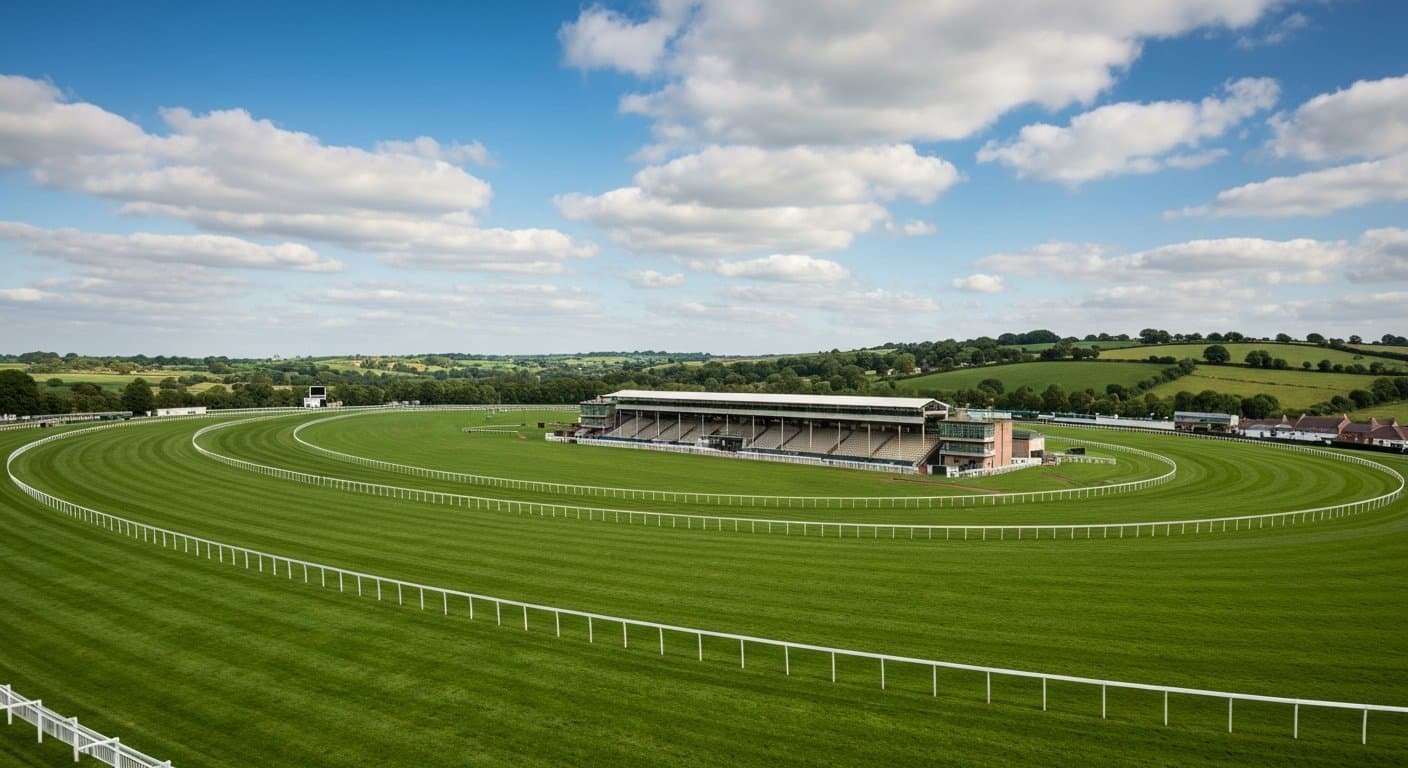
Uttoxeter is a left-handed oval of approximately one mile and four furlongs round. The circuit is longer than it looks from the stands — longer, for instance, than Huntingdon (one mile and two furlongs) and significantly longer than a tight track like Plumpton. The shape suits galloping horses rather than nippy, agile types, and the long straight of roughly four furlongs means there is a real run-in where tired horses are exposed.
The track is undulating. There is a notable downhill section as runners leave the back straight and begin to turn for home, and this gradient rewards horses that are balanced through their jumping rather than those that simply throw themselves at fences. The undulation is not on the scale of Cheltenham's infamous hill, but it is enough to matter in a long-distance race when horses are already tiring in the final mile.
The Fence Layout
On the full circuit there are ten fences for steeplechasers. The fences at Uttoxeter have a reputation for being honest rather than tricky — they are well-made and properly maintained, but they do not have the quirks of fences at courses like Haydock or the particular challenge of the cross-country obstacles at Cheltenham. What this means in practice is that errors tend to be down to jumping ability (or the lack of it) rather than the terrain playing tricks on a horse.
The layout includes a water jump, positioned in front of the stands and providing one of the best viewing points on the course, and an open ditch on the far side. Horses running the full Midlands Grand National distance of 4m2f complete approximately two circuits, meaning they encounter those ten fences twice. By the time the field turns for home in the final mile, the water jump and the ditch have already taken their toll — horses that are poor jumpers rarely complete the course cleanly.
Hurdle races use an inner course, which follows the same left-handed oval but with the hurdles positioned inside the chase course line. The standard hurdle distances are 2m, 2m4f, and 3m, providing a full range from novice hurdlers to staying handicappers.
Key Distances and What They Mean
2 miles: The minimum distance at Uttoxeter. Run on both the chase and hurdle course, 2m races here are truly competitive. The long straight means pace-setters cannot simply front-run and coast — horses are caught out if their stamina gives way in the final four furlongs.
2m4f: A middle-distance test that suits the experienced handicapper. On soft or heavy ground — which Uttoxeter carries for most of the winter — this distance becomes a proper stamina test.
3m: A staying test by any measure. Uttoxeter's 3m races regularly throw up results that surprise the market because the combination of trip, ground and the track's undulations catches out horses that have form at shorter distances or on firmer going.
3m2f: Reserved for the stronger handicap chases in the winter programme. Winners at this trip at Uttoxeter tend to be proven stayers with at least one previous run at 3m or further.
4m2f (Midlands Grand National): The defining distance of the course. This is 34 furlongs — only four furlongs shorter than the Aintree Grand National at 4m2½f. Horses that win the Midlands National do not merely stay the trip; they relish it. The race has been won by horses aged 8, 9, 10, 11 and 12, and that age profile tells you everything about what the race demands. Young chasers — even talented ones — very rarely have the physical and mental constitution to handle 4m2f on soft or heavy ground at Uttoxeter in March.
Going Tendencies
The Staffordshire clay beneath Uttoxeter's turf holds water exceptionally well. From October onwards the ground is rarely better than good to soft, and by November it is typically soft. Through December, January, February and into March, the course runs on soft or heavy going for the majority of fixtures. The Midlands Grand National has been run on soft ground more often than not since its establishment in its current form in 1972, and it has been run on heavy ground on multiple occasions.
This is not a seasonal quirk — it is a structural feature of the course. Trainers who understand Uttoxeter plan their horses' campaigns accordingly. A horse that ran well at Uttoxeter in December almost certainly has the physical constitution to handle demanding going, and that matters when assessing its prospects in the Midlands National.
Summer jumping at Uttoxeter — when the course runs occasional fixtures in May, June and July — takes place on ground that can be good to soft or good. These are the only meetings where going is not a significant negative factor for horses with limited soft-ground form.
Horse Types That Succeed
For the Midlands Grand National specifically: The profile of a typical winner is a horse aged between 8 and 12 with proven ability over 3m or further on soft or heavy ground, a clean jumping record, and a handicap mark that allows it to run off a manageable weight. Horses at the foot of the weights — carrying 10st or less — have a particularly strong record in the race because the sheer distance amplifies the effect of weight on tired horses in the final mile. Horses that are described in form guides as "not to be trusted on heavy going" or "needs quicker ground" should be opposed regardless of their other credentials.
For regular winter NH fixtures: Front-runners perform well at Uttoxeter because the honest fences and the galloping track do not disrupt their rhythm. A horse that can bowl along at the front without making jumping errors is hard to catch at Uttoxeter, particularly in handicaps where the field thins out through the race. However, the long run-in from the final fence means a front-runner needs reserves to hold on — those that win on a shortened run-in at tighter tracks sometimes get found out here.
Going specialists: Perhaps the clearest edge at Uttoxeter is horse form on real soft or heavy ground. Many form guides distinguish between "soft" and "heavy" as if they are comparable, but at Uttoxeter in January or February, heavy going means heavy going — the kind that tests lung capacity and physical strength rather than pace. Horses with a record of winning on heavy ground at other testing tracks — Chepstow, Wetherby, Exeter — are worth highlighting at Uttoxeter.
The wrong type: Lightly-framed horses that run well on good or good to firm ground rarely handle Uttoxeter in winter. Speed horses that need a fast surface to show their best are at a structural disadvantage. In the Midlands National specifically, horses that have only run over 2m or 2m4f and are stepping up in trip dramatically are extremely high-risk, regardless of their rating — the distance is not a simple extension of shorter trips but a different kind of race entirely.
Comparing to Related Courses
Uttoxeter is often grouped with Warwick and Huntingdon as a solid, mid-tier National Hunt circuit. The comparison is fair in terms of race quality, but the courses differ sharply in character. Warwick is slightly tighter with a more pronounced camber on the bend; Huntingdon is flatter and faster-draining. Uttoxeter's clay and its particular combination of undulation and long straight make it the most stamina-testing of the three. Cheltenham, the yardstick for all NH courses, has dramatic elevation changes that Uttoxeter does not replicate, but the effect of the Staffordshire clay in testing conditions is its own kind of examination.
Key Fixtures & Calendar
The Season at Uttoxeter
Uttoxeter operates as a National Hunt-only venue throughout the year. The core season runs from October to May, with the majority of fixtures concentrated in the winter months when the clay-based ground is at its most testing. Uttoxeter stages between 19 and 25 fixtures annually. The schedule divides naturally into four distinct phases, each with its own character.
The Autumn Opening: October and November
The season at Uttoxeter typically begins in late October when the going transitions from the summer dry to the first soft ground of winter. The November meeting — usually held on a Saturday in mid-November — is an important early-season fixture for staying chasers. Trainers use it to give their longer-distance horses a pipe-opener before the Christmas programme. Horses that run well here, particularly over 3m or 3m2f, are worth noting in the ante-post market for the Midlands Grand National in March.
Fields in October and November tend to include a high proportion of horses making their seasonal reappearance. First-time-out winners at Uttoxeter in autumn are rarer than at tracks with firmer autumn ground — the Staffordshire clay quickly becomes testing, and horses returning from summer breaks are not always match-sharp enough to handle it.
The Christmas Meeting: 26–27 December
The Christmas meeting at Uttoxeter is a two-day fixture held on 26 and 27 December, and it is among the best-attended regular fixtures of the year. Crowd numbers on 26 December typically reach 6,000 to 7,000. The card on Boxing Day is the stronger of the two, with a Premier Handicap Chase as the headline race. Competitive handicap hurdles fill out the supporting programme.
The Christmas meeting is a good indicator of which staying chasers are in form for the Midlands Grand National season. Trainers with horses targeting the March race frequently give them a Christmas run at Uttoxeter as a conditioning exercise. The ground in late December is reliably soft or heavy, so any horse that performs well here has already demonstrated it can handle the conditions it will face in the National.
For visitors, the Christmas meeting has a particular atmosphere — busy enough to feel lively, but not as crowded as the Midlands National. Hospitality packages sell out quickly; general admission remains available on the door for most Christmas fixtures.
The Midlands Grand National: March
The Midlands Grand National is run in March, usually on the second or third Saturday of the month. In the British jump racing calendar it stands as the most important long-distance handicap chase outside of the Cheltenham and Aintree Festivals. The race was established in its current form in 1972, originally known as the Stones Ginger Wine Chase, and has grown in standing to its current Grade 3 status.
The distance — four miles and two furlongs — is exceptional. Only the Aintree Grand National at 4m2½f, the Welsh Grand National at 3m5½f, and the Scottish Grand National at 4m (in recent runnings) approach this trip among the major staying chases. At Uttoxeter's left-handed oval, 4m2f means approximately two complete circuits and part of a third. The race takes between nine and eleven minutes to complete, depending on the going.
Field sizes for the Midlands Grand National are typically between 15 and 22 runners. With prize money of around £70,000 to the winner in recent renewals, the race attracts horses from the leading NH yards. Jonjo O'Neill, David Pipe, Philip Hobbs and Colin Tizzard have all targeted it in recent years. The BHA weight range runs from 10st 0lb to 11st 12lb, and horses at the bottom of the weights have a particularly strong strike rate — the extreme distance is a leveller.
Attendance on Midlands Grand National day reaches 8,000 to 10,000. The racecourse car park is shared between racegoers and the town centre; on National day it fills quickly. Anyone driving should aim to arrive no later than 11am for a card that typically has a first race at 1pm or 1.30pm.
The Spring Trophy Meeting: April
The Spring Trophy meeting in April is Uttoxeter's final major fixture of the standard jumping season. The card is typically built around a Grade 3 or Listed staying hurdle alongside competitive handicap chases. By April the going has often eased slightly from the worst of winter — good to soft is common — and the racing is frequently high quality.
The Spring Trophy meeting also has a practical function: it gives trainers a final opportunity to run horses before the season ends. Horses aiming at summer jumping or returning from a mid-season break appear on the card alongside regulars. The crowd is smaller than for the Christmas or Midlands National meetings — typically 2,500 to 4,000 — but the racing quality per race is among the best of the Uttoxeter year.
Summer Jumping: May to July (Selected Fixtures)
Uttoxeter is one of a small group of courses — alongside Newton Abbot and Market Rasen — that continues National Hunt racing into the warmer months. Summer fixtures at Uttoxeter run on selected Saturdays and occasional evenings from late May through July. The going in this period is typically good to soft or good, which changes the character of the racing significantly from the winter programme.
Summer jump racing at Uttoxeter attracts horses from a wider range of yards, including some that operate primarily on the flat but maintain a small NH team. Trainers use summer Uttoxeter fixtures to educate young horses — bumpers (National Hunt Flat races) appear on these cards — and to keep mid-season jumpers ticking over. Crowds are smaller: 2,000 to 3,500 is typical for a summer Saturday card.
Planning Your Visit
For the Midlands Grand National, tickets should be booked at least four to six weeks in advance. General admission typically costs between £15 and £25; Premier enclosure and hospitality packages range from £60 to £150 per person. The racecourse website lists available packages for each fixture.
For Christmas and spring fixtures, advance booking is advisable for hospitality but general admission is usually available on the day. Summer meetings are the easiest to attend without prior planning — gates open approximately 90 minutes before the first race.
Facilities & Hospitality
Enclosures and Grandstand
Uttoxeter offers three enclosures: Premier, Grandstand, and Centre Course. The Premier enclosure gives access to the best viewing positions in the main grandstand, the Premier Suite hospitality area on the first floor, and the paddock and winner's enclosure. The Grandstand enclosure covers the covered terracing of the main stand and provides a clear view of the full circuit including the final fence and the run-in. Centre Course is the general admission area, positioned on the inside of the track, which gives a different — and at some fences, closer — angle on the jumping.
The main grandstand was substantially refurbished as part of Jockey Club Racecourses' investment programme in recent years. The rebuild improved covered viewing capacity and updated the concourse areas that run along the base of the stand. The work means the facilities are Of note better than their reputation from older visits might suggest — Uttoxeter is not a scruffy course, and the grandstand holds up well against comparable mid-tier NH venues.
The paddock sits adjacent to the main grandstand and is open to all enclosures. Pre-race viewing in the paddock is one of the best free pleasures of a visit to Uttoxeter — the compact layout means you can watch the horses being saddled from close range without the crowds that make paddock viewing difficult at a Cheltenham or Newbury. The winner's enclosure is directly between the paddock and the grandstand, so the post-race presentation is easy to watch from multiple positions.
The Premier Suite
The Premier Suite is Uttoxeter's main hospitality offering, situated on the first floor of the grandstand with views across the track. It operates as a shared hospitality area on most fixtures, with tables bookable for groups from six to twelve people. On Midlands Grand National day the suite is fully subscribed weeks in advance, and all-inclusive packages — which cover admission, a set menu lunch, an afternoon buffet, a racecard, and a race-day host — represent good value compared to equivalent packages at larger venues.
Private boxes in the Staffordshire and Prince Edward Stands are available for parties of ten to twenty. These provide a dedicated space with private catering and a view of the straight. For corporate groups that want to combine racing with a working afternoon, the private boxes offer the kind of separation from the general crowd that makes conversation practical. Prices and availability are listed on the racecourse website under the hospitality section.
Food and Drink
Uttoxeter's food offering leans into regional identity more than most racecourses. The course serves Staffordshire oatcakes — a thick, savoury pancake made from oatmeal that is distinctive to North Staffordshire — alongside the Staffordshire pies that are a regional staple at market town events. These are not token gestures; the oatcake stall in particular is well-regarded and draws queues on busy fixtures. For visitors from outside the county, it is worth trying — oatcakes with cheese and bacon are a proper cold-weather raceday meal.
The 1907 Restaurant — named in reference to the year the course claims as its modern founding — offers a sit-down lunch service in the hospitality areas, with a set menu that typically features three courses and a regional focus. Booking is required and the restaurant is open on most Saturday fixtures. For casual eating, Wright's Pie and Fish and Chip stall operates track-side with a full range of hot food. Marston's Bar is the primary drinks outlet in the grandstand, serving ales and lagers from the Burton-on-Trent brewing tradition — Uttoxeter sits in the shadow of one of England's great brewing regions and the draught ale selection reflects that.
Kiosks around the course sell hot drinks, soft drinks, sandwiches and fast food. The distribution is adequate for regular fixture sizes; on Midlands National day the queues at popular outlets can be significant around the 30 minutes before the big race, so it is worth eating and drinking before the card reaches its peak.
Betting Ring and Tote
The betting ring at Uttoxeter operates with a standard rail bookmaker layout alongside the Tote. The number of rails bookmakers on course varies by fixture: the Midlands Grand National typically attracts 20 or more pitches; weekday and summer fixtures may have fewer than ten. The ring is positioned alongside the track between the grandstand and the straight, which means racegoers can watch the early stages of each race from the ring itself.
The Tote operates on-course with win, each-way, forecast and jackpot pools. Tote pools at Uttoxeter are smaller than at the major venues — the jackpot has paid out at substantial odds on several occasions when no one has selected all six winners.
Children, Disabled Access and Dogs
Children under 18 are admitted free of charge to Uttoxeter on all fixtures. The course has a dedicated family area with a children's activity zone that runs on major race days, including a carousel and a supervised play area. Uttoxeter is generally considered one of the more family-friendly NH courses in the Midlands, and the atmosphere — particularly at Christmas and Midlands National fixtures — is welcoming to younger visitors.
Disabled access at Uttoxeter has improved significantly following the recent investment programme. There is step-free access to the main grandstand via ramps and a lift to the first floor. Dedicated viewing areas for wheelchair users are positioned at ground level with clear sightlines to the track and the final fence. Disabled parking spaces are available close to the main entrance and are signposted from the car park entrance. The course recommends contacting them in advance for Midlands National day to ensure a suitable space.
Dogs are not permitted in most areas of the course on race days, with the exception of guide dogs. The policy is consistent with Jockey Club Racecourses' standard approach across all their venues.
Getting to Uttoxeter
By Train — The Best Option from the Major Midlands Cities
Uttoxeter station is positioned directly adjacent to the racecourse. The walk from the platform to the course entrance is approximately two minutes. This is one of the few racecourses in Britain where you step off the train and walk straight in — there is no taxi rank, no shuttle bus, no 20-minute walk along a country lane. The station and the racecourse are essentially neighbours.
The station is served by the Crewe to Derby line, which gives direct access from three major cities:
- Derby: 20 minutes, with services running roughly hourly on weekdays and on race Saturdays. From Derby you can connect to the East Midlands mainline (trains from London St Pancras reach Derby in approximately 1 hour 30 minutes).
- Stoke-on-Trent: 20 minutes, with the same line running westward. Stoke connects to the West Coast Main Line, giving access from London Euston (1 hour 40 minutes to Stoke) and from Manchester Piccadilly (40 minutes to Stoke).
- Birmingham New Street: The most common approach for Midlands visitors. There is no direct train — you change at Derby, giving a total journey of approximately 50 minutes from Birmingham New Street to Uttoxeter station (40 minutes Birmingham to Derby, then 20 minutes Derby to Uttoxeter, with connection time). On race Saturdays, train services on the Crewe–Derby line run to accommodate race traffic, but check the timetable in advance on the National Rail website for specific departure times.
On Midlands Grand National day, trains from Derby and Stoke are busy. The 30 to 45 minutes before the first race sees the heaviest passenger load. Booking a specific train in advance is not necessary — services are not reservation-only — but arriving at the station slightly ahead of peak times reduces queuing on the platform.
By Car
Uttoxeter sits at the intersection of two A-roads that connect it to the major Midlands cities.
From Birmingham (approximately 40 miles, 50–60 minutes): Take the A38 north from Birmingham to Burton-on-Trent, then join the A50 eastbound — but you only need a short stretch of the A50 before taking the A518 northwest to Uttoxeter. Alternatively, take the A38 to Lichfield and then the A515 north to Uttoxeter. Both routes work; sat-nav is recommended as the road layout around Burton-on-Trent can be confusing at the A38/A50 interchange.
From Derby (approximately 14 miles, 25 minutes): Take the A516 west from Derby, which connects to the A50, then the A518 northwest into Uttoxeter. The most direct and straightforward approach.
From Stoke-on-Trent (approximately 20 miles, 30 minutes): Take the A50 east from Stoke to its junction with the A518, then follow the A518 southeast into Uttoxeter.
From Stafford (approximately 16 miles, 25 minutes): Take the A518 northeast directly to Uttoxeter. This is the most direct route and the A518 is well-signposted throughout.
Sat-nav postcode: ST14 8BD. The course is well-signposted from the A518 and A50 on race days, with temporary road signs directing traffic from the main approach roads.
Parking
There is a large free car park at the racecourse. On most fixtures, parking is straightforward — arrive within 90 minutes of the first race and you will find a space without difficulty. On Midlands Grand National day, the car park fills from approximately 10am, and latecomers are directed to overflow parking in the town centre, which adds a 10 to 15-minute walk. Arriving by 11am for a 1pm or 1.30pm first race is strongly advised on National day.
The main car park is shared between the racecourse and the Uttoxeter town centre market on non-racedays. On racedays it is allocated entirely to the course.
From Further Afield
From London: Train to Derby from St Pancras (East Midlands Railway, approximately 1 hour 30 minutes), then change for Uttoxeter (20 minutes). Total journey approximately 2 hours including connection time. Or train to Stoke from Euston (Avanti West Coast, approximately 1 hour 40 minutes), then change for Uttoxeter (20 minutes).
From Manchester: Train from Manchester Piccadilly to Stoke-on-Trent (approximately 40 minutes), then change for Uttoxeter (20 minutes). Total journey under 70 minutes.
From Nottingham: Train to Derby (approximately 30 minutes), then change for Uttoxeter (20 minutes). Total journey approximately 55 minutes.
The train remains the best option for any visitor travelling from a city with a reasonable service to Derby or Stoke. Driving to Uttoxeter is straightforward, but the proximity of the station to the entrance makes rail travel unusually convenient — and removes the parking headache on the busiest fixture days.
Frequently Asked Questions
History of Uttoxeter Racecourse
Origins: 1881 and the Staffordshire Racing Tradition
Racing at Uttoxeter has been documented since 1881, when the course was established on the plain to the east of the market town. The location was practical: the flat pasture land along the River Dove offered natural drainage by Staffordshire standards, the town was well connected by the newly extended Churnet Valley Railway, and the agricultural community of the region had a long tradition of horse breeding and dealing. The course that opened in 1881 was a modest circuit by the standards of the era — a rural track serving a rural community, dependent on the local landowner and farming network for its horses and its crowd.
The early decades of racing at Uttoxeter were predominantly summer flat racing. National Hunt racing as a formal, regulated discipline was still establishing itself in the late Victorian period, and many provincial courses ran a mixture of flat races, hurdles and early chase events that would be barely recognisable to a modern racegoer. Uttoxeter followed this pattern through the 1880s and 1890s, staging a modest annual programme of mixed racing.
The Shift to National Hunt
The transition to a purely National Hunt track was gradual. By the early 20th century, the Midlands region had a well-established circuit of NH venues — Warwick to the south, Leicester to the east, Wolverhampton before it closed its jumps programme, and smaller tracks at Stafford and Stone that no longer exist. Within this network, Uttoxeter found its identity as a stamina track. The Staffordshire clay that makes the ground testing in winter proved to be an advantage for a NH venue: trainers who needed a real test for staying chasers and long-distance hurdlers found Uttoxeter a reliable option.
The year 1907 has been used by the course itself as a reference date for its modern establishment — the 1907 Restaurant takes its name from this year — though records of racing at Uttoxeter pre-date this by more than two decades. The distinction probably relates to the formal reorganisation of the course management and infrastructure in the early 20th century rather than the first running of a race meeting.
Jockey Club Racecourses acquired Uttoxeter as part of its portfolio of mid-tier NH venues. Jockey Club Racecourses is the largest commercial racecourse group in Britain, operating 15 venues including Cheltenham, Newmarket, and Sandown Park alongside the smaller regional tracks. Under Jockey Club ownership, Uttoxeter has benefited from the capital investment that a large organisation can direct — the recent grandstand refurbishment is the most visible example — while retaining the local character of a Staffordshire market-town course.
The Midlands Grand National: Establishment and Growth
The race now known as the Midlands Grand National was first run in 1972 under the name the Stones Ginger Wine Chase. Its establishment reflected a broader trend in British NH racing in the early 1970s: the sport was actively trying to develop regional championship races that could compete for interest with the major Festival and Grand National fixtures. A staying chase over a distance comparable to the Aintree race was an obvious candidate for Uttoxeter, given the course's natural affinity for long-distance jumping.
The race was run at a variety of distances in its early years before settling at four miles and two furlongs. Prize money grew gradually through the 1970s and 1980s as the race attracted better horses. Its rebranding as the Midlands Grand National — a straightforward appeal to the Aintree race's reputation — came later, and the Grade 3 status it now carries reflects the Handicapper's recognition of the race's quality.
Trainers Associated with Uttoxeter
The course has historically attracted horses from Midlands and West Country yards. Jonjo O'Neill, whose Jackdaws Castle yard is situated in the Cotswolds near Cheltenham, has been among the most successful trainers at Uttoxeter over the past three decades. O'Neill's record in the Midlands Grand National specifically is strong — his yard targets the race with horses that have been campaigned over long distances and proved on soft ground.
Kim Bailey, whose yard is in Lambourn, has run strong teams at Uttoxeter's winter fixtures. David Pipe, based in Somerset, has sent horses north for the Midlands National on multiple occasions. Philip Hobbs, another West Country trainer, has a long-standing record at the course. The pattern — leading West Country trainers targeting Uttoxeter's signature race — reflects the fact that Uttoxeter's going conditions in March closely resemble the testing ground at courses like Chepstow and Exeter in winter, which these yards know well.
Local Midlands handlers form the backbone of Uttoxeter's regular programme. Smaller yards based in Staffordshire, Derbyshire and Warwickshire provide horses for the weekday and lower-grade Saturday fixtures throughout the season. These trainers know the track intimately and often produce horses that outperform their ratings at Uttoxeter, particularly on testing ground in the back half of the season.
The Course Today
Uttoxeter remains among the top 20 NH venues in Britain by prize money distribution. It is not a Festival track — Grade 1 racing has never been staged here — but its Grade 3 programme and the quality of the Midlands Grand National place it well above the lowest tier of NH courses. Under Jockey Club management, the fixture list has been structured to avoid clashes with major Festival dates while providing a coherent programme from October through May.
The course's identity is firmly rooted in its signature race. In a National Hunt landscape where many courses have broadly similar programmes of 2m to 3m handicap chases and novice hurdles, Uttoxeter's 4m2f flagship event gives it a distinct character that no other Midlands course can replicate.
Famous Moments
The Midlands Grand National as a Stayer's Graveyard
The phrase most commonly attached to the Midlands Grand National at Uttoxeter is that it sorts the real stayers from the pretenders. The four miles and two furlongs, the Staffordshire clay going heavy by March, and the accumulated jumping effort of two full circuits combine to produce a race that regularly confounds market expectations. Horses that arrive as clear favourites based on 2m or 2m4f form find the final mile at Uttoxeter unlike anything in their experience. The race does not merely reward stamina — it punishes its absence with a brutality that shorter distances conceal.
This has produced, over the course of the race's history since 1972, a pattern of results that no other comparable race in the calendar matches. The Midlands Grand National favourite has won at a rate well below that of favourites at standard handicap chases. The field thins through errors and fatigue, and the horse that completes the course most cleanly — not necessarily the fastest or the highest-rated — tends to prevail.
Lord Gyllene and the Aintree Connection
The most celebrated individual associated with the Midlands Grand National trail is Lord Gyllene, trained by Steve Brookshaw, who won the Aintree Grand National in 1997. Lord Gyllene's preparation for Aintree included a run at Uttoxeter, and his success at the Staffordshire course over a long trip on testing ground was cited as evidence that he could handle the similar demands of Aintree the following month. He started 5–1 favourite at Aintree and won by 25 lengths.
Rag Trade, the 1976 Aintree Grand National winner trained by Fred Rimell, also had Uttoxeter form in his record. The connection between the Midlands National trip and the Aintree preparation is not incidental: trainers understood from the early years of the race that a horse which could win or perform well at Uttoxeter in March had demonstrated the particular constitution — stamina, sound jumping, physical durability — that Aintree demands.
Dramatic Renewals
The Midlands Grand National's most dramatic finishes tend to involve the attrition of a large field over the extreme distance. In races where 18 or 20 runners start, it is not unusual for fewer than 10 to complete the course cleanly. Fallers, unseated riders, horses pulled up by their jockeys when tiring dangerously — the toll of 4m2f on horses at the lower end of fitness is significant. Races where a decisive leader has opened up a clear advantage by the third mile, only to be collared in the final two furlongs by a fresh-legged chaser that has tracked the pace without ever appearing prominent, are a recurring feature of the race's history.
The 1995 running saw the race won in near-dark conditions in late afternoon, the field having been reduced to a handful of finishers by the demands of heavy ground. The winning trainer described the conditions as the most testing he had encountered at any course outside Cheltenham on an extreme winter day.
Notable Horses Developed at Uttoxeter
The course's role in the wider NH calendar extends beyond the Midlands National itself. Uttoxeter's winter programme has provided formative experience for a number of horses that Then reached Festival level at Cheltenham or performed at Grade 1 meetings. The common thread is the ground: horses that showed ability at Uttoxeter in December and January, on soft or heavy going, and then went on to perform at the Cheltenham Festival in March, had demonstrated a key attribute. The Cheltenham Festival is invariably run on ground that can range from good to soft to very testing — soft Staffordshire preparation gives trainers real data.
Novice chasers that win their first chase at Uttoxeter in October or November on soft ground have a well-documented advantage in the subsequent season over horses that have only run on good or good to soft surfaces. This is not unique to Uttoxeter — any soft-ground track provides the same evidence — but Uttoxeter's October meetings, when the ground first turns, attract a high volume of early-season novice chasers from leading yards, which gives the form a wider significance than it would carry from a smaller or more remote venue.
The Christmas Meeting's Memorable Races
Boxing Day at Uttoxeter has produced several competitive handicap chases that served as form markers for the season. The Christmas meeting's headline race — a Premier Handicap Chase over 3m or 3m2f — has been won by horses that Then finished in the frame at the Cheltenham Festival or won at Grade 2 level later in the season. The race's usefulness as a form guide is amplified by the going: reliable soft or heavy conditions on 26 December at Uttoxeter mean the form is comparable to the conditions at the later major meetings.
The Course's Identity
What Uttoxeter's race history collectively demonstrates is the value of an honest, stamina-testing track. The course does not have the prestige of Cheltenham or the glamour of Sandown Park, but its contribution to the NH landscape — principally through the Midlands Grand National but also through its winter programme — is that it provides a reliable, conditions-based filter. Horses that handle Uttoxeter's clay in March are horses built for the harder end of the National Hunt season. That is the course's lasting contribution to the sport.
Betting Guide
The Midlands Grand National: The Key Betting Event
The Midlands Grand National at Uttoxeter in March is the most significant betting event the course stages. It is also one of the most distinctive betting puzzles in the jump racing calendar. The four miles and two furlongs trip, the near-certain heavy or soft going, and the profile of horses that can handle both combine to produce a race where form analysis from shorter distances or firmer ground is largely irrelevant. Applying standard handicap chase betting logic to the Midlands Grand National produces losing results; applying the race's specific filters significantly improves strike rates.
Factor One: Going
The single most important factor in the Midlands Grand National is ground conditions. The race has been run on soft or heavy going in the overwhelming majority of renewals since 1972. The Staffordshire clay holds water from autumn through spring, and by March the course is almost invariably testing.
The practical implication is straightforward: horses whose form guides contain any phrase indicating uncertainty on heavy ground — "not to be trusted on heavy", "best on good ground", "form tails off in winter" — should be opposed regardless of their rating, their trainer, or their recent form. The Midlands National does not reward ability over 3m on good to soft going; it rewards ability over 4m2f in mud. These are not the same attribute.
Horses to focus on are those with explicit heavy-ground wins on their record, ideally at 3m or further. A horse with two wins on heavy going at Chepstow or Exeter over 3m is a better starting point for Midlands National research than a higher-rated horse whose best form has come on quick summer ground.
Check the official going report from Tuesday of race week through to Friday morning. The BHA updates Uttoxeter's going description daily in the build-up to the race. If the going moves from soft to heavy following late rainfall, horses with heavy-ground form improve in the market relative to their true probability — the market often underreacts to a going change that makes the race significantly harder.
Factor Two: Age
In the Midlands Grand National, horses aged 8 to 12 win at rates substantially above expectation. This is not a marginal effect — it is one of the most reliable age-profile patterns in jump racing. Younger horses (6 and 7 year olds, even well-regarded ones) rarely have the accumulated jumping experience and physical durability to handle 4m2f at Uttoxeter on heavy ground in March. They may have the rating; they typically lack the constitution.
The reason is straightforward. At 4m2f on testing ground, the race is partly about jumping efficiency accumulated over many chase runs. A horse that has completed 15 to 20 steeplechases over its career — the profile of a typical 9 or 10-year-old targetting a race of this type — conserves energy through its jumping in a way that a lightly-raced 6-year-old, however talented, cannot yet replicate.
Do not dismiss an older horse (11 or 12) on grounds of age alone in this race. A 12-year-old with clean jumping, good soft-ground form, and a low weight has won the Midlands Grand National and will do so again.
Factor Three: Trainer Patterns
Jonjo O'Neill (Jackdaws Castle, Gloucestershire) has one of the strongest records in the race among leading trainers. O'Neill campaigns his horses over long trips and regularly targets the Midlands National as a preparation race for Aintree or as a target in its own right. His runners at Uttoxeter are worth noting in the ante-post market, particularly horses that have been freshened after a mid-season break and are returning specifically for this race.
David Pipe (Nicolashayne, Somerset) has targeted the Midlands National over multiple seasons. Pipe's record in long-distance staying chases on testing ground is strong across his career, and the family tradition — his father Martin Pipe was the most successful NH trainer of his era — includes a deep understanding of how to prepare horses for extreme distances.
Philip Hobbs (Minehead, Somerset) has won the race and consistently runs strong teams. Colin Tizzard (Sherborne, Dorset) — or, since 2022, his son Joe Tizzard taking over the licence — has produced Midlands National runners with an above-average strike rate.
A trainer pattern to note across all fixtures at Uttoxeter, not just the National: local and Midlands-based handlers whose horses have run at the track before tend to outperform their overall form figures at Uttoxeter specifically. Track familiarity matters at a clay-based course with specific going characteristics.
Factor Four: Favourites and Market Efficiency
Favourites in the Midlands Grand National win at a below-average rate compared to favourites in standard handicap chases. This is a documented feature of the race over its history since 1972. The explanation is the same as the age-profile pattern: the race's specific demands — 4m2f, heavy going, twice round — expose horses whose ratings were earned under different conditions.
This does not mean backing long-priced outsiders blindly. It means that in the Midlands National, the favourite should be assessed against the going and age filters before any consideration is given to its racing credentials. A favourite that is 6 years old and has its best form on good to soft ground fails both the primary filters and should be opposed actively, even if it starts at 2–1.
For each-way betting in the Midlands National, the race's attrition rate — a significant proportion of starters fail to complete the course — means that horses finishing in the first four (standard each-way terms for a field of 12 or more) often do so having stayed on past beaten, tired opponents. An each-way play on a horse at 12–1 or 16–1 that fits the going and age profile, trained by a handler with a Uttoxeter record, represents the structural opportunity the race's market inefficiency creates.
Regular Winter NH Fixtures: Key Principles
For Uttoxeter's regular winter programme, two patterns stand out above others.
Front-runners on the honest track. The fence layout at Uttoxeter — ten well-made fences round a galloping oval with a long straight — does not punish horses that set their own pace. A horse that can bowl along at the front, jump cleanly, and maintains its momentum through the downhill section into the back straight is difficult to catch. Front-runners at Uttoxeter in winter, on soft or heavy going, have a strong statistical record in handicap chases from 2m4f to 3m2f. The long four-furlong run-in from the final fence is the one check on this — a front-runner needs reserves to hold a challenge in the straight.
Going specialists in handicap hurdles. The same clay-going principle that applies to the chases applies to hurdles. Horses with heavy-ground form in handicap hurdles over 2m4f and 3m at Uttoxeter from November to February regularly outperform their SP. The market consistently underrates soft-ground specialists in lower-grade hurdle handicaps, partly because form figures from summer good-ground racing dominate the ratings.
Ante-Post Strategy for the Midlands Grand National
Ante-post markets for the Midlands Grand National open in November and December. The value window for ante-post betting is typically January and February — after the Christmas meeting has provided form guidance on potential runners, and before the March race brings the short-price punters into the market. Horses that ran well at Uttoxeter at the Christmas meeting on testing ground and have been freshened for the National are worth tracking from early January. If the going forecast for the race week suggests heavy conditions, ante-post prices on proven heavy-ground stayers shorten quickly once the weather becomes a story — getting on before that happens is where the value lies.
Atmosphere & Visitor Planning
Uttoxeter Town and the Racecourse
Uttoxeter is a market town of approximately 13,000 people on the southern edge of the Staffordshire Moorlands. The town has a compact centre — a market square, a modest high street, and the Charter Street market that has operated on the same site since the 13th century — and the racecourse is integral to town life in a way that is less common at larger venues where the track sits at a distance. On race Saturdays, the town centre and the course share their main car park, and the proximity of the station to both the course entrance and the town square means that on Midlands National day the streets between them carry a steady flow of racegoers.
The town is a practical base rather than a destination in its own right. There are hotels — the White Hart is the most central — and a reasonable range of pubs, including the Roebuck on High Street, which fills quickly after races. Booking a table for dinner after a winter race meeting, particularly after the Midlands National, requires forward planning; the town's restaurants are small and the post-race influx from 10,000 people creates queues at every venue within walking distance.
What to Expect on Midlands National Day
The atmosphere at Uttoxeter's Midlands Grand National is defined by the conditions. The race is always in March; March in Staffordshire is cold, frequently wet, and invariably muddy. The going on the track is heavy or soft — as described in the course guide — and the conditions underfoot in the general enclosure and the outdoor areas around the stands reflect this. Wellies are not worn ironically at Uttoxeter in March; they are worn because the grass areas between the car park and the stands are soft, and standing in them for six hours in leather shoes is a mistake.
The crowd on National day — 8,000 to 10,000 — is larger than at any other Uttoxeter fixture, and the concentration of that crowd in a compact grandstand produces a notable level of noise and energy for a course of this size. The atmosphere is closest in spirit to the middle-tier Festival days at Cheltenham or a busy Boxing Day at a regional NH course: real racing crowd, majority National Hunt fans who know the sport, mix of local Staffordshire racegoers and visitors from Birmingham, Derby, Stoke and further afield.
The race itself — run in the middle of the card, typically as the third or fourth race of the afternoon — generates the kind of sustained communal tension that only a very long race can produce. The first circuit is tactical; the second circuit sorts the field; the final mile is where the race is won and lost. If you have not watched a four-mile chase before, the experience of tracking a large field through two circuits at Uttoxeter is a reasonable introduction to what the Aintree Grand National feels like from the stands.
Combining with Nearby Attractions
The Staffordshire Moorlands begin approximately 12 miles north of Uttoxeter, and the Peak District National Park boundary is within 15 to 20 miles. Dovedale — the limestone gorge on the River Dove, which forms the Derbyshire–Staffordshire border — is 15 miles north and is one of the most visited walking sites in the Peak District. The Manifold Valley, a quieter parallel valley, is approximately 18 miles north. For visitors staying for a weekend, combining a Saturday race meeting at Uttoxeter with a Sunday walk in Dovedale or the Manifold Valley is a natural pairing.
Alton Towers theme park is 10 miles north of Uttoxeter on the B5032. For families visiting with children, a Saturday race meeting at Uttoxeter followed by a Sunday at Alton Towers is an efficient two-day trip from Birmingham, Derby, or the East Midlands. The two venues are close enough that a single accommodation base in Uttoxeter or the surrounding villages serves both. The combination works particularly well in spring and early summer when Uttoxeter's season is finishing and Alton Towers is running at full capacity.
Burton-on-Trent, 14 miles south of Uttoxeter, is the historical centre of British brewing — Bass, Carling and Marston's all have roots in the town. The National Brewery Centre in Burton is open most days and covers the industrial brewing history of the region. It is a reasonable half-day option for anyone arriving early or leaving the following day.
Practical Planning Notes
Accommodation: Uttoxeter is small. For major fixtures, particularly the Midlands National, accommodation in the town itself sells out months in advance. Burton-on-Trent (14 miles), Derby (16 miles), and Stafford (16 miles) all have substantially more hotel capacity and are straightforward to travel from by car or train on race day.
Dress for the weather: The consistent advice for any Uttoxeter visit from October to March is to dress for cold and wet conditions and be pleasantly surprised if it stays dry. The course's exposed position on the Staffordshire plain means wind is a factor even when rain is not. In March specifically, a waterproof outer layer, warm mid-layers, and footwear that handles wet grass are the baseline. The atmosphere inside the grandstand's covered areas is warm enough, but the walk from car park to stands and time spent watching races from open-air positions requires proper preparation.
Timing: For the Midlands National, gates open from approximately 10.30am. The first race is typically 1pm or 1.30pm. The National itself is the third or fourth race, running between 2.30pm and 3.30pm depending on the card. Most visitors stay for the full card, which finishes around 5pm. The last race is usually around 4.45pm, with adequate daylight in March.
Town centre after racing: The 20-minute walk from the course through the town centre to the far end of the high street covers most of what Uttoxeter offers. On National day, the pubs and the town square are busy from 5pm onwards. The train back to Derby or Stoke departs from the station adjacent to the course — check the last service time before travelling, particularly if you intend to stay in the town for the evening.
More guides for this course
Share this article
More about this racecourse
All Uttoxeter guides
A Day Out at Uttoxeter Racecourse
Everything you need for a day at Uttoxeter — getting there, what to wear, enclosures, food and drink, and tips.
Read moreUttoxeter Festival Guide
Your complete guide to Uttoxeter Racecourse festivals — the Midlands Grand National, the Summer Jump Spectacular and what makes this Staffordshire track one of the Midlands' best jump venues.
Read more
The History of Uttoxeter Racecourse
From Edwardian beginnings to home of the Midlands Grand National — the story of Uttoxeter Racecourse.
Read morePhotos on this page are used under Creative Commons licences. Titles, sources and licence links for each one are on our image credits page.
Research the field with the AI Race Predictor
Our model publishes calibrated win-probability estimates for UK races — a second opinion to understand a race, not tips. It's open about its record: it doesn't beat the market, and we show exactly how it does.
Work it out & learn the basics
Gamble Responsibly
Gambling should be entertaining and not seen as a way to make money. Never bet more than you can afford to lose. If you or someone you know has a gambling problem, help and support is available.