
Founder & Editor · Last reviewed 2026-04-05
Picture the scene on an August Bank Holiday Saturday. The village of Cartmel — population roughly 1,500, a place where you know every shopkeeper by name — is carrying something like 20,000 people. They are packed into the racecourse meadow, queuing at the sticky toffee pudding stall by the village square, jostling for space in the pub gardens along Cavendish Street, and spilling up the lane past Cartmel Priory, whose distinctive offset tower has watched over this ground since 1190. It is not Cheltenham. It is not Ascot. It is something far stranger, and for many people, far better.
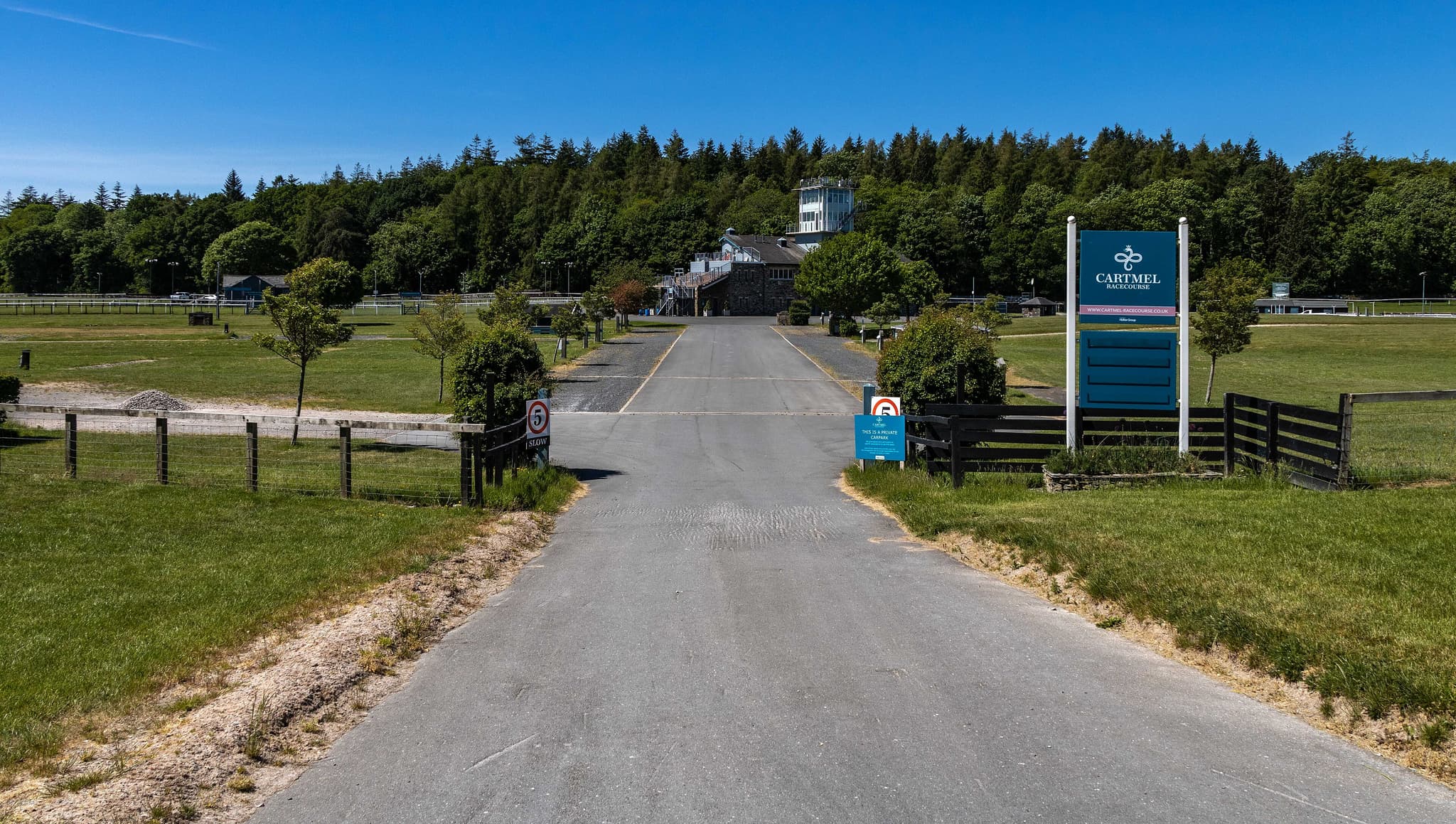
Cartmel Racecourse occupies a flat meadow at the heart of the village, hard against the southern edge of the Lake District. The course is essentially in the village square — a left-handed, roughly oval circuit of about one mile, one of the tightest National Hunt tracks in Britain. The Priory sits just beyond the far rail. In the middle distance, the fells of the Lake District National Park rise to the north-east; Morecambe Bay's vast tidal estuary opens to the south. Nowhere else in British racing does a course feel so embedded in the life of the place around it.
That embeddedness is the key to Cartmel's character. The course stages only five race days per year — all of them Bank Holidays: the Spring Bank Holiday weekend in late May (two days) and the August Bank Holiday weekend (three days, typically the preceding Saturday through the Monday). Those five days are, in the most literal sense, events in the life of the village. The economic gravity of the August meeting alone bends the whole of north Cumbria. Hotels from Grange-over-Sands to Windermere sell out months in advance. The lanes approach gridlock. And in the middle of it all, horses jump fences around a tight one-mile track while 20,000 people cheer from a meadow where cows graze eleven months of the year.
The formal history of racing here begins with a Whit Monday meeting on 12 May 1856. A horse called Phoenix, owned by a Mr R Menzie, won all three races on the card that day. Hurdle racing followed in 1863; National Hunt rules arrived by 1875. The Bank Holiday framework that defines modern Cartmel took its shape through the late nineteenth and early twentieth centuries — the August meeting was added as recently as 1969 — but the essential ingredients were there from the beginning: the tight track, the Priory backdrop, the village crowd, the festival atmosphere that belongs to no other sport and no other landscape.
This history traces the journey from that first meeting in 1856 through to the present day. It covers the priory's medieval origins, the Victorian railways that first brought crowds to the Cartmel Peninsula, the decades of post-war stability, the serial winners who became household names in Cumbria, the independent management that has kept the course free from the pressures of larger organisations, and the food culture — the sticky toffee pudding, the Michelin-starred restaurants — that has made Cartmel a destination in its own right. Cartmel is not the biggest, the fastest, or the wealthiest racecourse in Britain. It may be the most itself.
Origins
The Land Before the Starting Gate
The Cartmel Peninsula is one of those corners of England that resisted easy access for centuries. Bounded to the south and west by the tidal sands of Morecambe Bay and to the north by the southern fells of the Lake District, it was effectively an island at high tide and a morass of shifting channels at low. The historic route into Furness — the broader area north of the Bay — crossed the sands on foot or horseback, guided by a royal official whose title, the Queen's Guide to the Sands, remains in use today. It was a beautiful and treacherous crossing: horses could be lost to quicksand, and parties of travellers drowned with some regularity before the railway age removed the necessity.
Cartmel village itself sits in a small valley at the heart of the peninsula, sheltered from the Bay by low hills. The flat meadow where the racecourse now stands has been common grazing land since at least the medieval period. It is the kind of land that invites horses: level, soft underfoot, with the Priory and the surrounding hills providing natural grandstands. Whether informal races were run here before the nineteenth century is difficult to verify — records from the village's fairs and market days are patchy — but the Lake District had a strong tradition of fell racing and horse sport stretching back through the medieval period, and the meadow's flatness would have made it an obvious gathering place.
Cartmel Priory: Founded 1190
At the centre of any account of Cartmel stands the Priory. Founded in 1190 by William Marshal, 1st Earl of Pembroke — one of the most celebrated knights of the medieval world, who served four English kings and was appointed regent for the young Henry III — Cartmel Priory was established as an Augustinian house and quickly became the dominant institution of the peninsula. The village grew up in its shadow, and the Priory's market rights and fair privileges shaped the economic character of Cartmel for centuries.
The Priory's survival is singular. When Henry VIII dissolved the monasteries between 1536 and 1541, Cartmel Priory was suppressed alongside almost every other monastic house in England. But the chancel of the Priory church had served simultaneously as a parish church for the surrounding villages, and in 1537 the local inhabitants successfully argued that they needed it for worship. The building was saved, though the Priory itself was dissolved and the conventual buildings stripped. The distinctive offset tower — square, set diagonally on the main structure — stands today as it did in the fourteenth century, visible from the racecourse rail throughout every meeting.
The Furness Railway and the Opening of the Peninsula
The transformation of the Cartmel Peninsula from an isolated backwater into a viable location for a formal racecourse came with the railway. The Furness Railway, which had been pushing north through Barrow and along the coast since the early 1840s, reached Grange-over-Sands in 1857 — within a year of the first confirmed racing meeting at Cartmel in 1856. The two events were not coincidental in their timing: they were part of the same broad shift in Victorian Lancashire and Cumbria, as industrialisation connected previously remote rural areas to the mill towns of the north-west.
Grange-over-Sands lies approximately three miles south-east of Cartmel. The Furness Line from Lancaster ran along the edge of Morecambe Bay — scenic, slow, and immediately popular with day-trippers from the cotton towns. Families from Lancaster, Barrow, and Ulverston could reach the Cartmel Peninsula in an afternoon. The railway did not create the appetite for an outing to the races, but it made that appetite satisfiable at Cartmel in a way that the dangerous sand crossing never had.
The First Meeting Under Rules: 12 May 1856
The first confirmed meeting under racing rules at Cartmel took place on Whit Monday, 12 May 1856. The card comprised three races: the Cartmel Sweepstakes, the Innkeepers Stakes, and the Tradesmen's Stakes. A horse called Phoenix, owned by a Mr R Menzie, won all three — an achievement that entered local folklore immediately and has been cited in accounts of the course ever since. The naming of the races tells its own story: the Innkeepers Stakes and the Tradesmen's Stakes were funded by local businesses, and the event was as much a commercial fair as a sporting contest. The pattern of the village rallying around its race day was established on the very first afternoon.
Hurdle racing appeared at Cartmel in 1863, as the National Hunt format was spreading rapidly through Britain's smaller courses. The terrain suited it: the tight bends and the soft meadow ground imposed demands on jumping horses that could not be replicated on flat, galloping tracks. By 1875, the meeting was being run under full National Hunt rules. Racing on the flat never returned. Cartmel had found its identity.
The Bank Holiday Act 1871 and Its Significance
Parliament's Bank Holiday Act of 1871, which created four statutory public holidays in England and Wales, was as important for Cartmel's long-term future as the railway. The Act gave the working population of industrial Britain predictable days off — and predictable days off created the conditions for organised leisure events. The Whitsun holiday (not technically one of the 1871 Bank Holidays but an established public holiday in practice) had been the anchor of Cartmel's calendar from the first meeting. The August Bank Holiday — created by the 1871 Act — would eventually become the bigger of the two meetings, though that development took another century to fully materialise.
A Landscape That Shaped the Racing
The sheep-farming country of the Cartmel Peninsula gave the course its character as much as any human decision. The meadow is flat — flat in the way that Lakeland meadows are flat, which is to say enclosed on all sides by rising ground. The circuit is just under one mile, left-handed, with sharp bends at each end. Horses bred for the galloping tracks of Newbury or Kempton find themselves suddenly operating in a different discipline at Cartmel: the bends arrive quickly, the straight is short, and the ability to switch off behind other horses and produce a sharp acceleration matters far more than raw speed over ground.
This character attracted, from the earliest decades, a particular type of northern trainer and owner: people who understood that Cartmel was a specialist venue requiring specialist preparation. The Lake District has always produced horses suited to tough, undulating terrain — the same country that produced the Herdwick sheep, the most hardy of English breeds. Cartmel's origins are inseparable from that landscape.
The Golden Era
The Cartmel Steeplechase Company
The Cartmel Steeplechase Company was formally established in 1925. The registration gave the course a proper organisational structure for the first time, allowing investment in the venue and a degree of certainty about its future. Before 1925, the meetings had been run on a more ad hoc basis, reliant on the goodwill of local landowners and the annual effort of a small group of volunteers. The Steeplechase Company — small by national standards but sufficient for a course that aspired only to serve its community well — set Cartmel on a stable footing that would carry it through the interwar years and, after a wartime interruption, into the second half of the twentieth century.
For the first several decades of its existence, the course staged only the Whitsun meeting: two days of racing at the end of May, anchored by the Bank Holiday Monday. This was not a limitation the organisers apologised for. It was simply what Cartmel was. The Whitsun meeting drew crowds from across the North West and from the agricultural hinterland of north Lancashire and south Cumbria: farmers and their families, mill workers from Barrow and Lancaster, visitors who had come to the Lake District for walking holidays and discovered that there was racing in the valley. The meeting sat within the annual rhythm of the farming year — the lambing done, the fells greening, the days long enough to make the journey worthwhile.
The Course Takes Shape
The layout that modern racegoers encounter at Cartmel was established in its essential form during the interwar years. The paddock was placed inside the course, enclosed by the track itself — an arrangement that gives Cartmel one of its most distinctive features: the parade ring sits in the middle of the racing, visible from all sides, with horses walking through the crowd to reach the start. The run-in, from the final fence home, was developed into what became one of the longest in British National Hunt racing. Horses that jumped the last in front could be run down in the straight; stayers who had been conserving energy through the tight bends could suddenly stretch on the flat. The track rewarded a particular kind of horse, and trainers in the region began to select their runners accordingly.
The undulating Cumbrian character of the country around Cartmel produced horses that could handle the tight left-hand circuit. Sharp jumpers — quick over their fences rather than spectacular — tended to do well. Front-runners who could use the opening bend to establish a good position and control the pace had a significant advantage. This was, and remains, a course where tactical positioning matters as much as outright ability.
Wartime Suspension and Post-War Resumption
Racing at Cartmel, like racing at most British courses, was suspended during the Second World War. The meadow reverted to agricultural use, and the infrastructure of the Steeplechase Company went into a kind of hibernation. When racing resumed in the post-war period, the Whitsun meeting came back first, and the continuity with the pre-war fixture was careful and deliberate. The course returned to exactly what it had been: a two-day Whitsun meeting in a Cumbrian village, drawing the same communities, running the same kinds of races.
The post-war decades were a period of quiet consolidation rather than transformation. Northern National Hunt racing in the 1940s and 1950s had a different character from the metropolitan circuit: horses were often bred and trained locally, jockeys came from farming families, and prize money was modest. Cartmel fitted naturally into this world. The course had no ambition to compete with the northern powerhouses at Haydock Park or Carlisle; it was content to be the best version of what it was.
The Northern NH Trainer Connection
The geography of northern National Hunt racing created a natural relationship between Cartmel and the trainers of Cumbria, Lancashire, and the Yorkshire Dales. Trainers based within fifty miles of the course — at Greystoke, at Cholmondeley, in the Dales — found that Cartmel's tight circuit suited certain horses in their yards that would never trouble the form book at Cheltenham. The course offered the chance to win races for horses that were quick, sharp, and good on bends rather than classically talented over fences.
This relationship intensified over the decades. By the 1960s, the pattern was established: northern NH trainers would target Cartmel's meetings with specific horses, horses that they had identified as suited to the one-mile circuit and the sharp bends. The course became, in the language of the sport, a track that certain horses loved and kept coming back to. This consistency — a horse returning year after year to win at the same venue — became part of Cartmel's identity.
The Addition of the August Meeting: 1969
The decision to add an August Bank Holiday Monday meeting in 1969 was the single most important development in Cartmel's post-war history. Until that point, the course had staged only the Whitsun fixture for over a century — a extraordinary continuity, but also a limitation on the course's economic viability and its ambition to serve a wider audience.
The August meeting transformed the equation. The August Bank Holiday is, in terms of crowd potential, the most powerful Bank Holiday in the English calendar: school holidays are in full swing, the weather is statistically better than May, and the Lake District is at the peak of its tourist season. Cartmel in August draws visitors who would never have considered a winter or spring racing trip to Cumbria. The meeting quickly established itself as the larger of the two fixtures, with the Cartmel Cup run on the August Bank Holiday Monday becoming the course's signature race.
A Saturday programme was added in 1974, expanding the August festival to three days. This gave the meeting a shape it has broadly retained: a Saturday opener, a Sunday raceday, and the Bank Holiday Monday as the climax. The Spring meeting retained its own identity as the quieter, more local of the two festivals — the Whitsun gathering for north-west families who had been coming to Cartmel every May for generations.
What the Golden Era Established
By the end of the 1970s, Cartmel had assembled the components of its modern identity. The tight one-mile circuit, the paddock in the middle, the Priory backdrop, the two Bank Holiday festivals, the loyal northern NH trainer community, the village crowd that grew in direct proportion to the course's confidence in itself. The Steeplechase Company had built something that large organisations with far greater resources struggled to replicate: a racecourse that was truly loved, not merely attended. That love is the inheritance of the golden era.
Famous Moments
The Scale of It
There is a particular moment on August Bank Holiday Saturday at Cartmel when the arithmetic of the place becomes impossible to ignore. The village has around 1,500 permanent residents. The surrounding lanes are jammed from Grange-over-Sands to Lindale. The meadow — eleven months of the year home to livestock — carries something between 15,000 and 20,000 people. The queue at the sticky toffee pudding stall stretches past the churchyard. And on the flat oval track, horses are jumping fences at thirty miles an hour while the Priory tower, unchanged since the fourteenth century, stands serenely at the far end of the course.
This contrast — the medieval village and the Bank Holiday crowd, the 1190 tower and the bookmakers' boards — is not an accident. It is the thing that makes Cartmel's famous moments feel different from famous moments at other tracks. At Cheltenham or Aintree, a great race is a great race within the context of a great sporting institution. At Cartmel, a great race is a great race within the context of a village fete that has somehow acquired a racecourse, or perhaps a racecourse that has somehow acquired a village fete. The scale mismatch gives everything that happens here an intensity that is hard to manufacture elsewhere.
Deep Mystery and the Serial Winner Tradition
The horse that first demonstrated Cartmel's particular capacity for serial winners was Deep Mystery. This mare won seven races at the course, a total she reached in 2004, and became the first horse to accumulate that many victories at Cartmel under the modern record-keeping era. She was trained by a northern handler who understood precisely what the tight, left-handed circuit required: a sharp, front-running style, quick at the bends, comfortable jumping at speed without taking extravagant risks at the fences.
Deep Mystery's seven wins were a record for nearly a decade. The relationship between a specific horse and a specific course — something that British racing has always celebrated, from Red Rum at Aintree to Kauto Star at Kempton — found one of its most focused expressions at Cartmel, where the tight circuit means that a horse either loves the track or finds it perplexing. There is little middle ground.
Soul Magic equalled Deep Mystery's seven-win record in 2013, and for a time the two horses shared the mark. The achievement attracted national attention, partly because the idea of a horse winning seven races at any single track in the modern era — when horses travel freely and trainers rarely specialise in one venue — is sufficiently unusual to warrant notice.
Tonto's Spirit: Eight Wins at Cartmel
Tonto's Spirit broke the record in 2022, winning his eighth race at Cartmel to stand alone at the top of the course's all-time winners' list. The achievement was celebrated with the kind of enthusiasm that Cartmel reserves for its own: this was not a famous horse by the standards of Cheltenham or the Grand National circuit, but it was a Cartmel horse in the most significant sense — a horse that had found its perfect ground, its perfect circuit, its perfect crowd. Eight wins at any single venue is a significant feat at any level of the sport; eight wins at Cartmel, where the tight track and sharp bends demand such precision, is a real record to be proud of.
The Cartmel Cup
The Cartmel Cup, run on the August Bank Holiday Monday, is the course's signature race. A National Hunt handicap run over a distance of approximately two and a half miles, it draws the best horses that northern NH trainers target specifically for Cartmel's August meeting. The race is not a Grade 1 — it carries nothing like the prize money of Cheltenham's major events — but within the northern jump racing community it has the status of a real target race. Trainers map their late-summer programmes around it.
The race has been won by horses who later distinguished themselves at higher levels, and by horses who were brilliant specifically at Cartmel and nowhere else. That mix is the point: the Cartmel Cup is an honest race, attracting horses at the level the course can support, run in conditions that suit the course's particular demands. The Bank Holiday Monday crowd gives it an atmosphere that races run on ordinary Tuesday afternoons at modest tracks cannot replicate.
The Food Stalls and The Sticky Toffee Pudding Company
No account of Cartmel's famous moments is complete without acknowledging The Sticky Toffee Pudding Company, which was founded in the village in 1984 by Patricia and Francis Udell. What began as a local operation supplying a speciality pudding to restaurants and hotels in the north-west became, over the following decades, a nationally recognised brand. The puddings are now sold through major supermarkets across Britain, but the company remains based in Cartmel, and on race days the stall in the village is one of the defining features of the event.
The queues for sticky toffee pudding during the August meeting have become, in their own way, a famous moment — a ritual that visitors observe with the same seriousness they bring to choosing their bets. The village's food culture extends well beyond the pudding stall: Cartmel has two Michelin-starred restaurants, with Simon Rogan's L'Enclume consistently rated among the finest in England. On Bank Holiday race weekends, the combination of racing, food, and countryside draws a crowd that includes people who have no particular interest in horses but a very strong interest in eating well in a beautiful place.
Cartmel Versus the Grand National Venues
The contrast between Cartmel and the great NH venues of the south and midlands — Cheltenham, Ascot, Aintree — is not simply a matter of scale. It is a matter of character. At Cheltenham, the crowd is racially diverse, cosmopolitan, and professionally engaged with the sport; the atmosphere is elevated and the stakes are enormous. At Cartmel, the crowd is often families — grandparents and children together, people who have been coming to Cartmel for twenty years and who treat the August Bank Holiday meeting as an annual fixture in their personal calendar rather than a racing occasion.
This egalitarian, domestic character gives Cartmel's famous moments a different texture. The cheer when Tonto's Spirit crossed the line for his eighth win was not the roar of professionals acknowledging excellence; it was the noise of a community recognising something that belonged to them. Cartmel's famous moments are famous because they happened here, in this particular meadow, in front of this particular crowd, with the Priory watching from the far rail.
The Modern Era
Independent Ownership in a Consolidating Sport
British racing in the twenty-first century has moved, at the larger end of the market, towards consolidation. The Arena Racing Company group controls sixteen courses; Jockey Club Racecourses manages fourteen. Against that background, Cartmel Racecourse Ltd — an independent company operating five race days per year from a meadow in a village of 1,500 people — represents a different philosophy entirely.
Independent ownership suits Cartmel. The course's identity depends on its relationship with the village, and that relationship is best managed by people who live and work within it, not by a board in London making decisions across a portfolio of sixteen venues. Cartmel Racecourse Ltd has been able to focus its resources on the quality of the experience at those five race days — infrastructure, hospitality, the event-management challenge of filling a village meadow with 20,000 people twice a year — without having to balance Cartmel's needs against the priorities of a larger group.
The Five-Day Calendar
Cartmel's current racing calendar comprises five days per year, split into two meetings. The Spring meeting runs across the Spring Bank Holiday weekend in late May, typically two days of racing including the Bank Holiday Monday. The August meeting covers three days: the Saturday before the Bank Holiday, a Sunday card, and the August Bank Holiday Monday itself, which carries the Cartmel Cup and the largest crowd of the season.
This schedule is fixed in the national racing calendar by the British Horseracing Authority, and it has been broadly stable for several decades. Five days might seem a thin operation, but the economics work precisely because those five days carry crowds that a flat-meeting track would need thirty or forty ordinary fixtures to accumulate. The gate receipts from a Bank Holiday Monday with 20,000 through the turnstiles are substantial. Hospitality — marquees, restaurants, private boxes overlooking the track — has been developed carefully to provide additional revenue without overwhelming the atmosphere that generates the attendance in the first place.
The Northern NH Trainer Community
In the modern era, Cartmel's racing is shaped by a small number of northern National Hunt trainers who understand the track's demands and target it deliberately. Nicky Richards, based at Greystoke in Cumbria approximately twenty-five miles north-east of Cartmel, is the trainer most closely associated with the course in the contemporary period. Richards won the Trainers' Championship in 2003-04 and has trained hundreds of winners at tracks across Britain, but Cartmel holds a particular place in his operation: he knows the circuit, he breeds horses that suit it, and he plans his spring and summer programmes around the two festivals.
Donald McCain, based at Cholmondeley in Cheshire roughly sixty miles south of Cartmel, brings a different strand of the northern NH tradition. Son of the legendary Grand National trainer Ginger McCain, Donald has built a substantial operation that targets a range of northern fixtures, and Cartmel's Bank Holiday meetings appear regularly on his programme. Sue Smith, who trains at Bingley in West Yorkshire, has also been a regular presence in the winners' enclosure at Cartmel. James Moffatt, operating from his yard in Cumbria, represents the most local dimension of the modern training landscape.
The pattern common to all of them is specificity: they study Cartmel, identify which horses in their yards will handle the tight bends and the short straight, and arrive with a plan. This is not a track where you send a horse hoping the form will translate. It is a track where you send a horse because you believe, based on experience, that this particular horse will thrive here.
Prize Money and the Quality of Racing
Cartmel's prize money is modest in absolute terms but appropriate to the level at which the course operates. Northern NH handicappers — horses rated in the 90s to low 100s on the official handicap mark — are the core of the race cards. These are not the top-class animals that populate Cheltenham's Grade 1 programme, but they are real horses, trained by experienced professionals, and the competition is real.
The prize money has been increased incrementally over the years as the course's revenue has grown, and this matters for the quality of the racing. Better prize money attracts better horses; better horses produce closer, more competitive races; closer races produce a better experience for the crowd. Cartmel has invested in prize money while managing the balance carefully — the course is not trying to become something it is not, but it is trying to be the best version of what it is.
Food, Tourism, and the Cartmel Brand
The modern era has seen Cartmel the village acquire a food and tourism identity that is inseparable from, and mutually reinforcing with, the racecourse. Simon Rogan's L'Enclume restaurant, which opened in 2002 and has held two Michelin stars since 2013, is consistently rated among the top restaurants in England — some critics have placed it in the top ten in the country. L'Enclume draws visitors from across Britain and beyond, and many of those visitors coincide their trips with the race meetings.
The Sticky Toffee Pudding Company, now selling nationally through major retailers, keeps Cartmel's name in kitchens across Britain year-round. The village's pubs — the Kings Arms, the Cavendish Arms — are landmarks of north-west hospitality. Together, these elements have made "a weekend in Cartmel" a distinct product: racing, food, countryside, and the Priory all within a few hundred metres of each other. The racecourse benefits from the village's reputation, and the village benefits from the racecourse's crowds.
The Race Weekend Economy
The economic impact of the two Bank Holiday festivals on the wider Cumbria tourism economy is considerable. Hotels in Grange-over-Sands, Newby Bridge, and Windermere fill entirely for the August meeting. Restaurants book out months in advance. The three-day August festival alone generates spending across the hospitality sector that sustains businesses through quieter parts of the year. For a county that relies heavily on tourism — the Lake District National Park receives around 20 million visitors annually — the racecourse is a significant contributor to the summer season.
This economic relationship gives the course a status within Cumbria that extends beyond the sport. Local councils, tourism bodies, and business associations take an interest in the health of the Cartmel meetings in a way that they would not necessarily do for a larger course in a larger town. The course is small enough to feel like a community asset, which is exactly what it is.
Cartmel's Legacy
What Cartmel Leaves Behind
Every sport has its great venues and its peculiar ones. Cartmel belongs emphatically to the second category, which is why it is also, for a large number of people, one of the great ones. The course has never pretended to be something it is not. It stages five race days per year, all of them Bank Holidays, all of them carrying the same premise: that 20,000 people will come to a meadow in a village of 1,500 and watch horses jump fences around a one-mile left-handed circuit while the tower of a 1190 Priory rises from the far rail. This proposition is, on paper, absurd. In practice, it has been drawing crowds for over 165 years.
The legacy of Cartmel's distinctive approach is visible in how the course has aged. Venues that overextended — that built too much, borrowed too heavily, chased prize money they could not sustain — have struggled or disappeared from the British racing calendar. Cartmel, by remaining within its own scale, has avoided all of those pressures. The Steeplechase Company of 1925 became Cartmel Racecourse Ltd, and the essential commitment remained constant: serve the Bank Holiday crowd, serve the village, and resist the temptation to be something you are not.
The tight one-mile circuit has produced a distinct type of Cartmel horse: sharp, front-running, quick at the bends, capable of producing a strong finish down the longest run-in in British NH racing. Horses like Deep Mystery (seven wins), Soul Magic (seven wins), and Tonto's Spirit (eight wins, the record) became local legends not because they were the best horses in Britain but because they had found their perfect ground. This relationship between a horse and a single course — one of the sport's most appealing stories — is more visible at Cartmel than almost anywhere else, precisely because the course's tight character polarises horses so sharply.
The Priory, the village square, the sticky toffee pudding stall, the Bank Holiday crowds, the northern NH trainers who plan their summers around two festivals in a Cumbrian meadow — all of these things are part of a legacy that has nothing to do with prize money or prestige and everything to do with belonging. Cartmel Racecourse belongs to Cartmel. That, in the end, is the whole story.
Frequently Asked Questions
When was Cartmel Racecourse founded?
The first confirmed racing meeting under rules at Cartmel took place on Whit Monday, 12 May 1856. The Cartmel Steeplechase Company, which gave the course its formal organisational structure, was established in 1925. The Bank Holiday meeting tradition developed through the late nineteenth and twentieth centuries: the August Bank Holiday meeting was added in 1969, and the Spring Bank Holiday programme solidified around the Whitsun fixture that has been the backbone of the calendar since 1856.
How many race days does Cartmel stage per year?
Five race days per year, all on Bank Holiday weekends. The Spring meeting takes place over the Spring Bank Holiday weekend in late May, typically running across two days including the Bank Holiday Monday. The August meeting covers three days: the Saturday before the Bank Holiday, a Sunday card, and the August Bank Holiday Monday, which carries the Cartmel Cup and the largest crowds of the year. No other British racecourse restricts its programme so tightly — and no other racecourse generates quite this concentration of atmosphere across so few fixtures.
What is the setting of Cartmel Racecourse?
The course occupies a flat meadow at the heart of Cartmel village in Cumbria, postcode LA11 6QF. The racecourse is essentially the village's common meadow, enclosed by the buildings of the village square on one side and open farmland on the other. Cartmel Priory — founded in 1190 by William Marshal, 1st Earl of Pembroke, and one of England's most important medieval buildings — stands immediately beside the course, its distinctive offset tower visible throughout every race. The Lake District fells rise to the north and north-east; Morecambe Bay's tidal estuary lies to the south. Few settings in British sport rival it.
Who owns Cartmel Racecourse?
The course is operated by Cartmel Racecourse Ltd, an independent company. This independence distinguishes Cartmel from the majority of British racecourses, which are now owned by one of two large groups — Arena Racing Company and Jockey Club Racecourses — together controlling thirty of the sixty-odd licensed tracks in Britain. Independent ownership has allowed Cartmel to remain closely integrated with the village community and to manage its growth at a pace that suits its scale, rather than being pulled by the priorities of a larger organisation.
How do I get to Cartmel Racecourse?
By rail, the nearest station is Grange-over-Sands, approximately three miles from the course on the Furness Line from Lancaster. Shuttle buses operate between Grange-over-Sands station and the racecourse on race days. By road, the standard approach is the M6 to Junction 36, then the A590 west towards Barrow, turning off for Cartmel at the Meathop or Haverthwaite junction. Parking in and around the village fills quickly on Bank Holiday days; arriving early or using the park-and-ride provision is strongly advised. Grange-over-Sands can also be reached via the Transpennine Express service from Manchester and beyond.
What is the track like at Cartmel?
Cartmel runs left-handed on a roughly oval circuit of approximately one mile — one of the smallest National Hunt tracks in Britain. The course is flat, set on the meadow floor of the village, with sharp bends at each end. The paddock is positioned inside the track, giving the course its characteristic layout where the parade ring sits in the middle of the racing. The run from the final fence to the winning post is among the longest in British NH racing, favouring horses with stamina and the ability to produce a sustained gallop on the flat after the jumping is done. Sharp jumpers and front-runners with a strong finishing gallop are consistently favoured; horses that like to be covered up and produce a sprint finish around tight bends do not always translate their form from galloping tracks.
Share this article
More about this racecourse
All Cartmel guides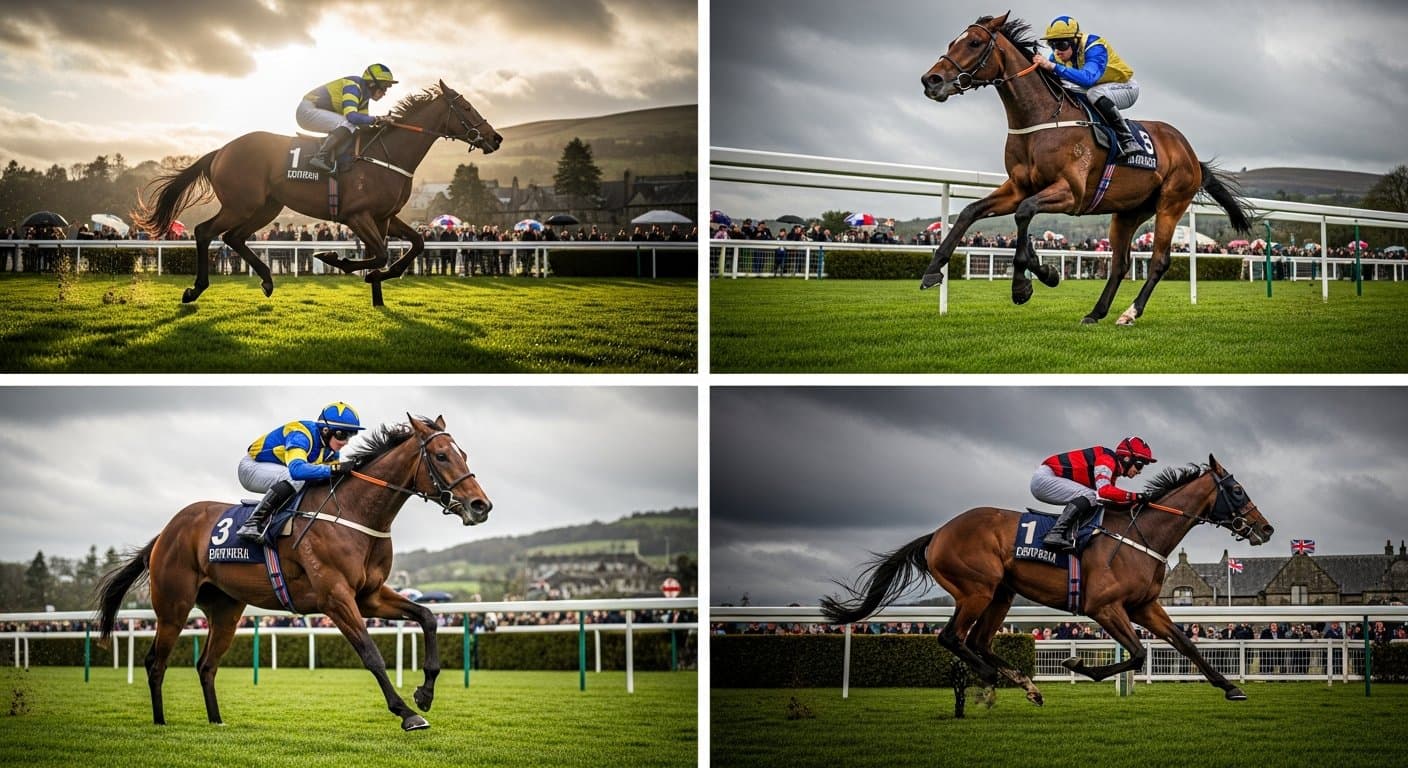
Tonto's Spirit at Cartmel: The Complete Story
How a £700 castoff became the most successful horse in Cartmel racecourse history, winning eight times at the Cumbrian track.
Read more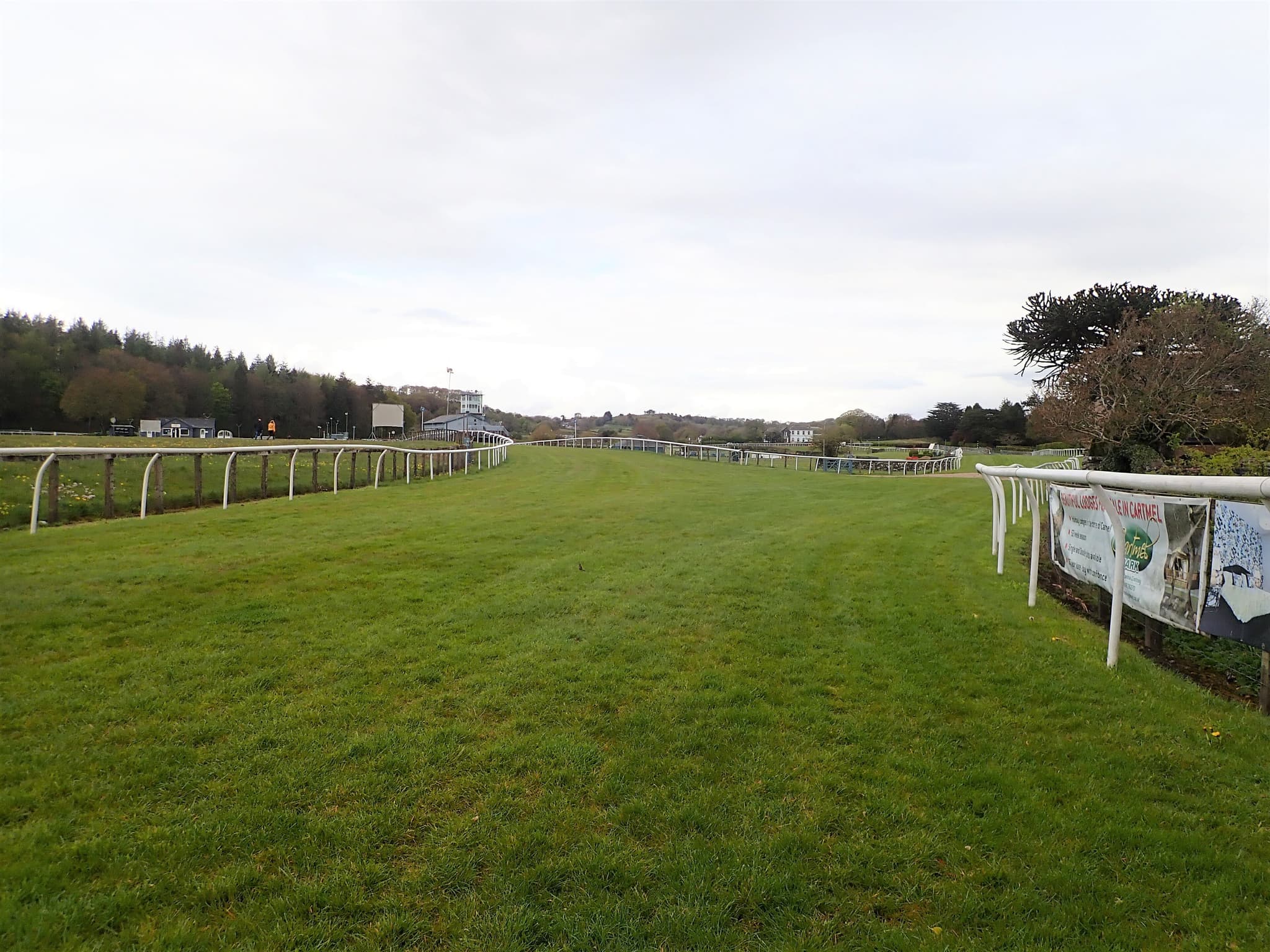
Whit Bank Holiday Monday at Cartmel: The Complete Guide
Cartmel's Whit Bank Holiday Monday: the most festive day in jump racing, with the Cartmel Cup, the Cartmel Chase and 10,000 people in a Cumbrian village.
Read more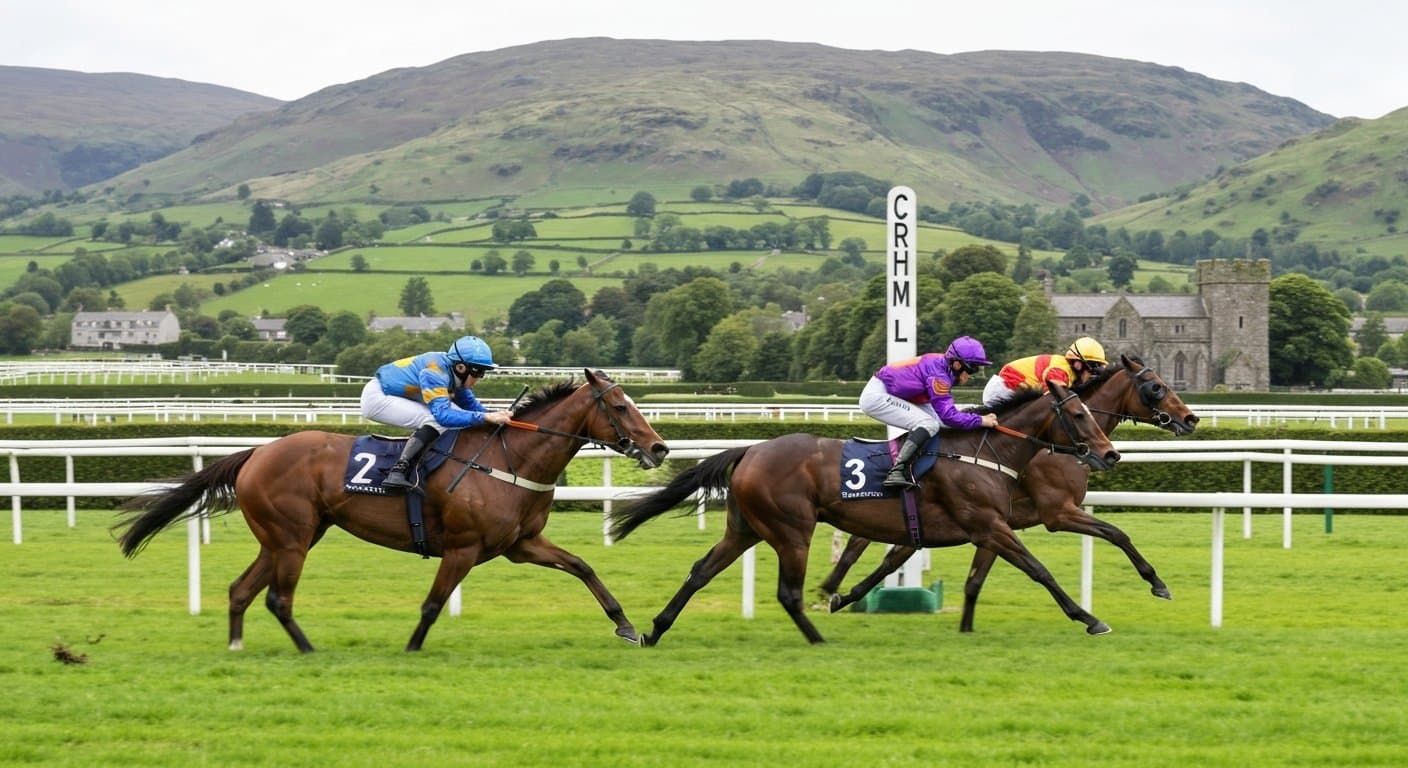
Betting at Cartmel Racecourse
Betting at Cartmel: the track's long run-in, going and draw, the key trainers and jockeys, and strategies for the Lake District's unique jumps venue.
Read morePhotos on this page are used under Creative Commons licences. Titles, sources and licence links for each one are on our image credits page.
Gamble Responsibly
Gambling should be entertaining and not seen as a way to make money. Never bet more than you can afford to lose. If you or someone you know has a gambling problem, help and support is available.