
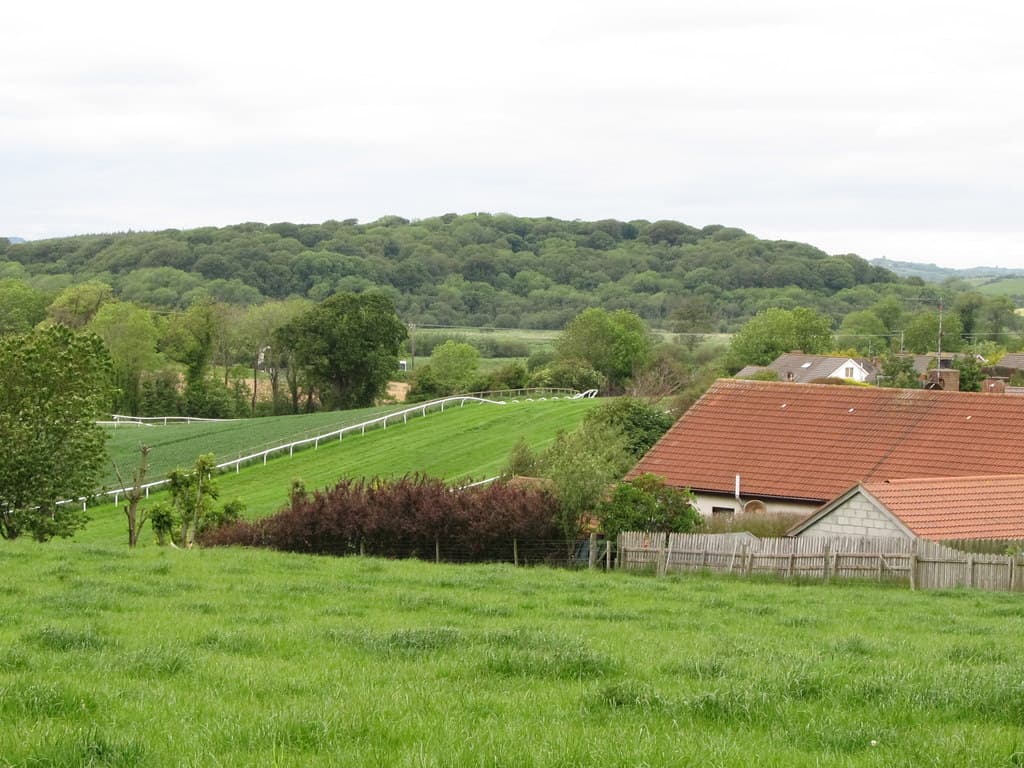
Founder & Editor · Last reviewed 2026-04-05
Stand on the grass verge near Downpatrick's finishing straight on a November afternoon and the view is unlike anything else in Irish racing. Half a kilometre to the south-east, the tower of Down Cathedral rises from Cathedral Hill, its grey stone catching what remains of the winter light. Beneath that hill, in the cathedral grounds, lies a slab of rough granite marking the grave of Saint Patrick — patron saint of Ireland, buried here sometime around the year 461 AD. The racecourse wraps around the slopes below that hill, running right-handed on ground that rises and falls across the Struell Hills. On a jumping afternoon, horses labour up inclines that would flatter a fell race and descend with the wind behind them, and the cathedral tower watches all of it from above.
There is no other racecourse in Ireland, north or south, positioned quite like this. Downpatrick Racecourse sits at BT30 6RL, just outside the county town of Downpatrick in County Down, Northern Ireland. The track is a tight one-mile right-handed circuit, undulating sharply across terrain that punishes the unfit and exposes horses without a real engine. Racing here is governed not by the British Horseracing Authority but by Horse Racing Ireland and the Irish Horseracing Regulatory Board — a distinction that matters, because Downpatrick has always been part of the Irish racing tradition despite sitting in the United Kingdom. It is National Hunt only: hurdles, chases, and bumpers, with no flat racing staged here in living memory.
The Downpatrick and County Down Race Club owns and operates the course as an independent members' club. There are no external shareholders, no corporate parent, and no connection to the larger racecourse groups that have consolidated so much of British and Irish racing over the past three decades. That independence shapes everything: the atmosphere, the schedule of roughly ten to twelve race days per season, and the sense that this is a course run by people who love County Down racing for its own sake.
The Ulster National is the course's flagship race, a handicap steeplechase that draws the best of the Northern Irish jumpers and attracts runners from southern Irish stables too. But it is one chapter in a history that stretches back to the charter era, when racing was formally organised in County Down in the same year that Down Royal, ten miles to the north-west, received its own royal warrant. Centuries of continuous racing have shaped the course, the community and the landscape around it, and the origins section covers that beginning in detail.
Understanding Downpatrick means understanding that it is simultaneously a racecourse and a piece of Irish history. The town itself takes its name from the Old Irish Dún Pádraig — Patrick's Fort — and the whole area carries the weight of early Christian Ireland. Inch Abbey, a Cistercian ruin of considerable beauty, stands one mile north of the town on the banks of the River Quoile. Strangford Lough, one of Ireland's most protected marine environments, lies three miles east. Downpatrick is not a racecourse that happens to be near some history. It is a racecourse embedded in centuries of Irish religious, political, and agricultural life, and racing here has always been shaped by that context.
Origins
The County Down of 1685
The year 1685 was significant for two County Down racecourses simultaneously. The County Down Corporation established formal horse racing in the county that year, providing the institutional framework under which both Downpatrick and Down Royal — the latter sited near Lisburn, roughly ten miles north-west of Downpatrick — trace their origins. Down Royal received a royal warrant from King James II in the same period, and the two venues have since developed along different lines while sharing a common founding era. Downpatrick remained a course shaped by the specific landscape of the cathedral town rather than by any royal association.
County Down in the late 17th century was a prosperous Ulster county by the standards of the age. The linen trade had begun its long expansion through the region, the Protestant Ascendancy had consolidated landholding across much of the province, and the Anglo-Irish gentry maintained the equestrian culture they had brought across from England and Scotland. Horse racing was a central part of that culture — a display of wealth, a vehicle for wager, and a social occasion that drew the county's landowners onto the same ground twice a year. The landscape around Downpatrick provided terrain that suited racing in a way that flat land did not: the slopes of the Struell Hills offered natural gradients, drainage through sandy subsoil, and a circuit that could be laid out on undulating ground with the town as a backdrop.
The Hill and the Saint
The hill that gives Downpatrick its racing character is the same hill that gives the town its name and its deepest meaning. Cathedral Hill — known in Old Irish as Dún Pádraig, Patrick's Fort — rises above the town to the point where Down Cathedral stands today. The Cathedral Church of the Holy Trinity was established on this site in 1183 by Benedictine monks, though the hill had been a place of Christian worship since at least the fifth century. Saint Patrick is believed to have chosen this site, along with Saul Church (three miles north-east of Downpatrick), as a centre of his ministry in Ulster. When he died around the year 461 AD — having spent the final decades of his life converting the Irish to Christianity — tradition holds that he was buried on this hill.
Patrick's biography is embedded in the landscape within a few miles of the racecourse. He was born around 385 AD, likely in Roman Britain. As a young man he was seized by Irish raiders and spent six years enslaved on Slemish Mountain in County Antrim, approximately thirty miles north of Downpatrick, tending sheep. He escaped, returned to Britain, trained as a priest, and came back to Ireland around 432 AD as a missionary. Over the following three decades he travelled extensively across the island, ordaining clergy, establishing churches, and conducting baptisms. His choice of Downpatrick as a base in the latter part of his life — and his burial on Cathedral Hill — transformed an already significant site into one of the most visited Christian destinations in Ireland.
The rough granite marker that now identifies his grave in the Down Cathedral grounds was placed there in 1900. The cathedral itself has stood through Norman conquest, Cromwellian destruction, and Protestant Reformation, retaining its hilltop position through every change of regime. When horses run on the slopes below, they run in the shadow of all of that.
Norman Conquest and Medieval Downpatrick
The town's importance in the Norman period adds another layer to its history. In 1177, John de Courcy led an Anglo-Norman force into Ulster and captured Downpatrick in a rapid campaign. He recognised the strategic and symbolic value of the Cathedral Hill site and made Downpatrick the administrative centre of his Ulster lordship. Three years later, in 1180, he founded Inch Abbey on the banks of the River Quoile, one mile north of the town, as a Cistercian monastery. The abbey ruins still stand today in a remarkably complete state, their arched windows framing views across the Quoile Marshes to Strangford Lough beyond.
Down Cathedral was formally established in 1183 on de Courcy's initiative, replacing an earlier church on the site. De Courcy also promoted the cult of Saint Patrick with considerable political intent, commissioning translations of Patrick's writings and encouraging pilgrimage to Downpatrick. By the end of the 12th century, the town had established itself as an ecclesiastical capital of Ulster, a status it retained through the medieval period.
The agricultural landscape that developed around the town during the medieval period — field strips, farmland running down to the Quoile and the lough — created the open ground on which later racing would take shape. The Struell Hills to the east of the cathedral, where the wells known as Struell Wells attracted pilgrims seeking healing, provided the undulating terrain that defines the modern circuit.
The 18th Century and the Formalisation of Racing
Between the establishment of formal County Down racing in 1685 and the consolidation of the Downpatrick course as a fixed institution in the early 19th century, racing at the site passed through several phases. Early meetings were informal by modern standards: match races between the horses of neighbouring landowners, with wagers struck on the day and the crowd drawn from surrounding parishes. The course layout was not fixed; horses ran on whatever ground the organisers designated for that meeting.
Through the 18th century, the county's linen prosperity created a class of wealthy merchants and landowners who could afford to breed and maintain racehorses. The Ards Peninsula farming communities, east of Strangford Lough, contributed to the horse-owning culture of County Down. Racing at Downpatrick drew participants from across the county and from County Armagh to the south-west.
By the end of the 18th century, the course had established a fixed circuit using the slopes below Cathedral Hill, and the meetings had developed a formal structure with printed programmes and advertised prizes. The transition from match racing to card racing — multiple horses competing in each event — brought Downpatrick in line with the professionalised English model that had developed at Newmarket and York. The right-handed circuit, shaped by the contours of the Struell Hills, became a permanent feature. Horses that could handle the undulations and the tight bends had an advantage that the course's regulars learned to recognise and exploit.
Racing here was never just sport. In County Down, where the Saint Patrick connection drew pilgrims from across Ireland each spring, the racecourse was part of a broader culture of gathering — seasonal, communal, anchored in a landscape with long memory.
The Golden Era
The 19th Century: Racing Takes Shape
The Victorian period brought the formal infrastructure that transformed Downpatrick from a seasonal gathering into a recognisable racecourse. A permanent grandstand was erected, the circuit was levelled and railed, and the fixture list was committed to print. County Down's agricultural prosperity through the middle decades of the 19th century — before the Famine devastated much of Ireland — sustained the horse-owning class that provided runners and the labouring community that provided the crowd.
Downpatrick and Down Royal had, by this point, settled into distinct roles within the Northern Irish racing calendar. Down Royal, positioned close to the larger population centres of Lisburn and Belfast, attracted the bigger crowds and the grander occasions. Downpatrick served a different constituency: the farming communities of County Down's southern districts, the market town's own population, and the visitors drawn by the combination of racing and pilgrimage to the Saint Patrick sites. The two courses were not in direct competition so much as serving different facets of the same regional racing culture.
The National Hunt tradition in County Down had deep roots in the point-to-point circuit. Hunting over the fields and hedges of the Ards Peninsula and the drumlins of south County Down had been practised for generations, and the transition from hunt racing to organised jumping was a natural evolution. Farmers who rode in point-to-points on their own land had horses accustomed to uneven terrain, quick turns, and natural obstacles. Those horses handled the undulations of Downpatrick's circuit well. The course became a natural destination for horses graduating from the point-to-point field into regulated competition under National Hunt rules.
The Ulster National
The development of the Ulster National as the course's flagship race reflected the broader professionalisation of Irish jumping. Chase racing required proper fences, maintained going, and an organisational structure capable of handling declarations, starting procedures and prize distribution. The race gave local connections a target worth preparing for and gave visitors from across Ulster a reason to make the journey south from Belfast.
The race drew quality chasers from training establishments across County Down and beyond. The tight circuit, the uphill finish and the demanding fences produced a race that separated real jumpers from those merely capable on flatter, more forgiving courses. A winner at Downpatrick had demonstrated something worth respecting.
Point-to-point graduates who won at Downpatrick in the early 20th century sometimes went on to significant careers in Ireland and Britain. The course's connection to the point-to-point pipeline — the route by which Irish horses move from unregulated field racing to registered competition — was one of its defining characteristics throughout this period.
The Troubles Period: 1969–1998
The outbreak of sustained political violence in Northern Ireland in 1969 cast a long shadow over everyday life in the province, and racecourses were not exempt from its effects. Downpatrick is in County Down, which experienced its share of the conflict's disruption, though it was not among the most intensely affected areas. Security arrangements at public gatherings became more elaborate throughout the 1970s and 1980s. Attendance at some meetings was reduced, and the practical difficulties of travelling to events in Northern Ireland discouraged some southern Irish visitors who might otherwise have made the journey north.
Racing continued through the Troubles, a point worth stating plainly. The Downpatrick and County Down Race Club maintained its fixture programme, and the course remained part of the HRI calendar throughout. Horses trained in the Republic of Ireland continued to run at Downpatrick when the economics warranted the journey, though the volume of cross-border traffic was reduced from what it might have been in more settled times. The Ulster National retained its place in the calendar.
The atmosphere of the period inevitably affected the character of race days. The tight, community-centred nature of Downpatrick's meetings — a course where regular racegoers knew one another and where the local farming networks supplied a significant proportion of the horses — may have insulated it from the more severe impacts that affected larger events in Belfast. County Down had its tensions, but Downpatrick remained a functioning, attended racecourse through the entire period of the conflict.
Key Northern Irish Trainers of the 20th Century
Northern Irish National Hunt training in the 20th century was shaped by a small number of handlers with deep roots in the county. Trainers operating from County Down and County Armagh consistently targeted Downpatrick as a key fixture in their annual plans. The course suited horses they knew: it favoured animals with stamina, balance over undulating ground, and the ability to handle tight turns.
Southern Irish trainers also sent runners north when a horse needed a specific type of trip or when the prize money was attractive relative to the competition. The Ulster National, in particular, attracted stables from Leinster and Munster willing to make the journey when they had a horse suited to the conditions. This cross-border traffic was part of what made Downpatrick a real NH venue rather than simply a local fixture.
The Ulster National Handicap Chase, run over three miles, four furlongs and 110 yards in March, became a second major target for stayers. Its March timing placed it at the heart of the NH season, when horses had enough experience behind them to handle the extended trip and the demanding going that Downpatrick's hill terrain produced in late winter.
Era Takeaway
The golden era of Downpatrick racing was built on the foundations of County Down's agricultural culture, its NH point-to-point tradition, and the determination of the Race Club to maintain a fixture programme through political disruption that would have closed a less committed venue. By the time the Good Friday Agreement brought the Troubles to a formal conclusion in 1998, Downpatrick had survived more than three centuries of change and was positioned to enter the modern era with its identity intact.
Famous Moments
Caughoo and the Grand National Connection
The most celebrated story in Downpatrick's relationship with the Aintree Grand National concerns Caughoo, the 100/1 winner of the 1947 running. Caughoo was trained by Herbert McDowell in County Down and had raced at Downpatrick before taking his place in the field at Aintree that April. He was a real outsider — dismissed by most bookmakers and largely unknown to English racing's mainstream — and his victory in a race run in heavy fog remains one of National Hunt's most extraordinary upsets. The fog was so thick that portions of the race were invisible to spectators in the stand, and only a photo confirmed the finishing order. Caughoo's connection to County Down made the victory locally significant in a way that reached beyond racing circles.
A decade earlier, Workman had also raced at Downpatrick before winning the 1939 Grand National for trainer Jack Ruttle. Workman was Irish-trained and represented the Irish NH tradition at its most effective — a horse prepared over undulating Irish circuits, hardened by demanding ground, and ready for the test Aintree presented. County Down connections to Aintree ran through the 20th century in this manner: not a systematic production line, but a recurrent pattern of Irish horses using courses like Downpatrick as preparation for the biggest jumps prizes.
The 1988 Grand National winner Rhyme 'N' Reason, trained by David Elsworth, was another horse with Downpatrick appearances in his career record. Rhyme 'N' Reason was a horse of considerable talent who had been placed in top-class chases before his Aintree success. The tight, testing circuit at Downpatrick was part of his racecourse education, and his ability to handle demanding ground and sharp turns was evident from those early performances.
The Queen Mother and Laffy
One of the most celebrated Royal occasions at Downpatrick came when the Queen Mother was present to watch her horse Laffy win the Ulster Grand National. The Queen Mother was a lifelong patron of National Hunt racing with a real affection for Irish jumping, and her horse's success at Downpatrick brought the course to national attention in a way that its usual provincial calendar did not. The combination of a Royal visitor, a competitive staying chase, and the backdrop of Cathedral Hill above the town created a day that those present remembered clearly.
The Ulster Grand National was at that point Downpatrick's most prestigious staying chase. Run over an extended distance in March, it drew the best NH chasers in Ulster and regularly attracted runners from the south. The Queen Mother's enthusiasm for the race and for Downpatrick's atmosphere was in keeping with her broader engagement with Irish jumping — she raced horses under National Hunt rules in Ireland and Britain throughout the 1950s and into the 1970s.
Saint Patrick's Day and the March Atmosphere
When Downpatrick's fixture programme has placed meetings in mid-March, the coincidence of NH racing within days of Saint Patrick's Day on 17 March has created an atmosphere unlike any other Irish course can offer. The town is the burial place of the patron saint; the cathedral on the hill above the track is the most significant Patrick site in Ireland. March racing at Downpatrick has always carried that weight. Racegoers travelling from Dublin or Belfast for a March fixture arrive in a town that has observed the feast of its founding saint for fifteen centuries, and the racing sits inside that larger occasion.
The March meeting has drawn crowds energised by the combination of the NH season's peak and the cultural significance of the period. Cheltenham typically falls in the second week of March, meaning that Irish racegoers in mid-to-late March are primed with jumping's premier festival still in their minds. Horses returning from Cheltenham or horses that missed Cheltenham with a view to County Down targets create a field quality that makes the March card at Downpatrick particularly worth attending.
The Downpatrick and County Down Railway
Race days at Downpatrick are enhanced by a transport option that exists nowhere else in Irish racing: the Downpatrick and County Down Railway, a preserved heritage railway that operates services into Downpatrick station on certain race days. The line was part of the original County Down Railway network before closure in the 1950s and has since been restored by volunteers as a working steam and diesel heritage railway.
The sight and sound of a vintage train arriving at Downpatrick on a race morning is an attraction in its own right. Racegoers who make the journey from Belfast via the heritage railway arrive with a particular sense of occasion. The railway connects Downpatrick to the wider County Down experience — the same landscape of drumlins, lough shoreline, and cathedral towns that defined the county through the age of steam. It is a twenty-first century novelty only in the sense that it has been revived; the original railway carried racegoers to Downpatrick meetings for decades in the 19th and early 20th centuries.
The Point-to-Point Pipeline
Some of Downpatrick's most significant historical moments have been the quieter ones: afternoons when a young horse, graduating from the point-to-point field, demonstrated the talent that would take him to Leopardstown or Cheltenham. The Irish point-to-point circuit is the principal nursery for National Hunt horses in these islands, and County Down has contributed a steady supply of horses to the professional NH game through the Downpatrick route.
Horses that began in County Down point-to-points and graduated to Downpatrick under rules before moving to progressive careers in the South have shaped the modern NH game in ways that are not always legible from the record. The course has been a proving ground — testing horses on an undulating, tight circuit that rewards real ability and exposes those without the engine or the jumping technique to succeed at the highest level.
Trainers sending young horses to Downpatrick for early career runs have been able to assess them in conditions that closely replicate the most demanding courses in Irish jumping. A horse that wins at Downpatrick with authority has demonstrated balance, jumping accuracy, and the ability to sustain effort up an uphill finish. Those are precisely the qualities demanded at Punchestown, Leopardstown, and Cheltenham.
The Ulster National
The Ulster National has produced its share of memorable afternoons, and local Northern Irish trainers saddling the winner is an occasion for the course's regulars. The race is run over roughly three miles and four and a half furlongs, which is a good deal further than the trip our pages used to give it. We hold no verified roll of honour for it, so no winners are named here until we do.
The finish of the Ulster National, running uphill to the winning post with the Cathedral Hill vista behind the stands, provides a backdrop that sets it apart from flat-ground finishes. Horses lengthening stride up the incline, jockeys pushing and driving in the final two furlongs, and the sound of the crowd gathered on the natural amphitheatre of the Struell Hills slope — it is a finish that has been described by riders as one of the more physically demanding in Irish jumping.
The Modern Era
The Good Friday Agreement and the Peace Dividend
The Good Friday Agreement, signed on 10 April 1998, changed the operating environment for all public events in Northern Ireland. The agreement brought a formal end to the sustained political violence of the Troubles and began the process of normalising life across the province. For Downpatrick and its Race Club, the practical effects accumulated gradually over the following decade: security arrangements at public gatherings were scaled back, cross-border travel between the Republic and Northern Ireland became easier and less fraught, and the pool of potential racegoers from southern Ireland expanded.
The peace dividend was not immediate. The political situation in Northern Ireland remained complex through the early 2000s as institutions were established, then suspended, then re-established. But by the mid-2000s, the racecourse was operating in a truly different environment from the one that had constrained it for three decades. Southern Irish stables began making the journey north more readily. Attendance at marquee fixtures increased. The Ulster National attracted better-quality fields as connections from Leinster and Munster weighed up the trip and found it worthwhile.
The Downpatrick and County Down Race Club
The Downpatrick and County Down Race Club operates as an independent members' club — a model that has become increasingly rare in modern racing as courses have passed into corporate ownership or merged into larger groups. The members' club structure means that the people who run Downpatrick are primarily motivated by the health of racing in County Down rather than by the requirement to satisfy external shareholders or meet the growth targets of a parent company.
This independence has practical consequences. The Race Club can make decisions with a long-term view of the course's interests, allocating prize money and investment according to the priorities of the local racing community rather than the demands of a corporate calendar. The course's capacity of approximately five thousand gives it a scale that is manageable within the members' club model: large enough to generate significant revenue, small enough to be run with the attentiveness that a volunteer-heavy organisation requires.
The Race Club's relationship with Horse Racing Ireland is central to the modern operation. HRI administers the funding of Irish racing through a levy structure, and its support for smaller courses like Downpatrick has been an important element in maintaining a national fixture programme that includes venues in Northern Ireland. The Irish Horseracing Regulatory Board handles the regulatory functions — stewarding, drug testing, jockey licensing — that keep racing within the rules on race days.
The Current Programme
Downpatrick stages approximately ten to twelve race days per year in the modern era. The programme runs primarily from August through to May, following the National Hunt season's arc, with the core months being autumn, winter, and spring. The summer months see occasional fixtures, typically timed to take advantage of the County Down tourist economy during the holiday season.
The Ulster National anchors the prestige end of the programme and provides the principal staying chase test of the season, run at the turn of March into April. The rest of the card typically includes maiden hurdles, beginner chases, novice events, and handicaps that serve the Northern Irish training community by giving horses a competitive target within a short journey of their stables.
Prize money at Downpatrick sits at the modest end of the Irish NH hierarchy. The course does not compete with the Grade 1 prizes available at Leopardstown, Punchestown, or Cheltenham's major festivals. Its position in the market is different: it provides a fixture programme for horses developing through the lower grades of NH competition, offering a demanding test that is worth passing before connections target the bigger prizes elsewhere.
Key Modern Trainers
Northern Irish trainers have been central to Downpatrick's modern identity. A small number of County Down and County Antrim handlers maintain yards within easy reach of the course and target Downpatrick's fixtures regularly. These trainers know the circuit — its idiosyncrasies, the way certain types of horse handle the hill, the advantage that course experience confers on a horse making its second or third visit. The local knowledge embedded in Northern Irish training yards is one of the factors that makes home-trained horses competitive at Downpatrick even against better-credentialled visitors from southern stables.
Southern Irish trainers also contribute to the modern picture. A stable in County Kildare or County Tipperary assessing a horse's options for the autumn can identify Downpatrick's Ulster National as a worthwhile target: a race with competitive prize money, a testing circuit that will advance a horse's education, and, since cross-border travel improved, a journey that is a practical proposition in a day.
County Down Tourism and the Strangford Lough Economy
The modern racecourse operates within a County Down tourism economy that has grown substantially since the peace. Strangford Lough, three miles east of Downpatrick, is one of Ireland's most protected natural environments — an Area of Outstanding Natural Beauty and a Special Area of Conservation covering 150 square kilometres of sea lough, mudflats, and islands. The lough and its surroundings draw birdwatchers, sailors, and walkers throughout the year.
The Saint Patrick's Trail — a designated tourist route connecting the principal Patrick sites in County Down — has Downpatrick at its centre. Down Cathedral, Saul Church (where Patrick is believed to have established his first church in Ireland, three miles north-east of the town), Struell Wells (the pilgrimage site one mile east), and Slieve Patrick (a hill near Saul bearing a statue of the saint) form a circuit that attracts visitors specifically interested in the early Christian history of Ireland. The racecourse sits within this landscape, and the town's identity as a place of pilgrimage and tourism reinforces the sense that Downpatrick race days are occasions worth making a journey for.
The heritage railway connection — the Downpatrick and County Down Railway operating on race days — places the course within a wider leisure offer that the Race Club has been able to use in its marketing. A day at Downpatrick can incorporate the railway, the cathedral, the lough, and the racing, in a combination that differentiates the venue from a generic NH fixture at an anonymous course.
Downpatrick's Legacy
An Enduring Identity
Three and a half centuries of racing have not smoothed out Downpatrick's character. The course remains as demanding as the terrain requires it to be: a one-mile right-handed circuit running over the undulating slopes of the Struell Hills, with a finish that climbs to the post in front of the stands. Horses that handle it well carry the mark of real NH ability. Horses that struggle here tend to struggle in similar conditions elsewhere.
The Saint Patrick connection is not marketing language. Down Cathedral is a functioning Anglican church on Cathedral Hill, five hundred metres from the racecourse's finishing post. The granite slab in the cathedral grounds identifying the saint's burial place draws pilgrims and visitors throughout the year. When racing takes place in March — close to Saint Patrick's Day on the 17th — Downpatrick is the only racecourse in Ireland where the patron saint of the country is buried within walking distance of the winning post. That is simply a fact of geography and history, and it gives the course an atmosphere that no amount of corporate investment could manufacture elsewhere.
The members' club model operated by the Downpatrick and County Down Race Club has preserved something that many courses have surrendered: the sense that the venue belongs to the people who use it and to the community it serves. County Down racing has a character shaped by the farming families of the Ards Peninsula, the small training yards of County Down and County Antrim, and the NH point-to-point culture that continues to feed young horses into the course's maiden and novice events. That character persists because the people who run Downpatrick are the same people who have always run it — connected to the land, the sport, and the county.
Downpatrick's position within the HRI framework, rather than the BHA's, reflects a truth that applies to Northern Irish racing as a whole: the sport in this corner of the United Kingdom has always been organised on an all-Ireland basis, sharing a regulatory structure, a prize money pool, and a community of trainers and owners with the Republic. The course is nine miles from the border with County Louth. Its history is inseparable from the history of Irish NH racing, and its future will be shaped by how that sport develops across the island.
The combination of a demanding circuit, a historically resonant location, an independent governing club, and a heritage railway connection on race days makes Downpatrick a course worth defending and worth visiting. It has survived three centuries of change. There is no reason to expect the next century to require anything less.
Frequently Asked Questions
When was Downpatrick Racecourse established?
Formal horse racing in County Down was organised in 1685, the same year that racing was established at Down Royal. Downpatrick's current course has operated on the same hillside site since the 18th century, making it one of the longest-continuously-operating NH venues in Ireland.
What makes Downpatrick uniquely significant as a racecourse?
Downpatrick Racecourse is adjacent to Down Cathedral, the burial place of Saint Patrick — patron saint of Ireland, who died around 461 AD and was interred on Cathedral Hill, approximately 500 metres from the finishing post. No other racecourse in Ireland or Britain is positioned beside a site of comparable religious and historical importance.
Who owns and operates Downpatrick Racecourse?
The course is owned and operated by the Downpatrick and County Down Race Club, an independent members' club with no corporate parent or external shareholders. This model gives the club the freedom to run the course in the long-term interests of County Down racing rather than to meet external commercial targets.
How do I get to Downpatrick Racecourse on a race day?
By rail, the Downpatrick and County Down Railway — a preserved heritage railway operated by volunteers — runs services to Downpatrick station on selected race days, providing a distinctive and atmospheric approach to the course. By road, Downpatrick is reached via the A7 and A25 from Belfast, a journey of approximately 23 miles. The course postcode is BT30 6RL. The nearest main-line railway station for non-race-day travel is Belfast Central or Lisburn.
What type of racing does Downpatrick stage, and who governs it?
Downpatrick is a National Hunt only racecourse: all fixtures involve hurdles races, steeplechases, or National Hunt flat races (bumpers). There is no flat racing. Despite being located in Northern Ireland — part of the United Kingdom — the course is governed by Horse Racing Ireland (HRI) and the Irish Horseracing Regulatory Board (IHRB), not the British Horseracing Authority. Irish racing is administered on an all-island basis.
What is the track at Downpatrick like, and why does it matter for betting?
Downpatrick is a right-handed circuit of approximately one mile, running over the undulating slopes of the Struell Hills below Cathedral Hill. The ground rises and falls in a way unusual for a one-mile track. The finish is uphill. The bends are tight. This combination makes Downpatrick one of the most physically testing one-mile circuits in Ireland or Britain: horses require balance, real jumping ability, and the stamina to sustain effort up the final incline. Course form carries significant weight, and horses with previous experience of the circuit have a measurable advantage over first-time visitors.
Share this article
More about this racecourse
All Downpatrick guides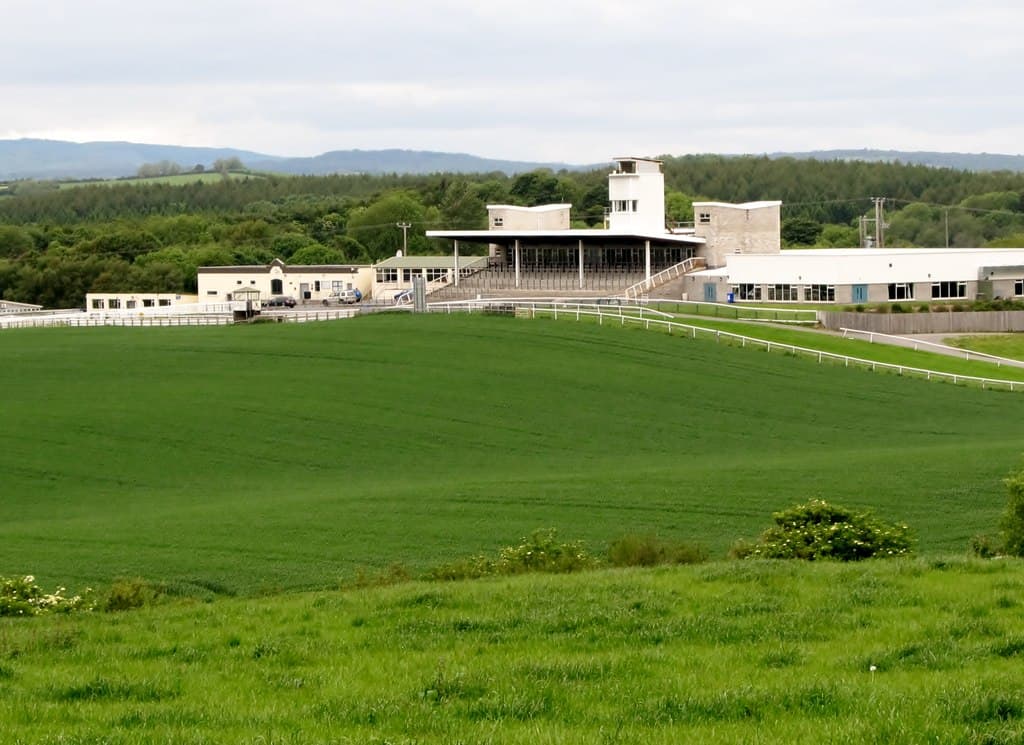
Downpatrick Summer Festival 2026: Floor Plan & Capacity
Check Downpatrick racecourse capacity, floor plans and meeting room spaces for Summer Festival 2026. Essential venue info for County Down's top jumps event.
Read more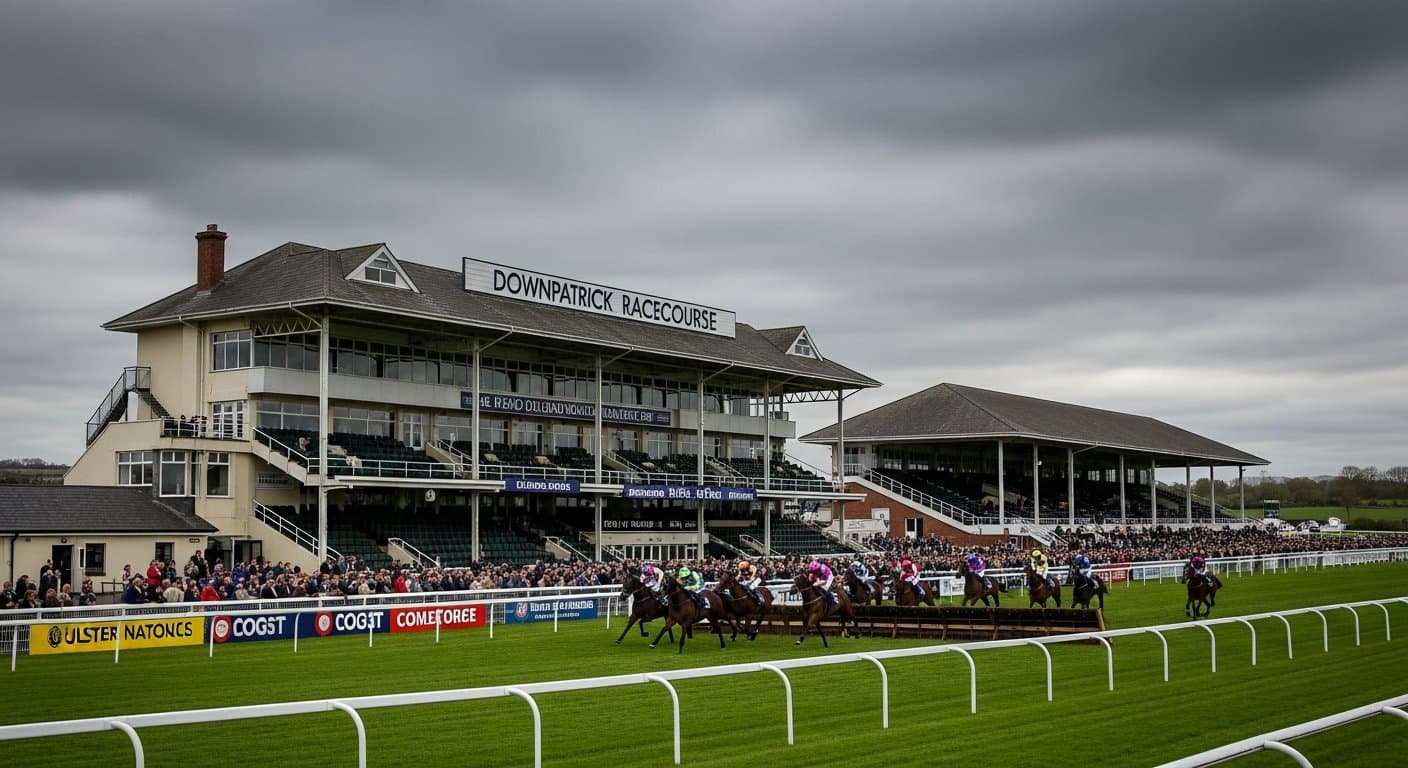
Caughoo at Downpatrick: The Complete Story
The full story of Caughoo, who won the Ulster National at Downpatrick before his legendary 100/1 victory in the 1947 Aintree Grand National.
Read more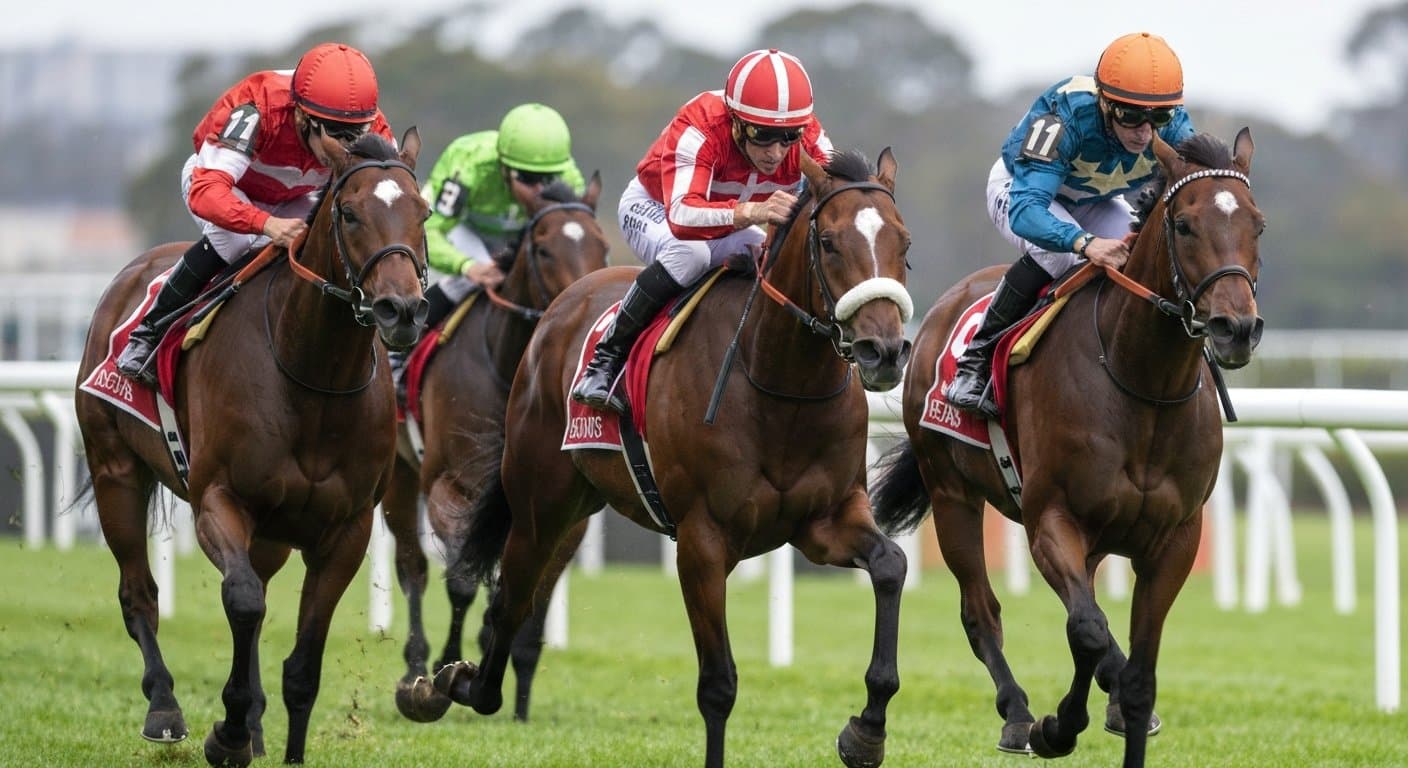
Betting at Downpatrick Racecourse
Bet smarter at Downpatrick — track characteristics, tricky fences and uphill finish, going and conditions, strategies for County Down's National Hunt venue.
Read morePhotos on this page are used under Creative Commons licences. Titles, sources and licence links for each one are on our image credits page.
Gamble Responsibly
Gambling should be entertaining and not seen as a way to make money. Never bet more than you can afford to lose. If you or someone you know has a gambling problem, help and support is available.