
Founder & Editor · Last reviewed 2026-10-14
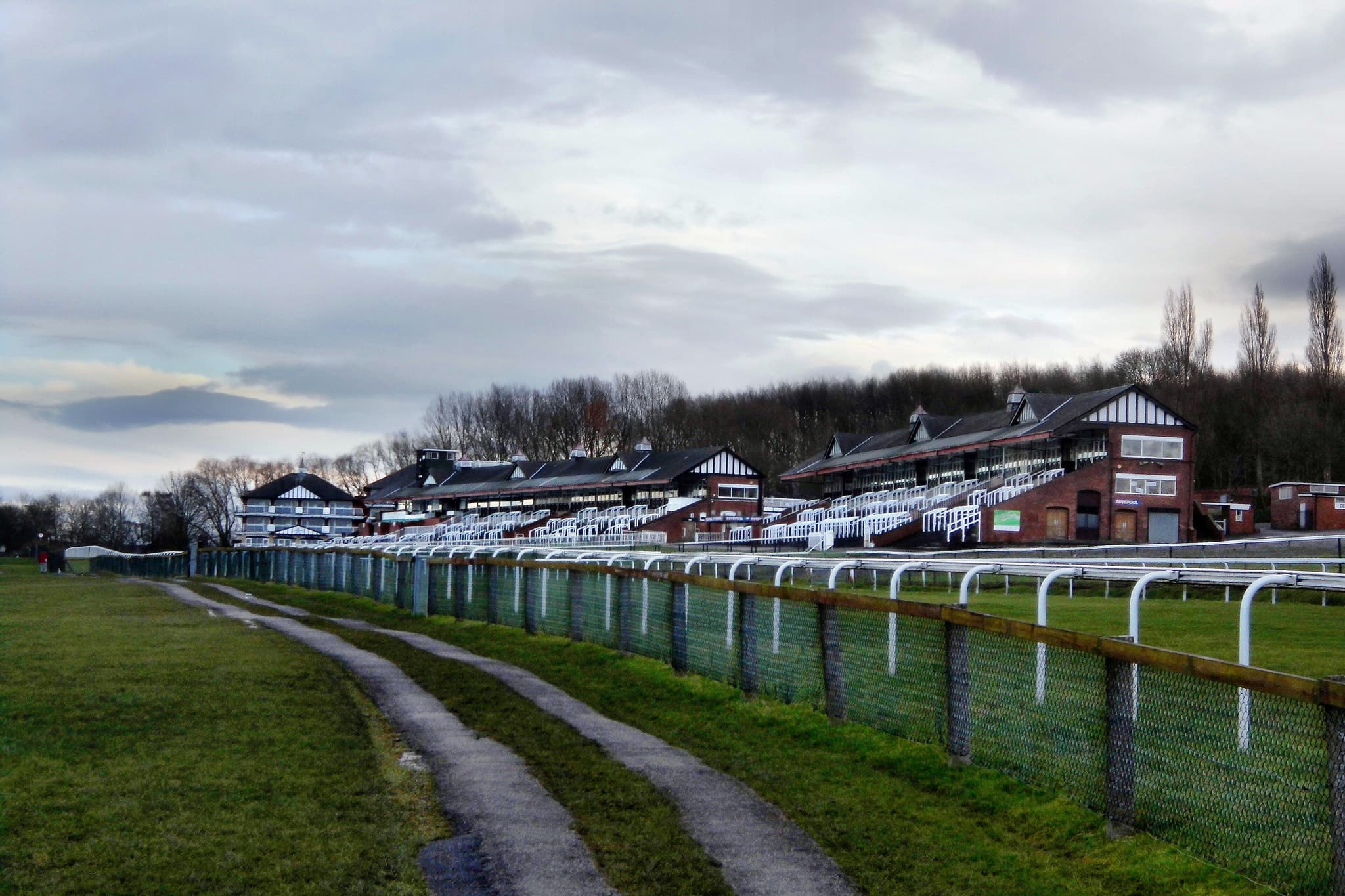
Pontefract Racecourse has one of the longest and most unusual histories in British racing. Racing is recorded here as early as 1648, the year Oliver Cromwell's forces were engaged in their protracted siege of Pontefract Castle. That places the course among the oldest in the country, predating Doncaster and Beverley, and sitting well ahead of the formalisation of many institutions the sport now takes for granted. The castle itself is visible from the course on any clear morning, the medieval ruins rising above the park on the south-east horizon.
The early story is not one of unbroken tradition. Those first races in the meadows near the town ceased by 1769, and it took civic energy to revive them in 1801. From that second beginning, the course grew steadily: a horseshoe layout through Pontefract Park, shaped by the natural contours of the land and by the working community surrounding it. The mines, the castle, the liquorice fields that once characterised the town's economy: Pontefract pressed its identity into the character of the racecourse in ways that are still legible today, more than two centuries on.
What eventually emerged is unlike anything else in British flat racing. The 1983 transformation extended the horseshoe into a full circuit, and Pontefract became the longest continuous flat track in Britain and Europe, capable of staging races over distances up to 2m 2f 125y, longer than anything Ascot, York, or Newmarket can offer on the flat. That distance record is not just a statistic; it changes the type of horse that wins here, the training plans of stables targeting the course, and the shape of every race beyond a mile and a half. The uphill finish of approximately 25 feet in the final two furlongs amplifies the stamina test further, producing race outcomes that consistently favour horses ridden conservatively and produced late.
Pontefract is also unusual in being a family-owned, independent course, not part of the Jockey Club group, ARC, or any other operator. Its five Listed races draw runners from across Britain, its evening meetings attract large local crowds from Wakefield, Leeds, and Barnsley, and its long-distance programme serves a type of staying horse that has almost no comparable domestic targets elsewhere.
For serious students of form, Pontefract's history is not background reading: it is context that shapes how to read a race. The uphill finish, the extreme distances, the dominance of hold-up horses on the circuit, the names of trainers who have used it as a preparation ground: all of these flow from decisions and events explained by what follows. This guide traces the full journey from the origins in 1648, through the Victorian and Edwardian era of expanding crowds and mining-shift start times, the famous moments including wartime substitute races and the 1983 conversion, the modern programme of Listed races and northern trainer dominance, and finally the legacy of a course that has earned its position over nearly four centuries.
Origins & Early Racing
Origins and Early Racing
Racing in Pontefract does not begin with the pleasures of peacetime. The first recorded races here date to 1648, when West Yorkshire was a battlefield. Cromwell's New Model Army had encircled Pontefract Castle, the last major Royalist stronghold in the north, and a siege that would last from June 1648 to March 1649 was grinding through its early weeks. Yet in the meadows near the town, people were laying odds and running horses. The castle rises above the park to this day, visible from the racecourse on a clear morning, and the knowledge that organised sport was taking place in its shadow during one of the country's most violent political upheavals is a striking reminder of racing's stubborn grip on English life.
The castle itself carries its own weight of history. Richard II was imprisoned within its walls in 1400 and is believed to have died there, possibly by starvation. That detail lends the backdrop a medieval severity the meadows below have never quite shed. The Richard II Stakes, a Listed race that sits in Pontefract's modern programme, is a conscious nod to this past, connecting a twenty-first-century flat race with a king who was deposed more than six centuries ago.
The Gap: 1648–1801
The early racing did not last. By 1769, meetings at Pontefract had ceased, and the reasons are not fully documented. Provincial racing of this era was patchy by nature: dependent on local landowners willing to provide ground and prize money, on enough horse-owning gentry to make a field, and on crowd numbers sufficient to justify the cost. When any of those elements faltered, meetings quietly disappeared. Pontefract's first chapter closed without ceremony.
It was closed for roughly thirty years. What revived it was local initiative rather than aristocratic patronage. In 1801, Pontefract townsfolk organised races on grounds adjacent to the present park course. This was not an isolated impulse; across Yorkshire in the early nineteenth century, the enclosure movement was redrawing the countryside and racing was finding new institutional forms. But at Pontefract, the driving force was civic: the town wanted its races back, and the town made it happen.
Founding Infrastructure: 1802–1827
The revival moved quickly into permanence. In 1802, members' badges were sold at £50 each to fund the construction of the first grandstand. That sum represented a serious financial commitment from local subscribers and signalled that this was not a casual experiment. A year later, in 1803, the Pontefract Cup was established, giving the course a named feature race around which meetings could be organised and publicised. Named races of this sort were the anchor of nineteenth-century racing calendars; they created destination events, encouraged owners to plan months ahead, and gave the press a peg for coverage.
By 1827, the September meeting was being reported as "very fashionably attended," a phrase from local newspaper accounts that tells us several things at once: crowds were coming from beyond the immediate town, the social geography of a race meeting was already taking shape, and Pontefract had earned enough reputation to attract commentary. The course had, within a quarter-century of its revival, established itself as a real racing venue rather than a scratch affair.
The Horseshoe Course Takes Shape
The original layout was a horseshoe circuit of approximately one and a half miles, running through the natural contours of Pontefract Park. This was not a designer's creation but a course shaped by the land itself: the undulations, the gradients, the cambers were all there already, imposed by the park's topography. The decision to race here rather than on flat meadows downstream was significant: it produced a track with character baked in from the first gallop.
The defining feature that emerged from this landscape was the finish. The final two furlongs climb approximately 25 feet, a sustained uphill gradient that punishes horses who have overextended themselves in the early and middle stages. This finish-line test shaped the profile of winning horses here from the earliest Victorian meetings. Hold-up horses settled off the pace and produced late consistently outperformed front-runners in races over a mile and beyond. That pattern was established not by any race-designer's intention but by the geology of West Yorkshire.
The park setting also shaped the atmosphere. Pontefract Racecourse has always been embedded in public green space, visible from the surrounding streets, accessible on foot from much of the town. The castle ruins, the park paths, the liquorice gardens that once occupied parts of the surrounding land: the course existed within a civic landscape, not behind private gates. Pontefract is historically famous as the home of Pontefract Cakes, the distinctive liquorice sweets whose production dominated the town's economy through the nineteenth and early twentieth centuries. The same alluvial soil that supported liquorice cultivation also underlies the park's turf, and the town's identity and the racecourse's identity have been intertwined since the revival of 1801.
Takeaway: Why Origins Matter
The early history of Pontefract explains two things that still define the course. The first is its independence: this was a community-built racecourse, not a product of aristocratic estate planning or railway company investment. That civic DNA has kept it out of the large racing groups and preserved its distinctive character. The second is its course shape: the horseshoe layout of the 1803 version, determined by the park's terrain, created a test so unusual that it still separates Pontefract from every other flat course in Britain. Both those qualities trace directly back to the men who sold £50 badges in 1802.
The Golden Era
The Victorian and Edwardian Era
The Victorian period brought Pontefract into the mainstream of northern racing. The course could not claim parity with York, where the Knavesmire's four-day Ebor meeting and its royal connections placed that venue in a different bracket, and it did not challenge Doncaster for the St Leger traffic. Pontefract sat one rung below those county showpieces, but it occupied that position with increasing confidence. By the 1870s and 1880s, it had established a reputation for testing racing over honest ground, for straightforward administration, and for a crowd that understood the sport.
The Railway Changes Everything
The arrival of the railway at Pontefract Monkhill station transformed the course's reach. The Monkhill station, still the recommended arrival point for racegoers today, linked Pontefract to Leeds, Wakefield, Sheffield, and the wider Yorkshire network. Special race-day trains were run, and crowds that had previously walked from the town or arrived by horse-drawn transport could now be supplemented by visitors from across the county. The economic consequence for the racecourse was direct: bigger crowds meant more gate income, which funded improved facilities, which attracted better fields.
The social consequence was equally significant. Victorian race meetings were stratified events, with different enclosures catering to different classes. At Pontefract, those class divisions were always present but never the defining feature. The course's situation inside a public park, adjacent to a working colliery, in a market town rather than a spa city, gave it a democratic edge that courses catering primarily to the carriage trade never quite managed.
The Mining Community and the 2:45 Tradition
Pontefract's position at the centre of the Yorkshire coalfield produced one of the more idiosyncratic features in British racing history. The course traditionally began its afternoon meetings at 2:45 pm, significantly later than the standard start times at most venues. The reason was practical: the adjacent colliery employed thousands of men on morning shifts, and the 2:45 start allowed them to finish work, clean up, and reach the racecourse in time for the first race. This was not a formal policy but a working accommodation between the course and the community it served, and it endured for well over a century, until the colliery closed in 2002.
That start time was a visible expression of something more general: Pontefract was built around and for the working people of the town, not for the convenience of owners travelling down from London or Newmarket. The stands filled with miners, steelworkers, and market traders as readily as with local landowners. That mix gave the atmosphere a directness that more fashionable courses lacked.
The Pontefract Cup
The race that carries the town's name is the Pontefract Cup, a staying handicap still run today. A founding year of 1803 is often repeated for it, but we could not confirm that from a primary source, and we do not hold a sourced account of its Victorian history. For the course's current feature races, see the Pontefract big races guide.
Edwardian Infrastructure and Attendance
By the Edwardian period, Pontefract had the infrastructure to support serious racing. The grandstand had been rebuilt and extended, the paddock arrangements formalised, and the fixture list expanded beyond the original September concentration to include spring and summer meetings. The course was profitable enough to invest in facilities without the subsidy of a wealthy patron, which distinguished it from several smaller Yorkshire venues that depended on annual donations from local gentry.
Attendance figures from the Edwardian era are imprecise: racecourses did not consistently publish crowd numbers. Contemporary newspaper accounts from the Yorkshire Evening Post and Leeds Mercury regularly describe "large crowds" and "excellent attendance" at the major summer and autumn meetings.
The Liquorice Town and Its Racecourse
To understand Pontefract's Victorian character fully, it helps to understand the town. Pontefract was nationally known for liquorice production: the distinctive oval Pontefract Cakes that carry the castle's image had been manufactured commercially in the town since at least the 1760s, using liquorice root grown in the surrounding alluvial soil. By the mid-nineteenth century, several manufacturers including Dunhill's and the firm that became Haribo's UK predecessor were operating in the town. The liquorice economy gave Pontefract a stable middle tier of tradespeople and small manufacturers who attended race days as paying customers rather than as part of the landowning or mining classes.
The racecourse existed inside the same civic landscape as those businesses. The park through which the circuit runs was and remains a public amenity for the whole town; the racecourse occupies it on race days but does not own it exclusively. That relationship between the course and the public park is unusual in British racing, where most courses either own their land outright or lease it from a single private estate. At Pontefract, the integration of racecourse and public space is baked into the physical geography, and it produced the unpretentious, accessible character that persists to the present day.
Takeaway: Why the Victorian Era Still Matters
Two legacies from this period remain live at Pontefract. The first is the course's taste for a stamina test, which the Pontefract Cup and the Pontefract Marathon still carry. The second is the course's independent, unpretentious character: the product of serving a mining community rather than a gentry circuit. That character has survived the colliery, the redevelopment of Pontefract town centre, and the consolidation of British racing into a handful of large corporate groups. Pontefract remains family-owned and independently operated, and the Victorian foundation is part of why.
Famous Moments
Famous Moments
Wartime Racing: 1940–1945
The Second World War produced one of the most unusual chapters in Pontefract's story. When the Jockey Club suspended racing at dozens of venues in 1940, courses requisitioned for military use and transport severely restricted, the sport contracted to a small number of approved venues. Pontefract was one of only two northern courses permitted to continue racing through the war years. The consequence was that it inherited some of the most significant races in the British calendar, temporarily relocated from their traditional homes.
The Lincoln Handicap, normally run at Lincoln Racecourse to open the flat season in the south, was staged at Pontefract as a wartime substitute. The November Handicap, another major handicap event, followed the same route north. For a few years between 1940 and 1945, Pontefract was running some of the most prestigious handicaps in British racing, attracting fields and betting volumes that far exceeded its peacetime profile. The course handled those occasions competently, confirming that its infrastructure was adequate for high-profile racing even if its day-to-day programme was of a more modest level.
The wartime period also tested the course's administration. Fuel rationing limited transport; crowd sizes were restricted at various points; prize money was reduced across the board. That Pontefract kept its operation running through all of this reflects the organisational resilience of the people running it.
Photo Finish and Dope Testing: 1952
Pontefract's instinct for practical innovation showed itself clearly in 1952. The course installed a photo finish camera that year, placing it at the forefront of racecourse technology at a time when most British courses still relied on the judge's eye for close finishes. The photo finish was not merely a convenience; it was a commitment to accuracy in results that mattered acutely for betting and prize distribution. Pontefract's early adoption put it alongside major courses rather than in the provincial tier.
The same period saw Pontefract become the first racecourse in England to install a dedicated dope testing facility. That distinction is easy to underestimate from the present day, but it mattered considerably. Doping scandals had periodically damaged confidence in racing's integrity through the first half of the twentieth century. A course that invested in testing facilities was making a public commitment to clean competition, and doing so ahead of the larger, better-funded venues was a statement of principle. Pontefract did not announce this as a marketing exercise; the facility was built and used, and the sport took note.
The 1983 Transformation
The most consequential single event in Pontefract's modern history occurred on 6 April 1983. The horseshoe course that had been in continuous use since 1801 was converted into a full oval circuit. The engineering involved connecting the two ends of the horseshoe to create a continuous loop, producing a track of approximately two miles and half a furlong in circumference. Overnight, Pontefract became the longest continuous flat racing circuit in Britain and Europe, a distinction it still holds.
The practical effects were immediate. Distances that had been impossible on the horseshoe layout became available. The course could now stage flat races over 2m 2f 125y, a distance unmatched anywhere else in Britain for flat racing under rules. The Pontefract Marathon, at 2m 5f 139y, extended the range further still and created a race for a type of horse that had few other opportunities in the calendar: the extreme staying flat horse who needs trip above all else.
Trainers who specialised in staying horses took notice quickly. The 1983 conversion was not a cosmetic change; it altered the strategic calculations of stables across the country. A horse bred for stamina, or a four-year-old who had filled out and developed the constitution for extreme distances, now had a real target at Pontefract that could not be replicated at York or Ascot or Newmarket.
Henry Cecil and the Quality Question
Through the 1980s and 1990s, Pontefract's Listed races attracted trainers of the highest calibre. Henry Cecil, ten times champion trainer and the handler of horses including Frankel and Oh So Sharp, targeted Pontefract Listed races on multiple occasions with horses on their way to Group company. Cecil's approach was methodical: he would send a promising Classic-generation horse to a Listed race at a testing track as a form of conditioning run, and Pontefract's uphill finish and undulating layout provided precisely the kind of examination he valued.
Michael Stoute, another multiple champion trainer, used Pontefract in a similar way. Stoute's horses, often bred by the Aga Khan or Sheikh Mohammed, would appear at Pontefract in races that looked beneath their class until the trainer's longer-term target became clear. The pattern of quality trainers using Pontefract as a preparation venue rather than a destination in itself is one that Aidan O'Brien has followed in more recent years, sending horses from Ballydoyle for Listed-race experience on the circuit before targeting the major autumn races.
This traffic confirmed something about Pontefract's value in the training calendar: the course is used not merely as a local venue by northern stables but as a proving ground by handlers who need to know whether their horses can handle stress, gradient, and a real stamina test. A horse that wins a Listed race at Pontefract over a mile and six furlongs has earned its preparation tick.
The Richard II Stakes
The Richard II Stakes, the course's premier Listed race for staying horses, became a focus for quality horses through the 1990s and into the twenty-first century. The race's distance, typically run over a mile and six furlongs, makes it one of the more searching Listed staying contests in the calendar. Horses that had run well in the Yorkshire Oaks or were being pointed towards the Prix de l'Arc de Triomphe trip occasionally appeared here, using the race as a final tuning run before a major autumn target.
The choice of name is worth noting. The Richard II Stakes at a course where Pontefract Castle stands visibly on the horizon is an act of historical self-awareness. The course knows its location, and the race name is one of the ways it communicates that knowledge.
Takeaway: A Course That Has Earned Its Stripes
The famous moments in Pontefract's history are not confined to a single glamorous period. They are distributed across the decades: wartime resilience, technical innovation in 1952, structural transformation in 1983, and the steady accumulation of quality racing through the following decades. None of those moments was handed to the course; each was the product of decisions taken by the people running it. That pattern of earned progress, rather than inherited prestige, is what distinguishes Pontefract's story from those of more obviously illustrious venues.
The Modern Era
The Modern Era
Settling After 1983
The decade following the 1983 conversion was one of consolidation. The extended circuit needed time to bed in: literally, in terms of the turf establishing itself over the new connecting sections, and figuratively in terms of trainers and owners understanding what the longer distances meant for their horses. By the late 1980s, the course had absorbed the change and the fixture list was being built around it. Meetings ran from March through to November, a nine-month season that reflected the course's capacity to host quality racing across the turf year.
The colliery adjacent to the course continued to shape the timetable. The 2:45 pm start time that had been maintained since the Victorian era to accommodate mining shift patterns remained in place through the 1980s and 1990s, a visible link between the course's present management and the working community that had been its core audience for generations. When the colliery finally closed in 2002, the 2:45 tradition went with it, and afternoon starts now align with standard industry times. The change was small in logistics but large in symbolism: one of the last surviving traces of the mining economy that had defined Pontefract for 150 years had disappeared.
Richard Fahey and Northern Dominance
Pontefract's modern era has been shaped, more than by any other individual, by Richard Fahey. Based at Musley Bank near Malton, roughly 40 miles north-east of Pontefract, Fahey has been the dominant trainer at the course through the 2010s and into the 2020s, topping the course's trainer standings across multiple seasons. His operation is large and efficiently run, with a particular strength in sprinters and milers who handle undulating tracks, and the combination of course familiarity, volume of runners, and a well-matched horse profile has made Fahey's Pontefract record a consistent source of betting value for those who track form carefully.
Other northern stables with strong Pontefract records include Tim Easterby at Sheriff Hutton, another Malton-area trainer with a large and varied string, and David O'Meara at Upper Helmsley, who has built a formidable operation around horses acquired and improved from other yards. These three trainers between them account for a substantial proportion of winners at the course in any given season, and their records here are worth examining before any Pontefract meeting.
The Listed Race Programme
The modern fixture list includes five Listed races, which collectively provide the quality spine of the season. The Pontefract Castle Stakes, typically run in June over six furlongs, caters to sprinters stepping up from handicap company or older horses dropping back from Group races. The Pipalong Stakes is named after the sprinting mare trained by Tim Easterby who won at Royal Ascot in 2000; it runs over five furlongs and attracts fast, experienced mares. The Pomfret Stakes, over a mile, sits in the middle of the card in terms of distance and class. The Flying Fillies' Stakes, for three-year-old fillies over five furlongs in late June or early July, occasionally produces horses who go on to Group 1 glory at the end of their season. The Silver Tankard Stakes, run in September over a mile for two-year-olds, serves as a form-reference point ahead of the autumn pattern programme.
These five races give Pontefract a programme that reaches beyond its immediate catchment area. Connections from Newmarket, Lambourn, and Middleham all appear in the Listed fields regularly, and the presence of high-quality horses from outside Yorkshire across a season lends the course's form book an authority that purely local tracks cannot match.
Evening Racing and the Local Crowd
Pontefract's evening meetings have become a central part of its commercial model in the twenty-first century. The course's proximity to Leeds (18 miles west), Wakefield (8 miles), and Barnsley (12 miles south) gives it a large urban population within easy reach, and the evening fixture format, with a first race around 5:15 pm and a last race around 8:00 pm, has proved well suited to working crowds from those cities. The atmosphere at evening meetings at Pontefract is different from that of the weekend cards: fewer families, more groups of friends after work, a social tone that sits alongside the racing rather than subordinating it.
Evening racing at Pontefract has consistently drawn healthy attendance figures. The course's setting within the public park means that on summer evenings, with light lasting until past 9:00 pm, the visual environment is more attractive than at many urban tracks. The castle on the horizon, the trees within the park, the relatively compact circuit: these elements combine to produce an evening that functions as entertainment beyond the racing itself, which is part of why the crowds return.
Family Ownership and Independence
Pontefract Racecourse is operated by Pontefract Racecourse Ltd, a family-owned company that has been independent of the major racing groups throughout the modern era. It is not part of the Jockey Club group, whose courses include Epsom, Cheltenham, and Newmarket, and has no connection to ARC (Arena Racing Company) or any other large operator. That independence has consequences for how the course operates. Decisions about the fixture list, the prize money structure, the facilities investment, and the racing programme are taken locally rather than by a head office hundreds of miles away.
The family ownership structure also affects the course's relationship with its community. Pontefract Racecourse does not function as a unit in a portfolio managed for returns to shareholders; it functions as a business with a specific geography and a specific audience. Whether that independence has been uniformly advantageous is debatable, since larger group membership brings resources and shared expertise, but it has preserved the character of the course in ways that consolidation might have eroded.
The Park Course Today
The Park Course that racegoers use today is left-handed, undulating throughout, with that defining uphill finish in the final two furlongs. Horses turning into the home straight with a clear lead are significantly more vulnerable here than equivalent leaders at a flat circuit, because the rising ground finds out those who have burned their reserves too early. Hold-up horses who have covered the earlier ground economically, are produced at the two-furlong pole, and travel up the hill with energy still in reserve: those are the horses that fill Pontefract's results columns year after year. Understanding why this is so is the starting point for any analysis of the course's form book.
Pontefract's Legacy
Pontefract's Legacy
What the Course Has Built
Pontefract's legacy is not one of glamour preserved or aristocratic lineage maintained. It is a record of a community institution that refused to disappear. Racing ceased here in 1769 and came back in 1801. The colliery that shaped the timetable for a century closed in 2002, and the course adapted. The 1983 transformation changed the circuit's geography without changing its character. What persists through all these shifts is a course defined by its landscape and by the people who built it rather than by any outside authority.
The Longest Track in Britain
The claim to being the longest continuous flat circuit in Britain and Europe is not merely a trivia answer. It represents a deliberate choice, made in 1983, to extend the range of racing available at Pontefract rather than to conform to the standard distances offered at other venues. Races over 2m 2f 125y are rare in the British flat calendar; the number of courses capable of offering them is very small. Pontefract's ability to cater for extreme stayers gives it a niche that no Group 1 course can fill. Horses bred for the St Leger or the Ascot Gold Cup distance, and those who mature into real staying ability after their three-year-old season, have targets at Pontefract that exist nowhere else.
The "Pontefract test" that trainers refer to informally is the uphill finish applied to a horse over a long distance on an undulating track. A horse that passes this test has demonstrated not just stamina but balance and athleticism over varied ground. Henry Cecil understood this, which is why he used Pontefract Listed races for horses he was developing towards major autumn targets. Michael Stoute understood it too. The course is not a soft option for a staying horse; it is a particularly demanding one.
A Castle, a Town, and 375 Years
The visible presence of Pontefract Castle from within the racecourse is a geographical accident with real historical weight. The castle stands as a reminder that racing at Pontefract began in 1648, in a period of national crisis, and that it has continued with one significant interruption through every subsequent upheaval. Two world wars, a coal mining collapse, a decade of racecourse consolidation that closed or merged dozens of smaller venues: Pontefract survived all of it. The castle is a ruin; the racecourse is not.
The liquorice connection that the town wears in the form of Pontefract Cakes is part of the same story. The town had its own identity before the racecourse formalised in 1801: a market town, a centre of medieval power, a liquorice producer. The racecourse grew up within that identity rather than replacing it. The Richard II Stakes is not a casual naming; it is an acknowledgement that the course exists within a town whose history reaches back centuries before any horse ran here.
Position in the Northern Circuit
Pontefract occupies a specific position within northern flat racing that York, Doncaster, and Beverley cannot fill. York has the Ebor meeting and the Juddmonte International and operates as the premium northern venue for Classic-generation horses. Doncaster has the St Leger and the Lincoln and functions as the seasonal bookend course. Beverley offers sprint distances and a right-handed track that suits a specific horse type. Pontefract offers stamina, an extreme distance ceiling, a left-handed circuit, and an uphill finish: a combination found nowhere else in the north.
That distinctiveness extends to the form book. Pontefract form translates differently to other courses. A horse that wins over a mile and four furlongs at Pontefract, having travelled up the hill strongly, may well outperform its handicap mark when racing on a flat circuit at a similar trip. Conversely, a horse that wins easily on a flat track sometimes finds the Pontefract gradient an exposure of a different kind. The course form has its own currency, and understanding it separates those who study it from those who apply generic models.
What Pontefract Represents for British Racing
British flat racing is richer for having Pontefract on the map. The sport's diversity, its ability to accommodate the sprint specialist and the extreme stayer, the spring trial and the autumn staying contest, the Group 1 showpiece and the competitive handicap, depends on courses that occupy different positions in the landscape. Without Pontefract's extreme distances, the staying horse has fewer domestic targets. Without its uphill finish, the form book loses one of its more instructive test cases.
The course's independent ownership, its Yorkshire location, its working-community history, and its refusal to conform to the template of the southern prestige venue: all of these are part of what British racing gains by Pontefract continuing to operate. For racegoers who drive up from Wakefield or catch the train to Monkhill station on an August evening, that abstraction takes a simpler form: a racecourse within a park, the castle on the hill, and a proper race to finish the summer.
Frequently Asked Questions
When did racing start at Pontefract?
Racing at Pontefract is first recorded in 1648, making it one of the oldest courses in Britain. However, those early races ceased by 1769 and the course lay dormant for roughly thirty years. The current, unbroken tradition of racing at Pontefract dates from 1801, when local townspeople revived the sport and quickly moved to build permanent infrastructure, including the first grandstand in 1802.
Why is Pontefract called the longest flat course in Britain?
The 1983 conversion of the original horseshoe layout into a full oval circuit created a track of approximately two miles and half a furlong in circumference. This makes it the longest continuous flat racing circuit in Britain and Europe. The course can stage races over distances up to 2m 2f 125y, a ceiling that no other British flat track reaches. Before 1983, the horseshoe was just one and a half miles, and the longest distances available were significantly shorter.
What is the connection between Pontefract Castle and the racecourse?
Pontefract Castle is visible from the racecourse and the two share a park setting in the centre of the town. The connection is historical as well as geographical: the first races at Pontefract in 1648 took place while Cromwell's forces were besieging the castle. The castle is also where Richard II was imprisoned and is believed to have died in 1400, which gives the Richard II Stakes, one of the course's Listed races, its name.
Why did Pontefract meetings used to start at 2:45 pm?
The 2:45 pm start was an accommodation for the workers at the colliery adjacent to the course. Mining shifts ended in the late morning, and the delayed start allowed miners to travel to the course in time for racing. The tradition persisted from the Victorian era until the colliery closed in 2002. Pontefract's afternoon meetings now begin at standard industry times, though the colliery's influence on the course's working-class character remained long after it closed.
Which trainers have the strongest records at Pontefract?
Richard Fahey has been the dominant trainer at Pontefract in the modern era, topping the course standings across multiple seasons from his Musley Bank base. Tim Easterby and David O'Meara are other northern trainers with strong records here. In earlier decades, Henry Cecil and Michael Stoute used Pontefract's Listed races to prepare high-quality horses for autumn targets, reflecting the course's value as a stamina test rather than simply a northern regional venue.
What Listed races does Pontefract stage?
The course's Listed programme includes the Pontefract Castle Stakes (six furlongs, typically June), the Pipalong Stakes (five furlongs, for mares), the Pomfret Stakes (one mile), the Flying Fillies' Stakes (five furlongs, three-year-old fillies), and the Silver Tankard Stakes (one mile, two-year-olds, September). The Richard II Stakes, for staying horses over a mile and six furlongs, is a further Listed race and the course's most historically weighted event given its connection to the medieval castle visible from the track.
Share this article
More about this racecourse
All Pontefract guides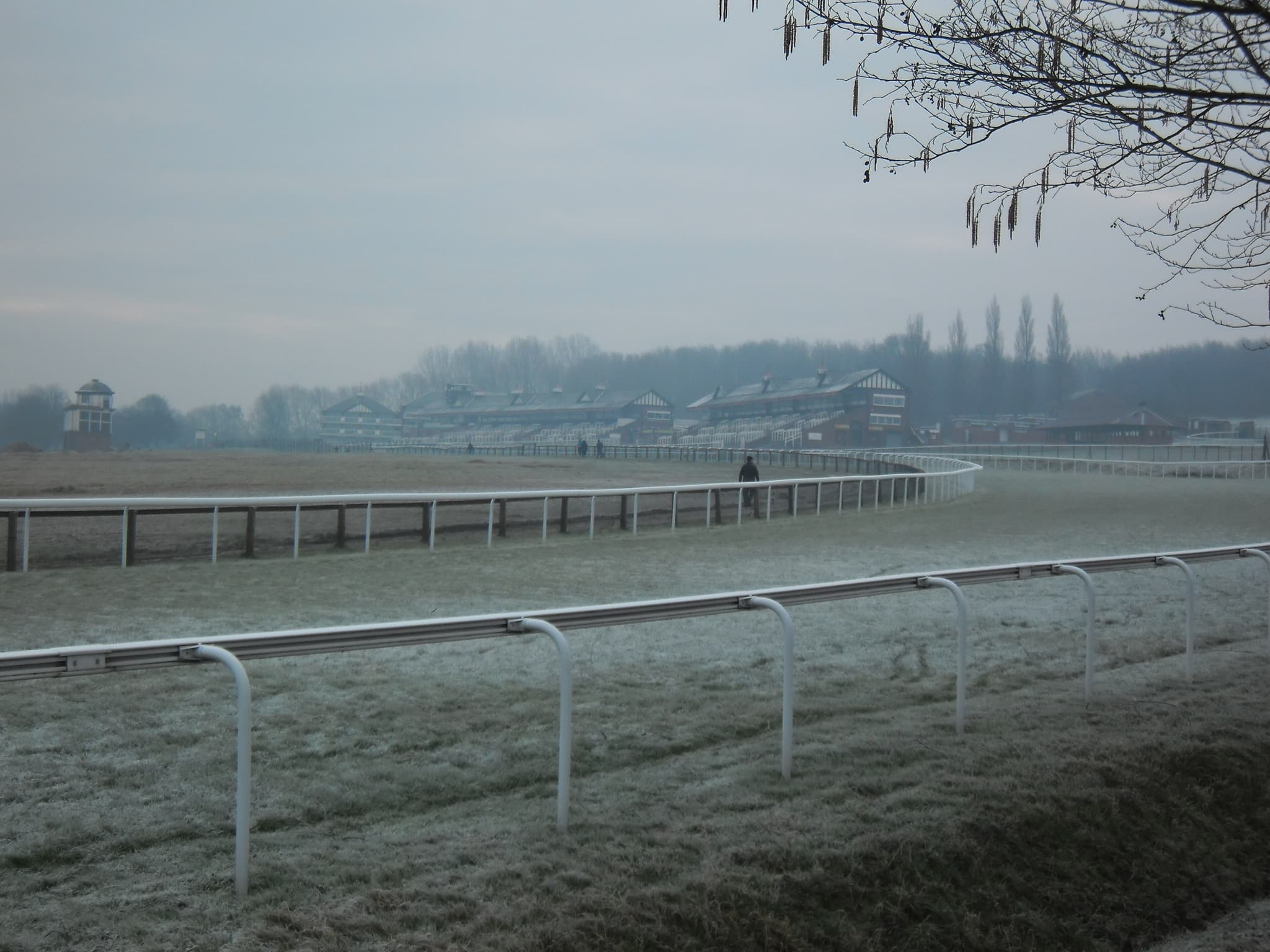
Pontefract Park Course: The Unique Undulating Layout
Understanding Pontefract's Park Course: the longest flat circuit in Britain, its horseshoe-to-oval transformation, and how the undulations affect racing.
Read more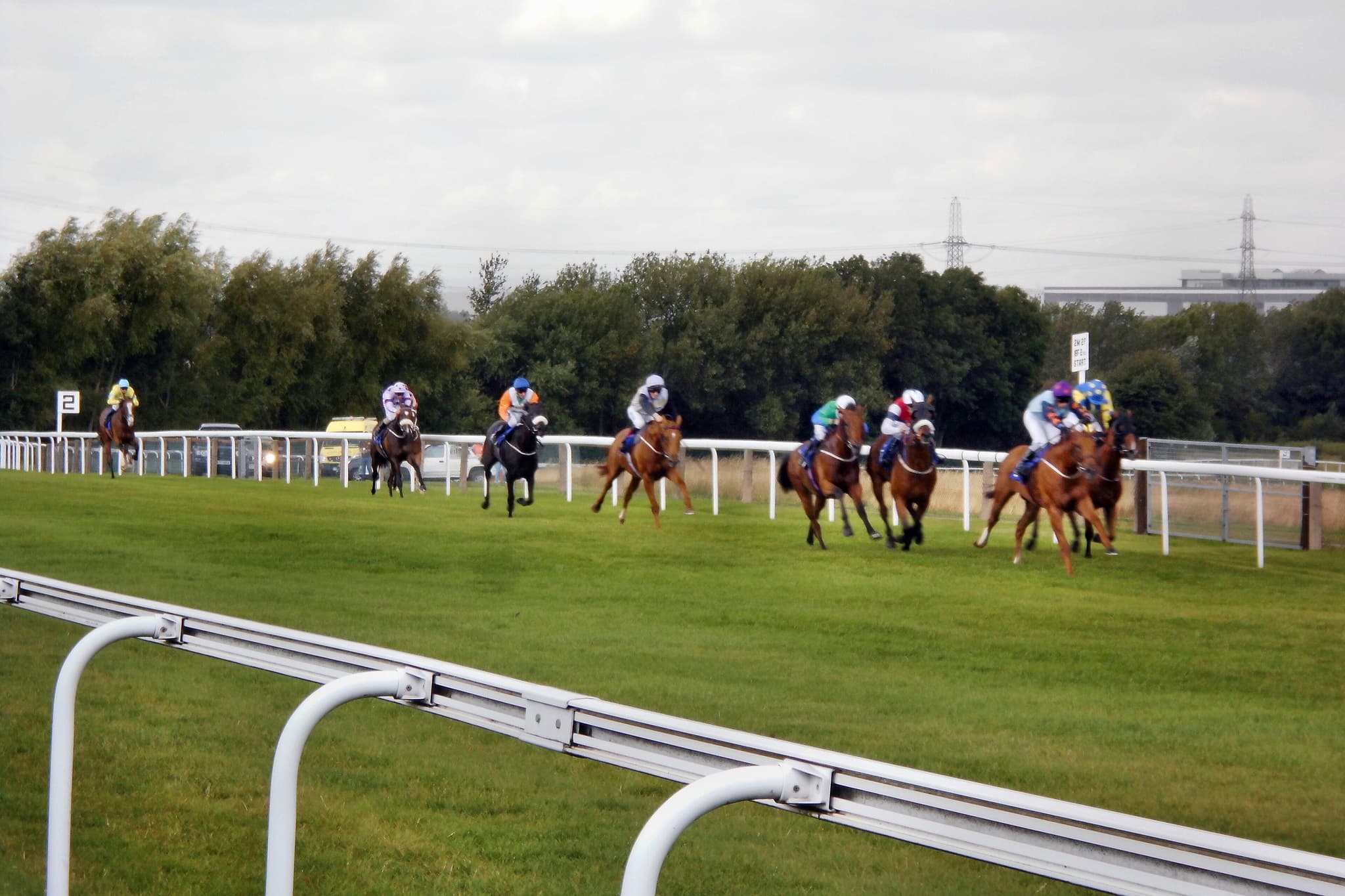
Mr Wolf at Pontefract: Eight Wins on the Hill
Mr Wolf won eight races at Pontefract in 36 starts at the West Yorkshire track, becoming the definitive horse-for-course at Britain's most unusual flat circuit.
Read more
Betting at Pontefract Racecourse
How to bet smarter at Pontefract — track characteristics, going and draw, key trainers and jockeys, and strategies for the Park Course.
Read morePhotos on this page are used under Creative Commons licences. Titles, sources and licence links for each one are on our image credits page.
Gamble Responsibly
Gambling should be entertaining and not seen as a way to make money. Never bet more than you can afford to lose. If you or someone you know has a gambling problem, help and support is available.