
Founder & Editor · Last reviewed 2026-04-05
Introduction
Salisbury Racecourse: Complete Guide
Salisbury Racecourse has been in continuous use for flat racing since 1585, placing it among the half-dozen oldest operational racecourses in England. The current site on Netherhampton Road, south-west of the city above the River Nadder, has been used for organised racing since the early 17th century. That longevity is not simply a historical footnote; it shapes everything about the place, from the layout of the track to the character of the meetings.
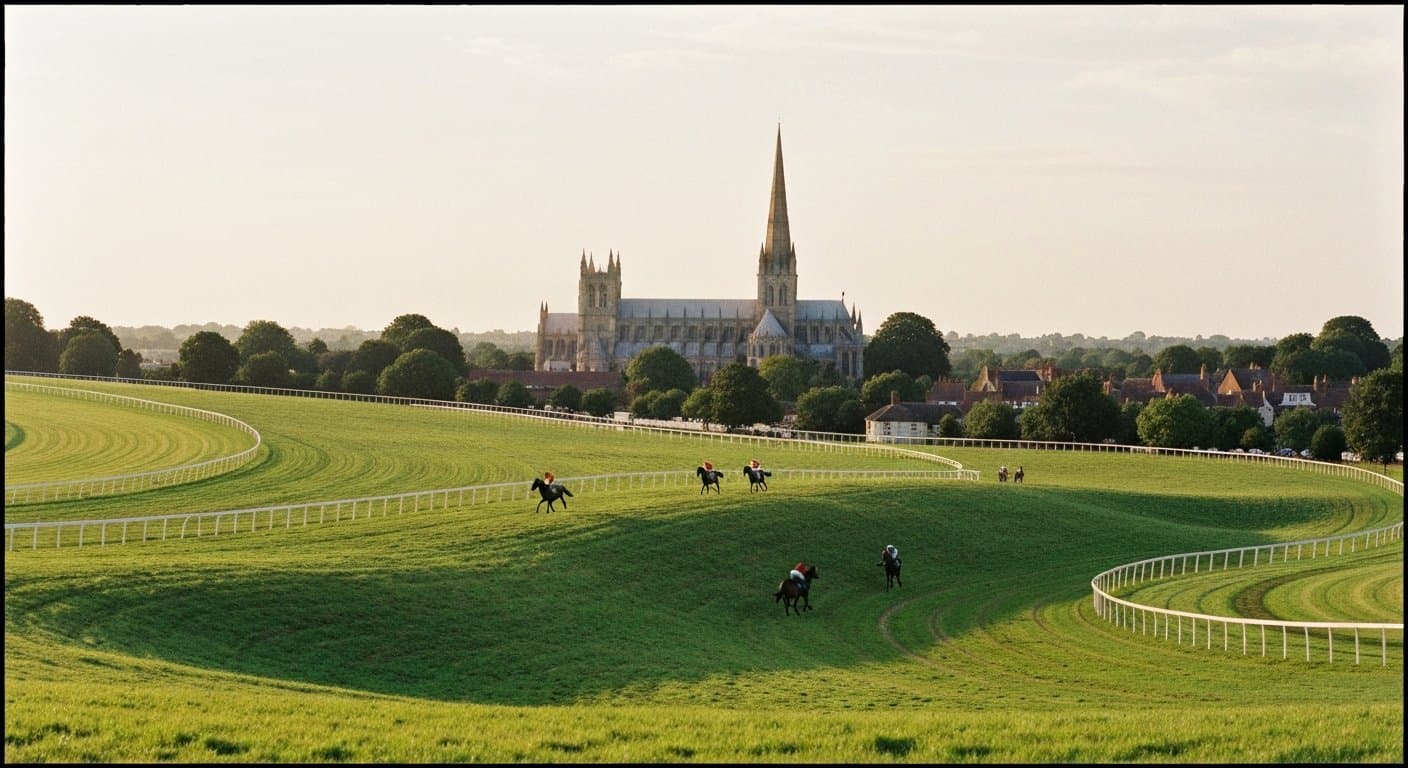
The course occupies a ridge of chalk downland roughly 2.5 miles south-west of Salisbury city centre. Salisbury Cathedral, its spire at 123 metres the tallest in England, is visible from the top of the course on a clear day. Stonehenge stands 8 miles to the north on the A303. For visitors combining a racing trip with tourism, few British racecourses offer this kind of backdrop.
What makes Salisbury stand out among southern flat tracks is the course configuration. A long descending straight of over seven furlongs runs down from Harnham Hill, turning into a home straight that climbs steeply in the final half-mile, a rise of 76 feet that amounts to one of the most demanding finishes in British racing. Horses that handle this finish well tend to have more stamina than their distance record suggests. The form here is taken seriously by trainers and handicappers across the sport.
The Dick Poole Fillies' Stakes, a Group 3 for two-year-old fillies run in September, has produced a disproportionate number of subsequent Classic contenders. The Bibury Cup, run over 1 mile 4 furlongs in June, is the other date regulars mark. Both bring the best of the south-of-England training establishments to Wiltshire, yards from Lambourn, Newmarket, and the Hampshire downs are all well-represented in the course's entries throughout the summer.
The intimate nature of the fixture list, around 15 meetings between May and September, means that each card matters. There are no throwaway days at Salisbury. The form book produced here carries weight that racecourses of a similar profile elsewhere in Britain cannot always match, in part because the stiff finish demands a real performance and in part because the trainers who use the course are among the most astute in the business.
Britain has a handful of racecourses where history, landscape, and the quality of racing on the track converge in a single place. Salisbury is one of them. Chester's circuit dates from 1539; Newmarket's organised racing begins in the early 17th century; Salisbury sits among that group, courses where the setting is inseparable from the meaning of the sport. For anyone with a real interest in flat racing rather than just a social occasion, a visit to Salisbury repays attention in a way that newer, more corporate venues cannot replicate.
Who This Guide Is For
This guide is for anyone planning to attend a meeting at Salisbury for the first time, visitors combining a race day with wider tourism in Wiltshire, and punters who want to understand the course configuration and the betting angles it creates. It covers the layout in precise detail, the full fixture programme, facilities by enclosure, travel options from London and the south coast, a dedicated betting guide, the history of the course and the Bibury Club, and the historical context that makes this one of the more distinctive venues on the British racing calendar. Each section is self-contained, you can read the betting guide without reading the history, or use the getting-there section without reading anything else.
Quick Facts
- Location: Netherhampton Road, Salisbury, Wiltshire, SP2 8PN
- Racing type: Flat only (no National Hunt)
- Season: May to September
- Course shape: Right-handed with a long straight; loop for 1m4f+ races
- Key distances: 5f, 6f, 6f213y, 1m, 1m1f209y, 1m4f5y, 1m6f21y
- Signature races: Dick Poole Fillies' Stakes (Group 3, 6f, September), Bibury Cup (Class 3 handicap, 1m 4f, June)
- Capacity: Approximately 10,000 at peak festival meetings
- Nearest station: Salisbury (shuttle bus on racedays, approx 1.5 miles)
- Nearest landmark: Salisbury Cathedral (2.5 miles), Stonehenge (8 miles)
- Website: salisburyracecourse.co.uk
- Related courses: Goodwood, Bath, Newbury
Bet on Salisbury
Place your bets on Salisbury races with a trusted bookmaker.

Promo code BETFRED50. New customers only. Register, deposit with a Debit Card, and place a first bet of £10+ at Evens (2.0)+ on Sports, to be settled within 7 days, to get £30 in Sports Free Bets and £20 in Bet Builder Free Bets within 24 hours of settlement. 7-day expiry. Eligibility & payment exclusions apply. Full T&Cs apply. Take Time to Think. BeGambleAware.org. 18+. Full T&Cs.

Promo code R30. New UK customers only, 18+. Register, deposit £10 or more, then place a £10 single cash bet at odds of 1/2 (1.5) or greater on any sports market (excluding Virtuals). Once the qualifying bet settles you get £30 in Free Bets (3 x £10) — the qualifying bet can win or lose. Free Bets are valid on any sports market excluding Virtuals, expire in 7 days, are non-withdrawable and must be used in full. Excluded deposit methods apply (including PayPal, Apple Pay, Skrill and NETELLER). Named bets such as Lucky 15 do not qualify. If you cash out the qualifying bet, or it is voided, you are no longer eligible for the offer. Ends 31.12.26. Full T&Cs apply. Please gamble responsibly. BeGambleAware.org. 18+. Full T&Cs.

Promo code BET40GET20. New UK customers, 18+. Register with the code and place a first bet of £40 or more at Evens (2.0) or greater. Receive 2 × £10 free bets: the first credited automatically once the qualifying bet settles, the second 24 hours later. Free bets must be placed at minimum odds of 4/1 (5.0), expire 24 hours after credit, and the free-bet stake is not returned with winnings. Debit card deposits only. Take Time to Think. BeGambleAware.org. 18+. T&Cs apply. Full T&Cs.

50% of your first-day net losses refunded as a free bet, capped at £25. New UK customers aged 18+ only. To qualify, deposit and place a first bet of £10 or more on any sport at minimum odds of evens (2.00), then place at least two further bets on different events, each worth at least 50% of your largest bet, all at evens (2.00) or greater. Losses are counted from your first settled bet until 23:59 the same day. Place a qualifying £10+ bet and you are guaranteed at least a £5 free bet. Bets placed at SP, void bets, cashed-out bets and bets struck with free bets do not count towards the offer. The free bet is credited the day after your qualifying bets settle and must be used within 7 days, after which it expires. It can be used at odds from 1/4 (1.25) up to 250/1 on singles and straight accumulators, but not on Trixie, Patent or Yankee style multiples. Free-bet stake is not returned with winnings. One offer per person, household, address, IP address and device. E-wallet deposits may not qualify, so check the cashier before depositing. Customers registered with GAMSTOP cannot claim. KYC identity verification must be completed before the free bet is credited. Take Time to Think. BeGambleAware.org. 18+. T&Cs apply. Full T&Cs.

New customers, 18+. Choose the sports bonus at sign-up, make a first deposit and receive a 100% bonus up to £50 in your Sports Bonus balance. To convert the bonus to cash, wager it 10x within 30 days. Single bets below Evens (2.00) do not qualify; accumulators do not qualify if any selection is below 1/2 (1.50). Virtual Sports, voided, cancelled, drawn, cashed-out and free-bet wagers do not count towards wagering. Only the first settled bet per event counts. Withdrawing before the wagering requirement is met forfeits the bonus balance including bonus winnings. Real-money funds are used before bonus funds. Deposits via Skrill or Neteller are not eligible. Not valid in conjunction with other promotions. Odds, bet and payment limits apply. 10bet general and promotion T&Cs apply. BeGambleAware.org. 18+. Full T&Cs.

New customers in Great Britain and Republic of Ireland, 18+. Place a £10 fixed-odds qualifying bet at minimum odds of 1/2 (1.50) — single or each-way (only the win part counts), pre-event or in-play, not cashed out early, within 28 days of opening the account. Receive up to £60 in bonuses credited over three days: 3 × £10 fixed-odds free bets (the first on settlement, then 24 and 48 hours later) plus 3 × £5 Total Goals FOOTBALL spread bets and 3 × £5 racing Winning Favourites spread bets, with a £1 racing Race Index spread bet as an extra on top. The spread bets need a full spread-betting account, opened within 28 days of the fixed-odds account and subject to Spreadex's eligibility and appropriateness checks. Free-bet stakes not returned with winnings; free bets valid 28 days from issue. IMPORTANT: the £5 credits are SPREAD bets — sports spread betting carries the risk that losses can exceed your stake. Sports spread-betting customers do not have Financial Ombudsman or FSCS recourse. Take Time to Think. BeGambleAware.org. 18+. T&Cs apply. Full T&Cs.

Promo code WELCOME15, entered under My Bonuses after registering. New UK customers, 18+. Place a first qualifying bet of at least £10 from your cash balance at odds of evens (2.0) or greater within 7 days of opening the account. Once the qualifying bet fully settles you receive £15 in free bets, credited as 3 x £5 tokens with set uses: one £5 accumulator free bet (minimum 4 legs, each leg at 2/5 or bigger), one £5 sports free bet (any market at evens or bigger) and one £5 Sub Cover free bet (selected football player markets at evens or bigger). Free-bet stakes are not returned with winnings. Free bets expire 7 days after they are credited. Void, cashed-out and partially cashed-out bets do not qualify. One offer per customer. Confirm the current terms on BetGoodwin's own welcome-offer page before claiming. Take Time to Think. BeGambleAware.org. 18+. T&Cs apply. Full T&Cs.

New UK customers, 18+. Minimum deposit £10. Place a £10 qualifying single on sports (excluding virtuals) at minimum odds of 1/2 (1.50), settled within 14 days. Deposit-method exclusions apply. Receive £30 in free bets (stake not returned), split £20 for sportsbook use (2 x £10) and £10 for Bet Builder only (2 x £5); Bet Builder does not cover horse racing. Free bets must be accepted within 7 days and expire 7 days after acceptance. No promo code required. Best Odds Guaranteed on UK & Irish racing, subject to having staked over £25 in the previous seven days. Operated by LiveScore Betting and Gaming (Gibraltar) Ltd, UKGC 56859. Confirm the current terms on LiveScore Bet's own promotions page before claiming. Take Time to Think. BeGambleAware.org. 18+. T&Cs apply. Full T&Cs.
18+. BeGambleAware.org
The Course
The Course
Salisbury's track has no close equivalent on the British racing calendar. It is not a conventional oval, not a pure straight, and not a conventional right-handed circuit. Understanding what it actually is, and what that means for races run on it, is the first step to making sense of form here.
The Overall Configuration
The course is broadly right-handed and measures approximately 1 mile 4 furlongs around. The basic shape is a long descending straight, running down from Harnham Hill for over seven furlongs, that swings right at the elbow near the five-furlong marker and feeds into the home straight. For races of 1m4f and above, a loop branches away from the main straight on the far side, adds distance, and rejoins the straight before the final turn into home. Shorter races, anything up to a mile, are run on the straight course from various starting points, all finishing at the same winning post.
That means every race at Salisbury, regardless of distance, finishes on the same uphill straight. The home straight rises 76 feet from the two-furlong marker to the winning post. On a windless summer afternoon that gradient is always present; it is the defining feature of the track.
Key Distances
Salisbury offers a specific set of distances dictated by the track geometry:
- 5 furlongs, straight run, starting from the top of the hill, entirely downhill before swinging right at the elbow, then up the straight
- 6 furlongs, starts further back on the straight course
- 6 furlongs 213 yards, one of the odd Salisbury distances that catches out uninformed punters; the extra yardage comes from a slightly extended starting position
- 1 mile, the full straight course from start to winning post; the most-run distance at the track
- 1 mile 1 furlong 209 yards, incorporates the elbow and a small section of the loop
- 1 mile 4 furlongs 5 yards, uses the full loop; the distance of the Bibury Cup
- 1 mile 6 furlongs 21 yards, the longest trip; only run occasionally, for stayers
The distances matter because pace calculations and draw analysis differ significantly between the straight-course trips (5f, 6f, 6f213y, 1m) and the loop races (1m1f209y, 1m4f5y, 1m6f21y).
The Uphill Finish: What It Actually Means
The 76-foot climb in the final two furlongs is not the kind of gentle incline found on many British courses. It is a sustained gradient that places a specific demand on horses: they must be able to sustain their effort when the ground is rising and their energy reserves are depleting. Front-runners who have gone too fast through the early part of a race find this finish merciless, the lack of a flat run-in offers no recovery phase.
Practically, what this means for reading form: a horse that wins at Salisbury has demonstrated it can finish off a race under duress. Trainers who know the track, and there are several Lambourn stables who use Salisbury extensively, will often use a Salisbury run as a stamina test before stepping a horse up in trip elsewhere. A one-mile winner at Salisbury will frequently go on and perform well at 1m2f at Goodwood or Newbury. The finish does not lie.
For front-runners, the picture is more complicated. Horses with the ability to dictate at a slow-to-moderate pace through the straight course can still win from the front, particularly in smaller fields where they are not pressed. But a horse that goes fast early in a big sprint field at Salisbury, where 12 or more runners may string out across the straight, will almost always get caught. The incline finds them out.
Draw Bias
On the straight course (races up to 1 mile), the draw creates a bias that is worth understanding, though it is not as mechanically consistent as, for instance, Chester.
The course bends right at the elbow around the five-furlong mark. In large-field sprints of 12 runners or more, horses drawn in higher stalls (the right-hand side of the track, stalls numbered from the far rail) tend to have a marginal advantage because the bend works in their favour as the field swings right. In sprint races of fewer than 10 runners, the bias is less pronounced and the going can be the more important variable.
On 1-mile races and above, draw matters less. The stalls are usually positioned centrally or on the far side, and by the time the field has settled into the home straight the initial draw position has largely been neutralised by the tactical running through the loop or the long straight.
A reliable rule of thumb: in big-field sprint handicaps at Salisbury, check the high draws, stalls 8 and above in a field of 12 or more. In smaller fields and all longer distances, the draw becomes secondary to going preference and fitness.
Going Tendencies
Salisbury sits on chalk downland, the same geology that makes the Wiltshire plains distinctive. Chalk drains exceptionally well. After a dry April and May, the ground at Salisbury can be good to firm by late May, and it often remains good to firm or firm throughout June, July, and August unless the area receives sustained rain. The course does not have an irrigation system that can soften a firm surface across its full extent.
In wet years, and Wiltshire does receive summer rain, the going can ease to good or good to soft in August and September, when late-season fixtures often run on softer ground. The going reports issued by the course on the British Horseracing Authority's website are generally accurate, and the chalk base means the ground tends to be consistent across the track rather than varying between rails and centre.
What this means in practice: Salisbury suits horses that act on quicker ground. A horse with a preference for soft conditions is structurally disadvantaged at most summer Salisbury meetings. Conversely, a horse bred on the Juddmonte or Darley sire lines, typically suited to faster going, often runs well here.
Horse Types That Succeed
The profile of a Salisbury winner is fairly consistent across distances. Given the uphill finish, horses with a high cruising speed allied to a real finishing kick outperform those reliant on an early lead. Pure front-runners who require a well-run race to be worn down by pace tend to struggle, because in a steady-paced race at Salisbury they can dictate comfortably, but in a strongly-run race the hill finds them out.
The best horses for the track are those with an above-average cruising speed, capable of sitting off a moderate pace without pulling, and then accelerating up the hill from the two-furlong pole. That type is prized by the Lambourn and Newmarket establishments alike, and it is no coincidence that Salisbury's biggest race, the Salisbury Stakes for two-year-olds, consistently throws up winners who go on to show Classic form. Those horses tend to have exactly the blend of speed and stamina that the track rewards.
Older horses, four-year-olds and five-year-olds running in handicaps, often improve their records at Salisbury once they have encountered the track and learned what the finish requires. A horse returning to Salisbury with a previous run on the course is worth noting, particularly in handicap company, because the track knowledge is a real asset.
Reading Form From Salisbury
Form at Salisbury travels. This is a settled view in British racing, endorsed by handicappers at the British Horseracing Authority over many years. Maiden winners from the June and July meetings at Salisbury regularly go on to win at Listed and Group level later in their two-year-old season. Handicap winners from the August and September meetings frequently follow up at tracks including Newbury, Kempton, and Epsom.
There is a reason for this: the stiff finish ensures that only horses with a real performance level win here. An ordinary effort dressed up by a weak field is caught out quickly at the next start, but a truly good performance, measured by the time taken to conquer the hill, translates accurately. Keep notes on Salisbury form through the summer; it is among the most reliable form guides of the southern flat season.
Key Fixtures & Calendar
Key Fixtures and Calendar
Salisbury's flat season runs from May to September, with around 15 meetings spread across those five months. The programme mixes conditions races, Group and Listed action, and a substantial card of handicaps across all distances. The course is not a major Group 1 venue, but its feature races, the Listed Cathedral Stakes and the Bibury Cup in June and the Group 3 Dick Poole Fillies' Stakes in September, frame the season and draw strong fields from the best southern stables.
The course holds approximately 10,000 spectators at its peak festival meetings; regular midweek fixtures run at considerably more intimate levels, typically drawing 3,000 to 5,000 through the gate. That variance is part of what makes Salisbury interesting: the atmosphere shifts depending on the meeting, from a busy Saturday in late June to a quiet midweek card in July where the serious punters and trainers' representatives outnumber the casual visitors.
The Salisbury Stakes Meeting (June)
The Salisbury Stakes is a Group 2 race for two-year-olds over 6 furlongs, run in late June. It is the most important race on the Salisbury calendar and one of the most significant juvenile races of the summer outside the Pattern race programme at Newmarket and York. The race has a strong record of producing horses who go on to perform at the highest level: horses that win or place in the Salisbury Stakes frequently appear in the following season's Classic trials and beyond.
The meeting itself extends across two days in late June, often described as the Salisbury Festival, with a supporting card of handicaps, conditions races, and a Listed race for older horses. Friday evening and Saturday afternoon programmes mean it can be attended across a weekend. The late-June timing places it after the school term ends in many areas, making it a popular family meeting.
Two-year-old form from the Salisbury Stakes meeting is closely watched. Horses that run well here, not just winners, tend to go on to better things. The placed horses in the Stakes itself have an excellent record at their next start, a point covered in more detail in the betting guide.
The August Bank Holiday Meeting
The August Bank Holiday meeting is the most-attended fixture on the Salisbury calendar. The Bank Holiday Monday in late August draws the largest crowds of the year, fields are competitive across all distances, the going is typically good to firm, and the programme is designed to be accessible rather than purely specialist. Families attend in significant numbers; the course's children's facilities are used to capacity.
This meeting also carries tactical significance for trainers: horses pointed at September targets at Newmarket or Haydock will often make their final prep run at Salisbury in August. The form from the Bank Holiday meeting is worth following closely in the subsequent weeks.
The Bibury Cup (June)
The Gold Cup is a valuable handicap over 1 mile 4 furlongs 5 yards, run in September, and it is the course's oldest-established race in its current form. As the season approaches its end, the field for the Gold Cup tends to include improving older horses who have been building through the summer as well as progressive four-year-olds stepping up in trip. The stiff uphill finish makes this a real test at the longer distance, horses who win the Gold Cup are confirmed stayers.
The September timing means the going is occasionally softer than earlier in the season. Trainers who have horses that need juice in the ground, and have been frustrated by firm conditions in July and August, will target the Gold Cup specifically. That trainer behaviour is a useful angle for punters; it means the Gold Cup field often contains horses running on their ideal ground for the first time in weeks.
Other Fixtures
Beyond the three anchor meetings, Salisbury stages a mix of midweek evening fixtures and weekend afternoon cards from May through to late September. The evening fixtures, typically five or six races on a Wednesday or Thursday, are aimed at the casual racegoer and are priced accordingly, with lower admission and an informal atmosphere. They also carry useful form; the smaller fields on midweek cards mean pace dynamics are easier to read, and trainer statistics at the course are more significant in smaller fields.
May fixtures tend to be earlier-season conditions races where three-year-olds are testing their abilities for the first time following their winter breaks. These races, while modest in grade, are closely followed by bloodstock agents and form analysts, as the Salisbury test gives an early read on horses that will be competitive in the summer Pattern programme.
Planning Around the Calendar
The course publishes its full fixture list each January on salisburyracecourse.co.uk. The Salisbury Stakes meeting in late June is the primary target for a first visit, two days of racing, the prestige of a Group 2 card, and the best atmosphere of the season. The Bank Holiday meeting in August is the right choice for families or those who prefer the busier, more festival-like atmosphere. For anyone with a specific interest in the form book and the betting angles the stiff course creates, a quieter midweek fixture in July or August offers the best combination of value and concentration.
Facilities & Hospitality
Facilities and Hospitality
Salisbury is not a course that competes with Ascot or Goodwood on scale or corporate gloss. It is a medium-sized, independently managed venue with a capacity of around 10,000 at peak festival meetings. The facilities have been upgraded progressively over the past two decades, but the character remains that of a working racing venue: functional, well-organised, and orientated towards the racing rather than the event management.
The County Grandstand
The County Grandstand is the main enclosure and the centrepiece of the course's viewing infrastructure. It sits alongside the home straight with a clear sight-line to the winning post and a long view back up the chalk straight towards the elbow. The stand has covered seating in the upper tier and open standing below: most racegoers stand or move between the rails and the stand throughout the afternoon rather than taking a fixed seat.
Access to the County Grandstand requires a County Enclosure ticket, which is the premium general admission option. This enclosure includes the main betting ring immediately in front of the stand, where the on-course bookmakers set up in two rows. There is also access to the parade ring from the County Enclosure, which is positioned on the far side of the stand from the track: a short walk that means you can see the horses before each race without fighting through large crowds.
The Wessex Stand
The Wessex Stand is the secondary grandstand, positioned further towards the far end of the home straight and offering a slightly different angle on the finish. It is part of the standard admission area and does not require an upgrade. Viewing from the Wessex Stand is good: some racegoers prefer it precisely because it is less crowded on major days. There are bar and food facilities adjacent.
The Paddock and Parade Ring
The parade ring at Salisbury is compact but well-laid-out. On ordinary race days it provides an intimate opportunity to watch the horses close up before each race: trainers and jockeys confer in the centre while horses are led around by the stable staff. On the Salisbury Festival days and Bank Holiday meeting, the parade ring fills quickly in the ten minutes before each race; arriving early and taking a position on the inside of the rail is the best approach.
The Tented Village at Major Meetings
For the Salisbury Festival in late June and the Bank Holiday meeting in August, the course erects a Tented Village on the open lawn area adjacent to the main enclosures. The tented structures house additional food outlets, a Champagne bar, and covered tables for groups who have not booked formal hospitality. The Tented Village is ticketed separately as a day-rate upgrade at some meetings; at others it is included in the premium enclosure price. Check the course website when booking.
Hospitality Suites and Boxes
The grandstand contains private boxes and hospitality suites available for hire on a race-day basis. These are typically sold as packages including a reserved table, a set menu lunch or afternoon tea, and a racecard. The views from the upper-floor boxes are among the best on the course: looking directly down the home straight with the Cathedral backdrop visible in the middle distance. Packages for the Salisbury Stakes meeting are typically sold out months in advance; the Gold Cup and Bank Holiday meeting have more availability closer to the day.
Catering
Salisbury puts an emphasis on local supply, with several Wiltshire-based food producers and caterers represented at the main meetings. The June Festival and August Bank Holiday card typically offer a broader range, hot food, artisan suppliers, a dedicated seafood bar at some meetings, while midweek fixtures run a more straightforward menu of standard racecourse catering. Coffee and cake in the morning before racing begins is available from the opening of the gates, which on a Saturday meeting is typically 11:30am for a first race at 2pm.
Bar facilities are distributed across the course: there are bars in the County Grandstand, adjacent to the Wessex Stand, and in the Tented Village on major days. Queues at the main bar can build in the 20 minutes before a race; visiting during the race itself is the most efficient approach.
Betting Facilities
The betting ring in front of the County Grandstand hosts the on-course bookmakers: typically 15 to 25 boards on an ordinary meeting, with more pitches filled on the Salisbury Festival days. Tote facilities (now run under the Britbet umbrella) are available on the concourse. Self-service betting terminals are positioned in several locations including adjacent to the Wessex Stand. For anyone placing bets through an app on a mobile device, the course has reasonable 4G coverage across the main enclosure area, though reception can be unreliable at the back of the Tented Village.
Disabled Access and Facilities
The course has designated accessible parking close to the main gate, with a surfaced path to the main enclosures. Viewing platforms with level access are available on both sides of the winning post. Accessible toilet facilities are signposted from the main enclosure entrance. The BHA's guidance on accessible racecourses lists Salisbury as meeting the standard requirements; for visitors with specific needs, contacting the course directly before the day is advisable as the terrain on the open lawn areas is uneven in places.
Children's Facilities
A children's play area is set up at major meetings near the open lawn section of the course. It is staffed and includes basic play equipment and supervised activities on the Salisbury Festival and Bank Holiday days. Children are welcomed on all race days; under-18s are admitted free of charge to most meetings when accompanied by a paying adult.
Getting There
Getting There
Salisbury Racecourse sits on Netherhampton Road, south-west of the city, postcode SP2 8PN. It is approximately 1.5 miles from Salisbury railway station as the crow flies, and about 2.5 miles by road from the city centre. The A36 (Bath Road) and the A338 (Ringwood Road) are the main approaches from the north and south respectively; the racecourse road itself, Netherhampton Road, branches off from the south side of the city.
By Train
Salisbury station sits on the main South Western Railway line from London Waterloo. Direct services run from Waterloo to Salisbury in approximately 90 minutes; trains run frequently on racing Saturdays and the journey time is consistent. There are also direct services from Bristol Temple Meads (around 50 minutes), Southampton Central (around 30 minutes), and from Exeter St Davids (around 90 minutes).
On race days the course operates a shuttle bus between Salisbury station and the racecourse, running from roughly 90 minutes before the first race through to 45 minutes after the last. The shuttle picks up outside the main station entrance on South Western Road. Return shuttles depart regularly after the last race. This is by far the easiest option for anyone arriving by train and avoids the question of parking entirely.
If you miss the shuttle, taxis from the station to the course cost approximately £8 to £12 and take 10 to 15 minutes depending on traffic. Pre-booking a return taxi from the course for after the last race is advisable on busy days — it is easier to arrange than finding one ad hoc in the racecourse car park after the final event.
By Car
From London and the South East: Take the M3 to junction 8, then the A303 westbound to the A36 junction, and follow the A36 south into Salisbury. From the city follow signs for Netherhampton. Journey time from central London is approximately 1 hour 45 minutes outside peak hours, longer on a Bank Holiday Saturday.
From Bath and Bristol: The A36 runs directly south from Bath to Salisbury, a distance of approximately 25 miles. Journey time is typically 35 to 45 minutes. This is a scenic route across the Wiltshire downland.
From Bournemouth and Dorset: The A338 runs north from Bournemouth to Salisbury, approximately 30 miles. Journey time is around 40 to 50 minutes.
From Southampton and the South Coast: The A36 runs north-west from Southampton to Salisbury, a distance of around 23 miles. This is a fast route taking 30 to 40 minutes.
The racecourse car park is on-site with a surface of compacted grass and hardcore. Parking is charged on major meetings (typically £5 to £8 per car) and free on smaller midweek fixtures; this is confirmed on the course website before each race day. On the Bank Holiday meeting and Salisbury Festival days, arriving at least 45 minutes before the first race gives a clear run into the car park. The main car park entrance is on Netherhampton Road and is well-signposted from the city's southern roundabouts.
From Stonehenge
Stonehenge is 8 miles north of the racecourse on the A360 and A303. If combining a morning at Stonehenge with an afternoon at the races, allow 20 to 25 minutes for the drive south from the monument into Salisbury and out to the course. English Heritage recommends booking a timed entry slot for Stonehenge in advance, particularly in summer; slots from 9am to 11am leave sufficient time to reach the course before the shuttle begins. The atmosphere and planning section has more detail on this itinerary.
By Coach
National Express runs services to Salisbury bus station from London Victoria, Bristol, and Southampton. The bus station is roughly 500 metres from the railway station; the raceday shuttle operates from the railway station forecourt, so those arriving by coach should walk to the train station to catch it. No direct coach-to-racecourse service operates, but the shuttle system effectively covers this gap.
Summary
For visitors from London, the train is the most straightforward option: 90 minutes from Waterloo, a shuttle bus to the course, and no parking or traffic to navigate. For those coming from Bath, Bristol, or the south coast, the car is typically quicker. The course is easy to find from all directions once you reach the southern outskirts of Salisbury.
Frequently Asked Questions
History
History
Origins on the Wiltshire Downs
Organised racing on the chalk downland above Salisbury predates reliable written records. The broad ridge south-west of the city — Harnham Hill and the surrounding plain — provided the natural ingredients that drew early racing activity: firm, well-drained ground, long unobstructed stretches, and a proximity to a prosperous cathedral city. The first dateable reference to racing at Salisbury is from 1585, making it one of the oldest continuously recorded racing venues in England.
The 1585 date relates to a match race — a contest between two horses for a wager — rather than a formal organised meeting. Such contests were the standard form of Elizabethan horse racing, conducted between wealthy landowners on agreed strips of ground. The downland south of Salisbury was already established as a site for this activity by the time of the first written record, implying a practice that was probably already a generation or more old. Whether the exact geography of the 1585 races corresponds to the present course on Netherhampton Road is debated, but by the early 17th century racing on or very close to the present site was well-established.
Royal Patronage: Charles II and the Restoration Period
The most significant figure in Salisbury's early history is Charles II, who attended and participated in racing at Salisbury in the 1660s. Charles's enthusiasm for horse racing — he won a race at Newmarket himself in 1671, riding his own horse — led him to patronise courses across the south of England, and Salisbury was among those he visited. Royal attendance at a racing venue in this period gave it social legitimacy that attracted the wealthiest participants and spectators, and it helped establish the Wiltshire fixture as a date in the sporting calendar of the English aristocracy.
The Restoration period in general was the moment when horse racing began to transform from informal aristocratic gambling into something closer to an organised sport with agreed rules and a recognised programme of meetings. Salisbury was part of that transformation from the beginning.
The Bibury Club
The Bibury Club, which still administers Salisbury Racecourse, is one of the oldest racing organisations in Britain. Formed in the 17th century, the Club originally took its name from the Bibury course in Gloucestershire — a location where its members also organised racing before the Gloucestershire meetings lapsed. The Club transferred its primary focus to Salisbury, where it has continued to operate ever since.
The significance of the Bibury Club's longevity is practical as well as historical. Unlike many British racecourses that passed through multiple ownership changes during the 19th and 20th centuries, Salisbury's independent character has been preserved by a single governing body. The Club's membership has historically drawn from the Wiltshire and Hampshire landowning and military establishment — the same social networks that supplied many of the horses and patrons at Salisbury meetings from the 17th century onwards.
The Victorian Era and Formalisation
The 19th century brought the formal infrastructure that defines a modern racecourse. The grandstand was built in the 1880s — a period when major racecourses across Britain were investing in permanent viewing facilities as the railway opened racing to a much broader paying public. Salisbury station, opened in 1857, connected the course to London in a journey of roughly two hours, transforming the potential audience for major meetings.
By the late Victorian period, Salisbury was an established fixture on the southern flat calendar, hosting a programme of handicaps, conditions races, and match races that drew serious competition from the Newmarket and Lambourn stables. The 1880s grandstand was progressively modified through the 20th century, though its basic footprint remains recognisable in the present County Grandstand.
The 20th Century
Salisbury's role in the 20th century was as a reliable quality venue for the southern flat programme — not a course that sought to host the very top-grade races, but one that maintained a consistent standard of competition and a reputation for producing reliable form. Several of the greatest trainers of the mid-20th century, including those based in the Wiltshire and Berkshire downland training centres, used Salisbury regularly as a prep ground for horses targeted at bigger prizes.
The course was modernised significantly from the 1980s onwards. Facilities were upgraded, the enclosure infrastructure was improved, and the race programme was reviewed. The Salisbury Stakes — already a prestigious race in the programme — was elevated to Group 2 status, which marked Salisbury's arrival as a venue for racing of real Pattern-race significance.
The Salisbury Stakes as a Group 2 Race
The elevation of the Salisbury Stakes to Group 2 status formalised what had long been known in the industry: that the race's field quality and its predictive value for subsequent Classic performance placed it among the most important juvenile races of the British summer. The race's history of producing subsequent Classic contenders is examined in the famous moments section. The Group 2 classification means the race attracts Pattern-level horses from the major Newmarket, Lambourn, and Newbury operations, and that placed horses earn Pattern-race black type — a significant factor in determining their future career options and breeding value.
Today Salisbury occupies a distinctive position in British racing: historic enough to carry real authority, small enough to retain an intimate character, and strategically placed on the racing calendar to make its form a relevant guide across the second half of the flat season.
The Bibury Club's independence means Salisbury has avoided the homogenisation that affected several British courses absorbed into larger ownership groups in the 1990s and 2000s. The course retains its character as a working flat track with a focus on the racing itself — infrastructure is functional and well-maintained rather than corporate, and the race programme prioritises field quality over spectacle. That independence, stretching back to the 17th-century origins of the Club, is a thread that runs continuously from the races attended by Charles II in the 1660s to the Pattern-race programme of the present day.
Famous Moments
Famous Moments
The Salisbury Stakes as a Classic Pointer
No feature of Salisbury's modern racing history is better documented than the Salisbury Stakes' record as a guide to future Classic performers. The race sits in late June, early enough in a two-year-old's career to test horses who have only run once or twice, and its stiff uphill finish provides an assessment of stamina reserves that later Pattern races at Newmarket and Goodwood cannot replicate on their flat surfaces.
The list of subsequent high achievers who have appeared at Salisbury at the two-year-old stage, either in the Stakes itself or in the supporting maiden and conditions races run on the same Festival card, includes horses who went on to win the 2,000 Guineas, the Derby, and the Oaks. Salisbury maiden races in late June and early July have a particularly strong record: horses winning Salisbury maidens by a wide margin in June have, on multiple occasions in recent decades, been the most talked-about juvenile prospects by the time the Dewhurst Stakes arrives in October.
Kingman, trained by John Gosden and a son of Invincible Spirit, is among the horses associated with the Salisbury juvenile programme in the period around his 2013 and 2014 campaigns. While his specific path to the 2014 2,000 Guineas went through multiple prep grounds, the pattern he represents, a speed-and-stamina blend ideally suited to uphill finishes, is exactly the profile Salisbury identifies and rewards. Lambourn and Newmarket yards have consistently used the Salisbury Stakes meeting as an early benchmark for their best juvenile prospects.
The placed horses in the Salisbury Stakes deserve specific attention. Second and third in this race have an exceptional record at their subsequent starts: significantly better than the placed record in comparable Group 3 or Listed races. The reason is structural: the uphill finish at Salisbury punishes horses that lack real quality, so a horse that finishes second by a length here has typically run a high-quality race even if the bare margin does not reflect that. Punters who note placed horses from the Salisbury Stakes and follow them at shorter odds in their next starts have found consistent value over many seasons.
Trainers Who Have Shaped Salisbury's History
The course's proximity to the major southern training centres: Lambourn is approximately 35 miles north, Newbury is 25 miles north, and the Hampshire downs stables around Kingsclere are under 30 miles away: means that the major training operations in the south of England have always been heavily represented at Salisbury meetings. In the post-war period, trainers including Dick Hern (based at West Ilsley in Berkshire), Jeremy Tree (Beckhampton, near Marlborough), and Barry Hills (Lambourn) all used Salisbury as a regular prep ground for horses pointed at bigger targets.
In the modern era, John Gosden's Newmarket operation and William Haggas's Newmarket yard have strong Salisbury records. Charlie Hills, based at Faringdon Place in Lambourn, is among the trainers who appear consistently in the Salisbury Stakes results. The connection between these yards and Salisbury is not coincidental: the uphill finish tests horses in a way that flat southern tracks cannot, and trainers who need to know whether a horse truly stays a trip, or truly handles fast ground, will point them at Salisbury before committing to a bigger target.
Royal Ascot Prep Runs
Salisbury occupies a specific tactical role as a final prep ground before Royal Ascot for horses targeted at the sprint and mile races. The timing of Salisbury's May and early June fixtures fits naturally into a preparation programme for horses aimed at Ascot week in mid-June. A horse running at Salisbury in early June, demonstrating form on fast ground over six furlongs or a mile, is ready to run at Royal Ascot ten days later. Several horses who have run at Salisbury as their final prep before Ascot have gone on to win at the Royal meeting: the fast ground that Salisbury typically offers in June mirrors the going at Ascot in a dry year.
Upsets in Two-Year-Old Maiden Races
Salisbury's maiden races for two-year-olds, particularly the early-season maidens run at the May and June fixtures, have a record for producing what appear to be upsets but are, on reflection, early form guides to horses of real quality. A big-priced winner in a Salisbury 6-furlong maiden in June will frequently turn out to have beaten horses that go on to win at Listed or Group level later in the season, making the "upset" look like a well-beaten favourite and a high-class winner. The form of Salisbury two-year-old maidens is worth keeping. Handicappers at the BHA have consistently found that official ratings assigned after Salisbury maiden performances hold up well through the subsequent season.
Memorable Finishes on the Hill
The uphill straight has produced its share of memorable finishes over the decades. Salisbury's specific combination, a long run to the hill, then a sustained climb with no flat run-in, produces finishes where horses struggle visibly in the final 100 yards, and the order can change completely between the two-furlong pole and the line. Races in which a clear leader at the two-furlong marker is overhauled by a seemingly impossible margin from a horse held up through the race are a recurring Salisbury pattern, not an exceptional one. This feature of the course, dramatic finishes driven by the gradient, is part of what makes it a distinctive venue for spectators who understand what they are watching.
Betting Guide
Betting Guide
Salisbury is a course where the physical characteristics of the track produce clear, repeatable betting signals. Understanding those signals does not require advanced data analysis: it requires understanding what the uphill finish means, which draw positions matter and when, and which trainer and horse profiles have historically overperformed here.
The Uphill Finish: The Most Important Variable
The 76-foot rise in the final two furlongs is the dominant factor in every race at Salisbury. Its implications for betting are specific and worth spelling out:
Horses that win at Salisbury stay further than their distance record suggests. A horse rated as uncertain to get a mile, based on its breeding or its previous form at a flat track, that wins over a mile at Salisbury has demonstrated it can finish off a sustained effort on an uphill gradient. When that horse Then runs at 1m2f at Goodwood, Sandown, or Newmarket, its Salisbury win is a more reliable guide to its stamina reserves than any flat-mile form elsewhere. The implication for betting: when assessing step-up horses, a Salisbury win should be weighted above an equivalent performance on a flat track.
Front-runners are structurally disadvantaged in strongly run races. A horse that leads and sets a quick early pace in a competitive sprint handicap at Salisbury is running into the hill having already depleted its energy reserves. In small fields where the pace is slow, front-runners can maintain their position, but in big-field handicaps with real pace, held-up horses regularly come through in the final furlong. The betting signal: in competitive handicap sprints, back the hold-up horses and be sceptical of early leaders unless the field is small (six or fewer runners).
The stiff finish finds out horses that are not at peak fitness. Trainers know this, which is why Salisbury is used as a pre-Ascot prep ground rather than as a "safe" win opportunity. A horse that runs below its form at Salisbury is often truly unfit or below full fitness; the track does not allow a lazy or unfit horse to get away with it. This makes it a reliable form guide but also a venue where non-runners and late scratchings are worth watching, if a trainer removes a horse from a Salisbury entry at short notice, physical readiness is often the reason.
Draw Analysis
In sprint races (5f, 6f, 6f213y) with 12 or more runners, high draws, stalls 8 and above, have a marginal advantage. The right-handed elbow at the five-furlong mark means that horses drawn wide on the right-hand side of the track have a fractionally shorter path around the bend. The advantage is not as pronounced or as consistent as at Chester, where the tight oval makes high draws almost mandatory, but in a big-field sprint at Salisbury, a high draw is a positive factor rather than a neutral one.
In fields of 10 or fewer runners in sprint races, the advantage dissipates. Horses spread across the track run on more similar paths, and the going becomes more influential than the draw. In these races, favour the going-preference angle over the stall position.
In races at 1m and above, the draw is not a significant variable. By the time the field has settled into its running positions through the long straight or the loop, the initial stall position has become irrelevant. Betting purely on draw bias above a mile at Salisbury is a common mistake.
Trainer Statistics
Three training operations deserve specific attention in Salisbury form.
John Gosden / Thady Gosden (Newmarket): The Gosden operation, now run jointly by John and Thady Gosden from Clarehaven Stables in Newmarket, has a long record of strong performance at Salisbury. Their horses tend to be well-suited to the fast ground that Salisbury typically provides in summer, and the yard's use of Salisbury as a prep ground for Pattern-race targets means their runners are often ready to win rather than being placed for experience.
William Haggas (Newmarket): Haggas's Somerville Lodge yard has consistent Salisbury form, particularly in maiden and conditions races for lightly raced horses. Haggas runners appearing at Salisbury for the first or second time, in fields where the yard has a confirmed first-time starter, are worth noting.
Charlie Hills (Lambourn): Hills, based at Faringdon Place in Lambourn, is one of the trainers most closely associated with the Salisbury Stakes meeting. His two-year-old record at the June Festival meeting is strong, and his sprint handicappers at the course through July and August have an above-average strike rate.
A working rule: if any of these three yards runs a horse at Salisbury that is not clearly overpriced in the market, the form case for backing it is strengthened by the trainer's record at the course.
The Salisbury Stakes: Follow the Placed Horses
The Salisbury Stakes winner is usually well-supported in the market and returns a fair but rarely spectacular price. The real value in the race comes from the placed horses. Second and third in the Salisbury Stakes have a significantly better record at their subsequent starts than the placed horses in comparable Group races on flat tracks. The structural reason is the one described above: the uphill finish means that a horse finishing second by a length here has run a high-quality race. Those horses are regularly underestimated in the market at their next start, particularly if that next start is a maiden or Listed race on a flat track where bookmakers and punters focus on the winner's credentials rather than the runner-up's form.
In practical terms: when the Salisbury Stakes is run, note the second and third. If either runs next in a maiden or conditions race within four weeks, their Salisbury form is worth more than their odds will typically reflect.
Fillies Returning to Turf
A more specific Salisbury angle that has held value over multiple seasons: fillies who have run on the all-weather (Kempton, Lingfield, or Wolverhampton) during the winter or spring and are returning to turf at Salisbury in August tend to outperform their odds. The reason is that all-weather form for fillies is systematically underrated by the market, and Salisbury's fast summer ground suits the Flat-bred filly profile well. Fillies with two or three all-weather runs who appear in Salisbury handicaps in August are worth checking for trainers with a Salisbury record and for horses whose all-weather ratings suggest they are competitive with the turf handicap mark they have been assigned.
Going Reports and Market Timing
Because Salisbury's going can shift significantly between meetings, from good to firm in June to good in September, the going report is a real piece of information rather than a formality. Horses with a specific going preference whose record shows a clear performance uplift on quick ground should be checked against the Salisbury going report published on the Wednesday or Thursday before a Saturday meeting. Backing going-preference horses before the report is confirmed carries unnecessary uncertainty. Markets at Salisbury for Saturday fixtures typically move on Thursday evening when the going report is published; that window is the most useful for backing horses whose price will shorten once their going preference is confirmed.
Atmosphere and Planning
Atmosphere and Planning
The Setting
Salisbury is one of the great English cathedral cities, and the racecourse sits on the chalk downland directly south-west of it. From the top of the track, above the starting gates for the longer straight-course races, Salisbury Cathedral's spire is visible on a clear day, rising 123 metres above the city. No other British racecourse offers quite this combination: an ancient chalk-downland track, an intact medieval city within three miles, and England's most visited prehistoric monument eight miles up the road.
The racecourse itself sits above the River Nadder valley, with views across the downland to the south and east. On summer afternoons, when the racing is taking place on fast ground under an open Wiltshire sky, the setting is one of the most attractive in British flat racing, not the manicured grandeur of Goodwood or the urban intensity of Sandown, but open, airy, and distinctly English.
A Full Day's Itinerary
Morning at Stonehenge: Stonehenge is 8 miles north of the racecourse on the A360 and A303. English Heritage operates timed entry slots that must be booked in advance, particularly from May to September. A 9am entry slot gives you 90 minutes at the monument before the main crowds arrive, and departure by 10:30am leaves ample time to drive south to Salisbury and reach the course before the shuttle service begins or the car park fills. The A360 south to Amesbury and then the A338 or A36 into Salisbury is a 25-minute drive.
Salisbury Cathedral: For those who arrive in Salisbury with time before racing, the Cathedral is the city's standout attraction. The Chapter House contains one of the four surviving 1215 copies of Magna Carta: the British Library holds another, Lincoln Cathedral another, and Salisbury's is among the best preserved. Admission to the cathedral is typically £10 to £15 for adults. The building itself, construction began in 1220 and the spire was added in the 14th century, is intact in a way that few English medieval buildings are, having avoided major damage in the Civil War or the Reformation.
Evening in the city: Salisbury's restaurant and food scene has improved substantially since the 2010s. The city centre has a range of options from independent restaurants in the medieval streets near the market square to pubs along the River Avon. The Haunch of Venison in the old city is one of the oldest pub buildings in the country. If staying overnight, the city offers accommodation at all price points from budget chains near the ring road to boutique hotels in converted Georgian townhouses within walking distance of the Cathedral.
What the Atmosphere Is Actually Like
Salisbury at a major meeting, the June Festival or Bank Holiday, has an informal summer atmosphere that feels distinct from the more formal southern tracks. The dress code is relaxed, the crowd is mixed across age groups, and the course's moderate capacity means it rarely feels overcrowded. Trainers, stable staff, and serious punters mix with families and first-timers in a way that feels less stratified than Ascot or Goodwood.
On quieter midweek evenings in July, the atmosphere is almost private: small crowds on the open lawn, bookmakers adjusting prices in an unhurried way, and a pace of the afternoon that allows attention to the racing rather than the event. These are the meetings that experienced racegoers tend to value most.
Practical Tips
- Weather: The chalk downland above Salisbury is exposed. In summer it can be very warm with no shade on the open lawn; bring sun protection and water. In May and September, an afternoon that starts warm can turn cool and windy. A light layer is worth packing regardless of the forecast.
- Racecard: Buy a printed racecard from the sellers at the gate: it includes the form guide, trainer and jockey information, and the going report. At Salisbury, where the form book is an active tool rather than background decoration, the racecard is worth the cost.
- Timing: Gates open approximately two hours before the first race on major meeting days. Arriving at gate opening allows you to see the course before it fills, visit the parade ring in peace, and have first access to the best viewing spots at the rails.
- Return journey: If arriving by train and shuttle, note the last shuttle departure time. This is typically 45 minutes after the last race: sufficient if you leave promptly but not if you linger at the bar. Taxis from the course to Salisbury station should be pre-booked for major meetings.
More guides for this course
Share this article
More about this racecourse
All Salisbury guides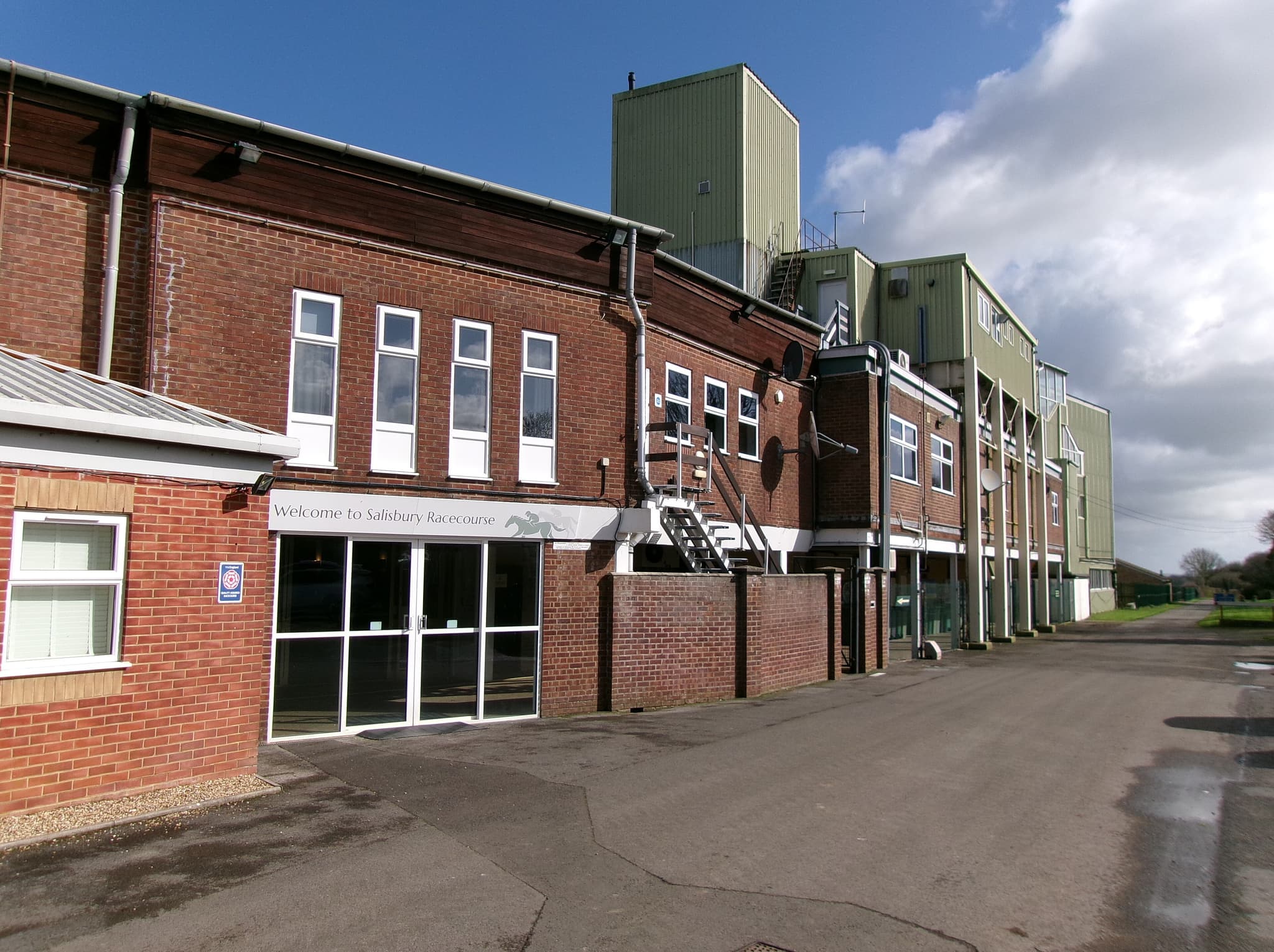
A Day Out at Salisbury Racecourse
Everything you need for a day at Salisbury — getting there, what to wear, enclosures, food and drink, and insider tips for the historic cathedral course.
Read more
Salisbury Summer Racing Festival: Your Complete Guide
Salisbury's Cathedral Course stages the Bibury Cup and some of the most competitive summer flat racing in the south. Here's your guide to the Wiltshire racing festival.
Read more
There Is No Salisbury Gold Cup
We published a guide to a Salisbury Gold Cup and the race does not exist. Here are the course's real feature races, including the historic Bibury Cup.
Read morePhotos on this page are used under Creative Commons licences. Titles, sources and licence links for each one are on our image credits page.
Research the field with the AI Race Predictor
Our model publishes calibrated win-probability estimates for UK races — a second opinion to understand a race, not tips. It's open about its record: it doesn't beat the market, and we show exactly how it does.
Work it out & learn the basics
Gamble Responsibly
Gambling should be entertaining and not seen as a way to make money. Never bet more than you can afford to lose. If you or someone you know has a gambling problem, help and support is available.