
Founder & Editor · Last reviewed 2026-04-05
Introduction
Wincanton sits in the Somerset countryside near the Dorset border, roughly four miles from the A303 and about 25 miles south of Bath. It is a dedicated National Hunt venue — hurdles and steeplechases only, no flat racing — and has been staging jumps racing on its current site since 1927. The Jockey Club owns and operates the course. In a typical year it runs around 15 fixtures between October and May, which places it firmly in the middle tier of the national National Hunt calendar in terms of number of meetings. What it lacks in volume it makes up for in quality on its three signature days.
The course carries more weight than its modest size would suggest. The Kingwell Hurdle is a Grade 2 race run over two miles each February, and it has become one of the most-watched Champion Hurdle trials in the pre-Cheltenham programme. The race sits four to six weeks before the Festival, making it one of the last significant form guides for Champion Hurdle selection. Horses that run well here in mid-February are invariably on the shortlist for Cheltenham in March. Past winners include Binocular (2010), Zarkandar (2012), and My Tent Or Yours (2014) — a roll call that reflects how seriously the top stables take the race as a preparation vehicle.
Paul Nicholls' Ditcheat yard sits approximately eight miles east of the course. That proximity shapes the fixture programme significantly. Nicholls sends more runners to Wincanton than almost any other trainer in the country and his novice hurdlers and chasers regularly make their competitive debut here, or use the track for an early-season outing before more ambitious targets. Philip Hobbs, based about 40 miles west near Minehead in Somerset, also targets the track with regularity. The result is a programme where even midweek cards carry quality that would not normally be expected from a course of this size.
Desert Orchid won five times at Wincanton between 1983 and 1990, including the Kingwell Hurdle in 1984. His nine appearances at the course produced a five-win record and a loyalty between horse and crowd that was visible to anyone who attended. The Desert Orchid Chase is now staged here each December in his honour, drawing fans who remember the grey and a newer generation who know him through footage and reputation. That association gives Wincanton something that cannot be engineered: a history with a face.
The West Country National Hunt circuit — Wincanton, Taunton (30 miles west), Exeter (55 miles south-west), and Newton Abbot (65 miles south-west) — forms a distinct regional block within the national jumps programme. Wincanton is the most prominent of the four in terms of graded races. Its Grade 2 programme across the season is one of the fuller ones outside the obvious championship tracks.
Who this guide is for
First-time visitors will find everything they need to plan a day: the course layout, what the facilities are like, how to get there and park, what to expect from the atmosphere, and the practical details that help a visit run smoothly.
Regular racegoers who want more analytical depth on the fixture calendar, the key races, and how the track characteristics affect outcomes will find that in the course and fixtures sections. The betting guide section builds on the structural analysis.
History-focused readers can go straight to the History section (section 07), which covers Wincanton from its opening in 1927 through the Desert Orchid era and the Paul Nicholls effect. The Famous Moments section covers specific races and performances in more detail.
Punters and form students will find the betting guide (section 09) useful for its analysis of the track configuration, the going tendencies, and the trainer patterns that consistently shape results here.
Quick decisions
- Signature meeting: Kingwell Hurdle day in February — the peak of Wincanton's year and a direct window onto the Champion Hurdle field
- Best for newcomers: the November Badger Beers day — three graded races, easy car access from multiple directions, manageable crowd size
- Best for atmosphere: Desert Orchid Chase day in December — smaller crowd, local regulars, a truly affectionate atmosphere
- Nearest station: Castle Cary, approximately six miles east; direct trains from London Paddington take around 90 minutes, from Bristol Temple Meads around 30 minutes
- By car from London: M3 then A303, roughly 2 hours 15 minutes in clear traffic
- Paul Nicholls runners: check declarations; Ditcheat is eight miles away and he dominates home meetings, especially with novices
- Going watch: Somerset clay and chalk mix means the course can go soft to heavy in mid-winter; autumn and spring fixtures often ride good to soft
- Parking: on-site parking, free for general admission; arrive early on Kingwell Hurdle and Badger Beers days
The sections that follow cover each of these areas in full. If you are planning a first visit, the facilities and getting-there sections are a practical starting point. If you want to understand what makes the racing here distinctive, the course layout and the fixtures sections provide the analytical foundation.
Bet on Wincanton
Place your bets on Wincanton races with a trusted bookmaker.

Promo code BETFRED50. New customers only. Register, deposit with a Debit Card, and place a first bet of £10+ at Evens (2.0)+ on Sports, to be settled within 7 days, to get £30 in Sports Free Bets and £20 in Bet Builder Free Bets within 24 hours of settlement. 7-day expiry. Eligibility & payment exclusions apply. Full T&Cs apply. Take Time to Think. BeGambleAware.org. 18+. Full T&Cs.

Promo code R30. New UK customers only, 18+. Register, deposit £10 or more, then place a £10 single cash bet at odds of 1/2 (1.5) or greater on any sports market (excluding Virtuals). Once the qualifying bet settles you get £30 in Free Bets (3 x £10) — the qualifying bet can win or lose. Free Bets are valid on any sports market excluding Virtuals, expire in 7 days, are non-withdrawable and must be used in full. Excluded deposit methods apply (including PayPal, Apple Pay, Skrill and NETELLER). Named bets such as Lucky 15 do not qualify. If you cash out the qualifying bet, or it is voided, you are no longer eligible for the offer. Ends 31.12.26. Full T&Cs apply. Please gamble responsibly. BeGambleAware.org. 18+. Full T&Cs.

Promo code BET40GET20. New UK customers, 18+. Register with the code and place a first bet of £40 or more at Evens (2.0) or greater. Receive 2 × £10 free bets: the first credited automatically once the qualifying bet settles, the second 24 hours later. Free bets must be placed at minimum odds of 4/1 (5.0), expire 24 hours after credit, and the free-bet stake is not returned with winnings. Debit card deposits only. Take Time to Think. BeGambleAware.org. 18+. T&Cs apply. Full T&Cs.

50% of your first-day net losses refunded as a free bet, capped at £25. New UK customers aged 18+ only. To qualify, deposit and place a first bet of £10 or more on any sport at minimum odds of evens (2.00), then place at least two further bets on different events, each worth at least 50% of your largest bet, all at evens (2.00) or greater. Losses are counted from your first settled bet until 23:59 the same day. Place a qualifying £10+ bet and you are guaranteed at least a £5 free bet. Bets placed at SP, void bets, cashed-out bets and bets struck with free bets do not count towards the offer. The free bet is credited the day after your qualifying bets settle and must be used within 7 days, after which it expires. It can be used at odds from 1/4 (1.25) up to 250/1 on singles and straight accumulators, but not on Trixie, Patent or Yankee style multiples. Free-bet stake is not returned with winnings. One offer per person, household, address, IP address and device. E-wallet deposits may not qualify, so check the cashier before depositing. Customers registered with GAMSTOP cannot claim. KYC identity verification must be completed before the free bet is credited. Take Time to Think. BeGambleAware.org. 18+. T&Cs apply. Full T&Cs.

New customers, 18+. Choose the sports bonus at sign-up, make a first deposit and receive a 100% bonus up to £50 in your Sports Bonus balance. To convert the bonus to cash, wager it 10x within 30 days. Single bets below Evens (2.00) do not qualify; accumulators do not qualify if any selection is below 1/2 (1.50). Virtual Sports, voided, cancelled, drawn, cashed-out and free-bet wagers do not count towards wagering. Only the first settled bet per event counts. Withdrawing before the wagering requirement is met forfeits the bonus balance including bonus winnings. Real-money funds are used before bonus funds. Deposits via Skrill or Neteller are not eligible. Not valid in conjunction with other promotions. Odds, bet and payment limits apply. 10bet general and promotion T&Cs apply. BeGambleAware.org. 18+. Full T&Cs.

New customers in Great Britain and Republic of Ireland, 18+. Place a £10 fixed-odds qualifying bet at minimum odds of 1/2 (1.50) — single or each-way (only the win part counts), pre-event or in-play, not cashed out early, within 28 days of opening the account. Receive up to £60 in bonuses credited over three days: 3 × £10 fixed-odds free bets (the first on settlement, then 24 and 48 hours later) plus 3 × £5 Total Goals FOOTBALL spread bets and 3 × £5 racing Winning Favourites spread bets, with a £1 racing Race Index spread bet as an extra on top. The spread bets need a full spread-betting account, opened within 28 days of the fixed-odds account and subject to Spreadex's eligibility and appropriateness checks. Free-bet stakes not returned with winnings; free bets valid 28 days from issue. IMPORTANT: the £5 credits are SPREAD bets — sports spread betting carries the risk that losses can exceed your stake. Sports spread-betting customers do not have Financial Ombudsman or FSCS recourse. Take Time to Think. BeGambleAware.org. 18+. T&Cs apply. Full T&Cs.

Promo code WELCOME15, entered under My Bonuses after registering. New UK customers, 18+. Place a first qualifying bet of at least £10 from your cash balance at odds of evens (2.0) or greater within 7 days of opening the account. Once the qualifying bet fully settles you receive £15 in free bets, credited as 3 x £5 tokens with set uses: one £5 accumulator free bet (minimum 4 legs, each leg at 2/5 or bigger), one £5 sports free bet (any market at evens or bigger) and one £5 Sub Cover free bet (selected football player markets at evens or bigger). Free-bet stakes are not returned with winnings. Free bets expire 7 days after they are credited. Void, cashed-out and partially cashed-out bets do not qualify. One offer per customer. Confirm the current terms on BetGoodwin's own welcome-offer page before claiming. Take Time to Think. BeGambleAware.org. 18+. T&Cs apply. Full T&Cs.

New UK customers, 18+. Minimum deposit £10. Place a £10 qualifying single on sports (excluding virtuals) at minimum odds of 1/2 (1.50), settled within 14 days. Deposit-method exclusions apply. Receive £30 in free bets (stake not returned), split £20 for sportsbook use (2 x £10) and £10 for Bet Builder only (2 x £5); Bet Builder does not cover horse racing. Free bets must be accepted within 7 days and expire 7 days after acceptance. No promo code required. Best Odds Guaranteed on UK & Irish racing, subject to having staked over £25 in the previous seven days. Operated by LiveScore Betting and Gaming (Gibraltar) Ltd, UKGC 56859. Confirm the current terms on LiveScore Bet's own promotions page before claiming. Take Time to Think. BeGambleAware.org. 18+. T&Cs apply. Full T&Cs.
18+. BeGambleAware.org
The Course & Layout
The Course & Layout
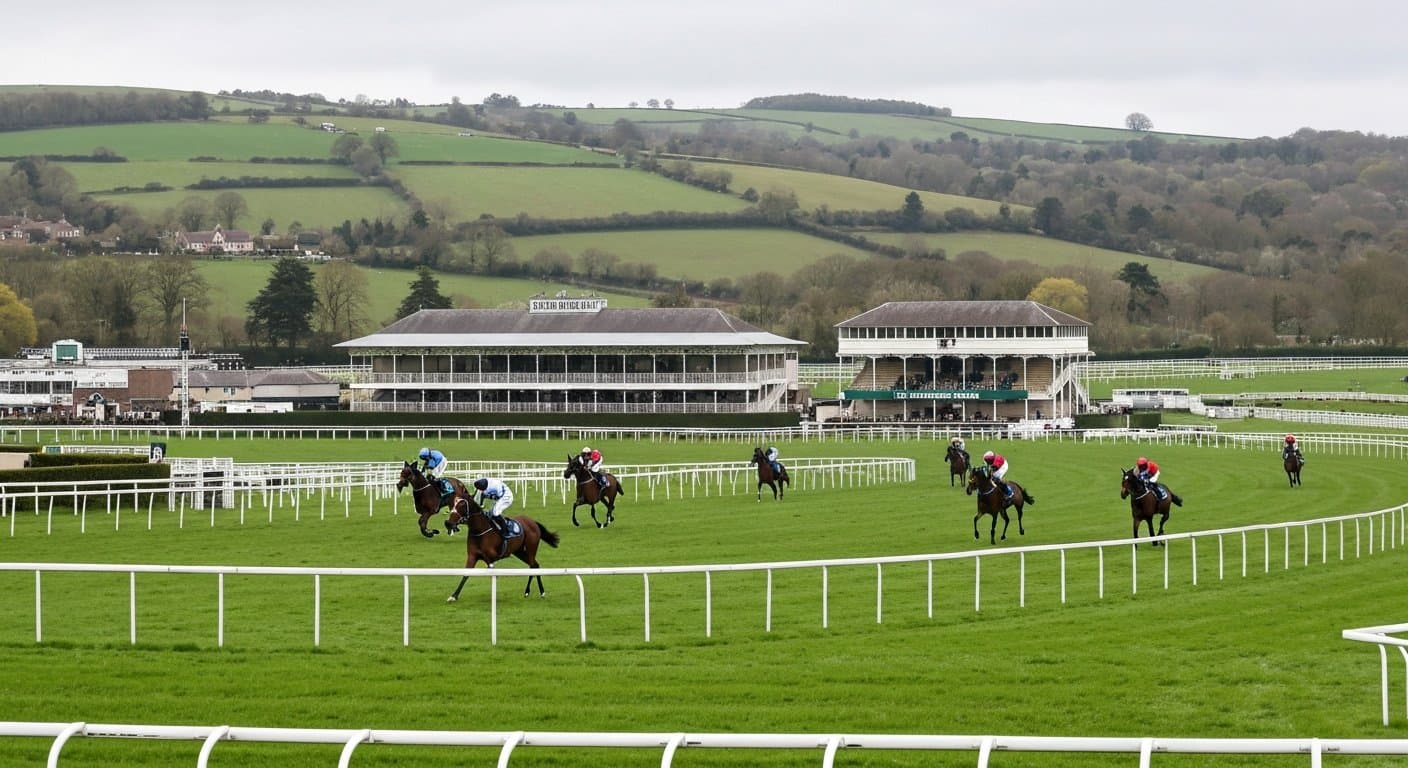
Wincanton is a right-handed, roughly oval National Hunt circuit. The total distance round is approximately one mile three furlongs. The track is undulating — the ground rises and falls across the far side and into the home turn — and that variation in gradient is one of the factors that tests horses throughout a race rather than just at the finish. It is not a dramatic or unusual layout, but it is an honest one. Horses that stay, jump well, and travel efficiently through their races are consistently rewarded. Those that do not jump or do not stay are consistently exposed.
The Home Straight
The home straight at Wincanton is approximately two furlongs in length. This is the most important single fact about the course layout. It is short enough that horses arriving at the home turn with a lead must defend it through three fences in quick succession without the luxury of a long run to rally. It is short enough that hold-up horses who find themselves wide or stuck behind traffic at the home turn often cannot recover in time to win.
Understanding the home straight shapes everything else you think about Wincanton form. Races set up here from the front — where a pace-setter goes into the final bend with an advantage — produce a different pattern of results than races where the front pair are closely matched and one runs out of petrol. In the latter scenario, the horse second or third, positioned on the rail into the bend, is almost always better placed than the one wide and behind.
The three fences in the home straight are not placed close together in the way that, say, a fence immediately after a tight bend would be. They come in sequence across the two furlongs, each one presenting itself as horses are already under pressure from jockeys trying to find an answer. It is at these fences that jumping technique makes the clearest difference in outcomes.
The Steeplechase Fences
Wincanton's steeplechase fences are built large. They are honest, standard National Hunt construction — plain fences, an open ditch, and a water jump — but the scale is towards the upper end of what you encounter on a regular National Hunt track. The course has a long-standing reputation for testing jumping, and that reputation reflects a real characteristic of the fences rather than a marketing claim.
The open ditch is positioned on the far side of the course. It arrives at a point in a race where the pace has usually settled and horses are working through the middle section of the contest. A horse that meets the ditch on a poor stride and loses confidence can be unsettled for the remainder of the race; a horse that flies it tends to travel forward into the final circuit with its jumping rhythm intact.
The three plain fences in the home straight — the sequence that defines the finish of most chases at Wincanton — are what separate this course from a standard circuit. They arrive as horses are flat to the boards, trying to assert themselves or hold their position in a competitive finish. A mistake at the first of the three can cost two lengths. A mistake at the second, with only one more fence and the run-in to go, can cost the race.
Novice chasers at Wincanton are on a proper test from the start. The course is not one where an inexperienced horse can get away with being untidy and still win. Paul Nicholls uses the course regularly for his novices precisely because it teaches them something — a horse that jumps well at Wincanton, with its big fences and its testing home-straight sequence, has usually learned to jump accurately in competitive conditions.
The Hurdles Track
The hurdles course follows the same general circuit, with eight flights over the standard two-mile distance. The Kingwell Hurdle is run over two miles. Hurdle flights are smaller than fences and Wincanton is not known for catching out experienced hurdlers, but the track characteristics — the short home straight, the undulations — still apply. Two-mile hurdle races here tend to be strongly run; the track does not suit horses that want to idle in front and conserve energy. The first flight of hurdles in the home straight arrives quickly after the home turn, and horses that are already under maximum pressure sometimes clip the top of it.
Longer hurdle trips — two miles and a half and beyond — ask more of a horse's stamina. The extra distance means negotiating the undulations of the far side twice, and when the going is testing in January or February, the ground begins to exert a real influence on outcome.
Track Configuration and Race Distances
Wincanton programmes races across a range of distances:
- Two miles (hurdles and chases): the most common distance, used for the Kingwell Hurdle, the Desert Orchid Chase, and the majority of novice hurdle and novice chase races
- Two miles and one furlong: a variant hurdle distance used in some novice and handicap races through the season
- Two miles and five furlongs: a middle-distance trip that suits stayers who also have enough pace to hold their position; often used for mares' races and middle-distance handicap hurdles
- Three miles and one furlong (chases): the distance of the Badger Beers Silver Trophy Handicap Chase; the full circuit at Wincanton over three miles tests stamina, jumping accuracy, and positioning across the entire far side of the course
The variety of distances across the season means the fixture programme can accommodate horses of different types. But the compact circuit consistently favours horses that jump fluently and travel through their races rather than grind from the front.
Going and Ground Conditions
Wincanton sits on a Somerset clay and chalk mix. The ground responds quickly to rainfall. In a typical winter, conditions shift from good to soft through November, from soft to heavy through December and January, and sometimes ease back to soft or good to soft in March as days lengthen. Autumn fixtures in October often ride on going described as good to soft; spring fixtures in late April and May can ride close to good.
Heavy going at Wincanton is not a superficial description. The Somerset clay holds water. When the going is heavy at this course, the take-off and landing ground around fences rides truly deep, and horses with any doubt about their stamina are likely to be found out. In these conditions, the horses that do best are those with proven form on testing ground and those acclimatised to the West Country conditions — which, in practice, means Nicholls' horses and others from the regional yards that train on similar ground.
In firmer conditions — good to firm, which is rare but not unknown in October — the track rides more quickly and class tends to assert itself more directly. Horses with higher speed ratings from good-ground performances elsewhere transfer their form more readily to Wincanton in these conditions than they do in mid-winter mud.
Checking the going on the morning of a Wincanton fixture is standard practice. Going reports at the course can change significantly overnight, and a race that looks like a stamina test on the morning of declarations can become a more technical affair if the ground has dried by raceday.
What the Track Rewards
Three consistent principles emerge from the Wincanton track profile:
Jumping accuracy. The size of the fences and the three-fence home-straight sequence mean that horses with clean jumping records have a consistent advantage. This is not always reflected in the market, where form and class often dominate the price.
Race position into the home turn. The short home straight means that position at the home turn is more valuable than position at the furlong pole. A horse on the rail, second or third at the home turn, has access to the run it needs. A horse three wide and four lengths off the pace at the home turn is usually beaten.
Stamina over pure speed. The undulations, the testing fences, and the frequent heavy going mean that stamina counts for more here than on a flat, quick circuit. Horses that run well in Grade 2 and 3 company on going that is good or better do not automatically reproduce that form at Wincanton in January.
For more on how these characteristics translate into betting patterns, see the betting guide to Wincanton and the betting guide section of this article.
Section takeaway: The short home straight and the three-fence sequence are the defining features of Wincanton. Jumping accuracy and race positioning into the final turn matter more here than at many other National Hunt tracks. Building any analysis of Wincanton form around those two principles gives you a better starting framework than raw class or speed figures alone.
Key Fixtures & Calendar
Key Fixtures & Race Calendar
Wincanton stages approximately 15 fixtures a year, all National Hunt. The season runs from October through to May, with the biggest meetings concentrated in November, December, and February. The course is part of the Jockey Club portfolio and most of its top fixtures appear on Racing TV and ITV, giving the card wider reach than its modest size might suggest.
The fixture programme is shaped by three signature race days, each with its own character. Those who know Wincanton well tend to structure their visits around them.
Kingwell Hurdle Day (February)
The Kingwell Hurdle is Wincanton's flagship race and one of the most significant Champion Hurdle trials in the pre-Cheltenham programme. It is run in February, over two miles, at Grade 2 level. The race sits approximately four to six weeks before the Cheltenham Festival, making it one of the last significant form guides ahead of the Champion Hurdle in March.
Trainers use the Kingwell in different ways. Some send proven Grade 1 horses here for a racecourse pipe-opener before Cheltenham. Others use it as a stepping stone for horses that are still climbing the ladder. The result is a race that often mixes established Grade 1 performers with progressive types, and the outcome is truly hard to predict.
Past winners include Desert Orchid (1984), Kribensis (1990), Binocular (2010), Zarkandar (2012), and My Tent Or Yours (2014). Several went on to win the Champion Hurdle; others used the race as a springboard for later careers. The supporting card on Kingwell Hurdle day typically includes a graded novice hurdle or chase, a novice chase, and a handicap hurdle, making it one of the better all-round cards of the Somerset jumps season.
In terms of crowd and atmosphere, February at Wincanton is a step up from a normal raceday. The course operates at closer to its 5,000 capacity and the racing press is well represented. Book hospitality in advance for this fixture.
Badger Beers Day (November)
The Badger Beers Silver Trophy Handicap Chase is a Premier Handicap run over three miles and one furlong, held in November. It is one of the earliest significant staying handicap chases of the National Hunt season and regularly attracts horses that will go on to run well in the major staying handicaps at Cheltenham and Haydock later in the winter.
The race is named after the Badger brewery, which is based in Blandford St Mary in Dorset — close enough to the course that local ales have long been associated with the fixture. The sponsorship gives the meeting a regional character that sits well with Wincanton's broader identity.
The same card usually includes the Elite Hurdle, a Grade 2 over two miles, and the Rising Stars Novices' Chase, also at Grade 2 level. This makes it the most graded day in the November programme. The Elite Hurdle has a history of attracting horses from Nicholls' yard; the Ditcheat operation has a strong record in this race.
November going at Wincanton can vary from good to soft to soft or even heavy in a wet autumn, which adds an extra dimension to the staying handicap. Horses with proven form on testing ground have an obvious advantage.
Desert Orchid Chase Day (December)
The Desert Orchid Chase is run each December, over two miles, in honour of the grey horse who won five times at Wincanton between 1983 and 1990. It is a Grade 2 contest that attracts speedy two-mile chasers, and it frequently serves as a trial or warm-up for the Tingle Creek at Sandown and, further down the line, the Queen Mother Champion Chase at Cheltenham in March.
The December meeting has a different feel from the other two signature days. It is often cold, the going is frequently soft or heavy, and the crowd tends to be made up of the course's core local following rather than visitors drawn from further afield. That intimacy is part of its appeal. The Desert Orchid story at Wincanton is told in a separate article, but the short version is that his five wins here made him the course's most celebrated regular.
Other Key Fixtures
Beyond the three headline days, Wincanton runs a steady programme of weekend and midweek cards from October to May. Saturday fixtures typically attract the stronger entries; midweek cards tend to feature novice and handicap races that, while less glamorous, are often where Paul Nicholls debuts promising young horses.
The Pendil Novices' Chase, a Grade 2 race, is run in February as part of the build-up to Cheltenham and regularly attracts one or two seriously exciting young chasers from the top West Country yards. The January programme also includes novice hurdle races that are worth monitoring for horses making their debuts under rules or stepping up in class.
Check the official Jockey Club website for the current season's full fixture list and any changes to race scheduling.
Section takeaway: Wincanton's three signature meetings — Badger Beers in November, Desert Orchid Chase in December, and Kingwell Hurdle in February — form the backbone of a fixture programme that punches above its size. Planning a visit around any one of these three days gives you access to Grade 2 racing and the best atmosphere the course offers.
Facilities & Hospitality
Facilities & Hospitality
Wincanton holds around 5,000 spectators at capacity and on most days it is nowhere near full. That is not a criticism — it means you are rarely fighting for space at the bar, struggling to find a view, or queuing to place a bet. The compact layout works in visitors' favour.
Grandstand and Viewing
The main grandstand sits alongside the home straight and gives a clear view of the final three fences and the winning post. On days when the stands are reasonably full, the atmosphere around the run-in is good. The parade ring is close to the main entrance and grandstand, so moving between the paddock and your viewing position takes less than a minute.
The Tattersalls enclosure is the main general admission area. It gives access to the grandstand, the parade ring, the winner's enclosure, and the majority of the food and drink outlets. For most visitors, this is all they need. The course does not have the elaborate temporary village of some larger venues, but what it offers is well arranged.
Viewing from the rail at the home turn is one of the best spots on the course. You can watch the field throughout most of the back straight, see them come around the home turn, and then move quickly to see the finish. On a quiet midweek card, this kind of self-directed movement around the course is straightforward. On Kingwell Hurdle day, it requires more planning.
Hospitality and Private Facilities
Wincanton offers a range of corporate and hospitality packages, particularly for the three main meetings. Private boxes and function rooms are available and can be booked for groups from around 10 to larger corporate parties. The course's hospitality team handles corporate enquiries directly — the Jockey Club's central booking system covers the main packages.
For groups organising a social day, the hospitality options at Wincanton represent reasonable value compared to the course's larger Jockey Club stablemates. Cheltenham hospitality packages, for instance, run to multiples of what you would pay at Wincanton for the equivalent experience. The racing quality on the top days here — Kingwell Hurdle, Badger Beers — is comparable to many bigger fixtures on the national calendar.
Hospitality on peak days should be booked well in advance. Kingwell Hurdle day in particular can sell out the private dining and box options by December of the preceding year.
Food, Drink, and Catering
Food and drink outlets are scattered around the Tattersalls enclosure. The standard racecourse catering is available: hot food including burgers, hot dogs, and fish and chips, plus hot drinks. On peak days, additional catering units tend to operate. The quality is consistent with what you would expect from a course in this tier.
The Badger brewery sponsorship means that Badger ales — including their well-known Tanglefoot and Fursty Ferret ales — often feature on the bar at the relevant November meeting. This is a real local connection rather than a generic commercial arrangement; the Badger brewery has been based in the region since the 19th century.
The restaurant in the main hospitality building offers sit-down dining for those who have booked ahead. The menu runs to two or three courses, with racing fixtures timed to allow a sit-down lunch before the first race. If you are coming for a full day with a group, this is worth booking.
General Amenities
The course has the standard range of amenities: betting ring with on-course bookmakers, Tote windows, and a betting shop facility inside the enclosure. Mobile signal across the site is generally adequate for checking live odds or form on a smartphone, though busy days can affect connectivity around the grandstand.
Accessible facilities are provided for racegoers with disabilities, including accessible parking spaces, viewing areas, and toilet facilities. The Jockey Club's central accessibility page has specific detail for Wincanton, and the course staff are helpful if you contact the racecourse office in advance of a visit. The compact layout of the course — unlike the spread-out site of a larger venue — means that accessible routes between the key areas are relatively short.
On-course race programmes are available for purchase at the entrance. They carry form, jockey information, trainer details, and going reports. Given that Wincanton regularly fields runners from Paul Nicholls' yard for whom this may be a debut or early start, having access to a race programme that gives full trainer and horse information is a practical advantage.
The Parade Ring and Winner's Enclosure
One of the underrated aspects of Wincanton as a racegoing venue is the accessibility of the parade ring. At larger courses, the parade ring is surrounded by several rows of spectators and good viewing is a function of how early you arrive. At Wincanton, a spot at the rail is achievable for most racegoers even on the busier days. This matters because the parade ring is where you assess how a horse looks physically before a race — a piece of information that is truly useful and which most online punters cannot access.
The winner's enclosure sits adjacent to the parade ring and is equally accessible. After a finish, the top three or four horses are brought in, and connections — trainers, owners, jockeys — are visible and audible as they discuss the race. For racegoers interested in what trainers actually say after a race, Wincanton gives you a better opportunity to hear it than most bigger venues.
Section takeaway: Wincanton is a compact, well-run course where the facilities match the scale of the fixture. The accessibility of the parade ring and winner's enclosure is a real advantage for racegoers who want to engage with the racing rather than simply watch it. It is not Cheltenham, but for a day in the Somerset countryside watching quality jumps racing, it delivers what it promises.
Getting to Wincanton
Getting to Wincanton
Wincanton Racecourse is located on the edge of the town of Wincanton in Somerset. The postcode for navigation is BA9 8BJ. The course sits close to the junction of the A303 and the A371, which means it is well served by road from multiple directions, including London, Bristol, and the South West.
By Car
The car is the most practical way to reach Wincanton for the majority of visitors. From London and the South East, take the M3 to junction 8 (Basingstoke), then follow the A303 westwards. The journey from central London is approximately 115 miles and takes around two hours 15 minutes in clear traffic. In practice, allow more time on race days — the A303 between Andover and Wincanton can slow significantly on busy afternoons.
From Bristol (approximately 45 minutes), take the A36 south from the city towards Bath and Warminster, then pick up the A303 eastbound or continue south to join the A371 into Wincanton. From Bath itself, the journey is around 25 miles and takes under 40 minutes in normal conditions.
From Taunton and the west (approximately 35 miles, 45 minutes), use the A358 northeast to join the A303.
On-site parking is available directly at the racecourse. General admission parking is free. On the three main race days — Badger Beers in November, Desert Orchid Chase in December, and Kingwell Hurdle in February — the car parks fill up earlier than usual. Arriving at least 30 minutes before the first race is recommended on those occasions.
By Train
The nearest mainline station to Wincanton is Castle Cary, approximately six miles east of the course. Castle Cary sits on the Great Western Main Line (Paddington to Penzance) and also has services from Bristol Temple Meads. From London Paddington, the journey takes around 90 minutes on the faster services. From Bristol Temple Meads, it is approximately 30 minutes.
On major race days, the Jockey Club and local taxi operators typically co-ordinate to ensure there are enough vehicles available at Castle Cary station. Book a return taxi in advance for the busier fixtures — the station can get congested after racing finishes. The approximate taxi fare from Castle Cary to the course is around £12–15 each way, though this will vary.
Templecombe, listed as the nearest station in some older sources, is approximately five miles south of the course on the London Waterloo to Exeter line. It is a less frequent service and the taxi link is less organised. Castle Cary is the better option for most travellers.
By Coach
Coach packages are operated by various racing clubs and tour operators throughout the National Hunt season, particularly for the Kingwell Hurdle and Badger Beers meetings. These typically combine transport from a central pick-up point with admission and sometimes a meal package. Local racing clubs across the South West and South East run trips to Wincanton; it is worth checking with your regional racing club or searching the Racing UK travel listings if this is of interest.
Staying Nearby
Wincanton itself is a small market town with limited hotel provision. For visitors travelling from a distance and wanting to stay overnight, the best base is Bath, approximately 25 miles north, which has a wide range of accommodation at different price points and is a pleasant city to spend an evening. Shepton Mallet (around 12 miles north) and Frome (around 14 miles north-east) also have accommodation options at closer range.
For those visiting on a day trip from London, the 90-minute train journey from Paddington to Castle Cary makes an overnight stay unnecessary in most cases, provided you are comfortable with the taxi leg at each end.
Getting Home After Racing
The final race at Wincanton on a typical Saturday card runs at around 4:00pm to 4:30pm. Racegoers heading back to London by car should note that the A303 eastbound can be slow on Saturday evenings in the stretch between Andover and the M3. Leaving before the final race or allowing 30 to 45 minutes after racing finishes before joining the main flow tends to reduce journey time meaningfully.
For those returning by train, the last direct service from Castle Cary to London Paddington typically departs in the early to mid-evening. Check times in advance as services are less frequent in the evening than earlier in the day. The National Rail journey planner has reliable departure times for Castle Cary.
Section takeaway: The A303 makes Wincanton straightforward to reach by car from London, Bristol, or the West Country. For rail travel, Castle Cary is the right station — allow time for the taxi link, book ahead on busy days, and check the evening train schedule if returning to London by rail.
Frequently Asked Questions
History of Wincanton Racecourse
History of Wincanton Racecourse
Racing in and around Wincanton predates the current course by a considerable margin. Point-to-point meetings and informal races were held in the area throughout the nineteenth century, making use of the Somerset farmland that surrounds the town. The modern course was established in 1927, when the Wincanton Race Company was formed and a permanent circuit was laid out on the site it still occupies today. From the beginning, the course was positioned as a National Hunt venue — no flat racing was ever part of the plan.
Early Years: 1927 to 1950
The course opened to racing in 1927 at a time when West Country jumps racing was a staple of the rural calendar. Taunton, Exeter, and Newton Abbot all had established programmes, and Wincanton took its place in that regional circuit as the Somerset venue closest to the Dorset and Wiltshire borders. In the early years, the fixture list was modest — a handful of meetings per season — and the racing drew heavily from the local farming and hunting community.
The track quickly developed a reputation for testing fences. The Somerset agriculture that surrounded the course — the heavy clay soil, the winter rainfall — meant that ground conditions could deteriorate rapidly. Horses that handled soft going and jumped precisely were rewarded; those that did not were exposed quickly. That reputation for honest, demanding racing established itself in the 1930s and has not changed since.
The Second World War interrupted racing across Britain between 1940 and 1945, and Wincanton was no exception. The course closed for the duration and the facilities were used in part by the military, as happened at many agricultural sites across Somerset during the conflict.
Post-War Development: 1945 to 1970
Racing resumed at Wincanton in 1945 and the post-war period brought a gradual expansion of the fixture programme. The National Hunt calendar was growing nationally, and Wincanton's profile rose in tandem. The course infrastructure was improved through the 1950s and 1960s — new grandstand facilities, improved drainage, and the development of a proper hospitality offering for a growing racegoing public.
Through these decades, the course consolidated its identity as the home of quality West Country jumps racing. The core racing community in Somerset and Dorset — farmers, hunting families, local trainers — remained the backbone of the attendance, but the course was attracting more visitors from Bristol, Bath, and further afield as car ownership expanded and the A303 became a more reliable route westward.
The Jockey Club Era: 1970 to Present
Wincanton came under the ownership of the Jockey Club as part of the organisation's consolidation of British racecourses during the latter decades of the twentieth century. The Jockey Club's stewardship brought investment in the physical infrastructure of the course and an improved position in the national fixture list. The introduction of television coverage — first on the BBC and then through dedicated racing channels — gave Wincanton races a national audience that previous generations of management could not have imagined.
The most significant development for the course's national profile was the elevation of the Kingwell Hurdle to Grade 2 status and its explicit position as a Champion Hurdle trial. From the 1980s onwards, the race attracted horses and trainers from outside the South West, turning a good regional race into a fixture with national significance. That elevation coincided with the era of Desert Orchid, whose five wins at Wincanton between 1983 and 1990 gave the course a single horse association that endures decades later.
The Paul Nicholls Effect
The rise of Paul Nicholls as the dominant force in British National Hunt training from the mid-1990s onwards has had a visible effect on Wincanton. Nicholls' Ditcheat yard, eight miles east of the course, became one of the most powerful in British racing history over the following two decades. His association with Wincanton is not merely proximity — it has shaped the character of the fixture list. The course now actively programmes races suited to Nicholls' novice runners, and the trainer's regular use of the venue as a starting point for young horses gives the winter cards a quality that a course of this size would not otherwise command.
Trainers including Martin Pipe, who retired in 2006 after a record-breaking career, and Philip Hobbs, also based in Somerset, contributed to the depth of good horses that appeared at Wincanton through the 1990s and 2000s. The West Country has historically produced a cluster of top National Hunt trainers, and Wincanton has benefited directly from being their home course.
Wincanton Today
The modern course continues to stage around 15 fixtures a year, all at National Hunt. The three signature meetings — Badger Beers in November, Desert Orchid Chase in December, and Kingwell Hurdle in February — anchor the calendar and give the course a consistent national presence. The physical infrastructure has been maintained and modernised under Jockey Club ownership, and the course's capacity of around 5,000 is appropriate for the level of racing it stages.
For a full account of the Desert Orchid story at Wincanton, see the Desert Orchid at Wincanton article.
Section takeaway: Wincanton's history from 1927 to the present is a story of steady growth shaped by its geography, its soil, and its proximity to some of the finest National Hunt stables in Britain. The course's national profile has been built through the Kingwell Hurdle, through Desert Orchid, and through the Paul Nicholls effect — not through a single dramatic moment but through accumulation over nearly a century.
Famous Moments
Famous Moments at Wincanton
Wincanton is not Cheltenham or Ascot. It does not host the kind of Grade 1 festivals that produce years of accumulated talking points per meeting. But it has its own catalogue of moments that mean something to those who were there, or who follow the horses that went on from here to greater things. A few of those moments are worth recording properly.
Desert Orchid's Five Wins
The central chapter in Wincanton's modern story belongs to Desert Orchid. The grey — trained by David Elsworth and ridden most memorably by Simon Sherwood and Colin Brown — had a particular relationship with this course. He won here five times between 1983 and 1990, including the Kingwell Hurdle in February 1984. His overall record at Wincanton was nine appearances, five wins, and a crowd that had claimed him as one of their own.
What made Desert Orchid's Wincanton record notable was not just the number of wins but the way he went about them. He was an extravagant jumper, attacking his fences with a boldness that the Somerset crowd responded to. In his 1984 Kingwell Hurdle, run on ground that was on the soft side, he showed the front-running style that would become his hallmark: away from the tapes quickly, jumping accurately at pace, and asserting himself through the race rather than being produced with a late run.
The Desert Orchid Chase, inaugurated in his name and run each December at the course, is the permanent reminder of that association. It draws trainers who take the two-mile chase programme seriously and an audience who remember what racing was like when a grey horse from David Elsworth's yard was the most famous animal in Britain.
Binocular's Kingwell Hurdle (2010)
In February 2010, Binocular won the Kingwell Hurdle for trainer Nicky Henderson and owner JP McManus. The performance was notable for the manner of the win — controlled, authoritative, and without undue drama. Binocular went on to win the Champion Hurdle at the Cheltenham Festival the following month, which made his Wincanton performance in retrospect one of the cleaner pre-Cheltenham trial runs of the modern era.
The Binocular Kingwell illustrates how the race is sometimes used. Henderson sent a Champion Hurdle favourite to Wincanton for what amounted to a confidence-building exercise and a racecourse gallop. The horse won, confirmed his well-being, and took his Champion Hurdle preparation forward without incident. It was the right race used in the right way.
Zarkandar's Kingwell Hurdle (2012)
Zarkandar won the Kingwell Hurdle in 2012, also for Paul Nicholls, and the performance caught the eye for the manner in which the horse travelled through the race. He had the hallmarks of a Cheltenham type — quick, accurate over his hurdles, and finding readily when asked. His subsequent Champion Hurdle appearance at Cheltenham in March 2012 confirmed that the Kingwell had again served its purpose as a preparatory race for the very best staying hurdlers.
My Tent Or Yours (2014)
My Tent Or Yours, trained by Nicky Henderson and ridden by AP McCoy, won the Kingwell Hurdle in February 2014. The horse had finished second in the Champion Hurdle in 2013 and was being prepared to go one better in March 2014. His Wincanton performance was clean and purposeful, and he went on to Cheltenham where he was again placed. The 2014 Kingwell field that day included some quality opposition, and the race provided legitimate trial form.
The 2019 Badger Beers
The 2019 running of the Badger Beers Silver Trophy Handicap Chase produced a finish that captured the difficulty of betting handicap chases in heavy going. The winner — a horse who had shown promise over fences earlier in the season — came from off the pace to win in the final strides as the leader made a mistake at the last of the three home-straight fences. It was a reminder of how the course's fence sequence affects handicap outcomes: position at the top of the home straight is not as valuable here as it is on a track with a longer run-in.
The Kingwell as a Recurring Moment
Taken together, the roll of honour for the Kingwell Hurdle constitutes the most consistent series of famous moments in Wincanton's history. The race has been won by horses of real quality across multiple decades, and the list of winners that went on to Champion Hurdle glory or prominence is long enough to give the race a track record that stands scrutiny.
For a full account of those who have shaped the Kingwell's history, see the Kingwell Hurdle guide.
Section takeaway: Wincanton's most famous moments cluster around the Kingwell Hurdle and the Desert Orchid story. They are the two threads that run through the course's modern identity and explain why a Somerset National Hunt venue carries more weight than its size alone would suggest.
Betting Guide
Betting Guide
Wincanton is a course with characteristics that produce clear, identifiable patterns in its results. Understanding the track configuration, the going tendencies, and the trainer dominance of Paul Nicholls gives a punter a useful analytical framework before looking at any individual race.
This section covers the structural factors. For the responsible gambling reminder, see the note at the foot of the page.
Track Characteristics and What They Mean for Betting
The most important structural fact about Wincanton for betting purposes is the short home straight, which is approximately two furlongs in length. This directly affects what kind of horse wins here.
Front-runners at Wincanton are in a more complicated position than at a track with a long run-in. A horse that takes up the lead at the top of the straight must negotiate three fences in quick succession while under pressure from horses coming with their challenge. Any mistake at the first or second of those fences — even a minor one that costs a length and a half — is difficult to recover from in two furlongs. The data from previous years at Wincanton shows that horses who lead at the top of the straight win at a rate below the national average for front-runners.
Conversely, hold-up horses — those that race in the rear of the field and produce their finishing effort late — need to be in a good position at the home turn. If a hold-up horse is two or three wide on the final bend and finds traffic, there is simply not enough room in the home straight to recover. The sweet spot in terms of race position is tracking the pace from second or third, arriving at the home turn on the inner or alongside the leader, and then jumping the three home-straight fences accurately.
For chases specifically, accurate jumping is worth roughly two lengths at Wincanton compared to a flat course where mistakes are less costly. Horses with clean jumping records at other National Hunt venues should be given more credit here than their raw speed figures might suggest.
Trainer Patterns
Paul Nicholls' dominance at Wincanton is the single most important trainer factor at this course. His win rate at Wincanton in recent seasons has been well above the course average — not surprising given that Ditcheat is eight miles away and his horses regularly make their debut or second appearances here. But the pattern is worth understanding more specifically.
Nicholls' novice hurdlers at Wincanton, particularly those appearing for the first time or second time under rules, tend to be fit and well-schooled. They often start at shorter odds than their experience warrants, which means the value in opposing them comes from identifying when the opposition is truly strong rather than when Nicholls' horse looks short-priced. His horses at this course generally perform to form.
His more experienced horses — handicappers and graded horses being pointed towards a specific target — are often given a straightforward race at Wincanton as a pipe-opener. These are not always winning days; sometimes a Nicholls runner is doing 90% of the work and the trainer knows it. Context matters.
Philip Hobbs, whose yard is near Minehead approximately 40 miles west, also targets Wincanton with regularity. His record at the course is solid rather than dominant. Hobbs' runners here tend to be more consistently exposed in terms of what they can achieve, so their form is often easier to evaluate than a Nicholls debutant.
The Kingwell Hurdle Specifically
The Kingwell Hurdle is a Grade 2 race and betting markets on it are typically well formed. The race serves as a Champion Hurdle trial, which means the better-connected runners often have informed support from the market. Odds on Kingwell runners at big-race meetings — the Champion Hurdle, the International Hurdle at Cheltenham — often reflect not just form but what connections believe about their horses' well-being. The Kingwell market itself is usually tight and efficient.
The most useful analytical angle on the Kingwell is the going. In years when the ground is soft or heavy, the race selects for stamina more than pure speed. In good to soft conditions, the faster types tend to dominate. This distinction matters for assessing how Kingwell form translates to Cheltenham, where the Champion Hurdle is run on ground that is usually good to soft at the Festival.
Going Strategy
Heavy going at Wincanton in January or February affects betting strategy significantly. Horses with proven form on heavy ground — particularly those trained locally who will have schooled in similar conditions — deserve a premium. The Somerset clay-and-chalk mix rides truly testing when saturated, and class advantages can be partially negated when the going becomes a factor in its own right.
Conversely, in the firmer conditions of October and early May, class tends to reassert itself and form from good-ground performances at other tracks transfers more directly.
Always check the going report on the morning of any Wincanton meeting, and check whether going reports indicate directional movement — "softening" or "drying" through the card can affect later races differently from earlier ones.
Please gamble responsibly. If you feel you may have a problem with gambling, visit BeGambleAware.org or call the National Gambling Helpline on 0808 8020 133.
Section takeaway: Wincanton rewards accurate pre-race assessment of jumping ability, race position, trainer context, and going. The short home straight and the three-fence sequence are the structural features that separate this course from a generic National Hunt circuit, and they are worth factoring into any serious analysis.
Atmosphere & Planning Your Visit
Atmosphere & Planning Your Visit
What Wincanton Feels Like on a Raceday
Wincanton on a busy day — Kingwell Hurdle or Badger Beers — is not the frenetic experience of Cheltenham during the Festival or a packed Sandown Saturday in December. It is something quieter and, for many racegoers, more enjoyable for that. The crowd is around 4,000 to 5,000 on the biggest occasions, and it is made up overwhelmingly of people who are there for the racing rather than for a day out that happens to have horses in it.
The area around the parade ring before each race is the best place to be. Horses come into the ring around 20 minutes before the off and the handlers and trainers are within easy view. At a compact course like Wincanton, you can watch Paul Nicholls or Philip Hobbs with their runners at close quarters in a way that would be impossible in the scrum of a Cheltenham paddock.
The three-fence sequence in the home straight is the best place to watch the racing itself. Standing at the rail as the horses come around the bend and attack those fences in the final two furlongs gives you a view of the race at the point of maximum pressure — the moment where positions change and outcomes are determined.
Practical Planning
When to go: The three main meetings are the obvious choice for a first or special visit. If those dates do not suit, any Saturday card between November and February is likely to include at least one interesting race, often with runners from Nicholls' or Hobbs' yard.
What to bring: Waterproof footwear and a warm layer are non-negotiable from November to February. The course is exposed on the Somerset plateau and wind chill is significant on cold days. A racecard (available at the entrance for a small charge) is useful; the electronic display boards at the course carry basic information but a card gives you form and jockey details.
Eating and drinking: The Badger brewery ales on offer at the November meeting are worth trying if you are there for it. General catering around the Tattersalls enclosure is standard racecourse fare — hot food, hot drinks, bar with draught beer and wine. For a sit-down meal, book the restaurant in advance.
Timing: First race is typically at 12:30pm or 1:00pm on Saturday fixtures, sometimes later for midweek cards. Racing usually finishes between 4:00pm and 4:30pm. The drive back towards London on the A303 can be slow after a Saturday meeting — allowing 30 minutes for traffic to ease before leaving is sensible practice.
The West Country Circuit
Wincanton is the most prominent of the four courses that form the core of Somerset and Devon National Hunt racing. Taunton is 30 miles to the west, Exeter around 55 miles to the south-west, and Newton Abbot approximately 65 miles south-west. Racegoers who visit regularly in this region tend to rotate between all four; each has its own character and the distance between them is manageable for a committed National Hunt follower.
For a dedicated racing trip to the South West, Wincanton and Taunton can be combined within the same week, and Exeter in the same trip. The hotel offer around Wincanton itself is modest — the town is small — but Bath, 25 miles north, provides a much wider range of accommodation and is well worth using as a base.
Section takeaway: Wincanton offers a racegoing experience that rewards the visitor who comes for the horses rather than the occasion. At its best — a cold February afternoon, the Kingwell field going to post, a full crowd at the rail — it is exactly what National Hunt racing in the English countryside should feel like.
More guides for this course
Share this article
More about this racecourse
All Wincanton guides
A Day Out at Wincanton Racecourse
Everything you need for a day at Wincanton — getting there, what to wear, enclosures, food and drink, and tips.
Read moreWincanton Festival Guide
Your complete guide to Wincanton Racecourse festivals — the Elite Hurdle, the Jim Ford Gold Cup and what makes this Somerset track one of the south-west's best jump venues.
Read more
The History of Wincanton Racecourse
From a 1920s beginning to a thriving Somerset jumps venue — the story of Wincanton Racecourse.
Read moreResearch the field with the AI Race Predictor
Our model publishes calibrated win-probability estimates for UK races — a second opinion to understand a race, not tips. It's open about its record: it doesn't beat the market, and we show exactly how it does.
Work it out & learn the basics
Gamble Responsibly
Gambling should be entertaining and not seen as a way to make money. Never bet more than you can afford to lose. If you or someone you know has a gambling problem, help and support is available.