
Founder & Editor · Last reviewed 2026-04-05
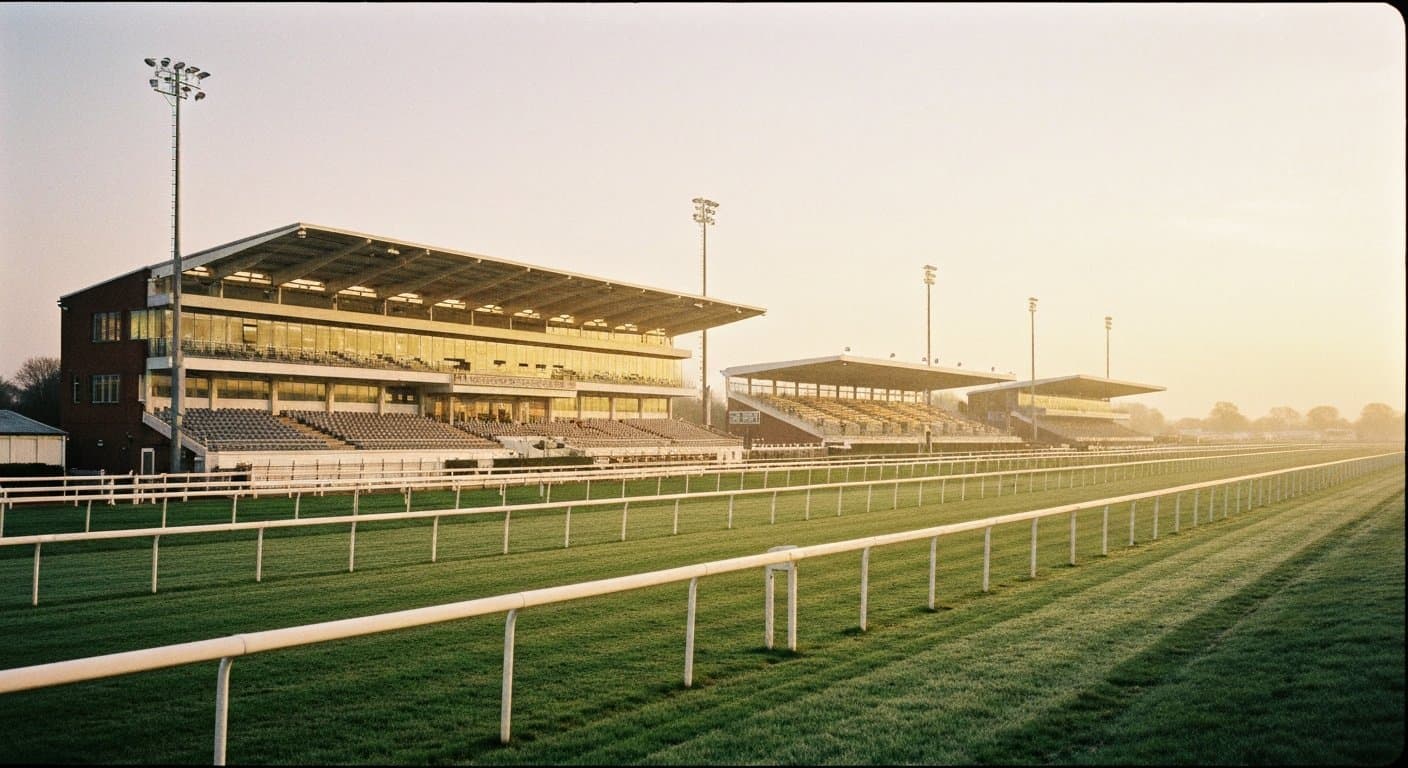
Chelmsford City Racecourse has one of the most unusual histories in British racing. It opened in 2015, which makes it the newest racecourse in England, but it stands on the same Polytrack oval that Great Leighs Racecourse occupied when it opened in April 2008 and closed in January 2009. The same left-handed circuit, the same Essex parkland, the same postcode. Two entirely different outcomes.
The site sits in the grounds of the New Hall estate, approximately three miles north-east of Chelmsford city centre at CM3 1QP. New Hall itself is a Tudor mansion built for Henry VIII around 1517, one of the royal palaces where the young Princess Mary (later Mary I) spent periods of her childhood. The buildings still stand today, visible from the racecourse car park, now occupied by St Mary's School. Racing takes place in the parkland to the east of the house, on a circuit of approximately one mile and two furlongs.
Great Leighs was conceived as England's first new racecourse in over 80 years, and for a brief period in 2008 it attracted real interest from trainers and punters across the region. Essex had no racecourse, London was 35 miles down the A12, and the county's population of over 1.6 million was entirely underserved. The commercial logic was there. The execution was not. Within nine months, Great Leighs had entered administration, the British Horseracing Authority had revoked its licence, and the track fell silent.
Six years passed. The Polytrack sat unused. Then Arena Racing Company acquired the site, invested approximately £14 million in new infrastructure, secured a fresh BHA licence, and reopened the course as Chelmsford City on 22 January 2015. Where Great Leighs failed, Chelmsford City succeeded, and the difference between the two tells you a great deal about what makes a racecourse work.
Chelmsford today runs around 60 fixtures per year, making it one of the busiest all-weather venues in Britain. Newmarket trainers (William Haggas, the Gosden operation, Charlie Appleby) use it as their effective local winter track, 30 miles south-west of the headquarters of British flat racing. The Polytrack surface, identical to the one used at Kempton Park, produces consistent racing throughout the year and allows reliable form comparisons between the two venues.
The course's signature race, the Winter Derby Trial, run in February over one mile and two furlongs, has established itself as a real prep for Classic-generation three-year-olds targeting the Lingfield Winter Derby in March and the spring turf campaign beyond. It is a long way from the circumstances that greeted Kyllachy Star when she won the first race at Great Leighs in April 2008. Back then, the question was whether Essex could sustain a racecourse at all. Today, the question is what comes next.
This is the story of how that transformation happened: the original vision, the collapse, the six years of silence, and the revival that produced one of the more striking second acts in the history of British sport.
Origins & Great Leighs
The Gap in the Market
Essex in the early 2000s was an anomaly. A county of more than 1.6 million people, sitting 35 miles north-east of central London on the A12 corridor, with no racecourse. The nearest all-weather venue was Lingfield Park in Surrey, over 50 miles to the south-west. Cheltenham was 120 miles away. Newmarket was 50 miles north but turf only, no evening meetings, and with no significant public transport link from Essex towns. The gap was real.
John Holmes and his son Jonathan identified this opportunity in the early 2000s. Their ambition was straightforward: build England's first new racecourse in over 80 years and serve a part of the country that had been overlooked by the racing industry. They chose a site at Great Leighs, a village roughly nine miles north of Chelmsford town centre, set back from the A131.
The New Hall Estate
The land selected for the project sits within the grounds of the New Hall estate, a place with a history stretching back five centuries. New Hall was built as a royal palace for Henry VIII around 1517 and remained in royal use through much of the Tudor period. It was at New Hall that the young Princess Mary (later Mary I, who reigned from 1553 to 1558) spent portions of her childhood while her father was occupied elsewhere. The building passed through multiple owners after the dissolution of the monasteries and the subsequent redistribution of royal properties.
By the 20th century, New Hall had become a convent school. Today it operates as St Mary's School, Chelmsford, an independent school occupying the Tudor and Jacobean main house. The racecourse occupies the parkland to the east of the historic buildings. Racegoers arriving in the car park can see the old stone facade of New Hall across the grounds, a peculiar backdrop for a Polytrack oval.
Construction and the Surface Choice
Construction of the racecourse began in 2005–06. The decision to lay a Polytrack surface was logical: Polytrack had proven itself at Lingfield Park (relaid in 2001) and at Wolverhampton's Dunstall Park. It drains quickly, rides consistently regardless of weather, and supports the year-round programme that makes an all-weather venue financially viable. A turf course in Essex, with its clay-heavy soil and tendency to waterlog, would have created problems from the outset.
The track was designed as a left-handed oval of approximately 8.5 furlongs, with a home straight of just over two furlongs. The circuit is essentially flat, with no significant undulations. Races can be staged from five furlongs to two miles, though the bread-and-butter distances are seven furlongs, one mile, and one mile two furlongs. The shape of the track rewards horses that handle left-handed bends and can settle in the early stages. A characteristic that would become important when Newmarket trainers began identifying Chelmsford as a useful winter outlet.
The grandstand was sourced from the 2006 Ryder Cup at the K Club in County Kildare, Ireland. It was a 10,000-capacity temporary structure, disassembled and shipped to Essex in a cost-saving measure. The decision would prove symbolic of the wider problem: a racecourse built to a budget that prioritised getting the doors open over getting the infrastructure right.
The Opening: April 2008
Great Leighs Racecourse opened on 20 April 2008. The first race was won by a filly called Kyllachy Star, trained by Henry Candy. It was a significant date in British racing history. This was the first entirely new racecourse to open in England since Taunton in 1927, a gap of 81 years. The BHA allocated a full fixture list. Trainers from Newmarket were interested. Initial press coverage was broadly positive about the racing product, which rode well and drew a reasonable opening-day crowd.
But the structural problems were apparent almost immediately. The grandstand, despite its 10,000-person capacity, provided an unsatisfactory experience. Catering facilities were inadequate for the volume of racegoers expected. Car parking was disorganised. The access roads to the site from the A131 were not designed for raceday traffic. The atmosphere that a new racecourse requires (one that encourages racegoers to return) was absent.
The Collapse
The financial model never recovered from the slow start. Attendance figures through summer and autumn 2008 fell short of projections. Revenue from hospitality, without a proper hospitality infrastructure, could not compensate. Debts accumulated faster than income could service them. The Holmes family had invested heavily to reach opening day; the runway to viability proved shorter than anticipated.
In November 2008 (just seven months after opening) the BHA announced it was withdrawing Great Leighs's racing licence, citing concerns about the financial position of the operating company and the welfare of those employed at the course. The final race meeting had taken place in October 2008. In January 2009, the operating company entered administration formally.
The track sat empty. Essex had its racecourse for seven months, and then it was gone.
Six Years of Silence
From January 2009 to June 2015, the site lay dormant. The Polytrack surface remained in place, gradually degrading without maintenance. The Ryder Cup grandstand stood empty. Various parties expressed interest in the site over the years. Nothing came of it. Planning permission, licensing requirements, and the sheer capital required to bring a derelict racecourse back to life deterred most serious buyers.
The failure of Great Leighs became a case study in what not to do when building a new racecourse. Insufficient investment in visitor infrastructure, a grandstand ill-suited to its permanent purpose, poor access, and underestimated start-up costs were all cited. The lesson was clear: location and surface quality are necessary but not sufficient. A racecourse is a hospitality business that also happens to stage horse races.
Rebirth as Chelmsford City
Arena Racing Company and the Acquisition
The revival of the Essex site began in earnest in 2014 when Arena Racing Company acquired it. ARC is one of Britain's two major racecourse groups, operating venues including Windsor, Wolverhampton, and Doncaster. Their interest in the Chelmsford site was partly strategic: they had no all-weather track in the south-east, and a well-run Essex venue would complement their existing portfolio.
The involvement of Fred Done, founder of Betfred, added financial weight. Done had built Betfred from a single betting shop in Salford in 1967 into one of Britain's largest bookmaking businesses; he understood the economics of racing from the bookmaker's side and had sponsored major races over the years. His consortium brought the capital required to do the job properly. This was not going to be another Great Leighs, under-resourced and opened before it was ready.
The Investment Programme
The total spend on the rebuild was reported at approximately £14 million. The Ryder Cup grandstand was replaced entirely. In its place, a purpose-built grandstand was constructed, smaller than its predecessor in terms of raw capacity, but designed for the actual experience of racegoing rather than the theoretical maximum of a temporary structure. Viewing angles from the new stand were prioritised, with the sightlines to the home straight and the final bend considered carefully.
Catering facilities were built to a standard appropriate for a modern racecourse. The access and car parking arrangements that had troubled visitors to Great Leighs were redesigned. The Polytrack surface itself was assessed; though it had been laid in 2007–08, it required significant work after six years without maintenance. By the time the course reopened, the racing surface was in good condition.
The £6 million spent on the new grandstand alone (published in trade press at the time) represented three times what Great Leighs had put into its entire visitor infrastructure. The contrast was deliberate.
Securing the Licence
The BHA's process for relicensing the site was thorough. A course that had its licence withdrawn once was not going to be granted a new one without scrutiny. ARC and the Done consortium had to satisfy the BHA on financial sustainability, safety standards, infrastructure quality, and management capability. The process took through 2014, with the licence confirmed in late 2014 ahead of an early-2015 opening.
The new name, Chelmsford City Racecourse, was chosen partly to distance the venue from the Great Leighs episode and partly to reflect the course's geographic identity. Chelmsford had been granted city status in 2012, the first new English city created as part of the Queen's Diamond Jubilee celebrations. The name was a statement: this was a city's racecourse, not a rural experiment.
The First Race: 11 January 2015
The official reopening took place on 11 January 2015, initially as an invited-audience event to test the new facilities before public racing began. The first race winner on the relaunched track was Tryster, trained by Charlie Appleby for the Godolphin operation and ridden by Adam Kirby. Tryster was a maiden over one mile, and the winner was a quality animal, Godolphin's decision to send a horse to the opening meeting signalled that the major Newmarket yards were taking the new course seriously.
Public racing began on 22 January 2015. The BHA had allocated 56 fixtures for the year, a number that reflected confidence in the course's ability to operate consistently. The fixture allocation placed Chelmsford immediately among the busier all-weather venues in the country.
The Evening Racing Programme
One of the early commercial decisions that defined Chelmsford City's character was the investment in floodlit evening racing. Evening meetings on Polytrack, under floodlights, had already shown their appeal at Kempton Park and Wolverhampton. Chelmsford's location (accessible from central London in under an hour, with Chelmsford station on the Greater Anglia mainline just three miles away) made it well placed for the after-work racegoer.
The course embraced the evening format aggressively. Sunday evening fixtures, midweek floodlit cards, and a general emphasis on racing as a social occasion all followed. This was a departure from the traditional British racing model of afternoon cards aimed primarily at the betting market. The social dimension was the point.
Chelmsford City also became one of the first British courses to trial Sunday evening racing under a BHA initiative in 2015, working with the authority to explore whether floodlit Sunday meetings could attract new audiences. The trial was judged a success. Sunday evening fixtures became a regular feature of the annual programme.
Why the Rebirth Worked
The difference between Great Leighs and Chelmsford City ultimately comes down to the gap between first-generation and second-generation thinking about what a racecourse needs. Great Leighs tried to build a racecourse. Chelmsford City built a venue that stages racing.
The distinction matters. A venue that stages racing needs car parks that work, grandstands with good sightlines, catering that doesn't require a 40-minute queue, and a customer journey from arrival to departure that is positive enough to make people want to come back. None of this requires a famous history or a Group 1 race. It requires money spent in the right places and management that understands the leisure industry.
ARC and the Done consortium provided both. The £14 million investment figure is the headline, but the more important number is the proportion of that spend directed at visitor infrastructure rather than racing infrastructure. The track was already there. It was the surroundings that needed rebuilding.
Takeaway: The revival of 2015 succeeded not because the location had changed or the surface had changed, but because the organisation behind the project understood that the original concept was sound and that the failure was one of execution. Chelmsford City opened with proper facilities, proper backing, and a proper fixture list, and it has not looked back.
Key Moments
The First Winner and What It Signalled
The first race at the relaunched Chelmsford City on 11 January 2015 was a one-mile maiden, run on an overcast January afternoon in front of an invited audience. Tryster, a three-year-old colt trained by Charlie Appleby at Godolphin's Moulton Paddocks yard in Newmarket, won at 2/1 under Adam Kirby. The horse was not a household name, but the trainer and owner most certainly were. Godolphin, Sheikh Mohammed's racing operation, had chosen to send a runner to the very first race at the reopened track. That was a statement.
It told the racing world that Chelmsford City was not going to be a backwater all-weather track filling the fixture list with handicappers from small yards. Newmarket (30 miles north-east along the A1303 and A134) had decided to treat this course as a convenient, high-quality winter outlet. From that January afternoon onward, the Newmarket–Chelmsford relationship would define the racecourse's character.
Sunday Evening Racing: A Pilot That Became Standard
In spring 2015, Chelmsford City took part in a BHA trial for Sunday evening racing under floodlights. At the time, British racing had no Sunday evening fixtures anywhere in the calendar. The prevailing assumption was that racegoers would not travel to an evening meeting on a Sunday, and that broadcasters would not want it. Chelmsford, backed by ARC and with a catchment area stretching from east London through Essex and into south Suffolk, was the right test case.
The first Sunday evening meeting attracted a stronger crowd than expected. The atmosphere was different, less like a traditional afternoon card, more like an evening out that happened to involve racing. The format suited the Chelmsford demographic: working-age racegoers from Chelmsford, Brentwood, and the wider Essex commuter belt who could not realistically attend an afternoon midweek card but could manage a Sunday evening. The BHA extended the trial, then made Sunday evening fixtures a permanent part of the all-weather calendar. Chelmsford was the course that made it happen.
The Winter Derby Trial
The course's most significant contribution to the racing calendar is the Winter Derby Trial, run in February over one mile and two furlongs on the Polytrack. The race was established to serve as a prep for horses targeting the Winter Derby at Lingfield Park in March, which in turn serves as a preparatory race for the Classic generation ahead of the spring turf campaign. The Winter Derby Trial at Chelmsford has attracted horses from William Haggas, John Gosden, and Charlie Appleby, the same Newmarket yards that dominate the course's day-to-day fixture list.
The race sits within a short sequence that matters to trainers of middle-distance three-year-olds in winter: Chelmsford Winter Derby Trial (February) to Lingfield Winter Derby (March) to the Classic trials in April and beyond. A horse that wins the Winter Derby Trial at Chelmsford in good style has demonstrated it can handle Polytrack at a competitive level, which is useful information for a trainer deciding whether to target turf Classics or prepare for a summer AW campaign.
Listed Race Status
The granting of Listed race status to fixtures at Chelmsford City was a significant step in the course's development. Listed races sit immediately below Group 3 in the Pattern race structure and attract horses rated in the high 90s to low 100s, a level of quality significantly above the bread-and-butter handicaps that make up most of any all-weather card. For a course that had been open less than five years, hosting Listed races was a sign that the BHA trusted Chelmsford's infrastructure and the quality of its field-filling capabilities.
The Listed races have been won by horses trained by Haggas, Gosden, and Appleby (the Newmarket triumvirate) as well as by horses from Lambourn and from the northern training centres. This cross-regional interest reflects Chelmsford's real neutrality as a venue: it is not geographically convenient for yards in Middleham or Malton, but the prize money and the quality of the racing attract runners from further afield when the prize is significant enough.
The Newmarket Pipeline in Full Flow
By 2017 and 2018, the pattern of Chelmsford City's racing had become clear. William Haggas at Somerville Lodge in Newmarket was among the course's leading trainers by winners. John Gosden at Clarehaven Stables (succeeded in management by his son Thady Gosden in the early 2020s) was another consistent presence. Charlie Appleby, operating from Godolphin's Moulton Paddocks, sent horses to Chelmsford throughout the winter months for races that would establish their form and fitness ahead of the turf season.
The 30-mile distance from Newmarket to Chelmsford by road means a horse can leave the yard, race, and return home within a day without the fatigue associated with longer journeys. This matters in winter, when horse welfare and management decisions around travel are taken carefully. Chelmsford's position as Newmarket's effectively local all-weather track (an accident of geography that no one planned for in the original Great Leighs concept) has become the cornerstone of the course's commercial model.
The 2025 Tenth Anniversary
In January 2025, Chelmsford City marked ten years since the reopening on 22 January 2015. The anniversary prompted reflection on how different the story could have been. When Great Leighs closed in January 2009, there was no particular reason to expect the site would ever host racing again. Racecourses that lose their licence rarely recover; the history of British racing includes several venues where the track was eventually sold for housing or agriculture. Essex was realistic about the prospects.
A decade on, the racecourse was running approximately 60 fixtures a year, attracting Listed-class horses, staging floodlit Sunday evening meetings, and maintaining a fixture list that gives it more race days per year than many established turf courses. The tenth anniversary was marked with special fixture presentations, and the Chelmsford City Cup (the course's flagship handicap) was promoted within the season's marketing. Ten years from the reopening is still a short history by the standards of British racing, but it is long enough to have established a clear identity.
Charlie Hills and the Lambourn Runners
While Newmarket dominates Chelmsford's trainer statistics, the course has also attracted significant runners from Lambourn, 65 miles to the west via the M25 and M4. Charlie Hills, based at Faringdon Place Stables in Lambourn, has had winners at Chelmsford and targets the course's better races with his stronger Polytrack performers. The presence of Lambourn trainers demonstrates that the prize money at Chelmsford's premium fixtures is sufficient to justify the longer journey. For a course that has been open for ten years, that is a significant indicator of where it sits in the racing hierarchy.
The Modern Era
The Current Fixture List
Chelmsford City now runs approximately 60 fixtures per year, placing it among the busiest all-weather venues in Britain. By comparison, Kempton Park runs around 70 fixtures annually and Wolverhampton around 65. For a course that has been operational in its current form for only a decade, 60 fixtures is a substantial allocation and reflects the BHA's confidence in its management and facilities.
The programme runs through all 12 months. In summer, Chelmsford competes with the turf season for fixture allocation and for runners, but the quality of its card is maintained by the Newmarket pipeline, trainers who want to give horses a run between turf engagements, or who need to find a race for an animal that has shown Polytrack affinity. In winter, from November through February, Chelmsford is a primary venue when the turf programme is disrupted by frost and heavy ground.
The Polytrack Advantage
Chelmsford's use of Polytrack (the same synthetic surface used at Kempton Park) is a significant factor in its modern identity. Polytrack was developed by Martin Collins Enterprises and first laid at Turfway Park in Kentucky before Lingfield and Kempton brought it to Britain. The surface consists of a mixture of fibres, rubber crumb, and silica sand coated in wax. It drains quickly, does not freeze, and produces consistent racing in conditions that would render turf courses unraceable.
From a punting perspective, the Polytrack surface at Chelmsford and Kempton allows form to transfer reliably between the two courses. A horse that has won over one mile on the Polytrack at Chelmsford is likely to act on the same surface at Kempton, all else being equal. This inter-course form comparison is more reliable than comparisons between Polytrack venues and the Tapeta surface used at Wolverhampton and Newcastle. When studying form for a Chelmsford race, Kempton and Lingfield (also Polytrack) are the most directly comparable courses; Wolverhampton and Newcastle results should be used with more caution.
The Newmarket–Chelmsford Relationship Today
The relationship between Chelmsford City and the Newmarket training establishment has deepened over the past decade. William Haggas, operating from Somerville Lodge, has been among the top trainers at the course by both winners and prize money won. The Gosden operation (now Gosden and Gosden, with John and Thady running the Clarehaven yard jointly) sends horses regularly to Chelmsford for winter races and maiden events where Polytrack form is the objective.
Charlie Appleby's Godolphin string from Moulton Paddocks, Newmarket, is another consistent presence. Godolphin's operation typically keeps horses in training through the winter at its Al Quoz training complex in Dubai, but the horses that remain in Britain over winter are well suited to Chelmsford. It is close, the surface suits well-bred middle-distance animals, and the prize money at the better races is sufficient to justify the entry.
The practical consequence for punters studying the form is significant. Trainers who know the track send fit, well-prepared horses. A debutant from the Haggas or Appleby yard running at Chelmsford on a midweek winter card is very likely to have been schooled specifically for the Polytrack and is not being sent there simply to get a run. This changes how you approach the form.
Access and the London Catchment
Chelmsford city centre is served by the Greater Anglia mainline from London Liverpool Street, with journey times of approximately 35 minutes to Chelmsford station. The racecourse is approximately three miles from the station, accessible by taxi or race-day shuttle. By car, the course is reached via the A12 or A131, roughly 35 miles from the M25 junction 28 near Brentwood.
This accessibility to London racegoers sets Chelmsford apart from most other all-weather venues. Windsor is closer to London but stages only summer turf racing. Kempton at Sunbury-on-Thames is 14 miles from central London and is the nearest all-weather track to the capital, but Kempton's future has been subject to ongoing uncertainty since its sale by Jockey Club Racecourses to developers in 2017. Chelmsford, with clear ownership and a strong balance sheet, is a stable option for London-based racegoers who want all-weather racing.
Ownership and Financial Stability
The course remains under the operational oversight of Arena Racing Company. The Fred Done consortium's original acquisition has provided a stable ownership structure: no financial stress, no disruption to the BHA licence, and continued reinvestment in facilities. This stability contrasts sharply with the Great Leighs period. ARC as a group operates commercially and is answerable to shareholders, but the scale of the organisation means that individual venues are not exposed to the kind of single-entity financial fragility that destroyed Great Leighs.
Investment in the track has continued since 2015. The Polytrack surface has been maintained and partially renewed. The grandstand facilities have been updated. The hospitality offer has been developed to include private boxes and packages aimed at the corporate market as well as the individual racegoer. The evening racing programme has been refined year-on-year based on what works.
The Future Direction
Chelmsford City enters its second decade in a sound position. All-weather racing in Britain has grown in stature since 2015. It is no longer treated as a poor alternative to turf but as a distinct and valid form of the sport with its own form guides, its own specialists, and its own audience. The BHA's allocation of prize money to all-weather races has improved, and the creation of the All-Weather Championships (which culminates in finals day at Lingfield Park each spring) has given the best all-weather performers a pathway to recognition that did not exist a generation ago.
Chelmsford has not yet hosted an All-Weather Championships Finals Day, which remains at Lingfield. But the course contributes qualifying races to the series, which means some of the best AW performers in the country pass through Chelmsford at some point during the winter campaign. This positions the course within the elite tier of all-weather racing, not merely as a raceday filler.
The practical question for the next decade is whether Chelmsford can build a signature race (something with the scale and prestige of Kempton's Christmas racing or Lingfield's Winter Derby) that draws national attention. The Winter Derby Trial is a step in that direction. Whether a Group 3 or Group 2 race comes to Chelmsford in the coming years depends on the BHA's willingness to extend the Pattern race structure to all-weather venues and on Chelmsford's continued ability to fill high-quality fields.
Chelmsford's Legacy
What the Great Leighs Episode Taught British Racing
The short, unhappy life of Great Leighs Racecourse left a clear lesson in its wake: the concept of a new racecourse in Essex was never the problem. Essex had the population, the proximity to London, the gap in the racing map. What failed in 2008–09 was the execution, the under-resourced infrastructure, the inadequate visitor facilities, the financial model that assumed attendance would come once the doors were open.
This lesson had implications beyond Essex. It prompted questions across the racing industry about the financial requirements for a new or refurbished racecourse and about the minimum standard of visitor experience that punters and racegoers now expected. The Great Leighs collapse was cited in subsequent discussions about smaller struggling venues: the cost of bringing a racecourse up to modern standards is higher than it appears on a business plan, and the consequences of underestimating that cost can be rapid and terminal.
Chelmsford as a Model for Revival
The Chelmsford City story from 2015 onwards has been studied as a case study in racecourse revival. The key variables that differentiated the second attempt from the first were: sufficient capitalisation (£14 million against Great Leighs's reportedly much smaller investment), a professional racing operator with experience across multiple venues (ARC), a realistic fixture allocation starting from 56 days rather than something smaller that would undermine the commercial case, and a management team that understood the leisure and hospitality dimensions of racecourse operation.
None of these are secret ingredients. They are the basics of running a venue business in a competitive leisure market. The reason they are worth identifying is that British racing has had several examples of venues that have struggled because one or more of these elements was missing. Chelmsford assembled all of them simultaneously, and the result was a course that broke even in its early years and has since become a reliable part of the racing calendar.
Essex Racing: A Proper Home at Last
For the racegoing public of Essex, Chelmsford City represents something simple: somewhere to go. A county of over 1.6 million people, with a strong commuter population drawn from east London as well as the county's own towns (Chelmsford, Colchester, Southend-on-Sea, Basildon) now has a racecourse within practical reach. A family from Chelmsford can drive to the racecourse in 15 minutes. A group from Brentwood or Basildon can reach it in under half an hour.
The economic case for Essex always existed. The original mistake was not believing that the case would translate into sustainable attendance on its own. What Chelmsford City demonstrated is that the case does hold, but only if you give people a reason to come back. The evening racing programme, the corporate packages, the raceday experience improvements. These are what converted the latent demand into actual revenue.
All-Weather Racing's Rise
Chelmsford City arrived at exactly the right moment in the trajectory of British all-weather racing. When Great Leighs opened in 2008, all-weather racing was still widely regarded as a secondary product. The racing you watched when there was nothing else on, the place you sent moderate horses to pick up small prizes in handicaps. The betting exchanges and data-driven punting approaches of the 2010s began to change this perception. All-weather form turned out to be highly consistent, highly analysable, and highly suitable for systematic study.
The creation of the All-Weather Championships, which completed its first full cycle in 2014 and continues to run each winter, was the formal recognition that all-weather racing had developed its own elite performers and deserved its own season climax. Chelmsford City opened in January 2015, just as that shift in perception was consolidating. It was not a pioneer of all-weather racing (Lingfield, Wolverhampton, and Kempton had been doing this for decades) but it arrived in time to benefit from a market that was growing in both quality and audience.
The Tudor Setting and Its Quiet Significance
There is something quietly striking about the physical setting of Chelmsford City. The Polytrack oval, with its floodlights and tote boards, sits in the parkland of a Tudor estate. New Hall, the mansion built for Henry VIII around 1517, stands a few hundred metres from the racecourse car park. The school that now occupies it was founded in the early 17th century and has operated at the site in various forms ever since.
Racing at New Hall connects, however tenuously, to a place that has been in continuous use as a significant site for over 500 years. The connection is not architectural or cultural in any deep sense. The racecourse makes no claims about it in its marketing, and rightly so. But for anyone interested in the landscape of English history and English sport, the combination of a 16th-century royal palace and a 21st-century all-weather racecourse in the same Essex parkland is a conjunction worth a moment's consideration.
A Short History, Still Being Written
Chelmsford City is, by any measure, a young racecourse. It has been operating for ten years in its current form. Most of the courses on the British flat-racing calendar have histories measured in centuries: Newmarket has been staging racing since the 1620s; Chester hosted its first race in 1539. Chelmsford cannot compete with that kind of depth.
What it can offer is a story with an unusual shape: failure, dormancy, revival, and sustained success within a single generation. The original Great Leighs Racecourse opened and closed within a calendar year; the phoenix that replaced it has outlasted its predecessor many times over. The story is not yet complete, the next significant chapter, whether that is a Pattern race, an expanded fixture list, or some structural change to the all-weather calendar, is still to come.
For racegoers in Essex, for Newmarket trainers seeking a winter outlet, and for punters who prize consistent Polytrack form, Chelmsford City already has a clear and established place in British racing. Ten years in, that is an achievement the Great Leighs era never came close to reaching.
Frequently Asked Questions
When did Chelmsford City Racecourse open?
Chelmsford City Racecourse opened on 22 January 2015, when racing was made available to the public for the first time. An invited-audience test meeting had taken place on 11 January 2015. The course occupies the same site as Great Leighs Racecourse, which opened in April 2008 but had its BHA licence withdrawn in November 2008 and entered administration in January 2009. If you count from the Great Leighs opening, the site's racing history begins in 2008, but Chelmsford City's own history begins in 2015.
What happened to Great Leighs Racecourse?
Great Leighs opened on 20 April 2008 as England's first new racecourse in 81 years. It encountered financial difficulties almost immediately: attendance fell below projections, hospitality revenue was insufficient, and debts accumulated. The BHA withdrew the racing licence in November 2008, citing concerns about the financial position of the operating company. The course entered administration in January 2009 and the site lay dormant until Arena Racing Company acquired it in 2014 and rebuilt it as Chelmsford City.
What surface does Chelmsford City use?
Chelmsford City races on Polytrack, a synthetic surface manufactured by Martin Collins Enterprises. Polytrack consists of fibres, rubber crumb, and silica sand coated in wax. It drains quickly and does not freeze, allowing year-round racing regardless of weather. Kempton Park and Lingfield Park also use Polytrack, which makes form transfer between those three courses more reliable than comparisons with Wolverhampton or Newcastle, which use the Tapeta surface.
Which trainers dominate at Chelmsford City?
Newmarket trainers lead the statistics at Chelmsford City, reflecting the 30-mile distance between the town and the course. William Haggas, the Gosden operation (John and Thady Gosden), and Charlie Appleby (Godolphin) are consistently among the leading trainers by winners. The short travel distance makes Chelmsford the effective local all-weather track for the Newmarket training centre. Trainers from Lambourn, such as Charlie Hills, also target the course's better races when the prize money justifies the longer journey.
What is the Winter Derby Trial?
The Winter Derby Trial is run at Chelmsford City in February over one mile and two furlongs on the Polytrack. It serves as a preparatory race for horses targeting the Winter Derby at Lingfield Park in March, which is itself a Classic-generation prep race. The Trial attracts quality three-year-olds from leading Newmarket yards and is one of Chelmsford's most significant annual fixtures. Horses that perform well in the Trial are often seen in competitive conditions company or Classic trials later in the spring.
How does Chelmsford City compare with Kempton Park?
Both courses use Polytrack and both stage year-round all-weather flat racing. Kempton is 14 miles from central London and has a longer history as an all-weather venue; Chelmsford is 35 miles from London but sits much closer to the Newmarket training base. The two courses are direct form comparables. A horse's record at Kempton is the most relevant all-weather comparison when assessing a Chelmsford runner, and vice versa. Kempton's future has been subject to periodic uncertainty since its sale by Jockey Club Racecourses; Chelmsford's ownership under ARC has remained stable throughout its ten years.
Share this article
More about this racecourse
All Chelmsford City guides
Twilight Payment at Chelmsford City: The Complete Story
Twilight Payment's remarkable journey from Chelmsford City's all-weather surface to Melbourne Cup glory. The story of modern racing's most inspiring champion.
Read more
Cardinal Stakes Day at Chelmsford City: Your Complete Guide
Chelmsford City's flagship race day — the £100,000 Cardinal Stakes for Classic three-year-olds, held every April on the Polytrack.
Read more
Betting at Chelmsford City Racecourse
How to bet smarter at Chelmsford City — Polytrack characteristics, draw biases, key trainers and winning strategies.
Read moreGamble Responsibly
Gambling should be entertaining and not seen as a way to make money. Never bet more than you can afford to lose. If you or someone you know has a gambling problem, help and support is available.