
Founder & Editor · Last reviewed 2026-04-05
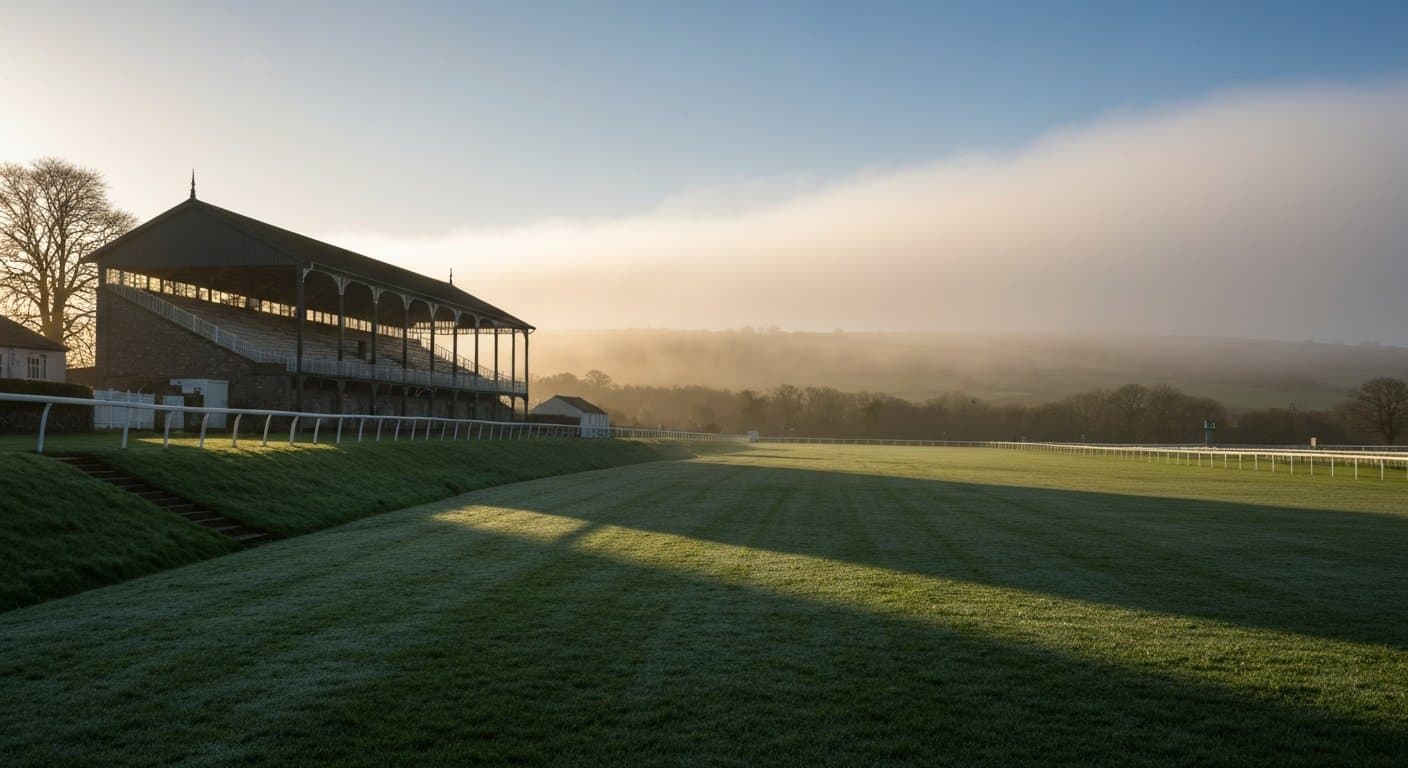
On a damp Friday in late October, a few thousand racegoers make their way south from Belfast along the M1 motorway, turning off at Lisburn before pulling into The Maze. The occasion is the Down Royal November Festival, the course's two-day National Hunt showpiece, and the air carries that particular mixture of anticipation and autumn chill that defines the opening months of the Irish jumping season. By early afternoon, the parade ring is full of premium chasers from the stables of Willie Mullins and Gordon Elliott, assembled for the Ladbrokes Champion Chase — a Grade 2 contest run over two miles that has, over the years, attracted horses of Cheltenham quality to a corner of County Down with an astonishing 340-year institutional history.
That history began in 1685, when King James II granted a Royal Charter establishing horse racing at what would become Down Royal. The charter predates Newmarket's formal regulation by decades and was issued in only the first year of James II's reign — making Down Royal Corporation one of the oldest continuously operating chartered sporting organisations anywhere in the world. The Curragh, Ireland's flat racing headquarters in Kildare, was already established as the country's primary venue, but the charter meant that the north of Ireland had its own formal racing home. For over three centuries since, the Down Royal Corporation has governed the course without interruption.
Down Royal sits at The Maze, Lisburn — a site approximately ten miles south of Belfast city centre that carries its own complicated weight in Northern Irish history. The Maze Prison, which operated on adjacent land from 1971 until its decommissioning in 2000, made this one of the most loaded geographical coordinates in the United Kingdom during the Troubles. That the racecourse continued to operate through those decades, hosting meetings less than a mile from one of the most heavily securitised institutions in Europe, is itself a measure of the sport's place in daily life in County Down.
Today, Down Royal is a dual-purpose venue. Flat racing fills the summer calendar, while National Hunt fixtures from autumn through to early spring form the commercial backbone of the operation. Around 12 to 14 race days are staged each year, the majority concentrated in the NH season. The November Festival is the peak — two days, top-class fields, and prize money that reflects Down Royal's status within the Irish National Hunt hierarchy. The Ladbrokes Champion Chase is the headline act, a Grade 2 race over two miles that serves as an early-season barometer for some of the best chasers in training.
Racing at Down Royal falls under the jurisdiction of Horse Racing Ireland and the Irish Horseracing Regulatory Board, not the British Horseracing Authority. Although Down Royal sits within the United Kingdom, Northern Ireland has always been part of the all-island racing structure, sharing race programming, rules, and prize-money frameworks with the Republic. That alignment shapes the course's identity in a straightforward way: Down Royal is an Irish racecourse, in the broadest and most accurate sense of that description, sitting ten miles from the centre of Belfast.
The right-handed oval track, measuring approximately one mile and two furlongs in circuit, is flat and fair. It suits a type of horse — not the galloping three-mile specialist, but the sharp, well-balanced two-miler that can travel through a race and quicken off the home turn. For a course with such a long history, Down Royal has always rewarded quality over stamina, which is why the Champion Chase draws the calibre of horse it does.
This history examines how a Royal Charter granted in the reign of a monarch who would be deposed three years later became the foundation for one of Irish racing's most enduring institutions.
Origins
Origins: The 1685 Royal Charter and the First Centuries of Racing
King Charles II died on 6 February 1685 after a sudden illness, having reigned since the Restoration of the monarchy in 1660. He was succeeded immediately by his Catholic brother, James, Duke of York, who was crowned James II of England (and James VII of Scotland) in April of that year. Within those first months of the new reign, before the political tensions that would culminate in the Glorious Revolution of 1688 had fully surfaced, James II granted a Royal Charter establishing horse racing at The Maze in County Down. The precise date of the charter places it firmly in the early period of James's reign, before his policies on Catholic emancipation had begun to fracture his support among the Protestant gentry who dominated Irish public life.
The charter did not simply authorise race meetings. It created the Down Royal Corporation — a legal entity with defined governance powers, the right to manage racing on the site, and a formal institutional identity that has persisted without interruption for 340 years. That continuity is rare in any sport. Most racing organisations of equivalent age have been dissolved, restructured, absorbed, or renamed. The Down Royal Corporation, operating under the terms of a 17th-century Royal Charter, governs the course to this day. Its status as a charitable corporation means it is structured around the long-term promotion of racing rather than commercial profit distribution, a model that has given it a degree of stability unusual for a sporting institution of its size.
The Province in 1685
To understand why a racecourse was being chartered in County Down in 1685, it is worth understanding what Ulster looked like at that point. The Plantation of Ulster, which had begun in earnest around 1610, had brought large numbers of Scottish Presbyterian settlers and English colonists to a province that had previously been dominated by Gaelic Irish lords. By the 1680s, County Down had one of the highest concentrations of Scottish settlers in the whole of Ireland. Families from Ayrshire, Galloway, and Argyll had crossed the North Channel and taken up land throughout the county, bringing with them both Presbyterianism and a culture of horse ownership that was already established in lowland Scotland.
Horse racing in Scotland and northern England in the mid-17th century was overwhelmingly a sport of the gentry and minor aristocracy. The Restoration under Charles II had revived it in England after the Puritan suppression of racing during the Interregnum, and the enthusiasm spread. Charles himself was a keen horseman who attended meetings at Newmarket and Epsom and actively promoted the breeding of thoroughbred stock. That enthusiasm for racing was the cultural context in which the Down Royal charter was requested and granted. The landowning gentry of County Down — both the established Old English Protestant families and the newer Scottish settler families — had the horses, the land, and the social organisation to support a formal racing fixture.
The River Lagan and Lisburn's Early Identity
The course sits within the Lagan Valley, a few miles south of where the River Lagan leaves the high ground of the Castlereagh Hills and begins its final run north to Belfast Lough. Lisburn, the nearest town, had begun to emerge as a significant settlement in the second half of the 17th century, partly because of the linen trade. In the 1690s, Huguenot refugees from France — Protestants who had fled after the revocation of the Edict of Nantes in 1685 — settled in Lisburn and the surrounding area, bringing sophisticated linen-weaving techniques that would transform the local economy. Samuel-Louis Crommelin, the most prominent of these Huguenot weavers, arrived in the Lagan Valley in 1698 and established the Irish linen industry on a commercial footing. By the early 18th century, the bleaching greens of the Lagan Valley were among the most productive in Europe, and Lisburn had grown into a prosperous market town whose merchants and landowners had both the means and the inclination to support racing at Down Royal.
The Maze itself — the name refers to an area of low-lying ground rather than to any enclosure — sits south-west of Lisburn, in flat land close to the Lagan. The course is unusually flat for a right-handed circuit in Ireland, most of which have at least some undulation. That flatness is a product of the terrain: the glacial deposits of the Lagan Valley create an even, well-drained surface well suited to the construction of an oval track.
Early Racing in Ireland
When the Down Royal charter was granted, the Curragh of Kildare was already the most important racing venue in Ireland. The flat plain of the Curragh had been used for racing since at least the early 17th century, and it functioned as the headquarters of Irish flat racing in a way that the Newmarket of England did. Down Royal's charter positioned it as the premier northern venue — a complement to the Curragh rather than a rival. The sport in the 17th and 18th centuries looked very different from what it became. Races were often match races between two horses, wagered between their owners, over distances of several miles. The Arabian and Barb blood that would eventually produce the thoroughbred was only beginning to enter Irish breeding in the late 17th century; horses at Down Royal's earliest meetings would have been native Irish stock of varying quality, ridden by their grooms or by gentlemen riders.
Prizes in early Irish racing were frequently plate — silver plate donated by the Crown or by local dignitaries — rather than cash purses. The Down Royal Corporation, with its Royal Charter, would have been entitled to seek Crown patronage for such prizes, linking the early meetings to the social hierarchy of the Protestant Ascendancy in Ulster. Racing meetings were social events first and sporting contests second. They attracted trade, provided an occasion for the gathering of the gentry, and were embedded in the agricultural calendar.
The 18th Century and Institutional Stability
Through the 18th century, Down Royal's racing continued within a broader Irish context that was shaped by the consolidation of the Protestant Ascendancy, the linen trade's growth, and the gradual professionalisation of bloodstock breeding. By the middle of the 18th century, the Jockey Club had been founded in England (around 1750), and rules and weights were being standardised. Irish racing lagged slightly behind in formal regulation, but the structures were moving in a similar direction. Down Royal, with its chartered status, had a degree of institutional legitimacy that informal race meetings in the surrounding countryside lacked.
The Down Royal Corporation's longevity through this period was not accidental. The charter gave it legal standing, and the backing of the County Down landowning class gave it social and financial support. Racing at The Maze was part of the rhythm of County Down life, a fixture for the gentry in the summer season, and it continued through the political upheavals of 1798 — when the United Irishmen's rebellion briefly threatened the social order of the province — and into the 19th century with its institutional identity intact.
Three and a half centuries on, that 1685 charter remains the foundational document of one of Irish sport's oldest continuous organisations.
The Golden Era
The Golden Era: 19th-Century Development, Dual-Purpose Racing, and the Troubles
The 19th century was the period in which Irish racing acquired its modern institutional shape. The Irish Turf Club, founded in 1790, provided a governing framework for flat racing on the island; the Jockey Club's English rules were adapted and applied; and the Curragh emerged as an unambiguous national headquarters. Down Royal's place within this emerging structure was as the principal northern course — geographically remote from the Curragh and Leopardstown, but connected to the same aristocratic and landowning networks that funded racing across the island.
Belfast's growth through the 19th century changed the character of the hinterland that Down Royal served. The city, which had been a relatively modest linen-trading town in 1800, became one of the great industrial centres of the United Kingdom by 1850. The linen industry had mechanised; the shipbuilding yards on the Lagan — Harland and Wolff among them, founded in 1861 — were expanding rapidly; and the Belfast merchants and industrialists who benefited from this growth were acquiring the wealth to invest in bloodstock. Linen magnates from the Lagan Valley and shipping families from Belfast were among the patrons who sustained racing at Down Royal in the Victorian era. The connection between the linen trade and the horse was direct: the same network of prosperous Protestant families who owned bleaching mills and shipping interests in the Lagan Valley kept horses in training and sent them to The Maze.
National Hunt Racing Arrives
For its first two centuries, Down Royal had been primarily a flat racing venue, following the seasonal pattern established by the Curragh and the pattern of elite English racing. The rise of National Hunt racing in the mid-19th century transformed the Irish racing calendar. Steeplechasing had grown from informal point-to-points across agricultural land into a formalised sport with standardised obstacles, rules, and increasingly significant prize money. Punchestown, which had staged a steeplechase since 1850, became the flagship NH fixture in the Republic; Down Royal added NH racing to its programme to capitalise on the growing appetite for jumping among northern racing fans and the owners and trainers who based their horses in Ulster and the surrounding counties.
The addition of a NH programme gave Down Royal a dual-purpose identity that it has maintained ever since. Flat racing in the summer drew the County Down and Antrim gentry; NH meetings in the autumn and winter attracted a different audience, including farmers and working-class spectators for whom the spectacle of jumping was more accessible than the aristocratic world of flat racing. The course's right-handed oval circuit, roughly a mile and two furlongs around, suited both codes. The flat surface, relatively unusual for a jumping track in Ireland, allowed NH horses to travel quickly and rewarded jumping accuracy over raw stamina.
The Royal Ulster Agricultural Society and Breeding
The Royal Ulster Agricultural Society, founded in 1854, was a significant influence on horse breeding and equestrian culture in County Down and across Ulster in the second half of the 19th century. The RUAS promoted agricultural improvement across the province, including the quality of horse stock, and its annual show at Balmoral in Belfast was among the most important agricultural exhibitions in Ireland. The culture of horse improvement that the RUAS encouraged fed directly into the breeding networks that supplied Down Royal's runners. County Down had a tradition of producing strong, athletic horses suited to jumping — bred from the farm stock of the Lecale Peninsula and the Ards, crossed with thoroughbred blood from the established studs of the Curragh and Tipperary.
By the late Victorian era, Down Royal was a well-established feature of the northern racing calendar, staging meetings that drew horses from across Ulster and from the Republic. The fixture list, modest by modern standards, provided a reliable programme for the landowning and farming class who followed racing in the north.
The Interwar Years and Post-War Resumption
The 1914-18 war disrupted racing across the British Isles, but Down Royal resumed after the Armistice in patterns familiar from before the conflict. The partition of Ireland in 1921, which created the Irish Free State and the six-county Northern Ireland within the United Kingdom, did not fundamentally alter the racing arrangements. The Irish Turf Club continued to govern racing on an all-island basis through the interwar period, and Down Royal remained part of the Irish rather than the British racing structure despite its location within what was now a separate UK jurisdiction. The border created new political complications, but it did not sever the racing connections between the north and the south.
The 1939-45 war again interrupted the calendar, but by the late 1940s Down Royal was back to a programme recognisable from the interwar years. The post-war decades brought gradual modernisation: improved facilities, a more formalised fixture list, and the first steps toward the prize money increases that would eventually make the November Festival a nationally significant meeting. The Curragh, Leopardstown, Punchestown, and Fairyhouse continued to dominate the Republic's racing, but Down Royal carved out a distinct identity as Northern Ireland's only major venue, with a programme timed around the agricultural and social calendar of County Down.
The Troubles and Racing at The Maze
The onset of the Troubles in 1969 placed Down Royal in an extraordinarily unusual position. The Maze Prison — formally known as HM Prison Maze, and earlier as the Long Kesh internment camp — was established on land directly adjacent to the racecourse site in 1971. Long Kesh had initially been an RAF base; it was converted to an internment centre for republican prisoners without trial following the introduction of internment in August 1971, and later became a conventional prison with H-Block wings housing both republican and loyalist paramilitary prisoners.
The prison operated in the shadow of the racecourse for three decades. At its peak in the late 1970s and early 1980s, Long Kesh/Maze held over 800 prisoners. The 1981 hunger strikes, in which ten republican prisoners died including Bobby Sands, who had been elected as MP for Fermanagh and South Tyrone while imprisoned, made the Maze the most internationally reported prison in Europe that year. Down Royal continued to hold race meetings throughout this period, separated from the prison perimeter by a short distance of County Down farmland.
Racing in Northern Ireland during the Troubles required security arrangements and a kind of collective pragmatism that those outside the province rarely appreciated. Attendances at Down Royal dropped in the worst years of the conflict, particularly in the early 1970s when the security situation made public gatherings a concern. But the course did not close. The Down Royal Corporation maintained the programme, the racing continued, and the November meeting — already established as the course's annual showpiece — survived the worst years of the Troubles with its identity intact. For many in County Down, the racecourse was a piece of normal life in abnormal times.
The November Festival Takes Shape
The modern November Festival, the two-day NH meeting that anchors Down Royal's commercial calendar, grew in stature through the 1970s and 1980s as prize money in Irish National Hunt racing increased and the role of television — first RTÉ and later Racing UK and At The Races — gave the meeting a national audience. The Ladbrokes Champion Chase, now a Grade 2 race run over two miles, became established as an early-season test of quality for chasers who might later head for Cheltenham, Leopardstown, or Punchestown. The meeting attracted horses from the major stables in the Republic and provided Northern Irish owners and trainers with a home fixture of real quality.
By the early 1990s, Down Royal's November Festival had a defined place in the Irish NH calendar: an early-season graded race that was not yet the testing ground of Christmas or Cheltenham but offered prize money and a level of competition that made it worth targeting for connections with horses on the way up. That positioning — early-season quality, accessible to Northern Irish participants, but attracting the best of the south — has remained the Festival's core proposition to this day.
Famous Moments
Famous Moments: The Champion Chase, Festival Highlights, and Down Royal's Finest Days
The Ladbrokes Champion Chase, a Grade 1 National Hunt chase run over about three miles at the November Festival, is the race that defines Down Royal's reputation in the modern era. Staged on the Saturday of the two-day meeting, it is an early-season event in the Irish NH calendar, arriving in late October or early November when the ground is often on the soft side of good and the best chasers in training are just finding their rhythm after the summer break. The conditions suit a particular type of horse: sharp, accurate at the fence, and able to travel through a fast two-mile race without needing three miles of galloping to show their quality. That profile has made the Champion Chase a reliable pointer toward the Cheltenham Festival in March, where the Queen Mother Champion Chase over the same distance is the most prestigious two-mile chase in the sport.
The Race and Its Grade 1 Status
The Ladbrokes Champion Chase was given Grade 1 status in 2002 by Horse Racing Ireland, giving it a formal position within the graded race structure that had expanded through the 1990s and 2000s as Irish NH prize money grew. At Grade 1, the race stands alongside the championship contests at Leopardstown's Christmas Festival, the Dublin Racing Festival in February, and Punchestown's spring championship meeting, but above the ungraded races that fill most of the NH calendar. That positioning makes it an ideal stepping stone: competitive enough to give connections solid form to work with, but not so exposed as the Grade 1 contests where a poor run can damage a horse's market position significantly.
The race has attracted horses trained by the dominant names in Irish NH racing. Willie Mullins, based at Closutton in Bagenalstown, County Carlow, has saddled multiple winners of the Champion Chase and has consistently viewed Down Royal's November Festival as an early-season target worth respecting with quality horses. Gordon Elliott, whose yard at Cullentra House in Longwood, County Meath, has become one of the largest NH operations in Europe, has also targeted the race regularly. Henry De Bromhead, training from Knockeen in County Waterford, has contributed winners from horses that would go on to Grade 1 success later in the season. The pattern of top-stable involvement is consistent: the November Festival pulls the best of Irish NH training talent northward, at least for a weekend.
Sizing John and the Road to Cheltenham
One of the most significant performances in the modern history of the Champion Chase came from Sizing John, trained by Jessica Harrington, who won the 2016 running of the race before going on to win the RSA Chase at the 2017 Cheltenham Festival — and later in his career winning the 2017 Cheltenham Gold Cup itself in March 2017, trained by Harrington. Sizing John's form at Down Royal in November 2016 identified him as a horse with an engine capable of carrying him to the top level, and that proved accurate. Ridden by Robbie Power in his Cheltenham Gold Cup win, Sizing John's trajectory illustrated what the Champion Chase offers: a high-quality staging post for horses heading toward the season's major prizes.
The 1998 Peace Process and Growing Crowds
The Good Friday Agreement of April 1998 — signed at Stormont in Belfast on 10 April 1998, bringing an end to 30 years of organised political violence in Northern Ireland — had a direct and measurable effect on public life in the province, including attendance at sporting events. The security measures that had constrained Down Royal's attendances through the worst years of the Troubles were progressively lifted after 1998. The Maze Prison itself was decommissioned in 2000, ending three decades in which the racecourse had operated in the literal shadow of one of Europe's most politically charged custodial institutions. From 1998 onwards, Down Royal's November Festival began to attract significantly larger crowds, with the course's capacity of around 10,000 more regularly tested.
The peace dividend in Northern Ireland transformed the tourism and hospitality economy of Belfast, and that transformation extended southward to Lisburn and the County Down corridor. Racegoers from the Republic who might previously have been deterred by security concerns and a general sense of unease about travelling north began to attend the November Festival in greater numbers. The cross-border dimension — southern horses, southern trainers, and southern punters mixing with a Northern Irish host audience — became a feature of the meeting's atmosphere that participants regularly noted as distinctive.
Willie Mullins and the November Festival
Willie Mullins has won at the Down Royal November Festival so consistently that his involvement has become a structural feature of the meeting. From his base at Closutton in Bagenalstown, County Carlow, Mullins typically sends a string of horses to The Maze in late October or early November, often including horses being readied for Cheltenham or for the Leopardstown Christmas Festival. His record at Down Royal is the record of a trainer who takes the meeting seriously: not a dumping ground for horses in need of a run, but a target fixture where quality horses are aimed with preparation and intent.
Among the notable performances from the Mullins yard at Down Royal, Un De Sceaux stands out. The French-bred gelding, one of Mullins's most brilliant two-mile chasers, was a consistent performer at the Champion Chase during his career — a horse whose explosive jumping style suited the flat, quick Down Royal track and whose form pointed forward with reliability. Ruby Walsh, who rode for the Mullins yard for most of the 2000s and 2010s, rode multiple winners at Down Royal's November Festival during his career, including several for the Mullins stable in the Champion Chase and supporting races.
The Festival's Supporting Card
The November Festival is not a one-race meeting. The Ladbrokes Champion Chase occupies the headline slot on Day Two — the Saturday — but the programme across both days includes a range of NH races that draw horses from across Ireland and, in some years, from leading British yards. Hunters' chases, bumpers, novice hurdles, and handicap chases fill the card, and the combination creates a meeting with real variety. The Grade 2 status of the Champion Chase ensures the Friday programme gets quality horses too, with trainers using the opening day to give horses a run in preparation for the headline card.
The Friday evening atmosphere at Down Royal — quieter, more local in character than the main event — has become part of the meeting's identity. Northern Irish racing fans who cannot take the Saturday off work treat the Friday evening as their moment, and Down Royal manages the two-day format intelligently to serve both audiences.
Memorable Festival Winners: A Snapshot
Beef Or Salmon, trained by Michael Hourigan and ridden by Timmy Murphy, won the Down Royal Champion Chase in 2003, a year in which he was also placed in the Cheltenham Gold Cup. Hurricane Fly, the two-time Champion Hurdle winner trained by Mullins and ridden by Ruby Walsh, won a Down Royal hurdle race in November 2012 during one of the most sustained periods of excellence any horse has maintained in NH racing. More recently, horses such as Put The Kettle On and Chacun Pour Soi — both Mullins-trained animals with high-profile Cheltenham careers — have appeared at Down Royal's Festival before going on to feature prominently at the bigger spring meetings. The pattern of Down Royal form translating forward is consistent and traceable.
The Course's Place in the Irish Calendar
Down Royal's November Festival occupies a specific niche: it arrives after the season-opening flat fixture has closed for winter and before the December rush of Fairyhouse, Leopardstown, and Punchestown. For trainers preparing horses for Cheltenham in March, a run at Down Royal in late October or early November provides a proper competitive race at a point in the season when the horses are fit and ready. For Northern Irish racing fans, the Festival is the only home opportunity to watch graded NH racing at the highest domestic level. The combination makes the meeting what it is — a gathering that carries specific weight for a specific audience, with real sporting substance behind it.
The Modern Era
The Modern Era: Down Royal Corporation, Festival Growth, and the Maze Regeneration
Down Royal in the 21st century is a course with a clear sense of its own position. Its programme of approximately 12 to 14 race days per year is modest by the standards of the larger Irish tracks, but it is built around a coherent identity: dual-purpose racing, a loyal regional audience, and a November Festival that punches well above the course's size in terms of the quality of horses it attracts. Understanding how the course operates today requires understanding the institution that runs it.
The Down Royal Corporation
The Down Royal Corporation is the charitable body established by the 1685 Royal Charter that has governed the course ever since. Its structure as a charitable corporation — rather than a commercial company with shareholders — means that any surpluses generated by the course are directed back into the maintenance and improvement of the venue and the promotion of racing in Northern Ireland. The Corporation is governed by a Board, and its operations are subject to oversight from Horse Racing Ireland, which provides a regulatory and funding framework for all racecourses operating under Irish racing jurisdiction.
The Corporation's longevity is unusual in modern sport. Boards of directors, regulatory frameworks, and ownership structures in British and Irish racing have changed significantly over the past century, with many historic courses moving to private ownership or into the hands of larger leisure companies. Down Royal has remained under the control of its original chartered body. That continuity brings both stability and certain constraints: the Corporation operates without the capital reserves of a commercial parent company, which means investment in infrastructure must be planned carefully within available budgets.
Racing Under HRI Jurisdiction
Down Royal's governance by Horse Racing Ireland rather than the British Horseracing Authority is a consistent source of confusion for visitors from Great Britain who assume that a Northern Irish course would operate under BHA rules. The reality is straightforward historically: racing in Northern Ireland has always been part of the all-island structure. When the BHA and its predecessors regulated British racing, Northern Ireland's courses remained under the Irish Turf Club, and when the Turf Club's functions were transferred to HRI in 2001, Down Royal followed naturally into the new framework.
In practical terms, this means that Down Royal's race conditions, prize money frameworks, and handicap ratings are calculated and applied according to the IHRB's systems. Jockeys and trainers hold Irish licences. The prize money, though in sterling because Down Royal operates within the UK, is pegged to levels consistent with Irish racing's prize money schedule. The course benefits from HRI's investment in Irish racing infrastructure, including prize money top-ups from the Horse and Greyhound Racing Fund.
The Programme: Flat and National Hunt
The flat programme at Down Royal runs from late spring through the summer months, typically featuring a series of conditions races, maidens, and handicaps across a range of distances. The flat track, right-handed and around one mile and two furlongs in circuit, is sharp enough to suit speedier horses rather than stayers, and the summer programme attracts a mixture of Aidan O'Brien's younger horses from Ballydoyle, local northern trainers, and occasionally trainers from Great Britain who fancy a run on Irish turf. The flat programme is smaller in scale and commercial significance than the NH calendar, but it provides year-round activity and a connection to the summer racing community in the north.
The National Hunt programme carries the course's reputation. From the October opener through the late autumn and early winter, Down Royal stages a programme of hurdle races and steeplechases that builds toward the November Festival as its centrepiece. The rest of the NH calendar features handicap and conditions races that attract runners from the mid-tier of Irish NH training, giving owners based in Northern Ireland a home track at which to run during the bread-and-butter season.
The Maze Regeneration Project
The former Maze Prison, which operated on land adjacent to the racecourse from 1971 to 2000, has been at the centre of a prolonged and politically fraught regeneration debate since its decommissioning. The site — known variously as the Maze/Long Kesh site — covers around 347 acres and represents one of the largest brownfield development opportunities in Northern Ireland. Plans for its regeneration have gone through multiple iterations since 2000, involving debates about what, if anything, should be preserved of the H-Block prison buildings, whether a conflict transformation centre should be built on the site, and how the land should be redeveloped for commercial or civic purposes.
Down Royal sits at the edge of this site, and the racecourse's future is bound up, to some degree, with what happens to the broader Maze/Long Kesh land. In the early 2010s, plans were advanced for a significant sports stadium development on the site that would have shared infrastructure with the racecourse, but those plans stalled after political disagreement between the unionist and nationalist parties in the Stormont assembly about the proposed conflict transformation centre. The regeneration project has continued in a reduced form, with some commercial development proceeding, but the scale of transformation originally envisaged has not yet materialised.
For Down Royal, the adjacency to the former prison is a geographical fact that is increasingly becoming historical. Visitors arriving at The Maze for a November Festival raceday are as likely to be unaware of the prison's former proximity as they are to think about it — particularly visitors from the Republic or from Great Britain for whom the specific geography of the Troubles was never immediate. The course has moved forward.
Belfast's Transformation and Northern Irish Tourism
Belfast in the 21st century is a significantly different city from the one that existed before the Good Friday Agreement of 1998. The post-conflict peace dividend funded a major regeneration of the waterfront — the Titanic Quarter, where the Titanic was built by Harland and Wolff in 1912, opened the Titanic Belfast visitor centre in 2012 and has become one of Ireland's most visited tourist attractions. Game of Thrones, filmed extensively in Northern Ireland between 2010 and 2019, brought international film tourism to locations across County Antrim, the Mourne Mountains in County Down, and the coastal roads north of Belfast.
Down Royal benefits indirectly from this transformation. Belfast is now a city that attracts visitors from across Ireland, Britain, and further afield, and the November Festival sits within a tourism ecosystem that can offer accommodation, restaurants, and entertainment options that did not exist in anything like their current form a generation ago. Racegoers from Dublin, who can reach Lisburn in roughly two hours by rail on the Belfast-Dublin Enterprise line, increasingly include the November Festival as a northern racing trip in their annual calendar.
Prize Money and the Irish NH Hierarchy
Down Royal's prize money for the November Festival reflects the course's position in the Irish NH hierarchy. The Ladbrokes Champion Chase carries a prize fund that, in recent years, has been structured to attract Grade 2-quality horses without competing directly with the Grade 1 prizes at Leopardstown's Christmas Festival or Punchestown. Sponsorship from Ladbrokes has supported the Chase since the race adopted its current title, and the continued involvement of a major bookmaker at the headline race level confirms the commercial seriousness with which the November Festival is treated by the wider Irish racing industry.
The course's role as Northern Ireland's only venue for graded racing gives it a significance beyond its size. There is no equivalent to Cheltenham in Northern Ireland, no Grade 1 course within the province. Down Royal, with its single Grade 2 race, is the highest level of NH racing that a Northern Irish racegoer can attend on home ground, and that fact alone gives the November Festival a weight in the local community that comparable Grade 2 races at larger courses cannot quite replicate.
Down Royal's Legacy
Legacy: A Royal Charter, A Northern Identity, and 340 Years of Continuity
Down Royal's legacy rests on three things that are rarely found together in a single sporting institution: extreme institutional age, an unbroken line of governance, and a continued relevance to contemporary sport. The Royal Charter of 1685 established the Down Royal Corporation, and that body — charitable, constitutionally stable, and rooted in the specific character of County Down — has run the course without interruption ever since. Across 340 years, that is an achievement without close parallel in Irish or British sport.
The sport itself has changed beyond recognition since the first races were held at The Maze. The horses are faster, the prize money is substantial, the regulatory frameworks are complex and internationally connected, and the audience — split between those in the stands, those watching on Racing TV, and those betting through smartphone apps — bears almost no resemblance to the County Down gentry who attended the early meetings under the terms of James II's charter. What has not changed is the place and the institution. Down Royal is still held at The Maze, still governed by the Corporation, and still answering to the all-island racing structure that positions it as an Irish course first and a Northern Irish course second.
The November Festival is the most tangible expression of what Down Royal has become. Two days of National Hunt racing in late October or early November, anchored by the Ladbrokes Champion Chase at Grade 1 level, drawing horses from the leading stables in Ireland and trainers whose names appear on the Cheltenham Festival roll of honour. For Willie Mullins at Closutton, Gordon Elliott at Longwood, and Henry De Bromhead at Knockeen, the journey north to Lisburn is a journey they make because the prize money is competitive and the race has a record of producing horses that go on to perform at the highest level in spring.
For the racing audience in Northern Ireland, Down Royal carries something additional that prize money alone cannot quantify. It is the only graded National Hunt racing in the province. Belfast, ten miles north of the course, is a city that has been remaking itself since 1998, and the November Festival sits within that remade Belfast's calendar as a fixed annual point at which horse racing brings tens of thousands of people to a corner of County Down that carries, in its name and its geography, the weight of the Troubles era. The Maze Prison is gone. Its H-Block buildings stand derelict on the adjacent site while the regeneration debate continues. Down Royal races on.
The 1685 charter is the document everything else flows from, but Down Royal's legacy is not merely historical. It is the sum of a racing programme that has survived plague, rebellion, partition, industrialisation, two world wars, and three decades of civil conflict, and has arrived in the 2020s with a Grade 1 race, a two-day flagship festival, and a governance structure that has not fundamentally changed since the reign of a Stuart king.
Frequently Asked Questions
When was Down Royal Racecourse established?
Down Royal was established in 1685, when King James II granted a Royal Charter creating the Down Royal Corporation and authorising horse racing at The Maze in County Down. The Corporation has governed the course without interruption since then, making it one of the oldest continuously operating chartered sporting organisations in the world.
What is the Down Royal November Festival?
The November Festival is Down Royal's flagship meeting, a two-day National Hunt fixture held in late October or early November each year. The headline race is the Ladbrokes Champion Chase, a Grade 1 chase run over two miles that attracts top Irish NH horses from the stables of trainers including Willie Mullins, Gordon Elliott, and Henry De Bromhead. The Festival is the only graded National Hunt racing in Northern Ireland.
Who owns Down Royal Racecourse?
Down Royal Racecourse is owned and operated by the Down Royal Corporation, a charitable body established under the terms of the 1685 Royal Charter granted by King James II. The Corporation's charitable status means that any surpluses are directed back into the maintenance of the course and the promotion of racing in Northern Ireland rather than distributed to shareholders.
How do I get to Down Royal Racecourse?
By rail: Lisburn station is on the Belfast–Dublin Enterprise line and is served by local trains from Belfast Great Victoria Street, with a journey time of approximately 15 minutes from central Belfast. The course is a short taxi or bus ride from Lisburn station. By road: the M1 motorway from Belfast leads directly to the Lisburn junction, with the course at The Maze signposted from the A3 road south of the city. Down Royal's postcode for satellite navigation is BT27 5RW.
What type of racing does Down Royal stage?
Down Royal is a dual-purpose racecourse, staging flat racing in the summer months and National Hunt racing — hurdles and steeplechases — from autumn through to early spring. The course runs approximately 12 to 14 race days per year. Racing at Down Royal is governed by Horse Racing Ireland and the Irish Horseracing Regulatory Board, not the British Horseracing Authority, despite the course's location within the United Kingdom.
Where exactly is Down Royal Racecourse?
Down Royal Racecourse is located at The Maze, Lisburn, County Down, Northern Ireland, postcode BT27 5RW. It sits approximately ten miles south of Belfast city centre on the southern edge of the Lagan Valley corridor. The site is adjacent to the former Maze Prison (Long Kesh), which operated from 1971 until 2000 and was one of the most significant sites in Northern Ireland during the Troubles era. The surrounding landscape is the flat farmland of the lower Lagan Valley.
Share this article
More about this racecourse
All Down Royal guides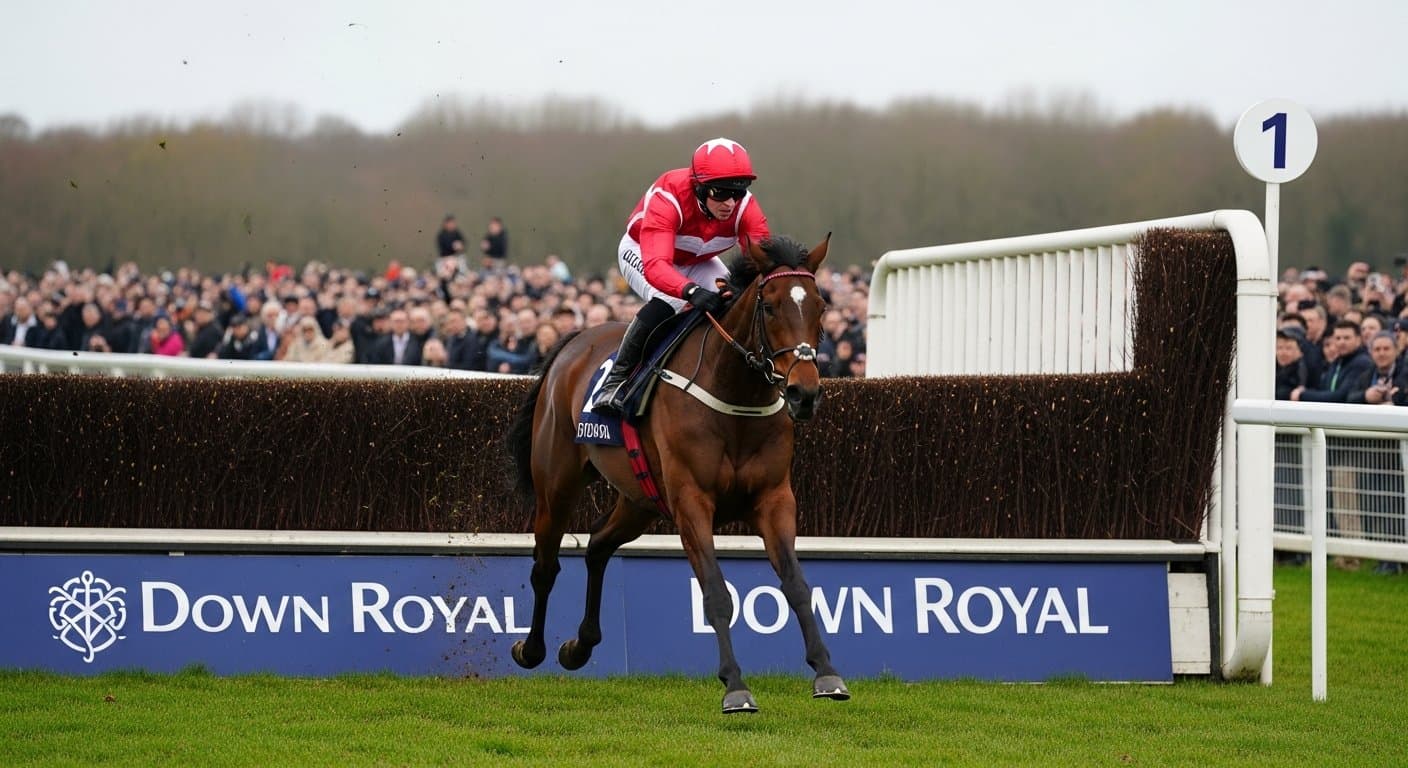
Florida Pearl at Down Royal: The Complete Story
How Florida Pearl became Down Royal's greatest champion, winning the James Nicholson Champion Chase and defining an era of Irish jump racing.
Read more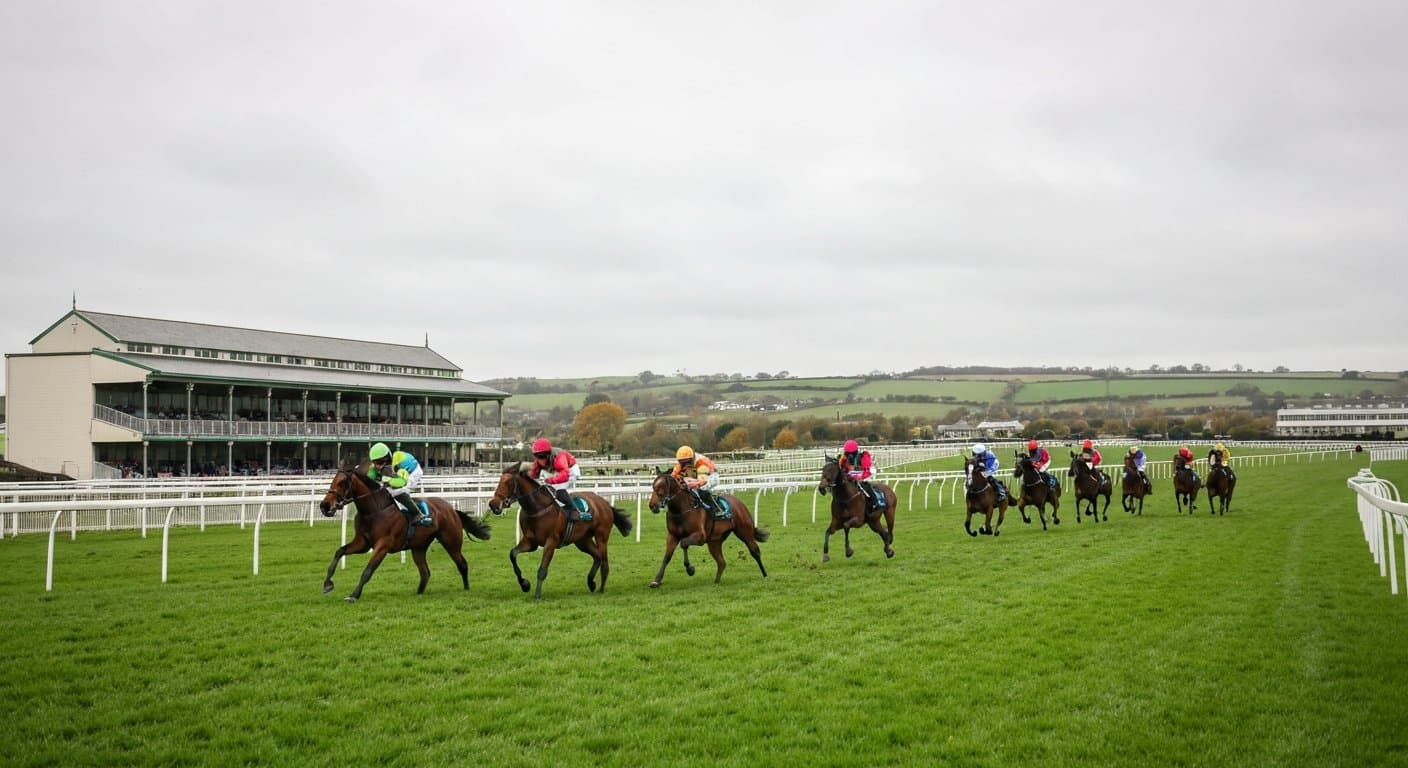
Ladbrokes Champion Chase: Complete Guide
Your complete guide to the Ladbrokes Champion Chase — Down Royal's Grade 1 steeplechase and the most valuable race at the Northern Ireland Festival.
Read more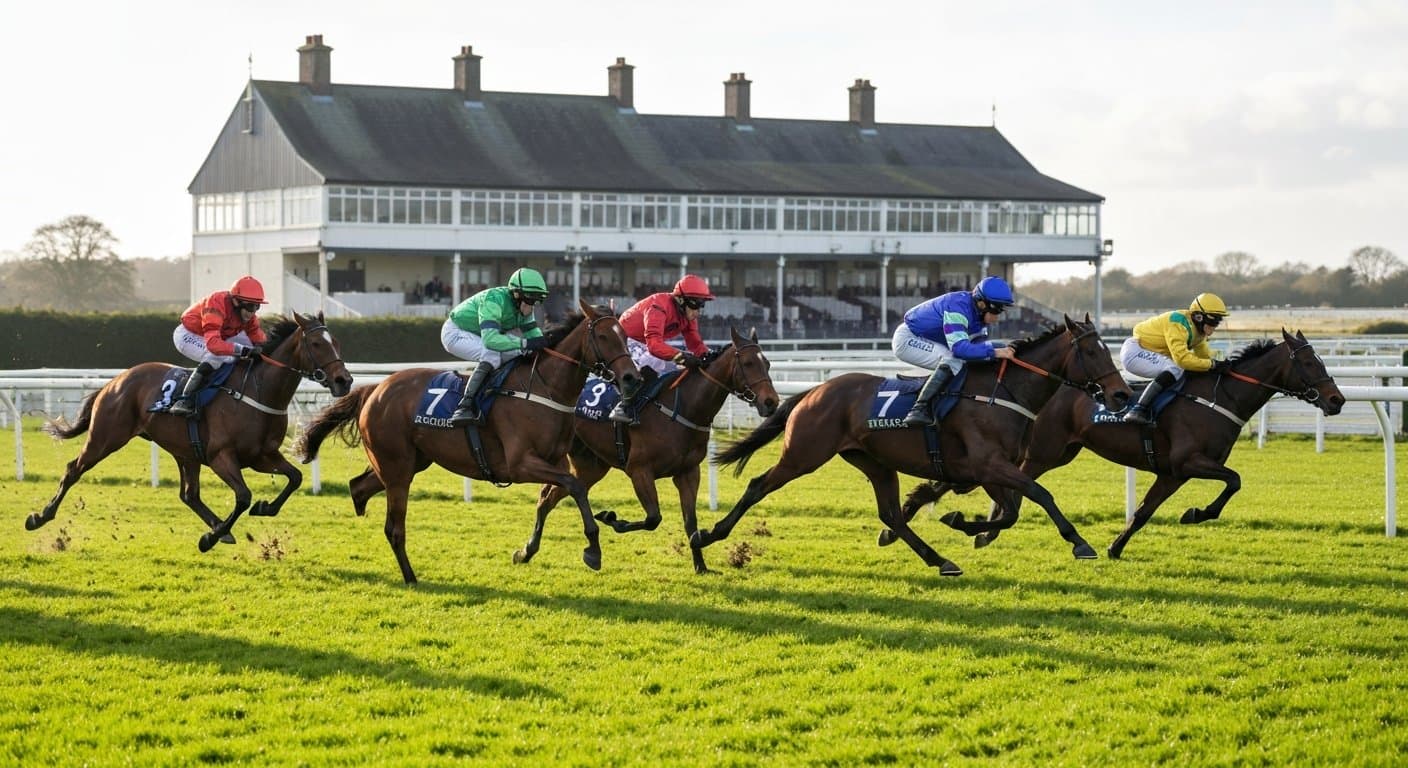
Betting at Down Royal Racecourse
How to bet smarter at Down Royal — track characteristics, going and conditions, key trainers and jockeys, and strategies for Northern Ireland's premier venue.
Read moreGamble Responsibly
Gambling should be entertaining and not seen as a way to make money. Never bet more than you can afford to lose. If you or someone you know has a gambling problem, help and support is available.