
Founder & Editor · Last reviewed 2026-03-02
Britain's highest National Hunt racecourse sits at approximately 850 feet in the Haldon Hills, 7 miles south-west of Exeter city and several degrees colder than the city on any given November afternoon. That gap in temperature between Exeter St Davids station and the Haldon hilltop is the first thing returning visitors tell newcomers. The second thing they tell them is that it does not matter, because the racing and the views make the cold irrelevant.
Exeter Racecourse occupies a ridge in the Haldon Hills with views that reach south toward Dartmoor on clear days. The Haldon Hills are a sandstone ridge running south-west from Exeter, rising above the surrounding Devon farmland, and the course has been placed at the highest navigable point of this ridge. Dartmoor National Park is 8 miles south from the course entrance. On a clear morning in November, the high moorland is clearly visible to the south, and the sense of elevation is present in every aspect of the day: the wind, the light, the views, and the way the horses perform over the uphill finish.
Racing in the Exeter area dates to 1738. The modern course at Haldon has operated since 1898, giving it over 125 years of continuous history on this specific stretch of high ground. NH racing is all that happens here. No flat meetings, no mixed cards. This is a dedicated jumps course from September to late spring, and the atmosphere on race days reflects a specific kind of racegoer: the NH enthusiast who prefers quality and atmosphere to convenience and scale.
The Haldon Gold Cup is the event that marks Exeter's place in the racing calendar. A Grade 2 handicap chase run in November, it attracts top-class chasers and sets the tone for the NH season in the West Country. Trainers including Paul Nicholls, Philip Hobbs, and the Pipe stable have been regulars at Exeter for decades, and the quality of the racing reflects the concentration of serious NH training operations in the Somerset and Devon area. The form from the Haldon Gold Cup meeting often reads out well at Cheltenham and at the major Irish NH venues as the season progresses. If you are tracking horses for the NH season, the November Festival at Exeter is a key reference point.
The uphill finish is the defining feature of the course. It is not a decoration. It is a real test of stamina that separates horses with reserves of energy from those that have given everything earlier in the race. A horse that has jumped fluently and traveled smoothly throughout will stay on up the final climb. A horse that has expended extra energy on poor jumps or by racing in an unsuitable position will stop in the last two furlongs in a way that is immediately visible from the grandstand. Watching a big field of chasers tackle the Exeter finish in November, with the Dartmoor horizon behind them, is one of the more satisfying experiences in British NH racing.
Getting to Exeter by train is straightforward. GWR runs direct services from London Paddington to Exeter St Davids, and the journey takes approximately two hours, which puts this firmly in the category of a manageable day trip from the capital. From Bristol Temple Meads, the journey is about one hour. From Plymouth, around 40 minutes. At the station, a taxi to the course costs roughly £12 to £15 and takes 15 to 20 minutes.
The city of Exeter below the Haldon Hills is Devon's largest and most accessible city. The Cathedral Close, dominated by the twin Norman towers of Exeter Cathedral dating from the 12th century, is the historical centrepiece. The RAMM (Royal Albert Memorial Museum) on Queen Street is free to enter and one of the best regional museums in England, covering natural history, art, and the archaeology of Devon and beyond. The Quayside area along the old ship canal has a concentration of restaurants and bars that make it the most natural pre or post-race destination in the city.
Dartmoor is the other natural partner to a day at Exeter. Haytor (one of the most recognisable granite tors on the moor) is around 20 minutes by car from the racecourse. A morning on the moor, driving the high roads between Widecombe-in-the-Moor and Princetown, followed by afternoon racing at the Haldon Gold Cup meeting is one of the best possible ways to spend a November day in Devon.
The scale of the course is part of its appeal. With a capacity of around 5,000 and a compact layout, Exeter works in the opposite direction from the big southern venues. It is not trying to be Cheltenham or Sandown. It is a West Country NH track of the kind that produced the jumping culture that gave British racing the Pipe and Nicholls dynasties, and attending a race meeting here is to be inside that world rather than watching it from a distance. The course has a quietly significant history running through it. More information at exeter-racecourse.co.uk.
Quick decisions:
- Best visit: Haldon Gold Cup day (November). Grade 2 racing, proper NH atmosphere, top West Country trainers on home ground.
- Good for: Devon touring. Dartmoor 8 miles south, Exeter city with the medieval Cathedral Close and RAMM museum.
- Train access: GWR direct from London Paddington in approximately 2 hours; from Bristol in 1 hour.
- Key note: The 850-foot elevation means weather at the course is noticeably colder than Exeter city. Dress accordingly regardless of the city forecast.
Getting to Exeter
Getting to Exeter Racecourse
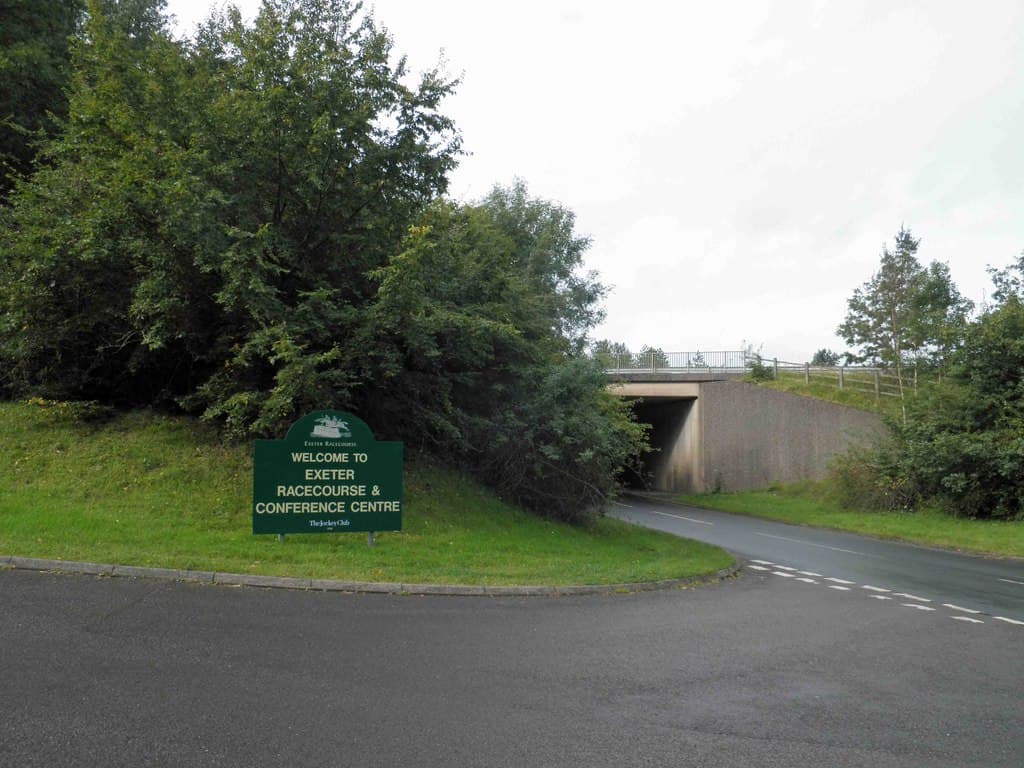
Exeter Racecourse is on the Haldon Hills, postcode EX6 7XS, approximately 7 miles south-west of Exeter city centre. The course is accessed from the A30 trunk road, and the turn-off is well signed. The final approach involves a short stretch of country road up to the hilltop, which is straightforward but worth taking steadily.
By Train
Exeter St Davids is on the GWR main line from London Paddington. Direct services run throughout the day and the journey takes around 2 hours. There are enough departures that you can plan a return on the same day without difficulty. From Bristol Temple Meads, the journey to St Davids is approximately 1 hour. From Plymouth, around 40 minutes. Regional services also connect Exeter to Taunton, Tiverton Parkway, and other West Country stations.
From the station, the racecourse is 6 to 7 miles by taxi. The journey takes 15 to 20 minutes and costs roughly £12 to £15. Taxi ranks operate at Exeter St Davids and cars are generally available during the day, but for Haldon Gold Cup day (the busiest meeting of the year) demand at the rank after the last race can exceed supply. Pre-booking your return taxi is the right approach for any major meeting. Have the firm's number in your phone before you travel rather than trying to find one at the course at 5pm on a busy race day.
No bus route serves the Haldon Hills directly. The course is rural enough that public transport beyond the train and taxi combination is not a practical option.
By Car
From the M5, take Junction 31 (signed Exeter A30). Join the A30 westbound toward Okehampton. The racecourse is signed approximately 4 miles from Junction 31 on the right. Follow the brown racecourse signs from this point. The turn takes you onto the Haldon road and up to the hilltop.
From Exeter city centre, head south on the A38 (Plymouth direction) and then join the A30 westbound at the interchange. Follow signs for Haldon. The city-to-course journey by car takes around 20 minutes in normal traffic.
From Plymouth, take the A38 northbound toward Exeter. The A30 interchange is well signed before you reach the city. Total journey from Plymouth city centre to the course is approximately 45 minutes.
On-site parking is available at Exeter and is included in the standard admission price. For Haldon Gold Cup day, the car park fills progressively from about 11am for a midday start. Arriving 45 minutes to an hour before the first race is the sensible approach. The car park is on grass in sections, and wet weather in November can soften these areas. Wellies are the appropriate footwear choice if the forecast shows rain.
Combining with Exeter City
Exeter's Cathedral Close is the most distinctive area of the city for a pre-race visit. Exeter Cathedral has twin Norman towers dating from the late 11th and 12th centuries, making them among the oldest standing parts of any English cathedral. The Close itself is a medieval square with cafes, independent shops, and a relaxed atmosphere on a weekday morning. It is about 15 minutes on foot from St Davids station.
The RAMM (Royal Albert Memorial Museum) on Queen Street is free to enter and consistently rated as one of the best regional museums in England. Allow 90 minutes if you are visiting before racing. It covers Devon natural history, world archaeology, and a substantial art collection.
The Quayside area, along the old ship canal about 15 minutes' walk from the city centre, has a concentration of restaurants and bars that make it the most practical pre-race dining destination. The canal basin setting is attractive and the food options are more varied than the immediate cathedral area.
Combining with Dartmoor
Dartmoor National Park begins approximately 8 miles south of the racecourse. Haytor, one of the most accessible of Dartmoor's granite tors, can be reached in around 20 minutes by car from Exeter Racecourse via the B3387 through Bovey Tracey. A morning on the moor (parking at the Haytor car park and walking the 20 minutes to the tor) followed by afternoon racing at Exeter makes a coherent and well-paced Devon day without any rushing. The National Park visitor information centre at Haytor is a useful orientation point for anyone new to the moor.
For a longer Devon break, Newton Abbot Racecourse (NH and flat) is around 14 miles south of Exeter and runs a separate fixture list. The two courses make a natural West Country racing combination.
From Other West Country Locations
From Taunton: the M5 southbound to Junction 31 is straightforward, around 25 miles and 30 minutes in normal traffic. From Torquay: the A380 northbound to the Newton Abbot bypass, then the A38 toward Exeter, and from there to the A30 westbound and the Haldon turn. Allow 45 minutes from Torquay. From Tiverton: south on the A396 toward Exeter, then the A30 westbound, about 20 minutes.
For racegoers arriving from other West Country towns (Barnstaple, Okehampton, or Tavistock), the A30 is the natural approach road, and the racecourse signs from the A30 are clear from both directions. The postcode EX6 7XS will route a satnav directly to the course entrance.
Coach and Group Travel
Exeter Racecourse sometimes operates or publicises coach links from Exeter city centre on major racedays. Check the course website or Stagecoach Devon for any race day coach service from the bus station near Exeter St Davids. For groups travelling together, a hired minibus from Exeter city is a practical option that avoids the taxi queue issue after the last race and allows the group to leave on a fixed schedule rather than waiting for individual taxis to become available.
What to Wear
What to Wear at Exeter
Smart casual applies across all enclosures at Exeter. There is no formal dress code for general admission. The atmosphere is relaxed and practical, shaped by the kind of racegoer who prioritises the racing over the social performance of attending it. You will see tweed jackets and you will see fleeces. Both are acceptable.
What Exeter requires more than any dress code is a realistic approach to the weather.
The Elevation Problem
At approximately 850 feet above sea level in the Haldon Hills, Exeter Racecourse sits significantly higher than the city below. The temperature differential between Exeter St Davids station and the racecourse can be 4 to 6 degrees Celsius on a November day. Add wind chill on an exposed hilltop and the effective temperature drops further. On days when Exeter city seems merely autumnal, the course can feel truly cold. Dress for the hilltop, not for the city.
This is not a warning to be dismissed. It catches people out regularly. Arriving at the course in a lightweight autumn jacket because the city felt mild is one of the most reliable routes to an uncomfortable afternoon. The Haldon ridge is exposed to south-westerly weather systems rolling in from the Atlantic, and these hit the hilltop directly. A proper winter coat from late October through to March is not overcaution. It is the correct preparation.
November and the Haldon Gold Cup Meeting
For the Haldon Gold Cup day in November, the full winter wardrobe is required. A warm, insulated, waterproof outer layer. Thermal or warm layers underneath. A scarf and gloves if the forecast is cold (and on the Haldon Hills in November, it usually is). Wellies are practical if rain is forecast. The car park has grass sections that become soft in wet conditions, and walking from the car to the entrance in thin-soled shoes on muddy ground is avoidable with the right footwear.
The Gold Cup meeting is a social occasion as well as a racing one. Some racegoers in the Premier enclosure and hospitality areas make an effort with smarter outfits. A warm, smart coat over a smarter outfit is the right approach if you want to dress up for the occasion without sacrificing comfort. The key is that the warmth layer cannot be compromised.
General Winter Meetings (October to March)
Any visit from October through March at Exeter demands the same practical approach. Warm coat. Sensible waterproof. Layers that you can adjust if the afternoon warms slightly. Wellies or walking boots for wet days. Comfortable flat shoes for drier days. You will be standing and walking throughout.
Spring Meetings (April to May)
April and May are the shoulder months at Exeter. The going is usually better, the fields are smaller, and the weather is more unpredictable in a different way. Warmer spells are possible but so are cold fronts. A light jacket may be sufficient on a sunny April day, but a waterproof layer is always worth having in your bag. The elevation still makes the Haldon course cooler than the surrounding Devon landscape.
Summer Days at the Hilltop
Exeter does not run summer meetings. The course is NH only and the programme runs from September through to late spring. There is no equivalent of a summer flat meeting here. The warmest racing weather at Exeter tends to be in September, when the early autumn season begins and the going is typically firmer. Even then, a jacket for later in the afternoon is sensible.
Footwear Priorities
Comfort and grip matter more than appearance at Exeter. The course terrain is uneven in places, the car park is on grass, and you will spend several hours on your feet. Flat shoes with grip soles work well on dry days. Walking boots or wellies are the right call in wet or cold conditions. High heels with narrow bases are truly impractical here. The ground is not flat and even in dry conditions the terrain around the course is not suited to them.
Premier Enclosure
On Gold Cup day, the Premier enclosure has a slightly smarter expectation. Smart casual remains the appropriate standard: clean, presentable clothing rather than sportswear or overly casual attire. If you are unsure, contact the course directly or check exeter-racecourse.co.uk for any specific guidance on Gold Cup day dress.
The September Season Opener
Exeter's season typically begins in September, and early autumn here is the mildest point of the racing programme. The going is usually good to soft or good at this time of year, the fields are larger than they will be by spring, and the days are still long enough to make an afternoon visit comfortable without heavy winter layers. A mid-weight jacket, a pair of chinos or smart trousers, and a decent pair of shoes or boots is sufficient for September. Carry a waterproof if there is any chance of rain.
September racing at Exeter is the point in the year when you get to see how NH horses have come back from their summer breaks, and the form from the early September meetings often takes several weeks to fully establish itself. An experienced racegoer watching the September card can learn things about horses that the betting public will not price in for another month.
Layers and the GWR Journey
For visitors arriving on GWR from London Paddington, the train journey passes through Somerset and Devon with approximately two hours of travel. The carriage temperature on a November morning can be warm enough that a heavy coat becomes uncomfortable. Wearing your mid-layers on the train and adding the outer coat at Exeter St Davids is the practical approach. Pack the coat on top of any bag so you can access it quickly before the taxi to the Haldon Hills, where the temperature on arrival will remind you why you brought it.
Enclosures & Viewing
Enclosures and Viewing at Exeter
Exeter is a compact course with a capacity of around 5,000, and its enclosures are sized accordingly. Nothing is far from anything else. The grandstand, parade ring, winners' enclosure, and trackside rail are all within a few minutes' walk of each other. For a course at this level of NH racing quality, the accessibility is one of its real strengths.
The Grandstand
The main grandstand faces the home straight and the uphill finish, which is the defining feature of Exeter racing. From the upper tier of the grandstand, you can see the horses coming off the final bend and beginning the climb to the line. This is where races at Exeter are won and lost. A horse that has more left to give will pick up on the climb and extend its lead. A horse that has been ridden too aggressively earlier in the race will visibly shorten its stride and stop. The uphill finish makes the tactical nature of NH racing directly observable in a way that a flat finish line does not always allow.
For the Haldon Gold Cup in November, the grandstand fills from around 11.30am for a 12pm first race. Position yourself in the upper tier before the feature race. By the time the Gold Cup goes to post in the early afternoon, the lower tier and the concourse are busy. The upper tier gives an unobstructed view of the complete run-in from the final bend to the line.
Parade Ring
Exeter's parade ring is small and close to the main concourse. Before a big race like the Haldon Gold Cup, this is where the serious preparation begins. Paul Nicholls sends horses to Exeter regularly from his Ditcheat base in Somerset, and Philip Hobbs's Sandhill Racing Stables near Minehead is one of the most active yards at this course. Watching a Grade 2 chaser in the parade ring at a small course like Exeter gives you a clearer view than you would get at Cheltenham or Leopardstown, where the crowd and the occasion create more distance between the racegoer and the horse.
Allow 15 to 20 minutes in the parade ring before the Gold Cup. Assess how the horses are moving, whether they are settled or tense, and whether they look well in their coat. At a small course with a limited field, parade ring observation adds significant information to a betting assessment.
Winners' Enclosure
The winners' enclosure at Exeter is positioned adjacent to the parade ring and is accessible from the main viewing area. After a Grade 2 race like the Gold Cup, the immediate aftermath at the winners' enclosure is where the trainer's early comments, the jockey's assessment, and the owners' reaction all converge. For racegoers who want to be close to that moment, positioning yourself near the enclosure as the winner is being unsaddled is worth planning for.
Premier Enclosure
The Premier enclosure provides the best facilities on Gold Cup day and other major meetings. Covered viewing, access to the highest quality catering and bar areas, and a slightly smarter crowd. For hospitality packages, book directly with the course. The November Festival hospitality fills well in advance. Details at exeter-racecourse.co.uk.
The Premier enclosure's covered viewing positions are most valuable on wet November days when the exposed Haldon ridge is taking the full force of an Atlantic weather system. On a clear day the difference in weather protection matters less, but the facilities difference remains.
Trackside Rail
The rail along the inside of the circuit gives you the closest possible view of the jumping. NH fences at Exeter are well built and the course is fair. The horses jump cleanly here compared to some courses where the fences have a reputation for catching out otherwise good jumpers. Watching a field of chasers take the fences at the far end of the track from the rail in November, with the Dartmoor horizon in the distance, is the most direct engagement with what makes Exeter's racing distinctive.
The uphill finish is best viewed from the grandstand rather than the rail. From the rail at the finish line you will see the horses close up but lose the perspective on how they are travelling and whether they are staying on or stopping. The grandstand elevated position makes the stamina test visible in a way that the rail does not.
Betting Ring
Exeter maintains an active on-course betting ring alongside Tote and fixed-odds machines. For the Haldon Gold Cup, the ring is busy from an hour before the race as the market forms and money moves. The on-course bookmakers at a West Country NH meeting have a strong understanding of local form. Horses trained by Nicholls, Hobbs, and the Pipe yard are well known to them, and price movements in the ring on Gold Cup day often reflect yard confidence before the wider market catches up. Watching the ring in the 20 minutes before the Gold Cup goes to post is informative.
The ring is positioned between the grandstand and the parade ring, making it easy to pass through when moving between the two primary viewing positions. On wet November days, the ring is exposed and the bookmakers keep their boards covered until the last moment. Factor in the weather when planning your time there.
Compact Layout
The compact nature of the course at 5,000 capacity means the facilities are always manageable. On Gold Cup day the concourse and the bars get busy, but nothing reaches the overwhelming scale of a Cheltenham Saturday. You can get from the parade ring to the grandstand to the betting ring to the catering and back in well under 10 minutes. This accessibility is part of what makes Exeter one of the more enjoyable NH venues in the south of England.
Food & Drink
Food and Drink at Exeter
Exeter's catering does better than many NH courses of its size. The food offering leans toward honest, filling West Country fare: pasties, pies, burgers, chips. The quality is above the average for a 5,000-capacity rural track. This is Devon, and the county has strong food traditions that surface at local events in ways that are easy to overlook until you are standing at a catering counter noticing that the pasty looks significantly better than the standard racecourse variety.
The Devon Pasty
A properly made Devon pasty at Exeter Racecourse is one of the more regionally appropriate food choices available at any British sporting venue. The Devon pasty (as distinct from the Cornish) is a real and slightly contentious thing. The cream goes first in a Devon cream tea, jam second. This is a fixed point of local identity. The pasty is filled and substantial, and on a cold November afternoon at 850 feet on the Haldon Hills, it is entirely the right choice.
Catering units serve from multiple points around the concourse. On Gold Cup day, the queues build in the 20 minutes before the feature race. Plan your eating for between races rather than at the peak demand moment. Pies and burgers are consistent alternatives. Hot drinks (tea, coffee, hot chocolate) are available throughout and are worth prioritising early on cold days.
The Bars
The bars at Exeter stock a reasonable range including ales, lager, wine, and spirits. Otter Brewery, based in the Otter Valley near Honiton in Devon, produces ales that are sometimes available at Exeter. Their Bitter and their Amber are well-made, session-appropriate ales that suit the NH atmosphere considerably better than a standard national lager brand. Worth asking about at the bar.
On Gold Cup day, the bars get crowded between races. The practical advice is the same as for the catering: get your drink before the parade ring viewing for the feature race, not immediately before the race goes to post. A pint poured in the bar while you watch the earlier races gives you time to get to the grandstand with a decent position before the Gold Cup field enters the parade ring.
Hospitality and Restaurant Packages
Exeter offers hospitality options for the Gold Cup meeting and other major days. A table in a covered marquee with catering and bar service included is the most comfortable way to spend a wet November day on the Haldon ridge. The quality of hospitality catering is considerably above the general concourse offering. For groups of six or more who want a full race-day experience with a sit-down meal, this is the right choice.
Book hospitality well in advance for Gold Cup day. The November Festival packages fill early. The course website at exeter-racecourse.co.uk has current availability and pricing.
Exeter City Before the Races
If you are arriving by GWR from London or Bristol, there is time to eat in Exeter before taking a taxi up to the course. The Quayside area along the old ship canal is the most straightforward option. The Flat Iron on Quay Hill has been a reliable lunch venue for pre-race visits to Exeter: solid food, good range, sensible prices. The canal setting is attractive even in winter.
The White Hart on South Street, close to the Cathedral Close, is a classic Devon pub with good food and the kind of interior that has clearly not been over-designed at any point. A pre-race lunch here followed by a taxi to the course fits neatly into a GWR day trip from London. Allow 45 minutes for lunch and the taxi journey to the Haldon Hills.
For breakfast before an early train from London Paddington, the GWR First Class lounge at Paddington provides an alternative for those travelling on applicable tickets. The onboard catering is also functional.
Post-Race Return to Exeter
After the last race, the taxi back to Exeter St Davids takes 15 to 20 minutes. Exeter city centre has a solid post-race dining scene. The Cathedral Close area and the Quayside between them cover most needs. If you are getting a late GWR service back to London or Bristol, the Quayside is close to the station and gives you time for a meal before the train.
West Country Wider Options
The area around Haldon has a few local pubs that catch the racing crowd when the event finishes. The Royal Oak at Ide, a village a couple of miles from the course on the Exeter side, is a traditional Devon pub serving food. If you are driving and want to decompress before the journey rather than fighting the post-race traffic queue, a quiet post-race pint in a local pub before the road clears is a reasonable option.
Dartmoor has its own food culture for those extending the day southward. The Warren House Inn near Postbridge, sitting at around 1,425 feet on the high moor, is reportedly the most remote pub in southern England. It is about 25 minutes from the course by car and serves straightforward food and Dartmoor ale in a setting where a fire has reportedly been burning continuously since 1845. Whether this is entirely true or not, it is the kind of claim that belongs at a Dartmoor pub. A post-race drive to the moor, a pint at the Warren House, and a drive back to Exeter for the evening train is one of the more unusual ways to end a Gold Cup day.
Tips & FAQ
Tips and FAQ: Exeter
When Should I Arrive?
For Haldon Gold Cup day: arrive 45 to 60 minutes before the first race. The car park fills progressively from mid-morning, and securing a parking position early (along with getting your bearings in the grandstand before the crowd builds) makes the day considerably more comfortable. The Gold Cup card includes several supporting races that are worth watching properly, not just the feature.
For standard winter or spring meetings: 30 minutes before the first race is sufficient. Exeter is compact enough that you can navigate it quickly.
The Uphill Finish as a Betting Tool
The Haldon Hills finish is Exeter's most important single feature from a racing and betting perspective. Every horse that runs here will face a stiff uphill climb in the final two furlongs. This is not a finish that rewards horses that have exhausted themselves getting to the front at the wrong moment. A horse that has been held up, jumped cleanly, and has energy in reserve will pick up on the climb. A horse that has worked hard early (whether because the pace was high, because it jumped poorly, or because it was ridden aggressively) will stop at the foot of the hill.
This means Exeter favours horses with stamina, good jumping technique, and trainers who understand how to set a horse up for this kind of test. Paul Nicholls, Philip Hobbs, and the Pipe operation understand Exeter well. When their horses appear at the course's major meetings with good form, treat that alignment seriously.
Is Exeter Worth a Trip from London?
Yes, specifically for the Haldon Gold Cup. GWR from Paddington to Exeter St Davids in approximately 2 hours is one of the better inter-city train journeys in Britain. The Somerset Levels and the Devon coast are visible from the train on a clear day, and a reserved window seat is well worth booking. The return can be made on the same day with an evening departure from St Davids.
The Grade 2 Gold Cup is a real reference point for the rest of the NH season. If you are tracking Cheltenham Festival horses (particularly in the chasing divisions) the Haldon Gold Cup meeting in November provides some of the most useful early-season form available. Attending in person rather than watching on television gives you the parade ring and the conditions assessment that the television picture does not fully convey.
Combining with Dartmoor
The 8-mile drive from Exeter Racecourse to Haytor on Dartmoor takes around 20 minutes via the B3387 through Bovey Tracey. This is entirely achievable on the same day as racing. A 9am departure from Exeter city, 45 minutes on the moor, back in the car by 10.30, at the racecourse by 11.15. The Haytor car park is signposted from Bovey Tracey and is the standard access point for one of the most accessible of Dartmoor's high tors.
If you have a second day in Devon, the full Dartmoor circuit (Haytor, Widecombe-in-the-Moor, Princetown, and the B3212 back to Exeter) takes a half-day and gives a clear sense of why the moor has the character it does. The Dartmoor Inn at Merrivale serves food and is a reasonable mid-moor lunch stop.
Pre-Race Exeter: The Cathedral Close
For visitors arriving by train with 90 minutes before a taxi to the course, the Cathedral Close is a 15-minute walk from St Davids and the natural orientation point for Exeter. Exeter Cathedral's twin Norman towers (the North Tower dates to approximately 1133, the South Tower to approximately 1150) are among the oldest standing Norman structures in the south-west. The Close itself is a medieval precinct with independent cafes, a covered market, and a relaxed morning atmosphere on race days.
The RAMM (Royal Albert Memorial Museum) is free to enter and is 10 minutes' walk from the station. The ground floor natural history collection and the Egyptian archaeology displays are the highlights for a short visit.
Going Conditions
Exeter's going is one of the more variable in the NH calendar. The Haldon Hills receive significant rainfall from Atlantic weather systems, and the course can carry heavy or soft going for weeks at a time from November through February. When the going is good or good-to-soft in November, the racing is at its fastest and most competitive. When it is heavy, the uphill finish becomes a severe test of stamina and the field thins considerably. Horses that are not bred and trained for staying power in very testing conditions will not cope with the combination of heavy ground and the final climb.
Check the going report on race morning through the BHA or the course's own updates. It affects not just which horses will perform best, but the pace of the race throughout. Fast ground at Exeter produces one kind of race, heavy ground produces another, and the same horse can look entirely different in the two conditions.
Family Attendance
Exeter is family-friendly and compact enough to be manageable with children. The scale of the course (5,000 capacity, everything within easy walking distance) means you will not lose anyone. The weather in November and December requires proper preparation for children as much as for adults. Warm layers and wellies are not optional.
Check the course website at exeter-racecourse.co.uk for current ticket pricing and any age-related discounts. The course staff are accessible and helpful for any accessibility requirements. Contact them directly in advance if you need specific arrangements for the viewing areas.
Booking Tickets
For the Haldon Gold Cup day, booking in advance through exeter-racecourse.co.uk is advisable. The course has a 5,000 capacity and the Gold Cup meeting is its busiest day of the year. General admission does not always sell out, but advance booking avoids gate queuing and sometimes carries a small discount. Hospitality and Premier enclosure packages for the November Festival should be treated as priority bookings. They fill well before the event and are the most popular option for groups travelling from further afield.
Share this article
More about this racecourse
All Exeter guides
Devon National: Complete Guide
Your complete guide to the Devon National — Exeter's staying handicap chase and February highlight for chasers.
Read more
Exeter Racing Festival: Your Complete Guide
Exeter Racecourse's Haldon Gold Cup weekend launches the south-west jump season. Here's your guide to Devon's premier National Hunt festival.
Read more
The History of Exeter Racecourse
Over 280 years of racing at Exeter — from the Haldon Hills to Britain's highest National Hunt track.
Read moreGamble Responsibly
Gambling should be entertaining and not seen as a way to make money. Never bet more than you can afford to lose. If you or someone you know has a gambling problem, help and support is available.