
Founder & Editor · Last reviewed 2026-04-05
Introduction
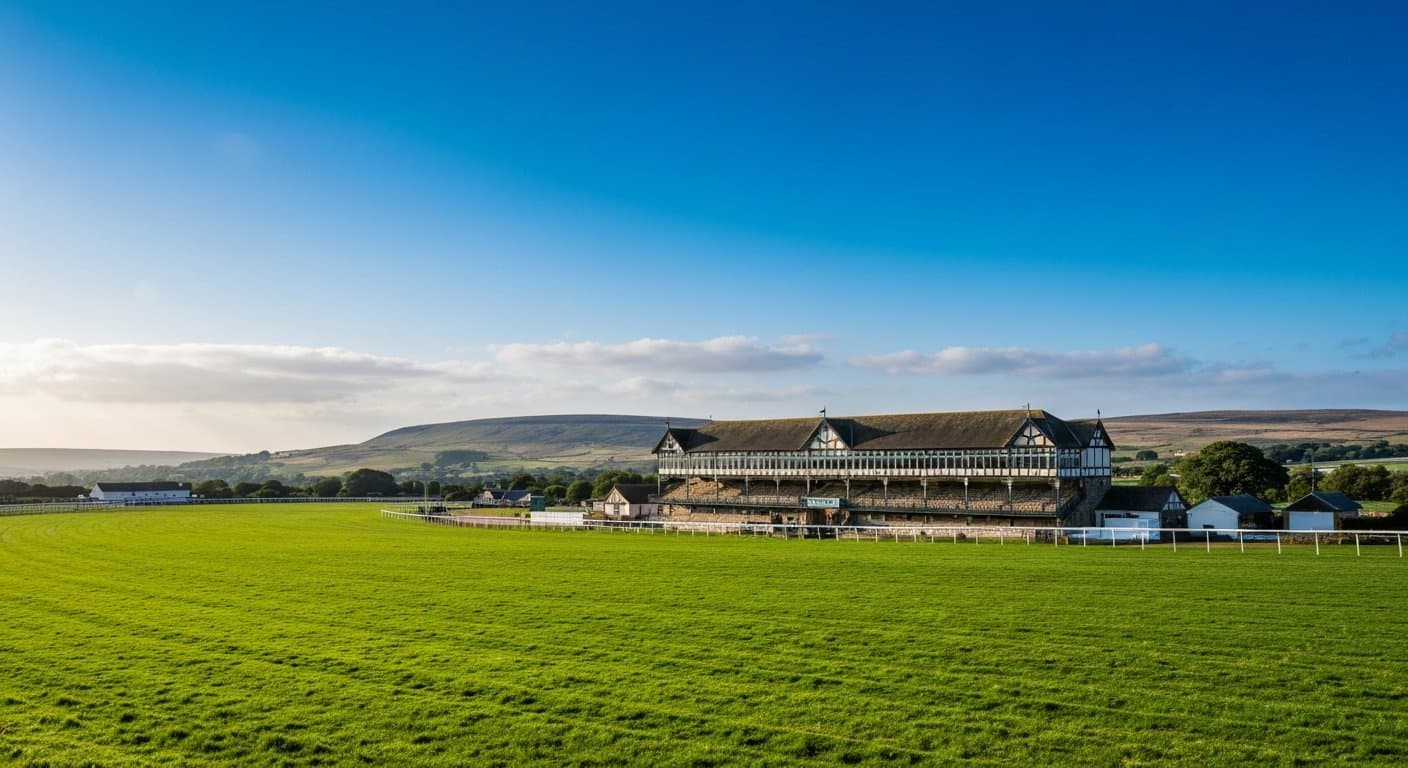
Exeter Racecourse stands 240 metres above sea level on Haldon Hill, five miles south of the city across the Exe Valley. From the grandstand on a clear November afternoon you can pick out Dartmoor to the west, the Exe estuary to the east, and on the best days the English Channel beyond Teignmouth. No other National Hunt track in Britain offers a backdrop quite like it, and the altitude shapes racing in ways visitors rarely expect — the wind cuts hard on the hill even when the city below is mild.
The course has been staging jumping here since 1895, when the Devon and Exeter Hunt established the fixture on the plateau of Haldon Hill. It spent much of the 20th century trading under the name Devon and Exeter Racecourse, and locals still call it Haldon as often as they call it Exeter. That dual identity captures something real about the place: it is simultaneously a city track on the fringe of the South West's largest urban centre and a rural hilltop circuit that owes its character entirely to the landscape.
Who This Guide Is For
This guide is for anyone planning a visit to Exeter — whether it's your first time on the Haldon Hill or your twentieth trip to watch the Haldon Gold Cup. The sections cover the course layout and what it demands from horses, the full fixture calendar, facilities and food, transport, and the best angles for informed betting. There is also a history section tracing the track from the Victorian era through to the modern NH calendar, and a planning section for combining a race day with a visit to Exeter city or Dartmoor.
If you are coming primarily to bet, the betting guide covers the most important structural fact about this track: the run-in from the final fence to the winning post is approximately two furlongs, longer than almost anywhere else in Britain. That single feature eliminates certain horse types entirely and rewards others systematically.
Quick Facts
| Location | Haldon Hill, 5 miles south of Exeter, Devon — postcode EX6 7XS |
| Altitude | 240 metres (approximately 787 feet) above sea level |
| Racing type | National Hunt only (hurdles and chases) |
| Founded | 1895 on current Haldon Hill site |
| Circuit | Right-handed, approximately 2 miles round, significantly undulating |
| Season | October to May, approximately 16 fixtures |
| Signature race | Haldon Gold Cup — Grade 2 chase, held in November |
| Nearest station | Exeter St Davids, 5 miles north |
| Capacity | Approximately 5,000 |
| Website | exeter-racecourse.co.uk |
The Haldon Gold Cup
The Haldon Gold Cup, run over 2 miles 1 furlong 110 yards in November, is the first significant two-mile chase of the National Hunt season. By the time the race is run, Cheltenham's November Meeting is still two or three weeks away and Sandown's Tingle Creek is six weeks out. Horses who will compete in the Queen Mother Champion Chase the following March regularly open their campaigns here — the race functions as the 2m chase division's first true roll-call. Paul Nicholls has won it eight times; the Gold Cup day card, attracting crowds of 5,000 to 8,000, is the highest-profile afternoon Devon racing offers.
For any visit to Exeter, November is the month that repays most richly.
What Makes Exeter Different
Three things separate Exeter from other National Hunt venues in the South West and in Britain more broadly.
First, the altitude and its effects. At 240 metres, the course sits above the local weather patterns of the Exe Valley. In November, when temperatures in Exeter city centre sit at 9 or 10 degrees, the racecourse can be a real 5 degrees colder. Wind is a constant factor — westerlies across the plateau have nothing to interrupt them between Dartmoor and the grandstand. If you are visiting for the first time, dress for the hill rather than the city.
Second, the run-in. The straight from the final fence to the winning post is approximately two furlongs — roughly 400 yards. For comparison, Ascot's run-in is around 100 yards, Cheltenham's is 350 yards but uphill, and most provincial NH tracks have 50 to 150 yards. Exeter's flat, extended run-in fundamentally changes which horses win and lose here. Jockeys know not to celebrate at the final fence: the post is a long way away. Punters who learn this early give themselves a structural edge at every Exeter meeting.
Third, the trainer geography. Philip Hobbs trains at Sandhill Farm near Minehead, 30 miles north. Paul Nicholls trains at Ditcheat, 45 miles to the north-east. Having two of Britain's top three National Hunt trainers within an hour of the course gives Exeter's card a quality ceiling that regional tracks rarely achieve. Hobbs and Nicholls both know exactly what Exeter requires, and they place their horses accordingly.
Bet on Exeter
Place your bets on Exeter races with a trusted bookmaker.

Promo code BETFRED50. New customers only. Register, deposit with a Debit Card, and place a first bet of £10+ at Evens (2.0)+ on Sports, to be settled within 7 days, to get £30 in Sports Free Bets and £20 in Bet Builder Free Bets within 24 hours of settlement. 7-day expiry. Eligibility & payment exclusions apply. Full T&Cs apply. Take Time to Think. BeGambleAware.org. 18+. Full T&Cs.

Promo code R30. New UK customers only, 18+. Register, deposit £10 or more, then place a £10 single cash bet at odds of 1/2 (1.5) or greater on any sports market (excluding Virtuals). Once the qualifying bet settles you get £30 in Free Bets (3 x £10) — the qualifying bet can win or lose. Free Bets are valid on any sports market excluding Virtuals, expire in 7 days, are non-withdrawable and must be used in full. Excluded deposit methods apply (including PayPal, Apple Pay, Skrill and NETELLER). Named bets such as Lucky 15 do not qualify. If you cash out the qualifying bet, or it is voided, you are no longer eligible for the offer. Ends 31.12.26. Full T&Cs apply. Please gamble responsibly. BeGambleAware.org. 18+. Full T&Cs.

Promo code BET40GET20. New UK customers, 18+. Register with the code and place a first bet of £40 or more at Evens (2.0) or greater. Receive 2 × £10 free bets: the first credited automatically once the qualifying bet settles, the second 24 hours later. Free bets must be placed at minimum odds of 4/1 (5.0), expire 24 hours after credit, and the free-bet stake is not returned with winnings. Debit card deposits only. Take Time to Think. BeGambleAware.org. 18+. T&Cs apply. Full T&Cs.

50% of your first-day net losses refunded as a free bet, capped at £25. New UK customers aged 18+ only. To qualify, deposit and place a first bet of £10 or more on any sport at minimum odds of evens (2.00), then place at least two further bets on different events, each worth at least 50% of your largest bet, all at evens (2.00) or greater. Losses are counted from your first settled bet until 23:59 the same day. Place a qualifying £10+ bet and you are guaranteed at least a £5 free bet. Bets placed at SP, void bets, cashed-out bets and bets struck with free bets do not count towards the offer. The free bet is credited the day after your qualifying bets settle and must be used within 7 days, after which it expires. It can be used at odds from 1/4 (1.25) up to 250/1 on singles and straight accumulators, but not on Trixie, Patent or Yankee style multiples. Free-bet stake is not returned with winnings. One offer per person, household, address, IP address and device. E-wallet deposits may not qualify, so check the cashier before depositing. Customers registered with GAMSTOP cannot claim. KYC identity verification must be completed before the free bet is credited. Take Time to Think. BeGambleAware.org. 18+. T&Cs apply. Full T&Cs.

New customers, 18+. Choose the sports bonus at sign-up, make a first deposit and receive a 100% bonus up to £50 in your Sports Bonus balance. To convert the bonus to cash, wager it 10x within 30 days. Single bets below Evens (2.00) do not qualify; accumulators do not qualify if any selection is below 1/2 (1.50). Virtual Sports, voided, cancelled, drawn, cashed-out and free-bet wagers do not count towards wagering. Only the first settled bet per event counts. Withdrawing before the wagering requirement is met forfeits the bonus balance including bonus winnings. Real-money funds are used before bonus funds. Deposits via Skrill or Neteller are not eligible. Not valid in conjunction with other promotions. Odds, bet and payment limits apply. 10bet general and promotion T&Cs apply. BeGambleAware.org. 18+. Full T&Cs.

New customers in Great Britain and Republic of Ireland, 18+. Place a £10 fixed-odds qualifying bet at minimum odds of 1/2 (1.50) — single or each-way (only the win part counts), pre-event or in-play, not cashed out early, within 28 days of opening the account. Receive up to £60 in bonuses credited over three days: 3 × £10 fixed-odds free bets (the first on settlement, then 24 and 48 hours later) plus 3 × £5 Total Goals FOOTBALL spread bets and 3 × £5 racing Winning Favourites spread bets, with a £1 racing Race Index spread bet as an extra on top. The spread bets need a full spread-betting account, opened within 28 days of the fixed-odds account and subject to Spreadex's eligibility and appropriateness checks. Free-bet stakes not returned with winnings; free bets valid 28 days from issue. IMPORTANT: the £5 credits are SPREAD bets — sports spread betting carries the risk that losses can exceed your stake. Sports spread-betting customers do not have Financial Ombudsman or FSCS recourse. Take Time to Think. BeGambleAware.org. 18+. T&Cs apply. Full T&Cs.

Promo code WELCOME15, entered under My Bonuses after registering. New UK customers, 18+. Place a first qualifying bet of at least £10 from your cash balance at odds of evens (2.0) or greater within 7 days of opening the account. Once the qualifying bet fully settles you receive £15 in free bets, credited as 3 x £5 tokens with set uses: one £5 accumulator free bet (minimum 4 legs, each leg at 2/5 or bigger), one £5 sports free bet (any market at evens or bigger) and one £5 Sub Cover free bet (selected football player markets at evens or bigger). Free-bet stakes are not returned with winnings. Free bets expire 7 days after they are credited. Void, cashed-out and partially cashed-out bets do not qualify. One offer per customer. Confirm the current terms on BetGoodwin's own welcome-offer page before claiming. Take Time to Think. BeGambleAware.org. 18+. T&Cs apply. Full T&Cs.

New UK customers, 18+. Minimum deposit £10. Place a £10 qualifying single on sports (excluding virtuals) at minimum odds of 1/2 (1.50), settled within 14 days. Deposit-method exclusions apply. Receive £30 in free bets (stake not returned), split £20 for sportsbook use (2 x £10) and £10 for Bet Builder only (2 x £5); Bet Builder does not cover horse racing. Free bets must be accepted within 7 days and expire 7 days after acceptance. No promo code required. Best Odds Guaranteed on UK & Irish racing, subject to having staked over £25 in the previous seven days. Operated by LiveScore Betting and Gaming (Gibraltar) Ltd, UKGC 56859. Confirm the current terms on LiveScore Bet's own promotions page before claiming. Take Time to Think. BeGambleAware.org. 18+. T&Cs apply. Full T&Cs.
18+. BeGambleAware.org
The Course
Exeter is a right-handed circuit of approximately 2 miles round, set on the plateau and upper slopes of Haldon Hill at 240 metres above sea level. The course undulates throughout — it climbs, drops, and climbs again in a way that is unusual even among Britain's more varied National Hunt tracks. There is no flat back straight here, no gentle glide into the home bend. Horses are working continuously against the terrain.
The Track Layout
The circuit begins near the grandstand and sweeps right-handed into the back of the course. The descent away from the stands is noticeable — horses drop several metres in elevation through the first half of the back straight. They then climb back up through the far turn, gaining height steadily before reaching the final bend. The home straight rises slightly and then flattens into the run-in.
The defining structural feature is the run-in from the last fence to the winning post: approximately two furlongs of relatively level ground. At most National Hunt tracks the run-in is 50 to 100 yards. At Exeter it is roughly 400 yards — a full quarter-mile. This is not a quirk of the design; it shapes every result at this track. Horses that jump the last fence clear and in front cannot simply kick and go. They need to maintain their gallop for another 24 to 28 seconds. Anything that has emptied itself getting to the final fence will be caught. Anything that travels well through a race and jumps cleanly at the last gains a longer window to finish the job.
Race Distances
Exeter races over the following distances, reflecting the natural breaks in the circuit:
- 2 miles 1 furlong 110 yards — the shortest trip, used for the Haldon Gold Cup and the majority of two-mile chases
- 2 miles 2 furlongs 179 yards — the standard two-mile-plus novice chase distance
- 2 miles 3 furlongs 174 yards — used for longer handicap chases and some novice hurdles
- 2 miles 5 furlongs 56 yards — a proper test of stamina, particularly when the ground is soft
- 3 miles 2 furlongs 15 yards — the marathon distance, used for staying chases including the Devon National in February
The gap between the shortest and longest trips — just over a mile — means the same circuit produces quite different races. The two-mile-plus distances favour horses comfortable with multiple changes in gradient. The staying distances at 2m5f and 3m2f expose any weakness in jumping accuracy, because errors on the downhill sections cost considerable lengths.
Fences and Jumping Demands
Exeter's fences are built to standard specifications but have a reputation among jump jockeys for demanding respect. They are well-maintained and not unusually stiff by Grade 1 standards, but the undulating ground on the approach and departure from each fence means horses cannot meet them on flat ground and fire cleanly over. On the descent sections, horses sometimes meet fences slightly short, making for awkward jumping. On the climb sections, the fences come at horses when they are tiring — a combination that produces falls and errors at a slightly higher rate than flat-circuit courses of equivalent class.
There are eight fences per circuit in chases. At the longer distances (3m2f) horses will complete over 20 jumps in total. The open ditches — there are two per circuit — are positioned where horses are carrying pace and the stakes for an error are highest.
Hurdle races at Exeter are less dramatically affected by the terrain than chases, but the same stamina premium applies. A hurdle race at 2m3f on a soft November day at Exeter is a harder test than the distance might suggest at a flatter track.
Going and Ground Conditions
Exeter sits on Devon clay over the hard rock of the Haldon ridge. This combination means water sits near the surface after rain and dries slowly. The altitude adds a further variable: the hill generates its own microclimate, and weather on the course can differ sharply from conditions in Exeter city five miles away. Fog, strong westerly wind, and driving rain are all more frequent on Haldon Hill than the local forecast suggests.
In practice, the going is soft or heavy for the majority of fixtures from October to February. Good to soft is a real possibility in October, late March, and April. The April Easter meeting — usually the season's final fixture — can produce the best ground of the year and fields that look quite different from the mud-filled contests of mid-winter.
Drainage improvements made at the course in the early 2000s mean the track rarely becomes unraceable, but "good" ground at Exeter in January is almost unknown. The Devon climate does what it does, and trainers who target the track plan their entries around the expectation of testing conditions.
Which Horse Types Succeed
The combination of the long run-in, the undulating circuit, and the typically testing ground produces a clear picture of the type that wins at Exeter:
Front-running chasers who jump boldly and stay on. The long run-in means a horse that reaches the final fence two lengths clear and jumping well has time to maintain that advantage. Horses that win their races at the last fence and grind out a finish are naturally suited. A short-striding quickener who saves everything for a 100-yard sprint is at a structural disadvantage.
Proven heavy-ground performers. Form from Chepstow, Taunton, Kempton on soft, and Wetherby in deep winter translates to Exeter well. Course-and-distance winners at Exeter are worth following back — the specific demands of the track repeat with unusual consistency.
Horses that have won on undulating circuits. Lingfield, Plumpton, Ffos Las, and Market Rasen all share something with Exeter: the terrain changes throughout the race and horses must cope with different gradients. A horse that handles those tracks with ease is likely to handle Exeter. A horse that has only raced on flat, galloping tracks — Newbury, Haydock, Kempton's flat hurdles course — may find the terrain unfamiliar.
Nicely weighted handicappers dropping in class. Exeter's fields are often small — six to ten runners in chases is normal. Horses dropping a class or returning from a break here face less pressure than at a course with consistent 14-runner fields, and trainers use that to their advantage.
Trainer Philip Hobbs, based at Minehead roughly 30 miles north of the course, has a win rate at Exeter that exceeds his overall average by a significant margin. His horses are fit, suited to testing ground, and prepared for the specific demands of the circuit. His runners here, particularly with conditional jockeys, deserve full attention in the betting.
The Home Straight and Final Fence
The home straight at Exeter runs for approximately three furlongs from the final bend to the post, with the last fence positioned roughly at the two-furlong marker. The ground in the home straight is relatively level compared to the dramatic changes of gradient elsewhere on the circuit — which is precisely why the run-in is so long. The circuit's design means horses enter the straight having completed the demanding climbing and descending sections, and the final two furlongs become a pure stamina test.
The last fence itself is a plain fence — not an open ditch — and is met by horses who have been racing for at least two miles. By this point, horses who lack the jumping accuracy to meet a fence correctly when tired will have made errors; horses who have been taken wide on bends will have wasted energy; horses who cannot sustain a gallop will be shortening their stride. The combination of these factors means the winner of most Exeter chases is identifiable from the jumping style and fitness level visible through the race, not just from what happens at the final fence.
Comparison with Similar Courses
For context on what Exeter demands, these courses share significant similarities:
Chepstow: Right-handed, undulating, heavy-ground prone in winter. The long straight at Chepstow shares some characteristics with Exeter's run-in. Form between the two courses transfers well.
Plumpton: Tight, right-handed, undulating. Smaller in scale than Exeter but the same demand for jumping accuracy on uneven ground. A horse that is clumsy at Plumpton will be clumsy at Exeter.
Cheltenham's Old Course: The undulation and the stamina premium at Cheltenham over 2m5f and beyond share DNA with Exeter's demands. Horses who have won on Cheltenham's New Course in flat conditions are less obviously suited.
The courses that do not translate well to Exeter are the flat, galloping tracks: Newbury, Haydock on good ground, Kempton's hurdles track. Speed without stamina is wasted here.
Key Fixtures & Calendar
Exeter runs approximately 16 National Hunt fixtures per season, spread from early October through to an Easter meeting in April. The calendar concentrates its headline races at either end of the winter — the Haldon Gold Cup in November and the Devon National in February — with a consistent programme of hurdles, chases, and bumpers filling the months between.
The October Opener
The season at Exeter typically begins in early October, when the NH calendar is still thin on the ground nationally and trainers are looking for straightforward starting points for horses returning from their summer break. The October opener at Exeter attracts a combination of lightly raced novices making their seasonal reappearance and older horses whose trainers know the track suits them. Crowds are modest — 2,000 to 3,000 — but the card is competitive and represents one of the better early-season betting opportunities in the South West. Going in October can be good to soft, which is as quick as the course gets for most of the year.
Haldon Gold Cup Meeting — November
The Haldon Gold Cup meeting is the signature fixture of the Exeter calendar and one of the most important days in the early National Hunt season nationally. The meeting typically falls in the first or second week of November, before Cheltenham's November meeting and ahead of Newbury's Hennessy (now Ladbrokes) weekend.
The Haldon Gold Cup itself is run over 2 miles 1 furlong 110 yards. It carries Grade 2 status, making it one of the most significant races of its distance run in the first two months of the season. The field is typically small — six to ten runners is standard — and is drawn from horses who will contest the Queen Mother Champion Chase at Cheltenham in March. In some years the race doubles as a direct clash between Queen Mother candidates: it has featured horses of the calibre of Sire De Grugy, Dodging Bullets, and Al Ferof in their campaign openers.
Paul Nicholls has the best overall record in the race, with eight wins. Willie Mullins has targeted it from Ireland. The race carries enough prize money and prestige to attract serious horses without the depth of a Grade 1 field, which makes it unusually navigable for punters.
The supporting card on Haldon Gold Cup day is strong, typically including a novice hurdle, a handicap chase, and a bumper that often features one or two well-regarded young horses from the leading yards. Crowds for the day run between 5,000 and 8,000, the largest gathering of the year at Exeter by some margin. The car parks fill from noon; arriving 45 minutes before the first race — usually 1.00pm or 1.30pm — is advisable.
The Christow Cup Meeting
December and January bring a sequence of midweek and weekend fixtures that are less prominent nationally but important to Devon's racing community. The Christow Cup meeting, typically held in January, is a card built around longer-distance chases that suit the 3m-plus specialists who thrive on Haldon Hill's testing terrain. It draws smaller crowds — 1,500 to 2,500 — and the going is usually soft or heavy, making it a real stamina test. This is the kind of card where trainer-course statistics and form on similar ground matter most.
The Devon National — February
The Devon National, run in February over 3 miles 2 furlongs 15 yards, is the second feature race of the Exeter season and one of the longest chases in the National Hunt calendar outside of the Grand National and Scottish National. It is a staying handicap chase, and the combination of the distance, the Haldon Hill terrain, and the typically winter ground makes it one of the sternest staying tests available outside the Grade 1 calendar.
Whereas the Haldon Gold Cup attracts relatively high-class speed-biased chasers, the Devon National rewards the opposite type: relentless gallopers who jump economically and stay through the long run-in when they have already covered 22 or more fences. Many Devon National entries arrive having run at Taunton or Chepstow and carry heavy-ground form that transfers directly to Haldon Hill.
The meeting draws crowds of 2,500 to 4,000 depending on weather and the day of the week. A Saturday Devon National tends to pull the larger attendance.
The Easter Meeting
The Easter meeting — held on either Easter Saturday or Easter Monday — is typically the final fixture of the Exeter season, though the exact date varies with the calendar. It is frequently the best-ground meeting of the year, with good or good-to-soft conditions possible in late March or April. The Easter card tends to be lighter in quality — horses with Cheltenham and Aintree plans are otherwise engaged — but it includes bumpers and novice hurdles that can feature horses beginning what will become significant careers. It is a pleasant, low-key end to the season and well-suited to families and casual racegoers.
Season Summary
| Meeting | Typical Month | Feature Race | Typical Crowd |
|---|---|---|---|
| Season opener | Early October | — | 2,000–3,000 |
| Haldon Gold Cup day | November | Haldon Gold Cup (Grade 2) | 5,000–8,000 |
| Christow Cup meeting | January | Christow Cup Chase | 1,500–2,500 |
| Devon National day | February | Devon National | 2,500–4,000 |
| Easter meeting | March/April | — | 1,500–2,500 |
| Other fixtures | Oct–May | — | 1,500–3,000 |
The full fixture list, including any changes to the programme, is published on the Exeter Racecourse website.
Facilities & Hospitality
Exeter is a compact course with a capacity of around 5,000. The layout keeps enclosures, bars, food, and the paddock within easy walking distance of each other — there are no long treks across exposed ground, which matters on a hill where the wind can pick up sharply by mid-afternoon.
The Grandstand
The main grandstand faces the home straight and provides covered tiered viewing of the finish. The stand is not large by racecourse standards, but the elevation of the course means the views from the upper tiers are exceptional — the Exe Valley, the Dartmoor skyline, and on clear days the coast near Teignmouth are all visible from the grandstand roof. The stand houses the main betting ring, the primary bars, and the tote windows. Seating is available on the upper levels; the lower tiers give direct access to the paddock area below.
The Paddock
The parade ring sits directly in front of the grandstand, close enough that racegoers can watch horses being saddled without leaving the viewing area. This proximity is one of Exeter's real advantages as a day out: at larger, more spread-out tracks you might walk several hundred yards to see the paddock and lose your viewing position. At Exeter the parade ring, the winner's enclosure, and the main viewing stand form a single connected space.
Trainers and owners gather at the paddock rail before each race. On Haldon Gold Cup day, when Paul Nicholls or Willie Mullins may be in attendance with a leading horse, the pre-race gathering in the paddock is worth watching — it is as close as a public enclosure gets to the inner workings of a top jumping operation.
The Devon Suite and Hospitality
The Devon Suite is Exeter's main hospitality facility, positioned within the grandstand building with views over the course. It is used for corporate packages and private bookings, particularly on Haldon Gold Cup day. Packages typically include a reserved table, a three-course lunch or afternoon tea, a race card, and entrance to the Premier enclosure. Pre-booking is required well in advance for the November feature meeting.
Smaller hospitality options — boxes and shared tables — are available for most fixtures. The course also offers a Members' enclosure for annual badge-holders, which includes access to the members' bar and a designated viewing area at the paddock rail.
Food and Drink
Exeter's food and drink provision makes a real effort to reflect Devon produce. The main concourse includes a Pasty & Pie stand offering traditional Cornish-style pasties made with locally sourced beef and vegetable fillings. Clotted cream scones are sold from a baked-goods counter adjacent to the main bar — this is Devon, and a cream tea between races is entirely normal. Several stalls sell locally sourced pork rolls and hot food during cold winter meetings.
The course's primary beer offering is drawn from Otter Brewery, a Devon-based brewery established in 1990 at Luppitt, near Honiton, approximately 18 miles east of the course. Otter Bitter, Otter Ale, and seasonally Otter Head appear on draught at the main bars. Devon cider — typically from Sandford Orchards or a similar local producer — is available at most meetings. Hot drinks, including proper filter coffee from at least one of the concession stands, are easy to find from the first race onwards.
The Betting Ring
Exeter maintains a healthy on-course betting ring. On Haldon Gold Cup day, fifteen to twenty on-course bookmakers are present; for weekday fixtures the number drops to eight or ten. The ring is positioned close to the grandstand, sheltered by the stand's lower level, which makes it one of the more comfortable places to bet on course on a wet November afternoon. The Tote windows are inside the main concourse building.
Disabled Facilities
The course has level access from the main car parks to the grandstand and betting ring via a dedicated pathway. The paddock viewing area has a flat apron that is accessible for wheelchair users. Disabled toilet facilities are located adjacent to the main grandstand. A viewing position with an unobstructed sightline of the finish is available on the lower level of the grandstand without needing to use the tiered seating. Exeter Racecourse asks visitors with specific access requirements to contact the course office in advance so that appropriate arrangements can be confirmed.
Children
Under-18s are admitted free at most meetings when accompanied by a paying adult. There is no dedicated children's entertainment area, but the compact layout means the course is straightforward to navigate with younger visitors. The relaxed atmosphere at most Exeter fixtures — particularly the weekday midwinter cards — makes it a good introduction to a race day for children who are curious about horses.
Getting There
Exeter Racecourse is at postcode EX6 7XS on Haldon Hill, five miles south of Exeter city centre. The course sits on the A38 Exeter to Plymouth road at one of its highest points — the approach is well-signposted but the final road to the course is a single-track lane for the last half-mile.
By Train
Exeter St Davids is the nearest mainline station, approximately five miles from the course. It sits on the Great Western Main Line and receives regular direct services from London Paddington (approximately 2 hours), Bristol Temple Meads (approximately 1 hour), and connections from Birmingham, Cardiff, and the North via Bristol.
A raceday shuttle bus runs between Exeter St Davids and the racecourse on major meeting days, including the Haldon Gold Cup meeting in November. Check with Exeter Racecourse's website or social channels in the week before the fixture to confirm the shuttle timetable and pick-up point, as the service does not always operate for smaller midweek cards.
On days when the shuttle is not running, taxis from Exeter St Davids to the course take 15 to 20 minutes depending on traffic and weather. Pre-booking a return taxi from the course to the station is strongly advisable for evening or dusk finishes — the hill road is dark after sunset, and passing cabs are rare.
Exeter Central station, in the city centre, is served by the Avocet Line from Exmouth and is also accessible from Exeter St Davids by a short local train hop. Central is marginally closer to the taxi rank used by race traffic but the difference is small.
By Car
From the north (M5): Leave the motorway at Junction 31, signposted Exeter, and join the A38 southbound. Follow the A38 for approximately four miles, passing through the Haldon ridge. The racecourse entrance is on the right, clearly signposted, before the descent toward Plymouth begins.
From Exeter city centre: Head south on the A38 (Alphington Road and then Kennford Road). The road climbs steadily through the suburbs onto the Haldon plateau. The total distance from the city centre to the course entrance is five miles, typically 12 to 18 minutes in normal traffic. Add time on Haldon Gold Cup day when queues form on the A38.
From Newton Abbot or the south (A380/A38): Join the A38 northbound at Chudleigh and follow it uphill. The racecourse is on the left approximately two miles past the Chudleigh junction, well before the descent into Exeter itself.
Parking at the course is free. The main car park accommodates several thousand vehicles on the flat ground adjacent to the course. On Haldon Gold Cup day, arriving 45 minutes before the first race (typically 12.30pm to 1.00pm) is recommended to avoid queuing on the approach lane. The car parks are managed by course stewards on busy days with clear directional signage.
By Taxi or Rideshare
Taxis from Exeter St Davids to the course cost approximately £15 to £20 each way. Exeter has multiple cab companies including Gemini Taxis and City Cabs. Uber operates in Exeter. On Gold Cup day, demand for return taxis after racing is high — booking in advance through an Exeter cab company is the most reliable option.
Combining With a Wider Devon Visit
Exeter Racecourse is well-placed for a broader Devon trip. Dartmoor National Park's eastern edge at Hay Tor is approximately 15 miles west of the course via the B3344. The Jurassic Coast at Dawlish Warren is nine miles to the east on the A379. Taunton Racecourse is 28 miles north on the M5, making an Exeter and Taunton combination possible within a single two-day trip. Newton Abbot Racecourse is 10 miles south on the A38.
Frequently Asked Questions
History of Exeter Racecourse
Racing in the Exeter area is first recorded at Woodbury Common in 1738, when the Devon and Exeter Races were established as an annual fixture for local cavalry horses and country gentlemen's hunters. Those early meetings bore little resemblance to modern jump racing — they were tests of the hunting horse across natural terrain rather than formal Thoroughbred competition. But they established a racing culture in Devon that persisted through the late 18th and early 19th centuries, moving between various common land sites in the county.
The Haldon Hill Site — 1895
The current racecourse site on Haldon Hill was established in 1895, when the Devon and Exeter Hunt and its associated landowners secured the plateau of the Haldon ridge as a permanent racing venue. The timing coincided with the formalisation of National Hunt racing nationally — the National Hunt Chase had been formalised at Cheltenham in 1860, and steeplechasing had moved decisively from informal point-to-point events to organised fixtures with defined distances and prize structures.
The choice of Haldon Hill reflected both practicality and tradition. The plateau offered several miles of grassland above the clay and fog of the valley floor; the altitude gave natural drainage from the plateau edge; and the Devon and Exeter Hunt had used the hill for autumn meets over many years. The original circuit was laid out right-handed to take advantage of the natural contours, and the basic track shape — right-handed, undulating, with a long run-in — has remained consistent ever since.
The Victorian and Edwardian Era
The early meetings at Haldon attracted primarily local entries — horses trained by Devon and Somerset farmers, ridden by hunt professionals and amateur riders — with occasional raiders from Bristol and Bath. Steeplechasing in the South West was closely tied to the hunting tradition, and many of the horses at Exeter in the 1890s and 1900s would have run in the same season at Taunton, Wincanton, and over the informal point-to-point courses scattered across Devon and Somerset.
Prize money was modest by the standards of the Midlands and northern tracks. The great trainers of the pre-First World War era — Ivor Anthony, the Colemans, and others — rarely sent horses to Devon. Exeter was a regional fixture for regional horses, sustained by the enthusiasm of the Devon hunting community and the income from gate receipts at its two or three major meetings per year.
The Interwar Period and Course Development
Between the wars Exeter gradually developed its infrastructure. A permanent grandstand replaced the earlier temporary structures by the 1920s, and the card began to attract a wider range of entries as road and rail connections to Devon improved. The course was officially known as the Devon and Exeter Racecourse throughout this period — a name that emphasised its dual identity as both a civic institution and a rural hunt meeting.
The 1930s saw Exeter begin to attract horses from the prominent Somerset and Dorset yards. The course's reputation as a proper test of jumping — demanding both accuracy and stamina — was already established, and trainers who understood the importance of the long run-in began targeting it deliberately.
Post-War to the Modern Era
The postwar period brought the National Hunt scene its modern structure: the Jockey Club reorganised the fixture list, prize money increased, and the major yards began to dominate the winner's list at regional tracks in a way they had not previously. Exeter benefited from this professionalisation. Better prize money attracted better horses; better horses attracted larger crowds; larger crowds funded further improvements.
The Devon and Exeter Racecourse name was finally retired in the early 1990s, and the course rebranded as Exeter Racecourse — simpler, clearer, and aligned with the city's growing national profile. By this point the Haldon Gold Cup had become a Grade 2 fixture and a recognised stepping stone on the two-mile chase calendar.
Philip Hobbs and the Modern Training Partnership
Philip Hobbs, who trains at Sandhill Farm near Minehead in Somerset — approximately 30 miles north of Exeter on the A396 — has shaped modern racing at the course more than any other trainer. Hobbs's record at Exeter significantly exceeds his overall national average, a function of the fact that his horses arrive truly fit, suited to testing ground, and prepared for the specific demands of the right-handed undulating circuit. Hobbs has had multiple winners at every significant Exeter fixture including the Haldon Gold Cup.
Paul Nicholls, training at Ditcheat in Somerset approximately 45 miles from the course, has used Exeter throughout his career as a venue for placing novice chasers in winnable conditions. Nicholls's Haldon Gold Cup record — eight wins — is the most striking single statistic in the race's recent history, but his broader Exeter record across novice chases and handicaps is equally significant.
The presence of two of Britain's leading trainers within 45 miles of the course has given Exeter's card a quality ceiling that many regional NH venues lack. Horses who make their chasing debut at Exeter under a Hobbs or Nicholls conditional rider in a novice chase may be better horses than their odds suggest — the yards use the course as a learning ground for young horses with significant futures.
The Haldon Gold Cup Through the Decades
The race that became the Grade 2 Haldon Gold Cup has been run at Exeter since the mid-20th century, evolving through various sponsorships and distance adjustments to its current form over 2 miles 1 furlong 110 yards. In the 1990s the trainer Martin Pipe won it with front-running types who suited the long run-in perfectly. In the 2000s Nicholls began his dominant run in the race. More recently the race has attracted Irish-trained horses for the first time with any regularity, reflecting the growing importance of early-season British Grade 2s to the Mullins and Elliott operations.
The course and the race it is built around have arrived at a stable relationship with the national NH calendar: Exeter is the first serious test of the two-mile chasing division each November, and that is a role it will not easily relinquish.
Famous Moments
Exeter's most memorable moments cluster around the Haldon Gold Cup and the dramatic finishes that the course's two-furlong run-in regularly produces. The long run from the last fence to the post creates racing that is decided over nearly half a minute of sustained galloping — a format that generates lead changes, comebacks, and hard-luck stories at a rate that flatter tracks cannot match.
The Haldon Gold Cup: First Look at the Champions
The race's significance lies in timing as much as class. Run in early November, the Haldon Gold Cup is where Britain and Ireland's two-mile chasing elite is first seen in competition each season. For racegoers at Exeter that day, the viewing experience is unique: horses who will appear at the Cheltenham Festival in March, at Sandown in December, at Kempton on Boxing Day, are here on Haldon Hill for the first time.
Sire De Grugy (2013) is among the most celebrated Haldon Gold Cup winners of recent decades. Trained by Gary Moore and ridden by Jamie Moore, Sire De Grugy won the 2013 renewal by a comfortable margin and went on to win the Queen Mother Champion Chase at Cheltenham in March 2014. His Gold Cup victory, viewed in retrospect, was the announcement of a Champion Chase horse — and it came at Exeter in November on ground that was testing even by Devon standards. The Exeter performance was a template for everything that followed: jumping accurately under pressure, travelling smoothly through a strongly run race, and then sustaining the gallop through the long run-in when other horses were shortening their stride.
Dodging Bullets — trained by Paul Nicholls and ridden by Sam Twiston-Davies — won the Haldon Gold Cup in 2014 and went on to land the Queen Mother Champion Chase in 2015. The pattern of Haldon Gold Cup winner to Queen Mother Champion was repeating itself with unusual reliability: the race was attracting horses good enough to win at Grade 1, and those horses were arriving at Exeter in the right state of fitness to perform.
Al Ferof, also trained by Nicholls, won a Haldon Gold Cup edition earlier in the decade as part of a career that included Grade 1 success. His win demonstrated how effective the Nicholls operation was at placing horses at Exeter: the stable's understanding of the track, the going, and the stamina requirements of the long run-in produced horses that were specifically well-prepared for what the course demanded.
The Long Run-In and the Finishes It Creates
The two-furlong run from the final fence to the post has produced a distinctive pattern of finishes at Exeter over the years. Horses who make a mistake at the last fence — or who simply fail to take off cleanly — lose two or three lengths in the air. On most courses, from that position a length or two behind on the run-in, the leader simply holds on. At Exeter, the leading horse must maintain its gallop for another 400 yards after that point. A horse that jumped the last fence perfectly but has little stamina left will be overhauled. A horse that hit the last fence hard but possesses reserves of stamina can run down a tired leader in the final 100 yards.
This creates finishes where the result appears settled at the second-last fence and is then overturned — or apparently overturned — in the closing stages. Jockeys who have ridden at Exeter learn not to celebrate at the last fence; the post is at least ten strides further than it feels during the race.
Philip Hobbs at Exeter
The Minehead trainer has contributed a disproportionate share of Exeter's notable winners over the past three decades. Among the most significant was Flagship Uberalles, a talented chaser trained by Hobbs who demonstrated the kind of jumping accuracy and stamina that the Haldon circuit rewards. Several of Hobbs's Cheltenham-calibre horses have posted their best early-season performances at Exeter, where the combination of the terrain, the Devon ground, and the course's specific demands suits horses that the stable conditions to be truly fit in October and November.
Hobbs's record with conditional jockeys at Exeter is also notable: the stable has long used the course to give valuable experience to young riders on horses good enough to win but in races where the competition level allows a learning opportunity.
Devon-Based Horses
Several horses trained in Devon itself have left marks on the course's history. The Devon and Exeter hunting tradition produced capable staying chasers throughout the 20th century — horses whose natural habitat was heavy winter ground over long distances. While none have achieved national Grade 1 prominence, the tradition of Devon-bred and Devon-trained staying chasers performing well at Exeter over distances of 3 miles or more runs through the course's history in a way that the headline races do not always capture.
The Course as a Launch Pad
Looking across the past two decades, the Haldon Gold Cup has an unusually strong record as a predictor of subsequent performance. Winners of the race have gone on to land the Queen Mother Champion Chase (Sire De Grugy, Dodging Bullets), multiple Grade 2 and Grade 1 chases, and festival placings at a rate that exceeds what the raw class of a Grade 2 field would predict. The reason is structural: to win the Haldon Gold Cup you must be a horse capable of sustaining a high cruising speed for over two miles of undulating Haldon Hill ground and then maintaining that gallop through two furlongs of the most testing run-in in Britain. Horses that can do that in November are real two-mile chasers, and real two-mile chasers tend to be significant horses.
Betting Guide
Betting at Exeter requires understanding one structural fact before any other: the run-in from the final fence to the winning post is approximately two furlongs. No other consideration — trainer form, draw, weight — has anything close to the influence of that single measurement on which horse types win here and which types lose. Everything else in this guide works from that foundation.
The Long Run-In: What It Means in Practice
At Ascot, the run-in is approximately 100 yards. At Sandown it is around 200 yards. At Exeter it is approximately 400 yards — a full quarter-mile of sustained galloping after the last fence. That means that a horse who jumps the final fence cleanly and with a two-length lead must maintain its gallop for another 25 to 30 seconds before crossing the line.
The practical consequence is that horses with a short, sharp sprint — the type that appears to be travelling poorly for most of a race and then finds a sudden burst of pace in the final 100 yards — are systematically disadvantaged at Exeter. There is simply too much ground to cover for a quick finish to compensate for a lack of sustained staying power.
The type that wins is the bold-jumping front-runner or prominent racer that travels well through the race, jumps the final fence with energy remaining, and then sustains its gallop to the line. If you are reading a race for the Haldon Gold Cup or any other Exeter chase and you find a horse whose form shows a habit of finding little after the last fence but not being caught, be cautious — that horse's style works at shorter run-ins. At Exeter, the closing stages expose it.
Practical application: In a chase at Exeter, weight the following positively in your assessment: horse has won over 2m+ at undulating tracks with long run-ins (Chepstow, Plumpton, Towcester); horse has front-run or raced prominently in recent wins; horse's RPR and speed figures have been achieved on heavy or soft ground; trainer has a notable record at Exeter.
Trainer Statistics
Philip Hobbs (Minehead, 30 miles north): Hobbs's overall win rate in National Hunt racing nationally hovers around 14 to 18 percent depending on season. His win rate at Exeter is materially higher — industry form databases consistently show his Exeter runners winning at a rate of 25 percent or above over a multi-year sample. The reasons are straightforward: his horses are trained on terrain similar to Exeter, they are fit early in the season when others are still building peak condition, and his stable manages Devon ground well having had decades of experience on it. Back Hobbs runners at Exeter as a default, particularly in novice chases and staying hurdles.
Paul Nicholls (Ditcheat, 45 miles north-east): Nicholls uses Exeter primarily for two purposes: Grade 2 campaigns in the Haldon Gold Cup, and novice chase debuts for horses he considers real. His eight Haldon Gold Cup wins are the headline statistic, but his record in novice chases at the course is equally valuable to a punter — horses making their chasing debut at Exeter from the Nicholls yard frequently win at odds that underestimate the stable's intent. When Nicholls enters a horse for an Exeter novice chase that has won a bumper or hurdle race at a Graded level, treat it with serious respect.
Other trainers to note: David Pipe (son of Martin Pipe, training near Nicholashayne in Devon) has maintained a reasonable record at Exeter in handicap chases. Irish trainers (Willie Mullins, Gordon Elliott) occasionally target the Haldon Gold Cup directly for horses who need an early-season run before Leopardstown's December festival — these horses are sometimes poorly understood by the British betting market.
Going Analysis
Exeter's Devon clay and Haldon Hill altitude produce consistent going patterns:
- October: Good to soft to soft; the quickest ground of the season
- November–January: Soft to heavy; heavy is possible after prolonged rain
- February–March: Heavy to soft, beginning to ease by late March in most years
- April: Soft to good to soft for the Easter meeting in most years
Form from the following courses translates well to heavy or soft Exeter: Chepstow in winter, Taunton (same Devon clay and testing conditions), Kempton on soft (the flat circuit shares a stamina premium when the going is testing), Wetherby in November and December. Form from galloping summer tracks — Newbury, Haydock on fast ground, Ascot — should be discounted unless the horse has subsequent heavy-ground experience.
Horses that have previously won at Exeter are particularly worth noting when they return to the course with similar going conditions. The specific combination of undulating terrain and heavy Devon clay is unusual; horses that have already demonstrated they handle it are statistically more likely to handle it again than any form extrapolation from other courses can predict.
The Haldon Gold Cup: A Punter's Race
The Haldon Gold Cup is one of the most accessible big-race betting opportunities of the early NH season. Field sizes are small — typically six to ten runners — eliminating the single biggest source of value destruction in National Hunt betting: wide open handicap fields where the winner is truly difficult to identify. In a nine-runner Haldon Gold Cup, you are making a choice among nine horses for a race where the course requirements are clearly defined and trainer patterns are well-established.
The key variables to assess:
-
Ground on the day. If the going is soft or heavy, horses with demonstrated form on similar ground have an immediate advantage over horses who have only raced on good ground. The Haldon Gold Cup is in November; soft or heavy is more likely than not.
-
Most recent run. The Haldon Gold Cup is often a season opener or second run of the season. Horses who have had a prep run are generally more forward than those making a seasonal reappearance, unless the trainer has a specific history of winning first time out at Exeter (Nicholls does).
-
Run-in applicability. Review each horse's recent form and identify whether their wins have been sustained gallops or late sprints. The sustained gallopers belong here.
-
Avoid overreacting to previous Haldon Gold Cup form. Some horses finish second at Exeter repeatedly without winning — this is a course where the winner's profile (bold jumper, stayer, goes on testing ground) recurs. Prefer horses with winning form on the course over placed-only horses.
Devon National Betting
The Devon National over 3 miles 2 furlongs in February is a staying handicap, and the betting approach differs from the two-mile chases. Here, jumping accuracy over 20+ fences on heavy ground, combined with the ability to sustain a gallop through the final two furlongs of the run-in after three miles, is the test. Weight matters less than jumping record: horses with a history of unseating riders or making serious errors in long-distance chases should be avoided regardless of their handicap mark. Target horses that have completed the course at distances of 3 miles or more at Taunton, Chepstow, or Exeter itself.
Practical Betting at the Course
The on-course betting ring at Exeter is active. On Haldon Gold Cup day, 15 to 20 bookmakers are present. For standard fixtures, eight to ten. Early prices are typically posted 20 to 25 minutes before the race. In small-field chases (six runners), the on-course market is often fractionally more generous than the exchanges because bookmakers compete for business in low-liquidity situations. For fields of ten or more, the exchanges tend to offer better value.
Atmosphere & Day Planning
Haldon Hill in November is as good a setting for a day's racing as England offers. The plateau sits 240 metres above the Exe Valley, and from the grandstand the country opens in every direction: the moor to the west, the estuary to the east, the Channel coast 12 miles away on the days when the haar has lifted. The racing takes place in this landscape rather than despite it, and the atmosphere on Haldon Gold Cup day reflects that — there is a particular quality to an autumn afternoon when the field turns into the home straight and the Dartmoor skyline is the backdrop.
Best Month to Visit
November is the answer, and specifically the Haldon Gold Cup meeting. The views are at their sharpest before the winter fog settles in for good; the racing is the best of the season; the crowd is the largest Exeter sees all year. For a first visit, the combination of atmosphere, card quality, and the course looking its best makes the Gold Cup day the obvious choice.
April is the second recommendation — the Easter meeting marks the end of the season, the ground is often the quickest it gets all year, and the lighter calendar means races are often run in faster conditions with horses finishing more strongly. The Easter card lacks the Gold Cup's drama but offers good racing and, if the sun cooperates, the best weather of the racing year on Haldon Hill.
Combining the Race Day
Morning on Dartmoor: Hay Tor, the most recognisable of Dartmoor's granite outcrops, is 15 miles from the racecourse via the B3387 through Bovey Tracey — 30 minutes each way on a clear road. A 90-minute walk from the Hay Tor car park (at the 450-metre contour on the moor) and back requires little preparation and rewards with moorland views across to the coast at Torbay. Leave the moor by 11.30am to reach the course in time for the gates.
Lunch in Exeter: The Cathedral Close provides the most concentrated 15 minutes of Exeter's architectural heritage — the Norman West Front of Exeter Cathedral (begun in 1114, the current nave completed in the 14th century) faces a broad lawn flanked by Georgian and Victorian townhouses. The Cathedral itself is free to enter; the 91-metre Gothic stone vault above the nave is the longest uninterrupted vaulted ceiling of its type in the world. The Old Firehouse on New North Road, a five-minute walk from the Close, is a reliable lunch option with local ales and unpretentious food. Allow 30 minutes to drive from central Exeter to the course.
After Racing: Topsham, an estuary village three miles south of the city on the Exe, is worth the short detour. The village has a medieval quayside, several well-regarded pubs, and a view across the estuary to the Haldon Hill skyline — you can look back up at the plateau where the racing took place. The Passage House Inn at Topsham is the most atmospheric choice for an early evening meal.
What Exeter City Offers
Exeter's compact city centre is navigable on foot in 20 minutes. Beyond the Cathedral, the Roman city wall — sections remain on the south and east sides of the city — and the underground Roman passages (a scheduled ancient monument, open to tours) give a sense of Exeter's 2,000-year continuity. The quayside warehouses, once part of the Exeter Ship Canal system built in 1566, are now bars and restaurants; the canal itself still runs for five miles to Topsham and is walkable.
Princesshay, the main shopping quarter, is modern and efficient if you need to fill an hour before trains depart. The Saturday market on South Street sells Devon produce — the same Otter Brewery ales sold at the racecourse, Sandford Orchards cider, and local cheese from the Quicke's dairy at Newton St Cyres, eight miles north.
Accommodation
Exeter city centre: Abode Exeter, in a converted department store on Cathedral Yard, is the most characterful mid-range option and is 50 metres from the Cathedral Close. Premier Inn on the quayside is the reliable budget choice. The Magdalen Chapter, in the Magdalen Road area south of the centre, is the city's best independent hotel.
Topsham: Several B&Bs and the Topsham Quay area provide a quieter alternative to the city. Booking for the Gold Cup meeting period should be done at least four to six weeks in advance — Exeter's limited hotel stock fills quickly when the November NH calendar is confirmed.
Dartmoor: Moretonhampstead (12 miles from the course on the B3212) has the White Hart Hotel and several B&Bs on the edge of the national park. An overnight on the moor followed by morning walking and an afternoon at Exeter is a two-day Devon trip that uses the geography well.
Weather Preparation
The forecast for Exeter city in November will typically read 8 to 12 degrees with some chance of rain. On Haldon Hill the actual conditions are likely to be 3 to 5 degrees colder, with a stronger west wind. On clear November afternoons, wind chill on the exposed grandstand upper deck can make it feel close to zero. Waterproof jacket, thermal underlayer, and gloves are not overcaution for any winter fixture. The views from the upper grandstand on a clear day are worth the cold — but go prepared.
More guides for this course
Share this article
More about this racecourse
All Exeter guides
Exeter Racecourse Day Out: Dress Code, Tickets & Tips
Plan your perfect day at Britain's highest National Hunt track. Essential guide to Exeter's enclosures, dress code, and insider tips.
Read more
Devon National: Complete Guide
Your complete guide to the Devon National — Exeter's staying handicap chase and February highlight for chasers.
Read more
Exeter Racing Festival: Your Complete Guide
Exeter Racecourse's Haldon Gold Cup weekend launches the south-west jump season. Here's your guide to Devon's premier National Hunt festival.
Read morePhotos on this page are used under Creative Commons licences. Titles, sources and licence links for each one are on our image credits page.
Research the field with the AI Race Predictor
Our model publishes calibrated win-probability estimates for UK races — a second opinion to understand a race, not tips. It's open about its record: it doesn't beat the market, and we show exactly how it does.
Work it out & learn the basics
Gamble Responsibly
Gambling should be entertaining and not seen as a way to make money. Never bet more than you can afford to lose. If you or someone you know has a gambling problem, help and support is available.