
Founder & Editor · Last reviewed 2026-04-05
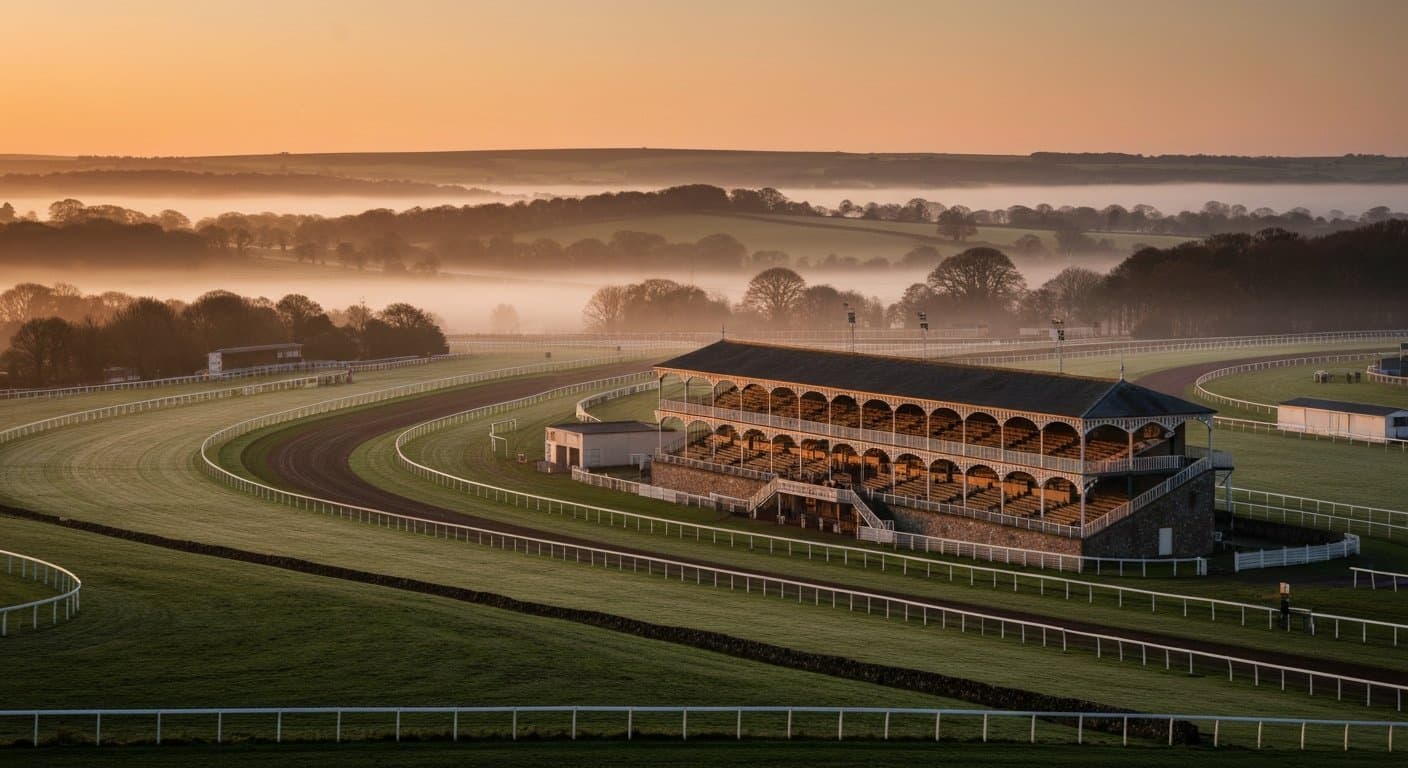
Exeter Racecourse sits on a sandstone and granite plateau above the Exe valley, roughly four miles south-west of Exeter city centre, at an elevation that touches 850 feet above sea level. On a clear autumn morning the horizon stretches from the dark moorland edge of Dartmoor ten miles to the west across to the distant glint of the English Channel ten miles to the south-east. No other National Hunt racecourse in Britain commands a view like it, and no other jumping course in the country sits higher.
The Haldon Hills have been associated with horse racing since at least 1738, when meetings were already a fixture on the plateau south of Exeter. The current course at Kennford was laid out and opened in 1895, and for most of the 20th century the venue operated under the name Devon and Exeter — a title that acknowledged its role as the regional centre for jump racing across two counties. The rebrand to Exeter Racecourse came in the early 1990s, and the course is now part of The Jockey Club's portfolio alongside Cheltenham, Sandown, and Newmarket.
The physical character of the track shapes everything that happens here. The right-handed oval circuit measures approximately two miles round, and what separates it from almost every comparable National Hunt venue in Britain is the run-in: roughly 400 yards — close to two furlongs — from the final fence to the winning post. That straight, running slightly downhill before levelling out, is one of the longest run-ins in the country. Horses who jump the last fence in front do not automatically win at Exeter; horses who arrive at the final obstacle with reserves to call on regularly overhaul those who have set off too boldly earlier in the race. Trainers who understand this active — Philip Hobbs at Minehead, 30 miles to the north-west, is the most consistent example — win here at a rate that consistently exceeds their national average.
The Haldon Gold Cup is the course's signature race: a Grade 2 chase over two miles held each November. Since its introduction in 1969, it has served as the season-opening Grade 2 for two-mile chasers in the South West and has launched more than one Queen Mother Champion Chase campaign. Sire De Grugy won the Haldon Gold Cup in November 2013 and the Queen Mother Champion Chase the following March. Dodging Bullets did exactly the same twelve months later. Paul Nicholls has won the race eight times — a record that reflects both his proximity at Ditcheat, 45 miles to the north-east, and his long-standing ability to have two-mile chasers sharp in the early weeks of the jumping season.
This article traces the course's history from the first recorded meetings on the Haldon Hills through to the present day — the decisions, the races, the horses, and the trainers that turned a windswept hilltop into one of the most characterful National Hunt venues in Britain.
Origins & Early Racing
Origins and Early Racing on the Haldon Hills
Horse racing on the Haldon plateau south of Exeter has a documented history stretching back to 1738, though the sport was almost certainly present on these hills before any written record was kept. The earliest meetings were run on common ground across the plateau rather than on a defined circuit, with local landowners and gentlemen riders organising competitions that drew crowds from Exeter and the surrounding Devon parishes. Racing was an integral part of Georgian public life, and the Haldon Hills — open, elevated, and easily visible from the city — provided a natural setting for it.
The Landscape That Defined the Sport
The Haldon Hills form a sandstone and granite ridge running roughly north to south above the Exe valley, reaching elevations of around 850 feet. The plateau offered the kind of open, firm terrain that early race organisers needed: space for competitors to accelerate, clear lines of sight for spectators, and drainage that typically kept the ground usable during Devon's frequently wet autumns and winters. The views that draw visitors today — Dartmoor to the west, the Channel to the south-east, the cathedral city of Exeter four miles to the north-east — were equally visible to 18th-century racegoers. Exeter Cathedral, whose twin Norman towers were completed between 1133 and 1400, sits clearly in the valley below, a fixed point on the horizon that has oriented race days here for nearly three centuries.
Racing in this period was informal by modern standards. There were no permanent stands, no enclosures as we now understand them, and no fixed starting points. Meetings were announced by broadsheet and word of mouth, and the format followed the pattern of the time: heats over measured distances, with horses often running twice or three times in an afternoon. Sweepstakes between gentlemen riders and plates organised by the local corporation were the dominant formats. The Haldon meetings were not yet nationally significant — they served the Devon gentry and the sporting community of Exeter rather than the wider racing world.
The Shift Towards Organised Racing
By the early 19th century, the character of racing at Haldon was shifting. The formation of the Jockey Club in 1750, though its influence was initially concentrated on Newmarket and the flat-racing calendar, gradually spread norms and expectations that shaped provincial venues. Rules became more standardised, disputes were increasingly referred to recognised authority, and the distinction between flat racing and jumping grew more formal after the National Hunt Committee was established in 1866.
Jump racing — specifically the kind of cross-country obstacle racing that developed from hunting culture — was deeply suited to Devon. The county's landscape of steep banks, water courses, and heavy ground produced both the horses and the riders for it. Local hunts, including the Dartmoor and the South Devon, were active and well-supported, and the step from hunt race to organised steeplechase was a short one across most of the West Country.
The Haldon Hills meetings through the mid-19th century took on an increasingly jump-racing character. Flat racing continued to be staged on the plateau at various times, and there were meetings at other locations around Exeter, including courses closer to the city. But the combination of terrain and local jumping tradition gradually made the Haldon site the natural home for National Hunt racing in the county.
Establishing the Present Course: 1895
The current course at Kennford, registered at postcode EX6 7XS on the Haldon plateau, was formally established and opened in 1895. The layout fixed a right-handed oval of approximately two miles as the principal circuit — a shape that suited the natural contours of the ground. From the outset, the track incorporated what would become its most distinctive characteristic: a long, sweeping run from the final fence home. That run-in of approximately 400 yards gave the course a finish unlike almost any other jumping track in Britain, rewarding horses that could sustain their effort beyond the last obstacle rather than simply jumping boldly into the lead.
The opening of the 1895 venue coincided with a broader consolidation of jump racing in England. The National Hunt Committee was tightening its governance of the sport, the fixture list was becoming more formally organised, and courses that could offer a reliable programme of quality racing were securing a place in the national calendar. Exeter fitted that description. It had history, it had a defined track, it had an established local audience, and it had the geography to make race days an occasion for the wider South West.
The Devon and Exeter Identity
For most of its existence through the 20th century, the course traded under the name Devon and Exeter Steeplechases — commonly abbreviated to Devon and Exeter, or simply Devon and Ex among the racing community. The name carried weight. It signalled that this was not merely a local track for a single city but the representative course for an entire region. The joint title aligned Exeter with the dual-county character of racing in the South West, where horses, trainers, and racegoers crossed the Devon-Cornwall border without much ceremony.
The Devon and Exeter fixture list grew through the first half of the 20th century, interrupted by the two world wars as it was at every British racecourse. Racing was suspended during both conflicts, with the courses used for military purposes or simply closed as resources were directed elsewhere. The resumption after 1945 saw the course return to its pre-war programme, and through the late 1940s and 1950s, Devon and Exeter built the foundation of what would become a truly competitive National Hunt programme.
By the time the sport's landscape was changing significantly in the 1960s — with the introduction of sponsored races, higher prize money at the top end of the sport, and the growing influence of television — Exeter was well placed to compete for attention. The course had a distinctive physical identity, a loyal regional following, and a fixture calendar that slotted into the National Hunt season without clashing awkwardly with the major championship meetings. That positioning, established in 1895 and consolidated across the decades that followed, was the foundation on which the Haldon Gold Cup era was built.
Era takeaway: The Haldon Hills provided racing with a setting that no other course in Britain could replicate — high, exposed, far-seeing. When the present oval was fixed at Kennford in 1895, the course inherited nearly 160 years of racing history on the same ground. The long run-in, the elevation, and the jumping tradition of Devon together shaped an identity that the Devon and Exeter name carried for most of the 20th century.
The Haldon Gold Cup Era
The Haldon Gold Cup Era: 1969 to the 1990s
The introduction of the Haldon Gold Cup in 1969 changed Exeter's standing in the National Hunt world. Before it, the course was a solid regional fixture with a loyal local following, serviceable facilities, and a place in the fixture list. After it, Exeter had a race that national trainers planned their campaigns around, a race that newspapers previewed and form students analysed in relation to the Cheltenham Festival two-mile division. That transformation, from regional track to nationally relevant venue, is the central story of what might be called Exeter's golden era.
Why 1969 Mattered
The Haldon Gold Cup was created in the same period that the sport was professionalising rapidly. Television coverage had been expanding since the late 1950s, prize money was rising at the sport's upper end, and the dominance of a few major trainers — Fulke Walwyn, Fred Rimell, Peter Cazalet in that era — was creating the kind of recognisable narratives that drew wider audiences. A race at a regional course could find national relevance if it was correctly positioned in the calendar and correctly structured. The Haldon Gold Cup was: a two-mile chase, run in early November, at a course whose testing track and long run-in made it a real examination rather than a glorified spin. The race name itself was distinctive. Named after the hills on which the course sits, it carried a geography that identified it immediately with Devon and the South West.
Run over approximately two miles with twelve fences, the race was designed to attract two-mile chasers at the start of their seasonal campaigns. A horse who won the Haldon Gold Cup in November was, by definition, fit and sharp early — and if the same horse improved through the winter and arrived at the Cheltenham Festival in March, the Haldon form gave punters and analysts a reference point. That connection between the November race at Exeter and the March championship at Cheltenham, once established, became self-reinforcing. Better horses entered because the form would be noticed; the form was noticed because better horses entered.
The Race Takes Shape in the 1970s and 1980s
Through the 1970s and 1980s, the Haldon Gold Cup established itself in the two-mile chasing calendar without yet producing the sequence of Cheltenham champions that would define it in later decades. The race attracted competitive fields from the West Country yards — Philip Hobbs was not yet training, but the tradition of Devon and Somerset horsemanship ran deep — and from further afield when connections decided early-November Exeter suited a horse's preparation.
The course itself during this period remained essentially as it had been established in 1895: the right-handed oval, the exposed plateau, the long run-in. Facilities were functional rather than spectacular. Devon and Exeter was not a course that spent heavily on its infrastructure in the mid-20th century; the racing itself was the draw. What the course did invest in was the fixture calendar. The Devon National, a staying handicap chase run in February, gave the course a second feature race and broadened its appeal beyond the speed division that the Haldon Gold Cup served. By the 1980s, Exeter was running around 15 to 17 fixtures per season, a programme that filled the fixture list from October through to May.
Travado and the Martin Pipe Years
The defining sequence of the Haldon Gold Cup's early decades came between 1993 and 1995, when Martin Pipe's Travado won the race three consecutive times. No horse had won the Haldon Gold Cup three times before, and none has done so since. The achievement stood as the record for the race and for an era that Pipe dominated across British jump racing.
Pipe's operation at Nicholashayne, near Wellington in Somerset — approximately 35 miles north of Exeter — was by the early 1990s the most prolific training establishment in National Hunt history. Between 1988-89 and 1993-94, Pipe was champion trainer every season. His methods, which emphasised interval training, precise fitness management, and a relentless focus on finding races his horses could win, made him a dominant force at every level of the sport. At Exeter specifically, the long two-furlong run-in suited horses trained to stay strong through the closing stages — exactly the kind of fitness Pipe's programme produced.
Travado was a French-bred gelding, trained initially for speed over two miles before Pipe refined him into a consistent performer at the highest level. His 1993 Haldon Gold Cup win was followed by a campaign that included runs at the highest level, and his returns to Exeter in 1994 and 1995 underlined both the horse's quality and Pipe's judgement in targeting the race. That three-peat drew attention to the Haldon Gold Cup in racing circles beyond the South West, cementing its reputation as a race worth following into the Cheltenham season.
Infrastructure and the Growing Fixture Programme
While the Haldon Gold Cup was building the course's national profile, Exeter was also investing in the physical infrastructure needed to sustain a growing fixture programme. The stands were improved through the 1970s and 1980s, viewing areas were expanded, and the capacity grew to around 5,000. For a racecourse at 850 feet on an exposed Devon hilltop, that capacity was truly significant — the logistics of getting spectators to the plateau and managing them through a race day demanded facilities that matched the ambition of the fixture list.
Newton Abbot, 25 miles to the south, was by this period operating as a summer jumping track — a truly complementary venue. Where Exeter ran in the autumn, winter, and spring, Newton Abbot provided a summer programme that kept the South West active through the months when many National Hunt venues went dark. The two courses served different functions and rarely competed directly for trainers, horses, or audiences. Taunton, across the Somerset border, added a third flavour. The three together formed a cluster of jumping courses that gave the region a programme of National Hunt racing that few comparable areas of England could match.
The Race as a Cheltenham Qualifier
By the early 1990s, the Haldon Gold Cup's reputation as a Cheltenham qualifier was firmly established. Trainers who had horses pointed at the Queen Mother Champion Chase — the two-mile championship at the Festival — began to consider Exeter in November as a logical starting point. The race's Grade 2 status, formalised as the sport's grading system developed, confirmed its standing in the official hierarchy. A Grade 2 win in November carried weight in discussions about Festival form, and the Haldon Gold Cup was increasingly cited alongside other early-season markers when analysts assessed two-mile chasers through the winter.
The period between the introduction of the race in 1969 and the end of Travado's three-peat in 1995 established the Haldon Gold Cup as the race that defined Exeter. The course had other good races — the Devon National, the novice chases that produced future festival horses — but the Haldon Gold Cup was the one that set the course apart from its regional peers and gave it national standing.
Era takeaway: The Haldon Gold Cup, introduced in 1969 and consolidated through the Martin Pipe years, gave Exeter a race that connected a regional venue on a Devon hilltop to the Queen Mother Champion Chase at Cheltenham. Travado's three consecutive wins between 1993 and 1995 fixed the race in the record books. What came after — a sequence of winners who graduated to Cheltenham glory — was built on the foundation laid in this period.
Famous Moments
Famous Moments at Exeter Racecourse
A racecourse's history is built not only from decisions made in boardrooms and architecture offices but from the specific afternoons when something happened that people still mention years later. Exeter has had several of these: a tragedy that stopped the sport, a sequence of Grade 2 winners that became a pattern, and the particular drama that comes when a long run-in turns a race upside down in the final furlong.
Best Mate: November 2005
The most sombre afternoon in Exeter's modern history came on 1 November 2005, during the Haldon Gold Cup. Best Mate, trained by Henrietta Knight at West Lockinge Farm in Oxfordshire and ridden by Paul Carberry, was making his long-awaited return to racing. The horse had won three consecutive Cheltenham Gold Cups, in 2002, 2003, and 2004, becoming the most celebrated chaser in Britain since Arkle. After a year off the track through 2004-05, the Haldon Gold Cup was chosen as his comeback race — a Grade 2 over two miles at Exeter in early November, exactly the kind of race that should have been within his compass.
He collapsed and died on the course after the race, having shown signs of distress in the closing stages. The cause was a suspected heart attack. There are photographs of Knight and jockey Jim Culloty — who had ridden the horse to all three Gold Cup victories — at the scene, and the images were carried on every back page the following day. Best Mate was ten years old. The response across the sport was immediate and profound. Henrietta Knight received condolences from racing figures and from the public in volumes that few training operations had ever experienced. Exeter, as the location of what happened, became associated with the loss in a way that the course had no say in and that neither the management nor the racegoing public had any desire to replay.
Racing continued at Exeter after November 2005, as it had to. The Haldon Gold Cup was run in subsequent years and continued to attract top-class fields. But anyone who follows jump racing closely knows what happened at Exeter that November afternoon.
Sire De Grugy: November 2013
Eight years after Best Mate's death, the Haldon Gold Cup produced one of its most significant winners. Sire De Grugy, trained by Gary Moore at Lower Beeding in West Sussex and ridden by Jamie Moore, won the 2013 running with a performance that announced him as a serious two-mile chasing prospect. He was a front-runner, bold at his fences and quick away from them, and at Exeter the long run-in might have been expected to catch him out — but he held on with something to spare.
The following March, Sire De Grugy went to the Cheltenham Festival and won the Queen Mother Champion Chase, the two-mile championship. He beat Overturn by a length and a half. The Haldon Gold Cup had produced a Queen Mother Champion Chase winner — which was not entirely without precedent, but was not something that had happened in recent memory. The connection between the November race and the March championship was suddenly news again.
Dodging Bullets: November 2014
Twelve months later, the same sequence happened again. Dodging Bullets, trained by Paul Nicholls at Ditcheat and ridden by Sam Twiston-Davies, won the 2014 Haldon Gold Cup on 4 November. Nicholls had won the race before — his total would reach eight victories in the race overall — but Dodging Bullets was a different type of runner. He was a quick, accurate jumper who could also sustain his effort through a finishing straight, which made Exeter's long run-in less of a concern than it was for many front-runners.
In March 2015, Dodging Bullets won the Queen Mother Champion Chase at Cheltenham. He beat Sire De Grugy, the previous year's winner, by three-quarters of a length. Two consecutive Haldon Gold Cup winners had gone on to win the two-mile championship at Cheltenham in successive years. The Haldon Gold Cup's standing as a Cheltenham indicator was, from that point, as strong as any early-season two-mile chase in Britain.
That back-to-back sequence — Sire De Grugy in 2013/14, Dodging Bullets in 2014/15 — is the Haldon Gold Cup's most celebrated chapter. It brought the race the kind of attention that only Cheltenham results can generate, and it gave Exeter Racecourse a place in the two-mile chasing conversation that no amount of marketing could have purchased.
Paul Nicholls and Eight Haldon Gold Cups
Paul Nicholls has won the Haldon Gold Cup eight times, a total that no other trainer has approached. His winners include Master Minded (2007 and 2008), Twist Magic (2006), and Politologue (2017 and 2019). Master Minded was among the most dominant two-mile chasers of the last generation, winning the Queen Mother Champion Chase in 2008 and 2009 and recording a time in the 2007 Tingle Creek that was regarded by many analysts as among the fastest chasing performances of the modern era. Politologue, a more workmanlike but entirely reliable performer, won two Haldon Gold Cups and finished second in the Queen Mother Champion Chase in 2019 before winning it in 2021.
Nicholls trains at Manor Farm Stables in Ditcheat, Somerset, approximately 45 miles from Exeter. The proximity is a factor, but proximity alone does not explain eight wins. His understanding of what Exeter's long run-in demands — a horse that can travel efficiently behind the early pace and still produce an effort after the last fence — is reflected in the type of runner he consistently sends to the Haldon Gold Cup. He rarely runs horses there that are likely to be caught in the final furlong.
Philip Hobbs and the Run-In
Philip Hobbs, who trained at Minehead until his retirement, 30 miles north-west of Exeter, spent decades exploiting his knowledge of the course's particular demands. His win rate at Exeter, when measured against his overall strike rate, consistently outperformed the national average. The reason, as Hobbs has explained in interviews over the years, is simple: he targets horses with the right profile for the track. At Exeter, a horse who jumps cleanly and travels well within himself to the final fence will nearly always beat a horse who has led at a pace that leaves nothing in reserve for the two-furlong run home. Hobbs's horses, trained on the hills of west Somerset with terrain that is not entirely unlike the Haldon plateau, tend to be fit, relaxed, and capable of finishing their races out.
The Devon National
The Devon National, run in February over a staying distance at Exeter, has produced its own memorable renewals. The race tests stamina over the undulating circuit rather than speed — it is a different examination from the Haldon Gold Cup, attracting grinders and stayers rather than quick two-milers. Several Devon National winners have gone on to run well at the Grand National and the Cheltenham Festival's staying handicap division in the same season. The race is less high-profile than the Haldon Gold Cup, but within the staying chasing community it is recognised as a real test. Exeter stages the Devon National as part of a card that typically draws a strong regional field and gives the late winter fixture programme a focal point before the spring festivals arrive.
The Long Run-In as Drama Maker
Strip away the named races and the celebrated horses, and what Exeter's most dramatic finishes have in common is the run-in. At most National Hunt courses, the race is effectively decided at the last fence. At Exeter, there are still 400 yards to run after the final obstacle — long enough for a race that appeared settled to reverse. Horses who have jumped the last in front have been caught by horses who were still finding their stride. Horses who looked beaten turning for home have found the flat section and the slightly downhill gradient before it kind to their rhythm.
The run-in does not guarantee drama, but it creates the conditions for it. It means that jumping the last fence in front is not as decisive as at most courses, which in turn means that tactics before the final fence are necessarily different. Jockeys who understand this — and the list of riders who have won consistently at Exeter over the years reflects that understanding — ride the race with the run-in in mind from the moment they leave the paddock.
Era takeaway: Exeter's most famous moments share a common thread: the course's specific physical character — above all the two-furlong run-in — created the conditions in which form could be tested and reputations made. The Sire De Grugy and Dodging Bullets sequence of 2013-15, Best Mate's tragedy in 2005, and Nicholls's eight Haldon Gold Cup victories are all part of a course identity built on a track that asks questions other venues do not.
The Modern Era
The Modern Era: Rebranding, The Jockey Club, and a 21st-Century Programme
The rebrand from Devon and Exeter to Exeter Racecourse, completed in the early 1990s, was more than a change of signage. It reflected a shift in how the course positioned itself — as a National Hunt venue with a specific identity rather than as a regional representative carrying two county names. The simpler title suited a period in which racecourse branding was becoming more considered, television coverage was expanding, and the relationship between a course's name and its public profile had practical commercial implications.
Joining The Jockey Club Portfolio
Exeter became part of The Jockey Club Racecourses group, which also manages Cheltenham, Sandown, Newmarket, and ten other venues across Britain. The alignment brought resources that a standalone regional course would struggle to access independently: shared marketing, group hospitality infrastructure, a national profile on The Jockey Club's communications channels, and the financial backing that supports capital investment in facilities.
For a course at 850 feet on an exposed Devon hilltop, with around 5,000 capacity and approximately 15 fixtures per season, The Jockey Club connection provided security and scale. Improvements to the grandstand, the parade ring area, and the public enclosures came through the late 1990s and into the 2000s. The course's catering and hospitality offer was brought into line with The Jockey Club's wider standards — an upgrade from the functional provisions that had characterised Devon and Exeter's pre-commercial era.
The Fixture Calendar in the 21st Century
Exeter now runs around 15 meetings per season, spread from October through to May. The programme is built around two anchor days. Haldon Gold Cup day in early November is the course's highest-profile fixture: a card that typically features four or five competitive races alongside the Grade 2 feature, drawing around 5,000 spectators to the plateau and generating the kind of national coverage that sustains Exeter's reputation through the winter. The Devon National card in February — usually the second or third Saturday of the month — provides the season's second peak: a card built around the staying handicap chase that attracts stayers from across Britain.
Between the two anchor days, Exeter runs competitive midweek and weekend fixtures through the autumn, winter, and spring. The fixture mix covers novice chases and hurdles that provide a pathway for young horses developing through the grades, handicap chases and hurdles that serve the bread-and-butter programme, and the occasional Listed or Grade 2 contest that keeps the course on the national radar between the two main events. Exeter's fixture dates slot neatly into the National Hunt calendar without clashing with the sport's major championship meetings, which means trainers from outside the South West use it regularly as a stepping stone or a starting point for horses whose next target is Cheltenham or Sandown.
Philip Hobbs: The Local Master
For much of the 21st century, no trainer at Exeter more consistently exploited course knowledge than Philip Hobbs. Based at Sandhill Racing Stables in Minehead, Somerset — 30 miles north-west of Exeter — Hobbs ran horses at the course from his first years in training in the mid-1980s through to his semi-retirement in the early 2020s. His strike rate at Exeter, measured over any extended period, significantly exceeded his national average.
The reasons Hobbs offered when asked about his Exeter record were consistently practical. The two-furlong run-in favours horses that are fit and relaxed enough to accelerate after the final fence rather than those who have used themselves up jumping boldly from the front. The Somerset hills around Minehead, across which Hobbs exercised his horses, produced animals that could gallop at pace for extended distances — exactly what Exeter demands. His proximity to the course also meant he could walk the track regularly and observe going changes through the season. Local knowledge, compounded across decades, produced a record that out-of-county trainers found difficult to replicate consistently.
Paul Nicholls: Distance No Barrier
While Hobbs exploited proximity, Paul Nicholls — based 45 miles north-east of Exeter at Ditcheat — demonstrated that distance from the course was no obstacle if you understood what it required. Nicholls's eight wins in the Haldon Gold Cup, spread across the late 1990s and the 2000s, 2010s, and 2019, represent the most complete record any trainer holds in the race. His winners — Twist Magic (2006), Master Minded (2007 and 2008), Dodging Bullets (2014), Politologue (2017 and 2019) — were not a single type of horse but shared the ability to handle Exeter's particular demands: clean jumping, efficient travelling, and the capacity to sustain a run from the final fence to the post.
The eight wins also reflect Nicholls's habit of using the Haldon Gold Cup as a real seasonal starting point rather than an exercise run. He sends horses to Exeter that he expects to win, not horses he is simply trying to get a run into. The combination of that ambition and the Ditcheat yard's consistent production of top-quality two-milers meant that the Haldon Gold Cup was, for most of the 2000s and 2010s, a race in which Nicholls was the first name punters looked for when the entries were published.
Best Mate's Shadow and the Course's Response
The death of Best Mate at Exeter in November 2005 prompted a period of reflection at the course and across jump racing more broadly. Welfare protocols were reviewed, and the course worked with the British Horseracing Authority to ensure that post-race monitoring of horses was conducted with the care that the sport's evolving welfare standards required. Best Mate's death was not the result of inadequate course management — a cardiac episode of that nature cannot be predicted or prevented — but it focused attention on the standards that applied after races at every jumping venue in Britain.
Exeter's management in the years following 2005 maintained the course's commitment to the Haldon Gold Cup and to attracting high-quality fields. The race's subsequent history — including the Sire De Grugy and Dodging Bullets sequence that produced two consecutive Queen Mother Champion Chase winners — demonstrated that neither trainers nor owners drew back from sending their best horses to the Haldon course because of what had happened in 2005.
The South West Racing Cluster
Exeter's modern identity cannot be fully understood without its neighbours. Newton Abbot, 25 miles to the south, runs a summer jumping programme that fills the months when Exeter is dark. The two courses serve different seasonal niches and different styles of racing: Newton Abbot's flat, sharp track suits a quick, handy type of jumper, while Exeter's undulating, exposed circuit suits a stronger, more resolute animal. Taunton, in Somerset, offers a third flavour. The three courses together form a cluster that gives the South West one of the richest regional National Hunt programmes in England.
Trainers based in the region — and there are many, given the tradition of West Country horsemanship — use all three. A horse might begin its career at Newton Abbot in August, step up in class at Exeter in October, and then target a feature race at Taunton in December. The regional circuit works because each course occupies a distinct ecological niche in the racing calendar, and Exeter's role as the prestige end of that circuit has been reinforced by the Haldon Gold Cup's national standing.
Looking at the Current Programme
The Exeter of the mid-2020s runs a programme that would be recognisable to anyone who followed the course in the 1990s: the same right-handed oval, the same long run-in, the same exposed plateau with its long views. The prize money has risen substantially. The facilities are better. The national profile — sustained by The Jockey Club's marketing and by the Haldon Gold Cup's consistent production of high-class winners — is stronger than at any point in the course's history. But the character of the racing has not changed. Exeter still rewards horses that can gallop and jump and sustain their effort beyond the last fence. It still punishes those who arrive at the final obstacle with nothing left to offer.
That constancy is the modern era's most accurate summary: a course whose geography was set in 1895, whose signature race arrived in 1969, and which has spent the 21st century building a quality of programme around those fixed elements without trying to disguise what it is.
Era takeaway: The modern Exeter is The Jockey Club's smallest major jumping venue by capacity but one of its most distinctive by character. The rebrand to a simpler name, the investment in facilities, and the Haldon Gold Cup's consistent production of Cheltenham champions have given the course a national standing that the Devon and Exeter era never quite achieved. The fixture calendar — built around two anchor days and 13 supporting meetings — sustains a programme that serves both the regional jumping community and the national two-mile chasing conversation.
Exeter's Legacy
Exeter's Legacy in British Jump Racing
A racecourse earns its place in the permanent record of a sport not through age alone but through what it has produced. Exeter has been staging National Hunt racing since 1895 — and on the same hilltop since the first documented meetings in 1738 — and across that span it has contributed specific things to British jumping that no other course could have provided in quite the same way.
The Haldon Gold Cup as a National Institution
The Haldon Gold Cup is Exeter's most enduring contribution to the shape of the National Hunt season. As a Grade 2 chase over two miles, run in early November, it occupies a position in the racing calendar that nothing else fills in quite the same way: a real test of a two-mile chaser at the start of the season, early enough to give trainers options for the winter, late enough that horses are fit rather than merely sharp. The race's record of producing Queen Mother Champion Chase winners — most clearly in the back-to-back sequence of Sire De Grugy (2013 Haldon Gold Cup, 2014 Queen Mother) and Dodging Bullets (2014 Haldon Gold Cup, 2015 Queen Mother) — is not a coincidence. It reflects what the race actually is: a serious examination that prepares two-mile chasers for the highest level.
Paul Nicholls's eight wins in the race, spread from the late 1990s into the 2020s, represent the most complete endorsement a single training operation could give a Grade 2 contest. When the sport's most successful trainer of the era sends his best two-mile chasers to a race year after year, it is because the race serves a real purpose in his preparation programme. The Haldon Gold Cup has been that race for Nicholls, and for the West Country jumping community more broadly.
A Physical Identity That Cannot Be Replicated
Exeter's track is, in the literal sense, irreplaceable. The right-handed oval on the Haldon plateau, at 850 feet above sea level, with its two-furlong run-in from the final fence, is not a shape or a setting that could be reconstructed elsewhere. The views — Dartmoor ten miles to the west, the English Channel ten miles to the south-east, Exeter Cathedral in the valley four miles to the north-east — are the product of a specific geography that the course happened to occupy from 1895. The going on the Haldon plateau, influenced by the sandstone and granite subsoil and the exposure of the elevated position, has its own character through the autumn and winter months.
These physical facts have shaped racing at Exeter in ways that accumulate over 130 years into something irreversible. The trainers who have understood the long run-in — Hobbs, Nicholls, and others before them across the Devon and Exeter era — have won disproportionately because they sent the right kind of horse. The horses who have found Exeter's ground and gradient suit them have produced their best form there. Over time, this creates a record of racing that maps a course's character as precisely as any specification sheet.
The South West's Premier Jumping Venue
Exeter's role as the leading National Hunt course in the South West carries obligations. Newton Abbot, 25 miles south, provides the summer programme. Taunton, across the Somerset border, offers a winter alternative. But Exeter is where the Grade 2 prize money lives, where the national trainers point their best early-season horses, and where the Cheltenham-calibre form is established. That position — top of a regional hierarchy, nationally relevant through one key race — is the legacy of the decisions made in 1895, 1969, and the early 1990s, when the course set its circuit, introduced its signature race, and updated its identity.
For racing in Devon and Cornwall, Exeter is the benchmark. Owners who want their horses in races that will be noticed, trainers who want form that translates to the spring festivals, racegoers who want to see the best horses in the region at their best — all of them end up at Exeter, and most of them end up there in November.
FAQs
When did Exeter Racecourse open? The current course on the Haldon plateau at Kennford opened in 1895. Horse racing on the same Haldon Hills dates back at least to 1738, making the area one of the longest-established racing venues in the West of England. The 1895 opening fixed the right-handed oval and the long run-in that define the modern track.
Why is Exeter's run-in so significant? At approximately 400 yards — close to two furlongs — Exeter's run-in from the final fence to the winning post is one of the longest in British National Hunt racing. This means a horse who jumps the last fence in front is not guaranteed to win; the finishing straight is long enough for a well-held horse to run on and overhaul the leader. It changes how races are ridden tactically and rewards horses that are fit enough to sustain effort beyond the last obstacle.
What is the Haldon Gold Cup and when was it introduced? The Haldon Gold Cup is a Grade 2 chase over two miles, run each November at Exeter. It was introduced in 1969 and has since become the season-opening Grade 2 for two-mile chasers in the South West. The race has produced two consecutive Queen Mother Champion Chase winners — Sire De Grugy (2013 Haldon Gold Cup, 2014 Queen Mother) and Dodging Bullets (2014 Haldon Gold Cup, 2015 Queen Mother) — and Paul Nicholls holds the record with eight wins.
Why did Exeter change its name from Devon and Exeter? The rebrand from Devon and Exeter (or Devon and Exeter Steeplechases) to Exeter Racecourse was completed in the early 1990s. The change reflected the course's shift to a cleaner, nationally focused identity at a time when racecourse branding was becoming more commercially important. The simpler name also aligned with the broader Jockey Club portfolio branding conventions.
How does Exeter fit into the South West racing circuit? Exeter is the premier National Hunt venue in the South West. Newton Abbot, 25 miles south, runs a summer jumping programme, and Taunton provides a winter alternative across the Somerset border. The three courses together give the region a rich programme of jumping across all seasons. Exeter holds the highest-class races in the cluster, with the Haldon Gold Cup (Grade 2) and the Devon National serving as its two signature events.
What happened to Best Mate at Exeter? Best Mate, the three-time Cheltenham Gold Cup winner (2002, 2003, 2004), collapsed and died at Exeter on 1 November 2005 after the Haldon Gold Cup, from a suspected cardiac episode. He was ten years old and had been returning to racing after a year off the track. His death was one of the most widely reported events in British jump racing of the decade and remains the most sombre moment in Exeter's modern history.
Share this article
More about this racecourse
All Exeter guides
Haldon Gold Cup Day at Exeter: The Complete Guide
Your guide to Haldon Gold Cup Day at Exeter — the jump season's first major Grade 2 chase occasion. Race card breakdown, betting angles, how to get there, and what to expect from Devon's most important jump day.
Read more
Haldon Gold Cup: Complete Guide
Your complete guide to the Haldon Gold Cup — Exeter's Grade 2 chase and early-season highlight for two-mile chasers.
Read more
Best Mate's Exeter Legacy: 4 Haldon Gold Cups & Final Race
Relive Best Mate's dominant Haldon Gold Cup victories at Exeter and the tragic final race that shocked the racing world in 2005.
Read moreGamble Responsibly
Gambling should be entertaining and not seen as a way to make money. Never bet more than you can afford to lose. If you or someone you know has a gambling problem, help and support is available.