
Founder & Editor · Last reviewed 2026-04-05
Hamilton Park Racecourse sits on Bothwell Road in Hamilton, South Lanarkshire, 12 miles south-east of Glasgow city centre. It is Scotland's busiest flat racecourse, running approximately 23 fixtures each year across a programme that runs from April through to September. The track is right-handed, approximately one mile and one furlong round, and its tight configuration means that pace, draw, and positioning matter as much here as at any course in Britain.
The history behind that busy fixture list stretches back more than two centuries. Racing in the Hamilton area can be traced to 1782, when the Dukes of Hamilton, one of Scotland's most powerful noble families, sanctioned meetings on their estate at Chatelherault. Those early gatherings were informal by modern standards, but they established a tradition that survived the industrial transformation of Lanarkshire, two world wars, and the slow decline of many provincial courses across Scotland.
The current racecourse on Bothwell Road opened in 1888 and has operated continuously since, aside from wartime interruption. In 1947, Hamilton Park became the first racecourse in Britain to stage an evening meeting under rules, a practical innovation that drew workers from Glasgow who could not attend afternoon fixtures. That decision changed how the sport thought about scheduling, and the evening racing programme remains central to Hamilton's identity today.
The aristocratic connections that gave early racing here its social standing are still visible in the landscape. Chatelherault Country Park, designed by the architect William Adam between 1732 and 1743 as a hunting lodge and banqueting house for the Dukes of Hamilton, sits within a short distance of the current racecourse. Hamilton Palace, which stood a mile away and was the largest private residence in Europe at its peak, was demolished in 1927 just as the modern incarnation of the racecourse was establishing itself. The grandeur of that vanished estate casts a long shadow over Hamilton's racing history.
The circuit itself has a character that rewards close study. Two sharp bends compress the field and give low-drawn horses a measurable advantage in sprint races. The home straight is approximately two furlongs, which means horses making their challenge from the rear have limited time to close. Trainers who understand these demands, Of note Keith Dalgleish at Carluke and Jim Goldie at Uplawmoor, consistently outperform those who simply export form from elsewhere without adjustment. The track's configuration explains a good deal of the racing that takes place here, and understanding it is the first step in reading Hamilton's form correctly.
Today, the course is operated by Arena Racing Company (ARC) and draws consistent crowds from Glasgow, Lanarkshire, and Ayrshire. Its signature race, the Lanark Silver Bell, carries a trophy that dates to 1608, making it the oldest racing prize in Scotland. This is the full story of how Hamilton Park reached that position and what the journey means for Scottish racing more broadly.
Origins at Chatelherault
Origins: Racing on the Hamilton Estate
The story of horse racing in Hamilton begins with the Dukes of Hamilton, whose family had dominated South Lanarkshire for centuries before the first recorded meeting took place in 1782. The Hamiltons were among the wealthiest and most politically connected families in Scotland. Their principal seat, Hamilton Palace, stood on the north bank of the River Avon, and at its height in the mid-19th century it was the largest private house in the country, a neo-classical colossus that required a workforce of hundreds simply to maintain. That scale of wealth and social influence translated naturally into patronage of horse racing, which was the prestige sport of the Scottish and English aristocracy throughout the 18th century.
The earliest meetings were held at Chatelherault, the extraordinary hunting lodge and banqueting house that the fifth Duke of Hamilton commissioned from the architect William Adam in the 1730s. Adam began work in 1732 and the building was completed by 1743. The design drew on French baroque influences; the name itself references the French duchy of Châtellerault, granted to the Hamilton family in the 16th century as recognition of their alliance with the French crown. The grounds at Chatelherault offered open parkland with natural gradients that suited informal racing, and the estate provided shelter and viewing that a completely open course could not.
Meetings at Chatelherault were not, by later standards, highly organised. The racing calendar of the late 18th century was loosely structured across much of Scotland. Meetings depended on the patronage of local landowners and the willingness of local horse-owners to bring their animals forward. What Chatelherault offered was legitimacy. The Dukes of Hamilton were guarantors of order and quality, and their backing meant that the Hamilton meetings attracted both horses and spectators of a calibre that many comparable towns could not match.
The Clyde Valley Setting
The geography of Hamilton shaped its racing from the outset. The town sits in the Clyde Valley, where the River Clyde bends southward before turning west toward Glasgow. To the south, the Avon Water joins the Clyde at Chatelherault itself, the confluence forming a natural boundary to the estate. The Clyde Valley in the 18th and early 19th centuries was agricultural land of high quality, interspersed with the coal and ironworking operations that were beginning to transform Lanarkshire's economy. Racing at Chatelherault sat at an interesting social boundary: an aristocratic sport staged in a landscape already changing beneath industrial pressure.
Glasgow, 12 miles to the north-west, was expanding rapidly throughout this period. By 1801, the city had a population of around 77,000. By 1841, it had grown to over 250,000, and the growth showed no sign of stopping. That expanding urban population represented both an opportunity and a challenge for racing at Hamilton. An opportunity because working people and an emerging middle class constituted a potential audience far larger than the gentry could provide on its own. A challenge because the tastes and habits of that audience were quite different from those of the aristocratic patrons who had originated the meetings.
The Railway and Its Consequences
The arrival of the railway in the 1840s changed everything. Hamilton Central station opened in 1849, connecting the town to Glasgow Queen Street in a journey of well under an hour. For the first time, large numbers of Glaswegians could realistically attend a race meeting at Hamilton without requiring horses, carriages, or an overnight stay. The effect on crowds was immediate. Race meetings that had drawn hundreds of spectators could now draw thousands, and the social composition of those crowds shifted accordingly.
That shift created pressure for better facilities. The informal arrangements at Chatelherault, open parkland with minimal grandstanding and basic enclosures, were adequate for a polite gathering of the gentry but unsuitable for crowds of several thousand. Through the second half of the 19th century, the need for a purpose-built venue became increasingly clear. The Hamilton estate provided the land and the social backing, but the design of a modern racecourse required investment and planning of a different order.
The Move to Bothwell Road
The decision to establish a dedicated racecourse on Bothwell Road was taken in the 1880s. The site lay on the western edge of Hamilton, closer to the River Clyde and better connected to the road network that served the town and Glasgow. The new course opened in 1888 on the Cadzow estate, which formed part of the broader Hamilton landholding. The basic right-handed configuration that still defines the track today was established at that opening, though the course has been modified and improved at various points since.
The 1888 opening marked the beginning of Hamilton Park as a formal institution rather than a fixture of one family's estate. The Dukes of Hamilton retained their connection to the area, but the course was no longer dependent on their direct patronage. Racing at Hamilton now had a permanent home, a structured programme, and facilities that could be improved over time. The Chatelherault era, which had given Hamilton racing more than a century of continuity, gave way to a more professional and commercial model that better suited the demands of a large, urbanised catchment area.
Why the Origins Matter
Racing at Hamilton did not begin as a commercial enterprise. It began as an aristocratic recreation on a private estate, and it took more than a century of gradual evolution, demographic, economic, and infrastructural, to produce the purpose-built course that opened in 1888. That long gestation explains why Hamilton Park's identity is simultaneously aristocratic and working-class. The Dukes of Hamilton gave it legitimacy; the workers and families of Glasgow gave it crowds. Both influences are still present in how the course presents itself today, from the Listed quality of the Lanark Silver Bell to the informal, family-friendly atmosphere of the summer evening fixtures.
The Bothwell Road Course: Establishment and Growth
The Bothwell Road Course: Establishment and Growth
The course that opened on Bothwell Road in 1888 was a considered piece of sporting infrastructure for its time. The right-handed loop, approximately one mile and one furlong in circumference, made efficient use of a relatively compact piece of ground on the edge of Hamilton. The tight bends that are now synonymous with the course's character were a feature from the outset, shaped partly by the geometry of the available land and partly by the practical needs of a course serving a dense urban catchment. Sharp turns favour horses that settle well and jockeys who understand positioning, qualities that have always been more apparent at Hamilton than raw, relentless galloping ability.
The course prospered through the Edwardian era and into the years before the First World War. Scotland's flat racing scene was concentrated across a handful of venues: Ayr in the south-west, Musselburgh on the east coast, and Hamilton serving Central Scotland and the Clyde Valley. The three courses divided the Scottish calendar between them, each drawing on a distinct geographic constituency. Hamilton's advantage was its proximity to Glasgow. By the early 20th century, the city had a population approaching one million, and the short rail journey to Hamilton Central made afternoon race meetings accessible to a far broader social range than most Scottish courses could attract.
Wartime Interruption
Racing at Hamilton was suspended during both world wars. The First World War brought a general suspension of British racing outside Newmarket, and Hamilton followed the national pattern of shutting down from 1915 through to 1918. The course reopened in 1919, and the interwar period saw it resume its place in the Scottish flat calendar. The Second World War brought a more complete cessation — the course closed from 1940 to 1945, as did most British racecourses outside the essential wartime fixtures at Newmarket and a small number of other venues. When Hamilton reopened in 1946, it did so into a changed world.
1947: The Evening Racing Experiment
The defining moment in Hamilton Park's 20th-century history came on a summer evening in 1947. The decision by the course's management to stage a fixture beginning in the early evening, rather than in the traditional afternoon slot, was not universally welcomed by the racing establishment. Evening racing had no precedent under Jockey Club rules in Britain, and there were legitimate practical objections: variable lighting in late summer, the logistics of running a fixture that would finish in early dusk, and uncertainty about whether racegoers would actually turn up for an unfamiliar format.
They did turn up. The 1947 evening meeting drew a substantial crowd, drawn heavily from the Glasgow working population for whom an afternoon fixture was simply not accessible. Factory workers, shipyard workers, and the office staff of Glasgow's commercial quarter could finish their shifts and be at Hamilton Park in time for a 5:30pm or 6:00pm first race. The social composition of the crowd that evening was markedly different from a standard afternoon meeting, and the atmosphere, informal, sociable, relaxed, was different too. Hamilton had found something real: a format that served an audience the sport had not previously served.
The implications spread gradually. Bath staged evening racing in the following years. Windsor followed. By the 1960s and 1970s, evening fixtures were an established part of the British flat racing calendar at courses across England. By the 1990s, the all-weather tracks at Kempton, Wolverhampton, and Lingfield were running evening meetings as a matter of routine. Hamilton's 1947 experiment set in motion a structural change in how British racing scheduled itself, one that is still playing out today.
The Postwar Flat Calendar
Through the 1950s and 1960s, Hamilton Park consolidated its position in the Scottish flat calendar. The course staged a programme of Class 4 and Class 5 fixtures that served as the bread and butter of the Scottish flat scene, producing form that could be assessed clearly and followed by a knowledgeable Glaswegian punting public. The track's sharp configuration meant that it became a specialist's course, with horses and trainers who understood its particular demands consistently outperforming those who simply assumed that form from elsewhere would translate.
Local training operations in Lanarkshire and Ayrshire developed a particular affinity with Hamilton. The course's demands, quick recovery from bends, the ability to race handy in a small field on a tight circuit, the need to be ridden from a decent position given the limited opportunity to make up ground on the short home straight, suited the compact, sharp types that tended to come from Scottish yards rather than the big middling-distance operations further south.
The 1973 Trust Structure
In 1973, Hamilton Park Racecourse passed into the ownership of the Hamilton Park Trust, a charitable body established with the specific purpose of owning and developing the course for the long-term benefit of Scottish racing. The Trust model was unusual in British racing at that time. Most courses operated as commercial companies, with shareholders expecting returns and directors answerable to profit imperatives. The Hamilton Park Trust removed that pressure by committing all operating surpluses to reinvestment in the racecourse and its facilities rather than distribution to shareholders.
The practical effect of the Trust structure was stability. Through the economic turbulences of the 1970s and 1980s, decades that saw several British racecourses struggle to survive, Hamilton Park maintained its programme and gradually improved its facilities. The Trust's charitable obligations meant that decisions about investment were made with a long horizon in mind. New grandstand facilities, improved stable facilities, better public enclosures: each improvement came steadily rather than in dramatic bursts. The result, by the end of the 20th century, was a course in better structural shape than many comparable venues that had operated under purely commercial models.
Why This Era Shaped the Modern Course
The decisions made between 1888 and the end of the 20th century set the terms on which Hamilton Park operates today. The right-handed sharp circuit has never been fundamentally altered, and it continues to demand the same qualities it has always demanded. The evening racing innovation of 1947 became a template for the course's identity: informal, accessible, Glasgow-oriented. The Trust structure of 1973 created the financial discipline that allowed sustained improvement rather than short-term exploitation. Each of these choices accumulated to produce a course that, by the turn of the millennium, was ready for the next stage of its development.
Famous Moments
Famous Moments in Hamilton Park's History
Hamilton Park's most enduring moments tend to share a particular character: they are firsts, or they involve horses whose subsequent careers revealed that what had looked like ordinary Hamilton form was actually something considerably better. The course's tight configuration, its strong local training community, and its position at the top of the Scottish flat calendar have between them produced a series of episodes that matter beyond the results board.
1947: Britain's First Evening Meeting
The evening meeting of 1947 deserves more than a passing reference, because the specific conditions of that night illuminate why it worked and why it spread. The late summer programme at Hamilton typically ran through July and August, when northern light lingers long enough for an early evening start to be practical. The first fixture ran in conditions clear enough for racing to conclude before the light began to fade badly. The crowd that arrived was unlike the afternoon meeting crowd in composition: it included women and families in numbers that typical afternoon meetings did not, partly because the evening format made a trip to the races a social occasion rather than simply a sporting one.
The Jockey Club had given its cautious approval to the experiment after considerable discussion. The concern was not simply the light but the risk of undermining the established afternoon programme by creating a competing product. What Hamilton's management argued successfully was that the evening audience was largely additive, not drawing existing racegoers away from afternoon meetings but bringing entirely new people to the sport. That argument proved correct, and it has remained the commercial justification for evening racing ever since.
The Lanark Silver Bell
The Lanark Silver Bell is the oldest racing trophy in Scotland and one of the oldest in the world. The original Bell was cast in 1608 and first run for at Lanark Racecourse, then one of Scotland's principal racing venues. The race ran at Lanark for centuries before that course eventually closed. By then a historic artefact of the Scottish sporting calendar, the Bell was transferred to Hamilton Park, where it now forms the centrepiece of the Listed race that bears its name.
The trophy's age means it carries resonance that a modern prize cannot replicate. The Bell predates the Jockey Club, predates the St Leger (first run 1776), and predates the Derby (first run 1780) by more than a century and a half. Running for it at Hamilton Park connects the present to a racing tradition that extends back to the early Stuart period. That historical depth is unusual for a provincial flat course, and it is one reason why the Lanark Silver Bell occupies a different kind of place in Hamilton's story from a race that simply carries a large prize fund.
The Glasgow Stakes and Its Graduates
The Glasgow Stakes arrived at Hamilton Park to give the course a Listed race of real quality, run over one mile and one furlong. That distance suits the course configuration well, requiring the full lap and the complete range of handling qualities that Hamilton demands.
The roll of honour tells the story. Postponed, trained by Roger Varian, won the Glasgow Stakes in 2015 as part of a preparation that culminated in victories in the King George VI and Queen Elizabeth Stakes and the Dubai Sheema Classic. His Hamilton success was, at the time, a relatively routine Listed performance for a horse not yet widely known. What followed, four Group 1 victories and prize money exceeding £4 million, reframed that Hamilton run as the beginning of something significant. Subjectivist, trained by Mark Johnston at Middleham, won the race in 2020 and Then landed the Gold Cup at Royal Ascot in 2021, becoming only the third horse in the previous decade to win both races. The Glasgow Stakes has become a reliable marker race, and its winners' records give Hamilton's form a verifiable quality that many comparable venues cannot demonstrate.
Mark Johnston's training record at Hamilton generally warrants particular attention. Johnston's Kingsley Park operation in Middleham is 150 miles to the south of Hamilton, but the yard has consistently targeted the course across its career, identifying the straight-mile and extended-mile trips at Hamilton as well-suited to the powerful, forward-going types that the yard produces. The consistency of Johnston's record here reflects a deliberate strategic decision, not coincidence.
Keith Dalgleish and Local Dominance
Keith Dalgleish's yard at Carluke, eight miles south-west of Hamilton, has become the dominant training operation at the course in the modern era. Dalgleish has trained at Carluke since establishing his own yard after riding as a jump jockey, and his geographical proximity to Hamilton gives him an operational advantage in the kind of lower-class flat racing that constitutes the majority of Hamilton's programme. His winners' tallies at Hamilton in a typical season put him clearly ahead of any other trainer at the course. That dominance reflects not only ability but the deliberate matching of horses to the conditions that Hamilton typically offers.
Jim Goldie, based at Uplawmoor in Renfrewshire some 20 miles to the west of Hamilton, represents a similar pattern of local expertise. Goldie has trained competitive sprinters for Hamilton's five and six-furlong contests over many years. His ability to read the form at the course, understanding which draws are favoured in which conditions and which types of horses handle the camber through the bends, is a product of long acquaintance with a track that rewards that kind of knowledge.
The Evening Racing Atmosphere
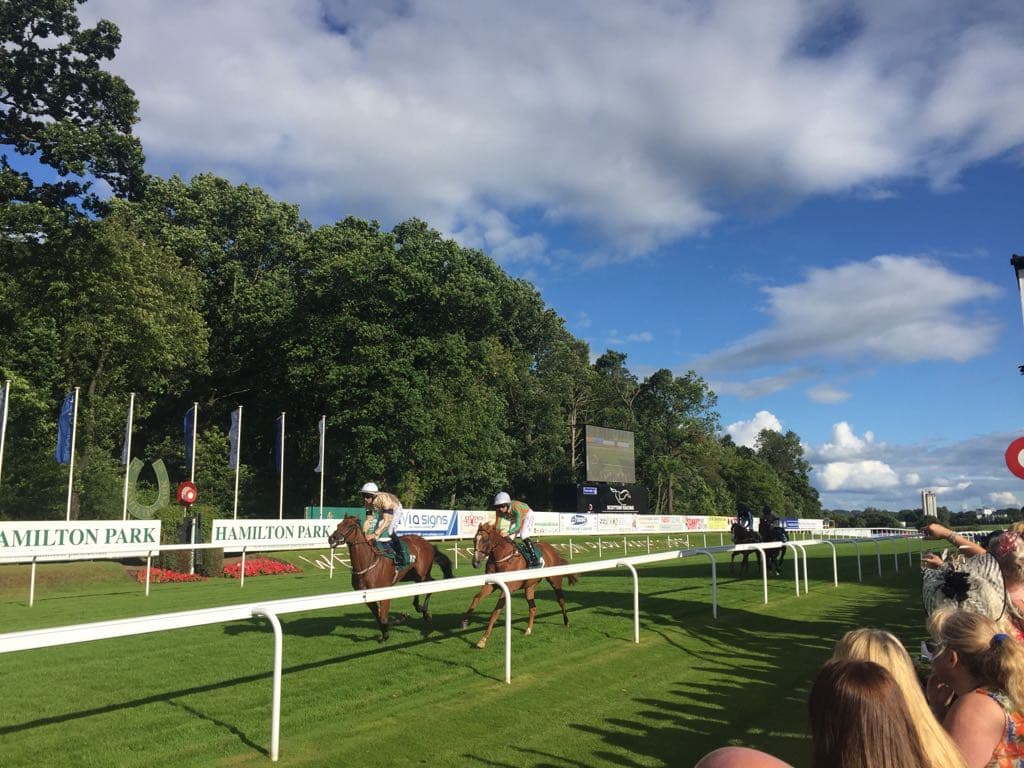
Any account of Hamilton's famous moments must include the intangible but real quality of its summer evening fixtures. By the 1980s and 1990s, the evening meetings had developed a character that afternoon fixtures rarely matched. Crowds of 4,000 to 6,000 were routine on a fine mid-summer evening, drawn from across Greater Glasgow and the surrounding towns. The course sat in the long northern light, Hamilton's latitude means proper dusk does not fall until after 9:30pm in midsummer, with the Clyde Valley stretching away to the west and the lights of the town visible from the grandstand.
Those evenings created a form of racing participation that was less intense than the serious afternoon fixture but more engaged than a purely social occasion. Punters arrived having studied the card during the day. Families brought children. The atmosphere was good-natured in a way that many larger and more commercially pressured courses could not sustain. Hamilton's evening meetings became a benchmark for how informal flat racing could be done well.
Hamilton and the Scottish Racing Community
Hamilton Park has played a broader role in sustaining Scottish flat racing as a distinct entity within the wider British structure. Scotland has always been a secondary market for flat racing, with Ayr's Western Meeting in September the only Scottish fixture that attracts the very top horses and the full attention of the major southern yards. Hamilton's contribution has been different: it has provided the volume of fixtures that keeps Scottish jockeys, trainers, and stable staff in steady work through the summer months, and it has given Scottish owners a programme of racing close enough to home to make ownership viable without the constant logistics of travelling to England.
That institutional role is less glamorous than producing a Classic winner, but it is arguably more important to the long-term health of the sport in Scotland. Without Hamilton's 23-fixture programme, the Scottish flat calendar would be thin enough to seriously damage the economics of training in the region. The famous moments matter; the routine programme matters more.
The Modern Era
The Modern Era: ARC Ownership and a Settled Identity
Hamilton Park's transition into the Arena Racing Company group came in the early 2000s, part of a broader consolidation of British racecourse ownership that accelerated through that decade. ARC, which by the 2010s operated 21 courses across Britain, provided Hamilton with access to shared commercial and media infrastructure while the course retained its operational identity and its strong local character. The combination has broadly worked: ARC's scale enables commercial deals and media rights negotiations that a standalone course could not achieve, while Hamilton's audience remains predominantly Glaswegian and local in a way that resists generic treatment.
The ARC period has coincided with a significant increase in fixture volume at Hamilton. Approximately 23 meetings per year now makes it Scotland's busiest flat racecourse by fixture count, surpassing Musselburgh and Ayr on that specific measure. The extended programme runs from April through to late September, keeping the course operational for six months of the year and providing a consistent supply of local racing that the Scottish market can follow without the need to travel south.
The Sharp Circuit in Detail
Understanding Hamilton Park in the modern era requires understanding what the track actually does to horses and races, because the circuit's character has become more widely discussed as form analysis has become more data-driven. The course is approximately one mile and one furlong round, right-handed, with two relatively sharp bends that compress the field and reward horses raced close to the pace. The home straight is short, roughly two furlongs, which means that horses drawn wide in sprint races have to use energy early to get into position, while horses drawn low can settle closer to the rail and conserve that energy for the finish.
In five-furlong and six-furlong races at Hamilton, draw statistics consistently favour low numbers, particularly on fast ground when the pace tends to be high and the advantage of a shorter path round the bends is most apparent. In races over a mile and beyond, the draw effect is less pronounced, because horses have time to find their positions before the first significant bend. Local trainers who target Hamilton regularly, Dalgleish, Goldie, and others, have learned to account for the draw in their race planning, booking appropriate jockeys and identifying conditions under which the course's configuration will suit the horses they run there.
The going at Hamilton is another characteristic that experienced Hamilton watchers understand well. The course tends to ride on the faster side of good through most of the summer, and when it softens after rain it can do so quickly given the relatively free-draining nature of the turf. Knowing how the going behaves at Hamilton, and how different horses respond to the surface transitions, is part of the intelligence that regular Hamilton followers accumulate over time.
The Glasgow Stakes as Modern Flagship
The Glasgow Stakes at Listed level has given the modern Hamilton calendar a clear flagship race that provides the quality anchor the meeting has long needed. Before the race established itself in its current form, Hamilton's programme was solid but somewhat undifferentiated, a series of competent flat fixtures without a single race that brought significant attention from beyond Scotland. The Glasgow Stakes changed that.
By producing subsequent Group 1 winners in Postponed and Subjectivist, the race demonstrated that Hamilton's form could be taken seriously at the highest level. That credibility matters for the course's broader identity: it signals to trainers, owners, and serious punters that Hamilton is not simply a volume producer of lower-grade form but a venue capable of identifying horses of real quality. The Glasgow Stakes preview and betting analysis, covered in the Glasgow Stakes guide, draws significant interest from outside Scotland during the weeks leading up to the race.
Evening Racing in the 21st Century
The evening racing programme remains the commercial and social heart of Hamilton's summer calendar. On a fine evening in June or July, Hamilton Park draws crowds that a straightforward assessment of its status as a provincial Scottish flat course would not predict. The course's position at the edge of Greater Glasgow, accessible by rail from Hamilton Central station and reachable by car in under 30 minutes from large parts of the city via the M74, means that a summer evening fixture is a realistic casual option for Glaswegians who might not plan a day at the races but are happy to spend an evening at them.
The atmosphere at evening fixtures is deliberately informal. The dress code is relaxed, the food and drink offer has been expanded in recent years to reflect the social nature of the occasion, and the programme of racing, typically six or seven races over roughly two hours, is compact enough to fit comfortably into an evening out. Families attend in numbers that afternoon fixtures do not match. The combination of racing, socialising, and the specific quality of a Scottish summer evening at the racecourse has produced an offering that is distinct from what the major southern courses provide.
The Scottish Racing Landscape
Hamilton's position within Scottish flat racing has clarified further in the modern era as the number of Scottish racecourses has stabilised. Scotland now operates four courses under rules: Hamilton (flat), Musselburgh (flat), Ayr (flat and jumps), and Perth (jumps only). The Scottish flat programme is therefore divided between three courses, each with a distinct character and constituency. Musselburgh draws from Edinburgh and the east; Ayr serves the west coast and has the prestige of the Western Meeting in September; Hamilton serves Glasgow and Central Scotland.
That three-way division means Hamilton does not need to be everything to Scottish flat racing. It needs to be Hamilton, accessible, well-run, family-friendly on summer evenings, with enough quality in the Glasgow Stakes to anchor the programme at Listed level. By those measures, the modern course performs consistently well. Attendances at evening fixtures regularly reach 4,000 or more. The Glasgow Stakes attracts runners from leading yards across Britain. The local training community, led by Dalgleish at Carluke and supported by operations at Ayr and across Lanarkshire, keeps the core of the fixture list competitive without requiring external injections of quality.
Stable Facilities and Operational Standards
Modern Hamilton Park has invested in the operational infrastructure that makes a racecourse function well for stable staff, jockeys, and horses as well as for the paying public. The stable facilities on the Bothwell Road site have been improved progressively, and the course's management has worked to maintain the BHA's operational requirements as those standards have risen over time. The paddock area and pre-parade facilities are compact but functional, and the weighing room has been updated to accommodate current requirements.
For racegoers, the grandstand and viewing areas provide clear sightlines over most of the circuit, with the exception of the far side of the track where the bends are. The compact nature of the course means that most of the racing action is visible from the main enclosures, which is an advantage that larger courses — where significant parts of the race take place at distance — do not always offer. A racegoer at Hamilton can follow the entire race from close range, which contributes to the engaged, participatory atmosphere that the evening meetings in particular produce.
Looking at the Programme
The full story of what Hamilton Park offers racegoers today, the specific meetings, the big-race programme, the best enclosures and viewing areas, is covered in the Hamilton Park complete guide. The history traced here is the background against which that present-day offering makes sense.
Hamilton Park's Legacy
Hamilton Park's Legacy
Hamilton Park's place in the history of British racing rests on several distinct contributions, each of which would be significant on its own. Together, they describe a course that has done considerably more than simply survive.
The Evening Racing Claim
The most nationally significant contribution is the 1947 evening meeting. British racing today schedules dozens of evening fixtures each year at courses from Carlisle to Chelmsford. The format is so embedded in the calendar that it is easy to forget it had to be invented somewhere, by someone willing to risk the investment and the institutional scepticism. Hamilton took that risk and the format worked. The specific social dynamics of Hamilton, its working-class Glasgow audience, its summer light, its compact programme, created the conditions in which evening racing could succeed, and the success of that 1947 experiment gave the rest of the sport the evidence it needed to follow.
Bath staged its first evening meeting shortly after Hamilton. Windsor, Leicester, and Nottingham followed through the 1950s and 1960s. When the all-weather tracks arrived in the early 1990s, Lingfield Park opened its all-weather circuit in 1989 and Wolverhampton in 1993, the evening slot was central to their commercial models from the outset. The prize money and media rights income that British racing now generates through evening racing has its origins, in a direct and traceable line, in Hamilton Park's 1947 decision.
Glasgow's Racecourse
Hamilton Park has served as Glasgow's primary flat racing venue for more than a century, and that civic role has shaped both the course and the city's relationship with the sport. Glasgow is the largest city in Scotland and the third largest in the United Kingdom by population. A city of that size needs racing nearby if the sport is to maintain the kind of grassroots engagement that sustains participation, in attendance, in ownership, and in the supply of stable staff and ancillary workers.
The 12-mile distance from Glasgow city centre, bridged by the rail connection through Hamilton Central and the road connection via the M74, makes Hamilton Park accessible to a large urban population. That accessibility is not incidental to the course's success; it is the foundation of it. Without the Glasgow catchment, Hamilton would be a pleasant provincial course of modest crowds. With it, the summer evening meetings are among the most consistently well-attended non-prestige fixtures in Scotland.
The Lanark Silver Bell and Scotland's Racing Heritage
The presence of the Lanark Silver Bell at Hamilton connects the course to the very deepest roots of Scottish racing history. The Bell was first run for at Lanark in 1608, making it the oldest racing prize in Scotland and one of the oldest in the world. The race has been contested for more than four centuries across different political regimes, different administrative structures, and different social frameworks. That continuity across 400-plus years is a form of institutional resilience that very few sporting prizes can claim.
When the race transferred to Hamilton Park following Lanark Racecourse's closure, the course acquired a piece of Scottish sporting heritage that no amount of prize money or marketing could manufacture. The Bell now sits at the top of Hamilton's race programme, serving as a reminder that the traditions behind the modern card stretch back to a Scotland that was still a separate kingdom. For the punter studying Saturday's form on a tablet, that context sits lightly. For the broader question of what Hamilton Park means to Scottish racing, it matters considerably.
A Model of Sustainable Management
The period between 1973 and the ARC acquisition in the early 2000s demonstrated something worth recording about how racecourses can be managed. The Hamilton Park Trust's charitable ownership model kept the course financially stable through three decades that were difficult for many British racecourses. The 1970s brought inflation and energy costs that squeezed racecourse operating margins across the country. The 1980s brought declining attendances and the Levy Board negotiations that shaped how prize money was distributed. The 1990s brought the all-weather revolution, which changed how the winter programme operated and created new competitive dynamics for summer flat courses.
Hamilton navigated those decades without losing its programme, without closing enclosures, and without the crisis points that afflicted courses operating under greater commercial pressure. The Trust model will not suit every racecourse, as it requires specific governance conditions and long-term financial stability that are not universally available, but Hamilton's experience suggests that removing the shareholder-return imperative from a community racecourse can allow for the kind of patient, incremental improvement that produces lasting quality.
A Course That Has Earned Its Fixture Count
Scotland's busiest flat racecourse by fixture count is a distinction Hamilton Park has earned rather than simply inherited. The approximately 23 annual meetings represent a programme built on demonstrated demand, operational competence, and the consistent delivery of safe, well-organised racing. The Horserace Betting Levy Board and the BHA do not award fixtures without reason; Hamilton's programme has grown because the evidence, attendance, operational standards, programme quality, has justified the growth.
That fixture count matters to the broader Scottish racing economy. It keeps local trainers, Dalgleish, Goldie, Linda Perratt, and others, in regular work through the summer. It keeps Scottish jockeys riding and therefore maintaining the fitness and experience they need. It provides a programme that Scottish racing fans can follow week by week without a journey to England. In aggregate, Hamilton's volume of racing does more for the practical sustainability of Scottish flat racing than any single prestigious fixture could.
The Character of the Place
Legacy, in the end, is not only about what a course has contributed to the sport in abstract terms. It is also about what it feels like to be there: the specific character of the place that makes it worth visiting and worth caring about.
Hamilton Park has a character that is easier to describe in terms of what it is not than what it is. It is not pretentious. It is not exclusive. It does not make racegoers feel that their attendance is conditional on meeting some standard of dress or expenditure. It is a working racecourse in a working town, and it has never moved very far from that identity even as it has upgraded its facilities and attracted better racing. The Clyde Valley backdrop, the proximity of the town, the consistent crowd of Glaswegians and Lanarkshire locals: these are the setting for a day or evening at Hamilton, and they give the experience a grounded quality that some more famous courses have lost.
For a full picture of what the course offers today, including meetings, enclosures, racing tips and form analysis, see the Hamilton Park complete guide and the Glasgow Stakes guide.
Frequently Asked Questions
When did Hamilton Park Racecourse open?
The current racecourse on Bothwell Road opened in 1888 on the Cadzow estate in Hamilton. Racing in the wider Hamilton area dates back further, to meetings at Chatelherault that began in 1782 under the patronage of the Dukes of Hamilton. The Bothwell Road course has been the permanent home of Hamilton racing for over 130 years, modified and improved at various points but retaining the basic right-handed circuit established at opening.
Why is Hamilton called Scotland's busiest flat racecourse?
Hamilton Park stages approximately 23 flat racing fixtures per year, which is more than any other Scottish flat course. Musselburgh typically runs around 18 meetings annually and Ayr's flat programme is smaller still. The higher fixture count at Hamilton reflects both the demand from its large Glasgow catchment area and the operational capacity of the course to handle a busy programme across a six-month flat season from April to September.
What is the Lanark Silver Bell?
The Lanark Silver Bell is the oldest racing trophy in Scotland. The original Bell was cast in 1608 and first run for at Lanark Racecourse in that year. When Lanark Racecourse closed, the Bell and the race associated with it transferred to Hamilton Park. The race now runs as a Listed contest at Hamilton, and the Bell trophy, more than 400 years old, is among the most historically significant prizes in British flat racing.
When did Hamilton Park first host an evening race meeting?
Hamilton Park hosted Britain's first evening race meeting under rules in 1947. The format was a deliberate experiment designed to serve Glasgow's working population, who could not attend afternoon fixtures on weekdays. The 1947 meeting proved that evening racing could attract strong crowds and generate a viable commercial return, and the format spread to courses across England over the following decades. Bath and Windsor were among the early adopters.
Which trainers perform best at Hamilton Park?
Keith Dalgleish, based at Carluke eight miles south-west of Hamilton, has consistently been the dominant trainer at the course in recent seasons. His proximity and familiarity with the track give him a structural advantage in the lower-class fixtures that make up the majority of the programme. Jim Goldie, based at Uplawmoor in Renfrewshire, has a strong record in Hamilton's sprint races. For the Glasgow Stakes, Mark Johnston's Middleham yard has been particularly successful, with multiple winners including Subjectivist in 2020.
Who owns Hamilton Park Racecourse?
Hamilton Park is operated by Arena Racing Company (ARC), one of Britain's largest racecourse groups with 21 venues. ARC acquired the course in the early 2000s. Before that, the course was owned by the Hamilton Park Trust, a charitable body established in 1973 that reinvested all operating surpluses into the racecourse rather than distributing them to shareholders. The Trust model provided the financial stability that kept the course in good shape through the difficult economic conditions of the 1970s, 1980s, and 1990s.
Share this article
More about this racecourse
All Hamilton Park guides
Ladies Day at Hamilton Park: The Complete Guide
Everything you need for Hamilton Park's Ladies Day in June — the Scottish Sprint Cup, 10,000+ from Glasgow and Lanarkshire, and one of British racing's most accessible big days courtesy of Hamilton West station opening directly onto the track.
Read more
Postponed at Hamilton Park: From the Glasgow Stakes to the King George
In July 2014, Postponed won the Glasgow Stakes at Hamilton Park — the Listed race that launched a career culminating in four Group 1 victories across three countries.
Read more
Glasgow Stakes: Complete Guide
Your complete guide to the Glasgow Stakes — Hamilton Park's flagship Listed race, transferred from York in 2006 and won by Postponed and Subjectivist.
Read moreGamble Responsibly
Gambling should be entertaining and not seen as a way to make money. Never bet more than you can afford to lose. If you or someone you know has a gambling problem, help and support is available.