
Founder & Editor · Last reviewed 2026-04-05
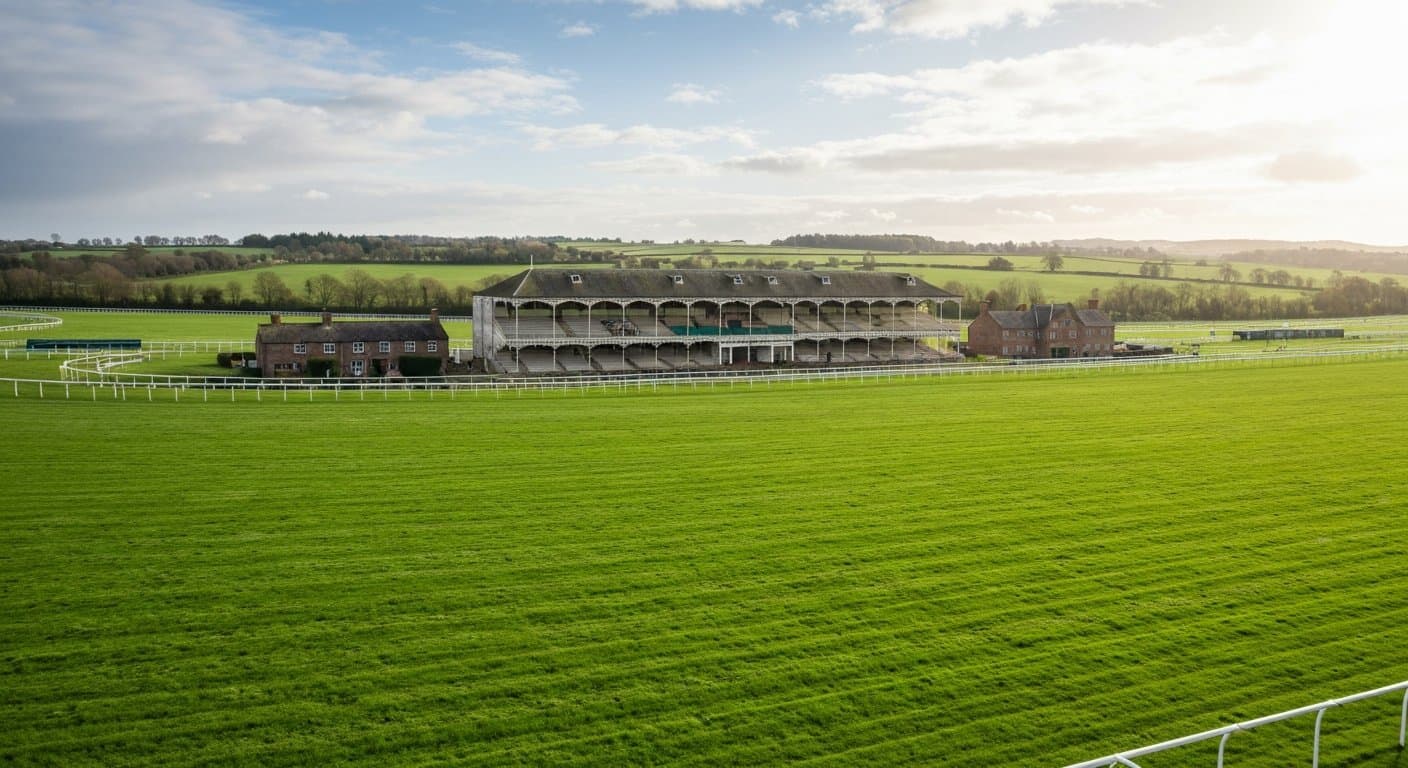
Hamilton Park sits 10 miles south-east of Glasgow city centre, making it the most accessible flat racecourse to Scotland's largest city. Drive the M74 south, exit at junction 5 or 6, and you are in the car park in under 25 minutes from the city centre — a convenience that shapes the course's identity as much as anything that happens on the track itself.
That identity is built on evening racing, sprint racing, and a strong local following that treats Hamilton as its home venue in a way that the grander but more distant Ayr racecourse cannot replicate. Hamilton staged the first evening race meeting at any British racecourse on 18 July 1947, and the evening programme has remained the backbone of its season ever since. On a warm July Tuesday with 4,000 people in from Glasgow and the Lanarkshire towns, Hamilton has an atmosphere unlike anywhere else in Scottish racing.
The track is a right-handed oval of approximately 1m1f around, with flat ground throughout — no gradients of note, no camber. Sprint races dominate the fixture list, and sprint horses dominate the results. The stalls position matters greatly: high draws have a statistically significant advantage in 5f and 6f races, one of the most pronounced draw biases at any British flat course. If you are studying a sprint card at Hamilton and ignoring the draw, you are working with incomplete information.
This guide is written for three readers. First, the racegoer planning a visit from Glasgow or the surrounding area who wants to know what to expect on the day — what facilities are available, how to get there, and whether to dress up or dress down. Second, the racing fan who wants to understand what kind of course Hamilton actually is, which horses it suits, and which trainers consistently exploit home advantage here. Third, the punter who knows Hamilton's name but has not previously dug into the draw data and the trainer angles that make sprint betting here unusually learnable.
Quick facts
| Location | Bothwell Road, Hamilton, South Lanarkshire, ML3 0DW |
| Region | Scotland |
| Racing type | Flat only |
| Track shape | Right-handed oval, approx 1m1f round |
| Year established | 1888 |
| Signature race | Glasgow Stakes (Listed, 1m3f16y, July) |
| Distances run | 5f4y, 6f5y, 1m65y, 1m3f16y, 1m4f14y |
| Season | April – September |
| Capacity | approx 5,000 |
| Nearest station | Hamilton Central (services from Glasgow Central, 20 min) |
| By car from Glasgow | M74 junctions 5/6, approx 12 miles |
| Website | hamilton-park.co.uk |
Where Hamilton differs most from Ayr — the other major flat course in the west of Scotland — is scale and tone. Ayr hosts the Scottish Champion Stakes and the Ayr Gold Cup; it operates on a different budget and draws horses from the biggest southern yards for its prestige meetings. Hamilton's strength is consistency and accessibility. It runs around 20 fixtures a season, several of them evening meetings drawing 3,000–5,000 people, and it does that job reliably every year. The Glasgow Stakes is a Listed race with a real pedigree — winner Subjectivist went on to take the Gold Cup at Royal Ascot in 2021 — but Hamilton's core product is competitive flat racing at a venue that feels local and unpretentious.
For sprint betting in particular, Hamilton rewards preparation. The draw, the going, and the proximity of trainer Keith Dalgleish's Carluke yard — 12 miles from the racecourse — are the three variables worth understanding before you back a horse here. The sections that follow cover all of them in detail.
Bet on Hamilton Park
Place your bets on Hamilton Park races with a trusted bookmaker.

Promo code BETFRED50. New customers only. Register, deposit with a Debit Card, and place a first bet of £10+ at Evens (2.0)+ on Sports, to be settled within 7 days, to get £30 in Sports Free Bets and £20 in Bet Builder Free Bets within 24 hours of settlement. 7-day expiry. Eligibility & payment exclusions apply. Full T&Cs apply. Take Time to Think. BeGambleAware.org. 18+. Full T&Cs.

Promo code R30. New UK customers only, 18+. Register, deposit £10 or more, then place a £10 single cash bet at odds of 1/2 (1.5) or greater on any sports market (excluding Virtuals). Once the qualifying bet settles you get £30 in Free Bets (3 x £10) — the qualifying bet can win or lose. Free Bets are valid on any sports market excluding Virtuals, expire in 7 days, are non-withdrawable and must be used in full. Excluded deposit methods apply (including PayPal, Apple Pay, Skrill and NETELLER). Named bets such as Lucky 15 do not qualify. If you cash out the qualifying bet, or it is voided, you are no longer eligible for the offer. Ends 31.12.26. Full T&Cs apply. Please gamble responsibly. BeGambleAware.org. 18+. Full T&Cs.

Promo code BET40GET20. New UK customers, 18+. Register with the code and place a first bet of £40 or more at Evens (2.0) or greater. Receive 2 × £10 free bets: the first credited automatically once the qualifying bet settles, the second 24 hours later. Free bets must be placed at minimum odds of 4/1 (5.0), expire 24 hours after credit, and the free-bet stake is not returned with winnings. Debit card deposits only. Take Time to Think. BeGambleAware.org. 18+. T&Cs apply. Full T&Cs.

50% of your first-day net losses refunded as a free bet, capped at £25. New UK customers aged 18+ only. To qualify, deposit and place a first bet of £10 or more on any sport at minimum odds of evens (2.00), then place at least two further bets on different events, each worth at least 50% of your largest bet, all at evens (2.00) or greater. Losses are counted from your first settled bet until 23:59 the same day. Place a qualifying £10+ bet and you are guaranteed at least a £5 free bet. Bets placed at SP, void bets, cashed-out bets and bets struck with free bets do not count towards the offer. The free bet is credited the day after your qualifying bets settle and must be used within 7 days, after which it expires. It can be used at odds from 1/4 (1.25) up to 250/1 on singles and straight accumulators, but not on Trixie, Patent or Yankee style multiples. Free-bet stake is not returned with winnings. One offer per person, household, address, IP address and device. E-wallet deposits may not qualify, so check the cashier before depositing. Customers registered with GAMSTOP cannot claim. KYC identity verification must be completed before the free bet is credited. Take Time to Think. BeGambleAware.org. 18+. T&Cs apply. Full T&Cs.

New customers, 18+. Choose the sports bonus at sign-up, make a first deposit and receive a 100% bonus up to £50 in your Sports Bonus balance. To convert the bonus to cash, wager it 10x within 30 days. Single bets below Evens (2.00) do not qualify; accumulators do not qualify if any selection is below 1/2 (1.50). Virtual Sports, voided, cancelled, drawn, cashed-out and free-bet wagers do not count towards wagering. Only the first settled bet per event counts. Withdrawing before the wagering requirement is met forfeits the bonus balance including bonus winnings. Real-money funds are used before bonus funds. Deposits via Skrill or Neteller are not eligible. Not valid in conjunction with other promotions. Odds, bet and payment limits apply. 10bet general and promotion T&Cs apply. BeGambleAware.org. 18+. Full T&Cs.

New customers in Great Britain and Republic of Ireland, 18+. Place a £10 fixed-odds qualifying bet at minimum odds of 1/2 (1.50) — single or each-way (only the win part counts), pre-event or in-play, not cashed out early, within 28 days of opening the account. Receive up to £60 in bonuses credited over three days: 3 × £10 fixed-odds free bets (the first on settlement, then 24 and 48 hours later) plus 3 × £5 Total Goals FOOTBALL spread bets and 3 × £5 racing Winning Favourites spread bets, with a £1 racing Race Index spread bet as an extra on top. The spread bets need a full spread-betting account, opened within 28 days of the fixed-odds account and subject to Spreadex's eligibility and appropriateness checks. Free-bet stakes not returned with winnings; free bets valid 28 days from issue. IMPORTANT: the £5 credits are SPREAD bets — sports spread betting carries the risk that losses can exceed your stake. Sports spread-betting customers do not have Financial Ombudsman or FSCS recourse. Take Time to Think. BeGambleAware.org. 18+. T&Cs apply. Full T&Cs.

Promo code WELCOME15, entered under My Bonuses after registering. New UK customers, 18+. Place a first qualifying bet of at least £10 from your cash balance at odds of evens (2.0) or greater within 7 days of opening the account. Once the qualifying bet fully settles you receive £15 in free bets, credited as 3 x £5 tokens with set uses: one £5 accumulator free bet (minimum 4 legs, each leg at 2/5 or bigger), one £5 sports free bet (any market at evens or bigger) and one £5 Sub Cover free bet (selected football player markets at evens or bigger). Free-bet stakes are not returned with winnings. Free bets expire 7 days after they are credited. Void, cashed-out and partially cashed-out bets do not qualify. One offer per customer. Confirm the current terms on BetGoodwin's own welcome-offer page before claiming. Take Time to Think. BeGambleAware.org. 18+. T&Cs apply. Full T&Cs.

New UK customers, 18+. Minimum deposit £10. Place a £10 qualifying single on sports (excluding virtuals) at minimum odds of 1/2 (1.50), settled within 14 days. Deposit-method exclusions apply. Receive £30 in free bets (stake not returned), split £20 for sportsbook use (2 x £10) and £10 for Bet Builder only (2 x £5); Bet Builder does not cover horse racing. Free bets must be accepted within 7 days and expire 7 days after acceptance. No promo code required. Best Odds Guaranteed on UK & Irish racing, subject to having staked over £25 in the previous seven days. Operated by LiveScore Betting and Gaming (Gibraltar) Ltd, UKGC 56859. Confirm the current terms on LiveScore Bet's own promotions page before claiming. Take Time to Think. BeGambleAware.org. 18+. T&Cs apply. Full T&Cs.
18+. BeGambleAware.org
The Course
The Shape of the Track
Hamilton Park is a right-handed oval of approximately 1 mile 1 furlong in circumference — compact by British flat racing standards, but not exceptionally tight. The bends are reasonably well-banked for a provincial track, and the going from the home turn into the straight is straightforward. What makes Hamilton distinctive is not dramatic curvature but the combination of its short overall circuit and the five distance configurations that squeeze onto it, some of which place very short races on a loop that rewards positional racing above nearly everything else.
The track is flat throughout. There is no significant gradient in any direction — no uphill finish of the kind you encounter at Epsom or Lingfield, and no descent to the start. This matters more than it might seem, because the flatness amplifies the importance of ground position and the stalls draw. A horse does not need to carry momentum through an adverse gradient; the race is decided more cleanly by pace, position, and — critically — which stall a horse starts from.
Distances and Configurations
Five distances are run at Hamilton, ranging from the sprint 5f4y to the staying 1m4f14y.
5f4y is the course's shortest and most frequently run distance. Races at this trip are run largely on the straight, with runners joining the round course only in the final stages. With the stalls positioned on the stands side, high-drawn horses — those in the higher-numbered stalls — are immediately advantaged. They take the shorter path around the slight kink onto the straight and have cleaner daylight throughout. In fields of ten runners or more, high draws are significantly favoured at this distance. In large fields of fourteen or more, the top quarter of the draw has historically produced close to 40% of winners — a skew that is among the most pronounced at any British flat course.
6f5y extends slightly but retains the same fundamental geometry. High draws remain an advantage, though the additional distance gives low-drawn horses marginally more time to recover ground if they are squeezed early. In practice, the bias is almost as pronounced at 6f as at 5f: in competitive handicaps with ten-plus runners, low draws (stalls 1–3) have a poor record. The bias is less severe in small fields of six runners or fewer, where traffic patterns are simpler and position matters less.
1m65y is the middle-distance option. Races at this trip start on the far side of the course and complete a full loop before finishing on the straight. The draw bias largely disappears at this distance. Horses from low and high stalls win at approximately equal rates, and the race becomes a question of stamina, cruising speed, and how horses handle the two bends. Front-runners can be effective here if they find an uncontested lead; Hamilton's flat profile means a slow tempo is not automatically punished by a severe finish.
1m3f16y is the distance of the Glasgow Stakes, the course's flagship Listed race. Runners start on the far side, travel around the first turn and down the back straight, and complete the oval before the final straight. At this distance, class and cruising speed dominate. Horses that have contested good-quality races at Ayr, York, or Newmarket and found those tracks too sharp can run their race shape more comfortably on Hamilton's flat oval. Conversely, horses suited by true galloping tracks occasionally find Hamilton's circuit too tight to build momentum effectively.
1m4f14y is the longest distance on offer. Fields at this trip are often smaller, and the race tends to develop into a test of stamina and pacing judgement. The flat circuit means there is no natural energy-saving moment mid-race, and horses that go too fast in the first mile can be caught by horses that have been kept fresh on the bend.
The Draw Bias in Detail
Hamilton's draw bias is the defining statistical feature of the course, and it is worth treating it with the same seriousness as a gradient or a track characteristic at any other venue.
In sprint races at 5f and 6f, the bias is generated by the positioning of the stalls on the stands side and the way the track bends slightly to the right as runners approach the straight. High-drawn horses — in practical terms, anything in the top third of the draw — travel a shorter effective path to the rail and find cleaner racing room throughout. Low-drawn horses are often forced wide or are outpaced early in the race because they must cover ground to establish a position.
The bias is most acute in fields of ten or more. In a twelve-runner handicap at 5f, stalls 8–12 have a significant statistical advantage over stalls 1–4. When fields reach fourteen or more — as they regularly do in competitive summer handicaps — the advantage of the top four or five stalls is substantial enough to warrant actively opposing low-drawn favourites on price alone, regardless of their form.
In wet conditions, the bias does not reverse, but it may narrow slightly as the ground becomes more equal across the track. The key variable is not going but field size: the larger the field, the more pronounced the advantage of a high draw.
Going at Hamilton
The Glasgow area sits on clay-based subsoil that retains moisture. Hamilton can move from good ground to soft ground within 24 hours of significant rainfall. The course drains adequately in normal Scottish weather but is vulnerable to persistent rain: when the West of Scotland has three or four wet days in succession, Hamilton can deteriorate to soft or even heavy in sprint races and short-course configurations where the ground receives concentrated traffic.
In summer, the predominant going is good to firm or good. The flat track and open aspect mean the top few millimetres of turf dry quickly in dry spells. Soft or heavy ground is more common in April and late September — the shoulders of the season — than in the July and August peak.
What this means in practice: always check the going report, and take the official going description with some caution if the preceding 48 hours have included significant rainfall. Hamilton's ground can be one grade softer in reality than the official description suggests when weather has moved through quickly.
Horse Types That Succeed
Sprint horses with high draws. The single most consistent pattern at Hamilton. A horse drawn in stalls 8–14 in a sprint handicap field of twelve-plus runners starts with a real positional advantage and should be assessed accordingly. Sprint horses that are suited by a flat track and can travel smoothly from the stalls — rather than requiring a long, steady gallop to wind up — are well placed here.
Front-runners in middle-distance races. Hamilton's flat profile does not penalise pace-setters the way an undulating course can. A horse that goes to the front at 1m65y or 1m3f16y and finds an uncontested lead can control the race's tempo without expending energy on gradients. This makes real front-runners more viable at Hamilton than at comparable tracks with topographical challenges.
Horses with a high cruising speed. The flat track rewards horses that can sustain a rhythm rather than burst. Horses that need to be driven to peak speed are less effective than those that travel smoothly at a high sustained pace — particularly at the middle distances.
Local trainers who know the ground. Keith Dalgleish's yard in Carluke is 12 miles from the racecourse. His horses run regularly at Hamilton, he understands the going tendencies, and his strike rate at this course is significantly above his overall figures. Jim Goldie and Linda Perratt are other Scotland-based trainers worth noting. When a Dalgleish sprint runner appears with a favourable draw in a competitive summer handicap, that combination of local knowledge and statistical advantage is worth taking seriously.
Key Fixtures & Calendar
The Season at a Glance
Hamilton Park runs a flat-only programme from April through September, staging around 20 fixtures a season. The schedule is weighted heavily towards summer: May, June, July, and August account for the majority of meetings, with the evening racing programme forming the spine of the calendar. Weekend afternoon fixtures and the occasional Saturday card round out a programme that serves both the local racegoing public and the betting markets.
Crowds range from around 3,000 on a standard weekday evening to 5,000 or slightly above for the most popular Saturday meetings and the Glasgow Stakes card. Those are not spectacular numbers by southern standards, but for a provincial Scottish course they represent consistent, reliable attendance built on a loyal Glasgow and Lanarkshire following.
Evening Racing
Hamilton Park staged the first evening meeting at any British racecourse on 18 July 1947, and evening racing has remained central to its identity ever since. The evening programme typically runs from May through August, with first race times of around 6pm or 7pm depending on the fixture and the time of year. Some of the earlier-in-season evenings kick off closer to 5:30pm when the light is less reliable, while midsummer meetings with long Scottish evenings can start later and still finish with adequate light.
Evening meetings are the most popular fixtures on the Hamilton calendar, and for good reason. The format suits Glasgow — people finish work, drive the M74 or take the 20-minute train from Glasgow Central, and arrive at a racecourse that is set up for a social evening rather than a full day's commitment. Pre-booking is strongly advised for any group of ten or more, and the course's hospitality packages fill up for popular summer evenings. The dress code for evening meetings is smart casual — relaxed by British racing standards, but not scruffy.
The evening racing draw is amplified by Hamilton's position relative to Glasgow's population. No other Scottish flat course is as easy to reach from the city: Musselburgh is east of Edinburgh, Ayr is 35 miles south-west of Glasgow, and Catterick across the border serves a different catchment altogether. Hamilton has the west central Scotland evening market largely to itself.
The Glasgow Stakes
The Glasgow Stakes is run in mid-July and is Hamilton's flagship race. It is a Listed contest over 1m3f16y, open to three-year-olds. The race has been staged at Hamilton since 2006, when it was transferred from its original home at York. That transfer was initially met with scepticism — moving a Classic-trial-heritage race from York to a Scottish provincial track seemed like a downgrade. The quality of subsequent winners has done much to counter that view.
Subjectivist won the Glasgow Stakes in 2020 and went on to win the Ascot Gold Cup in 2021, providing the race with the kind of blue-riband validation that no amount of marketing could manufacture. Postponed, trained by Roger Varian, ran at Hamilton earlier in his career and went on to win the King George VI and Queen Elizabeth Stakes at Ascot in 2015. The race does not consistently produce Group 1 winners, but it has a reasonable record as a pointer to real staying talent.
The Glasgow Stakes card is typically one of Hamilton's larger weekend afternoon meetings of the season, with a full supporting programme and hospitality packages that sell in advance. It is the one day of the year when Hamilton attracts runners from the major southern yards alongside the Scottish-based contingent, giving the card a quality step up from the routine summer programme.
Sprint Series Qualifiers
Hamilton's sprint programme includes meetings that serve as qualifiers for broader sprint series competitions. The course is well suited to these: sprint distances are its natural territory, fields are competitive because the sprint programme is well-developed, and the draw bias makes results here a talking point across the sprint-racing community. Hamilton sprints attract horses that are specifically aimed at sprint series titles, alongside improving handicappers from Scottish and northern yards that find the prize money and conditions attractive.
The sprint qualifier meetings typically fall in June and July, when sprint form is most active and trainers are targeting summer targets. These meetings tend to draw fields of ten or more runners even in handicaps, which is precisely the configuration where Hamilton's draw bias is most significant. From a betting perspective, sprint series qualifier meetings are among the most analytically interesting cards Hamilton stages.
Weekend Afternoon Fixtures
Saturday and Sunday afternoon meetings provide a more traditional raceday experience. The Glasgow Stakes card in July is the weekend highlight, but Hamilton stages several other Saturday meetings through the season with competitive programmes of handicaps, conditions races, and two-year-old maidens. These meetings attract larger crowds than weekday evenings — the combination of free afternoon time and a more accessible start time for families makes afternoon racing the option for groups attending with children.
The two-year-old maiden programme is worth following for those with a medium-term betting interest. Hamilton's flat track can help expose real ability in young horses — the absence of gradients means that a maiden winner at Hamilton has generally won on merit rather than through ground tactics or positional fortune. Horses that win maiden races convincingly at Hamilton in June and July sometimes reappear at better tracks later in the season.
Typical Fixture and Crowd Breakdown
| Meeting type | Typical crowd | Time | Season |
|---|---|---|---|
| Evening meetings | 3,500–5,000 | 6–7pm first race | May–August |
| Glasgow Stakes card | 4,000–5,000+ | Afternoon | Mid-July |
| Sprint series qualifiers | 3,000–4,500 | Varies | June–July |
| Weekend afternoon | 3,000–4,500 | Afternoon | April–September |
| Weekday afternoon | 2,000–3,500 | Afternoon | April–September |
These are approximate figures based on the course's typical range. The Glasgow Stakes card and popular summer evening meetings attract the higher end. Early-season April fixtures and late-September fixtures at the tail of the season tend towards the lower end.
Facilities & Hospitality
The Grandstand and Main Enclosure
The main grandstand at Hamilton Park runs along the finishing straight and provides covered viewing across the full width of the course. The structure is functional rather than grand — Hamilton is a working provincial racecourse, not a showpiece venue, and the facilities reflect that honestly. The upper tier of the grandstand offers elevated views of the straight and partial views of the final bend, which is useful for sprint races where the action is concentrated in front of the stands. The lower tier sits closer to the track and gives a strong impression of pace and movement in sprint finishes.
The main enclosure connects to the betting ring, the principal food and drink outlets, and the Pavilion area that runs alongside it. The layout is easy to navigate and the circuit is compact enough that you are never more than a two-minute walk from any part of the course. First-time visitors rarely get lost.
The Pavilion Area
The Pavilion is Hamilton's primary hospitality space and functions as both a restaurant and an event venue. It overlooks the course and provides seating with track views, which distinguishes it from hospitality venues at some courses where tables are positioned for dining convenience rather than racing visibility. The Pavilion is used for pre-booked hospitality packages as well as walk-in dining on general admission days when tables are available.
Hospitality packages at Hamilton typically include a reserved table in the Pavilion, a two- or three-course meal, a racecard, and access to premium viewing areas on the balcony above the main enclosure. The balcony views are among the best at the course for watching sprint finishes. On Glasgow Stakes day and popular evening meetings, Pavilion tables sell out weeks in advance; for less prominent fixtures, availability is generally good on the day.
Group bookings — corporate events, birthday parties, hen and stag parties — are a significant part of the Pavilion's business, and the course has adapted its offering accordingly. Pre-arrival packages including welcome drinks are available, and the catering can be adjusted for group sizes and dietary requirements. Enquire via the course website at least two weeks before any group visit.
Open Viewing Enclosures
Beyond the grandstand and Pavilion, Hamilton has open grass viewing areas that extend around the home turn and along the back of the course. These are free to use within your enclosure admission and are popular on warm summer evenings when standing outside is more pleasant than sitting in the grandstand. Bring a layer — even in July, the Lanarkshire evenings can cool noticeably after 8pm.
The open areas closest to the final bend offer an unusual perspective on sprint races: you see the horses turning into the straight and can watch the draw advantage play out in real time, with high-drawn horses typically finding cleaner ground and lower-drawn horses fighting for position. It is an instructive vantage point if you want to understand Hamilton's bias with your own eyes rather than through statistics alone.
Food and Drink
Hamilton's catering operates at several price points and locations across the course. The Pavilion restaurant at the top end, the main concourse bars and food kiosks in the middle, and informal outdoor bars for evening meetings at the casual end.
The food kiosks on the main concourse serve pies, burgers, fish and chips, and similar standard racecourse fare. Hamilton leans into its Scottish setting more than many courses: Tunnock's tea cakes and Tunnock's caramel wafers are a traditional Hamilton staple, available at kiosks and popular with regulars. Tunnock's is a Uddingston company, 4 miles from the racecourse — local enough that the association feels natural rather than novelty branding. Scottish produce appears in various forms on the Pavilion menu when in season, including Scottish beef and locally sourced fish dishes.
The bars on the main concourse serve a standard range of draught beers, lagers, wines, and spirits. On evening meetings, additional outdoor bars are set up in the open areas behind the grandstand to manage demand during the peak social period between races. Queues can build in the 10 minutes immediately after a race — if you want a drink without waiting, move away from the main bar immediately after the result is announced rather than joining the rush.
Betting Ring
The on-course betting ring at Hamilton is active, with a row of bookmakers along the main concourse taking board prices. On sprint qualifier meetings and competitive Saturday cards, the ring has sufficient volume to absorb reasonable bets without moving prices significantly. On smaller weekday meetings, the ring can be thin, particularly for shorter-priced selections. The Tote is also present. For those betting on phones, the on-course Wi-Fi is adequate for mobile app use.
Children's Facilities
Hamilton Park is a family-friendly venue and regularly runs activities for children on afternoon and evening meetings. A designated children's area near the main enclosure has been part of the summer programme in recent years. Some meetings include inflatable play areas or fairground-style attractions. Check the fixture listing on the course website for specific family-friendly designations — these are flagged in advance rather than present at every meeting.
Disabled Access
The course is accessible to wheelchair users and those with mobility requirements. The main grandstand has level access from the car park via a dedicated route, and the Pavilion has lift access to upper viewing areas. Disabled parking bays are available in the main car park adjacent to the entrance — arrive early for these on busy meetings. The open grass areas are less straightforward for wheelchair users in wet conditions when the ground is soft. The course's accessibility information page on hamilton-park.co.uk lists specific assistance available on race days.
Getting There
By Train
Hamilton Central station is the most convenient rail option for the racecourse. Regular services run from Glasgow Central throughout the day, with the journey taking approximately 20 minutes. Trains on the Hamilton Circle line run at frequent intervals on weekdays and Saturdays; on Sunday and on bank holiday evenings, check the ScotRail timetable in advance as frequencies can reduce.
From Hamilton Central, the racecourse is approximately 1.5 miles along Bothwell Road heading north-east. The walk takes 20–25 minutes on a dry day and follows a straightforward route out of the town centre. A taxi from Hamilton Central to the racecourse costs around £5–7 and takes under five minutes. Several local firms operate this route regularly on race days. Pre-booking a taxi for the return journey is worth doing on evening meetings, when demand peaks sharply after the last race and waits can extend to 20–30 minutes without a pre-booked car.
Hamilton West station is slightly closer to the course in terms of straight-line distance, but services from Glasgow Central via this route are less frequent. Most visitors use Hamilton Central.
By Car from Glasgow
The M74 motorway is the primary route from Glasgow. From the city centre, take the M74 southbound — the motorway begins at the south-east fringe of the city and is reached via the M8 ring road junction. Exit at junction 5 (for the Motherwell/Hamilton east approach) or junction 6 (for the Hamilton town centre approach). Both junctions are well signed for Hamilton, and the racecourse on Bothwell Road is straightforward to find from either exit. Total distance from Glasgow city centre is approximately 12 miles. Journey time in normal traffic is around 20–25 minutes; allow 35–40 minutes on a Saturday afternoon or on any meeting where significant crowds are expected.
Free car parking is available on-site at the racecourse. The main car park is accessed directly from Bothwell Road and can accommodate several hundred vehicles. On Glasgow Stakes day and popular summer evening meetings, the car park fills in the 30 minutes before the first race. Arriving 45 minutes early on busy fixture days secures a good spot. Overflow parking is sometimes available in the surrounding area — follow marshalling instructions if directed.
By Car from Edinburgh
From Edinburgh, the journey takes approximately 45 minutes in normal traffic. Take the M8 westbound from the city towards Glasgow, then follow signs for the M74 southbound at the Baillieston interchange on the east side of Glasgow. From there, the route is the same as the Glasgow approach: M74 south, exit at junction 5 or 6, follow signs for Hamilton and the racecourse. Distance from Edinburgh city centre is approximately 42 miles.
From Ayr or the south-west, take the A77 or A70 east and pick up the A71 towards Hamilton, or use the M77 to join the M74. The racecourse is straightforward to find from any approach into Hamilton town.
By Bus
Local bus services connect Glasgow and Hamilton regularly throughout the day. The 18 and 19 services operated by McGill's and First Scotland link Glasgow's Buchanan Street bus station with Hamilton. Journey time is approximately 35–45 minutes depending on traffic. Ask the driver for the stop closest to the racecourse, or alight in Hamilton town centre and walk the Bothwell Road route (20 minutes) or take a taxi.
Bus return times can be awkward on evening meetings — the last race typically finishes around 8:30–9:00pm, which requires checking return departure times carefully. The train from Hamilton Central is generally the more reliable option for evening meeting returns.
Practical Notes
Hamilton Central to Glasgow Central operates a direct service that makes the journey simple in both directions. For evening meetings starting at 6pm or 7pm, the 5pm or 5:30pm train from Glasgow Central allows comfortable arrival. Glasgow Central itself is in the heart of the city centre, 10 minutes' walk from the Merchant City restaurant area and 15 minutes from St Enoch Square.
The combination of Glasgow's size and Hamilton's M74 access makes this one of the easiest major-city-to-racecourse journeys in Scotland. No other Scottish flat course is as conveniently placed relative to a large urban population. Musselburgh is accessible from Edinburgh but is 45 minutes from Glasgow; Ayr requires either the rail journey to Ayr station or a 35-mile drive. Hamilton's 20-minute train journey or 25-minute drive from Glasgow city centre is a straightforward proposition that requires no special planning.
Frequently Asked Questions
History
Origins: 1888 and the Hamilton Park Estate
Racing in the Hamilton area predates the current course by over a century. Organised race meetings were held at nearby Chatelherault from 1782 onwards, using the parkland of the Duke of Hamilton's estate. Those early meetings were informal by modern standards — more festival than fixture — but they established Hamilton as a racing location in the public consciousness of west central Scotland.
The present Hamilton Park Racecourse was founded in 1888, established on land adjacent to the grounds of Hamilton Palace, at that time the principal seat of the Dukes of Hamilton and the largest private house in Scotland. Hamilton Palace had been built progressively from the 1820s onwards to designs including work by David Hamilton (no relation to the town's namesake), with later additions by James Gillespie Graham. By the 1880s it contained more than 200 rooms and was one of the most expensive private residences in Britain. The Duke of Hamilton's art collection, sold in 1882 just six years before the racecourse opened, realised over £400,000 at auction — a figure that indicates the scale of wealth attached to the estate on whose margins the racecourse was being built.
The Palace itself was demolished in 1927, a casualty of structural failure caused by the coal mines that had been worked beneath its foundations. The subsidence made the building uninhabitable, and rather than attempt repairs on an unstable base, the decision was made to demolish. The building that had anchored the estate for a century was reduced to rubble. What remained was the Hamilton Mausoleum (completed 1857), which still stands 600 metres from the racecourse site, and the open parkland that had been developed as the racing venue.
Development as Glasgow's Local Course
Through the late Victorian and Edwardian periods, Hamilton established itself as the racing outlet for Glasgow's industrial working population. The city was at the peak of its industrial expansion — shipbuilding, steel, coal, and textiles employed hundreds of thousands within a 15-mile radius of Hamilton — and racing offered a recognised form of popular recreation. Hamilton was accessible by rail from 1849, when the Caledonian Railway reached Hamilton, and the train from Glasgow Central made the course available to city racegoers in a way that was practically significant at a time when travel options were limited.
The interwar years brought reorganisation to the British racing industry, with the Jockey Club taking a firmer hand in course licences and fixture allocation. Hamilton consolidated its position as a provincial flat course serving the west of Scotland, operating alongside Ayr in the south-west and Musselburgh on the east coast as the three main Scottish flat venues. This triangular geography has defined Scottish flat racing ever since.
Evening Racing: 18 July 1947
The most historically significant date in Hamilton Park's history is 18 July 1947. On that evening, Hamilton staged the first evening race meeting held at any British racecourse. The experiment was prompted partly by practical necessity — crowds were still adjusting to postwar normality, and evening meetings offered a format that working people could attend without taking time off — and partly by entrepreneurial instinct. The Hamilton management under Jockey Club approval ran the card, it was successful, and the evening racing format gradually spread to other courses over subsequent decades.
Hamilton's claim to have invented British evening racing is accurate and is not disputed by any other course. The significance of 18 July 1947 is that it created a format that now accounts for a substantial portion of the British flat racing calendar each summer. Hamilton's willingness to try something new in 1947 did the sport a service that extended far beyond its own gates.
Evening racing became increasingly central to Hamilton's identity through the 1950s and 1960s. By the 1970s, evening fixtures were the best-attended meetings of the season, drawing crowds from Glasgow that treated Hamilton as a summer evening entertainment option rather than a full racing day. That active has remained intact.
Scottish Trainers and Hamilton's Local Identity
Hamilton's identity as a Scottish course has been reinforced by the trainers who have used it as a home track. In the late 20th century, several Scottish-based trainers built their programmes around Hamilton's fixture list. Jim Goldie, based at Uplawmoor in East Renfrewshire, developed a strong record at the course through the 1990s and 2000s, training sprint horses specifically suited to the tight oval. Linda Perratt, whose career took her from an assistant role to training in her own right from the Ayrshire coast, has been a consistent Hamilton presence.
The most significant contemporary relationship is between Hamilton and Keith Dalgleish, who trains from Carluke in South Lanarkshire — 12 miles from the racecourse. Dalgleish became Scotland's leading flat trainer by runner count and has used Hamilton extensively as a base for his horses. His sprint horses in particular are regularly aimed at Hamilton's sprint programme, and his knowledge of the going and draw tendencies at the course is reflected in a strike rate substantially above his overall figures. The Carluke-to-Hamilton axis is one of the clearest examples in British provincial racing of a trainer exploiting home proximity.
Ownership and the Hamilton Park Trust
Hamilton Park Racecourse is operated by the Hamilton Park Racecourse Trust, a charitable structure that reinvests revenue back into the venue rather than distributing profits to shareholders. This model has supported steady infrastructure development without the boom-and-bust dynamics that affect commercially owned courses. The Pavilion hospitality facilities, the track maintenance programme, and the evening racing calendar have all been sustained by reinvestment rather than external capital. For racegoers, the practical effect is a well-maintained venue that does not show signs of neglect despite operating at provincial scale.
The Trust structure also means Hamilton's future is more stable than that of commercially owned courses that depend on shareholder returns. The course has been operating continuously since 1888 — a run of over 130 seasons interrupted only by the wartime closures of 1940–1945 — and the structural model supports continued operation.
Famous Moments
Subjectivist and the Glasgow Stakes Pedigree
The most frequently cited Hamilton Park result in recent years is Subjectivist's Glasgow Stakes victory in 2020. Trained by Mark Johnston and ridden by Joe Fanning, Subjectivist won the Listed contest over 1m3f16y before going on to win the Yorkshire Cup in 2021 and, most significantly, the Gold Cup at Royal Ascot in 2021. A horse winning a Listed race at a Scottish provincial course and then landing the Gold Cup is not a routine trajectory, and Subjectivist gave the Glasgow Stakes a validation it had been seeking since the race moved north from York in 2006.
Johnston had used Hamilton as a prep track before — the Middleham stable's runners appeared here regularly through the 1990s and 2000s, and Johnston was one of the southern trainers who treated Hamilton as a legitimate stop on the season's route rather than a racecourse to be avoided. His record at the course was consistent, and Subjectivist's Glasgow Stakes victory was a reminder that horses campaigned through Hamilton can go on to races at the highest level.
Postponed, trained by Roger Varian, ran at Hamilton earlier in his career before developing into one of the best horses in Europe in 2015, when he won the King George VI and Queen Elizabeth Stakes at Ascot and the Irish Champion Stakes at Leopardstown. Hamilton was one staging post in a development that ended at the very top of the sport.
The Evening Racing Pioneer, 18 July 1947
The historical moment Hamilton can legitimately point to as unique is 18 July 1947. The first evening race meeting held at any British racecourse took place under Hamilton Park's management, and the format worked well enough that evening racing was adopted by other courses over the following decades. The card was unremarkable as a racing event — no famous horse ran that evening, no significant moment of drama was recorded — but the structural significance of that day is that it proved evening racing was a viable product for British racecourses. What Hamilton began in 1947 now accounts for hundreds of fixtures per summer across the British calendar.
Sprint Series Drama in Big-Field Handicaps
Hamilton's sprint programme has produced many results that illustrate the draw bias in unusually vivid form. In large-field summer handicaps at 5f and 6f — fields of fourteen or more runners are not uncommon in the course's sprint series qualifier meetings — the pattern of high-drawn horses dominating the placings has been replicated consistently enough to constitute one of the clearest statistical patterns in British flat racing.
Memorable renewals of big-field sprint handicaps at Hamilton often follow a similar narrative: a low-drawn favourite is well backed in the market, the race develops with the high-drawn horses getting clean air on the stands side, and the finish involves primarily horses from stalls 8 and above. The favourite finishes down the field having never seen daylight. For sprint specialists who study form, these races are instructive because they demonstrate how clearly one variable — stall position — can override form lines in the right conditions.
The sprint series qualifier meetings of July and August have been the setting for several performances that launched horses into further sprint campaign success. Scottish-trained sprint horses that win convincingly at Hamilton in competitive company have sometimes gone on to contest sprint series finals at Haydock or York with odds that undervalued their form because assessors outside Scotland had not weighted the Hamilton sprint qualifier form appropriately.
Scottish-Trained Horses Using Hamilton as a Platform
Keith Dalgleish has trained several horses that built their careers on consistent Hamilton performances before achieving success at higher-grade meetings. The trainer's local proximity means he runs horses here regularly, and his sprint handicappers that have established Hamilton form have Then been targeted at northern tracks including Catterick, Ripon, and York. The pattern — build confidence at Hamilton, run at a higher-grade northern track, assess — is a recognisable route for Scottish-based sprint trainers.
Jim Goldie's runners have followed similar trajectories. Goldie trained Brae Hill to win consecutively at Hamilton in the early 2000s and Then contest sprint handicaps at York's Ebor Festival. The Hamilton form was the foundation, and the York appearance was the graduation.
The Glasgow Area's Cultural Attachment to Hamilton
Beyond individual race results, Hamilton Park's fame within its region is built on evenings rather than races. For the Glasgow and Lanarkshire population, Hamilton is where racing memories are formed — a July Tuesday evening, long Scottish light still in the sky at 8pm, the course's compact oval in front of the grandstand, and the noise of a competitive sprint finish. Those evenings, accumulated across decades, are what the course means to its local audience. The statistical significance of the draw bias, the historical connection to Hamilton Palace, the Glasgow Stakes pedigree — all of these matter less to the regular Hamilton racegoer than the summer evenings that have made the place part of the fabric of central Scottish life.
Betting Guide
The Draw Bias: The Primary Tool
The starting point for betting at Hamilton is the draw, and it applies specifically and almost exclusively to sprint distances of 5f4y and 6f5y. Everything else in Hamilton's form book is secondary to this.
In races at 5f and 6f with ten or more runners, horses drawn in the higher stalls have a statistically significant advantage. The stalls at Hamilton are positioned on the stands side and the track bends slightly right as runners approach the straight, meaning that high-drawn horses travel a shorter effective path to the rail and find clean racing room throughout. Low-drawn horses must either fight for position — expending energy early — or accept a wide path into the straight.
The numbers are consistent across multiple seasons. In 10-plus runner fields at 5f–6f, horses in the top third of the draw (stall 7 and above in a 10-runner race; stalls 9 and above in a 14-runner race) win at materially above their expected rate. In fields of fourteen or more runners — which occur regularly in Hamilton's sprint series qualifier meetings — the top quarter of the draw has historically produced approximately 40% of winners from a starting population of around 25% of the field.
How to Use the Draw Bias Practically
Step one: identify the field size. The draw bias becomes significant at ten runners and increasingly important as the field grows. In fields of six or fewer, ignore the draw entirely and focus on form and going. In fields of 7–9, weight the draw lightly. In fields of 10+, make the draw a primary consideration.
Step two: identify the draw position of each runner. In a 12-runner sprint, stalls 1–4 are disadvantaged, stalls 5–8 are roughly neutral, and stalls 9–12 are advantaged. In a 14-runner sprint, adjust accordingly: the top three or four stalls carry a significant advantage, and the bottom three or four are disadvantaged.
Step three: check whether the market has priced the draw. The bias is now widely known, and in some cases high-drawn horses are priced to reflect it. The profitable opportunities come when the market has not adequately priced a high-drawn horse's positional advantage — typically when that horse is not the market leader and the form book alone does not flag it as the selection. Equally, low-drawn favourites at Hamilton sprint distances deserve scrutiny. If the market favourite is drawn in stall 1 or 2 in a 12-runner sprint, the price should reflect the draw disadvantage; if it does not, opposing that favourite is often sound.
Step four: do not over-apply the bias. The bias operates on probabilities, not certainties. A low-drawn horse with clearly superior form can overcome a poor draw in a small field or when conditions equalise across the track. Use the draw as a weighting mechanism, not a veto.
Going: The Second Key Variable
Hamilton's clay-based subsoil means the ground can change faster than the official description suggests. When significant rain has fallen in the 24–48 hours before a meeting, the going is worth checking carefully on the morning of the race rather than relying on the previous evening's official description.
The practical consequence for betting: horses suited by soft ground are worth upgrading when Hamilton has received persistent rainfall, even when the official going is described as good to soft. Conversely, after a dry spell in summer, Hamilton's flat profile means the top of the ground can dry to good to firm quickly, and horses suited by quicker ground are worth noting.
The intersection of going and draw is also worth considering. In soft ground, the track tends to become more uniform across its width — the difference between the stands side and the far side is reduced — and the draw bias narrows slightly. This does not reverse the advantage of high draws, but it can make low-drawn horses marginally more competitive than their draw alone would suggest when the ground is truly soft throughout.
Trainer Statistics: Dalgleish and the Local Advantage
Keith Dalgleish trains from Carluke, South Lanarkshire, 12 miles from Hamilton Park. His strike rate at Hamilton is significantly above his overall figures — this is one of the clearest examples in British provincial racing of a trainer systematically exploiting home proximity. Dalgleish runs horses at Hamilton regularly, knows the going tendencies at the track from direct and repeated experience, and aims his sprint handicappers at Hamilton's programme as a priority.
When Dalgleish has a runner with a favourable draw in a sprint handicap at Hamilton, the combination of local knowledge, likely track preparation, and statistical positional advantage creates a significant edge. The horse does not need to be at its absolute peak form — a Dalgleish runner at Hamilton that is 90% ready tends to perform better at this course than one that is 90% ready at a distant track.
Jim Goldie's record at Hamilton is also strong, particularly in sprint handicaps. Goldie is based at Uplawmoor in East Renfrewshire, approximately 18 miles from Hamilton, and runs here regularly with horses prepared for the sprint distances. His win percentage at the course is above average.
Linda Perratt, based on the Ayrshire coast, has a more modest strike rate at Hamilton but runs regularly and occasionally lands a well-placed sprint handicapper at a price worth having.
How to use these stats: When a Dalgleish or Goldie runner is going off at a price longer than market expectation might suggest, check the draw. If the draw is favourable and the going is appropriate for the horse, the combination of trainer advantage and positional advantage is worth a serious look. These are not slam-dunk selections — nothing in betting is — but they represent a systematic edge in a specific and identifiable market.
Middle-Distance Races at Hamilton
At 1m65y and above, the draw bias disappears and the betting proposition becomes more conventional. Look for horses with a high cruising speed on a flat track — Hamilton's absence of gradients rewards smooth, sustained movement rather than the ability to accelerate on a downhill gradient or grind up a stiff finish. Front-runners are worth taking seriously in medium-field races at middle distances because Hamilton's flat profile means pacemakers are not naturally wound up by a demanding finish.
The Glasgow Stakes at 1m3f16y is a Listed race where class is the primary factor. In recent renewals, horses from the major southern yards — Mark Johnston, Roger Varian, John Gosden and their successors — have brought runners that should, on form, be superior to Scottish-trained opposition. The race is not a prime opportunity for finding an undervalued Scottish-trained horse; it is an opportunity to assess whether the southern-trained favourite is worth the price. In most years, the Listed winner is correctly priced. In some years, the field is open enough that a well-placed Scottish raider at a longer price is worth considering.
Summary: The Hamilton Betting Checklist
Before placing any bet at Hamilton, run through these four checks:
- Distance: Is it a sprint (5f or 6f)? If yes, proceed to the draw check. If no, proceed to going and form.
- Field size: Is the sprint field 10 or more runners? If yes, make the draw a primary factor. If fewer than 10, weight it lightly.
- Draw position: Is your selection in the top third of the draw? If yes, that is an advantage. If it is in the bottom third in a big field, that is a material disadvantage that form alone rarely overcomes.
- Trainer: Is the horse trained by Dalgleish or Goldie? If yes, note the local advantage and consider whether the market has priced it in.
These four checks take under two minutes and cover the majority of exploitable edge at Hamilton's sprint programme. No tool guarantees winners, but working through this checklist before betting a Hamilton sprint will materially improve the quality of your decision-making.
Atmosphere & Planning
The Setting: More Than a Racecourse
Hamilton Park sits on land that once formed part of the grounds of Hamilton Palace, the largest private house Scotland ever contained. The Palace — built from the 1820s, extended through the Victorian period, housing 200-plus rooms and one of the finest private art collections in Europe — was demolished in 1927 after coal mining beneath its foundations caused irreversible subsidence. What remains on this landscape is the Hamilton Mausoleum (completed 1857), a sandstone structure visible from the road leading to the racecourse, and the open parkland now occupied by the track and its facilities.
The Mausoleum was built for Alexander, 10th Duke of Hamilton, and is notable for a specific acoustic property: its interior dome creates an echo measured at 15 seconds — the longest echo of any building in Europe. The construction was intended for ducal burials and served that purpose until the coffins were moved to Bent Cemetery in Hamilton in 1921. The Mausoleum is open to visitors during certain periods and is worth a 20-minute detour before or after racing. It sits approximately 600 metres from the racecourse entrance on the same road.
This historical layer does not dominate the modern raceday experience — Hamilton is a functional, unpretentious racecourse, not a heritage attraction — but it gives the venue a different quality of context from most comparable provincial tracks. Standing in the car park, you are in the former grounds of the grandest house in Scotland. The Palace is gone; the Mausoleum remains; the racecourse has been here since 1888.
The Atmosphere on Race Days
Evening meetings are Hamilton at its most itself. The crowd that arrives for a July or August evening fixture — families from Hamilton and the Lanarkshire towns, groups from Glasgow who have made a straightforward commute south on the M74 or the train — is relaxed in a way that prestige events rarely are. There is no pressure to dress up significantly, no sense that the occasion demands performance. People are there for a summer evening outdoors, a few races, food, and a drink.
Groups of ten or more are common at evening meetings and are catered for by the Pavilion's pre-booked packages, which are well suited to corporate evenings, birthday celebrations, and organised social events. The scale of Hamilton — a course that holds 5,000 people, not 50,000 — means even on a well-attended evening the atmosphere is sociable rather than overwhelming. You can move around freely, you can reach the bar and the betting ring without significant queuing between races, and you can find a good vantage point without planning ahead.
Afternoon meetings are quieter and have a more traditional racing-focused character. The Glasgow Stakes card in July is the exception: this is Hamilton's one day when the crowd is drawn specifically by the quality of the programme, and the atmosphere has more in common with a good northern course's prestige fixture than with a standard provincial afternoon.
Planning a Day or Evening
For an evening meeting from Glasgow: Take the 6pm (approximately) train from Glasgow Central, arriving Hamilton Central at around 6:20pm. A taxi from Hamilton Central to the course takes under five minutes. First race is typically around 7pm, giving 30 minutes on arrival to collect a racecard, place an initial bet, and find a position. The course is compact enough to navigate quickly. Last race is around 8:30–9:00pm; trains back to Glasgow Central run approximately every 30 minutes after that.
For the Glasgow Stakes card: This is an afternoon fixture. A morning in Glasgow's West End — Kelvingrove Art Gallery and Museum is free and houses the Mackintosh and Impressionist collections — followed by a drive south on the M74 (allow 30 minutes from the West End) arrives at Hamilton in time for the afternoon card. Kelvingrove to Hamilton Park is 14 miles and takes around 25 minutes in normal traffic.
For a wider Scottish racing trip: Hamilton, Musselburgh, and Ayr form Scotland's three main flat venues. A two-day itinerary combining Hamilton and Ayr is practical — Hamilton for an evening meeting, overnight in Ayr, Ayr races the following afternoon. The drive from Hamilton to Ayr is approximately 35 miles and takes around 45 minutes.
Hamilton Town
Hamilton itself is a South Lanarkshire town of approximately 50,000 people with facilities proportionate to that size. The town centre on Cadzow Street has standard high street shops and several food options. The Cameronians (Scottish Rifles) Regimental Museum in the town centre commemorates the regiment raised in Hamilton in 1689 and is open on limited weekday hours. The Hamilton Mausoleum and the adjacent Chatelherault Country Park — the hunting lodge of the Duke of Hamilton, built in 1732 to designs by William Adam — are both accessible on foot or by taxi from the town centre and provide approximately two hours of walking and heritage interest.
For food near the racecourse itself, the Pavilion restaurant inside the course is the most convenient option for pre-race dining. The town centre is a 15-minute walk or short taxi ride and has a broader range of options for post-race meals if the course catering does not suit. Glasgow's much larger restaurant offer is 20 minutes away by train for those whose evening extends beyond the last race.
More guides for this course
Share this article
More about this racecourse
All Hamilton Park guides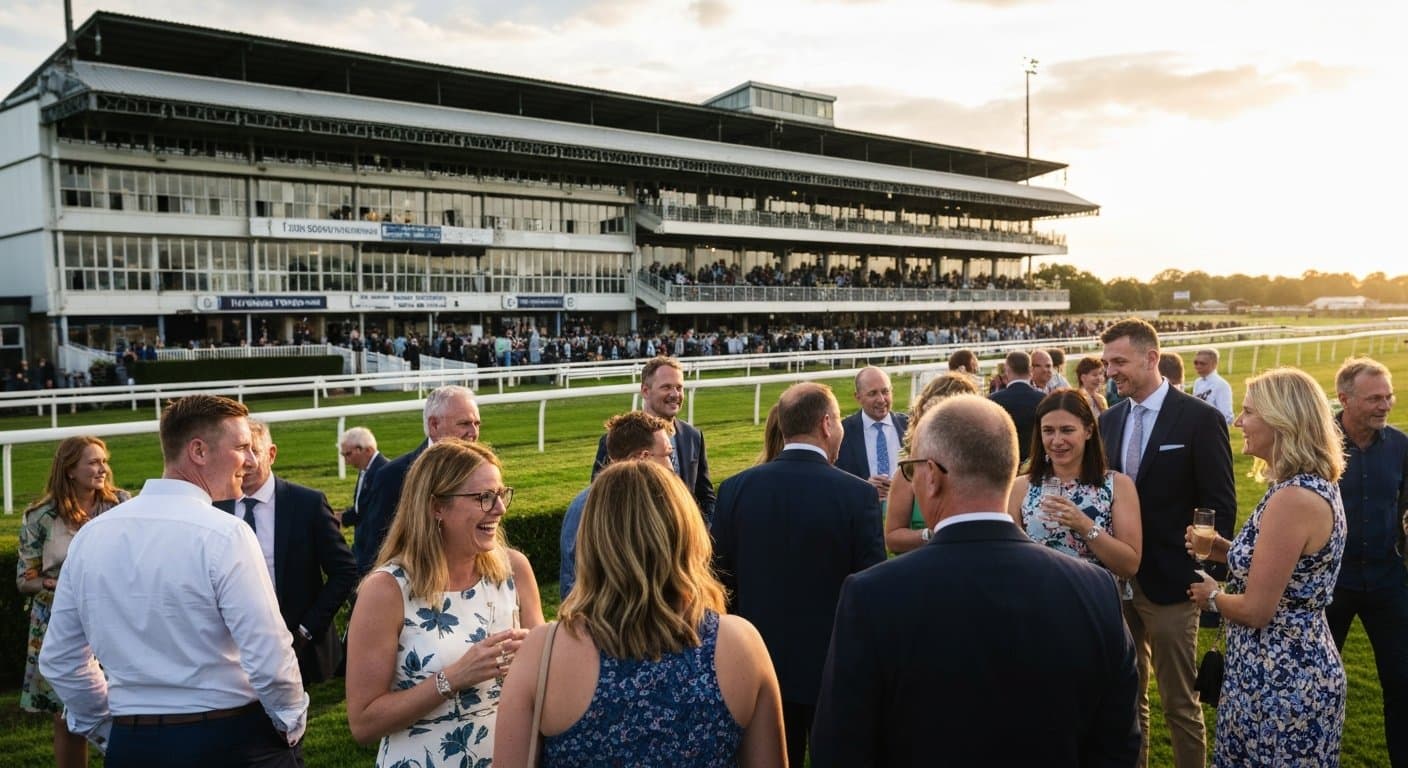
A Day Out at Hamilton Park Racecourse
Everything you need for a day at Hamilton Park — getting there, what to wear, enclosures, food and drink, and insider tips for Scotland's premier flat course.
Read more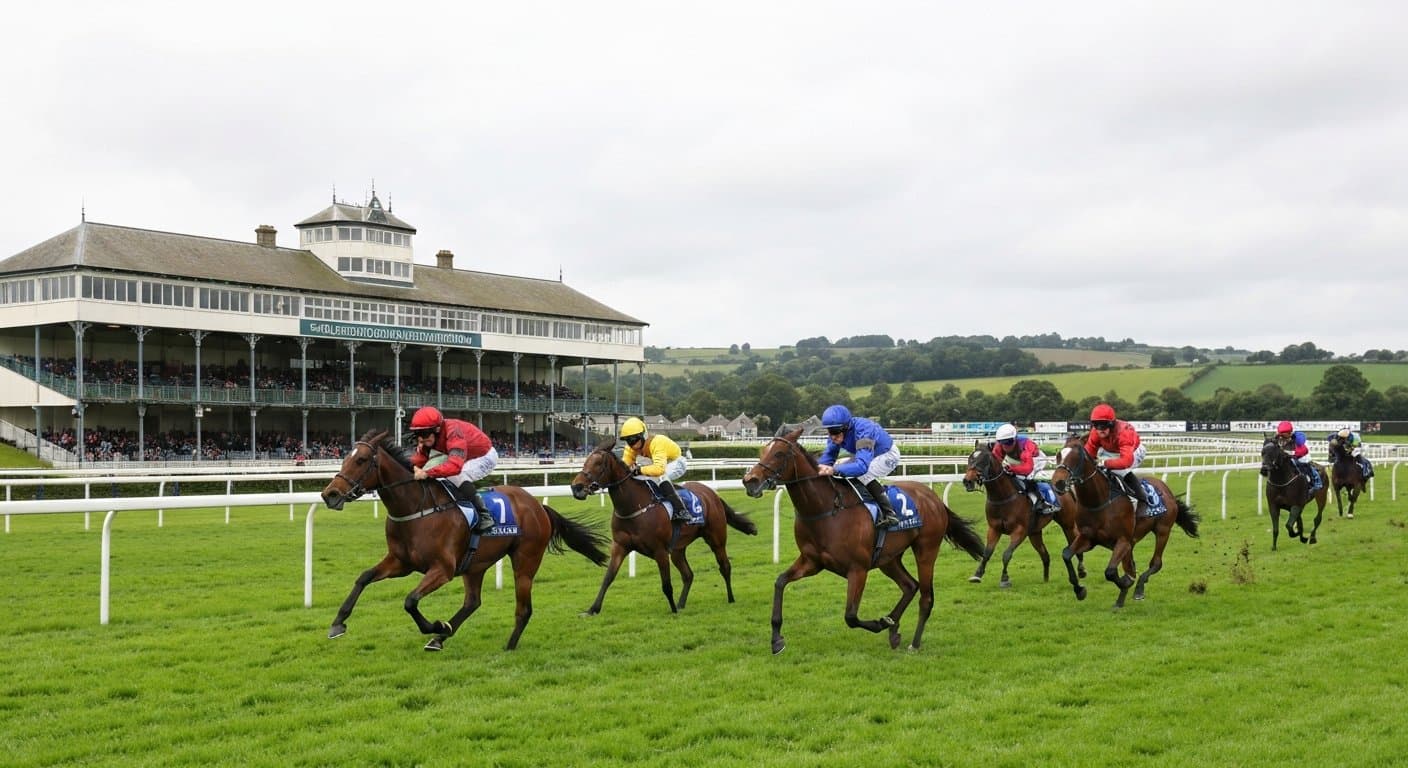
Evening Racing at Hamilton Park Racecourse
Your guide to evening racing at Hamilton Park — where British evening racing began in 1947, with summer nights in the Lanarkshire countryside.
Read moreHamilton Park Festival Guide
Your complete guide to Hamilton Park Racecourse — Scotland's busiest flat track, the summer sprint programme and what makes this Lanarkshire course the heart of Scottish flat racing.
Read moreResearch the field with the AI Race Predictor
Our model publishes calibrated win-probability estimates for UK races — a second opinion to understand a race, not tips. It's open about its record: it doesn't beat the market, and we show exactly how it does.
Work it out & learn the basics
Gamble Responsibly
Gambling should be entertaining and not seen as a way to make money. Never bet more than you can afford to lose. If you or someone you know has a gambling problem, help and support is available.