
Founder & Editor · Last reviewed 2026-04-04
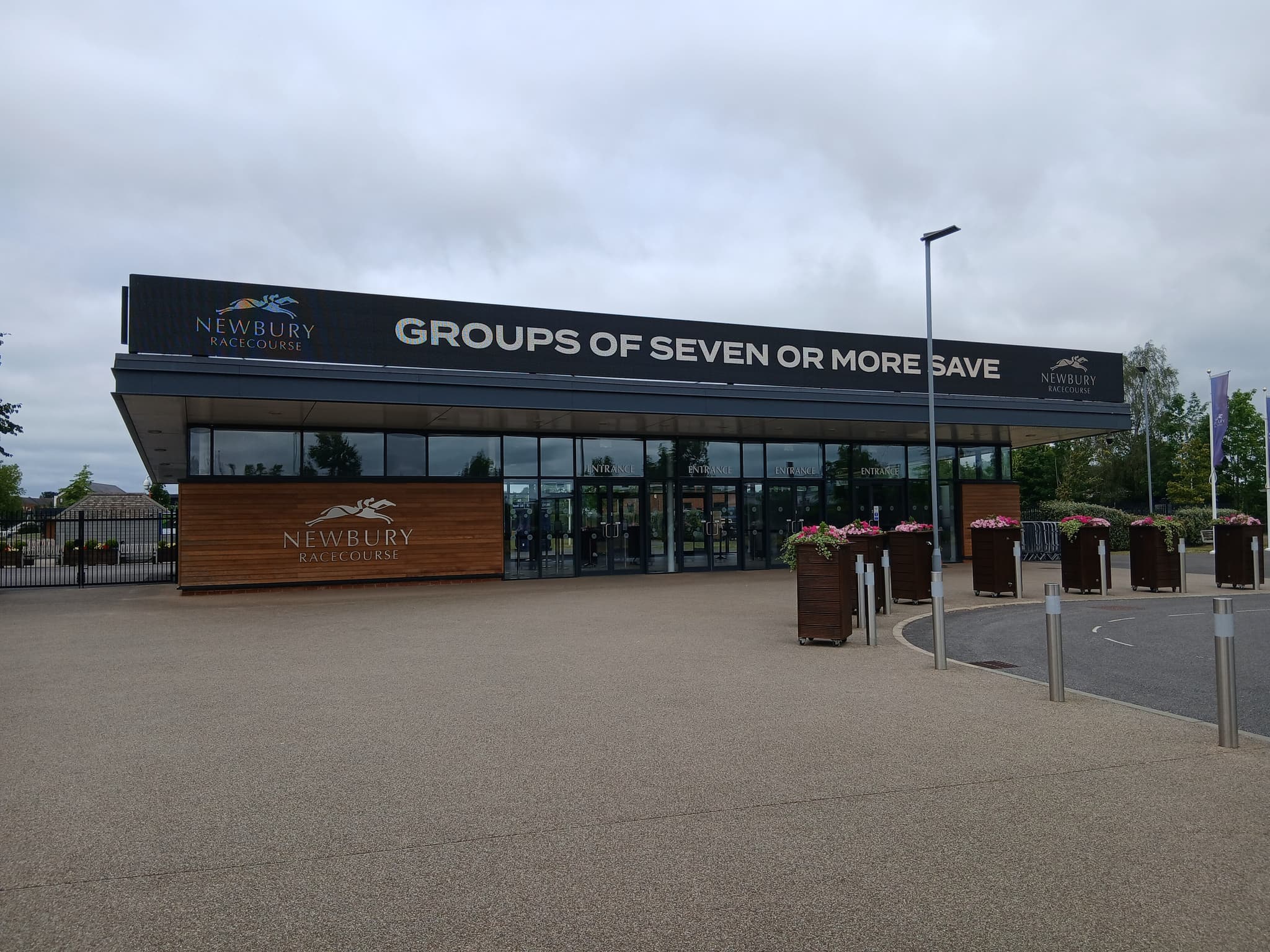
Newbury Racecourse opened in 1905. That's not old by the standards of British racing. Newmarket was staging matches in the 1600s, and Epsom hosted its first Derby in 1780. But relative youth hasn't stopped Newbury from accumulating one of the most distinguished records of any course in the country. Within fifty years of opening, it had hosted two world wars, inaugurated one of jump racing's greatest prizes, and watched Arkle do things on a racecourse that most people still struggle to believe.
The story of Newbury is, at its core, the story of a deliberate act of creation. This wasn't a course that evolved from a local fair or a stretch of common land that happened to suit racing. John Porter, the most successful trainer of the Victorian era, looked at the Berkshire countryside near his Kingsclere stables and decided to build something from scratch. He chose the site, secured the land, designed the layout, and lobbied for a dedicated railway station. The result was a course built exactly as intended: flat, fair, and wide. A place where ability wins.
That design philosophy has shaped everything since. When Arkle carried 12st 7lb to victory in the 1964 Hennessy Gold Cup, he did it on a course where there was nowhere to hide. When Frankel won the Lockinge Stakes in May 2012 by five lengths as a 1/6 favourite, the galloping straight exposed every rival's limitations in the clearest possible terms. Newbury doesn't produce fluky results. The best horses win, and they win convincingly.
Between the racing, there were requisitions. German prisoners of war occupied the infield during the First World War. American troops prepared for D-Day in the second. Both times, racing returned. Both times, the course picked up more or less where it left off, because the infrastructure was solid and the location hadn't changed — still accessible from London by direct rail, still a fair track on the right side of the Berkshire Downs.
This article covers the full span: from Porter's founding vision and the 1905 opening through both wars, the Hennessy era and Arkle's two visits, Denman's back-to-back victories, the Lockinge's rise to Group 1, Frankel's final season appearance, the modern redevelopment, and the course's place in racing today. Each period left something permanent behind, and together they explain why Newbury matters as much now as it did when it opened.
Origins & Foundation (1905)
Origins and Foundation (1905)
John Porter's Idea
The man behind Newbury Racecourse had already achieved everything the racing world could offer. John Porter was born in 1838 and trained at Kingsclere, in the Hampshire hills a few miles south of Newbury. Between 1868 and 1894 he sent out seven Derby winners, six St Leger winners, and five Oaks winners from those same stables. His patrons included the Prince of Wales, who later became King Edward VII. By the time Porter stepped back from training at the turn of the twentieth century, he was the most decorated trainer of the Victorian era.
What he didn't have was a proper racecourse nearby. The county of Berkshire was home to some of the finest training centres in the country (Lambourn to the north, Kingsclere to the south), yet the nearest quality tracks were Ascot, thirty miles east, and Salisbury, thirty miles south. Porter had spent decades watching well-bred horses travel unnecessary distances to race on tracks that weren't ideally suited to them. He thought Berkshire could do better.
His concept was clear from the start: a flat, wide, left-handed oval, built on ground that drained well, with long straights that would give horses room to race without interference. Nothing tricky, nothing quirky. A track where the best horse won.
Finding the Right Ground
The site Porter identified was Enborne Heath, a stretch of open land on the southern edge of Newbury town. It was well-drained, relatively flat, and right beside the Great Western Railway's main line between London Paddington and the West of England. Porter had spent enough time watching carriages and, later, trains bring crowds to racecourses to understand that transport was not a secondary consideration. It was the difference between a course that attracted London money and one that scraped along on local custom.
Parts of Enborne Heath were common land, which complicated matters. Enclosing common land required parliamentary approval, and there were objectors: local people who used the heath for grazing and recreation. Porter worked through those obstacles with the persistence of a man who had been dealing with difficult owners and difficult horses for forty years. He was well-connected, respected, and persuasive. The local MP lent his support. A company was incorporated, capital was raised from local landowners and racing investors, and a parliamentary bill secured the necessary permissions.
Construction began in 1904.
Building a Purpose-Made Course
The course was designed with care. Porter wanted the straight to be long enough that a horse could bowl along at its best pace rather than being shuffled around tight bends. The home straight at Newbury runs to roughly five furlongs, among the longest in Britain. The turns are gentle and wide, which means that position at the start of the straight matters far less than it does at courses where horses are bunched into a sharp bend. This layout has direct consequences for racing: Newbury produces fewer pace-dependent results than most tracks, which is one reason trainers trust it.
The grandstand was built in red brick, functional, solid, and considered modern for 1905. Facilities for owners, trainers, and the press were designed from scratch rather than bolted onto older structures, which gave the course a coherence that many established venues lacked.
The most forward-thinking decision was the railway station. Porter and the course's backers lobbied the Great Western Railway to build a dedicated halt on the main line, right beside the racecourse gates. Newbury Racecourse station opened in 1905 alongside the course itself, giving racegoers from London Paddington a direct, comfortable journey of under an hour. This was not standard practice. Very few racecourses had their own dedicated stations. Those that did, like Kempton Park, enjoyed a significant commercial advantage. Porter knew it, and he made sure Newbury had one from day one.
Opening Day
Newbury Racecourse held its first meeting on 26 September 1905. The day went well: large crowds arrived, the racing was competitive, and the press covered it favourably. Among those who attended was the Prince of Wales (the future King George V), whose presence gave the new venture an immediate stamp of social credibility.
The quality of racing from the first season was higher than many expected of a brand-new track. Trainers from Lambourn and Kingsclere sent horses, as did yards from further afield. The Berkshire location, split between London's sphere of influence and the west country's racing culture, meant it could draw from both. Within a few years Newbury was hosting pattern races and important handicaps that attracted competitive fields.
Why the Design Mattered
Porter's insistence on a fair, galloping layout had consequences that outlasted him by more than a century. Because Newbury doesn't reward positional good luck or front-running bias, a horse's performance there is more transferable than one from a quirky track. Trainers use it as a yardstick. A horse that wins well at Newbury is almost certainly capable of winning on a similar surface elsewhere: Cheltenham's New Course, Haydock, Sandown's straight mile.
The course's reputation for fairness became one of its most important commercial assets. Top trainers trusted it with their best horses. Owners wanted their animals to run there. The fixture list filled with quality, and quality drew crowds.
Era takeaway: Porter built Newbury to suit horses, not spectacle. The wide galloping layout, long home straight, and dedicated railway station were deliberate choices that shaped the course's character for the next 120 years. Most racecourses inherit their quirks from history. Newbury's strengths were designed in from the start.
Newbury at War (1914–1945)
Newbury at War (1914–1918 and 1939–1945)
The First World War
Newbury had been open for nine years when war was declared in August 1914. Racing across Britain shut down almost immediately. The Jockey Club suspended flat racing in May 1915, and National Hunt racing followed. The practical reason was partly military (horses, oats, and transport were all needed elsewhere) and partly moral: it seemed wrong to stage sport while men died in France.
Newbury Racecourse was requisitioned by the War Office shortly after the outbreak of hostilities. Unlike some courses that became training depots or military hospitals, Newbury took on a more unusual role: prisoner of war camp. German prisoners, captured on the Western Front and elsewhere, were held on the course infield behind wire fencing. The grandstand, the stable blocks, and the open land around the course were all pressed into military use.
The course remained in this state for the duration of the war. Racing didn't return until 1919, by which time the turf had been worn and the facilities were in need of attention. The physical damage was manageable. The social and financial disruption was harder to measure. Four years without a fixture meant four years without income, without crowds, without the accumulated momentum of a racing programme. The course had to rebuild from scratch.
Recovery came steadily through the early 1920s. The fixture list was rebuilt, the facilities were repaired, and racing quality returned to something close to pre-war levels by the middle of the decade. It took time, but the fundamentals of the course (location, layout, rail access) were untouched by the war. They remained as strong as Porter had made them.
The Interwar Years
The period between the wars was one of steady development at Newbury. National Hunt racing was added to the calendar, complementing the flat programme and beginning the course's dual-purpose identity. The Berkshire racing community expanded through the 1920s and 1930s, with the Lambourn Valley growing as a training centre and sending ever-increasing numbers of horses through the course's gates.
Newbury hosted competitive fields across both codes through this period, though no single race yet defined the course in the way the Hennessy would later do. The Berkshire Stakes and other established flat races drew good fields. The early jumps programme began to find its feet. By the late 1930s, the course was in the best shape it had been since opening.
Then Germany invaded Poland.
The Second World War
Newbury was requisitioned again in the autumn of 1939, even before racing fully ceased. This time, the course's role was different: it became a military base for Allied forces. The site's proximity to good road and rail links into southern England made it useful for troop movements and logistics.
The most significant chapter of the course's wartime history came in the months before D-Day in June 1944. American troops preparing for the Normandy landings were stationed across southern England, and Newbury Racecourse was among the sites used by the US Army. The scale of the preparation for Operation Overlord was immense. Hundreds of thousands of soldiers needed feeding, housing, training, and supplying across a region that had to absorb them without drawing German attention to the invasion's timing or direction.
General Dwight D. Eisenhower, Supreme Commander of the Allied Expeditionary Force, reportedly reviewed troops at Newbury Racecourse during this period. Whether he stood on the track itself or in the surrounding grounds, the detail captures something about the course's wartime function: it was large, accessible, and centrally located enough to serve as a staging point for one of the most consequential military operations in history.
Racing resumed in 1945 and 1946 as the war ended and normality slowly returned. The course was again in need of repair. Years of military use had not been kind to the turf, and the facilities needed work. But as after 1918, the core assets were intact. The track was still flat. The station was still there. And racegoers, starved of racing for years, came back eagerly.
What the Wars Left Behind
Twice in thirty years, Newbury was taken over and put to uses its founder hadn't imagined. Twice it came back. That resilience owed something to the quality of the original construction. Porter built facilities that could withstand hard use. It also owed something to the course's strategic location, which made it valuable in wartime as well as in racing.
The more lasting consequence was cultural. Newbury was old enough by 1945 to have history, to have a roll of honour, to have racegoers who remembered pre-war meetings and wanted to get back to something recognisable. That sense of continuity mattered in the post-war world, where British institutions were rebuilding their identities alongside their infrastructure.
Era takeaway: Newbury lost nearly eight years of racing to the two world wars. The course served as a German prisoner of war camp in the first conflict and an American military base in the second. Both times it recovered, because the fundamentals Porter built into the site in 1905 (location, layout, transport links) were untouched by the requisitions. The interruptions delayed Newbury's development but didn't alter its direction.
The Hennessy Gold Cup Era and Arkle
The Hennessy Gold Cup Era (1957–2016)
How the Race Was Born
In 1957, a French cognac house agreed to sponsor a new three-mile-two-furlong handicap chase at Newbury in late November. The Hennessy Gold Cup was not an existing race given a commercial partner. It was created specifically for this slot, this course, and this time of year. The timing was deliberate: late November sat between the start of the jumps season and the Christmas period, giving the best staying chasers their first major test of the campaign.
The inaugural running in 1957 was won by Mandarin, trained by Fulke Walwyn. Mandarin was a tough, honest chaser who would go on to win the King George VI Chase and produce one of jump racing's most extraordinary stories: the 1962 Grand Steeplechase de Paris, where his bit broke after the first fence and jockey Fred Winter rode him home with his legs alone for the remaining three miles. But Mandarin's first Hennessy win, at Newbury in 1957, was where that story began.
From its first running, the race attracted fields of real quality. The combination of a substantial prize, a prestige sponsor, and a track that tested staying chasers without resorting to severe gradients or tight turns made it appealing to top trainers. By the early 1960s it was firmly established as one of the most important chases outside Cheltenham. And then, in November 1964, it became something more.
Narrative Anchor: Arkle at Newbury, 1965
November 1965. Arkle walks into the parade ring carrying 12st 7lb — more than any horse in the race by two stone. The crowd stands six deep along the rails. He is unhurried, ears forward, and Pat Taaffe barely needs to gather the reins. When the tape rises, Arkle settles in midfield, jumping with an economy that makes the fences look smaller. At the third last he moves wide and begins to go. By the last fence no rival is in his vicinity. Taaffe is motionless. Arkle wins by fifteen lengths.
Arkle at Newbury: 1964 and 1965
Arkle won the Hennessy Gold Cup in both 1964 and 1965. Taken together, those two performances amount to the most extraordinary thing that happened at Newbury during the twentieth century, and they have few rivals anywhere in the history of jump racing.
In 1964, Arkle was already recognised as an exceptional horse. He had won the Cheltenham Gold Cup in March that year, beating Mill House, then considered the best staying chaser in Britain. At Newbury in November, the handicapper had given him 12st in an attempt to bring the field together. Trained by Tom Dreaper in County Meath and ridden throughout his career by Pat Taaffe, Arkle won the 1964 Hennessy without being fully extended. He carried his weight with an ease that suggested the handicapper hadn't gone nearly far enough.
The following year, 1965, the handicapper responded by assigning Arkle 12st 7lb, the maximum permitted under the rules. No horse carrying that weight in a competitive staying chase had any realistic expectation of winning. The weight was designed to make the race a fair contest, to compensate for what everyone could see was a horse operating on a different level from his rivals. Arkle treated it as irrelevant.
He won by fifteen lengths, with Pat Taaffe motionless in the saddle for most of the final circuit. The second horse, Freddie, was a very good chaser who had pushed Mill House close earlier that season. The gap between Arkle and Freddie in the Hennessy was not a gap between a champion and a moderate horse. It was a gap between Arkle and a very good chaser. That tells you something about what Arkle was.
What made the Newbury wins particularly striking was the weight. Arkle's Cheltenham Gold Cups are often cited as his greatest achievements, but Gold Cup racing is level weights: every horse carries the same. The Hennessy handicap was specifically designed to bring the best horses down to the level of their rivals. Arkle ignored it. He carried more weight than any other horse in the field, in a race designed to neutralise superior ability, and he still won by a distance. Twice.
The crowds at Newbury in those two Novembers knew what they were watching. Pat Taaffe spoke afterwards with a quiet directness that was characteristic of the man: he said the horse had plenty left. The figures confirmed it. Arkle was clocked jumping the last fence on the bridle, with the race already won.
There is a detail worth noting about the 1965 Hennessy that goes beyond racing. Arkle was already a public figure in Ireland and Britain in a way that no jump racing horse had been before: receiving fan mail, appearing on television, recognised by people who didn't follow racing. His Newbury appearances were events. The late-November crowds at Newbury in 1964 and 1965 were larger than usual partly because people wanted to see him, not just to bet on a race.
His final Cheltenham Gold Cup came in 1966. He broke down in the King George VI Chase in December 1966 and never raced again. The two Hennessy wins at Newbury are therefore among the last complete expressions of what he could do. No injury, no decline, just a horse operating as close to his ceiling as any jumping horse in recorded history.
Era takeaway: The Hennessy Gold Cup arrived in 1957 as a new prize for a November slot. Mandarin gave it credibility in its first year. Arkle gave it immortality in 1964 and 1965. The race became inseparable from Newbury's identity, and Arkle's two visits are still the most cited performances in the course's history.
Denman: 2007 and 2009
The Tank Arrives
Forty-two years after Arkle's second Hennessy, another horse came to Newbury in November and did something that made the racing world pay attention. Denman was trained by Paul Nicholls at Ditcheat, Somerset. He was large, strong, and relentless. A horse that got into a rhythm over his fences and refused to slow down. When he arrived at the 2007 Hennessy carrying 11st 12lb, he was an exciting young chaser who had won a Grade 1 novice chase the previous season. The Hennessy was his first serious test against experienced, top-class opposition.
He passed it decisively. Sam Thomas rode him, and Thomas barely needed to work. Denman settled mid-division, made his fences look straightforward, and began to press from the back of the final turn. The horses around him started to struggle. Denman didn't. He won by eleven lengths, pulling away through the final furlong with his ears pricked, carrying his weight as though it wasn't there.
The phrase that circulated in the press box afterwards, which became a shorthand for Denman's style, was that he had "pulled a cart." The sense was of a horse so far within himself, so far below his ceiling, that the race was a casual exercise. He finished that season by winning the Cheltenham Gold Cup in March 2008, beating his stablemate Kauto Star. The Newbury form had been correct.
The Return in 2009
What happened next made Denman's second Hennessy win more moving than his first. In early 2009, he was diagnosed with atrial fibrillation, a heart condition that disrupted the electrical rhythms regulating his heartbeat. His Cheltenham Gold Cup defence was abandoned. He spent months away from racing. The prognosis was uncertain.
He came back in the autumn of 2009, and Paul Nicholls sent him to Newbury for the Hennessy again. The racing public was unsure what to expect. He was still only eight years old, but a serious cardiac episode was not something any horse recovered from with certainty. The question wasn't whether he could win but whether he was the same horse at all.
He was. Under Ruby Walsh, who replaced the injured Sam Thomas, Denman carried 11st 12lb again and won by three lengths. He wasn't as imperious as in 2007. The margin was smaller, the effort slightly more visible. But he was back. The Newbury crowd's reception as he was led in was warmer than the first time, because everyone understood what had been at stake.
Denman went on to finish second in the 2010 Cheltenham Gold Cup, giving Kauto Star eight lengths at the weights. He was never quite the same force after the heart condition, but two Hennessy wins and a Gold Cup represent a record that most staying chasers would envy.
His two victories at Newbury sit alongside Arkle's in the Coral Gold Cup roll of honour. Different in style (Arkle's wins were characterised by effortless class; Denman's by grinding power), but each one a display of a horse operating at a level the handicapper couldn't fully account for.
Era takeaway: Denman's 2007 Hennessy established him as a Gold Cup contender. His 2009 win confirmed he had recovered from a potentially career-ending heart condition. Both victories came at Newbury, and both were won under top weight. The pattern matched Arkle's from forty years earlier: a horse that made the weight irrelevant.
The Lockinge Stakes and Frankel
The Lockinge Stakes: Newbury's Flat Flagship
Origins and Elevation
The Lockinge Stakes is named after the Lockinge Estate, a large agricultural and woodland estate a few miles north of Newbury near Wantage, in the Vale of White Horse. The estate was historically associated with the Loyd family, and the race bearing its name was first run in 1958, three years after the course opened and one year after the Hennessy arrived.
For its first few decades the Lockinge sat in the programme as a valuable mile race in May, a useful prep for horses heading to Royal Ascot or targeting the summer's top mile contests. It attracted decent fields but didn't carry the status of the races at the Classics venues. That changed in 1995, when the Lockinge was awarded Group 1 status by the pattern race committee, placing it alongside the 2000 Guineas, the Sussex Stakes, and the Queen Anne Stakes as one of the defining mile races on the European calendar.
The elevation reflected what the race had become. By the mid-1990s, Newbury's galloping mile was well-established as the most reliable test of miling ability available in May. The long straight exposed weaknesses. The course's fair layout meant the result was trusted. Top trainers had been sending good horses to it for years. The Group 1 status confirmed what the results had been showing.
Brigadier Gerard (1972)
Before the Group 1 era, the Lockinge had already produced one of the great performances in British flat racing. Brigadier Gerard, trained by Dick Hern at West Ilsley near Newbury, won the 1972 Lockinge as part of an unbeaten sequence that reached seventeen consecutive victories before his sole career defeat. He was at his peak in 1972, winning six races including the Prince of Wales's Stakes and the King George VI and Queen Elizabeth Stakes. His Lockinge victory that year was the work of a horse for whom Group 1 competition was insufficient challenge.
The Brigadier's career is one of the great chapters in British racing history, and he was a Berkshire horse, trained on the Downs not far from where he ran. His Lockinge appearances were local events in the best sense, though the quality of the racing was anything but parochial.
The Group 1 Era
Since 1995, the Lockinge has been won by a roll-call of the best milers in training. Paco Boy won it. Night of Thunder won it after landing the 2014 2000 Guineas. Bated Breath won it. Palace Pier, one of the dominant milers of recent seasons, won it in 2021. Inspiral won it in 2022. The list is a reliable index of miling excellence across three decades.
What the Lockinge does well, specifically, is identify horses who can sustain top speed for a full mile on a demanding, fair track. The May timing, early in the season, means there's a freshness to the competition. Horses arrive off their winter breaks, well-prepared by trainers who know that a strong Lockinge performance sets up everything that follows.
Frankel at Newbury and the Cecil Connection
Two Visits, Two Meanings
Frankel ran at Newbury twice in his unbeaten career. His first visit came in April 2011, in the Greenham Stakes, a seven-furlong Group 3 used as a prep race for the 2000 Guineas. He won, though not in the manner that would become his signature. The Guineas followed, and then the sequence of performances that made him the highest-rated horse in the world.
His second visit, to the Lockinge Stakes on 19 May 2012, was different in character. By then, Frankel was a four-year-old who had spent the winter at Warren Place, Cecil's yard in Newmarket, the question of whether he would stay sound for a second campaign occupying everyone who cared about him. He returned to work in early 2012. The Lockinge was chosen as his seasonal debut.
The Day of the Lockinge, May 2012
Frankel went off at 1/6. That is a price that says: the question isn't whether he'll win, the question is by how much. He was ridden by Tom Queally, as he had been throughout his career, and he was drawn to the middle of the track. The pace was honest from the start. Frankel settled better than he had in some of his earlier races. Cecil had worked hard over the winter to channel the horse's extraordinary energy rather than letting it combust in the first furlong.
He hit the front with two furlongs to run and drew clear without drama. The winning margin was five lengths. In a race of that calibre, five lengths is a distance. The time was fast. He was still on the bit when he crossed the line.
The crowd at Newbury that day knew what they were watching. Frankel had become, by May 2012, a racing figure who transcended the sport's usual audience. People who didn't normally attend race meetings had come to Newbury to see him. The reception as he came back to the winner's enclosure was loud and long.
Henry Cecil: The Last Season
The context that made the 2012 Lockinge more than a race result was Henry Cecil. Frankel's trainer had been diagnosed with stomach cancer in 2008. He had continued training through illness, though his yard's numbers were reduced and there were periods when his health deteriorated sharply. By 2012, he was visibly unwell: gaunt, moving carefully, but present at the races that mattered.
Cecil was at Newbury for the Lockinge. He stood in the winner's enclosure, wearing his customary pale clothes, and received congratulations with the quiet grace that characterised him. Photographs from that day show a man who was clearly ill but entirely concentrated on what was happening around him. He died on 11 June 2013, aged seventy.
Frankel's career ended after the 2012 Champion Stakes at Ascot in October, his fourteenth and final win, completing a perfect record of fourteen races, all won. The Newbury Lockinge was his thirteenth victory, his penultimate race, and the last time many people saw Cecil at a racecourse in anything close to full engagement with his horse. The combination of what Frankel was and what Cecil was going through gave that Newbury afternoon a quality that went beyond the form book.
Era takeaway: The Lockinge's elevation to Group 1 in 1995 formalised what the race had become over thirty-seven years. It was the first major test of miling class in the European flat season. Frankel's 2012 appearance gave it a moment that exists partly as racing history and partly as something else: the last good day of a great trainer watching his best horse do what he'd taught it to do.
Modern Newbury and Legacy
Modern Newbury: Development and the Present Day
Rebuilding the Facilities
The early years of the twenty-first century brought a major programme of physical investment to Newbury. The course's original grandstand, built in 1905 and added to in subsequent decades, was no longer fit for purpose by the 2000s. Racegoers expected better facilities, hospitality clients demanded modern infrastructure, and the course needed income from non-racing events to remain financially sustainable.
The Berkshire Stand, opened in 2000, was the main result of that investment. It replaced older structures along the home straight with a purpose-built facility offering multiple levels of viewing, corporate hospitality suites, and the kind of amenities that allow a racecourse to compete with other leisure venues for discretionary spending. The design was considered and practical rather than showy, which suited Newbury's character.
Behind the scenes, drainage improvements were made to the track, and the course's grounds staff developed a reputation as some of the most skilled in British racing. Newbury's ability to stage safe racing in difficult conditions (soft ground without becoming waterlogged, good ground without cracking) reflects decades of attentive management of a course built on ground that Porter chose well in 1904.
The Housing Development Controversy
The course's commercial strategy through the 2010s included a decision that generated significant debate. Newbury Racecourse sold part of its land for residential development: a housing scheme on the site's edges that provided revenue to fund continued investment in the racing operation. For racing traditionalists, the idea of a racecourse selling land to house builders was difficult. For the course's management, it was a practical response to the economics of modern racing: prize money, maintenance, and facility costs are substantial, and land values in Berkshire are high.
The development went ahead. The revenue funded further improvements to the course. Whether it was the right decision depends partly on your view of how racecourses should be run, and partly on whether you think the racing product has improved as a result. On both the flat and jumps, Newbury's racing quality has remained at the top level through the 2010s and 2020s, which suggests the trade-off was managed reasonably.
The Race Name Changes
In 2016, the Hennessy Gold Cup became the Ladbrokes Trophy after fifty-nine years of cognac sponsorship. The change was hard for long-standing racegoers. "The Hennessy" had become a fixture in the language of racing, a shorthand that carried immediate meaning across several generations of followers. When the name changed, something familiar disappeared.
The race's quality didn't diminish. The Ladbrokes Trophy continued to attract fields of top-class staying chasers. Native River won in 2017 under top weight and went on to win the 2018 Cheltenham Gold Cup. The form held. Cloth Cap won with an authoritative front-running display in 2020. When Coral took over the sponsorship in 2018, the race became the Coral Gold Cup, a name that has gradually settled.
The Betfair Hurdle, run over two miles and a half in February, has meanwhile grown into one of the most heavily backed handicap hurdles of the season. Carried by a combination of the February timing (when punters are hungry for a competitive event after the Christmas period) and a consistently competitive field, the race generates significant betting turnover and draws a large crowd to Newbury at a quiet point in the winter calendar.
Fixture List and Programme
Newbury currently hosts around twenty-five to thirty race meetings per year across both codes. The flat season runs from spring to autumn, anchored by the Lockinge in May and a series of valuable summer fixtures. The jumps programme runs from October through to March, with the Coral Gold Cup in late November as the season's highlight.
The course's proximity to the Lambourn Valley, home to more than forty licensed trainers, means it continues to attract runners from the most powerful yards in British racing. Nicky Henderson's Seven Barrows stable, less than twelve miles away, sends significant numbers to both codes. Paul Nicholls in Somerset is a short drive. John and Thady Gosden have sent multiple high-class flat horses to the Lockinge meeting.
Newbury's Legacy
What Porter built in 1905 was a racecourse designed on principle rather than evolved by accident. The flat galloping layout, the long home straight, the dedicated railway station, the well-drained ground on the southern edge of a market town with direct rail access to London: all of those features are still present, and still matter.
The roll of honour at Newbury is a credible record of quality: Arkle, Frankel, Denman, Brigadier Gerard, Mandarin, Native River, Frankel. The connection between the course's fair character and the quality of its winners is not coincidental. The best horses win at Newbury because there's nowhere to hide in a race run on this track. Position doesn't save you. Weight concessions in handicaps are real. The run to the line is long enough that the horse who gets there first is the one who deserved to.
For trainers, racegoers, and those who follow the form, that reliability is worth more than almost any other quality a course can have. Newbury produces results you can trust. In British racing, where the calibre of a horse's performance at one track tells you something useful about what it will do elsewhere, that reliability matters.
Era takeaway: Twenty-first-century Newbury has invested in its facilities, navigated commercial pressures with a mixture of pragmatism and controversy, and maintained the quality of its racing programme through a period when many courses have struggled. The Coral Gold Cup and the Lockinge remain two of the most important races on their respective calendars. The course John Porter built in 1905 is still doing what he intended it to do.
Frequently Asked Questions
Share this article
More about this racecourse
All Newbury guides
Frankel at Newbury: The Greenham and the Lockinge
Frankel won twice at Newbury: the 2011 Greenham Stakes and the 2012 Lockinge Stakes. Here is the full story of the greatest racehorse's Berkshire chapter.
Read more
Coral Gold Cup Day at Newbury: The Complete Guide
Everything you need to know about Coral Gold Cup Day at Newbury — the most prestigious staying handicap chase in Britain outside the Grand National. Racing card, atmosphere, tickets, travel and betting guide.
Read more
The Coral Gold Cup at Newbury: Complete Guide
Your complete guide to the Coral Gold Cup — Newbury's famous late-November staying handicap chase, formerly the Hennessy Gold Cup.
Read moreGamble Responsibly
Gambling should be entertaining and not seen as a way to make money. Never bet more than you can afford to lose. If you or someone you know has a gambling problem, help and support is available.