
Founder & Editor · Last reviewed 2026-04-05
Newton Abbot Racecourse is National Hunt racing's southernmost summer outpost on the English mainland. Opened in 1866, it sits at Totnes Road in the town of Newton Abbot, Devon — TQ12 3AF — and has spent more than 150 years staging jumps racing in a county better known for cream teas and coastal walking. The course is left-handed, runs on a tight oval of approximately one mile and one furlong, and operates exclusively as a summer venue, with fixtures running from May through to September each year.
The practical position of the track matters. Newton Abbot station — one of the busiest on the Great Western mainline between London Paddington and Plymouth — sits around ten minutes' walk from the entrance gate. Direct trains run from London Paddington in approximately two hours and 30 minutes, from Bristol in about one hour 20 minutes, from Exeter in 15 minutes, and from Plymouth in 25 minutes. Very few National Hunt tracks in England offer that kind of rail access, which is one reason the course draws racegoers from well beyond Devon.
The racing itself is shaped by the circuit. At roughly 1m1f round, the oval is one of the sharpest in Britain. Turns arrive quickly, the back straight carries three fences on the chase course, and horses that sit handy and jump cleanly consistently outperform those who need time and room to wind up. That tactical quality runs through the entire card at every meeting, from maiden hurdles to the Aubrey Loze Memorial Handicap Hurdle.
The course races in the summer National Hunt calendar alongside Cartmel, Worcester, Stratford, and Perth — a group of tracks that keeps jump racing alive between the Cheltenham Festival in March and the reopening of the major northern and Midlands courses in the autumn. For Devon's racing public, Newton Abbot is the heartbeat of local National Hunt sport. Exeter is the county's other jumps course, but Exeter is more formal, more uphill, and more of a winter venue. Newton Abbot has claimed the summer, and it does so with an atmosphere that reflects the holiday mood of the surrounding region.
Who This Guide Is For
First-time visitors will find the sections on the course layout, facilities, and getting there the most immediately useful. The August Bank Holiday fixture is the recommended starting point for anyone new to the course — it offers the best racing of the season and a crowd of 6,000–8,000 that makes the atmosphere feel truly special.
Regular racegoers who know Devon racing will find the course layout analysis and the FAQ section useful for drilling into the tactical details that shape results at this track. The going analysis in the course section is particularly relevant for anyone approaching Newton Abbot from a betting angle.
History-focused readers should head to the history section which covers the course from its Victorian founding in 1866 through to the present day, including the moments and trainers that have defined its character over 150-plus years.
Trip planners combining racing with a Devon holiday should read the atmosphere and planning section alongside the getting there section. Dartmoor National Park begins approximately five miles to the west; Torquay and Torbay are five miles to the south-east; Totnes is six miles to the south. Newton Abbot sits at the intersection of several of Devon's best-known destinations.
Quick Decisions: Newton Abbot at a Glance
- Best meeting to attend: the August Bank Holiday fixture, typically the last Monday in August, the course's flagship day with crowds of 6,000–8,000
- Best enclosure for value: the Course Enclosure for atmosphere and proximity to the action; the Premier Enclosure for paddock access and facilities
- Best position on the track: anywhere along the home straight gives clear views of the final fence and the run-in; the stands on the home turn show the full oval
- Rail access: Newton Abbot station is around ten minutes on foot from the gate — trains run from London, Bristol, Exeter, and Plymouth
- Going to watch: Devon clay holds water; the going is typically good to soft or soft through summer; firm going is rare even in drought conditions
- Trainers to follow: David Pipe (Nicholashayne, 30 miles), Philip Hobbs (Minehead, 40 miles), and Paul Nicholls (Ditcheat, 60 miles) all target this course with purpose
- Season dates: May to September; around 15 fixtures per year; no winter racing
Newton Abbot's combination of easy access, a proper test of jumping, and a relaxed summer atmosphere sets it apart from most other National Hunt venues. This guide covers the course layout, key fixtures, facilities, how to get there, and a full FAQ. For those approaching from a betting angle, the betting guide and the summer jumping guide provide the deeper tactical analysis.
Bet on Newton Abbot
Place your bets on Newton Abbot races with a trusted bookmaker.

Promo code BETFRED50. New customers only. Register, deposit with a Debit Card, and place a first bet of £10+ at Evens (2.0)+ on Sports, to be settled within 7 days, to get £30 in Sports Free Bets and £20 in Bet Builder Free Bets within 24 hours of settlement. 7-day expiry. Eligibility & payment exclusions apply. Full T&Cs apply. Take Time to Think. BeGambleAware.org. 18+. Full T&Cs.

Promo code R30. New UK customers only, 18+. Register, deposit £10 or more, then place a £10 single cash bet at odds of 1/2 (1.5) or greater on any sports market (excluding Virtuals). Once the qualifying bet settles you get £30 in Free Bets (3 x £10) — the qualifying bet can win or lose. Free Bets are valid on any sports market excluding Virtuals, expire in 7 days, are non-withdrawable and must be used in full. Excluded deposit methods apply (including PayPal, Apple Pay, Skrill and NETELLER). Named bets such as Lucky 15 do not qualify. If you cash out the qualifying bet, or it is voided, you are no longer eligible for the offer. Ends 31.12.26. Full T&Cs apply. Please gamble responsibly. BeGambleAware.org. 18+. Full T&Cs.

Promo code BET40GET20. New UK customers, 18+. Register with the code and place a first bet of £40 or more at Evens (2.0) or greater. Receive 2 × £10 free bets: the first credited automatically once the qualifying bet settles, the second 24 hours later. Free bets must be placed at minimum odds of 4/1 (5.0), expire 24 hours after credit, and the free-bet stake is not returned with winnings. Debit card deposits only. Take Time to Think. BeGambleAware.org. 18+. T&Cs apply. Full T&Cs.

50% of your first-day net losses refunded as a free bet, capped at £25. New UK customers aged 18+ only. To qualify, deposit and place a first bet of £10 or more on any sport at minimum odds of evens (2.00), then place at least two further bets on different events, each worth at least 50% of your largest bet, all at evens (2.00) or greater. Losses are counted from your first settled bet until 23:59 the same day. Place a qualifying £10+ bet and you are guaranteed at least a £5 free bet. Bets placed at SP, void bets, cashed-out bets and bets struck with free bets do not count towards the offer. The free bet is credited the day after your qualifying bets settle and must be used within 7 days, after which it expires. It can be used at odds from 1/4 (1.25) up to 250/1 on singles and straight accumulators, but not on Trixie, Patent or Yankee style multiples. Free-bet stake is not returned with winnings. One offer per person, household, address, IP address and device. E-wallet deposits may not qualify, so check the cashier before depositing. Customers registered with GAMSTOP cannot claim. KYC identity verification must be completed before the free bet is credited. Take Time to Think. BeGambleAware.org. 18+. T&Cs apply. Full T&Cs.

New customers, 18+. Choose the sports bonus at sign-up, make a first deposit and receive a 100% bonus up to £50 in your Sports Bonus balance. To convert the bonus to cash, wager it 10x within 30 days. Single bets below Evens (2.00) do not qualify; accumulators do not qualify if any selection is below 1/2 (1.50). Virtual Sports, voided, cancelled, drawn, cashed-out and free-bet wagers do not count towards wagering. Only the first settled bet per event counts. Withdrawing before the wagering requirement is met forfeits the bonus balance including bonus winnings. Real-money funds are used before bonus funds. Deposits via Skrill or Neteller are not eligible. Not valid in conjunction with other promotions. Odds, bet and payment limits apply. 10bet general and promotion T&Cs apply. BeGambleAware.org. 18+. Full T&Cs.

New customers in Great Britain and Republic of Ireland, 18+. Place a £10 fixed-odds qualifying bet at minimum odds of 1/2 (1.50) — single or each-way (only the win part counts), pre-event or in-play, not cashed out early, within 28 days of opening the account. Receive up to £60 in bonuses credited over three days: 3 × £10 fixed-odds free bets (the first on settlement, then 24 and 48 hours later) plus 3 × £5 Total Goals FOOTBALL spread bets and 3 × £5 racing Winning Favourites spread bets, with a £1 racing Race Index spread bet as an extra on top. The spread bets need a full spread-betting account, opened within 28 days of the fixed-odds account and subject to Spreadex's eligibility and appropriateness checks. Free-bet stakes not returned with winnings; free bets valid 28 days from issue. IMPORTANT: the £5 credits are SPREAD bets — sports spread betting carries the risk that losses can exceed your stake. Sports spread-betting customers do not have Financial Ombudsman or FSCS recourse. Take Time to Think. BeGambleAware.org. 18+. T&Cs apply. Full T&Cs.

Promo code WELCOME15, entered under My Bonuses after registering. New UK customers, 18+. Place a first qualifying bet of at least £10 from your cash balance at odds of evens (2.0) or greater within 7 days of opening the account. Once the qualifying bet fully settles you receive £15 in free bets, credited as 3 x £5 tokens with set uses: one £5 accumulator free bet (minimum 4 legs, each leg at 2/5 or bigger), one £5 sports free bet (any market at evens or bigger) and one £5 Sub Cover free bet (selected football player markets at evens or bigger). Free-bet stakes are not returned with winnings. Free bets expire 7 days after they are credited. Void, cashed-out and partially cashed-out bets do not qualify. One offer per customer. Confirm the current terms on BetGoodwin's own welcome-offer page before claiming. Take Time to Think. BeGambleAware.org. 18+. T&Cs apply. Full T&Cs.

New UK customers, 18+. Minimum deposit £10. Place a £10 qualifying single on sports (excluding virtuals) at minimum odds of 1/2 (1.50), settled within 14 days. Deposit-method exclusions apply. Receive £30 in free bets (stake not returned), split £20 for sportsbook use (2 x £10) and £10 for Bet Builder only (2 x £5); Bet Builder does not cover horse racing. Free bets must be accepted within 7 days and expire 7 days after acceptance. No promo code required. Best Odds Guaranteed on UK & Irish racing, subject to having staked over £25 in the previous seven days. Operated by LiveScore Betting and Gaming (Gibraltar) Ltd, UKGC 56859. Confirm the current terms on LiveScore Bet's own promotions page before claiming. Take Time to Think. BeGambleAware.org. 18+. T&Cs apply. Full T&Cs.
18+. BeGambleAware.org
The Course
The Course
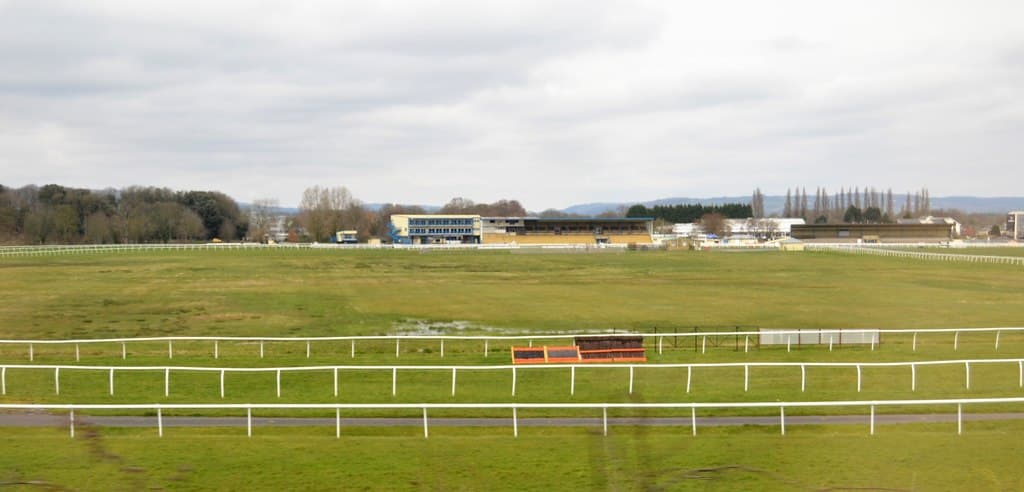
Newton Abbot's track is one of the most technically demanding short circuits on the summer National Hunt calendar. The oval measures approximately one mile and one furlong in circumference, runs left-handed, and is essentially flat throughout — there is no significant elevation change anywhere on the circuit. That combination of tight turns, a flat profile, and a relatively short distance round the full oval creates a very specific set of demands on horses and jockeys alike.
Layout and Direction
The course runs left-handed. From the start, horses travel down a back straight of reasonable length before encountering the first of several turns that define the track's character. The bends at Newton Abbot are not wide, sweeping curves — they are tight enough that horses who race wide consistently lose ground. Jockeys who know the course well tend to hug the rail through the turns, particularly on the home bend, where the track sweeps sharply into the finishing straight.
The finishing straight itself is relatively short by National Hunt standards. Once a horse comes off the home turn, there is limited time to make up ground on those ahead. That geometry rewards horses who are already in a racing position through the turn, rather than those who launch late runs from the back of the field. Over hurdles and fences, it also rewards clean jumping — a mistake at the final obstacle can be extremely costly with so little room to recover.
The back straight carries three fences on the chase course, which is a significant number for a section of that length. Horses must jump them in reasonably quick succession, and the pace through the back straight often determines who has enough left to hold on through the tight home bend and up the short straight. In hurdle races, the obstacles are spaced differently, but the same principle applies: jumping fluency through the back section sets up the finish.
Going and Soil Type
Newton Abbot sits on Devon clay soil, and that clay has a significant bearing on how the course rides. Clay holds water. After rain, the going can move from good to good to soft quickly, and prolonged wet spells through the summer can produce soft or even heavy ground at a track that one might expect to ride fast in August. Conversely, even during extended dry periods, the clay tends to retain some moisture at depth, which is why the course rarely produces truly firm ground.
The practical result is that good to soft or soft is the most commonly experienced going at Newton Abbot through the racing season. Good ground does appear, particularly in dry spells in June and July, but it is not the default state. Racegoers planning to attend a summer meeting should check the going report issued by the course on the morning of racing — it can change overnight after a heavy shower, and the flat nature of the track means that changes in going tend to have a pronounced effect on pace and finishing times.
For punters, the going at Newton Abbot is a more significant variable than it might appear at first glance. Because the track is flat and the circuit is short, pace tends to be consistent throughout a race rather than varying sharply by section. On soft ground, the pace naturally slows and stamina becomes a more important factor. On good ground, the race is more truly run and tactical speed over the final two furlongs carries more weight. The betting guide covers these patterns in detail.
The Chase Course
The chase course at Newton Abbot uses fences that are well maintained and well presented. The three fences on the back straight are approached at a fair pace and demand accurate jumping — Newton Abbot is not a forgiving course for horses who take liberties with their fences. The open ditch, which appears on the chase circuit, is one of the key tests.
Because the turns come quickly after each fence in the back straight, horses must jump, balance, and turn in a rapid sequence. Horses with a natural jumping rhythm — those who stand back and clear their fences without losing momentum — tend to hold an advantage over horses who shuffle into their obstacles and take time to reorganise. This is one reason why course experience matters at Newton Abbot: horses who have raced here before understand the tempo the circuit demands.
The last fence before the home turn is worth particular attention. A horse who jumps it cleanly and maintains momentum through the bend arrives in the straight in a position to challenge. A horse who mistakes it or drifts wide at the turn can lose several lengths in an instant. Watching replays of previous chase races at Newton Abbot reveals this pattern repeatedly.
The Hurdle Course
Over hurdles, Newton Abbot races in a similar style to the chase course in terms of the general demands — tight turns, short finishing straight, a premium on position. Hurdle flights are easier to negotiate than fences, so the jumping premium is slightly lower, but the positional premium remains just as high.
Newton Abbot stages juvenile hurdles, novice hurdles, and handicap hurdles across the season, giving it a broad range of race types over the smaller obstacles. Juvenile hurdles in the summer can produce interesting form, particularly when horses trained by the major West Country yards run on their home patch against visitors from further afield.
The winning post sits at the end of the short home straight, and the run-in after the final hurdle is brief. Horses who idle or hang in front can be caught in the final strides, which is worth noting for anyone assessing narrow-margin form from Newton Abbot.
Viewing the Track
Newton Abbot's flat profile and compact layout are advantages for spectators. The oval shape means that from the main grandstand area, racegoers can follow horses through most of the circuit. The back straight is visible from a distance, and the home turn is close enough to the stands that the tactical battle through the bend — which is where so many races are won and lost — can be watched in real time.
The course sits in a natural bowl, which aids viewing from multiple points around the enclosures. There is no single blind spot where the field disappears from view, which distinguishes Newton Abbot from undulating tracks like Exeter where the hill means sections of the course are briefly out of sight from the stands.
Why this matters: Understanding Newton Abbot's tight oval and clay-based going is the foundation for any serious analysis of races here. Position through the turns and jumping fluency through the back straight decide more results at this course than raw ability alone.
Key Fixtures & Calendar
Key Fixtures and Calendar
Newton Abbot stages approximately 15 fixtures per year, all of them National Hunt, all of them between May and September. The course does not race in winter. That concentrated summer programme places Newton Abbot squarely within the summer jumps circuit — a group of tracks that includes Cartmel, Worcester, Stratford, and Perth — and gives it a distinct identity in the National Hunt calendar.
The Season Structure
The season typically opens in May with a weekend or Bank Holiday fixture. From there, meetings run through June, July, and August, with the season closing out in September. Weekday meetings are a regular feature, attracting the midweek crowd of serious racegoers, pensioners, and holiday visitors who are willing to attend on a Tuesday or Wednesday. Weekend fixtures draw broader audiences, particularly in August when the Devon holiday season is at its height.
The course has historically staged around three to four meetings per month through the core summer period, with August accounting for the heaviest concentration of fixtures. That calendar gives Newton Abbot a natural rhythm: a steady background of competitive NH racing through the summer, building to the August Bank Holiday meeting as the season's focal point.
Newton Abbot's role in the summer National Hunt scene is real. When Cheltenham, Sandown, Ascot, and the major northern courses move to the flat season and close their jumps programmes, tracks like Newton Abbot are keeping jump racing alive. For trainers whose horses are not well-suited to flat-season breaks, the summer NH circuit offers options — and Newton Abbot's accessible Devon location, combined with its manageable prize money structure, makes it a practical target for yards across the West Country and beyond.
The August Bank Holiday Meeting
The August Bank Holiday fixture is Newton Abbot's flagship meeting. It is typically held on the last Monday of August, and it is the single most attended day of racing on Devon's annual NH calendar. Crowds of 6,000 to 8,000 are typical, which for a course with a capacity of around 5,000 regular racegoers means that the Bank Holiday atmosphere is markedly different from a standard weekday fixture.
This is the meeting where trainers bring their best summer jumpers. Paul Nicholls, whose Ditcheat stables in Somerset are approximately 60 miles from Newton Abbot, regularly targets the August Bank Holiday meeting with horses that are fresh from a summer break or specifically campaigned through the summer circuit. Philip Hobbs, based in Minehead at around 40 miles, and David Pipe, at Nicholashayne near Taunton at approximately 30 miles, are similarly active on this day.
The August Bank Holiday meeting carries a full programme of hurdles and chases across the card. The atmosphere at this meeting reflects the wider Devon Bank Holiday weekend — visitors from across the South West and beyond, a relaxed but engaged crowd, and a quality of racing that stands comparison with any summer NH fixture in the country.
For anyone planning a single visit to Newton Abbot, the August Bank Holiday meeting is the recommended option. Tickets should be booked in advance; the course website lists on-sale dates, and the Premier Enclosure in particular can sell out ahead of the flagship day.
The Aubrey Loze Memorial Handicap Hurdle
The Aubrey Loze Memorial Handicap Hurdle is the course's most significant race: a Class 2 handicap hurdle over 2m 5f 122y, run on a Saturday in late August. Earlier versions of this page named a chase here, the Newton Abbot Cup. There is no Newton Abbot Cup, and the real feature is a hurdle.
Over 2m 5f 122y on a mile-and-a-furlong oval, a horse is turning almost continuously, which rewards balance and the ability to hold a position. Before the Aubrey Loze, the course's August feature was the Lord Mildmay Memorial Handicap Chase, Listed after 2008, with no running evidenced since 22 August 2015.
Summer Weekday Fixtures
Newton Abbot's weekday meetings are a different experience from the August Bank Holiday, but they are worth attending in their own right. A Tuesday or Wednesday card in July, with a crowd of 1,500 to 2,500 racegoers, offers an intimate, unhurried afternoon. Trainers use weekday summer meetings to give young horses experience and to campaign lower-grade handicappers who would struggle to compete at higher levels.
For the form student, weekday Newton Abbot fixtures can be productive. The fields are often smaller, the going consistent through the summer months, and the form from previous meetings at the course relatively reliable. Horses who have won at Newton Abbot before on similar going tend to return — the course specialist is a real phenomenon at this track.
Planning Around the Fixture List
The official fixture list is published on the Newton Abbot Racecourse website, and the British Horseracing Authority publishes the full programme at the start of each year. Specific dates for the August Bank Holiday meeting and other key fixtures should be confirmed there, as dates can shift slightly from year to year depending on the wider NH calendar.
Booking accommodation in Newton Abbot and the surrounding area around Bank Holiday Monday requires advance planning — the town fills during the August Bank Holiday weekend across all attractions, not just the racecourse. If Torbay or Dartmoor are part of the trip, accommodation in Torquay or Totnes can serve as a base, with both towns accessible to the racecourse by car or taxi.
Why this matters: The August Bank Holiday meeting is Newton Abbot's standout fixture, offering the best racing of the season alongside the highest crowds and the strongest trainer and horse quality. All other summer meetings are worth attending, but this is the one to prioritise.
Facilities & Hospitality
Facilities and Hospitality
Newton Abbot is a mid-sized National Hunt venue. It is not a grand festival track with vast stands and a dozen separate enclosures, and it does not try to be. The facilities are well maintained, proportionate to the course's scale, and designed around the practical needs of summer racegoing in Devon — which means covered viewing areas when the weather turns, outdoor space when it doesn't, and a catering operation that feeds several thousand people on the busiest Bank Holiday days.
Enclosures and Viewing Areas
The course operates with the standard British racecourse structure of tiered enclosures. The Premier Enclosure sits closest to the paddock and the winners' enclosure, and it offers the best overall package of facilities, food, and viewing. Access to the paddock — where horses are paraded before each race — is straightforward from this area, and racegoers can watch trainers, jockeys, and owners discuss tactics in the minutes before the off. For anyone who wants to combine good racing views with close access to the centre of activity, the Premier Enclosure is the natural choice.
The Grandstand Enclosure covers the majority of racegoers on a typical fixture day and provides clear sightlines down the home straight from the stands. Seating is available in the covered areas, and the open sections of the grandstand allow racegoers to stand close to the rail for the finish. The Course Enclosure gives access to a wider area of the track and tends to attract the most relaxed end of the crowd — families with children, groups of friends, and visitors who are as interested in the day out as in studying the form.
The compact layout of the track means that even from the outer reaches of the enclosures, racegoers are never truly far from the action. The flat circuit and natural bowl configuration ensure good viewing without requiring premium positioning.
Catering and Bars
Newton Abbot offers a range of food and drink outlets across the course. On Bank Holiday fixture days, catering capacity is expanded to meet the higher crowd numbers. The options range from standard raceday food — burgers, fish and chips, sandwiches — through to more substantial sit-down dining in the premium areas. The course has a number of bars dotted across the enclosures, all licensed for alcohol service on fixture days.
Quality and queue times vary by meeting. On a quiet mid-week day in June, service is quick and unhurried. On August Bank Holiday Monday with 7,000 people on site, the queues at the most popular outlets lengthen noticeably in the break between races. The practical advice is to eat before the main rush between races two and three, when demand at the food outlets peaks.
For those in premium areas, pre-booked hospitality packages include food and drink as part of the price, which eliminates the queueing problem and generally offers a more comfortable base for the day.
Corporate Hospitality and Private Events
Newton Abbot offers corporate hospitality packages for groups and companies, with suite hire and private dining options available for the right occasions. The August Bank Holiday meeting is the most popular corporate day, and spaces for the premium packages in that fixture are worth booking several months in advance for groups who want a guaranteed table.
Private events — birthday parties, celebrations, work away-days with a racing theme — can be arranged with the course's events team. Contact the racecourse directly for current packages, capacity, and pricing, as these details change from season to season. The course website at newtonabbotracing.com is the starting point for enquiries.
Family Facilities
Newton Abbot is family-friendly in the practical sense: it is not a course that tries to push families out to a remote corner. Children are welcomed in the enclosures appropriate to their age group, and the summer schedule means the outdoor spaces are truly usable — a dry July or August afternoon at Newton Abbot is a much easier family proposition than a muddy November Wednesday at a winter track.
Children under 18 are often admitted free when accompanied by a paying adult; the specific policy should be confirmed on the course website before visiting, as it can be adjusted for specific fixtures. Parents should note that the racecourse environment, particularly on busy Bank Holiday days, involves crowds, noise, and proximity to betting activity — all standard for British racing, but worth being prepared for with younger children.
Betting Facilities
On-course bookmakers are present at every Newton Abbot fixture, taking bets in the traditional way from the rails. The Tote — now operated by Britbet — offers pool betting on all races. For those who prefer to bet through a bookmaker account, the course has Wi-Fi in most areas, and mobile signals are generally reasonable for a Devon location.
Why this matters: Newton Abbot's facilities are functional, well maintained, and proportionate to a summer NH venue. They suit the relaxed style of racing that defines the course — not a grand occasion, but a well-run day out that delivers what it promises.
Getting There
Getting There
Newton Abbot Racecourse is located at Totnes Road, Newton Abbot, Devon, TQ12 3AF. The course sits on the edge of the town itself — not in a remote rural location — which is one of its practical advantages over several other National Hunt venues in the South West.
By Train
The train is the standout option for getting to Newton Abbot. The course is approximately ten minutes' walk from Newton Abbot railway station, which sits on the Great Western mainline between London Paddington and Penzance. Service frequency on this route is high, and connections are available from a wide range of cities.
Journey times on standard services: London Paddington to Newton Abbot takes approximately two hours 30 minutes. Bristol Temple Meads to Newton Abbot is around one hour 20 minutes. Exeter St Davids to Newton Abbot is 15 minutes. Plymouth to Newton Abbot is 25 minutes.
On major fixture days — particularly the August Bank Holiday meeting — Great Western Railway often runs additional services to meet demand. Ticket prices vary significantly depending on how far in advance they are booked; same-day walk-up fares from London can be considerably higher than advance fares purchased weeks earlier.
The walk from Newton Abbot station to the racecourse takes roughly ten minutes along a straightforward route. It does not require crossing any major roads at speed, which makes it manageable for older racegoers. Taxis from the station are available on standard days; on Bank Holiday Monday, it is worth expecting a short queue at the rank.
By Car
Newton Abbot is accessible from the A38 Devon Expressway, which runs from the M5 at Exeter down towards Plymouth. From the A38, the town centre is well signposted. The A380 brings traffic from Torquay and Torbay — the five-mile drive from the coast takes approximately 15 minutes on a clear day, though Bank Holiday traffic on the A380 in August can slow the journey considerably.
On-site car parking is available at the racecourse. Arrive early for the August Bank Holiday meeting; by noon, the car park is filling, and late arrivals may need to use overflow parking. On quieter weekday fixtures, parking is straightforward at any time. There is a parking charge; the current rate is listed on the racecourse website.
For drivers from further afield: Bristol is approximately 90 miles north-east via the M5 and A38; Exeter is 15 miles north-east; Plymouth is 20 miles to the south-west; Taunton is around 30 miles to the north. The proximity of Taunton is significant — it puts David Pipe's Nicholashayne yard within 30 miles, which helps explain why his runners are frequent and often well-prepared for this track.
Nearby Towns and Local Areas
Newton Abbot itself is a market town of around 25,000 people with a range of pubs, restaurants, and hotels. It is not a tourist town in the way that Torquay or Dartmouth are, but it has a solid practical infrastructure for racegoers who want to eat and drink before or after racing.
Torbay — which covers Torquay, Paignton, and Brixham — is five miles to the south-east and offers a much wider range of accommodation and restaurants. Staying in Torquay and driving or taking a taxi to the races is a practical option for those visiting for the Bank Holiday weekend. Totnes, six miles to the south, is a smaller market town on the River Dart with a strong independent food scene and good accommodation options.
Dartmoor National Park begins approximately five miles to the west. For those combining the Bank Holiday meeting with a wider Devon stay, Newton Abbot's central position in the county makes it a useful base — Dartmoor, Torbay, and the South Hams are all within 30 minutes by car.
Why this matters: Newton Abbot's ten-minute walk from a mainline railway station makes it one of the most accessible National Hunt venues in England by public transport. For those arriving by car, the A38 connection provides straightforward motorway access from Bristol and the Midlands.
Frequently Asked Questions
History of Newton Abbot Racecourse
History of Newton Abbot Racecourse
Racing at Newton Abbot dates to 1866, which places the course firmly in the Victorian era of British National Hunt development. The town of Newton Abbot was already connected to the national rail network by that date — the South Devon Railway had reached Newton Abbot in 1846, two decades before organised racing began on the current site — and it was that rail link that made staging a racecourse on the edge of a Devon market town a practical proposition rather than a curiosity.
Victorian Origins
The original racing at Newton Abbot in 1866 was organised under the conditions typical of Victorian NH racing: local stewards, limited prize money, and a programme aimed primarily at the surrounding agricultural and market town community. Devon and the South West had a tradition of horse sport stretching back centuries through hunting and point-to-point meetings, and formal NH racing on a regulated course was a natural evolution of that culture.
The site at Totnes Road was chosen partly for its flat ground — unusual in a county dominated by rolling hills and moorland — and partly for its proximity to the railway station, which could bring horses, owners, and racegoers from further afield without the journey difficulties that plagued more rural venues. That practical advantage has never changed; Newton Abbot station remains one of the course's strongest assets more than 150 years after the course opened.
Through the final decades of the 19th century, Newton Abbot established itself as a working summer jumps course. It was never a prestige venue of the type that attracted Royal patronage or drew the aristocratic racing establishment that gathered at Newmarket or Ascot. It was a local course serving a local community, with a racing calendar that reflected the agricultural rhythms of South Devon — summer meetings when the land was dry enough, a programme modest enough to be self-sustaining without large patronage.
The 20th Century
The course continued racing through the first half of the 20th century, surviving the disruptions of both World Wars that forced many smaller racecourses to suspend operations. Newton Abbot's summer programme made it slightly less exposed than winter-only venues during wartime — the racing calendar was already confined to the warmer months, which aligned with the agricultural priorities of wartime Britain more naturally than the winter season.
Through the 1950s and 1960s, Newton Abbot was part of a regional NH scene centred on the South West, alongside Exeter, Wincanton, and the now-closed venues that once operated across Devon and Somerset. Prize money was modest, fields were often small by modern standards, and the course served its function as a local racing outlet without aspirations beyond that role.
The development of West Country training as a serious force in British National Hunt racing began accelerating in the latter decades of the 20th century. The emergence of major yards in Somerset — eventually leading to the dominant operations of Paul Nicholls and Philip Hobbs — changed the nature of the horses being sent to Newton Abbot. Through the 1990s, quality summer chasers and hurdlers from the best West Country stables began appearing in Newton Abbot fields, lifting the competitive standard of the programme and bringing the course to wider national attention.
The Jockey Club Acquisition and Modernisation
Newton Abbot became part of the Jockey Club Racecourses portfolio, which placed it within a group of 15 venues managed under a single organisation committed to long-term investment in British racing's infrastructure. The Jockey Club's ownership brought capital for improvements that independent courses often struggle to access: upgraded drainage, improved facilities, better communications, and a more professionally managed operational model.
The physical improvements at Newton Abbot over the past two decades include drainage work aimed at managing the clay soil's tendency to hold water — a persistent challenge on the going front given the Devon climate. The facilities have been updated progressively, with the hospitality and catering operations modernised to meet the expectations of 21st-century racegoers while maintaining the relaxed, accessible character that defines a summer afternoon at the course.
Summer National Hunt Racing in Context
Newton Abbot's place in the history of British summer jumping is worth understanding. The summer NH circuit was not always the structured entity it is today. Through much of the 20th century, summer jump racing was fragmented and poorly attended, treated as a marginal activity by the racing establishment. The sustained campaign by individual courses — Cartmel, Worcester, Newton Abbot among them — to develop summer programming proved the demand was real.
Today the summer NH programme is a recognised and respected part of the British racing calendar, with racecourse executives, trainers, and punters who follow it closely through the summer months. Newton Abbot has been part of that history from the beginning — a course that has held its place in the calendar for more than 150 years by doing the straightforward things well: producing competitive racing, keeping the course in good order, and welcoming racegoers in a setting that the Devon landscape makes naturally attractive.
The Aubrey Loze Memorial Handicap Hurdle is the most tangible expression of that continuity: the course's own news pages headline it, and it connects the present programme to the long arc of National Hunt racing in South Devon. An earlier version of this sentence put a Newton Abbot Cup in that role. No such race exists.
Famous Moments
Famous Moments at Newton Abbot
Newton Abbot does not generate the national headlines that attach themselves to Cheltenham or Aintree. It is not a course where Gold Cups are decided or where Grand National legends are made. What it produces, season after season, is competitive National Hunt racing with moments that matter to the people present — close finishes at the last, debut winners who go on to better things, and Bank Holiday afternoons that those who attended remember for years.
August Bank Holiday Atmospheres
The August Bank Holiday meeting is where Newton Abbot's most talked-about days have occurred. A crowd of 7,000-plus on a warm Devon Bank Holiday Monday, the card topped by the Aubrey Loze Memorial Handicap Hurdle, and the West Country's leading yards in direct competition: the setting produces the kind of racing atmosphere that summer jumping at its best can generate.
The meetings of the early 2000s were particularly notable for the quality of horses sent by the major Somerset yards. Paul Nicholls — who had by then established himself as one of the leading National Hunt trainers in Britain from his Ditcheat base, approximately 60 miles from Newton Abbot — began targeting the Bank Holiday card with purpose, sending horses that were in form and freshened by a summer break. The contrast between a Nicholls-trained summer chaser arriving at Newton Abbot in peak condition and the background field of modest West Country handicappers sharpened the form picture and produced some convincing winning performances.
Emerging Horses at Newton Abbot
Newton Abbot's role as a summer venue means it frequently hosts horses at early stages of their careers, or horses returning from injury at a manageable level of competition. Several horses who later competed at the highest levels of National Hunt racing ran at Newton Abbot at some point in their development. The course's relatively modest prize money and competitive but not elite fields make it a logical stepping stone.
For racegoers who follow NH racing closely, spotting those horses early is part of the appeal. A well-bred novice hurdler trained by Philip Hobbs, winning easily on debut at Newton Abbot in July, can give the informed racegoer a reference point that matters when the same horse runs at Cheltenham the following spring. David Pipe's yard in particular has used Newton Abbot effectively in this way — horses winning there in summer form have Then won at higher levels later in the season.
The tactical premium of a short, flat finish
This section used to describe tight finishes in a Newton Abbot Cup, including a blow-by-blow account of a 2018 running decided by a short head. There is no Newton Abbot Cup, and that renewal did not happen.
What is true is the shape of the track, and it does set races up this way. On a tight 1m1f oval with a short, flat run-in, a front-runner who gets to the home turn first is hard to peg back, and a horse taken the wide route round the bend gives away ground it has very little straight in which to recover. The course's real feature race, the Aubrey Loze Memorial Handicap Hurdle, is run over 2m 5f 122y, which on this circuit means well over two laps.
The Course as a Testing Ground
Newton Abbot's history includes several moments that mattered less for the race itself than for what they revealed. The course's compact oval, in combination with its summer going, has long been used by West Country trainers as a fitness test for horses returning from lay-offs. A horse who wins or runs well at Newton Abbot in June after a break is fit; one who struggles behind is not yet ready. Trainers understand this, and the form reading at Newton Abbot requires understanding which runners are there to win and which are there to blow away the cobwebs.
Paul Nicholls has been particularly transparent about this approach in interviews — Newton Abbot, given its proximity to Ditcheat and its accessible summer programme, allows him to give valuable racecourse experience to horses without subjecting them to the pressure of a high-profile Cheltenham or Sandown fixture. That honesty makes Newton Abbot a more interesting form reading exercise for the informed punter.
Local Racing Culture
The history of racing in South Devon runs through Newton Abbot in the way that local culture runs through any town with a long sporting tradition. The families who have attended the August Bank Holiday meeting for decades, the local trainers who graduated through point-to-points before getting a ride at the course, the bookmakers who have stood on the rails there through changing decades — all of these are part of a local racing story that does not make national pages but is real and continuing.
Devon and Cornwall have a strong NH following, and Newton Abbot is its focus. Exeter is the county's other course, but Newton Abbot's town-centre accessibility, its summer character, and its Bank Holiday crowd give it a warmer, more communal feel than the more formal Exeter on the hill outside the city.
Betting Guide
Betting Guide
Newton Abbot produces a specific set of betting conditions that reward racegoers who understand the track. The tight left-handed oval, the clay-based going, and the concentrated summer programme create patterns that repeat across seasons. Understanding those patterns is the basis of a disciplined approach to betting at this course.
Please gamble responsibly. If you feel you may have a problem with gambling, visit BeGambleAware.org or call the National Gambling Helpline on 0808 8020 133.
Track Characteristics and Positional Bias
The most important single factor at Newton Abbot is the tight oval. The course is approximately 1m1f round, and the turns are sharp enough that horses who race towards the front early, or who can take the shortest route through the bends, consistently have a positional advantage over those drawn wide or held up at the back.
In sprint-distance hurdles and novice chases, front-runners and prominent racers at Newton Abbot win at a higher rate than the national average for their race type. This is not a coincidence — it reflects the geometry of the circuit. The short home straight and tight home bend mean that a horse who arrives at the turn in the first two or three simply needs to maintain momentum. A horse launching from the back of the field faces a two-part problem: getting past those in front through the bend, and then doing it again in a short finishing straight where the leaders have already set the pace.
This does not mean backing all front-runners blindly. It means checking whether a horse who ran poorly at Exeter (a more galloping, uphill track) has the speed and agility to handle Newton Abbot, and whether a course debut runner's style of racing suits the circuit. Race replays from Newton Abbot's own archive show this pattern clearly.
Going Analysis
As covered in the course section, Newton Abbot's clay soil produces going that is most commonly good to soft or soft. The practical betting implication is this: horses with soft-ground form should be assessed positively, and horses who have shown their best form on fast ground elsewhere may underperform here, even in summer.
When the going is officially good at Newton Abbot, it usually means a dry spell of two or more weeks has preceded the meeting. Good-ground races at this course are the minority, not the norm, and the form from those meetings is less reliable for predicting soft-ground future performances. Conversely, a horse who has won at Newton Abbot on soft ground twice has demonstrated exactly the right combination of going preference and track suitability.
Before any Newton Abbot meeting, check the course's going report (typically issued the morning of racing on the BHA website and the course's own site) and cross-reference each runner's form against their best performances by going description.
Trainer Intelligence
Three trainers dominate the Newton Abbot winner's list: David Pipe (Nicholashayne, 30 miles), Philip Hobbs (Minehead, 40 miles), and Paul Nicholls (Ditcheat, 60 miles). The proximity of all three yards to the course is relevant — horses do not need lengthy journeys to reach Newton Abbot, which reduces travel-related fitness concerns and allows trainers to target the course when a horse is at its peak rather than sending it when logistics permit.
Paul Nicholls is particularly worth following at the August Bank Holiday meeting. His runners on that day typically include horses who are fit, well-prepared, and running with a clear purpose. The strike rate of Nicholls-trained runners at Newton Abbot on Bank Holiday Monday is historically above his overall national average, which suggests deliberate targeting. A Nicholls runner at a short price on that day carries more confidence than a similarly priced runner at a course where his strike rate is lower.
Philip Hobbs's runners at Newton Abbot across the season are worth noting in novice hurdles. Hobbs has a long history of producing sharp, early-season novice hurdlers who handle left-handed tracks well and who perform to their marks without drama. For in-running betting, Hobbs's runners at Newton Abbot tend to travel smoothly and jump reliably — they rarely fall dramatically short of expectations.
David Pipe's stable at Nicholashayne is the closest of the three major yards and sends more runners per season to Newton Abbot than either Nicholls or Hobbs. Volume means a mixed strike rate across all runners, but Pipe's runners in handicap chases at Newton Abbot, particularly over the summer months, carry good form from the course's own previous meetings.
Course Form and Specialists
Newton Abbot has real course specialists — horses who repeatedly run well here and whose form figures at other venues tell a different story. The combination of left-handed tight turns and clay-based going is specific enough that some horses simply suit the track in a way that cannot be fully explained by their form elsewhere.
When assessing a field for any Newton Abbot race, filter the results by previous runs at the same course before looking at the wider form. A horse with a course form figure of 1-2-1 at Newton Abbot on soft or good-to-soft ground is not simply a horse with a good record — it is a horse who has demonstrated that it can handle this specific circuit under these conditions, and that evidence outweighs less specific form from other venues.
Value Identification
The best value at Newton Abbot often comes from mid-range handicaps on weekday summer fixtures. The fields tend to be smaller, the form more consistent, and the odds slightly larger than equivalent races at better-known venues. Summer jumping has a smaller following than winter jumping, and the prices available on course and with bookmakers on Newton Abbot's Tuesday or Wednesday summer cards occasionally reflect that lower attention rather than a real assessment of each horse's chance.
The Newton Abbot betting guide covers these themes in greater depth, including specific race type analysis and trainer statistics for the current season.
Atmosphere & Planning Your Visit
Atmosphere and Planning Your Visit
Picture the August Bank Holiday meeting on a dry Devon afternoon. The crowd is already 5,000 by the time the second race goes to post, families spread across the Course Enclosure, the Premier's viewing area full along the rail. The Torbay visitors have driven the five miles up the A380; the train from Exeter brought the Friday-to-Monday crowd who are doing Dartmoor and the coast in the same trip. By the time the Aubrey Loze Memorial Handicap Hurdle is off, there are 7,000 people in a racecourse that normally holds 5,000 on a quiet Wednesday, and the noise at the last fence is audible across the town.
That is Newton Abbot at its best: not a grand occasion engineered for corporate entertainment, but a racing day that has grown naturally out of a community's relationship with its local course.
The Summer Atmosphere
Newton Abbot's character is shaped by its summer calendar more than any other single factor. Summer jumping draws a different crowd from the Cheltenham Festival or a winter Saturday at Sandown. The holiday dimension is present throughout the season — many racegoers at Newton Abbot on a July afternoon are in Devon for a week and have chosen a day at the races as part of the holiday rather than as the sole reason for the trip. That creates a relaxed, curious atmosphere that is less intense than a major winter fixture but no less enjoyable.
The South West racing public — Devon, Cornwall, Somerset — has a real following for NH racing. Newton Abbot and Exeter between them sustain that local interest year-round. At Newton Abbot in summer, the local core mixes with the tourist crowd to create something between a community event and a proper race meeting. Both elements are real, and neither overwhelms the other.
Planning the Day
Arrive early for any fixture but particularly for the August Bank Holiday meeting. The car park fills from mid-morning; the train is the better option for those arriving from Exeter or Plymouth, with the 10-minute walk from Newton Abbot station a straightforward transition from the platform to the entrance gate.
Dress for Devon summer weather rather than guaranteed sunshine. The county's meteorology is famously variable — a forecast of "sunny with some cloud" in August can mean anything from a scorching afternoon to a sea-mist-grey cool day by 3pm. A light waterproof layer takes up minimal bag space and removes the risk of a damp last two races. Smart casual attire is appropriate for the Premier Enclosure; the Course Enclosure is entirely informal.
Food and drink queues peak between races two and three and again between four and five. Eating before those windows — either immediately after the first race or during the fourth — avoids the longest waits. The local pub options in Newton Abbot town, a ten-minute walk from the gate, provide an alternative for those who prefer to eat before arriving or after the last race.
Combining Racing with a Devon Stay
Newton Abbot's position makes it a natural anchor for a wider Devon trip. Dartmoor National Park begins five miles to the west — direct road routes from Newton Abbot reach the moor within 15 minutes. Torbay, with Torquay as its centre, is five miles to the south-east. Totnes, one of Devon's most distinctive market towns and the gateway to the River Dart and the South Hams, is six miles to the south.
For those planning a longer stay, the August Bank Holiday fixture falls at the height of the Devon tourist season, so accommodation across the region books up quickly. Torquay and Paignton have the greatest capacity; Newton Abbot itself has fewer hotels but several good B&Bs within walking range of the station. Booking accommodation for Bank Holiday weekend three months in advance is sensible; in peak years, six months is not excessive.
The day out guide covers practical logistics in more detail, including what to wear across the different enclosures and tips for racegoers with children.
More guides for this course
Share this article
More about this racecourse
All Newton Abbot guides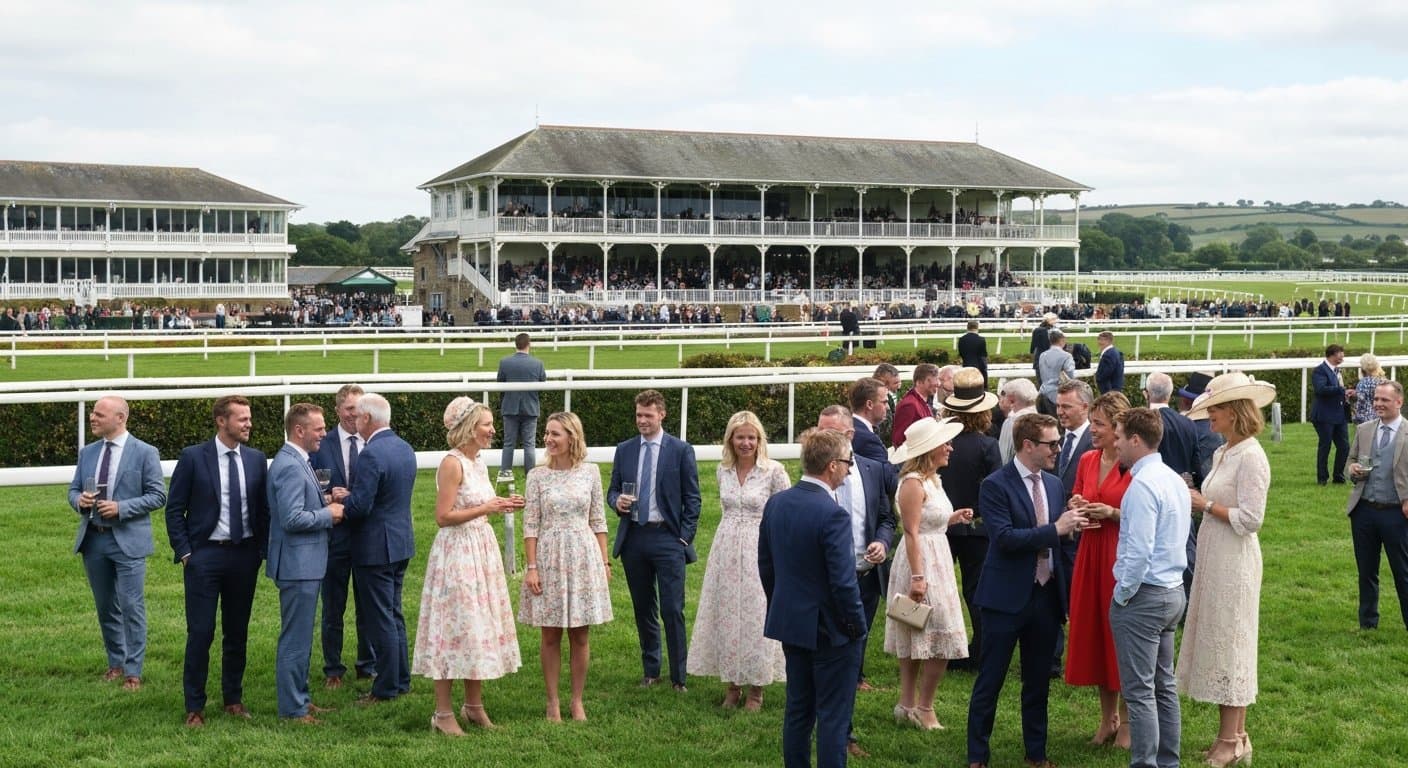
A Day Out at Newton Abbot Racecourse
Everything you need for a day at Newton Abbot — getting there, what to wear, enclosures, food and drink, and insider tips for Devon's summer jumping venue.
Read moreNewton Abbot Festival Guide
Your complete guide to Newton Abbot Racecourse — the summer jump season, the Devon & Exeter connection and what makes this South Devon track the heartland of west-country jump racing.
Read more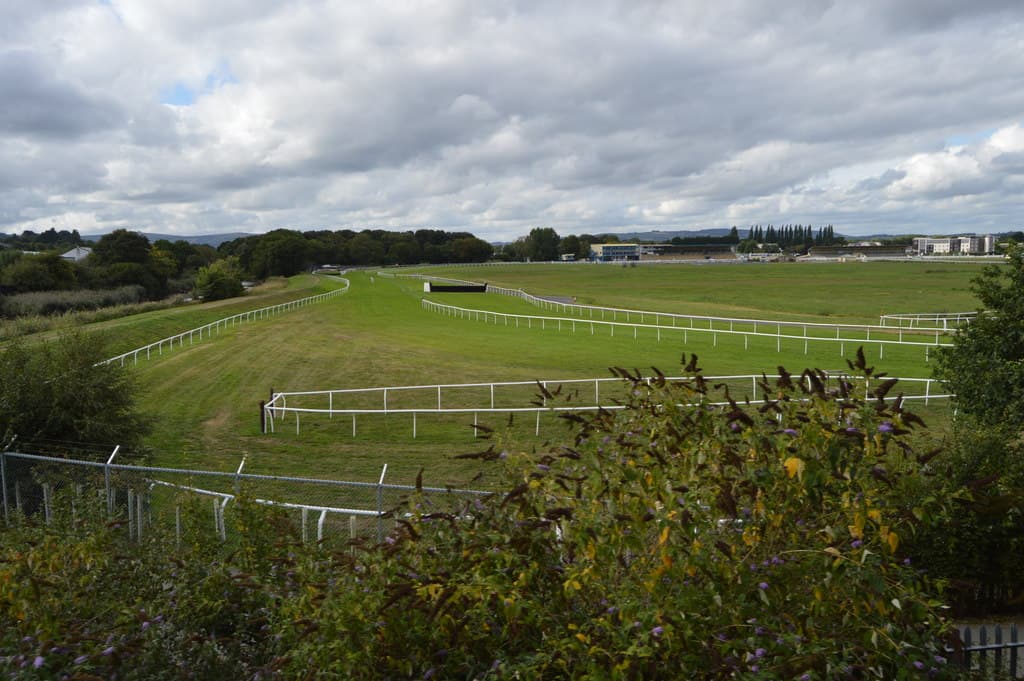
The History of Newton Abbot Racecourse
Over 150 years of racing at Newton Abbot — from its origins in 1866 to Devon's summer jumping venue and the Aubrey Loze Memorial.
Read morePhotos on this page are used under Creative Commons licences. Titles, sources and licence links for each one are on our image credits page.
Research the field with the AI Race Predictor
Our model publishes calibrated win-probability estimates for UK races — a second opinion to understand a race, not tips. It's open about its record: it doesn't beat the market, and we show exactly how it does.
Work it out & learn the basics
Gamble Responsibly
Gambling should be entertaining and not seen as a way to make money. Never bet more than you can afford to lose. If you or someone you know has a gambling problem, help and support is available.