
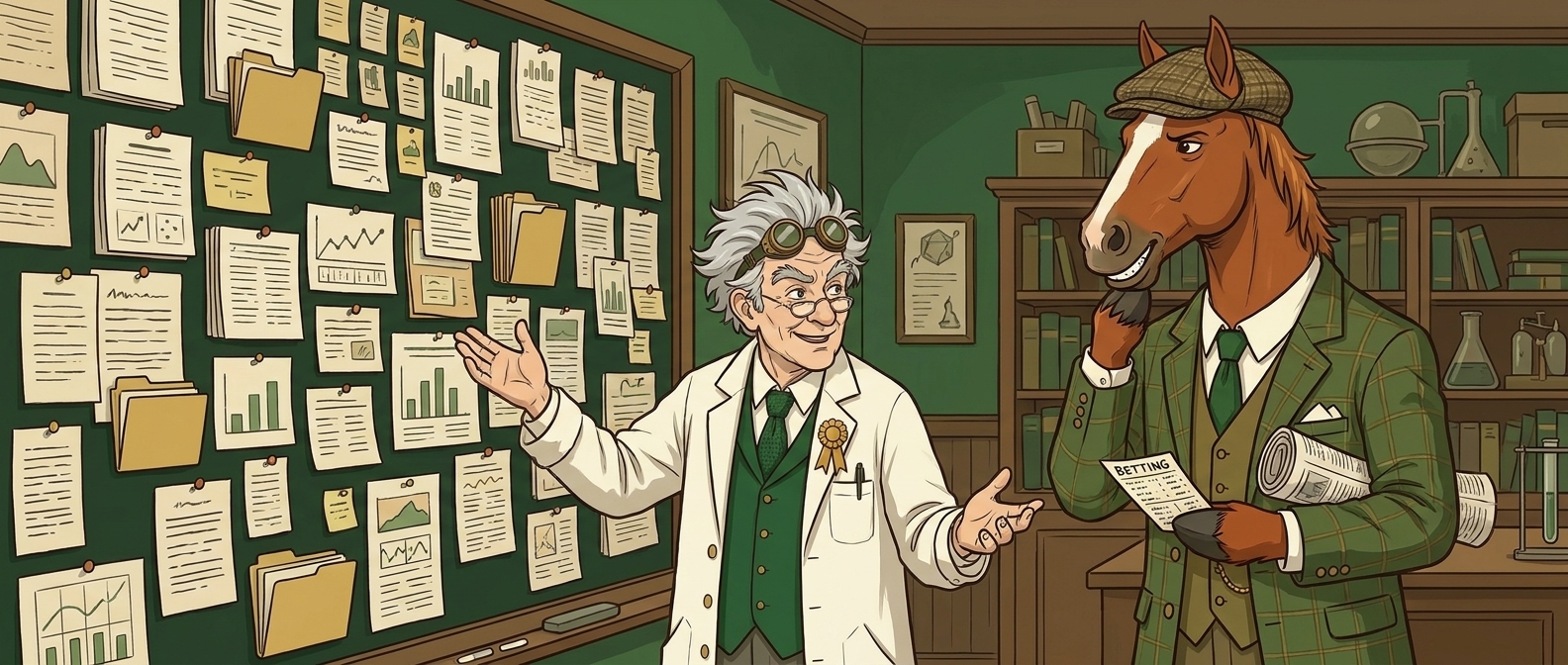


The claim
The pitch writes itself. We built an AI race predictor, an ensemble of two machine-learning models, and pointed it at every runner's own form, the race conditions and the weather. It scores the field and names a top pick. So the obvious move, the one punters ask us for almost every week, is the simplest one imaginable: back that number one in every race and let the machine do the thinking.
It is a tidy idea. A computer that has chewed through tens of thousands of races surely knows more than a person squinting at the racecard over a cup of tea. If the model can rank the horses, and its top pick wins more often than any other single runner, then backing it blind ought to be a quiet, hands-off way to grind out a profit. No reading the form, no second-guessing, just trust the number.
That is the claim we set out to test, and it matters more than most because it is our own model in the dock. We have every reason to want it to win. If following the AI made money, we would say so loudly and publish the proof.
So we did the honest thing. We took the model's actual top pick in race after race and settled every one at the official Starting Price, the same price a real punter gets, fallers and all. No cherry-picking, no hindsight, no quiet dropping of the bad days. Just the question a lot of people genuinely want answered: if a clever AI tells you which horse it likes best, and you back it every single time, do you come out ahead? The answer, it turns out, is no, and the reason is worth understanding.
Why it feels like it should work
The appeal is almost impossible to argue with, which is exactly why so many people fall for it. Picking the most likely winner sounds like precisely the job a machine should be brilliant at, and in the narrow sense it is. Our model's top pick wins more often than any other single runner in the race. Feed it the form and it really does rank the horses better than a coin toss. So far, so good.
The trap is hidden in one quiet swap of words. People hear most likely to win and read it as profitable to back. Those are two completely different things, and the gap between them is where the money goes. A horse can be the most probable winner in the race and still be a terrible bet, if the price you are paid does not match the risk you are taking. The model tells you which horse, it does not promise you a fair price for backing it.
Then there is the festival effect. Watch the AI nail three or four winners across a big meeting and it feels like proof, a clever machine outsmarting the bookies in real time. What you do not see in that run is the overround you paid on every bet, winners and losers alike, or the longer stretches where the picks came up short. A hot week is a small sample wearing a convincing disguise.
The word AI does the rest of the work. It invites you to trust the cleverness rather than do the unglamorous sum. But the machine is reading the same form the whole market reads, only without the market's price. It cannot magically know something the prices do not already reflect. The belief is reasonable. It is just wrong, and the data shows exactly how wrong.
Where the money goes
Backing the AI's top pick in every race is, stripped of the branding, just backing one horse per race at Starting Price. So it pays the exact same toll every blind staking line pays: the bookmaker's overround. On British racing that margin runs at about 12% per race, and it climbs towards 30% in big fields of sixteen runners or more. You are charged it on every single bet, with no way to dodge it. That alone is enough to settle the question.
The deeper problem is what the pick actually is. The model is fed no market price, no Betfair price and no speed figures, by design. It reads a horse's own form, the conditions and the weather, and guesses at a number the market already prices more sharply. Its top pick is the market favourite only about a third of the time. The rest of the time it lands on a short-priced non-favourite a little further out in the book than the actual favourite, where the favourite-longshot bias means every step away from the front of the market buys a worse-value price. You are not buying an edge. You are renting the bookmaker's margin, race after race.
The model's own scoreboard says the same thing in another language. Its Brier score, a measure of how well-calibrated its probabilities are, sits around 0.099 against the market's 0.091. Lower is better, so the bookmakers' implied prices are the sharper read. Paying their margin to fade their own, better numbers can only lose over the long run.
There is no recovery mechanism either. Every losing run is funded by fresh stakes, not clawed back by a clever next bet. Three races in four are losers, and the winners come at prices too short to close the gap. The return is steady, one-directional, and entirely predictable, which is exactly what makes it worth measuring.
How we tested it
We ran the test the way a real punter would actually live it, with no comforts added. The backtest covers 29,687 real British races, and the Follow the AI line places a flat stake on the model's top pick in 6,601 of them, the races the model priced. Every bet is settled at the official industry Starting Price, the same price you would get walking up to a real book, not a Betfair price flattered by lower margins and not a hindsight best-odds figure that no one ever actually got.
The settling rules are deliberately harsh on the system, because the honest ones always are. Fallers and pulled-up horses are counted as the losing bets they plainly are. Your money is gone whether the horse finishes last or never finishes at all, so we settle it that way. Joint-favourites and dead-heat ties are split rather than rounded up, so no phantom result can leak in to make the numbers look kinder than reality.
There is no staking trickery layered on top. It is one flat stake per race, the cleanest possible version of the strategy, so the result measures the picks themselves and nothing else. No doubling after losses, no skipping the races that look hard, no quietly dropping a bad meeting. If the model named a top pick, it got backed.
We ran the same blind staking treatment across 24 different betting systems, from backing the favourite to random accumulators, so Follow the AI could be judged against its peers on identical terms. The whole point of the Lab is that we publish what we find, not what we hoped to find. Our own model gets no special pleading. It faced exactly the same test as every other system, and the next section is what came back.
The numbers
Here is the figure, plainly. Over 6,601 real British races, backing the AI's top pick at flat stakes to Starting Price returned -11.36%. For every £100 you staked, you got back about £88.64. The leak is −11.4p of every £1 turned over, and stake two hundred pounds a week on the top pick and a year of it comes out at −£1,181, with no mechanism anywhere in the system to win it back.
The strike rate tells you why, and it is the number people find hardest to square. The top pick won about one race in four. That is genuinely good. It is more often than any other single runner in those races wins. And it still loses you money, because three races in four are losers and the winning quarter comes at prices too short to bridge the gap. Accuracy was never the problem. The price was.
Set that -11.36% beside the other systems and the verdict gets sharper. It is a touch worse than blindly backing the favourite, which returns -9.0% over the same kind of test, even though the model's top pick is favourite-adjacent most of the time. The AI reads the form but not the price, so it keeps drifting onto short-priced non-favourites a little further out in the book than the actual favourite, and that small drift costs it. Of the 24 systems we put through the identical blind test, not one made a profit. Follow the AI is not the worst of them, but neither is it the escape hatch. It sits in the pack, losing for the same reason they all do.
The one mercy is relative, not real. The AI loses a little less violently than chasing big-priced outsiders, because its picks cluster nearer the front of the market rather than out at the 33/1-plus end where the favourite-longshot bias is at its cruellest. Read that as harm reduction, not an edge. Losing slowly is still losing. There is no field size, no going, no code and no clever filter inside this test where flat-staking the top pick crosses back into profit. The number is the number, and the number is a loss.
The verdict
So, does following an AI tipster work? No. Our own model, a capable one, backed flat in every race it priced, still handed back -11.36% to Starting Price over 6,601 real British bets with fallers counted as losers. That is a shade worse than simply backing the favourite, which returns -9.0%, and it is the cleanest illustration we have of why blind staking loses. It is not a flaw in the model. It is the toll. You must pay the bookmaker's overround, about 12% per race, on every bet, and the top pick is too often a short-priced non-favourite at the worst end of the favourite-longshot bias.
The lesson worth keeping is the myth-buster underneath the number. A model can be a genuinely accurate read on a race and still not make you money, because the market has already priced that read in. Naming the most likely winner is a real skill. Being paid more than the true risk is a different skill entirely, and it is the only one that pays. Our model carries no market price by design, and its Brier of 0.099 sits behind the market's 0.091, so it cannot out-price the very book it would have to beat.
None of that makes the model useless, it just makes it the wrong tool for this job. Set against the live market price, it is a sharp, free opinion that shows you where the over-round and the favourite-longshot bias are hiding. Used as information it earns its keep. Used as a bet it loses, every time, in the long run.
If you want to know whether we believe we hold any edge worth staking on at all, we publish that too, wins and losses alike, in the track record. The bottom line on Follow the AI: interesting to read, costly to back.