
Founder & Editor · Last reviewed 2026-04-17
Looking for the current Scottish Grand National?
Our live guide has 2026+ racetimes, TV coverage and runners as they're confirmed.
See the Scottish Grand National live hubScottish Grand National Day is the biggest race day in Scottish sport. Held every April at Ayr — usually on the second Saturday of the month — it's the climax of the course's two-day spring meeting and one of the most anticipated fixtures in the entire UK National Hunt calendar. Around 15,000 people pack the course, and the headline race itself draws a UK-wide television audience that few other Scottish sporting events can match.
The day is built around the Scottish Grand National — a Grade 3 handicap chase over four miles and 110 yards, run over 27 fences. It's the longest handicap chase in Scottish racing and one of the most gruelling tests in the British calendar. The race has a history stretching back to the early 19th century and a roll of honour that includes some of the finest stayers in jumping history.
But Scottish Grand National Day is not a one-race card. Seven races fill the programme, with a mix of Graded jumps races, competitive handicaps, and novice events. The Scottish Champion Hurdle — a Grade 2 over two miles — is the supporting headline and frequently features horses from the top of the two-mile hurdling division. Below that sit a long-distance handicap chase, a novice chase, handicap hurdles, and often a mares' race or bumper.
This guide walks through each of the races on the day, the atmosphere at Ayr, everything you need to know about attending, and the betting angles that have a track record of doing well on Scottish Grand National Day specifically. If you're attending or just watching from home, it's the companion piece to have open on raceday.
For this year's edition specifically, see our 2026 Scottish Grand National preview and the 2026 race-timings guide. The live Ayr racecard shows confirmed runners, going, and off-times.
Where to Bet
Place your bets with a trusted, licensed bookmaker.

Promo code BETFRED50. New customers only. Register, deposit with a Debit Card, and place a first bet of £10+ at Evens (2.0)+ on Sports, to be settled within 7 days, to get £30 in Sports Free Bets and £20 in Bet Builder Free Bets within 24 hours of settlement. 7-day expiry. Eligibility & payment exclusions apply. Full T&Cs apply. Take Time to Think. BeGambleAware.org. 18+. Full T&Cs.

Promo code R30. New UK customers only, 18+. Register, deposit £10 or more, then place a £10 single cash bet at odds of 1/2 (1.5) or greater on any sports market (excluding Virtuals). Once the qualifying bet settles you get £30 in Free Bets (3 x £10) — the qualifying bet can win or lose. Free Bets are valid on any sports market excluding Virtuals, expire in 7 days, are non-withdrawable and must be used in full. Excluded deposit methods apply (including PayPal, Apple Pay, Skrill and NETELLER). Named bets such as Lucky 15 do not qualify. If you cash out the qualifying bet, or it is voided, you are no longer eligible for the offer. Ends 31.12.26. Full T&Cs apply. Please gamble responsibly. BeGambleAware.org. 18+. Full T&Cs.

Promo code BET40GET20. New UK customers, 18+. Register with the code and place a first bet of £40 or more at Evens (2.0) or greater. Receive 2 × £10 free bets: the first credited automatically once the qualifying bet settles, the second 24 hours later. Free bets must be placed at minimum odds of 4/1 (5.0), expire 24 hours after credit, and the free-bet stake is not returned with winnings. Debit card deposits only. Take Time to Think. BeGambleAware.org. 18+. T&Cs apply. Full T&Cs.

50% of your first-day net losses refunded as a free bet, capped at £25. New UK customers aged 18+ only. To qualify, deposit and place a first bet of £10 or more on any sport at minimum odds of evens (2.00), then place at least two further bets on different events, each worth at least 50% of your largest bet, all at evens (2.00) or greater. Losses are counted from your first settled bet until 23:59 the same day. Place a qualifying £10+ bet and you are guaranteed at least a £5 free bet. Bets placed at SP, void bets, cashed-out bets and bets struck with free bets do not count towards the offer. The free bet is credited the day after your qualifying bets settle and must be used within 7 days, after which it expires. It can be used at odds from 1/4 (1.25) up to 250/1 on singles and straight accumulators, but not on Trixie, Patent or Yankee style multiples. Free-bet stake is not returned with winnings. One offer per person, household, address, IP address and device. E-wallet deposits may not qualify, so check the cashier before depositing. Customers registered with GAMSTOP cannot claim. KYC identity verification must be completed before the free bet is credited. Take Time to Think. BeGambleAware.org. 18+. T&Cs apply. Full T&Cs.

New customers, 18+. Choose the sports bonus at sign-up, make a first deposit and receive a 100% bonus up to £50 in your Sports Bonus balance. To convert the bonus to cash, wager it 10x within 30 days. Single bets below Evens (2.00) do not qualify; accumulators do not qualify if any selection is below 1/2 (1.50). Virtual Sports, voided, cancelled, drawn, cashed-out and free-bet wagers do not count towards wagering. Only the first settled bet per event counts. Withdrawing before the wagering requirement is met forfeits the bonus balance including bonus winnings. Real-money funds are used before bonus funds. Deposits via Skrill or Neteller are not eligible. Not valid in conjunction with other promotions. Odds, bet and payment limits apply. 10bet general and promotion T&Cs apply. BeGambleAware.org. 18+. Full T&Cs.

New customers in Great Britain and Republic of Ireland, 18+. Place a £10 fixed-odds qualifying bet at minimum odds of 1/2 (1.50) — single or each-way (only the win part counts), pre-event or in-play, not cashed out early, within 28 days of opening the account. Receive up to £60 in bonuses credited over three days: 3 × £10 fixed-odds free bets (the first on settlement, then 24 and 48 hours later) plus 3 × £5 Total Goals FOOTBALL spread bets and 3 × £5 racing Winning Favourites spread bets, with a £1 racing Race Index spread bet as an extra on top. The spread bets need a full spread-betting account, opened within 28 days of the fixed-odds account and subject to Spreadex's eligibility and appropriateness checks. Free-bet stakes not returned with winnings; free bets valid 28 days from issue. IMPORTANT: the £5 credits are SPREAD bets — sports spread betting carries the risk that losses can exceed your stake. Sports spread-betting customers do not have Financial Ombudsman or FSCS recourse. Take Time to Think. BeGambleAware.org. 18+. T&Cs apply. Full T&Cs.

Promo code WELCOME15, entered under My Bonuses after registering. New UK customers, 18+. Place a first qualifying bet of at least £10 from your cash balance at odds of evens (2.0) or greater within 7 days of opening the account. Once the qualifying bet fully settles you receive £15 in free bets, credited as 3 x £5 tokens with set uses: one £5 accumulator free bet (minimum 4 legs, each leg at 2/5 or bigger), one £5 sports free bet (any market at evens or bigger) and one £5 Sub Cover free bet (selected football player markets at evens or bigger). Free-bet stakes are not returned with winnings. Free bets expire 7 days after they are credited. Void, cashed-out and partially cashed-out bets do not qualify. One offer per customer. Confirm the current terms on BetGoodwin's own welcome-offer page before claiming. Take Time to Think. BeGambleAware.org. 18+. T&Cs apply. Full T&Cs.

New UK customers, 18+. Minimum deposit £10. Place a £10 qualifying single on sports (excluding virtuals) at minimum odds of 1/2 (1.50), settled within 14 days. Deposit-method exclusions apply. Receive £30 in free bets (stake not returned), split £20 for sportsbook use (2 x £10) and £10 for Bet Builder only (2 x £5); Bet Builder does not cover horse racing. Free bets must be accepted within 7 days and expire 7 days after acceptance. No promo code required. Best Odds Guaranteed on UK & Irish racing, subject to having staked over £25 in the previous seven days. Operated by LiveScore Betting and Gaming (Gibraltar) Ltd, UKGC 56859. Confirm the current terms on LiveScore Bet's own promotions page before claiming. Take Time to Think. BeGambleAware.org. 18+. T&Cs apply. Full T&Cs.
18+. BeGambleAware.org
The Races on Scottish Grand National Day
Seven races make up the Scottish Grand National Day card, with the National itself as the penultimate event on the programme. Here's what to expect from each.
The Coral Scottish Grand National (4m 110y, Grade 3 Handicap Chase)
The headline. Twenty-plus runners, 27 fences, four miles. The Scottish Grand National is one of the longest, toughest handicap chases in Britain. The race is run over two full circuits of Ayr's wide, galloping left-handed course, with horses jumping the fences in the back straight twice before the long run to the finish.
The safety limit is typically 30 runners, with the BHA setting a lower field size in practice based on declarations and ground conditions. The top weight is usually rated in the mid-150s; the bottom of the weights sits around 130. It's a Grade 3 handicap, meaning the handicapper shapes the weights specifically for this race rather than applying standard handicap ratings.
The race is traditionally sponsored by Coral in recent years, though sponsors have changed over the decades. The prize fund has grown substantially over the past ten years and now sits at a level that puts the race comfortably among the most valuable staying chases outside the Cheltenham Festival and Aintree.
The Scottish Champion Hurdle (2m, Grade 2)
Run earlier in the afternoon, the Scottish Champion Hurdle is a Grade 2 over two miles — the day's best race by official rating. Twelve to fifteen runners line up for a race that often attracts horses coming out of the Cheltenham Festival hurdling races, or preparing for a summer campaign at Punchestown.
It's a class race in its own right: several winners have gone on to win or place at Grade 1 level, and the race is a useful form guide for the two-mile hurdle division going into the summer.
The Land Rover Handicap Hurdle (2m 4½f)
A long-standing fixture on the day, this is a competitive two-and-a-half-mile handicap hurdle that regularly attracts 14-plus runners. The fiercely competitive pace usually makes for a tactical race, with the winner coming from mid-division.
The Jordan Electrics Future Champion Novices' Chase
A novice chase for younger stayers, typically run over around three miles. The race is a good early pointer for horses that might progress to graded staying chasers in the following season.
The Ayrshire Handicap Chase (approx 3m)
A long-distance handicap chase that fills the card below the Scottish National itself. Often features horses that just missed the cut for the Scottish National or are preparing for one final spring run.
Supporting races
The remaining one or two races typically include:
- A mares' novices' hurdle — showcasing mares coming through the Scottish and Northern circuit.
- A handicap hurdle over two miles — a tactical sprint-hurdle to open the card.
- Occasionally a National Hunt Flat race (bumper) to close the afternoon.
The exact composition varies year on year depending on the BHA fixture calendar. For the confirmed programme on the day, see the live Ayr card or the official racecard on the Ayr Racecourse website.
Race times
The Scottish Grand National Day card typically starts at approximately 1:50pm and runs to 5:30pm, with the Scottish Grand National itself scheduled for approximately 4:00pm. Exact times are published the week of the meeting and confirmed on the morning — always check the live racecard or the official Ayr Racecourse website.
The Atmosphere
Scottish Grand National Day has a character all of its own. It's not a carbon copy of Aintree Grand National Day — the crowd is different, the weather is different, and the way the day unfolds reflects the fact that Ayr is a working seaside town that turns into Scotland's racing capital for 48 hours every April.
The crowd
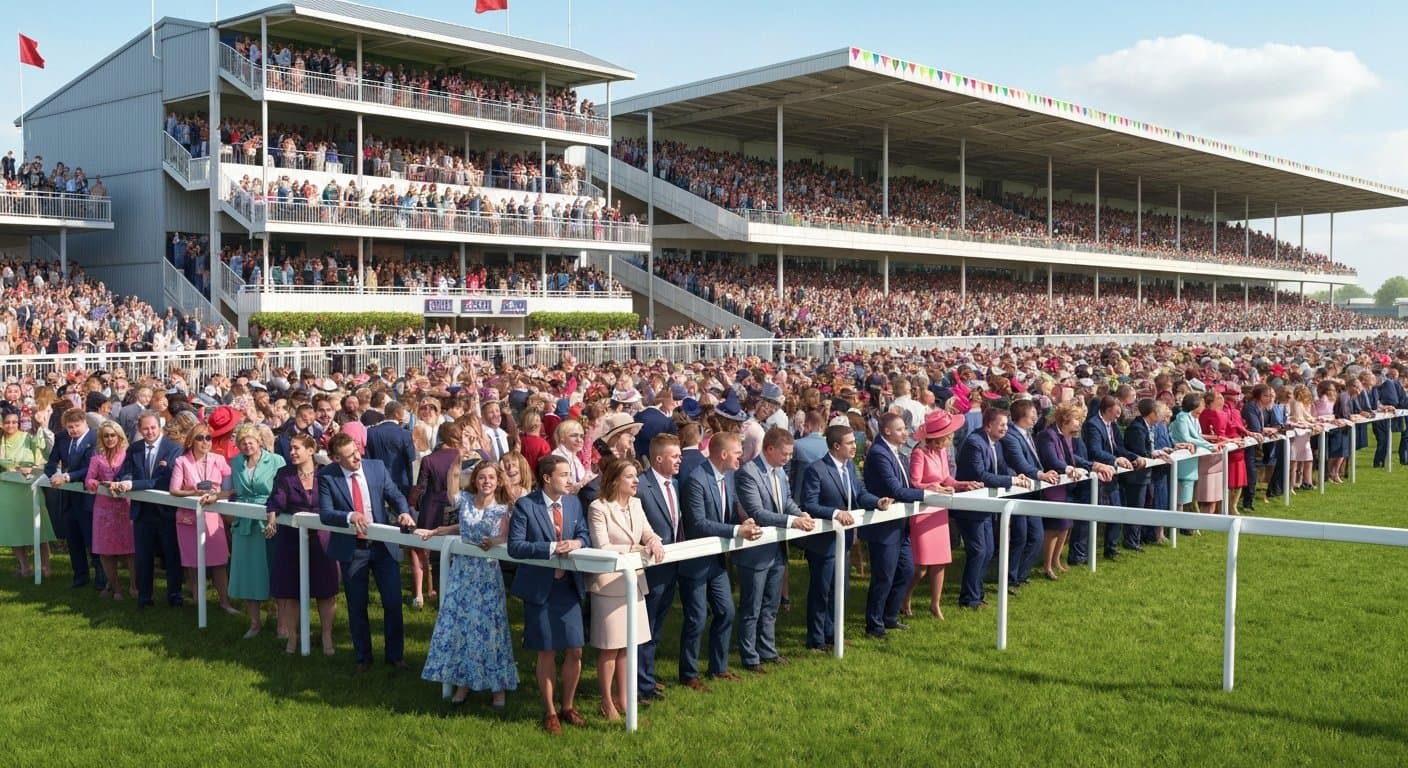
Fifteen thousand people, at capacity, pack the course on the Saturday. The mix is distinctly Scottish — a strong local contingent from Ayrshire, Glasgow, and the Central Belt, with regulars up from the north of England, smaller groups over from Ireland, and a steady flow of London-and-south racing enthusiasts who make the spring pilgrimage. Unlike Aintree, where Ladies' Day sets a specific tone, Ayr's dress code is generally more relaxed: smart clothes are welcomed in the Premier Enclosure, but the broader crowd leans toward "raceday smart" rather than full morning dress or fascinators.
The atmosphere builds through the afternoon. The early races, especially the opener and the Scottish Champion Hurdle, draw a more form-focused crowd — serious punters and race-fans studying the card. By the time the Scottish Grand National is being paraded, the stands are full, the rails are three-deep with bookmakers, and the tension is palpable.
The weather
Ayr in April can deliver anything. A bright, mild, slightly breezy Saturday is the ideal, but more often the day brings cloud, patchy rain, and a wind off the Firth of Clyde that can sharpen the feel of the afternoon. The course is exposed — the grandstands provide shelter, but the paddock and the lawn areas benefit from a waterproof, a hat, and a sensible pair of shoes. Scottish April is not Cheltenham March, and it's certainly not Royal Ascot June. Dress for the weather, not the occasion.
The good news is that Ayr's grandstands are substantial enough to handle a full crowd even in bad weather, and the roof coverage means you can watch the racing in comfort whatever the conditions.
The build to the big race
The hour before the Scottish Grand National is where the day earns its reputation. The parade ring fills with runners — the horses circle, the jockeys mount, the crowd gathers, and the atmosphere lifts. For the uninitiated, it's worth making a point of being paddock-side for the big race. You'll see horses you've only watched on television, you'll get a sense of which ones are travelling well before the race, and you'll feel the occasion.
When the tapes go up and 20-plus horses set off on their four-mile journey, the noise is unlike any other Scottish sporting event. The race goes through several phases — an eerie quiet as the field settles, a rising hum as the pace lifts from the third fence, a roar as the field comes past the stands for the first time, and an absolute wall of noise over the final three fences. If you're on course, stand somewhere you can see the run-in from the second-last. The vantage is worth working for.
After the race
The last race goes off about 90 minutes after the Scottish Grand National, giving time to digest the result, watch the replays, and settle up. The bars stay busy well after the racing, and there's a steady flow of supporters walking back into Ayr town centre for evening drinks. The train back to Glasgow fills up quickly — if you're heading home that night, allow a little extra time to get to the station.
Attending: What You Need to Know
Attending Scottish Grand National Day is well within reach of a day trip from most of the UK, but it pays to plan ahead. Here's what you need to know.
Tickets
Scottish Grand National Day tickets typically go on sale in the autumn and prices rise as the day approaches. There are several enclosure options:
- Premier Enclosure — the best views of the finish, access to the parade ring, and the most comfortable surroundings. Price is at the upper end.
- Grandstand — excellent viewing from the main stands, full access to the betting ring, paddock, and amenities.
- Course Enclosure — a budget option with access to the lawn areas; good atmosphere but more limited viewing of the far side of the course.
- Hospitality packages — private boxes, restaurant dining, and elevated views. Sold out weeks in advance for the Saturday.
Tickets are available directly from the Ayr Racecourse website. Print-at-home and mobile tickets are both accepted. The course rarely sells out entirely on the day, but Premier and hospitality options do.
Getting there
By train: Ayr station is on the main Glasgow-to-Ayr line. Trains from Glasgow Central run roughly every 30 minutes and take about 50 minutes. The station is a 10-12 minute walk from the racecourse, well-signed on raceday. ScotRail runs additional services on the Saturday, but the return trains fill up fast — allow time to walk back, and consider a slightly earlier departure than you'd naturally choose.
By car: Ayr is well-connected by the A77 from Glasgow (around an hour), the M74 from Carlisle and the north-west of England, and the coastal road from Stranraer. On-site parking is available at the course, first-come, first-served. Arrive by midday at the latest to guarantee a spot. The postcode is KA8 0JE.
By plane: Glasgow Prestwick Airport is a ten-minute train from Ayr and has its own station on the same line. For international visitors, Glasgow Airport (20 minutes from Glasgow Central by shuttle) is the main hub.
Where to stay
Ayr itself has a good range of hotels, B&Bs, and holiday lets. The town centre is compact and walkable, and most accommodation is within 15 minutes of the racecourse. Book early — Scottish Grand National weekend is the busiest of the Ayrshire calendar.
Alternatives include staying in Troon (10 minutes north, with its golf links and hotels), Prestwick (coastal, with the airport nearby), or in Glasgow (commuter-style, relying on the half-hourly train). Staying in Glasgow gives the widest hotel choice but costs time and train fares each day.
What to wear
Ayr has no strict dress code outside the Premier Enclosure, and even there the bar is more "smart raceday" than "formal". Smart-casual is the baseline — suit jackets and collared shirts for men, dress or smart separates for women. The key consideration is the weather, not the occasion: waterproofs, layers, and comfortable shoes are a must for Scottish April. Fascinators and hats are welcomed but not required.
On course
Facilities are good. Bookmaker rails run the full length of the betting ring, tote windows are plentiful, food vans and indoor food courts cater for all budgets, and bars are scattered throughout the enclosures. Cash machines on-course are limited — bring some cash or card for quick transactions.
Our Ayr day out guide has a more detailed course walk and practical tips for the general raceday experience. The Ayr complete guide covers the course in full.
Betting on Scottish Grand National Day
Betting on Scottish Grand National Day is a day-long job if you want it to be. Seven races, most of them competitive handicaps or graded events, give you plenty to get your teeth into. Here's a framework for approaching the day as a whole, rather than just the big race in isolation.
Plan the day before, not on the morning
The racecard is published days ahead of the meeting, with declarations confirmed by the Thursday morning. Use the Friday to study the form, build a shortlist, and note the prices. The Saturday morning is for adjusting to the going report and the market, not for building opinions from scratch. Racing Post, Timeform, and the Ayr betting guide are your starting points.
Bankroll and staking
Seven races is a lot. Decide a total stake for the day before you start, split it sensibly across the races, and resist the urge to chase. A common mistake is to hit the first three races with modest stakes, then load up on the Scottish National because the morning went well. Keep discipline — the Scottish Grand National is a 20-plus runner handicap where the market is often wrong, and that makes it a race for your biggest stake if you have a strong opinion, but not because you're trying to get ahead.
Each-way dominates the big race
With 20+ runners and generous each-way terms (typically the first four or five places, at a fifth the odds), the Scottish Grand National is one of the most each-way-friendly races of the year. Double-figure price selections with stamina, jumping, and ground credentials offer excellent structural value in the each-way market. Win-only betting is a harder way to make the race pay over the long run.
The supporting card
The Scottish Champion Hurdle is the best race on the card by class and offers the cleanest form lines. Horses coming out of the Cheltenham Festival with sound credentials can offer good value here if the market has written them off after a Festival defeat.
The handicaps (particularly the Land Rover Handicap Hurdle and the Ayrshire Handicap Chase) are competitive 14-plus runner events that reward patient, each-way selections rather than win-only betting.
The novice races are harder — smaller fields, more obvious favourites, and less structural edge. If you don't have a strong opinion, these are races to sit out or bet only lightly.
Market shape: when to bet
Ante-post prices on Scottish Grand National runners can be attractive, but there's real risk of non-runners and going changes. Our rough rule:
- Ante-post (more than 48 hours out) — value in taking a price if you have strong conviction and a horse that looks a confirmed runner. Avoid horses with Aintree or Cheltenham entries alongside Ayr.
- Thursday to Friday morning — declarations drop, prices settle. This is often the sweet spot for betting — form is known, non-runners are clear, market is stable.
- Saturday morning — prices shift with the going report and stable money. Good for adjusting positions, risky for building new ones.
Bookmakers and offers
Bookmakers typically run enhanced offers on Scottish Grand National Day — extra places, best-odds guaranteed, non-runner no-bet. Shop around. See our bookmakers comparison for a full review of which firms offer the best terms for big-race handicaps.
A word on responsibility
The Scottish Grand National weekend is a big betting day. Set limits, know when to stop, and treat it as entertainment. If gambling stops being fun or you feel it's getting out of hand, our responsible gambling page has support resources.
Frequently Asked Questions
Share this article
Research the field with the AI Race Predictor
Our model publishes calibrated win-probability estimates for UK races — a second opinion to understand a race, not tips. It's open about its record: it doesn't beat the market, and we show exactly how it does.
Work it out & learn the basics
Gamble Responsibly
Gambling should be entertaining and not seen as a way to make money. Never bet more than you can afford to lose. If you or someone you know has a gambling problem, help and support is available.