
Founder & Editor · Last reviewed 2026-04-05
Ffos Las Racecourse sits in the Gwendraeth Valley in West Wales, near the village of Trimsaran in Carmarthenshire. Opened in 2009, it is the newest racecourse to open in Britain in the 21st century and the only venue in Wales to stage flat racing. The course was built on the site of the former Ffos Las opencast coal mine, which had closed in the late 1990s, and its transformation from industrial wasteland into a functioning racecourse required five years of civil engineering work. The name itself comes from the Welsh for "blue ditch" — a reference to the drainage channels that once served the mine — and is pronounced roughly "Foss Lass".
Who this guide is for
- First-time visitors will find the sections on facilities, getting there, and the course layout the most useful starting points.
- Regular racegoers travelling from Swansea, Llanelli, or Carmarthen should focus on fixtures, the fixture list, and the betting guide.
- History-focused readers should head to the history section and the account of how the site was reclaimed from the coal industry.
- Trip planners should read the atmosphere and planning section alongside the getting there guide for travel and accommodation advice.
Quick decisions
- Notable race: the West Wales National, a staying handicap chase. Welsh Champion Hurdle day was the showpiece meeting until 2024, when the race moved to Chepstow.
- Best spot to stand: the viewing bank near the home straight gives a clear view of the finish.
- Best for families: midweek flat fixtures in July and August are relaxed and rarely crowded.
- Arriving by train: catch a service to Llanelli (20 minutes from Swansea, 55 from Cardiff), then take a taxi — roughly 15 minutes and six miles north.
- Arriving by car: take the M4 to Junction 48, then the A4138 north towards Trimsaran; postcode SA17 4DE for sat-nav.
- Notable race on the calendar: the West Wales National, a staying handicap chase. The Welsh Champion Hurdle, a Limited Handicap over about two miles, was staged here from 2010 to 2024.
- Busiest car parks: fill early on the busiest cards — allow extra time.
The course runs left-handed on a roughly oval circuit of approximately one mile and four furlongs. Because the land was reclaimed from opencast mining, the track is exceptionally flat by British standards, which has a direct bearing on the type of horses that run well here. Galloping, long-striding types tend to prosper on both the flat and National Hunt circuits.
Ffos Las is the only Welsh racecourse that stages flat racing. Chepstow and Bangor-on-Dee both offer National Hunt only, which means Ffos Las holds a unique position in Welsh racing — it attracts flat trainers from across the south-west of England, including David Pipe (based at Nicholashayne, approximately 90 miles east) and Paul Nicholls (Ditcheat, about 100 miles east). For the Welsh National Hunt community, Christian Williams at Ogmore-by-Sea — around 35 miles east along the M4 — is among the most locally prominent trainers, while Rebecca Curtis operates from Newport in Pembrokeshire, roughly 30 miles to the west.
The racecourse serves the Swansea and Llanelli conurbation as its primary urban catchment. Swansea is around 20 miles to the east; Cardiff is approximately 55 miles via the M4. The Gwendraeth Valley has a strong Welsh-language identity, and Welsh is widely spoken in the surrounding villages of Trimsaran, Kidwelly, and Burry Port. Race day at Ffos Las has a distinctly local character that sets it apart from the larger English courses.
The wider development around the racecourse also brought housing, hotels, and commercial units to what had previously been an industrial wasteland. The course sits at the centre of a regeneration project that has transformed a significant section of the Gwendraeth Valley floor, and the area around the site has a more settled residential and commercial character now than at any point in its post-mining history.
This guide covers every aspect of a visit to Ffos Las: the layout and going characteristics of the three-circuit course, the annual fixture list, facilities and hospitality, travel options, the history of the site, famous moments from the course's short but eventful history, and a betting guide covering the patterns that matter most at this track. Whether you are making a first visit or looking to sharpen your knowledge of a course you already know, the sections below have what you need.
Bet on Ffos Las
Place your bets on Ffos Las races with a trusted bookmaker.

Promo code BETFRED50. New customers only. Register, deposit with a Debit Card, and place a first bet of £10+ at Evens (2.0)+ on Sports, to be settled within 7 days, to get £30 in Sports Free Bets and £20 in Bet Builder Free Bets within 24 hours of settlement. 7-day expiry. Eligibility & payment exclusions apply. Full T&Cs apply. Take Time to Think. BeGambleAware.org. 18+. Full T&Cs.

Promo code R30. New UK customers only, 18+. Register, deposit £10 or more, then place a £10 single cash bet at odds of 1/2 (1.5) or greater on any sports market (excluding Virtuals). Once the qualifying bet settles you get £30 in Free Bets (3 x £10) — the qualifying bet can win or lose. Free Bets are valid on any sports market excluding Virtuals, expire in 7 days, are non-withdrawable and must be used in full. Excluded deposit methods apply (including PayPal, Apple Pay, Skrill and NETELLER). Named bets such as Lucky 15 do not qualify. If you cash out the qualifying bet, or it is voided, you are no longer eligible for the offer. Ends 31.12.26. Full T&Cs apply. Please gamble responsibly. BeGambleAware.org. 18+. Full T&Cs.

Promo code BET40GET20. New UK customers, 18+. Register with the code and place a first bet of £40 or more at Evens (2.0) or greater. Receive 2 × £10 free bets: the first credited automatically once the qualifying bet settles, the second 24 hours later. Free bets must be placed at minimum odds of 4/1 (5.0), expire 24 hours after credit, and the free-bet stake is not returned with winnings. Debit card deposits only. Take Time to Think. BeGambleAware.org. 18+. T&Cs apply. Full T&Cs.

50% of your first-day net losses refunded as a free bet, capped at £25. New UK customers aged 18+ only. To qualify, deposit and place a first bet of £10 or more on any sport at minimum odds of evens (2.00), then place at least two further bets on different events, each worth at least 50% of your largest bet, all at evens (2.00) or greater. Losses are counted from your first settled bet until 23:59 the same day. Place a qualifying £10+ bet and you are guaranteed at least a £5 free bet. Bets placed at SP, void bets, cashed-out bets and bets struck with free bets do not count towards the offer. The free bet is credited the day after your qualifying bets settle and must be used within 7 days, after which it expires. It can be used at odds from 1/4 (1.25) up to 250/1 on singles and straight accumulators, but not on Trixie, Patent or Yankee style multiples. Free-bet stake is not returned with winnings. One offer per person, household, address, IP address and device. E-wallet deposits may not qualify, so check the cashier before depositing. Customers registered with GAMSTOP cannot claim. KYC identity verification must be completed before the free bet is credited. Take Time to Think. BeGambleAware.org. 18+. T&Cs apply. Full T&Cs.

New customers, 18+. Choose the sports bonus at sign-up, make a first deposit and receive a 100% bonus up to £50 in your Sports Bonus balance. To convert the bonus to cash, wager it 10x within 30 days. Single bets below Evens (2.00) do not qualify; accumulators do not qualify if any selection is below 1/2 (1.50). Virtual Sports, voided, cancelled, drawn, cashed-out and free-bet wagers do not count towards wagering. Only the first settled bet per event counts. Withdrawing before the wagering requirement is met forfeits the bonus balance including bonus winnings. Real-money funds are used before bonus funds. Deposits via Skrill or Neteller are not eligible. Not valid in conjunction with other promotions. Odds, bet and payment limits apply. 10bet general and promotion T&Cs apply. BeGambleAware.org. 18+. Full T&Cs.

New customers in Great Britain and Republic of Ireland, 18+. Place a £10 fixed-odds qualifying bet at minimum odds of 1/2 (1.50) — single or each-way (only the win part counts), pre-event or in-play, not cashed out early, within 28 days of opening the account. Receive up to £60 in bonuses credited over three days: 3 × £10 fixed-odds free bets (the first on settlement, then 24 and 48 hours later) plus 3 × £5 Total Goals FOOTBALL spread bets and 3 × £5 racing Winning Favourites spread bets, with a £1 racing Race Index spread bet as an extra on top. The spread bets need a full spread-betting account, opened within 28 days of the fixed-odds account and subject to Spreadex's eligibility and appropriateness checks. Free-bet stakes not returned with winnings; free bets valid 28 days from issue. IMPORTANT: the £5 credits are SPREAD bets — sports spread betting carries the risk that losses can exceed your stake. Sports spread-betting customers do not have Financial Ombudsman or FSCS recourse. Take Time to Think. BeGambleAware.org. 18+. T&Cs apply. Full T&Cs.

Promo code WELCOME15, entered under My Bonuses after registering. New UK customers, 18+. Place a first qualifying bet of at least £10 from your cash balance at odds of evens (2.0) or greater within 7 days of opening the account. Once the qualifying bet fully settles you receive £15 in free bets, credited as 3 x £5 tokens with set uses: one £5 accumulator free bet (minimum 4 legs, each leg at 2/5 or bigger), one £5 sports free bet (any market at evens or bigger) and one £5 Sub Cover free bet (selected football player markets at evens or bigger). Free-bet stakes are not returned with winnings. Free bets expire 7 days after they are credited. Void, cashed-out and partially cashed-out bets do not qualify. One offer per customer. Confirm the current terms on BetGoodwin's own welcome-offer page before claiming. Take Time to Think. BeGambleAware.org. 18+. T&Cs apply. Full T&Cs.

New UK customers, 18+. Minimum deposit £10. Place a £10 qualifying single on sports (excluding virtuals) at minimum odds of 1/2 (1.50), settled within 14 days. Deposit-method exclusions apply. Receive £30 in free bets (stake not returned), split £20 for sportsbook use (2 x £10) and £10 for Bet Builder only (2 x £5); Bet Builder does not cover horse racing. Free bets must be accepted within 7 days and expire 7 days after acceptance. No promo code required. Best Odds Guaranteed on UK & Irish racing, subject to having staked over £25 in the previous seven days. Operated by LiveScore Betting and Gaming (Gibraltar) Ltd, UKGC 56859. Confirm the current terms on LiveScore Bet's own promotions page before claiming. Take Time to Think. BeGambleAware.org. 18+. T&Cs apply. Full T&Cs.
18+. BeGambleAware.org
The Course
The Course
Ffos Las was designed from scratch, which is a rarity in British racing. Most courses evolved over many decades, shaped by the contours of the land they inherited; Ffos Las had the advantage and the challenge of a blank canvas. The former opencast coal mine left behind a large, almost perfectly flat area of reclaimed land in the Gwendraeth Valley, and the engineers who built the racecourse in the mid-2000s used that topography to create a modern, well-ordered circuit.
Layout and Direction
The track runs left-handed, forming a roughly oval circuit of approximately one mile and four furlongs. It is wider than many British courses, partly because the reclaimed land allowed for generous margins between the three separate circuits — chase, hurdle, and flat — each spaced roughly 20 metres apart. Horses therefore run on a different strip depending on the code, which helps with track management and drainage. The bends are sweeping rather than sharp, favouring horses with a long, galloping stride over nippy, quick-turning types. The home straight runs for approximately four furlongs, giving jockeys a long run-in and reducing the premium on a good tactical position at the top of the home turn.
The left-handed configuration is consistent with the majority of British National Hunt tracks, though it is less common on the flat. Horses making their first appearance at Ffos Las sometimes need a run to learn the track, particularly at the far turn, which comes sooner than some trainers expect on the approach from the back straight.
The Three Circuits
As a dual-purpose venue, Ffos Las maintains three distinct circuits on the same general footprint.
The flat track is the innermost of the three circuits. Distances run from five furlongs up to approximately one mile and six furlongs, giving the course flexibility across sprint and staying events. The shortest races start near the top of the back straight and use a chute to bring runners into the main oval. Summer flat fixtures at Ffos Las attract horses from yards in west Wales, Gloucestershire, Somerset, and sometimes further afield when conditions are suitable.
The hurdle track sits between the flat track and the chase track. Hurdle races at Ffos Las tend to be run over distances of two miles to two miles and four furlongs, though longer staying hurdles appear occasionally. The Welsh Champion Hurdle was run on this circuit until 2024, when it moved to Chepstow. The course provides a fair test for hurdlers: the flat terrain means there are no steep gradients to catch out a tiring horse, but the long home straight does expose weak finishers.
The chase track is the outermost of the three circuits and takes in the full perimeter of the racecourse. Fences at Ffos Las are well maintained and built to standard dimensions. The track suits a galloping chaser that can maintain rhythm through the bends. Given the flatness of the track, there is no downhill fence to catch horses out as there might be at a course like Cheltenham, but the open ditch on the back straight does demand respect. Novice chasers often run well at Ffos Las because the fences are sighted clearly and the bends give a horse time to organise itself before each obstacle.
Going Characteristics
Carmarthenshire sits in one of the wetter parts of Wales, but the drainage at Ffos Las holds up well for a venue of its type. The reclaimed land was engineered with a purpose-built drainage system installed during the original construction, and the course management invests in regular aeration and maintenance to keep it working. As a result, the going at Ffos Las rarely reaches the extremes that can affect other Welsh venues.
In summer, the going on the flat track is typically good to firm or good, though heavy summer showers can soften the surface quickly. In winter, on the National Hunt circuits, the going most frequently ranges from good to soft to soft, with heavy ground appearing during prolonged wet spells in January and February. The course has raceable ground for most of the season, and abandonments are relatively rare compared with courses on heavier soils.
One practical consideration: the flat, open nature of the site means wind can be a factor at Ffos Las in a way it is not at courses sheltered by hedgerows or grandstands. A strong south-westerly off the Atlantic can affect finishing times, particularly in sprint events where the runners are directly facing the wind down the home straight.
Always check the going report before travelling to Ffos Las, especially for National Hunt meetings in January and February when the cumulative rainfall in Carmarthenshire can soften the ground faster than the drainage can cope. The Ffos Las website publishes going reports the day before each fixture.
The Flat Terrain and What It Means for Racing
The absence of any significant gradient at Ffos Las is one of the most consequential facts about the course. At tracks like Epsom, Cheltenham, or Chester, the terrain imposes a physical test that becomes part of the selection process — the hill at Epsom, the camber at Chester, the climb at Cheltenham all filter out certain types of horse. At Ffos Las, there is no equivalent filter. The test is almost pure: speed, stamina, and jumping technique, with very little topographic variation to alter the outcome.
This has an important practical effect. Horses that struggle on undulating ground often perform better than their recent form suggests at Ffos Las. A horse that was beaten on the final hill at Goodwood or Chepstow may find Ffos Las's flat home straight much more to its liking. Conversely, a horse that tends to idle in front — one that needs a hill or a challenge to focus — may not perform as well as its form suggests. Trainers with yards in Somerset and Gloucestershire, who send horses regularly to Ffos Las, often have a clear sense of which of their charges prefer this type of track.
Distances and Race Types
Flat distances at Ffos Las: 5f, 6f, 7f, 1m, 1m 2f, 1m 4f, 1m 6f.
National Hunt distances: hurdles from 2m to 2m 4f; chases from 2m to 3m 1f.
The course does not have a straight course for sprints of six furlongs or fewer — the shortest flat races use a starting chute that feeds into the left-hand oval, meaning even five-furlong sprints involve a left-hand turn. This is worth noting when assessing draw bias: horses that make the running and get a clean passage through the first bend have a clear advantage in short-distance flat races, and the low draw is generally preferred.
For National Hunt races, the distances typically favour horses that have real stamina. The flat terrain means there is no false pace injection from a downhill section, so races tend to be run at a steadier gallop than at undulating tracks. This can suit front-runners, who can bowl along at a fair clip without being harassed, and it can catch out horses with a finishing kick but insufficient stamina to back it up over the full trip.
Viewing the Racing
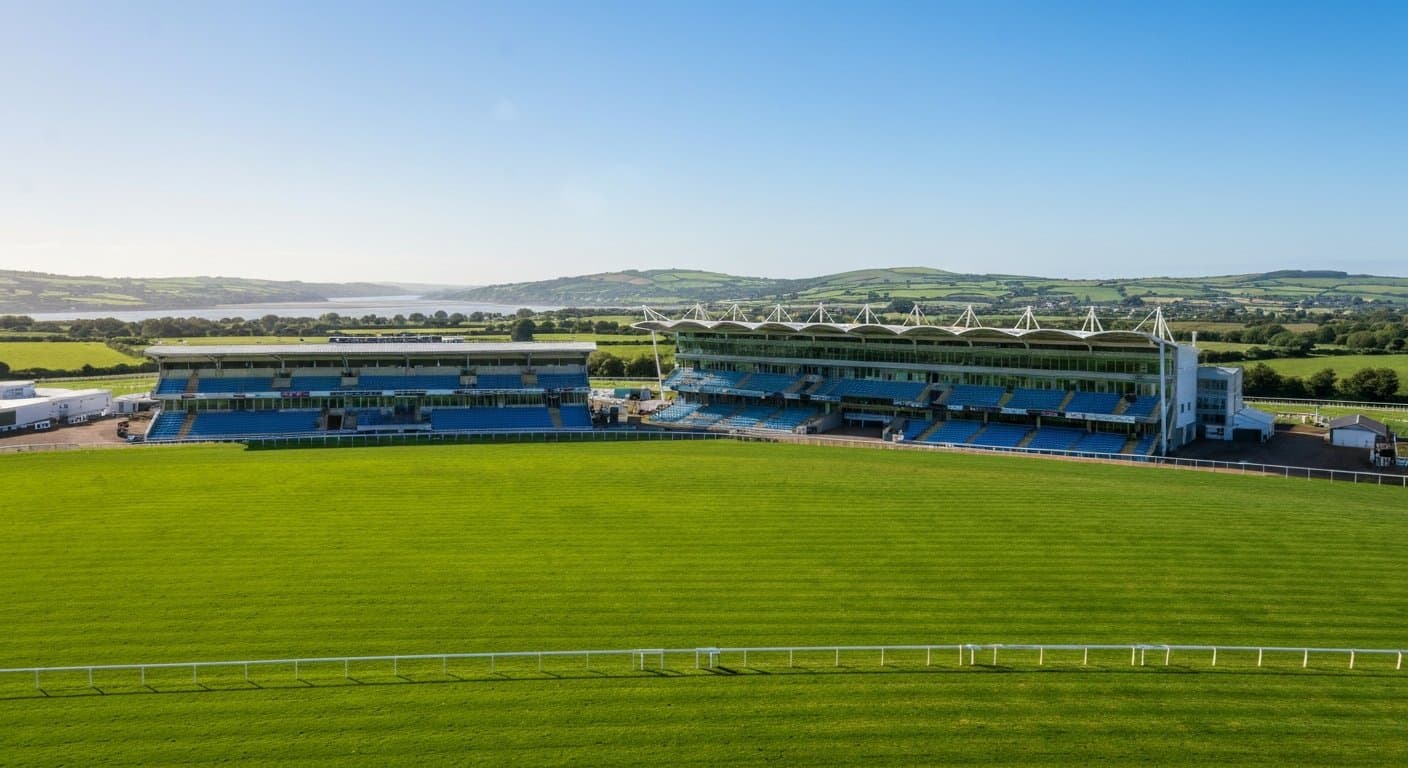
The main grandstand at Ffos Las runs along the home straight and gives excellent views of the finish. Because the track is flat and the circuit is not excessively large, spectators can follow the field from an early stage of each race without losing sight of the horses behind any banking or trees. The open nature of the site — again a function of the flat, reclaimed land — means sight lines are generally good from most parts of the enclosure. The viewing bank near the rail opposite the grandstand is a popular spot on sunny summer days, offering a ground-level view as the field sweeps through the bend onto the home straight.
Summary: What the Course Asks of a Horse
Ffos Las asks a horse to gallop, jump consistently (in National Hunt races), and see out its distance on a flat, testing circuit where there is nowhere to hide. Horses that tend to idle once in front need a strong partner from the saddle to get the job done in the long home straight. Horses that struggle with undulating ground or sharp bends frequently perform better here than their recent form at other venues implies. Understanding these tendencies is the starting point for any serious assessment of a race at Ffos Las.
For more on the history of the course's construction and its origins as an opencast mine, see the history of Ffos Las and the opencast to racecourse guide.
Key Fixtures & Calendar
Key Fixtures and Calendar
Ffos Las stages approximately 15 to 18 meetings per year, spread across both codes. Flat fixtures run from May to September; National Hunt takes over from October through to the spring. Because the course is the only Welsh venue for flat racing, its summer programme carries particular significance for west Wales racegoers who would otherwise have to travel to Chepstow — which offers jumps only — or cross the border into England.
Welsh Champion Hurdle Day
The Welsh Champion Hurdle was the biggest race on the Ffos Las calendar from 2010 to 2024. It is a Limited Handicap over about two miles, now run in October, and it moved to Chepstow in 2025 as part of the new Welsh Racing Festival. It drew horses that had operated at the highest levels of the jumping game. For the full race history and a guide to the race itself, see the Welsh Champion Hurdle guide.
Welsh Champion Hurdle day was the most heavily attended fixture at Ffos Las until 2024. The race is now run at Chepstow, so check the Ffos Las fixture list for the current season before planning a visit, and book tickets and parking ahead for any of the bigger cards.
The meeting gave Ffos Las its own moment in the wider racing calendar.
The Flat Season (May to September)
Flat racing at Ffos Las runs across the summer months and represents the only opportunity to watch flat racing in Wales. Meetings are typically held on weekday evenings and weekend afternoons, covering a range of race types — maiden races for unraced horses, handicaps for more experienced runners, and occasional listed or conditions races for better horses.
The summer programme draws stables from across South Wales and the West Country. Trainers like David Pipe at Nicholashayne and Paul Nicholls at Ditcheat both send horses to Ffos Las for flat fixtures, particularly when the going suits and the race conditions are favourable. Local Welsh trainers with smaller yards also use the flat programme to give young horses experience.
Evening flat meetings in July and August are among the most pleasant racing experiences at Ffos Las. The Gwendraeth Valley can be warm and sheltered on summer evenings, the crowds are manageable, and the format — a six- or seven-race card starting around 6pm — means you can make it to and from Swansea or Llanelli in a single evening without an overnight stay.
The National Hunt Season (October to April)
The jump season at Ffos Las begins in October with hurdles meetings and builds through the winter to include chases. The programme is not as large as the equivalent calendars at Chepstow or Bangor-on-Dee, but it covers enough fixtures to sustain interest through the winter.
Christian Williams, whose yard at Ogmore-by-Sea is roughly 35 miles east of Ffos Las, is among the most prominent local jumps trainers. He has been associated with some of the bigger National Hunt names to run at Ffos Las and uses the course regularly for his horses. Rebecca Curtis at Newport, Pembrokeshire — approximately 30 miles west of the course — also sends horses here with some frequency, particularly for hurdle races.
Midweek winter meetings at Ffos Las tend to draw smaller crowds but offer some of the sharpest handicap races of the year. The prize money is not large by Grade 1 standards, but the quality of the runners in the senior handicap classes is often higher than the course's profile might suggest. Trainers from further east — David Pipe and Nigel Hawke among them — use the course for horses that need a confidence-restoring run in a less pressurised environment.
Bank Holidays and Special Events
Ffos Las has used bank holiday weekends to programme some of its better summer flat fixtures, particularly the late May bank holiday and the August bank holiday weekend. These meetings attract larger crowds than a typical midweek fixture and sometimes feature additional entertainment for families.
The course has also staged music events and other entertainment in the evenings following summer flat fixtures, a format that has worked well at a number of British venues and helps attract racegoers who might otherwise not attend. Check the Ffos Las website for the current season's fixture list, as exact dates shift from year to year depending on the allocations made by the British Horseracing Authority.
Planning Around the Fixture List
For most visitors, the key decisions are: which code do you prefer (flat or jumps), what time of year suits you, and how busy do you want the course to be? The bigger weekend cards are the obvious choice for those who want an occasion, but midweek fixtures in July or January offer a very different and often more rewarding experience. Hospitality packages are available year-round but are most competitive on the quieter fixture days.
For the full fixture list and ticketing details, see the Ffos Las website. For a breakdown of how to plan your day, see the day out guide.
Facilities & Hospitality
Facilities and Hospitality
Because Ffos Las opened in 2009, its facilities were designed from the outset rather than retrofitted into an older structure. That gives the course an advantage over many British racecourses that have spent decades adding modern amenities to Victorian grandstands. The buildings are purpose-built, the layouts are logical, and the overall standard of upkeep reflects the relatively short time the course has been operating.
Enclosures and General Admission
Ffos Las operates a straightforward enclosure structure. General admission covers access to the main enclosure, the betting ring, the parade ring, and the viewing areas along the home straight. The parade ring is close to the main stand, making it easy to watch the horses being led up before each race without having to navigate far from the main facility.
The winning enclosure is positioned for good visibility from the grandstand area, and the post-race presentation ceremony — for the bigger races — takes place where most racegoers can see it clearly. There is no sharp physical separation between enclosures that might force you to watch the finish from a poor angle depending on your ticket category.
The course has a capacity of approximately 5,000. On most fixture days, the actual attendance is well below that figure, which means the facilities rarely feel stretched. Even on the busiest cards the site handles the crowd without the queuing and congestion that affect larger venues on their showpiece days.
There is no formal dress code at Ffos Las beyond the usual expectation of smart casual in the hospitality areas. General enclosure racegoers are dressed for a day out in West Wales, which in winter means layers and waterproofs, and in summer anything from shirts and shorts to a light jacket. The atmosphere is informal without being scruffy.
Hospitality Options
Ffos Las offers a range of hospitality packages, from private boxes on the upper level of the main stand to restaurant packages in the dedicated dining facilities. Private boxes accommodate groups from approximately 10 to 30 people and include catered food and drink, a dedicated viewing area, and entry to the enclosures. These are particularly popular for corporate days and are usually booked several weeks in advance for the bigger fixtures.
The restaurant packages provide a set menu lunch or dinner combined with general enclosure access, and represent a middle ground between general admission and a full private box. They are priced to suit groups and work well for birthdays, anniversaries, and other celebrations where a sit-down meal is the centrepiece.
For smaller groups or individuals looking for a better experience than general admission, the course sometimes offers premium raceday packages that include a table in one of the bar areas, a racecard, and a welcome drink. These tend to be better value per person than the full hospitality options while still providing a bit of structure to the day.
Food and Drink
The general enclosure has a standard selection of catering units — burger bars, fish and chip stalls, a pie stand — alongside a bar with draught beer, lager, and soft drinks. The quality is typical of British racecourse catering and is perfectly adequate for a day out.
The hospitality areas offer a higher standard of food, usually locally sourced where possible — West Wales has good suppliers of lamb, beef, and seafood — and the kitchens have the capacity to deliver a reasonable three-course meal on raceday. If you are eating in the restaurant as part of a package, you will typically be asked to pre-order your choices.
Alcohol is available throughout the day at all bars and catering units. The course applies the same responsible service standards as all licensed British racecourses, and service can be refused if staff judge a customer to be intoxicated.
Stabling and Stable Staff
As a dual-purpose venue, Ffos Las has stabling for horses arriving on raceday. The stabling complex is separate from the main spectator areas and is served by a dedicated access route for horseboxes. Horses typically arrive from mid-morning on raceday, and stable staff who travel with their horses have a separate facility near the stabling block.
Families and Children
Ffos Las is a good choice for families new to racing. The site is open and easy to navigate, there are no awkward slopes or steps that create difficulty for pushchairs, and the flat terrain means children can move around comfortably without parents worrying about crowds on steep banking. The betting ring is clearly separated from the family-friendly areas, and the general enclosure is spacious enough that children have room to watch the horses in the parade ring without being crowded out.
For more on planning a full day at Ffos Las, including food, parking, and timing your visit, see the day out guide.
Getting There
Getting There
Ffos Las is located near Trimsaran in Carmarthenshire, postcode SA17 4DE. It sits in the Gwendraeth Valley approximately six miles north of Llanelli and ten miles west of Carmarthen. The M4 motorway is the primary arterial route from both east and west Wales, with the final approach on the A4138 northward from Junction 48.
By Car
Driving is the most practical option for the majority of racegoers. The course is well signposted from the A4138 and from local roads in the Trimsaran area. From the M4, leave at Junction 48 and follow the A4138 north. Ffos Las is clearly signed from this road, and in the final mile the approach is straightforward.
Journey times by car:
- Swansea city centre: approximately 30 minutes
- Llanelli town centre: approximately 15 minutes
- Carmarthen: approximately 20 minutes
- Cardiff: approximately 60 to 70 minutes via the M4
- Bristol: approximately 90 minutes
- Bridgend: approximately 50 minutes
On-site parking is included with most ticket categories or available at a small additional charge. The car parks are large and well organised on standard fixture days. Arrive at least 30 minutes before the first race on a busy card; the car parks begin to fill from around noon.
By Train
Llanelli is the nearest railway station, served by Transport for Wales on the Swansea to Fishguard Harbour line, with direct services from Cardiff Central (approximately 55 minutes) and Swansea (approximately 20 minutes). The station is six miles south of Ffos Las. Taxis from Llanelli railway station to the racecourse take approximately 15 minutes and cost around £10 to £15 one-way, though prices vary.
There is no direct bus service from Llanelli to the racecourse on racedays, though the course occasionally arranges a shuttle service for major meetings. Check the Ffos Las website in the weeks before any fixture to confirm what transport links are in place.
Carmarthen is an alternative rail option — slightly further from the course at approximately ten miles — but is served by more frequent trains, including services from Cardiff, Swansea, and the west Wales network. The same principle applies: a taxi from Carmarthen station to the course takes around 20 minutes.
By Coach and Group Travel
For large groups, several coach operators in Swansea and Cardiff offer raceday transfers to Ffos Las, particularly for the bigger fixtures. Group bookings must typically be arranged in advance directly with operators. The course website carries details of any officially partnered coach services for the year's major fixtures.
Staying Overnight
The wider Carmarthenshire area offers a good range of accommodation from which Ffos Las is accessible. Llanelli has a selection of hotels and guest houses; Carmarthen town centre, ten miles east, has a slightly wider choice; and the Gower Peninsula, accessible within 30 minutes by car, offers coastal bed-and-breakfast options that make a racing weekend into a broader Welsh break.
If you are coming from further afield — from Cardiff or Bristol — a Saturday fixture can be combined with a Friday night stay in Swansea, which is the nearest city with a full range of hotels, restaurants, and evening entertainment. Swansea's SA1 waterfront area has hotels at various price points within a 20-minute taxi ride of the racecourse.
Ffos Las sits within easy range of some of the finest coastal scenery in south-west Wales. The Gower Peninsula, designated Britain's first Area of Outstanding Natural Beauty in 1956, begins approximately 20 miles east near Swansea. Pembrokeshire National Park is within an hour's drive to the west. If you are travelling to Ffos Las from further afield, it is worth building a broader Carmarthenshire trip around your raceday rather than making the journey purely for the racing.
For a full planning checklist — what to bring, how to time your day, where to eat nearby — see the day out guide.
Frequently Asked Questions
History of Ffos Las Racecourse
History of Ffos Las Racecourse
The Gwendraeth Valley Before Racing
The Gwendraeth Valley in Carmarthenshire has been shaped by two distinct industrial forces. In its earlier centuries, the valley was associated with tinplate production and coal, both of which drove the economic life of the communities around Trimsaran, Kidwelly, and Burry Port. The latter half of the twentieth century saw the decline of both industries, and the valley — like many parts of south Wales — spent the 1980s and 1990s adjusting to deindustrialisation.
The Ffos Las opencast coal mine was a significant feature of the landscape during its operational period. Opencast mining, which extracts coal from open excavations rather than deep underground shafts, leaves behind a distinctive imprint on the land: a flat, cleared area of disturbed and then reclaimed soil. The Ffos Las mine was described during its working years as one of the largest opencast operations in Europe, extracting coal across a substantial area of the Gwendraeth Valley floor. It ceased operations in the late 1990s, leaving a large expanse of reclaimed land with no immediate industrial purpose.
The Concept and Planning (2000–2007)
The idea of building a racecourse on the Ffos Las site emerged in the early 2000s, when Carmarthenshire County Council and private developers were examining options for the post-industrial regeneration of the area. Racecourses had been built on former industrial land elsewhere in Britain, and the flat, open nature of the Ffos Las site made it an unusually good candidate — most racecourse sites require expensive earthworks to reduce gradients, but Ffos Las needed almost no levelling at all because the mining operations had already done that work.
The project required planning consent, environmental assessments, and agreement from the British Horseracing Authority before construction could begin. The planning and permitting process took several years, and the final approval came in the mid-2000s. The development was conceived not just as a racecourse but as part of a broader residential and commercial regeneration scheme for the site — housing, hotels, and retail units were planned alongside the track, making it one of the more ambitious post-industrial redevelopment projects in Wales at that time.
Construction (2004–2009)
The physical construction of the racecourse began in earnest in the mid-2000s. The engineering challenge was not levelling the ground — the mine had done that — but building a stable, well-draining surface capable of sustaining regular racing traffic across three circuits. The reclaimed mining land had good structural characteristics for construction purposes, but it required careful work to install drainage, lay the turf foundation, and build the grandstand and stabling complex.
The three-circuit design — with the flat track innermost, the hurdle track in the middle, and the chase track outermost — was chosen to maximise the use of the available land and to future-proof the venue for dual-purpose racing. The grandstand was designed as a single main structure rather than the sprawling collection of buildings found at older British courses, which gives Ffos Las a clean and functional appearance that reflects its 21st-century origins.
Construction was completed in 2009, when the course staged its inaugural fixture. Ffos Las became the newest racecourse to open in Britain in the 21st century, and the event attracted considerable attention from the Welsh racing community.
The Early Years (2009–2015)
The opening years of Ffos Las were spent establishing the course's fixture allocation, building its trainer and owner base, and developing the Welsh Champion Hurdle as the event that would define the course's identity. The race, a Limited Handicap over about two miles, came to Ffos Las in 2010 and quickly attracted a field of quality hurdlers.
The course's location in West Wales gave it a natural catchment among the Swansea and Llanelli populations, both of which had limited local racing options before 2009. Attendance at early fixtures was encouraging, and the course developed a loyal local following — particularly for the summer flat programme, which was entirely new to Welsh racegoers who had previously had to travel to England for flat racing.
Christian Williams, then establishing his training career at Ogmore-by-Sea, was among the first prominent trainers to build a strong association with Ffos Las. He used the course regularly for his jumpers and developed a good record at the track in its early years.
Growth and Consolidation (2015 to Present)
By the mid-2010s, Ffos Las had settled into a defined place in the British racing calendar. Its fixture list stabilised at around 15 to 18 meetings per year, split between flat and National Hunt. The course developed its hospitality offer, expanded its corporate facilities, and continued to attract runners from yards as far east as Somerset and Gloucestershire.
The Welsh Champion Hurdle continued to draw quality hurdlers each autumn until its final Ffos Las running in 2024. Other meetings found their own character — the summer flat evenings became particularly popular with local families and casual racegoers who used Ffos Las as their first point of contact with horse racing.
The course also developed its identity as a venue rooted in West Wales culture. Welsh-language signage, local suppliers, and a Welsh-speaking staff base gave Ffos Las a character distinct from any English racecourse, and it played an active part in the wider cultural and community life of Carmarthenshire.
For an account of the engineering details of the mine-to-racecourse conversion, see the opencast to racecourse guide. For the most notable races and moments from the course's history, see the famous moments section of this guide.
Famous Moments
Famous Moments at Ffos Las
The Opening Fixture, 2009
Ffos Las held its first race meeting in June 2009, an event that drew significant coverage in Welsh media and from the broader racing press. Any new racecourse opening in Britain is a rare occasion; the last before Ffos Las had been Great Leighs in Essex, which opened in 2008 and closed a year later. Ffos Las became only the second new British racecourse of the 21st century, and its opening day attracted a large crowd by the standards of any inaugural meeting.
The occasion was more than a racing event — it was also a statement about the post-industrial regeneration of Carmarthenshire. The site that had extracted coal for decades was now hosting racehorses, and the contrast was not lost on the local communities of Trimsaran and the wider Gwendraeth Valley. Welsh politicians and local council officials attended the opening alongside the racing industry figures who had overseen the course's construction.
The Welsh Champion Hurdle as a Set Piece
The Welsh Champion Hurdle was the course's defining race from 2010 to 2024. A Limited Handicap, it gave trainers an early-season target for hurdlers that did not quite reach the top level at the Cheltenham Festival. It moved to Chepstow in October 2025.
Over the course of its short history, the Welsh Champion Hurdle has been won by horses with Cheltenham Festival form and by horses that have gone on to run at the highest level in subsequent seasons. The race has also served as a confidence-booster for horses returning from injury, given the relatively straightforward test the flat Ffos Las circuit provides. The full roll of honour for the race is available in the Welsh Champion Hurdle guide.
Christian Williams and the Local Training Connection
One of the recurring storylines at Ffos Las is the presence of local Welsh trainers. Christian Williams, whose yard at Ogmore-by-Sea is approximately 35 miles east along the M4, has trained a number of winners at Ffos Las across both the early and more recent years of the course's history. Williams's horses have included some of the most prominent Welsh National Hunt names of the 2010s and 2020s, and Ffos Las has served as an important home fixture for his operation.
Rebecca Curtis at Newport, Pembrokeshire, has also produced notable winners at the course, particularly in hurdle races where her horses have often been well priced given local support from Pembrokeshire racegoers. The pattern of Welsh trainers having a strong local record at Ffos Las is one of the consistent themes of the course's history.
Big-Field Handicaps and Competitive Betting Races
While the Welsh Champion Hurdle attracts the headline attention, some of the most talked-about afternoons at Ffos Las have been driven by large-field flat handicaps and competitive National Hunt handicaps in which the market was turned upside down by a rank outsider. The flat track's benign surface and absence of gradients mean that horses in good form can run to their mark reliably, which creates good-value handicap racing and sharp on-course markets. Several well-backed favourites have won from outside the reckoning in the early betting at odds well above 10/1.
Summer Flat Evenings as a Social Occasion
Not every famous moment at a racecourse involves a race result. The summer evening flat meetings at Ffos Las — held on weekday evenings in July and August — have become part of the social fabric of south-west Wales. For many regular attendees from Swansea, Llanelli, and Carmarthen, the evening meetings are an annual fixture in their own right rather than just a racing event. The setting — the Gwendraeth Valley in the long Welsh summer evening light — gives these meetings a character that is difficult to replicate.
The course has used these summer evenings to introduce new racegoers to racing, and several people who now attend Ffos Las regularly throughout the year cite a summer evening flat meeting as the occasion that first brought them to the track.
For the full statistical record of notable performances at Ffos Las, see the course history section. For a guide to how these moments affect betting patterns, see the betting guide.
Betting Guide
Betting Guide
Please gamble responsibly. If you feel you may have a problem with gambling, visit BeGambleAware.org or call the National Gambling Helpline on 0808 8020 133.
Ffos Las is a course with clear structural characteristics that bear directly on betting. The flat terrain, the long home straight, the left-handed configuration, and the relatively small field sizes at most fixtures all create patterns that are worth understanding before you bet.
How the Flat Terrain Affects Outcomes
The absence of any significant gradient at Ffos Las is the single most important physical fact for betting purposes. It means the course does not impose a physical test on horses the way that Cheltenham's hill or Epsom's camber do. The result is that horses tend to run closer to their form figure at Ffos Las than at more testing venues. A horse that has been placed consistently without winning at undulating tracks often finds the flat Ffos Las circuit to its advantage; a horse with a glittering form line at hilly tracks may not replicate it here.
When assessing a race at Ffos Las, check the recent form of every runner at flat or near-flat tracks — courses like Lingfield, Wolverhampton, or Kempton on the all-weather, or tracks like Leicester and Catterick on turf. Horses with a decent record at those venues are more likely to handle Ffos Las than horses whose best form came at sharply undulating courses.
Draw Bias on the Flat
For flat races at Ffos Las, the low draw has a statistical advantage in sprints. Races of seven furlongs or fewer use the left-hand bend early in the race, and horses drawn in the lower stalls get a cleaner run through the first bend without being carried wide. The advantage diminishes in longer flat races — over one mile or further — where the early bend has less influence on the outcome. In fields of 10 or more runners, the draw effect is worth factoring into your assessment, particularly in sprint handicaps.
Front-Runners and Pace Bias
The long home straight at Ffos Las — approximately four furlongs — benefits horses that can sustain a gallop rather than horses that produce a short, sharp burst of speed. Front-runners with real stamina for their distance do well here. In both flat and National Hunt races, the pace is often set from the front without being pressurised through the middle section of the race, which means a horse with the ability to lead and control the tempo can win from a long way out.
In National Hunt races specifically, the flat terrain means there is no section of the course where the pace slows naturally — no downhill stretch to compress the field. Horses held up in the rear need plenty of stamina and a clear run through the field in the straight. If you are backing a hold-up horse at Ffos Las, look for a jockey booking who is known for positive, forward riding rather than waiting for late gaps.
Trainer Patterns
David Pipe (Nicholashayne, Devon) has a strong record at Ffos Las across both flat and National Hunt. His horses typically travel well through a race and stay on truly, which suits the long home straight. When Pipe sends a runner to Ffos Las, particularly in a flat handicap, Note the price — the yard does not make the 90-mile journey without a reasonable expectation.
Christian Williams (Ogmore-by-Sea) has an excellent record at the course in National Hunt races and knows the track well. His runners are worth following, especially in hurdle races, where his horses have won at a variety of odds.
Paul Nicholls (Ditcheat) sends horses to Ffos Las less frequently than Pipe or Williams but his runners have a solid strike rate when they do appear. Nicholls tends to target specific conditions races and handicaps where his horses have a clear class advantage.
Rebecca Curtis (Newport, Pembrokeshire) uses Ffos Las regularly and has a particularly good record with hurdlers at the track. Her horses are often well-priced given the distance of her yard from the course, making them worth considering when she does travel.
Jockey Booking Patterns
At smaller tracks like Ffos Las, jockey bookings carry significant information. When a major stable sends a horse with a high-profile retained jockey who has ridden few winners at the course in the past month, it can indicate a specific target. Conversely, when a trainer books a conditional jockey or apprentice for a horse in a competitive race, the confidence behind the booking may not be as strong as the stable's first team.
Check the Racing Post for trainer-jockey combinations at Ffos Las over the past three seasons — the data is available freely and reveals which partnerships have performed well at the track.
Betting Markets and On-Course Betting
Ffos Las has a bookmakers' ring in the general enclosure, with a typical selection of on-course bookmakers for flat and National Hunt fixtures. The on-course market at smaller fixtures is sometimes more generous than the exchange starting price, particularly for well-fancied favourites. Arriving early enough to assess the tissue prices before the market firms up can be worthwhile.
For the bigger meetings, the on-course market is efficient and closely aligned with the exchange prices. The tote is available at all Ffos Las fixtures through the PoolMaster terminal network.
For a more detailed analysis of course statistics, trainer records, and historical going patterns at Ffos Las, see the full betting guide.
Atmosphere & Planning Your Visit
Atmosphere and Planning Your Visit
What Ffos Las Feels Like on Raceday
Imagine arriving at a summer evening flat meeting at Ffos Las on a clear July evening. The Gwendraeth Valley holds the last of the afternoon warmth, and the grandstand casts a long shadow across the parade ring as the first runners are led up. You can hear Welsh being spoken in the queue for the bar, and the hills of Carmarthenshire are visible in every direction beyond the open site. There are no imposing structures blocking the view, no decades of accumulated grandstand extensions creating awkward dead ends — just a clean, modern venue and a well-presented racecourse.
That setting is what Ffos Las's regulars come back for. It is not the largest racecourse in Britain, nor does it stage the most valuable races. What it offers is a well-organised day out in a part of Wales that is truly beautiful, at a venue that takes pride in its community identity and its role as the only flat racecourse in the country.
The Welsh Champion Hurdle Meeting
Welsh Champion Hurdle day was the most crowded and most festive fixture on the Ffos Las calendar from 2010 to 2024. The car parks opened earlier than usual, the catering outlets extended their hours, and the hospitality areas filled with groups who had booked weeks in advance. The race moved to Chepstow in October 2025, so check the current fixture list before planning a visit.
If you are attending one of the bigger cards for the first time, arrive by noon to secure parking, collect your racecard from the entrance, and take time to walk the course perimeter before the racing begins. The open site means you can position yourself at various points of the track during the early races before settling on your preferred viewing spot.
A Midweek Fixture in Winter
National Hunt racedays at Ffos Las in January or February have a completely different atmosphere. Attendance on a cold Wednesday is often below 1,000, the betting ring is quieter, and you can stand at the rail within touching distance of the horses as they jump the final flight. There is a pleasure in watching good jumpers at close range without the crowds of a major festival, and the honest, competitive handicap races at midwinter Ffos Las fixtures often feature horses that go on to better things.
For racegoers who want to feel close to the racing rather than surrounded by it, midweek winter meetings at Ffos Las are an underrated option. The journey from Swansea takes 30 minutes, the car park is free-flowing, and the on-course bookmakers are often willing to negotiate a price.
Planning Your Trip
Book in advance for: any bank holiday Saturday fixture and the busier weekend cards. Hospitality packages for these days sell quickly.
Turn up on the day for: midweek National Hunt fixtures in autumn and winter, and summer flat evening meetings except on bank holidays.
What to wear: layers in spring and autumn; waterproofs for winter; light clothing plus a jacket for summer evenings, which can turn cool once the sun drops over the valley.
Eating before arrival: Llanelli town centre has a good selection of restaurants if you are arriving by train from Swansea or Cardiff. Carmarthen has a wider range if you are coming from the east. The course catering is adequate but not a destination in itself.
For more on what to do before and after racing at Ffos Las, including nearby attractions in Carmarthenshire and the Gower Peninsula, see the day out guide.
More guides for this course
Share this article
More about this racecourse
All Ffos Las guides
A Day Out at Ffos Las Racecourse
Everything you need for a day at Ffos Las — getting there, what to wear, enclosures, food and drink, and insider tips for Wales's newest racecourse.
Read moreFfos Las Festival Guide
Your complete guide to Ffos Las Racecourse — Wales's newest racecourse, the summer festivals and what makes this Carmarthenshire track the centre of Welsh racing.
Read more
The History of Ffos Las Racecourse
The story of Ffos Las: from Europe's largest opencast mine to Wales's first new racecourse in 80 years, and the Welsh Champion Hurdle years, 2010 to 2024.
Read morePhotos on this page are used under Creative Commons licences. Titles, sources and licence links for each one are on our image credits page.
Research the field with the AI Race Predictor
Our model publishes calibrated win-probability estimates for UK races — a second opinion to understand a race, not tips. It's open about its record: it doesn't beat the market, and we show exactly how it does.
Work it out & learn the basics
Gamble Responsibly
Gambling should be entertaining and not seen as a way to make money. Never bet more than you can afford to lose. If you or someone you know has a gambling problem, help and support is available.