
Founder & Editor · Last reviewed 2026-03-02
In September, the Sprint Cup field loads into the stalls on Haydock's straight six-furlong course and the fastest horses in Britain are about to find out who's best. Two months later, the Betfair Chase field sets off down the back straight in November mud with Gold Cup ambitions on the line. These two races — one flat, one over jumps — define what Haydock Park is: a proper dual-purpose track that treats both codes of racing with equal seriousness.
Tucked between Liverpool and Manchester in Newton-le-Willows, Merseyside, Haydock has been racing since 1899. It holds a Group 1 on the flat and a Grade 1 over fences. It sits right beside the M6. It fills three days a year with the most important sprint contest in Britain and the opening major chase of the NH season. For a track that doesn't have a Classic and doesn't do a five-day festival, that's a serious resumé.
Quick Decision Block
- Best flat meeting: Sprint Cup Day in early September — six furlongs, Group 1, Europe's sprint championship on your doorstep
- Best jumps meeting: Betfair Chase Day in November — Grade 1, Gold Cup contenders in winter mud, proper northern racing atmosphere
- Getting there: Junction 23 off the M6 — 25 minutes from Manchester, 35-40 minutes from Liverpool. Nearest station: Newton-le-Willows (shuttle buses run on big days)
- Which enclosure: County Enclosure for the full experience on major days; Grandstand Enclosure is excellent value and gets you everything that matters
- Dress code: Smart attire in the County Enclosure; smart casual elsewhere. For winter jumps days, add waterproofs over whatever you're wearing — November at Haydock is not Glorious Goodwood
- Families: Children under 18 free. Summer flat days are the most family-friendly — the big NH days are better suited to racegoers who are there for the sport
- Parking: Free on most racedays. Large car parks adjacent to the course, well-signposted from the motorway
Who This Guide Is For
If you're visiting Haydock for the first time — whether for the Sprint Cup, the Betfair Chase, or just a summer Saturday card — the sections on facilities and transport will save you most of the practical headaches.
If you're a betting-focused reader, the betting angles section covers the Sprint Cup pace map, the Betfair Chase going angles, draw considerations, and trainer patterns that are worth tracking. The racing calendar section breaks down every major fixture in detail.
If you want the full picture — the history of the course from 1899 to the present, the course layout and what makes it distinctive, the notable horses who've made their names here — it's all here.
Haydock Park doesn't shout about itself the way some racecourses do. There's no single event that dominates the national consciousness, no once-a-year circus that brings the casual punter flooding through the gates. What Haydock does instead is deliver top-class racing on both codes, virtually all year round, at a course that's easy to get to and honest in what it offers.
Bet on Haydock Park
Place your bets on Haydock Park races with a trusted bookmaker.

Promo code BETFRED50. New customers only. Register, deposit with a Debit Card, and place a first bet of £10+ at Evens (2.0)+ on Sports, to be settled within 7 days, to get £30 in Sports Free Bets and £20 in Bet Builder Free Bets within 24 hours of settlement. 7-day expiry. Eligibility & payment exclusions apply. Full T&Cs apply. Take Time to Think. BeGambleAware.org. 18+. Full T&Cs.

Promo code R30. New UK customers only, 18+. Register, deposit £10 or more, then place a £10 single cash bet at odds of 1/2 (1.5) or greater on any sports market (excluding Virtuals). Once the qualifying bet settles you get £30 in Free Bets (3 x £10) — the qualifying bet can win or lose. Free Bets are valid on any sports market excluding Virtuals, expire in 7 days, are non-withdrawable and must be used in full. Excluded deposit methods apply (including PayPal, Apple Pay, Skrill and NETELLER). Named bets such as Lucky 15 do not qualify. If you cash out the qualifying bet, or it is voided, you are no longer eligible for the offer. Ends 31.12.26. Full T&Cs apply. Please gamble responsibly. BeGambleAware.org. 18+. Full T&Cs.

Promo code BET40GET20. New UK customers, 18+. Register with the code and place a first bet of £40 or more at Evens (2.0) or greater. Receive 2 × £10 free bets: the first credited automatically once the qualifying bet settles, the second 24 hours later. Free bets must be placed at minimum odds of 4/1 (5.0), expire 24 hours after credit, and the free-bet stake is not returned with winnings. Debit card deposits only. Take Time to Think. BeGambleAware.org. 18+. T&Cs apply. Full T&Cs.

50% of your first-day net losses refunded as a free bet, capped at £25. New UK customers aged 18+ only. To qualify, deposit and place a first bet of £10 or more on any sport at minimum odds of evens (2.00), then place at least two further bets on different events, each worth at least 50% of your largest bet, all at evens (2.00) or greater. Losses are counted from your first settled bet until 23:59 the same day. Place a qualifying £10+ bet and you are guaranteed at least a £5 free bet. Bets placed at SP, void bets, cashed-out bets and bets struck with free bets do not count towards the offer. The free bet is credited the day after your qualifying bets settle and must be used within 7 days, after which it expires. It can be used at odds from 1/4 (1.25) up to 250/1 on singles and straight accumulators, but not on Trixie, Patent or Yankee style multiples. Free-bet stake is not returned with winnings. One offer per person, household, address, IP address and device. E-wallet deposits may not qualify, so check the cashier before depositing. Customers registered with GAMSTOP cannot claim. KYC identity verification must be completed before the free bet is credited. Take Time to Think. BeGambleAware.org. 18+. T&Cs apply. Full T&Cs.

New customers, 18+. Choose the sports bonus at sign-up, make a first deposit and receive a 100% bonus up to £50 in your Sports Bonus balance. To convert the bonus to cash, wager it 10x within 30 days. Single bets below Evens (2.00) do not qualify; accumulators do not qualify if any selection is below 1/2 (1.50). Virtual Sports, voided, cancelled, drawn, cashed-out and free-bet wagers do not count towards wagering. Only the first settled bet per event counts. Withdrawing before the wagering requirement is met forfeits the bonus balance including bonus winnings. Real-money funds are used before bonus funds. Deposits via Skrill or Neteller are not eligible. Not valid in conjunction with other promotions. Odds, bet and payment limits apply. 10bet general and promotion T&Cs apply. BeGambleAware.org. 18+. Full T&Cs.

New customers in Great Britain and Republic of Ireland, 18+. Place a £10 fixed-odds qualifying bet at minimum odds of 1/2 (1.50) — single or each-way (only the win part counts), pre-event or in-play, not cashed out early, within 28 days of opening the account. Receive up to £60 in bonuses credited over three days: 3 × £10 fixed-odds free bets (the first on settlement, then 24 and 48 hours later) plus 3 × £5 Total Goals FOOTBALL spread bets and 3 × £5 racing Winning Favourites spread bets, with a £1 racing Race Index spread bet as an extra on top. The spread bets need a full spread-betting account, opened within 28 days of the fixed-odds account and subject to Spreadex's eligibility and appropriateness checks. Free-bet stakes not returned with winnings; free bets valid 28 days from issue. IMPORTANT: the £5 credits are SPREAD bets — sports spread betting carries the risk that losses can exceed your stake. Sports spread-betting customers do not have Financial Ombudsman or FSCS recourse. Take Time to Think. BeGambleAware.org. 18+. T&Cs apply. Full T&Cs.

Promo code WELCOME15, entered under My Bonuses after registering. New UK customers, 18+. Place a first qualifying bet of at least £10 from your cash balance at odds of evens (2.0) or greater within 7 days of opening the account. Once the qualifying bet fully settles you receive £15 in free bets, credited as 3 x £5 tokens with set uses: one £5 accumulator free bet (minimum 4 legs, each leg at 2/5 or bigger), one £5 sports free bet (any market at evens or bigger) and one £5 Sub Cover free bet (selected football player markets at evens or bigger). Free-bet stakes are not returned with winnings. Free bets expire 7 days after they are credited. Void, cashed-out and partially cashed-out bets do not qualify. One offer per customer. Confirm the current terms on BetGoodwin's own welcome-offer page before claiming. Take Time to Think. BeGambleAware.org. 18+. T&Cs apply. Full T&Cs.

New UK customers, 18+. Minimum deposit £10. Place a £10 qualifying single on sports (excluding virtuals) at minimum odds of 1/2 (1.50), settled within 14 days. Deposit-method exclusions apply. Receive £30 in free bets (stake not returned), split £20 for sportsbook use (2 x £10) and £10 for Bet Builder only (2 x £5); Bet Builder does not cover horse racing. Free bets must be accepted within 7 days and expire 7 days after acceptance. No promo code required. Best Odds Guaranteed on UK & Irish racing, subject to having staked over £25 in the previous seven days. Operated by LiveScore Betting and Gaming (Gibraltar) Ltd, UKGC 56859. Confirm the current terms on LiveScore Bet's own promotions page before claiming. Take Time to Think. BeGambleAware.org. 18+. T&Cs apply. Full T&Cs.
18+. BeGambleAware.org
History of Haydock Park
Early Beginnings: 1899
Racing at Newton-le-Willows dates back to the late nineteenth century, but the course we know today took shape in 1899 when Haydock Park officially opened for business. The land formed part of the Haydock Lodge estate, a natural bowl of parkland between Liverpool and Manchester with the Lancashire and Yorkshire Railway running conveniently nearby. The promoters knew what they were doing: two major cities within easy reach, a railway line at the door, and flat, open ground that could accommodate a proper oval circuit.
The early years were modest. Haydock operated as a provincial track, hosting mixed cards of flat and National Hunt racing that drew decent crowds from the surrounding mill towns — Wigan, St Helens, Warrington — where working men with a day off wanted somewhere to go. There was no pretension about the place. It was honest racing, run at a practical price, and that ethos set the tone for what followed.
By the Edwardian era, Haydock had established a reputation as one of the more reliably managed provincial tracks in the north-west. The going was consistent, the fences well-built, and the officials ran tight, professional cards. It wasn't Newmarket. It wasn't Epsom. But it was a proper racecourse, and serious trainers sent serious horses there.
The Wars and Their Aftermath
Like most British racecourses, Haydock's programme was interrupted by both World Wars. During the First World War, racing was suspended and the course requisitioned for military purposes — a pattern that repeated itself across most of Britain's tracks as the government took control of large open spaces. The land returned to racing after 1918, but the post-war years brought their own challenges: rationing, a contracting economy in the north-west's industrial towns, and a racing calendar that took several years to rebuild.
The Second World War brought a longer interruption. Between 1940 and 1945, the grounds were again put to military use. Racing resumed after 1945 with a racing calendar that looked very different from what had come before — fewer fixtures, tighter budgets, and a workforce that needed rebuilding from scratch.
By the 1950s, Haydock was finding its feet again. The track attracted better horses, built a stronger fixture list, and began to capitalise properly on its location. The M6 motorway — which would eventually run through Junction 23, literally beside the racecourse entrance — was still a decade away, but the road links were improving, and Haydock's accessibility was already its strongest card.
The 1960s: Sprint Cup and Modernisation
The 1960s marked a turning point. Haydock invested in facilities, improving the grandstand and track infrastructure. The management began targeting premium races that would attract the best horses in training.
The Sprint Cup was established in 1966. Run over six furlongs in September, it became the principal sprint prize in the north of England and gradually assumed national significance. In 1988 the race was elevated to Group 1 status — recognition that Haydock had built one of the most competitive sprint contests in Europe. The race now carries over £250,000 in prize money and attracts the best sprinters from Britain, Ireland, France, and further afield.
The Sprint Cup's position on the racing calendar — early September, before the season closes — makes it the definitive sprint championship. By that point in the year, the best sprinters have been tested at Royal Ascot, York, and Goodwood. The form book is full. The race frequently produces the horse that ends up named European Sprint Champion.
The Lancashire Racing Tradition
Through the 1970s and 1980s, Haydock built its flat programme around a core of prestigious handicaps and Pattern races that rewarded serious form study. The Old Newton Cup — a summer handicap over a mile and a half, first run in the Victorian era — became one of the most eagerly anticipated betting races of the northern flat season. The Lancashire Oaks, run over a mile and four furlongs, established itself as a key middle-distance prize for fillies and mares.
These races drew top-quality fields and strong betting markets. Haydock was never a track that needed a single headline event to justify its existence — it built a programme dense enough that it rewarded racegoers who kept coming back throughout the season.
The National Hunt programme was growing steadily alongside the flat. The Peter Marsh Chase, run in January, became an important pointer for the spring festivals. The Tommy Whittle Handicap Chase, named after the popular local trainer, emerged as a competitive long-distance event that regularly produced Grand National and Gold Cup hopefuls.
The Betfair Chase: Grade 1 Status Arrives
The race that truly put Haydock on the national jumps map arrived in 2005. The Betfair Chase — run over three miles and approximately one furlong in late November — was established as a Grade 1 contest and immediately attracted the most serious staying chasers in training.
The timing was deliberate. The Betfair Chase is the first Grade 1 of the new National Hunt season, a race that opens the accounts for horses with Gold Cup ambitions. Any horse that wins here in November is immediately in the Gold Cup conversation, and the race quickly became the first leg of the Jockey Club Chase Triple Crown — a bonus prize for horses who win the Betfair Chase, King George VI Chase, and Cheltenham Gold Cup in the same season.
No horse has ever collected the Triple Crown bonus. But the attempt has produced some of the most memorable racing storylines of the past two decades.
Kauto Star: Three Betfair Chase Wins
No horse in the race's short history has defined the Betfair Chase the way Kauto Star did. Trained by Paul Nicholls at Ditcheat and ridden in all three victories by Ruby Walsh, Kauto Star won the Betfair Chase in 2006, 2007, and 2009 — a record that stands alone and seems unlikely to be matched.
In 2006, Kauto Star arrived at Haydock as a horse with enormous potential but limited exposure over fences. He won comfortably, and Paul Nicholls described him after the race as the best chaser he'd trained. He went on to win the King George that December.
The 2007 win came after Kauto Star had already established himself as one of the great chasers of his generation — he'd won the 2007 Cheltenham Gold Cup in March. He arrived at Haydock in November as the reigning Gold Cup champion and won again. The 2007 King George VI Chase followed, and then the 2008 Gold Cup.
The 2009 win was different in character. Kauto Star had lost the Gold Cup to his stablemate Denman in 2008, then produced one of the great comeback stories of the National Hunt era by winning the 2009 Gold Cup at the age of nine. He came to Haydock in November 2009 as a horse in the autumn of his career, but he won the Betfair Chase for a third time, confirming what the form book already said: this was a horse who treated Haydock as a home track.
Bristol De Mai: The Course Specialist
If Kauto Star was the Betfair Chase's greatest competitor across its full history, Bristol De Mai was its defining specialist of the modern era. Trained by Nigel Twiston-Davies and ridden by Daryl Jacob, Bristol De Mai won the race three times in 2017, 2018, and 2020 — turning it into something close to a private exhibition when the ground came up soft or heavy.
Bristol De Mai's dominance was not about class in the conventional sense. His Gold Cup record never matched his Haydock form. What he was, specifically, was a horse built for Haydock's winter conditions: an enormous, powerful chaser who relished deep ground and stayed the three miles without any loss of concentration. On heavy ground at Haydock in November, there was no point opposing him. His Betfair Chase victories included winning margins of 57 lengths in 2018 on properly heavy ground — a performance that said everything about the specific demands of this race on this track in these conditions.
The Sprint Cup: Defining Sprinters
The Sprint Cup's Group 1 roll of honour includes some of the best sprinters in European racing history. Dream Ahead won in 2011 under William Buick for David Simcock, confirming his status as the season's top sprinter. Harry Angel's 2017 victory, trained by Clive Cox, was a performance of raw speed on good ground that confirmed him as the fastest horse in training at the time.
Muhaarar — trained by Charlie Hills and owned by Sheikh Hamdan Al Maktoum — stormed home under Paul Hanagan in 2015 as part of a season that ended with European Sprint Horse of the Year. His Haydock win was a statement: he gave weight away around the field and still won comfortably.
In 2016, Quiet Reflection became one of the few fillies to beat a field of colts in the Sprint Cup. Trained by Karl Burke and ridden by Dougie Costello — an apprentice jockey on the biggest day of his career at that point — she won by a neck and provided one of the race's more unlikely storylines. An apprentice, on a filly, winning a Group 1 sprint championship. Haydock does not produce boring Sprint Cups.
Jockey Club Ownership and the Modern Course
Haydock Park is part of the Jockey Club Racecourses group, which owns fifteen of Britain's leading tracks including Cheltenham, Aintree, Epsom, and Newmarket. Jockey Club ownership has brought sustained investment in facilities, track maintenance, and the racing programme.
The course has benefitted from improved drainage, modernised grandstand facilities, and a fixture list that keeps Haydock busy across both codes. It hosts around 30 fixtures a year — a substantial schedule that reflects its importance as a dual-purpose venue.
The capacity is approximately 25,000, and the big days — Sprint Cup, Betfair Chase — regularly fill the course. For major racedays, advance booking is essential in the premium enclosures.
A Track Built on Consistency
Haydock Park's strength is not any single famous race or legendary horse story. It's consistency. From its Victorian origins to the present day, the course has delivered quality racing on both flat and jumps, attracted the best horses in training to its biggest contests, and built a programme that rewards racegoers who keep coming back.
The M6 junction beside the entrance was not there in 1899. The Betfair Chase was not there in 1899. But the flat, galloping track and the clay soil that turns to mud in November were. And they still determine everything that happens here.
The Course
Layout and Configuration
Haydock Park is a left-handed, broadly oval circuit with a circumference of approximately one mile and five furlongs. The track is essentially flat — there are no significant undulations to speak of — which gives it a reputation as a fair, galloping course where the best horse on the day usually wins. There are no tricky cambers, no tight turns that reward agile horses over powerful ones, no short home straights where position over the final furlong decides everything. Haydock is honest.
The jumps course sits on the outside, with the flat course running inside it. The two layouts are maintained independently, which allows the course to host back-to-back flat and jumps fixtures without one code compromising the other's ground conditions.
Crucially, Haydock also has a separate six-furlong straight course that is entirely distinct from the oval circuit. This is where the Sprint Cup is run, and it changes the nature of sprint racing here considerably. We'll come to that in detail shortly.
The Oval Course — Flat
The oval flat course favours horses with a long, raking stride. The turns are sweeping rather than sharp, so runners do not get significantly disadvantaged by racing wide unless they concede too many lengths. This is not Chester, where running wide on the bends can cost a horse multiple lengths.
The home straight is approximately three and a half furlongs long. That's a proper run to the line — long enough for jockeys to organise a finishing challenge from well off the pace, but short enough that dawdlers get found out. A horse that enters the home straight with petrol in the tank and space to run will almost always get its chance at Haydock.
The flat oval is used for all races beyond six furlongs. From seven furlongs up to the classic distances of a mile and a half and beyond, the character of the track is consistent: galloping, fair, and unforgiving of horses that are not truly staying their trip.
Ground on the flat oval tends to ride on the quicker side through summer. Good to firm is typical for the sprint-supporting races in June, July, and August. The autumn brings softer conditions — by October, good to soft is the norm, and the going can deteriorate to soft or even heavy if the season has been particularly wet.
The Six-Furlong Straight Course
This is the single most distinctive feature of Haydock Park's flat track and the one most worth understanding if you're betting the Sprint Cup or any other six-furlong race here.
The straight course is exactly that: a pure, undeviated straight shot of six furlongs from start to finish. There is no bend. Horses load into the stalls, the gates open, and they race in a straight line to the winning post. There are no turns to negotiate, no bends to help one draw position over another, no opportunities to switch ground mid-race.
This makes the draw largely irrelevant in the way it matters at courses like Chester or Newbury, where the rail position at a bend can give a significant advantage to certain stall positions. On Haydock's straight course, horses essentially get an equal start from any stall. The race is decided by speed, fitness, tactics, and — critically — the going.
The straight course does have one tactical dimension: pace. With no bends to reshuffle the field, the shape of the race is established from the gates and rarely changes dramatically. A horse that goes to the front on the straight course at Haydock either stays there or gets run down from behind; there is no mid-race position change triggered by the geometry of a bend. This is why the pace map matters so much for Sprint Cup betting — if the front-runners are properly strong, they can hold their position all the way to the line on fast ground.
Ground on the straight course in September typically ranges from good to firm through to soft, depending on the season's rainfall. A dry summer produces good to firm for the Sprint Cup meeting. A wet August can soften conditions significantly, changing the winner profile entirely.
Draw Bias on the Straight Course
On the six-furlong straight at Haydock, draw bias is minimal by the standards of most British sprint tracks. Because there is no bend, no stall has a structural advantage over another in the way that a favoured rail position on a turning course would provide.
That said, on soft or heavy ground, the ground near the stands rail can ride marginally better — track staff typically concentrate their watering and rolling on the portions of the course that receive the most wear, but in wet conditions this can create subtle variations in ground quality across the width of the track. When the going is soft, a preference for one side of the track can emerge, and watching where the field fans out in the early stages of a race can be informative.
On good to firm or faster ground, draw irrelevance is essentially complete. Horses race where they're comfortable, and the race is decided by straightforward speed and fitness.
The Oval Course in Longer Flat Races
For races from seven furlongs upward, the oval course introduces the two bends that characterise all non-sprint flat racing at Haydock. These sweeping turns give the course its distinct galloping character.
In large fields — the Old Newton Cup, for instance, can attract fields of 20 or more — positioning becomes important at the bends. A horse caught wide throughout will cover more ground than one able to race closer to the rail. But the sweeping nature of the turns means this disadvantage is less severe than at tight tracks. The key positioning battle is in the opening half-mile: horses that get a clean run into the first bend without being checked or squeezed tend to race more cleanly throughout.
The home straight — three and a half furlongs — is long enough to allow significant changes of position in the closing stages. Horses with a late gear change can make up significant ground in the last two furlongs if they've been ridden conservatively through the first half of the race. This makes Haydock's flat oval a real test of both horse and jockey: patient rides can pay off, but you need a horse with the engine to produce the finishing kick.
The Jumps Course
This is where Haydock makes its most distinctive mark on British racing. The National Hunt track is a thorough test of stamina, jumping ability, and — above all — a horse's appetite for a battle in demanding conditions.
The chase course features well-constructed fences that are fair but demand respect. There are nine fences to a circuit, including three in the back straight and two in the home straight. These are regulation Jockey Club fences — not as formidable as Aintree's National fences, but stiff enough to catch out a careless jumper. The open ditch, typically positioned in the back straight, requires particular accuracy.
The jumps course measures approximately three miles and one furlong for a full circuit-and-a-bit, which is the Betfair Chase trip. Horses racing over this distance face the full character of the track: two full circuits of the bends, the back straight three times, and the testing home straight finish with its slight uphill gradient.
The hurdles course runs inside the chase track. The two-mile hurdle trip — used for the Champion Hurdle Trial in January — produces a different test: speed over hurdles rather than stamina over fences, but still on a track that rewards horses who can maintain pace across a full circuit.
The Ground Factor
If there is one thing that defines Haydock's jumps racing, it is the going. The course is built on heavy clay soil that retains moisture, and by November it can ride properly heavy. This is not a track that drains quickly or produces the predictable good-to-soft conditions you might find at Kempton in midwinter.
When Haydock describes the going as soft or heavy in late autumn, that description has real meaning. This is real, energy-sapping ground that tests a horse's stamina over three miles in a way that faster conditions simply do not. Horses that have won here on soft or heavy carry that form evidence into subsequent races with confidence.
Bristol De Mai's three Betfair Chase wins demonstrated the principle in its most extreme form. His 2018 victory came on ground officially described as heavy, and he won by 57 lengths. The field that day included horses with legitimate Grade 1 form, but in those specific conditions on that specific track, they were competing for second place.
For punters, the practical implication is clear: always check the going report before betting at Haydock in autumn and winter. A horse's Haydock form on soft or heavy ground is the most directly transferable form evidence you can have.
The Home Straight and Finish
The run from the final fence or hurdle to the winning post is approximately two furlongs, with a gentle uphill gradient towards the winning post. It is long enough to allow a well-timed challenge from behind, but short enough that a front-runner who has jumped cleanly throughout and conserved energy can hold on under pressure.
The uphill finish adds an extra dimension to the stamina test. Horses that have been travelling comfortably on the bridle sometimes find the rise harder than expected, while proven stayers who have been grinding away through testing ground frequently pick up tired rivals in the final hundred yards.
In the Betfair Chase, this run-in has produced several memorable finishes. The combination of three miles of testing ground, the fences in the home straight, and the uphill finish sorts out horses that have been flattering to deceive through the earlier stages.
What Type of Horse Wins Here
The flat and jumps courses reward different types, but they share a common thread: Haydock favours horses that can maintain their pace over a distance rather than those who produce a sharp, sudden acceleration.
On the flat oval, middle-distance horses with a high cruising pace do well. A horse with a flashy finishing kick that produces three furlongs of brilliance from the rear will get its chance at Haydock — but it needs to be a sustained kick, not a brief burst. The three-and-a-half-furlong straight is not so long that a late challenge automatically fails, but it is long enough that a horse which produces its effort too late can run out of track.
On the Sprint Cup straight course, the winner is typically a horse with a high natural speed who can hold that speed across six furlongs of flat, undeviated running. These are not sprinters who need a bend to launch from — they are horses who can set and maintain a fast, sustained pace from gates to line, or who can sit just off the pace and produce a controlled acceleration rather than a sudden burst.
Over jumps, the winning profile is clearest of all: a strong, powerful staying chaser who handles soft or heavy ground, jumps accurately under pressure, and has enough stamina to maintain its gallop through the demanding back straight for a third time. Light, quick-ground types with brilliant jumping ability but limited stamina have a poor record here.
Course Characteristics at a Glance
The key things to understand about Haydock Park's track:
- Left-handed, flat, oval circuit — approximately 1m5f circumference
- Separate 6f straight course used for sprint races including the Sprint Cup — no bends, minimal draw bias
- Home straight approximately 3½ furlongs with a gentle uphill finish
- Chase fences fair but demanding — nine per circuit, including an open ditch in the back straight
- Ground is the defining factor for jumps racing — heavy clay soil, goes soft to heavy quickly in autumn/winter
- Draw matters minimally on the 6f straight; positioning at the bends becomes relevant in large-field oval races
- Favours galloping, staying types across both codes — particularly stamina-laden chasers in testing winter ground
Facilities & Enclosures
Enclosures Overview
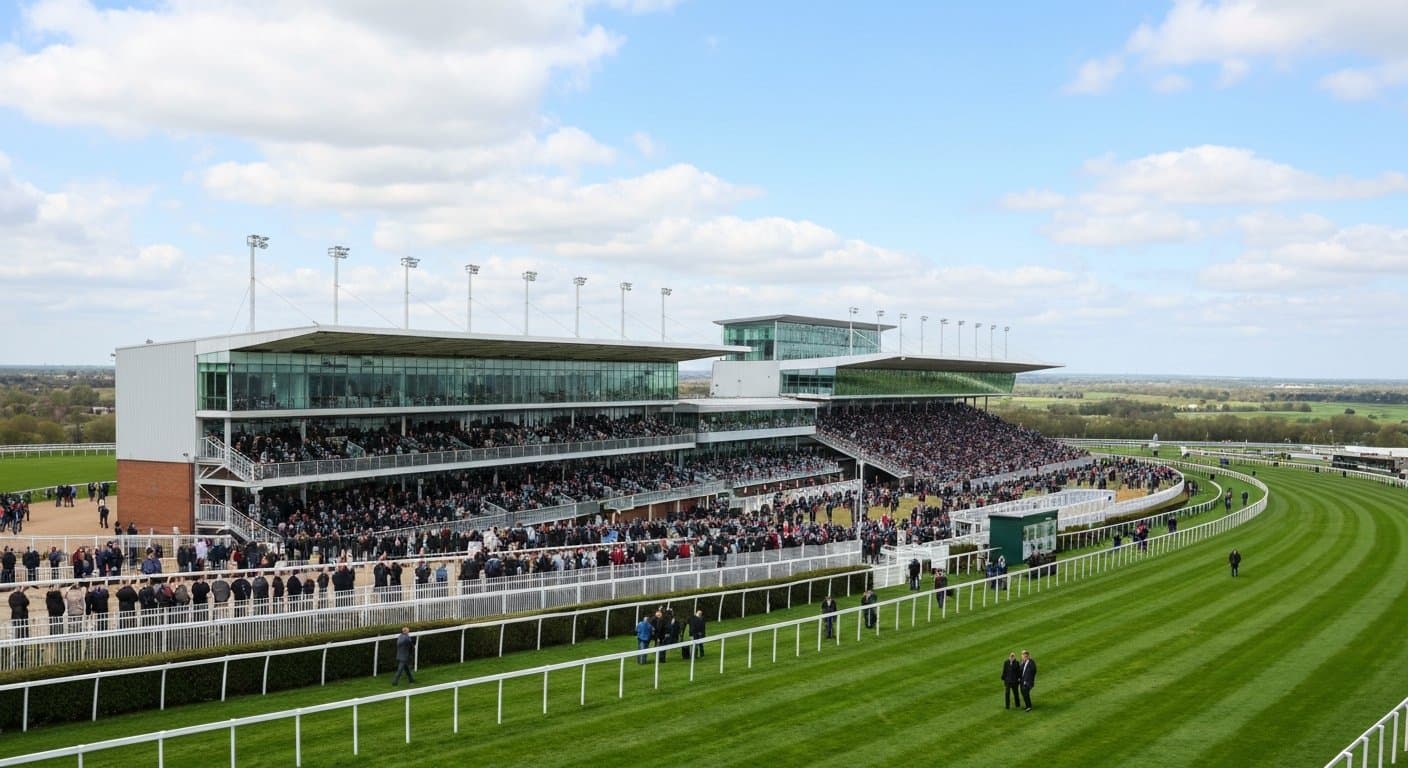
Haydock Park offers several enclosure options, each at a different price point and with a different character. The layout is compact enough that wherever you are, you're never far from the track — one of the real advantages of a day here compared to larger, more sprawling venues where the cheap seats can feel half a mile from the action.
The main areas are the County Enclosure, the Grandstand Enclosure, and the Tommy Whittle Stand. The exact configuration varies between meetings, with the biggest flat fixtures and Betfair Chase day offering the fullest range. For smaller midweek cards, the enclosure structure is simpler — but the core facilities remain consistent.
County Enclosure
The County Enclosure is the premium experience at Haydock Park. It offers the best views of the finishing straight, direct access to the parade ring, and a more polished atmosphere with a dress code to match. On major racedays — the Sprint Cup, Betfair Chase, and feature Saturday fixtures — this is where the serious racing crowd gathers alongside the hospitality groups and corporate parties.
Facilities in the County include bars, restaurants, and private dining options. The viewing from the County Stand is excellent: a tiered structure ensures that even when crowds build through the afternoon, sightlines to the track are not blocked. The design suits Haydock's long home straight — from the County Stand, you can watch the whole of the final three furlongs from a fixed viewpoint without craning.
Hospitality packages in the County are available for corporate groups and larger parties. These typically include a reserved table, a set-meal option, drinks packages, and a dedicated host. For companies bringing clients to the racing, Haydock's County packages are competitive with other Jockey Club venues in the north — and the location off the M6 makes attendance straightforward for guests coming from across the North West.
Expect to pay a premium for County badges, particularly on the big days. The Betfair Chase and Sprint Cup meetings command higher admission prices than regular fixture days, and County badges will run into double figures. Advance booking is strongly recommended — walk-up availability in the premium enclosure on the Betfair Chase can be limited.
Smart attire is required in the County Enclosure. Jackets for men are appropriate; smart-casual wear is the minimum standard. Particularly muddy November conditions will test the smart-casual brief, but that's the nature of a jumps festival in Lancashire.
Grandstand Enclosure
The Grandstand Enclosure is where the majority of regular racegoers spend their day. It offers solid viewing of the track, access to the parade ring from a slightly different vantage point to the County, and a range of food and drink outlets that cover most needs.
The atmosphere in the Grandstand tends to be livelier and less formal than the County. On big days it can get properly buzzing, with a crowd that mixes racing regulars, groups celebrating birthdays or office outings, and day-trippers who've come down from Manchester or Liverpool for the occasion. The grandstand structure offers covered seating and standing areas, so you're not completely exposed to the elements — worth noting at a course that hosts major fixtures in November.
For a standard midweek fixture, the Grandstand Enclosure is the obvious choice. You get everything that matters — the parade ring, the betting ring, the track views — at a considerably lower price than the County. For major meetings, the Grandstand still delivers an excellent day's racing; the decision to upgrade to the County is a question of whether you want the sit-down restaurant option and the specific viewing position.
A note on viewing: Haydock's Grandstand gives excellent sight of the home straight, which is what matters most for watching races finish. The position at the bottom of the stretch is slightly less elevated than the County tiered structure, but on a clear day the views across the track are good from most positions.
Tommy Whittle Stand
Named after the popular Haydock trainer who trained for decades in the area, the Tommy Whittle Stand comes into its own during the National Hunt season. Positioned to give excellent views of the final fences and the run to the line, it is a favourite with jumps enthusiasts who want to be close to the action without paying County prices.
The facilities in the Tommy Whittle Stand are functional: a covered area with a decent vantage point over the finishing straight, a bar, and access to the trackside betting operations. It is not the place for a sit-down meal or premium hospitality. It is the place for serious racegoers who want to watch the jumping up close.
On a cold November afternoon for the Betfair Chase, the atmosphere under the Tommy Whittle Stand roof has its own character. The crowd here knows what they're watching. They're not there for the food or the social occasion — they're there for the Grade 1 chase.
Food and Drink
Haydock offers a range of catering options across all enclosures. The standard fare includes burgers, fish and chips, pie and chips, and the kind of hot food that makes sense on a cold raceday. The quality is above the average provincial track — Jockey Club venues have invested in their food and drink offering over the past decade, and Haydock benefits from that.
In the County Enclosure, the sit-down restaurants offer a more substantial meal option. For hospitality packages, a three-course meal is typically included. The quality is broadly what you'd expect from a catered corporate event — consistent, reasonably presented, with a menu built around classic British dishes.
The bars serve a full range of drinks. On major racedays, additional pop-up bars and food stalls appear around the course, which helps to reduce queuing pressure on the permanent outlets. Prices are racecourse-standard: noticeably higher than a local pub, but not egregiously so. A pint of lager in the Grandstand bar will cost around what you'd pay at a Premier League football ground.
Bringing your own picnic is an option on summer flat days if you're in the appropriate enclosure areas — worth checking the current policy on the Haydock website before arriving with a cooler bag.
The Parade Ring
Haydock's parade ring is well-positioned and accessible from both main enclosures. It sits close to the grandstands, so you do not need to walk the length of the course to watch horses being saddled and led round before the race. On big days — particularly the Betfair Chase and Sprint Cup — arriving at the parade ring fifteen minutes before the off gives you the chance to assess horses in the flesh.
This is worth doing for serious punters. Watching how a horse moves, whether it's sweating or appears calm, whether it carries itself well in the parade — this is information you can't get from a form book. At a course like Haydock, where the going can be challenging in winter, a horse that looks properly fit and fresh before the Betfair Chase is worth noting.
The winner's enclosure sits adjacent to the parade ring and provides a good vantage point for the post-race unsaddling. On major days the crowds build quickly after the big race, but the design allows reasonable viewing from multiple angles. Watching a Betfair Chase winner return to the enclosure in November mud, with Ruby Walsh or Daryl Jacob pulling up and the crowd gathering round — that's what Haydock is about.
Betting Facilities
The betting ring at Haydock is active and well-run. On big days, a good number of on-course bookmakers operate along the rails, and the Tote windows are positioned throughout the enclosures. Prices in the Haydock betting ring are competitive — the Sprint Cup and Betfair Chase both attract enough money that the markets are liquid and the early prices are worth noting.
Self-service Tote terminals are available in the Grandstand Enclosure, and the course operates the full suite of Tote products: Win, Place, Exacta, Trifecta, and the Scoop6 on selected Saturdays. For cash bettors, the rails bookmakers are the most efficient option; for those who want to track the market and bet in running, the Tote offers the pooled alternative.
Pre-race, the parade ring area immediately before the betting ring closes gives the best opportunity to get a feel for the market and the horses simultaneously. On the Betfair Chase, where 10 or 12 horses might be in contention, that fifteen minutes between the parade ring and the off is worth using well.
Accessibility and Practical Details
Haydock Park is reasonably well set up for wheelchair users and those with mobility issues. There are dedicated viewing areas positioned with sightlines to the track, accessible toilets throughout the course, and assistance available from course staff. If you have specific requirements, contacting the racecourse in advance via the Jockey Club website is the best approach — they can confirm facilities and make any necessary arrangements.
Racecard programmes are sold at the gate and at outlets around the course. The big-screen displays around the track show live race coverage, results, and betting information — these are clearly visible from most areas and are particularly useful when a race is running on a part of the course that isn't directly in front of the grandstands.
Children and Families
Haydock is generally welcoming to families, particularly on summer flat days when the atmosphere is more relaxed. Children under 18 are admitted free, and the bigger summer Saturday fixtures occasionally include additional family-friendly activities.
The Betfair Chase day in November and the jumps fixtures through winter are less obviously family-friendly — the weather can be testing, the atmosphere is more adult, and the primary draw is the racing itself rather than any surrounding entertainment. If you're bringing children to Haydock, a June or July flat card in good weather is a better fit than a November jumps day.
The course's compact layout is useful for families: it's easier to keep a group together at Haydock than at a larger, more spread-out venue. The parade ring is accessible, the big screens are visible from most areas, and there's enough going on between races to keep young visitors engaged without requiring a dedicated children's programme.
Getting There
By Car
Haydock Park is one of the most accessible major racecourses in Britain by road. The course sits directly beside Junction 23 of the M6 motorway — you can be in the car park within minutes of leaving the motorway. This is not a slight exaggeration for a tourist guide: the entrance to the racecourse car parks is visible from the junction approach road.
From Manchester city centre, allow roughly 25 minutes in normal traffic. From Liverpool, 35-40 minutes via the M62 and M6. From Leeds, approximately 90 minutes via the M62. From Birmingham, the M6 takes around two hours. From London, the journey is two and a half to three hours depending on traffic, making Haydock a realistic same-day trip for major fixtures.
The M6 connects to the M62 running east-west across the north of England, the M58 towards Liverpool, and the A580 East Lancashire Road, which also connects to Manchester and Liverpool without using the motorway. If there are problems on the M6, the A580 serves as a reasonable alternative.
For visitors coming from the east — Yorkshire, Leeds, Sheffield — the M62 is the main route, joining the M6 at Warrington and heading south one junction to J23. The journey from Leeds is consistently under 90 minutes in normal conditions.
Parking at the course is free on most racedays, which is a real benefit — many comparable tracks charge between £5 and £15 for car parking. Large, well-signposted car parks sit adjacent to the course, and the approach roads are staffed by stewards on race days who direct traffic efficiently. On the biggest days — Betfair Chase, Sprint Cup — arriving at least 60-90 minutes before the first race is advisable to secure a space reasonably close to the entrance.
After racing, the car parks take time to clear. If you're concerned about the M6 getting congested, staying for the last race and then waiting 30 minutes in the car park can be a more relaxing exit than joining the immediate rush.
By Train
The nearest station to Haydock Park is Newton-le-Willows, on the Liverpool Lime Street to Manchester Victoria line via Earlestown. Journey times are approximately 20 minutes from Liverpool Lime Street and 25 minutes from Manchester Victoria. Northern Rail services operate this line, with trains running at regular intervals throughout the day — check the timetable in advance for evening fixtures, where late services can be less frequent.
From Newton-le-Willows station, the racecourse is approximately one and a half miles. That is a 25-30 minute walk along predominantly suburban roads. The route is walkable in good weather and straightforward to follow, but on a cold November evening after the Betfair Chase, most racegoers prefer the taxi option.
Earlestown station, also on the same line, is a similar distance from the course and can sometimes be less busy than Newton-le-Willows on major race days. It's worth knowing as an alternative if the taxi queue at Newton-le-Willows is particularly long.
Warrington Bank Quay is approximately ten miles from the course and is served by Avanti West Coast services from London Euston. Journey times from Euston to Warrington Bank Quay are under two hours on the fast trains. From Warrington Bank Quay, a taxi to Haydock takes around 20 minutes. For visitors from London who want to travel by train, this is the most direct option — arrive at Warrington, taxi to Haydock, taxi back afterwards.
Warrington Central (served by TransPennine Express from Liverpool and Manchester) is closer to Haydock but less well-served by national long-distance services. Worth considering if your route naturally passes through it.
Shuttle Buses on Race Days
On major racedays — primarily the Sprint Cup, Betfair Chase, and the biggest Saturday fixtures — the Jockey Club typically arranges shuttle buses from Newton-le-Willows station to the course. These run at regular intervals before and after racing and are either free or available for a nominal charge.
Always confirm shuttle arrangements in advance on the Haydock Park website, particularly for the Betfair Chase in November when the weather can make the walk from the station a cold, wet ordeal. The shuttle service for major fixtures is well-organised and takes most of the inconvenience out of arriving by train.
By Coach and Organised Travel
Several coach companies run organised trips to Haydock's major meetings, primarily the Betfair Chase and Sprint Cup. These packages typically include return travel from a local pick-up point and admission to the course. They're a good option if you're travelling as a group and don't want the logistics of driving and parking.
Check local operators in the Greater Manchester and Merseyside areas, as availability and departure points vary. Group bookings often come with price benefits over individual admission plus transport costs.
Taxis and Ride-Hailing
Taxis operate from Newton-le-Willows station and are generally available in the local area. Ride-hailing apps including Uber serve the Newton-le-Willows and St Helens area.
Pre-booking a return taxi is strongly recommended on major racedays. After the final race of the Betfair Chase or Sprint Cup, demand for taxis spikes dramatically, and waiting times for an unpre-booked taxi can stretch to 30-45 minutes. If you're arriving by train and taxi from Newton-le-Willows, booking the return journey when you arrive at the course is the sensible approach.
From the North: Additional Options
Visitors from the north — Preston, Lancaster, Blackpool, the Lake District — reach Haydock via the M6 southbound, exiting at J23. The journey from Preston is around 35 minutes; from Lancaster, allow just over an hour. The M6 is a consistent route and the J23 exit is well-signposted.
Sat Nav and Directions
The postcode for Haydock Park Racecourse is WA12 0HQ. Follow signs for Haydock Park Racecourse from Junction 23 of the M6. On racedays, stewards on the approach roads direct traffic into the car parks, so following signs and steward directions is simpler than relying solely on sat nav once you're close.
Planning Your Journey
For the major days — Betfair Chase in November, Sprint Cup in September — allow generous time for arrival and departure. The M6 around Junction 23 can develop significant congestion on raceday afternoons, particularly in the 90 minutes before the first race. Arriving early enough to park, collect a racecard, study the form, and settle in before the first race makes the day considerably more enjoyable than arriving in a rush five minutes before the off.
The same applies for the return. The car parks at Haydock clear efficiently but the volume of traffic on the M6 after a major fixture can create delays. If you're not pressed for time, the last race is often the best betting race on the card, and staying for it means you depart into a thinning traffic flow rather than the immediate post-racing rush.
Racing Calendar & Key Fixtures
Season Overview
Haydock Park is one of the busiest racecourses in Britain, hosting around 30 fixtures a year across both flat and National Hunt codes. The flat season runs from approximately April to September, with the jumps programme running from October through to April. There is very little downtime — Haydock races throughout most of the year.
This dual-purpose calendar means the course offers something worth attending regardless of the time of year. Summer evenings bring competitive flat handicaps in good weather. Autumn and winter deliver the heavyweight jumps fixtures that draw the top trainers from Britain and Ireland.
The racing programme has been built deliberately over decades. The headline races at both ends of the season — the Sprint Cup in September, the Betfair Chase in November — bookend an autumn that is one of the strongest two-month periods in Haydock's annual calendar. In between, the summer flat programme and winter jumps cards provide consistent quality without relying on a single tentpole event.
Key Flat Fixtures
Sprint Cup (Group 1) — September
The Sprint Cup is Haydock's flagship flat race and the premier sprint contest in Europe. Run over six furlongs in early September on the straight course, it regularly attracts the best sprinters from Britain, Ireland, France, and occasionally further afield. The race carries prize money of over £250,000 and its Group 1 status — achieved in 1988 — reflects 35-plus years of consistently attracting the highest calibre of sprinting talent.
The September timing makes it the de facto end-of-season sprint championship. By the time the Sprint Cup is run, the flat season's major early-summer sprint races — the King's Stand, the Diamond Jubilee, the July Cup, the Nunthorpe — have already sorted the leading sprinters. What arrives at Haydock in September is the field that matters.
The timing shapes the betting market in a specific way. Horses arrive with contrasting profiles: established older sprinters who have been campaigned through the season, and improving three-year-olds who have developed through the summer and now hold a weight allowance against their elders. Three-year-olds have won the Sprint Cup, and when an improving one has been lightly raced earlier in the season, it can arrive at Haydock with the scope to outperform its market price.
The race is preceded by the Betfair Sprint Cup Support Race programme, which typically includes a number of Listed and Group races making it one of the best single-day cards of the flat season. The supporting card is worth attention — competitive sprint handicaps and Listed races that often feature horses who will be Sprint Cup contenders in future years.
Lancashire Oaks (Group 2) — July
The Lancashire Oaks is Haydock's main summer prize for fillies and mares, run over a mile and four furlongs. It is a Group 2 contest that attracts quality middle-distance fillies from the major yards, often serving as a stepping stone for the Yorkshire Oaks or other late-summer targets.
The race has been won by some classy fillies over the years. It sits in the middle of the summer flat programme and typically attracts fields of eight to 12 runners, making it a competitive and betting-friendly event. On the Haydock oval, the distance rewards real staying ability in fillies who can maintain their pace across the full mile and four furlongs.
Old Newton Cup — July
The Old Newton Cup is a summer handicap over a mile and a half with a history stretching back well over a century. The race was first run in the Victorian era and has been one of the most reliably competitive handicaps in the northern flat calendar ever since.
The appeal of the Old Newton Cup for betting purposes is straightforward: it draws a large field of well-matched handicappers, the distance and track test ability properly, and the prize money attracts quality horses. It is the sort of race that rewards detailed form study — the winner is rarely a 4/1 favourite but is usually a horse whose profile, when you examine it carefully, made sense.
The Old Newton Cup demonstrates the quality of Haydock's flat programme as well as any race on the calendar. A competitive field, an honest track, and a race that has been settled on merit for over a century.
Sandy Lane Stakes (Group 2) — May
The Sandy Lane Stakes runs over six furlongs in May and has become an important Royal Ascot trial, particularly for the Commonwealth Cup. Speedy three-year-olds with sprint ambitions use this race to establish their credentials before the June meeting. In recent years it has thrown up horses who went on to Group 1 success, and it is now on the radar of the major flat yards who target the Commonwealth Cup.
Rose of Lancaster Stakes (Group 3) — July/August
Run over a mile and a quarter, the Rose of Lancaster is a Group 3 for middle-distance horses that provides a competitive summer race on the Haydock flat programme. It draws horses from the big yards and often features horses who have run in Pattern company at Newmarket, Goodwood, or York earlier in the season.
Summer Evening Fixtures
Haydock hosts several evening flat meetings through June, July, and August that offer a different experience from the big afternoon cards. Smaller crowds, a more relaxed atmosphere, and competitive handicap racing make these evenings a solid option for a night out that is different from the usual.
These fixtures are often better value for attendance than the major Saturday meetings — admission prices are lower, the course is less crowded, and the racing is still competitive.
Key National Hunt Fixtures
Betfair Chase (Grade 1) — November
The Betfair Chase is the race that defines Haydock's jumps season. Run over approximately three miles and one furlong in late November, it is the first Grade 1 of the British National Hunt season and carries prize money of over £200,000.
The race's significance goes beyond its immediate prize. It is the first leg of the Jockey Club Chase Triple Crown, alongside the King George VI Chase (Kempton, 26 December) and the Cheltenham Gold Cup (March). A horse that wins the Betfair Chase is automatically in the Gold Cup conversation, and the race has been the first major statement of intent from serious Gold Cup contenders for two decades.
The going at Haydock in November is typically soft or heavy. This is not a race for horses who need good ground to show their best jumping. The Betfair Chase sorts horses who can stay three-plus miles in testing conditions and jump accurately under pressure over fences that demand concentration.
The race was established in its current Grade 1 form in 2005 and has been won by some of the best staying chasers of the past 20 years. Kauto Star won it three times. Bristol De Mai won it three times. Cue Card, Might Bite, and a succession of serious Gold Cup candidates have run here to announce their seasonal intentions.
For attendees, the Betfair Chase day is one of the great autumn racedays in the northern National Hunt calendar. The combination of Grade 1 chasing, November going, a full supporting card of competitive jumps races, and the atmosphere of a Haydock crowd on its biggest annual day makes it worth attending on its own merits.
Peter Marsh Chase (Grade 2) — January
The Peter Marsh Chase is run over approximately three miles in January and serves as a key pointer for the spring festivals. It regularly features horses working towards the Cheltenham Gold Cup, the Grand National, or other major spring targets.
The January timing and the Haydock conditions — typically good to soft or soft in mid-winter — make it a real test of staying ability. Horses who perform well here in January with spring targets in mind are worth noting. The race has a good record of producing placed horses in the Gold Cup and Grand National.
Champion Hurdle Trial (Grade 2) — January
Haydock's Champion Hurdle Trial gives hurdlers a chance to stake Cheltenham claims over two miles in January. The race has been won by horses who went on to compete in the Champion Hurdle, and the testing winter conditions at Haydock provide a useful pointer to a horse's resilience and soundness heading into the spring.
Tommy Whittle Handicap Chase — December
Named after the popular local trainer, this long-distance handicap chase is a competitive winter event that regularly produces Grand National hopefuls. It rewards horses with staying ability and experience of Haydock's conditions, and the handicapper's assessments following strong Tommy Whittle performances can be worth following into the spring festivals.
December Jump Meeting
Haydock's December National Hunt card is a significant jumps fixture in its own right. Positioned between the Betfair Chase in November and the January Grade 2 programme, the December meeting offers competitive racing at an accessible time of year — post-Christmas jumps racing in the north-west, with a full card of novice and handicap chases and hurdles.
Planning Your Visit
Advance ticket prices are lower than on-the-day admission across all enclosures and all meetings. For the Betfair Chase and Sprint Cup, booking several weeks in advance is strongly recommended — County Enclosure places in particular can be limited.
Annual memberships are available from the Jockey Club and offer significant savings if you attend multiple fixtures per season. A membership that covers Haydock alongside Aintree and Chester, for instance, makes obvious sense for north-west racegoers who attend regularly across both codes.
The Jockey Club website is the definitive source for fixture dates, ticket prices, and any special offers or themed racedays. Haydock runs occasional promotional meetings with themed entertainment alongside the racing, and these can offer good value for groups or first-time visitors.
Betting at Haydock Park
Course Form Carries Real Weight
Haydock Park is one of those tracks where previous course form carries real weight in the betting — particularly over jumps. The combination of the left-handed oval, the testing winter going, and the nature of the fences means that horses who have performed well here before tend to run well again. Bristol De Mai's three Betfair Chase wins are the extreme example, but the principle applies through the whole card.
Before you assess a runner at Haydock, check its course record. A horse with a win or strong placing on this specific track — especially in similar going conditions — is worth serious consideration even if its recent form elsewhere has been moderate. Course specialists at Haydock are real, not a fiction of the form book.
Ground Is Everything in Winter
You cannot bet intelligently at Haydock during the jumps season without factoring in the going. The heavy clay soil means ground conditions can deteriorate rapidly through autumn and winter, and races run on properly heavy going produce very different results from those on good to soft.
The practical rule: always check the official going report on the morning of a Haydock jumps fixture, ideally 24-48 hours in advance if you're planning stakes. The going can move a full two descriptions in 48 hours if the right storm system comes through Lancashire. A race that looked like a test of jumping technique on good to soft can become a pure stamina slog on heavy.
Horses bred for stamina and with proven heavy-ground form hold a major advantage when conditions are at their most testing. Light, nimble types who look impressive at Kempton or Sandown in December can struggle completely at Haydock in November. The market does not always price this in correctly — particularly with horses that have impressive form on a quick surface and then arrive at Haydock for the first time.
The Sprint Cup — Pace Map and Going
The Sprint Cup over six furlongs is one of the most interesting betting races of the flat season. Several specific factors shape the race:
Pace scenario: The Sprint Cup on the straight course at Haydock can be dominated by front-runners on fast going if the pace set is strong and sustainable. A field with multiple proven front-runners often produces a truly run race, which tends to suit horses with a finishing kick who can pick up the pieces. When there is only one pace-setter in the field and the early pace is therefore steady, front-runners who are not challenged early can control the race from the front and hold on. Mapping the pace before you bet — identifying how many early pace horses are in the field and whether they will engage each other — is the most important pre-race analysis you can do.
Draw: On the six-furlong straight course, draw bias is minimal in standard conditions. No stall has a structural advantage from a bend. In softer going, the track can ride better on one side of the course than the other — if there is a bias in these conditions, it tends to emerge in the first two furlongs and becomes visible as the field fans out. In fast going, draw is essentially irrelevant.
Ground: A soft-ground Sprint Cup is a different race from one on good to firm. Soft conditions slightly favour horses with a high level of stamina alongside their speed — pure flat-track sprinters who rely on a fast surface sometimes find the pace they can sustain on quick ground is not available to them on soft. Horses with proven form on soft going at sprint distances are worth upgrading in the market when the ground softens.
Three-year-olds: The weight allowance for three-year-olds in the Sprint Cup is worth taking seriously. A lightly raced improving three-year-old can arrive at Haydock in September with a profile that the market undervalues because the form is not as fully exposed as the four and five-year-olds. Check the horse's season: has it been improving steadily? Is it running off a weight allowance that makes its adjusted rating competitive with the older horses? The three-year-old who wins the Sprint Cup often looks, in hindsight, like an obvious winner — they improve through the summer and peak at exactly the right time.
Betfair Chase — Angles and Approaches
The Betfair Chase produces more betting analysis per race than almost any other Grade 1 in Britain, partly because the going factor is so stark and the course specialist trend is so well-documented.
Fitness angle: The Betfair Chase is the first Grade 1 of the National Hunt season. Some horses arrive having run a prep race in October or November. Others arrive after a summer off with just work at home to show. The trainers who prepare horses specifically for Haydock — with one or two preparatory runs to sharpen fitness before November — often have an advantage over horses arriving for their seasonal debut in a three-mile Grade 1 on soft going. A horse who has had one run since returning from summer and is clearly short of peak fitness will struggle to grind out a Betfair Chase.
Gold Cup picture: The Betfair Chase winner is immediately in the Gold Cup conversation. This shapes the betting market — Gold Cup favourites regularly start at shorter odds in the Betfair Chase than their Haydock form alone would justify, because punters are pricing in the Gold Cup quality rather than pure suitability for this specific race. When a Gold Cup fancy arrives at Haydock having never won or threatened to win on soft or heavy ground, this can create a pricing error that other horses benefit from.
Going watch: For the Betfair Chase specifically, the going watch in the week before the race is essential. If the going is forecast to be soft, the field of contenders narrows to proven heavy-ground performers. If a dry autumn has kept the ground at good to soft, the race opens up to horses who need a faster surface. Check the 10-day forecast for Newton-le-Willows a week out and then refine your assessment as the going reports arrive.
Trainer patterns: Paul Nicholls has the strongest record in the Betfair Chase of any trainer. His experience with Kauto Star across three victories gives Nicholls-trained horses from Ditcheat a Haydock association worth noting. Nigel Twiston-Davies, who trained Bristol De Mai to three wins, understands Haydock's winter conditions well. When trainers with a strong Haydock record send runners to the Betfair Chase, that course knowledge is part of the preparation.
General Flat Betting: Middle-Distance Races
In the oval middle-distance flat races — the Lancashire Oaks, the Rose of Lancaster, the Old Newton Cup — the key betting factor is whether a horse truly stays its trip while maintaining pace across three and a half furlongs of straight.
Haydock's flat oval rewards horses with a high cruising pace rather than those who produce a single burst of speed from the rear. If you're assessing a horse in a mile-and-a-quarter or mile-and-a-half race at Haydock, look at its previous form for sustained running. Does it stay on all the way to the line, or does it produce its effort in a specific window and then flatten out? The former profile is better suited to Haydock.
Trainer Patterns at Haydock
Richard Fahey has an excellent record in the sprint races at Haydock. His Musley Bank yard in North Yorkshire is one of the leading sprint operations in Britain, and he targets the straight six-furlong course regularly. His runners in sprint handicaps and Listed races at Haydock are consistently worth checking.
Tim Easterby is another northern trainer with a strong Haydock record in sprints and middle-distance flat races. His horses tend to be well-suited to the track's galloping nature.
Karl Burke — who trained Quiet Reflection to her 2016 Sprint Cup victory — is another name to note in sprint company at Haydock. His horses are well-prepared for the big sprint days.
Over jumps, Paul Nicholls and Nigel Twiston-Davies have the strongest historical records in the Betfair Chase and the big winter fixtures. The Scottish and Welsh-based yards also travel well to Haydock, and it's worth checking whether trainers with strong Haydock form are sending horses specifically for this fixture.
Northern trainers on the quieter cards: On midweek jumps fixtures outside the major races, northern trainers — Donald McCain in Cheshire, Micky Hammond in Yorkshire, Keith Dalgleish in Scotland — have home advantage in the handicap chases and hurdles. Their horses know the track, the trainers know the conditions, and the market for midweek NH racing at Haydock can underestimate local form.
Handicap Betting
Haydock's handicaps — both flat and jumps — are worth serious form study. The Old Newton Cup in July is a classic summer handicap: high quality, competitive, and rewarding for punters who dig into the specific form rather than following market moves.
Over jumps, the Peter Marsh Chase and Tommy Whittle Handicap Chase are stamina tests where the market underestimates proven stayers with Haydock experience. Horses who have demonstrated they handle this specific course and these specific conditions can outrun their odds, particularly when the going is at its heaviest and the field contains horses who have not proven their ability in those conditions.
In larger-field handicaps, Haydock's fair, galloping track means well-handicapped horses generally get their chance. The home straight is long enough that a horse with ability who has raced in a good position throughout can produce its effort at the right time. Each-way betting in competitive Haydock handicaps — particularly at distances beyond a mile where field sizes of 15-20 are common — has a reasonable long-term record.
Practical Betting at the Course
The on-course betting ring at Haydock is active and well-run. Rails bookmakers on the major days carry solid liquidity, and the markets are competitive. Pre-race prices worth taking on Sprint Cup and Betfair Chase day are often available in the 15-20 minutes before the off — the market firms up quickly once betting opens, so early movers who have done their analysis can secure better prices than those who wait.
The Tote's pooled market is worth using for handicap races with large fields, where the pool size relative to field size can produce better returns than fixed-odds bookmakers in competitive races. The Exacta and Trifecta pools in the big handicaps are worth a small investment when you have a strong opinion on the likely first three home.
Please gamble responsibly. If you feel you may have a problem with gambling, visit BeGambleAware.org or call the National Gambling Helpline on 0808 8020 133.
Frequently Asked Questions
Notable Horses at Haydock Park
Kauto Star: The Betfair Chase's Defining Horse
No horse has shaped the identity of Haydock Park in the modern era the way Kauto Star did between 2006 and 2009. Trained by Paul Nicholls at his Ditcheat yard in Somerset and ridden in all three victories by Ruby Walsh, Kauto Star won the Betfair Chase in 2006, 2007, and 2009 — a record that remains unmatched and gives the race a centre of gravity that it will carry for decades.
Kauto Star's first Betfair Chase victory in 2006 came early in his career as a chaser. He had shown exceptional jumping technique and an easy, fluent galloping style that suited Haydock's flat, left-handed circuit immediately. He won that November as a horse being confirmed as a potential champion — and the confirmation came: he won the King George VI Chase at Kempton on Boxing Day, then the Cheltenham Gold Cup in March 2007.
He returned to Haydock in November 2007 as the reigning Gold Cup champion. He won the Betfair Chase again, then the King George VI Chase again. He finished second in the 2008 Gold Cup to his stablemate Denman — arguably the most famous result in modern National Hunt racing — and then won the 2009 Gold Cup, becoming only the second horse in history to win the Gold Cup more than once.
November 2009 brought his third Betfair Chase win. He was nine years old. He had already won two Gold Cups, three King Georges, and two Betfair Chases. He won his third Betfair Chase on Haydock's testing ground, confirming that this track — with its flat, galloping circuit and its autumn going — was perfectly calibrated for his style.
Kauto Star's relationship with Haydock was not accidental. The flat, left-handed oval suited his long, sweeping stride. He was not a horse who needed tight, technical tracks — he was at his best on honest galloping courses where his sustained pace and clean jumping could dominate. Haydock was that course.
Bristol De Mai: Course Specialist in Extremis
If Kauto Star was the Betfair Chase's greatest all-time performer, Bristol De Mai was its most extreme course specialist. Trained by Nigel Twiston-Davies and partnered by Daryl Jacob, he won the race in 2017, 2018, and 2020 — a record that now matches Kauto Star's three victories, though achieved in very different circumstances.
Bristol De Mai's Haydock form bears almost no relationship to his form elsewhere. His Gold Cup record was moderate. At other tracks, even on soft ground, he was a good but not exceptional Grade 1 chaser. At Haydock in November, on soft or heavy going, he was virtually unbeatable.
His 2018 Betfair Chase win was won by 57 lengths on officially heavy ground. The field included horses with authentic Grade 1 credentials. None of them could live with Bristol De Mai's brutal, relentless galloping over three miles in conditions that favoured stamina above all else. The margin was not the result of an unusually weak field — it was the result of a horse precisely matched to a specific set of conditions on a specific track.
The punting lesson from Bristol De Mai is one that transfers to other courses with specific going profiles: when you find a horse whose course form is dramatically better than its form elsewhere, and when the conditions that produced that form are likely to repeat, the horse deserves to be shorter in the market than its general class rating suggests. Bristol De Mai at Haydock on soft or heavy was not the same horse as Bristol De Mai at Cheltenham on good ground. The market, in his early years, did not always price this correctly.
Quiet Reflection: Sprint Cup 2016
The 2016 Sprint Cup produced one of the race's more unlikely stories. Quiet Reflection, a filly trained by Karl Burke at his Spigot Lodge yard in North Yorkshire, beat a field of colts to win the Group 1 under apprentice jockey Dougie Costello.
Costello was riding in a Group 1 sprint for the first time. He and Quiet Reflection produced a race-reading performance of controlled aggression — tracking the pace from a midfield position on the straight six-furlong course, moving to challenge over the final two furlongs, and holding on by a neck. Fillies taking on colts in sprint Group 1s are a small percentage of the field; fillies winning them are rarer still.
Burke's training operation in North Yorkshire is one of the leading sprint yards in Britain, and Quiet Reflection's Sprint Cup victory put the yard on the national map in sprint Group 1 company. The race also underlined something important about Haydock's Sprint Cup: the six-furlong straight course is a fair, honest test where a horse with raw ability and a well-judged ride can beat a field of more fancied rivals.
Harry Angel: 2017 Sprint Cup
Harry Angel won the 2017 Sprint Cup under Daniel Tudhope for trainer Clive Cox. He won it on ground described as good to firm, setting a fast time for the straight course and confirming his status as the best sprinter in Britain that season.
What made Harry Angel's Haydock performance notable beyond the result was how he won: he travelled comfortably just off the pace, moved smoothly into contention in the final two furlongs, and drew clear on the run to the line without appearing to be fully extended. That sort of performance — controlled, professional, with something in reserve — is the calling card of a proper Group 1 sprinter rather than a horse getting lucky on the day.
Cox went on to campaign Harry Angel through the rest of the season, and the Sprint Cup win stood as the performance that confirmed his 2017 title as European Sprint Champion.
Muhaarar: 2015 Sprint Cup
Muhaarar, trained by Charlie Hills and owned by Sheikh Hamdan Al Maktoum, won the 2015 Sprint Cup in the middle of a brilliant unbeaten autumn campaign that earned him European Sprint Horse of the Year. Under Paul Hanagan, he gave weight to every horse in the field and won comfortably, showing the sort of effortless superiority over a top-class sprint field that marks out a horse with real Group 1 ability at the top of its form.
The 2015 Sprint Cup was one of those races where the winner was obvious in retrospect — Muhaarar had been building toward a peak all season, and Haydock was where the peak was delivered. He retired at the end of that season and went to stud.
The Broader Roll of Honour
The Sprint Cup's Group 1 roll of honour since 1988 reads as a list of the best European sprinters of the past three decades. Dream Ahead (2011), Lethal Force (2013), G Force (2013), and successive winners have confirmed the race's status as the definitive end-of-season sprint championship.
The Betfair Chase's roll of honour since 2005 similarly reads as a catalogue of serious Gold Cup contenders. Cue Card won it in 2015, confirming his stature as a top-class chaser. Might Bite won in 2017 before finishing second in the Gold Cup. Each winning trainer in November has gone on to target Cheltenham in March, and the Haydock form has held up year after year.
That consistency — of the Sprint Cup as the true sprint championship, and the Betfair Chase as the opening statement of the Gold Cup campaign — is what gives Haydock Park's two signature races their weight in the racing calendar.
Atmosphere and Experience
What Haydock Feels Like
Haydock Park does not have Cheltenham's hill, Aintree's National fences, or Goodwood's natural amphitheatre. What it has is something more straightforward: a well-run, properly accessible course where serious racing happens and serious racegoers turn up to watch it.
The atmosphere at Haydock is northern in the best sense. There is no performance about it. The crowd at the Betfair Chase in November is not there because going racing is fashionable that month — they are there because the Grade 1 chase is on and they want to watch it. The crowd at the Sprint Cup in September knows the form book. They've been following the sprinters since Royal Ascot. They have opinions.
This makes Haydock a different experience from Ascot, Goodwood, or any of the festival courses where the occasion itself is partly the attraction. At Haydock, the racing is the occasion. The surrounding entertainment — the food, the bars, the hospitality — supports the day rather than competing with it. If you're going purely for the racing, that's a better balance.
The Betfair Chase Experience
The Betfair Chase day in November is Haydock at its most Haydock. The weather is rarely kind — this is north-west England in the last week of November, and the combination of cold temperatures, the possibility of rain, and ground conditions that can be anywhere from soft to properly heavy is simply the context in which the race is run.
This creates an atmosphere that is specific to the jumps season in the North. Racegoers arrive wrapped up, with racecards in hand and their form work done. The parade ring in the hour before the Betfair Chase fills with people who have been waiting for this race for weeks. There is a focus to the day that reflects the quality of the contest — when Gold Cup contenders are in the parade ring at Haydock in November, the crowd takes the measure of them seriously.
The race itself, over more than three miles of testing going, has a different feel from a flat sprint. There is time to watch it develop. You can see positions change in the back straight, follow jumping errors and recoveries, watch a horse move through the field or struggle to maintain contact. The three-and-a-half-minute duration of the Betfair Chase allows the crowd to respond to what is actually happening, not just watch 90 seconds of blur from gate to line.
After the race, the winner's enclosure fills quickly. The trainer and jockey are brought in, the presentations are made, and the post-race analysis begins. On a cold November afternoon, with the going heavy and the stands well-filled, the Betfair Chase finish has a particular quality that is hard to replicate at less demanding tracks.
Sprint Cup Day: A Different Energy
The Sprint Cup in September brings a different crowd and a different feel. This is flat racing at the end of summer, and the conditions — typically good to firm, with the September sun often still present — make it the most visually pleasant of Haydock's major days.
The straight six-furlong course puts the action directly in front of the stands. From anywhere in the Grandstand or County Enclosure, you watch the field from the moment the stalls open to the moment the winner passes the line. There are no distant back straights, no far-side groups obscured by the track — just horses coming straight at you for six furlongs on the fastest ground of the year.
Sprint racing at this level — Group 1 horses at the peak of their season — is the purest test of a horse's natural speed. When the field breaks from the stalls and resolves itself in the first furlong, the pace is extraordinary. By the two-furlong pole, the pattern is usually clear and the crowd responds to whoever is running into contention.
The atmosphere on Sprint Cup day is more open and less specifically focused than Betfair Chase day. There are social groups alongside the racing crowd, the weather is typically kind, and the atmosphere has a summer-Saturday quality that the November jumps days don't share. Both have their appeal, but they are different experiences.
The Northern Racing Character
Haydock's identity is shaped by its location between Liverpool and Manchester. This is not the Home Counties racing crowd. The racegoers who come to Haydock regularly know their horses, follow both codes seriously, and treat the betting ring as part of the day rather than an intimidating side element.
There is a straight-talking quality to Haydock's atmosphere that you don't always find at southern tracks. Opinions are aired freely in the parade ring. Trainers and jockeys are recognised and their decisions scrutinised. When a fancied horse runs disappointingly, the assessment in the stands is not diplomatic.
This is also a course where families have been coming for generations. Grandparents who watched Kauto Star's first Betfair Chase win in 2006 have brought grandchildren in the years since. Local trainers and jockeys are known by name. The racing community that orbits Haydock — from the Cheshire and Lancashire yards nearby to the Liverpool and Manchester racegoers who regard it as their local course — gives the place a sense of continuity that makes it feel established in a way that fancier but less rooted venues sometimes don't.
Summer and Midweek Days
The atmosphere on summer midweek flat days is noticeably different from the big weekend fixtures. Smaller crowds, more breathing room, and competitive handicap racing at prices that are accessible for a day out. The course feels more relaxed, the queues are shorter, and the racing is just as worth watching.
Evening meetings in June, July, and August have their own appeal. The light lingers in north-west England until 9pm in midsummer, and racing under that quality of evening light — with the course surrounded by the trees and greenery of the Haydock Park estate — is one of the quieter pleasures of the flat season. These are the kind of days that regulars remember and recommend to anyone asking about Haydock who has only seen it on its biggest days.
The course's parkland setting is part of the experience. The trees around the perimeter, the green of the track itself, and the relatively modest scale of the grandstands give Haydock a different character from city-adjacent courses or more industrial-feeling venues. It does not try to be more than it is. It is a racecourse in a park, running races — and that is more than enough.
More guides for this course
Share this article
More about this racecourse
All Haydock Park guides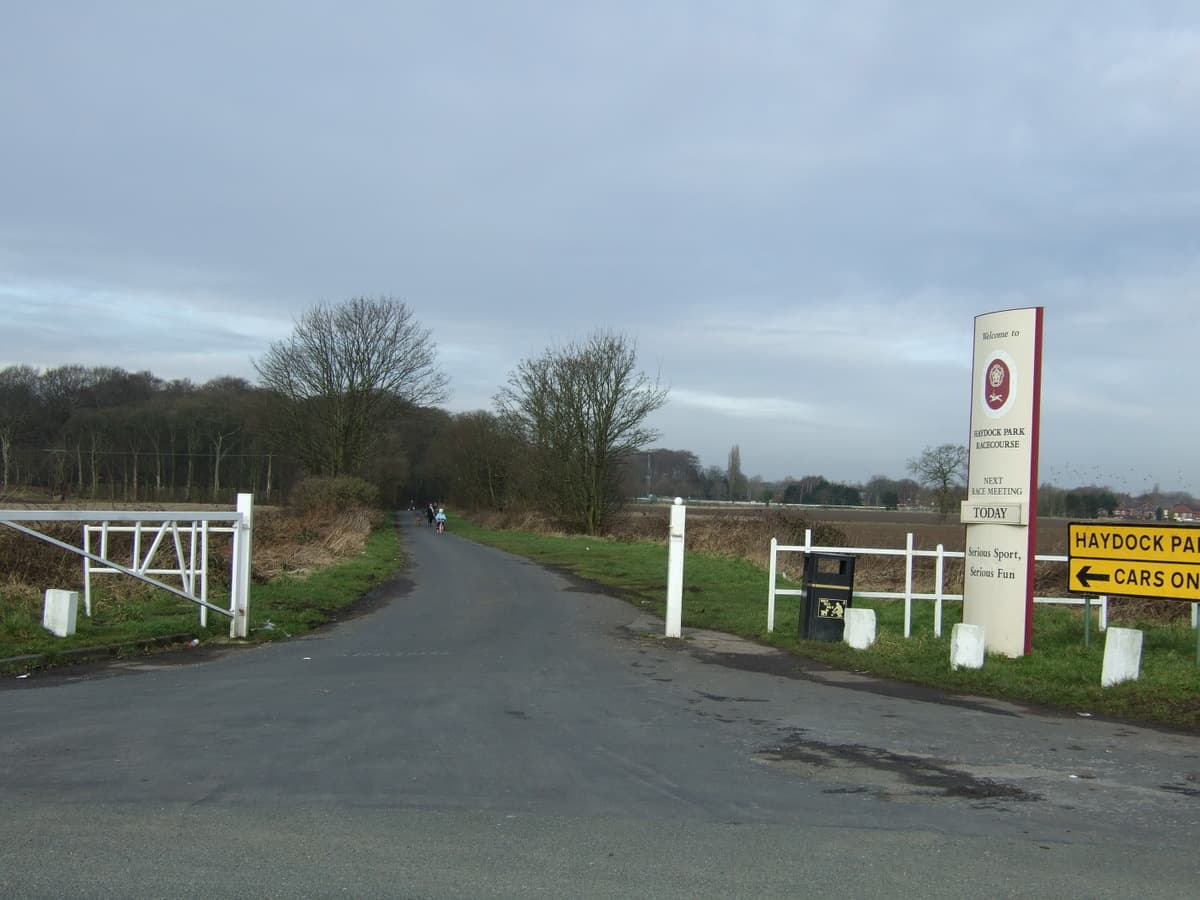
A Day Out at Haydock Park Racecourse
Everything you need for a day at Haydock Park: getting there, what to wear, enclosures, food and drink, and insider tips for your visit.
Read more
Haydock Park's Autumn Festivals: Sprint Cup and Betfair Chase Guide
Haydock stages two of the north's premier racing festivals — the Sprint Cup in September and the Betfair Chase in November. Here's your complete guide.
Read more
The History of Haydock Park Racecourse
From a modest course in 1899 to one of the North West's premier dual-purpose venues: the story of Haydock Park, the Sprint Cup, and the Betfair Chase.
Read morePhotos on this page are used under Creative Commons licences. Titles, sources and licence links for each one are on our image credits page.
Research the field with the AI Race Predictor
Our model publishes calibrated win-probability estimates for UK races — a second opinion to understand a race, not tips. It's open about its record: it doesn't beat the market, and we show exactly how it does.
Work it out & learn the basics
Gamble Responsibly
Gambling should be entertaining and not seen as a way to make money. Never bet more than you can afford to lose. If you or someone you know has a gambling problem, help and support is available.