
Founder & Editor · Last reviewed 2026-04-05
Introduction
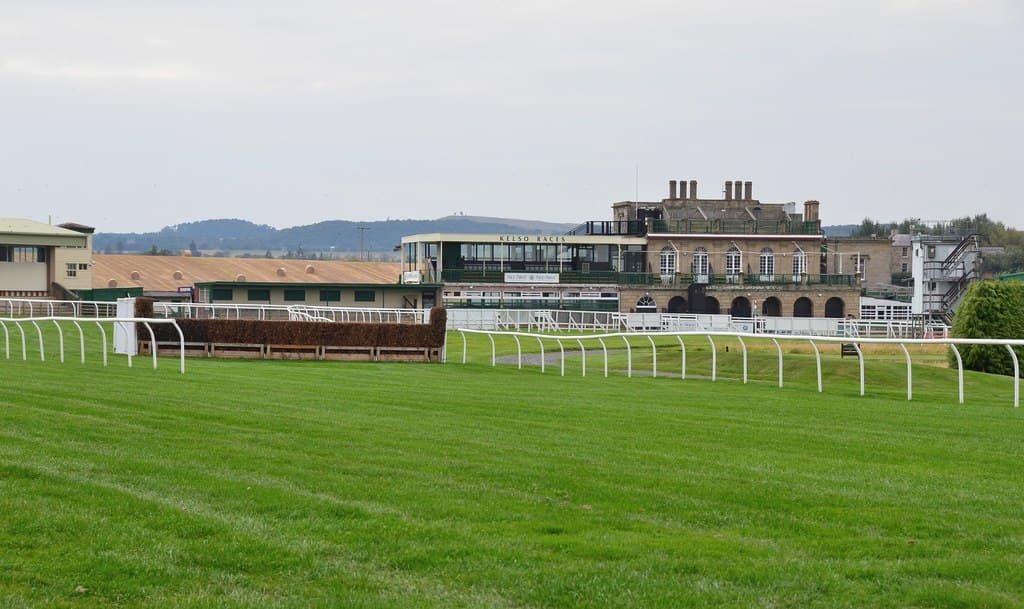
Kelso Racecourse sits in the Tweed Valley in the Scottish Borders, on the south bank of the River Teviot just before it joins the Tweed, with the rooftops and abbey tower of Kelso town visible across the water. On a clear October morning, with the Cheviot Hills rising to the south and Floors Castle — the seat of the Duke of Roxburghe — standing half a mile north across the Tweed, the setting is as good as any in British jump racing. This is not a course that tries to be anything other than what it is: a well-run, honest, community National Hunt track with 200 years of racing history behind it.
Racing at Kelso dates to 1822, making it one of the oldest continuously operating jump courses in Scotland. The course stages around 15 fixtures per year across the NH season from September to April. Crowds at regular meetings run to 3,000–4,000; the annual Premier Raceday, built around the Morebattle Hurdle and the Premier Chase, draws up to 7,000. For a course with a stated capacity of 4,000, that tells you something about how the town treats its race meetings.
Who This Guide Is For
This guide is for anyone planning to visit Kelso — whether for a single afternoon, a Borders weekend, or as part of a wider Scottish racing trip. It covers the track layout and going tendencies, the racing calendar, facilities, getting there, and a full FAQ. There are also dedicated sections on the course's history from 1822 to the present, notable moments and races, betting angles specific to this track, and how to combine a race day with everything the Scottish Borders has to offer.
If you are approaching from a betting perspective, the betting guide section covers the going variable in detail — Kelso's Scottish Borders location means going reports here require a different interpretation than at most English courses. If you are planning a day out, the atmosphere and planning section outlines how to structure a visit around the racing, with Kelso Abbey, Floors Castle, and the other three Borders abbeys all within 20 miles.
Quick Facts
| Detail | Information |
|---|---|
| Location | Kelso, Scottish Borders, TD5 8PP |
| Racing type | National Hunt only |
| Year opened | 1822 |
| Circuit | Left-handed, approximately 1m3f round |
| Signature races | Morebattle Hurdle, Premier Chase |
| Season | September to April |
| Nearest city | Edinburgh (45 miles north-west) |
| Nearest station | Berwick-upon-Tweed (25 miles east) |
| Car parking | Free, on-course |
| Website | kelso-races.co.uk |
The Morebattle Hurdle, run in early spring, is Scotland's most valuable hurdle race with prize money that can exceed £120,000 and a £100,000 Cheltenham Festival bonus. The Premier Chase, run on the same card, is a Listed contest just short of three miles. Combined prize money for Premier Raceday can exceed £330,000 — an extraordinary figure for a course of this size and location, and a measure of how seriously the Borders racing community invests in its sport.
Kelso is also a racecourse that makes sense to visit for reasons beyond the racing itself. The town of Kelso, with its great cobbled market square and the ruins of the 12th-century Kelso Abbey five minutes' walk from the stands, is one of the more attractive destinations in the eastern Borders. Floors Castle — the Duke of Roxburghe's seat, visible across the Tweed from the grandstand — is the largest inhabited castle in Scotland and is open to visitors from April to October. The four medieval abbeys of the Borders (Kelso, Melrose, Jedburgh, and Dryburgh) are all within 20 miles, and Edinburgh is 45 miles north-west via the A68. The atmosphere and planning section covers all of this in detail. For a course of its size, Kelso offers an unusually rich set of reasons to make the journey.
Bet on Kelso
Place your bets on Kelso races with a trusted bookmaker.

Promo code BETFRED50. New customers only. Register, deposit with a Debit Card, and place a first bet of £10+ at Evens (2.0)+ on Sports, to be settled within 7 days, to get £30 in Sports Free Bets and £20 in Bet Builder Free Bets within 24 hours of settlement. 7-day expiry. Eligibility & payment exclusions apply. Full T&Cs apply. Take Time to Think. BeGambleAware.org. 18+. Full T&Cs.

Promo code R30. New UK customers only, 18+. Register, deposit £10 or more, then place a £10 single cash bet at odds of 1/2 (1.5) or greater on any sports market (excluding Virtuals). Once the qualifying bet settles you get £30 in Free Bets (3 x £10) — the qualifying bet can win or lose. Free Bets are valid on any sports market excluding Virtuals, expire in 7 days, are non-withdrawable and must be used in full. Excluded deposit methods apply (including PayPal, Apple Pay, Skrill and NETELLER). Named bets such as Lucky 15 do not qualify. If you cash out the qualifying bet, or it is voided, you are no longer eligible for the offer. Ends 31.12.26. Full T&Cs apply. Please gamble responsibly. BeGambleAware.org. 18+. Full T&Cs.

Promo code BET40GET20. New UK customers, 18+. Register with the code and place a first bet of £40 or more at Evens (2.0) or greater. Receive 2 × £10 free bets: the first credited automatically once the qualifying bet settles, the second 24 hours later. Free bets must be placed at minimum odds of 4/1 (5.0), expire 24 hours after credit, and the free-bet stake is not returned with winnings. Debit card deposits only. Take Time to Think. BeGambleAware.org. 18+. T&Cs apply. Full T&Cs.

50% of your first-day net losses refunded as a free bet, capped at £25. New UK customers aged 18+ only. To qualify, deposit and place a first bet of £10 or more on any sport at minimum odds of evens (2.00), then place at least two further bets on different events, each worth at least 50% of your largest bet, all at evens (2.00) or greater. Losses are counted from your first settled bet until 23:59 the same day. Place a qualifying £10+ bet and you are guaranteed at least a £5 free bet. Bets placed at SP, void bets, cashed-out bets and bets struck with free bets do not count towards the offer. The free bet is credited the day after your qualifying bets settle and must be used within 7 days, after which it expires. It can be used at odds from 1/4 (1.25) up to 250/1 on singles and straight accumulators, but not on Trixie, Patent or Yankee style multiples. Free-bet stake is not returned with winnings. One offer per person, household, address, IP address and device. E-wallet deposits may not qualify, so check the cashier before depositing. Customers registered with GAMSTOP cannot claim. KYC identity verification must be completed before the free bet is credited. Take Time to Think. BeGambleAware.org. 18+. T&Cs apply. Full T&Cs.

New customers, 18+. Choose the sports bonus at sign-up, make a first deposit and receive a 100% bonus up to £50 in your Sports Bonus balance. To convert the bonus to cash, wager it 10x within 30 days. Single bets below Evens (2.00) do not qualify; accumulators do not qualify if any selection is below 1/2 (1.50). Virtual Sports, voided, cancelled, drawn, cashed-out and free-bet wagers do not count towards wagering. Only the first settled bet per event counts. Withdrawing before the wagering requirement is met forfeits the bonus balance including bonus winnings. Real-money funds are used before bonus funds. Deposits via Skrill or Neteller are not eligible. Not valid in conjunction with other promotions. Odds, bet and payment limits apply. 10bet general and promotion T&Cs apply. BeGambleAware.org. 18+. Full T&Cs.

New customers in Great Britain and Republic of Ireland, 18+. Place a £10 fixed-odds qualifying bet at minimum odds of 1/2 (1.50) — single or each-way (only the win part counts), pre-event or in-play, not cashed out early, within 28 days of opening the account. Receive up to £60 in bonuses credited over three days: 3 × £10 fixed-odds free bets (the first on settlement, then 24 and 48 hours later) plus 3 × £5 Total Goals FOOTBALL spread bets and 3 × £5 racing Winning Favourites spread bets, with a £1 racing Race Index spread bet as an extra on top. The spread bets need a full spread-betting account, opened within 28 days of the fixed-odds account and subject to Spreadex's eligibility and appropriateness checks. Free-bet stakes not returned with winnings; free bets valid 28 days from issue. IMPORTANT: the £5 credits are SPREAD bets — sports spread betting carries the risk that losses can exceed your stake. Sports spread-betting customers do not have Financial Ombudsman or FSCS recourse. Take Time to Think. BeGambleAware.org. 18+. T&Cs apply. Full T&Cs.

Promo code WELCOME15, entered under My Bonuses after registering. New UK customers, 18+. Place a first qualifying bet of at least £10 from your cash balance at odds of evens (2.0) or greater within 7 days of opening the account. Once the qualifying bet fully settles you receive £15 in free bets, credited as 3 x £5 tokens with set uses: one £5 accumulator free bet (minimum 4 legs, each leg at 2/5 or bigger), one £5 sports free bet (any market at evens or bigger) and one £5 Sub Cover free bet (selected football player markets at evens or bigger). Free-bet stakes are not returned with winnings. Free bets expire 7 days after they are credited. Void, cashed-out and partially cashed-out bets do not qualify. One offer per customer. Confirm the current terms on BetGoodwin's own welcome-offer page before claiming. Take Time to Think. BeGambleAware.org. 18+. T&Cs apply. Full T&Cs.

New UK customers, 18+. Minimum deposit £10. Place a £10 qualifying single on sports (excluding virtuals) at minimum odds of 1/2 (1.50), settled within 14 days. Deposit-method exclusions apply. Receive £30 in free bets (stake not returned), split £20 for sportsbook use (2 x £10) and £10 for Bet Builder only (2 x £5); Bet Builder does not cover horse racing. Free bets must be accepted within 7 days and expire 7 days after acceptance. No promo code required. Best Odds Guaranteed on UK & Irish racing, subject to having staked over £25 in the previous seven days. Operated by LiveScore Betting and Gaming (Gibraltar) Ltd, UKGC 56859. Confirm the current terms on LiveScore Bet's own promotions page before claiming. Take Time to Think. BeGambleAware.org. 18+. T&Cs apply. Full T&Cs.
18+. BeGambleAware.org
The Course
Kelso is a left-handed, roughly oval circuit of about 1 mile 3 furlongs round. The track is mostly flat with a very slight undulation in the back straight, and there are no significant hills or cambers to negotiate. The turns are tighter than the track's apparent size suggests — tighter, certainly, than Carlisle or Perth — and the short straight of around two furlongs means that horses cannot easily make up ground from off the pace in the final hundred yards. Position entering the home straight matters more here than at galloping tracks with long run-ins.
The course suits agile horses that handle turning tracks, front-runners, and horses with proven soft-ground form. A horse that has won easily at Hamilton Park or Ayr on a sharp-ish track is a more reliable guide to Kelso form than one whose wins have come on the wide, galloping circuit at Newbury or Sandown.
Fence Layout
There are 12 fences on the full circuit. They are well-built, upright, and honest — the same quality you would expect at a well-funded NH venue. There are no particularly unusual obstacles: no open ditches positioned awkwardly at the entry to a bend, no fences that produce disproportionate numbers of falls. The course maintains its obstacles carefully, and the safety record is good.
In a two-mile chase, horses jump 12 fences. In a three-mile chase — the trip used for the Premier Chase — they will complete almost two and a half circuits and jump in the region of 19–20 fences, depending on the start point. The fences at Kelso reward fluent, accurate jumping; horses that make persistent jumping errors tend to drop back on the tight turns and cannot recover.
The hurdles track follows the same left-handed circuit, with the obstacles set slightly inside the chase line. The Morebattle Hurdle is run over two miles, requiring horses to jump 8 hurdles.
Distances
Kelso caters well for the middle and staying distances that define Scottish NH racing. Common race distances include:
- 2m1f — the minimum trip for most chases
- 2m2f — the standard two-mile hurdle
- 2m6f — a popular intermediate staying trip
- 3m — the Premier Chase distance, run just short of three miles
The course does not run many ultra-short-trip contests. Races at 2m1f or below are less common than the 2m6f and 3m slots that dominate the card. This reflects the typical horses available to Scottish NH trainers and the kind of racing the track handles best.
Going Tendencies
Kelso's going is the primary variable for anyone assessing a race here. The course sits in the Tweed Valley, in one of the wetter parts of lowland Scotland. October through April — the heart of the NH season — is when the Scottish Borders receives most of its rainfall, and the flat, low-lying ground near the confluence of the Teviot and Tweed does not shed water quickly.
For most of the season, the ground at Kelso is soft or heavy. Good to soft ground in October is not unusual if the autumn has been dry, but by November the track is usually soft, and from December through February it is often heavy or close to unraceable without drainage work. The course has invested in recent years in improving its drainage, and the going is more reliably raceable than it was a decade ago — but this remains a track where checking the going report on the morning of the race is not optional.
One important calibration point for bettors: Kelso going reports tend to be conservative. The stated going in the morning is frequently a grade better than the ground the horses actually encounter in the afternoon. In wet October conditions, a morning report of "soft" should be read as "likely soft to heavy or heavy by the afternoon card." This is not unique to Kelso — many Scottish courses have the same characteristic — but it is more pronounced here than at most tracks in England.
The flat circuit drains as well as any Scottish track of similar topography. Perth, sitting on its own flood plain, can be worse; Musselburgh, by the Firth of Forth, has the advantage of coastal drainage. Kelso sits between those extremes. In a dry spring — April meetings occasionally benefit — the going can come up good to soft or even good, and the track rides faster and more accurately.
Which Horses Succeed
The tight turns and soft going combine to produce a very specific profile for horses that perform well at Kelso. Three characteristics stand out.
Agility on turning tracks. Horses that handle the bends at sharp tracks — Hamilton Park, Ayr, Plumpton — transfer their form to Kelso better than those from open, galloping tracks. The two-furlong straight is too short to reward a horse that needs time to organise itself after a bend.
Front-runners and prominent racers. Because the run-in is short and the turns are tight, horses that race prominently have a structural advantage. A horse that sits last of eight into the home turn needs to produce an exceptional finishing effort to win; a horse that sits third or fourth going into the last fence is in a much stronger position. At Kelso, the flat pace and tight track tend to produce races where the lead changes relatively little from the turn out of the back straight to the line.
Proven soft-ground form. A win at Kelso in November or January on heavy ground is nearly always achieved by a horse with an established preference for that going. Form on good to firm ground from summer point-to-points or Irish racing does not convert to Kelso winter form in the way it might at a drier track. The Scottish NH programme is built on soft-ground performers, and Kelso's horse population reflects this.
Stayers. The dominance of 2m6f and 3m races on the card means Kelso is fundamentally a stayers' track. Two-mile horses that operate on pace and sharp jumping — the type suited to Kempton, Sandown, or Cheltenham — are less at home here than at those tracks. A horse with a staying pedigree that has been lightly raced and is improving will often outperform its market price at Kelso's longer-distance races.
Comparison with Nearby Courses
Kelso is often grouped with Hexham and Carlisle in discussions of northern NH tracks. Hexham is the more extreme of the group: a much tighter, more undulating circuit at altitude, with going that can deteriorate further than Kelso's. Carlisle is a bigger, more galloping track with a longer straight — closer to a grade 2 course in character. Kelso sits between them: tighter than Carlisle, less extreme than Hexham, with a flat circuit that produces more front-running winners than either. Musselburgh, Scotland's other major NH venue, is a similarly flat, left-handed track, but with a longer straight and somewhat quicker ground on average.
Understanding where Kelso sits in this group helps when assessing horses that have run at one of these courses and are appearing at another. A horse that won from off the pace at Carlisle on a dry autumn day may find Kelso considerably tighter and softer; one that won at Hexham in January on testing ground may find Kelso's better-drained flat track riding faster than it expects.
The Run-In and Finishing Positions
The straight at Kelso is approximately two furlongs from the final fence to the winning post. This is short enough that a horse making a jumping error at the last fence has limited time to recover — unlike Cheltenham's uphill run-in of about 350 yards, which allows a horse to recover from a blunder and still win, Kelso's shorter straight means the final fence is decisive. A horse that jumps the last cleanly and is travelling well will almost always hold on; a horse that knuckles on landing faces a sprint to the line that the tighter track geometry does not accommodate.
The combination of the short run-in and the tight turns into the home straight means that races at Kelso tend to be settled earlier than they appear on a sectional basis. The sectional data from the final two furlongs often shows little change in the order between the last fence and the line — the race, in practice, was decided on the turn into the straight. This pattern is consistent across distances and going conditions, and is one of the more reliable structural features of the course.
Hurdles vs Chases
The chase and hurdle courses at Kelso follow the same basic circuit, but the jump configuration produces different race dynamics. Chase races at Kelso are less frequently won by horses making late runs, because the fences take more out of horses through the circuit and the tight turns give no advantage to hold-up horses who are looking for a gap. Hurdle races, where the obstacles are smaller and take less toll on stamina, produce slightly more varied finishing positions — but the front-runner premium still applies. In a competitive handicap hurdle at Kelso on soft ground, the horse that is able to set or track a sensible pace through the tight turns will almost always feature in the finish ahead of one that is covered up in the rear half of the field.
Key Fixtures & Calendar
Kelso stages approximately 15 NH fixtures per year, running from September or October through to April. The programme is built around National Hunt handicaps, conditions races, and novice events across hurdles and fences, with the Premier Raceday — anchored by the Morebattle Hurdle and Premier Chase — as the centrepiece of the season.
The Season Opener: September and October
Kelso typically opens its season in September or October, with one of the earliest fixtures in the Scottish NH calendar. The opener usually falls in late September or the first week of October, when the ground is at its firmest of the season. Going at this point is often good to soft or soft, and horses that have been campaigning through the summer on better ground perform reasonably well.
The early-season fixtures are well-attended by local trainers and by horses from Scottish and northern English yards looking to get a run into their charges before the deeper winter. Crowds at these meetings run to around 3,000–4,000. The atmosphere is informal and the racing is competitive in a workmanlike way — it is not Premier Raceday, but it produces good-value betting races where course form and going preference are reliable handicapping tools.
October and November Meetings
Through October and November, Kelso stages two or three fixtures. These meetings tend to feature a mix of novice hurdles, handicap chases over the standard 2m6f trip, and veterans' contests. By late October the ground is usually soft, and by mid-November soft to heavy is the norm.
The November meetings carry reasonable prize money and attract a broader spread of raiders from Yorkshire, Cumbria, and occasionally Ireland. Horses that have opened their accounts at other Scottish courses — Perth, Musselburgh, or Ayr — often appear here as connections target a specific distance or going condition. For betting purposes, these meetings offer some of the most reliable going-bias data of the season, because the ground is consistently testing and the field sizes are competitive.
Typical crowds at October and November meetings: 3,000–4,500.
The Kelso Chase Meeting
Kelso stages a feature chase meeting — historically known in various forms as the Border Chase meeting or the Kelso Chase card — in the November to December period. The card is built around a chase of two and a half to three miles and is one of the most competitive jump cards in Scotland outside of the Musselburgh and Ayr programmes.
This meeting serves as an important trial for horses being aimed at the Cheltenham Festival or the Edinburgh National Chase at Musselburgh. Connections use it to assess stamina, jumping, and soft-ground ability before committing to longer campaigns. The prize money is solid for a non-Listed contest, and the quality of entry is often Of note higher than the surrounding midweek fixtures.
Midwinter Fixtures: December to February
Kelso continues racing through December and into January and February, though the programme is more intermittent than the busier autumn and spring periods. Going in this window is almost always heavy or soft to heavy. Some meetings are abandoned due to frost or waterlogging — Kelso averages one to two abandonments per season, which is comparable with other Scottish courses operating in similar conditions.
The midwinter fixtures are characterised by smaller fields and more specialist horses. Long-distance handicap chases of 3m or more dominate, and stamina and jumping accuracy matter more than pace. The crowds at January and February meetings tend to be smaller — 2,500–3,500 — but the racecourse audience is knowledgeable and supportive.
Premier Raceday: The Morebattle Hurdle and Premier Chase
The annual highlight is Premier Raceday, which typically falls in early to mid-March. The card is anchored by two feature races.
The Morebattle Hurdle is Scotland's most valuable hurdle race. The prize fund has exceeded £120,000 in recent renewals, and the race carries a bonus of £100,000 for any winner that goes on to win at the Cheltenham Festival. The race has attracted Grade 1-winning hurdlers and has served as a trial for the Champion Hurdle and the Supreme Novices'. It is run over two miles and typically carries a field of eight to twelve runners, drawing raiders from the top Scottish, northern English, and Irish yards.
The Premier Chase is a Listed contest run just short of three miles. It is a strong race for quality staying chasers who are held in too high a regard for ordinary handicap company but are not quite at the Grade 1 level. Previous winners include horses that Then ran in the RSA Chase and the Ryanair Chase at Cheltenham.
Combined prize money for Premier Raceday regularly exceeds £330,000, which makes it one of the most valuable fixtures outside of Cheltenham, Sandown, and the major Grade 1 tracks. The day attracts up to 7,000 racegoers, well above the course's standard capacity of 4,000. Book tickets and hospitality well in advance — the corporate hospitality packages sell out within weeks of being released.
Spring Meetings: March and April
Following Premier Raceday, Kelso stages two or three fixtures in late March and April as the season winds towards its close. These are often the most attractive meetings for visitors: the going is frequently good to soft, the days are longer, and the Scottish Borders countryside is at its most appealing.
The spring fixtures attract horses being prepared for the Scottish Grand National at Ayr (typically held in mid-April) and horses that have performed well at Cheltenham and are being cooled down. Crowds at spring meetings run to 3,500–5,000 depending on the day and the card quality.
The April closer is usually one of the most sociable days at Kelso, with a family-friendly atmosphere, music, and an end-of-season mood that the October opener lacks.
Annual Fixture Summary
| Period | Approx. meetings | Typical going | Typical crowd |
|---|---|---|---|
| September–October | 1–2 | Good to soft, soft | 3,000–4,500 |
| October–November | 2–3 | Soft, soft to heavy | 3,000–4,500 |
| November–December | 1–2 | Soft to heavy, heavy | 3,000–4,000 |
| January–February | 2–3 | Heavy | 2,500–3,500 |
| March (Premier Raceday) | 1 | Soft to heavy | Up to 7,000 |
| March–April (spring) | 2–3 | Good to soft, soft | 3,500–5,000 |
Facilities & Hospitality
Kelso is a compact, well-managed racecourse that punches above its weight for facilities. The grandstand was renovated in recent years and now provides a better spectator experience than the old structure allowed. The total capacity is around 4,000 in the main enclosures, with additional outdoor standing areas used on Premier Raceday when the crowd can reach 7,000.
The Grandstand
The main grandstand faces the home straight and provides covered seating and standing viewing for several hundred racegoers. The sight lines are good — the course is flat and the turn into the home straight is clearly visible from the stand's upper levels. There is no position within the grandstand from which you cannot follow the full home straight run.
The renovation improved the concourse below the seating: the bars, food outlets, and circulation areas are wider and better organised than they were before the work. The grandstand is accessible from the paddock and betting ring via a short covered walkway, which matters on wet October and January days when the ground underfoot is invariably soft.
The Tweed Suite
The principal hospitality facility is the Tweed Suite, which occupies a dedicated space within the grandstand complex. Hospitality packages include a reserved table, a three-course meal, a complimentary race card, and access to a dedicated viewing terrace overlooking the home straight. The suite is named in reference to the River Tweed, which runs along the northern boundary of the course.
On Premier Raceday, the Tweed Suite is fully booked weeks in advance. For other fixtures, hospitality packages are available closer to the date. Corporate bookings of ten or more are usual; smaller private bookings for groups of four to eight are also offered, depending on availability. Check the course website for current packages and pricing.
Paddock Viewing
The parade ring at Kelso is one of the most accessible in Scottish racing. The oval paddock is positioned directly in front of the grandstand, and racegoers can stand close to the rail on all sides without obstruction. On smaller-crowd days, it is possible to stand within a few yards of the horses as they walk round. On Premier Raceday, the paddock fills up considerably, but the management of the space is sensible and crowding is not a problem.
Horses look well in the Kelso paddock. The turf is well maintained, and the backdrop of the grandstand and the hills beyond creates the kind of setting that makes paddock watching enjoyable in its own right.
Food and Drink
Kelso has invested in its food and drink offer in recent years, and the course now reflects its Scottish Borders location in a way that older visitors will notice has improved.
Scottish Borders produce features prominently. The main catering outlets serve Borders beef burgers — the Scottish Borders is one of Britain's better beef-farming regions, and the quality difference from generic stadium catering is noticeable. Locally-produced pies and sausage rolls from Borders butchers appear on the concourse catering stands.
Beer is a strength. The course serves locally-brewed ales from Borders breweries. Tempest Brewing Co., based in Kelso itself, has supplied the course and their pale ales and IPAs are a better option than the standard national-brand lager available elsewhere on the course.
Border tarts — a traditional Scottish Borders pastry, similar to a treacle tart with raisins and filled with a mixture of sugar, butter, and dried fruit — appear on the dessert menu in the Tweed Suite and occasionally on the general catering stands. They are the kind of truly regional food that most racecourses stopped serving thirty years ago, and their presence at Kelso is worth noting.
General catering covers the usual range: tea, coffee, hot dogs, burgers, and a limited selection of hot food. The quality is above the median for a course of this size. On midwinter weekday fixtures, the hot drinks stand near the betting ring is a practical priority.
The Betting Ring
The betting ring at Kelso is compact and active. On Premier Raceday, the ring expands to accommodate eight to ten on-course bookmakers; on quieter weekday fixtures, five or six stands is more typical. The ring is positioned close to the paddock exit, which allows easy movement between watching the horses walk and placing a bet.
On-course Tote facilities are available throughout the season. The Tote windows are usually positioned within the main grandstand concourse.
Disabled Facilities
The renovation improved accessibility across the course. There is level access from the car park to the grandstand, dedicated disabled viewing positions in the grandstand with good sight lines, and accessible toilet facilities in the main concourse. Kelso's staff have a reputation for being helpful — if you have specific requirements, calling the course office in advance of your visit is worthwhile. The course website lists current accessibility details and the contact number for the office.
Practical Details
- Children: The course is family-friendly; children under 18 enter free with a paying adult on most fixtures. Check the website for Premier Raceday terms.
- Dogs: Dogs on leads are permitted in outdoor areas. They are not admitted to the grandstand or hospitality areas.
- ATM: There is a cash machine at the course, though bringing cash is advisable as it can be out of service on busy days.
- Phone signal: Signal is generally adequate in the main enclosures; coverage drops in some outdoor areas on the north side of the track.
Getting There
Kelso Racecourse is at Kelso, Scottish Borders, postcode TD5 8PP. This is a car-dependent venue. There is no railway station at Kelso — the line that once ran through the town closed in 1964 as part of the Beeching cuts — and public transport options are limited enough that planning around them requires considerable effort. The overwhelming majority of racegoers arrive by car, and the course provides free on-course parking for all fixtures.
By Car
The course is straightforward to reach by car from all major directions.
From Edinburgh (45 miles, approximately 55 minutes): Take the A68 south from the Edinburgh bypass. Continue on the A68 through Lauder and past the moorland between the Lammermuir Hills and the Eildon Hills. At St Boswells, join the A699 east and then the A698 into Kelso. The course is signposted from the town centre. This is the standard route from Scotland's capital and works well for anyone based in Edinburgh or arriving at Edinburgh Airport.
From Newcastle (45 miles, approximately 55 minutes): Take the A1 north from Newcastle to just past Morpeth, then the A697 north-west through Wooler and Coldstream. At Coldstream, cross into Scotland and continue on the A698 west into Kelso. This is the most direct route from Tyneside and passes through some of the best Northumberland countryside.
From Carlisle (55 miles, approximately 65 minutes): Take the A7 north from Carlisle through Langholm and Hawick, then the A698 east to Kelso. The A7 is a scenic single-carriageway road through the Eskdale and Teviotdale valleys — allow extra time in winter conditions or on Friday afternoons when road traffic from Carlisle can be slow.
From Berwick-upon-Tweed (25 miles, approximately 30 minutes): Take the A698 west directly into Kelso. This is the quickest route for anyone arriving by train at Berwick (see below) or based in the eastern Borders.
From Jedburgh (8 miles, approximately 12 minutes): Take the A698 north-east into Kelso. A natural combination route for visitors to the Jedburgh Abbey area.
Parking: Free on-course parking is available for all fixtures. On Premier Raceday, when crowds can reach 7,000, arrive at least 30–40 minutes before the first race to avoid queuing at the car park entrance. For standard fixtures, parking is plentiful and the walk from car to grandstand is under five minutes.
By Train
There is no railway station at Kelso. The nearest mainline stations are:
-
Berwick-upon-Tweed (25 miles east): Served by the East Coast Main Line with regular services from London King's Cross (approximately 3 hours), Edinburgh (approximately 45 minutes), and Newcastle (approximately 30 minutes). From Berwick, a taxi to Kelso takes approximately 30 minutes and costs around £30–£40. Taxi numbers should be pre-booked — post-race demand from a 7,000-crowd Premier Raceday will exhaust local supply quickly if you do not arrange a return in advance.
-
Edinburgh Waverley (45 miles north-west): Well served from London, Glasgow, Aberdeen, and the rest of Scotland. From Edinburgh Waverley, a taxi to Kelso takes approximately 55 minutes. Car hire from Edinburgh is a practical option for a full-day visit.
There are no direct race-day bus or shuttle services currently operating from either station. Check the course website ahead of Premier Raceday, as the course occasionally arranges or publicises community transport links.
By Bus
Scottish Borders Council operates bus services connecting Kelso with Galashiels, Edinburgh, Jedburgh, and other Borders towns. The 67 and 131 services have historically covered the Kelso–Galashiels and Kelso–Jedburgh routes. Frequencies are limited — typically one to two buses per hour on the main corridors — and evening services thin out significantly. For a race meeting that ends at 17:00 or later, getting back to Edinburgh by bus requires checking return times carefully and accepting a journey of well over two hours including connections.
Bus travel is viable for local Borders racegoers or those staying in Kelso. It is not a practical option for anyone travelling from Edinburgh or further afield without a clear plan for the return.
Staying in Kelso
Kelso is a market town with a good range of hotels, guest houses, and self-catering accommodation. The Ednam House Hotel (a Georgian mansion a short walk from the course) is the most well-known local option. Booking accommodation well in advance is essential for Premier Raceday — rooms in Kelso and Jedburgh fill up from the moment the fixture date is announced.
Staying overnight opens up the wider Borders. The four medieval abbeys — Kelso, Melrose, Jedburgh, and Dryburgh — are all within 20 miles, and Floors Castle, the largest inhabited castle in Scotland, is a five-minute drive from the racecourse.
Frequently Asked Questions
History of Kelso Racecourse
Racing at Kelso is recorded from 1822, making the course one of the oldest continuously operating National Hunt venues in Scotland. The early races were established by the Border landowners and the hunting community of Roxburghshire and Berwickshire — the same families who managed the great agricultural estates along the Tweed and Teviot valleys and who kept packs of hounds through the winter. Horse racing was a natural extension of the hunting culture, and Kelso's market town status made it the obvious location: the town had been the commercial hub of the eastern Borders since at least the 12th century, with a weekly market and an annual fair that drew buyers and sellers from across the region.
The Medieval and Early Modern Context
To understand Kelso as a racing town, it helps to understand Kelso as a place. The town sits at the confluence of the Tweed and Teviot rivers, a location that made it one of the most strategically important crossings in the eastern Borders. Kelso Abbey, founded by David I of Scotland in 1128 as a house of Tironensian monks, became one of the wealthiest abbeys in medieval Scotland. By the 15th century the abbots of Kelso were among the most powerful ecclesiastical figures in Scotland, and the town market they controlled was central to the Borders economy.
The same confluence that made Kelso important also made it a target. The town was burned repeatedly during the Anglo-Scottish wars of the 14th through 16th centuries. The most severe destruction came in 1545, when the Earl of Hertford's army, acting on Henry VIII's orders during the so-called Rough Wooing — England's attempt to force a marriage between the infant Mary Queen of Scots and Edward VI — burned Kelso and much of the eastern Borders. Kelso Abbey was largely destroyed at this point; the ruins that stand today date primarily to the 12th and 13th centuries and are among the most evocative remnants of Scottish medieval ecclesiastical architecture.
The Border Reivers operated throughout this period and beyond. The Reivers were raiding families — Scottish and English alike — who lived outside the effective authority of both crowns and who sustained themselves partly through systematic cattle-stealing, protection rackets, and violent reprisal raids across the border. The Armstrong, Elliot, Scott, and Kerr surnames that appear throughout the Borders today are largely derived from the Reiver clans. Kelso's position on the Tweed made it a crossing point for these raids, and the surrounding countryside was shaped by the peel towers and fortified farmhouses that the local population built to survive repeated raiding.
By 1822, when racing was formally established, the Reiver period was 200 years in the past. The Border counties had become some of the most productive agricultural land in Britain, the estates were settled and prosperous, and the Border Reivers had been absorbed into the mythology of the region — romanticised by Walter Scott, whose home at Abbotsford is 13 miles west of Kelso, and whose poetry and novels had turned the Borders into a literary landscape of considerable renown by the time the first races were run.
The Victorian Era
Through the middle and late Victorian period, Kelso developed along the lines common to established NH courses: the programme grew, grandstand facilities were built, and the meeting acquired a fixed place in the regional social calendar. The October and spring fixtures became annual events for the agricultural community of Roxburghshire. Farmers, estate agents, livestock dealers, and their families attended as a matter of course — the races were inseparable from the autumn and spring farming year.
The prize money at this period was modest by today's standards, but the racing was competitive. The courses at this point were less standardised than the modern track: the circuit was adjusted more than once as drainage and ground conditions required, and the current configuration — the left-handed oval of approximately 1 mile 3 furlongs — took its definitive shape in the late 19th century.
The 20th Century
Kelso continued operating through the First World War period with reduced programmes, and resumed full fixtures through the interwar years. The Second World War brought more significant disruption: like many British racecourses, Kelso was requisitioned for military purposes during the conflict, and racing was suspended between 1940 and 1946. The course reopened in the late 1940s as part of the general resumption of British NH racing, and has operated continuously since.
The major structural changes at Kelso in the 20th century involved the development of the prize money programme. The Morebattle Hurdle — named after the village of Morebattle, six miles south-east of Kelso in the Kale Water valley — grew from a modest conditions hurdle to Scotland's most valuable hurdle race over several decades of investment by the racecourse management and sponsors. The creation of the Premier Raceday concept, combining the Morebattle Hurdle with the Premier Chase on a single high-value card, was a significant step in repositioning Kelso from a local NH fixture to a nationally recognised meeting.
Scottish Borders Trainers and the Course
Kelso's relationship with Scottish NH training is embedded in the course's character. The Borders do not have a dominant local training centre in the way that Lambourn or Newmarket define flat racing. Horses trained within the Borders have historically come from small NH yards and permit holders — farmers and landowners who train their own chasers in the traditional way.
Beyond the local yards, Kelso draws horses from the main Scottish training centres. Lucinda Russell, based at Arlary House near Milnathort in Perth and Kinross approximately 80 miles north of Kelso, has sent winners to the course across multiple seasons. Her string, which produced One For Arthur to win the 2017 Grand National at Aintree, is one of the strongest NH yards in Scotland and a reliable source of Kelso form. Paul Nicholls and Willie Mullins have occasionally raided the Premier Raceday with smart horses targeting the Morebattle Hurdle, reflecting the race's prize money status.
The development of Scottish NH training more broadly through the late 20th and early 21st centuries — partly driven by the expansion of synthetic surfaces at Musselburgh for flat racing and the growing prize money at Scottish NH fixtures — has improved the quality of horses available to Kelso's programme without changing its essential character as a community-rooted Border course.
Famous Moments
Kelso's 200-year history has produced moments that live in the memory of the Borders racing community, even if the course's relatively modest scale means that those moments rarely feature in the national press. The best of them share a common quality: they belong to the place and the people as much as to the horses.
October Mornings and the Sense of Place
The most consistent thing anyone says about Kelso is about the setting. On a clear October morning, before the first race, standing at the rail of the grandstand with the Cheviot Hills rising to the south and the Tweed Valley spread out behind the back straight, there is a quality to the light and the landscape that makes it hard to concentrate on the form. The hills are brown and gold in October, the Tweed is visible through the trees, and Floors Castle — the Duke of Roxburghe's Palladian-and-Playfair mansion — sits on the opposite bank of the river about half a mile north.
This is not sentiment: it is a practical point about what Kelso is for. Unlike some courses that measure themselves against Cheltenham or Ascot, Kelso's identity is rooted in the community it serves. The October opener is an annual occasion for farming families across Roxburghshire and Berwickshire in a way that is qualitatively different from the relationship between a major urban course and its audience. When the weather is right and the card is competitive, there are few better afternoons in Scottish racing.
The Morebattle Hurdle: Quality on the Tweed
The race that has put Kelso on the national racing map is the Morebattle Hurdle, now Scotland's most valuable hurdle race and a legitimate Cheltenham trial. Over the past decade, the race has attracted entries from Irish yards targeting the £100,000 Cheltenham Festival bonus, and on several occasions the winner has gone on to run competitively at the Festival.
The race's standing improved significantly when it attracted runners from Nicky Henderson's and Willie Mullins' yards in the early 2010s, at a point when the bonus structure was first making it worthwhile for southern trainers to make the journey to Kelso in early March. A Grade 1-winning hurdler running at a small Scottish course in testing March conditions is not a common sight, and when it happens it generates the kind of occasion that Kelso's regular crowd — knowledgeable and loyal — appreciates fully.
Lucinda Russell at Kelso
Lucinda Russell, trained from Arlary House in Perth and Kinross, has provided some of the most significant Kelso moments of the past two decades. Russell is best known outside Scotland for training One For Arthur, the winner of the 2017 Randox Grand National at Aintree under Derek Fox — a race result that generated extraordinary celebrations across Scotland.
The path to Aintree ran partly through the Scottish NH programme, and Kelso was a regular staging post. Russell's horses have won a range of Kelso races across her career, and her yard's familiarity with Scottish soft-ground conditions and left-handed tracks is an acknowledged advantage. When Russell's name appears in a Kelso entry list on ground that suits, it is a significant factor in the betting market.
The Premier Chase and Staying Chasers
The Premier Chase, a Listed contest at just under three miles, has provided a platform for staying chasers who Then ran at Cheltenham and Aintree. The race's Listed status makes it a proper target for connections who want a competitive run over a staying trip on testing ground before the spring Festivals.
Several Premier Chase winners have gone on to run in the RSA Chase (now the Brown Advisory Novices' Chase) at the Cheltenham Festival, and the race has a reasonable record as a form reference. The field sizes are typically eight to twelve runners, with a mix of established chasers and improving novices — the conditions occasionally allow for both — and the combination of the trip, the tight turns, and the soft ground produces a truly searching test.
Borders Farming Families and the Annual Occasions
The October opener and the April closer at Kelso serve a social function that is slightly different from most British racecourses. For many Borders farming families, these meetings are annual calendar fixtures in the same way that the Jedburgh Border Games (held in July) or the agricultural shows at Kelso and Coldstream are annual fixtures.
The autumn meeting coincides with the end of harvest and the beginning of the Borders sheep sale season — Kelso Farmers Mart, one of the largest livestock markets in Scotland, is a five-minute drive from the course and holds some of its biggest annual sales in October. The combination of the livestock trade and the racing on the same autumn week is a deeply rooted pattern in local life that has persisted through the 20th century and into the 21st.
The April meeting serves a similar function at the other end of the farming year: the lambing season is underway, the longer days have returned, and the Borders landscape is at its most open and green. Families that have been at October come back in April, and the end-of-season atmosphere — the last racing of the NH year at this course — has a particular warmth.
A Community Asset
What defines the memorable moments at Kelso is not necessarily the quality of the individual racehorses — though the Morebattle Hurdle produces legitimately smart performances — but the relationship between the course and the community it has served since 1822. The 7,000-strong Premier Raceday crowd, at a course with a stated capacity of 4,000, is a measure of how the meeting is regarded. Very few racecourses in Britain consistently draw crowds 75% above their stated capacity; Kelso does it on Premier Raceday because the local community treats the occasion as something it owns rather than something it merely attends.
Betting Guide
Kelso is a course where two or three specific variables explain a disproportionate share of race results. Getting those variables right matters more here than at most NH courses of comparable size. This section covers the primary factors in order of importance.
Going: The Primary Variable
Going is the single most important factor at Kelso, and it requires more careful interpretation here than at almost any other NH venue in Britain.
Kelso's Scottish Borders location means the ground is soft or heavy for the majority of the October–April season. Rainfall in the eastern Borders averages around 700–800mm per year — broadly comparable with much of northern England — but the flat, low-lying topography of the Tweed Valley means water drains more slowly than on elevated or sloping ground. The course has invested in drainage infrastructure, but the baseline position remains: this is a track that frequently runs on ground officially described as heavy.
The critical calibration point, already mentioned in the course section, is that Kelso going reports understate the actual conditions. A morning report of "soft, good to soft in places" should be read as "likely soft to heavy or heavy on the raceable parts of the track by afternoon." This is not an error in the going reports — it is the normal behaviour of a flat, low-lying course receiving continued moisture through the morning. The practical betting implication: horses whose form notes show a preference for going no slower than good to soft are at a significant disadvantage at Kelso in November, December, and January, regardless of what the official going description says when the markets open.
The opposite effect applies to the spring fixtures. A spring meeting at Kelso on a dry April week, when the going comes up good to soft, will ride faster and more truly than the average Kelso race. Horses with a form profile of front-running on good to soft ground who have been campaigned on softer going through the winter can find the spring Kelso conditions more favourable than their recent form suggests.
Trainer Patterns
There is no dominant local trainer in the way that Gary Moore dominates Plumpton's stats or Paul Nicholls dominates Wincanton's. Kelso draws from a broader spread of northern English and Scottish yards, and no single trainer accounts for more than a small fraction of winners.
That said, certain trainer profiles are worth noting.
Scottish and northern training centres. Edinburgh-based flat trainers Keith Dalgleish and Jim Goldie do not train NH horses, but the same principle applies to Scottish NH yards: familiarity with Scottish course conditions and the ability to prepare horses on equivalent soft ground at home gives local connections an advantage over southern raiders who have trained on good to firm ground. Lucinda Russell's yard near Milnathort is the clearest example — horses from her string are conditioned for exactly the ground Kelso presents, and her win rate at the course over a career is well above average.
Small Borders permit holders. The Borders farming community supports a number of permit holders — landowners and farmers who train small numbers of horses under a restricted licence. These trainers do not have large stables, and their entries are often at competitive prices when they appear at Kelso because the betting market under-rates local knowledge. A permit holder whose horse won a point-to-point in the Borders in soft ground in November, and who is now running in a hunter chase or a conditional jockeys' hurdle at Kelso, is worth looking at.
Southern raiders on Premier Raceday. The Morebattle Hurdle prize money attracts raiders from the major southern yards. These horses are often well-fancied in the market, but they require a specific caveat: they are prepared on training-ground conditions that rarely replicate heavy going, and a long journey to Kelso in early March adds travel stress. The Morebattle Hurdle bonus structure is designed to attract these runners, and it succeeds, but the strike rate of southern raiders at short odds is not as strong as the market prices imply.
The Tight Turns
The circuit is approximately 1 mile 3 furlongs round, with turns that are tighter than the track's overall size suggests, and a straight of only about two furlongs. This configuration produces a specific statistical pattern: front-runners and horses that race prominently have a structural advantage.
The data on pace bias at Kelso aligns with this: horses that lead or race in the first two from the turn out of the back straight win at a higher rate than horses ridden from the rear. This is partly a function of the going — heavy ground slows the pace and makes it harder for hold-up horses to generate a finishing effort — and partly a function of the track itself.
In practice: when assessing a Kelso race, identify which horses are likely to race prominently. A horse with a good record at sharp, turning tracks — Hamilton Park, Ayr's NH course, Plumpton in Sussex — will handle the configuration better than one accustomed to galloping tracks like Carlisle or Ascot. Form from Musselburgh, which is a similarly flat left-handed track, converts to Kelso form reasonably well, adjusting for the difference in going.
Distance Bias
Kelso's card is weighted towards 2m6f and 3m races, and the course's character — flat, soft, tight turns — produces its most reliable form at these trips. Two-mile races at Kelso are less frequent and produce less consistent form as a guide to other courses, partly because the two-mile horse population that arrives at Kelso is not the same calibre as that at southern courses where two-mile chasing and hurdling is the main programme.
The 3m trip, used for the Premier Chase, is where the course's character is most clearly expressed. Stamina, jumping accuracy, soft-ground form, and the ability to handle tight turns all converge at this distance, and the resulting form is a more reliable guide than any single factor in isolation.
Practical Angles
- Always check the going report on the morning of the race, and add one grade of softness to your mental model for afternoon conditions.
- Front-runners and prominent racers carry positive value at Kelso, particularly in heavy ground from November to February.
- Scottish-trained horses — particularly from Lucinda Russell's yard and well-regarded northern NH yards — carry their form better to Kelso than their prices typically reflect.
- Southern raiders at the Morebattle Hurdle are often overbet. A well-prepared Scottish or northern horse at a bigger price is frequently the better bet.
- Form from Hamilton Park, Ayr, Plumpton, and Musselburgh converts to Kelso form more reliably than form from Carlisle, Sandown, or Kempton.
- For the spring fixtures, if the going comes up good to soft, revise upwards the prospects of horses that have been disappointing through the winter on heavier ground but who have soft-side-of-good in their form profile.
Atmosphere & Planning Your Visit
Kelso town is one of the most attractive market towns in the Scottish Borders, and the racecourse sits within a wider landscape that rewards a full day or overnight visit rather than a drive-in, drive-out race trip.
Kelso Town
The town centre is a ten-minute walk from the racecourse. The large, cobbled market square — one of the finest in Scotland — has a long history as a trading hub: Kelso Market, held on Fridays, has operated on or near this site since the 12th century. The town has a good range of independent shops, cafés, and hotels for a community of 6,000 people. Arriving an hour before the gates open gives enough time for a coffee in the square before the racing begins.
Kelso Abbey, the ruined 12th-century Tironensian house founded by David I, stands at the north end of town, within five minutes' walk of the market square. It is free to enter and manages perhaps 50 visitors at any given time — a quiet, unhurried historic site, very different from the managed-tourism experience at Stirling Castle or Edinburgh. The west tower, which survived into the 19th century as a shelter for the congregation of the adjacent Kelso parish, is the most photographically recognisable element of the ruin.
Floors Castle
Floors Castle is the seat of the Duke of Roxburghe and sits directly across the Tweed from the racecourse, visible from the grandstand. The original building was designed by William Adam in the 1720s; the current appearance — the crenellated roofline, the towers, the dramatic skyline — is largely the work of William Henry Playfair, who extended and remodelled it in the 1840s. The castle is described as the largest inhabited castle in Scotland, which is a claim that depends on how you measure "castle," but the building is undeniably large and the setting on the north bank of the Tweed is exceptional.
The castle is open to visitors from April to October. The grounds, which include formal gardens and parkland along the Tweed, are open year-round. A morning visit to Floors — the drive takes about five minutes from the racecourse — followed by an afternoon at the racing is one of the most enjoyable ways to spend a day in the eastern Borders. The castle café serves lunch.
The Four Borders Abbeys
The Scottish Borders contains four great ruined medieval abbeys within a 20-mile circuit of Kelso, all managed by Historic Environment Scotland and all worth visiting.
Kelso Abbey (Kelso town, 0.5 miles from the course): The oldest of the four, founded 1128. The least complete in terms of standing structure but the most atmospheric fragment — a single massive Romanesque arcade that gives a powerful impression of the original scale.
Jedburgh Abbey (8 miles south via A698): The most complete structurally, with the nave walls largely intact to full height. Jedburgh is one of the most impressive medieval ruins in Scotland and has been well preserved by Historic Environment Scotland. Allow 90 minutes.
Melrose Abbey (13 miles west via A699 and A6091): The largest of the four in floor area and arguably the finest in terms of carved stonework. The heart of Robert the Bruce is buried here, enclosed in a lead container and marked by a plaque in the nave. The Cistercian abbey church, built from the 14th century onwards in red sandstone, has extraordinary carved window tracery. Allow 90 minutes to two hours.
Dryburgh Abbey (10 miles west of Kelso, near St Boswells): The most secluded, set in a wooded horseshoe bend of the Tweed. Sir Walter Scott is buried here in the north transept. Less frequently visited than Melrose but arguably the most atmospheric of the four, particularly in autumn when the surrounding trees are in colour. Allow one hour.
A full abbey circuit — Kelso, Jedburgh, Melrose, Dryburgh in that order — takes a long day by car. Combining two abbeys with an afternoon at Kelso races is the more practical approach.
A Suggested Day
Morning: Park at Floors Castle (open from 10:00 April–October) and visit the castle and gardens. Drive five minutes to Kelso town centre by 12:30 for lunch at one of the town's pubs or cafés. Walk to Kelso Abbey (five minutes from the square). Drive to the racecourse — gates open approximately 90 minutes before the first race.
Evening: Kelso has a limited but serviceable range of restaurants and pubs. The Cross Keys Hotel on the market square and the Ednam House Hotel are the two main options within easy walking distance of the town centre.
Combining with Edinburgh
Edinburgh is 45 miles north-west via the A68, approximately 55 minutes by car. The combination of a Kelso race meeting with an Edinburgh city visit — whether before or after the racing — is one of the more straightforward Scottish cultural itineraries. Edinburgh airport is 50 miles from the course, roughly 60 minutes. Fly in, collect a rental car, drive to Kelso for the racing, spend the night in Kelso or drive back to Edinburgh. For the Premier Raceday in early March, when Edinburgh hotels tend to be busy with the International Science Festival preparation, booking in Kelso itself is often easier and leaves you better placed for the races.
Kelso's hotels — the Ednam House and several good guest houses on the approach roads — are small and book out quickly around Premier Raceday. Jedburgh, eight miles south, has additional options and makes a convenient base for exploring the abbeys before or after the racing.
More guides for this course
Share this article
More about this racecourse
All Kelso guides
A Day Out at Kelso Racecourse
A day at Kelso — getting there, what to wear, enclosures, food and drink, and insider tips for the Scottish Borders' premier jumps venue.
Read moreKelso Festival Guide
Your complete guide to Kelso Racecourse — the Border country jump festivals, the Borders National and what makes this Scottish Borders track one of Britain's most characterful jump venues.
Read more
Kelso Racecourse History: 200 Years of Border Racing
Discover how Kelso became Scotland's premier jumps venue since 1822. From humble beginnings to hosting the Morebattle Hurdle in the Borders.
Read morePhotos on this page are used under Creative Commons licences. Titles, sources and licence links for each one are on our image credits page.
Research the field with the AI Race Predictor
Our model publishes calibrated win-probability estimates for UK races — a second opinion to understand a race, not tips. It's open about its record: it doesn't beat the market, and we show exactly how it does.
Work it out & learn the basics
Gamble Responsibly
Gambling should be entertaining and not seen as a way to make money. Never bet more than you can afford to lose. If you or someone you know has a gambling problem, help and support is available.