
Founder & Editor · Last reviewed 2026-04-05
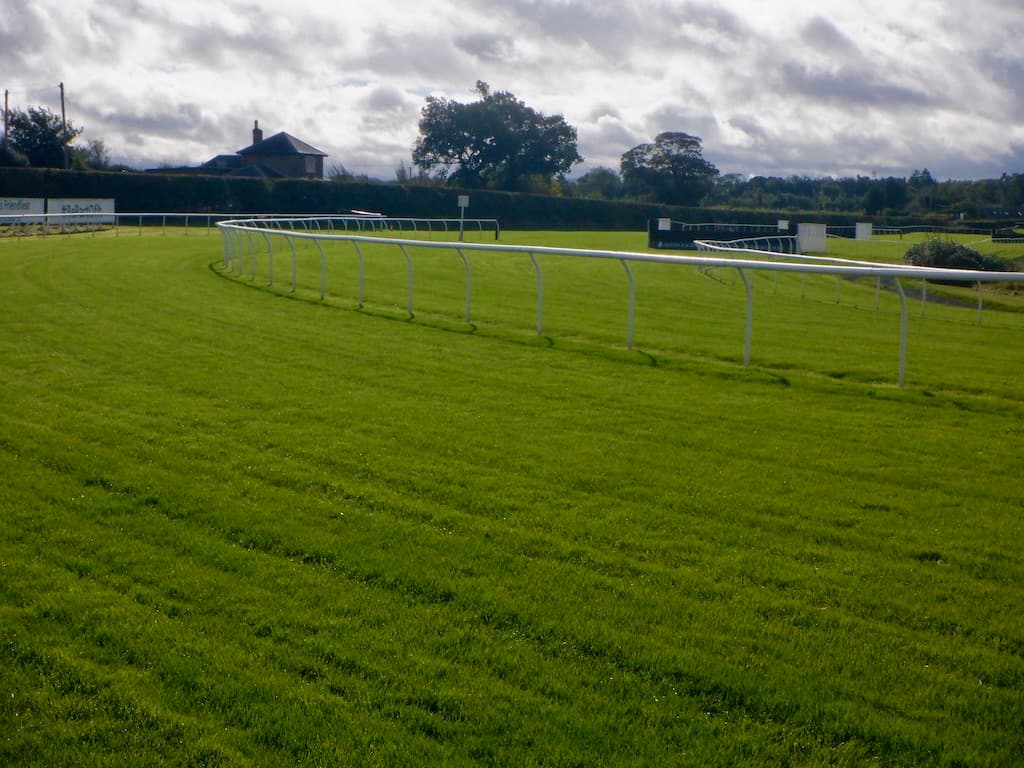
Stand at the rails at Kelso on a wet October morning and the course tells its own story. The River Teviot bends south towards its confluence with the Tweed barely half a mile away, the ruins of Kelso Abbey — begun in 1128 — are visible above the rooftops, and the limestone towers of Floors Castle rise from the north bank less than a mile distant. Racing has taken place on this ground since 1822, making Kelso one of the longest-running jump venues in Britain. That is not a casual claim: only a handful of National Hunt courses can point to continuous operation across more than 200 years, and most of those are metropolitan venues with far greater resources behind them.
The course is left-handed, roughly one mile two furlongs round, and stages National Hunt racing only. Those facts have been constant since the beginning. What has changed across more than two centuries is the scale and profile of the racing: from modest local fixtures in the early 19th century, when the Duke of Roxburghe's influence on Borders equestrian sport was at its height, to a programme that now includes Scotland's most valuable hurdle race, the Morebattle Hurdle, worth over £120,000 on Premier Raceday. The Premier Chase sits alongside it on that card, and the combined prize money on that late-October fixture has exceeded £330,000 in recent seasons.
The Borders setting is not just scenic backdrop. It has shaped Kelso's character: a tight-knit racing community where local trainers such as Sandy Thomson, based at Lambden roughly 15 miles to the south-west, have trained horses specifically for this track. The geography also explains the racecourse's catchment area. Racegoers travel from Edinburgh to the north, Newcastle to the south-east, and the wider Borders region in every direction, drawn by competitive jump racing and a course that rarely produces unfair results. The absence of a railway — Kelso's branch line closed in 1964, and the nearest mainline station is Berwick-upon-Tweed, 25 miles north-east — means that almost every racegoer arrives by car, passing through some of the best-looking countryside in southern Scotland on the way.
What Kelso lacks in size it compensates for in specificity. The course has a defined identity — a particular type of racing, a particular community of trainers and owners, a particular landscape — that gives it a coherence many larger venues struggle to achieve. When Simonsig won the Morebattle Hurdle in 2012 and then won the Arkle Challenge Trophy at the Cheltenham Festival in 2013, the sequence confirmed something Kelso racegoers had long understood: the form produced here is worth paying attention to, and the horses it identifies are the real article.
This history traces Kelso from its 1822 origins through the growth of the Borders racing tradition, the famous moments that fixed the course in the national consciousness — Jinxy Jack's four consecutive Morebattle wins between 1990 and 1993 chief among them — the modern era of Premier Raceday, and the legacy that makes this one of Scottish jumping's essential venues. The complete guide covers everything a visitor or punter needs to know about the course as it stands today.
Origins and Early Racing
Origins and Early Racing
Kelso Racecourse was established in 1822, placing it among the older National Hunt venues still operating in Britain. To understand why racing took root here specifically, it helps to understand the town and its surroundings at that moment in history. Kelso — population around 5,000 in the early 19th century — was a prosperous Border market town with weekly livestock sales, a weekly corn exchange, and a wealthy agricultural hinterland. The Duke of Roxburghe's seat at Floors Castle, less than a mile north-west of the town centre across the Tweed, made the area a focal point for the landowning class of the eastern Borders. Where landed gentry gathered, equestrian sport followed.
The Borders Landscape and Equestrian Culture
The Scottish Borders had long sustained a culture built around horses. Before modern road networks, horses were the medium of trade, war, and travel across this upland country. The area's riding festivals — the Common Ridings that survive in Hawick, Jedburgh, Kelso, and a dozen other Border towns to this day — trace their origins to the practice of riding the town boundaries to check for encroachment by neighbouring landowners. By the early 19th century those traditions had fused with the Georgian love of organised equestrian sport to produce a public appetite for race meetings.
The landscape suited the development of jump racing. The rolling hills and open ground of the eastern Borders could produce horses with the staying power and jumping ability that jump racing required. Farmers and landowners bred working horses that could handle varied terrain. When a proper racecourse was established in 1822, it was drawing on a deep pool of local equestrian knowledge rather than importing a sport from elsewhere.
The Site and Original Layout
The course sits on low-lying ground near the confluence of the Teviot and the Tweed, rivers that have shaped Kelso's geography since the town was founded. This position — flatter than much of the surrounding terrain — made the ground suitable for racing. The layout was left-handed from the outset, an approximately oval circuit of around one mile two furlongs. The track that racegoers and horses navigate today is recognisably descended from that original design. The going can vary; the proximity to two major rivers means the drainage characteristics of the course are closely watched, and soft ground is not unusual, particularly in autumn and winter.
Floors Castle and the wider Roxburghe estate provided an important social anchor for the early meetings. The Duke of Roxburghe in the 1820s was a prominent figure in Border society, and his involvement — or at least his proximity — lent the nascent racecourse a degree of social legitimacy. Floors Castle remains the largest inhabited castle in Scotland, its Georgian exterior and grounds visible from the northern approach to Kelso across the Tweed bridge.
Sir Walter Scott and the Literary Borders
It is worth placing Kelso's 1822 founding in its literary and cultural moment. Sir Walter Scott, born in Edinburgh in 1771, had spent much of his adult life reshaping perceptions of the Scottish Borders through his novels and poetry. Waverley appeared in 1814; Rob Roy in 1817; Ivanhoe in 1819. By 1822, Scott was at the peak of his fame, resident at Abbotsford House — 18 miles west of Kelso — and had done more than any single individual to make the Borders a place of national and international interest. His funeral at Dryburgh Abbey in 1832, just seven miles south-west of Kelso, drew mourners from across Britain. Tourism to the Borders increased steadily through the 19th century partly on the strength of Scott's reputation, and that cultural gravity helped sustain visitor interest in the region's various attractions, including horse racing.
The Border Abbeys added further depth to the area's identity. Kelso Abbey, begun in 1128 under King David I and substantially built by the late 12th century, stood as the town's most prominent ruin by the time the racecourse opened. Jedburgh Abbey, founded in the 1130s, and Dryburgh Abbey, established around the same period, completed a quartet of monastic sites within 20 miles that drew visitors throughout the 19th century. All of this placed Kelso within a network of cultural and historical interest that made a day at the races part of a broader Borders experience.
Early Race Meetings and Local Competition
The early meetings at Kelso drew horses from across the eastern Borders and into Northumberland. Records from the first half of the 19th century are patchy by modern standards, but the pattern is clear: local trainers and owners competed for modest prize money over a programme dominated by chases and hurdles, with the occasional flat race that was common at mixed-code meetings of the period. The form from Kelso was recognised as honest by trainers across the north of England and southern Scotland, which helped fields grow through the 1830s and 1840s.
The Jedburgh to Kelso branch of the North British Railway opened in 1851, connecting Kelso to Edinburgh via St Boswells and improving access considerably. Racegoers from Edinburgh could reach Kelso in a few hours rather than a day on horseback or by coach. That railway link, closed in 1964 as part of the Beeching cuts, defined Kelso's accessibility for over a century. The nearest functioning mainline station today is Berwick-upon-Tweed, 25 miles to the north-east on the East Coast Mainline — a reminder of how dramatically rural infrastructure changed in the second half of the 20th century.
Consolidation Through the 19th Century
Through the second half of the 19th century, Kelso consolidated its position as a reliable National Hunt fixture in the Scottish racing calendar. The quality of the racing improved as breeding standards rose nationally, and the course's reputation for producing competitive fields on fair ground attracted trainers from Edinburgh and Newcastle. Kelso settled into the pattern that would define it for the next century and a half: a compact, well-organised venue producing honest jump racing in one of Britain's most distinctive landscapes.
Why this era mattered: The 1822 founding was not a tentative experiment — it was the establishment of a proper racecourse in a community with the social structures, equestrian culture, and financial backing to sustain it. The geography and the Roxburghe connection gave it roots that proved durable enough to carry racing through two centuries of change.
The Borders Racing Tradition
The Borders Racing Tradition
By the early 20th century, Kelso was one of four functioning racecourses in Scotland, alongside Ayr, Musselburgh, and Perth. It occupied a specific niche: the only National Hunt-only course in the eastern Borders, drawing horses and racegoers from the south-east of Scotland and the north of England. The agricultural calendar shaped the fixtures list, and the autumn and spring programmes became the busiest periods, fitting around the rhythms of farming communities that still provided much of the course's audience.
The Course in the Interwar Years
Racing at Kelso continued through the First World War with limited interruption, though the scale of meetings reduced as manpower and horses were drawn into military service. By the early 1920s — the course's centenary decade — Kelso had re-established its seasonal programme and was attracting fields that reflected improving standards in Northern jump racing. The jump racing calendar in Britain at this period was growing: the Cheltenham Festival, founded in its modern form in 1902, had established a hierarchy of races and a Festival that gave the whole season structure. Courses like Kelso fed into that hierarchy, producing winners that could progress to higher-grade competition.
The interwar years were productive for Scottish jump racing generally. Trainers in the Borders and Lothians developed horses specifically for the northern circuit, and Kelso was a regular staging post. The course's tight, left-handed oval rewarded handy horses that could jump accurately at pace — skills that translated well to the Festival hill at Cheltenham and the long home straight at Haydock. Form from Kelso began to be taken seriously by national betting markets.
Wartime and Recovery
The Second World War brought a more severe disruption. Organised racing in Britain was heavily curtailed from September 1939, with the Jockey Club reducing the programme to a handful of venues from 1940 onwards. Kelso did not stage racing during the war years, joining the majority of British courses in suspension. When racing resumed in the late 1940s, the task was to rebuild fields, attract owners, and restore the course infrastructure.
Recovery came steadily through the 1950s. Kelso attracted support from Border farming families who had retained their horses through the war years and wanted to return to local sport. The course's identity as a community fixture — smaller and more local in character than Ayr or Musselburgh — worked in its favour during this period. Racegoers knew each other. Trainers lived within a short drive. The meetings had a social function that extended beyond betting.
The Course Infrastructure Develops
The 1950s and 1960s saw gradual improvement to the physical infrastructure at Kelso. A grandstand provided covered viewing, and the racecourse office modernised its administration to meet the requirements of the Jockey Club's increasingly professionalised licensing regime. The National Hunt Committee, which administered jump racing separately from flat racing until the two bodies merged in 1968 to form the Jockey Club in its modern form, recognised Kelso as a well-run venue producing competitive fixtures.
The 1964 closure of the Jedburgh and Kelso branch railway altered the course's logistics permanently. Road access from Edinburgh takes approximately 50 minutes via the A68 and A698; from Newcastle, the journey is around 45 minutes via the A697. Those routes were serviceable for car-owning racegoers in the 1960s, but the loss of rail access ended any realistic prospect of large crowds arriving by public transport — a constraint that shaped attendance patterns for the rest of the century.
The Rise of the Northern Jumps Community
Through the 1970s and into the 1980s, a coherent community of trainers, owners, and breeders developed around Scottish jump racing. Kelso sat at the centre of an eastern Borders cluster. The presence of working farms and estates with paddocks and gallops made it possible for small training operations to exist within a few miles of the course. Sandy Thomson, who would become one of Kelso's most associated trainers, is based at Lambden near Greenlaw, roughly 15 miles south-west of the course. That proximity — and the similar proximity of other northern trainers — gave Kelso a supply of local horses that was the backbone of mid-card races throughout the season.
Lucinda Russell, training from her base near Kinross approximately 30 miles to the north, represents a different kind of engagement: a larger operation that targets specific Scottish fixtures including Kelso's premier meetings. Donald McCain, based at Cholmondeley in Cheshire around 65 miles to the south-west, has periodically targeted Kelso fixtures when conditions and race grades suit horses in his string. The pattern of a small, consistent local supply supplemented by periodic raiding from larger yards defined the Kelso entries list for decades.
The Morebattle Hurdle Takes Shape
The Morebattle Hurdle takes its name from the village of Morebattle, a few miles south-east of Kelso in the rolling country near the English border. The race had been a feature of the Kelso programme for many years before it acquired the status and prize money that would make it Scotland's most valuable hurdle race. Through the 1970s and 1980s, the race grew in prestige as connections increasingly recognised its value as a trial. Horses running well at Kelso in the Morebattle were being watched by trainers preparing for the Cheltenham Festival in March.
The race's development as a trial was partly a function of the course's geography. Kelso in late February and early March — when the Morebattle Hurdle was historically run — could produce ground conditions that matched what Festival runners would encounter at Cheltenham: soft to heavy in bad years, good to soft in typical ones. A horse that ran a good race at Kelso on testing ground was demonstrating qualities that would serve it at the Festival.
Fixtures and the National Hunt Calendar
By the mid-1980s, Kelso was running approximately 15 to 18 fixtures per season, mostly between October and May, with a concentration in the autumn and spring months. The card structure followed the standard National Hunt pattern: novice chases and hurdles for younger horses gaining experience, handicap chases and hurdles for established performers, and the graded and Listed races that attracted the best horses. The two-mile and two-mile-four-furlong hurdles were typically the strongest divisions, producing the form that the Morebattle Hurdle would eventually crown.
Why this era mattered: The Borders racing tradition developed during this period from a provincial fixture into a nationally recognised circuit. Kelso's role as a proving ground for Cheltenham-bound horses — horses that needed to demonstrate stamina and jumping accuracy on northern ground — gave the course a function within the wider racing economy that a venue of its size would not otherwise have commanded.
Famous Moments
Famous Moments
Kelso's history does not produce the same volume of documented individual moments as Cheltenham or Ascot — it is a regional course, not a championship venue, and its records are less complete before the modern broadcasting era. But there are sequences and individual performances that define what the course has meant to jump racing in Scotland and the north.
Jinxy Jack: Four Morebattle Hurdles, 1990–1993
The defining achievement in Kelso's modern history is Jinxy Jack's four consecutive wins in the Morebattle Hurdle between 1990 and 1993. Trained by Gordon Richards and ridden in most of his races by Peter Niven, Jinxy Jack was a hurdler of real class who found the Kelso course suited him precisely. He won the Morebattle in 1990, returned to win again in 1991, and continued the sequence through 1992 and 1993, four victories in the same race at the same course across four consecutive seasons.
The achievement was more than a statistical curiosity. To win a competitive race four times requires the horse to stay sound and in form across four complete seasons, the trainer to keep the race as a target without burning the horse out, and the racing luck to go right on each occasion. Jinxy Jack managed all three. His four-timer is the benchmark against which every subsequent Morebattle winner is measured, and it gave Kelso a narrative centrepiece that the course's historians and racegoers have returned to ever since. No horse has come close to matching it.
Peddlers Cross: From Kelso to the Champion Hurdle
Peddlers Cross won the Morebattle Hurdle before going on to finish second in the Champion Hurdle at the Cheltenham Festival, one of the closest connections the Kelso race has produced to the sport's most prestigious hurdle prize. Trained by Donald McCain and owned by Trevor Hemmings, Peddlers Cross was a high-class hurdler who ran at Kelso as part of a preparation programme aimed at the Festival. The form he showed at Kelso translated into the form required to run a Champion Hurdle race, demonstrating that the Morebattle was serving the purpose its organisers intended — identifying horses ready for championship company.
His Champion Hurdle second demonstrated the ceiling of Morebattle Hurdle form. A winner of this race can reach the top level; the preparation Kelso provides is not a compromise but a valid route. That message has been absorbed by trainers, and the quality of horses targeted at the Morebattle has increased accordingly over the past two decades.
Simonsig: The Arkle Connection
In 2012, Simonsig won the Morebattle Hurdle before transferring to fences and winning the Arkle Challenge Trophy Chase at the 2013 Cheltenham Festival. Trained by Nicky Henderson and owned by J.P. McManus, Simonsig was one of the most exciting young chasers of his generation. His Morebattle win was part of a hurdling career that demonstrated his speed and jumping ability; the Festival win that followed established him as a top-class novice chaser.
The Simonsig connection matters to Kelso's reputation for a specific reason: the horse ran in the Morebattle as a hurdler and won it, then was converted to fences and went on to win at the Festival. The implication is that the Morebattle Hurdle identified a horse of Festival quality before that quality had fully expressed itself over obstacles. Whether a trainer specifically targets Kelso because of that sequence or whether the pattern is partly coincidental is a matter of debate, but the fact of it is not disputed. Simonsig won at Kelso in 2012 and at Cheltenham in 2013.
Premier Raceday: The Meeting That Defined Modern Kelso
Premier Raceday — held in late October or early November — has become the fixture that defines Kelso in its modern form. The meeting features the Premier Chase and the Morebattle Hurdle on a card that attracts the best horses and the biggest crowds of the Kelso season. Combined prize money on Premier Raceday has exceeded £330,000, which for a Scottish regional course is a statement about what the racecourse and its sponsors have built.
The atmosphere on Premier Raceday is specific to Kelso: a compact course with a capacity of around 4,000, a crowd that knows the horses and the form, a programme that delivers competitive racing across seven races. The intimacy of the setting — the Borders hills visible in three directions, the close proximity of the town — creates a character that larger courses cannot replicate. Trainers who win here talk about the reception as different from a routine fixture at a metropolitan course.
The £100,000 Morebattle Bonus
The introduction of a £100,000 bonus for Morebattle Hurdle winners who go on to win at the Cheltenham Festival was a deliberate act of repositioning. It made the Morebattle commercially significant for connections of any horse capable of winning at the Festival, turning a quality regional trial into a race with a direct financial incentive for the best connections in the sport to enter. The prize money for the Morebattle itself can exceed £120,000, making the combined potential value of the race and the bonus around £220,000.
That structure elevated the entries. Horses that would previously have bypassed Kelso in favour of a more convenient southern trial now had a financial reason to travel north. The bonus scheme has been one of the most effective pieces of race engineering in the Scottish fixture list.
A Particular Afternoon: The Kelso Setting in Memory
There is a passage from the racing writer Hugh McIlvanney's wider work on Scottish sport that captures something of what regional venues like Kelso represent. He wrote, broadly, that the best sporting experience in Britain often happens at places where the crowd knows each other, where the action is close, and where the day has a rhythm that the participant recognises. Kelso fits that description precisely. The racegoer who has been coming since the 1970s can describe the view from the stands — the Cheviots in the east, the river line to the south, the castle towers to the north-west — as a continuity of experience that no rebuilt grandstand or rebranded fixture has disrupted.
That consistency — not the headline performances but the character of the place across generations — is perhaps Kelso's most durable achievement. The Morebattle winners change. The Premier Chase results accumulate. What stays constant is the frame: two rivers, a ruined abbey, a castle on a hill, and a left-handed oval of grass that has been carrying jump racing since 1822.
Why these moments mattered: Jinxy Jack's four-timer gave Kelso a story; Peddlers Cross and Simonsig gave the Morebattle Hurdle credibility as a real trial; the Premier Raceday bonus structure converted that credibility into commercial value. Each development built on the last, and the cumulative effect was a course that punched well above the weight its size and location might suggest.
The Modern Era
The Modern Era
The modern era at Kelso begins, in practical terms, with the elevation of Premier Raceday to a fixture with national significance and the formalisation of the Morebattle Hurdle bonus structure. Both developments occurred through the late 1990s and early 2000s, and their effects have been felt continuously since. The course that existed before those changes was a well-regarded regional venue; the course that emerged from them had a specific, defensible identity within the British jump racing calendar.
Premier Raceday Takes Its Current Form
Premier Raceday in late October or early November brings together the Premier Chase — a Listed race run over approximately three miles — and the Morebattle Hurdle, now a Listed race worth in excess of £120,000. The two headline races sit within a seven-race card, and the combined prize money has reached figures that would not have been conceivable for a Scottish venue of Kelso's size 30 years ago. Prize money at that level attracts horses at the top of their division, which produces competitive racing, which draws racegoers and television coverage, which justifies the prize money — a reinforcing cycle that the organisers have managed carefully.
The Premier Chase attracts quality chasers that sit below the top graded handicap company but above the routine handicapper. Listed status means the race carries weight for owners and breeders looking for black-type, and the three-mile trip at Kelso — over a course that tests jumping accuracy through the tight turns as well as stamina up the home straight — produces form that is informative for subsequent targets at Cheltenham, Aintree, or Sandown.
Trainer Relationships With the Course
Three training establishments define the modern trainer landscape at Kelso in different ways. Sandy Thomson at Lambden, roughly 15 miles south-west of the course, trains specifically for northern tracks and knows the Kelso configuration in detail. His horses appear regularly throughout the season, not just on the premier days, and he has developed a record at the course that local punters study carefully. Thomson's stable produces horses that handle Kelso's left-handed turns and variable ground — the form from his runners is consistent enough to be trusted.
Lucinda Russell's operation near Kinross, approximately 30 miles north of Kelso, represents a larger-scale engagement with Scottish racing. Russell, who trained One For Arthur to win the 2017 Grand National — the first Scottish-trained winner of the race since Rubstic in 1979 — brings horses to Kelso's better days as part of a programme that takes in the full northern fixture list. Her stable's success on the national stage has raised the profile of the whole Scottish jumps community, and Kelso benefits indirectly.
Donald McCain at Cholmondeley in Cheshire, around 65 miles south-west of Kelso, targets Scottish fixtures selectively, typically with horses whose form profile suits the going and the distance on a particular day. His family's connection to National Hunt racing — his father, Ginger McCain, trained Red Rum to three Grand National victories at Aintree — gives him a regard for prize money and form considerations that filters into his entries decisions. When McCain sends horses to Kelso, the market takes notice.
Facilities and the Raceday Experience
Kelso's facilities have improved incrementally rather than through a single large capital project. The grandstand provides covered viewing along the home straight, and the hospitality areas have expanded to include private boxes and syndicate packages that have become a standard part of the racing-day commercial model. Capacity of around 4,000 creates an intimacy that is a deliberate feature of the Kelso experience rather than a constraint to be overcome. The course does not want to be Ascot. It wants to be Kelso.
The racecourse's position within the Kelso townscape is part of this identity. The postcode is TD5 8PP, and the address puts the course within easy walking distance of the Market Square, the Abbey ruins, and the riverside paths along the Tweed. A racegoer can arrive by road — there is no realistic public transport alternative since the 1964 railway closure — spend the afternoon at the races, and then walk into the town for food and drink. That integration with the town is more developed at Kelso than at many courses, which are often isolated from their nearest settlement.
The Scottish Racing Ecosystem
Kelso's modern era must be understood within the context of Scottish jump racing as a whole. The country has four National Hunt venues: Ayr, Musselburgh, Perth, and Kelso. Musselburgh also stages flat racing. Ayr is the largest and most commercially significant, with the Scottish Champion Hurdle and the Scottish Grand National providing Grade 1 and Grade 3 prizes respectively. Perth, in the north, serves a different catchment. Kelso serves the eastern Borders, and its specialisation — a well-defined set of races for a well-defined audience — has proved more durable than trying to compete with Ayr on scale.
The Morebattle Hurdle sits within that ecosystem as the premier hurdling prize in Scottish jumping. The complete guide to Kelso today gives a full breakdown of the current fixture list, prize money structure, and attendance data. For betting purposes, the modern era has produced enough consistent form data from established trainers to make Kelso one of the more predictable Scottish venues when conditions and trainer patterns are read correctly.
Looking at the Fixture List
A typical Kelso season runs from early September to late April or early May, with around 16 to 18 days of racing. The card structure in a normal season includes novice chases and hurdles in September and October as younger horses begin their education, a peak period around Premier Raceday in late October and early November, then a run of handicap and graded cards through the winter and into spring. The Morebattle Hurdle, historically staged in late February or early March, is the final major landmark of the season before the Cheltenham Festival draws the attention of the whole jump racing community southwards.
Why the modern era matters: The decisions taken in the 1990s and 2000s to invest in prize money and develop the Morebattle bonus structure transformed Kelso from a respected regional fixture into a course with a defined national role. The community of trainers who target Kelso's better days now includes some of the most recognised names in northern jump racing, and the form they produce feeds into the broader conversation about Cheltenham prospects in ways it simply did not a generation ago.
Kelso's Legacy
Kelso's Legacy
A racecourse that has operated continuously since 1822 accumulates a legacy not through a single defining event but through the weight of repetition: seasons of honest jump racing, generations of racegoers who made the journey, trainers who knew the course and returned because the form it produced was fair and the conditions were respected.
What Kelso Has Done for Scottish Racing
Kelso's primary contribution to Scottish jump racing is the Morebattle Hurdle. The race now stands as the strongest hurdle trial in Scotland, with a prize-money structure that brings horses of real quality to the Borders and an optional bonus of £100,000 for Festival winners that connects Kelso to the sport's biggest stage. Without that race, Kelso would be a well-regarded regional fixture; with it, the course has a function within the national calendar that goes beyond its size.
The course has also provided a proving ground for trainers and jockeys who went on to careers at higher levels. Sandy Thomson's horses have run across the northern circuit and into graded company at Cheltenham and Aintree. Lucinda Russell's record of training One For Arthur to a Grand National victory in 2017 was built on seasons of northern fixture experience that included Kelso. The course is part of the infrastructure that makes a career in Scottish jump racing viable.
The Borders Identity
Kelso's setting is not incidental to its legacy. The course occupies a position in the Scottish Borders that is defined by landscape, history, and community in ways that a purpose-built venue in an urban area cannot replicate. The ruins of Kelso Abbey, founded in 1128, are visible from the approach to the racecourse. Floors Castle, the largest inhabited castle in Scotland, stands less than a mile away. The confluence of the Rivers Teviot and Tweed is half a mile south. Dryburgh Abbey, where Sir Walter Scott was buried in 1832, is seven miles to the south-west.
None of those facts make a horse run faster or slower. But they define the experience of being at Kelso as different from being at any other course in Britain, and that difference is part of what racegoers who travel here are purchasing with their admission. The place has a weight of history that the racing inhabits rather than competes with.
Access and the Modern Visitor
The loss of the railway in 1964 means that Kelso is now a car-dependent destination. Berwick-upon-Tweed, 25 miles to the north-east on the East Coast Mainline, is the nearest functioning station, from which a taxi or shuttle bus is necessary. Racegoers from Edinburgh drive south via the A68 and A698; those from Newcastle travel north via the A697. Both routes pass through countryside that is part of the appeal of the day. For visitors arriving in the wider Borders area, the proximity of Abbotsford House, the Border Abbeys, and the towns of Jedburgh, Hawick, and Melrose means that a race day at Kelso can be part of a longer visit to the region.
The day out guide covers the practical logistics in detail. For punters focused on the racing, the betting guide sets out the form angles that the course's consistent ground conditions and established trainer patterns produce.
What Endures
More than 200 years of National Hunt racing on the same left-handed oval, in the same Borders town, with the same rivers and the same ruined abbey and the same castle on the hill: that is what endures at Kelso. The faces change, the prize money increases, the technology of timing and broadcasting advances. The course itself changes only in ways that improve safety and comfort without altering the fundamental character of a tight oval that rewards jumping accuracy, stamina, and honest preparation.
Jinxy Jack's four consecutive Morebattle wins between 1990 and 1993 will be talked about as long as there is racing at Kelso. Simonsig's 2012 Morebattle victory and 2013 Arkle win have fixed the race in the national consciousness as a trial worth watching. The names accumulate across 200 years, and the course absorbs them all. Kelso's legacy is the ongoing fact of its existence as a place where jump racing happens, properly and repeatedly, in one of Britain's most historically layered landscapes.
Frequently Asked Questions
When did Kelso Racecourse open?
Kelso Racecourse opened in 1822, making it over 200 years old. It has staged National Hunt racing on the same left-handed course near the confluence of the Rivers Teviot and Tweed throughout that period. The railway that once served Kelso closed in 1964, but the course itself has operated without significant interruption.
What type of racing does Kelso stage?
Kelso is a National Hunt-only course. It does not stage flat racing. The programme consists of chases and hurdles across a season that typically runs from September to May, with around 16 to 18 fixtures. The track is left-handed, approximately one mile two furlongs round, and the going is often soft or heavy in the winter months given the course's proximity to two major rivers.
What is the Morebattle Hurdle?
The Morebattle Hurdle is Scotland's most valuable hurdle race. It takes its name from the village of Morebattle near Kelso and has grown over the past 30 years into a recognised trial for the Cheltenham Festival. Prize money can exceed £120,000, and a separate bonus of £100,000 is available to any Morebattle winner that goes on to win at the Festival. Notable winners include Jinxy Jack (four times, 1990–1993), Peddlers Cross, and Simonsig (2012).
How close is Kelso Racecourse to Floors Castle?
Floors Castle, the Duke of Roxburghe's seat and the largest inhabited castle in Scotland, stands less than one mile from Kelso town centre on the north bank of the River Tweed. The racecourse sits within the wider landscape of the Roxburghe estate. The castle and estate have been associated with equestrian sport in the area since the early 19th century.
Is there a railway station at Kelso?
Kelso has not had a functioning railway station since 1964, when the Jedburgh to Kelso branch line was closed as part of the Beeching cuts. The nearest mainline station is Berwick-upon-Tweed, approximately 25 miles to the north-east on the East Coast Mainline. Most racegoers travel to Kelso by car via the A68, A698, or A697 depending on their starting point.
What is Premier Raceday at Kelso?
Premier Raceday is Kelso's prestige fixture, held in late October or early November. The card features the Premier Chase — a Listed race over approximately three miles — and the Morebattle Hurdle as its headline races. Combined prize money has exceeded £330,000, making it one of the most valuable meetings in Scottish jump racing. It attracts the biggest fields and crowds of the Kelso season. The complete guide has full details.
Share this article
More about this racecourse
All Kelso guides
Premier Chase: Complete Guide
Your complete guide to the Premier Chase — the Listed staying chase run at Kelso on Premier Raceday alongside the Morebattle Hurdle.
Read more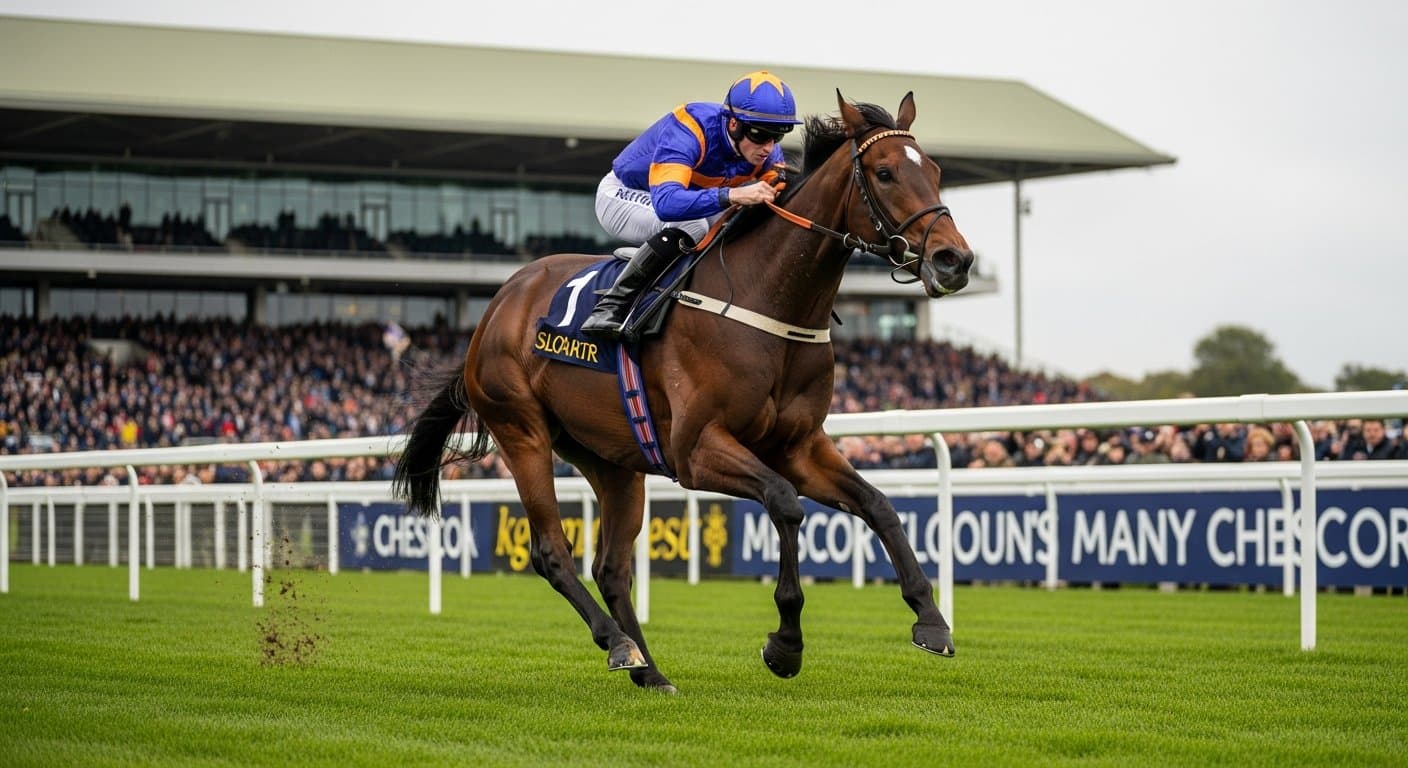
Many Clouds at Kelso: The Premier Chase Story
Many Clouds won the Listed Premier Chase at Kelso in 2016 by ten lengths, cementing his status as one of the great staying chasers of his era.
Read more
Morebattle Hurdle: Complete Guide
Your complete guide to the Morebattle Hurdle — Scotland's most valuable hurdle race, run at Kelso each March with a Cheltenham Festival bonus.
Read moreGamble Responsibly
Gambling should be entertaining and not seen as a way to make money. Never bet more than you can afford to lose. If you or someone you know has a gambling problem, help and support is available.