
Founder & Editor · Last reviewed 2026-04-05
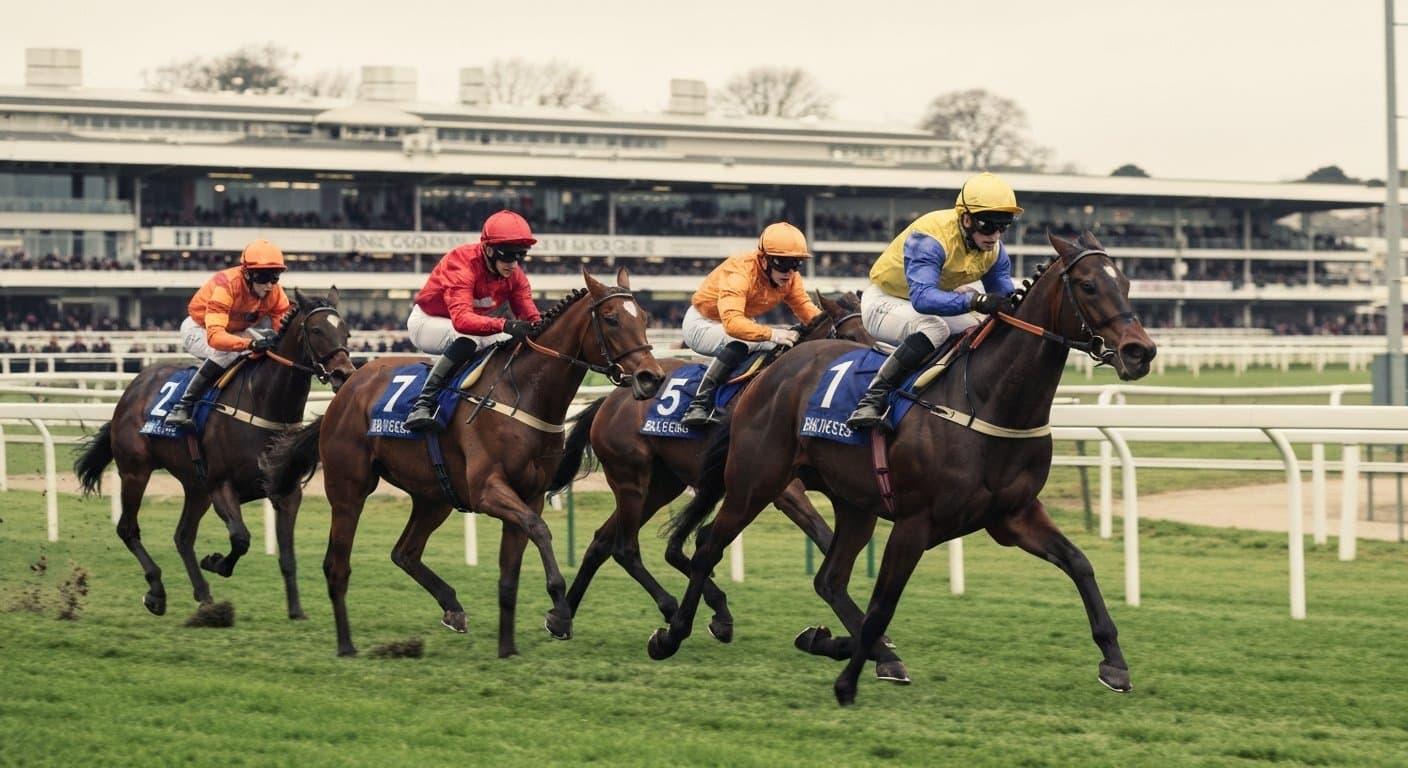
Kempton Park is one of the most distinctive betting venues in British racing. Positioned on the edge of the Surrey commuter belt at Sunbury-on-Thames, it operates as a dual-purpose course — a Polytrack all-weather flat circuit running through the year and a turf National Hunt course that stages jumps fixtures through the winter. Both tracks share the same triangular footprint and the same right-handed direction, yet they produce entirely different racing patterns and demand entirely different approaches from punters.
The all-weather programme is the engine room. Kempton runs AW flat meetings several times a week, every week, filling its card with a mix of maiden races, nurseries, conditions events and handicaps across a range of distances. This relentless schedule attracts horses from every tier of the sport — southern powerhouses like Godolphin putting new recruits through their paces on Tuesday evenings, alongside seasoned handicappers who have built careers entirely around the all-weather circuit. The consistent Polytrack surface means form translates reliably from meeting to meeting, and this predictability rewards the punter willing to do their homework. At Kempton on the AW, knowledge accumulates and pays interest.
The jumps programme is smaller in volume but far larger in prestige. The Boxing Day card anchors the calendar. Two Grade 1 races on the same afternoon — the King George VI Chase and the Christmas Hurdle — make it one of the highest-quality single days' racing in Britain, and one of the most heavily bet. The King George has been the stage for some of the sport's most celebrated horses. Desert Orchid won four of them between 1986 and 1990. Kauto Star won five — a record that may stand permanently — between 2006 and 2011. Those performances are not just historical footnotes; they define what the race rewards and which betting angles have the longest track record of success.
Understanding Kempton means understanding that you are dealing with two separate ecosystems operating on the same ground. The all-weather course is a science — measurable, data-led and consistent. The jumps course is part science, part tradition, with one afternoon of the year carrying a weight that the preceding 364 days build toward. This guide covers both, with particular depth on the areas where correct preparation translates into consistent betting profit: draw bias on the AW, pace dynamics on the Polytrack, King George trends, the annual all-weather championship programme, evening meeting angles, and the race calendar that tells you when the best opportunities cluster.
Whether you approach Kempton as a midweek punter looking for an edge in a seven-runner maiden or as an ante-post player building a position on Boxing Day, the principles are the same: know the track, know the surface, understand who wins and why. The rest follows from there.
Bet on Kempton Park
Place your bets on Kempton Park races with a trusted bookmaker.

Promo code BETFRED50. New customers only. Register, deposit with a Debit Card, and place a first bet of £10+ at Evens (2.0)+ on Sports, to be settled within 7 days, to get £30 in Sports Free Bets and £20 in Bet Builder Free Bets within 24 hours of settlement. 7-day expiry. Eligibility & payment exclusions apply. Full T&Cs apply. Take Time to Think. BeGambleAware.org. 18+. Full T&Cs.

Promo code R30. New UK customers only, 18+. Register, deposit £10 or more, then place a £10 single cash bet at odds of 1/2 (1.5) or greater on any sports market (excluding Virtuals). Once the qualifying bet settles you get £30 in Free Bets (3 x £10) — the qualifying bet can win or lose. Free Bets are valid on any sports market excluding Virtuals, expire in 7 days, are non-withdrawable and must be used in full. Excluded deposit methods apply (including PayPal, Apple Pay, Skrill and NETELLER). Named bets such as Lucky 15 do not qualify. If you cash out the qualifying bet, or it is voided, you are no longer eligible for the offer. Ends 31.12.26. Full T&Cs apply. Please gamble responsibly. BeGambleAware.org. 18+. Full T&Cs.

Promo code BET40GET20. New UK customers, 18+. Register with the code and place a first bet of £40 or more at Evens (2.0) or greater. Receive 2 × £10 free bets: the first credited automatically once the qualifying bet settles, the second 24 hours later. Free bets must be placed at minimum odds of 4/1 (5.0), expire 24 hours after credit, and the free-bet stake is not returned with winnings. Debit card deposits only. Take Time to Think. BeGambleAware.org. 18+. T&Cs apply. Full T&Cs.

50% of your first-day net losses refunded as a free bet, capped at £25. New UK customers aged 18+ only. To qualify, deposit and place a first bet of £10 or more on any sport at minimum odds of evens (2.00), then place at least two further bets on different events, each worth at least 50% of your largest bet, all at evens (2.00) or greater. Losses are counted from your first settled bet until 23:59 the same day. Place a qualifying £10+ bet and you are guaranteed at least a £5 free bet. Bets placed at SP, void bets, cashed-out bets and bets struck with free bets do not count towards the offer. The free bet is credited the day after your qualifying bets settle and must be used within 7 days, after which it expires. It can be used at odds from 1/4 (1.25) up to 250/1 on singles and straight accumulators, but not on Trixie, Patent or Yankee style multiples. Free-bet stake is not returned with winnings. One offer per person, household, address, IP address and device. E-wallet deposits may not qualify, so check the cashier before depositing. Customers registered with GAMSTOP cannot claim. KYC identity verification must be completed before the free bet is credited. Take Time to Think. BeGambleAware.org. 18+. T&Cs apply. Full T&Cs.

New customers, 18+. Choose the sports bonus at sign-up, make a first deposit and receive a 100% bonus up to £50 in your Sports Bonus balance. To convert the bonus to cash, wager it 10x within 30 days. Single bets below Evens (2.00) do not qualify; accumulators do not qualify if any selection is below 1/2 (1.50). Virtual Sports, voided, cancelled, drawn, cashed-out and free-bet wagers do not count towards wagering. Only the first settled bet per event counts. Withdrawing before the wagering requirement is met forfeits the bonus balance including bonus winnings. Real-money funds are used before bonus funds. Deposits via Skrill or Neteller are not eligible. Not valid in conjunction with other promotions. Odds, bet and payment limits apply. 10bet general and promotion T&Cs apply. BeGambleAware.org. 18+. Full T&Cs.

New customers in Great Britain and Republic of Ireland, 18+. Place a £10 fixed-odds qualifying bet at minimum odds of 1/2 (1.50) — single or each-way (only the win part counts), pre-event or in-play, not cashed out early, within 28 days of opening the account. Receive up to £60 in bonuses credited over three days: 3 × £10 fixed-odds free bets (the first on settlement, then 24 and 48 hours later) plus 3 × £5 Total Goals FOOTBALL spread bets and 3 × £5 racing Winning Favourites spread bets, with a £1 racing Race Index spread bet as an extra on top. The spread bets need a full spread-betting account, opened within 28 days of the fixed-odds account and subject to Spreadex's eligibility and appropriateness checks. Free-bet stakes not returned with winnings; free bets valid 28 days from issue. IMPORTANT: the £5 credits are SPREAD bets — sports spread betting carries the risk that losses can exceed your stake. Sports spread-betting customers do not have Financial Ombudsman or FSCS recourse. Take Time to Think. BeGambleAware.org. 18+. T&Cs apply. Full T&Cs.

Promo code WELCOME15, entered under My Bonuses after registering. New UK customers, 18+. Place a first qualifying bet of at least £10 from your cash balance at odds of evens (2.0) or greater within 7 days of opening the account. Once the qualifying bet fully settles you receive £15 in free bets, credited as 3 x £5 tokens with set uses: one £5 accumulator free bet (minimum 4 legs, each leg at 2/5 or bigger), one £5 sports free bet (any market at evens or bigger) and one £5 Sub Cover free bet (selected football player markets at evens or bigger). Free-bet stakes are not returned with winnings. Free bets expire 7 days after they are credited. Void, cashed-out and partially cashed-out bets do not qualify. One offer per customer. Confirm the current terms on BetGoodwin's own welcome-offer page before claiming. Take Time to Think. BeGambleAware.org. 18+. T&Cs apply. Full T&Cs.

New UK customers, 18+. Minimum deposit £10. Place a £10 qualifying single on sports (excluding virtuals) at minimum odds of 1/2 (1.50), settled within 14 days. Deposit-method exclusions apply. Receive £30 in free bets (stake not returned), split £20 for sportsbook use (2 x £10) and £10 for Bet Builder only (2 x £5); Bet Builder does not cover horse racing. Free bets must be accepted within 7 days and expire 7 days after acceptance. No promo code required. Best Odds Guaranteed on UK & Irish racing, subject to having staked over £25 in the previous seven days. Operated by LiveScore Betting and Gaming (Gibraltar) Ltd, UKGC 56859. Confirm the current terms on LiveScore Bet's own promotions page before claiming. Take Time to Think. BeGambleAware.org. 18+. T&Cs apply. Full T&Cs.
18+. BeGambleAware.org
The All-Weather Track and What It Rewards
The All-Weather Track and What It Rewards
The Kempton Park Polytrack is a right-handed, triangular circuit measuring approximately one mile and three furlongs in circumference. The shape is the first thing to understand. Unlike the horseshoe-shaped galloping tracks at Newmarket or Ascot, Kempton's AW configuration has three distinct corners with relatively tight radii, connected by short straight sections. The home straight runs for approximately three furlongs, long enough for a horse to mount a challenge but not long enough for pure stayers to grind their way past speedier rivals. The track is flat throughout, with no elevation change of any consequence — this matters because it removes one of the variables that can make turf form unreliable. Here, tired legs are the only hill.
The Polytrack surface itself is a proprietary blend of synthetic fibres, sand and rubber particles bound together to provide consistent footing. Kempton installed the surface in the early 2000s and has maintained it as Polytrack ever since. This distinction carries practical betting weight: Polytrack plays differently to the Tapeta surfaces installed at Wolverhampton and Newcastle. AW form from Lingfield, which also runs on Polytrack, transfers to Kempton with considerably more reliability than form recorded on Tapeta. When assessing a horse's AW credentials, filter by surface type first. A horse with four wins at Wolverhampton on Tapeta has demonstrated synthetic surface competence, but it has not demonstrated Polytrack competence specifically. These are related but not identical skills.
Pace Dynamics on the All-Weather
The triangular shape of the circuit, combined with the grippy but not sticky Polytrack surface, creates a specific pace bias. Front-runners perform noticeably better at Kempton AW than at most turf tracks, and the reason is structural. On the straight sections, a leader in full flow can maintain a high cruising speed without expending excess energy. Through the bends, the relatively tight turns encourage horses racing close to the pace to conserve momentum by tracking the leader into the corner, then benefiting from the slingshot effect coming off the bend into the next straight. For horses tracking from further back, the problem is straightforward: by the time they arrive at the bend, the front-runners are already accelerating out of it. Ground is lost on every turn, and in a circuit this compact, there are three turns per race minimum.
In sprint races over six furlongs, the pace dynamic is even more pronounced. Six-furlong runners at Kempton start from a chute that feeds into the main circuit near the first bend. A horse that breaks well and secures a position near the front within the first furlong can effectively dictate the entire race from that point. The short sprint from the chute to the bend rewards quick-breaking, front-running types who can hold their lead into the corner and then maintain it down the home straight. In conditions races and small-field handicaps over six furlongs at Kempton, front-runners win far more than their proportional share of races.
Over seven furlongs and a mile, the round course starts at a point that sends horses into a bend almost immediately. This means that horses breaking from high draws face an acute problem: they must either take a direct line to the inside rail — crossing in front of low-drawn horses — or race wide to take the bend on the outside. Either option costs energy. Low draws on the inside rail can slot straight into position without any navigational cost. On the mile course especially, the proximity of the start to the first bend makes the draw a real factor even before pace considerations enter the equation.
Over a mile and a quarter and further, the track opens up slightly. The extra distance means horses complete more of the circuit, and by the time the field reaches the home straight, the compression from early bends has had time to sort itself out. Draw bias at these longer distances is measurably smaller. Pace still matters — Kempton AW remains a track where those racing prominently hold an advantage — but the extreme draw effects seen in the shorter distances are diminished. At a mile and a quarter and beyond, class and ability have more time to reassert themselves.
Jumping Fluency on the Turf Course
The National Hunt turf circuit at Kempton follows the same right-handed triangular layout on a slightly wider outside path, measuring approximately one mile and five furlongs in circumference. The fences are fair and inviting by Grade 1 standards — not as technically demanding as Cheltenham's downhill fence or as physically challenging as the big Aintree obstacles. Kempton's fences reward horses that are naturally fluent and bold, rather than those that are careful, economic jumpers. A horse that meets every fence on a good stride and gallops on without losing momentum will cover the trip markedly faster than a horse that fiddles its fences.
The flat nature of the turf course amplifies this effect. There is no downhill section to create false momentum and no uphill finish to drain stamina reserves. What you see is what you get — the best jumper and the best galloper, provided they are well matched in class, will win. This is why Kempton's chase record books are filled with horses of the highest calibre. An inferior jumper cannot hide behind a hill finish. A stamina plodder cannot make up ground on a descent. The track is an honest examination, and that honesty is what makes it so useful as a form reference.
The hurdle course operates on the same principles. Flat, consistent, rewarding pace and fluency. Two miles over hurdles at Kempton on good to soft in December is a test of speed, jumping precision and tactical awareness. It is not a test of raw jumping courage or extreme stamina, which is why the Christmas Hurdle so consistently goes to horses with Champion Hurdle-level speed rather than staying hurdlers who excel at two and a half miles and beyond.
Draw Bias on the All-Weather
Draw Bias on the All-Weather at Kempton
Draw bias at Kempton's Polytrack is one of the most consistently misunderstood topics in British AW betting. Casual analysis often either overstates it or dismisses it entirely. The reality is distance-dependent, and once you understand the specific pattern for each trip, it becomes one of the most reliable tools in your AW handicapping armoury.
Six Furlongs: The Straight Course Bias
The six-furlong course at Kempton is the most draw-sensitive distance on the entire circuit. Races at this trip start from a chute that joins the main track before the first bend. Stalls are positioned so that low-numbered draws — stalls 1, 2 and 3 — are positioned closest to the inside rail when horses funnel from the chute into the corner. This matters because the junction between the chute and the main track creates a brief left-handed kink that horse and jockey must negotiate before the main right-handed circuit begins.
Horses drawn in stalls 1 to 3 can hold a straight line into this kink without losing ground. They arrive at the first proper right-handed bend of the circuit in the optimal position: on the inside rail, running economically, ahead of any wide runners. In a field of six to eight runners, this positional advantage translates directly into a measurable pace advantage, and pace advantage at six furlongs on a right-handed triangular track is enormously difficult to overcome from behind.
The data supports this clearly. When analysing races of 10 runners or fewer over six furlongs at Kempton AW, low-drawn horses win significantly above their expected proportion. Stalls 1, 2 and 3 collectively account for a win rate that exceeds their statistical share by a margin worth noting when constructing each-way bets or singles. The effect is most pronounced in fields of eight or fewer and in conditions races or low-grade maidens where pace tends to be honest from the flag.
In fields of 12 or more runners, the bias is diluted but not eliminated. With many horses breaking simultaneously, the initial advantage of a low draw can be overridden if a high-drawn horse breaks quickly and crosses to the inside before the bend. Speed out of the stalls matters in big fields over six furlongs, and a horse drawn in stall 11 that breaks fastest may effectively become a low-drawn horse by the time the field reaches the first corner. The practical approach: in fields up to 10, favour low draws heavily at six furlongs; in bigger fields, note draw alongside early pace tendencies.
Seven Furlongs and One Mile: Round Course Start
At seven furlongs and a mile, races move onto the round course with a start that feeds almost immediately into a bend. This is the most significant distance range for draw study because the proximity of the stalls to the first corner is at its most acute. Horses drawn in stalls 1 to 4 on the inside rail have a direct, unobstructed line into the bend. They do not need to take any evasive action, cross to the inside or compete for position — they are already in the inside position before the first corner begins.
High-drawn horses at seven furlongs and a mile face a more complex task. If they break in line with the rest of the field, they will reach the bend racing wide unless they have actively pushed forward to cross in front of inside-drawn horses. That crossing manoeuvre costs energy. Horses that race wide through the first bend — which is inevitable for high draws in large fields unless they have exceptional gate speed — are running a materially longer trip than horses on the rail. Over a mile at Kempton, running two horses wide through three bends adds up to a significant additional distance that does not show in the official race distance.
The practical implication: at seven furlongs and a mile, low draws carry real weight in your assessment of any race. In a competitive handicap where half a length could separate first from fourth place, the horse drawn in stall 2 versus stall 12 is not running quite the same race. Stalls 1 to 5 are preferred; stalls 6 to 10 are neutral with caveats; stalls 11 and above in fields of 14+ deserve a small negative weight unless the horse has demonstrated elite gate speed or a trainer who specifically schools horses to break quickly and cross.
Mile and a Quarter and Beyond: Draw Neutralises
At a mile and two furlongs and over longer distances, the draw picture changes considerably. By the time horses have covered the extra early ground before the first bend, and by the time pace has sorted the field into a natural running order, stall position has been substantially superseded by ability and tactical positioning. The analysis from multiple seasons of Kempton AW results shows no statistically significant draw advantage at a mile and two furlongs and further.
This does not mean draw is irrelevant at these distances. A horse in stall 15 of a 16-runner mile and a half handicap will almost certainly race wide early on and may use energy doing so. But the effect is small enough to be last in your list of assessment priorities, well below class, trainer form, recent race pattern and surface suitability.
Applying Draw in Practice
The most profitable application of Kempton draw data is in sprint handicaps of 8 to 12 runners over six furlongs where low-drawn horses with front-running tendencies appear at odds that do not fully reflect their positional advantage. Markets price form and class efficiently; they price draw and pace bias less efficiently, especially in midweek AW meetings that attract less analytical attention than Saturday turf racing. A low-drawn front-runner at seven furlongs in a 9-runner handicap is carrying a measurable structural advantage that the market frequently undervalues by 10 to 20 percent in implied probability terms.
Going on the All-Weather
Kempton's Polytrack is officially described as "standard" in normal conditions and "standard to slow" in wet weather when the surface absorbs excess moisture. The consistency of the going is the principal argument for placing AW form above turf form when assessing a horse's predictability. You will not encounter frozen ground in January, firm ground in August or heavy ground that varies by furlong depending on where water has pooled on a camber. The surface drains at a predictable rate and recovers to standard condition without the weeks of waiting that turf requires.
One important subtlety: not all Polytrack is equal over time. As the surface ages, it can begin to favour front-runners more strongly, because the top layer compacts slightly and grip becomes marginally less consistent for horses that have to accelerate from a trailing position. Kempton maintains its surface carefully, but in the early weeks after a major resurfacing or significant renovation work, form can be temporarily unpredictable as the new surface beds in. If you are aware of recent maintenance work at the track, treat the first two or three meetings after renovation with slightly lower confidence in form continuation.
Jumps Going
The turf course going operates on a completely different logic from the AW surface. It is entirely weather-dependent and varies widely through the winter season. October and early November meetings often run on good to soft; the Boxing Day meeting is typically soft or good to soft; January and February meetings can be heavy. Ground preference is a primary factor in jumps form assessment, and it matters more at Kempton than at most other venues because the flat track offers no shelter from the worst of wet winter conditions.
The King George has been run on ground ranging from good to soft in favourable Decembers to heavy after particularly wet autumns. Desert Orchid's four wins came on a range of ground types, but his Boxing Day performances were typically on going that had some give. Kauto Star's five victories included years with varying going descriptions, and his connections consistently reported that he was effective on any ground at Kempton — but the flat track suited his racing style regardless of surface condition, which made going a secondary concern for him specifically. For most other King George contenders, ground preference remains a primary selection filter.
The King George VI Chase
The King George VI Chase
The King George VI Chase is the centrepiece of British jump racing's midwinter schedule. Run at three miles on Boxing Day over Kempton's right-handed flat turf circuit, it is Grade 1 racing at full strength: the best staying chasers in training, fully fit and campaigning at the height of their powers, meeting each other in a direct championship clash just over two months into the season. No race better illustrates what the Kempton jumps track rewards, and no race has generated more reliable betting trends across its decades of running.
What the Race Rewards
The King George's flat, galloping circuit is a direct test of jumping fluency and galloping class. There are no quirky obstacles to unsettle a classy horse, no hill to expose weak stamina reserves, and no technical complexities to reward a lesser horse with a fortunate jumping technique. What wins the King George is a combination of high-class form, bold fluent jumping, and the ability to travel prominently through the race before quickening when the pace increases in the final mile.
Front-runners and prominent racers hold a strong record in the King George. The flat circuit means that a horse leading or tracking the leader through the long bends loses minimal momentum — there is no downhill section to unsettle a front-runner, and no uphill finish to drain their reserves faster than a horse sitting off the pace. Horses that make the running or race in the first two or three have won the King George with statistical regularity across multiple decades. Horses that come from well off the pace and make sweeping late runs win occasionally, but they are fighting the structural bias of the track when they do so.
Desert Orchid's Four Wins
Desert Orchid won the King George VI Chase four times — in 1986, 1988, 1989 and 1990. His performances in the race defined what front-running jumping excellence looked like on a flat galloping circuit. In each of his four wins, he jumped boldly from the front or very close to it, maintained a pace that discouraged rivals from settling, and quickened decisively when challenged. His record at Kempton was extraordinary even by his overall standards: his course form here far surpassed what his record at undulating tracks like Cheltenham might have predicted.
The 1989 running is the most celebrated, partly because of the conditions — heavy ground and a race that many expected to go against him — and partly because the performance defied the conventional logic that such ground would blunt his speed. Desert Orchid's four King George wins remain a record for a horse that spans a specific era, and they underline the value of course-and-distance form when assessing any King George contender.
Kauto Star's Five Wins
Kauto Star's five King George victories — in 2006, 2007, 2008, 2009 and 2011 — are an unmatched record in the race's history. Trained throughout by Paul Nicholls and ridden in all five by Ruby Walsh, his record at Kempton was built on a combination of exceptional jumping ability, tactical versatility and a racing style perfectly suited to the flat circuit. Unlike Desert Orchid, who essentially needed to dominate from the front, Kauto Star could win from any position in the field, often settling midfield before producing a devastating turn of foot in the final mile.
His 2011 win is particularly instructive from a betting perspective. Kauto Star had finished behind Long Run in the 2010 King George and had then suffered a fall at the Cheltenham Gold Cup in March 2011. Coming back to Kempton at the end of 2011, after a period that included doubts about his continued effectiveness at the highest level, he beat Long Run by seven lengths. The market had not fully priced in how well suited Kempton's specific characteristics were to him compared with other tracks. His course record — five wins from seven starts in the King George — is the clearest illustration available of course-specific suitability at the top level of jump racing.
Betting Angles for the King George
Course-and-distance form is the single strongest King George betting angle. Horses that have won the race before, or have finished placed at the track over the same trip, carry a statistical advantage that persists even when the market has already priced it in. Of the last 20 King George winners, a substantial majority had either won at Kempton previously or had shown Grade 1 form specifically on flat, right-handed circuits.
Class is the second most reliable angle. The King George rarely rewards course specialists from lower grades; it rewards the best horses who also happen to suit the track. When the best-performed horse in the race on form also has a clean Kempton record, that combination is close to a banker in statistical terms.
Ground conditions on Boxing Day deserve close attention. The King George is typically run on going described as good to soft or soft, with the precise description varying depending on autumn rainfall. Horses with proven form on soft ground have a stronger King George record than horses whose best form has been produced on faster going. This sounds obvious, but it has tangible implications for ante-post selections: a horse whose best turf wins have come on good or good to firm is a category risk in an average Boxing Day year when the ground has given significantly. Conversely, a horse whose form profile shows strong soft-ground performances is carrying a bonus that the ante-post market often underprices in October.
Freshness versus race fitness is a more nuanced King George angle. Some trainers use a November prep race at a track like Sandown or Haydock before the King George. Others bring their horses fresh from a period of rest and schooling, relying on fitness from home work rather than race conditioning. The record shows that both approaches can succeed — Kauto Star won the King George arriving from a prep race and also won it arriving fresh. What matters is that the horse arrives well within itself on Boxing Day, travelling strongly in the early stages rather than labouring from the third fence. A horse that sweats up and fights its jockey in the parade ring is a negative signal regardless of how its trainer has prepared it.
Paul Nicholls has won the King George more times than any other trainer in the modern era. His King George record with Kauto Star (five wins) and Clan Des Obeaux (wins in 2018 and 2019) means that any strongly fancied Nicholls runner for the race merits respect regardless of the broader ante-post market dynamics. Nicky Henderson's runners are the other consistent market presence, with horses like Long Run (winner in 2010 and 2011, though narrowly beaten the second year) regularly making the frame.
Christmas Hurdle
The day's other Grade 1 is the Christmas Hurdle over two miles. Run on the same Boxing Day card, it attracts the best two-mile hurdlers in training and frequently features the leading Champion Hurdle contenders from Ireland and Britain. Nicky Henderson's record in the Christmas Hurdle is outstanding across multiple decades, and his market representatives at the meeting almost always justify close analysis.
The two-mile trip at Kempton on hurdles rewards speed above everything. The flat track means a horse cannot rely on a strong jumping technique to steal ground at the downhill hurdle that would be present at tracks with topography. Pure pace, quick hurdling and the ability to sustain a high cruising speed from the third-last flight onward are the decisive factors. Champion Hurdle-type horses — those with real speed and quick, fluent jumping — have won the Christmas Hurdle more consistently than staying types who have had their trip adjusted downward.
Lanzarote Hurdle
The Lanzarote Hurdle is a Grade 3 handicap run over two miles and five furlongs at the January meeting, typically held in the second or third week of January after the Christmas break. It is named after the 1974 Champion Hurdle winner and has established itself as a valuable Cheltenham Festival pointer. Winners of the Lanzarote frequently appear at the Festival in competitive staying hurdle races, and their Kempton form provides reliable evidence of both ability level and suitability to a flat, galloping track.
For punters, the Lanzarote is valuable because the January meeting attracts horses specifically aimed at the race as a Cheltenham prep. The field is typically well-informed rather than speculative, trainers send horses in form, and the race distances are real rather than compromise distance choices. The market is usually fair but occasionally misprices horses whose Kempton form from earlier in the winter has been overlooked.
All-Weather Flat Betting Patterns
All-Weather Flat Betting Patterns
All-weather flat racing at Kempton is its own genre. It operates to different rules than turf flat racing, rewards different horses and trainers, and requires a different framework for form analysis. Punters who apply turf betting instincts to the AW without adjustment will consistently miss value and misread form.
AW Form as a Distinct Evidence Base
The foundational principle of Kempton AW betting is this: form on Polytrack is more reliable than form on turf, and form specifically at Kempton's Polytrack is the most reliable form of all. The consistent surface removes going as a variable entirely, and the consistent track configuration means that horses who have won here before are likely to continue running well here. Repeat course winners are far more common at Kempton AW than at any turf track, and the data across multiple AW seasons consistently shows that course-and-distance form is the strongest single predictor of a horse's probability of winning at the track.
When assessing any Kempton AW race, the first filter is simple: which horses have won or placed at this track on this surface at this distance? Horses with two or more wins at Kempton AW are building a profile that should generate positive expectation in every subsequent appearance. They know the track, they are suited to the surface, and they have demonstrated the specific combination of gate speed, turning ability and home-straight acceleration that Kempton's triangular layout rewards.
Horses That Excel on Polytrack
Not every horse takes to synthetic surfaces, and not every synthetic surface horse is equally suited to Polytrack. The horses that tend to perform best on Kempton's AW share a set of common characteristics. They are generally smooth-actioned rather than high-actioned — horses with a ground-eating stride rather than those that bounce off the surface. They tend to travel well within themselves rather than racing excessively keenly, because the tight bends on the Kempton circuit punish horses that pull hard. They have the acceleration to quicken in the home straight, which at three furlongs is long enough to reward a well-timed challenge but short enough that the challenge must be launched at precisely the right moment.
Horses transitioning from turf to AW often need one or two outings to adapt. A horse making its first Polytrack start after a turf season is an uncertain proposition even if its turf form is strong. The surface feels materially different underfoot, the bends require a different level of balance and cooperation, and some horses simply never take to it. A trainer with a strong AW conversion rate — measured as the percentage of horses that run well in their first AW start — is a more reliable guide for first-time Polytrack runners than general stable form.
Trainer Angles for Kempton AW
Godolphin under Charlie Appleby has been the dominant force in Kempton AW flat racing for over a decade. Appleby's operation is purpose-built for the type of racing that fills Kempton's all-weather card. Godolphin horses are typically well-schooled, balanced, and trained to peak fitness throughout the year — the operation does not traditionally have an 'off-season' in the way that purely turf operations do. Their year-round fitness programme means their horses arrive at AW meetings in optimum condition, which translates directly to the strike rates that consistently place them at the top of the Kempton AW trainer table.
When a Charlie Appleby-trained horse appears at Kempton on the all-weather in a race where the opposition is primarily from outside the top yards, it deserves very close attention regardless of its price. Godolphin horses that are sent specifically to Kempton rather than entered at multiple tracks on the same day are typically being aimed at the race rather than used for fitness or education purposes.
John and Thady Gosden carry the strongest record among the non-Godolphin yards. Their Kempton AW runners in maiden and conditions races regularly outclass the field — well-bred horses making their early career appearances in small-field events where their superior quality shows clearly. A Gosden maiden or conditions runner at Kempton AW at odds shorter than 5/2 is operating in a range where the market has done its job, but at 3/1 or higher, the strike rate in that price range remains profitable over a large enough sample.
William Haggas, Roger Varian and Andrew Balding are the other consistent Kempton AW names. Each of these trainers targets Kempton's handicap programme with specific horses that have been identified as AW-suited through their work at home or their surface adaptability. Varian in particular has an excellent record with AW sprinters, and his six-furlong Kempton AW runners appear to receive specific draw-conscious preparation.
Class Droppers from the Turf Season
One of the most consistently profitable Kempton AW betting angles is the class-dropper returning to the surface after a disappointing turf campaign. The pattern is predictable: a horse runs on turf through the summer, fails to reproduce its AW form in the mud at Haydock or on firm ground at Sandown, and drops back in class to a midwinter Kempton AW handicap. The market, still weighing the recent turf form, undervalues the probability that the switch back to a familiar surface triggers a return to the horse's best.
The critical qualifier is surface history. A class-dropper with three or more previous Kempton AW wins or places has a strong record in this scenario. A class-dropper who has never run on Polytrack is speculative at best. The AW comfort zone thesis only applies when there is a comfort zone to return to.
Trainers who regularly execute this move — cycling horses through the turf season and then returning them to AW with specific Kempton targets — include Mark Johnston's yard, Ralph Beckett and several of the smaller southern operations that run predominantly on the southern AW circuit. When you see a horse with a solid Kempton AW record dropping back from a 0-3 summer turf campaign into a winter handicap at an accessible price, that is worth adding to your shortlist.
AW Finals Day
The British all-weather flat championship series concludes at Kempton in April with Finals Day, which brings together the qualifiers from the AW series across all distances and categories. Finals Day is a concentrated betting opportunity. The field for each Finals race is comprised of horses that have earned their place through consistent AW form across the winter, which means the overall form standard is high and the form book is rich with directly relevant data. Horses that have been consistent performers at Kempton AW throughout the winter — particularly those with wins at the track at the relevant finals distance — have a structural advantage in these races even when the market has identified them as leading contenders.
Finals Day also attracts horses from the northern AW tracks — Wolverhampton, Newcastle, Southwell — who have qualified through strong Tapeta or Fibresand form. These horses are typically untested at Kempton specifically and represent a risk category that the market does not always price accurately. When comparing a horse with five Kempton AW wins to a qualifier from Wolverhampton with strong Tapeta form but no Kempton experience, the Kempton specialist deserves a rating bonus that reflects the surface-specific track knowledge advantage.
Evening Meeting Angles
Evening Meeting Angles
Kempton's midweek evening programme on the all-weather is one of the most consistently underanalysed fixtures in British racing. These cards run from April through October and into the winter months, typically on Tuesday or Wednesday evenings, attracting smaller fields and a specific category of horse that is worth knowing well.
Why Evening Meetings Matter
Betting markets for evening meetings are thinner than those for Saturday afternoon cards. The volume of money in the market is lower, bookmakers' margins are maintained but their starting price adjustments are less refined, and the information flow from the major yards is slightly less visible to the wider public. This creates conditions where a punter with specific track knowledge and an understanding of trainer patterns can find prices that are truly ahead of the market rather than fractionally behind it.
Evening meetings at Kempton also attract a specific type of race that is informative in its own right. Trainers who are introducing young horses to the AW for the first time — or who are testing whether a horse can handle the surface before entering it in a higher-grade handicap — often choose midweek evening meetings for this purpose. The smaller fields reduce the risk of a rough race that could set a horse back, and the lower-profile environment allows trainers to learn about a horse without the scrutiny that attaches to a Saturday Group race.
Young Horses and First-Time Polytrack Runners
The most reliable evening meeting angle at Kempton is the well-bred newcomer or lightly-raced horse from a major yard appearing in a small-field maiden or novice race on the all-weather. Charlie Appleby and John and Thady Gosden both use Kempton's evening programme to introduce promising horses to the Polytrack. When a well-bred first or second-season runner from one of these yards appears in a five or six-runner evening maiden against modest opposition, the probability of a winning performance is high even at short odds.
The key signal is field size and opposition quality. A 6/4 shot from Appleby in a 5-runner maiden where the other four runners are unspectacular platers is effectively a near-certainty that the market is pricing as a near-certainty — which is precisely the odds at which the intelligence is justified. The value is not in the price but in the reliability of the selection. For matched betting, accumulator construction or any scenario where probability rather than odds drives the decision, these evening maiden winners are as close to a banker as British flat racing offers.
Competitive Evening Handicaps
Evening meeting handicaps attract a more competitive mix. These races draw horses from across the southern AW circuit — Lingfield, Chelmsford, Kempton — many of whom are experienced Polytrack operators with consistent form profiles. The market for these races is reasonably efficient, but there are specific trainer-jockey combinations that outperform in evening handicap conditions.
Smaller southern yards that focus almost exclusively on the AW circuit — operations that do not have a large turf string and therefore run their horses on AW year-round — have an information advantage in evening handicaps. They know their horse's form better than a larger yard rotating between turf and AW might, and their runners are often arriving at Kempton after careful preparation specifically for this race rather than as a fill-in between turf entries. When you see a horse from a smaller specialist AW yard that has been running consistently at Kempton throughout the winter, and it drops into a field that is primarily composed of first-time AW entrants or horses returning from turf, that consistency is worth a significant rating premium.
Nursery Handicaps in the Evening Programme
The nursery racing that fills Kempton's summer and autumn evening programme is a specific sub-market worth understanding. Nurseries — handicaps for two-year-olds — are run from August through October, and the evening Kempton programme is a particularly active venue for these races. Two-year-olds in nurseries are the most volatile class in British racing: their form is thin, their physical development is rapid and unpredictable, and the handicapper's assessment of their ability is often working on two or three data points rather than the fifteen or twenty races that inform a mature horse's official rating.
The evening nursery angle at Kempton is the improving juvenile from a progressive-minded trainer that has been dropped into a race where the opposition's form is older and therefore likely to be less reflective of current ability. A two-year-old that ran a modest debut two months ago may be a substantially better horse now than its rating suggests, and trainers who develop young horses quickly — David Loughnane, Clive Cox, and several of the southern pattern specialists — often target evening Kempton nurseries with horses that are ready to show their improvement.
Jockey Patterns in Evening Racing
Jockey booking for evening AW meetings provides information that is underused by casual punters. When a leading jockey with multiple rides available on the same evening takes a specific Kempton booking for a horse from a yard not normally associated with that jockey, it signals a degree of trainer confidence that the horse will perform. Leading southern AW jockeys — Jim Crowley, Oisin Murphy and Robert Havlin — all have strong Kempton AW records and their bookings at evening meetings carry informational weight.
Conversely, when a horse that was ridden by a top jockey on its last outing is handed to an apprentice or a replacement rider for an evening meeting, the reason matters. If the change is purely logistical — the retained jockey has a higher-profile engagement elsewhere — the horse's chances are unchanged. If the change coincides with a step down in class or a trip extension that suggests the trainer is simply trying to find a winning opportunity rather than targeting a prize, the reduced jockey is part of a broader pattern worth noting.
Monthly Programme and When to Bet
Monthly Programme and When to Bet
Kempton's racing calendar is structured by two distinct rhythms: the all-weather programme that runs throughout the entire year without interruption, and the jumps programme that provides a small but high-quality winter counterpoint. Knowing when the best opportunities concentrate — and when to be more cautious — is as important as knowing how to assess individual races.
The All-Weather Programme Month by Month
January and February bring some of the most consistent AW betting opportunities of the year. Fields are smaller than the spring and summer peak, but the horses in these fields are typically established AW performers with deep form records. The January card at Kempton regularly features the Lanzarote Hurdle (a valuable Grade 3 handicap over two and a half miles) alongside its AW flat programme, which means media and betting interest is concentrated on the jumps race and the surrounding AW markets receive slightly less public scrutiny.
March is the month when the AW programme begins its transition toward the pattern of the flat season. Horses that have been running on AW through the winter start to receive declarations on turf as the ground dries. This creates interesting opportunities in AW handicaps: horses approaching the end of their AW campaign can be at a fitness peak from their winter racing, while the opposition may include horses that have been off the track since the autumn and are arriving for first-of-season appearances with unknown fitness. The experienced winter AW campaigner against the returning turf horse is a matchup that frequently favours the former at the start of the turf season.
April is Finals Day month. The AW Championship Finals are held at Kempton in April, typically in the first half of the month, and represent the annual climax of the British all-weather flat season. These races carry prize money significantly higher than standard AW handicaps, and the fields are drawn from the most consistent performers of the AW season across all tracks. The Kempton specialist angle applies most forcefully here — horses with multiple wins at the track at the finals distance are carrying a significant advantage over qualifiers from Wolverhampton or Newcastle whose form has been compiled on different surfaces.
May through August is the peak summer programme. Evening meetings on the all-weather run alongside the turf schedule, typically held on Tuesday or Wednesday evenings. Nurseries begin in August. The summer evening programme is where the young horse and first-time Polytrack angles are most productive, as trainers use the light evenings and smaller fields to introduce promising two-year-olds to racing.
September and October brings the September Stakes (Group 3, one mile and four furlongs), which is one of Kempton's surviving prestige flat races, now run on Polytrack rather than the turf it was historically staged on. This pattern race attracts quality middle-distance horses being prepared for autumn targets at Ascot or abroad, and the form it produces is reliable and directly relevant to the late-season pattern programme. The September Stakes is a race worth following in both directions — for ante-post purposes at the upcoming autumn Ascot or Champions Day races, and as a form reference for similar AW conditions races later in the winter.
October and November see the resumption of the jumps programme. Early-season National Hunt racing at Kempton attracts novice chasers and hurdlers having their first outings of the campaign, often on ground that remains relatively quick. These early jumps meetings are informative rather than immediately high-stakes — the King George preparation begins here, and horses that run well in October and November at Kempton are plausible King George entries. Watching the early National Hunt programme with the Boxing Day card in mind is sound ante-post practice.
December: Boxing Day is the most important single day of Kempton's racing year. The Boxing Day card centred on the King George VI Chase and Christmas Hurdle is one of the highest-bet meetings in the British calendar. Markets are deep, ante-post trading begins from October, and the race attracts the sport's leading trainers and horses as a matter of tradition rather than obligation. The supporting card — a mixture of handicap chases, conditions hurdles and the novice races — provides betting opportunities that the King George's gravity often overshadows. The handicaps on the Boxing Day card are typically competitive but not impossibly tight, and well-researched course form gives a real edge.
When to Be Cautious
Two periods of the Kempton AW calendar carry elevated risk and require additional caution in staking.
The first is the immediate aftermath of major track maintenance or surface renovation. Polytrack requires periodic resurfacing and significant maintenance, and Kempton closes for these periods. In the first two or three meetings after a track reopening, form can be temporarily inconsistent as the new or renovated surface beds in. Front-running biases may be amplified or reduced, and pace dynamics shift as the surface finds its stable characteristics. If you are aware that Kempton has recently completed track work, treat the opening meetings of the season back with a measured reduction in confidence until several results confirm the surface is performing predictably.
The second is the autumn overlap period in October and November, when the jumps programme has begun but the all-weather flat programme is still running. Cards at Kempton during this period can be split between codes, with flat AW races and hurdle races on the same card. Fields for these mixed meetings can be thin and the quality within them variable. This is the period when horses are transitioning between programmes — turf horses finishing their flat seasons, jumpers beginning their campaigns — and form comparisons are most difficult to make accurately.
The King George Ante-Post Market
The King George VI Chase ante-post market opens in the summer, typically with the leading horses from the previous season's Cheltenham Gold Cup and King George being quoted from June or July onward. Punters with a specific interest in ante-post King George trading should note that the market is efficient for the leading two or three horses in the betting but noticeably less efficient for horses priced between 8/1 and 20/1. This mid-range zone often contains horses whose form profile is complex — perhaps a horse that won the King George two years ago, ran below form last year, and is returning for another campaign — where the market has not fully priced in the course-specific advantage of a previous winner.
Kauto Star's 2011 victory is the most striking example. He was available at double-figure ante-post odds in the autumn of 2011 despite being a four-time King George winner, because his overall form had suggested decline. The course record was underweighted relative to the general form trend. Ante-post punters who focused specifically on his Kempton record rather than his overall rating trajectory were rewarded with a price that dramatically underrepresented his probability of winning.
Frequently Asked Questions
Share this article
More about this racecourse
All Kempton Park guides
Kempton Park Racecourse: Complete Guide
Kempton Park — home of the King George VI Chase on Boxing Day. All-weather and turf racing, facilities, transport and betting angles.
Read more
A Day Out at Kempton Park Racecourse
Everything you need for a day at Kempton Park — getting there, what to expect, enclosures, food and drink, and tips for Boxing Day and beyond.
Read more
Kempton Christmas Festival: Your Complete Guide
Boxing Day at Kempton is the jumps season's Christmas centrepiece. Three days of top-class racing over the festive period — here's everything you need to know.
Read morePhotos on this page are used under Creative Commons licences. Titles, sources and licence links for each one are on our image credits page.
Research the field with the AI Race Predictor
Our model publishes calibrated win-probability estimates for UK races — a second opinion to understand a race, not tips. It's open about its record: it doesn't beat the market, and we show exactly how it does.
Betting offers for Kempton Park
Work it out & learn the basics
Gamble Responsibly
Gambling should be entertaining and not seen as a way to make money. Never bet more than you can afford to lose. If you or someone you know has a gambling problem, help and support is available.