
Founder & Editor · Last reviewed 2026-04-05
On a clear October afternoon at Redcar, the North Sea fills the horizon beyond the far rail. From the main grandstand you can watch a field of two-year-olds break from the stalls on the straight six-furlong track, the grey water behind them, the Cleveland Hills faint to the south-west, and the Victorian promenade off to the right. It is one of the most distinctive views in British flat racing — and it belongs entirely to Redcar.
Redcar Racecourse was formally established in 1872 on the north-east coast of England, in a seaside town that had been growing rapidly since the railway arrived from Middlesbrough in 1846. The course runs left-handed, broadly parallel to the seafront, on a flat and slightly undulating strip of turf that makes it one of the most speed-testing tracks in the northern flat circuit. The main straight measures five furlongs. The full oval circuit runs to approximately one mile and two furlongs. There are no significant gradients and no sharp bends — this is a track that rewards horses with real pace, not the specialist jumpers' agility demanded at tighter circuits.
The independent Redcar Race Company has operated the course for decades, outside the Jockey Club and ARC networks that control the majority of British racecourses. That independence has given Redcar a particular character: locally rooted, financially pragmatic, and committed to the northern flat-racing calendar in a way that a group-owned venue might not be.
The course's signature event is the Two Year Old Trophy, a Group 3 race over six furlongs run each October. It is one of the most important late-season juvenile races in the north of England, attracting horses from leading trainers across Yorkshire, the Midlands, and sometimes further afield. The winner has repeatedly gone on to prove its quality in stronger company, and the race functions as a real talent-spotter for the following season's Classics crop.
Redcar's hinterland is worth understanding. To the west, across the Tees floodplain, lie Middlesbrough and Stockton-on-Tees — industrial towns shaped by the steel and chemical industries. The Lackenby steelworks at Redcar itself and the great ICI plant at Billingham, eight miles to the west, defined the working economy of Teesside for most of the twentieth century. The racegoing crowd at Redcar has always drawn from those communities, which gives the course a directness and warmth that more fashionable southern venues sometimes lack.
This article traces Redcar's history from its earliest beach meetings through the formal opening of 1872, the interwar and post-war years, the introduction of the Two Year Old Trophy, and the challenges and ambitions of the modern course. Redcar has survived two world wars, changes of ownership, and the long post-industrial contraction of Teesside. The North Sea is still there beyond the far rail.
Origins
Racing Before the Course Existed
Horse racing at Redcar is older than the racecourse itself by a considerable margin. The flat beach at Redcar — wide, firm, and stretching for miles in both directions — was a natural venue for informal racing in the eighteenth century, well before any permanent infrastructure existed. The town sits at the mouth of the Tees estuary, where the river meets the North Sea, and the sands that front the town provided a surface that any horse could gallop on when the tide allowed.
Records of organised racing at Redcar on the beach date to at least the early nineteenth century. These were not polished fixtures with weighing rooms and permanent stands. They were often festive occasions tied to the summer calendar of the town, drawing crowds from the wider Cleveland area and from the growing industrial settlements along the Tees. The nature of beach racing — dependent on tides, weather, and the informally arranged patronage of local landowners — meant that the programme changed from year to year. But the enthusiasm was consistent. The North East had a racing culture rooted in the agricultural and aristocratic life of Yorkshire and Durham, and Redcar's beach meetings fed into that culture while remaining distinctly coastal in character.
The Railway and the Resort
The transformation of Redcar from a quiet fishing village into a recognisable seaside resort began in 1846, when the branch line from Middlesbrough was completed. The railway was part of the network expanding across Teesside from the Stockton and Darlington Railway's original 1825 route, and it brought with it something that changed Redcar permanently: easy access for the industrial workforce of Middlesbrough.
Middlesbrough in the 1840s was already the centre of a rapidly expanding ironworking region. The Bolckow and Vaughan ironworks had begun operating in 1841, and the town's population was growing at a rate almost without parallel in Victorian Britain — from a few hundred at the turn of the century to more than 7,000 by the time the Redcar branch opened. For those men and their families, the train journey to the seaside at Redcar was a short one: roughly fifteen minutes along the coast, arriving at a station that put visitors within a few minutes' walk of the beach.
Henry Bolckow, the German-born ironmaster who became Middlesbrough's first MP in 1868 and one of the most prominent industrialists in Victorian England, was among those who shaped the character of Teesside in this period. Bolckow died in 1878, but he and his partner John Vaughan had spent the 1840s and 1850s turning the Tees valley into one of the world's great centres of iron production. That wealth, and the patronage of men like them, was not confined to the factories. Racing attracted the ironmasters as it attracted other provincial industrialists, and the beach meetings at Redcar drew support from Teesside money.
The 1872 Establishment
The final beach meeting at Redcar was staged in 1870. Two years later, in 1872, the current racecourse was opened on its present site — inland from the beach, between the town and the sea, occupying a strip of ground that allowed for a proper left-handed oval track. The move from sand to turf was a significant change. A permanent site meant permanent infrastructure: a defined track layout, sightlines that could be planned, and the possibility of a grandstand that racegoers could rely on.
A grandstand was erected in 1876, four years after the course opened. Its construction gave Redcar the basic physical form of a Victorian racecourse: a viewing platform from which the races could be followed, a separation between the enclosures, and a sense that this was a venue to be taken seriously rather than an improvised gathering on the sands. The 1870s were a period in which many British racecourses were consolidating their infrastructure, partly in response to Jockey Club regulation and partly because the rail network made it commercially viable to charge admissions to properly enclosed grounds.
The Pier and the Holiday Town
Redcar's pier opened in 1873, one year after the racecourse. The pier — now the longest surviving Victorian seaside pier in the north-east of England — was central to the resort's identity for a generation. It gave the town a destination attraction and extended the promenade experience that had already drawn visitors from Teesside. The combination of the pier, the beach, and the racecourse made Redcar one of the more complete seaside leisure destinations on the north-east coast.
The racing days drew working-class crowds from Middlesbrough and Stockton alongside the better-off visitors who stayed in the lodging houses along the seafront. This mix of audiences was characteristic of Victorian flat racing, which occupied a social space somewhere between the aristocratic Ascot model and the raw betting culture of northern town meetings. At Redcar, the industrial hinterland gave race days a particular flavour: these were communities that worked hard and played hard, and the racegoing holiday fit naturally into that culture.
The Cleveland Setting
Behind Redcar to the south-west, the landscape changes abruptly. Within ten miles of the seafront, the ground rises into the North York Moors — the Cleveland Hills, a line of escarpments that marks the southern edge of the old Cleveland district. The contrast between the flat coastal plain, with its steelworks and chemical plants, and the open moorland above is one of the defining features of this corner of England. Racegoers arriving from Guisborough, Skelton, or the upper Tees valley would have crossed that transition on their way to Redcar, from the agricultural and mining communities of the moors to the seaside course by the North Sea.
The early racing programme at Redcar reflected these multiple audiences. Flat racing was the only code — the terrain and the turf suited speed rather than jumping — and the distances ranged from sprint races of five and six furlongs to middle-distance events that tested stamina on the undulating straight. The jockeys and trainers in those early decades came largely from the Yorkshire community: Malton, thirty miles to the south-west, was already establishing itself as a training centre, and horses from the North Riding were a consistent presence at Redcar meetings throughout the Victorian era. The foundations of a northern flat-racing circuit — linking Redcar with York, Catterick, Thirsk, and Ripon — were being laid in these years, and Redcar's position at the northern-eastern edge of that circuit gave it a character that was simultaneously connected to the broader Yorkshire tradition and shaped by the quite specific social world of Teesside.
The Golden Era
The Late Victorian and Edwardian Years
By the 1890s, Redcar had a settled place in the northern flat-racing calendar. The course drew regularly from the training yards in Malton, thirty miles to the south-west, and from the smaller training operations scattered across the North Riding. The Edwardian era was a period of expansion for British racing broadly — prize money was growing, the bloodstock market was being shaped by wealthy new owners from industry and finance, and the number of fixtures was increasing at courses across England. Redcar benefited from that expansion, adding to its programme and attracting a slightly wider field of runners.
The seaside setting was an advantage in this period as much as it was in the Victorian decades before. Redcar in the early twentieth century remained one of the busiest tourist destinations on the north-east coast, and race days drew from a holiday crowd as well as the committed racegoing public from Middlesbrough, Stockton, and the smaller communities around the Tees estuary. The North Sea was a backdrop, and on summer meeting days the combination of a day at the races and an afternoon on the beach drew the kind of crowds that made flat racing at small northern venues commercially viable.
The Interwar Decades
The First World War disrupted racing nationwide. Redcar's fixture list was curtailed along with most provincial courses, and the course itself was requisitioned for military use. When racing resumed in the early 1920s, the Redcar meeting returned to a sports landscape that had changed in several ways. Attendance at entertainment events broadly was strong in the 1920s, partly as a response to the years of wartime restriction. The interwar period — from the resumption of racing in 1919 through to the late 1930s — was a productive one for northern flat racing. The Yorkshire circuit of major meetings was well established, and Redcar sat at its northern and eastern edge, drawing from both the industrial communities of Teesside and the agricultural hinterland of Cleveland and the North Riding.
Seaside racing had a particular character in the 1920s and 1930s. Trains from Middlesbrough to Redcar Central ran frequently on race days, and the fifteen-minute journey made the course accessible to a broad cross-section of the Teesside public. The steel and chemical workers who filled the Teesside factories — ICI's Billingham plant, opened in 1926, employed thousands — formed a substantial part of the racecourse audience. For those communities, a race day at Redcar was a holiday in miniature: a train trip to the coast, an afternoon in the enclosures, and the possibility of a small profit from the bookmakers' rails.
The Second World War and Major Petch
Racing was suspended again during the Second World War. Redcar's course was used, as many racecourses were, for military purposes — as an airfield and army camp, the infrastructure of the sport giving way to the infrastructure of the conflict. By 1945 the track was in need of significant work.
The man who took on that task was Major Leslie Petch OBE. Petch managed Redcar from 1945, and his contribution to the course's post-war character was substantial. Under his stewardship, Redcar became the first racecourse in the United Kingdom to install a timing clock and furlong posts on the track — practical innovations that seem straightforward now but were far ahead of most British venues at the time. Timing clocks allowed accurate race times to be posted immediately, giving punters and form analysts consistent data across meetings. Furlong markers let spectators follow the race's progress on the straight and calibrate the pace. These were real improvements to the racegoing and form-study experience, and they arrived at Redcar before they arrived almost anywhere else.
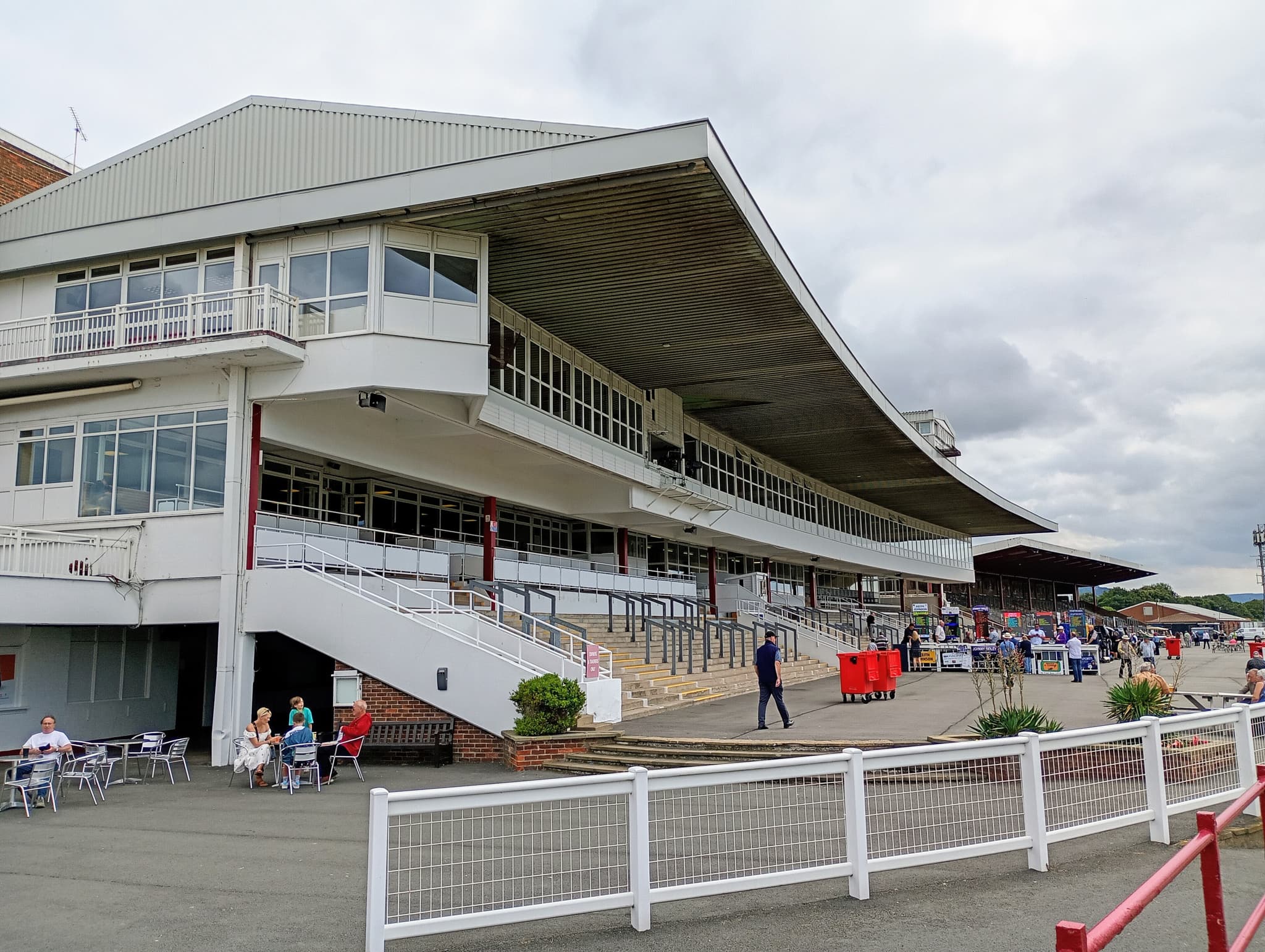
Petch's most visible contribution to the course's physical fabric came in 1964, when a new grandstand was erected. The stand gave Redcar a modern face at a time when much provincial racing infrastructure was dated, and it remains in use today. The 1964 build set a standard for the course's facilities that held for decades.
The Northern Flat Circuit
Through the 1950s and 1960s, Redcar operated within a northern flat-racing circuit that was distinct in character from the major southern venues. York, fifty miles to the south-west, was the prestige meeting — the Ebor and the Yorkshire Oaks set the standard for the region. Catterick, thirty miles south-west of Redcar along the Tees valley, offered a tighter, sharper course better suited to small-field handicaps. Thirsk, forty miles south-west, had its own traditional spring and summer fixtures. Ripon, forty-five miles away, drew from the West Riding as well as the North Riding. Redcar sat within that network as the coastal venue: distinctive in setting, limited in prize money relative to York but consistent in its programme and loyal in its audience.
Timeform, the ratings and form analysis service founded by Phil Bull in Halifax in 1948, became a significant presence in northern flat racing through the 1950s and 1960s. Bull's ratings were built on precisely the kind of careful timing and consistent form analysis that northern flat racing — with its relatively straightforward tracks and reliable ground conditions — made possible. Redcar's timing clock and consistent flat surface made it a useful venue for establishing the kind of reliable performance benchmarks that Timeform sought. The form from Redcar meetings filtered into Timeform's ratings with some regularity, and the course built a reputation among serious students of the form book as a venue where performances could be taken at face value.
The Lord Zetland Connection
The Zetland family's association with racing in the North East was long established well before Lord Zetland became centrally involved with Redcar. The Dundas family, who hold the Zetland title, had deep roots in the North Riding, and the social world of northern horse racing and the great landed families of Yorkshire had overlapped for generations. When Lord Zetland took control of Redcar in the later decades of the twentieth century, he brought a racing proprietor's interest in developing a signature event that could draw quality horses and national attention.
The result was the Two Year Old Trophy. First run in 1993, the race was designed as a six-furlong October race for two-year-olds — a distance and timing that addressed a real gap in the northern flat calendar. October is relatively late in the flat season, and a quality juvenile race at that point of the year gave late-maturing two-year-olds and those trained specifically for an autumn campaign a target that could also function as a form reference for the following season. The race was awarded Group 3 status, confirming its place in the graded flat-racing hierarchy. The Two Year Old Trophy gave Redcar a race it had lacked before — one with national reach and demonstrable form implications. It would prove to be the most significant development in the course's post-war history.
Famous Moments
Sheikh Hamdan's First British Winner, 1980
On 30 July 1980, Sheikh Hamdan bin Rashid Al Maktoum had his first winner in British racing at Redcar — a horse named Mushref. At the time, the Maktoum family's investment in European bloodstock was in its earliest phase. Sheikh Mohammed, Sheikh Hamdan's brother, had begun buying horses in 1977, and the family's presence in British racing was new enough to be notable rather than assumed. Mushref's win at Redcar predates the years of dominance at Epsom, Goodwood, and Ascot that would define Sheikh Hamdan's long involvement in the sport. The fact that it happened at a north-east seaside course, rather than at one of the southern fixtures where the family later concentrated most of its purchasing power, gives the moment a particular significance in Redcar's story. The course was the setting for a beginning that eventually became one of the great chapters in British racing.
Pipalong and the Early Trophy Years
The Two Year Old Trophy was first run in 1993, and within a few seasons it had begun producing horses that confirmed its quality as a form pointer. Pipalong, trained by Tim Easterby at Great Habton in the Malton area, won the race in 1999 as a two-year-old and went on to become a top-class sprinter. She won the Group 1 Prix de l'Abbaye at Longchamp in 2000, as a three-year-old, beating a field of the best sprinters in Europe. Pipalong's trajectory — from a six-furlong Group 3 in October at Redcar to the Abbaye the following autumn — is the clearest example of the Two Year Old Trophy functioning as it was designed to: identifying a horse of real quality before that quality was fully recognised by the wider market.
Tim Easterby's yard at Great Habton, near Malton, has been one of the dominant forces at Redcar for three decades. The yard is approximately thirty miles south-west of the course, in the Vale of Pickering at the edge of the North York Moors. Easterby sends horses to Redcar regularly, and the course's northern flat programme suits the type of horses he produces.
Captain Rio and the Group Route
Captain Rio won the Two Year Old Trophy in 2002, trained by Richard Fahey. Fahey operates from Musley Bank, near Malton — again, approximately thirty miles south-west of Redcar. Captain Rio was a high-class juvenile who went on to take the Group 3 Coventry Stakes at Royal Ascot the following year. His Redcar win as a two-year-old in October 2002 was a marker of a horse already showing the kind of acceleration over six furlongs that the course's flat straight suits.
Richard Fahey has become the trainer most consistently associated with the Two Year Old Trophy in the race's history. His Musley Bank yard is one of the largest training operations in the north of England, with well over a hundred horses in training at any point in the season. Fahey's ability to have juveniles at their peak in October — a time of year when many two-year-olds are being given easier races or being rested for the winter — has made him a dominant force in the race. His record at Redcar more broadly is similarly strong, and his name appears regularly in the winners' enclosure across the season.
Somnus and Speed at Six Furlongs
Somnus won the Two Year Old Trophy in 2002 (sharing the honours in what was run as a dead heat with Captain Rio), and went on to a career that confirmed the depth of quality in that renewal. A consistent performer at Group level through his career, Somnus remained in training as a four and five-year-old and ran in some of the major sprint handicaps and pattern races of his era. The 2002 Two Year Old Trophy — producing two horses of that quality from a single race — was evidence that the October juvenile race at Redcar had established itself as a real Group 3 contest rather than a convenient prize for moderate northern juveniles.
Limato: A Group 1 Star
Limato won the Two Year Old Trophy in 2014 under Paul Hanagan, trained by Henry Candy. The Wantage-based trainer sending a horse north to Redcar for the October juvenile race underlined how wide the Trophy's reach had become by that stage. Limato went on to become one of the most popular flat horses of the 2015–2018 period — a multiple Group 1 winner at five furlongs and six furlongs, winning the Prix de Saint-Georges at Longchamp and the Diamond Jubilee Stakes at Royal Ascot in 2016. He retired in 2018. Paul Hanagan, one of the leading flat jockeys in northern England through the 2010s, rode with a precision that suited Redcar's straight track, and the Limato victory was one of several significant moments in his association with the course.
Kevin Ryan and Northern Dominance
Kevin Ryan, based at Hambleton Lodge near Thirsk, approximately forty miles south-west of Redcar, has been another trainer with a strong record at the course. Ryan's yard produces a steady supply of flat horses suited to the northern sprint and middle-distance programme, and Redcar's six-furlong straight and mile-and-a-quarter oval have both hosted Ryan-trained winners across the years. His approach to juvenile development — patient, with horses often improving through the back end of the season — aligns well with the Two Year Old Trophy's October timing.
A Finish at the Seaside
The Two Year Old Trophy in 2018 was run in conditions that illustrated something particular about Redcar's coastal position. A westerly wind off the North Sea was blowing across the straight, creating a crosswind that pushed horses towards the near rail in the early stages of the six-furlong race. The eventual winner, Threat, trained by Roger Varian, showed the adaptability required to win in those conditions, holding his line under Robert Havlin and drawing clear in the final furlong with the sea visible behind the far post. Threat's subsequent career confirmed the Trophy's status: he won the Group 3 Chesham Stakes at Royal Ascot the following year and was placed in Pattern company on multiple occasions.
The coastal exposure that shapes race-day conditions at Redcar is not incidental — it is one of the ways in which the course's specific geography produces a test that differs from inland tracks at the same trip. Horses that handle wind and the occasional damp ground find Redcar a congenial venue; those that prefer sheltered conditions may find October at the seaside less straightforward than the track's flat, left-handed shape might suggest.
The Modern Era
Independent Operation in a Consolidated Industry
British racing ownership has consolidated significantly over the past thirty years. The Jockey Club, which operates fifteen courses including Cheltenham, Newmarket, and Epsom, and Arena Racing Company (ARC), which runs sixteen, between them control a majority of British racecourses. Redcar sits outside both networks, operated by the independent Redcar Race Company. That independence has consequences — for prize money levels, for commercial negotiation with the levy board, and for the flexibility with which the course can respond to changing fixture pressures.
Independent courses face a structural difficulty in British racing's current economics. The central levy from bookmakers is distributed partly through the British Horseracing Authority's fixture allocation process, and larger group-owned venues can negotiate preferential positions in the fixture list. An independent course like Redcar has to compete for attractive dates and draw on its own commercial relationships with sponsors and broadcasters rather than the group-level deals available to ARC and Jockey Club venues. The Redcar Race Company has managed that challenge with some success. The course typically runs approximately twenty fixtures per year, from late April through to early November, with a programme spread across the northern flat season.
The Two Year Old Trophy as Anchor
The October meeting built around the Two Year Old Trophy is the commercial and sporting centrepiece of Redcar's year. The race carries Group 3 status, which means it appears in the Pattern programme — the hierarchy of graded and listed races that defines British flat racing's prestige calendar. Group 3 status brings several advantages: higher prize money than a listed or conditions race, the prestige that encourages better-quality nominations, and the form implications that come from a result embedded in the Pattern. Horses that win or place in Group 3 company are automatically credible at the higher levels, and the Two Year Old Trophy's October timing makes it a useful autumn pointer.
Prize money at Redcar's Two Year Old Trophy has varied with sponsorship levels and levy funding, but the race has consistently been one of the more valuable juvenile events in the northern flat calendar. For comparison, the course's other high-value race, the Cleveland Plate — a sprint handicap — is a useful northern handicap but does not carry the same national profile as the juvenile Group 3.
The SSI Steelworks and Teesside's Economy
In October 2015, SSI UK — the Thai company that had reopened the Teesside steelworks at Redcar in 2012 after a period of closure — went into liquidation. The blast furnaces at Redcar, which had been operational since 1979, were shut within days. Around 2,200 workers lost their jobs immediately, with thousands more affected in the supply chain. It was the largest single industrial closure in Britain since the 1980s pit closures.
The SSI closure is relevant to Redcar's story because it illustrates the economic vulnerability of the town and its surrounding communities. Redcar the town had already lost much of its steel industry to earlier closures, and the SSI collapse removed what had been a fragile recovery for the heavy-industrial base of Teesside. The racecourse, dependent on discretionary leisure spending from local and regional visitors, operates in a town where a significant proportion of the population experienced sharp income falls in 2015 and the years immediately following. The relationship between racing and the communities it serves is not insulated from those economic realities, and the course's management has had to work within a local context in which disposable income for entertainment is constrained.
Richard Fahey and Malton's Dominance
In the modern era, the trainer Richard Fahey has been more consistently prominent at Redcar than any other figure in the training world. His Musley Bank yard near Malton, approximately thirty miles south-west of the course, has the scale — more than a hundred horses in training across a typical season — and the expertise in northern flat racing to produce regular winners at Redcar across all distance categories. Fahey won multiple trainers' championships on the northern flat circuit during the 2010s, and his ability to have two-year-olds ready for October has made the Two Year Old Trophy a race he targets with serious intent each year.
Tim Easterby, also based in the Malton area at Great Habton, is the other trainer whose yard defines the competitive landscape at Redcar. Easterby's father, Peter Easterby, was a dominant figure in both flat and jump racing from the 1960s through the 1980s, and Tim has maintained the family's northern prominence through a long training career. His winner Pipalong, who took the Two Year Old Trophy in 1999 before winning the Group 1 Prix de l'Abbaye the following year, remains one of the most significant horses to have passed through the course.
Tourism and the Seaside Setting
Redcar's beach remains one of its practical assets. The racecourse sits close enough to the seafront that a race day can be combined with a visit to the beach, the promenade, or the town's shops and cafes. Redcar Central station — on the Middlesbrough to Saltburn-by-the-Sea line — is roughly a mile from the course entrance, and the train journey from Middlesbrough takes approximately fifteen minutes. That accessibility from the Teesside conurbation remains one of the course's competitive advantages as a day-out destination. Post-industrial tourism — heritage, coastal leisure, and events — is one of the few growth sectors in Teesside's economy, and the racecourse can position itself within that broader offer.
The grandstand from 1964, still in use, looks out across the straight and towards the sea. On a clear day in October, when the Two Year Old Trophy draws a crowd of several thousand to watch the season's most significant juvenile flat race north of the Trent, the combination of the race-day atmosphere and the coastal backdrop produces something that is hard to replicate at a more conventional inland venue.
Redcar's Legacy
What Redcar Represents
Redcar's identity as a racecourse has been shaped by three things above all: its location on the north-east coast, its independence from the major ownership groups, and the Two Year Old Trophy. These are not incidental features — they define what the course is and why it has endured through more than 150 years of British flat racing.
The coastal location is unlike any other on the northern flat circuit. York has the grandeur of the Knavesmire and the prestige of the Ebor, Goodwood equivalent in scale and reputation. Catterick is a sharp, tight track in the Swale valley. Thirsk is a small, traditional Yorkshire course with a strong local following. Redcar is the one that has the North Sea behind the far rail, that runs almost parallel to the promenade, that sits in a seaside town shaped by steel and industry and the holiday trade in equal measure. That specificity of place is part of its character, and it is not something that can be designed or manufactured — it is simply where the course is.
The Two Year Old Trophy has been the vehicle through which Redcar has argued its case for national relevance in the flat-racing hierarchy. A Group 3 race in October for two-year-olds, over six furlongs, in the north of England — it is a specific and deliberate creation, introduced by Lord Zetland in 1993 to give the course a race with Pattern status and future-season implications. The horses that have won the Trophy and gone on to Group 1 success — Pipalong, Limato, and others — are the evidence that the race does what it was designed to do. They are also the reason that trainers from outside the north send horses to Redcar in October rather than assuming that a northern October juvenile race is automatically a minor event.
The North East industrial character of Redcar's audience is the third element. The Teesside towns — Middlesbrough, Stockton, Hartlepool, Guisborough — have a long relationship with racing that draws from the working communities shaped by steel, chemicals, and the sea. The SSI steelworks closure of 2015 was a serious blow to Teesside's economy, and its effects on the disposable income of the racecourse's local catchment area have been real. Redcar faces those economic conditions as a small, independent course without the financial backing of a group owner. That it has continued to function, invest modestly, and maintain its position in the northern flat calendar is a product of careful management and the loyalty of its audience.
The 1964 grandstand still stands. The Two Year Old Trophy still runs in October. Redcar Central station still carries train passengers from Middlesbrough in fifteen minutes. The North Sea is still there.
Frequently Asked Questions
When was Redcar Racecourse founded? The current course was formally established in 1872, on its present site between the town and the seafront. Racing at Redcar predates this by a considerable period — informal and beach-based meetings on the sands at Redcar were held from at least the early nineteenth century, and the final beach meeting took place in 1870.
What is the Two Year Old Trophy? The Two Year Old Trophy is a Group 3 flat race for two-year-olds, run over six furlongs at Redcar each October. It is one of the most important late-season juvenile races on the northern flat circuit, attracting horses from leading trainers across Yorkshire and beyond. The race was first run in 1993 and has produced several horses who went on to Group 1 success, including Pipalong (winner of the 1999 Prix de l'Abbaye) and Limato (winner of the 2016 Diamond Jubilee Stakes at Royal Ascot).
What is unusual about Redcar's location? Redcar is one of the few racecourses in Britain that runs directly alongside the coast. The track is laid out close to the North Sea seafront, and the grandstand looks out across the straight with the sea visible beyond. The course runs left-handed on a flat, slightly undulating strip of turf, with the main straight measuring five furlongs. The coastal position means that wind conditions can affect racing, particularly in spring and autumn.
Who owns Redcar Racecourse? Redcar is owned and operated by the Redcar Race Company, an independent organisation. The course is not part of the Jockey Club group (which operates fifteen British racecourses, including Cheltenham and Newmarket) or the Arena Racing Company (which operates sixteen). Independent operation gives Redcar a distinct character and means it competes for fixtures and commercial revenue without the backing of a group structure.
How do I get to Redcar Racecourse? By rail, the course is served by Redcar Central station, on the Middlesbrough to Saltburn-by-the-Sea line. The journey from Middlesbrough takes approximately fifteen minutes, and services run regularly. The station is roughly one mile from the course entrance. By road, Redcar is reached via the A1085 from Middlesbrough; parking is available on course. The nearest major road junction is on the A174 Tees Valley link road.
What type of racing does Redcar stage? Redcar stages flat racing only. The course runs no jumps fixtures. The flat season at Redcar typically runs from late April through to early November, with approximately twenty race days spread across that period. The highlight of the year is the October meeting that includes the Two Year Old Trophy.
Share this article
More about this racecourse
All Redcar guides
Redcar Straight Mile: UK's Only Level Mile Track Guide
Discover why Redcar's straight mile is racing's ultimate speed test. The UK's only flat, straight mile reveals true form like no other track.
Read more
Two-Year-Old Trophy Day at Redcar: The Complete Guide
Everything you need to know about Two-Year-Old Trophy Day at Redcar — the most important juvenile form guide in northern flat racing, the Zetland Gold Cup, pedigree reading on the straight course, and how to find next year's Classic horses.
Read more
Two Year Old Trophy: Complete Guide
Your complete guide to the Two Year Old Trophy — Redcar's signature Listed race for two-year-olds and a key pointer for juvenile form.
Read moreGamble Responsibly
Gambling should be entertaining and not seen as a way to make money. Never bet more than you can afford to lose. If you or someone you know has a gambling problem, help and support is available.