
Founder & Editor · Last reviewed 2026-04-05
Thirsk Racecourse sits at the end of Station Road, a few minutes' walk from the town's railway station, in a position that says a great deal about how British provincial racing was built and sustained. When the York and Newcastle Railway arrived in Thirsk in 1848, the town was already an established market centre serving the Vale of York and the southern fringe of the North York Moors. The racecourse followed the railway's logic: a venue that drew crowds from Leeds, Darlington, and York as easily as it drew local farmers and their families. That geography has shaped Thirsk's story ever since.
Flat racing has taken place at Thirsk in some organised form since the 17th century, with the current course layout established in the early 19th century. The venue that visitors know today, a left-handed, roughly one mile two furlong circuit with an undulating profile and a finish that rises to test a horse's stamina, has been refined rather than reinvented across its long history. The course became a limited company and was formally registered in 1855, the year most commonly cited as its modern founding, though racing on the site predates that registration by decades.
Yorkshire's flat racing circuit is among the densest in Britain. York sits 22 miles to the south, Ripon 12 miles to the north-east, Catterick 20 miles to the east, and Wetherby 25 miles to the south-east. Within that competitive cluster, Thirsk has always needed a clear identity. It found one early: a compact, honest track that rewards real racehorses rather than flashy ones, with a sprint programme that has attracted quick horses and sharp-eyed trainers for well over a century.
The town of Thirsk adds a layer that no other Yorkshire racecourse can claim. James Alfred Wight, who wrote under the pen name James Herriot, practised as a vet at 23 Kirkgate, a short walk from the market square, from 1940 until the 1980s. His books, published from 1970 onwards, fixed North Yorkshire rural life in the popular imagination: the dales, the farms, the weather, the characters. The World of James Herriot museum now occupies his former surgery. Racing visitors who know Thirsk only as a fixture in the calendar often discover, on their first visit, that the town itself rewards a full afternoon.
None of that literary heritage has made Thirsk a glamour venue. It was never meant to be. The Thirsk Classic Trial and the Thirsk Hunt Cup are its marquee contests, a Listed race for the Classic generation in April and a competitive handicap sprint that draws sprinting talent from across the north and beyond. Between those two anchors, the course stages a programme of accessible flat racing that serves trainers from Middleham, Malton, and the wider Yorkshire training corridor without pretending to rival the grandeur of York's Knavesmire.
This is the story of how that identity was built: slowly, with setbacks, shaped by geography, railway economics, and the particular demands of North Yorkshire's racing community. The complete guide to Thirsk Racecourse covers the venue as it stands today; the betting guide explains how the track's characteristics play out in the market. What follows is the history that underlies both.
Origins and Early History
Origins and Early History
Racing in the Thirsk area predates any formal organisation by a considerable margin. The Vale of York and the North York Moors hinterland had been horse-breeding and trading territory for centuries before anything resembling a racecourse existed in the town. Agricultural fairs, market days, and informal wagers on horses were part of the fabric of North Yorkshire life, and by the late 17th century there are records of organised races taking place in the district. The exact location varied in those earliest years, common land on the edges of market towns was the standard venue, but the Thirsk area's flat, open terrain made it a natural candidate.
The course that would become the modern Thirsk Racecourse was taking shape in the early 19th century. The flat land immediately adjacent to the town, off what is now Station Road, offered a workable circuit, and the horse-trading networks of the Vale of York provided a supply of animals and a body of interested owners. Yorkshire was already the heartland of English flat racing by this period: Doncaster's Town Moor had been racing since 1614, York's Knavesmire had hosted organised meetings since the early 18th century, and Beverley, Richmond, and Ripon all had established fixtures. Thirsk was the newest arrival in a county already well served.
The Railway and the 1855 Formalisation
The arrival of the York and Newcastle Railway at Thirsk in 1848 changed the commercial logic of the course completely. Before the railway, a racecourse's catchment was limited by how far a racegoer could travel on horseback or by road in a reasonable time. The railway dissolved that constraint. A punter in York could reach Thirsk in under half an hour; one travelling from Darlington or the industrial towns of County Durham could make the journey in an afternoon. The same railway that brought spectators also brought horses and their connections, making it possible for trainers based some distance away to target Thirsk meetings without the stress of long road journeys.
The racecourse was formally constituted as a limited company in 1855, and this date is generally treated as the course's official founding, though the physical track had existed in recognisable form for decades before that. The 1855 formalisation reflected a broader trend: as Victorian racing became a more organised commercial enterprise, courses across Britain were moving from ad-hoc arrangements to corporate structures with defined shareholders, officers, and rules. Thirsk followed that pattern, setting out the terms on which the course would be managed, races would be framed, and revenues would be distributed.
The early fixtures were modest by later standards. A typical Thirsk meeting in the 1850s and 1860s would have comprised a handful of races, sweepstakes, plates, and hurdle events, spread across two days. Prize money was limited, reflecting the course's provincial status, and the fields were predominantly local: horses trained in Yorkshire and the north-east, owned by local squires, farmers, and the emerging industrial class. The atmosphere owed more to market fair than to the formality of Goodwood or Newmarket, and that earthiness was part of the appeal.
The Track Takes Shape
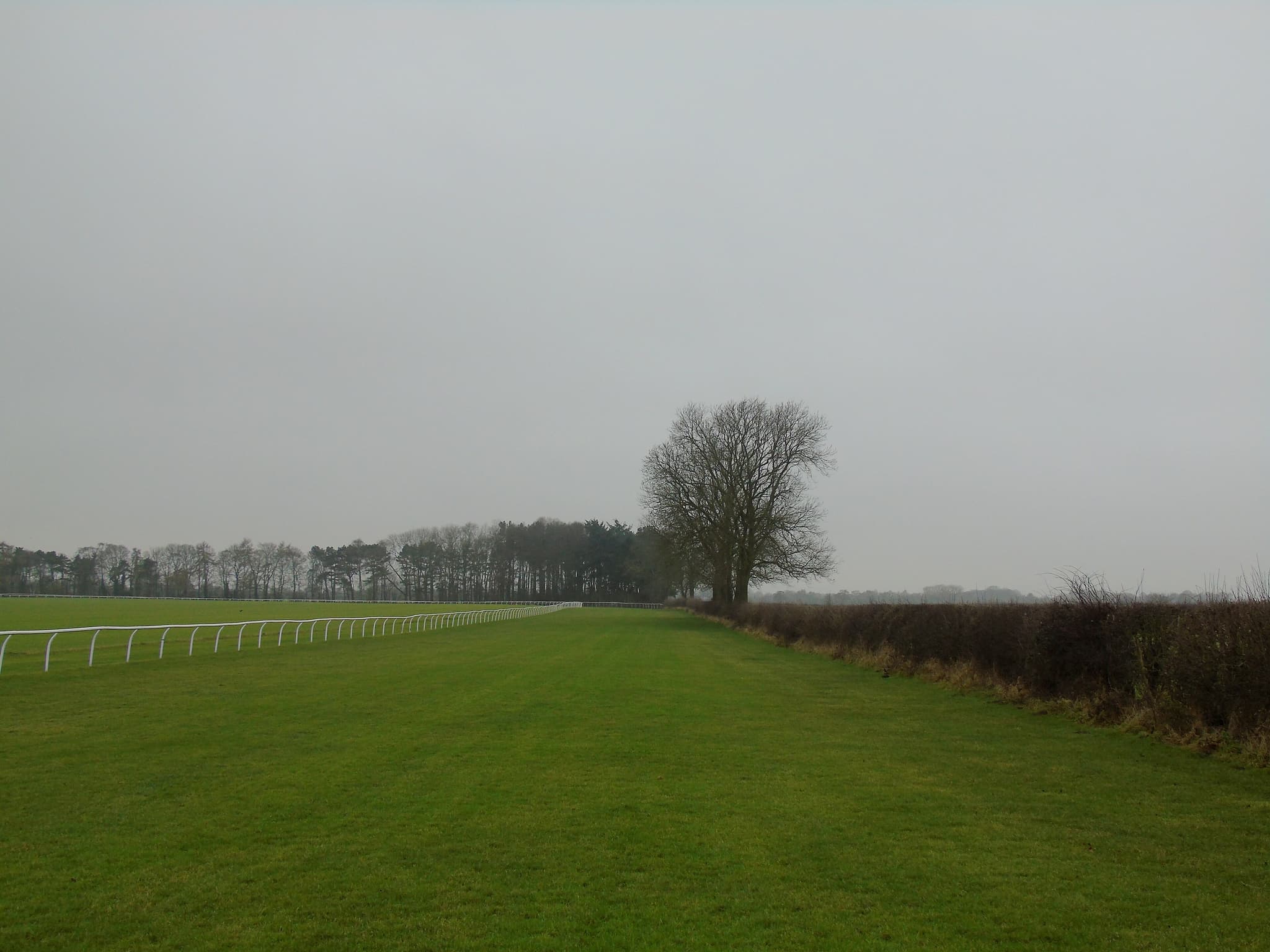
The course layout that developed through the latter half of the 19th century established features that persist today. The circuit runs left-handed over approximately one mile two furlongs, with an undulating profile across the far side that tests a horse's balance and jumping ability on the flat. The finish rises slightly, not a severe uphill climb by the standards of Epsom or Goodwood, but enough of a gradient to expose horses who have been ridden too aggressively in the early stages. The straight five-furlong track, used for sprint races, runs into the finishing straight and has its own character: fast ground in summer creates conditions that suit low-draw horses, while soft going tends to favour those drawn high.
The soil composition in the Vale of York, a limestone and clay mix overlaid with well-drained turf, means the going at Thirsk can shift considerably across a season. Summer meetings typically race on ground ranging from good to firm; autumn can bring soft or heavy ground that significantly changes the profile of the results. Victorian trainers learned quickly that the Thirsk surface rewarded horses with a particular kind of constitution: tough enough to handle variety, balanced enough for the undulations, and honest enough not to down tools when the finish hill appeared.
Thirsk in the Victorian Racing Ecosystem
By the 1870s, Thirsk had found a workable position within the Yorkshire flat racing calendar. York's prestigious August meeting sat at the top of the regional hierarchy, with Doncaster's Leger meeting close behind. Ripon, Beverley, and Catterick served their own local communities. Thirsk occupied the space below these more prominent venues: accessible enough for working-class racegoers who had arrived by train from Northallerton or Stockton, attractive enough to tempt owners and trainers who wanted a competitive but not over-exposed fixture in their programme.
The Thirsk Hunt Cup, a handicap that would in later decades become the course's signature contest, was established in this period, providing a race around which connections could plan a spring campaign. The hunting connections embedded in the race's name reflected the social world from which the course drew much of its support: the North Riding of Yorkshire was, and remained well into the 20th century, country that bred and celebrated the horse across all its disciplines.
The course employed a small permanent staff and relied on local businesses, hotels, public houses, the railway station itself, to handle the overflow of visitors on race days. Thirsk's market square, a few minutes' walk from the course, became the natural gathering point before and after racing, a pattern that persists to the present. The town and the racecourse were not separate institutions; they were intertwined, economically and socially, in the way that characterised provincial racing venues at their best.
Era takeaway: By the end of the Victorian period, Thirsk had established its essential character, a left-handed, undulating flat track, formally constituted in 1855, made commercially viable by the railway, and embedded in the agricultural and social life of North Yorkshire. The foundations were solid, if unspectacular. What those foundations supported would depend on what the 20th century brought.
The Golden Era
The Golden Era: Edwardian to Mid-Twentieth Century
The Edwardian period brought prosperity to many provincial racecourses, and Thirsk was no exception. The years between 1900 and 1914 saw racing attendance rise across Britain as wages improved, leisure time expanded for the working class, and the railway network reached full maturity. Thirsk benefited from each of those forces. The station was a five-minute walk from the course entrance, and on major racedays the platforms saw trains arriving from York, Darlington, and Northallerton at regular intervals through the morning.
Prize money grew, if modestly, and the quality of horses entered for Thirsk meetings improved in step. Trainers from the Middleham training centre, located roughly 20 miles south-west of the course via the A61, began to regard Thirsk as a sensible first target for horses being prepared for bigger prizes at York or Doncaster. Middleham, set on the high limestone plateau above Wensleydale, had been producing quality northern horses for centuries; by the Edwardian era, its trainers had refined the practice of using lower-grade provincial meetings to give young horses an educational first run before pointing them at more demanding tasks.
Facility Development and the Growing Grandstand
The physical fabric of the course changed substantially in the first two decades of the 20th century. A permanent grandstand, enlarged from its Victorian predecessor, gave racegoers a covered viewing area on the home straight. Separate enclosures, Tattersalls and the Members, were formalised, with the enclosure hierarchy creating both the social ordering and the revenue stream that provincial courses required. The paddock was improved, with better presentation facilities for horses and cleaner sight lines for punters assessing horses before racing.
These were not luxury investments; they were the minimum required to remain competitive in the Yorkshire market. Ripon, Catterick, and Beverley were all making similar improvements in this period, each course trying to offer enough to justify a racegoer choosing it over its neighbours on a given day. The competition for the provincial racegoer's shilling was real, and courses that neglected their facilities lost custom steadily.
The First World War halted racing at Thirsk, as it did at most British racecourses. Between 1915 and 1918, the course was requisitioned and racing suspended. The interruption was significant but not fatal: the racecourse company retained its structure, the track was maintained at a basic level, and racing resumed in 1919 with the pent-up enthusiasm that marked so many sporting resumptions after the war years. Prize money took time to recover, the economic disruption of the war, and the difficulties that followed in the early 1920s, kept racing revenues under pressure for a decade, but the fixture list was gradually rebuilt.
Sprint Racing Establishes Itself
The interwar years were the period in which sprint racing at Thirsk took on a defined identity. The straight five-furlong track, fast in good summer conditions and testing when rain arrived, began to attract a regular cast of sprinting specialists. Horses with high cruising speed who could maintain their form over the relatively short trip found Thirsk's straight course suited them. Trainers targeting the sprint programme learned to read the draw carefully: on fast ground, horses drawn in the lower stalls tend to race on the more favourable ground nearer the stands rail, but in soft conditions the draw bias can reverse and high-drawn horses find better going near the far rail.
The Thirsk Hunt Cup, by now an established handicap on the late-spring calendar, was drawing entries from beyond the immediate Yorkshire region. The race's place in the flat racing programme, typically framed in early to mid-spring, before the summer sprinting programme at York and the northern tracks reached full intensity, gave it a niche as a target for horses whose connections were seeking prize money rather than prestige. That honest pragmatism suited Thirsk well.
Racing at Thirsk continued through the Second World War on a restricted basis, one of a handful of permitted racecourses that maintained fixtures as a contribution to wartime morale. The wartime racing programme was radically reduced across Britain, only a small number of approved venues staged meetings, and Thirsk's inclusion in that permitted list reflected both its accessibility by rail and its established management structure. Race days were quieter, prize money was further reduced, and the atmosphere was necessarily subdued, but the continuity mattered: Thirsk was one of the courses that kept the show running through six difficult years.
The Postwar Consolidation
The decade after 1945 saw Thirsk settle into a well-defined role in northern flat racing. York's Knavesmire was the premium venue in the region, staging Group-level racing that attracted the best horses in training; Doncaster hosted the St Leger and a full autumn programme. Thirsk occupied a tier below those two, but clearly above the most modest courses, offering a calendar of well-framed handicaps and conditions races that served the needs of northern trainers and provided regular opportunities for horses of moderate to good ability.
The Middleham training centre, which would later produce generations of quality northern horses under trainers such as Mark Johnston, was growing in this period. The limestone gallops above Wensleydale, sharp, testing work grounds, produced horses well suited to Thirsk's undulating circuit. Horses trained at altitude on firm limestone ground tend to handle undulating courses more readily than those trained on flat, all-weather facilities, and the Thirsk surface rewarded that athletic type.
James Herriot and the Town's New Identity
A development that had nothing directly to do with racing would, from the early 1970s onwards, shape the way visitors perceived Thirsk. James Alfred Wight, the veterinary surgeon who had practised at 23 Kirkgate since 1940, published the first of his James Herriot books in 1970. If Only They Could Talk introduced the character of James Herriot, a young vet practising in the North Riding of Yorkshire in the late 1930s, to a British and then international readership. The books were adapted for BBC television in the series All Creatures Great and Small, which ran from 1978 to 1990, fixing Thirsk in the popular imagination as the town of Darrowby, Herriot's fictional market town.
The effect on Thirsk's visitor profile was gradual but cumulative. Tourists came to find the town they had seen on television, walked the market square, visited Kirkgate, and discovered that the racecourse was a short walk away. Some of them came for the racing and stayed for the town; others came for the town and found themselves at the races almost by accident. The overlap was never managed as a deliberate marketing strategy in this period, that would come later, but it created a dual identity for Thirsk that its Yorkshire neighbours could not replicate.
Racing visitors in the 1970s and 1980s would have found a course that retained much of its mid-century character: the grandstand functional rather than grand, the facilities adequate, the atmosphere friendly. The prize money remained at the level appropriate for a course of Thirsk's class, and the fixture list continued to draw trainers who wanted competitive races without the intense scrutiny of York or Newmarket. That quiet competence, rather than any single dramatic episode, was the hallmark of Thirsk's golden era.
Era takeaway: Between the Edwardian period and the 1980s, Thirsk built a durable identity as a working flat track that served the practical needs of northern racing. It survived two world wars without structural disruption, developed a sprint programme with a real following, and acquired, almost by chance, a literary resonance through the Herriot connection that gave the town around it a distinctiveness no other Yorkshire racecourse could claim.
Famous Moments and Defining Races
Famous Moments and Defining Races
Thirsk has never been a stage for the Classics or the Royal Ascot card. Its famous moments are of a different kind: horses whose careers were launched here before bigger things, sprint contests that produced unusually close or unusually one-sided finishes, and the peculiar intensity of a northern spring meeting where the going can change three times in a morning and the draw can decide the outcome before the starting gates open. To understand Thirsk's place in racing history, it helps to look at what the course has consistently produced rather than seeking a single defining event.
The Thirsk Classic Trial: Early-Season Revelation
The Listed Thirsk Classic Trial, run over one mile in April and aimed at Classic-generation horses, has been the source of some of the course's most significant moments. The race, scheduled early enough to be a real trial for the Guineas generation, and over a distance that suits milers and potential middle-distance horses in their first or second run of the season, has a habit of producing performances that look modest on the day but acquire context as the season unfolds.
The April timing is the key. Horses stepping out for the first time or second time in April are rarely at their peak; trainers are managing fitness levels, the ground can be anything from good to soft depending on the Yorkshire spring, and races over one mile at this stage of the year are truly informative precisely because they are demanding. A horse that runs well over a mile at Thirsk in early April, on good to soft ground with a slight rise to the finish, has passed a test that separates the real Classic generation from the horses who will need more time.
Trainers who have used the Classic Trial as a springboard have generally been those based in the north or targeting northern prize money: connections looking to assess a horse's readiness before committing to a Newmarket or Chester entry. The race offers Listed prize money and a straightforward mile on an honest track, no silly angles, no tight bends, a finish that requires real staying power to the line.
Sprint Days and the Draw Debate
The most regularly repeated conversation among Thirsk regulars concerns the draw bias in sprint races on the straight five-furlong course. This is not a minor quirk, it is a structural feature of the course that has influenced results for decades and continues to be the central factor in sprint race analysis at the track.
On ground ranging from good to firm, the bias historically favours low-drawn horses (stalls one to six), who race on the stands side of the course where the ground tends to be faster. As the going deteriorates towards soft or heavy, that pattern reverses: the far rail holds better ground, and horses drawn high (stalls 10 to 16 on a full field) gain a significant advantage. Punters who have ignored the draw at Thirsk sprints have paid for it repeatedly; those who have treated the draw as a near-fundamental factor have found an edge that the market does not always fully price in.
Several sprint handicaps at Thirsk have produced post-race discussions that stayed in the memory of regular attendees not because of the quality of the winner but because of the drama created by two groups of horses racing on different parts of the track with markedly different going conditions. The group that picked the better ground, occasionally the group that drew away from the field rather than towards them, has won by margins that bear no relationship to actual form, leaving the opposing group to finish a bedraggled second cluster several lengths behind the first. Those races are Thirsk at its most instructive, if not its most straightforward.
The Thirsk Hunt Cup Renewals
The Thirsk Hunt Cup, the course's longest-running handicap, first run in 1859, has produced a series of renewals that have stayed in the records for the right reasons. The race, typically run over six furlongs in the spring, attracts sprinters from northern and southern stables, making it one of the more competitive sprint handicaps on the northern calendar for its class.
Horses who have won the Thirsk Hunt Cup tend to share characteristics: they handle the undulating circuit, they have a turn of foot that can be deployed on the run to the finish, and they have connections willing to travel north for a prize that carries real prestige within the sprint community even if it sits below the very top sprint handicaps in terms of prize money. Several Thirsk Hunt Cup winners have gone on to compete in Listed sprint races, and the race has historically served as a form reference for early-season sprint assessments across Yorkshire.
The Thirsk Hunt Cup's place on the early-May fixture programme puts it at a moment in the season when horses are sharp from winter preparation but have not yet been exposed to the full demands of a summer campaign. Horses winning early in the season carry a particular kind of freshness that can translate into emphatic winning margins, and the Thirsk Hunt Cup has provided several performances over the years where a well-prepared sprinter has bolted up from a high weight on ground that suited it precisely.
The Middleham Factor
The training centre at Middleham, roughly 20 miles south-west of Thirsk via the A61 and A1, has contributed a thread that runs through the course's history of notable performances. The sharp, hilly gallops above Wensleydale, operated by yards including those of Mark Johnston (now run by his son Charlie Johnston) and David O'Meara, produce horses with a particular fitness and toughness. These animals tend to handle Thirsk's undulations comfortably, because their training preparation involves far more gradient work than horses from flat, all-weather facilities.
The practical consequence is that Middleham-trained horses at Thirsk have, over the decades, been among the more reliable form lines in northern handicap racing. Trainers who know the track, who understand which ground on the far side of the circuit tends to ride slower after rain, or which part of the straight is best avoided on quick summer going, have been able to exploit that knowledge in competitive handicaps. The Richard Fahey stable at Musley Bank, Malton, 25 miles to the east of Thirsk, has made similar use of the course in recent decades: Fahey, one of the most prominent trainers of northern sprinters, has sent horses to Thirsk regularly and found the results informative for planning.
A Moment in the Paddock: The Spring of 2001
The foot-and-mouth outbreak of 2001 suspended all equine movement and sport across Britain from February, and racing did not resume until late April. When Thirsk's spring fixture was eventually run, the atmosphere on course was different from a standard spring card: there was relief mixed with the usual anticipation, and the horse population had been concentrated into fewer weeks of racing than normal. Trainers who had been preparing horses through a long, enforced absence were keen to run, and some April meetings in 2001 produced unusually good fields for their class.
The 2001 resumption was a reminder of something the sport occasionally forgets: that the regularity of fixtures matters to the health of racing. Thirsk, like every other course, found that the forced absence of 2001 created both backlog and opportunity, horses running with more races left in them than usual, form lines harder to interpret across the gap. The first meetings back were raw and unpredictable. Thirsk's April fixture that year produced results that defied straightforward form-book reading, and several horses who ran well there in late April went on to better things through the summer.
Horses Who Graduated
Thirsk's role as a stepping stone is perhaps more significant than any single famous moment. The course has seen early-career appearances from horses who later competed at Group level, used the course as an educational first run before more demanding targets. The pattern is consistent across decades: a horse who needs a first run somewhere honest, where the track will tell you what it actually has without flattering or misleading, will often be pointed at Thirsk before York. That quiet function, the honest audition rather than the grand stage, has produced a longer list of notable early appearances than the record books always acknowledge.
Section takeaway: Thirsk's famous moments are less about single dramatic scenes and more about recurring patterns, the draw bias that punishes the unprepared, the Classic Trial that tests horses before the season's real tests begin, the Thirsk Hunt Cup renewals that concentrate northern sprint talent in late spring, and the steady stream of horses who ran first or second at Thirsk and then ran much better somewhere else. The course's significance is cumulative rather than episodic.
The Modern Era
The Modern Era: 1990s to Present
The 1990s brought a shift in how British racing was financed and presented. The Levy Board system, which channelled a share of bookmakers' revenues back into the sport, had funded racecourse improvements across the preceding decades, but the rise of off-course and telephone betting meant that the relationship between on-course attendance and overall betting turnover was changing. Racecourses increasingly had to justify their place in the market not just to the Levy but to television broadcasters, sponsors, and, as the internet age arrived, to new forms of betting that had no necessary connection to attending a meeting.
Thirsk responded to these pressures by doing what it had always done: staying within its means, improving facilities incrementally, and maintaining a fixture list that served the practical needs of the racing industry without overreaching. The course stages around 15 fixtures per year, running from April through to September, with the spring fixtures carrying the most commercial weight. That programme has remained broadly stable since the late 1990s.
Facility Investment
The grandstand and enclosure facilities at Thirsk were substantially updated in the late 1990s and early 2000s. The work was pragmatic: better viewing for racegoers, improved hospitality infrastructure, a paddock presentation area that met the standards racegoers had come to expect at well-maintained venues. The capacity of around 5,000, modest by the standards of York or Chester, generous enough to fill the course with noise on a good day, meant that investment decisions could be targeted at quality rather than scale.
The Racecourse Association's quality ratings, which became a more formal mechanism for assessing provincial courses in this period, gave venues like Thirsk an incentive to invest in specific areas: catering, viewing infrastructure, accessible facilities, and the quality of the racecourse surface. Thirsk's track maintenance improved through the 2000s, with drainage work on the lower-lying sections of the circuit reducing the incidence of waterlogging that had occasionally cancelled or compromised meetings.
The Thirsk Classic Trial as a Listed Race
The elevation of the Thirsk Classic Trial to Listed status was a significant moment in the course's modern history. A Listed race carries a prize money premium and attracts a higher calibre of entry than a Class 2 or Class 3 conditions race, and the Classic Trial's timing, April, one mile, Classic generation, gave it a niche that the British racing authorities were willing to recognise with formal graded status.
Listed status meant that horses winning the Classic Trial accumulated a pattern-race penalty for future entries. That sounds like a minor technical detail, but it matters: it means the race became part of a horse's formal career record in a way that unrated conditions races do not, and trainers began to treat a win or placed run in the Classic Trial as a form reference when entering horses for recognised trials at Newbury, Chester, or Goodwood. The Classic Trial became, in effect, a northern alternative to southern early-season mile races, accessible to horses whose connections preferred to stay on familiar northern ground through April.
The Northern Training Circuit and Thirsk
The concentration of training operations in North Yorkshire and the North Riding became, if anything, more pronounced in the 2000s and 2010s. Middleham, 20 miles south-west, housed the Johnston operation, at various points the highest-volume licensed yard in Britain, sending runners across every type of flat race, alongside David O'Meara, whose sprinting and middle-distance horses were regular Thirsk visitors. Malton, 25 miles to the east, remained home to Richard Fahey's Musley Bank yard, one of the most productive sprint-training operations in the north.
These stables regarded Thirsk as a natural part of their seasonal programme. The course's April fixture fell at a point in the calendar when northern-trained horses were typically a week or two sharper than their southern counterparts, who often had to contend with slower-developing going in the south. Northern tracks in April can race on going that is already approaching good; southern venues are frequently heavy or soft well into May. That seasonal quirk has meant that northern trainers targeting Thirsk's spring meetings have had a real advantage over southern rivals: horses prepared on firm northern limestone gallops running on good ground at a course their jockeys know well.
Fahey, in particular, developed a formidable record at Thirsk sprints. His runners, often prepared specifically for sprint handicaps at this level, carried reasonable confidence for those who tracked his patterns. The draw knowledge accumulated at Musley Bank, trainers who watch the draw effects at Thirsk year after year develop an intuition for which stalls suit which ground conditions, translated into strike rates that made Fahey's Thirsk runners a reliable reference point in the market.
Television and the Online Betting Market
The growth of online betting from the mid-2000s onwards changed the context in which all provincial racing operated. Betfair, launched in 2000, created a liquid exchange market for every race on the British card; traditional bookmakers developed online platforms that competed for customers without requiring them to visit a racecourse or a shop. The practical consequence for Thirsk was that races which would previously have attracted only locally knowledgeable betting were now subject to market attention from punters across Britain and internationally.
This cut both ways. The draw biases at Thirsk sprints, once the preserve of regular attendees and form students who read the Raceform house style carefully, became more widely understood as online racing communities disseminated information across forums and social media. The market became less exploitable on raw draw knowledge alone; the edge moved towards more sophisticated interpretations, understanding not just that the draw mattered at Thirsk, but understanding the interaction between draw, going, horse profile, and pace of race in specific conditions.
For the course itself, the online market meant that Thirsk's races received broader coverage on television and on racing data platforms. At-the-Races and Racing UK (later Racing TV) broadcast from Thirsk, giving the course national visibility on days when multiple racecourses are competing for viewer attention. The spring fixtures, with the Classic Trial as an anchor and the Thirsk Hunt Cup meeting as a highlight, attracted consistent coverage that helped sustain the course's profile beyond its immediate geographical catchment.
The James Herriot Brand in the 21st Century
The World of James Herriot museum, which opened in 1999 at 23 Kirkgate, the former surgery where Alfred Wight practised from 1940, became an anchor for Thirsk's tourism economy in a way that the racecourse could not ignore. By the 2010s, the museum was attracting significant visitor numbers, and the new BBC adaptation of All Creatures Great and Small, which began in 2020, brought a fresh generation of viewers to the Herriot story. Thirsk's market square, its architecture largely unchanged from the post-war decades, provided exactly the setting the series required.
The racecourse began to market itself more explicitly in relation to the town's Herriot identity. Race day visitor packages that included time in the town, joint promotions with the museum, and the general positioning of a Thirsk race day as part of a North Yorkshire experience rather than a standalone racing event all reflected an awareness that the Herriot connection was an asset worth using. Visitors to the World of James Herriot frequently expressed surprise at the quality of a race day at Thirsk; regular racegoers who discovered the museum equally expressed surprise at how much else the town offered.
That synergy between a provincial racecourse and the literary and cultural identity of its host town is unusual in British racing. Stratford-upon-Avon has Shakespeare; Cheltenham has the Festival. Thirsk has Herriot, and the fit, a vet who wrote about the rural North Riding, set within a few decades of the period when the racecourse was consolidating its modern character, is more than coincidental. The agricultural community that kept the Herriot practice busy in the 1940s was the same community that provided owners, breeders, and racegoers at Thirsk through the same decades.
Era takeaway: The modern era has seen Thirsk do the difficult thing well: compete with its Yorkshire neighbours without trying to become something it is not. The Classical Trial's elevation to Listed status, the sprint programme's continued depth, the facility improvements of the 2000s, and the growing integration of the Herriot tourism economy have all contributed to a course that is more professionally run and more broadly known than at any previous point in its history.
Legacy and Looking Forward
Legacy and Looking Forward
Thirsk Racecourse's place in British racing is defined by its persistence and its honesty. Those are not small qualities. Many provincial courses that operated in the late Victorian and Edwardian period have not survived to the present; the pressures of the 20th century, two world wars, changing leisure habits, shifting economics of the racing industry, the rationalisation of the fixture list under various regulatory regimes, closed dozens of courses that were, in their day, as well-established as Thirsk. That Thirsk is still racing in the 21st century, having operated on broadly the same site since the early 19th century, is a fact that deserves to be stated plainly.
The course has survived partly because of its geography. Sitting within a 25-mile radius of York, Ripon, Catterick, and Wetherby, Thirsk might seem to be in the most competitive possible environment for a provincial flat track. In practice, that density of venues created a circuit rather than a competition: northern trainers, owners, and racegoers moved between the courses through the season, and each venue's distinct character, York's grandeur, Ripon's setting, Catterick's all-weather programme, Thirsk's honest flat circuit, served different needs within the same community.
The Course's Physical Legacy
The undulating left-handed circuit of approximately one mile two furlongs, combined with the separate straight five-furlong sprint track, represents a particular type of British racecourse design: one that evolved from the landscape rather than being imposed upon it. The Vale of York's flat terrain, interrupted by the occasional ridge and the general undulation of the limestone country approaching the Moors, shaped the circuit in ways that course designers working from a blank plan would not have replicated. The result is a track that tests different qualities in horses depending on the distance and the ground, a horse that sprints well over five furlongs on fast going is not necessarily the same animal that handles the longer circuit over a mile or more on softer ground.
That physical diversity has kept the course's programme varied. Thirsk is not purely a sprint track and not purely a mile track; it offers both, and the fact that the sprint programme and the Classic Trial draw different types of horse and different types of racegoer on the same fixture list has given the course a breadth that single-specialty venues cannot match.
The Yorkshire Racing Community
The racecourse's legacy is inseparable from the community that has sustained it. The Middleham yards, currently including the Charlie Johnston operation (formerly Mark Johnston's), David O'Meara, and several smaller training operations, regard Thirsk as home territory. Richard Fahey's Musley Bank yard at Malton has a similar relationship with the course. These are not casual visitors who arrive at Thirsk for a single big race; they are trainers who send horses to the course multiple times each season, who know the ground conditions and the draw patterns from years of observation, and whose results at Thirsk carry more significance in the form book than their raw figures might suggest.
The Yorkshire owner community, farming families, local businesspeople, the northern arm of syndicates who want their horses run regularly without travelling to Newmarket or Lambourn for every fixture, has provided a reliable base of support. Thirsk's racing is conducted, in the main, for and by people who know the area and have an investment in its success that goes beyond the commercial. That is not something that can be engineered; it is the product of decades of racing in the same place.
The Herriot Inheritance
The literary connection with James Herriot, and, more precisely, with Alfred Wight, the actual vet who lived and worked in Thirsk from 1940 to the 1980s, gives the racecourse a context that money cannot buy. The 2020 BBC adaptation of All Creatures Great and Small introduced the North Riding of Yorkshire to a new generation of viewers, many of whom have since visited Thirsk for the first time. Some of those visitors find their way to a race day. That pipeline from Herriot tourism to racing attendance is modest in scale but durable in character: people who fall in love with the town tend to return, and racedays are a natural part of returning.
The racecourse sits within walking distance of the market square, the World of James Herriot museum at 23 Kirkgate, and the town's independent shops and restaurants. A full day in Thirsk, museum in the morning, racing through the afternoon, dinner in the market square, is a coherent proposition for visitors who might never otherwise have attended a race meeting. That accessibility, both physical and conceptual, is part of the legacy that distinguishes Thirsk from courses that exist in relative isolation from their host towns.
Frequently Asked Questions
When did Thirsk Racecourse officially open?
Racing in the Thirsk area dates back to the 17th century, with organised meetings on the current site from the early 19th century. The racecourse company was formally constituted in 1855, the date most commonly cited as the course's official founding. That 1855 date reflects formalisation rather than establishment, the track had existed in recognisable form for several decades before then. The railway connection, which arrived in 1848 with the York and Newcastle line, transformed the course's commercial viability in the years leading up to the formal registration.
What is the Thirsk Classic Trial and when was it introduced?
The Thirsk Classic Trial is a Listed flat race run over one mile in April, restricted to horses of the Classic generation (three-year-olds). The race serves as an early-season trial for horses being assessed for Guineas or Oaks routes, or for middle-distance campaigns later in the season. Its Listed status means it is formally recognised in the pattern of British racing and carries penalties for future entries. The race's April timing and honest mile trip on an undulating track give it real informative value as a form reference.
Why does the draw matter so much at Thirsk sprints?
The five-furlong straight sprint track at Thirsk has a documented draw bias that shifts with ground conditions. On good to firm going, horses drawn low (stalls one to six) tend to race on ground that is faster near the stands rail and have historically shown a bias in sprint results. When the ground softens to good to soft or worse, the far rail holds better ground and high-drawn horses gain an advantage. The bias is not absolute, pace and horse profile also matter, but it is consistent enough that ignoring the draw at Thirsk sprint days is a known and quantifiable mistake.
How does Thirsk relate to the James Herriot connection?
James Herriot was the pen name of Alfred Wight, a veterinary surgeon who practised at 23 Kirkgate, Thirsk, from 1940 until the 1980s. His books, published from 1970, and the subsequent BBC television adaptations depicted a fictionalised version of Thirsk (called Darrowby) and the surrounding North Riding countryside. The World of James Herriot museum at 23 Kirkgate is now a visitor attraction in the town. The racecourse and the museum are within comfortable walking distance of one another, and the Herriot connection has contributed to Thirsk's profile as a tourist destination among visitors who might not have sought out racing independently.
Which training centres supply most horses to Thirsk?
Middleham, approximately 20 miles south-west of Thirsk, is the most significant single source. The yards based there, including the Charlie Johnston operation and David O'Meara's stable, send horses to Thirsk multiple times each season. Richard Fahey's Musley Bank yard at Malton, around 25 miles to the east, is another consistent supplier, particularly for sprint races. York-based trainers and a smaller number of southern yards also target specific races on the Thirsk card, particularly the Classic Trial and the Thirsk Hunt Cup, but the day-to-day programme is substantially shaped by the Middleham and Malton training corridors.
What type of going does Thirsk typically race on?
The course's soil, a limestone and clay mix in the Vale of York, drains reasonably well but is sensitive to sustained rainfall. Spring meetings in April and May can encounter going ranging from good to firm to soft within a single fixture programme depending on Yorkshire weather. Summer meetings, particularly in June and July, often race on good to firm. The course can deteriorate quickly in late August and September if rain arrives, occasionally producing soft or heavy ground before the season closes. The variation in going across the season makes Thirsk a course where ground preference is a more consequential factor in race analysis than at courses with more consistent drainage.
Thirsk's story is a Yorkshire story: practical, persistent, occasionally overshadowed by larger neighbours, and more interesting on close inspection than its modest exterior suggests. The course that opened formally in 1855, adjacent to a railway station in a market town in the Vale of York, has navigated every economic and social disruption of the intervening 170 years and emerged still racing. The Thirsk Classic Trial and the Thirsk Hunt Cup anchor a programme that serves northern racing reliably. The complete guide and the betting guide take the story from here into the practical present.
Share this article
More about this racecourse
All Thirsk guides
Thirsk Hunt Cup Day: The Complete Guide
Thirsk Hunt Cup Day is the biggest fixture of the flat season in North Yorkshire — a May bank holiday meeting built around Britain's oldest surviving flat handicap.
Read more
Thirsk Ladies Day 2026: Dates, Tickets & What to Wear
Thirsk Ladies Day is Saturday 5 September 2026. Ticket prices, the racecard, the Best Hat competition, getting there and how to bet on the day.
Read more
Sprint Racing at Thirsk: Complete Guide
Your complete guide to sprint racing at Thirsk, the Thirsk Hunt Cup, key meetings, and speed contests in North Yorkshire.
Read morePhotos on this page are used under Creative Commons licences. Titles, sources and licence links for each one are on our image credits page.
Gamble Responsibly
Gambling should be entertaining and not seen as a way to make money. Never bet more than you can afford to lose. If you or someone you know has a gambling problem, help and support is available.