
Founder & Editor · Last reviewed 2026-03-02
Windsor Racecourse is among the most accessible and enjoyable family racing destinations in the South East. The compact site, the relaxed atmosphere, the flat terrain, and the Thames-side setting all work in favour of families with children. On designated family racedays, the course adds specific entertainment for children — fairground rides, face painting and similar activities — and under-18s get in free when accompanied by a paying adult. The formula works because the base experience is already family-friendly; the extras simply add to it.
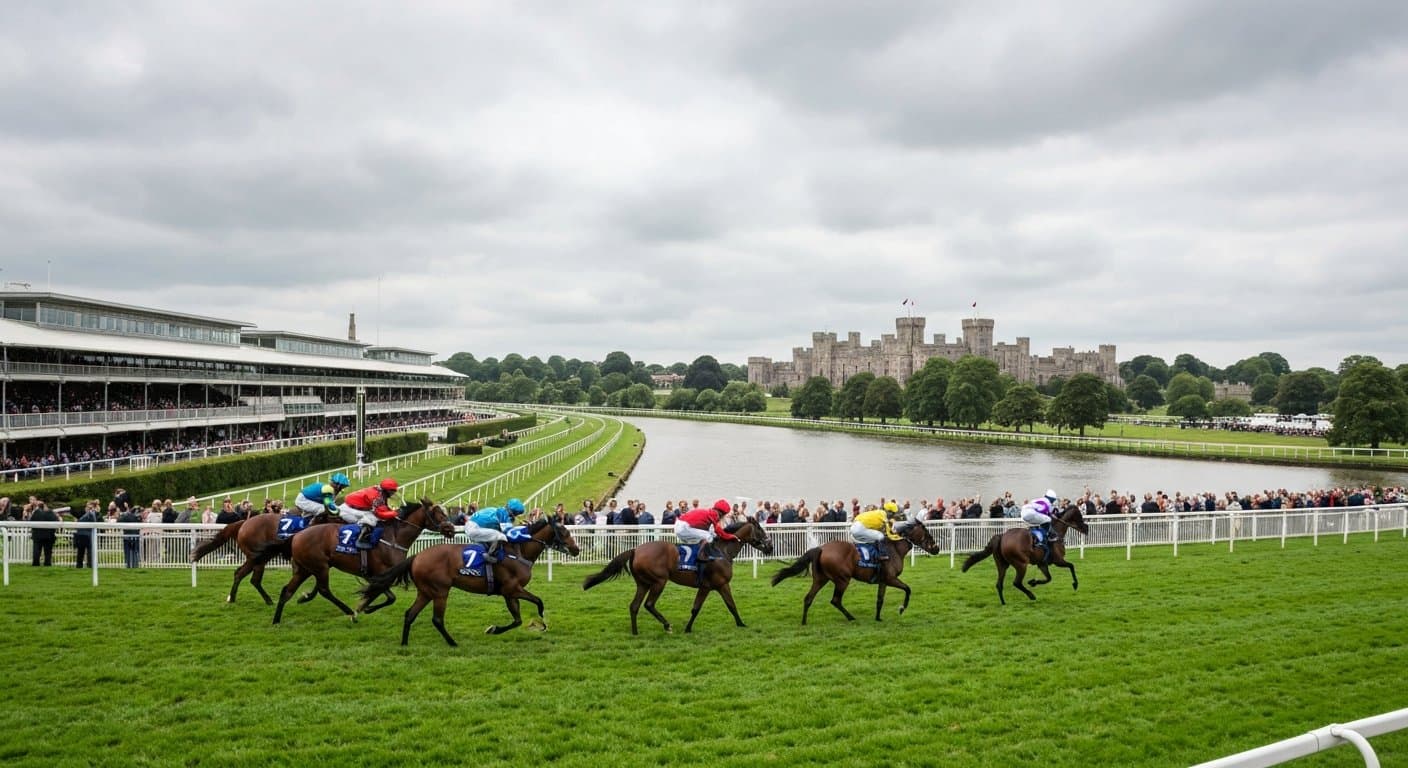
The course sits on an island between the River Thames and the Clewer Mill Stream. The figure-of-eight layout creates a compact track where everything is within easy walking distance. The grandstand, the paddock, the food concourse, the toilets and the betting ring are all close together. With young children, that proximity matters enormously. You are not managing a long walk across an open heath between every race; you are moving between features that are a few minutes apart at most.
Windsor is a flat-racing venue only — jump racing ended here in 1998 — and the flat programme runs from April through October. Family racedays are typically scheduled on Saturdays or occasionally Sundays through the summer programme, targeting peak family availability without competing with the Monday evening audience. Evening meetings in June, July and August are also worth considering for families with older children: the first race is at 5:30pm, the last finishes by 9:30pm, and the summer-evening atmosphere works well for children aged seven or older.
This guide covers what is on for families, how to plan your day, food and facilities, specific tips for parents, and a FAQ covering the most common practical questions. For the general day-out experience including full transport detail, see our day out guide. For the betting side of a Windsor evening, see the evening racing guide.
Windsor is one of the more practical family racing choices in the South East — smaller than Goodwood and Chester, closer to London than Newmarket, and consistently better set up for families than many courses that are technically accessible but not specifically welcoming. With some planning, a family day at Windsor is straightforward and thoroughly enjoyable.
Bet on Windsor
Place your bets on Windsor races with a trusted bookmaker.

Promo code BETFRED50. New customers only. Register, deposit with a Debit Card, and place a first bet of £10+ at Evens (2.0)+ on Sports, to be settled within 7 days, to get £30 in Sports Free Bets and £20 in Bet Builder Free Bets within 24 hours of settlement. 7-day expiry. Eligibility & payment exclusions apply. Full T&Cs apply. Take Time to Think. BeGambleAware.org. 18+. Full T&Cs.

Promo code R30. New UK customers only, 18+. Register, deposit £10 or more, then place a £10 single cash bet at odds of 1/2 (1.5) or greater on any sports market (excluding Virtuals). Once the qualifying bet settles you get £30 in Free Bets (3 x £10) — the qualifying bet can win or lose. Free Bets are valid on any sports market excluding Virtuals, expire in 7 days, are non-withdrawable and must be used in full. Excluded deposit methods apply (including PayPal, Apple Pay, Skrill and NETELLER). Named bets such as Lucky 15 do not qualify. If you cash out the qualifying bet, or it is voided, you are no longer eligible for the offer. Ends 31.12.26. Full T&Cs apply. Please gamble responsibly. BeGambleAware.org. 18+. Full T&Cs.

Promo code BET40GET20. New UK customers, 18+. Register with the code and place a first bet of £40 or more at Evens (2.0) or greater. Receive 2 × £10 free bets: the first credited automatically once the qualifying bet settles, the second 24 hours later. Free bets must be placed at minimum odds of 4/1 (5.0), expire 24 hours after credit, and the free-bet stake is not returned with winnings. Debit card deposits only. Take Time to Think. BeGambleAware.org. 18+. T&Cs apply. Full T&Cs.

50% of your first-day net losses refunded as a free bet, capped at £25. New UK customers aged 18+ only. To qualify, deposit and place a first bet of £10 or more on any sport at minimum odds of evens (2.00), then place at least two further bets on different events, each worth at least 50% of your largest bet, all at evens (2.00) or greater. Losses are counted from your first settled bet until 23:59 the same day. Place a qualifying £10+ bet and you are guaranteed at least a £5 free bet. Bets placed at SP, void bets, cashed-out bets and bets struck with free bets do not count towards the offer. The free bet is credited the day after your qualifying bets settle and must be used within 7 days, after which it expires. It can be used at odds from 1/4 (1.25) up to 250/1 on singles and straight accumulators, but not on Trixie, Patent or Yankee style multiples. Free-bet stake is not returned with winnings. One offer per person, household, address, IP address and device. E-wallet deposits may not qualify, so check the cashier before depositing. Customers registered with GAMSTOP cannot claim. KYC identity verification must be completed before the free bet is credited. Take Time to Think. BeGambleAware.org. 18+. T&Cs apply. Full T&Cs.

New customers, 18+. Choose the sports bonus at sign-up, make a first deposit and receive a 100% bonus up to £50 in your Sports Bonus balance. To convert the bonus to cash, wager it 10x within 30 days. Single bets below Evens (2.00) do not qualify; accumulators do not qualify if any selection is below 1/2 (1.50). Virtual Sports, voided, cancelled, drawn, cashed-out and free-bet wagers do not count towards wagering. Only the first settled bet per event counts. Withdrawing before the wagering requirement is met forfeits the bonus balance including bonus winnings. Real-money funds are used before bonus funds. Deposits via Skrill or Neteller are not eligible. Not valid in conjunction with other promotions. Odds, bet and payment limits apply. 10bet general and promotion T&Cs apply. BeGambleAware.org. 18+. Full T&Cs.

New customers in Great Britain and Republic of Ireland, 18+. Place a £10 fixed-odds qualifying bet at minimum odds of 1/2 (1.50) — single or each-way (only the win part counts), pre-event or in-play, not cashed out early, within 28 days of opening the account. Receive up to £60 in bonuses credited over three days: 3 × £10 fixed-odds free bets (the first on settlement, then 24 and 48 hours later) plus 3 × £5 Total Goals FOOTBALL spread bets and 3 × £5 racing Winning Favourites spread bets, with a £1 racing Race Index spread bet as an extra on top. The spread bets need a full spread-betting account, opened within 28 days of the fixed-odds account and subject to Spreadex's eligibility and appropriateness checks. Free-bet stakes not returned with winnings; free bets valid 28 days from issue. IMPORTANT: the £5 credits are SPREAD bets — sports spread betting carries the risk that losses can exceed your stake. Sports spread-betting customers do not have Financial Ombudsman or FSCS recourse. Take Time to Think. BeGambleAware.org. 18+. T&Cs apply. Full T&Cs.

Promo code WELCOME15, entered under My Bonuses after registering. New UK customers, 18+. Place a first qualifying bet of at least £10 from your cash balance at odds of evens (2.0) or greater within 7 days of opening the account. Once the qualifying bet fully settles you receive £15 in free bets, credited as 3 x £5 tokens with set uses: one £5 accumulator free bet (minimum 4 legs, each leg at 2/5 or bigger), one £5 sports free bet (any market at evens or bigger) and one £5 Sub Cover free bet (selected football player markets at evens or bigger). Free-bet stakes are not returned with winnings. Free bets expire 7 days after they are credited. Void, cashed-out and partially cashed-out bets do not qualify. One offer per customer. Confirm the current terms on BetGoodwin's own welcome-offer page before claiming. Take Time to Think. BeGambleAware.org. 18+. T&Cs apply. Full T&Cs.

New UK customers, 18+. Minimum deposit £10. Place a £10 qualifying single on sports (excluding virtuals) at minimum odds of 1/2 (1.50), settled within 14 days. Deposit-method exclusions apply. Receive £30 in free bets (stake not returned), split £20 for sportsbook use (2 x £10) and £10 for Bet Builder only (2 x £5); Bet Builder does not cover horse racing. Free bets must be accepted within 7 days and expire 7 days after acceptance. No promo code required. Best Odds Guaranteed on UK & Irish racing, subject to having staked over £25 in the previous seven days. Operated by LiveScore Betting and Gaming (Gibraltar) Ltd, UKGC 56859. Confirm the current terms on LiveScore Bet's own promotions page before claiming. Take Time to Think. BeGambleAware.org. 18+. T&Cs apply. Full T&Cs.
18+. BeGambleAware.org
What's On for Families
Windsor's family racedays are built around a simple premise: give adults a proper day of racing while giving children enough to keep them occupied between races. When it works, both groups get what they came for without either compromising for the other.
Family Raceday Entertainment
On designated family racedays, Windsor typically provides a range of children's activities in a dedicated area of the course. The standard offering includes fairground rides, face painting, bouncy castles, arts and crafts stations and, on some racedays, pony rides. The exact lineup varies from fixture to fixture — the racecourse website confirms what is scheduled for each event, and it is worth checking before you go so you can set appropriate expectations with your children.
The activities are designed around the rhythm of a race meeting: you watch a race, then take the children to the fairground area for 20 to 25 minutes before the next race, then come back to the track. This alternating structure is the most practical approach for families with younger children (under eight), and the activity area is positioned to allow parents to see the track from nearby.
Face painting is consistently popular with children aged three to ten. Queues build up on busy racedays, so visiting early in the afternoon is sensible — the face painting queue after race two is usually shorter than after race four. Fairground rides are appropriate for different ages depending on the specific rides provided; the racecourse website or social media previews for each family raceday will indicate what is running.
On some specific family racedays, Windsor also runs competitions and activities aimed at children — best dressed child competitions, racing colours contests, and similar. These are typically advertised on the racecourse's social media and website. If your children are the type to enjoy entering something like this, keep an eye on the raceday preview.
Under-18s Admission
On designated family racedays at Windsor, under-18s get in free when accompanied by a paying adult. This is one of the most attractive admission policies in British racing for families. A family of two adults and two children paying only the two adult admissions — typically £25 to £35 each, so £50 to £70 total — represents significantly better value than comparable family days at most other entertainment venues.
The exact terms can vary slightly between fixtures. Some family raceday offers apply a specific age limit (under 16 or under 12) rather than under 18, and the policy for older teenagers may differ. Check the specific fixture on the racecourse website before you travel. The general under-18s free admission policy is well established at Windsor's family racedays, but do not assume without confirming.
On standard fixtures that are not designated family racedays, children may still be admitted free or at a reduced rate depending on age. Again, confirm for your specific date.
The Paddock
The paddock is one of the best parts of a Windsor family raceday for children. Before each race, the runners parade around the central ring. You can stand at the paddock rail and get very close to the horses — close enough to see them clearly, to watch the jockeys mount, and to hear the trainers and jockeys talking. For children who have not been near a horse at close quarters, this is memorable. The sheer size of a racehorse up close is impressive in a way that no television broadcast conveys.
The paddock is accessible to all general admission ticket holders and is positioned centrally in the site. It takes less than three minutes to walk from the grandstand viewing area to the paddock rail. This proximity means you can watch the parade, walk back to the track, and still find a viewing spot before the horses canter down to the start.
For children aged five and upward, the paddock parade before each race is a natural anchor point for the day. Ten minutes at the paddock, then a race, then an activity, then the paddock again — that rotation makes good use of the inter-race time and keeps children engaged across the full afternoon or evening.
The Racing Itself
Children respond differently to live horse racing depending on their age and temperament, and it is worth managing expectations accordingly.
Under fives: will be engaged briefly by the horses but have no concept of the race itself. The day is really about the fairground activities, the animals in the paddock, and the general stimulus of a busy outdoor event. Short visits to the rail are fine, but do not expect sustained attention.
Ages five to seven: start to understand that the horses are in a race, can pick a favourite by colour or name, and will cheer with real enthusiasm if their horse is near the front. The races are short enough (five to seven furlongs, lasting under 90 seconds for the sprints) to hold a young child's attention. Follow the race on the big screen as well as the track.
Ages seven and above: can engage with the race as a sporting event. They can study the names and numbers in the racecard, pick a horse on whatever basis they choose, and understand the concept of winning and losing. At this age, the racing itself is interesting. Sprint races are especially exciting for children — the pace is fast, the finishes are close, and the action is over quickly enough to maintain attention without asking for sustained concentration.
Teenagers: will either be enthusiastic or reluctant, depending on the individual. The atmosphere of Windsor's evening meetings in summer is truly appealing to teenagers who have not been before — it is a social, relaxed outdoor event with the novelty of live sport and the option to bet small amounts (with parental permission) once they are old enough.
Sprints and close-fought finishes are the most exciting races to watch with children. A six-furlong sprint at Windsor, watched from the rail as the horses come charging past in under 80 seconds, is a physical experience that surprises children who have only seen racing on television.
Evening Meetings for Families
Windsor's summer evening meetings — typically Monday nights from May through September — are a legitimate option for families with children aged seven and above. The first race at 5:30pm allows families to travel after school or collect children from after-school activities. The last race finishes by 9:30pm, which is a reasonable finishing time during the long summer evenings of June, July and August.
The Monday evening atmosphere is different from a Saturday family raceday — there is no specific children's entertainment laid on for a standard Monday evening, and the crowd is an adult working-week audience rather than a mixed family group. But the setting is more beautiful in summer (the long evenings, the Thames at dusk), the racing is good, and for children who are old enough to engage with the racing directly, it is a different and enjoyable experience.
The practical consideration for evening meetings with children is the return journey. A race finishing at 9:15pm to 9:30pm means leaving the course by 9:30pm at the latest, catching a train by 9:45pm, and being home before 11pm. For school-age children, that is manageable in school holidays or at half-term, but might not work on a school night. Weekends — if a Saturday fixture is available — are the better option when school timing is a constraint.
Planning Your Family Day
A bit of planning will make your family day at Windsor run smoothly. The logistics are not complicated, but with children the margin for error is smaller. Getting the right fixture, the right transport, and the right timing removes most of the stress before you arrive.
Choose the Right Fixture
Family racedays are the ones to target if you are bringing children for the first time, or if you are bringing children under eight who need entertainment beyond the racing. These fixtures are advertised clearly on the racecourse website — look for "Family Raceday" in the fixture list, or equivalent labelling. Family racedays are typically scheduled on Saturdays or Sundays in the summer programme.
On a family raceday, under-18s get in free, children's entertainment is provided between races, and the crowd includes plenty of other families — which in itself makes the experience less strange for children who are new to racing. The presence of other children normalises the environment, and the family entertainment areas give your children somewhere to go between races that does not require adult supervision.
Standard fixtures (non-family racedays) are still accessible for families, but the children's entertainment is not there and the crowd is a more adult one. For an older child (ten and above) who is there specifically for the racing, this is not a problem. For younger children who need structured activities, a non-family raceday is harder work.
Getting There with Children
By train: Windsor & Eton Riverside from London Waterloo (55 minutes, no change) or Windsor & Eton Central from London Paddington via Slough (35 minutes). Both stations are around a ten-minute walk from the racecourse. With young children and a pushchair, the walk takes slightly longer — allow 15 minutes. A taxi from either station to the course is a reasonable option if you have a toddler, a lot of kit, or children who are tired before the racing even starts.
When travelling by train with children, avoid the absolute last workable train. Plan to arrive 45 to 60 minutes before the first race rather than 15 minutes. The additional margin allows for the inevitable delays — a slow child, a missed connection, a queue at the ticket barrier — without causing a stressful rush from the station.
On Saturday family racedays, trains from London can be busier, particularly the services that are timed to arrive just before the first race. An earlier train to Windsor, with time to walk around the town or have lunch before the racing, is a calmer approach for families than a last-minute rush.
By car: Postcode SL4 5JJ. The racecourse is well signposted from Junction 6 of the M4 and from the M3 via the A332. Parking is typically available on site and is usually included in general admission. On family racedays, car parks can fill up earlier than on a standard Monday evening. Arriving at least an hour before the first race is the safe approach. On Saturday fixtures, the surrounding roads can be busy with Windsor Castle visitors as well as racegoers, so build in extra time on the approach.
The car has advantages with young children: you have a base for the day, you can store kit in the boot, and the return journey is entirely on your terms rather than dependent on train times. For families with toddlers or babies who have a lot of kit, the car is often more practical than the train.
Arrival Time and First Steps
Gates open approximately two hours before the first race. For a family raceday with a 2:00pm or 2:30pm first race, arrival at 1:00pm or 1:15pm is ideal. This gives you time to:
- Get through the entrance without rushing
- Find the children's entertainment area and let the children explore before the racing starts
- Locate the toilets (important with children: identify these immediately on arrival)
- Get a programme or load the racecard app
- Find a good viewing spot near the track for the first race
- Get drinks and any snacks before the queues build
Arriving at this point also means you can visit the paddock before the first race, which is the best introduction to the experience for children. Seeing the horses close up before race one sets the context for everything that follows.
Realistic Cost Planning for a Family
A family of two adults and two children at a Windsor family raceday:
Admission: approximately £25 to £35 per adult; under-18s free on family racedays. Two adults: £50 to £70. Children: £0.
Car parking: typically included in general admission or a small additional charge. Allow £5 to £10 if it is a separate charge.
Food and drink: budget £10 to £15 per adult for a meal and drinks. Children's food: £5 to £8 per child for a burger or chips and a soft drink. Family of four: approximately £35 to £55 on food and drink. This assumes normal racecourse pricing — burgers £8 to £10, chips £5 to £7, beer or wine £6 to £7, soft drinks £2 to £3.
Children's entertainment: activities on family racedays are typically included with admission or available for a small charge (£1 to £2 per ride). Budget £5 to £10 per child for the afternoon's entertainment activities.
Betting: entirely optional. For a family visit, £5 to £10 each on a couple of races is the appropriate level if you want to bet. There is no obligation. Many families do not bet at all; others let the children pick a horse for each race and put on a small amount to give them a stake in the outcome.
Total typical spend for a family of two adults and two children: £100 to £150 including admission, food, activities and a modest betting allowance. This compares well to other family entertainment options — a similar four-person day out at a theme park, theatre or stadium event regularly costs £150 to £250 after transport, food and tickets.
Leaving at the Right Time
The end of a family raceday requires more planning than a solo visit. Children's energy levels drop in the afternoon and early evening. There is no fixed rule, but most families with children under ten find that leaving after race five or six (rather than staying for the full card) is the right call. By that point, the children have seen five or six races, used the entertainment area several times, visited the paddock, and had something to eat. The natural fatigue that follows four to five hours outdoors means the last race is often more stress than it is worth.
If you are driving, leaving after race five gives you a comfortable exit before the main crowd heads for the car park. If you are catching a train, check that your departure time aligns with the race schedule so you are not leaving mid-race.
For families who can stay until the end, the last train timing is the governing factor. Check the last South Western Railway or GWR service back in your direction before you leave home, and plan to be walking to the station by no later than ten minutes after the final race finishes.
Comparing Windsor to Other Family-Friendly Courses
Windsor sits in a useful position in the family-racing landscape: it is not the largest or the most famous family venue, but it is one of the most practically accessible from London.
Goodwood is a beautiful setting with a well-established family raceday programme, but it is significantly further from London (approximately 90 minutes by train and road) and requires more planning. The downside for families is the hilly terrain — the grandstand is on a hillside that is not pushchair-friendly in places.
Chester has a similar compact, historic circuit appeal and truly strong family raceday provision. It is considerably further from London (around two and a half hours by train) but is the natural choice for families in the North West and Midlands.
Newmarket is the home of British racing and has excellent facilities, but the setting is functional rather than beautiful, and the distance from central London (approximately 75 minutes by train) plus the requirement for a taxi or shuttle from the station makes logistics more complex with children.
Epsom is closer to London but the terrain is more challenging for families with pushchairs, and the race meetings are concentrated around specific fixtures (Derby Day being the major one) rather than spread through a summer programme.
For London-based families, Windsor's combination of easy access (35 to 55 minutes by train), compact site, free child admission on family racedays, and the Thames-side setting makes it the most consistently practical family racing option. It is not perfect — the entertainment provision on family racedays is solid rather than extraordinary — but it is reliably good and reliably accessible.
Food & Facilities
Windsor's food and facilities are adequate for a family day out. Nothing fancy, but they serve the purpose. The on-course food covers the main bases that families need, and the compact site means nothing is far away.
Food Options on Course
The standard raceday food offering includes burgers, hot dogs, fish and chips, chips on their own, and drinks from the food vans and concession stands. Prices are at the standard racecourse level: burgers from £8 to £10, fish and chips around £8 to £12, soft drinks £2 to £3.
On family racedays, Windsor sometimes supplements the standard food offering with options aimed at children — smaller portions, a children's menu from one of the stands, or lighter snacks suited to younger appetites. The racecourse website or the raceday preview will confirm what is available for your specific fixture; it is worth checking if you have children with specific food preferences.
The food stands are positioned across the main concourse area. They are accessible from the grandstand and from the activity zones, which means you do not have to choose between watching a race and getting food — the concourse is close enough to the track that you can see what is happening while you queue. Queues are typically short in the minutes before a race (when everyone is at the track) and longest in the five minutes immediately after a race finishes. Plan your food run accordingly.
For children who are fussy eaters, the safe fallback is always chips. Every food van at a British racecourse sells chips. It is not nutritionally optimal, but it is the backup that works for most children when the alternatives do not appeal.
Pre-Race Eating in Windsor Town
Many families eat before they arrive at the course, using the time in Windsor town. Both train stations are well placed for the town centre, and there are several family-friendly restaurants and pubs within a ten-minute walk.
Windsor and Eton have a good range of options for families with children. Independent pubs with gardens near the river, chain restaurants along the main high street, and cafes near Windsor Castle all cater for families. If you arrive in Windsor an hour or more before the first race, eating first and then walking to the course is a relaxed approach that sidesteps the on-course queue entirely and gives you a more comfortable meal than a burger van provides.
For families with toddlers or babies, eating before the racing also means the children are fed and settled before the stimulation of the raceday environment, which makes the first couple of hours at the course easier.
Baby and Toddler Facilities
Windsor has basic provisions for babies and toddlers. Baby changing facilities are available on site — the racecourse website confirms the location, and course staff can direct you on arrival. On busy family racedays, the baby changing area can be in demand, so timing your visit (not immediately after a race when everyone heads inside at once) makes it more comfortable.
A feeding room or quiet room may be available — this varies by fixture and is worth confirming directly with the racecourse if you are breastfeeding or need a quiet space for a young baby. Contact the course in advance of your visit rather than discovering the situation on the day.
Nappy bins are available in the toilet facilities. The usual advice applies: bring more nappies than you think you will need for a four to five-hour outdoor event.
The toilets are positioned across the site and are accessible from the main viewing areas. With young children who need frequent toilet visits, identifying the nearest toilets to your chosen base is worth doing within the first ten minutes of arriving.
Pushchair Access
The course is largely flat and pushchair-friendly. The island site has level ground between the main features — grandstand, paddock, food area, activities — and there are no significant steps or ramps to navigate on the standard raceday route. Pushchairs can be taken through most of the general admission area without difficulty.
The main viewing areas along the track rail are accessible with a pushchair. You will be standing at the rail with a pushchair in front of you, which works well for a baby or toddler who is in the buggy — they are at a height to see the horses pass, and you are standing directly behind. For other spectators, a pushchair at the rail is a consideration in terms of space; position yourself at a less crowded section of the rail if possible.
There may be some sections of the site — certain grandstand areas, the hospitality zones — where pushchairs are not permitted or need to be parked in a designated area. Staff will advise. The practical approach is to identify the pushchair parking or storage area early in the day so you know where to leave it if you need to go somewhere without it.
From the car park to the main entrance, the walk is short (five to ten minutes) and on level ground. This is less of an issue than at some courses where the car park is a significant distance from the entrance.
If you have come by train, the walk from Windsor & Eton Riverside to the racecourse (approximately ten minutes) is on pavement and crossing level ground. It is manageable with a pushchair, though the route crosses a busy road near the course entrance — use the crossing points and be cautious. A lightweight pushchair or travel buggy is easier to manage on this walk than a full-size pram.
Shade, Shelter and Outdoor Comfort
Windsor is an outdoor venue, and the facilities for shelter are limited to the grandstand areas. On a hot summer day, shade is at a premium on the open sections of the course. Bring sunscreen, hats for children, and plenty of water. Sunburn on a British summer afternoon can be significant even when the temperature does not feel extreme — four or five hours outdoors in June or July without sunscreen on children is a mistake.
The grandstand provides cover from rain and is accessible to all ticket holders. On a wet day, the grandstand can become crowded when everyone seeks shelter, but it does accommodate the crowd. If you have a young baby in a pushchair and the rain arrives, the grandstand covered area is the practical refuge.
On hot days, positioning yourself in the shade of the grandstand structure is worthwhile even when the weather is good. The western side of the grandstand typically gets afternoon shade in summer. Course staff can help with access if you need a specific location.
Betting Infrastructure for Families
For parents who want to bet, the on-course infrastructure is straightforward. Ring bookmakers (fixed-odds) are positioned in the betting ring near the grandstand. They operate in cash and, increasingly, with card payment. Tote terminals are positioned around the concourse and accept both cash and card.
For families, the Tote has a specific advantage: it allows small-stake bets in round numbers that are easy to manage. A £1 win bet or a £1 each-way bet is placed on the Tote terminal without any negotiation with a bookmaker. For a family where the children are picking horses and you want to put a pound on each child's selection, the Tote terminal is quicker and easier than the ring.
The Placepot — selecting a horse to place in each of the first six races — is a format that works well for families as a shared activity: each family member contributes a selection for one of the races, you build the ticket together, and everyone has a stake in each of the first six races. The cost is typically £1 to £2 per line, and the dividend if successful can be disproportionate to the outlay.
For older children (16 and 17) with parents present, betting is at the parent's discretion and the racecourse's rules. Children under 16 do not bet. Parents can place a bet on behalf of a child on their preferred horse as part of the shared experience of the day — a pound each way on a long-shot is the appropriate level for a child's stake.
Cash is useful on course. While most stands and terminals take card, having some cash for the bookmakers and for any cash-only food stands removes potential friction. An ATM may be available at the course; do not rely on it on a busy day without checking in advance.
Top Tips
A family day at Windsor is more enjoyable when you go in with a clear approach. The tips below are drawn from the practical realities of managing children at a raceday event — not theory, but the specific things that make the difference between a smooth day and a stressful one.
Alternate Racing and Activities
The most effective structure for a family raceday at Windsor is a rotation between racing and entertainment. Watch a race from the rail or the grandstand; take the children to the activity area for 15 to 20 minutes; visit the paddock for the next parade; watch the next race. Repeat across the afternoon.
This approach works because it gives children regular change and stimulus rather than asking them to stand at the track for five races in a row. The compact site makes the rotation easy — you are never more than three minutes from the paddock or the entertainment area. The children are occupied and engaged, and the parents see enough of the racing to enjoy it.
Trying to watch every race from start to finish with young children is the approach most likely to produce a frustrated family by race four. Let go of completeness. The children come first, the racing second, and a flexible rotation gives everyone a good day.
Pick a Horse Together
Before each race, let the children pick a horse. The selection method does not matter: by name (children often pick the most memorable or amusing name on the card), by colour of the jockey's silks, by number, or by any other system. The act of picking creates a stake in the outcome. Children who have picked a horse will stand at the rail and cheer with real enthusiasm, even if they have no concept of form or betting.
If you are comfortable with it, a small stake on each child's selection adds to the experience. A pound each way on a long-shot is the appropriate level for a child's "bet" — it is not about money, it is about having a reason to watch. A child who has picked a horse and put a pound on it at 10/1 will watch every inch of that race with complete focus. Whether it wins or loses, that engagement is the point.
If you are not comfortable with children betting, simply picking a horse and cheering it is enough. The principle is the same: give them a stake in what is happening on the track, and the racing becomes an event rather than background noise.
Visit the Paddock for Every Race You Can
The paddock parade is worth visiting before as many races as possible when you have children with you. Children who have never been near a racehorse in real life are truly surprised by the scale of the animal and the vividness of the scene — the jockeys in their silks, the trainers and handlers circling in the ring, the pre-race ritual. It is a five to ten-minute event before each race, and it takes priority over the bar queue or the betting ring if you are deciding how to spend the inter-race interval.
Position yourself at the paddock rail with the children at the front. Let them watch and ask questions. A child who has seen the horse they picked in the paddock, watched it canter down to the start, and then cheered it around the figure-of-eight circuit is getting the complete racing experience. That experience sticks.
Manage Expectations Before You Arrive
Explain to the children, before you get to the course, what the day involves. There will be waiting between races. The horses will run for about one minute, then there will be 25 minutes until the next race. During those 25 minutes, there are things to do — the activities, the paddock, food — but there is also waiting. Children who know this in advance are better able to manage it than children who expect constant action.
Bring backup entertainment. A book, a small toy, a tablet with downloaded content for the moments when a child is tired, between races, and has already done the activities. The family entertainment provision at Windsor is good, but not so relentless that children are occupied at every second. A quiet 15 minutes reading or watching something gives you a break and gives them a reset.
Dress Children for the Weather and for Being Outside
Four to five hours outdoors at a British racecourse in summer requires more thought than a typical day trip. Sunscreen on children is essential — the exposure on a sunny day is significant even when temperatures feel moderate. Hats are useful for younger children and babies who cannot regulate temperature effectively.
Layers for later in the day. Even on a warm afternoon, a family raceday that runs from 2pm to 7pm involves the cooler late afternoon and early evening. A light fleece or zip-up that goes in the bag is worth the minor inconvenience. Children who are cold become unhappy quickly, and a cold child at race five is the limiting factor on the day.
Comfortable shoes for children. They will be on their feet and running around for the entire afternoon. Trainers rather than sandals. Leave the smart shoes at home.
Timing Your Arrival to Avoid Traffic and Queues
On family raceday Saturdays at Windsor, the approach roads see both raceday traffic and Windsor Castle tourist traffic, which can be significant on a summer Saturday. If you are driving, arriving an hour before the first race is the conservative approach — not because you need that much time at the course, but because the last 15 minutes of the approach can be slow.
If you are coming by train, the services in the 45 to 60 minutes before the first race will be the busiest. An earlier train — arriving 90 minutes before the first race — gives you time to eat in Windsor town, visit the Castle briefly or simply walk to the course at a relaxed pace. With children, that breathing room is worthwhile.
Post-Race Exit Strategy
With children, leaving before the main exit rush is almost always the right call. After race five or six on a Saturday family raceday, the children are usually ready to leave. Taking that opportunity — rather than staying for the final two races while managing tired, restless children — produces a better end to the day. You leave on a high rather than a grind.
If you are driving, leaving after race five gives you a comfortable exit from the car park before the main crowd departs after race seven or eight. If you are taking the train, leaving after race five or six also gives you the pick of services rather than competing for space on the post-last-race train.
What Works for Different Ages: A Summary
Under 3: the day is really about the general experience — the horses, the noise, the outdoors. The paddock is the highlight. Keep the visit short (three hours maximum) and focus on comfort.
Ages 3 to 6: the fairground rides and face painting are the main draws. The paddock is a real highlight. Watching two or three races is enough. Plan for a nap or quiet time mid-afternoon.
Ages 7 to 10: can engage with the racing properly. Picking horses, watching sprints, visiting the paddock and betting a small amount with parental guidance all work at this age. A full afternoon programme is manageable.
Ages 11 to 15: the experience broadens. They can study the form (with guidance), understand the race card, and engage with the betting side. Windsor's summer evenings work well for this age group — the atmosphere is sociable without being intimidating.
16 and 17: can attend evening meetings independently (with parental permission) and engage with the full raceday experience including the betting infrastructure. Windsor's Monday evenings are a good introduction for older teenagers.
Frequently Asked Questions
Share this article
More about this racecourse
All Windsor guides
Windsor Summer Racing Festival: Your Complete Guide
Royal Windsor's summer evening meetings are some of the most atmospheric in flat racing. Here's your guide to the Windsor summer festival season.
Read more
The History of Windsor Racecourse
From Victorian beginnings to a beloved evening racing venue — the story of Windsor Racecourse.
Read more
Winter Hill Stakes at Windsor: The Complete Guide
Windsor's only Group race, the Winter Hill Stakes in August is the biggest race day of the year at Royal Windsor. Here's what to expect.
Read morePhotos on this page are used under Creative Commons licences. Titles, sources and licence links for each one are on our image credits page.
Research the field with the AI Race Predictor
Our model publishes calibrated win-probability estimates for UK races — a second opinion to understand a race, not tips. It's open about its record: it doesn't beat the market, and we show exactly how it does.
Work it out & learn the basics
Gamble Responsibly
Gambling should be entertaining and not seen as a way to make money. Never bet more than you can afford to lose. If you or someone you know has a gambling problem, help and support is available.