
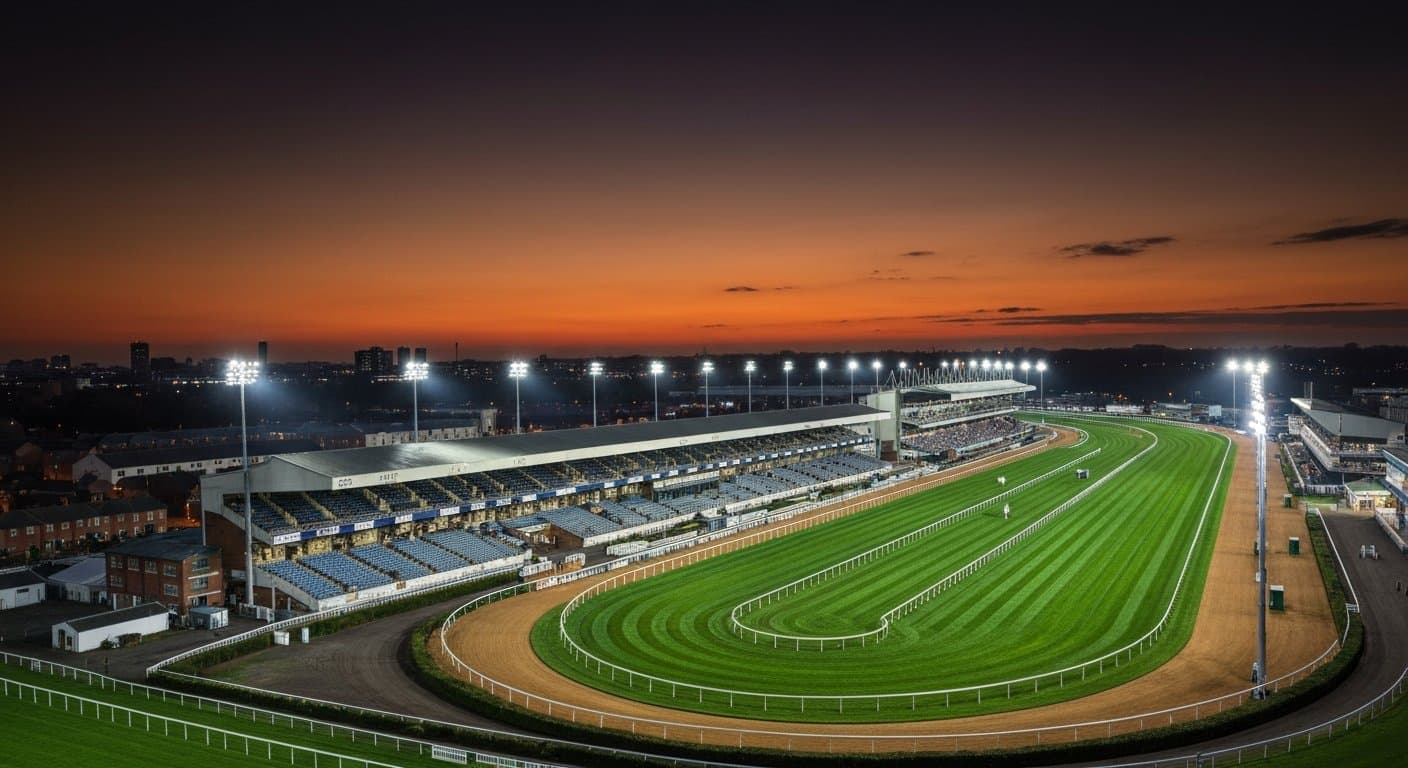
Founder & Editor · Last reviewed 2026-04-04
Introduction
Wolverhampton Racecourse runs every month of the year. While turf venues lock up for winter, Dunstall Park keeps its floodlights on and its Tapeta prepared. It's one of six all-weather venues in Britain, and the busiest among them for winter evening racing. If you want to bet on British flat racing in January, you'll be watching Wolverhampton most Fridays.
The course sits at Dunstall Park, northwest of Wolverhampton city centre, roughly a mile from the station. It opened in 1887 and converted to all-weather in the 1990s, replacing the old turf and gain the ability to race through frost, snow, and the kind of wet that makes conventional courses unraceable. That conversion changed everything. The fixture list expanded, the winter card became a stable source of competitive handicap racing, and Dunstall Park became the go-to venue for anyone who follows form seriously through the colder months.
This is not a glamour track. There's no equivalent to Royal Ascot week or a Cheltenham Festival. The draw here is different: consistency, accessibility, and year-round form that holds up meeting after meeting. Punters who understand the draw bias, the pace bias that rewards front-runners, and how winter markets behave at a smaller venue can find a real edge that doesn't exist at more fashionable tracks.
Quick Decision Block: Should You Go?
- Year-round racing? Yes. Wolverhampton races every month, with evening cards most weeks. The winter programme runs from October through March and is among the busiest in Britain.
- Best time to visit? Friday evening meetings from November to February are the busiest and most atmospheric. The floodlit track and a full card of competitive handicaps make these the signature Wolverhampton experience.
- Best for punters? Draw bias and pace bias are exploitable and consistent. The 5f draw bias in particular is one of the sharpest in British all-weather racing. If you understand it, it's immediately useful.
- Getting there? Wolverhampton station has direct trains from Birmingham (20 minutes), Shrewsbury (40 minutes), and London Euston (1 hour 30 minutes). A taxi from the station costs around £6-8. By car: M54 Junction 2, then the A449. Postcode WV6 0PE.
- What to wear? Smart casual covers you on any evening card. Wolverhampton doesn't enforce strict dress codes. Warm layers are a sensible addition for winter evening meetings.
- Family-friendly? Yes for afternoon and early evening meetings, but the late evening winter cards run until 9:30pm or later, which isn't practical with young children.
- Ticket prices? Moderate. Standard admission for most evening meetings is accessible and Wolverhampton rarely sells out, though popular Friday nights benefit from booking ahead.
Who This Guide Is For
If you've never been to Wolverhampton, this guide walks you through everything from the track layout to the transport options. If you're a punter looking for a specific edge, the course characteristics section and the betting chapter are where the most useful material lives. Draw bias at sprint distances is the single most exploitable factor at this track, and we've covered it in detail.
If you're visiting from outside the West Midlands and treating it as a trip rather than a local evening out, the facilities section covers enclosures and hospitality options. If you're interested in how Dunstall Park became what it is, the history section covers over 130 years from the Victorian turf days to the all-weather conversion.
The rest of this guide covers the course itself, the fixtures programme, facilities, transport, the atmosphere Wolverhampton creates on a winter evening, and fifteen frequently asked questions about the venue.
Bet on Wolverhampton
Place your bets on Wolverhampton races with a trusted bookmaker.

Promo code BETFRED50. New customers only. Register, deposit with a Debit Card, and place a first bet of £10+ at Evens (2.0)+ on Sports, to be settled within 7 days, to get £30 in Sports Free Bets and £20 in Bet Builder Free Bets within 24 hours of settlement. 7-day expiry. Eligibility & payment exclusions apply. Full T&Cs apply. Take Time to Think. BeGambleAware.org. 18+. Full T&Cs.

Promo code R30. New UK customers only, 18+. Register, deposit £10 or more, then place a £10 single cash bet at odds of 1/2 (1.5) or greater on any sports market (excluding Virtuals). Once the qualifying bet settles you get £30 in Free Bets (3 x £10) — the qualifying bet can win or lose. Free Bets are valid on any sports market excluding Virtuals, expire in 7 days, are non-withdrawable and must be used in full. Excluded deposit methods apply (including PayPal, Apple Pay, Skrill and NETELLER). Named bets such as Lucky 15 do not qualify. If you cash out the qualifying bet, or it is voided, you are no longer eligible for the offer. Ends 31.12.26. Full T&Cs apply. Please gamble responsibly. BeGambleAware.org. 18+. Full T&Cs.

Promo code BET40GET20. New UK customers, 18+. Register with the code and place a first bet of £40 or more at Evens (2.0) or greater. Receive 2 × £10 free bets: the first credited automatically once the qualifying bet settles, the second 24 hours later. Free bets must be placed at minimum odds of 4/1 (5.0), expire 24 hours after credit, and the free-bet stake is not returned with winnings. Debit card deposits only. Take Time to Think. BeGambleAware.org. 18+. T&Cs apply. Full T&Cs.

50% of your first-day net losses refunded as a free bet, capped at £25. New UK customers aged 18+ only. To qualify, deposit and place a first bet of £10 or more on any sport at minimum odds of evens (2.00), then place at least two further bets on different events, each worth at least 50% of your largest bet, all at evens (2.00) or greater. Losses are counted from your first settled bet until 23:59 the same day. Place a qualifying £10+ bet and you are guaranteed at least a £5 free bet. Bets placed at SP, void bets, cashed-out bets and bets struck with free bets do not count towards the offer. The free bet is credited the day after your qualifying bets settle and must be used within 7 days, after which it expires. It can be used at odds from 1/4 (1.25) up to 250/1 on singles and straight accumulators, but not on Trixie, Patent or Yankee style multiples. Free-bet stake is not returned with winnings. One offer per person, household, address, IP address and device. E-wallet deposits may not qualify, so check the cashier before depositing. Customers registered with GAMSTOP cannot claim. KYC identity verification must be completed before the free bet is credited. Take Time to Think. BeGambleAware.org. 18+. T&Cs apply. Full T&Cs.

New customers, 18+. Choose the sports bonus at sign-up, make a first deposit and receive a 100% bonus up to £50 in your Sports Bonus balance. To convert the bonus to cash, wager it 10x within 30 days. Single bets below Evens (2.00) do not qualify; accumulators do not qualify if any selection is below 1/2 (1.50). Virtual Sports, voided, cancelled, drawn, cashed-out and free-bet wagers do not count towards wagering. Only the first settled bet per event counts. Withdrawing before the wagering requirement is met forfeits the bonus balance including bonus winnings. Real-money funds are used before bonus funds. Deposits via Skrill or Neteller are not eligible. Not valid in conjunction with other promotions. Odds, bet and payment limits apply. 10bet general and promotion T&Cs apply. BeGambleAware.org. 18+. Full T&Cs.

New customers in Great Britain and Republic of Ireland, 18+. Place a £10 fixed-odds qualifying bet at minimum odds of 1/2 (1.50) — single or each-way (only the win part counts), pre-event or in-play, not cashed out early, within 28 days of opening the account. Receive up to £60 in bonuses credited over three days: 3 × £10 fixed-odds free bets (the first on settlement, then 24 and 48 hours later) plus 3 × £5 Total Goals FOOTBALL spread bets and 3 × £5 racing Winning Favourites spread bets, with a £1 racing Race Index spread bet as an extra on top. The spread bets need a full spread-betting account, opened within 28 days of the fixed-odds account and subject to Spreadex's eligibility and appropriateness checks. Free-bet stakes not returned with winnings; free bets valid 28 days from issue. IMPORTANT: the £5 credits are SPREAD bets — sports spread betting carries the risk that losses can exceed your stake. Sports spread-betting customers do not have Financial Ombudsman or FSCS recourse. Take Time to Think. BeGambleAware.org. 18+. T&Cs apply. Full T&Cs.

Promo code WELCOME15, entered under My Bonuses after registering. New UK customers, 18+. Place a first qualifying bet of at least £10 from your cash balance at odds of evens (2.0) or greater within 7 days of opening the account. Once the qualifying bet fully settles you receive £15 in free bets, credited as 3 x £5 tokens with set uses: one £5 accumulator free bet (minimum 4 legs, each leg at 2/5 or bigger), one £5 sports free bet (any market at evens or bigger) and one £5 Sub Cover free bet (selected football player markets at evens or bigger). Free-bet stakes are not returned with winnings. Free bets expire 7 days after they are credited. Void, cashed-out and partially cashed-out bets do not qualify. One offer per customer. Confirm the current terms on BetGoodwin's own welcome-offer page before claiming. Take Time to Think. BeGambleAware.org. 18+. T&Cs apply. Full T&Cs.

New UK customers, 18+. Minimum deposit £10. Place a £10 qualifying single on sports (excluding virtuals) at minimum odds of 1/2 (1.50), settled within 14 days. Deposit-method exclusions apply. Receive £30 in free bets (stake not returned), split £20 for sportsbook use (2 x £10) and £10 for Bet Builder only (2 x £5); Bet Builder does not cover horse racing. Free bets must be accepted within 7 days and expire 7 days after acceptance. No promo code required. Best Odds Guaranteed on UK & Irish racing, subject to having staked over £25 in the previous seven days. Operated by LiveScore Betting and Gaming (Gibraltar) Ltd, UKGC 56859. Confirm the current terms on LiveScore Bet's own promotions page before claiming. Take Time to Think. BeGambleAware.org. 18+. T&Cs apply. Full T&Cs.
18+. BeGambleAware.org
History of Wolverhampton Racecourse
The History of Wolverhampton Racecourse
Racing at Dunstall Park has been going since 1887. By the standards of British horse racing, that makes Wolverhampton a relative newcomer: it postdates Newmarket, Epsom, and Chester by centuries. But the course has spent the best part of 140 years serving the West Midlands racing public, and that longevity carries its own weight.
The story of Wolverhampton is in two parts. The first runs from the 1880s to the mid-1990s: a conventional turf racecourse serving an industrial city, running seasonal flat racing for a working-class audience. The second starts in 1993, when the installation of Fibresand all-weather surface began a change that eventually made Wolverhampton one of the most active racing venues in Britain.
Victorian Origins: Dunstall Park from 1887
Wolverhampton is an industrial city. In the 1880s, when the racecourse at Dunstall Park first opened, it sat in the middle of one of Britain's most productive manufacturing regions. The Black Country was at the height of its industrial output, and Wolverhampton itself was a city of iron, steel, and coal. Racing here was always a working-class pastime, not a gathering of the landed gentry.
The course was built on land at Dunstall Park, northwest of the city centre, in grounds that were also used for other sporting and recreational purposes. From its first meeting in 1887, Wolverhampton served as a regional flat racing track operating under Jockey Club rules. The racing calendar was seasonal, as it was everywhere in those days: racing on turf through spring and summer, closing for winter.
Victorian Wolverhampton sat in the shadow of bigger regional venues. Warwick, Stratford, and the more established Midlands tracks drew larger crowds and better horses for their premium meetings. Dunstall Park was a working venue: honest racing, competitive handicaps, useful maiden races for horses working their way up through the ranks. It wasn't glamorous, but it filled a real need for a region with a large population and an appetite for sport.
By the early 20th century, the pattern was established. Wolverhampton held a compact programme of flat meetings, typically from April through to October, running the usual mix of two-year-old maidens, handicaps, and the occasional conditions race. The horses that came were mostly trained locally or in the wider Midlands and the north of England. The big trainers at Newmarket and the south generally bypassed Wolverhampton for more valuable targets, but the course provided regular, competitive racing for its local audience.
Through the 20th Century
The first half of the 20th century brought the usual disruptions. Both World Wars interrupted the national racing programme, and Wolverhampton, like all British courses, lost meetings to wartime restrictions and the requisitioning of land and labour. Racing returned after each conflict, and the course continued on its modest, functional path through the 1950s, 1960s, and 1970s.
By the 1970s and 1980s, the wider scene in British racing was changing. Prize money was growing at the top end, particularly at the big Graded meetings. Smaller courses were finding it harder to sustain their programmes in competition with television coverage of the major fixtures. Wolverhampton in this era was a workmanlike course that kept racing but didn't particularly distinguish itself.
What it did have was a loyal local audience. The West Midlands is a large, densely populated region, and Dunstall Park's position within the city, accessible by bus and close to the train station, meant it could draw a solid local crowd for its meetings. That local connection, built over a century of racing, would matter when the course needed to make its most significant decision.
The All-Weather Conversion
In 1993, Wolverhampton made a decision that defined everything that followed. The course installed Fibresand, the first generation of all-weather synthetic surface used in British racing, and began running year-round meetings. It was among the early adopters of all-weather racing in Britain, joining Lingfield and Southwell as the pioneer venues.
Fibresand was imperfect. It was loose, it kicked back badly when horses raced over it, and the racing was often messy and inconclusive from a form perspective. But it worked well enough for the core purpose: keeping racing going through winter months when turf surfaces became unplayable. For Wolverhampton, the ability to race in December, January, and February was a significant shift. The fixture list expanded from perhaps 25-30 meetings a year to double that or more.
The second major surface change came later, when Wolverhampton replaced Fibresand with Polytrack: a denser, more consistent synthetic surface made of sand, rubber, and fibrous materials bonded together. Polytrack was a clear improvement on the early Fibresand. Wolverhampton then replaced it with Tapeta, a sand, wax and fibre mix, in 2014, and that is the surface the course runs on today. The racing is cleaner, form holds up better from meeting to meeting, and the surface plays consistently whether it's a hot summer evening or a January night with temperatures close to freezing.
The floodlights were part of the same modernisation push. Wolverhampton became one of the first British racecourses to install floodlighting that allowed evening racing to run through the short days of winter. A seven-race card starting at 5pm, running through to 9:30pm under artificial light, became the standard Wolverhampton format for the winter months. That evening card format drew a different audience from traditional afternoon racing: people who worked during the day and could come to the course for a few hours after work, treating it as an evening out rather than a day trip.
The All-Weather Championship Connection
As the all-weather circuit developed through the 2000s and 2010s, British racing's administrators moved to formalise it with a structured championship. The All-Weather Championships, concluded at Kempton Park's Finals Day each April, gave the winter AW programme a clear purpose. Horses who performed consistently across the AW season at Wolverhampton, Kempton, Lingfield, Chelmsford, Newcastle, and Dundalk (Ireland) accumulated qualifying points, with the best in each division competing in championship finals.
For Wolverhampton, this development raised the stakes of what had previously been purely functional winter racing. Certain meetings during the October to April qualifying window became championship qualifying races, attracting horses specifically targeting AW glory rather than just filling a race card. The course that had once been a purely working venue now hosted racing with a defined championship context.
This matters to punters. Horses that are building AW Championship credentials can be assessed more systematically. Their AW form over the winter is the form that matters, and a horse with a strong Wolverhampton record returning to Dunstall Park for a qualifying race is operating in familiar territory.
Dunstall Park Today
The physical course at Dunstall Park today is compact but functional. The grandstand overlooks the oval track, the Tapeta surface sits under permanent floodlights, and the venue holds around 5,000-6,000 racegoers. It's not architecturally distinguished: the facilities are modern and practical rather than historic. But the location and the purpose it serves haven't changed since 1887.
What has changed is the frequency of racing. Wolverhampton now runs more fixtures annually than almost any other British racecourse. The year-round calendar means the course is active in every month, with the evening card format making it a practical option for Midlands racegoers regardless of season. In terms of raw fixture numbers, Wolverhampton sits alongside Lingfield and Kempton as one of the most active venues in Britain.
The working-class character of the venue has persisted through all of this. Wolverhampton isn't a dress-circle racecourse. There's no significant social occasion attached to a Tuesday evening card at Dunstall Park in the way there is to, say, a Glorious Goodwood afternoon or even a Cheltenham summer meeting. The crowd is local, practical, and there to watch racing and bet on it. That's been true since 1887, and it remains true now.
For the punter who knows the track's characteristics and how its markets behave in winter, that functional, no-nonsense character is exactly the point. Wolverhampton exists to provide racing. It does so reliably, week after week, year after year. In British racing's calendar, that's a useful thing.
The Course & Layout
The Course and How It Races
Wolverhampton is a left-handed, oval Tapeta circuit with a circumference of approximately one mile and two furlongs. The back straight is short. The home straight runs to about four furlongs (longer than it looks from the stands) and the track bends left through a wide sweep coming out of the far side. There's no turf here at all: everything runs on the synthetic surface, year-round, regardless of weather.
The course is flat. There are no real gradients. What you're dealing with at Dunstall Park is a tight, left-handed track on a consistent synthetic surface where draw position and early positioning in the race matter far more than ground conditions or undulations that you'd have to factor in at a turf track.
The Oval Layout
For races up to and including seven furlongs, runners start in a straight section and are almost immediately on the bend coming into the final turn. For mile races and longer, the full oval circuit is used. The one-mile start is at the far end of the back straight; horses run the back straight, sweep around the far bend, and come into the home straight with four furlongs to run.
Sprint races at five furlongs and six furlongs begin in the home straight with runners heading away from the grandstand before bending left around the track and coming back through the home straight. This configuration means that in sprint races, the very first phase of the race is spent going into the bend, which is why draw position has such a significant effect.
The home straight is where races are decided, as you'd expect. Four furlongs gives closers enough room to produce a run, but the pace bias at Wolverhampton (discussed in the next section) means front-runners and prominent racers have a better-than-average record relative to turf tracks of equivalent configuration.
Draw Bias: The Most Important Betting Factor at Wolverhampton
This is the part that matters most for anyone betting at Dunstall Park. The draw bias here is one of the sharpest in British all-weather racing, and understanding it is worth understanding properly.
The core principle: Wolverhampton is a left-handed oval. Low-numbered stalls (stalls 1, 2, 3) are on the inside, closest to the inside running rail. High-numbered stalls are on the outside of the field. In sprint races, where horses immediately run into the first bend, low-drawn horses have a direct path to the inside rail through the bend. High-drawn horses must either drop back to find cover or use extra ground by racing wide around the outside of the field.
Five-furlong races, where the bias is most severe:
In a 12-runner, five-furlong race at Wolverhampton, stalls 1-5 are significantly favoured. Horses drawn in stalls 1-5 can sit on or near the inside rail from the start, travelling the shortest possible route around the bend. By contrast, a horse drawn in stall 10, 11, or 12 in a field of 12 must either:
(a) Drop to the back of the field to find a gap on the rail, losing ground and position in the process, or (b) Race wide throughout, covering extra ground and expending more energy to maintain position.
The distance disadvantage from racing wide in a five-furlong sprint has been estimated at four to eight lengths before a horse has run a single furlong of the race. In a field where the winner might beat the runner-up by one length or less, that's a structural disadvantage that the highest draws almost never overcome.
The data backs this up. Looking at historical five-furlong results at Wolverhampton, the bias toward low draws is consistent and persistent. Winners overwhelmingly come from the bottom half of the draw, and the lower the stall number relative to field size, the better the record. There's variability from race to race. A fast-starting high-drawn horse can sometimes cross to the rail before the first bend, but as a baseline expectation, high draws in five-furlong races at Wolverhampton are working against the geometry of the track.
Six-furlong races:
The bias is still present at six furlongs but slightly less severe. There's a short additional straight section before the first bend, which gives high-drawn horses marginally more time to work across toward the rail before the turn. The bias in six-furlong races roughly correlates with field size: in small fields of six or seven runners, the effect is minimal. In fields of 14-16 runners, the low-draw advantage is clear again, with stalls 1-6 having the best record and high stalls at a disadvantage.
Seven-furlong races:
At seven furlongs, the bias reduces further. There's more racing done before the first significant bend, and horses have time to settle into position more naturally. The inside rail still carries a marginal benefit, as it always will on a left-handed track, but horses drawn in the top third of the field are no longer at a structural disadvantage simply because of their starting position. The race becomes more about pace, class, and individual horse characteristics.
One-mile and beyond:
At one mile and over, the draw bias is minimal. The track's configuration means that runners have a full back straight to sort themselves out before the critical bend, and by the time they turn for home, field positions have been determined by pace and tactics rather than starting stall. Inside draws still carry a small rail advantage, but not enough to drive betting decisions in isolation.
Practical application:
When you're looking at a five-furlong race at Wolverhampton with 12 or more runners, the starting point is: where is each horse drawn? A horse drawn 1 or 2 gets a structural advantage. A horse drawn 10-12 in a 12-runner field faces a structural problem that its ability alone may not overcome. If the race has a high-drawn favourite, the draw question is worth asking seriously before deciding whether that favourite represents value.
This doesn't mean high-drawn horses never win. They do. But the frequency with which they win is lower than their market price typically reflects, and the frequency with which low-drawn horses win is higher. That gap is where value lives.
Pace Bias: Front-Runners and Prominent Racers
The second most significant factor at Wolverhampton is pace bias. Britain's synthetic surfaces, at Wolverhampton, Kempton and Chelmsford, consistently favour horses that race prominently. The surface doesn't slow the leaders as much as soft turf does, and closers who need horses in front of them to tire don't get the assistance they'd get on a true stamina-sapping surface.
At Wolverhampton specifically, the left-handed configuration adds to this. Horses on the inside running through the bend are already in a good position if they're racing near the front. A front-runner that leads from stall 1 in a five-furlong race is in an almost unassailable position: on the inside rail, having covered the shortest route, with energy to spend in the straight.
The pace bias doesn't mean every front-runner wins. Overpriced odds-on favourites running from the front get beaten like any other horse. But in sprint handicaps with competitive fields, the record of horses who have raced prominently at Wolverhampton is better than the record of horses who close from off the pace. When conditions at other tracks would normally suggest a strong pace that suits closers, the Wolverhampton Tapeta tends to blunt that effect.
For punters, this means: if you're choosing between two horses of similar ability and one typically races prominently while the other closes from behind, the prominently-racing horse gets a marginal bonus at Wolverhampton relative to many turf tracks.
The Surface Itself
Tapeta, the surface Wolverhampton has used since 2014, is a synthetic mix of sand, wax and fibre. The components are bound together and laid over a compacted base. It drains very well, far better than turf, and maintains consistent going regardless of rainfall or temperature. Racing at Wolverhampton isn't called off for wet weather. The course has met most of its fixture list consistently since installing the surface.
The going description on Tapeta is "standard" for most purposes. Occasionally you'll see "standard to slow" following very heavy rainfall, but these variations are minor compared to the swings from firm to heavy that turf courses deal with through the season. For the punter, this consistency is useful: form earned at Wolverhampton transfers well to subsequent Wolverhampton runs because the surface doesn't change.
Form from the other synthetic venues, Kempton and Chelmsford, also translates reasonably well to Wolverhampton, though the left-handed configuration at Dunstall Park means right-handed specialists from those venues occasionally struggle. Horses that have run well at Lingfield (left-handed Polytrack) often handle Wolverhampton well, as do horses with good form at Kempton who aren't specifically reliant on that course's right-handed configuration.
What Type of Horse Wins at Wolverhampton
The profile of a typical Wolverhampton winner, particularly at sprint distances, is:
A horse drawn low in the field. A horse that races prominently or leads. A horse that handles synthetic surfaces (all-weather form is the clearest indicator). At distances of seven furlongs and beyond, a horse that has the class to carry its head position through the race and sustain it in the straight.
Horses that carry large weights in handicaps and need soft ground to produce their best form don't thrive here as often as they do at wet turf tracks. Ground specialists who particularly want cut in the ground are better placed at turf venues.
Strong finishers who close from off the pace win here, but less often than their market share suggests. Wolverhampton isn't a one-dimensional track where closers never win. But the margin is consistent enough to be worth accounting for in your assessment.
For the bettor, Wolverhampton rewards preparation. Know the draw, know the pace bias, know the surface form. Apply those three factors consistently and you'll assess the card better than someone treating it like any other British flat race.
The Racing Programme
The Racing Programme at Wolverhampton
Wolverhampton runs more fixtures each year than almost any other British flat racecourse. The all-weather calendar doesn't take winter breaks, and Dunstall Park fills that space. Most weeks through the autumn and winter, you'll find two or three meetings. Through spring and summer, the pace doesn't drop much. The course continues alongside the turf season, providing AW alternatives when other venues are busy or when trainers want consistent conditions.
The total meeting count typically runs to 60 or more fixtures a year, spread across evening and afternoon cards. That volume is the foundation of what Wolverhampton offers to punters: frequent, well-structured form lines. A horse that runs at Wolverhampton every three weeks through winter builds a trackable record that's far more useful than the spotty form of a horse that ran twice at different turf tracks before the season paused for frost.
The Winter Programme: October to March
The heart of the Wolverhampton year is its winter programme. From late October through to the end of March, the course runs the majority of its fixtures, typically concentrating them on weekday evenings. Friday evening meetings are the busiest and most competitive. Friday cards often feature seven or eight races spread across three to four hours under the floodlights, drawing fields from across Britain because this is when AW racing has limited competition.
In December, January, and February, Wolverhampton and the other AW venues are running some of the only competitive British flat racing available. Turf courses are largely silent except for National Hunt, and the punters who follow flat form are concentrated on the AW circuit. This creates tighter, more focused betting markets at Wolverhampton during these months: the fields are smaller in some races because the pool of active flat horses is smaller, but the form is well-established and the draw bias and pace patterns are stable.
Saturday afternoon meetings also run through winter, giving the course a different feel from the weekday evening format. These tend to attract a slightly more varied crowd: people who might otherwise head to a National Hunt meeting on a winter Saturday but want flat racing.
Evening cards start between 5pm and 6:30pm depending on the time of year, with later starts through autumn and winter to allow the floodlights to function properly before the first race. Cards typically finish around 9:00-9:30pm. The format suits the evening-out model: a group can arrive after work, eat at the course, watch five or six races, and be back before midnight.
The All-Weather Championships Qualifying Window
From October through to the end of March, meetings at Wolverhampton feed into the All-Weather Championships, which culminates in Finals Day at Kempton Park each April. The championship divides horses by age, distance, and class, with the leading performers through the winter qualifying for Kempton's championship finals card.
For the Wolverhampton punter, this creates a useful lens on the winter racing. Certain horses are specifically targeting AW form and the championship. They'll run repeatedly at AW venues through winter, building their qualifying credentials. A horse that has run three times at Wolverhampton between November and February, improving each time, is a horse with a clear AW purpose. That pattern is worth identifying and following.
Championship-targeting horses also tend to be horses that actually handle synthetic surfaces rather than horses filling in while the turf is off. This distinction matters: a turf horse dropped into AW racing because there's nothing else available is very different from a horse whose connections have specifically targeted the AW Championship circuit. The former is running because it can; the latter is running because it wants to.
Qualifying races carry slightly more weight in the formbook than a routine handicap because connections are motivated to run their best horse on the day. This makes them, paradoxically, both more competitive and more valuable as form lines once the winter is over.
The Lady Wulfruna Stakes
The Lady Wulfruna Stakes is the course's feature race: a Listed contest run in March that sits at the top of the quality hierarchy for racing at Dunstall Park. Listed level is one below Group 3.
The Lincoln Trial is run on the same March card.
Beyond the Lady Wulfruna Stakes, the course's higher-quality races are conditions races rather than handicaps: races with restricted entries based on age, rating band, or number of previous wins. These sit above the handicap class but below Listed level, and they occasionally attract horses of real ability who are either being freshened up over winter or targeting AW Championships points.
Summer and Autumn Racing
Wolverhampton doesn't slow down in summer. It continues running alongside the turf season, attracting horses whose trainers want a consistent surface, horses returning from injury who need a predictable surface to reintroduce them to competition, and horses whose form profile simply suits synthetic racing better than turf.
Summer cards at Wolverhampton tend to draw slightly larger fields than winter, because more horses are in active training and trainers have more options to fill races. The racing quality varies. Some summer cards are strong, others are thin. But the structural characteristics of the track (draw bias, pace bias) are unchanged regardless of season.
Autumn meetings from September to November bridge the gap between the turf season winding down and the full winter programme beginning. These meetings often feature horses that have raced on turf through summer and are transitioning to AW for the first time in the current season. That transition question (does this horse handle the synthetic surface?) is worth assessing in autumn cards, because the answer shapes the horse's winter programme.
Planning Your Visit
Wolverhampton's fixture list is published well in advance and available on the course's website. Two or three meetings per week is the standard frequency. Evening cards are the dominant format from October to April; afternoon cards appear more often in summer.
Popular Friday evening meetings in winter are the most likely to require advance booking, though Wolverhampton's 5,000-6,000 capacity means it rarely approaches a true sellout. For groups of six or more, booking is worth doing a week or two ahead to guarantee table seating in the restaurant rather than general admission.
Tickets are generally available on the day for most midweek and Saturday meetings throughout the year.
Facilities & Hospitality
Facilities at Wolverhampton Racecourse
Wolverhampton is a compact venue. The 5,000-6,000 capacity means it doesn't sprawl across multiple separate enclosures the way the big turf courses do, and the layout is straightforward: grandstand, parade ring, betting ring, food and drink concessions, all arranged so that you're never more than a few minutes' walk from any part of the course.
This compactness is mostly an advantage. You can see the parade ring before a race, walk to the betting ring to place a bet, and be in your seat watching the race off without rushing. The oval track is fully visible from the main grandstand, and the floodlights ensure the whole track is clearly lit for evening meetings.
The Grandstand and Viewing
The grandstand runs along the home straight, giving a clear view of the four-furlong run to the finish. Tiered seating means sightlines are generally good throughout. The bend coming into the straight is visible from most positions, so you can watch horses rounding the final turn and then follow them all the way to the line.
For evening racing, the floodlit surface makes the horses and jockeys clearly visible even from the upper tiers of the grandstand. The lighting at Dunstall Park is one of the better installations among British all-weather venues, with even coverage that doesn't create the shadow or glare issues that can affect evening racing at less well-equipped venues.
The track itself is easy to observe from the stands because there are no crowd obstructions on the far side of the track. The inner area of the oval is infield, not used for spectators. This means you're looking across a clear stretch of track to the back straight and far bend, giving a panoramic view of the whole circuit.
Enclosures and Admission
Wolverhampton runs a straightforward enclosure structure. The main grandstand and general admission area covers most of the raceable parts of the venue. Hospitality and premium areas are available by separate booking but there's no rigid class-based enclosure system as you'd find at a big turf festival.
For a standard evening meeting, most racegoers enter on general admission and have access to the grandstand, the betting ring, the parade ring viewing area, and the food and drink concessions. Premium hospitality in the form of private boxes or restaurant packages is available on top of this, but it's an optional upgrade rather than a separate access tier.
Food and Drink
The food at Wolverhampton covers the standard racecourse range: burgers, chips, sandwiches, hot dogs, and similar casual fare from concession stands around the course. The quality is functional rather than distinguished. For a cold January evening under the lights, a hot burger from a trackside stand works perfectly well.
There are multiple bar areas operating through the grandstand and surrounding concourse. Beer, cider, and standard spirits are available, along with soft drinks and hot drinks. The bars get busy before and between races on popular winter evening cards, so arriving early for drinks is sensible if you want to avoid queuing during the peak period between the third and fourth races.
The course also operates a restaurant with table service, available as part of a hospitality package or by separate booking. This is the better option if you're making a proper evening of it, with table service meaning you can eat and watch comfortably rather than juggling food at a concession stand. For groups visiting for a birthday, corporate evening, or similar occasion, the restaurant option is a considerable step up from general admission.
Private boxes are available for groups who want their own dedicated space. Box hire typically includes catering, a good view of the track, and a degree of privacy from the general admission areas. Boxes suit corporate groups or a large gathering where having your own space is worth the cost.
Betting Facilities
The betting ring at Wolverhampton operates as the main on-course bookmaker area, with layers setting up boards and calling prices in the traditional way. On busy Friday evenings, there are enough bookmakers operating to create reasonable competition and movement in prices. On quieter midweek cards, there may be fewer layers, which can compress the market slightly compared to what you'd find at a major turf meeting.
Tote windows operate alongside the ring, covering win, place, exacta, trifecta, and jackpot bets. Self-service Tote terminals are also available in the grandstand. For punters who use exchange platforms, the on-course wifi allows exchange betting from the grandstand and concourse areas.
One practical note for winter evening meetings: the warmest betting vantage points are inside the grandstand. The outdoor betting ring is cold on a January night. Layers and a warm coat make the experience considerably more comfortable if you prefer watching from the ring rather than the stands.
Accessibility
The course is flat, with no significant gradients in the public areas, and the compact layout works in favour of visitors with mobility requirements. Wheelchair-accessible viewing positions are available in the grandstand. Contact the racecourse in advance if you have specific access requirements, and the team will arrange the appropriate provision.
Family Access
Wolverhampton is accessible to families for afternoon meetings and earlier evening cards. The late evening winter format, with races finishing at 9:30pm or later, is less suitable for younger children on a school night. Summer afternoon meetings and early-evening cards in the lighter months are a better fit for families with children.
Children are admitted at reduced rates or free depending on the meeting and accompanying adult arrangements. Check the racecourse website for the current policy, as it varies by meeting type.
Getting to Wolverhampton
Getting to Wolverhampton Racecourse
Wolverhampton Racecourse is at Dunstall Park, northwest of the city centre. The postcode for sat-nav is WV6 0PE. It's one of the more accessible racecourses in Britain by both rail and road, and the proximity to the M54/M6 motorway junction makes it straightforward by car from most of the West Midlands, Shropshire, and Staffordshire.
By Train
Wolverhampton station sits on the West Coast Main Line and is one of the better-connected stations for a mid-sized city. Direct trains run from:
- Birmingham New Street: approximately 20 minutes. West Midlands Trains services run frequently, often every 10-15 minutes at peak times. This is the most-used route for racegoers from the south Midlands.
- Shrewsbury: approximately 40 minutes. A direct service on the Shrewsbury to Birmingham corridor. Useful for racegoers coming from Shropshire and the Welsh border area.
- London Euston: approximately 1 hour 30 minutes direct on Avanti West Coast services. This makes Wolverhampton a realistic option for London-based punters who want evening racing without a two-hour or longer journey to a more remote venue.
- Manchester Piccadilly: approximately 1 hour 15 minutes. Direct services exist, making Wolverhampton accessible from the northwest.
- Coventry: approximately 30 minutes. Easy connection on the West Midlands network.
From Wolverhampton station to the racecourse is approximately 1.5 miles. The options are:
Taxi: The most common choice. A taxi from the station forecourt to the racecourse entrance costs approximately £6-8. Journey time is around 5-10 minutes depending on traffic. On busy race nights, there are usually taxis queuing at the station. The return journey after racing is busier. If you're catching a specific train, allow 20-25 minutes from the last race to ensure you make it.
Race day bus: On busy meeting days, particularly weekend afternoon cards and major evening fixtures, shuttle buses operate between the station and the course. Check the racecourse website or the National Rail arrivals board for the specific shuttle arrangements for your meeting.
Walking: The 1.5-mile walk from the station to the course is straightforward in daylight and reasonable weather. At night in January, less so: the route takes you through a mix of city-edge roads and isn't particularly well-lit in parts. Most racegoers take a taxi for evening meetings.
By Car
The road access to Wolverhampton Racecourse is good. The junction of the M54 and M6 is within a few miles of the course, and the A449 provides a clear route into Dunstall Park.
From the south (Birmingham and south Midlands): M6 northbound to Junction 10A, then M54 westbound to Junction 2, then A449 north toward Wolverhampton. The racecourse is signed from the A449 and is approximately 1.5 miles from the motorway junction. Total journey time from Birmingham city centre is typically 25-35 minutes depending on traffic.
From the west (Shropshire, Wales, west Midlands): M54 eastbound to Junction 2, then A449. The same route applies. From Shrewsbury, allow around 45 minutes to an hour.
From the north (Staffordshire, Cheshire): M6 southbound to Junction 12 or 13, then follow the A5 or A449 into Wolverhampton. From Stafford, allow around 30 minutes.
From Wolverhampton city centre: Five minutes. Follow signs for Dunstall Park from the ring road.
Evening meeting note: If you're attending a weekday evening card that starts around 5:30pm or 6pm, you'll be driving into Wolverhampton during rush hour. Allow an extra 15-20 minutes compared to an off-peak journey. The city-centre approach roads can back up significantly between 4:30pm and 6:30pm on weekdays.
Parking
On-site parking is available at Dunstall Park. The car park is substantial for a 5,000-6,000 capacity venue and can accommodate the majority of racegoers who arrive by car. Parking charges apply and are in line with other racecourses of similar size. Check the racecourse website for current pricing. Charges are occasionally included in packages or promotional tickets.
For the biggest evening meetings in winter, particularly popular Friday cards, the car park fills early. Arriving 45 minutes to an hour before the first race is sensible. On quiet midweek cards, parking is rarely an issue.
If the main car park is full, there is occasionally overflow parking available in the Dunstall Park area, but this isn't guaranteed. The safest approach for a winter Friday is to arrive early or use the train.
By Bus
Local bus services connect Wolverhampton city centre to the Dunstall Park area. The journey from the city centre takes around 15-20 minutes. Specific route numbers and stop locations are available through the Transport for West Midlands journey planner. Bus frequency varies by time of day, and on winter evenings after 9pm, services become less frequent.
Buses work well for daytime and early-evening meetings. For late evening cards finishing after 9:30pm, a taxi back to the city centre or station is more reliable than waiting for a late bus.
Practical Notes for Evening Meetings
A few practical details specific to evening racing at Wolverhampton:
The floodlit environment means the car park and surrounding areas are well-lit after racing, which makes the walk to the car or the wait for a taxi more straightforward than at some darker rural venues.
On cold winter evenings, the taxi queue after racing can be 20-30 minutes long if you're catching a late train. Booking a minicab in advance and arranging a specific collection time is an alternative worth considering for peak winter meetings.
Uber and similar services operate in Wolverhampton and work reliably from the racecourse area. The pick-up point is the main entrance on Gorsebrook Road.
Betting at Wolverhampton
Betting at Wolverhampton
Wolverhampton is not a complex course to analyse, but it rewards punters who apply a consistent process. The variables that matter here are fewer and more stable than at a turf course. There's no going variation to account for. There's no changing ground that turns one horse's form upside down and makes another's suddenly relevant. What there is, meeting after meeting, is a consistent surface with a clear draw bias and a pace bias that favours front-runners. Understanding those two factors in depth, and knowing how to read the AW form book, is where the edge at Dunstall Park lives.
Draw Bias: Applied to Betting
The draw bias at Wolverhampton, particularly in sprint races, is the single most exploitable structural factor in British all-weather betting. This section sets out exactly how to use it.
Five-furlong races, fields of 10 or more runners:
This is where the bias is sharpest. In a field of 12 runners, stalls 1-5 are on the inside of the oval. They have the shortest distance to travel around the first bend. A horse drawn in stall 1 travels the inside rail from the first stride; a horse drawn in stall 12 must either cross the field to find a rail position (which requires being quicker out of the gate and expending energy to cross) or race wide throughout.
The practical implication: if you're assessing a 12-runner, five-furlong handicap at Wolverhampton, your first filter is draw. Horses in stalls 1-5 get a pass on the draw question. Horses in stalls 10-12 need a specific reason why they can overcome the bias: exceptional early pace that allows them to cross to the inside, a significant class advantage, or a track record of handling high draws at this course.
How significant is the disadvantage? In terms of ground covered, a horse racing widest in a 12-runner five-furlong race at Wolverhampton covers approximately 6-8 more lengths of ground than the horse on the inside rail. In a race where the winner beats second by one length, that structural difference is enormous. It doesn't mean high-drawn horses never win. They do. But their win rate is considerably below their market representation, and this creates value in low draws that is often underpriced.
Field size matters significantly:
In a field of four runners, the draw bias is minimal. The inside and outside rail are close together, and the advantage of an inside draw is small. The bias becomes noticeable from eight runners upward and is most severe in fields of 12 or more. A 16-runner five-furlong sprint at Wolverhampton is about as extreme a draw-bias scenario as you'll encounter in British racing. Stalls 14, 15, and 16 are in a structurally difficult position, and the form of high-drawn horses should be treated with appropriate scepticism.
Six-furlong races:
The short additional straight before the first bend moderates the bias at six furlongs compared to five, but it's still present in large fields. In fields of 10 or more, stalls 1-6 have a track record that outperforms their market share. Stalls 12 and above need a specific reason to overcome the geometry.
Practical approach for six-furlong races: Low draws are beneficial but not as dramatically favoured as at five furlongs. High draws can win in small fields and can win when a horse has fast early pace that allows it to cross naturally. The bias is a factor in your assessment, not a complete veto on high draws in the way it is at five furlongs in big fields.
Seven furlongs and beyond:
Draw is a minor factor at seven furlongs and essentially irrelevant beyond a mile. The racing adjusts itself through the back straight. Focus your assessment on form, class, trainer patterns, and pace rather than stall draw.
Pace Bias: What It Means in Practice
Wolverhampton's Tapeta rewards front-running and prominent racing. This bias isn't as pronounced as at, say, a dead flat turf track with a four-furlong straight, but it's consistent and worth accounting for.
The mechanism: a synthetic surface doesn't pull at horses' legs the way deep turf does. There's no "give" in the surface that drains energy from horses racing at pace. This means that horses who lead or race near the front don't tire as quickly as they might on a soft or heavy turf surface. Closers who rely on the leaders running out of steam in the final two furlongs find that this happens less often at Wolverhampton than at turf tracks.
How to use it: In any race at Wolverhampton, check the pace scenario. If there's a clear front-runner drawn low (stalls 1-3 in a sprint), they have a double advantage: inside draw and first run. A horse like this, at a fair price, fits the profile of a Wolverhampton winner.
If there's no obvious front-runner, a field of closers with no natural leader, then the pace scenario opens up. The closers will be fighting for position early, and the draw becomes slightly less important because there's no established leader to set the inside rail pace.
When to be cautious about front-runners: Horses that front-run on the synthetic can be vulnerable to being set a strong pace by a rival who also wants to lead. If two or three horses all have front-running form and are drawn close together, the result can be a sprint for the lead that burns out the entire front portion of the field, creating a race for closers. This happens at Wolverhampton but is less common than at some turf venues.
Reading All-Weather Form
All-weather form has its own logic that differs from turf form in specific ways.
Surface specificity: Wolverhampton has raced on Tapeta since 2014, so Tapeta form is the most relevant starting point. That means form at Wolverhampton itself, at Newcastle, and at Southwell, which switched from Fibresand to Tapeta in 2021. Polytrack form from Kempton, Chelmsford and Lingfield is a reasonable secondary reference, and Lingfield's left-handed configuration makes it the closest of the three in shape, but the two surfaces do not ride identically and a horse can clearly prefer one over the other.
Watch for older form guides that still describe Wolverhampton as a Polytrack track. It was, between the early Fibresand years and 2014, and plenty of writing has not caught up. Any advice built on that premise is reading the wrong surface, including the common line that Newcastle's Tapeta is a distant secondary reference. On surface alone, Newcastle is now the closer comparison of the two.
Turf form on AW: When turf horses come to Wolverhampton, typically in autumn or returning from a break, the question is whether they handle the surface. First-time AW runners are an unknown quantity. Some handle it immediately; others never settle on synthetic. In betting terms, first-time AW runners carry uncertainty, and that uncertainty should be reflected in your confidence level and stake size.
Repeat runners at the course: A horse with multiple starts at Wolverhampton, particularly if the form shows progressive improvement over those starts, is telling you something about its suitability for the track. Horses that run consistently at Dunstall Park through winter are specifically comfortable with the Tapeta and the left-handed configuration. Treat this positively.
Winter Market Conditions
The winter all-weather market has characteristics that differ from summer turf betting. Understanding these differences can improve your approach.
Smaller fields: Winter AW races at Wolverhampton often run with seven to ten runners rather than the 14-20 runner handicaps you see at big summer turf meetings. Smaller fields mean fewer each-way places available, tighter markets, and less scope for big-priced each-way winners. The tactical approach in small winter fields is different from large-field summer handicaps.
Reduced market liquidity: Exchange markets at Wolverhampton in January are less liquid than at a Newmarket summer meeting or a Cheltenham Festival day. Prices move more easily when large sums are placed, and matching large bets at the best available price is harder. For smaller punters, this is rarely an issue. For anyone placing bets of £500 or more on exchange, match the available price rather than assuming the full depth of the market is accessible.
Familiar form lines: The winter AW programme means that many of the same horses meet each other repeatedly over a 4-5 month period. By February, you may be assessing a race where half the field have run against each other two or three times in the past six weeks. This familiarity is useful. The form lines are clean and directly comparable. A horse that has finished second twice to the same rival in similar conditions is telling you something clear about its place in the pecking order.
The All-Weather Championships Angle
Certain horses in the winter programme are specifically targeting the All-Weather Championships. These horses tend to produce consistent, honest form at AW venues because their connections are motivated to run them on their best days rather than using winter racing as light exercise.
Championship-targeting horses also tend to be drawn from the upper portion of the handicap or from Listed and conditions class. Their form at Wolverhampton is often among the most reliable in the winter programme.
Identifying these horses is straightforward: look for horses that have run two or more times at AW venues in the current season, show improving or consistent form, and whose trainers have a track record with AW Championship contenders. A horse in this profile returning to Wolverhampton for a third or fourth time is a horse operating in familiar, comfortable territory.
Trainer Patterns Worth Noting
Certain trainers consistently produce winners at Wolverhampton. Yards with large strings that run horses year-round, rather than small operations that focus on the summer turf season, have a higher strike rate at AW venues in winter because they're producing horses specifically prepared for the conditions.
Trainers based in the Midlands and the north have a natural advantage at Dunstall Park. They know the track, their horses have often run there before, and the logistics of a midweek evening card at Wolverhampton are simpler for a yard in Yorkshire or the East Midlands than for a southern trainer sending horses up for a £5,000 handicap.
When assessing a race at Wolverhampton, checking trainer form at the course over the past six months is a useful five-minute exercise. Trainers with a 15%+ strike rate at the track in recent months are worth noting as positive flags when their horses appear in the formbook.
Responsible Betting at Wolverhampton
The frequency of racing at Wolverhampton is a double-edged consideration. The volume of meetings means there are plenty of opportunities, but it also means there's a risk of betting on every card simply because racing is available. The draw bias and pace bias are real and exploitable, but they're not an automatic profit formula. They're factors that improve your assessment in races where they apply clearly.
Apply a selective approach: assess each race on its merits, use draw and pace as factors in your analysis rather than rules, and don't bet on a race where the form looks unclear. Wolverhampton will be running again in a few days. There's no need to force a bet on a weak card.
Please gamble responsibly. If you feel you may have a problem with gambling, visit BeGambleAware.org or call the National Gambling Helpline on 0808 8020 133.
Atmosphere & Experience
The Atmosphere at Wolverhampton
Wolverhampton's atmosphere is unlike any other British racecourse's. It's not a festival venue; it's not a social calendar fixture. On a Friday evening in December, when the floodlights are on and the temperature is around 5 degrees, the crowd that comes to Dunstall Park is there because it wants to watch racing.
That sounds obvious, but it isn't. At the big turf meetings (Ascot, Goodwood, Cheltenham) a substantial portion of the crowd is there for the occasion rather than the racing itself. At Wolverhampton on a winter evening, almost everyone in the grandstand is engaged with the form, has money on the race, and is watching the track rather than the champagne bar.
This creates a specific kind of atmosphere. It's functional, informed, and local. The crowd is overwhelmingly West Midlands. Conversations in the grandstand are about draw bias and the going description rather than this year's hat designs. The bookmakers' boards are watched carefully. When a horse goes from 3/1 to 7/4 in the ten minutes before a race, people notice.
Dunstall Park in Winter
The floodlit setting at Wolverhampton is the defining physical experience of the venue. Under artificial light, the Polytrack surface has a distinctive appearance: slightly brighter than turf under the same conditions, with the rubber and sand components catching the light in a way that makes the surface look almost luminous. Horses running on it look sharp and clear, even from the upper grandstand.
The cold is real. Winter evening racing at Wolverhampton means proper cold-weather preparation if you're going to be comfortable. The grandstand has enclosed areas, but the betting ring and the concourse around the parade ring are open to the air. January meetings can be at 2-4 degrees by the sixth or seventh race, and if there's wind, colder. Regular winter racegoers at Dunstall Park learn quickly: warm coat, warm layers underneath, comfortable shoes. This is not a stilettos and summer dress venue in February.
The warmth inside the bars and restaurant areas is part of the circuit of a winter evening at the course. Between races, many racegoers move from the stands to the bar to warm up, watch the replays on the screens, and study the form for the next race. The rhythm is: study the parade ring before the race, watch the race from the stands, go to the bar between races, repeat.
The Regular Crowd
The Wolverhampton crowd on a weekday evening is overwhelmingly local. The West Midlands is one of Britain's most densely populated areas, and Dunstall Park sits within easy reach of Wolverhampton, Walsall, West Bromwich, Bilston, and the surrounding towns. Many racegoers are regulars who attend several times a month through the winter, treating it as their normal evening entertainment rather than an occasional special trip.
This gives Wolverhampton a community feel that's different from what you get at a major festival. Regulars know each other, know the course staff, and have their preferred spots in the grandstand. The bookmakers in the ring know their regular customers. There's a familiarity to the scene that takes a couple of visits to settle into, but once you're part of it, it's a comfortable and welcoming environment.
New visitors occasionally expect more spectacle and are surprised by the directness of Wolverhampton. The course doesn't try to be something it isn't. The facilities are functional, the atmosphere is focused on racing, and the experience is about the betting and the horses rather than the surrounding entertainment.
What Makes It Different
Turf racing is seasonal and weather-dependent. When you go to Ascot on a summer afternoon, part of the experience is the setting: the green turf, the open sky, the gardens. That context is part of what makes those events feel like occasions.
Wolverhampton in January at 7pm under the floodlights is something else entirely. The racing feels more immediate. There's no seasonal context, no special-event overlay. The Polytrack under the lights, the horses running clear and sharp against the dark sky, the crowd watching from the heated enclosures: it's a specific kind of racing experience that turf venues simply cannot replicate.
For some racegoers, this stripped-back quality is a negative. For those who come specifically for the racing and the betting, it's the point. Wolverhampton exists to provide racing, week in and week out, regardless of season or weather. In a sport that can disappear for weeks during wet winters, that reliability has a value that goes beyond what the fixture list alone suggests.
Frequently Asked Questions
More guides for this course
Share this article
More about this racecourse
All Wolverhampton guides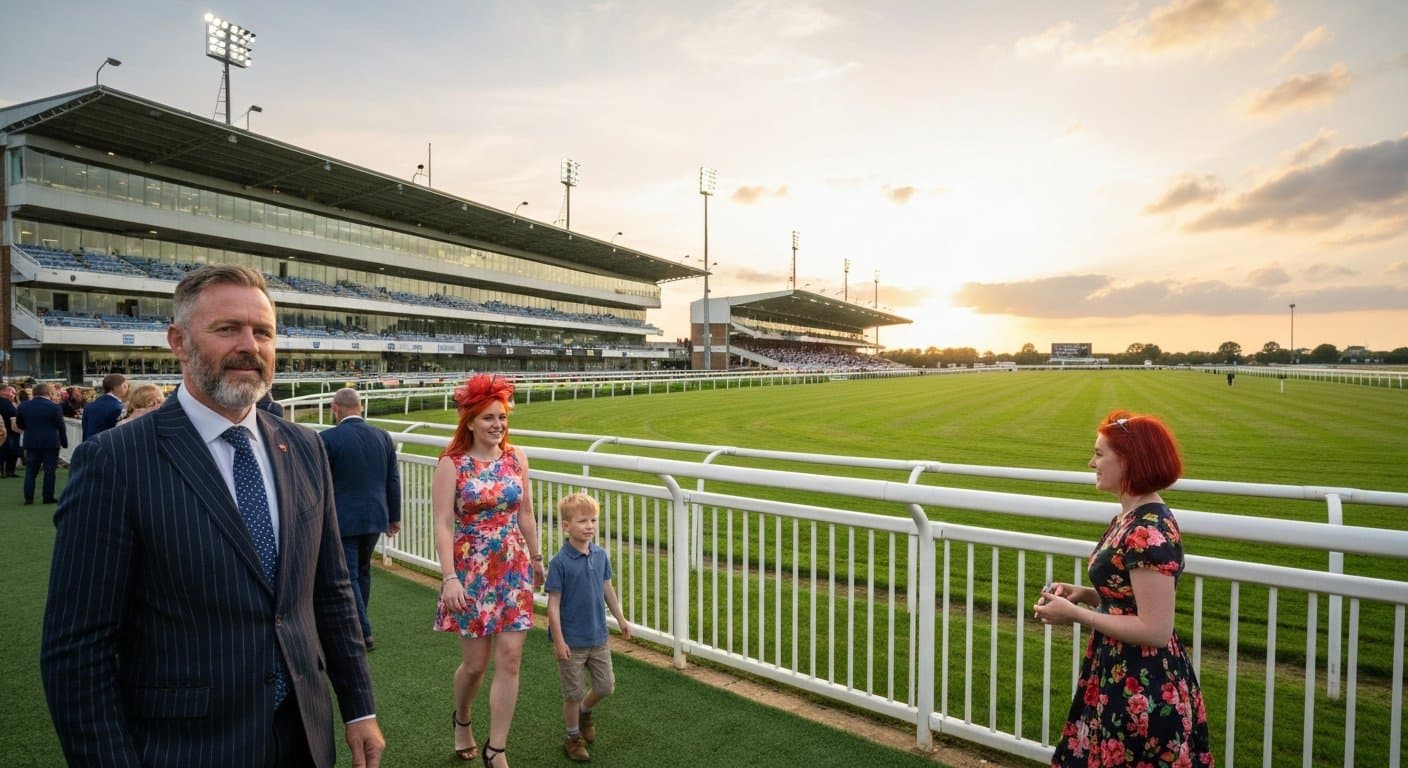
A Day Out at Wolverhampton Racecourse
Everything you need for a visit to Wolverhampton — getting there, what to wear, enclosures, food and drink, and tips.
Read more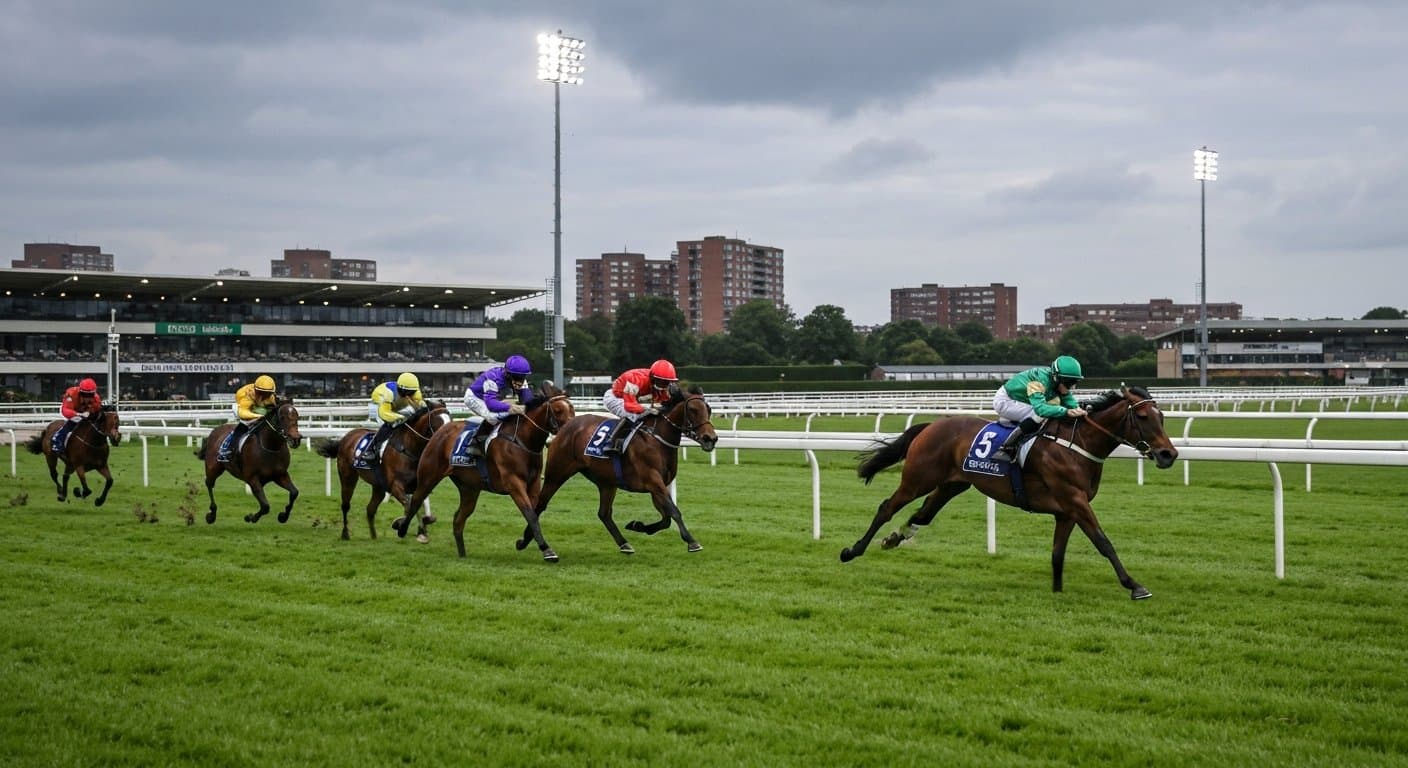
Evening Racing at Wolverhampton
Your guide to floodlit evening racing at Wolverhampton — the unique atmosphere, betting tactics and what to expect.
Read moreWolverhampton Festival Guide
Your complete guide to Wolverhampton Racecourse's all-weather festivals — the Winter Series, the floodlit evening meetings and what makes this Midlands Polytrack circuit Britain's most prolific race-day host.
Read moreResearch the field with the AI Race Predictor
Our model publishes calibrated win-probability estimates for UK races — a second opinion to understand a race, not tips. It's open about its record: it doesn't beat the market, and we show exactly how it does.
Work it out & learn the basics
Gamble Responsibly
Gambling should be entertaining and not seen as a way to make money. Never bet more than you can afford to lose. If you or someone you know has a gambling problem, help and support is available.