
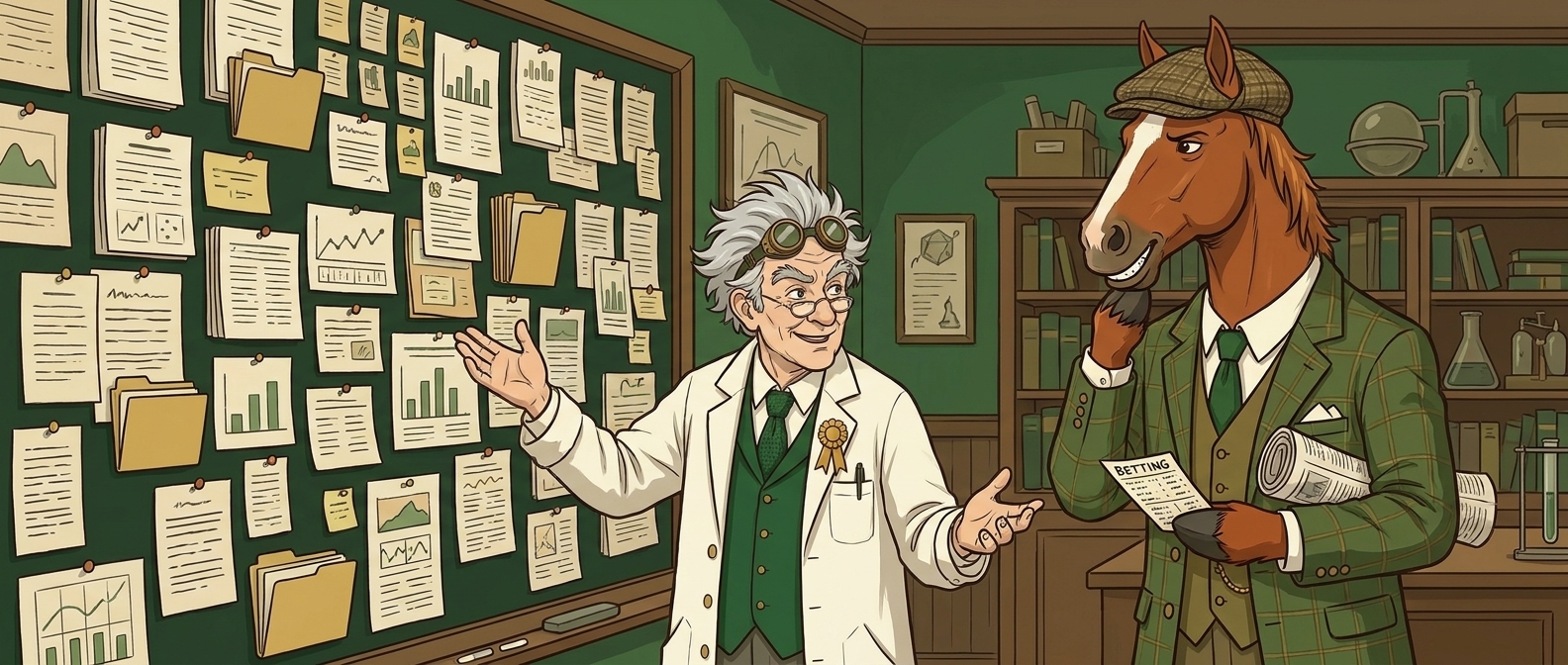


The claim
Pascal puts it the way most punters do. Both horses are favourites, so both should win, and stacking the two prices turns a couple of short returns into one tidy payout. If they are good enough to be favourites on their own, what is the harm in tying them together?
It is the sensible-looking end of multiples. A win double is one bet on two selections where both have to win, and the first winner's returns roll straight onto the second. You are not chasing a big-priced longshot accumulator, you are picking the most fancied horse in each of two races and asking them to do their job. The combined price is bigger than either single bet, so it reads like more reward for not much more risk.
The believing runs deeper than greed. People reason that if favourites win more often than any other runner, then doubling up on the two most-fancied horses must be the smart, low-risk way to chase a real return. The occasional landed double pays out memorably enough to paper over the many that fall at one leg, and the memory of that payout sticks far longer than the quiet losses.
The trap is hidden in one word. Most likely to win is not the same as priced to pay. The favourite is the most efficiently priced runner in the book, which is exactly why backing it blind already loses money. Tying two of them together does not fix that. It multiplies it. We took that claim and priced it against the 29,687 real British races in our sample, to see what the double actually returns, with nothing dropped to make it look kinder.
Why it feels safe
The appeal of a favourite double is that it feels like the responsible way to be greedy. A single favourite is a bit dull, the prices are short and the returns are small. A longshot accumulator feels reckless. The favourite double sits comfortably in between, and that middle ground is exactly where it does its damage.
Start with the horses. The favourite is the runner the whole betting market has decided is most likely to win, so picking it requires no skill or judgement, just a glance at the board. Picking two of them feels twice as sensible. You are not gambling on a hunch, you are following the crowd's best guess in two races at once, which carries a reassuring sense of doing the obvious right thing.
Then the price does its work. Multiplying two short prices together produces a number that looks generous next to either single bet. A pair of even-money shots becomes a 3-to-1 return. That jump in the potential payout reads as more reward, while the stake stays the same small flat amount, so the risk feels unchanged. More upside, same downside, is a powerful illusion.
Finally there is memory. When a favourite double lands, it lands as one clean, satisfying hit, and that moment is easy to remember. The dozens of slips that died when one leg got beaten are forgotten almost instantly, because a near miss on a multiple does not sting the way a clear loss does. So the highlight reel in your head is all winning doubles and no losing ones.
Every one of those feelings is real. None of them is profit. The double pays out less often than a single, the price you are getting is already shaded against you, and the maths underneath is quietly working in the opposite direction to how it feels.
Where the money goes
Here is the part most punters never see coming, and it is maths, not bad luck. A win double pays the two single-race prices multiplied together, and each of those prices already has the bookmaker's margin baked in. So you are not buying one fair price, you are buying two shaded ones and multiplying them.
Start with a single favourite. Backed blind to Starting Price across real British racing, it leaks −9.0p of every £1 staked. That is not because the favourite is a bad horse, it is the most efficiently priced runner in the book. The cost comes from the overround, the bookmaker's built-in margin, which runs at about 12% per race and climbs towards 30% in big fields of sixteen runners or more. That margin is shared out so that even the favourite is shaded a fraction short of its true chance.
Now stack two of them. A double multiplies the two legs rather than adding them, so the margins do not add, they compound. The margin working against you in leg one is multiplied by the margin working against you in leg two. The second leg does not rescue the first, it simply hands the bookmaker a second cut of the same slip. That is why the leak almost doubles, from -9.0% on a single to -17.1% on the double.
The pain arrives in a worse shape too. Because both horses must win, the double pays out far less often than a single, and the favourite only wins about a third of its races to begin with. So the same loss comes in fewer, lumpier hits. You can sit through a long losing run, land one tidy double, and still be well underwater, because the winners never come close to covering the doubled margin plus every leg that came down or was pulled up.

How we tested
We wanted the honest long-run figure, not a hot streak, so we built the test on real results and stripped out anything that could flatter it.
The sample is 29,687 real British races, settled and counted to 20 September 2026. For every race we took the favourite, the runner sent off at the shortest price, exactly as a punter reading the board would. Where two or more horses shared favouritism as joint-favourites, we split them rather than cherry-picking the one that happened to win, because in real life you do not get to know which way the dead-heat in the betting will break.
Every bet is settled to Starting Price, the official odds at the off, with no commission deducted and no clever in-running timing assumed. Stakes are flat, the same notional amount on every slip, so a few big-priced winners cannot be inflated by staking more on them after the fact. This is the plainest, most generous version of the bet we could build.
The single most important rule is how we treat the horses that do not complete. Only non-runners are voided. Every favourite that fell or was pulled up is counted as the losing bet it really is, and a race only counts where it has a recorded winner. Counting fallers and pulled-up horses properly is the difference between a polite-looking loss and the true one.
The double figure itself is an analytic estimate from the single-leg result. Because a double's return is the product of two independent favourite legs, and we have measured the single favourite's real return to SP across the full sample, the double's expected return follows directly from compounding that single-leg edge across both legs. No selective pairing, no survivorship, just the measured single-favourite return applied twice over.
The numbers
The headline is blunt. A double on two favourites returns -17.15% to Starting Price across the 29,687-race sample, on flat stakes, with fallers and pulled-up horses counted as the losers they are. In plain money, for every £100 you turn over you get back about £82.85. The leak is −17.1p of every £1 staked, and stake two hundred pounds a week on doubles like this and a year of it comes out at −£1,784.
Line that up against the single favourite. One favourite backed to SP returns -9.0%. The double returns -17.1%, very nearly double the single-leg leak. That is the compounding doing exactly what the maths said it would. You are not adding two small losses, you are multiplying two shaded prices, so the house edge is taken twice on the same slip.
The shape of the bet tells the other half of the story. The double needs both legs to land, and the favourite only wins 35% of its races to begin with, so the slip pays out far less often than a single bet ever would. The wins that do arrive are bigger, because the price is bigger, but they are rare and lumpy, and they never come often enough to cover the doubled margin plus all the legs that fell or were pulled up.
This figure is analytic. It is the expected value drawn from the measured single-favourite cost compounded across two legs, not one lucky or unlucky run, and it sits firmly in negative territory. There is no plausible version of the long run where this bet creeps back to break-even. A short burst can run hot through plain variance and briefly look like it works, but that is luck, not profit, and it vanishes the moment you play a meaningful number of doubles.
Across the 24 systems we test this way, not one makes a profit. The favourite double is not the gentlest loser in that set. It is one of the steeper ones.
The verdict
Did the data back up the idea that two favourites are the safe way to play multiples? No, and not politely. The double on two favourites returns -17.15% to Starting Price against 29,687 real British races, flat stakes, with fallers and pulled-up horses counted as the losers they are. It was never going to win, because it stacks two negative-edge bets and multiplies the margin instead of beating it.
The reason is the maths, not the horses. Backing one favourite already leaks −9.0p of every £1 staked, because the bookmaker's margin is baked into the price. Tie two together and you do not cancel that out, you stack it. Each leg drags its own losing edge, both have to land or the slip dies, and multiplying two shaded prices multiplies the house edge with them. The second leg does not rescue the first, it just gives the bookmaker a second cut. That is the whole story, and it is why this comes in as a steeper loser than any single favourite bet rather than the safe one.
There is no winning version to point you towards. The version that holds up best is two short, well-backed favourites rather than longer prices, because the favourite-longshot bias punishes every extra bit of price, so longer legs would cost you faster. But holding up best still means losing. The only honest use for this bet is entertainment, a small flat stake for the fun of two results going your way, with the loss accepted up front as the cost of the fun.
If you want to know whether anyone holds a real edge worth staking on, including us, we publish that either way, losses included, in the track record. The bottom line here is simple. A respectable-looking bet that quietly pays the bookmaker twice, and hands back about £82.85 of every £100 you put through it.