

The claim
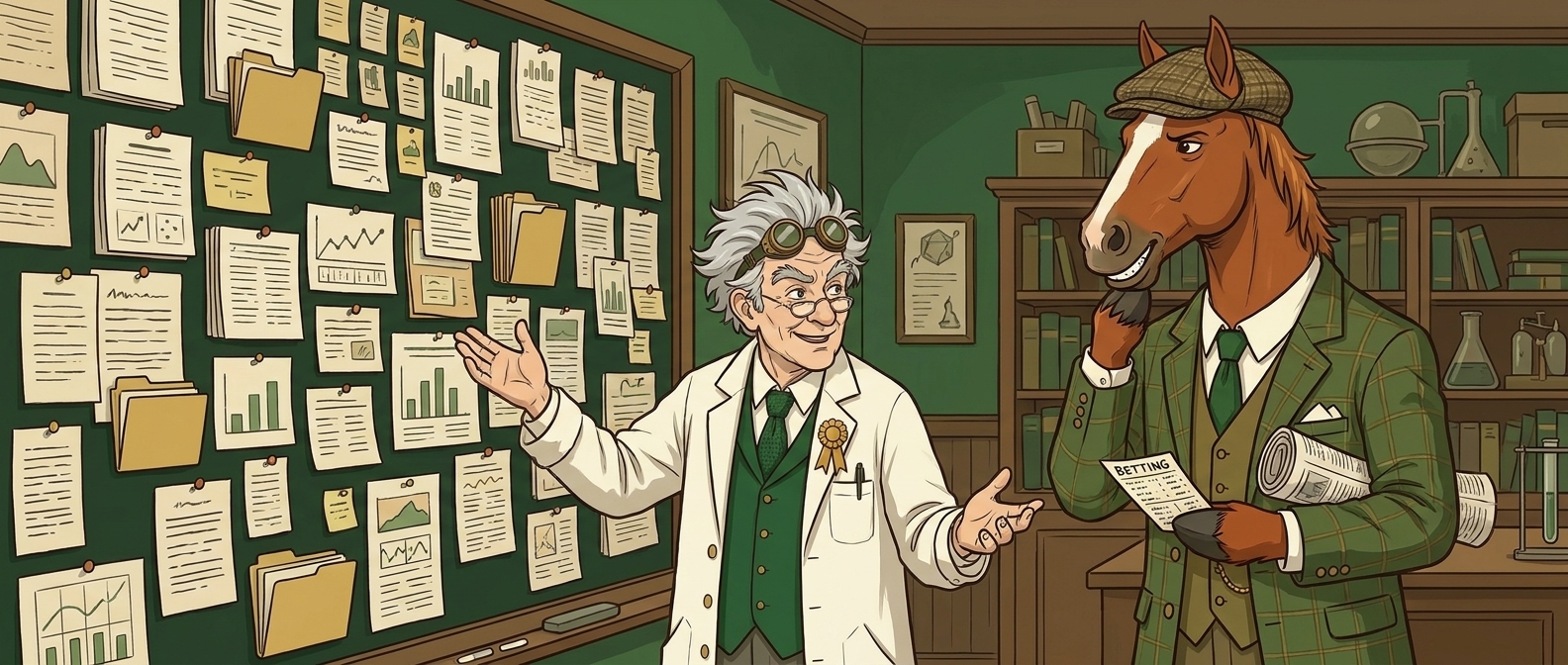
Nobody seriously sits down and argues that a random horse wins. The claim is quieter than that, and it is the one Pascal makes when the form book defeats him. If you cannot read the form anyway, one runner is as good as another, so you may as well stick a pin in the paper and let luck do the work. The favourite loses too, the reasoning goes, so a random pick gives you the same shot at a touch of action without the homework.
It is a comforting idea because it dresses giving up as a strategy. A pin in the racecard feels neutral, an honest coin-flip, the level baseline everyone else is straining to beat with their ratings and their tipster columns. If the favourite only wins about a third of the time, why sweat over the form at all? Throw the dart, take your chances, and call it luck not skill.
The specific belief we are testing is that a random selection is roughly fair: no edge, but no special disadvantage either, just a clean fifty-fifty with the racing gods. We wanted to know what a blind pick actually returns once it meets real prices, real fields and real results, with nothing clever behind it at all.
So we did the dullest possible thing. We backed a horse chosen at random in race after race after race, with no judgement of any kind, and let it run across the whole of British racing. No system, no angle, no information. The number that comes back is not a fair coin-flip. It is the price of bringing nothing to the race, and it is steeper than most people would ever guess.
Why people reach for it
The pull of the random pick is the occasional big-priced winner. Throw a dart, land a 16/1 shot, and that one giddy afternoon drowns out the dozens of quiet losers that funded it. You remember the day you guessed and got it spectacularly right, because it felt like proof that you do not need the form book, that luck is as good a guide as anybody's tips. You do not remember the long, grey run of beaten slips in between, because nothing about them sticks.
There is also a comfort in the luck-not-skill story. If picking winners is hard, and the favourite only obliges about a third of the time, then maybe the whole thing really is a lottery and you might as well let fortune decide. That feels honest, even humble. It quietly ignores that the prices are set precisely so that guessing is a paid-for privilege, not a free coin-flip, and that a blind pick keeps dragging you towards the worst-value end of the book.
The random pick is also the lazy person's hedge against being wrong. If you back a fancied horse and it loses, that stings, because you backed your own judgement and your judgement failed. If you stick a pin in and it loses, well, it was random, so there is nobody to blame and nothing to feel foolish about. The dart absolves you.
And a handful of races genuinely can run hot. Over a short burst the swings are wide enough that a random punter can finish in front by pure luck, which is exactly the trap. One lucky session looks like vindication, feels like a method, and tells you nothing at all. Stretch the sample and that cover vanishes completely.
Where the money goes
A random pick is a blind draw from every runner in the race, so what it returns is just the average price you are charged across the whole card, minus the bookmaker's cut. And every British race is built to take a cut. Add up the chances implied by all the prices and they come to more than 100%: the extra is about 12% per race, and it climbs towards 30% in big fields of sixteen runners or more. That surplus is the overround, the house margin, and a dart-throwing punter pays the full whack of it because they have no information to dodge it.
That alone would sink you. But the random pick has a second, heavier problem, and it is why this loses so much more than backing the favourite. The favourite is the part of the market the crowd over-pays for, which makes it the fairest-priced runner on the card thanks to the favourite-longshot bias. A blind pick has no such cushion. It scoops up the longshots as readily as the favourite, and longshots are where the price is shaved hardest of all against you. So you are not landing on fair-value horses on average. You are wandering, again and again, into the padded big-priced end of the book where every pound is worst spent.
There is no compounding rescue and no clever staking fix. Flat stakes return a fixed share of turnover, and chasing with bigger stakes only enlarges the same negative edge until a losing run wipes you out. The variance is wide in the short run, so a random punter will hit the occasional 20/1 winner and feel like a genius, but every one of those is already paid for, and over-paid for, by the long run of losers in between. Count the fallers and pulled-up horses honestly as the losing bets they are, and what it really costs gets steeper.

How we tested it
We kept the test as plain as the bet. For every race in the sample we backed a horse chosen at random from the field, with no judgement of any kind applied. No form, no ratings, no market read, no filtering by code, course or field size. A pin in the racecard, repeated across the whole of British racing.
The sample is 29,687 real GB races. Stakes are flat, the same notional unit on every bet, so the result is a clean return on turnover and no staking progression is hiding the true cost or flattering it. Everything is settled to industry Starting Price, the official odds returned as each race goes off. That is deliberately generous: SP carries no commission and no allowance for a price drifting against you, so a real punter taking real prices would do a touch worse than the figure we report.
The honesty test is in how we count the bets that do not finish. Every horse that fell, unseated its rider or was pulled up is settled as the losing bet it really is, because your whole stake is gone whether the horse completes or not. Older, friendlier-looking numbers quietly dropped those non-finishers, which deleted a pile of losing stakes and flattered the result. We count them. Joint-favourite ties and dead-heats are split so no phantom result can leak in and nudge the figure.
We then ran the whole thing as one long ledger and read off the return on every pound staked, plus how often the random pick actually won, plus a 95% range so you can see how tight the result is. The point was never to find an angle. It was to measure, as cleanly as possible, what a punter who brings nothing to the race hands the bookmaker.
The numbers
A random horse returned -21.38% to Starting Price across 29,687 real British races. In plain money, for every £100 you staked you got back only about £78.62 over the long run. The 95% range on that figure is [-22.5,-20.3], which matters: it means the result is real and durable, not a quirk of a small sample or a stretch of bad luck. Run it again and you land in the same hole.
A horse picked blind from the whole field wins 13% of the time, well short of the favourite's roughly one in three. That gap is the whole story. You are winning far less often, and the prices you collect when you do win are not big enough to cover the long run of losers in between, because the overround has already been shaved off every one of them.
The headline comparison is the one to hold on to. Backing the favourite returns -8.98% on this same honest data. A random pick returns -21.38%, roughly two and a half times as much. The extra leak is not random noise. It is the cost of having no information: the favourite soaks up the over-bet part of the market and so loses least of the two, while a blind dart keeps landing on the padded longshots that lose most. You pay the house margin and the bad-value tax at the same time.
Stake two hundred pounds a week on random picks and a year of it comes out at −£2,224. The more races you play, the more reliably the result converges on that -21.4%, because the law of large numbers works for the bookmaker, not for you. And remember this is to SP with no commission, so the real-world figure is worse again.
The verdict
No. A random horse does not work, and that makes it the cleanest illustration on this whole page of what information is actually worth at the racecourse. It returned -21.38% to SP across 29,687 real British races, flat stakes, with fallers and pulled-up horses counted as the losing bets they are. That number is simply the bookmaker's margin plus the cost of landing blind on the big-priced end of the book, paid by a punter who brought nothing to the race.
It is not a strategy and it suits no one as a way to make money. The pin-in-the-paper coin-flip is a comforting story, but the prices are set precisely so that guessing is a paid-for privilege, and a blind pick keeps landing on the worst-value runners on the card. That is why it costs roughly two and a half times what backing the favourite does. A random horse is not a neutral baseline you could beat with a bit of nous. It is the no-information floor, and it is a long way below break-even.
Its one honest use is exactly that: a yardstick. The -21.38% figure proves the overround is real and unavoidable, and it puts a hard number on what bringing zero judgement costs you. Everything else on this page should be measured against it.
Past performance is no guide to the future, and this is SP-only with no commission, so real life is worse again. The takeaway is a clear one: a blind pick costs −21.4p in every pound, and that holds steady the more you play. It is a useful number to carry into every other system on this page, because not one of the 24 we tested makes a profit, and a random pick is one of the costliest of the lot. The value here is knowing exactly what you are up against.