
One number for everything
One number for everything
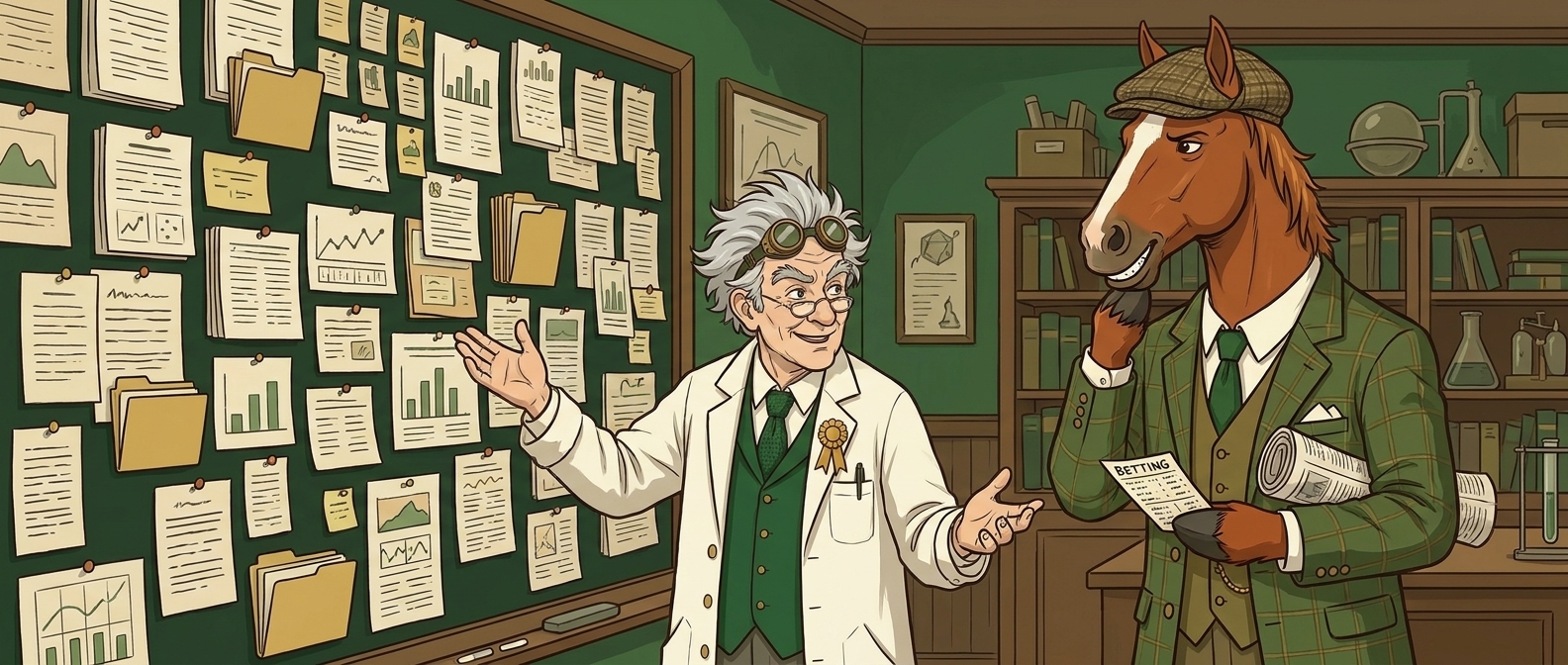
Everyone who has ever sat down with a racecard has felt it. You read the form, the going, the draw, the trainer's recent runners, the way the horse finished last time, and slowly a picture forms. This one has a chance. The price is too big. You have spotted something.
Here is the awkward part. Every other serious punter has done the same study, and so has every layer with money on the line, and all of that work has already been poured into a single number before you stake a penny: the price.
So we asked a simple question. How good is that number? If the market squeezes a horse's whole profile down to one figure, how close does the figure land to the truth?
We took 218,437 runners across 28,175 races, from October 2023 to June 2026, and for every price we compared the chance the market implied against how often horses at that price actually won.
The answer is the honest version of two things punters usually believe separately, and both halves matter.
The price is a remarkably good estimate of a horse's real chance. Across every band we looked at, the more likely the market said a horse was to win, the more often it won. The order is never wrong.
And the price still carries the margin in every single band. The real win rate sat just below the market-implied rate every time, and a level stake to starting price lost money everywhere, from 2.5% on odds-on shots to 62.7% on horses sent off at 100/1 and bigger.
The rest of this page shows how form turns into a price, why that price is so hard to argue with, and what the data is actually good for. (Every figure is to industry starting price, over a 2.7-year window, with fallers and pulled-up horses counted as losers. We explain exactly how below.)
Why you think you can beat it
Why you think you can beat it
The belief that you can read a horse better than the price is not stupid. It is built on three things that are all partly true.
The first is that form study works. It genuinely does tell you about a horse. A course winner returning to its track, a stayer dropping back to a trip that flatters it, a horse coming to hand after a break off the track. These are real signals, and reading them is the difference between watching racing and understanding it.
The second is that the price moves, all day, right up to the off. If the number were already perfect, why would it drift and tighten? Every shift looks like a fresh chance to land on the right side of a mistake.
The third is the outsider that should have been shorter. Everyone remembers the 50/1 winner they fancied, or the 16/1 shot that looked a 6/1 chance on the form. Those memories are vivid, and they make the long price feel like the place where the market gets careless.
Each of these has a kernel of truth, and we are not going to pretend otherwise. Form study is how you understand a race. Prices do move on real information. And the market is not flawless.
The problem is not that any of this is wrong. The problem is what the price already contains by the time you see it, and what gets added on top. That is the catch, and it is the same catch whether you are backing a red-hot favourite or a forgotten outsider.
The price already knows
The price already knows
A starting price is not the bookmaker's opinion. It is the settled result of everyone's opinion, weighted by money. Your form study, the trainer's intentions, the stable's quiet confidence, the professional backer's model, the late drift because a horse looked edgy in the paddock. All of it lands in the price before the off.
That is why the price is such a good estimate. It is the crowd's best guess, and on average the crowd is very hard to beat, because to beat it you have to know something that thousands of other interested, motivated people do not.
Then one more thing gets added, and it is the thing that decides the whole game. The margin.
A bookmaker does not frame a market to add up to a 100% chance. They frame it to add up to more, and the surplus is their built-in edge. Across our races that overround averages about 12% per race, and it climbs towards 30% in big fields of 16 runners or more. It is not a fee you can see on a receipt. It is baked into every price, which means every price is a little shorter than the horse's true chance.
So the number you are trying to out-think is the combined work of the entire market, and then it is shaded against you on purpose. You are not betting against the bookmaker's guess. You are betting against the crowd's guess, with a tax on top. The price already knows almost everything you know, and it charges you for the rest.

How we tested it
How we tested it
We wanted the plainest possible measure: at each price, how often does a horse actually win, and how does that compare with the chance the price implies?
So we took every runner in our database that had a starting price and a known finishing position, and we sorted them into price bands, from odds-on all the way out to 100/1 and bigger. For each band we worked out two numbers. The actual win rate is simply winners divided by runners. The implied win rate is what the starting price says the chance should be, averaged across the band. Then we settled a level 1-point stake on every runner, to industry starting price, and measured the return.
Methodology
Runners: 218,437 priced runners across 28,175 races, Flat and jumps combined, October 2023 to June 2026. Prices: industry starting price (SP). We do not hold Betfair starting price for this window, so an exchange backer would usually have got a bigger price. What counts: every runner with a price and a finishing position. Fallers and pulled-up horses are counted as losers, not quietly dropped. Win rate: winners divided by runners in each band. Return: flat 1-point level stake to SP, non-winners lose the stake.
Two honest limits before the numbers. First, this is starting price, not the exchange, so the real-world picture for a Betfair backer is a little kinder, though the shape of it does not change. Second, in the deepest longshot bands the winners are rare, so we report the big, well-populated price bands with confidence and we do not quote a precise win rate for thin cells, such as 50/1-plus horses split out by code. The method was fixed before we read the results, and anyone with the same data can re-run it.
What the numbers showed
What the numbers showed
Here is the whole relationship between price and reality, in one table. Read it from the top down, from the shortest prices to the longest.
| Price (SP) | Runners | Actually won | Price implied | Return to SP |
|---|---|---|---|---|
| Odds-on (under evens) | 4,327 | 61.2% | 62.6% | −2.5% |
| Evens-2/1 | 24,757 | 32.4% | 34.4% | −5.8% |
| 3/1-4/1 | 32,326 | 19.2% | 21.3% | −9.8% |
| 5/1-6/1 | 24,726 | 13.5% | 15.0% | −9.9% |
| 7/1-9/1 | 27,314 | 9.7% | 11.2% | −13.5% |
| 10/1-13/1 | 23,578 | 6.9% | 8.3% | −16.5% |
| 14/1-19/1 | 21,778 | 4.9% | 6.0% | −18.6% |
| 20/1-32/1 | 23,057 | 3.1% | 4.1% | −23.8% |
| 33/1-49/1 | 13,100 | 1.9% | 2.7% | −30.9% |
| 50/1-65/1 | 5,299 | 1.0% | 2.0% | −50.0% |
| 66/1-99/1 | 7,234 | 0.8% | 1.4% | −45.0% |
| 100/1+ | 10,941 | 0.3% | 0.7% | −62.7% |
The price is a good estimate
Look at the two percentage columns. They track each other all the way down. When the market sent a group of horses off at an implied 34.4% chance, horses like them won about 32.4% of the time. When it implied 4.1%, they won about 3.1%. Across more than a fifth of a million runners the sequence holds: shorter price, higher real win rate, every step of the way. As a ranking of which horse is most likely to win, the market is close to flawless.
But it is always a little optimistic
Now compare the two columns against each other rather than down. In every single band, the horses won less often than the price implied. 61.2% against an implied 62.6%. 32.4% against 34.4%. 0.3% against 0.7%. That consistent shortfall is not bad luck. It is the margin, the overround we described above, showing up as a small, permanent gap between what you pay for and what you get. It is the floor the whole game is built on.
And it gets worse the longer the price
This is the part that surprises people, because it runs against instinct. The value does not improve as the price lengthens. It collapses. A level stake on odds-on shots lost 2.5p in the pound. By 20/1 to 32/1 it was losing 23.8p. At 100/1 and bigger it was losing 62.7p in every pound. The long price, the one that feels like the market being careless, is in fact where the market charges you the most. This is the favourite-longshot bias: outsiders are systematically over-bet, so their already-slim true chance is wrapped in the worst value on the card. (The climb is not perfectly smooth from one band to the next, where the rarest winners make small samples jumpy, but the direction is not in any doubt.)
It holds across the codes
The same shape turns up whether horses run on the Flat or over jumps. Overall win rates differ by code, mostly because field sizes do: a chase runner won 18.0% of the time across our data, a Flat runner 11.1%, simply because chases have fewer rivals to beat. But within each code the pattern is identical. Shorter is sharper, longer is dearer, and nothing is priced to make you money.
The verdict
The verdict
So, does a horse's price reflect its real chance of winning? Mostly yes, and that is exactly why it is so hard to beat.
The market takes everything you study, the form and the going and the draw and the stable's quiet confidence, adds the thousands of other people studying the same things, settles it into one number, and then shades that number in its own favour. The result is an estimate so good that across 218,437 runners it never once got the order wrong, and a price so loaded that every band on the card lost money to starting price.
This is structure, not bad luck. A better day at the form does not change it, because your form study is already in the price. Backing outsiders does not escape it, because the longest prices carry the worst value of all. There is no corner of the market where the tax does not apply.
That does not make form study pointless. It makes it useful for the right thing. The honest use of all this is to understand a horse's true chance well enough to see why the market made it the price it is, rather than to chase a formula that turns reading a race into winning at it. The price is the best estimate of a horse's chance you will find anywhere. Treat it as the thing to understand, never as the thing to beat.
If you want the mechanics of how a price converts into an implied chance, we lay it out in what the odds actually mean. For what happens when you turn these patterns into real betting rules, every single-pick system we have tested loses too: see do betting systems work and exactly how we settle every bet. And we hold ourselves to the same standard: our own model's record is published in the open, losses and all, because if a price could be reliably beaten, nobody would be giving the method away.
Bet responsibly. Nothing on this page is a tip or betting advice. It is research into how racing markets price chance. If you bet, stake only what you can afford to lose, and if it stops being fun, stop. Help is at GamCare, GambleAware and GAMSTOP. 18+.