
Founder & Editor · Last reviewed 2026-07-08
Introduction
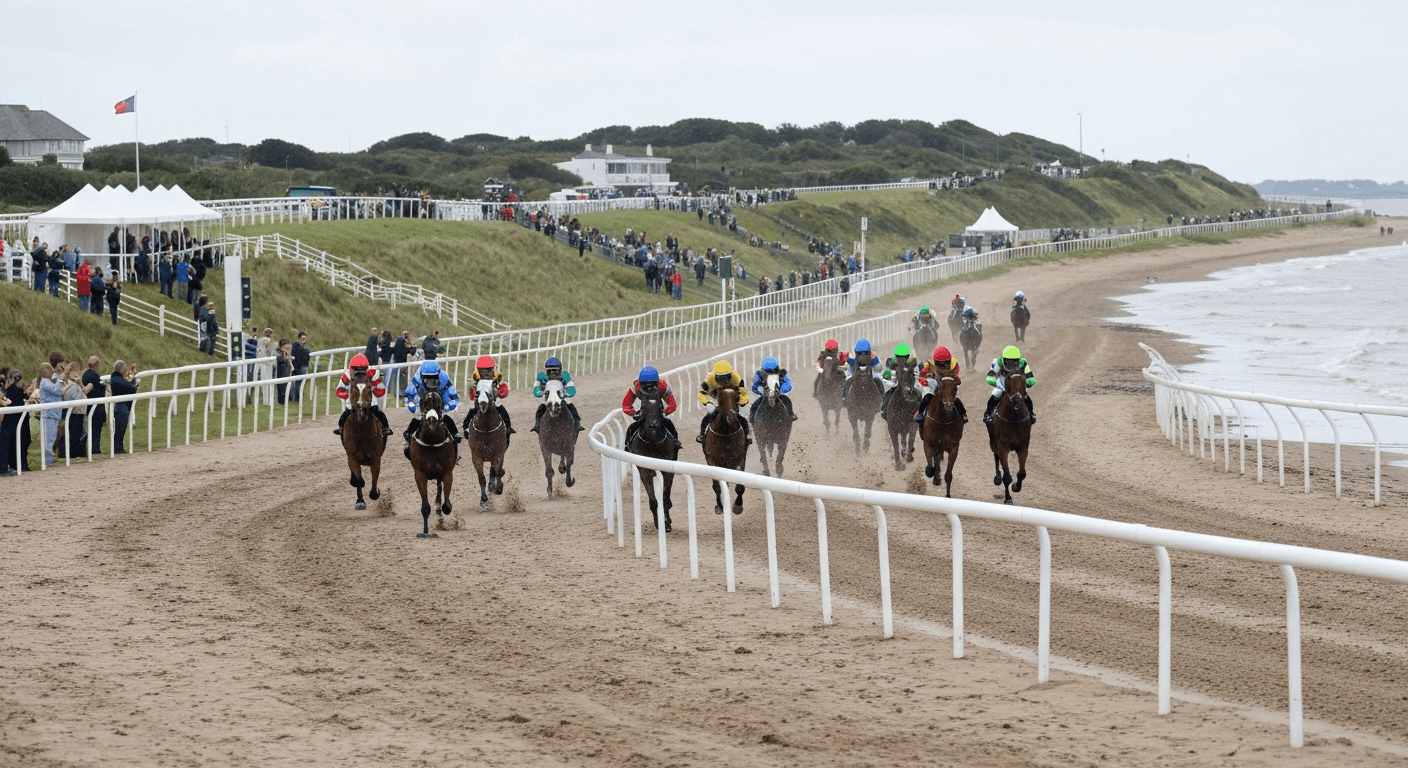
Laytown Racecourse stages the only beach race meeting run under the Rules of Racing in Europe. Racing takes place on the strand at Laytown, Co. Meath, in the Republic of Ireland, about 44km north of Dublin and 12km south of Drogheda on the Irish Sea coast. It is a flat-only course, run on the tidal sand of the beach rather than any permanent circuit, and the fixture is held on a single day each September, timed around low tide so the strand is fully exposed.
The meeting is run by the Laytown Races committee, chaired by Joe Collins, with Jessica Cahalan as secretary and manager since January 2023. She succeeded Kevin Coleman, who held the role for 25 years and retired at the end of 2022. Racing is overseen under the Rules of Racing, historically the Turf Club and now the Irish Horseracing Regulatory Board.
The first recorded race meeting at Laytown was in 1868, held in conjunction with the Boyne Regatta, and local folklore credits the parish priest with organising an early meeting in 1876. The nationalist politician Charles Stewart Parnell served as one of Laytown's first stewards, and Aga Khan III and the Begum attended in 1949. In the 1950s and 1960s trainers used the sand to prepare runners for the Galway Festival, and the day grew into a beachside carnival. A serious 1994 incident reshaped the meeting into its modern, safety-first form, covered in the history.
For how the tidal strand actually rides, see the track.
On this page
Where to Bet
Place your bets with a trusted, licensed bookmaker.

Promo code BETFRED50. New customers only. Register, deposit with a Debit Card, and place a first bet of £10+ at Evens (2.0)+ on Sports, to be settled within 7 days, to get £30 in Sports Free Bets and £20 in Bet Builder Free Bets within 24 hours of settlement. 7-day expiry. Eligibility & payment exclusions apply. Full T&Cs apply. Take Time to Think. BeGambleAware.org. 18+. Full T&Cs.

Promo code R30. New UK customers only, 18+. Register, deposit £10 or more, then place a £10 single cash bet at odds of 1/2 (1.5) or greater on any sports market (excluding Virtuals). Once the qualifying bet settles you get £30 in Free Bets (3 x £10) — the qualifying bet can win or lose. Free Bets are valid on any sports market excluding Virtuals, expire in 7 days, are non-withdrawable and must be used in full. Excluded deposit methods apply (including PayPal, Apple Pay, Skrill and NETELLER). Named bets such as Lucky 15 do not qualify. If you cash out the qualifying bet, or it is voided, you are no longer eligible for the offer. Ends 31.12.26. Full T&Cs apply. Please gamble responsibly. BeGambleAware.org. 18+. Full T&Cs.

Promo code BET40GET20. New UK customers, 18+. Register with the code and place a first bet of £40 or more at Evens (2.0) or greater. Receive 2 × £10 free bets: the first credited automatically once the qualifying bet settles, the second 24 hours later. Free bets must be placed at minimum odds of 4/1 (5.0), expire 24 hours after credit, and the free-bet stake is not returned with winnings. Debit card deposits only. Take Time to Think. BeGambleAware.org. 18+. T&Cs apply. Full T&Cs.

50% of your first-day net losses refunded as a free bet, capped at £25. New UK customers aged 18+ only. To qualify, deposit and place a first bet of £10 or more on any sport at minimum odds of evens (2.00), then place at least two further bets on different events, each worth at least 50% of your largest bet, all at evens (2.00) or greater. Losses are counted from your first settled bet until 23:59 the same day. Place a qualifying £10+ bet and you are guaranteed at least a £5 free bet. Bets placed at SP, void bets, cashed-out bets and bets struck with free bets do not count towards the offer. The free bet is credited the day after your qualifying bets settle and must be used within 7 days, after which it expires. It can be used at odds from 1/4 (1.25) up to 250/1 on singles and straight accumulators, but not on Trixie, Patent or Yankee style multiples. Free-bet stake is not returned with winnings. One offer per person, household, address, IP address and device. E-wallet deposits may not qualify, so check the cashier before depositing. Customers registered with GAMSTOP cannot claim. KYC identity verification must be completed before the free bet is credited. Take Time to Think. BeGambleAware.org. 18+. T&Cs apply. Full T&Cs.

New customers, 18+. Choose the sports bonus at sign-up, make a first deposit and receive a 100% bonus up to £50 in your Sports Bonus balance. To convert the bonus to cash, wager it 10x within 30 days. Single bets below Evens (2.00) do not qualify; accumulators do not qualify if any selection is below 1/2 (1.50). Virtual Sports, voided, cancelled, drawn, cashed-out and free-bet wagers do not count towards wagering. Only the first settled bet per event counts. Withdrawing before the wagering requirement is met forfeits the bonus balance including bonus winnings. Real-money funds are used before bonus funds. Deposits via Skrill or Neteller are not eligible. Not valid in conjunction with other promotions. Odds, bet and payment limits apply. 10bet general and promotion T&Cs apply. BeGambleAware.org. 18+. Full T&Cs.

New customers in Great Britain and Republic of Ireland, 18+. Place a £10 fixed-odds qualifying bet at minimum odds of 1/2 (1.50) — single or each-way (only the win part counts), pre-event or in-play, not cashed out early, within 28 days of opening the account. Receive up to £60 in bonuses credited over three days: 3 × £10 fixed-odds free bets (the first on settlement, then 24 and 48 hours later) plus 3 × £5 Total Goals FOOTBALL spread bets, 3 × £5 racing Winning Favourites spread bets and a £1 racing Race Index spread bet (the spread bets need a full spread-betting account). Free-bet stakes not returned with winnings; free bets valid 28 days from issue. IMPORTANT: the £5 credits are SPREAD bets — sports spread betting carries the risk that losses can exceed your stake. Sports spread-betting customers do not have Financial Ombudsman or FSCS recourse. Take Time to Think. BeGambleAware.org. 18+. T&Cs apply. Full T&Cs.

Promo code WELCOME15, entered under My Bonuses after registering. New UK customers, 18+. Place a first qualifying bet of at least £10 from your cash balance at odds of evens (2.0) or greater within 7 days of opening the account. Once the qualifying bet fully settles you receive £15 in free bets, credited as 3 x £5 tokens with set uses: one £5 accumulator free bet (minimum 4 legs, each leg at 2/5 or bigger), one £5 sports free bet (any market at evens or bigger) and one £5 Sub Cover free bet (selected football player markets at evens or bigger). Free-bet stakes are not returned with winnings. Free bets expire 7 days after they are credited. Void, cashed-out and partially cashed-out bets do not qualify. One offer per customer. Confirm the current terms on BetGoodwin's own welcome-offer page before claiming. Take Time to Think. BeGambleAware.org. 18+. T&Cs apply. Full T&Cs.

New UK customers, 18+. Minimum deposit £10. Place a £10 qualifying single at minimum odds of 1/2 (1.50), settled within 14 days. Receive £30 in free bets (stake not returned), split £20 for sportsbook use (2 x £10) and £10 for Bet Builder only (2 x £5); Bet Builder does not cover horse racing. Free bets must be accepted within 7 days and expire 7 days after acceptance. No promo code required. Best Odds Guaranteed on UK & Irish racing, subject to having staked over £25 in the previous seven days. Operated by LiveScore Betting and Gaming (Gibraltar) Ltd, UKGC 56859. Confirm the current terms on LiveScore Bet's own promotions page before claiming. Take Time to Think. BeGambleAware.org. 18+. T&Cs apply. Full T&Cs.
18+. BeGambleAware.org
The Track
The Track
Laytown is unlike any other track under the Rules of Racing, because there is no track for 364 days of the year. Racing takes place on the exposed strand at low tide, and a temporary course is marked out on the wet sand for the single September fixture before being dismantled again. The full temporary course runs to about seven furlongs.
The layout is straight and near level, following only the slight natural curve of the bay, so there is no meaningful handedness to speak of and no bends. Since the safety reforms that followed the 1994 accident, when the old U-bend at Bettystown was removed, every race is run over 6 or 7 furlongs on that straight course. There are no permanent rails; a temporary running rail is erected for the meeting and taken down afterwards. For more on how the course is set out on the day, see The Course Map, and for the race programme itself see The Races.
The going is dictated by the sea. As the tide retreats it leaves compacted, wet sand that rides fairly firm and fast, so fast-ground horses tend to be suited by the surface. There are no official going descriptions in the conventional sense, and the sand differs slightly every year.
On draw and pace, the dossier is clear that there is no reliable conventional draw bias: fields are small, the runners race in a straight line, and the sand changes from year to year. Percentage-of-rivals-beaten figures have leaned towards high draws, but this is reported as likely a small-sample effect rather than a confirmed bias, so it should be treated as a caveat, not a fact. Front-runners are favoured over both trips and hold-up horses fare poorly. These are course characteristics only, not a betting steer; the honest form angles are covered in Form and Betting.
Laytown keeps no course records or standard times, a consequence of the once-a-year fixture and a surface that resets each year. As a single indicative figure, the 7-furlong race on 4 September 2025 was recorded at 1m 24.47s.
Confirmed track facts
| Feature | Detail |
|---|---|
| Configuration | Straight, near level, following the bay's slight natural curve |
| Handedness | None (straight course) |
| Surface | Sand (tidal beach strand) |
| Race distances | 6f and 7f only (since post-1994 reforms) |
| Temporary course length | About 7 furlongs |
| Rails | Temporary running rail, erected and removed each year |
| Going | Firm, fast wet sand; fast-ground horses suited |
| Draw bias | No reliable conventional bias; high-draw lean reported as likely small-sample effect |
| Pace bias | Front-runners favoured over both trips; hold-up horses fare poorly |
| Course records / standard times | n/a (none published) |
| Indicative time | 7f in 1m 24.47s (4 September 2025) |
The Course Map
Course map and layout
For 364 days a year Laytown has no course to map. Everything is brought to the strand for the meeting and taken away afterwards, so the layout is temporary by design. The racing surface is the exposed wet sand itself, marked out as a straight, near-level course that follows only the slight natural curve of the bay. The full temporary course runs about seven furlongs, with races staged over 6 or 7 furlongs and a small fenced spectator area on the beach near the winning post. There are no permanent rails; a temporary running rail is erected to mark the track and dismantled once racing is done (see the track).
Spectators do not watch from the sand. The viewing sits above the strand on an elevated grassy field and a mound overlooking the bay, with a small fenced area on the beach near the winning post. The race field also holds the temporary marquees where jockeys change and horses are weighed, along with catering, bars and betting. The only permanent structure on the whole site is a toilet block. More on the viewing areas is in enclosures and stands.
The Races
The Races
Laytown is unusual among racecourses in that it has no signature contest to build a section around. The strand stages no Pattern, Graded or black-type races, and none of its events carry black type of any kind. The whole card is made up of handicaps, maidens and claiming or similar contests, run over 6 and 7 furlongs on the straight temporary course, with prize money for each race set below €10,000. At Laytown the day itself is the occasion rather than any single race, and the contests carry sponsor and local names that change from one year to the next. For how that straight, tide-dependent strip of sand is laid out, see the track.
Because there is no fixed feature roster, the most useful record is the most recent card. The 2025 meeting was held on Thursday 4 September and featured six races, including a claiming race alongside maidens and handicaps, all over 6f or 7f. The off-times are dictated by the tide, scheduled around low water so the strand is fully exposed and safe, which is why Laytown's races run unusually late in the day and shift year to year. One 7-furlong race on 4 September 2025 was timed at 1m 24.47s, though Laytown keeps no official course records given the once-a-year fixture and a surface that changes every year.
The dossier does not confirm the full 2025 finishing order or the individual race titles, distances and winners, so those cells are marked "n/a" below.
2025 card (Thursday 4 September 2025)
| Race | Off-time | Distance | Type | Winner |
|---|---|---|---|---|
| 1 | 16:30 | n/a | Handicap, maiden or claiming | n/a |
| 2 | 17:05 | n/a | Handicap, maiden or claiming | n/a |
| 3 | 17:40 | n/a | Handicap, maiden or claiming | n/a |
| 4 | 18:10 | n/a | Handicap, maiden or claiming | n/a |
| 5 | 18:40 | n/a | Handicap, maiden or claiming | n/a |
| 6 | 19:10 | n/a | Handicap, maiden or claiming | n/a |
All six races were run over 6f or 7f; the dossier confirms the card contained a claiming race, maidens and handicaps but does not map each type to a specific race.
The next fixture is scheduled for Thursday 10 September 2026, with tickets on sale. The 2026 off-times had not been set at the time of compiling this guide, as they are confirmed closer to the day once the tide times are known. For the meeting itself and how to plan a visit, see festivals.
Records and Stats
Records and stats
Laytown keeps almost none of the records other tracks publish. Because the meeting runs once a year on a tidal strand whose surface shifts every September, there are essentially no official course records or standard times, and none are published. The only indicative time to hand is the 7-furlong race on 4 September 2025, recorded at 1m 24.47s, a one-off figure rather than a benchmark. For how the card is framed, see the races.
Attendance is reported only in round terms. Horse Racing Ireland states that crowds in excess of 5,000 attend every year, and no more precise figure is published. Numbers were higher in the early 1990s carnival era, before the post-1994 reforms moved the crowd off the beach and confined it to the race field and a small fenced area near the winning post; the background to that change is covered in history.
There is no dominant trainer or jockey record, given only six races a year and no graded contests (prize money sits below EUR 10,000 per race). Champion jockeys who have won here include Colin Keane, Ruby Walsh, Joseph O'Brien, Pat Smullen and Declan McDonogh. A Laytown winner is often the hardest of the Irish courses to tick off: Mark Enright completed the full set at Laytown in 2021. Trainer Jamie Osborne is linked to the meeting through the Melbourne 10 ownership group, which buys some horses specifically to run on the sand.
History
History
The first recorded race meeting at Laytown took place in 1868, staged in conjunction with the Boyne Regatta. Local folklore credits the parish priest with organising an early meeting in 1876. From the outset the fixture carried a strong civic flavour: Charles Stewart Parnell, the nationalist politician, served as one of Laytown's first stewards, and Aga Khan III and the Begum attended in 1949.
Through the 1950s and 1960s trainers used the strand and its sand to prepare runners for the Galway Festival, and the day grew into a full carnival, with traders, bookmakers and amusements spread across the beach. That era ended abruptly on 4 August 1994, when a horse was spooked, reportedly by a small stream on the course, and bolted into the crowd, causing panic among the other runners. Three horses had to be put down and several jockeys were injured, one of whom, Micky Cleary, never rode again.
A Turf Club safety review followed, backed by a warning from the ISPCA, and it reshaped the meeting for good. The fixture was moved earlier in the year, the U-bend at Bettystown was removed to create a straight course, and races were confined to 6 and 7 furlongs. Field sizes were cut, horse headgear such as blinkers was banned, only horses aged four and older were allowed to run, and apprentices claiming more than 5lb were barred from riding. Traders, bookmakers and vehicles were cleared off the beach, with the crowd confined to the race field and a small fenced beach area. These conditions still govern the modern meeting, as covered in the races and form and betting.
Two later interruptions stand out. The 2002 meeting was abandoned after heavy rain made the sand unsafe, coinciding with the withdrawal of long-time sponsor Guinness, and the 2020 fixture was cancelled during the COVID-19 pandemic, with the 2021 meeting rescheduled to 1 November. A commemorative book, Laytown Strand Races: Celebrating 150 Years, was published in 2018. For the people who have shaped the meeting, see legends.
The Legends
Legends of Laytown
Laytown does not lend itself to legendary horses. With a single handicap-based card of up to six races once a year, no runner has been able to dominate the strand the way a Gold Cup winner stamps Cheltenham. The one horse the meeting is remembered for is remembered for refusing to take part: Labaik, who went on to win the Supreme Novices' Hurdle at Cheltenham in 2017, appeared at Laytown months earlier but so disliked the sand that he simply would not race, meaning the crowd never saw the future Festival winner in action.
The course's real legends are its people. Charles Stewart Parnell, the nationalist politician, served as one of Laytown's first stewards, and Aga Khan III and the Begum attended the meeting in 1949. In the modern era the committee has provided the continuity: chairman Joe Collins leads it, with Jessica Cahalan as manager since January 2023, succeeding Kevin Coleman, whose 25-year tenure ran to the end of 2022.
Among the riders, a Laytown winner is one of the hardest boxes for a jockey to tick, because there are only six races a year. Champion jockeys who have managed it include Colin Keane, Ruby Walsh, Joseph O'Brien, Pat Smullen and Declan McDonogh. Mark Enright completed the full set of Irish courses when he won at Laytown in 2021. On the training and ownership side, Jamie Osborne is associated with the meeting through the Melbourne 10 group, which buys some horses specifically to run on the strand.
For how these figures fit the wider story of the beach meeting, see History; for the annual fixture they return to each September, see Festivals.
The Festivals
Festivals and meetings
Laytown does not run a season of fixtures. It has a single annual meeting, held on one day each September, and that day is the whole occasion. There is no festival week, no evening series and no supporting card, which sets Laytown apart from almost every other course in Ireland. The strand hosts up to six races and then returns to being an ordinary public beach for the other 364 days of the year.
The one day in September
The 2025 meeting was held on Thursday 4 September, with six races off at 16:30, 17:05, 17:40, 18:10, 18:40 and 19:10. The 2026 fixture is scheduled for Thursday 10 September 2026, and tickets are on sale. The precise 2026 off-times were not confirmed at the time of writing, as they are set by the tide and finalised closer to the day.
Those shifting start times are the defining quirk of the meeting. The card is scheduled around low water so the strand is fully exposed and safe to race on, which is why Laytown's race times move from year to year and can fall unusually late in the day compared with other Irish meetings. Since the 2002 washout, organisers also drain excess water from the course during the meeting to keep the sand raceable.
What the card is made up of
There is no feature race in the conventional sense. Laytown stages no Pattern, Graded or black-type contests, and prize money for each race sits below €10,000. The card is built from handicaps, maidens and claiming or similar races over 6 and 7 furlongs, the only distances run since the post-1994 safety reforms. The 2025 card featured six races including a claiming race, maidens and handicaps over 6f and 7f, with race names that carry sponsor and local titles that change from year to year. For more on those distances and conditions see the races and on the track itself the track.
Because no single contest dominates, the occasion carries the weight that a feature race would elsewhere. The day is treated as the event in its own right, woven into the parish calendar, with touches such as a colouring competition for local schoolchildren forming part of the annual build-up.
A fixture that can be lost
Being tied to the tide and the weather makes the meeting fragile. The 2002 meeting was abandoned after heavy rain made the sand unsafe, and the 2020 meeting was cancelled during the COVID-19 pandemic, with the 2021 running rescheduled to 1 November. For the atmosphere on the day, see atmosphere and culture.
Form and Betting
Form and betting
The market wins and favourites lose to SP. That is the honest starting point at every track, and Laytown is no exception: backing favourites blindly loses money to Starting Price over time, and no system and no policy of backing the jolly is profitable over the long run. Nothing below is a tip or a betting instruction.
Laytown is also one of the hardest meetings in the calendar to read. The kickback, the tidal sand and a straight course that is rebuilt on the beach each September mean course or beach experience counts for a lot. From our own settled sample the picture is thin by design: this is a single day a year, so the numbers stay small and noisy.
What the data shows
Across the settled window below, all racing here is Flat on sand that our dataset classes as Standard going, in small fields (average 9.6 runners, most cards packed with 10-runner heats). There is no reliable conventional draw bias: fields are small, the runners race in a straight line and the sand differs slightly every year, so any apparent edge is a small-sample effect rather than a signal. The one repeatable form angle the dossier supports is that front-runners are favoured over both 6 and 7 furlongs, firm wet sand suits fast-ground horses, and hold-up horses fare poorly.
| Metric | Value |
|---|---|
| Sample window | 16 Sep 2024 to 4 Sep 2025 |
| Races settled | 12 |
| Runners | 115 |
| Race code | Flat (sand) |
| Going | Standard (100% of races) |
| Average field size | 9.6 (median 10, range 6 to 10) |
| Draw bias | None reliable (small-sample) |
| Favourite SP ROI / strike | n/a (sample too small to publish) |
Our per-course favourite ROI is not published for Laytown: the sample is too small and any figure would carry a wide, race-bootstrapped confidence interval that crosses zero, meaning no signal. Treat every number here as indicative, not predictive.
For how the single September card is put together, see the races; for the safety reforms that shaped the modern straight course, see history.
Please gamble responsibly
Betting should be fun, never a way to make money. Only ever stake what you can afford to lose, and never chase a loss. If gambling stops feeling like entertainment, free confidential help is available at BeGambleAware.org or on the National Gambling Helpline, 0808 8020 133. 18+ only.
Planning a Visit
Visiting
Laytown is a single-day fixture, held once each September on the strand at Laytown, Co. Meath, about 44km north of Dublin. The 2026 meeting is scheduled for Thursday 10 September, with tickets already on sale. Book early: the meeting's unique appeal draws racegoers from far afield, including many who do not usually attend racing. Off-times are set by the tide rather than fixed, so the card runs around low water and can fall unusually late in the day; the exact 2026 times are confirmed closer to the meeting.
The standout way to arrive is by train, as Laytown has its own station beside the strand, with a short walk or a free shuttle bus to the course on race day (see getting there). There is no formal dress code, and racegoers dress for a beach and weather-dependent day out (see what to wear). Horse Racing Ireland states crowds in excess of 5,000 attend every year. The beach setting inherently limits accessibility, with soft sand and temporary infrastructure, and the elevated grassy viewing field is the main vantage point.
Getting There
Getting There
Laytown is unusual among Irish tracks in having its own railway station right beside the strand, and the train is comfortably the standout way to arrive. The station sits on the Dublin to Belfast line, reached via Dublin Connolly and Drogheda, with services running roughly every 30 to 40 minutes from both Dublin and Drogheda on race day. From the platform it is about a 1km walk to the course, roughly 10 minutes, or you can take the free shuttle bus that runs throughout the day.
By road, Laytown is about a 20-minute drive from Drogheda and about 45 minutes from Dublin, some 44km to the north. There are no permanent car parks at the course, but three or four free temporary car parks are laid on around the town for the meeting. Arrive early: this is a small seaside resort that is not built for heavy traffic, and the single September fixture draws a crowd of well over 5,000, so the roads and parking fill quickly.
If you would rather take the bus, Matthews serves the route from Dublin and Bus Eireann serves Drogheda. For anyone flying in, Dublin Airport is the nearest airport.
A word on timing that catches out first-time visitors: Laytown's races are scheduled around low water so the strand is fully exposed and safe, which means the card can run unusually late in the day and the off-times shift from year to year. Check the published times before you set off, and build in enough slack to reach the strand comfortably. For what greets you once you arrive, see Visiting and Enclosures and Stands.
Tickets and Enclosures
Enclosures and stands
Laytown is unlike any other racecourse in this respect, because for 364 days a year it does not exist as a course at all. There are no permanent grandstands and no permanent enclosures. The only fixed building on the site is a toilet block; everything else, from the marquees where jockeys change and horses are weighed to the temporary running rail, is brought in for the meeting and taken away afterwards.
That means there is no traditional enclosure structure to choose between, no tiered pricing by ring and no members' area. Tickets are sold as general admission to a single meeting. They are sold in advance and worth booking early, because the day's unique appeal draws racegoers from far afield, including many who do not usually go racing. There is no membership scheme, which makes sense for a course that stages just one fixture a year.
Racegoers watch from an elevated grassy field and a mound overlooking the strand, which gives a natural vantage point across the straight course, and from a small fenced area on the beach near the winning post. Since the 1994 safety reforms the crowd is kept off the open sand, with the beach viewing confined to that fenced section by the line. Horse Racing Ireland states that crowds in excess of 5,000 attend every year, so the elevated field is where most people gather.
Prices for the 2026 fixture on Thursday 10 September are best checked on the official site, laytownstrandraces.ie, as any figures here would be indicative only. For catering and bars within the race field see Food, bars and hospitality, and for arrival and parking see Getting there.
Food, Drink and Facilities
Food, bars and hospitality
Because the course is assembled fresh each September and dismantled afterwards, there are no permanent hospitality buildings at Laytown. Catering, bars and betting are all provided in temporary structures set up within the race field above the strand, alongside the marquees used for weighing and changing. The only permanent building on the site is the toilet block.
Since the safety reforms of 1994, no bookmakers or traders operate on the beach itself. Betting facilities, which in the earlier carnival era spread across the sand, were relocated up into the race field, so all food, drink and wagering now sit together off the beach. Racegoers watch the racing from the elevated grassy field and the mound overlooking the bay, with the temporary bars and catering close at hand. For where the crowd actually stands, see enclosures and stands; for the relaxed beach-day approach to clothing, see what to wear.
Given the once-a-year fixture and the pop-up nature of the whole site, provision is deliberately simple rather than the boxes and restaurants of a permanent track. The day itself, not the dining, is the occasion.
What to Wear
What to Wear
Laytown keeps things refreshingly simple: there is no formal dress code. This is a beach meeting on the strand at low tide, so the sensible approach is to dress for a day by the sea and for whatever the September weather throws at you. Layers, a waterproof and footwear you do not mind getting sandy all make good sense, as the ground underfoot is soft sand and temporary infrastructure rather than paved enclosures.
That said, the occasion still brings out a bit of style, and many racegoers dress smartly to mark a genuinely unusual day out. There is no members' enclosure to satisfy and no jackets-and-ties rule to worry about, so you can pitch your outfit wherever you like on the scale from practical to dressed up. The mood is relaxed throughout.
For where you will actually be standing and how to reach the strand, see Getting There and Enclosures and Stands.
Capacity and Venue Hire
Capacity and venue hire
Laytown has no permanent stands or seating and, as a result, no official capacity figure in the way a conventional racecourse would quote one. For 364 days a year the course does not exist: the only permanent structure is a toilet block, and everything else, the marquees where jockeys change and horses are weighed, the temporary running rail and the stewarding facilities, is brought in for the meeting and removed afterwards. Racegoers watch from an elevated grassy field and a mound overlooking the strand, plus a small fenced area on the beach near the winning post, so the practical limit is set by that viewing ground rather than by built capacity. For more on where people stand and watch, see enclosures and stands.
The clearest guide to scale is the crowd figure. Horse Racing Ireland states that "crowds in excess of 5,000" attend every year. Attendances were higher in the early 1990s carnival era, before the post-1994 safety reforms confined spectators off the beach and removed the traders, bookmakers and vehicles that had once lined the sand.
On venue hire, the sources reviewed record no formal facility or space that Laytown lets out for private functions. The meeting is a single, tide-dictated day each September staged on a public strand that reverts to open beach the moment the temporary infrastructure comes down, which leaves little to hire in the conventional sense. For the flavour of the day itself, see atmosphere and culture.
The Atmosphere and What Laytown Means
Atmosphere and culture
Laytown's atmosphere comes from something no other course in Europe can offer: for 364 days a year the track does not exist. The strand is simply a beach, and only when the tide retreats and the temporary rails, marquees and stands go up does it become a racecourse for a single afternoon in September. That once-a-year quality gives the meeting the feel of a village occasion rather than a fixture on a calendar.
The day is deeply woven into the parish and the wider community. It is run by a local committee, chaired by Joe Collins with Jessica Cahalan as manager, and generations of Meath families describe it as a cherished day out. A colouring competition for local schoolchildren is a fixture of the annual build-up, a small detail that captures how much the event belongs to the town rather than to racing alone. The occasion is the day itself rather than any single race, since the card carries no Pattern or Graded contests.
The crowd watches from an elevated grassy field and a mound above the strand, with a small fenced area on the beach near the winning post. Horse Racing Ireland states that crowds in excess of 5,000 attend every year, many of them people who do not usually go racing. Dress is relaxed and weather-dependent, geared to a beach day out, though plenty turn out stylishly. For how that translates on the ground, see visiting and what to wear.
Accessibility
Accessibility
Laytown is a working tidal beach for all but one day a year, and that setting inherently limits accessibility. Racegoers watch from an elevated grassy field and a mound above the strand, with a small fenced area on the beach near the winning post. The soft sand, the slope down to the strand and the fact that almost everything on site is temporary all make level, step-free movement harder than at a conventional enclosed course. The only permanent building is a toilet block; the marquees, bars and betting stands are erected for the meeting and removed afterwards.
Laytown station sits right beside the strand on the Dublin to Belfast line, and a free shuttle bus runs throughout race day, which shortens the roughly 1km walk from the station. More on trains and transfers is in Getting there, and the viewing areas are described in Enclosures and stands.
The official material reviewed does not publish specific accessibility provision: there is no confirmed information on accessible parking, viewing platforms, accessible toilets or step-free routes to the viewing field. Anyone with access needs should contact the committee in advance on 041 9842111 or info@laytownstrandraces.ie to check what can be arranged for the day.
Where to Stay and Nearby
Nearby: Where to Stay and the Local Area
Laytown itself is a small seaside resort with only limited accommodation, so most racegoers stay in the surrounding towns and travel in on the day. The village has a guesthouse, and there are bed and breakfasts in Bettystown, which sits immediately adjacent to Laytown along the same stretch of coast.
For a wider choice of hotels and guesthouses, Drogheda is the obvious base. It lies about 12km north and, as the nearest large town, offers the fullest range of places to stay and eat. Beyond it, the Boyne Valley and the wider Boyne coast bring hotels, guesthouses and a good spread of attractions within easy reach of the strand.
Because Laytown is not built for heavy traffic, staying in Drogheda or Bettystown and using the train or the free race day shuttle is often the easiest approach. See Getting There for transport options, and Visiting for planning the day itself.
Frequently Asked Questions
Share this article
More about this racecourse
All laytown guides
The Laytown Strand Races: The Complete Guide
The Laytown Strand Races, the only racing under Rules run on a beach, staged one day each September on the Co. Meath sand with race times set by the tide.
Read more
Visiting the Laytown Strand Races: What to Expect
Planning a day at the Laytown Strand Races: how to get there, what the beach meeting is actually like, tickets, what to bring and answers to common questions.
Read more
Betting at Laytown: The Beach-Racing Guide
A factual betting and form guide to Laytown, Europe's only beach meeting under Rules of Racing: the wet-sand strand, small fields, and the honest read on favourites.
Read moreResearch the field with the AI Race Predictor
Our model publishes calibrated win-probability estimates for UK races — a second opinion to understand a race, not tips. It's open about its record: it doesn't beat the market, and we show exactly how it does.
Work it out & learn the basics
Gamble Responsibly
Gambling should be entertaining and not seen as a way to make money. Never bet more than you can afford to lose. If you or someone you know has a gambling problem, help and support is available.