Founder & Editor · Last reviewed 2026-07-13
Organised racing around Limerick goes back to 1790, and in the 235 years since then the sport has moved from one venue to the next across the county. The course you visit today, Greenmount Park at Patrickswell, is the seventh place Limerick has raced. It only opened in October 2001, which makes it one of the youngest tracks in Ireland even though the racing tradition behind it is one of the oldest.
That gap between an ancient habit and a modern grandstand is what makes Limerick's history worth telling. The story runs through a string of lost venues, most of them now just names in the record, and comes to rest at Greenpark on the edge of the city, which staged racing for 130 years before it closed in 1999. When Greenpark was hemmed in by houses and traffic, the whole operation was rebuilt from scratch a few miles out of town on farmland that had held point-to-points. It was the first purpose-built racecourse in Ireland in more than fifty years.
Since then Limerick has grown a reputation on the jumps. The Munster National each October and the Grade 1 Faugheen Novice Chase over Christmas are the two races that give the course its national standing, and one October afternoon in 2016 a small bay gelding called Tiger Roll won the Munster National here on his way to back-to-back Grand Nationals.
This article follows the whole arc: the early racing across the county, the closure of Greenpark and the building of Greenmount Park, the great horses and the people who made their names here, the record book, and what a day at Limerick is actually like.
Jump to a section:
Racing Around Limerick, from 1790
Racing in the Limerick area dates to 1790, and for most of the two centuries that followed it had no fixed home. Over roughly 225 years the sport used seven different venues around the county, moving on as land, access and fashion changed. The named grounds in that sequence were Bruff, Rathkeale, Newcastle West, Lemonfield, Ballinacurra and Greenpark, with the current course at Greenmount Park the seventh in the line.
Most of those early venues have left little behind beyond their place in the record. They belong to a period when a race meeting was a moveable event as much as a permanent institution, held on whatever suitable ground a town could offer. What the sequence shows is a long, unbroken appetite for racing in the county, passed from one site to the next rather than tied to any single grandstand.
Greenpark, the Long-Serving Home
The venue that eventually anchored Limerick racing was Greenpark, on the edge of the city. It served as the county's racecourse for 130 years, by far the longest tenure of any of the seven grounds, and for most people alive today Greenpark is the Limerick track their families remember.
Greenpark's importance ran well beyond racing. Its wide open space made it the natural gathering place for the biggest civic occasions Limerick has ever hosted. In 1963 United States President John F. Kennedy delivered an address there to a crowd of around 6,000 people. In 1979 Pope John Paul II celebrated an open-air Mass at Greenpark that drew a vast congregation, and the same year the athlete John Treacy won the World Cross Country title on the ground. For a racecourse to double as the setting for a papal Mass and a presidential visit tells you how central Greenpark was to the life of the city.
The End at Greenpark
By the 1990s Greenpark's location had become its problem. The city had grown out to meet it, so the course was hemmed in by urban sprawl, and it suffered from flooding and from traffic congestion on racedays. A cramped, waterlogged site with no room to expand was a poor fit for a modern racing operation.
The decision was taken to move. The last meeting at Greenpark took place on Sunday 21 March 1999, closing 130 years of racing on the ground. Rather than patch up an unsuitable site, the Limerick Race Company committed to building a new course from open farmland, a far bigger undertaking than any of the earlier moves between venues. That project, at Greenmount Park near Patrickswell, is where the modern history of Limerick Racecourse begins.
The Move to Greenmount Park
The move out of Greenpark gave Limerick something no other Irish course could claim at the time: a racecourse built new, from the ground up, for the modern era. The site chosen was Greenmount Park, near Patrickswell, six miles south of the city. It was bought in 1996, nearly 400 acres of greenbelt farmland in the Golden Vale that had already hosted point-to-points.
Building a Racecourse from Farmland
Turning that farmland into a racecourse was a major piece of engineering. The site had a fall of 27.5 metres across it, which had to be levelled by extensive earthworks before a track could be laid out. On top of that came new drainage, roads, car parking, the grandstand and its large cantilevered truss roof.
The course opened in October 2001. It was the first purpose-built racecourse in Ireland in over fifty years, and the inaugural meeting drew a record crowd. The course's own history records that the opening meeting "attracted a crowd of over 18,000 race goers," a figure that still stands as the venue's single-day benchmark. Limerick marked the venue's 21st anniversary in 2022.
The Munster National
Limerick's flagship jumps race is the Munster National, a staying handicap chase over three miles run each October. The race name predates the 2001 move, but the modern continuous record at Greenmount Park begins with the new track, Foxchapel King taking the first running there in 2001. Runners jump 16 fences, two of them open ditches, twice around, and recent runnings have carried a prize fund of €100,000.
In 2016 the race was renamed the JT McNamara Munster National in memory of the amateur rider John Thomas McNamara. It has long been treated as one of Ireland's premier handicaps: for years the racecards styled it "Grade A," the top Irish handicap band, and from 2023 onward it has been styled "Grade 3," a change of label rather than of standing. In its recent years the race has been sponsored by BoyleSports, contracted to remain title sponsor of the race and the two-day October festival until 2028.
The Faugheen Novice Chase
The other pillar of the programme is the Faugheen Novice Chase, run over about 2 miles 3½ furlongs at the Christmas Festival in late December. It was first run in 1993 as the Greenmount Park Novice Chase and ran at Grade 2 from 2002. Its defining milestone came with the 2018 running, when it was upgraded to Grade 1, the first Grade 1 race ever staged in Munster. In 2020 it was renamed the Faugheen Novice Chase, honouring the horse who had won the 2019 running.
The table below sets out the milestones that shaped the modern course.
| Year | Milestone |
|---|---|
| 1790 | Organised racing first recorded around Limerick |
| 1993 | First running of the Greenmount Park Novice Chase |
| 1996 | Greenmount Park site purchased near Patrickswell |
| 1999 | Last meeting at Greenpark, on 21 March |
| 2001 | Greenmount Park opens; first Munster National there (Foxchapel King) |
| 2016 | Munster National renamed the JT McNamara Munster National |
| 2018 | Novice chase upgraded to Grade 1, the first in Munster |
| 2020 | Grade 1 novice chase renamed the Faugheen Novice Chase |
| 2022 | Course marks its 21st anniversary |
The Great Horses
Limerick is a young track, so its roll of great horses is short by the standards of Ireland's older courses. The ones that belong here, though, belong emphatically, and two of them are among the best-loved names in recent National Hunt history.
Tiger Roll
Tiger Roll is the horse Limerick claims above all others. On 9 October 2016 he won the Munster National at 20/1, ridden by Donagh Meyler for Gordon Elliott, drawing clear to win by seven lengths. Meyler was a late substitute in the saddle. It was a staying-handicap victory on Tiger Roll's handicap debut over fences, and connections and the course alike have pointed to it as the springboard for what followed.
What followed was extraordinary. Tiger Roll went on to win the Grand National in both 2018 and 2019, the first horse to take back-to-back Aintree Nationals since Red Rum in 1973 and 1974. He also won five races at the Cheltenham Festival, becoming only the third horse ever to reach five or more Festival wins. A small bay gelding of just 15.2 hands, foaled in 2010 and owned by Michael O'Leary's Gigginstown House Stud, he built an outsized public following. The Limerick win was where the chasing story started, and the course has never let the connection be forgotten.
Faugheen
The second Limerick great gave his name to the course's Grade 1. Faugheen, the Willie Mullins-trained star nicknamed "The Machine," was already a 2015 Champion Hurdle winner and one of the finest two-mile hurdlers of his era when he switched to fences late in his career.
On 26 December 2019, aged 11, he won the Grade 1 novice chase at Limerick's Christmas Festival, beating the odds-on Samcro by 10 lengths in only his second run over fences. It was the kind of result that stops people in their tracks, an old champion proving himself over a new discipline, and Horse Racing Ireland renamed the race the Faugheen Novice Chase in his honour from 2020. Faugheen also has an earlier Limerick winner's rosette to his name: he took the Grade 2 Dorans Pride Novice Hurdle at the course's Christmas meeting in December 2013, during his unbeaten novice season.
Gaelic Warrior
A more recent Limerick winner to go on to the top table is Gaelic Warrior, who won the Faugheen Novice Chase in 2023 for Willie Mullins before landing the Arkle at the Cheltenham Festival. His win added another name to the growing list of horses who used the race as a stepping stone.
A note on who does not belong here. Some good staying chasers, such as Beef Or Salmon and Dorans Pride, are far more associated with Clonmel and other tracks than with Limerick, and their record here is not their defining one. Keeping the list to horses whose real Limerick moment came at Greenmount Park is the honest way to tell it.
Trainers, Jockeys and Owners
A racecourse this young takes much of its character from the trainers, riders and owners who have made it their own, and at Limerick that means a strong local presence alongside the two dominant yards of modern Irish jumping.
The Trainers
Willie Mullins has the best trainer win rate at the track, around 33 per cent, and his stable has shaped both of Limerick's signature races. Gordon Elliott is a regular force in the Munster National, sharing the lead in that race with three wins to Mullins's three over the last twenty renewals.
The local story runs through Eric McNamara of Croom, who trained back-to-back Munster National winners with Real Steel in 2024 and French Dynamite in 2025. Both wins came for a yard on the course's doorstep, which gave them an extra edge for the home crowd. The long-serving Michael Hourigan yard is also woven into the course's identity from the earlier years of Greenmount Park.
The Riders
Patrick Mullins has the best rider strike rate at Limerick, and he is the leading jockey of the Grade 1 era in the Faugheen Novice Chase with three winners, aboard Faugheen himself in 2019, Gaelic Warrior in 2023 and Final Demand in 2025. In the Munster National, Paul Townend is the leading rider of the last twenty runnings with two wins. Mouse Morris supplied the winner of the first two modern runnings at Greenmount Park, in 2001 and 2003.
JT McNamara
The race that carries a person's name here is the Munster National, styled the JT McNamara Munster National since 2016. John Thomas McNamara was an amateur rider from Croom, County Limerick, close to the course. He was paralysed in a fall at Cheltenham in 2013 and died in July 2016, aged 41. Renaming the county's biggest jumps race in his memory tied it firmly to its local roots.
Owners and the McManus Connection
JP and Noreen McManus of Martinstown support the Munster National weekend with a €40,000 charity sweepstake. The inaugural running of that sweepstake benefited Down Syndrome Limerick, which received €20,000. On the executive side, Michael Lynch is the course's CEO and manager, and Conor O'Neill managed Limerick before moving on to Punchestown.
Records and Stats
Limerick's record book comes with a caveat worth stating plainly. Certified all-time course-record times by distance are not published by the course, by Horse Racing Ireland or by the Irish Horseracing Regulatory Board in any accessible form, so no standard-time figures are quoted here. What can be shown are individual race times for the Munster National and the win counts that decide who has done best at the track.
Munster National Times
Across a run of recent renewals, the fastest recorded winning time for the three-mile handicap chase was Golden Kite's 5:49.00 in 2010, and the slowest was Dear Villez's 6:36.60 in 2008. Those are individual race times on the day's going, not certified standard times, and the spread between them shows how much the ground moves this race about.
| Munster National time | Horse | Year |
|---|---|---|
| Fastest recorded | Golden Kite (5:49.00) | 2010 |
| Slowest recorded | Dear Villez (6:36.60) | 2008 |
| Certified course records by distance | n/a (not published) | n/a |
Leading Connections
Over the last twenty runnings of the Munster National, Gordon Elliott and Willie Mullins lead the trainers with three wins each, with the local Croom trainer Eric McNamara on two from the 2024 and 2025 runnings. Paul Townend is the leading jockey of that span with two wins.
In the Faugheen Novice Chase, Willie Mullins is dominant in the Grade 1 era, and Patrick Mullins is the leading rider with three winners.
| Record | Holder | Count |
|---|---|---|
| Munster National, leading trainers (last 20) | Gordon Elliott / Willie Mullins | 3 each |
| Munster National, leading local trainer | Eric McNamara | 2 |
| Munster National, leading jockey (last 20) | Paul Townend | 2 |
| Faugheen Novice Chase, leading rider (Grade 1 era) | Patrick Mullins | 3 |
On attendance, the inaugural 2001 meeting's crowd of over 18,000 remains the single-day high. For annual footfall, regional impact reporting recorded 33,926 racegoers at Limerick in 2023. These figures describe the course's history and scale; they are not a betting guide, and no staking method or reliance on favourites is profitable over time.
Racedays and Local Character
Limerick sits in the Golden Vale, and the setting is a large part of the day. The course covers a wide green site near Patrickswell, with the four-level Hugh McMahon Stand looking out across open County Limerick countryside. The feel is that of a country track built to modern spec rather than a tight city meeting, which is fitting given the move out of the crowded Greenpark site.
The Christmas Festival
The busiest date in the local calendar is the Christmas Festival, a four-day meeting that starts on St Stephen's Day and runs to 29 December. It has become a fixture of Limerick's festive social life, marketed as post-Christmas socialising with fashion, music and family days. The Faugheen Novice Chase is the sporting centrepiece, but the meeting is built to be a broad occasion: there is a Ladies' Day, winter fashion is a feature even without a formal dress code, and the final day is a Family Fun Day with children's amusements and entertainers. Children are admitted free at every meeting.
The Munster National Weekend
October brings the other big date, the two-day Munster National weekend, with Ladies' Day on the Saturday and the Munster National itself on the Sunday. It is one of the early highlights of the Irish National Hunt season, and the McManus family's €40,000 charity sweepstake gives the weekend a local, community edge alongside the racing.
Summer Evenings
The lighter end of the calendar comes in summer, with around three twilight fixtures across June and July that carry live music after racing. These evening cards give the course a different, more relaxed character from the big winter meetings, and they lean on the setting and the long evenings rather than on graded races.
Limerick Today
The modern history of Limerick Racecourse is short and clearly dated. The Greenmount Park course opened in October 2001, the first purpose-built racecourse in Ireland in more than fifty years, and everything about the venue reflects that clean-sheet start.
The Course as Built
The build was substantial. A fall of 27.5 metres across the site was levelled by earthworks, and the course was fitted with new drainage, roads and car parking. The centrepiece is the four-level Hugh McMahon Stand, which houses the enclosures, bars, restaurant and hospitality suites and can hold up to 6,000 people, sitting beneath a large cantilevered truss roof. The parade ring, winners' enclosure and finishing straight are laid out in front of the grandstand.
The exact construction cost of the Greenmount Park development is not something the public record confirms, so no figure is given here.
Ownership and Governance
The course is run by the Limerick Race Company, whose corporate history as a public limited company traces back to 1891. Michael Lynch is the CEO and manager, with Paul Moloney as Clerk of the Course, and Tom Rudd served as General Manager during the mid-2020s, describing the October 2022 Munster National as his first meeting in the role.
The Course Today
Horse Racing Ireland records that Limerick hosts 18 race meetings through the year, spread across weekends, weekdays and bank holidays. It is a dual-code turf venue, staging both Flat and National Hunt racing with no all-weather surface, though the graded quality of the programme sits firmly on the jumps side through the Munster National and the Faugheen Novice Chase.
The upgrade of the novice chase to Grade 1 in 2018 was a landmark, giving Munster its first Grade 1 race and lifting Limerick's Christmas Festival into the top tier of Irish jumps meetings. The BoyleSports sponsorship of the Munster National and its October festival, contracted to 2028, gives the autumn showpiece commercial backing to match. Racing from Limerick is broadcast in Ireland and the UK by Racing TV, which holds the Irish media rights for the course.
Annual footfall reached 33,926 racegoers in 2023, within a Limerick and Clare racing economy that regional reporting valued at around €126 million in expenditure and 1,477 jobs. For a track that did not exist before 2001, replacing 130 years of history at Greenpark with a purpose-built home, that is a settled and busy place in Irish racing.
Frequently Asked Questions
Share this article
More about this racecourse
All limerick guides
Limerick Racecourse: The Complete Guide
Limerick Racecourse: a dual-code turf track in County Limerick, home of the Munster National and the Faugheen Novice Chase, plus tickets and travel tips.
Read more
Munster National Day at Limerick: The Complete Guide
Munster National Day at Limerick: the Grade 3 handicap chase over three miles that launched Tiger Roll, with its roll of honour, October card and viewing guide.
Read more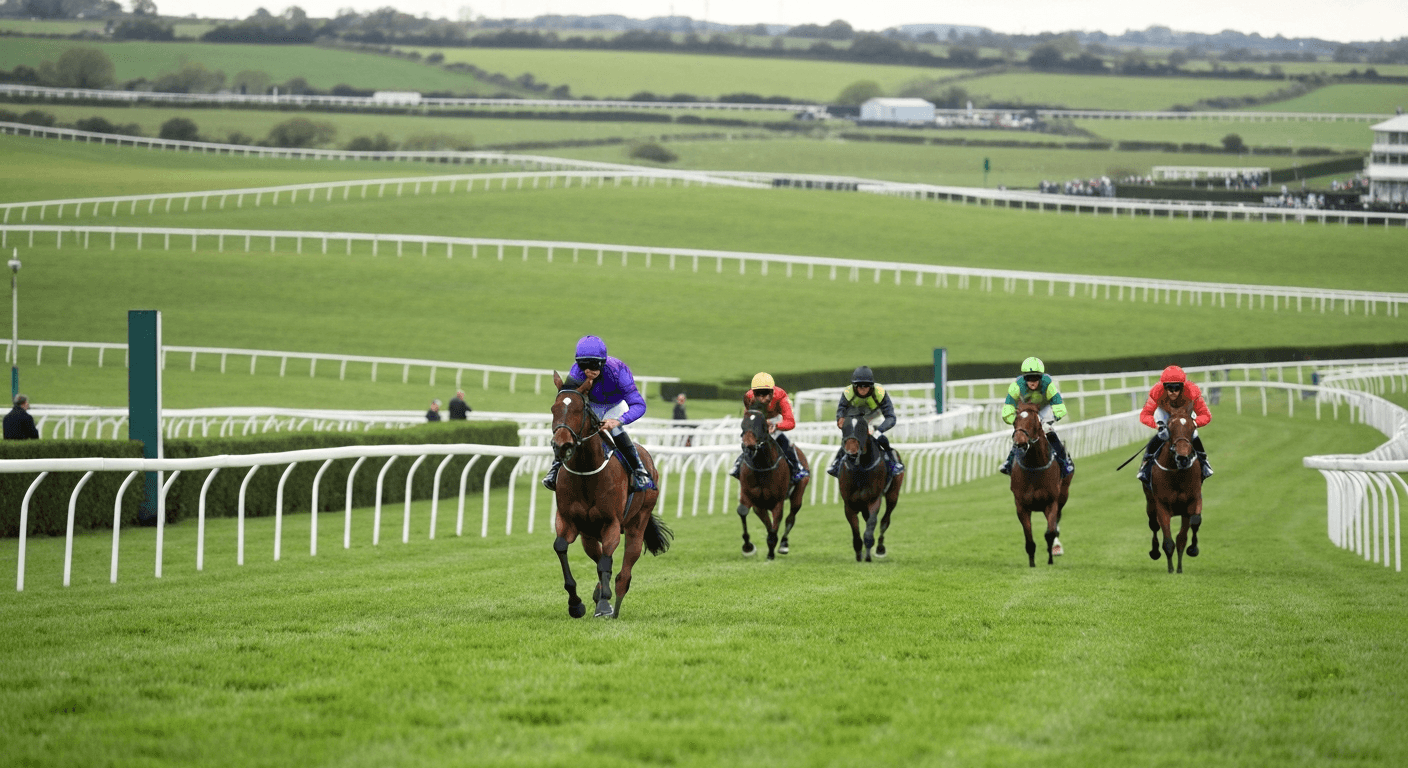
Tiger Roll at Limerick: The Complete Story
Tiger Roll won the 2016 Munster National at Limerick at 20/1, the staying-chase win that set up his back-to-back Grand Nationals. The full story.
Read moreGamble Responsibly
Gambling should be entertaining and not seen as a way to make money. Never bet more than you can afford to lose. If you or someone you know has a gambling problem, help and support is available.