Founder & Editor · Last reviewed 2026-07-13
Racing has taken place at Proudstown, on the edge of Navan in County Meath, since 1920. The first meeting was held on Friday 16 September 1921, over jumps, on a stretch of ground that a local farmer and auctioneer named Albert Lowry had set his mind on turning into a racecourse. A little over a century later, they are still racing on the same site, now owned by Horse Racing Ireland and counted among the more modern tracks in the country.
That is a shorter story than the great English courses can tell, but it is a dense one. Navan sits deep in Meath jumping country, within easy reach of the yards that have produced many of Ireland's best chasers, and the track has a habit of finding itself at the start of famous careers. The best-known example is Arkle, who ran and won here for the first time in January 1962 before he became a three-time Cheltenham Gold Cup winner. Navan can fairly claim a share of that story.
The course has kept its galloping, uphill character throughout. It is a left-handed circuit with a stiff climb to the line, prized by horsemen as a fair and searching test where, as one leading rider put it, the best horse usually wins. Around that track have grown the races that give the calendar its shape: the Troytown Handicap Chase in November, named after a locally bred Grand National winner, and the Vintage Crop Stakes on the Flat in spring, named after the horse who took Irish racing to Melbourne.
This article follows Navan from its founding at Proudstown, through the races and the horses and the people who built its reputation, and into the modern era of Horse Racing Ireland ownership and the November festival.
In this guide:
Racing at Proudstown Park
Navan Racecourse stands at Proudstown, about three miles from Navan town and roughly 48 kilometres north-west of Dublin. Horse racing has been staged on the site since 1920, and the venue is still referred to by some as Proudstown Park. The first meeting proper was held on Friday 16 September 1921. It was a jumps card, although the chase course was not finished until December of that year, so the earliest fixtures were run before the track was fully complete.
Albert Lowry's course
The founding of Navan is credited to the vision of a local farmer and auctioneer, Albert Lowry. Multiple accounts of the course's early years point to Lowry as the man who drove the project, turning a piece of Meath farmland into a working racecourse. That local, agricultural origin fits the place. Navan sits in the heart of County Meath, the Royal County, in a district where horses have always been part of the working landscape, and the course grew out of that world rather than being planted on it from outside.
There is no founding myth to untangle here, no saint's cloak or ancient fair to separate from the record. Navan's beginning is a documented 20th-century event: land, a plan, and a first meeting in September 1921. That makes it a young course by the standards of Irish racing, where several tracks trace their roots to hunt meetings and commons racing going back much further. What Navan lacked in age it made up for in the quality of ground and the character of the circuit.
A galloping, uphill test
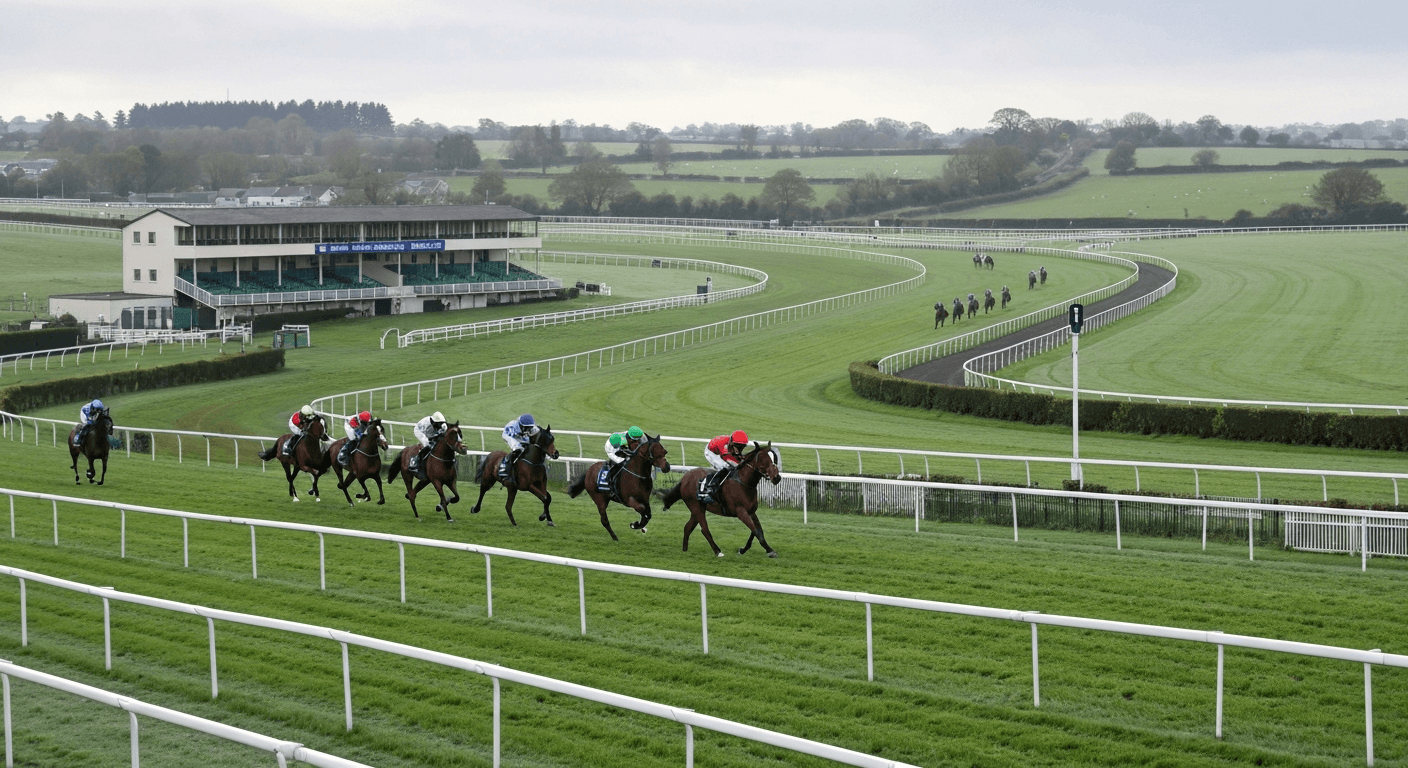
From the start, the defining feature of Navan has been the shape and slope of the track. It is a left-handed circuit of about a mile and a half, broad and sweeping, described somewhere between a wide oval and a rectangle, with long straight sections that give it a galloping character under both codes. The home straight runs to about three and a half furlongs and climbs steadily, with the final two furlongs uphill. That climb is what horsemen remember. It makes Navan one of the stiffest finishes in Ireland and a genuine test of stamina and fitness, a place where a horse cannot be flattered home.
The jumps tracks were laid out on that same galloping loop, the chase course running around the outside of the hurdles course. Both share the wide bends and the long uphill run to the line. Because the ground can ride very testing through the winter, with a slow-draining subsoil turning it soft to heavy, the stamina demand is often doubled on the big November days. In summer the course can water to avoid firm ground, but the character of the finish never changes.
From private venture to national ownership
For much of its history the course operated as a going concern in its own right, and some older guides still list the operator as Navan Races Limited. The more current and authoritative position is that the racecourse is owned by Horse Racing Ireland, the national governing and commercial body for the sport, whose corporate and privacy links run through the course's own website. The move into the HRI structure placed Navan within the national framework of Irish racing alongside the other principal tracks.
What carried the course from a modest 1921 opening to that position was the racing itself. Within a few decades Navan had become a recognised trials venue, a place where horses were tested for Cheltenham and for the Flat Classics before the big spring targets. The next section follows the races that built that reputation, from the Troytown Chase, named almost at the birth of the course after a local Grand National hero, to the Flat black-type that arrived much later.
The Races That Made Navan
A racecourse earns its standing through its races, and Navan's calendar was built up over the best part of a century. Some of its features arrived almost with the course itself; others were shaped, regraded and re-sponsored long afterwards. Taken together they turned Proudstown into a recognised trials ground for both codes.
The Troytown Chase
The race most associated with Navan is the Troytown Handicap Chase, run over three miles each November. It is named after Troytown, a horse bred close to the course who won the 1920 Aintree Grand National, so the name reaches back to the very years the racecourse was being founded. The Troytown has long been one of Ireland's most competitive early-season staying handicap chases, a pointer towards the big spring handicaps at Cheltenham and Aintree.
Historically the race carried an Irish "Grade B" premier-handicap classification, and it is now consistently listed as Grade 3. Its title has followed its sponsors while the Troytown name has always stayed put. Stanleybet backed it in 2004, Ladbrokes through the late 2010s to 2021, and Bar One Racing became title sponsor under a five-year partnership announced on 24 October 2022, running the race for a total purse of €100,000. In recent seasons the winner has taken €60,000 of that fund.
The Fortria and the Lismullen
Navan's other Graded jumps races grew up around the same November weekend. The Fortria Chase, a two-mile contest, is named after Fortria, the Tom Dreaper-trained dual Champion Chase winner who also took the 1961 Irish Grand National. The race was given Grade 3 status in 1993, extended by a furlong in 1996, returned to two miles as a conditions race in 2000, and promoted to Grade 2 in 2003. It spent a spell away from the course, moving to Fairyhouse in 1991, at a time when Navan's future was said to be in the balance, before returning.
The Lismullen Hurdle, run over about two miles four furlongs, was once an amateur race staged in mid-December. It was cut to Grade 3 in 1994 and later promoted to Grade 2. Alongside these sit the Grade 3 Monksfield Novice Hurdle, named after the dual Champion Hurdle winner Monksfield, and the Grade 3 For Auction Novice Hurdle, named after the 1978 County Hurdle winner.
The Flat black-type
Navan's Flat programme took longer to acquire its signature race. The Vintage Crop Stakes, over one mile six furlongs, was first run as a Listed race in 2003 and upgraded to Group 3 status from 2014, having been a furlong shorter until 2011. It is named after Vintage Crop, the Dermot Weld-trained stayer who in 1993 became the first northern-hemisphere-trained horse to win the Melbourne Cup, and it has developed into one of Ireland's leading Ascot Gold Cup trials. It is worth noting that some 2025 racecards labelled the race "Listed" while it has held Group 3 status since 2014; that Group 3 grade remains the authoritative position, even as sponsors and card presentation have varied.
Around it the course stages further black-type on the Flat, including the fillies' Group 3 Salsabil Stakes, the Listed Committed Stakes, the Kooyonga Stakes and the Yeats Stakes.
Milestones at a glance
| Year | Milestone |
|---|---|
| 1920 | Racing begins at the Proudstown site, credited to farmer and auctioneer Albert Lowry |
| 1921 | First meeting held on Friday 16 September, over jumps; chase course completed that December |
| 1962 | The future three-time Gold Cup winner Arkle wins his first race at Navan, the Bective Novice Hurdle |
| 1991 | The Fortria Chase moves to Fairyhouse, with Navan's future said to be in the balance, before returning |
| 1993 | The Fortria is given Grade 3 status (promoted to Grade 2 in 2003) |
| 1994 | The Lismullen Hurdle is cut to Grade 3, later rising to Grade 2 |
| 2003 | The Vintage Crop Stakes is run for the first time, as a Listed Flat race |
| 2014 | The Vintage Crop Stakes is upgraded to Group 3 |
| 2017 | The last major redevelopment of the course is completed |
| 2022 | Bar One Racing becomes Troytown Chase title sponsor on a five-year deal, purse €100,000 |
| 2023 | The two-day Navan Racing Festival is launched, combining the Fortria and Troytown weekends |
Each of these dates is drawn from the record of the races and the course itself, and the founding, redevelopment and festival dates carry through to the modern-era section below. The purse figures have moved over the years, and where a single fixed number would mislead, the changes are set out rather than flattened into one.
The Horses
Navan's place in racing history rests above all on the horses that began, or were honoured, here. Some ran and won on the Proudstown turf; others gave their names to the races that fill the calendar. Keeping the two apart matters, because a race named after a horse is not the same as a win on the track.
Arkle
Arkle is the horse who ties Navan to the very top of the sport. A bay gelding foaled in 1957 and trained by Tom Dreaper in County Meath, he went on to win three Cheltenham Gold Cups between 1964 and 1966 and is rated by Timeform at 212, the highest figure ever awarded to a steeplechaser. His first racecourse win came at Navan.
It is worth being precise about that win, because it is often loosely described. It was the Bective Novice Hurdle over three miles, run on 20 January 1962, not a bumper and not a chase. Stable jockey Pat Taaffe had chosen to ride the favourite, Kerforo, so the ride on Arkle went to stable lad Liam McLoughlin. Arkle beat 26 rivals by a length and a half at 20/1, and the story goes that Dreaper came down from the stand telling his wife he thought they might have something. It was the horse's third career start and his first success. He returned to Navan the following season to win the Donoughmore Plate, a Flat race, in October 1963, ridden by the former champion Flat jockey T.P. Burns. His chasing debut came later, at Cheltenham, so Navan's claim is specific and genuine: it launched him and produced at least two of his wins.
Troytown
Troytown was a local horse in the fullest sense. Foaled in 1913 and bred near Navan by his owner, Major Thomas Collins-Gerrard of Wilkinstown, Co. Meath, he was a genuine hero of the district, reared and schooled in the area before he made his name abroad. In 1919 he won the Grand Steeple-Chase de Paris, and on 26 March 1920, in heavy rain at Aintree, he won the Grand National by twelve lengths at 6/1 under the amateur Jack Anthony. His career was cut short later that year by a fatal injury in France, at Auteuil.
Those wins came at Aintree and in Paris, not at Navan, so the horse's link to the course is one of place and memory rather than a race on the track. The Troytown Handicap Chase, a bar at the racecourse and the Troytown Heights housing estate in the town all carry his name, keeping a local Grand National winner at the centre of Navan's identity a century on.
Vintage Crop
Vintage Crop gives his name to Navan's leading Flat race, and his story is one of the great Irish racing adventures. The Dermot Weld-trained chestnut won the Irish St Leger twice and the Cesarewitch before, in 1993, becoming the first northern-hemisphere-trained horse to win the Melbourne Cup, ridden by Mick Kinane for owner Michael Smurfit. He retired to the Irish National Stud's Living Legends exhibit and died there in July 2014 at the age of 27.
As with Troytown, his defining wins came elsewhere, at Flemington, the Curragh and Newmarket. His connection to Navan is the Vintage Crop Stakes, run in his honour and now a recognised Ascot Gold Cup trial.
The modern roll of honour
Away from the namesakes, plenty of good horses have done their winning on the track itself. The Fortria Chase roll of honour includes Moscow Flyer, who took it in 2003 and 2004, Big Zeb, who won three in a row from 2009 to 2011, and Found A Fifty, successful in 2024 and 2025. The Lismullen Hurdle has been won by the tough front-runner Limestone Lad, by the high-class mare Apple's Jade in 2017 and 2018, by Bob Olinger in 2023 and by Home By The Lee in 2022 and 2024.
The Troytown Chase itself has produced some memorable renewals. The Jam Man won by eighteen lengths under Paul Townend in 2020, one of the widest margins in the race's recent history. Run Wild Fred took it in 2021 on the course's hundredth-anniversary raceday, and more recent winners include Coko Beach in 2023, Stuzzikini in 2024 and Answer To Kayf in 2025.
| Horse | Navan link |
|---|---|
| Arkle | First career win, Bective Novice Hurdle 1962; Donoughmore Plate 1963 |
| Troytown | Locally bred; the Troytown Chase is named after him |
| Vintage Crop | The Vintage Crop Stakes is named after him |
| Moscow Flyer | Fortria Chase 2003 and 2004 |
| Big Zeb | Fortria Chase 2009, 2010 and 2011 |
| Apple's Jade | Lismullen Hurdle 2017 and 2018 |
| The Jam Man | Troytown Chase 2020 (won by 18 lengths) |
The Trainers and Jockeys
Navan sits in the middle of Ireland's richest jumping country, and the people who have shaped its history are, for the most part, Meath people working from yards within a short drive of the track.
Tom Dreaper
The first name belongs to Tom Dreaper. He trained Arkle in County Meath and sent him to Navan for the first of his wins, so the greatest chaser in the record book began his career in Dreaper's care on this track. Dreaper's influence on the course runs on through the calendar, since the Fortria Chase is named after Fortria, another of his horses, a dual Champion Chase winner who also took the 1961 Irish Grand National. Few trainers have left a longer shadow over a single racecourse.
Gordon Elliott
In the modern era no trainer is more closely tied to Navan than Gordon Elliott. He is based at Cullentra House in Longwood, County Meath, calls himself a Meath man through and through, and makes no secret of what the local track means to him. As he has put it, "It's a very fair track, the best horse usually wins and we are very lucky it is on our doorstep." The results back the affection. Elliott has dominated the Troytown Chase, winning it seven times, including four in a row from 2014 to 2017 and further wins in 2021, 2023 and 2024, and he is among the leading jumps trainers at the course by wins.
Dermot Weld and Noel Meade
Dermot Weld's link to Navan is through the Vintage Crop Stakes, the race named after the stayer who carried his stable to the Melbourne Cup. It is worth correcting a common assumption: Weld is based at Rosewell House on the Curragh, not at Navan itself. He has been Irish champion trainer many times and has trained more than 3,000 winners, and his name is attached to the course through that great horse rather than through a local base.
Noel Meade, by contrast, is a genuine local, a long-established County Meath trainer working from Tu Va Stables and a fixture of the regional jumps scene. On the Flat, the modern statistics at Navan are led by Aidan O'Brien and Ger Lyons.
The jockeys
The riders who have done best at Navan read like a roll-call of recent Irish jump racing. Davy Russell heads the career list of jockeys at the course and has won the Troytown more than once, on Tofino Bay and Mala Beach. Paul Townend rode The Jam Man to that eighteen-length Troytown win in 2020, having also won the race on Beroni in 2009. Jack Kennedy and Jamie Codd feature strongly among the modern jumps jockeys, and Barry Geraghty, a Troytown winner on Cane Brake in 2006, gave the track one of its best descriptions, calling it "one of the best tracks in Ireland or England, a proper test where the best horse usually wins because there is no hiding place."
The founder
Behind all of them stands the man who made the course possible. Albert Lowry, the local farmer and auctioneer credited with founding Navan, does not appear in any roll of honour, but without his early vision there would have been no Proudstown track for Dreaper, Elliott and the rest to win on. His is the quiet name at the start of the whole story.
These win counts and associations are drawn from the course record and are best read as indicative rather than final, since career totals move on with every meeting. What does not change is the pattern: Navan has been made by the trainers and riders of its own county, a track that the best local horsemen have always been glad to have on their doorstep.
Records and Stats
Navan is not a course with a tidy published record book. All-time course-record times and standard times by distance are not held in any authoritative central source, and the same is true of marquee-race track records and biggest winning margins. Rather than quote a figure that cannot be stood up, it is more honest to say that these records are not published. For context, the going on the big November days is often soft or heavy, which makes fast standard times unlikely in any case: the 2025 Troytown, for instance, was run on heavy ground.
What can be set out with more confidence is who has won most often at the track. The figures below are drawn from course data and are best read as indicative and "at time of writing", since they move on with every meeting.
| Category | Leader | Wins (indicative) |
|---|---|---|
| Trainer, jumps (since 2009) | Gordon Elliott | about 119 |
| Trainer, jumps (since 2009) | Willie Mullins | about 109 |
| Trainer, Flat | Aidan O'Brien | about 92 (from about 402 runners) |
| Jockey, jumps (career) | Davy Russell | about 62 |
| Jockey, Flat (recent) | Colin Keane | about 55 |
| Jockey, Flat (recent) | Shane Foley | about 44 |
| Troytown Chase, trainer | Gordon Elliott | 7 |
On strike rates, the recent numbers reflect the same names. Over jumps, Willie Mullins has run at about a 29.5% win rate and Gordon Elliott about 17%. On the Flat, Ger Lyons has posted about 26% since 2015 and Aidan O'Brien about 22.9%, with Ryan Moore holding the best strike rate riding for O'Brien.
These strike rates are historical description, not a betting angle. A high win rate for a stable does not translate into profit for anyone backing it, because the market prices those horses accordingly. The point is worth spelling out at Navan in particular, because the course is often described as one of the fairest in Ireland. Analysis of the track shows clear favourites winning around 32% to 35% of races while still returning a negative actual-versus-expected figure, meaning they have won less often than their prices implied and offered poor value over time. Handicap favourites have been notably worse. Backing favourites, and backing to any system, loses money to starting price over time, and none of the figures above should be read as a way to win.
The one record that is beyond dispute is the Troytown trainer count. Gordon Elliott's seven wins, four of them in a row from 2014 to 2017, make him the dominant figure in the race's modern history, and that tally is drawn straight from the roll of honour rather than from any wider strike-rate table.
A Day in the Royal County
Navan is a Meath racecourse through and through, and the county's nickname, the Royal County, sits comfortably over the place. This is working horse country, and the track has the unfussy, local feel to match. The course describes itself as a relaxed, friendly venue with no strict dress code, recommending smart casual and sensible footwear for the weather, and that is a fair account of a day there.
What the horsemen prize is the finish. The long uphill run to the line is talked about as a true test of stamina and fitness, the reason Navan is rated one of the fairest tracks in the country. Barry Geraghty summed up the feeling when he called it a proper test where the best horse usually wins because there is no hiding place. That reputation is part of the culture of the place as much as any bar or bandstand: people come knowing the result will be honest.
The social heart of the course is the Troytown Bar, tucked beneath the grandstand and named, like so much here, after the local Grand National hero. Recently refurbished with a dance floor and screens for the racing, it has Tote betting and live music after weekend meetings, and it is a short walk from the parade ring. Above the weigh room sits the Arkle Pavilion, its balcony running the length of the building over the ring below, carrying the name of the horse who started his career on the track.
The biggest cultural shift of recent years has been the arrival of the Navan Racing Festival in November. The two-day fixture has pushed the racecourse further into the town's social calendar, with choirs and live music on the festival days and after-parties spilling into Navan's pubs and hotels, among them The Central, The Royal Meath, Ryans Bar and The Round O. Crowds for the Troytown day run to around five thousand, a figure the course has put at close to that mark in both 2024 and 2025. This is a mid-sized meeting rather than one of the giants of the Irish calendar, and on its big weekend Navan works as the town's own day out, much as it did at the start.
Navan Today
The Navan of today is a dual-code turf course owned by Horse Racing Ireland, the national governing and commercial body for the sport. Ownership under HRI places the track within the same structure as Ireland's other principal courses, and the corporate and privacy links on the racecourse's own website route through the national body. Some older third-party guides still name the operator as Navan Races Limited, but the HRI position is the current and authoritative one.
Redevelopment
The last major redevelopment of the course was completed in 2017, and it is the work of that period that has left Navan regarded as one of the more modern Irish tracks. Set in around 181 acres at Proudstown, the venue carries the named enclosures and rooms that racegoers use now: the Arkle Pavilion above the weigh room, the Troytown Bar beneath the grandstand, the Bective and Kilberry restaurants, and the Proudstown, Boyne and O'Sullivan suites for functions. The physical circuit, with its long uphill finish, was not altered in character by the rebuild; the improvements were to the buildings and facilities around it.
The Navan Racing Festival
The single biggest addition to the calendar in recent years came in 2023, when the two-day Navan Racing Festival was launched under the then-manager Aidan McGarry. The festival combined what had been the separate Fortria and Troytown weekends into one November fixture, giving the course a clear flagship event. The Sunday centrepiece is the Bar One Racing Troytown Handicap Chase, worth €100,000, supported across the weekend by the Grade 2 Fortria Chase and Lismullen Hurdle and the Grade 3 Monksfield Novice Hurdle. The festival is a recognised early-season staying-chase trial, pointing towards the big spring handicaps at Cheltenham and Aintree.
Management
The course has seen a change of management in the middle of this period. Aidan McGarry ran Navan for three years, introducing the inaugural festival in 2023, before leaving in June 2024 to become General Manager of Naas Racecourse. He was succeeded in August 2024 by Ciaran Flynn, a native of nearby Duleek, who took up the post with immediate effect. Flynn had worked as Operations Lead at Navan since 2022 and had earlier held roles in high-performance sport with Paralympics Ireland, Tennis Ireland and the Sport Ireland Institute. HRI's chief executive, Suzanne Eade, welcomed his appointment.
The course today
Navan now stages in the region of 17 to 18 fixtures a year, spread across the calendar with racing in most months apart from August. Both codes run on turf, and while the marquee days are over jumps, the Flat programme carries valuable black-type, headed by the Group 3 Vintage Crop Stakes in spring. The course keeps its standing as a Cheltenham and Classic trials venue, a place where horses are tested before the biggest targets.
Coverage has kept pace. All Irish racecourses have been shown on Racing TV since 2019, and Navan's meetings are broadcast there, with the Sunday of the Troytown weekend also carried free-to-air on RTÉ. Crowds for the big day sit at around five thousand; the course has recorded figures close to that in both 2024 and 2025.
A little over a hundred years on from Albert Lowry's first meeting, Navan has grown from a private Meath venture into a state-owned course with a modern grandstand, a flagship festival and a settled place in the Irish racing year. The uphill finish that made its name still decides its races, and the horse who won here first, Arkle, is still the name above the door.
Frequently Asked Questions
Share this article
More about this racecourse
All navan guides
Navan Racecourse: The Complete Guide
Navan Racecourse in full: the Meath dual-code track where Arkle debuted, the Troytown Chase and Vintage Crop Stakes, plus tickets, travel and how to visit.
Read more
Troytown Chase Day at Navan: The Complete Guide
Troytown Chase Day at Navan: the Grade 3 Bar One Racing Troytown Handicap Chase over three miles each November, its history, great winners and how to watch.
Read more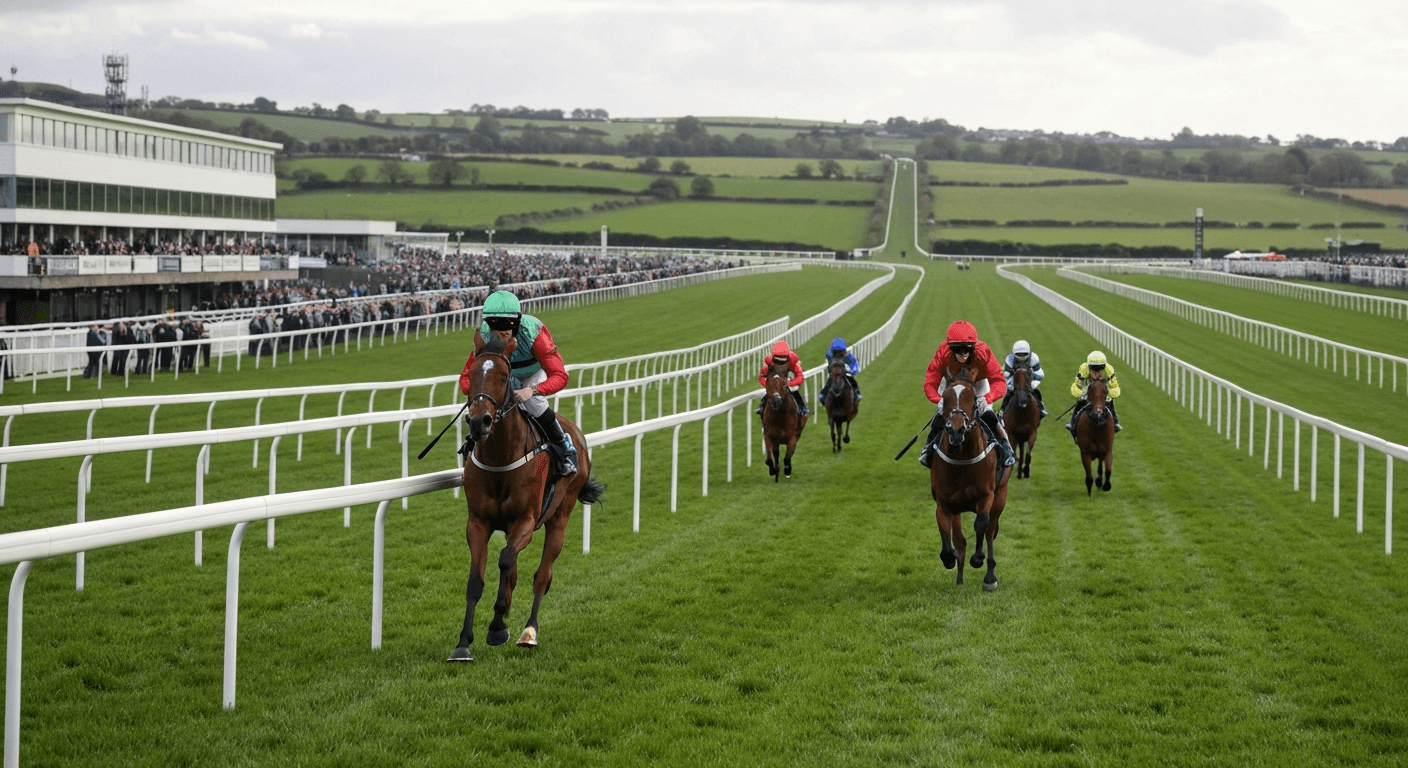
Arkle at Navan: The Complete Story
How Arkle, the highest-rated steeplechaser in history, won his first race at Navan in 1962 before three Cheltenham Gold Cups and an Irish Grand National.
Read moreGamble Responsibly
Gambling should be entertaining and not seen as a way to make money. Never bet more than you can afford to lose. If you or someone you know has a gambling problem, help and support is available.