Founder & Editor · Last reviewed 2026-07-08
Introduction
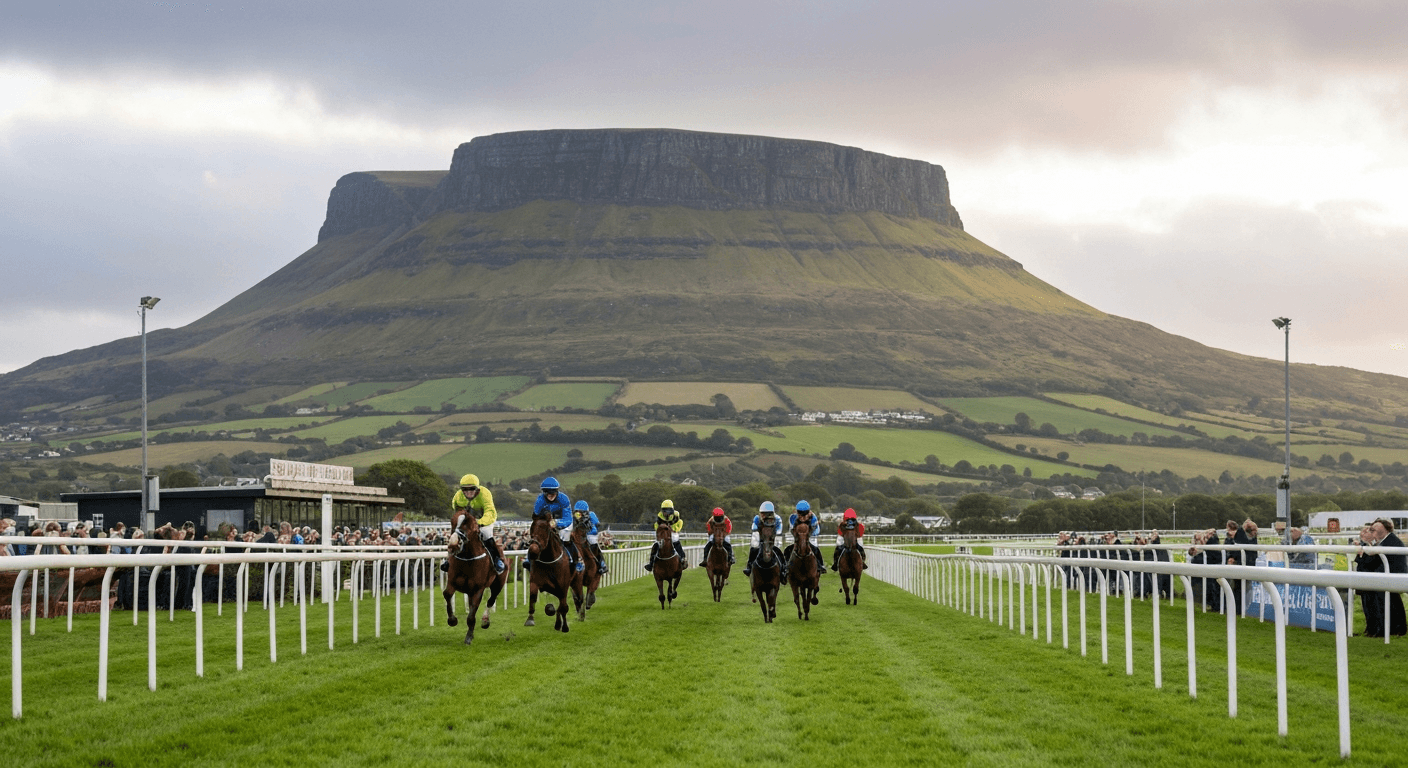
Sligo Racecourse sits at Cleveragh, about three-quarters of a mile (1km) south of Sligo town in the Republic of Ireland, in a natural bowl beneath the mountains of Benbulben and Knocknarea. Owned and run by the County Sligo Race Committee, it is a dual-code turf track staging both Flat and National Hunt racing, with no all-weather surface. It is the most northerly racecourse on the island of Ireland, and it stages around eight to nine fixtures a year, all between May and October.
The track itself is a sharp, undulating, right-handed oval of just over one mile, widely regarded as one of the stiffest and most testing in Ireland. Runners are almost constantly on the turn before an uphill run-in of just under two furlongs, which rewards course specialists and, in heavy going, genuine stamina. You can read more in The track and Form and betting.
Organised racing in County Sligo dates back to a four-day meeting at Bowmore, Rosses Point, in September 1781. After later homes at Bowmore and then Hazelwood (from 1873 to 1942), the current Cleveragh course opened on 24 August 1955 before more than 7,000 spectators. See History for the full story.
On this page
Where to Bet
Place your bets with a trusted, licensed bookmaker.

Promo code BETFRED50. New customers only. Register, deposit with a Debit Card, and place a first bet of £10+ at Evens (2.0)+ on Sports, to be settled within 7 days, to get £30 in Sports Free Bets and £20 in Bet Builder Free Bets within 24 hours of settlement. 7-day expiry. Eligibility & payment exclusions apply. Full T&Cs apply. Take Time to Think. BeGambleAware.org. 18+. Full T&Cs.

Promo code R30. New UK customers only, 18+. Register, deposit £10 or more, then place a £10 single cash bet at odds of 1/2 (1.5) or greater on any sports market (excluding Virtuals). Once the qualifying bet settles you get £30 in Free Bets (3 x £10) — the qualifying bet can win or lose. Free Bets are valid on any sports market excluding Virtuals, expire in 7 days, are non-withdrawable and must be used in full. Excluded deposit methods apply (including PayPal, Apple Pay, Skrill and NETELLER). Named bets such as Lucky 15 do not qualify. If you cash out the qualifying bet, or it is voided, you are no longer eligible for the offer. Ends 31.12.26. Full T&Cs apply. Please gamble responsibly. BeGambleAware.org. 18+. Full T&Cs.

Promo code BET40GET20. New UK customers, 18+. Register with the code and place a first bet of £40 or more at Evens (2.0) or greater. Receive 2 × £10 free bets: the first credited automatically once the qualifying bet settles, the second 24 hours later. Free bets must be placed at minimum odds of 4/1 (5.0), expire 24 hours after credit, and the free-bet stake is not returned with winnings. Debit card deposits only. Take Time to Think. BeGambleAware.org. 18+. T&Cs apply. Full T&Cs.

50% of your first-day net losses refunded as a free bet, capped at £25. New UK customers aged 18+ only. To qualify, deposit and place a first bet of £10 or more on any sport at minimum odds of evens (2.00), then place at least two further bets on different events, each worth at least 50% of your largest bet, all at evens (2.00) or greater. Losses are counted from your first settled bet until 23:59 the same day. Place a qualifying £10+ bet and you are guaranteed at least a £5 free bet. Bets placed at SP, void bets, cashed-out bets and bets struck with free bets do not count towards the offer. The free bet is credited the day after your qualifying bets settle and must be used within 7 days, after which it expires. It can be used at odds from 1/4 (1.25) up to 250/1 on singles and straight accumulators, but not on Trixie, Patent or Yankee style multiples. Free-bet stake is not returned with winnings. One offer per person, household, address, IP address and device. E-wallet deposits may not qualify, so check the cashier before depositing. Customers registered with GAMSTOP cannot claim. KYC identity verification must be completed before the free bet is credited. Take Time to Think. BeGambleAware.org. 18+. T&Cs apply. Full T&Cs.

New customers, 18+. Choose the sports bonus at sign-up, make a first deposit and receive a 100% bonus up to £50 in your Sports Bonus balance. To convert the bonus to cash, wager it 10x within 30 days. Single bets below Evens (2.00) do not qualify; accumulators do not qualify if any selection is below 1/2 (1.50). Virtual Sports, voided, cancelled, drawn, cashed-out and free-bet wagers do not count towards wagering. Only the first settled bet per event counts. Withdrawing before the wagering requirement is met forfeits the bonus balance including bonus winnings. Real-money funds are used before bonus funds. Deposits via Skrill or Neteller are not eligible. Not valid in conjunction with other promotions. Odds, bet and payment limits apply. 10bet general and promotion T&Cs apply. BeGambleAware.org. 18+. Full T&Cs.

New customers in Great Britain and Republic of Ireland, 18+. Place a £10 fixed-odds qualifying bet at minimum odds of 1/2 (1.50) — single or each-way (only the win part counts), pre-event or in-play, not cashed out early, within 28 days of opening the account. Receive up to £60 in bonuses credited over three days: 3 × £10 fixed-odds free bets (the first on settlement, then 24 and 48 hours later) plus 3 × £5 Total Goals FOOTBALL spread bets, 3 × £5 racing Winning Favourites spread bets and a £1 racing Race Index spread bet (the spread bets need a full spread-betting account). Free-bet stakes not returned with winnings; free bets valid 28 days from issue. IMPORTANT: the £5 credits are SPREAD bets — sports spread betting carries the risk that losses can exceed your stake. Sports spread-betting customers do not have Financial Ombudsman or FSCS recourse. Take Time to Think. BeGambleAware.org. 18+. T&Cs apply. Full T&Cs.

Promo code WELCOME15, entered under My Bonuses after registering. New UK customers, 18+. Place a first qualifying bet of at least £10 from your cash balance at odds of evens (2.0) or greater within 7 days of opening the account. Once the qualifying bet fully settles you receive £15 in free bets, credited as 3 x £5 tokens with set uses: one £5 accumulator free bet (minimum 4 legs, each leg at 2/5 or bigger), one £5 sports free bet (any market at evens or bigger) and one £5 Sub Cover free bet (selected football player markets at evens or bigger). Free-bet stakes are not returned with winnings. Free bets expire 7 days after they are credited. Void, cashed-out and partially cashed-out bets do not qualify. One offer per customer. Confirm the current terms on BetGoodwin's own welcome-offer page before claiming. Take Time to Think. BeGambleAware.org. 18+. T&Cs apply. Full T&Cs.

New UK customers, 18+. Minimum deposit £10. Place a £10 qualifying single at minimum odds of 1/2 (1.50), settled within 14 days. Receive £30 in free bets (stake not returned), split £20 for sportsbook use (2 x £10) and £10 for Bet Builder only (2 x £5); Bet Builder does not cover horse racing. Free bets must be accepted within 7 days and expire 7 days after acceptance. No promo code required. Best Odds Guaranteed on UK & Irish racing, subject to having staked over £25 in the previous seven days. Operated by LiveScore Betting and Gaming (Gibraltar) Ltd, UKGC 56859. Confirm the current terms on LiveScore Bet's own promotions page before claiming. Take Time to Think. BeGambleAware.org. 18+. T&Cs apply. Full T&Cs.
18+. BeGambleAware.org
The Track
The Track
Sligo is a sharp, undulating, right-handed turf oval of just over one mile. It is regarded as one of the stiffest and most testing tracks in Ireland. From the winning post horses turn sharply and descend, before climbing for much of the final stretch to an uphill run-in of just under two furlongs. Runners are almost constantly on the turn, which makes the circuit tricky to ride and tends to produce course specialists. Set in a natural bowl close to the Garravogue river, the ground can become genuinely heavy after rain, and in those conditions stamina becomes essential.
Over jumps there are four flights of hurdles to a circuit and five fences on the chase course. The chase track sits outside the hurdles track, with one fence just before the straight and one at the foot of the slightly uphill run-in.
On the Flat, the tight, turning shape tends to suit speedier, prominent types that carry enough stamina for the hill. Draw evidence is thin. What data exists for handicaps with ten or more runners points to a slight low-draw advantage, consistent with the early turn, but this is a lean rather than a firm rule. For how this feeds into reading a race here, see Form and betting.
Sligo does not publish an authoritative course-record or standard-times table, and there is no marquee-race track record on record. Individual winning times are available through result services on a race-by-race basis only, so no single benchmark time can be quoted as fact. For the fixtures that run on this circuit, see The races.
The grandstand overlooks the parade ring and the finish, with first-floor suites giving balcony views towards Benbulben.
Confirmed track facts
| Feature | Detail |
|---|---|
| Handedness | Right-handed |
| Shape | Undulating turf oval |
| Circuit length | Just over one mile |
| Run-in | Uphill, just under two furlongs |
| Codes | Dual (Flat and National Hunt) |
| All-weather surface | None |
| Hurdle flights per circuit | Four |
| Fences per circuit | Five (chase track outside the hurdles track) |
| Going | Can become genuinely heavy after rain |
| Draw bias | Thin evidence; slight low-draw lean in handicaps of 10-plus runners |
| Course record / standard times | Not published (per-race winning times only) |
Draw figures above are reported as a slight lean from limited handicap data, not established as a fixed bias.
The Course Map
Course Map and Layout
Sligo sits in a natural bowl at Cleveragh, a short way south of the town, with Benbulben and Knocknarea rising beyond the rails. The layout is compact and easy to read on foot, which is part of the track's appeal for racegoers who like to see plenty from one spot.
The grandstand is the focal point. It overlooks both the parade ring and the finish, so you can watch horses saddled and paraded, then turn to the winning line without moving far. The finish sits on the uphill run-in of just under two furlongs, so the closing stages play out directly in front of the stand. On the grandstand's first floor, the Cleveragh Suite and other suites give balcony views back towards Benbulben and across the track, while the ground-level Ballinode Suite sits beside the parade ring itself.
Over jumps, the chase course runs outside the hurdles track, with one fence just before the straight and one at the foot of the run-in. For how the circuit itself rides, see the track; for the stands and suites in detail, see enclosures and stands.
The Races
The Races
Sligo is a country track, and its race programme reflects that. It stages no Pattern (Group or Graded) or Listed black-type races at all, so the calendar is built around handicaps and maidens across both codes rather than championship contests. That does not make the racing any less competitive: fields range from around six to eight runners in some races up to sixteen or eighteen in the busier handicaps, and previous course form counts for a great deal on such a turning, uphill circuit.
Two contests stand out as the track's feature races, and both sit at the big August two-day meeting that is the centrepiece of the Sligo year (see Festivals).
The first is the Connacht Oaks, run in full as the Irish Stallion Farms EBF Connacht Oaks Fillies Handicap. It is a Flat handicap over about one mile two and a half furlongs, restricted to fillies and mares, and gives the meeting a distinct identity as a race for the female horse population. The second is the meeting's feature handicap hurdle, a National Hunt contest worth around €11,500 to the winner, staged as part of the same August fixture that also carries the Best Dressed Ladies Day. It carries no fixed name: the sponsor changes at every renewal, so the race runs under a different commercial title each year.
Because Sligo has no black-type races, its roll of honour is modest and its winners tend to be regionally rather than nationally prominent. The track's lore centres on course specialists that master the constant turn and the stiff finish rather than on famous names (see Legends). One of the best-remembered recent results came in 2015, when the mare Mollyanna, trained by Colin Bowe and ridden by Mark Walsh, won the Duke and Duchess of Cornwall Mares Maiden Hurdle in front of the visiting royal party.
Feature races at a glance
| Race | Code | Distance | Month | Winner's prize | Conditions |
|---|---|---|---|---|---|
| Connacht Oaks (Irish Stallion Farms EBF Connacht Oaks Fillies Handicap) | Flat | approx. 1m2½f | August | n/a | Fillies and mares handicap |
| Feature handicap hurdle (name changes yearly with sponsor) | National Hunt | n/a | August | approx. €11,500 | Handicap hurdle |
Sligo does not publish an authoritative course-record or standard-times table, and there is no marquee-race track record on record, so individual winning times are available only race by race through the result services. Headline-race off-times for 2026 were not published in a verifiable form at the time of writing. For how the turning, testing layout shapes the way these races are run, and why course form matters so much here, see Form and betting. As with any track, backing favourites loses money to starting price over time, and none of these patterns implies a profit.
Records and Stats
Records and stats
Sligo is a country track without the deep statistical record of Ireland's major venues, and much of what racegoers might want here is simply not published.
On course records, there is no authoritative standard-times or track-record table for Sligo, and no marquee-race record on file. Because the course stages no Pattern or Listed races, there is no black-type roll of honour to draw on either. Individual winning times exist only on a race-by-race basis through result services, so any "fastest time" figure would be an isolated data point rather than an official record.
Attendance figures tell a similar story. Sligo draws several thousand racegoers to its popular meetings, with Ladies Day in August and Students Day in September the busiest of the year. The racecourse's own history records that the inaugural Cleveragh fixture on 24 August 1955 opened before more than 7,000 spectators, but precise modern single-day and annual attendance numbers are not published.
On leading riders, the dossier supports naming Gary Carroll and Shane Cross as jockeys with strong Flat records around this tight, turning circuit, where course form counts for a great deal. No leading-trainer statistics are published for Sligo, so no reliable trainer standings can be quoted.
In short, Sligo rewards local knowledge over headline numbers. For the races that shape those winning times see the races, and for how the course profile plays out in running see form and betting.
History
History of Sligo Racecourse
Organised racing in County Sligo goes back a long way. The earliest recorded meeting was a four-day affair at Bowmore, Rosses Point, in September 1781, run under Turf Club rules over a three-mile horseshoe-shaped seaside course for stakes of 200 guineas. That fixture continued annually into the 1840s.
Racing later moved to a new course at Hazelwood, on land belonging to John Wynne, which held its first meeting on 16 April 1873. Hazelwood staged racing, with some breaks, until its final fixture on 8 April 1942. Once that site was no longer suitable, the story shifted to the present home at Cleveragh.
Sligo Corporation bought land at Cleveragh Demesne from the Wood-Martin family, and after the Irish racing authorities approved the "Pump Field" site in 1949, the current course opened on 24 August 1955. The inaugural meeting drew more than 7,000 spectators, and the Mayor of Sligo, E. Tolan, declared the new track open. That opening-day crowd remains one of the few attendance figures the racecourse itself puts on record.
More recent investment has modernised the Cleveragh site. A redevelopment in 2013, reported at around €2m, delivered a new grandstand, a pavilion bar, Tote facilities, offices, turnstiles and jockey changing rooms. In October 2015 Horse Racing Ireland approved a grant of close to €800,000 towards further upgrades, and that same year the course welcomed the then Prince of Wales and Duchess of Cornwall on their May visit, a landmark occasion in the track's modern history.
Today Sligo remains an ungraded country track run by the County Sligo Race Committee, staging around eight to nine dual-code fixtures a year between May and October. For more on how the modern course rides, see The Track, and for its calendar of meetings see Festivals.
The Legends
Legends of Sligo
Sligo is an ungraded country track, so its story is not one of champion horses. With no Pattern or Listed races on the card, the lore here belongs to the course specialists who master the sharp, undulating, right-handed circuit and its uphill run-in rather than to nationally famous names. Previous course form counts for a great deal on a track this tricky to ride, and the horses best remembered are those that handled the constant turning and the climb to the line.
The result that stands out came in 2015, when the mare Mollyanna, trained by Colin Bowe and ridden by Mark Walsh, won the Duke and Duchess of Cornwall Mares Maiden Hurdle in front of royal visitors. The then Prince of Wales and Duchess of Cornwall, now King Charles III and Queen Camilla, visited on 20 May 2015, a landmark occasion that lends the day its lasting place in the track's memory. The Benbulben Suite, where the royal couple were entertained, still carries that association.
Among riders, Gary Carroll and Shane Cross are noted for strong Flat records at a course where local knowledge tells. The wider legend, though, is the setting itself: Sligo sits in Yeats country, and the poet W.B. Yeats lies buried at nearby Drumcliffe beneath Benbulben, the mountain that forms the racecourse backdrop.
For the fuller story of how the course came to Cleveragh, see the history section; for the meetings that carry these occasions, see festivals.
The Festivals
Festivals and signature meetings
Sligo does not stage a multi-day festival in the mould of the bigger Irish tracks, and it holds no Pattern or Listed races. Its calendar is instead a run of themed single-day fixtures spread across the summer, with one two-day meeting in August as the clear centrepiece.
The racecourse lists nine dates for 2026. The season opens on Sunday 3 May with Peaky Blinders Day (Flat), followed by evening National Hunt cards on Tuesday 12 May and Tuesday 9 June. Family Day falls on Sunday 12 July over jumps. The August programme runs Diageo Day on Wednesday 5 August (Flat) and Ladies Day on Thursday 6 August (a National Hunt evening card), with a further evening jumps fixture on Wednesday 19 August. The year closes with Students Day on Wednesday 30 September and Vintage Day on Friday 23 October, both over jumps.
The August two-day meeting, staged on consecutive weekdays, is the biggest occasion of the year. It carries the track's two most notable feature races and hosts the Best Dressed Ladies Day, with the second day run as an evening card. The feature handicap hurdle, worth around €11,500 to the winner, is the headline jumps prize; it carries no fixed name, running under a different sponsor title at every renewal. On the Flat, the Connacht Oaks (the Irish Stallion Farms EBF Connacht Oaks Fillies Handicap, run over about 1 mile 2½ furlongs) is a handicap restricted to fillies and mares. Neither is a black-type race, so the roll of honour is regional rather than national in profile, a point picked up in the form and betting section.
Several of the May, June and August meetings are evening fixtures, which suit holidaymakers making the most of long summer days in the Yeats country beneath Benbulben. Gates open two hours before the first race. Ladies Day is the most fashion-led day, with a best-dressed competition judged by Marietta Doran and a €1,000 prize awarded in 2024, while Family Day lays on children's activities. More on the character of these days sits in the atmosphere and culture section.
Note that published headline-race off-times for 2026 were not confirmed at the time of writing, so check the racecourse's own listings before travelling.
Form and Betting
Form and betting
The market wins here, as it does everywhere. Across 157 races at Sligo between October 2023 and June 2026 (1,661 runners), backing the starting-price favourite returned a level-stakes ROI of about minus 9.1 per cent. Favourites won 33.1 per cent of the time, so roughly one in three obliged, but that strike rate still lost money to SP. Treat that headline figure with caution: the 95 per cent confidence interval runs from minus 32.6 to plus 13.2 per cent, so it crosses zero and reads as no reliable signal rather than proof favourites are a good or bad bet. The lesson is the plain one: over time, betting favourites loses to starting price, and none of the patterns below implies profit.
Sligo is a specialist's course. Its constant turning and just-under-two-furlong uphill run-in mean prominent runners can set too strong a pace early and be caught late, while horses held up with tactical speed often prosper. Previous course form is a strong positive, so course-and-distance winners deserve respect. Good ground is the norm (48.4 per cent of races), but soft or yielding turns up often, and in genuinely heavy ground stamina becomes essential. Fields are mid-sized, averaging 10.6 runners.
On the draw, the sharp early turn is often said to favour low numbers in bigger handicaps, but the sample here shows almost no separation: low, mid and high stalls all won between 9.3 and 9.9 per cent, so treat draw as a marginal factor rather than a system.
| Metric | Value |
|---|---|
| Sample | 157 races, 1,661 runners (Oct 2023 to Jun 2026) |
| Favourite SP ROI | minus 9.1% (95% CI minus 32.6% to plus 13.2%) |
| Favourite strike rate | 33.1% |
| Field size | avg 10.6, median 11, range 3 to 16 |
| Most common going | Good (48.4%), then Soft (17.8%) |
| Race-type mix | Hurdle 87, Flat 55, Chase 15 |
| Draw win rate | Low 9.3% / Mid 9.9% / High 9.7% |
Figures are SP-only (no Betfair SP for Irish racing), level stakes, with fallers and pulled-up settled as losses. For the layout that shapes all this, see the track; for the fixtures, see festivals.
A note on responsible gambling
Betting should be fun, never a way to make money. Set a budget you can afford to lose, treat any winnings as a bonus, and stop when it stops being enjoyable. If gambling is causing you harm, free confidential support is available at BeGambleAware.org or on the National Gambling Helpline, 0808 8020 133. 18+ only.
Planning a Visit
Visiting Sligo Racecourse
Sligo Racecourse sits at Cleveragh, about 0.75 mile (1km) south of Sligo town centre in a natural bowl beneath Benbulben and Knocknarea (Eircode F91 EE95). It runs a compact calendar of around eight to nine fixtures between May and October, several of them relaxed summer evening cards, so most trips centre on a single meeting rather than a multi-day festival.
Getting in is simple. Sligo uses a single-admission model, with tickets bought at the turnstiles or online for the same price; indicative recent prices are around €15 for adults, €10 for OAPs and students, and €25 for a family of two adults and two children, with confirmation advised through the course. Gates open two hours before racing. There is no dress code, though Ladies Day in August is a dressier affair. Parking on the infield and in adjacent streets is generally free.
For the full journey and transport detail see getting there; for prices, the Supporters Club and hospitality suites see enclosures and stands. The site is relatively compact, but detailed accessibility provisions are limited and best confirmed directly with the course before you travel.
Getting There
Getting There
Sligo Racecourse sits at Cleveragh, about 0.75 mile (1km) south of Sligo town centre, in a natural bowl beneath Benbulben and Knocknarea (Eircode F91 EE95). It is the most northerly racecourse on the island of Ireland, and getting there is straightforward from every direction.
By road, leave the N4 at Exit S2 and follow the signs for Sligo. Continue along Pearse Road, take the third right, and the racecourse is roughly 600m further on. Journey guides put Sligo at about two hours from Galway, three hours from Dublin and Belfast, and four hours from Cork, so most Irish racegoers can reach Cleveragh in a comfortable day trip.
By rail, the nearest station is Sligo Mac Diarmada, served by trains from Dublin Connolly. From the town it is a short taxi or a walk of under a mile to the course. Buses are handy too: the local Bus Eireann service stops adjacent to the racecourse, dropping you close to the entrance.
If you are flying in, the nearest airport is Ireland West Airport Knock, which runs a daily bus service to Sligo. From there you can pick up the local connections into Cleveragh.
Parking is easy and, in a welcome touch, generally free. Spaces are available on the infield and in the adjacent streets, so there is no need to book ahead or budget for a car park. The compact, close-to-town setting is one of Sligo's quiet strengths, and it pairs naturally with a relaxed summer evening card.
Once you arrive, gates open two hours before racing. For what to expect on the day, see Visiting and the Enclosures and Stands.
Tickets and Enclosures
Enclosures and stands
Sligo keeps things refreshingly simple. Rather than dividing the course into tiered enclosures with separate price bands, it runs a single-admission model: one ticket buys the run of the public areas, so wherever you stand you have the same access to the parade ring, the betting facilities and the finish. That layout suits a compact country track set in its natural bowl, and it means first-time visitors do not have to puzzle over which ring to choose.
The focal point is the grandstand, which overlooks both the parade ring and the finishing line. It came out of the roughly 2 million euro redevelopment completed in 2013, which delivered the new stand along with a pavilion bar, Tote facilities, offices, turnstiles and jockey changing rooms. From here you look out over the track towards Benbulben, the mountain that frames the whole venue.
On the grandstand's first floor sit three hospitality suites. The Cleveragh Suite overlooks the parade ring and track, with its own balcony and bar and room for larger groups. The Benbulben Suite is where the then Prince of Wales and Duchess of Cornwall were entertained on their 2015 visit. At ground level, beside the parade ring, is the Ballinode Suite. All three have satellite TV with the day's racing piped in, plus Tote facilities. Published numeric capacities for the suites were not confirmed in the dossier.
Indicative recent admission was around 15 euro for adults, about 10 euro for OAPs and students, a family ticket for two adults and two children around 25 euro, and roughly 20 euro on Ladies Day. Treat these as a guide and confirm current figures with the course. For how the suites feed into catering and hospitality, see food, bars and hospitality; for reaching the gates, see getting there.
Food, Drink and Facilities
Food, bars and hospitality
Sligo keeps its catering simple and well regarded. At the heart of it is a self-service public restaurant that reviewers consistently praise for value, backed up by a pavilion bar, with music playing after racing at some meetings. The 2013 redevelopment added the pavilion bar alongside the new grandstand and Tote facilities.
For a sit-down option, the course offers a small-group package: a two-course meal in a reserved area of the public restaurant with a glass of wine or prosecco and a racecard, aimed at parties of 4 to 10 and priced at around €40 per person. Beyond that sit the three first-floor and ground-level suites covered in the enclosures and stands section, all with satellite TV showing the day's racing and Tote facilities. Supporters Club members also get the use of the Owners and Trainers bar.
Family Day is the standout for younger racegoers, with Front Runners children's activities, a magician, free ice cream and goodie bags. Reviewers single out the cleanliness of the facilities as much as the value. For guidance on what to wear across these areas, see what to wear.
What to Wear
What to Wear
Sligo keeps things relaxed. There is no dress code, so racegoers wear whatever they find comfortable. Because several meetings in May, June and August are evening fixtures, a light jacket is a sensible idea once the sun drops behind Benbulben and Knocknarea.
The one exception in spirit, though not in rule, is Ladies Day in August. This is a fashionable occasion, with hats and fascinators common and a Best Dressed Ladies competition that in 2024 carried a €1,000 prize judged by Marietta Doran. Even so, formal dress is not a condition of entry, so you can dress up as much or as little as you like.
A few practical limits apply to the hospitality areas: fancy dress, novelty and branded clothing are not permitted in the grandstand suites and restaurant. Fancy dress may be worn in the public areas, provided it does not cause offence.
For where to enjoy your outfit, see enclosures and stands and the atmosphere and culture of the big August fixtures.
Capacity and Venue Hire
Capacity and venue hire
Sligo does not publish an official spectator capacity, so any single figure should be treated with caution. The clearest historical marker comes from the racecourse's own history page, which records that the inaugural Cleveragh fixture on 24 August 1955 opened before an attendance of more than 7,000 racegoers. In modern terms the course draws several thousand to its popular meetings, with August Ladies Day and the late-September Students Day the busiest of the year, but precise present-day single-day and annual attendance figures are not made public. There is no verified capacity table on record.
For private hire, the racecourse offers a small-group restaurant package: a two-course meal in a reserved area of the public restaurant with a glass of wine or prosecco and a racecard, aimed at parties of four to ten and quoted at around €40 per person (confirm current pricing with the course). Above this sit three grandstand suites. The first-floor Cleveragh Suite overlooks the parade ring and track and has its own balcony and bar, described as suiting large groups. The first-floor Benbulben Suite, where the Prince of Wales and Duchess of Cornwall were entertained in 2015, and the ground-level Ballinode Suite beside the parade ring complete the trio. All three carry satellite TV with the day's racing piped in, plus Tote facilities. Specific numeric banqueting or theatre capacities for the suites are not published.
See also food, bars and hospitality and atmosphere and culture.
The Atmosphere and What Sligo Means
Atmosphere and culture
Sligo's character is bound up with the town and the wider Yeats country that surrounds it. The course sits in a natural bowl at Cleveragh beneath Benbulben and Knocknarea, and the poet W.B. Yeats is buried a short way off at Drumcliffe, under the same mountain that forms the racecourse backdrop. Racing here feels like a local occasion rather than a national showpiece, run by the County Sligo Race Committee for a crowd drawn largely from the town and the north-west.
That community feel shows in the way the meetings are themed. The calendar leans on days that appeal to local sporting communities, with GAA, Sligo Rovers, Sligo rugby and the ladies' Gaelic football association all recognised alongside the glamorous Belfry Day, Family Day, the Best Dressed Ladies Day and the famously lively Students Day. Ladies Day fashion has been judged by Marietta Doran, with a best-dressed prize of 1,000 euro in 2024.
The track's best-remembered moments tend to be occasions rather than champions. The 2015 visit of the then Prince of Wales and Duchess of Cornwall, now King Charles III and Queen Camilla, on 20 May remains a landmark, and on that visit the mare Mollyanna won the Duke and Duchess of Cornwall Mares Maiden Hurdle in front of the royal guests. Several summer cards are run in the evening, which suits holidaymakers and gives the busiest meetings a relaxed, sociable air. See also festivals and meetings and food, bars and hospitality.
Accessibility
Accessibility
Sligo publishes little detail on accessibility, so plan ahead and confirm your needs directly with the County Sligo Race Committee before you travel. What can be said with confidence is that the site is relatively compact, set in a natural bowl at Cleveragh, with parking on the infield and in adjacent streets close to the entrances (see Getting There). That short walk-in from the car to the enclosures suits racegoers who prefer to limit distances on foot.
For step-free access, the ground-level Ballinode Suite sits beside the parade ring, giving level access to a hospitality space next to the action rather than up in the first-floor grandstand suites (see Enclosures and Stands). The main grandstand and its Cleveragh and Benbulben suites are on the first floor, so ask the course about lift or level routes if stairs are a concern.
The official website does not publish the provisions many racegoers rely on: designated blue-badge parking bays, accessible viewing areas, accessible toilets, an assistance-dog policy, or discounted carer and companion tickets. None of these could be confirmed from a Sligo accessibility page. Contact the course on +353 71 916 2484 or info@countysligoraces.com ahead of your visit to check exactly what is available on your chosen fixture.
Where to Stay and Nearby
Nearby: where to stay and the local area
Sligo Racecourse sits at Cleveragh, roughly three-quarters of a mile south of Sligo town centre, so hotels, food and the wider county are all within an easy drive or taxi. Named options close to the course include the Sligo Park Hotel, the Glasshouse Hotel and the Clayton Hotel Sligo, each a short hop from Cleveragh.
The setting is Yeats country, and the racecourse shares its backdrop with some of the north-west's best-known landmarks. Benbulben rises behind the track, with Knocknarea and Queen Maeve's cairn, the seaside village of Rosses Point and the surfing beach at Strandhill all nearby. Further afield you can visit Lissadell House, the megalithic cemetery at Carrowmore and the poet W.B. Yeats's grave at Drumcliffe, beneath Benbulben itself.
That makes a race day easy to fold into a longer stay, with an evening card followed by a night in town or a walk on the coast the next morning. For arrival routes and parking, see Getting there; for gates and timings, see Visiting.
Frequently Asked Questions
Share this article
More about this racecourse
All sligo guides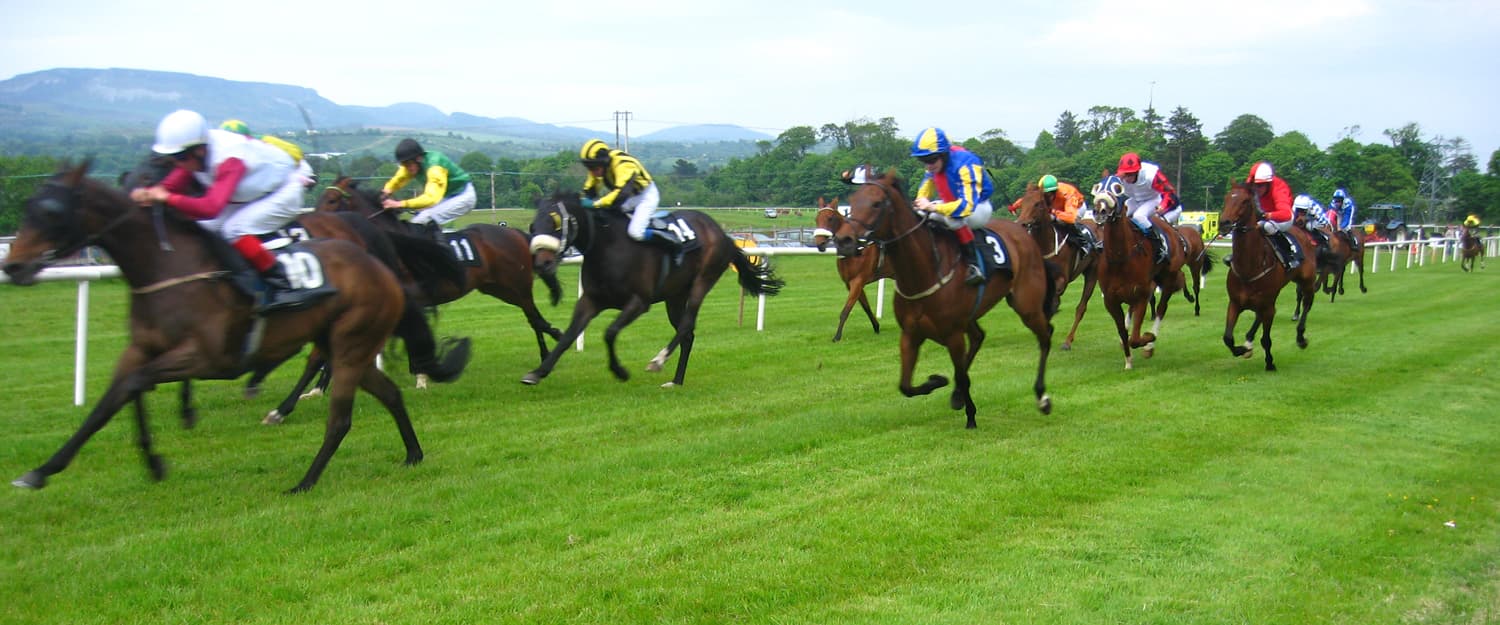
Racing in Yeats Country: Sligo's Setting and Story
Sligo Racecourse sits in a natural bowl at Cleveragh beneath Benbulben, in the heart of Yeats country, for one of Ireland's most scenic evening race days.
Read more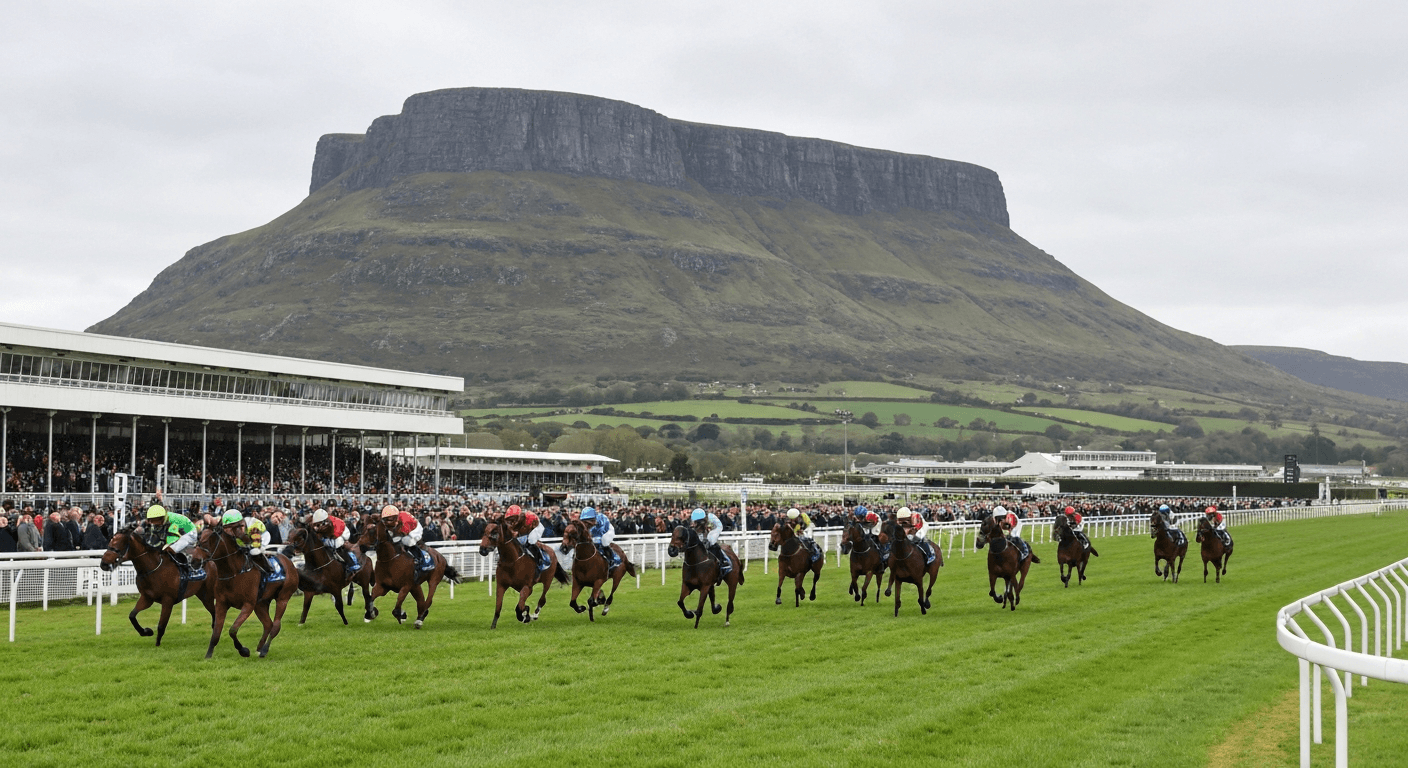
Sligo's August Festival: The Complete Guide
Sligo's two-day August meeting: the Connacht Oaks, the feature handicap hurdle, Ladies Day and Students Day at Ireland's most northerly track.
Read more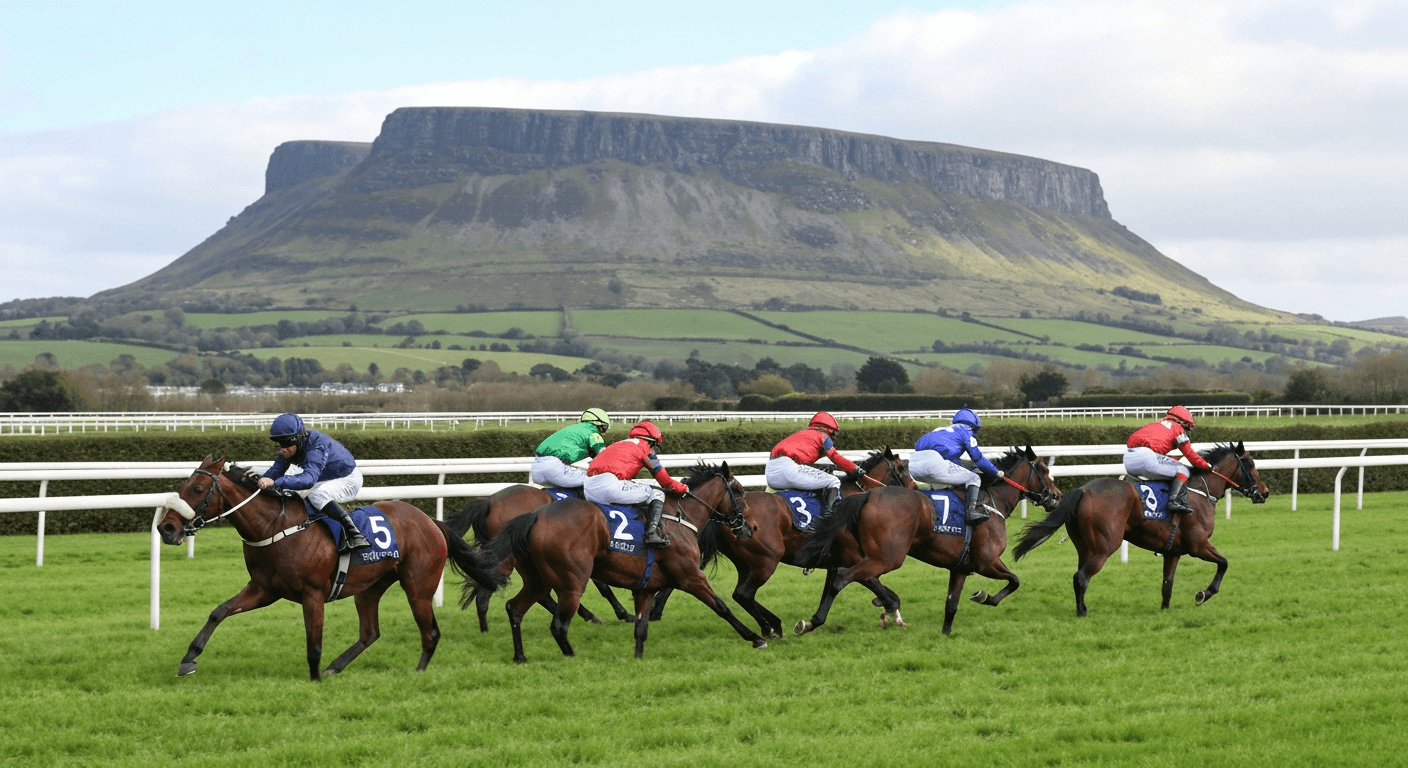
Betting at Sligo Racecourse
A grounded betting guide to Sligo Racecourse: what the sharp, uphill Cleveragh track asks of a horse, going and draw, course specialists and the August highlights.
Read morePhotos on this page are used under Creative Commons licences. Titles, sources and licence links for each one are on our image credits page.
Research the field with the AI Race Predictor
Our model publishes calibrated win-probability estimates for UK races — a second opinion to understand a race, not tips. It's open about its record: it doesn't beat the market, and we show exactly how it does.
Work it out & learn the basics
Gamble Responsibly
Gambling should be entertaining and not seen as a way to make money. Never bet more than you can afford to lose. If you or someone you know has a gambling problem, help and support is available.