
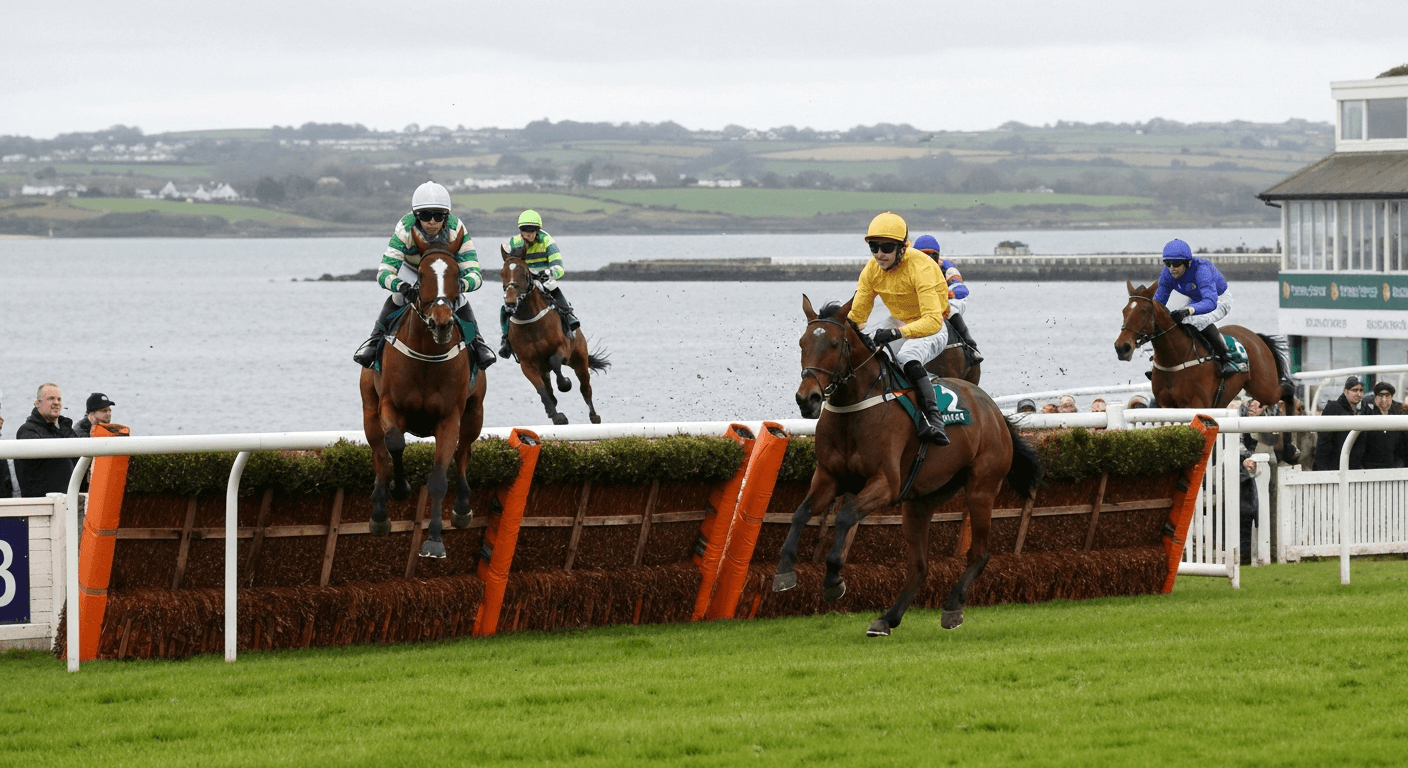
Founder & Editor · Last reviewed 2026-07-08
Introduction
Wexford Racecourse sits at Bettyville, Newtown Road, about 1km west of Wexford town on the Waterford road, opposite Wexford General Hospital and overlooking Wexford Harbour in County Wexford. It is a compact, undulating turf track in the heart of the "sunny south-east", staging around 11 fixtures a year between March and November for one of Ireland's most sociable racing crowds.
Although the venue once ran both Flat and jumps, it has been a National Hunt-only course since May 2016, so any older "dual-code" description no longer reflects how it operates today. The circuit is roughly rectangular and sharp, measuring about nine to nine-and-a-half furlongs, and has run left-handed since a major reconfiguration in early 2015 that also moved the winning post beyond the stands. You can read the full layout in the track.
The modern course opened on 15 October 1951, drawing an estimated 17,000 spectators, and grew through decades of supporter-funded improvements. Its black-type depth is genuinely thin: there are no Pattern or Graded races, and the single Listed contest is the M. W. Hickey Memorial Chase, run over the October bank-holiday weekend and won in 2025 by Blizzard Of Oz. More on that in the races.
Owned and operated by Sports (Wexford) DAC, Wexford blends competitive jumps action with summer Friday-evening meetings, an August Ladies Day and an Autumn Festival that anchor the town's social calendar.
On this page
Where to Bet
Place your bets with a trusted, licensed bookmaker.

Promo code BETFRED50. New customers only. Register, deposit with a Debit Card, and place a first bet of £10+ at Evens (2.0)+ on Sports, to be settled within 7 days, to get £30 in Sports Free Bets and £20 in Bet Builder Free Bets within 24 hours of settlement. 7-day expiry. Eligibility & payment exclusions apply. Full T&Cs apply. Take Time to Think. BeGambleAware.org. 18+. Full T&Cs.

Promo code R30. New UK customers only, 18+. Register, deposit £10 or more, then place a £10 single cash bet at odds of 1/2 (1.5) or greater on any sports market (excluding Virtuals). Once the qualifying bet settles you get £30 in Free Bets (3 x £10) — the qualifying bet can win or lose. Free Bets are valid on any sports market excluding Virtuals, expire in 7 days, are non-withdrawable and must be used in full. Excluded deposit methods apply (including PayPal, Apple Pay, Skrill and NETELLER). Named bets such as Lucky 15 do not qualify. If you cash out the qualifying bet, or it is voided, you are no longer eligible for the offer. Ends 31.12.26. Full T&Cs apply. Please gamble responsibly. BeGambleAware.org. 18+. Full T&Cs.

Promo code BET40GET20. New UK customers, 18+. Register with the code and place a first bet of £40 or more at Evens (2.0) or greater. Receive 2 × £10 free bets: the first credited automatically once the qualifying bet settles, the second 24 hours later. Free bets must be placed at minimum odds of 4/1 (5.0), expire 24 hours after credit, and the free-bet stake is not returned with winnings. Debit card deposits only. Take Time to Think. BeGambleAware.org. 18+. T&Cs apply. Full T&Cs.

50% of your first-day net losses refunded as a free bet, capped at £25. New UK customers aged 18+ only. To qualify, deposit and place a first bet of £10 or more on any sport at minimum odds of evens (2.00), then place at least two further bets on different events, each worth at least 50% of your largest bet, all at evens (2.00) or greater. Losses are counted from your first settled bet until 23:59 the same day. Place a qualifying £10+ bet and you are guaranteed at least a £5 free bet. Bets placed at SP, void bets, cashed-out bets and bets struck with free bets do not count towards the offer. The free bet is credited the day after your qualifying bets settle and must be used within 7 days, after which it expires. It can be used at odds from 1/4 (1.25) up to 250/1 on singles and straight accumulators, but not on Trixie, Patent or Yankee style multiples. Free-bet stake is not returned with winnings. One offer per person, household, address, IP address and device. E-wallet deposits may not qualify, so check the cashier before depositing. Customers registered with GAMSTOP cannot claim. KYC identity verification must be completed before the free bet is credited. Take Time to Think. BeGambleAware.org. 18+. T&Cs apply. Full T&Cs.

New customers, 18+. Choose the sports bonus at sign-up, make a first deposit and receive a 100% bonus up to £50 in your Sports Bonus balance. To convert the bonus to cash, wager it 10x within 30 days. Single bets below Evens (2.00) do not qualify; accumulators do not qualify if any selection is below 1/2 (1.50). Virtual Sports, voided, cancelled, drawn, cashed-out and free-bet wagers do not count towards wagering. Only the first settled bet per event counts. Withdrawing before the wagering requirement is met forfeits the bonus balance including bonus winnings. Real-money funds are used before bonus funds. Deposits via Skrill or Neteller are not eligible. Not valid in conjunction with other promotions. Odds, bet and payment limits apply. 10bet general and promotion T&Cs apply. BeGambleAware.org. 18+. Full T&Cs.

New customers in Great Britain and Republic of Ireland, 18+. Place a £10 fixed-odds qualifying bet at minimum odds of 1/2 (1.50) — single or each-way (only the win part counts), pre-event or in-play, not cashed out early, within 28 days of opening the account. Receive up to £60 in bonuses credited over three days: 3 × £10 fixed-odds free bets (the first on settlement, then 24 and 48 hours later) plus 3 × £5 Total Goals FOOTBALL spread bets, 3 × £5 racing Winning Favourites spread bets and a £1 racing Race Index spread bet (the spread bets need a full spread-betting account). Free-bet stakes not returned with winnings; free bets valid 28 days from issue. IMPORTANT: the £5 credits are SPREAD bets — sports spread betting carries the risk that losses can exceed your stake. Sports spread-betting customers do not have Financial Ombudsman or FSCS recourse. Take Time to Think. BeGambleAware.org. 18+. T&Cs apply. Full T&Cs.

Promo code WELCOME15, entered under My Bonuses after registering. New UK customers, 18+. Place a first qualifying bet of at least £10 from your cash balance at odds of evens (2.0) or greater within 7 days of opening the account. Once the qualifying bet fully settles you receive £15 in free bets, credited as 3 x £5 tokens with set uses: one £5 accumulator free bet (minimum 4 legs, each leg at 2/5 or bigger), one £5 sports free bet (any market at evens or bigger) and one £5 Sub Cover free bet (selected football player markets at evens or bigger). Free-bet stakes are not returned with winnings. Free bets expire 7 days after they are credited. Void, cashed-out and partially cashed-out bets do not qualify. One offer per customer. Confirm the current terms on BetGoodwin's own welcome-offer page before claiming. Take Time to Think. BeGambleAware.org. 18+. T&Cs apply. Full T&Cs.

New UK customers, 18+. Minimum deposit £10. Place a £10 qualifying single at minimum odds of 1/2 (1.50), settled within 14 days. Receive £30 in free bets (stake not returned), split £20 for sportsbook use (2 x £10) and £10 for Bet Builder only (2 x £5); Bet Builder does not cover horse racing. Free bets must be accepted within 7 days and expire 7 days after acceptance. No promo code required. Best Odds Guaranteed on UK & Irish racing, subject to having staked over £25 in the previous seven days. Operated by LiveScore Betting and Gaming (Gibraltar) Ltd, UKGC 56859. Confirm the current terms on LiveScore Bet's own promotions page before claiming. Take Time to Think. BeGambleAware.org. 18+. T&Cs apply. Full T&Cs.
18+. BeGambleAware.org
The Track
The Track
Wexford is a compact, sharp circuit that rewards speed and handiness far more than stamina reserves, and its shape has been transformed within living memory. Since the reconfiguration completed in early 2015, racing runs left-handed; before that the course was right-handed for its whole history. The circuit is undulating and roughly rectangular, measuring somewhere around nine to nine-and-a-half furlongs (about 1m 2f). The exact figure is not settled in the record: sources reviewed for this guide range from "under nine furlongs" through "nine furlongs" to "nine-and-a-half furlongs", so the length is best treated as approximate rather than a confirmed number.
The turns are tight and the track sharp, which suits speedy, prominent types over horses that need a long, galloping test. The hurdles course sits on the inside of the chase course. A circuit of the chase course carries six fences. Accounts of exactly how those fences fall differ, with descriptions varying between "one in the finishing straight" and "three in the home straight and two on the far side", so the precise layout of the closing fences is not something the dossier can pin down. The run-in from the final flight or fence is short, less than a furlong, and the finish is slightly uphill. One quirk dates from the 2015 work: the winning post now lies beyond the stands, to the right of the spectators, after two furlongs were added on the western side and the eastern end was widened. For how the fences and rails sit on the ground, see the course map.
On pace, the reported bias is pronounced. Data cited as of February 2021 show a clear edge to prominent, early-pace runners over both hurdles and chases, with front-runners posting the strongest win and place strike rates and returns falling away the further back a horse is held up. That is a track-shape signal, not a betting system: it describes where wins have come from, and it does not make any horse or angle profitable to back. The form and betting section covers this in more detail.
Confirmed track facts
| Feature | Detail |
|---|---|
| Handedness | Left-handed (since early 2015; previously right-handed) |
| Shape | Undulating, roughly rectangular, sharp with tight turns |
| Circuit length | About 9 to 9.5 furlongs (approx 1m 2f); exact figure varies by source |
| Surface | Turf only; no all-weather |
| Fences per chase circuit | Six |
| Run-in | Less than a furlong |
| Finish | Slightly uphill |
| Winning post | Beyond the stands (to the right), since 2015 |
| Reported pace bias | Front-runners / prominent types strongest (data as of Feb 2021) |
| Standard times | n/a (no published schedule) |
The Course Map
Course map and layout
Wexford sits at Bettyville, about 1km west of the town on the Waterford road and overlooking Wexford Harbour, with the spectator stands set near the finish, the winning post lying just beyond them. The circuit is a compact, roughly rectangular loop of about nine to nine-and-a-half furlongs, run left-handed since the 2015 reconfiguration, with the hurdles course laid on the inside of the chase course.
The most distinctive feature of the layout dates from that same rebuild: the winning post now lies beyond the stands, to the right of the main viewing area, rather than directly in front of it. The finish is slightly uphill, and the run-in from the final flight or fence is short, less than a furlong. For fuller detail on the shape of the loop, the turns and the fences, see the track.
Parking is set out inside the loop, with free space for around 200 cars in the centre of the course on a first-come basis; the yard outside the main gates is reserved for owners and trainers. For where the bars, ring and viewing areas sit, see enclosures and stands.
The Races
The Races
Wexford runs jumps only, and its race programme is honest about its level. There are no Pattern or Graded races here. The course carries a single piece of black type, the Listed M. W. Hickey Memorial Chase, supported by a series of feature handicaps spread across the roughly eleven fixtures between March and November.
The M. W. Hickey Memorial Chase
The Hickey Memorial Chase, also styled the Michael Hickey Memorial Chase, is the headline act and the most valuable race at Wexford. It is a Listed, Class 1 chase run over about 2m 4f to 2m 7f, staged in late October as the centrepiece of the two-day Autumn Festival over the bank-holiday weekend. It was awarded Listed status in 2013, becoming the first Listed race at the course since 2005.
Its roll of honour carries real quality for a track of this size. Double Seven took the 2013 running and went on to finish third in the 2014 Grand National. Later winners include the Grade 1-class chasers Valseur Lido, Road To Riches and Sub Lieutenant. Corbetts Cross won the 2024 running. The 2025 running, on Monday 27 October over 2m 7f with four runners going to post at 15:30, went to Blizzard Of Oz at 11/8, trained by Willie Mullins and ridden by Paul Townend, winning by three-quarters of a length in 6m 08.40s.
Feature handicaps
Below the Hickey Memorial, the programme leans on handicaps. The Veterans Handicap Chase is the second most valuable race at the course, and the calendar carries various sponsored handicap hurdles and chases across the summer Friday-evening meetings and the two-day August meeting. A full published roll of honour for these supporting races was not available in the source material.
Feature races at a glance
| Race | Status | Code | Distance | Month | Most recent winner |
|---|---|---|---|---|---|
| M. W. Hickey Memorial Chase | Listed (Class 1) | Chase | about 2m 4f to 2m 7f | Late October | Blizzard Of Oz (2025) |
| Veterans Handicap Chase | Handicap | Chase | n/a | n/a | n/a |
| Sponsored handicap hurdles and chases | Handicap | Hurdle / Chase | n/a | Across the season | n/a |
The absence of Group-level racing does not diminish the sport on offer. A Listed chase drawing a Willie Mullins-trained winner shows the quality that turns up on the day, and the sharp, prominent-runner-friendly nature of the circuit shapes how these races are won. For how that track configuration influences the racing, see The Track; for a fuller picture of trainers, jockeys and course records, see Records and Stats.
Records and Stats
Records and stats
Wexford does not publish an authoritative all-time course-record schedule or a set of standard times by distance, so there is no official fastest-time table to quote here. The one recent benchmark on record is the 2025 M. W. Hickey Memorial Chase over 2m 7f, won by Blizzard Of Oz in 6m 08.40s. Beyond that single time, record figures are simply unpublished.
Attendance is similar. The inaugural meeting on 15 October 1951 drew an estimated 17,000 spectators, and that opening-day figure is the only documented crowd number. Modern summer Friday evenings and the two-day August meeting are reported to draw sell-out crowds, but authoritative current attendance and annual footfall figures are not published. On scale, the course offers free parking for around 200 cars in the centre of the track and stages roughly 11 fixtures a year between March and November.
Leading trainers and jockeys are better documented, though the underlying data is a snapshot to February 2021 rather than a live table. Willie Mullins is the leading trainer, with 37 wins from 107 runners, a strike rate of 34.58 per cent. Among the riders, Ruby Walsh leads with 31 wins since 2009, followed by Paul Townend on 29 and Mark Walsh on 22; Townend was the leading rider across the 2015-16 to 2019-20 seasons with 17 wins.
For how these figures feed into form study, see Form and betting; for the headline race itself, see The races.
History
History
Racing in the Wexford area dates back to around 1870, but the modern course at Bettyville opened on Monday 15 October 1951, drawing an estimated 17,000 spectators. The first race went off at 2pm, and admission was ten shillings for gentlemen, five shillings for ladies and half-a-crown for the outside enclosure. The founding directors included brothers Dr T. E. Pierse and Dr James Pierse, County Manager T. D. Sinnott, Chief Agricultural Officer M. T. Connolly, P. O. Lambert and Dan Murphy, with James White as secretary. The course was laid out by architect N. O'Dwyer, with Paul Murphy of Brownswood, Enniscorthy, as contractor.
James White served as track secretary until 1989, when Michael Murphy took over as general manager. The Wexford Racecourse Supporters' Club, now the Racing Club, was founded in 1987 and raised funds for a run of track improvements: the surface was levelled and drained, the sharp bend into the straight was eased, two furlongs were added on the western side, and the bends were cambered. On 31 May 1996 the Minister for Agriculture, Ivan Yates TD, opened a new stand with bars and Tote facilities, returning in 1998 to open the Ivy Room bar and restaurant.
The biggest change in the course's history came in early 2015. The direction of racing was switched from right-handed to left-handed, two furlongs were added, the reservoir was relocated to widen the eastern end, and the irrigation was updated. That reconfiguration also moved the winning post beyond the stands, one of the track's most distinctive quirks today, covered further in the track. In May 2016 Flat racing was discontinued and Wexford became a National Hunt-only venue, the code it runs to this day.
The course's black-type story is short but real: the M. W. Hickey Memorial Chase was awarded Listed status in 2013, the first Listed race at Wexford since 2005, and it now headlines the autumn card, as set out in festivals.
The Legends
Legends of Wexford
For a compact provincial track, Wexford holds one genuinely blue-blooded footnote. On 30 July 1992 a mare called Sinntara won a maiden here, and later that year she took the Irish Cesarewitch at the Curragh. Her lasting fame, though, is as a broodmare: she produced Sinndar, who in 2000 won the Epsom Derby, the Irish Derby and the Prix de l'Arc de Triomphe. Few small courses can claim a link, however early, to a horse of that class.
The track's own showpiece, the Listed M. W. Hickey Memorial Chase (covered in more detail in the races), has drawn some smart staying chasers. Double Seven won it in 2013 and went on to finish third in the 2014 Grand National. Valseur Lido, Road To Riches and Sub Lieutenant, all Grade 1-class performers, also have their names on the roll, and the 2025 running fell to Blizzard Of Oz for Willie Mullins and Paul Townend.
Mullins is the dominant figure among the horsemen. As of February 2021 he had saddled 37 winners from 107 runners at Wexford, a strike rate close to 35 per cent. In the saddle, Ruby Walsh had ridden 31 winners here since 2009, with Paul Townend on 29 and Mark Walsh on 22; Townend led the riders through the late 2010s. Michael Hourigan and Conor O'Dwyer feature strongly too.
Off the track, the course owes much to James White, its secretary from the 1951 opening until 1989, and to Michael Murphy, who took over as general manager. The Supporters' Club, founded in 1987, funded the improvements that reshaped the course. For more on those changes, see history.
The Festivals
Festivals and signature meetings
Wexford packs roughly 11 fixtures into a season that runs from March to November, and the calendar has a clear rhythm: a spring opener, a run of summer evenings, a two-day August meeting and an autumn quality highlight. All of it is National Hunt racing, since Wexford dropped Flat fixtures in May 2016 and now runs jumps only on its turf circuit.
The season opens with a popular St Patrick's Day fixture, which in 2026 falls on Tuesday 17 March. From there the meetings spread across spring and early summer, with confirmed 2026 dates including Friday 10 April, Thursday 7 May, Saturday 16 May, Wednesday 27 May, Tuesday 30 June and Friday 3 July. Summer is built around Friday-evening racing, a fixture type Wexford has made its own in the "sunny south-east", along with a two-day August meeting. The confirmed August dates for 2026 are Friday 7 and Saturday 8 August, and this two-day meeting includes a Ladies Day around late August, the one fixture where dressing up is actively encouraged. Two July dates, Wednesday 22 and Thursday 23 July, sit alongside these summer highlights, and further autumn dates follow the official Horse Racing Ireland list.
The undisputed quality peak is the Autumn Festival over the October bank-holiday weekend. This two-day meeting is headlined by the Listed M. W. Hickey Memorial Chase (also called the Michael Hickey Memorial Chase), the most valuable race staged at Wexford and the only black-type race on the card. It was awarded Listed status in 2013, becoming the course's first Listed race since 2005. Run in late October over about 2m 4f to 2m 7f, it has attracted a strong roll of winners: Double Seven took the 2013 running before finishing third in the 2014 Grand National, and Grade 1-class chasers Valseur Lido, Road To Riches and Sub Lieutenant have all won it. Corbetts Cross won in 2024. The 2025 running, on Monday 27 October over 2m 7f with an off-time of 15:30, went to Blizzard Of Oz at 11/8, trained by Willie Mullins and ridden by Paul Townend, who won by three-quarters of a length in 6m 08.40s.
The festival card also features supporting handicaps, most notably the Veterans Handicap Chase, the second most valuable race at the course, plus a range of sponsored handicap hurdles and chases across the fixtures.
For more on the Hickey Memorial and the rest of the card, see the races; for the track quirks that shape how these meetings run, see the track.
Form and Betting
Form and Betting
The market wins here, as it does everywhere. Across 215 Wexford races from November 2023 to May 2026 (2,394 runners), backing the favourite blind returned minus 17.71 per cent to starting price at level stakes, even though favourites won 31.2 per cent of the time. Winning often is not the same as paying: the price already accounts for it, and the layer keeps the edge. That headline number carries a wide confidence interval (roughly minus 34 to plus 1 per cent), so on this sample it reads as no reliable signal either way, not as proof of a profitable angle. It is not one.
Wexford by the numbers
| Measure | Value |
|---|---|
| Races in sample | 215 (Nov 2023 to May 2026) |
| Runners | 2,394 |
| Favourite strike rate | 31.2% |
| Favourite ROI to SP | minus 17.71% (95% CI minus 34.15% to plus 1.23%) |
| Average field size | 11.1 (median 12, range 3 to 16) |
| Race-type split | 123 hurdles, 69 chases, 23 bumper/Flat |
| Most common going | Good to Yielding (35.8%), Good (30.2%) |
| Draw bias | n/a (jumps, no meaningful draw signal) |
Reading the track
Wexford is a sharp, undulating, left-handed circuit that rewards speedy, handy types who race close to the pace. Course data as of February 2021 showed front-runners posting the strongest win and place strike rates over both hurdles and chases, with returns falling away the further back a horse is held up. The going is usually on the quicker side of the scale, so genuine soft-ground form is worth weighing when it turns up. Willie Mullins is the yard to respect, with 37 wins from 107 runners (34.58 per cent) to February 2021. For the leading horses and race records, see Records and Stats; for the fixture and race roster, see The Races.
Bet responsibly
None of the above is a system for making money, and no staking plan overturns the long-run margin held by the bookmaker. Only ever stake what you can comfortably afford to lose. If betting stops being fun, free confidential help is available at BeGambleAware.org. 18+.
Planning a Visit
Visiting Wexford Racecourse
Wexford Racecourse sits at Bettyville, Newtown Road, about 1km west of Wexford town on the Waterford road, opposite Wexford General Hospital and overlooking Wexford Harbour. The course runs around 11 National Hunt fixtures a year between March and November, from the St Patrick's Day meeting through summer Friday evenings and the two-day August meeting to the Autumn Festival over the October bank-holiday weekend.
By road the course is signposted off the N25, roughly 1 hour 45 minutes from Dublin. Wexford station is about 2km away, served up to four times a day from Dublin, and free parking for around 200 cars is available in the centre of the course, first come first served. For the full route and rail detail, see getting there.
Admission is the same for every fixture, around €15 for adults, €10 for OAPs and students, with under-14s free. General tickets are bought on the day. There is no formal dress code; smart casual is typical, with dressing up encouraged on the August Ladies Day. For hospitality options and the Ivy Room package, see food, bars and hospitality.
Getting There
Getting There
Wexford Racecourse sits at Bettyville, Newtown Road, roughly 1km west of Wexford town on the Waterford road, directly opposite Wexford General Hospital and overlooking the harbour. Its position on the edge of town, rather than deep in the countryside, makes it one of the more straightforward provincial tracks to reach.
By road, the course is signposted from the N25. Coming into the area, exit at the New Ross roundabout and head towards Wexford, and the entrance lies about 1km along on the right. Journey times are roughly 1 hour 45 minutes from Dublin, around 2 hours 15 minutes from Cork and about 3 hours 30 minutes from Galway, so most racegoers arrive by car. Free parking is provided for around 200 cars in the centre of the course on a first come, first served basis. Note that the car park immediately outside the main gates is reserved for owners and trainers only, so general racegoers should follow signs to the public area.
By rail, Wexford station is about 2km from the racecourse and is served up to four times a day by Irish Rail from Dublin, running via Bray, Wicklow, Gorey and Enniscorthy. From the station you can walk, take a taxi, or use the Wexford Bus service, which runs up to 17 times a day and stops at nearby Wexford General Hospital, just across the road from the entrance.
For those flying in, Dublin Airport is the nearest reliable commercial airport, about two hours away by road. Waterford Airport lies closer but has had restricted services, so Dublin is the safer bet for connections.
For what to expect once you arrive, see Visiting and the Enclosures and Stands.
Tickets and Enclosures
Enclosures and Stands
Wexford keeps things simple. Unlike the tiered ring-and-lawn arrangements at some larger Irish tracks, it runs on a single general-admission basis, so one ticket puts you in the same area as every other racegoer. Admission is the same for all fixtures at around €15 for adults and €10 for OAPs and students, with children under 14 admitted free (prices indicative). There is no separate premium enclosure to upgrade into on a standard day. For the ticketing detail, including the All-In package and Racing Club membership, see getting there.
The principal viewing structure is the stand opened on 31 May 1996 by the then Minister for Agriculture, Ivan Yates TD, which came with bars and Tote facilities. A distinctive quirk dates from the early 2015 reconfiguration: when the direction of racing was switched to left-handed and two furlongs were added, the winning post was moved so that it now lies beyond, and to the right of, the spectator stands. The finish is slightly uphill. On a compact, sharp track of about nine to nine-and-a-half furlongs you can follow most of a race from a single vantage point, which suits the intimate feel of the place.
Members and their guests have the private Supporters' Club (Racing Club) Bar, one of the perks of the roughly €100 annual membership. The Ivy Room, opened in 1998, is the main bar and restaurant for everyone else, alongside numerous bars, mobile food outlets, a betting shop, on-course bookmakers and Tote windows. For the food and hospitality side of the enclosures, see food, bars and hospitality.
Food, Drink and Facilities
Food, bars and hospitality
The Ivy Room bar and restaurant is Wexford's principal dining venue. It was opened in 1998 by the then Minister for Agriculture, Ivan Yates TD, and remains the hub of the course's hospitality. Around the grounds you will also find numerous other bars and mobile food outlets, so grabbing a bite between races is straightforward whichever part of the enclosures you are in.
For a sit-down option, the All-In Ticket Package (around €30, pre-booked by phone) bundles admission with a two-course meal in the Ivy Room, which is a tidy way to secure both your entry and your lunch in one go. Members of the Supporters Club (Racing Club) get access to the private Supporters' Club Bar, complimentary hot beverages and one free two-course Ivy Room meal during their membership. More on those tickets sits in the visiting section.
Betting facilities are on hand too, with a betting shop, on-course bookmakers and Tote positions available. Dining choices and hospitality packages can be arranged for groups and celebrations, in keeping with the course's popularity for hen and stag parties and other gatherings, as noted under enclosures and stands.
What to Wear
What to Wear
Wexford keeps things relaxed. There are no formal rules on attire, so you can dress to suit the fixture and the weather rather than a rulebook. Smart-casual is the typical choice across the card, and comfortable footwear is sensible on a turf course where you may be walking between the stands, the parade ring and the bars.
The one occasion where racegoers tend to make more of an effort is the August Ladies Day, part of the two-day summer meeting, when dressing up is actively encouraged. If you are planning your outfit around that fixture, see festivals for how the summer meetings sit in the calendar.
Because Wexford races from March to November, layers are worth packing for the cooler St Patrick's Day opener and the late-October Autumn Festival, while summer Friday evenings by the harbour call for lighter clothing. For where to head once you are inside, see food, bars and hospitality.
Capacity and Venue Hire
Capacity and venue hire
Wexford does not publish an official capacity figure, so any single number should be treated with caution. For context, the inaugural meeting at Bettyville on 15 October 1951 drew an estimated 17,000 spectators, and modern fixtures, particularly the summer Friday evenings and the two-day August meeting, frequently sell out. Even so, authoritative current attendance and footfall figures are not in the public record, so we cannot state a reliable maximum. Free parking sits in the centre of the course for around 200 cars, first come first served, which gives a rough sense of the compact scale rather than a headcount.
On the hire side, the course actively markets itself for corporate events, hen and stag parties, and general celebrations. The Ivy Room, the principal bar and restaurant that opened in 1998, is the main dining and function space, and dining choices and hospitality packages are offered for groups. Beyond that, Wexford does not comprehensively publish named function or meeting rooms with specific banqueting, standing, or theatre capacities, nor detailed floor plans. Anyone planning an event of a particular size should therefore confirm room capacities and layouts directly with the course on +353 (0)87 3828 099 or info@wexfordraces.ie rather than rely on a stated figure.
Group visitors may also want to look at the tickets and enclosures options and the food, bars and hospitality section, where the All-In package and Ivy Room meals feed naturally into an event booking.
The Atmosphere and What Wexford Means
Atmosphere and Culture
Wexford Racecourse is woven into the life of the town it sits above, roughly a kilometre west of the centre and overlooking Wexford Harbour. Its identity is bound up with the "sunny south-east", and its fixtures function as much as social occasions as sporting ones. The busiest of them, the summer Friday-evening meetings and the two-day August meeting, regularly draw sell-out crowds who come for the evening light and the company as well as the racing.
The rhythm of the year gives the course its cultural footprint. The season opens with a popular St Patrick's Day fixture, builds through the summer evenings, and peaks at the Autumn Festival over the October bank-holiday weekend, the quality highlight and a fixed point in the town's social calendar. A Ladies Day around late August adds a note of occasion, with dressing up encouraged even though there is no formal dress code. For more on these dates, see festivals.
The town's wider character carries through to the racecourse, including its associations with the Fleadh Cheoil, the traditional Irish music festival. Beyond the enclosures, the quays, harbour and the beaches of the south-east coast give the area its holiday feel, which the racecourse leans into by marketing itself for celebrations, hen and stag parties and corporate days out. Racegoers wanting to make more of the trip will find the local attractions covered under nearby.
Accessibility
Accessibility
Wexford publishes very little detail on facilities for disabled racegoers, so plan ahead and contact the course directly before you travel. The one firm commitment on record is that Wexford has upgraded all its toilet facilities to a high standard and says it continues to develop patron facilities more widely. Beyond that, the official picture is thin.
The course site does not comprehensively set out the things most disabled visitors need to know: designated accessible parking, step-free routes across what is an undulating site, accessible viewing areas, whether any lifts serve the stands, or the policy on a free or discounted carer and companion ticket. None of these are confirmed in the material we reviewed, so treat any assumption as unverified until the course confirms it for your fixture.
Two practical points do help. Free parking sits in the centre of the course for around 200 cars on a first come, first served basis, so arriving early gives the best chance of a spot near the enclosures. And Wexford General Hospital lies directly opposite the entrance, a useful landmark for drivers and for anyone using the Wexford Bus service that stops nearby.
For confirmed access arrangements, call +353 (0)87 3828 099 or email info@wexfordraces.ie. See also Getting there and Visiting.
Where to Stay and Nearby
Nearby
Wexford Racecourse sits at Bettyville, about 1km west of Wexford town, so the town centre is well within reach for anyone wanting to make a night of it. It offers a spread of hotels, guesthouses and B&Bs within a short distance of the course, which suits both the summer Friday-evening meetings and the busier two-day August fixture. For the exact journey in from the town, station and main roads, see getting there.
The surrounding area leans on Wexford's "sunny south-east" identity. Close at hand are the Wexford quays and harbour, which the course itself overlooks, along with the Irish National Heritage Park and the coastal beaches of the wider region. These make an easy add-on if you are travelling from further afield rather than making a quick round trip.
If you are pairing a stay with the quality autumn meeting, the festivals section covers the October bank-holiday weekend and its headline Listed race, the fixture most likely to justify a room overnight.
Frequently Asked Questions
Share this article
More about this racecourse
All wexford guides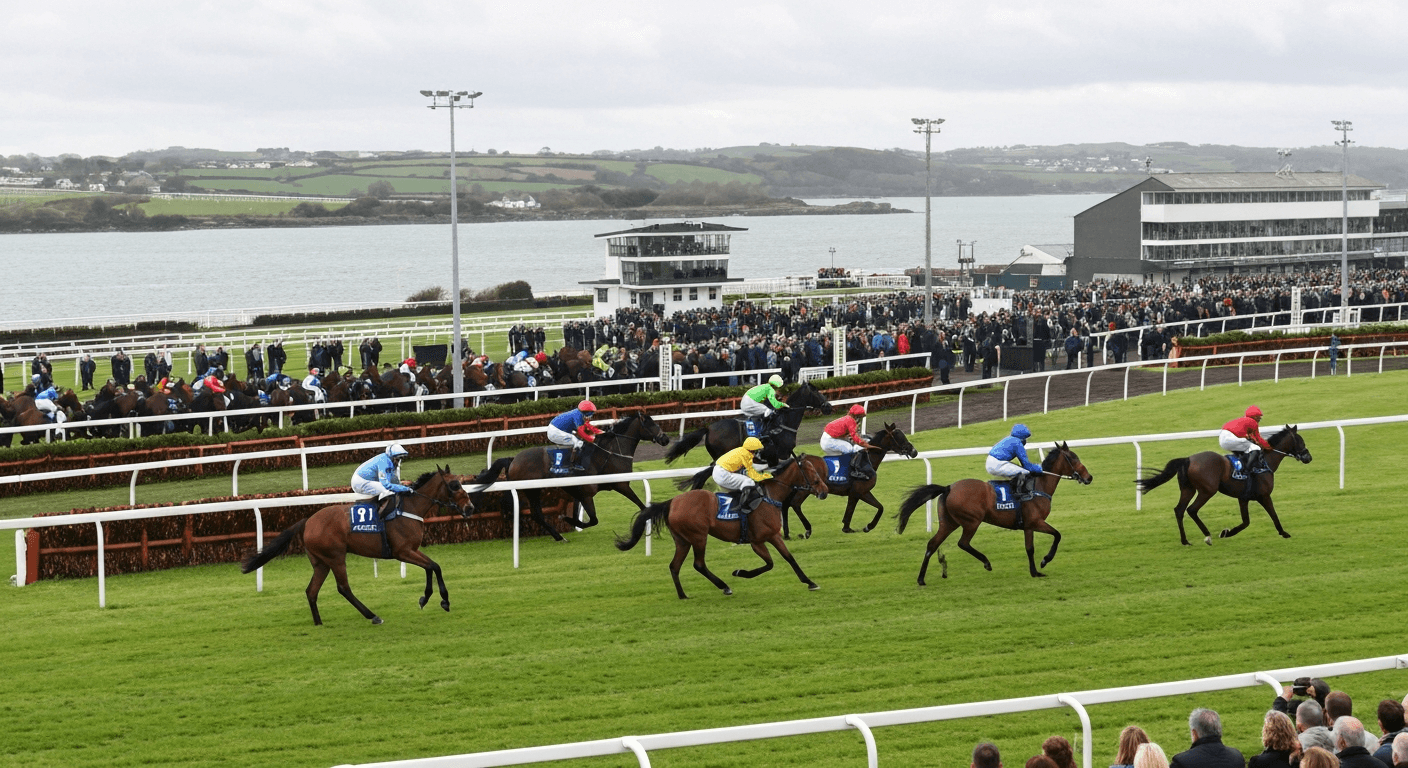
M.W. Hickey Memorial Chase Day at Wexford: The Complete Guide
Your guide to M.W. Hickey Memorial Chase Day at Wexford, the Autumn Festival's Listed chase highlight in late October, with the roll of honour and how to watch.
Read more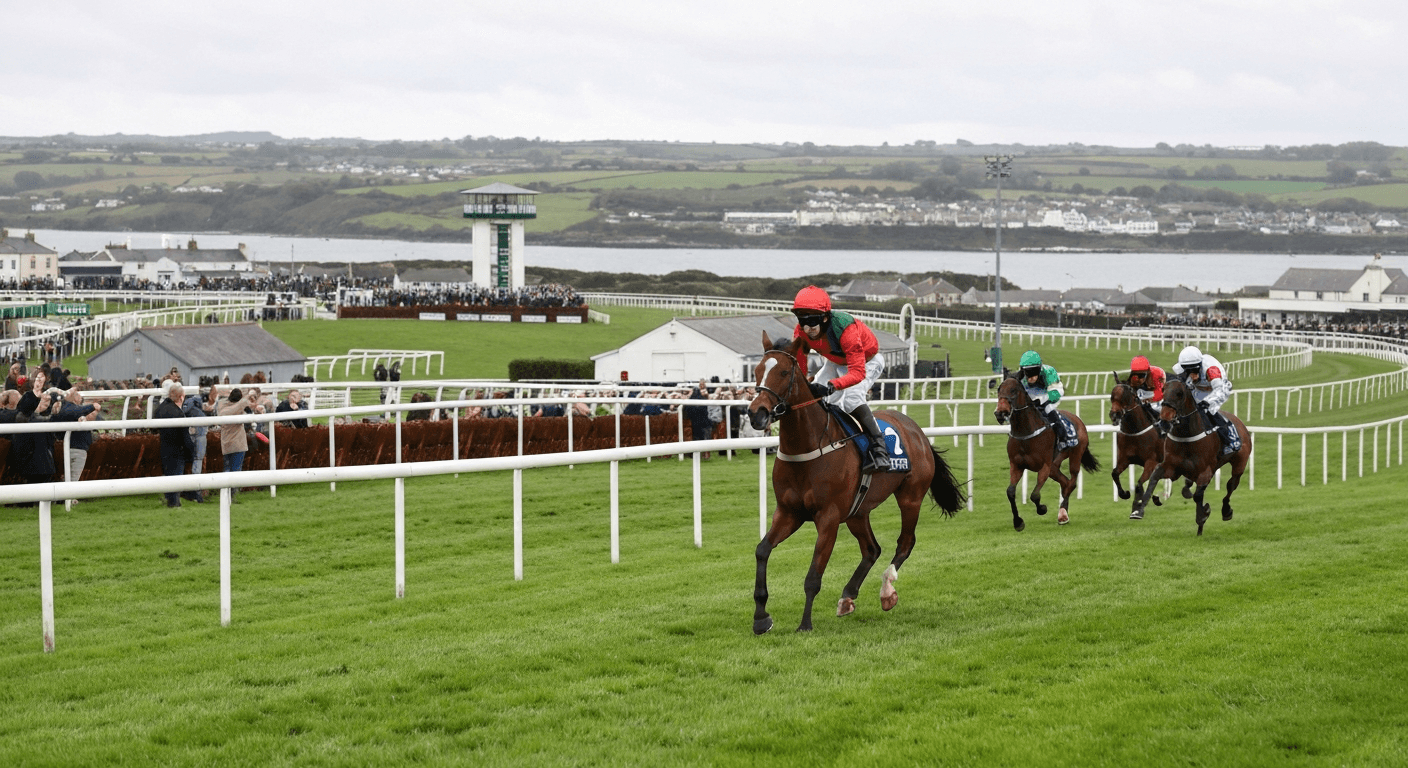
Sinntara at Wexford: The Complete Story
How Sinntara, winner of a maiden at Wexford in 1992, went on to breed Sinndar, the colt who won the 2000 Epsom Derby, Irish Derby and Arc.
Read more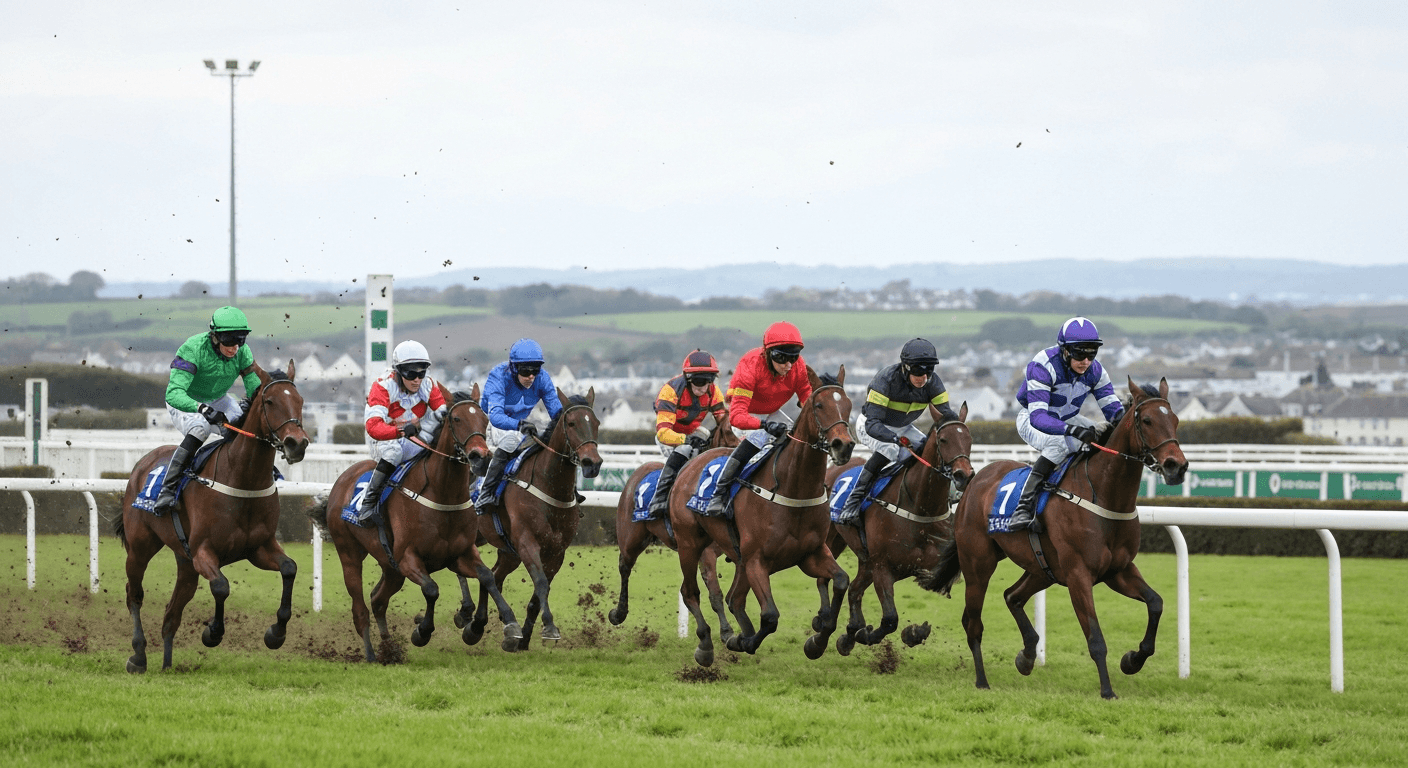
Betting at Wexford Racecourse
How Wexford's sharp, undulating, left-handed jumps track shapes the betting, with the Listed Hickey Memorial Chase, the front-runner bias and form framed honestly.
Read moreResearch the field with the AI Race Predictor
Our model publishes calibrated win-probability estimates for UK races — a second opinion to understand a race, not tips. It's open about its record: it doesn't beat the market, and we show exactly how it does.
Work it out & learn the basics
Gamble Responsibly
Gambling should be entertaining and not seen as a way to make money. Never bet more than you can afford to lose. If you or someone you know has a gambling problem, help and support is available.