
Founder & Editor · Last reviewed 2026-03-02
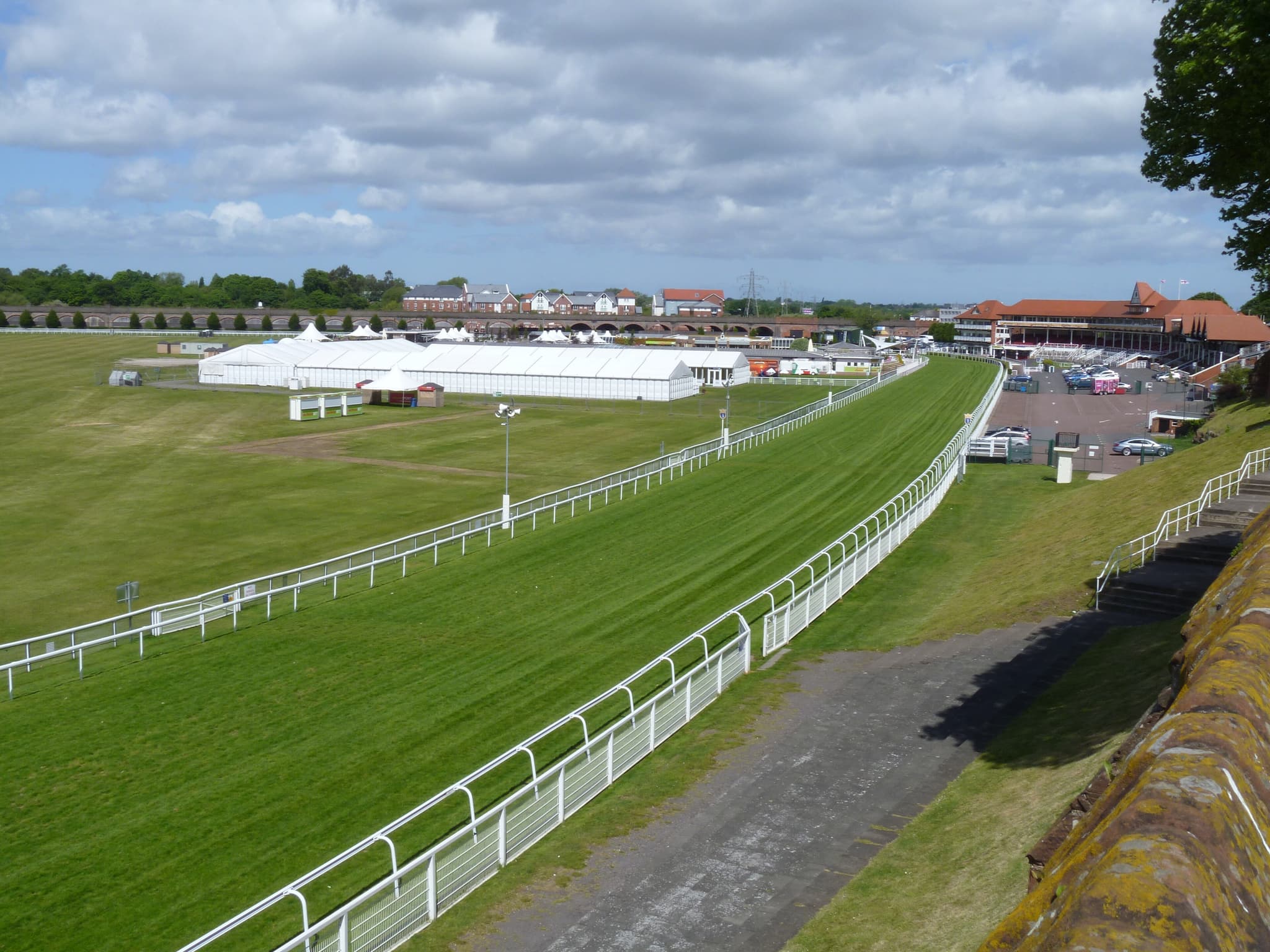
No racecourse in England can match Chester for history. When the first recorded horse race took place on the Roodee in 1539, Henry VIII was on the throne, the Dissolution of the Monasteries was underway, and the city of Chester was still a working port on the River Dee. Nearly five hundred years later, they're still racing on the same patch of ground.
That continuity is worth sitting with. Racing has come and gone at dozens of English venues since the Tudor period, meetings that flourished for a century or two before fading into the form book. Chester kept going through the Civil War, the Puritan Commonwealth, two world wars, a foot-and-mouth crisis, and more floods than anyone has cared to count. The Roodee is a flat meadow beside the Dee, just outside the medieval city walls, and its survival as an active racecourse is as much about civic identity as sporting appetite.
Chester's story goes further back than 1539. The Romans built a harbour on this ground. Medieval Cestrians held Shrove Tuesday football matches here. When horse racing eventually took root in the mid-16th century, it was building on centuries of communal use, drawing on a civic foundation that gave the earliest races their institutional backing. The city corporation supported Chester Races from the start, which is partly why they lasted.
The course has also been at the heart of racing's evolution. It witnessed the shift from two-horse matches to competitive fields. It established one of the oldest handicaps in Britain. It became a first-choice Classic trial ground. And through every era, the tight circular layout of the Roodee, bounded by the river and the ancient city walls, remained physically unchanged. The course layout you race on today is the same loop that Tudor horsemen first navigated.
This article follows Chester's history from its Roman antecedents through the Tudor founding, the Georgian and Victorian golden age, the great races that defined its reputation, and into the modern era. It also asks a question that most racing histories skip: why has this particular piece of ground survived when so many others didn't?
The answer has as much to do with geography, civic pride, and sheer luck as with anything sporting. But the racing, when it comes, has always been worth watching.
Medieval Origins & The Roodee
The story of Chester Racecourse begins with the Roodee itself, and the Roodee's story goes back far further than horse racing. Understanding the ground is essential to understanding why racing took root here and why it's endured.
The Roman Harbour
Chester, Deva Victrix as the Romans named it, was one of the largest fortress cities in Roman Britain. The fortress at Chester housed a full legion and served as the command centre for the Roman occupation of northern Wales and north-west England. But the military installation was only part of it. Chester was also a major port.
In Roman times, the River Dee was wider, deeper, and navigable much further inland than it is today. The flat meadow that would eventually become the Roodee sat at the river's edge, functioning as the city's harbour. Roman ships from the Irish Sea unloaded supplies here: grain, amphorae of olive oil and wine, building materials, and military equipment. The harbour was the economic artery that kept the fortress alive.
Over the centuries that followed the Roman withdrawal around 410 AD, the River Dee began to silt up. The river narrowed and shifted. What had been an active harbour gradually became a flat, grassy meadow sitting at the edge of the old city. By the medieval period, this open ground outside the city walls had passed into common use, available to the citizens of Chester for grazing animals, for assembly, for sport. The Romans' harbour had become the people's meadow.
That transformation matters. The Roodee's distinctive shape, circular and level, bounded by water on one side and the ancient walls on another, is a product of its Roman origins. The ground was shaped by the river, not by any intention to create a racing venue. The Romans gave Chester the topography that would, fifteen centuries later, produce England's most unusual and historically significant racecourse.
The Roodee Name
The word "Roodee" is a corruption of "Rood Eye," Old English meaning "Island of the Cross." A rood was a cross or crucifix; an ey was an island. The name refers to a rocky outcrop or raised islet in the meadow, on which a stone cross once stood. The cross had been there since at least the medieval period, though its exact origins are disputed. Some traditions connect it to an early Christian shrine; others to a boundary marker or waymarker for travellers approaching Chester from the Welsh side of the Dee.
By the Tudor period the cross was already ancient and worn, but the name Roodee had fixed itself to the meadow. The stone base of the original cross survives today. It stands in the centre of the racecourse, surrounded by turf, unremarked by most racegoers who walk past it on their way to the grandstand. It is approximately two thousand years of history compressed into a weathered lump of sandstone. You could walk right past it without a second look, and most people do.
Tudor Founding: Henry Gee and the Silver Bell
The first formal horse race at Chester on record took place in 1539, the thirty-first year of Henry VIII's reign. The man credited with organising it was Henry Gee, then serving as Lord Mayor of Chester. The prize he offered was a silver bell, to be awarded to the winning horse's owner.
This might sound modest by later standards, but it was a significant civic gesture. Gee was not simply putting on an entertainment. He was replacing something else.
From Football to Horse Racing
The Roodee had been the setting for Shrove Tuesday celebrations for generations before 1539. These events included foot races, games, and a form of football that was less a sport than an organised riot. Several hundred people would chase an inflated bladder across the meadow in a contest that had no formal rules and no obvious end point beyond exhaustion and injury. The city corporation tolerated these events as traditional, but they grew increasingly difficult to manage. Fights spilled into the streets. Civic order suffered.
The transition from chaotic Shrove Tuesday football to organised horse racing appears to have been a deliberate policy decision by the Chester corporation. Horse racing was more controllable, more prestigious, and more likely to attract the kind of wealthy visitors who would spend money in the city's inns and taverns. Henry Gee formalised the arrangement in 1539, setting rules for the races, providing a prize, and establishing the city's authority over the event.
The connection between Henry Gee's name and the word "gee-gee," the child's term for a horse, has been noted for centuries. The etymological link is almost certainly coincidental. Gee is a common English surname, and the reduplication "gee-gee" follows a standard pattern in English children's vocabulary. But the story is too appealing to ignore entirely, and Chester has always been happy to let the association stand.
The Early Races
Those first races on the Roodee looked nothing like what we'd recognise today. They were almost certainly match races, two horses head-to-head, probably over multiple circuits of the meadow. There were no starting stalls, no numbered silks, no enclosed grandstand, no official handicapper. The horses were owned by local gentry and merchants; the jockeys were likely servants or professional riders who travelled between wealthy households.
Spectators watched from the city walls. Chester's Roman walls, built between 70 and 80 AD, encircle the old city and include a section overlooking the Roodee from above. From the walkways on the walls, a good crowd could watch the entire course, an amphitheatre effect that the Romans would have recognised. This was the original free grandstand, and it has been in continuous use as a viewing area since the Tudor period.
The civic structure of the early races was important. Chester corporation organised and funded the meeting, which gave it a stability that privately funded meetings often lacked. When a wealthy patron died or withdrew support, a privately backed meeting could disappear within a season. Chester's races were underwritten by the city itself, which meant they survived changes of personnel and the occasional political disruption.
The Prize Evolves
The silver bell of 1539 was followed in later decades by gold and silver cups, more valuable prizes that reflected the growing ambition of the meeting. Records from the late 16th century show the city corporation spending considerable sums on cups and purses. By the time Elizabeth I was on the throne, Chester Races were drawing horses and owners from beyond the immediate region.
The Elizabethan era also saw the rules of racing begin to formalise. Disputes about starts, distances, and finishes required written agreements, and these early regulations laid the groundwork for the more structured governance that would arrive in the following century. Chester was part of this process, one of a handful of English meetings developing the administrative language of organised racing.
The City Walls and the Open Meadow
One aspect of the Tudor founding that often gets overlooked is what it said about Chester's relationship with its own citizens. Most of the great early English racecourses were private affairs, held on land owned by the Crown or by aristocratic patrons, with admission controlled and ordinary people kept at a distance. Chester was different. The Roodee was common land. The city walls were public. Anyone who climbed to the top of the walls could watch the racing for nothing.
This democratic character shaped the course's identity from the start. It's why Chester has never felt like an exclusively elite sport venue. The Chester May Festival today still draws racegoers who watch from the ancient walls without paying a penny. The tradition is 487 years old and counting.
Era takeaway: Chester's Tudor founding wasn't an accident or an aristocratic whim. It was a deliberate act of civic organisation by a Lord Mayor who turned a public meadow into a formal sporting venue. That civic foundation, the city owning the space and backing the prize, is what gave the Roodee its extraordinary staying power.
The Civil War and the Puritan Interlude
The English Civil War, which began in 1642, brought racing across England to a halt. Chester was a Royalist city and endured a prolonged siege by Parliamentary forces in 1644-45. During the siege, the Roodee became a defensive position rather than a sporting venue. The cattle grazing and race meetings gave way to earthworks, gun emplacements, and the grim business of a city being slowly starved into submission.
Chester fell to Parliament in February 1646 after fourteen months of siege. The city was badly damaged and its population exhausted. Racing was the least of anyone's concerns. When the Puritan Commonwealth took power nationally, public entertainments including horse racing were suppressed as ungodly frivolities.
The ban lasted until the Restoration of Charles II in 1660. Charles was a passionate racing enthusiast who did more than any monarch since Henry VIII to promote the sport. Newmarket became his personal racing headquarters, and his enthusiasm spread racing back across the country. Chester races resumed within a few years of the Restoration, and by the 1680s the Roodee was busy again.
The Civil War interlude is a useful reminder of what the Roodee survived. A fifteen-month siege, military occupation, national religious suppression, and civic ruin, and Chester racing bounced back within a generation. The institutional roots planted by Henry Gee were deep enough to endure even that.
The Georgian & Victorian Eras
The 18th and 19th centuries transformed Chester from a well-established regional meeting into one of the most important racecourses in England. This was the era when British racing reinvented itself: the Jockey Club was founded, the Classics were established, and the sport developed the structures we still recognise today. Chester was in the middle of that transformation.
The Georgian Boom
By the early 1700s, Chester Races had become a fixed point in the northern social calendar. The meeting drew owners, trainers, and horses from across the north of England and Wales, and the city's inns and taverns did extraordinary business during race week. The sport itself was also changing. Match races between two horses were giving way to competitive fields. Prize money was growing. The quality of horses on show was rising to match the ambitions of the promoters.
The city corporation continued to sponsor the races throughout the Georgian period, providing cups and purses that attracted the best-bred horses from the great northern stables. This civic investment was unusual by the standards of the day. Most racecourses by the 18th century had moved towards private patronage, with wealthy individuals or syndicates backing the meeting and controlling the purse strings. Chester retained its civic character, and that distinctiveness was a source of pride.
The grandstand era began at Chester during the 18th century. The first permanent viewing structure replaced the informal arrangements of earlier generations. Spectators had always watched from the city walls, but a proper grandstand meant Chester was competing with the other major courses (Newmarket, York, Epsom) for the attention of serious racing men. The investment signalled that Chester intended to be taken seriously as a national venue, not just as a regional curiosity.
Racing in this period was often raw and controversial. Disputes over finishes were common, gambling on races was widespread and sometimes corrupt, and the rules of racing were still being hammered out through decades of argument and litigation. Chester was not immune to any of this. There were disputed results and accusations of fixing during the Georgian period, as there were at every significant course. But the civic structure provided a degree of oversight that many privately run meetings lacked.
The Course Takes Shape
By the mid-18th century, the Roodee's physical boundaries were well established. The course ran along the riverbank, turned sharply at the bottom, and curved back along the inside of the city walls. The total distance around was approximately one mile and seventy-three yards, short by the standards of any other major course in Britain. The tight bends that characterise the Roodee were already producing the tactical racing that Chester became famous for. Low draws in short-course sprints were already advantageous, though this would not be formally quantified for another century and a half.
The confined nature of the course shaped the type of racing that Chester could offer. Very long straight courses, like Newmarket's Rowley Mile, favoured pure speed and power. Chester's bends rewarded balance, agility, and jockeyship. It was a different kind of test, and it produced a different kind of form. Horses that won at Chester were often underestimated when they ran at other tracks, because the skills needed at the Roodee didn't always transfer elsewhere. This is still true today, as anyone who has studied Chester's course-and-distance form will confirm.
The Chester Cup
The race that would define Chester's identity for the next two centuries was established in 1824. The Chester Cup, a staying handicap over two miles and two and a half furlongs, became one of the most anticipated betting races in the calendar.
The Cup arrived at the right moment. Handicap racing was growing in popularity across Britain, driven partly by the desire to create more competitive fields. If every horse carried weight proportional to its ability, the theory went, every runner had a chance of winning. In practice, the handicapper's decisions were disputed, the weights were sometimes manipulative, and the betting was occasionally corrupt. But the spectacle was undeniable. Big fields, uncertain outcomes, and the possibility of a long-priced winner made handicaps the crowd-pleasers of the Victorian era.
The Chester Cup fitted this template perfectly. Two miles around the tight Roodee was a real stamina test, and the multiple turns meant that position and luck in running were as important as outright ability. A horse with a poor draw could be baulked on the first bend and lose all chance. A well-placed horse at the right price could land a substantial betting coup before the wider market reacted. The Cup was a punter's race from the start.
A Victorian Chester Cup Day
Picture it: May afternoon, 1870. The city is alive from breakfast. The streets from the railway station to the Roodee are thick with people: factory hands from Liverpool, merchants from Manchester, country gentlemen in from Cheshire farms. The walls above the course are solid with bodies, thousands standing two and three deep along the ancient walkway, children lifted onto shoulders for a view. Below, the horses circle the paddock, steam rising off their backs in the damp spring air. The betting ring is already roaring. The favourite for the Cup is being backed off the boards; the rails bookmakers are shortening, shouting prices over the noise. An hour later, the horses go to post. The crowd on the walls falls briefly quiet as the starter drops his flag. Then noise again, a wave of it rolling along the stone parapet as the field comes into view on the far side. The race is done in under five minutes. The winner, a rank outsider, is led back through a crowd too shocked to cheer loudly. By the time the evening trains leave for Liverpool, three separate groups will claim they had the winner from the start.
That was Chester in May. It was one of the great sporting occasions in England, a combination of city festival, social event, and serious betting market that few other meetings in Britain could match.
The Chester Vase and Classic Connections
Chester's development as a Classic trial venue came gradually but by the mid-Victorian period was well established. The Chester Vase, formally introduced as a named race in 1907 though its antecedents stretch back further, became one of the most reliable Derby trials on the calendar. A win or a close second in the Vase could transform a horse's Epsom price overnight.
The connection between the Roodee and Epsom was logical. Both tracks demanded balance and adaptability from their runners. Epsom's infamous camber and undulating straight rewarded horses that could handle uneven ground; Chester's tight bends rewarded horses that could corner efficiently without losing momentum. Horses that handled the Roodee's specific demands tended to be the kind of horses who could cope with Epsom too. This wasn't coincidental. It was a function of what both tracks asked of a horse.
The Dee Stakes, also run during the May Festival, developed alongside the Vase as a trial ground. Between the two races, Chester could truly claim to be among the most important Classic prep meetings in Britain, drawing horses from Newmarket, Yorkshire, and the Irish stables that were beginning to have an influence on the English pattern.
The Railway and Victorian Expansion
The arrival of the railway at Chester transformed the scale of the meeting. The Chester and Birkenhead Railway opened in 1840, and subsequent lines soon connected Chester to Liverpool, Manchester, and the national network. A journey that might have required half a day by road could now be done in an hour. Racegoers who had previously made the trip only once in a season started coming regularly.
The effect on attendances was dramatic. The Roodee's capacity was limited by the same geography that shaped the course itself. You couldn't expand indefinitely when you were bounded by a river and a city wall. But within those constraints, the Victorian crowds were substantial, and on Cup day the walls and surrounding streets would hold several thousand spectators.
The Victorians also formalised much of what we now take for granted at Chester. Racecourse administration was professionalised, the fixture list was regularised, and rules were standardised in line with the Jockey Club's authority. Chester was never simply a local law unto itself. It operated within the national framework of regulated racing even as it maintained its distinctive civic character.
The Social Dimension
Chester Races in the Victorian and Edwardian era were as much a social occasion as a sporting one. The County Stand attracted the regional elite: Cheshire landowners, Lancashire industrialists, and their families in their race-week finery. The course was one of the few occasions in the year when the great houses of the north-west sent their carriages to town and the social calendar reached its annual peak.
But the democratic tradition held. The city walls remained open to anyone who climbed them. Working men from the Chester factories stood on the ancient ramparts and watched the same races as the occupants of the County Stand below. The contrast between the two audiences, separated by stone and a few feet of height, was one of the defining images of Chester race day and remained so well into the 20th century.
Era takeaway: The Georgian and Victorian eras cemented Chester's national importance. The Chester Cup gave the meeting a race of real standing, the railway opened it to mass attendance, and the Classic trial connections kept the best horses coming. By 1900, Chester was not merely the oldest racecourse in England but one of its most watched and most bet-upon.
Famous Races & Moments
Nearly five centuries of racing have produced more than their share of great moments at Chester. Some defined eras. Others are simply stories that capture what's unique about racing on the Roodee.
Chester Vase and Derby Glory
Chester's role as a Derby trial venue has produced some of the course's most memorable performances. The Chester Vase, a mile and three furlongs typically run during the May Festival, has seen future Classic winners arrive at the Roodee as promising horses and leave as serious Epsom contenders.
Authorized ran an impressive Chester Vase in 2007 before winning the Derby convincingly at Epsom. The performance at Chester, showing the balance to corner efficiently and the acceleration to pull clear, was exactly the kind of evidence that trainers and punters needed to take him seriously for the Classics. The Roodee had done its job as a trial ground.
The Dee Stakes, also part of the May programme, has produced its own share of Classic pointers over the decades. Chester in May is one of the few fixtures where you consistently see real top-level three-year-olds stretching out, and the form has repeatedly transferred to Epsom, Newmarket, and beyond. The tight-turning test at Chester weeds out horses that lack the balance for demanding tracks, which is precisely why the form is worth following.
Takeaway: Chester Vase results have been a reliable pointer to Derby form for over a century. Horses that negotiate the Roodee's bends efficiently tend to cope with Epsom's demands too. When a well-bred three-year-old wins the Vase with authority, Epsom punters should take note.
Chester Cup Legends
The Chester Cup has been the centrepiece of the meeting since 1824, and the race has a tradition of rewarding bold gamblers, punishing short-priced favourites, and producing finishes that take minutes to resolve.
In the Victorian era, the Cup was one of the most heavily wagered races in the calendar. Fortunes were made and lost on the Roodee's marathon test across two miles and two and a half furlongs. The race attracted horses from the great northern stables and from Newmarket, and the betting market was studied by professional backers weeks in advance. Information moved slowly in the 19th century, and a horse brought quietly to form in a country yard could be backed to substantial sums before word reached the ring. Some of the great Victorian betting coups were landed at Chester.
In more recent times, the 2003 Chester Cup produced a memorable piece of racing when Tycoon took the race under a brilliant ride from Kevin Darley. Threading through a packed field on the tight bends, Darley found gaps that other jockeys hadn't seen and delivered Tycoon with a perfectly timed run up the straight. It was the kind of race that Chester produces more than anywhere else, with navigation and jockeyship mattering as much as raw stamina.
The draw has always been a factor in the Cup too, though its effect over two miles is less pronounced than in the sprints. Horses drawn wide have found the first bend punishing, and several Cup winners over the years have benefited from a clean run on the inside from an early stage. Understanding the draw is part of understanding Chester, and the Cup is the race where that understanding most frequently pays off for the prepared punter.
Takeaway: The Chester Cup has been one of Britain's great staying handicaps for two hundred years. Its combination of distance, tight bends, and draw implications makes it among the most analytically interesting races in the flat calendar. Studying the form here, and how it has aged, is one of the more rewarding exercises a racing historian can undertake.
The Draw Controversy
Chester's extreme draw bias has been a source of debate for generations. The statistical advantage of low draws in sprint races has been documented thoroughly since at least the 1970s, but the phenomenon was noted informally long before that. In some years the bias has been so pronounced that horses drawn in the high teens appeared to have almost no realistic chance.
This is a direct consequence of the Roodee's geography. In a short sprint, the horses break from the stalls and almost immediately begin to turn left. A horse drawn wide has to travel further than a horse drawn close to the inside rail. On a track where the total distance is only about a mile and seventy yards, that extra distance in the early stages can be decisive. The bend comes too quickly for the wide-drawn horses to find the inside, and the race is often settled before the short straight.
The racecourse has experimented with stall positions and adjusted field sizes over the years in an attempt to mitigate the bias. None of the interventions has eliminated it entirely. The geometry of the Roodee is simply what it is. For many racegoers and punters, the draw is part of Chester's character, a feature rather than a flaw. For others, it's a source of real frustration when a well-fancied horse loses ground before the race has properly started. Either way, it's been a talking point for longer than any of us have been alive.
Takeaway: Chester's draw bias is not a new discovery. It's the inevitable result of a tight left-handed circuit with an early bend. Any punter betting at Chester without considering draw statistics is operating with incomplete information.
Frankie Dettori at Chester
Frankie Dettori has always been a popular figure at Chester, and his appearances on the Roodee have produced some of the course's most enjoyable recent riding performances. His ability to read the pace on a tight circuit, saving ground through the bends and delivering his mount at exactly the right moment, has been on display here many times.
Chester is a jockey's course. On wide, galloping tracks, raw horse power often overwhelms tactical finesse. At the Roodee, position is everything. A lengths-wide passage around the home turn can cost a horse more than a length in the straight, and a jockey who wastes that ground on a 12/1 shot will find an empty position on the podium. The best riders come to Chester with a specific plan and execute it precisely. Dettori at his best is a masterclass in this kind of riding, and the Chester crowd has always responded accordingly.
Wartime on the Roodee
Both World Wars disrupted racing at Chester, but in different ways. During the First World War, the racecourse was requisitioned for military use, as were many British venues. Racing was suspended for the duration, and the Roodee served purposes that Henry Gee would not have recognised.
The Second World War brought another interruption, though some wartime meetings were held at selected courses to maintain public morale. Chester's position as a regional centre made it a potential venue, but the Roodee was again given over to military and civic uses during the most intensive years of the conflict.
When racing resumed after 1945, Chester rebuilt quickly. The May meeting regained its place in the fixture list and its standing with the major stables. The post-war decade saw the course invest in its facilities and its racing programme, and by the 1950s the May Festival was as strong as it had been before the war.
The 2001 Foot-and-Mouth Crisis
The foot-and-mouth outbreak of 2001 caused some of the worst disruption to the British countryside in living memory. Racing was among many rural industries that shut down almost entirely as the country tried to contain the spread of disease. Chester's May meeting, the most important fixture in the course's year, was cancelled in full.
For the businesses that depend on the May Festival, the cancellation was a serious financial blow. Chester's economy has been linked to its racecourse since the Tudor period, and the May meeting in particular generates significant income for the city's hospitality and retail sectors. One missed year cost the local economy a sum that took several seasons to recover.
The 2001 cancellation was a reminder of how connected racing remains to the wider agricultural world, and of how much the May Festival matters beyond the racecourse gates. When people say the Roodee is part of Chester's identity, the foot-and-mouth year illustrates what that means in practical terms.
Takeaway: Chester's famous moments span four centuries and range from Classic trials to betting coups, draw debates to wartime occupation. What links them is the Roodee itself: the same ground, the same tight bends, the same city walls watching from above.
The Modern Era
The second half of the 20th century brought a different set of challenges to Chester. The great battles of the Victorian era, fighting for prize money, establishing Classic trial credentials, and building national recognition, were won. The modern challenge was sustaining that position while the entertainment market diversified and the economics of British racing changed around the course.
The May Festival Settles Its Status
The May Festival, now running over three days in May, became the undisputed centrepiece of Chester's racing year through the post-war decades. The structure that the Victorians had built, Cup day as the betting spectacular and the Vase and Dee Stakes as the Classic trials, was retained and strengthened.
Through the 1960s and 1970s, the Festival grew in both prestige and attendance. Better prize money brought better horses. Better horses brought better crowds. The Chester Vase gained Group 3 status and became a race that serious Classic trainers targeted from the start of the season. Henry Cecil, Vincent O'Brien, and other great handlers of the era sent horses to Chester specifically for the Vase, treating the Roodee's test as a real trial rather than a convenient prep.
The Ormonde Stakes and Huxley Stakes, both run during the Festival, developed into quality middle-distance races that attracted horses from the major stables throughout this period. Chester in May became a three-day sequence where you could follow Classic trials on the first day, serious handicaps on the second, and the Cup as the feature on the third. For a racecourse of limited size, it packed an enormous amount of quality racing into a single week.
The Facilities Problem
The post-war decades also made clear that Chester had a problem the Victorians had avoided by not thinking about it: the Roodee was full. Bounded by the river on one side, the city walls on another, and the medieval street pattern elsewhere, there was simply no room to expand in the conventional sense. Other post-war racecourses were able to add car parks, new grandstands, and hospitality facilities by acquiring adjacent land. Chester could not.
The course addressed this through careful upgrading of what already existed rather than wholesale redevelopment. The main stands were refurbished rather than replaced. Hospitality areas were created within the existing footprint. The parade ring was redesigned to improve flow. The work was painstaking and sometimes expensive for the results it produced, but the alternative, losing the character of the course by bulldozing its historic fabric, was never seriously considered.
Behind the scenes, drainage and track maintenance received substantial investment. Chester's position beside the River Dee makes it vulnerable to waterlogging, and a flooded course in May would be an expensive disaster. The drainage work undertaken from the 1980s onwards improved the surface reliability significantly, reducing the frequency of abandonments and giving trainers more confidence in targeting the Festival.
The Modern Fixture List
Chester today runs flat racing from May to September, with the May Festival the highlight and a series of evening fixtures through the summer providing a different kind of raceday experience. The evening meetings attract younger audiences and a more casual crowd, and they've been an effective way of broadening the course's demographic base without alienating the traditional May audience.
The complete guide to Chester covers the full programme in detail, but the key point historically is that Chester has diversified its calendar while keeping the May Festival as the anchor. The Festival's three days remain the ones where the biggest horses and the biggest crowds come; everything else in the season builds around that core.
Media, Analysis, and the Digital Age
Chester has adapted well to the world of digital racing media. The course's specific characteristics, particularly the draw bias, the tactical demands of the bends, and the course-and-distance statistics, make it unusually rewarding for data-driven analysis. Racing post writers, betting analysts, and independent researchers have produced extensive work on Chester form over the past two decades, and much of it is now readily available online.
The draw statistics are the most famous aspect of this. Chester's low-draw bias in sprint races has been documented to a degree that very few other British racecourses can match. When racing media runs draw analysis pieces, Chester is always one of the first courses cited because the numbers are so pronounced and so consistent. This statistical clarity has been good for Chester's profile, keeping the course in the spotlight throughout the flat season rather than just on race days.
Chester's Position in Modern British Racing
The modern Chester sits in an interesting position in the British racing hierarchy. It is not one of the great Group 1 venues. There is no Chester race at the level of the Epsom Derby or the Ascot Gold Cup. The course's physical constraints mean it cannot host the largest fields or the longest straight-course races. What it has is a concentration of quality in a compact package.
The Chester Vase and Dee Stakes are reliable Group 3 races that consistently produce horses who run well in the Classics. The Chester Cup is one of the oldest and most bet-upon handicaps in the flat calendar. The Ormonde and Huxley Stakes attract real pattern-race horses. And all of this happens in three days at the Roodee, with the city walls watching from above and the stone cross in the middle of the course unchanged since the medieval period.
Chester has also maintained strong commercial links with its regional market. Chester's proximity to Liverpool and Manchester, two of England's largest cities with established corporate entertainment markets, has made the May Festival hospitality one of the most commercially successful race-week operations in Britain outside London. Corporate bookings for the Festival often sell out months in advance, and the hospitality revenue has helped fund the constant investment that keeping an ancient racecourse competitive requires.
Community and Heritage Work
Chester has invested in the heritage dimension of the Roodee in a way that few other courses have attempted. The course offers heritage tours, educational events, and exhibitions that tell the story of the site from Roman times onwards. The stone cross base in the middle of the track is explained to visitors who might otherwise walk past it. The relationship between the Roman harbour, the medieval meadow, and the modern racecourse is told as a connected narrative.
This heritage work matters commercially. It gives Chester a story to tell that no purpose-built modern venue can replicate. But it also matters for less calculated reasons. The Roodee truly is the oldest racecourse in England, and the communities around it have been connected to racing here for nearly five hundred years. Acknowledging that history feels right, not just marketable.
Takeaway: The modern era has seen Chester consolidate its national standing rather than dramatically change it. Facility upgrades, a strengthened fixture list, and smart use of the course's heritage and commercial assets have kept the Roodee competitive in a crowded market. The course's identity is fixed by its geography and its history, and those are things that money and planning cannot manufacture elsewhere.
Chester's Legacy
Chester's legacy isn't simply about being old. Plenty of things are old without being interesting. What makes the Roodee's nearly 500-year story worth examining is that the course still matters, still producing competitive racing, still generating serious form debates, still drawing full crowds in May.
A Living Museum
Walk into Chester Racecourse on an afternoon in May and you're standing on ground where Elizabethan horsemen raced for silver bells and Victorian gamblers wagered fortunes on the Cup. The stone cross base from which the Roodee takes its name still stands in the middle of the course, weathered and slightly incongruous against the modern turf. The city walls still provide a free elevated viewpoint, just as they did for spectators in the 1540s.
That sense of connection to the past is rare in modern sport. Most venues reinvent themselves so thoroughly that the historical layers are erased. Chester has modernised (better stands, better drainage, better prize money) without losing the thread that connects today's racing to the earliest Tudor meetings. The physical constraints that the Romans, medieval town-planners, and Tudor city fathers imposed on this ground are the same constraints that determine the racing today. The Roodee is truly one place where the phrase "nothing has changed" is almost literally true.
Why the Course Has Never Changed
This is the aspect of Chester's history that deserves more attention than it usually gets. The Roodee's circuit has remained essentially unchanged for nearly five centuries, and the reason is straightforward: it can't change.
The River Dee runs along the western boundary. The Roman city walls run along the northern and eastern edge. Medieval streets and buildings close off the remaining sides. There is no expansion possible without demolishing something ancient or diverting something wet. When the city corporation laid out the racing circuit in the 16th century, they were working within boundaries that were already 1,400 years old. Those boundaries are still there.
This produces a racecourse of extraordinary consistency. A horse that raced here in 1824 (the first year of the Chester Cup) faced exactly the same geometric demands as a horse that races here in 2026. The same first bend, the same tight loop, the same short straight. No other British racecourse can make this claim. Newmarket has been modified. Ascot has been redeveloped. Epsom's course geometry has been adjusted. Chester's Roodee is unchanged not because of sentiment but because of sandstone and the River Dee.
At approximately one mile and seventy-three yards around, it remains the shortest flat racing circuit in Britain. That brevity is a product of the meadow's natural dimensions, and no amount of modern planning or funding can alter it.
The Tactical Legacy
Chester has contributed something specific to the tactical vocabulary of British flat racing. The extreme draw bias, the tight bends, the short straight, these aren't quirks to be apologised for. They've shaped how trainers prepare horses for the Roodee, how jockeys plan their races here, and how punters study the form.
Chester form is approached differently from the form at any other course in Britain. The track characteristics demand analysis of draw position, early pace, and bend efficiency that are largely irrelevant on straight or wide-galloping tracks. A horse that wins at Chester has proved something about its balance and temperament that isn't tested in the same way elsewhere. Trainers who target the Roodee know exactly what attributes they need, and the races reward that specific preparation.
This has produced a distinctive pattern in Chester's form book. Course specialists develop here, horses who consistently run better at Chester than their overall rating suggests, because the specific demands of the Roodee suit them in ways that other tracks don't. Studying which horses come back season after season to run well at Chester is one of the more productive exercises available to a serious punter.
Chester's Place in British Racing History
In the broader history of British racing, Chester occupies a position that no other course can claim. It predates Newmarket as a formal racing venue. Ascot was established in 1711, Epsom's Derby in 1780, the Jockey Club in the 1750s, all came after Chester's civic corporation had already been organising races on the Roodee for generations. Chester has been part of every chapter of the sport's development in England, from the Tudor matching culture through the Georgian betting boom, the Victorian racing industry, and into the regulated modern sport.
That isn't a sentimental observation. It means that Chester's form book is the longest continuous racing record at any single British venue. The human memory of the Roodee stretches back to conversations and arguments that predate every other racecourse on the calendar.
Frequently Asked Questions
When did racing start at Chester?
The first recorded formal horse race at Chester took place in 1539, organised by the city's Lord Mayor, Henry Gee. That makes 2026 the 487th year of racing on the Roodee, longer than any other racecourse in England. Racing may have taken place informally on the Roodee before 1539, as the meadow was used for Shrove Tuesday sports including foot races, but 1539 is the established date for organised horse racing with a formal prize.
What is the Roodee?
The Roodee is the name of the flat meadow beside the River Dee on which Chester Racecourse is built. The word derives from the Old English "Rood Eye" (Island of the Cross) referring to a rocky islet in the meadow where a stone cross once stood. The River Dee flowed around this outcrop in earlier centuries; as the river changed course and silted up, the meadow formed. The stone base of the original cross still stands in the centre of the racecourse today.
Can people still watch racing from the city walls?
Yes. Chester's Roman city walls, built between 70 and 80 AD, include a section that overlooks the Roodee directly. Spectators have watched racing from this elevated walkway since the Tudor period, and the tradition continues today. The walls are a public monument, free to enter, and during race meetings you'll find racegoers lined along the parapet watching without paying admission to the course itself. No other racecourse in Britain has a free ancient monument as a viewing area.
What is the Chester Cup?
The Chester Cup is a flat handicap race run over two miles and two and a half furlongs during the Chester May Festival. It was first run in 1824 and is one of the oldest and most historically significant staying handicaps in British racing. The race has been a major betting event since its inception and remains one of the most competitive and widely-analysed handicaps on the flat calendar. The Chester Cup guide covers the race's history and betting patterns in full.
What is Chester's connection to the Romans?
The Romans established the fortress city of Deva Victrix at Chester around 79 AD, one of the largest Roman military installations in Britain. The area that became the Roodee served as the city's harbour, where ships from the Irish Sea unloaded supplies. After the Roman withdrawal, the harbour silted up and the ground became the flat meadow that Chester races on today. The Roman city walls, substantially intact, still form the boundary of the racecourse on one side.
Why is Chester the shortest flat circuit in Britain?
Chester's circuit measures approximately one mile and seventy-three yards, making it the shortest flat circuit in British racing. The compact size is a result of the Roodee's natural boundaries: the River Dee on the western side, the ancient city walls on the north and east, and the medieval street pattern elsewhere. The course cannot be extended without demolishing historic infrastructure or redirecting the river. Those boundaries were set by Roman engineers and medieval town-planners, and they remain fixed today.
Share this article
More about this racecourse
All Chester guides
Chester May Festival: Complete Guide
Your complete guide to the Chester May Festival — three days of top-quality flat racing at England's oldest racecourse.
Read more
Enable at Chester: The Complete Story
How Enable's Cheshire Oaks victory at Chester in 2017 launched one of the greatest careers in modern British flat racing history.
Read more
Betting at Chester Racecourse
How to bet smarter at Chester — draw biases, track characteristics, going preferences, key trainers and winning strategies for the Roodee.
Read moreGamble Responsibly
Gambling should be entertaining and not seen as a way to make money. Never bet more than you can afford to lose. If you or someone you know has a gambling problem, help and support is available.