
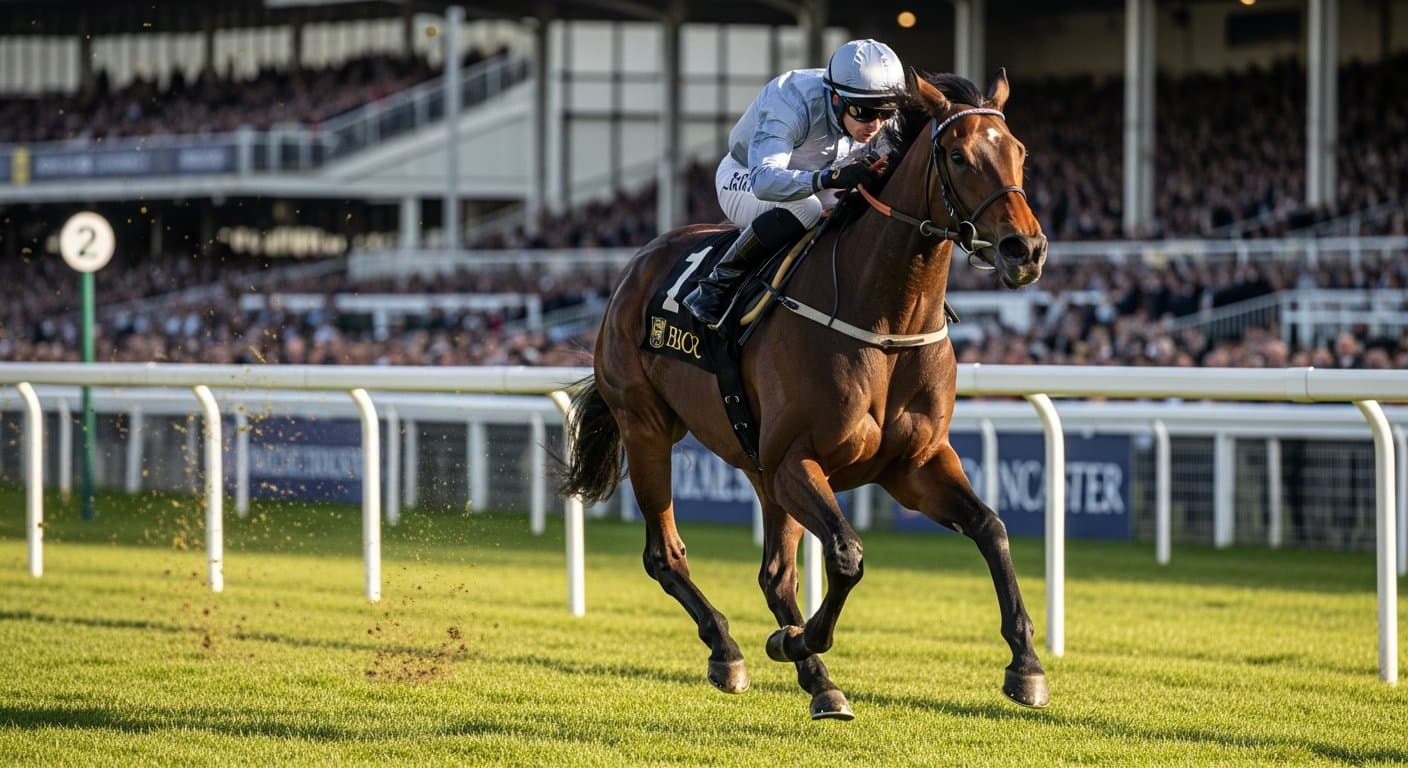
Founder & Editor · Last reviewed 2026-04-05
In September 1970, on the broad expanse of Town Moor at Doncaster, a bay colt named Nijinsky crossed the finishing line of the St Leger Stakes and became the first horse in thirty-five years to win the English Triple Crown. No horse has done it since. The record stands, more than half a century later, as one of the most enduring achievements in British sport.
The Triple Crown consists of the 2,000 Guineas at Newmarket, the Derby at Epsom, and the St Leger at Doncaster. It demands versatility across three different tracks, three different distances, and months of sustained racing at the highest level. The Guineas tests speed and resolution over a mile at Rowley Mile. The Derby tests class, stamina and the ability to negotiate Epsom's demanding cambers over one mile and four furlongs on a course that has humbled the best horses in training. The St Leger tests the staying power to see out one mile six furlongs and 132 yards on the world's oldest Classic track.
These three races have been run in this sequence since 1809, when the term Triple Crown first entered use after West Australian became the first horse to win all three in 1853. The challenge has been attempted dozens of times in the century and a half since. Fewer than a dozen horses have succeeded. The last was Nijinsky, in 1970: a horse bred in Canada, trained in Ireland, ridden by the most celebrated jockey of the age, and completing his greatest achievement on a Tuesday afternoon at a racecourse in South Yorkshire.
Nijinsky, trained by Vincent O'Brien at Ballydoyle in County Tipperary and ridden by Lester Piggott, arrived at Doncaster as the 2/7 favourite to complete the treble. The town came to attention. The racing world held its breath. He won by one length from Meadowville, and with that length, the history of British horse racing changed.
Doncaster's connection to Nijinsky is the connection to that moment: the last Triple Crown of the twentieth century, the last time a single horse was judged superior at every distance the Classics demanded. In September 1970, Town Moor became the backdrop for the most significant flat race result of the decade. The record it created has yet to be overturned.
For the full story of the race that defines the course, see our St Leger Festival guide and our Doncaster complete guide.
Bet on Doncaster
Place your bets on Doncaster races with a trusted bookmaker.

Promo code BETFRED50. New customers only. Register, deposit with a Debit Card, and place a first bet of £10+ at Evens (2.0)+ on Sports, to be settled within 7 days, to get £30 in Sports Free Bets and £20 in Bet Builder Free Bets within 24 hours of settlement. 7-day expiry. Eligibility & payment exclusions apply. Full T&Cs apply. Take Time to Think. BeGambleAware.org. 18+. Full T&Cs.

Promo code R30. New UK customers only, 18+. Register, deposit £10 or more, then place a £10 single cash bet at odds of 1/2 (1.5) or greater on any sports market (excluding Virtuals). Once the qualifying bet settles you get £30 in Free Bets (3 x £10) — the qualifying bet can win or lose. Free Bets are valid on any sports market excluding Virtuals, expire in 7 days, are non-withdrawable and must be used in full. Excluded deposit methods apply (including PayPal, Apple Pay, Skrill and NETELLER). Named bets such as Lucky 15 do not qualify. If you cash out the qualifying bet, or it is voided, you are no longer eligible for the offer. Ends 31.12.26. Full T&Cs apply. Please gamble responsibly. BeGambleAware.org. 18+. Full T&Cs.

Promo code BET40GET20. New UK customers, 18+. Register with the code and place a first bet of £40 or more at Evens (2.0) or greater. Receive 2 × £10 free bets: the first credited automatically once the qualifying bet settles, the second 24 hours later. Free bets must be placed at minimum odds of 4/1 (5.0), expire 24 hours after credit, and the free-bet stake is not returned with winnings. Debit card deposits only. Take Time to Think. BeGambleAware.org. 18+. T&Cs apply. Full T&Cs.

50% of your first-day net losses refunded as a free bet, capped at £25. New UK customers aged 18+ only. To qualify, deposit and place a first bet of £10 or more on any sport at minimum odds of evens (2.00), then place at least two further bets on different events, each worth at least 50% of your largest bet, all at evens (2.00) or greater. Losses are counted from your first settled bet until 23:59 the same day. Place a qualifying £10+ bet and you are guaranteed at least a £5 free bet. Bets placed at SP, void bets, cashed-out bets and bets struck with free bets do not count towards the offer. The free bet is credited the day after your qualifying bets settle and must be used within 7 days, after which it expires. It can be used at odds from 1/4 (1.25) up to 250/1 on singles and straight accumulators, but not on Trixie, Patent or Yankee style multiples. Free-bet stake is not returned with winnings. One offer per person, household, address, IP address and device. E-wallet deposits may not qualify, so check the cashier before depositing. Customers registered with GAMSTOP cannot claim. KYC identity verification must be completed before the free bet is credited. Take Time to Think. BeGambleAware.org. 18+. T&Cs apply. Full T&Cs.

New customers, 18+. Choose the sports bonus at sign-up, make a first deposit and receive a 100% bonus up to £50 in your Sports Bonus balance. To convert the bonus to cash, wager it 10x within 30 days. Single bets below Evens (2.00) do not qualify; accumulators do not qualify if any selection is below 1/2 (1.50). Virtual Sports, voided, cancelled, drawn, cashed-out and free-bet wagers do not count towards wagering. Only the first settled bet per event counts. Withdrawing before the wagering requirement is met forfeits the bonus balance including bonus winnings. Real-money funds are used before bonus funds. Deposits via Skrill or Neteller are not eligible. Not valid in conjunction with other promotions. Odds, bet and payment limits apply. 10bet general and promotion T&Cs apply. BeGambleAware.org. 18+. Full T&Cs.

New customers in Great Britain and Republic of Ireland, 18+. Place a £10 fixed-odds qualifying bet at minimum odds of 1/2 (1.50) — single or each-way (only the win part counts), pre-event or in-play, not cashed out early, within 28 days of opening the account. Receive up to £60 in bonuses credited over three days: 3 × £10 fixed-odds free bets (the first on settlement, then 24 and 48 hours later) plus 3 × £5 Total Goals FOOTBALL spread bets, 3 × £5 racing Winning Favourites spread bets and a £1 racing Race Index spread bet (the spread bets need a full spread-betting account). Free-bet stakes not returned with winnings; free bets valid 28 days from issue. IMPORTANT: the £5 credits are SPREAD bets — sports spread betting carries the risk that losses can exceed your stake. Sports spread-betting customers do not have Financial Ombudsman or FSCS recourse. Take Time to Think. BeGambleAware.org. 18+. T&Cs apply. Full T&Cs.

Promo code WELCOME15, entered under My Bonuses after registering. New UK customers, 18+. Place a first qualifying bet of at least £10 from your cash balance at odds of evens (2.0) or greater within 7 days of opening the account. Once the qualifying bet fully settles you receive £15 in free bets, credited as 3 x £5 tokens with set uses: one £5 accumulator free bet (minimum 4 legs, each leg at 2/5 or bigger), one £5 sports free bet (any market at evens or bigger) and one £5 Sub Cover free bet (selected football player markets at evens or bigger). Free-bet stakes are not returned with winnings. Free bets expire 7 days after they are credited. Void, cashed-out and partially cashed-out bets do not qualify. One offer per customer. Confirm the current terms on BetGoodwin's own welcome-offer page before claiming. Take Time to Think. BeGambleAware.org. 18+. T&Cs apply. Full T&Cs.

New UK customers, 18+. Minimum deposit £10. Place a £10 qualifying single at minimum odds of 1/2 (1.50), settled within 14 days. Receive £30 in free bets (stake not returned), split £20 for sportsbook use (2 x £10) and £10 for Bet Builder only (2 x £5); Bet Builder does not cover horse racing. Free bets must be accepted within 7 days and expire 7 days after acceptance. No promo code required. Best Odds Guaranteed on UK & Irish racing, subject to having staked over £25 in the previous seven days. Operated by LiveScore Betting and Gaming (Gibraltar) Ltd, UKGC 56859. Confirm the current terms on LiveScore Bet's own promotions page before claiming. Take Time to Think. BeGambleAware.org. 18+. T&Cs apply. Full T&Cs.
18+. BeGambleAware.org
Nijinsky: The Horse
Breeding and Origin
Nijinsky was a bay colt, bred in Canada by E.P. Taylor at Windfields Farm, Ontario, by Northern Dancer out of Flaming Page. Northern Dancer had won the 1964 Kentucky Derby and Preakness Stakes before injury ended his racing career, retiring to stud where his influence on the Thoroughbred breed would eventually become the defining story of late-twentieth-century bloodstock. In 1967, when Nijinsky was foaled, Northern Dancer was a relatively new stallion with fewer than three full crops of runners; his reputation was growing but his dominance was not yet established.
Flaming Page, Nijinsky's dam, was a daughter of Bull Page and had won the 1962 Queen's Plate, Canada's premier Classic, giving Nijinsky a pedigree that combined speed and staying power on both sides. E.P. Taylor, a Canadian businessman and racehorse breeder who had built Windfields Farm into one of North America's most respected breeding operations, recognised the quality of the mating and retained the colt through to his yearling season before offering him for sale.
The colt was purchased at the 1968 Keeneland yearling sale for $84,000 by Charles Engelhard, an American minerals magnate whose wealth had been built on South African platinum and gold mining. Engelhard was an established owner in British racing, with horses trained in both Britain and Ireland. He acted on the advice of Vincent O'Brien, whose eye for a yearling was already legendary. O'Brien had identified Ballymoss, who won the 1958 Prix de l'Arc de Triomphe; Sir Ivor, who won the 1968 Derby; and Larkspur, who won the 1962 Derby. His assessment of Nijinsky at Keeneland was that the colt represented a once-in-a-generation athlete.
$84,000 was a substantial sum for a yearling in 1968, though modest by the standards of what followed. Northern Dancer sons sold at auction for six and seven figures through the 1970s and 1980s, as the sire's reputation grew to unassailable levels. By those benchmarks, Engelhard's purchase price looks like an extraordinary bargain. The colt was sent to Ballydoyle, O'Brien's training establishment outside Cashel in County Tipperary, and entered a programme designed to bring a potentially exceptional horse to the peak of his powers at precisely the right moments.
Physical Description and Temperament
Nijinsky was a striking bay with a white blaze and three white stockings. He stood around 16.2 hands, not exceptionally large by Thoroughbred standards, but with a length of stride that observers at Ballydoyle noted as unusual even among O'Brien's best horses. John Gosden, who later became one of Britain's most successful trainers, worked at Ballydoyle during Nijinsky's time there and recalled a horse whose movement was unlike anything he had previously seen: the stride pattern was elongated and extraordinarily economic, covering ground without apparent effort.
In temperament, Nijinsky was sensitive and sometimes fractious, qualities that O'Brien managed with great care. His preparation for each race was calibrated to preserve his mental freshness alongside his physical sharpness. The ringworm infection that interrupted his preparation before the 1970 St Leger was a source of particular anxiety not just because of its physical effects but because of the stress it placed on a horse who was not psychologically robust under pressure.
The Two-Year-Old Season: 1969
Nijinsky was unbeaten in five races as a two-year-old, all in Ireland except for the final one. His first four victories came at the Curragh: the Erne maiden on 12 July 1969, then the Anglesey Stakes on 26 July, the Railway Stakes on 9 August, and the Beresford Stakes on 27 September. Each performance was more convincing than the last; the Beresford Stakes victory, over nine furlongs, first demonstrated the staying dimension that O'Brien had identified in his pedigree assessment.
In October 1969, Nijinsky travelled to Newmarket for the Dewhurst Stakes, the most prestigious two-year-old race in Britain. It was his first appearance in England, and his first race alongside the best British juvenile horses of the season. He won by three lengths from Great Wall, establishing Lester Piggott in the saddle for the first time. That partnership, forged at Newmarket in October 1969, would define the following year.
His rating at the end of his juvenile campaign placed him as the outstanding two-year-old in Europe. The Racing Post Ratings system, applied retrospectively, gives his 1969 Dewhurst performance a figure that places it among the ten best juvenile performances recorded in Britain in the post-war period.
Three-Year-Old Campaign: The Triple Crown Season
The 1970 season was constructed around the Triple Crown from its earliest planning stages. O'Brien and Engelhard were convinced Nijinsky possessed the versatility and stamina to win all three Classics, and the programme reflected that conviction.
The 2,000 Guineas at Newmarket on 29 April 1970 was won by two and a half lengths from Yellow God, with Piggott producing Nijinsky with controlled precision to dominate the mile at Rowley Mile. The performance prompted immediate discussion about the Derby, though the gap between Newmarket and Epsom, five weeks, was shorter than O'Brien would have chosen in ideal circumstances.
The Derby on 3 June 1970 was won by two and a half lengths from Gyr, a colt trained in France by Etienne Pollet who had beaten Sassafras and Meadowville in his previous race. The performance at Epsom, navigating the cambers and the crowds on a course unlike any other in Britain, drew comparisons with Sir Ivor's 1968 win: O'Brien's own previous Derby success. A margin of two and a half lengths at Epsom, over a field of that quality, was unusually authoritative.
After the Derby, Nijinsky won the Irish Derby at the Curragh on 27 June by three lengths from Meadowville, an opponent he would face again at Doncaster, and the King George VI and Queen Elizabeth Diamond Stakes at Ascot on 25 July by two lengths from Blakeney. These were not warm-up races run for experience; they were Group One victories of the highest class. By the time he arrived at Doncaster in September, he had not lost a race in sixteen months of competition, had won six races in 1970 alone, and carried the unbroken confidence of connections who believed they had the best horse in Europe.
The Two Defeats
No account of Nijinsky is complete without its difficult ending. After the St Leger on 12 September, he ran in the Prix de l'Arc de Triomphe at Longchamp on 4 October 1970. A stomach worm infection had compromised his preparation in the weeks before the race, leaving his handlers uncertain about his physical condition. He finished second to Sassafras, beaten a head, in a finish that ended his unbeaten record. The identity of the winning trainer, Francois Mathet, gave O'Brien cause to reflect that the Arc defeat was the product of circumstances rather than an honest verdict on the relative merits of the two horses.
His final race, the Champion Stakes at Newmarket on 17 October 1970, resulted in a three-length defeat by Lorenzaccio. He was not the same horse who had won at Doncaster five weeks earlier. He was retired to stud at the end of October 1970, the decision made in the knowledge that the intensity of the Triple Crown campaign, followed by the Arc and the Champion Stakes, had asked too much of a sensitive constitution.
His career record: eleven wins from thirteen starts. The eleven wins include the five Classics (2,000 Guineas, Derby, Irish Derby, St Leger, King George VI and Queen Elizabeth Diamond Stakes), the Dewhurst Stakes, and all four of his two-year-old starts in Ireland. The two defeats came at the very end of a campaign that lasted from July 1969 to October 1970.
At Stud
Nijinsky retired to Claiborne Farm in Kentucky, where he stood at stud from 1971 until his death in 1992. His record as a sire confirmed O'Brien's judgement about his quality. Among his sons were Golden Fleece, winner of the 1982 Epsom Derby; Shahrastani, winner of the 1986 Derby; Caerleon, winner of the 1983 Prix du Jockey Club; and Ferdinand, winner of the 1986 Kentucky Derby. His daughters and granddaughters produced champions across three continents.
The Northern Dancer bloodline that Nijinsky carried became, through his sons and daughters, the dominant genetic line in late-twentieth-century Thoroughbred breeding. A horse who cannot trace his lineage to Northern Dancer within three generations is now a rarity on any racecourse in the world, and a significant proportion of those lines pass through Nijinsky specifically.
The $84,000 yearling bought on Vincent O'Brien's recommendation at Keeneland in 1968 became, in every measurable sense, the most influential horse of his generation. His value at the time of his retirement to stud was estimated at £2 million. His influence on the breed, carried through succeeding generations, cannot be quantified.
The Races at Doncaster
The 1970 St Leger: Race Day
The St Leger Stakes is the oldest of the five Classics, first run in 1776 on the orders of Lieutenant General Anthony St Leger at Cantley Common on the outskirts of Doncaster, before moving to its permanent home at Town Moor two years later in 1778. By the time Nijinsky arrived in September 1970, the race had a history of nearly two centuries and had been won by some of the most celebrated horses in British racing's long record.
The 1970 edition was run on Tuesday 12 September, a fact that reflects how the Festival calendar was structured differently in that era. The race drew a crowd of 30,000, the practical limit of Doncaster's capacity at the time, and the atmosphere in the town in the days before the race had the quality of collective anticipation. A Triple Crown had not been completed since Bahram in 1935, thirty-five years of waiting for a horse exceptional enough to win all three Classics. Nijinsky was believed to be that horse, and Doncaster was to be the venue for the conclusion.
The race itself was not without anxiety for O'Brien and Piggott. Nijinsky had contracted ringworm in the weeks before the St Leger, a fungal skin infection that had interrupted his preparation and left the connections truly uncertain about his condition. In practical terms, ringworm does not necessarily affect a horse's ability to race, but the disruption to training routine and the psychological weight it placed on a sensitive horse meant that the Nijinsky who arrived at Doncaster in September 1970 was not quite as imperiously well as he had been in the summer. Piggott was given clear instruction to win the race without making it a harder contest than necessary.
The betting reflected the public's confidence rather than any concern about his preparation. Nijinsky started at 2/7, the shortest-priced Triple Crown favourite in living memory. Only Bahram, at 7/4 on for his 1935 St Leger, had started at shorter odds in a Triple Crown-deciding St Leger, though the contexts were quite different. At 2/7, punters received £2 for every £7 staked, a price that tells you everything about how certain the outcome was considered.
Against him in the field stood Meadowville, trained by Paddy Prendergast in Ireland, who had beaten Nijinsky's Irish Derby rival Ribero in his most recent start. Santamoss, who had won the Great Voltigeur at York on his previous outing, was also in the field, along with eight other colts who had each earned their place through creditable form. None of them was expected to win.
Race Tactics and the Finish
Piggott settled Nijinsky in mid-division for the first part of the race. With a field of ten on a course that gave every runner space to move, the early pace was set by Santamoss, who led through the long sweeping bend that brings the field into the home straight. Piggott began to move Nijinsky forward at the three-furlong mark, taking him from fifth to third as the field straightened up.
When he asked Nijinsky to accelerate at two furlongs out, the colt responded with the same controlled surge that had settled the Guineas and the Derby. He reached the front a furlong and a half from the line and held his lead as Meadowville, ridden by Sandy Barclay, launched his challenge. For twenty yards the two were close enough to generate real tension in the stands. Then Nijinsky's momentum and physical superiority reasserted themselves.
He won by one length. Not five, not ten: one length, which was all that was needed and all that Piggott extracted. The time of the race was 3 minutes 6.9 seconds, slightly slower than the course record of 3:01.2 set by Alcide in 1958, reflecting the September ground conditions rather than any lack of quality in the winner. The Triple Crown was complete.
The Town Moor Track and Why It Matters for the St Leger
Town Moor is one of the most demanding surfaces in British Flat racing. The course covers an ancient common that was first used for horse racing around 1600, predating the Jockey Club, predating the modern Classic system, predating almost everything that defines British Thoroughbred racing as it is practised today.
The Straight Mile, used for sprint races and shorter distance events, is entirely flat and entirely straight: one of the truest speed tests in the calendar. The round course, used for the St Leger and longer races, extends over one mile and six furlongs in a wide, sweeping left-handed loop. The configuration is unusual: after leaving the straight, the course curves gradually to the left, running across the common before bending more sharply into the home straight, which is dead flat for the final four and a half furlongs.
The gradient at the start of the St Leger, a slight uphill section in the opening quarter-mile, catches horses who begin too enthusiastically and has contributed to the tactical shape of many St Leger renewals. Horses who race keenly in the early stages tend to tire badly in the straight; horses who are settled and relaxed in the first half of the race tend to find reserves when they are needed.
For Nijinsky in 1970, these characteristics played directly to his strengths. His relaxed, ground-covering action was well suited to a flat, galloping track, and his real stamina, confirmed by two and a half miles of racing in the Irish Derby and another two in the King George, gave him a decisive advantage over a field in which no other horse had comparable credentials.
The critical feature for a stayer is the final three furlongs of the home straight, which are flat, fast, and unforgiving of horses who have spent too much energy earlier in the race. Nijinsky's ability to maintain his galloping rhythm through those final three furlongs, even with Meadowville's sustained challenge, was the technical quality that secured the Triple Crown. He did not sprint away from his rivals in the final furlong; he simply sustained his rhythm when others were beginning to fade.
The St Leger's Place in British Racing
The St Leger's status as the oldest Classic gives Doncaster a particular place in racing history that no other British course can claim. First run at Cantley Common in 1776, transferred to Town Moor in 1778, the race has been run continuously at Doncaster, interrupted only by wartime evacuations to Newmarket in 1915-18 and 1940-44, for more than two centuries. The 1970 renewal was the 192nd running of the race; the 2024 renewal was the 246th.
The list of St Leger winners reads as a register of British racing's most celebrated horses: Stockwell in 1852, Ormonde in 1886, Sceptre in 1902, Bahram in 1935, Nijinsky in 1970, Touching Wood in 1982, Classic Cliche in 1995, Camelot in 2012, Continuous in 2023. Each winner has contributed to a heritage that pre-dates the formation of the Jockey Club itself.
The weight of that history was present on Town Moor on 12 September 1970. Nijinsky was not simply winning a race; he was completing a sequence that had not been achieved since 1935, extending a tradition that stretched back to 1853, and doing so before 30,000 people who understood the magnitude of what they were witnessing.
In the context of the Triple Crown, the St Leger is the definitive test. The Guineas measures speed; the Derby measures class under pressure on an unusual track; the St Leger measures whether the horse who has done all of that through a demanding summer campaign still has the physical and mental reserves to sustain performance over the longest Classic distance. No horse since Nijinsky has passed that test at Doncaster.
For the full racing calendar at Doncaster, see our St Leger Festival guide and our Lincoln Handicap guide.
Great Moments
The Moment the Crown Was Completed
Tuesday, 12 September 1970. Doncaster racecourse, Town Moor. Nijinsky passed the winning post one length clear of Meadowville, and the announcement that the Triple Crown had been won was absorbed by a crowd of 30,000 with an emotion that horse racing rarely produces.
Here was a horse who had won everything the 1970 season had offered, and most of the 1969 season before it, completing the final act of the greatest individual achievement in British Flat racing. Lester Piggott, not a jockey given to excessive public emotion, allowed himself a visible moment of satisfaction as he returned to the unsaddling enclosure at Town Moor. Vincent O'Brien, watching from the stands, knew he had trained the best horse in Europe and possibly the best horse he would ever prepare. Charles Engelhard, whose $84,000 purchase had made it all possible, watched the completion of a journey that elevated Nijinsky to the pantheon of racing's most celebrated horses, alongside Ormonde, Bahram, Sceptre, and the handful of others who had won the Triple Crown before him.
The crowd's response was not only the noise of a big winner being well backed, though the vast majority of the 30,000 present had backed Nijinsky at some point. It was the sound of people recognising history at the moment it happened, a sensation that is available only in sport, and available in horse racing perhaps once in a decade.
Lester Piggott's Part
Piggott's partnership with Nijinsky extended across the entire 1970 season, from the Dewhurst the previous October through to the Champion Stakes at Newmarket in October 1970. But the St Leger was the ride that mattered most, and the one that history judges most carefully.
The instruction to win without making the race harder than necessary, given the horse's compromised preparation following the ringworm infection, required a particular quality of riding. Piggott needed to conserve Nijinsky's energy in the early stages, deliver him at precisely the right moment to avoid a sustained battle in the straight, and then judge how much to ask in the final furlong without draining reserves that might not be fully replenished. That he accomplished all of this, in the most watched Flat race of the decade, against a horse who made a determined effort to close the gap, speaks to his qualities at their highest.
The margin of one length was exactly what was needed: a winning margin, achieved without unnecessary effort. Nijinsky could have won by more in different circumstances. The one-length margin was Piggott's calibration, a conscious decision to do enough and no more on a horse whose condition was uncertain.
The St Leger victory was Piggott's seventh win in the race, extending a record that already made him the most successful jockey in the history of the oldest Classic. He would add an eighth in 1984 on Commanche Run and a ninth in 1983 on Teenoso, though his wins actually came across a career that spanned from 1954 to 1984. Among the others he rode to St Leger glory were Never Say Die in 1954, St Paddy in 1960, and Aurelius in 1961.
O'Brien's Masterwork
Vincent O'Brien's achievement in training Nijinsky to win the Triple Crown places him in a very small category of trainers who won all three Classics with the same horse. The list of trainers who achieved this feat in the twentieth century is short: Alec Taylor trained two Triple Crown winners (Gay Crusader in 1917 and Gainsborough in 1918); Fred Darling trained Pont l'Eveque in 1940; and O'Brien himself.
The management of Nijinsky's three-year-old programme, patient in planning and precise in execution, was a masterwork. The two-year-old season in Ireland, kept away from British attention until the Dewhurst in October, was designed to educate and develop rather than exhaust. The decision to run in the Irish Derby and the King George between the three British Classics added Group One experience while managing the horse's physical reserves. Every race was chosen for a reason; every run produced the expected result until the season's very end.
O'Brien ran Nijinsky in eight races in 1970. The first seven produced seven wins: the 2,000 Guineas, the Derby, the Irish Derby, the King George VI and Queen Elizabeth Diamond Stakes, and the St Leger. The eighth run was the Arc, on ground that was unsuitable for a horse whose preparation had been disrupted. The ninth and final run, the Champion Stakes, came too soon after both the Arc and the St Leger. O'Brien later acknowledged that he should have ended the campaign at Doncaster; the Triple Crown completion was the natural finishing point, and the Arc adventure was one race too many.
Doncaster's St Leger was the culmination of that programme: the final piece placed in position exactly where O'Brien had designed it to fall. The fact that it was won in the manner it was won, controlled, unhurried, decisive, reflected the quality of the plan as much as the quality of the horse.
Doncaster in September 1970
Town Moor on that September afternoon was briefly the centre of British sport. The Triple Crown completion drew coverage well beyond the racing press. National newspapers led their sports pages with it; the BBC's television coverage of the race was watched by audiences that extended far beyond the usual racing public. Doncaster, a northern industrial town with a working racecourse on its common land, hosted the most significant Flat racing event of the decade.
The town's connection to horse racing was already deep in 1970: racing on Town Moor had been documented since 1595, and the St Leger itself had been run at Doncaster for 192 consecutive years. But the Nijinsky St Leger gave the course something that centuries of racing could not manufacture, a moment of real national sporting significance, a result that would be remembered and discussed for generations.
The photographs from that afternoon have the quality of historical documents: Piggott in the saddle, returning to the enclosure with the particular expression he reserved for occasions he considered significant; O'Brien in the stands, the composure of a man who had expected this result and was nonetheless moved by it; Engelhard in the winner's enclosure, shaking hands with officials and friends; and the crowd pressed close against the rails, aware that they were part of something worth remembering.
The Ringworm Question
The ringworm infection that affected Nijinsky's preparation for the St Leger has become one of the enduring footnotes of the race. The question, often asked and never fully answered, is how much the infection affected his performance at Doncaster, and whether it contributed to the Arc defeat that followed.
The ringworm was diagnosed in mid-August 1970, approximately three weeks before the St Leger. It required topical treatment and disrupted the normal training programme. O'Brien judged that Nijinsky could be made ready for the race but acknowledged that his preparation had not been ideal. Piggott's instruction to win without excessive force reflected that concern.
The one-length winning margin, in that light, takes on an additional dimension. Was Nijinsky winning by the minimum necessary because Piggott was being cautious, or because the horse was not at his absolute peak? The honest answer is that both factors were likely in play. A fully fit Nijinsky, ridden to win comfortably, would probably have won by three or four lengths. The one-length margin was a combination of careful jockeyship and a horse operating at perhaps ninety per cent of his best. That ninety per cent was still enough to win the Triple Crown, a detail that speaks to how good he was at full capacity.
Legacy & Significance
The Last Triple Crown
More than half a century has passed since Nijinsky stood in the winner's enclosure at Doncaster in September 1970. In that time, horses have come close, several in ways that generated real public excitement, but none has won all three Classics. The record stands unbroken, and its longevity has transformed it from a racing statistic into a cultural touchstone.
The horses who came closest in the decades after 1970 tell their own stories. Grundy, winner of the 1975 Derby and King George VI and Queen Elizabeth Diamond Stakes, was not aimed at the Triple Crown. Reference Point, who won the 1987 Derby and St Leger, was beaten in the 2,000 Guineas. Nashwan, who won the 1989 2,000 Guineas and Derby as well as the King George, was not entered for the St Leger, his connections choosing the Eclipse and International Stakes instead. Sea The Stars, who won the 2,000 Guineas and Derby in 2009 and went on to win the Arc, was also not entered for the St Leger. The pattern of modern racing, with its international dimension, its autumn targets in France, and its commercial pressures on stallion prospects, makes the Triple Crown attempt structurally less likely than it was in Nijinsky's era.
Camelot, in 2012, came the closest since Nijinsky. He won the 2,000 Guineas on 5 May 2012, the Derby on 2 June, and started the 9/4 favourite for the St Leger on 15 September. He finished second to Encke, beaten one and a quarter lengths, in a race in which he was never moving with the fluency of his earlier Classics performances. John Gosden, who trained the placed horse that day, later described the St Leger as a race where the conditions and the pace conspired against Camelot. Aidan O'Brien, who trained Camelot, acknowledged that his horse had not been at his best.
The Triple Crown's enduring absence, fifty-six years and counting from the 2026 season, is itself part of Nijinsky's legacy. Each September, as the St Leger approaches, the question is asked again: is there a Triple Crown horse in this generation? Each September, the answer has been no. That sustained negative has magnified the achievement in retrospect; what seemed like the natural culmination of a great horse's career in 1970 now looks, from the distance of five and a half decades, like a feat that belongs to a different era of racing.
What Doncaster Holds
Doncaster's St Leger is the race that gives the course its permanent significance in Classic history. Every September, the oldest Classic is run at Town Moor, and every year the race is framed in the context of what happened in 1970 and whether anything comparable might occur. Since Nijinsky, none has succeeded, which means every St Leger starts with a kind of historical context that no other Classic in Britain can match.
The racecourse acknowledges the history explicitly. The St Leger Festival each September is one of the most attended race meetings in the British calendar, drawing crowds who understand they are attending a race with a heritage unlike any other in the sport. The fact that a Triple Crown winner last stood in the winner's enclosure here more than fifty years ago does not diminish the occasion; it deepens it. Sports venues become significant not just through the events they host but through the events they commemorate, and Doncaster's annual commemoration of the 1970 St Leger is one of the most enduring in British sport.
Nijinsky's Breeding Legacy
The legacy of Nijinsky extends far beyond Doncaster and beyond the Triple Crown. At Claiborne Farm in Kentucky, where he stood at stud from 1971 until his death on 16 April 1992 at the age of twenty-five, he became one of the most influential sires in Thoroughbred history.
His sons who won Classics included Golden Fleece, winner of the 1982 Epsom Derby trained by O'Brien and ridden by Pat Eddery; Shahrastani, winner of the 1986 Derby trained by Michael Stoute and ridden by Walter Swinburn; and Caerleon, winner of the 1983 Prix du Jockey Club. His daughter Niniski won the Irish St Leger in 1979, and his son Green Dancer won the Poule d'Essai des Poulains in 1975. He was European champion sire in 1970 and champion sire in North America in 1986.
The Nijinsky line has continued through his sons and grandsons. Caerleon sired Generous, winner of the 1991 Epsom Derby. Kahyasi, a Nijinsky grandson, won the 1988 Epsom Derby. The genetic thread runs forward through the decades, making Nijinsky's influence on the modern Thoroughbred one of the defining stories of late-twentieth-century breeding.
The Northern Dancer bloodline that Nijinsky carried became, through his own successes and those of his sons, the dominant genetic line in Thoroughbred racing across the world. A bloodstock analyst writing in 2010 calculated that approximately seventy per cent of Thoroughbreds registered with the Jockey Club in that year carried Northern Dancer blood within three generations; a significant proportion carried it specifically through Nijinsky.
For the Racing Visitor
Standing on Town Moor at Doncaster in September, watching the St Leger field come round the final bend and accelerate towards the winning post, it is possible to see the same view that those 30,000 spectators saw in 1970. The track has been modernised; the grandstands have been rebuilt; the crowd wears different clothes and carries smartphones. But the flat, wide expanse of Town Moor, the long straight run to the line, and the basic shape of the race are the same.
The St Leger course has not materially changed since Nijinsky ran it. Town Moor, as common land, is subject to restrictions that limit development of the surrounding area, and the course itself follows essentially the same circuit that it has followed since the race moved to its current configuration in the nineteenth century. A visitor standing at the winning post in September 2026 is standing in approximately the same place that a visitor stood in September 1970 when Nijinsky passed by.
That continuity, rarer in sport than it might appear, is one of Doncaster's real assets. The course has not been relocated, reconstructed, or fundamentally altered in pursuit of modernisation. The record that Nijinsky created here was created here. The winning post is the same winning post. The final furlong of Town Moor that Nijinsky covered in those last few strides is the same final furlong that every St Leger runner covers now.
Nijinsky's St Leger was run here. The record it established, the last Triple Crown of the twentieth century, last as of 2026 in any century, began here. That is Doncaster's permanent contribution to the history of British racing, and it requires no embellishment.
See our Doncaster history guide for the full story of the racecourse's four centuries.
The Triple Crown: History and Context
The Triple Crown Before Nijinsky
The English Triple Crown has been attempted more times than it has been achieved, and the history of those attempts gives Nijinsky's 1970 success its full weight. The term Triple Crown entered common use after West Australian's 1853 season, but the three races themselves had been run independently, without the formal designation, since the late eighteenth century. Nijinsky was the fifteenth Triple Crown winner in the race's history and, as it turned out, the last.
The sequence of Triple Crown winners across the nineteenth and early twentieth centuries reveals how the challenge was once considered, if not routine, then at least achievable by a horse of sufficient quality. Gladiateur won in 1865; Lord Lyon in 1866; Ormonde, perhaps the most celebrated of all Victorian Thoroughbreds, in 1886; Common in 1891; Isinglass in 1893; Galtee More in 1897; Flying Fox in 1899; Diamond Jubilee in 1900; Rock Sand in 1903; Pommern in 1915 (under wartime conditions at Newmarket); Gay Crusader in 1917; Gainsborough in 1918; and then a fourteen-year gap to Bahram in 1935.
Bahram's Triple Crown is worth examining because it was the last before Nijinsky and because the circumstances differed substantially. Bahram, trained by Frank Butters and owned by the Aga Khan III, was unbeaten in all nine races of his career. He won the 2,000 Guineas on 1 May 1935 by three lengths, the Derby on 5 June by a head after a race in which he was never troubled, and the St Leger on 11 September by half a length from Solar Ray. He retired to stud unbeaten and was champion sire in 1940, 1941, and 1944. The thirty-five-year gap between Bahram and Nijinsky was not for want of trying: several horses won two of the three in the intervening period, including Windsor Lad (1934 Derby winner, who didn't run in the Guineas), Tudor Minstrel (1947 Guineas winner, who didn't stay the Derby distance), and Crepello (1957 Derby winner, who retired injured before the St Leger). Each time, circumstances or the demands of the courses conspired against completion.
Why the Triple Crown Has Proved So Difficult Since 1970
The fifteen Triple Crown winners in the race's history shared a common characteristic: each was campaigned specifically with all three Classics as the primary targets. In the era before international travel was routine, before the Arc dominated autumn planning, and before the commercial considerations of a stallion's breeding value shaped racing programmes, a trainer could aim a horse at the Guineas, Derby, and St Leger without asking whether it was strategically optimal to do so. The question was simply whether the horse was good enough.
Since 1970, the question has become more complicated. The Breeders' Cup, inaugurated in 1984, drew American interest and the attention of horses who might otherwise have remained in Britain for the autumn. The Arc at Longchamp became the most commercially prestigious race in European racing, and its October timing makes it incompatible with full Triple Crown preparation. The Saint-Cloud and Chantilly alternatives for the autumn tempted French connections to target their best horses abroad rather than at Doncaster.
The result is that the pool of horses who are even entered for all three Triple Crown races has shrunk considerably since Nijinsky's time. In 2012, when Camelot came closest to completing the modern challenge, he was the first horse since 1970 to be seriously fancied at 4/5 or shorter in all three races. He failed at the final hurdle by one and a quarter lengths, beaten by a horse trained specifically to beat him on St Leger ground.
The Cultural Weight of the Record
The sustained absence of a Triple Crown winner for over fifty years has given Nijinsky's achievement a cultural weight that was not fully appreciated at the time. In September 1970, the racing public celebrated the completion of a feat that had not been achieved for thirty-five years, a long gap but not an unimaginably long one. By September 2026, the gap stands at fifty-six years, and it has passed through one generation and into another.
Younger racing fans in 2026 have never seen a Triple Crown winner. The oldest who watched Nijinsky at Doncaster would have been in their mid-twenties in 1970; they are now in their late seventies or older. The knowledge of what a Triple Crown winner looks like, feels like, and means to a racecourse crowd is knowledge carried by a diminishing number of people with direct experience.
That gap gives every September St Leger a particular atmosphere. The question, spoken or unspoken, is always whether this could be the year. The answer has been no for over half a century. But the question is asked because the precedent exists; it exists because of what happened at Doncaster on 12 September 1970.
Other Horses Who Won the Triple Crown
The full roll of honour, from West Australian in 1853 to Nijinsky in 1970, is worth recording as context for Doncaster's place in this story. Each Triple Crown winner sealed their achievement at Town Moor.
West Australian (1853) was the first. Trained by John Scott, he won all three Classics by margins that prompted the creation of the Triple Crown designation. John Scott, whose base was at Malton in North Yorkshire, was arguably the most influential British trainer of the mid-Victorian era and won the St Leger nine times.
Gladiateur (1865) was the first French-bred Triple Crown winner, trained by Tom Jennings and ridden by Harry Grimshaw. His Arc victory in the same year made him the first horse to add the Arc to an English Classic victory.
Lord Lyon (1866) was trained by James Godding; one of two Triple Crown winners trained at Newmarket in the Victorian era.
Ormonde (1886) was trained by John Porter at Kingsclere, ridden by Fred Archer, and unbeaten in sixteen races. Many contemporary commentators regarded Ormonde as the finest Thoroughbred they had ever seen.
Common (1891) was trained by John Porter; the second Triple Crown winner to emerge from Kingsclere.
Isinglass (1893) was trained by James Jewitt, owned by Harry McCalmont, and winner of eleven of his twelve races. His career earnings of £57,455 made him the highest-earning racehorse of his era.
Galtee More (1897) was trained by Sam Darling at Beckhampton; unbeaten in his Classic season.
Flying Fox (1899) was trained by John Porter for the Duke of Westminster; the last great horse of Porter's career.
Diamond Jubilee (1900) was trained by Richard Marsh for the Prince of Wales (later Edward VII), ridden by Herbert Jones.
Rock Sand (1903) was trained by George Blackwell; his St Leger victory gave Blackwell his first and only Classic win at Doncaster.
Pommern (1915) had all three Classics run at Newmarket during the First World War, making him a Triple Crown winner under unusual conditions.
Gay Crusader (1917) was again at Newmarket, trained by Alec Taylor for Alfred Cox.
Gainsborough (1918) was trained by Alec Taylor for Lady James Douglas; the third Alec Taylor Triple Crown winner.
Bahram (1935) was the only unbeaten Triple Crown winner of the twentieth century until Nijinsky, and he too retired unbeaten.
Nijinsky (1970) was the last.
Piggott, O'Brien, and Ballydoyle
Lester Piggott and the St Leger
Lester Piggott's association with the St Leger is one of the defining threads of his long career. By the time he rode Nijinsky in 1970, he had already won the race six times, more than any other jockey in the twentieth century at that point, and his understanding of Town Moor, its demands, and the particular requirements of the St Leger had been built through two decades of riding there.
His first St Leger win came in 1954 on Never Say Die, an 18/1 shot trained by Joe Lawson whose Derby victory he had also won. St Paddy in 1960 and Aurelius in 1961 followed for Noel Murless, the Newmarket trainer who had partnered Piggott through much of the late 1950s and early 1960s. Ribocco in 1967 and Ribero in 1968, both trained by Fulke Johnson Houghton, gave him five before Nijinsky.
The seventh, on Nijinsky in 1970, was the most significant: a win in the Triple Crown's deciding race, ridden under the specific instruction to win without exhausting an imperfectly prepared horse. The eighth came in 1984 on Commanche Run, trained by Luca Cumani, when Piggott was forty-eight years old. His ninth and final St Leger victory was on Teenoso in 1983. His nine wins in the race, a record he shared before it was equalled by Pat Eddery, spanned thirty years.
Piggott's riding at Doncaster was characterised by a particular quality: the ability to assess a field in the first few furlongs and adjust his tactics accordingly, saving ground without losing position. Town Moor's wide, flat circuit suited his style — there was no premium on finding a short route around a tight bend, and the long straight gave him time to build pace progressively rather than asking for everything at once. His nine St Leger wins are proof of how well he understood the race and the course.
His partnership with Vincent O'Brien, which produced not only Nijinsky but also Sir Ivor (1968 Derby) and Roberto (1972 Derby), represented an alignment of two of the sport's most exceptional practitioners. O'Brien provided horses trained to a level of precision that few trainers could match; Piggott provided the tactical intelligence and physical skill to extract from those horses exactly what the race required.
Vincent O'Brien's Career at Ballydoyle
Vincent O'Brien's position in the history of British and Irish racing is without parallel. Born in 1917 in County Cork, he established himself as a training phenomenon in the late 1940s through the quality of his National Hunt horses before switching his focus to Flat racing in the late 1950s. The transition, managed without fanfare, resulted in one of the most successful operations in the sport's history.
At Ballydoyle, the training establishment he had developed outside Cashel in County Tipperary from the 1950s onwards, O'Brien created conditions that attracted the best owners and the best bloodstock. The gallops at Ballydoyle were maintained to a standard that allowed precise assessment of a horse's progress; the attention to detail in preparation was carried through to the planning of each horse's programme. O'Brien rarely wasted a run: each race was chosen because it advanced the horse's preparation for a subsequent target, or because it was itself a primary objective.
His record at Doncaster's St Leger was extraordinary. He trained six St Leger winners at Doncaster: Ballymoss in 1957 (the first, by four lengths from Court Harwell); Nijinsky in 1970; Boucher in 1972 (ridden by Piggott's successor Bill Williamson); Alleged in 1977 (ridden by Lester Piggott, before Alleged's two Arc victories); and two further wins in the 1980s with Assert and Caerleon. No other trainer in the twentieth century matched that record in the St Leger.
The 1957 St Leger with Ballymoss was O'Brien's first Classic win at Doncaster. Ballymoss, trained with the St Leger as a primary objective rather than as the third leg of a Triple Crown attempt, won by four lengths and justified O'Brien's decision to target the race specifically. The horse went on to win the 1958 Prix de l'Arc de Triomphe, confirming that O'Brien's long-term planning had identified an exceptional animal.
The Ballydoyle Model
The training operation that O'Brien established at Ballydoyle set a template that subsequent generations of trainers have studied and adapted. Its core principles: identify exceptional horses at the yearling stage, manage their development to avoid wear and tear in the early years of their careers, target Classic races with precision rather than accumulating wins across a broad programme, and prioritise physical and mental freshness over racing frequency.
Nijinsky's two-year-old season, five races in Ireland plus the Dewhurst spread over three and a half months, embodied this approach. At a time when British trainers routinely ran their best juveniles six, seven, or eight times, O'Brien's five-race campaign was conservative. It was designed to introduce Nijinsky to competition, assess his qualities under race conditions, and prepare him for the demands of the following year without compromising his physical development.
The decision to keep Nijinsky primarily in Ireland until the Dewhurst in October 1969 also reflected O'Brien's understanding of the training benefit of minimising travel. Long journeys to British courses for juvenile races, when the horse had not yet established his full physical maturity, carried risks that O'Brien judged unnecessary. The Dewhurst, Nijinsky's only race in England as a two-year-old, was chosen specifically because it was the most prestigious juvenile race in Britain and because winning it would establish Piggott's partnership with the horse before the Classic season.
That decision to ride Piggott in the Dewhurst, rather than waiting for the following spring, was itself strategic. O'Brien had learned from experience with Sir Ivor that a jockey who knows a horse's characteristics, his preferred racing position, his response to the whip, his tendency to idle in front, rides him more effectively in high-pressure moments. By giving Piggott four months with Nijinsky before the Guineas, O'Brien ensured that the partnership was already established when it mattered most.
The Ballydoyle model's influence on subsequent training can be seen in the operations of Aidan O'Brien (no relation), who took over Ballydoyle in 1996 and has continued the tradition of patient preparation and precise targeting that Vincent O'Brien established. Aidan O'Brien trained Camelot, the most recent serious Triple Crown contender, applying many of the same principles — and came within one and a quarter lengths of repeating Nijinsky's achievement.
The Partnership of Engelhard and O'Brien
The relationship between Charles Engelhard and Vincent O'Brien, owner and trainer collaborating across several seasons on an agreed programme, produced results that neither could have achieved independently. Engelhard's financial resources and his willingness to follow O'Brien's advice on purchases and programme planning gave the trainer the tools he needed; O'Brien's ability to manage horses of exceptional quality to their peak performance gave Engelhard the results.
Engelhard, who died in March 1971 at the age of fifty-four (six months after watching Nijinsky complete the Triple Crown), had owned horses with numerous trainers in Britain, Ireland, and the United States. His association with O'Brien produced the best results of his ownership career. Beyond Nijinsky, Engelhard's horses trained by O'Brien included Ribocco and Ribero, who finished second and third respectively in the 1967 Derby, and Gyr, who finished second to Nijinsky in the 1970 Derby. That result made O'Brien the trainer of both first and second in the Derby: a detail that illustrates the depth of quality at Ballydoyle in that season.
Engelhard's death prevented him from seeing the full extent of Nijinsky's stud career. The horse he had purchased for $84,000 in 1968 stood at Claiborne Farm in Kentucky for twenty-one years and produced champions on multiple continents. The value generated, in prize money, in breeding fees, in the bloodstock value of his offspring, represents a return on investment that no purely commercial calculation could have predicted. It was the product of exceptional horsemanship identifying an exceptional animal, and of an owner with the confidence to follow that judgement.
Frequently Asked Questions
Share this article
More about this racecourse
All Doncaster guides
The November Handicap at Doncaster
A complete guide to the November Handicap — the traditional curtain-closer of the flat season at Doncaster, with history, trends and betting angles.
Read more
St Leger Day at Doncaster: The Complete Guide
Your complete guide to St Leger Day at Doncaster — the oldest Classic in the world, the final test of the staying generation, and Yorkshire's most famous race day. History, betting frameworks, attending advice and what makes Town Moor unique.
Read more
St Leger Festival: Complete Guide
Your complete guide to the St Leger Festival at Doncaster — four days of top-class racing, crowned by the world's oldest Classic.
Read morePhotos on this page are used under Creative Commons licences. Titles, sources and licence links for each one are on our image credits page.
Research the field with the AI Race Predictor
Our model publishes calibrated win-probability estimates for UK races — a second opinion to understand a race, not tips. It's open about its record: it doesn't beat the market, and we show exactly how it does.
Work it out & learn the basics
Gamble Responsibly
Gambling should be entertaining and not seen as a way to make money. Never bet more than you can afford to lose. If you or someone you know has a gambling problem, help and support is available.