
Founder & Editor · Last reviewed 2026-04-04
The Derby starts at a point you cannot see from the grandstand. Runners walk out to the start on the far side of the hill, disappear from view, and then the first you know of them is a line of colours appearing at the top of Tattenham Hill. From that moment they are travelling downhill at speed, swinging left around the famous corner, before straightening up for the run home. The whole thing is over in around two minutes and twenty-five seconds. For those two minutes and twenty-five seconds, roughly 55,000 people hold their breath.
That is Epsom Downs. There is no other race meeting quite like it in Britain, and no other racecourse that demands so much of a horse in so many different ways.
Situated on the chalk downs of Surrey, 15 miles south of central London, Epsom has been staging racing since at least 1661. The course rises sharply from the start, climbs Tattenham Hill, sweeps around a left-handed bend on a pronounced downhill camber, and then delivers horses into a short straight where the final furlong rises slightly. A last sting for those that led too soon. The terrain drops approximately 140 feet from start to finish across the Derby course. No other Group 1 race in the world is run over terrain like this.
Quick Decision Block
When should I go? Derby Day (first Saturday in June) is the main event. Oaks Day (the Friday before) offers a calmer version of the same atmosphere with equally high-quality racing. Summer evening meetings are low-key and well worth the trip.
Which enclosure? First visit on Derby Day: Duchess's Stand gives the best all-round experience and a good view of the home straight. Queen's Stand if you want restaurants and the formal experience. The Hill if you want free entry and a picnic with a view of the course's unique topography.
Train or car? Train. The roads around Epsom get congested from mid-morning on Derby Day. Tattenham Corner station is right beside the course; Epsom Downs station is a short walk away. Neither option requires planning around traffic.
Derby or Oaks Day? Derby Day for scale and occasion. Oaks Day if you want high-quality racing without as large a crowd. The Coronation Cup on the same card is worth watching in its own right.
Families? Good on the Hill, particularly for families with older children. The open downland setting gives children space to move around, and there is no entry cost. Main stand enclosures are less suited to young children.
Dress code? Queen's Stand: jacket and tie for men as a minimum, many wear morning dress. Duchess's Stand: smart casual. Lonsdale Enclosure and Hill: casual, but no sportswear.
Betting angle to know before you go? Horses that come to Epsom having shown form on undulating tracks with left-handed turns (Sandown, Chester, Goodwood) adapt better to the Derby course than those with only flat, right-handed experience. Position at Tattenham Corner matters. Three-and-a-half furlongs is not much runway.
Who This Guide Is For
First-time visitors planning the Derby Festival will find the sections on facilities, enclosures, and transport essential reading. The course is not difficult to navigate, but knowing where to position yourself to see the race matters, particularly the moment the field rounds Tattenham Corner.
Regular racegoers looking for an edge in the betting ring will want the course characteristics section and the betting angles pages. Epsom's terrain produces distinct patterns that do not appear anywhere else, and form from other courses translates unreliably.
History enthusiasts will find Epsom extraordinary: racing since 1661, the founding of two of the five British Classics here in 1779 and 1780, and a list of winners that maps the history of the thoroughbred from Diomed to Golden Horn.
Families and casual visitors planning a day out will find the Hill section and the transport guide most useful. The Hill on Derby Day is one of the few free sporting occasions of its kind in Britain, an open-air gathering that has been drawing Londoners since the 17th century.
Epsom in 2026
The Derby Festival continues to be the defining weekend of the British flat season. Prize money stands above £1.5m for The Derby itself, drawing the best three-year-old colts from Britain, Ireland, France, and increasingly further afield. The race remains as hard to predict as any in the calendar, partly because the course weeds out horses that look good on paper but cannot handle the terrain, and partly because no horse enters The Derby having previously run the course. Every runner is doing it for the first time.
That uncertainty is part of what makes Epsom so difficult to call and so interesting to follow. A complete guide is as close to a head start as any punter or visitor can get.
Bet on Epsom Downs
Place your bets on Epsom Downs races with a trusted bookmaker.

Promo code BETFRED50. New customers only. Register, deposit with a Debit Card, and place a first bet of £10+ at Evens (2.0)+ on Sports, to be settled within 7 days, to get £30 in Sports Free Bets and £20 in Bet Builder Free Bets within 24 hours of settlement. 7-day expiry. Eligibility & payment exclusions apply. Full T&Cs apply. Take Time to Think. BeGambleAware.org. 18+. Full T&Cs.

Promo code R30. New UK customers only, 18+. Register, deposit £10 or more, then place a £10 single cash bet at odds of 1/2 (1.5) or greater on any sports market (excluding Virtuals). Once the qualifying bet settles you get £30 in Free Bets (3 x £10) — the qualifying bet can win or lose. Free Bets are valid on any sports market excluding Virtuals, expire in 7 days, are non-withdrawable and must be used in full. Excluded deposit methods apply (including PayPal, Apple Pay, Skrill and NETELLER). Named bets such as Lucky 15 do not qualify. If you cash out the qualifying bet, or it is voided, you are no longer eligible for the offer. Ends 31.12.26. Full T&Cs apply. Please gamble responsibly. BeGambleAware.org. 18+. Full T&Cs.

Promo code BET40GET20. New UK customers, 18+. Register with the code and place a first bet of £40 or more at Evens (2.0) or greater. Receive 2 × £10 free bets: the first credited automatically once the qualifying bet settles, the second 24 hours later. Free bets must be placed at minimum odds of 4/1 (5.0), expire 24 hours after credit, and the free-bet stake is not returned with winnings. Debit card deposits only. Take Time to Think. BeGambleAware.org. 18+. T&Cs apply. Full T&Cs.

50% of your first-day net losses refunded as a free bet, capped at £25. New UK customers aged 18+ only. To qualify, deposit and place a first bet of £10 or more on any sport at minimum odds of evens (2.00), then place at least two further bets on different events, each worth at least 50% of your largest bet, all at evens (2.00) or greater. Losses are counted from your first settled bet until 23:59 the same day. Place a qualifying £10+ bet and you are guaranteed at least a £5 free bet. Bets placed at SP, void bets, cashed-out bets and bets struck with free bets do not count towards the offer. The free bet is credited the day after your qualifying bets settle and must be used within 7 days, after which it expires. It can be used at odds from 1/4 (1.25) up to 250/1 on singles and straight accumulators, but not on Trixie, Patent or Yankee style multiples. Free-bet stake is not returned with winnings. One offer per person, household, address, IP address and device. E-wallet deposits may not qualify, so check the cashier before depositing. Customers registered with GAMSTOP cannot claim. KYC identity verification must be completed before the free bet is credited. Take Time to Think. BeGambleAware.org. 18+. T&Cs apply. Full T&Cs.

New customers, 18+. Choose the sports bonus at sign-up, make a first deposit and receive a 100% bonus up to £50 in your Sports Bonus balance. To convert the bonus to cash, wager it 10x within 30 days. Single bets below Evens (2.00) do not qualify; accumulators do not qualify if any selection is below 1/2 (1.50). Virtual Sports, voided, cancelled, drawn, cashed-out and free-bet wagers do not count towards wagering. Only the first settled bet per event counts. Withdrawing before the wagering requirement is met forfeits the bonus balance including bonus winnings. Real-money funds are used before bonus funds. Deposits via Skrill or Neteller are not eligible. Not valid in conjunction with other promotions. Odds, bet and payment limits apply. 10bet general and promotion T&Cs apply. BeGambleAware.org. 18+. Full T&Cs.

New customers in Great Britain and Republic of Ireland, 18+. Place a £10 fixed-odds qualifying bet at minimum odds of 1/2 (1.50) — single or each-way (only the win part counts), pre-event or in-play, not cashed out early, within 28 days of opening the account. Receive up to £60 in bonuses credited over three days: 3 × £10 fixed-odds free bets (the first on settlement, then 24 and 48 hours later) plus 3 × £5 Total Goals FOOTBALL spread bets and 3 × £5 racing Winning Favourites spread bets, with a £1 racing Race Index spread bet as an extra on top. The spread bets need a full spread-betting account, opened within 28 days of the fixed-odds account and subject to Spreadex's eligibility and appropriateness checks. Free-bet stakes not returned with winnings; free bets valid 28 days from issue. IMPORTANT: the £5 credits are SPREAD bets — sports spread betting carries the risk that losses can exceed your stake. Sports spread-betting customers do not have Financial Ombudsman or FSCS recourse. Take Time to Think. BeGambleAware.org. 18+. T&Cs apply. Full T&Cs.

Promo code WELCOME15, entered under My Bonuses after registering. New UK customers, 18+. Place a first qualifying bet of at least £10 from your cash balance at odds of evens (2.0) or greater within 7 days of opening the account. Once the qualifying bet fully settles you receive £15 in free bets, credited as 3 x £5 tokens with set uses: one £5 accumulator free bet (minimum 4 legs, each leg at 2/5 or bigger), one £5 sports free bet (any market at evens or bigger) and one £5 Sub Cover free bet (selected football player markets at evens or bigger). Free-bet stakes are not returned with winnings. Free bets expire 7 days after they are credited. Void, cashed-out and partially cashed-out bets do not qualify. One offer per customer. Confirm the current terms on BetGoodwin's own welcome-offer page before claiming. Take Time to Think. BeGambleAware.org. 18+. T&Cs apply. Full T&Cs.

New UK customers, 18+. Minimum deposit £10. Place a £10 qualifying single on sports (excluding virtuals) at minimum odds of 1/2 (1.50), settled within 14 days. Deposit-method exclusions apply. Receive £30 in free bets (stake not returned), split £20 for sportsbook use (2 x £10) and £10 for Bet Builder only (2 x £5); Bet Builder does not cover horse racing. Free bets must be accepted within 7 days and expire 7 days after acceptance. No promo code required. Best Odds Guaranteed on UK & Irish racing, subject to having staked over £25 in the previous seven days. Operated by LiveScore Betting and Gaming (Gibraltar) Ltd, UKGC 56859. Confirm the current terms on LiveScore Bet's own promotions page before claiming. Take Time to Think. BeGambleAware.org. 18+. T&Cs apply. Full T&Cs.
18+. BeGambleAware.org
History of Epsom Downs
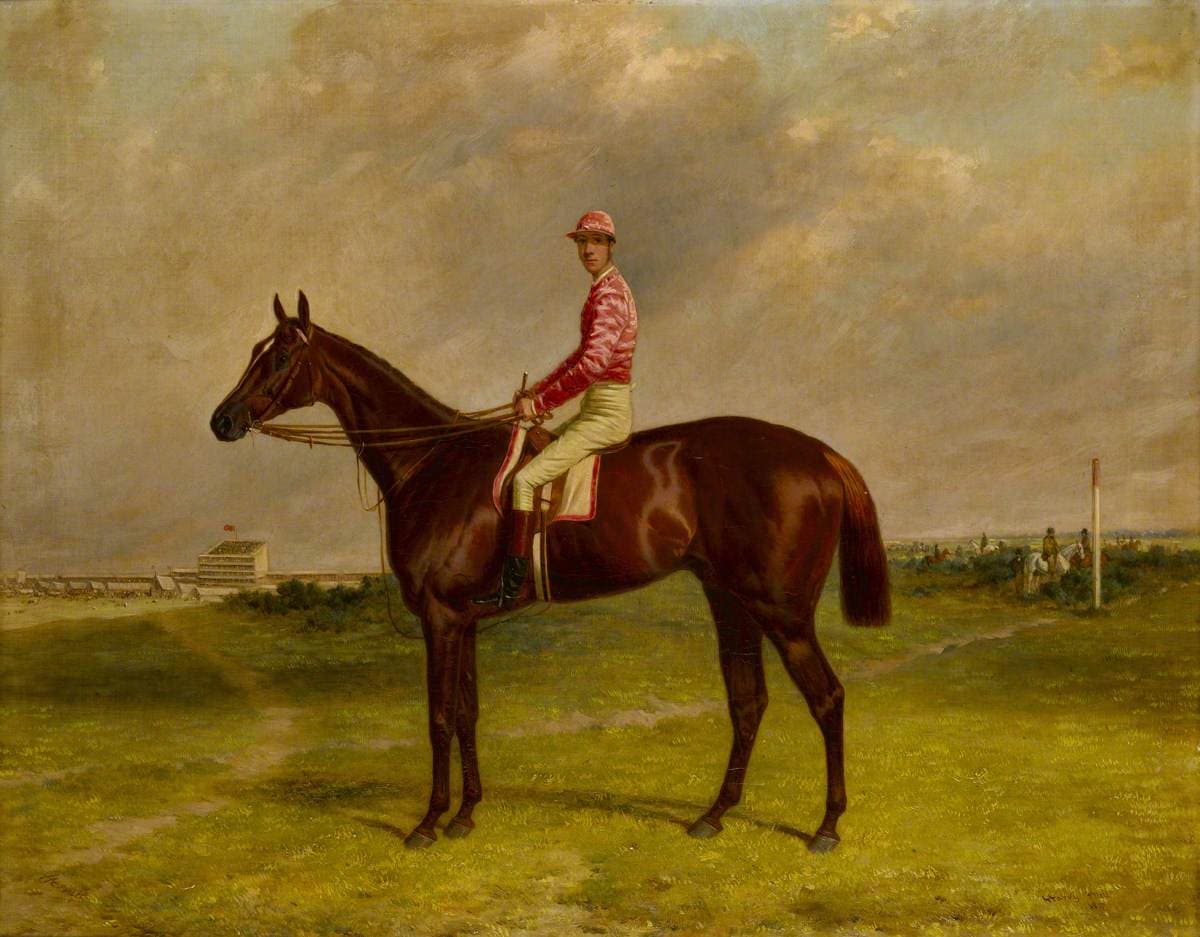
Racing on the Epsom Downs can be traced back to at least 1661, when records first mention organised contests on the open common land above the town. The area was already well known across southern England for its natural mineral springs. Epsom salts take their name from the town, and the combination of health tourism and sporting entertainment drew visitors from London throughout the late Stuart period. Some historians place informal racing even earlier, in the reign of James I, though the documented record begins with the Restoration era.
The open downland was well suited to racing. The chalk soil drained freely, the ground rode on the quick side in most weather, and the wide expanse of common land meant there was space for thousands of spectators without anyone owning the land outright. That last point has shaped Epsom's character ever since: the Downs are common land, and the Hill (the inside of the horseshoe course) remains technically accessible to the public, which is why the tradition of free admission to that area on Derby Day has never been formally ended.
The Oaks and The Derby — 1779 and 1780
The race that would become The Oaks was founded in 1779 by Edward Smith-Stanley, the 12th Earl of Derby, and named after his estate near the course. The Oaks was designed for three-year-old fillies and run over a mile and a half, the same distance and conditions as The Derby that would follow a year later. It was the first of the five British Classics, though its younger sibling would quickly become the more famous race.
The founding of The Derby in 1780 involves one of the most widely repeated stories in racing. The Earl of Derby and Sir Charles Bunbury, then the leading figure in English flat racing, agreed to establish a new race for three-year-old colts. They are said to have tossed a coin to decide whose name it would carry. Derby won the toss and won the naming rights. Bunbury, in a bitter irony, then won the first running itself: his horse Diomed took the inaugural Derby on 4 May 1780 at odds of 6/4 favourite. If the coin had fallen the other way, we would today be talking about the Bunbury.
The first Derby was run over one mile. It was extended to the current mile and a half in 1784 and has stayed at that distance ever since, despite the profound effect the extra half-mile has on the demands the course makes of the field. Adding distance meant adding the full climb up Tattenham Hill, which transformed the race from a speed test into something altogether more complicated.
The 19th Century — Parliament Adjourned
Through the early 19th century, The Derby grew into one of the defining events of the English social calendar. By the 1820s it was said that Parliament would adjourn for Derby Day, coaches packed every road into Epsom from dawn, and the crowd on the Downs numbered in the tens of thousands. This was not simply a racing crowd. It was a cross-section of Victorian England: aristocrats in private boxes alongside street traders and pickpockets, the wealthy and the destitute occupying the same open hillside for one afternoon each year.
Charles Dickens attended and wrote about it, describing Derby Day as "the great holiday of the English people." William Powell Frith captured the same chaos in his famous 1858 painting, which now hangs in Tate Britain. The painting shows eight distinct social groups pressing against one another on the Downs: a Romany fortune-teller, a group of clergymen, a family in their carriage, a knot of gamblers, all sharing the same patch of Surrey turf. Frith said it took him 15 months to complete and that he received more commissions off the back of it than any other work.
The arrival of the railway at Epsom in 1847 swelled the crowd further. Special trains from London Bridge and Victoria could deliver tens of thousands of passengers to within walking distance of the course in a single morning. By the Edwardian era, attendance on Derby Day was estimated at above 500,000, a figure that seems extraordinary now but reflects the absence of competing entertainment. There was no television, no radio, very little organised sport beyond the traditional calendar. The Derby was the biggest public event of the year.
Notable 19th-century winners include Bay Middleton (1836), Surplice (1848, the subject of Disraeli's famous complaint that he was told the news while dealing with parliamentary business), and Bend Or (1880, owned by the Duke of Westminster, later the source of one of the most celebrated naming controversies in breeding history). The race that attracted the most attention in the Victorian era, however, was Hermit's win in 1867. Hermit started at 1000/15 having been lame in the weeks before the race and having been scratched from consideration by most bookmakers. He won by a neck, ruining several large punters who had laid him heavily. Lord Chaplin, who owned him, is said to have won £140,000 on the race.
1913 — Suffragette Tragedy
The 1913 Derby is one of the most discussed moments in both sporting and political history. Emily Wilding Davison, a suffragette who had already been imprisoned multiple times and force-fed during hunger strikes, stepped onto the course during the running of the race and was struck by King George V's horse, Anmer. She died four days later from her injuries at Epsom Cottage Hospital, on 8 June 1913.
Davison had a return train ticket in her pocket when she died, which some have taken to suggest she did not intend to be killed. What she intended has been debated ever since: whether she meant to attach a suffragette banner to the horse, cross the course, bring the horse down, or simply make a visible political statement. Film footage of the incident, captured by the early newsreel cameras that had by then become a fixture at major events, exists and has been studied at length.
Her death came at a moment when the suffragette movement was escalating its tactics, and Davison's act, whatever its precise intention, became one of the central images of the campaign. A plaque near Tattenham Corner marks the spot. She was buried at Morpeth, Northumberland, with the words "Deeds not words" on her headstone.
The race itself was won by Aboyeur, who finished first past the post but was awarded the race after the disqualification of Craganour following a stewards' inquiry into interference in the closing stages. It remains one of the most controversial decisions in Classic racing.
The Interwar Years
The Derby was not run at Epsom during the First World War. Between 1915 and 1918 the race was held at Newmarket, where a version called the "New Derby" took place on the July Course. Racing resumed at Epsom in 1919. The course itself had been used by the military during the war, as had many racecourses across Britain.
The interwar period produced some of the most celebrated Derby winners. Hyperion (1933), trained by George Lambourn trainer Cecil Boyd-Rochfort and ridden by Tommy Weston, won by four lengths despite being the smallest horse in the field at 15.1 hands. Hyperion became one of the most influential sires of the 20th century, his bloodline running through several subsequent generations of Classic horses. Donoghue, the most popular jockey of the era, won the Derby three times, on Humorist (1921), Captain Cuttle (1922), and Papyrus (1923), though he was not riding when each horse met its fate: Humorist died shortly after the race, discovered to have been severely tubercular throughout his career.
The Second World War again displaced the race. From 1940 to 1945, the Derby was run at Newmarket. Epsom was used as a military base.
Post-War to the Modern Era
Racing returned to Epsom in 1946 and, despite the austerity of the period, crowds came back immediately. The hill was thronged again within a year of the war's end. The course began investing in its facilities through the 1950s and 1960s, though the grandstands remained largely unchanged until the 1990s.
The Queen's Stand was rebuilt in 1992 and became the premium facility it remains today. The Duchess's Stand was substantially redeveloped in the early 2000s, creating the modern grandstand that now serves most raceday visitors. Both projects were expensive and not universally popular: some traditionalists felt the modern structures looked out of place against the open downland backdrop. The Jockey Club, which owns and operates the course, took the view that upgrading facilities was essential to competing with the broader sports and entertainment market.
The post-war decades produced a series of memorable Derbies that define how the race is now remembered. Lester Piggott won it nine times between 1954 and 1983, a record that stands to this day. His last Derby winner was Teenoso in 1983, ridden at the age of 47. Nijinsky (1970, trainer Vincent O'Brien, jockey Lester Piggott) completed the Triple Crown (Guineas, Derby, St Leger), the last horse to do so. Mill Reef (1971, trained by Ian Balding) won the Derby by two lengths and went on to win the Arc that autumn, one of the great thoroughbreds of the 20th century. Reference Point (1987, trained Henry Cecil) won by three lengths from Most Welcome, setting a course record time.
Shergar, 1981
The 1981 Derby produced the most emphatic winning margin of the modern era. Shergar, owned by the Aga Khan and trained by Michael Stoute, was ridden by Walter Swinburn, then 19 years old and riding in only his first full season. He won by ten lengths, a margin that has never been approached in the race since. The previous two finishers, Glint of Gold and Scintillating Air, were both Group 1-class horses. Shergar simply destroyed them.
The horse was kidnapped in February 1983 from the Aga Khan's stud in County Kildare and was never found. The case remains unsolved.
The Coolmore and Godolphin Era
From the 1990s onwards the Derby has been dominated by two operations: the Coolmore partnership (racing horses under the O'Brien, Weld, and related connections) and Godolphin (the Sheikh Mohammed-owned operation based between Newmarket and Dubai). Between them they have accounted for the majority of Derby winners since 2000.
Aidan O'Brien, training for Coolmore at Ballydoyle in County Tipperary, has won the Derby multiple times. Galileo (2001) won by three and a half lengths from Golan and went on to become the most influential sire in modern thoroughbred breeding, his progeny winning Classics across Europe for two decades. High Chaparral (2002) won by three-quarters of a length. Camelot (2012), ridden by Joseph O'Brien, won convincingly before being beaten in the St Leger by Encke, ending any Triple Crown hopes.
John Gosden, arguably the best British trainer of the modern era, won the Derby with Golden Horn in 2015. Golden Horn, trained at Clarehaven in Newmarket, raced without a hood despite some early temperament concerns and won the race convincingly before taking the Irish Derby and the Arc later that season.
Sea The Stars (2009) was trained by John Oxx in Ireland and ridden by Mick Kinane. He won the Derby by two lengths from Fame and Glory, then went on to win the Coral Eclipse, the International Stakes at York, the Irish Champion Stakes, and the Prix de l'Arc de Triomphe: six consecutive Group 1 races in a single season. Whether he is the best horse to have won The Derby is a matter of personal judgement, but few dispute that his 2009 campaign was the finest by any European racehorse since Frankel.
The Jockey Club has continued to invest in Epsom through the 2010s and 2020s, with facility upgrades and an ongoing programme to broaden the appeal of the Derby Festival beyond traditional racing audiences. Prize money has increased substantially: The Derby now carries a total purse of over £1.5m, making it the most valuable flat race in Britain. For a race first run in 1780, it has lost none of its significance.
The Course
The Epsom Downs track is unlike any other in British racing. Understanding what it does to horses, and why that matters, is the single most useful thing a punter can know before the Derby Festival.
Track Layout
The course is a horseshoe-shaped, left-handed circuit. The full Derby distance is one mile, four furlongs and ten yards. The key features, in the order runners encounter them:
The Start sits out of sight of the main grandstand, near the bend in the horseshoe on the far side of the course. On Derby Day, the 15 or 20 runners walk out to the start watched by the infield crowd on the Hill but largely invisible to those in the main stands. The starting stalls sit at the lowest part of the track, just before the ground begins to rise.
The Climb begins immediately. From the moment the stalls open, runners face a sustained uphill gradient that lasts for roughly half a mile. The elevation gain over this section is approximately 140 feet. No other Classic in Britain or Ireland asks a horse to do this. In practical terms it means the early pace is often moderate, because jockeys know that expending energy attacking the hill is a race-losing strategy, and that horses which are keen and hard to settle can burn out before the race has properly started. A relaxed, well-balanced traveller is at a premium here.
The Top of the Hill provides a brief levelling off before the course begins to drop. This is the critical moment for jockeys: positioning matters enormously in the half-furlong before the course swings left into Tattenham Corner. Horses drawn wide need to be manoeuvred across the field before the turn. Those drawn low can slot onto the inside rail and hold their position. The top of the hill is where the tactical picture of the race takes shape.
Tattenham Corner is the feature that defines Epsom. The turn is a long, sweeping left-hander that also drops sharply downhill while simultaneously cambering away from the inside rail. The ground tilts outward, so horses are effectively running on a banked curve that pulls them toward the outside. Jockeys must manage three things simultaneously: maintaining balance on the descent, keeping their horse off the rail at the sharpest point of the camber, and securing position relative to the field without losing ground to those cutting the corner on the inside.
A horse that unbalances at Tattenham Corner loses ground it cannot recover. Three and a half furlongs is not enough runway to make up four or five lengths from the wrong position. This is why course experience and a particular kind of natural balance matter so much at Epsom, and why many well-regarded Group 1 horses have been beaten on their first and only appearance at the course.
The Home Straight runs from the bottom of Tattenham Corner to the winning post: approximately three and a half furlongs. Despite the overall downhill nature of the Derby course, the final furlong rises slightly. This rise comes just as horses are at their most tired, having climbed the hill, swung around the corner, and descended into the straight. Horses that led with a furlong to run and cannot handle the final gradient tend to be swallowed up by those that are still travelling.
The width of the course in the straight is generous, wide enough that horses are not forced into single file, but the short length means there is little margin for error. A jockey looking for a gap at the two-furlong marker needs to find one quickly.
Ground and Going
Epsom sits on chalk downland. Chalk is one of the most freely draining substrates in British geology, which means the surface at Epsom rarely holds water. The going is Good to Firm on most summer race days, and Firm conditions are not uncommon in June when there has been a dry spring. Soft or Heavy going is unusual for the Derby Festival and would be an aberration rather than a pattern.
The chalk surface also means the ground has a particular quality of firmness that is distinct from sand-based or clay-based courses. There is some give in the turf itself, but not much in the base. Horses that need give in the ground, particularly those by stamina sires bred for soft European autumn conditions, are at a disadvantage unless the weather is exceptional.
For punters: if a horse has been running well on soft ground and needs testing conditions to show its best form, Epsom in June is not likely to provide them. The field conditions favour horses with speed, balance, and the ability to act on quick ground. Hard-pulling, keen types that are hard to settle also suffer: the uphill start offers no early cover, and there is no way to take the sting out of them on this terrain.
Draw Bias
Draw bias at Epsom is nuanced and distance-dependent.
Sprint races (five and six furlongs): The bias toward low draws is well-established and statistically supported. In five-furlong races, horses drawn in stalls one through five (the inside of the track) can hug the rail into Tattenham Corner, saving ground and reaching the straight in the best position. A horse drawn in stall 15 in a five-furlong sprint faces a materially harder task than its barrier position alone would suggest. The Racing Post draw bias statistics for Epsom sprints consistently show a low-draw advantage of five to eight percent.
The Derby (one mile four furlongs): The draw matters far less at the Derby distance. The field has half a mile to settle into position before the corner, and a wide-drawn horse has time to drift across to a good position. Workforce won the 2010 Derby from stall 13 of 16 runners, and numerous other winners have come from double-digit draws. What matters at Derby distance is not stall position but where the horse finds itself at the top of the hill. That position is determined as much by the horse's natural ability to travel and balance as by where it started.
Handicap distances in between: For races between seven furlongs and a mile and a quarter, the draw effect is moderate and variable. In big-field handicaps, low stalls give an early advantage that can be significant in close finishes, but it is not as pronounced as in the sprints.
The Type of Horse That Wins at Epsom
Describing the ideal Epsom type requires separating the Derby from everything else.
For the Derby specifically, the pattern of winners over the past 30 years points toward a set of characteristics that are fairly consistent:
Balance and agility over raw galloping power. Epsom is not Ascot's straight mile. A horse that can only go in a straight line will struggle. The corner and the camber require a horse to bend, adjust its weight, and maintain stride rhythm through a downhill turn. Horses with a long, flowing stride that shortens and balances naturally under pressure are the type.
A relaxed temperament. Keen horses that want to race hard from the start get into trouble on the hill. The most successful Derby horses settle mid-field, travel well, and produce their effort when asked, not before. Ryan Moore consistently rides Epsom as if the race starts at Tattenham Corner, not at the stalls.
Stamina on the dam's side. The uphill start and the final furlong rise add distance-equivalent demands that the nominal trip does not capture. Horses by Galileo, Frankel, Sea The Stars, Camelot, and Australia, all sires who produce staying types, have an excellent record. Horses by high-speed sires who lack staying bloodlines on both sides have a patchy record despite sometimes winning trials over shorter distances.
Previous experience on undulating tracks. No horse runs the Derby course before Derby Day. There is no trial over the same terrain. But horses that have won or placed on undulating, left-handed tracks such as Sandown's Eclipse track, Chester's round course, or Goodwood's switching alignment tend to handle Epsom better than those with only flat, right-handed form. Trainers like Aidan O'Brien will often run Derby candidates at Leopardstown or the Curragh's round course specifically to prepare them for the balance challenges to come.
For sprint and handicap races, the profile shifts. Course specialists with multiple runs at Epsom carry a significant edge over form newcomers. The track's quirks reward familiarity in a way that most British racecourses do not. A horse that has won at Epsom before, even if its current form looks only average on paper, is always worth investigating at the right price.
Tattenham Corner in Detail
It is worth spending more time on Tattenham Corner than any other feature of the course, because it is where races are lost.
The corner takes its name from the nearby hamlet of Tattenham, which pre-dates the racecourse. It is a long bend, perhaps 150 yards of curving track, that begins at the top of the hill after the brief level section and delivers horses at the bottom into the home straight. The key points:
The camber at the apex of the corner tilts outward. This is the opposite of a banked motorway bend, where the road tilts inward to assist turning. Epsom tilts outward, which means the natural momentum of the horse is pulling it away from the rail. Jockeys on the inside, who might expect to have the rail as assistance, are actually fighting centrifugal force at exactly the point where they need to maintain balance on the descent.
Horses on the outside of the field at Tattenham Corner face a different problem. They are covering more ground around the wider arc of the bend while also dealing with the camber and descent. Losing two or three lengths on the corner by being wide is not unusual.
The speed of the descent adds to the problem. Horses are running downhill at full gallop into a left-hand turn on adverse camber. This requires a specific kind of coordination that some horses simply do not have. A horse that is naturally one-paced, that does not shorten and lengthen its stride easily, will struggle to manage the transition from the hill to the corner to the straight without losing rhythm.
Jockeys who have ridden the course multiple times know the corner's precise shape and plan their position a furlong before it arrives. Those riding it for the first time, as they all are on Derby Day, are navigating by training and instinct alone. Course experience in a jockey is worth several pounds at Epsom.
The Starting Walk
One logistical detail worth knowing: because the Derby start is out of sight from the main grandstands, runners are walked from the parade ring in the public view and then disappear around the course to the starting area. This walk takes several minutes and is a distinctive part of the Derby pre-race experience. Racegoers in the Hill area can see the start directly; those in the main stands follow proceedings by commentary until the runners appear at the top of the hill.
On normal racedays, the start positions for five-furlong races are inside the horseshoe curve on the far side of the course and equally remote from the main grandstand views. The home straight and the final two furlongs are where Epsom is best watched from the stands.
The Derby
The Derby has been run every year since 1780, barring the war years from 1915 to 1918 and again from 1940 to 1945, when it moved temporarily to Newmarket. In 246 runnings, no race in the British calendar has produced more argument, more legend, and more money changing hands.
It is worth being precise about what The Derby is and what it isn't, because the mythology sometimes obscures the reality. The Derby is a flat race, run over one mile and four furlongs and ten yards, open only to three-year-old colts and fillies, with the overwhelming majority of runners being colts. It is not the longest Classic (the St Leger runs over a mile and three-quarters at Doncaster), and it is not the most historic, since The Oaks predates it by a year. But it is the one that has the most weight attached to it, because the distance, the terrain, and the age of the horses combine to produce the most demanding test of the three-year-old thoroughbred.
Why the Course Makes the Race
Every other Group 1 race in Britain is run on a track that, while individual in character, does not actively punish horses for being horses. Ascot is a flat, right-handed galloping track. Goodwood has a sweep to it. Newmarket is wide and essentially level. These are demanding races, but they are run on terrain where the best horse, the one with the most raw ability, usually wins.
Epsom is different. The terrain introduces a variable that form books cannot fully price in: whether the horse can handle this particular course. A horse might be the best three-year-old in Europe on any other track and still fail at Epsom because it cannot balance around Tattenham Corner, or because the climb unsettles it, or because the final furlong rise finds it empty. The Derby selects not just for ability but for a particular kind of coordination that is only tested here.
This is why the Derby is harder to predict than any other Classic. The 2,000 Guineas form offers clues but the Guineas is run on a flat, right-handed track over a mile. The terrain is entirely different. Irish trials at Leopardstown are helpful only as far as they go. Chester, Sandown, and Goodwood trials give better evidence of a horse that can handle an undulating left-handed track, but none of them replicate Tattenham Corner on a steep descent.
Every Derby runner is doing the course for the first time. Even experienced travellers, horses that have run 10 or 12 times, will never have experienced anything like the hill and the corner. That is the great democratising feature of the race.
How the Race Unfolds
The field walks from the parade ring to the start, disappearing from the view of most spectators for several minutes. On Derby Day, this is a period of real anticipation. The horses are gone, the crowd is waiting, and the only information comes from the commentary and from those on the Hill who can see the start.
When the stalls open, the early running is typically modest. Jockeys know that the climb punishes those who attack it too hard, and a moderate early pace is almost a given unless there is an established front-runner in the field. The field strings out up the hill as some horses settle better than others — horses that are fighting against their jockeys tend to use more energy here than they can afford.
At the top of the hill, the positioning battle begins. Jockeys try to be on the inside rail or tucked in close to the leading group before the corner, because once the field swings left and begins the descent, moving around beaten horses becomes much harder.
Tattenham Corner arrives with the field still at speed. Horses at the front set the pace into the straight. Those at the back are already too far behind to win. The race, in most years, is won or lost in the half-furlong entering the straight — that moment when a jockey either has clear running and travelling horses, or is blocked, squeezed, or left flat-footed as the field fans out.
The straight itself is three and a half furlongs. The leaders enter it and the race looks like it might be over. Then the final furlong rise arrives and, very often, the picture changes. A horse that looked in control finds the ground rising against it. Another that has been conserved, held up until the straight, finds another gear. Most Derbies are decided in the final furlong.
Famous Winners
Shergar, 1981. The most emphatic Derby in the modern era. Walter Swinburn, 19 years old, won by ten lengths: the widest margin since Maccabaeus in 1863. The field behind Shergar was not ordinary: Glint of Gold, who finished second, was a proper Group 1 horse. Shergar simply annihilated the opposition. He was kidnapped in 1983 and never found.
Slip Anchor, 1985. Trained by Henry Cecil and ridden by Steve Cauthen, Slip Anchor went to the front before Tattenham Corner and was never headed, winning by seven lengths. Cecil would win the Derby five times in total. Slip Anchor's victory was so comfortable that Cauthen was seen looking back well before the line.
Nashwan, 1989. Willie Carson riding for Sheikh Hamdan Al Maktoum. Nashwan won the Guineas four weeks earlier and arrived at Epsom the hot favourite. He won by five lengths and then won the Eclipse and the King George. He was never beaten at a mile and a quarter or more.
Galileo, 2001. Trained by Aidan O'Brien, ridden by Mick Kinane. Galileo won by three and a half lengths and went on to sire more Group 1 winners than any other stallion in history. His influence on modern breeding cannot be calculated. Frankel, Camelot, Australia, Magical, and dozens of other outstanding horses carry his genes.
Sea The Stars, 2009. Trained by John Oxx, ridden by Mick Kinane. Sea The Stars won six consecutive Group 1 races across 2009: the Guineas, the Derby, the Eclipse, the International at York, the Irish Champion Stakes, and the Arc de Triomphe. He was unbeaten after his two-year-old season. No European horse since Frankel has shown a comparable level of performance.
Golden Horn, 2015. Trained by John Gosden, ridden by Frankie Dettori. Golden Horn broke the Derby course record, won the Irish Derby, the Eclipse, and the Arc. He was one of the fastest horses to win The Derby in the modern era.
Camelot, 2012. Trained by Aidan O'Brien, ridden by Joseph O'Brien. Camelot won the Guineas and the Derby convincingly, setting up a Triple Crown attempt at Doncaster in September. He was beaten by Encke in a St Leger that remains controversial. Encke was trained by Mahmood Al Zarooni, who was later found guilty of administering prohibited substances to horses in his care. The British Horseracing Authority did not retrospectively alter the result.
What to Look for in the Betting
The Derby market in the spring is driven by trial form, which is imperfect. Guineas form matters, but the Guineas is a different test — faster, flatter, right-handed. Horses that won the Guineas and then won the Derby include Sea The Stars (2009), Camelot (2012), and Nashwan (1989), but the Guineas-Derby double is completed in perhaps one year in five.
The key betting patterns, based on the last 25 runnings:
Position at Tattenham Corner. Horses that are in the first six entering the straight win a disproportionate share of Derbies. The short home straight makes it very difficult for horses to come from behind. This does not mean closers cannot win — Golden Horn came from fourth — but horses that need to make up eight or ten lengths in three furlongs almost never succeed.
Sire patterns. Galileo sires won five Derbies between 2007 and 2017. The Galileo line now runs through several sub-lines (Australia, Camelot, Frankel) which are increasingly prominent in the Derby market. Horses by speed sires designed for six furlongs or a mile struggle at Epsom; the terrain adds what amounts to an extra quarter-mile of stamina demands.
Trainer statistics. Aidan O'Brien's Ballydoyle operation has won the Derby more than any other trainer in the modern era. John Gosden (now Clarehaven Stables) has a strong record. Charlie Appleby, training for Godolphin, won in 2018 with Masar. Trainers with a consistent Derby record tend to prepare horses specifically for the terrain, running them at left-handed, undulating tracks in the trials.
Jockey course knowledge. This is harder to quantify but real. Jockeys who have ridden the Derby course multiple times handle Tattenham Corner differently to those riding it for the first time. Ryan Moore's record at Epsom is exceptional. He knows the exact moment to begin his move and how to position in the straight with the rise approaching.
The favourite's record. Derby favourites win less often than might be expected for a race at this level. Over the past 20 years, roughly 40% of Derby favourites have won — slightly below the typical Group 1 rate at a course where form translates reliably. The terrain introduces enough uncertainty that a horse rated 3/1 favourite on Guineas form alone is often shorter than it should be.
The Prize Fund
The Derby is the most valuable flat race in Britain. Total prize money exceeded £1.5m in recent renewals, with the winner's share above £900,000. By comparison, the Guineas at Newmarket carries around £700,000 in total prize money, and the Arc de Triomphe, the richest flat race in Europe, pays around €5m in total but is run under different prize money structures. The Derby's value, combined with its status and the breeding implications of winning it, makes the ante-post market one of the largest in British racing. Some horses have been backed to win £1m or more in ante-post bets before the race is run.
The Oaks and Other Races
The Derby gets most of the attention, but the Derby Festival is a two-day meeting and the Friday card, Oaks Day, is a high-quality fixture in its own right, with three Group 1 races on a single afternoon.
The Oaks
The Oaks was first run in 1779, a year before The Derby, making it the oldest of the five British Classics. Like The Derby, it was founded by the 12th Earl of Derby and named after his estate near the course. The race is run over a mile and four furlongs, on the same course as The Derby, and is open only to three-year-old fillies.
The Oaks occupies a peculiar position in the Classic calendar. It is, on paper, the female equivalent of The Derby, the fillies' championship at a mile and four furlongs, but it receives far less coverage, carries lower prize money (around £500,000 total in recent years), and is watched by a much smaller crowd. Oaks Day attendances are typically around 20,000 to 25,000, substantial, but dwarfed by the 55,000 on Derby Day.
The race itself is often less competitive than The Derby in terms of market depth. Many top fillies are trained with the Oaks in mind after performing well over shorter trips in the spring, and the Classic form through the fillies' trials (the Musidora at York, the Pretty Polly at Newmarket, the Blue Wind at Leopardstown) gives more information about likely performance at the distance than the colts' Derby trials do.
Recent Oaks winners include Enable (2017, John Gosden, Frankie Dettori), who was possibly the best filly of her generation in the 2010s and went on to win the Yorkshire Oaks and Arc in the same season. Snowfall (2021, Aidan O'Brien) won by 16 lengths: the widest margin in a Classic in the modern era, and one of the most dominant performances in any Group 1 race.
From a betting perspective, the Oaks is slightly more predictable than The Derby. The fillies' form from Newmarket and York translates to Epsom better than the colts', partly because the fillies' trials are run over more relevant distances. The favourite's record in the Oaks is marginally stronger than in The Derby.
The Coronation Cup
The Coronation Cup is a Group 1 race run over a mile and four furlongs on Oaks Day, open to older horses of four years or more. It was established in 1902, reportedly to commemorate the coronation of King Edward VII.
The race provides one of the few opportunities for older horses to race over the Derby course. It typically attracts some of the best middle-distance horses of the previous generation: horses that may have run in the Derby or the King George at Ascot and are now in their second or third full season. The field is usually small (six to ten runners is typical) and the race is often a tactical affair, with a single market leader and a small number of challengers.
Recent Coronation Cup winners of note include Cracksman (2018, trained by John Gosden), an exceptional stayer who demonstrated that older horses can handle the Derby course as effectively as three-year-olds. Defoe (2019) won the race and showed that middle-class Group 2 horses can outrun their ranking at Epsom. The same terrain advantage that applies in The Derby is equally valid for older horses in this race, and trainers with strong Epsom records tend to target it specifically.
The Woodcote Stakes and The Diomed Stakes
The Woodcote Stakes is a Listed race for two-year-olds run over six furlongs, usually appearing on the Derby Day card. Two-year-olds racing at Epsom in early June are doing so very early in their careers, and the Woodcote gives an early glimpse of the juvenile generation. Winners occasionally reappear in Classic trials the following year, though the correlation between Woodcote form and subsequent Classic form is not strong enough to draw reliable conclusions.
The Diomed Stakes is a Listed race for older horses run over a mile and a furlong, also typically on the Derby Day card. Named after the winner of the first Derby in 1780, it is a useful early-summer indicator for middle-distance performers but does not carry Group race status and receives relatively little attention in the wider press.
Other Fixtures at Epsom
Beyond the Derby Festival, Epsom stages six to eight additional fixtures through the spring and summer. These include:
Spring Meeting (April/May): The opening fixture of the Epsom season, held before the Derby Festival. Fields tend to be smaller and the card less high-profile, but it is an excellent opportunity to see the course without the crowds and to assess how the going is riding early in the season.
Summer Evening Meetings: Midweek evening fixtures through June and July are among the best-value racing days in the south of England. The admission price is lower than the big meetings, the atmosphere is relaxed, and the course looks at its best in long summer evenings when the Surrey Downs are green and the light lasts until after the last race.
Late Summer Card (August/September): Epsom closes its flat season with a card in late summer. The going is often at its firmest by this point, and form from earlier in the season has been tested enough to make these meetings more predictable for punters.
Facilities & Enclosures
Epsom Downs offers a range of enclosures that cover everything from formal dining to free entry on the open Downs. Choosing the right one depends on your budget, how much racing you want to watch, and what kind of day you are after.
The Queen's Stand
The Queen's Stand is the premium enclosure at Epsom. It sits closest to the winning post and provides the best elevated viewing of the home straight. On Derby Day, this is where the smartest dress code applies and where you will find the formal restaurant experience: pre-booked three-course lunches, champagne bars, and a clientele that includes owners, trainers, and the corporate hospitality crowd.
Dress code in the Queen's Stand is formal. Men are expected to wear a jacket and tie as a minimum; many wear morning dress on Derby Day. Women should dress in accordance with what is effectively a smart social occasion. The dress code is enforced at the entrance.
The Queen's Stand includes a members' area for annual badge holders, who have access throughout the season regardless of the day's meeting. On Derby Day, tickets for non-members are available but sell quickly. Premium packages include reserved seats on the grandstand terrace, which offers a clear sightline to the finishing line. If you are planning to watch The Derby from the best possible viewing position in the main stands, the Queen's Stand terrace is where you want to be.
Booking a restaurant table in advance is not optional on Derby Day — it is necessary. Tables fill weeks before the meeting. If you arrive without a reservation expecting a sit-down meal during the afternoon, you will be disappointed.
The Duchess's Stand
The Duchess's Stand is the main grandstand and the hub of the raceday experience for most visitors. It was substantially rebuilt in the early 2000s and provides good views across the course from its multiple tiers. This is where the majority of Derby Day's ticketed crowd will be: multiple bars, several food stalls, Tote betting windows throughout, and a covered terrace with views of the home straight.
The dress code here is smart casual. There is no requirement for a jacket and tie, though turning up in sportswear or replica football shirts is not welcome. Most visitors in the Duchess's Stand wear something that would pass muster at a garden party without being out of place at a barbecue.
The Duchess's Stand also provides direct access to the parade ring, which is one of the best ways to spend the 20 minutes before each race. Watching the horses walk the ring before the Derby is a significant part of the experience. You can assess their physical condition, observe how they are behaving, and form your own view of readiness in a way that television never replicates.
Tote windows are plentiful throughout the stand. The on-course bookmakers' ring is accessible from the Duchess's Stand and, on Derby Day, is one of the most active betting rings in British racing. The volume of money wagered here on Derby Day is substantial, and the prices on display often reflect a more open market than online exchanges in the build-up to the off.
Lonsdale Enclosure
The Lonsdale Enclosure offers a mid-tier option: cheaper admission than the Duchess's Stand, a decent view of the course, and a casual atmosphere. It is popular with regular racegoers and with groups who are more interested in the social day than the formal experience.
The view from the Lonsdale Enclosure is good for the home straight but less elevated than the upper tiers of the Duchess's Stand. There are food and drink outlets within the enclosure. The dress code is casual — no sportswear or fancy dress, but otherwise relaxed.
For those on a budget who still want to watch the Derby from inside the main stands rather than the Hill, the Lonsdale Enclosure is the value option.
The Hill
The Hill is the part of Epsom that makes it unlike any other racecourse in Britain.
The Hill is the open downland inside the horseshoe of the course. On Derby Day, it is free. Always has been. The tradition of free public access to the Downs goes back centuries — the land is common land and cannot be fenced off for commercial use. So while tickets for the stands can cost £90 or more, any member of the public can walk up onto the Hill, spread a blanket, open a picnic, and watch The Derby without paying a penny for entry.
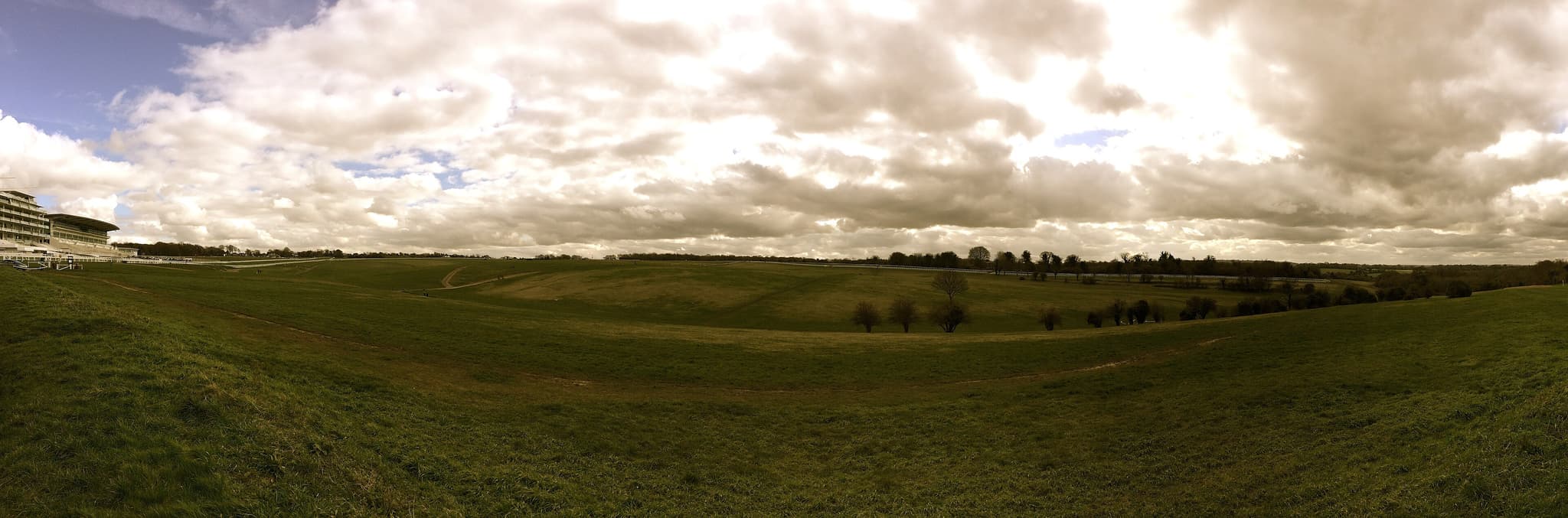
The trade-off is views. From the Hill you cannot see the finish line clearly. What you can see is Tattenham Corner and the course on the far side of the horseshoe — the horses climbing the hill, appearing at the top, swinging around the famous bend. The view of Tattenham Corner from the Hill is actually better than from the stands. You will need a portable radio, your phone, or the commentary to know who has won.
The atmosphere on the Hill on Derby Day has been famous since the Victorian era. At its peak in the early 20th century, the Hill drew as many as 300,000 to 400,000 people and featured a full funfair, dozens of bookmakers working the crowd, and every kind of street entertainment imaginable. The fairground element has scaled back significantly since then, but the essential character remains. Families arrive early with picnics. Bookmakers still work the Hill crowd. The combination of open sky, the course below, and the distant roar from the stands when the Derby is run creates a particular atmosphere you will not find at any other British sporting event.
For families, the Hill is the ideal Epsom option. There is space, there is no admission cost, and children can watch a major sporting occasion without navigating a formal enclosure.
Food and Drink
The Queen's Stand offers a full restaurant experience — book ahead. The Duchess's Stand has a range of bars and food outlets covering burgers, fish and chips, and various other options at standard racecourse prices. The Lonsdale Enclosure has basic catering. On the Hill, bring your own.
On Derby Day specifically, the queues for food and drink in the Duchess's Stand can be lengthy from mid-afternoon. If you want to eat around the time of The Derby (typically 4:30pm), plan to queue before the race that precedes it — not during the Derby build-up, when everyone else is doing the same thing. The restaurants in the Queen's Stand serve throughout the afternoon and are a significantly calmer eating experience than the Duchess's Stand catering outlets.
Local breweries and caterers feature at various Epsom meetings throughout the season. The summer evening meetings in particular tend to have a more relaxed, festival-feel catering offer. Check the current fixture's catering details on the Jockey Club website, as the offering varies by meeting.
Betting Facilities
The on-course bookmakers at Epsom occupy a betting ring near the Duchess's Stand. On Derby Day, the ring is at maximum activity: dozens of bookmakers displaying prices, runners moving between pitches, and a volume of money flowing through the market that produces real price movement in the build-up to the off.
Tote windows are located throughout the Duchess's and Lonsdale Enclosures. Self-service betting terminals are available in the Duchess's Stand for those who prefer not to queue.
For bigger races, it is worth checking the on-course price against online exchanges before betting. The ring can sometimes offer better value than the wider market early in the day before the weight of money has shaped the exchange prices.
Accessibility
Epsom provides wheelchair-accessible viewing in the Duchess's Stand, with dedicated areas that give a clear view of the home straight. The stand has lift access between levels. An accessibility team can be contacted in advance to arrange assistance, and the Jockey Club provides detailed accessibility information on the Epsom website.
Disabled parking is available near the main entrance with an appropriate badge. Guide dogs are welcome throughout the course. A free companion ticket is available for disabled racegoers who need to be accompanied by a carer.
Baby-changing facilities are available in the main stands. Pushchairs are welcome throughout the course and can be taken into the stands, though the upper tiers involve stairs.
Getting There
Getting to Epsom Downs is straightforward on a normal raceday. On Derby Day, the volume of people trying to arrive at the same time means you need a plan. The general rule: take the train. The roads become congested from mid-morning on Derby Day, and driving adds stress without a corresponding benefit unless you are arriving early for the Hill.
By Train
Tattenham Corner station sits right beside the course and is the most convenient rail option for most race meetings. The station is served by Southern Railway from London Bridge (with a change at Purley). The journey takes around 45 to 55 minutes from London Bridge. On Derby Day, Southern Railway significantly increases services to Tattenham Corner, with direct trains running from London Bridge. The station exit is a short walk across the open Downs to the Hill and course entrance, perhaps five minutes on foot.
Epsom Downs station is served by Southern Railway from London Victoria (via Sutton). The journey from Victoria takes around 40 to 45 minutes. The station is a short walk, less than ten minutes, from the main course entrance near the Duchess's Stand. On Derby Day, services from Victoria are increased. This is the preferred option for those heading to the main stands rather than the Hill.
Epsom town centre station (served by both Southern Railway and South Western Railway) is about 1.5 miles from the course, roughly a 25-minute walk uphill on a pleasant day, or a short shuttle bus on major racedays. This is the best option if you are coming from the Waterloo catchment area and prefer not to change trains at Purley or Sutton.
On Derby Day, all three stations see significant increases in services. Tattenham Corner trains become particularly busy in the hour before racing starts and in the hour or two after the last race. The queues at Tattenham Corner on Derby evening are long. Allow extra time, or consider walking to Epsom town and taking a service from there for the return journey.
By Car
Epsom Downs is well signposted from both the M25 and the major A-roads in Surrey. Key routes:
- From the M25 (junction 8 or 9): follow the A217 or A24 north toward Epsom, then follow racecourse signs
- From London south: the A217 from the A3 junction at Kingston passes through Epsom
- Sat nav: use KT18 5LQ for the main course entrance (Duchess's and Queen's Stands), or KT18 5NJ for the Hill car parks
The course has several car parks spread around the Downs. Standard parking costs around £10 to £15. Premium parking closer to the stands costs more. Car parks open several hours before the first race.
For Derby Day, advance booking is not just recommended. It is necessary. The main car parks sell out in advance for the flagship meeting. Arriving on the day without a pre-booked space risks a lengthy search for roadside parking in the surrounding streets, where restrictions apply on racedays. If you must drive on Derby Day, arrive before 10am to secure parking before the roads become congested.
The B280 Epsom Downs Road is the main approach from Epsom town centre. On Derby Day this road is managed with traffic control marshals directing vehicles to specific car parks. Follow the marshals' instructions rather than sat nav alone. Routing apps can send you down roads that are closed or restricted on racedays.
By Bus
Regular bus services run to Epsom town centre from the surrounding area. The 166 bus from Croydon and the 406 from Kingston both pass close to the town centre. From there it is a 25-minute walk to the course, or you can pick up the shuttle bus on major racedays.
Direct bus services to the Downs (rather than the town centre) are limited on non-Derby racedays. On Derby Day, shuttle buses operate from Epsom town centre station. The shuttle frequency increases around peak arrival and departure times.
On Derby Day — Logistics
Derby Day requires different planning to every other race meeting. The course expects around 55,000 ticketed visitors plus additional people on the free Hill area. The roads in the surrounding area (the B280, Tattenham Way, the A2022) are managing an unusual volume of traffic for a suburban Surrey location.
Recommendations if you are attending Derby Day:
-
By train to Tattenham Corner or Epsom Downs station: by far the least stressful option. Trains are frequent and fast. The walk to the course from both stations is short.
-
If driving, arrive before 10am: the first race is typically around 1:30pm, but parking lots fill from 9am and the roads become congested from 11am.
-
If heading to the Hill by car, the Hill car parks (use KT18 5NJ) are typically the first to fill. Arriving before 9:30am gives you a reasonable chance of a good spot.
-
For the return journey: the trains after the last race are very crowded. Allow at least 45 minutes from the last race before attempting to board. Alternatively, wait for one or two trains to clear and take a slightly later, quieter service. Trains run well into the evening.
-
Epsom Downs station is a better bet for the return journey on very busy days, as Tattenham Corner station can get extremely crowded at peak departure time.
Recommended Approach
For a first visit on Derby Day: take the train to Epsom Downs station, walk to the Duchess's Stand entrance, and spend the afternoon in the main enclosure. For the return, walk to Tattenham Corner and take the train, or continue a little further to Epsom Downs station if the Tattenham Corner queue is long.
For a first visit to the Hill: take the train to Tattenham Corner, which delivers you directly to the Hill area. Bring a picnic, a portable radio, and flat shoes suitable for grass. Arrive before midday to find a good spot with a clear view of the famous corner.
Racing Calendar & Key Fixtures
Epsom hosts a smaller number of fixtures than most British racecourses, but the quality of the flagship meeting is unmatched. The entire season is shaped around the Derby Festival in June. Everything else, the spring card, the evening meetings, the late-summer fixture, is worthwhile in its own right, but the two days of the Derby Festival are what give Epsom its place in British racing.
The Derby Festival — Oaks Day (Friday)
Oaks Day is the first day of the Derby Festival. It attracts a crowd of around 20,000 to 25,000: a proper big-race crowd, but far more relaxed than the 55,000 that follow on Saturday. The atmosphere on Oaks Day is noticeably different from Derby Day: more room to move, shorter queues at the bars, and the same course in the same condition with less competition for space.
The card on Oaks Day carries three Group 1 races, which makes it one of the highest-quality cards of the British flat season:
The Oaks (Group 1, one mile four furlongs) — the fillies' Classic, restricted to three-year-old fillies. Distance and course are identical to The Derby. The race was first run in 1779, a year before The Derby, making it the oldest Classic. Recent winners include Enable (2017) and Snowfall (2021).
The Coronation Cup (Group 1, one mile four furlongs) — open to older horses of four years and above, the Coronation Cup tests older middle-distance horses over the Derby course. It typically attracts between six and 12 runners. The field is often headed by a horse from the previous year's Derby generation stepping up to face older rivals. Cracksman won in 2018; Defoe in 2019.
The Princess Elizabeth Stakes (Group 3, one mile two furlongs) — a useful race for older fillies and mares, usually well-supported in the betting and providing a good guide to form for the middle-distance handicap campaign.
Supporting races on Oaks Day include a competitive handicap sprint and usually a novice race of interest for those tracking the juvenile generation.
The Derby Festival — Derby Day (Saturday)
Derby Day is one of the three or four biggest sporting occasions in the British calendar by attendance. The course fills to approximately 55,000 in the ticketed enclosures. The Hill, which requires no ticket, adds further numbers. The Epsom Downs area, from the grandstands across to the far side of the horseshoe, holds the largest crowd of the British flat season.
The card on Derby Day builds toward the race itself, which is typically scheduled for 4:30pm:
The Woodcote Stakes (Listed, six furlongs) — a two-year-old race that gives an early look at the juvenile generation. Winners occasionally reappear in Classic trials the following year.
The Diomed Stakes (Listed, one mile one furlong) — named after the winner of the first Derby in 1780. A useful race for older middle-distance performers. It does not carry Group status but the form is often informative for handicap purposes later in the season.
The Derby (Group 1, one mile four furlongs ten yards) — the centrepiece. Discussed in detail in the Derby section of this guide.
The Surrey Stakes (Listed, seven furlongs) — a juvenile race on the Derby Day card, providing a second look at the two-year-olds.
The full Derby Day card typically consists of six or seven races. Racing usually begins around 1:30pm and the last race is after 5:30pm.
Spring Meeting (April / May)
Epsom opens its flat season with a spring meeting in April or May, before the Derby Festival. This is a smaller fixture: a four or five-race card, a modest crowd, and a straightforward admission price. The course looks at its freshest in spring, and the going gives a useful first read on how the surface will ride for the Derby Festival a few weeks later.
The spring meeting is an excellent opportunity to see Epsom without any of the logistical complications of Derby Day. Parking is easy, the bars are not crowded, and you can spend time studying the track itself, the slope of the hill and the angle of Tattenham Corner, at your own pace. For anyone planning to use course knowledge to inform Derby betting, attending the spring meeting is worth doing.
Summer Evening Meetings (June / July)
Epsom stages two or three midweek evening meetings through June and July. These are among the best-value racing evenings in the south of England. Admission prices are lower, the atmosphere is relaxed, and the cards typically include a mix of handicaps and minor conditions races that draw field sizes large enough to provide proper racing.
The evening meetings at Epsom have a local character: racegoers from Surrey and the surrounding area who treat the course as a neighbourhood fixture rather than a destination event. The course looks excellent on a long summer evening, with the North Downs visible on the horizon and the light lasting well past the final race. If you are looking for a casual evening at the races without the expense or complexity of Derby Day, these meetings deliver exactly that.
Late Summer Card (August / September)
The Epsom season usually closes with a fixture in August or September. By this time the going is often at its firmest, Good to Firm or Firm, and the form of the summer has been tested enough to make handicap betting more informative than earlier in the season.
The late summer card does not carry the prestige of the Derby Festival fixtures, but it rounds off the season at a course that looks its best on a warm, dry late-summer afternoon.
Key Dates and Booking
The Derby and Oaks dates vary slightly each year but are always in late May or early June. The Derby Festival schedule is confirmed by the Jockey Club by January of each year. Tickets for the Queen's Stand and the better Duchess's Stand areas go on sale early and sell out well in advance of Derby Day. The Hill remains free on Derby Day as it always has been.
For summer evening meetings and the spring fixture, tickets are available on the door or online close to the date.
Full fixture list, ticket prices, and booking: thejockeyclub.co.uk/epsom.
Betting at Epsom
Epsom is one of the most interesting courses in Britain for punters, and one of the most dangerous to approach carelessly. The form book transfers poorly here. Horses that are well handicapped on flat, right-handed form get found out by the terrain. Horses that have handled undulating left-handed tracks before tend to outperform. Understanding why the course produces the results it does is more useful than relying on market confidence.
Course Specialists
Because of the camber at Tattenham Corner, the undulations on the hill, and the short home straight, some horses simply handle Epsom better than their overall form would predict. Horses with previous course form, wins or placed efforts at Epsom, are worth noting carefully, particularly in handicap races. Previous course form is a more reliable indicator here than at most other British tracks, because the specific demands of the terrain are so unusual that horses which have already shown they can manage them have a built-in advantage.
In a competitive handicap, a horse with two or three Epsom runs, even if they were placed rather than winning, is often a safer selection than a well-handicapped horse appearing at the course for the first time.
Going Considerations
The chalk downland at Epsom drains freely. The going for the Derby Festival is almost always Good to Firm. True Firm conditions are possible after a dry spring. Soft or Heavy going would be exceptional, perhaps once in 15 or 20 years.
The practical consequence: horses that need soft ground to show their best form rarely win anything significant at Epsom. Check the going requirements of any selection and be cautious about horses that have been running well in spring on soft conditions. Those same horses often underperform dramatically when the ground is fast.
Conversely, horses that have been running on Good to Firm or faster all season and whose form looks strongest on those conditions are the ones to back at Epsom in June.
Draw Bias in Sprint Races
In five-furlong races at Epsom, low draws (stalls one through five) have a clear statistical advantage. The inside rail through Tattenham Corner saves ground. On a tight, downhill left-hand bend, being on the inside is a significant positional advantage. The Racing Post draw bias data for Epsom five-furlong races consistently shows the low draw performing above expectation.
In six-furlong races the bias is slightly weaker but still present. In races over a mile or further, the draw matters much less because the field has time to settle into natural positions before the corner.
When you are assessing a sprint handicap at Epsom, always check the draw allocations before finalising your selection. A horse drawn in stall one or two has a materially easier task than the same horse drawn in stall 12. If the stall 12 horse is 6/1 and the stall two horse is 5/1, that is often not enough of a price difference to compensate for the disadvantage.
The Derby — Betting Approach
The Derby is one of the hardest races to bet in the British calendar. The reasons are structural: every runner is doing the course for the first time, form from the Guineas trials transfers imperfectly, and the market is extremely well-informed on paper quality but less reliable on course suitability.
Sire patterns matter. Galileo sires won five Derbies. His sub-lines (Australia, Camelot, Frankel as a sire) continue to be prominent. Horses by high-speed sprinting sires, or by sires whose best progeny operate at a mile, have a patchy Derby record. The uphill start and the final furlong rise add the equivalent of extra distance, so a horse that needs soft conditions or a flat track to stay the trip will be found wanting at Epsom.
The Guineas-to-Derby double happens occasionally but is not a banker. Since 2000, Guineas winners that have also won the Derby include Rock of Gibraltar (2002, narrowly), Camelot (2012), and Sea The Stars (2009). Several other Guineas winners have failed at Epsom. The Guineas is a flat, right-handed mile. The form has value but not the correlation you might expect.
Trial form from Sandown, Chester, and Goodwood is more useful than it looks. These tracks are left-handed, undulating, or both. A horse that handles the Sandown Eclipse track (sweeping, with a pronounced dip) or wins around Chester's tight left-handed circuit, is showing evidence it can manage what Epsom demands. These trial performances often go relatively uncelebrated in the market, which is where the value can sit.
Position at Tattenham Corner is the single strongest race-reading angle in the Derby. Horses in the first six entering the straight have won a disproportionate share of recent Derbies. Three and a half furlongs is not much runway for a horse that is eight lengths back at the corner. Closers can win: Golden Horn came from fourth. But horses that need to come from further than sixth or seventh position almost never do. Watch the in-play footage and positioning carefully if studying for the following year.
The favourite underperforms slightly. Over a 20-year period, Derby favourites win around 40% of the time, slightly below the Group 1 average on a reliable form track. The terrain introduces real uncertainty that market pricing based on Guineas form alone does not fully account for. A horse rated 5/2 purely on Guineas form is probably shorter than it should be for Epsom.
Aidan O'Brien's record. Between 2001 and 2024, O'Brien's Ballydoyle operation won the Derby multiple times and regularly ran the most horses in the race. His runners are specifically prepared for left-handed tracks in the lead-up. They run at Leopardstown and the Curragh's round course to simulate the balance demands of Tattenham Corner. His stable statistics at Epsom are the strongest of any trainer in the modern era, and when he runs two or three horses in the field, they cannot all be ignored.
Trainer and Jockey Patterns
John Gosden / Clarehaven Stables have an excellent record at Epsom across all race types, not just the Derby. Gosden horses tend to be well-suited to faster ground and to courses that reward a balanced stride, both of which apply at Epsom. Golden Horn (2015 Derby), Cracksman (2018 Coronation Cup), and Enable (2017 Oaks) all came from the Gosden yard.
Ryan Moore is the jockey with the best modern record at Epsom. He understands the corner, knows how to place a horse at the top of the hill, and rides the rise in the final furlong without being caught out by it. His mounts at Epsom deserve close attention.
William Buick has shown consistent competence around the course, particularly on Godolphin runners. Charlie Appleby's Godolphin operation won the Derby with Masar (2018), and Buick rode him. When Godolphin aim squarely at Epsom with a top-rated horse, the combination of operation and jockey quality is hard to dismiss.
Handicap Strategy
Epsom's summer handicaps produce more surprises than handicaps at most other courses, for the simple reason that horses appearing at Epsom for the first time are an unknown quantity. The form book says they should run to a certain level; the terrain may say otherwise.
Horses to look for in Epsom handicaps:
- Previous course form: even a placed effort at Epsom in a different class or distance carries weight
- Low draw in sprints: non-negotiable as a filtering factor
- Undulating track form elsewhere: Sandown, Goodwood, or Chester placed efforts are a positive signal
- A jockey who has ridden the course: course experience in the saddle is worth more at Epsom than at a flat galloping track
- A trainer with an Epsom record: Gosden, Andrew Balding, Roger Varian, and the Godolphin team all show positive statistics at Epsom
The Oaks and Coronation Cup
The Oaks market is generally better-behaved than the Derby. The fillies' trial form from the Musidora at York and the Pretty Polly at Newmarket translates to Epsom more reliably than the colts' trial form. Oaks favourites win slightly more often than Derby favourites, and the race tends to be easier to handicap because the depth of the fillies' Classic generation is typically shallower than the colts'.
The Coronation Cup is a small field, older-horse race that occasionally throws up value in a horse that has top-level form but is overlooked because it is perceived as past its peak. Horses with a proven ability to handle the Epsom terrain, established by running in a previous Derby or Coronation Cup, are particularly worth noting.
Please gamble responsibly. If you feel you may have a problem with gambling, visit BeGambleAware.org or call the National Gambling Helpline on 0808 8020 133.
Notable Horses
The list of horses that have won The Derby runs to 246 entries. Some of those winners went on to become nothing: one-race wonders who won on the day and faded from significance thereafter. Others transformed how the thoroughbred was bred, ridden, and understood. The horses below represent the moments when Epsom produced something beyond a race result.
Diomed — The First (1780)
Diomed won the first Derby, run over a mile at Epsom on 4 May 1780. He was owned by Sir Charles Bunbury, the man who lost the coin toss to the Earl of Derby over naming rights for the race. Bunbury's horse winning the inaugural running while the race was named after the other man is one of racing's better ironies.
Diomed was exported to Virginia in 1798 at the age of 21. American breeders considered him past usefulness. He proceeded to win the first Kentucky Derby at age 21 in 1801, just as the American Classic was establishing itself. His bloodline, which had seemed played out in England, became foundational in American thoroughbred breeding. The race named after him at Epsom, the Diomed Stakes on Derby Day, marks a winner who turned out to be more influential than his English chapter suggested.
Hermit — The 1,000/15 Outsider (1867)
Hermit's victory in the 1867 Derby is one of the most extraordinary results in the race's history. He had been lame in the weeks before the meeting. His connections, who knew his preparation had been compromised, scratched him from most pre-race wagers and largely stopped talking him up publicly. The market assessed him at 1,000/15, reflecting the view that he was broken down and running on hope alone.
Hermit won by a neck. Lord Chaplin, his owner, had backed him and won £140,000 on the race. An extraordinary sum in 1867. Several major bookmaking layers were ruined. The story has since become a shorthand for the type of result that makes Derby betting both maddening and endlessly interesting: the horse everyone wrote off, the prepared quietly, and the won when it mattered.
Hyperion — The Small Giant (1933)
Hyperion was 15.1 hands, small enough that several people who saw him dismissed him before the Derby as insufficiently substantial for a mile and a half on the Epsom terrain. George Lambourn trained him. Tommy Weston rode him. He won the Derby by four lengths from King Salmon, then took the St Leger by three lengths.
What Hyperion did after racing matters as much as what he did at Epsom. As a stallion, he became one of the most influential sires of the 20th century. Sun Chariot, Owen Tudor, and Aurelius were among his progeny. His bloodline runs through much of modern thoroughbred pedigree. The lesson, that the most influential Derby horses are not always the biggest or the most physically imposing, has been repeated many times since.
Lester Piggott — Nine Derbies
Lester Piggott is not a horse, but any account of Epsom's notable performers has to acknowledge what he did at this course specifically. He won the Derby nine times, from Never Say Die in 1954 to Teenoso in 1983: a span of 29 years. No other jockey has come close to that record.
What made Piggott's Epsom record particularly striking was his ability to navigate Tattenham Corner better than almost anyone riding in the same era. He had an instinctive understanding of when to commit and when to hold a position. In several of his nine Derby victories, Nijinsky (1970), Roberto (1972), and Empery (1976) being the standouts, he took the race by the scruff at the corner and produced the horse's effort at exactly the right moment. His record at Epsom across all races, not just the Derby, was exceptional.
Shergar — Ten Lengths (1981)
Shergar's 1981 Derby is the defining race of the modern era at Epsom. He won by ten lengths. The margin alone makes the result extraordinary: no Derby winner since has come close to matching it. The previous record winning margin was 12 lengths, set by Maccabaeus in 1863, more than a century before. In a race that regularly produces tight finishes, ten lengths is a statement.
Shergar was owned by the Aga Khan, trained by Michael Stoute at Newmarket, and ridden by Walter Swinburn, then 19 years old. Swinburn did not need to produce a tactical masterclass. Shergar simply had more ability than anything else in the field and demonstrated it over the full distance of the race.
Glint of Gold finished second, beaten ten lengths. Glint of Gold went on to win the Grand Prix de Paris at Group 1 level. The standard of the 1981 field was not weak. Shergar was simply on a different plane.
The kidnapping in February 1983 ended Shergar's breeding career before it had produced a first crop of runners. He was taken from the Aga Khan's stud at Ballymany in County Kildare. Despite a ransom demand and an extensive investigation, he was never recovered and the case was never solved. The INLA claimed responsibility in a 1999 interview, saying the horse died from an injury sustained during the kidnapping within days of being taken. Shergar's one crop of runners from 1981, bred before the Derby, included several animals that showed ability, but the potential of his full breeding career was destroyed.
Galileo — The Sire of Sires (2001)
Galileo won the 2001 Derby by three and a half lengths from Golan, trained by Aidan O'Brien and ridden by Mick Kinane. He then won the Irish Derby and the King George VI and Queen Elizabeth Stakes at Ascot. He was unbeaten in 2001 and was rightly regarded as an outstanding racehorse.
What Galileo became as a sire, however, goes beyond anything that could have been predicted from his racecourse record. He became the most influential stallion in the history of the modern thoroughbred. His sons include Frankel (unbeaten in 14 career starts, widely regarded as the best racehorse of the 21st century), Australia, Camelot, Nathaniel, and New Approach. His daughters include perhaps two dozen Group 1 winners. He died in 2021, and the thoroughbred world is still running his progeny and his progeny's progeny.
When Galileo won at Epsom, no one fully understood what they were watching. They were watching the future of the breed.
Sea The Stars — The Complete Horse (2009)
Sea The Stars was trained by John Oxx in County Kildare and ridden by Mick Kinane. He won six consecutive Group 1 races in 2009: the 2,000 Guineas at Newmarket (May), the Derby at Epsom (June), the Coral Eclipse at Sandown (July), the International Stakes at York (August), the Irish Champion Stakes at Leopardstown (September), and the Prix de l'Arc de Triomphe at Longchamp (October).
The 2009 Derby itself was won by two lengths from Fame and Glory. Sea The Stars travelled with an economy that made the race look easy. He was never fully tested. The rest of that campaign demonstrated his quality more conclusively than the Derby alone. He won races at a mile (Guineas), a mile and a quarter (Eclipse), a mile and a quarter to a half (International, Irish Champion), and a mile and a half (Derby, Arc): a range of distances that very few horses achieve at the highest level.
In the Arc, he beat Youmzain and Cavalryman under a confident Kinane ride. He was retired to stud immediately after. As a sire he has been good, though not at the level of Galileo. As a racehorse, the 2009 campaign is the standard against which subsequent European horses are measured.
Golden Horn — The Course Record (2015)
Golden Horn was trained by John Gosden and ridden by Frankie Dettori. He won the 2015 Derby in a course record time, covering the mile and four furlongs in two minutes 32.75 seconds. He then won the Irish Derby, the Coral Eclipse, and the Arc de Triomphe later that season.
Golden Horn was notable for his speed over the Derby distance. He won with more fluency than most Derby winners, suggesting the terrain at Epsom suited his natural way of going. His Arc victory confirmed him as the best horse in Europe that year. Gosden and Dettori's combination, which would later win multiple Classics together, announced itself at Epsom in June 2015.
Derby Day Atmosphere
Derby Day at Epsom is not like any other race meeting in Britain. It is not, ultimately, about racing in the way that Cheltenham or Ascot is about racing. It is about something older and harder to define, a tradition of gathering on this particular piece of Surrey downland that predates organised sport in the modern sense.
The Hill
The best way to understand what Derby Day is, rather than what it pretends to be, is to arrive early and walk to the Hill.
The Hill is the open ground inside the horseshoe of the course. No ticket is required. Families spread blankets from 9am. Groups of friends claim patches of grass near the Tattenham Corner view. The course below is still quiet, the horses not yet visible, the grandstands across the track beginning to fill. The North Downs rise in the middle distance. The sky is whatever June has decided to provide.
By midday the Hill holds several thousand people. By 2pm it holds tens of thousands. The bookmakers who work the Hill crowd, a diminishing but still present tradition, are taking bets. The portable radios are on. The smell of food from the various stalls drifts across the grass. And somewhere across the course, in the Queen's Stand, a thousand people in morning dress are having champagne with their starters.
That is Epsom in miniature: the same occasion, experienced in completely different ways, on the same piece of common land.
The Parade Ring
In the main enclosures, the pre-race parade ring viewing is one of the most rewarding parts of the day. Watching the Derby field walk the ring, 15 or 20 three-year-olds each representing months of training and significant financial expectations, gives you a direct sight of the horses that the starting prices and form figures cannot replicate.
Experienced racegoers use this time to assess how horses are moving, whether they look sharp or dull, whether they are settling or agitated. Shergar in 1981 looked perfect in the ring: composed, relaxed, physically outstanding. Several Derby winners have shown signs in the parade ring of a horse that is well and ready. The converse is also true: horses that are sweating heavily or too tense in the ring sometimes perform below expectation.
The Race Itself
The five minutes before the Derby start are unlike almost any other moment in British sport. The field has disappeared around the course to the start. The stands are packed. The Hill is packed. The commentary counts through the horses loading into the stalls. Then a pause.
When the stalls open, the crowd on the Hill can see the horses. The crowd in the stands cannot see them. They are on the far side of the hill. The commentary takes over for perhaps a minute and a half as the field climbs, reaches the top, and swings around Tattenham Corner.
The moment the horses appear in the home straight, a line of colours emerging from the corner and driving toward the winning post, is one of the great collective moments of the sporting year. Fifty-five thousand people who have been watching a television screen and listening to commentary suddenly have the race in front of them, three furlongs from the end, the result still undecided.
The roar that follows the winner passing the post, whoever their connections, whoever has backed them, is the sound of Epsom settling its debts and opening its next chapter.
After the Race
The bookmakers in the ring begin settling and taking bets for the next race almost immediately. On the Hill, the result is debated and replayed. In the Queen's Stand, there are presentations and photographs. In the Duchess's Stand, the queues for the bar lengthen.
The return journey from Derby Day begins in earnest after the last race, usually around 5:30pm or 6pm. The trains fill quickly. The Hill empties gradually. By early evening the Downs have absorbed another Derby Day and are returning to quiet. The Epsom mineral springs that brought the original visitors here in the 17th century are long gone, but the habit of gathering on this particular hill in June has never broken.
Frequently Asked Questions
More guides for this course
Share this article
More about this racecourse
All Epsom Downs guides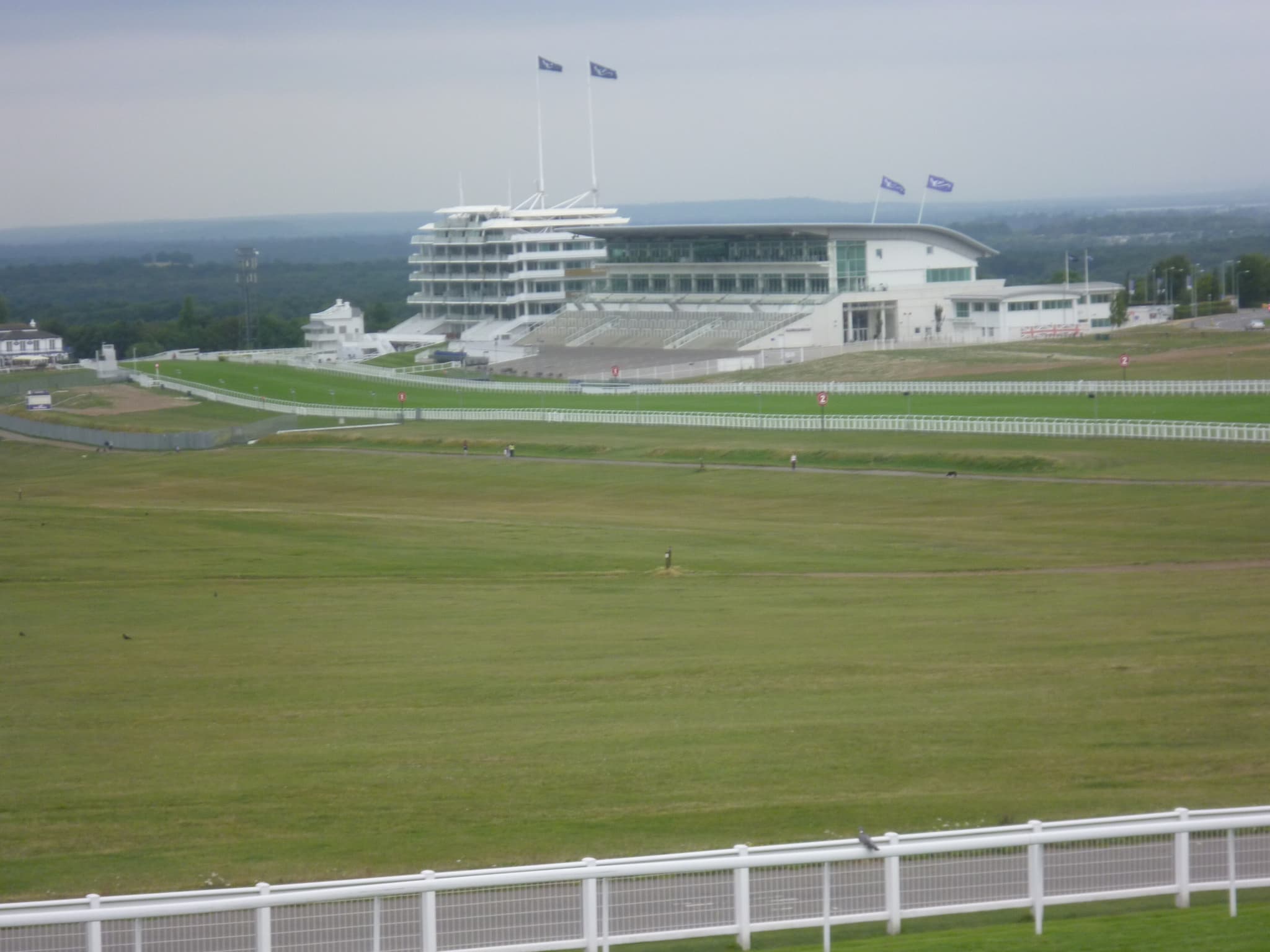
A Day Out at Epsom Downs Racecourse
Everything you need for a day at Epsom Downs: getting there, what to wear, enclosures, food and drink, and insider tips for Derby day and beyond.
Read more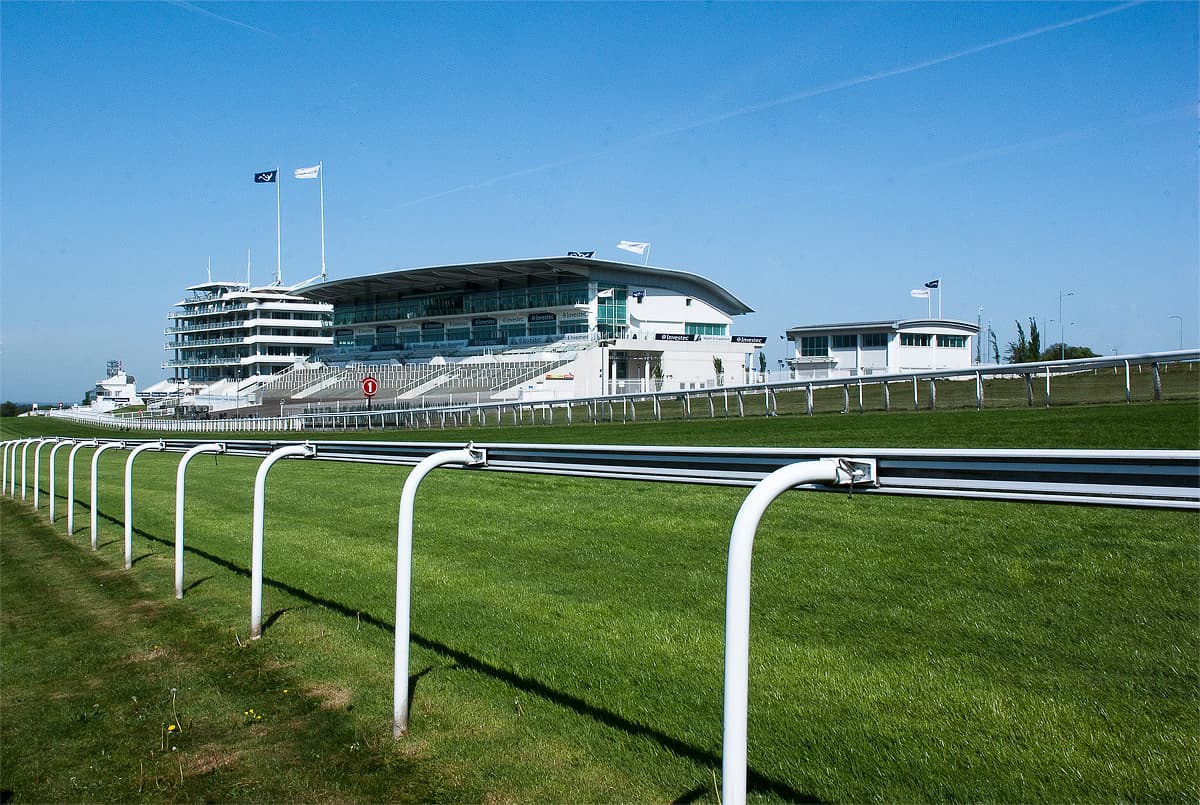
The Epsom Derby Festival: Your Complete Guide
Two days of Classic racing at Epsom Downs: the Oaks and the Derby. Everything you need to know about one of Britain's oldest sporting occasions.
Read more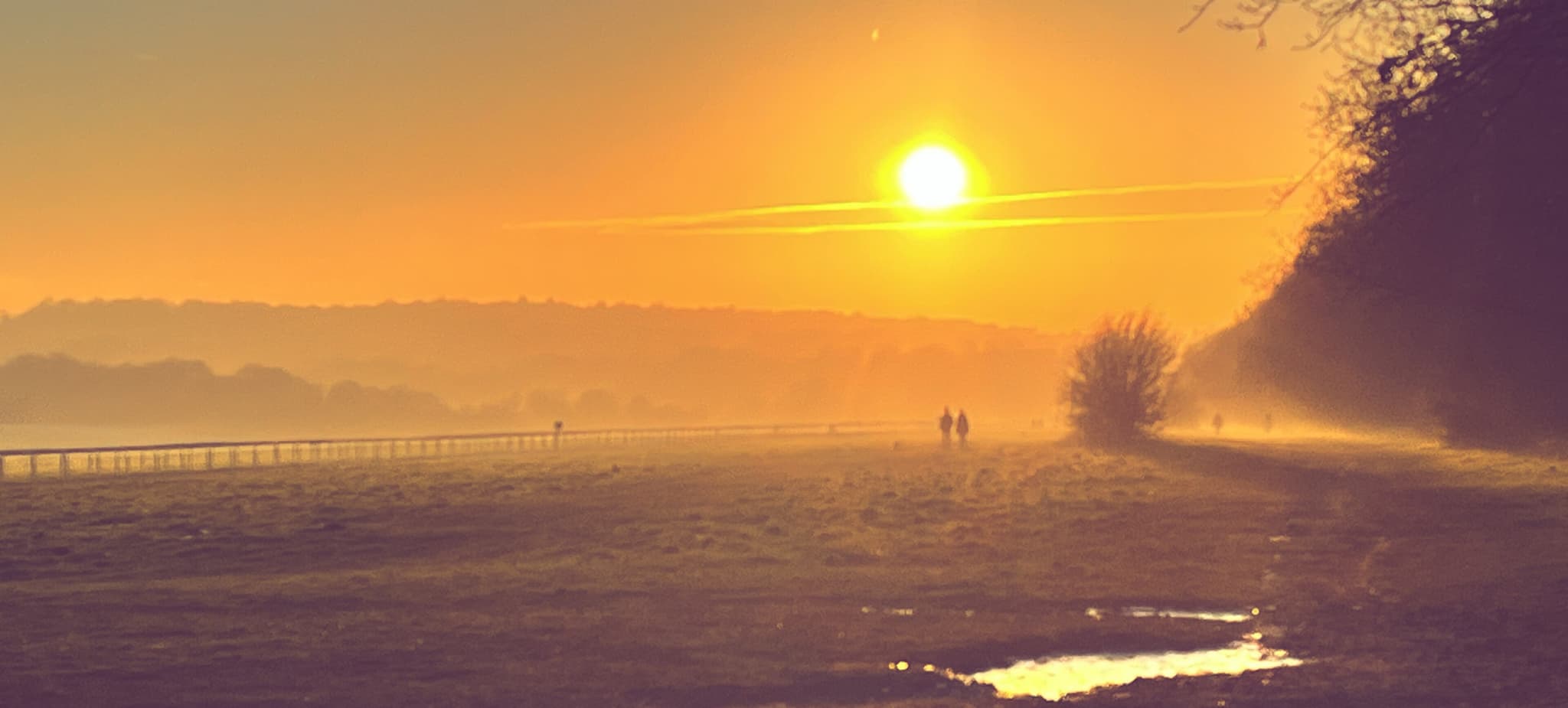
The History of Epsom Downs Racecourse
From 17th-century race meetings on the Downs to home of the world's most famous flat race — the remarkable story of Epsom.
Read morePhotos on this page are used under Creative Commons licences. Titles, sources and licence links for each one are on our image credits page.
Research the field with the AI Race Predictor
Our model publishes calibrated win-probability estimates for UK races — a second opinion to understand a race, not tips. It's open about its record: it doesn't beat the market, and we show exactly how it does.
Betting offers for Epsom Downs
Work it out & learn the basics
Gamble Responsibly
Gambling should be entertaining and not seen as a way to make money. Never bet more than you can afford to lose. If you or someone you know has a gambling problem, help and support is available.