
Founder & Editor · Last reviewed 2026-04-05
Stand in the grandstand at Musselburgh on a clear July afternoon and two things catch the eye at once. To the north, the Firth of Forth stretches out towards Fife, its surface catching the light. To the west, less than six miles away, Edinburgh's skyline sits low against the sky — Arthur's Seat rising behind it, the Castle visible on its rock. Beneath the grandstand, golfers are playing the seventeenth hole of Musselburgh Links. This is the only racecourse in Britain that shares its ground with the oldest documented golf course in the world.
That combination of geography and history gives Musselburgh Racecourse a character found nowhere else. Racing has taken place on or near this stretch of East Lothian coast since 1504, when records show James IV of Scotland watching horses race on Leith Sands. The current course — laid out in 1816 when the Royal Caledonian Hunt moved its Edinburgh-area meetings from the unreliable beach at Leith to this permanent linksland site — has been in continuous use for over two centuries. The name changed to Musselburgh Racecourse in 1996, but the setting has barely altered.
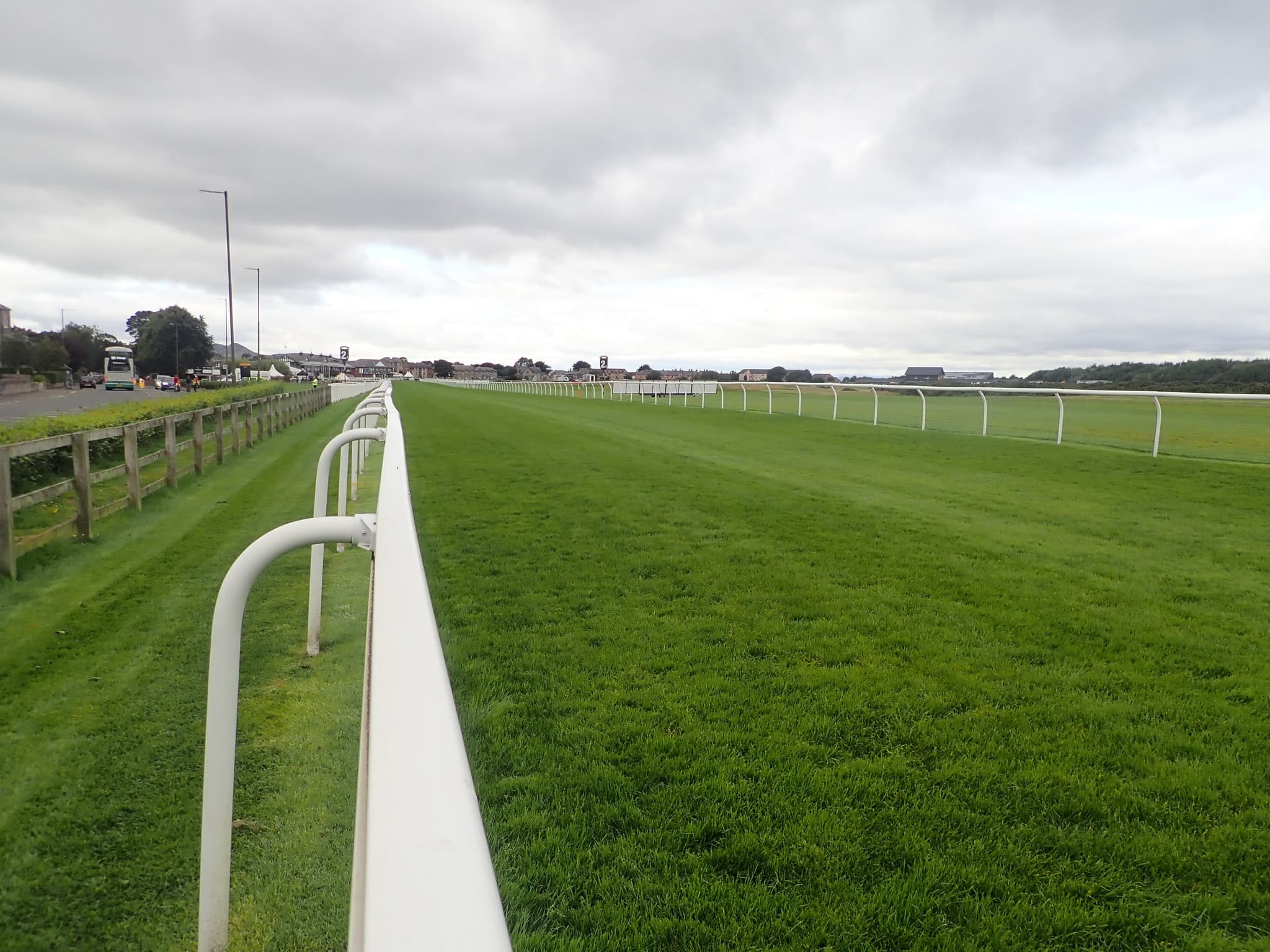
What makes the course work as a racing venue is the same thing that made Musselburgh Links a great golf course: firm, well-drained turf over sandy soil, a flat and consistent surface, and a coastal climate that keeps the ground rideable through most of the year. The right-handed circuit of one mile and two furlongs is tight enough to put a premium on position and handiness. Horses that race prominently tend to do well here. The sprint track, where the Scottish Sprint Cup is run every July over six furlongs, suits sharp, quick horses rather than those that need time to wind up.
The dual-purpose programme is a key part of what Musselburgh is. Flat racing runs from April through to November; National Hunt racing fills the winter months from October through to April, with the two seasons overlapping in autumn and spring. Around 28 fixtures take place each year across both codes, making Musselburgh one of Scotland's busiest courses by number of racedays. For trainers in the Central Belt and the Borders, it is the default venue: close, reliable, and consistent.
The Royal Caledonian Hunt, founded around 1777, was the organisation that first brought formal racing to Musselburgh. The Hunt was a body of landowners and gentlemen who treated racing and hunting as part of the same social world. Their backing gave the 1816 move to Musselburgh its authority and prestige. Today the Hunt's role is ceremonial, but the association is part of the course's identity.
For Edinburgh, Musselburgh functions as the city's racecourse. A twelve-minute train journey from Edinburgh Waverley to Musselburgh station puts racegoers at the course gate in under half an hour from the city centre. No other course in Scotland is as easy to reach from a major population centre. On big days — the Scottish Sprint Cup in July, the New Year's Day meeting in January — the Edinburgh crowd fills the stands and the atmosphere becomes something entirely its own.
The following sections trace how that came to be: the racing on Leith Sands, the move to Musselburgh Links in 1816, the Victorian and twentieth-century development of the programme, the moments and names that left a mark on the course's record, and the shape of Musselburgh today.
Origins and Early Racing
Origins and Early Racing
The story of racing near Edinburgh begins on a beach. Leith Sands, the broad tidal strand at the mouth of the Water of Leith just north of the city, hosted horse races as early as 1504. A record from that year shows James IV of Scotland attending meetings there — placing this stretch of the Firth of Forth coast among the oldest documented racing locations in Britain. The beach offered a flat, open surface long enough to stage races without the expense of constructing a permanent track, and the setting was accessible enough for Edinburgh's citizens to watch from the shore.
The Royal Caledonian Hunt
Organised Scottish racing gained its most important early patron in the Royal Caledonian Hunt. The Hunt was established in the 1770s — the formal society dates to around 1777 — as a body of Scottish landowners, lawyers, and gentleman farmers who shared an interest in hunting and horse sport. It drew its membership from across the country but was centred on Edinburgh's professional and landowning class. By the closing decades of the eighteenth century, the Hunt was running regular meetings at Leith Sands, providing the administrative structure and social prestige that gave Scottish racing a degree of organisation it had previously lacked.
The Hunt's meetings attracted entrants from across Scotland and from the north of England. Races were run in heats rather than single contests, which meant the best horses ran multiple times over a day, a format common in Britain until the mid-nineteenth century. The purses were not large by English standards, but the social gathering around the races — the dinners, the assemblies, the public display of the Edinburgh gentry — was part of the attraction. The Caledonian Hunt Ball, run in conjunction with the race meeting, was one of the events of the Edinburgh social year.
Racing on the Sands
Leith Sands worked as a venue, up to a point. The beach provided a surface that was firm enough when the tide was well out and the sand had time to drain. Races were timed around the tidal schedule, which meant the programme was hostage to the sea in a way that formal racecourses were not. A spring tide, a storm, or an unusually late ebb could shorten the available racing surface, compress the card, or render the meeting impossible to complete. Spectators gathered along the shoreline and on the dunes, with no stands, no enclosures, and no reliable way to control the crowd.
The informality was part of the appeal in the eighteenth century, when the separation of spectator from participant was less strictly enforced than it would later become. But as racing became more commercially organised across Britain in the early nineteenth century, the limitations of a tidal beach became harder to ignore. The racing establishment in England was investing in enclosed courses with proper grandstands, starting gates, and weighing rooms. Leith offered none of this.
Leith Transformed
The problem was compounded by changes to Leith itself. The port had been growing since the seventeenth century, but the early nineteenth century brought industrialisation on a new scale. The construction of docks and warehouses, the expansion of shipping, and the spread of industrial premises onto the foreshore progressively reduced the space available for racing. By the 1810s, the beach that had served Edinburgh racing for three centuries was being squeezed out of existence. The Royal Caledonian Hunt needed a new home.
Edinburgh was growing fast. The city's population reached around 90,000 by 1800 — more than double what it had been fifty years earlier — and the New Town, begun in 1767, was drawing the professional and merchant class away from the medieval Old Town. The appetite for organised sport was rising with the city's prosperity. A permanent racecourse, properly enclosed, with a grandstand and reliable going, was an investment that the Edinburgh market could support.
The Case for Musselburgh Links
The site identified was the Links at Musselburgh, six miles east of Edinburgh along the coastal road. Musselburgh Links was already one of the most storied pieces of sporting ground in Scotland. Golf had been played on the Links since at least 1672, when written records confirm a formal game. The tradition almost certainly pre-dates that documentation. In 1567, a year of extraordinary political drama in Scotland, Mary Queen of Scots is recorded as having played golf on the Musselburgh Links — or at least, a tradition to that effect was firmly established by the eighteenth century. Whether or not the detail is exactly right, the association speaks to the Links' long history as common ground used by the people of Musselburgh for recreation.
The Links offered what Leith Sands could not: a permanent, level surface over sandy, free-draining soil. The turf was firm in summer and held its structure even in wet autumn conditions. The site was flat enough to accommodate a racing circuit without significant earthworks. The coastal exposure kept frosts rare, which mattered for winter meetings. And the Links was already common land, owned by the town of Musselburgh, which simplified the question of who controlled the ground.
The Move in 1816
In 1816, the Musselburgh town council laid out a racing circuit on the Links, and the Royal Caledonian Hunt moved its Edinburgh-area meetings there permanently. The course was known from the outset as Edinburgh Racecourse, a name it would keep for nearly 180 years. The layout was right-handed, running around the perimeter of the linksland, and the shared-use arrangement with the golf course — horses racing over the same turf that golfers played across — was built into the design from the start.
The 1816 move was not a break with the past so much as a consolidation of it. Racing had been organised in and around Edinburgh for three centuries. What changed was the permanence and the infrastructure. A proper course meant consistent going, an identifiable location that could be advertised and planned for, and a venue that could be improved over time. The Royal Caledonian Hunt provided the prestige and the organisation. The town of Musselburgh provided the ground. Edinburgh provided the crowd.
That arrangement — a course defined by its proximity to a major city, its accessible location, and the quality of its turf — has shaped Musselburgh's character ever since.
The Golden Era
The Golden Era
Edinburgh Racecourse — as Musselburgh was formally known until 1996 — entered the Victorian era as Scotland's nearest thing to a metropolitan course. The city behind it had grown to around 160,000 people by the 1850s, a population base that few British racecourses outside England's largest cities could match. The Edinburgh middle class, expanded by law, medicine, finance, and the professions that clustered in the New Town, had both the disposable income and the leisure time to attend the races. Musselburgh, six miles out on the coastal road to North Berwick, was the obvious destination.
The Victorian Flat Programme
The course's flat racing programme developed steadily through the second half of the nineteenth century. The summer and autumn card attracted horses from Scotland's training centres — Ayrshire in the west, the Borders to the south, and the smaller yards that dotted East Lothian and Midlothian. English raiders from Northumberland and Yorkshire made the journey when the prizes justified it. The course's sprint track proved particularly well-suited to its natural surface: firm linksland turf, a straight run-in, and a consistent camber that rewarded horses with speed rather than stamina.
Sprint racing became the course's speciality early. The six-furlong course, which runs along the straight before the runners loop the right-handed circuit back to the stands, gave Musselburgh a clear identity in an era when many British courses offered broadly similar programmes. The emphasis on speed over distance attracted a particular type of horse and a particular type of trainer — those who valued quick ground, tight turns, and sharp finishes over the patient development needed for long-distance flat races.
The Royal Caledonian Hunt's Continuing Role
The Royal Caledonian Hunt remained central to Musselburgh's prestige through the Victorian era. The Hunt Cup — the Hunt's signature race at the course — was run annually as part of the Hunt's own meeting, which drew the organisation's members from across Scotland and added a social dimension to the racing day that attracted coverage in the Edinburgh papers. The presence of the Hunt gave the meetings a formal, organised character that separated them from lower-level country racing and helped attract quality horses and respected trainers.
By the 1870s and 1880s, the Hunt had been an organising presence in Scottish racing for a century. Its involvement at Musselburgh lent the course a continuity that newer venues could not claim. The shared history mattered to the Edinburgh sporting public, who had grown up reading about the Hunt's meetings and whose fathers and grandfathers had watched races on Leith Sands under the Hunt's patronage.
Musselburgh and Ayr
The other major Scottish flat course through this period was Ayr, on the west coast, seventy miles from Edinburgh. The two courses served different regional markets. Ayr drew its crowds from Glasgow and the west of Scotland; Musselburgh was Edinburgh's course. Their programmes overlapped in fixture date and in the type of racing offered, but there was enough geographical separation to avoid direct competition for the same audience.
The contrast in character was notable. Ayr's track is wider, longer, and more galloping in nature than Musselburgh's tight circuit. Horses that ran well at Ayr often needed time and space to find their stride; those that thrived at Musselburgh tended to be handy, quick-loading horses that were comfortable racing in a pack. The two courses complemented each other more than they competed, and the best Scottish horses of the Victorian era often ran at both.
Between the Wars
Scottish racing continued through the Edwardian era and into the First World War, which interrupted the programme as it did everywhere in Britain. Racing at Musselburgh resumed after 1918, but the interwar years were economically difficult for Scottish sport. Attendances at most racecourses fell through the 1920s as unemployment rose in the industrial Central Belt. The Edinburgh area was less severely affected than Glasgow or Dundee, but Musselburgh felt the economic pressure.
The course continued to operate through the 1920s and 1930s, maintaining a flat programme that drew moderate crowds. The Hunt meetings retained their social character, providing an occasion that attracted Edinburgh's professional class even when the form of the racing was secondary. Prize money remained modest; the emphasis was on the occasion rather than the competitive quality of the card.
The Second World War and After
Racing at Musselburgh ceased for the duration of the Second World War, as it did at most British courses. When flat racing resumed in 1945 and 1946, the course was in reasonable condition — the linksland turf was resilient, and shared use with the golf course had kept the ground maintained during the hiatus. The post-war years brought a gradual rebuilding of the programme.
The formal addition of National Hunt racing — hurdle races and steeplechases run over the winter months — gave Musselburgh its dual-purpose identity. Jump racing had been staged at the course informally before the war, but the development of a structured NH programme in the post-war decades transformed Musselburgh from a flat course that occasionally hosted winter racing into a real dual-purpose venue. The right-handed circuit, relatively flat and consistent in its going, suited both codes. Hurdles were run on the inner course; the fences for steeplechasing were positioned on the outer track.
The Scottish Sprint Cup
The emergence of the Scottish Sprint Cup as Musselburgh's flagship race was the final element in establishing the course's modern identity. The race — run over six furlongs in July, now classified as a Listed race — drew on the sprint tradition that had defined Musselburgh's flat programme since the Victorian era. Its elevation to Listed status gave it a place in the national racing hierarchy. Trainers from England began treating it as a target race rather than a consolation prize for horses that had failed to enter at the major meetings further south.
By the 1980s, with the dual-purpose programme established and the Scottish Sprint Cup recognised as a serious sprint event, Musselburgh had a clear identity. The course that had started as a beach meeting on Leith Sands, moved to the linksland in 1816, and survived the disruptions of two world wars had found its form: Scotland's sprint course on Edinburgh's doorstep, with a winter jumps programme that kept the fixtures coming through the cold months.
The crisis that followed in the late 1980s and early 1990s was a test of whether that identity was enough to sustain a course facing serious financial pressure.
Famous Moments
Famous Moments
Saving the Course: The 1963 Campaign
The most consequential moment in Musselburgh's modern history came not during a race but in a committee room. In 1963, the Levy Board — the statutory body that distributes betting levy funds to British racing — undertook a review of courses and concluded that Musselburgh was a candidate for closure. The reasoning was economic: the course was not generating enough revenue to justify its place in the programme, and rationalising British racing onto fewer, higher-quality venues was in fashion among racing administrators.
Archibald Primrose, the sixth Earl of Rosebery, led the campaign against closure. Rosebery was one of the most prominent figures in Scottish racing — a major owner and breeder, a descendant of the Prime Minister Lord Rosebery, and a man with both the connections and the public profile to make the case effectively. His argument was not just economic but cultural: that Edinburgh needed a racecourse, that Musselburgh had served Scottish racing for nearly 150 years, and that closing it would leave Scotland's capital without a local venue.
The campaign worked. Musselburgh was reprieved, and the closure threat lifted. The episode crystallised something that would be proved again thirty years later: the course had friends willing to fight for it, and those friends tended to win.
The Scottish Sprint Cup: Landmark Editions
The Scottish Sprint Cup has been Musselburgh's signature flat race since it was elevated to Listed status, run over six furlongs in July each year. It is a race that draws specialist sprinters from across Britain, and its place on the summer calendar — after Royal Ascot, before the major late-summer sprint meetings — makes it attractive to trainers looking for a quality target in the lull between the two biggest phases of the sprint season.
The course's sprint track suits a particular type of horse. The six furlongs at Musselburgh require speed from the gate, the ability to handle the camber on the bend, and the energy to sustain pace up the run-in. Horses that arrive with their speed already primed — those that had run recently at Chester, Haydock, or York — often produced their best form at Musselburgh because the track demanded the same qualities.
Keith Dalgleish, based at Carluke in South Lanarkshire around forty miles from the course, has trained multiple Scottish Sprint Cup winners. His operation has a particular affinity for Musselburgh's flat programme, returning consistent strike rates at the course over many years. The Scottish Sprint Cup is among the targets his yard plans around each season.
The East Lothian Council Rescue: 1991
By the late 1980s, the course was in serious financial difficulty. Attendances had fallen, prize money was uncompetitive, and the infrastructure was dated. There were serious questions about whether Musselburgh could continue as a going concern.
East Lothian Council's decision in 1991 to take over the management of the course was unmatched. Local authorities had managed leisure facilities — swimming pools, golf courses, sports centres — but a racecourse was a different proposition entirely. The scale of investment required, the complexity of the relationship with the Jockey Club and the racing industry, and the inherent unpredictability of horse racing made it a high-risk decision.
It worked. Within a year of the Council's involvement, the course returned to profit. The management team stabilised the finances, invested in the facilities, and repositioned Musselburgh as a community sporting asset rather than a private commercial operation. The approach was partly public relations — the Council's ownership made it easier to position the course as an Edinburgh-area amenity — and partly hard-headed business. Costs were cut, revenue streams were diversified, and the social calendar around the racing was developed.
The Joint Racing Committee and the Naming Change: 1994–1996
In 1994, the operational model was formalised into the Musselburgh Joint Racing Committee, a partnership between East Lothian Council and the Lothians Racing Syndicate. The partnership combined the Council's public sector credibility and access to resources with the racing industry expertise of the private syndicate. It has remained the governance structure ever since.
Two years later, in 1996, the course was renamed. Edinburgh Racecourse became Musselburgh Racecourse — a change that recognised the course's actual location and its identity as a Musselburgh institution, while accepting that the Edinburgh connection would remain a commercial asset. The name change coincided with a period of increased investment and gradually rising attendances.
Winter Jump Racing Highlights
The National Hunt programme has produced its own landmark moments. Musselburgh's jump fixtures in December and January draw trainers from across northern England as well as Scotland. Keith Reveley, operating from Saltburn-by-the-Sea in North Yorkshire around eighty miles south of the course, has been among the most successful NH trainers at Musselburgh over several decades, sending horses north to exploit their familiarity with right-handed tracks of this type.
The New Year's Day meeting has become the single most attended event on the Scottish racing calendar. First developed into a major occasion in the 2000s, the January 1st fixture combined jump racing — the Virgin Bet Auld Reekie Handicap Chase and the Virgin Bet Hogmaneigh Hurdle among its headline races — with live entertainment and a festive atmosphere that made it an alternative Edinburgh New Year option for people who had celebrated Hogmanay the night before. The meeting has sold out in advance for multiple consecutive years, with no walk-up tickets available at the gate.
Local Trainers and Course Specialists
The trainers who know Musselburgh best are those based within reach of East Lothian. Jim Goldie, based at Uplawmoor in East Renfrewshire about fifty miles to the west, has trained hundreds of winners at the course over a career spanning more than two decades. His string contains exactly the type of horse Musselburgh suits: quick, uncomplicated sprinters and milers that handle tight right-handed tracks and firm ground.
Linda Perratt, training at Ayr, has sent horses east to Musselburgh consistently, particularly for the sprint fixtures. Her operation shares Dalgleish's preference for the flat programme, and her runners at Musselburgh carry a good record in the lower-grade sprint handicaps that form the backbone of the summer card.
The course's tight circuit means that experience of the track matters. Horses that have run at Musselburgh before, and particularly those that have handled the camber of the bends without losing momentum, tend to have an advantage over first-time visitors. It is one of the reasons that yard statistics at Musselburgh are relatively stable year on year: the trainers who send horses there regularly are the ones who continue to win.
The Links as Backdrop
The shared setting with Musselburgh Links adds an unusual dimension to race days. Golfers on the course during a race meeting are a regular sight from the stands — the fairways of the oldest documented golf course in the world crossing the ground inside and outside the racing circuit. The arrangement requires careful coordination between the racecourse management and Musselburgh Links, which is managed by East Lothian Council under a public access arrangement that dates back centuries.
For visiting racegoers, particularly those from outside Scotland, the sight of golfers playing through a working racecourse — or rather, racehorses galloping around a working golf course — is one of the more memorable aspects of a day at Musselburgh. There is no other course in Britain where the two sports share the ground so directly.
The Modern Era
The Modern Era
Musselburgh Racecourse in the 2020s runs approximately 28 fixtures per year. That figure makes it Scotland's busiest racecourse by number of racedays, ahead of Ayr and Hamilton Park. The programme is split between flat racing, which runs from April through to November, and National Hunt racing, which fills the winter months from October through to April. The two seasons overlap deliberately: October and November carry both flat and jump fixtures, which gives trainers options and keeps the course active during the transitional months.
The Structure of the Programme
The flat programme runs roughly twenty fixtures, concentrated in the summer months of May, June, July, and August. The sprint card predominates. Musselburgh's six-furlong track is the reference point for Scottish sprint racing, and the Scottish Sprint Cup meeting in July is the high point of the flat season. The card that day attracts the largest attendance of any flat fixture at the course, with hospitality packages selling out weeks in advance and the betting market showing real depth.
The National Hunt programme fills the remaining eight or nine fixtures. The December and January meetings carry the most prize money in the NH season at Musselburgh. The New Year's Day fixture is the standout event of the winter — a large, ticketed occasion that combines jump racing with live entertainment and regularly attracts crowds of over 5,000, close to the course's stated capacity. It is a different kind of raceday from the typical winter jump fixture: louder, younger, and more deliberately pitched at an audience for whom the racing is one part of a broader day out.
Key Trainers in the Modern Programme
The modern Musselburgh training roster is dominated by a handful of yards that return consistently at this track. Keith Dalgleish, whose stable is at Carluke in South Lanarkshire, about forty miles from the course, is among the leading trainers by winners at Musselburgh most years. His flat string is well-suited to the sprint programme, and he targets the Scottish Sprint Cup each season as a primary objective for his best speed horses.
Jim Goldie, based at Uplawmoor in East Renfrewshire about fifty miles west of Musselburgh, has been training winners at the course for over two decades. Goldie's horses tend to be exposed, consistent performers in handicaps — exactly the type that accumulates winners at tracks like Musselburgh, where the handicapper's marks are well understood and the draw bias well-researched by regular connections.
Keith Reveley, operating from Saltburn-by-the-Sea in North Yorkshire, is the most prominent NH trainer to use Musselburgh as a regular target. His yard, about eighty miles south of the course, has a long history of sending jumpers north when the conditions suit. Reveley's horses are typically well-schooled over hurdles and fences and handle the right-handed track without difficulty. The journey north is worth the travel costs when a horse's form lines up.
Linda Perratt, training at Ayr, combines her west-coast base with regular raids on Musselburgh's flat card. Her horses tend to be sprint-oriented, and the east-coast trip pays off particularly in the lower-grade sprint handicaps on the summer card.
The Edinburgh Market
The relationship with Edinburgh is the defining commercial fact of Musselburgh's modern operation. A twelve-minute train journey from Edinburgh Waverley to Musselburgh station connects the course directly to the city centre. The station is a ten-minute walk from the racecourse entrance. On major racedays, the Scottish Government and Edinburgh City Council have co-operated with East Lothian Council on transport promotion, with Scotrail running enhanced services on the Edinburgh to North Berwick line.
Edinburgh's population of around 550,000, combined with the wider Lothian catchment area and the substantial tourist economy, gives Musselburgh a potential audience that most Scottish courses cannot match. The city attracted over 4 million overnight visitors per year in the years before the pandemic — a figure that had substantially recovered by the mid-2020s. For visiting groups and tourists, a raceday at Musselburgh is a natural extension of an Edinburgh trip. The course is close enough to be practical, distinct enough to be worth the excursion, and set in a location — the Links, the Firth of Forth — that provides its own backdrop.
Prize Money and Competitive Position
Musselburgh's prize money has been a long-running challenge. As a medium-sized venue without major commercial sponsorship of the kind that supports the bigger English tracks, the course offers prize funds that are competitive within Scotland but modest by British standards. The Scottish Sprint Cup, as a Listed race, carries prize money sufficient to attract high-quality sprinters from English yards. Below that level, Musselburgh's handicap and conditions races offer solid but not exceptional returns.
The Horserace Betting Levy, distributed by the Levy Board to British courses, is a significant component of Musselburgh's income. The course's position in the fixture list — competing with other regional courses for levy funding — means the management is attentive to any changes in how the Board calculates and distributes its payments.
The Course Today
The Musselburgh Joint Racing Committee, the partnership between East Lothian Council and the Lothians Racing Syndicate established in 1994, continues to manage the course. The Joint Committee has overseen a steady programme of facility investment: grandstand improvements, the hospitality offering, the raceday experience for general admission and premium customers. The course has not undergone the kind of large-scale redevelopment seen at some British venues, but the incremental improvements have maintained its competitive position.
The betting market on Musselburgh racing reflects the course's regional profile. On big days — Scottish Sprint Cup, New Year's Day — the market is active and the ante-post interest builds in the days before the meeting. On routine midweek fixtures in summer, Musselburgh sits in the background of the British racing day, providing competitive fields in the sprint and mile handicaps that form the bread and butter of the national card.
Scotland's racing industry has grown in visibility since the 2000s, partly through better marketing and partly through the efforts of courses like Musselburgh to build fixtures that generate real public interest. The New Year's Day meeting is the clearest example: a raceday that has become a Scottish sporting institution in its own right, drawing people who would not otherwise attend racing.
Musselburgh's Legacy
Musselburgh's Legacy
Musselburgh Racecourse carries more layers of history than almost any other venue in British racing. The ground it occupies has been used for sport — golf, racing, and the informal recreation of a coastal town — for centuries. The racing tradition on or near this stretch of East Lothian coast reaches back to 1504. The current course has been in operation since 1816. That is over two centuries of continuous use, a record interrupted only by the two world wars and the periodic financial crises that tested the course's survival.
What endures is a particular combination of qualities. The setting within Musselburgh Links, the oldest documented golf course in the world, is unique. No other racecourse in Britain shares its ground with a sporting venue of comparable antiquity. Golfers have played across this turf since at least 1672. The Racing circuit, laid out in 1816, follows the perimeter of the same linksland. The two sports coexist by arrangement — horses on the outer track, golfers on the fairways — in a shared-use agreement that has worked for over two centuries.
The Edinburgh connection is equally central to what Musselburgh is. For most of its modern history, the course was called Edinburgh Racecourse. The name changed in 1996, but the relationship did not. Edinburgh remains the primary market: 550,000 residents, a large tourist economy, and a twelve-minute train connection from Waverley station. On big days, the racecourse is truly part of the city's social fabric, drawing crowds that include regular racegoers, occasional visitors, and Edinburgh tourists who want a day out beyond the Old Town and Princes Street.
The Royal Caledonian Hunt's legacy runs through the course's entire history. The Hunt was the body that organised racing on Leith Sands, made the case for a permanent venue at Musselburgh, and gave the 1816 course its initial prestige. Its continued ceremonial involvement — the Hunt Cup, the Hunt's formal association with the race meeting — is a thread connecting the modern course to its eighteenth-century origins.
Dual-purpose racing defines the course's calendar and its identity. The flat season from April to November, the National Hunt season from October to April: the two programmes overlap, the two audiences partly overlap, and the course staff maintain the track across both codes throughout the year. It is a more demanding operational model than a single-code venue requires, but it gives Musselburgh a year-round presence on the racing calendar that keeps it relevant to trainers, punters, and the racing media in every month.
The course has faced closure twice — in 1963 and again in the late 1980s — and survived both. The 1963 campaign, led by the Earl of Rosebery against the Levy Board's rationalisation plans, drew on the deep sentiment that Scottish racing attaches to Musselburgh as a place. The 1991 East Lothian Council takeover was a more pragmatic rescue, turning a failing commercial operation into a publicly supported asset within a year. The Joint Racing Committee that emerged from that episode has governed the course since 1994, combining public accountability with industry expertise in a model that has worked well enough to sustain investment and growth.
Scotland's busiest racecourse by fixtures is not necessarily its most glamorous. Ayr carries the Gold Cup. Hamilton Park has its moments. But Musselburgh is the course that runs most often, that serves the most accessible major city in Scottish racing, and that has the most unusual setting. Its legacy is the sum of those things: a historic Links, a royal connection through the Caledonian Hunt, an Edinburgh audience within reach, and a programme that runs twelve months of the year.
Frequently Asked Questions
When was Musselburgh Racecourse established?
The current course at Musselburgh was formally established in 1816, when the Royal Caledonian Hunt moved its Edinburgh-area meetings from Leith Sands to the Links at Musselburgh. The history of organised racing in the area is considerably longer: records from 1504 show James IV of Scotland attending races on Leith Sands, and the Royal Caledonian Hunt had been running meetings there since the late eighteenth century.
What is the Scottish Sprint Cup?
The Scottish Sprint Cup is Musselburgh's flagship flat race. Run over six furlongs in July, it holds Listed status in the British flat racing hierarchy. The race is the high point of Musselburgh's summer flat programme, attracting sprint specialists from across Britain. Its place in the July calendar — after Royal Ascot and before the major late-summer sprint meetings — makes it an attractive target for trainers with horses in good summer form.
What type of racing does Musselburgh stage?
Musselburgh is a dual-purpose course, staging both flat and National Hunt racing. The flat season runs from April through to November; the National Hunt season covers October through to April, with the two programmes overlapping in autumn and spring. Around 28 fixtures take place across both codes each year, making Musselburgh Scotland's busiest racecourse by number of racedays.
How close is Musselburgh Racecourse to Edinburgh?
The course is approximately six miles east of Edinburgh city centre, in the East Lothian town of Musselburgh (postcode EH21 7RG). By train, the journey from Edinburgh Waverley to Musselburgh station takes around twelve minutes on the Edinburgh to North Berwick line. The station is a ten-minute walk from the racecourse entrance.
What is unusual about the course's setting?
Musselburgh Racecourse sits within Musselburgh Links, the oldest documented golf course in the world. Written records confirm golf being played on the Links in 1672, and the tradition pre-dates that documentation. The racing circuit shares the linksland with the golf course under a long-standing shared-use arrangement: golfers play across the ground on non-racing days, and on racedays the two uses are carefully coordinated. There is no other racecourse in Britain with a comparable setting.
What is the track like at Musselburgh?
The track is right-handed, flat, and measures one mile and two furlongs around the full circuit. The turns are relatively tight by British racecourse standards, which puts a premium on horses that race handily and handle bends well rather than those that need space to find their stride. The ground is firm in summer — the free-draining sandy soil of the Links dries quickly — and the going tends to be good to firm or good for most of the flat season.
Share this article
More about this racecourse
All Musselburgh guides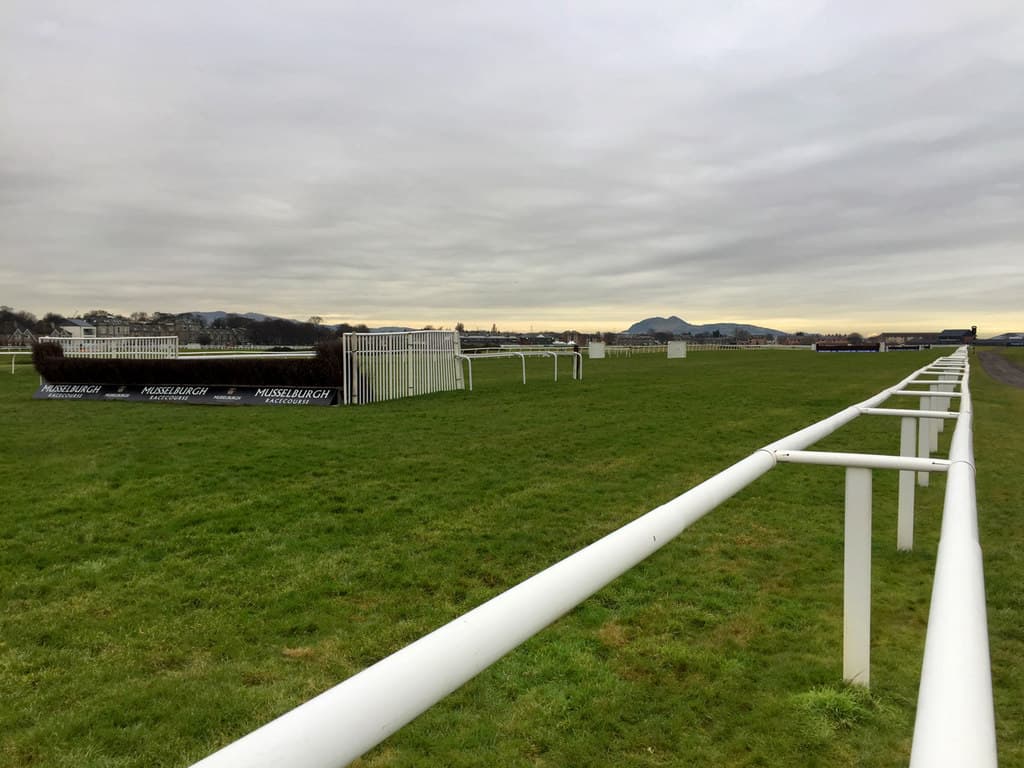
Musselburgh New Year's Day: Complete Guide
Musselburgh New Year's Day meeting — Scotland's largest sporting event on 1 January, with jumps racing, live music, and festive atmosphere.
Read more
New Year's Day Racing at Musselburgh: The Complete Guide
Your guide to New Year's Day racing at Musselburgh — Britain's most atmospheric January 1st occasion. Race card breakdown, betting angles, how to get there from Edinburgh, and what to expect from Scotland's most festive race day.
Read more
Scatter Dice at Musselburgh: The Complete Story
Scatter Dice won the Edinburgh Cup at Musselburgh in 2012 before landing the Cesarewitch at 66-1 in 2013 — one of Scotland's most memorable flat racing stories.
Read morePhotos on this page are used under Creative Commons licences. Titles, sources and licence links for each one are on our image credits page.
Gamble Responsibly
Gambling should be entertaining and not seen as a way to make money. Never bet more than you can afford to lose. If you or someone you know has a gambling problem, help and support is available.