
Founder & Editor · Last reviewed 2026-04-05
Musselburgh Racecourse sits six miles east of Edinburgh city centre, on the historic linksland of Musselburgh Links beside the Firth of Forth. Racing has taken place on this strip of coastal turf since 1816, making Musselburgh one of Scotland's oldest active racecourses and the closest to the capital. The site has long been intertwined with the town it serves — the Links that form its turf have hosted golf since at least 1672, and the two sports continue to share this uncommon ground.
The course carries a dual-purpose licence, hosting flat racing from April through to November and National Hunt fixtures from October into March. Across both codes, Musselburgh stages approximately 30 fixtures per year, making it one of the busiest racecourses in Scotland. The flat programme reaches its high point with the Scottish Sprint Cup in June, a listed sprint handicap that draws competitive fields from across Britain and frequently requires a consolation race when the field is oversubscribed at the 48-hour declaration stage. The jumps calendar peaks each year on 1 January, when the New Year's Day meeting typically draws between 6,000 and 8,000 racegoers — one of the largest single-day crowds in Scottish racing and routinely one of the first big crowd events anywhere in Britain in the new year.
Musselburgh is operated under a management agreement involving East Lothian Council and the Lothians Racing Syndicate, with the Jockey Club Racecourses group providing significant operational support. The Jockey Club also runs Cheltenham, Newmarket, Epsom, and a further 12 venues, and the Musselburgh relationship brings the course into line with national standards of race-day management.
The track is right-handed, tight, and approximately one mile two furlongs round. Sharp turns reward handy horses that can race close to the pace. The short run-in means that making ground late from off the pace is difficult, which gives the course a character quite distinct from wider, more galloping circuits such as York or Newmarket. Form at Musselburgh tends to be honest and reliable within the Scottish circuit, partly because the regular trainers know the track intimately.
The local training community is compact and well-established. On the flat, Keith Dalgleish (Carluke, 35 miles away), Jim Goldie (Uplawmoor, 45 miles away), and Linda Perratt are the handlers with the deepest Musselburgh records. For National Hunt racing, Lucinda Russell — whose Kinross stable is approximately 20 miles to the north — has been the dominant local jumps trainer for many years and targets the New Year and winter fixtures regularly. Runners from these stables at Musselburgh carry a track-knowledge premium that is worth factoring into any form assessment.
The course is straightforward to reach. Edinburgh Waverley is a 10-minute train ride away on the ScotRail service to North Berwick, and Lothian Buses run regular services from the city centre. By car, the A1 east from Edinburgh delivers racegoers to the course in roughly 15 minutes. Free parking is available on site. The combination of public transport access and the Edinburgh connection makes Musselburgh one of the most logistically accessible racecourses in Scotland, and it draws a consistent audience from across the Central Belt who treat it as their local course.
Who this guide is for
This guide is written for four types of reader. First-time visitors will find a full account of the layout, the enclosures, the food and drink, and how to get there by train, bus, and car. Regular racegoers looking to improve their results will find the course characteristics, the going tendencies, the draw biases, and the key trainers covered in detail. History-focused readers will find the racecourse's origins in the early nineteenth century, the key moments in its development, and the famous occasions that have shaped its reputation. Trip planners will find practical advice on combining a race day with Edinburgh's attractions and on choosing the right fixture for the right experience.
Five things to know before you go
- The right-handed, tight oval strongly favours horses drawn low in sprints — check the draw before you bet
- The New Year's Day meeting sells out; book tickets months in advance
- Musselburgh station (Edinburgh to North Berwick line) is a 15-minute walk from the racecourse
- The exposed coastal position means wind can affect going assessments — check the forecast
- Lucinda Russell, Keith Dalgleish, and Jim Goldie dominate the local trainer statistics; their runners at this track carry form worth tracking
Bet on Musselburgh
Place your bets on Musselburgh races with a trusted bookmaker.

Promo code BETFRED50. New customers only. Register, deposit with a Debit Card, and place a first bet of £10+ at Evens (2.0)+ on Sports, to be settled within 7 days, to get £30 in Sports Free Bets and £20 in Bet Builder Free Bets within 24 hours of settlement. 7-day expiry. Eligibility & payment exclusions apply. Full T&Cs apply. Take Time to Think. BeGambleAware.org. 18+. Full T&Cs.

Promo code R30. New UK customers only, 18+. Register, deposit £10 or more, then place a £10 single cash bet at odds of 1/2 (1.5) or greater on any sports market (excluding Virtuals). Once the qualifying bet settles you get £30 in Free Bets (3 x £10) — the qualifying bet can win or lose. Free Bets are valid on any sports market excluding Virtuals, expire in 7 days, are non-withdrawable and must be used in full. Excluded deposit methods apply (including PayPal, Apple Pay, Skrill and NETELLER). Named bets such as Lucky 15 do not qualify. If you cash out the qualifying bet, or it is voided, you are no longer eligible for the offer. Ends 31.12.26. Full T&Cs apply. Please gamble responsibly. BeGambleAware.org. 18+. Full T&Cs.

Promo code BET40GET20. New UK customers, 18+. Register with the code and place a first bet of £40 or more at Evens (2.0) or greater. Receive 2 × £10 free bets: the first credited automatically once the qualifying bet settles, the second 24 hours later. Free bets must be placed at minimum odds of 4/1 (5.0), expire 24 hours after credit, and the free-bet stake is not returned with winnings. Debit card deposits only. Take Time to Think. BeGambleAware.org. 18+. T&Cs apply. Full T&Cs.

50% of your first-day net losses refunded as a free bet, capped at £25. New UK customers aged 18+ only. To qualify, deposit and place a first bet of £10 or more on any sport at minimum odds of evens (2.00), then place at least two further bets on different events, each worth at least 50% of your largest bet, all at evens (2.00) or greater. Losses are counted from your first settled bet until 23:59 the same day. Place a qualifying £10+ bet and you are guaranteed at least a £5 free bet. Bets placed at SP, void bets, cashed-out bets and bets struck with free bets do not count towards the offer. The free bet is credited the day after your qualifying bets settle and must be used within 7 days, after which it expires. It can be used at odds from 1/4 (1.25) up to 250/1 on singles and straight accumulators, but not on Trixie, Patent or Yankee style multiples. Free-bet stake is not returned with winnings. One offer per person, household, address, IP address and device. E-wallet deposits may not qualify, so check the cashier before depositing. Customers registered with GAMSTOP cannot claim. KYC identity verification must be completed before the free bet is credited. Take Time to Think. BeGambleAware.org. 18+. T&Cs apply. Full T&Cs.

New customers, 18+. Choose the sports bonus at sign-up, make a first deposit and receive a 100% bonus up to £50 in your Sports Bonus balance. To convert the bonus to cash, wager it 10x within 30 days. Single bets below Evens (2.00) do not qualify; accumulators do not qualify if any selection is below 1/2 (1.50). Virtual Sports, voided, cancelled, drawn, cashed-out and free-bet wagers do not count towards wagering. Only the first settled bet per event counts. Withdrawing before the wagering requirement is met forfeits the bonus balance including bonus winnings. Real-money funds are used before bonus funds. Deposits via Skrill or Neteller are not eligible. Not valid in conjunction with other promotions. Odds, bet and payment limits apply. 10bet general and promotion T&Cs apply. BeGambleAware.org. 18+. Full T&Cs.

New customers in Great Britain and Republic of Ireland, 18+. Place a £10 fixed-odds qualifying bet at minimum odds of 1/2 (1.50) — single or each-way (only the win part counts), pre-event or in-play, not cashed out early, within 28 days of opening the account. Receive up to £60 in bonuses credited over three days: 3 × £10 fixed-odds free bets (the first on settlement, then 24 and 48 hours later) plus 3 × £5 Total Goals FOOTBALL spread bets and 3 × £5 racing Winning Favourites spread bets, with a £1 racing Race Index spread bet as an extra on top. The spread bets need a full spread-betting account, opened within 28 days of the fixed-odds account and subject to Spreadex's eligibility and appropriateness checks. Free-bet stakes not returned with winnings; free bets valid 28 days from issue. IMPORTANT: the £5 credits are SPREAD bets — sports spread betting carries the risk that losses can exceed your stake. Sports spread-betting customers do not have Financial Ombudsman or FSCS recourse. Take Time to Think. BeGambleAware.org. 18+. T&Cs apply. Full T&Cs.

Promo code WELCOME15, entered under My Bonuses after registering. New UK customers, 18+. Place a first qualifying bet of at least £10 from your cash balance at odds of evens (2.0) or greater within 7 days of opening the account. Once the qualifying bet fully settles you receive £15 in free bets, credited as 3 x £5 tokens with set uses: one £5 accumulator free bet (minimum 4 legs, each leg at 2/5 or bigger), one £5 sports free bet (any market at evens or bigger) and one £5 Sub Cover free bet (selected football player markets at evens or bigger). Free-bet stakes are not returned with winnings. Free bets expire 7 days after they are credited. Void, cashed-out and partially cashed-out bets do not qualify. One offer per customer. Confirm the current terms on BetGoodwin's own welcome-offer page before claiming. Take Time to Think. BeGambleAware.org. 18+. T&Cs apply. Full T&Cs.

New UK customers, 18+. Minimum deposit £10. Place a £10 qualifying single on sports (excluding virtuals) at minimum odds of 1/2 (1.50), settled within 14 days. Deposit-method exclusions apply. Receive £30 in free bets (stake not returned), split £20 for sportsbook use (2 x £10) and £10 for Bet Builder only (2 x £5); Bet Builder does not cover horse racing. Free bets must be accepted within 7 days and expire 7 days after acceptance. No promo code required. Best Odds Guaranteed on UK & Irish racing, subject to having staked over £25 in the previous seven days. Operated by LiveScore Betting and Gaming (Gibraltar) Ltd, UKGC 56859. Confirm the current terms on LiveScore Bet's own promotions page before claiming. Take Time to Think. BeGambleAware.org. 18+. T&Cs apply. Full T&Cs.
18+. BeGambleAware.org
The Course
The Layout
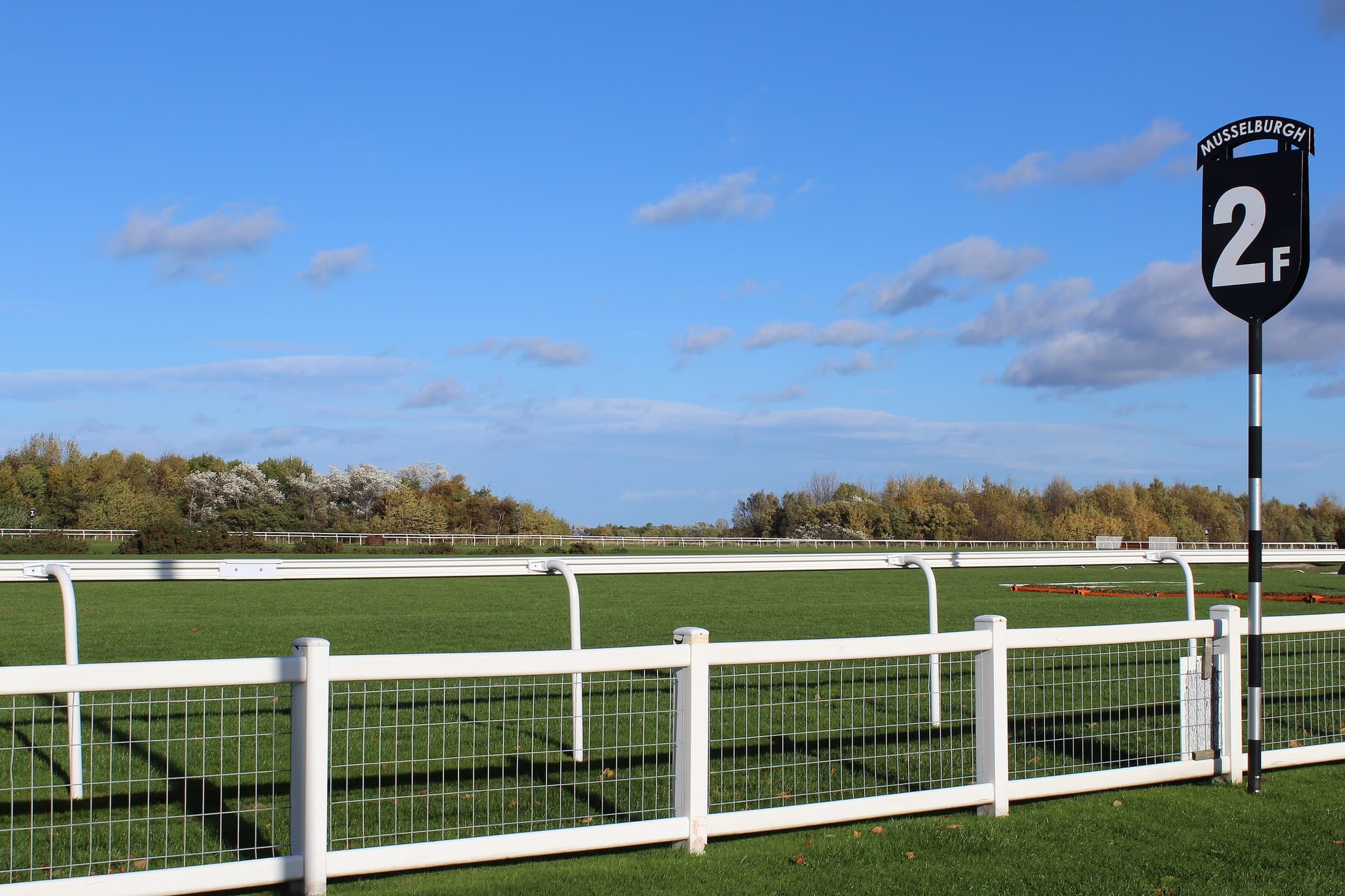
Musselburgh's track is a right-handed oval, roughly one mile two furlongs in circumference, set on the flat coastal plain of Musselburgh Links. The course shares this turf with one of the oldest golf courses in the world — golf has been played here since at least 1672, and the two sports divide the available land according to season and fixture schedule. The result is an unusual venue where the two oldest turf sports in Britain occupy the same ground, separated only by fence lines and calendar.
The oval shape is relatively tight, with bends that are sharper than those found on galloping tracks such as Haydock Park or Newmarket. Horses need to be agile and balanced to hold their position through the turns, and jockeys who ride the course regularly develop a detailed understanding of where to place their mounts to save the most ground. The run-in from the final bend to the winning post is short — approximately two furlongs — which places a premium on position at the top of the straight. Horses that get there in front or close to the pace have a structural advantage that makes it truly difficult for animals racing wide or from off the pace to overcome.
Distances and Starting Points
Musselburgh's range of distances covers most of what any trainer would want from a domestic programme. Flat distances in regular use include five furlongs, five furlongs and one hundred yards, six furlongs, seven furlongs, and one mile four furlongs. Sprint races starting at five furlongs begin near the back straight and use the full extent of the oval, sweeping into the home turn before the short straight home. The five-furlong start is where draw bias is most pronounced, as horses on the inner rail have a significant positional advantage into the first bend.
On the National Hunt side, the hurdles and chase courses follow the same right-handed loop, making use of the full circuit for longer trips and cutting across the interior of the oval for shorter events. Hurdle distances range from two miles to two miles and four furlongs, while chase courses typically run from two miles to two miles and four furlongs. The fences are considered fair rather than particularly demanding, and the tight bends that define the flat course shape the jumps track as well — jumping horses need to be balanced and fluent in their jumping to negotiate the course efficiently.
Going and Conditions
The turf at Musselburgh sits on a relatively flat coastal area, and the loamy soil of the linksland drains adequately in most conditions. In the flat season, the going most often registers as good to firm or good during the summer months, and good to soft in the spring and autumn shoulders. The course rarely reaches firm, though in extended dry spells in high summer it can approach it. Watering is used to maintain consistency when the weather is dry.
Winter National Hunt racing is a different proposition. The exposed coastal position, combined with the natural dampness of the East Lothian climate, means going regularly sits at good to soft and will often reach soft after a wet period. truly heavy going is less common than on more sheltered inland tracks, but it is not rare. Going updates are published on the racecourse website from approximately 48 hours before each fixture, and the British Horseracing Authority's going assessments are the formal reference point on race morning.
The coastal setting also introduces wind as a consistent factor. Musselburgh faces east, into the North Sea, and a brisk easterly can affect pace and positioning over the full circuit. In blustery conditions, horses drawn on the outer in sprints may face additional disadvantage from the wind, reinforcing the low-draw bias. Conversely, in still conditions, wider draws in longer races carry less penalty.
Draw Bias
Draw bias at Musselburgh is well-documented. In five-furlong flat sprints, low-drawn horses — those in stalls one through to approximately six or seven — have a consistent statistical advantage. The reason is geometric: the first bend on the five-furlong course arrives quickly after the start, and horses on the inner rail travel a shorter distance through the bend. High-drawn runners must either allow low-drawn horses to cross them (losing momentum) or run wide, adding distance. Neither is ideal in a sprint over five furlongs where the winning margin is often a head or a neck.
For longer flat distances — seven furlongs and beyond — the draw effect diminishes. Horses have more time to find their position, the pace tends to be more controlled, and the straight provides enough time for horses to produce their best form regardless of starting position. In races beyond one mile, draw bias is negligible.
National Hunt racing at Musselburgh does not show draw effects in the same way, since jumps races are not started from stalls. Position in the early stages is determined by the jockey's tactics and the horse's natural jumping rhythm.
How the Course Shape Affects Form
Musselburgh's tight, right-handed layout means that form from galloping tracks does not always transfer. A horse that has been running well over the wide, sweeping bends at York or the straight course at Newmarket may find Musselburgh a different test — particularly if the horse is a big, free-moving type that needs time to wind up and prefers a long, uninterrupted straight. Conversely, compact horses with a quick action and a low head carriage tend to take to the tight turns naturally.
Horses returning to Musselburgh with a previous course win are worth noting in form analysis, particularly in handicaps. The course-form factor at tracks with distinctive characteristics is well-established in racing analysis, and Musselburgh's tightness makes this effect more pronounced than it would be at a neutral, galloping venue. In sprints especially, a previous Musselburgh winner drawn low again in a similar class event is a combination worth assessing.
The short run-in also has implications for pacemakers and front-runners. At tracks with long straights, a horse that bowls along in front can be swallowed up by rivals with a late turn of foot. At Musselburgh, a horse that reaches the final bend in front and balanced is truly difficult to pass. Front-runners and horses ridden prominently have a better statistical record here than at most UK tracks, a tendency that experienced local trainers exploit when preparing their horses for the course.
The Jumps Programme and Course Character
The National Hunt course at Musselburgh provides a fair, balanced test of jumping and stamina. The hurdles are standard BHA-specification brush hurdles, and the fences are timber-framed with a birch filling. The first fence on the chase course comes up quickly from the start, requiring horses to be switched on and attentive from the off. The tight bends require fences to be positioned carefully, and horses that are wide-jumping or inconsistent in their jumping patterns can lose significant ground at Musselburgh through inefficiency around the turns.
The track does not produce the sustained, relentless climbing test of a track like Kelso, nor the sharp, technical test of Perth. Musselburgh sits between those two extremes — a compact, honest course where good jumpers with a basic level of fitness can produce their best form. Novice chasers handling the course for the first time occasionally find the tight bends unsettling, particularly if they have been schooled at a more open, galloping track. This can make the experienced track handler a value proposition in novice chases.
Takeaway: The tight, right-handed layout, the short run-in, and the low-draw bias in sprints are the three most important structural features to understand before betting at Musselburgh. Horses that have won here before, drawn low in sprints, and ridden prominently all carry structural advantages that the course configuration reinforces meeting after meeting.
Key Fixtures & Calendar
Musselburgh stages approximately 30 fixtures per year across both codes, which places it among the busiest racecourses in Scotland. The flat programme runs from April to November, the National Hunt calendar from October through to March, and there is a period of overlap in autumn when both codes are active within weeks of each other. The course is operated to a busy commercial schedule, with weekend fixtures designed to draw maximum attendance and weekday meetings providing competitive racing at a more relaxed scale.
The Scottish Sprint Cup
The Scottish Sprint Cup is Musselburgh's highest-profile flat race and the fixture that generates the most attention from trainers, punters, and the racing press. Held in June, the Sprint Cup is a listed sprint handicap contested over five furlongs. Listed status means the race is below Group level but above standard handicap class, and it attracts horses that are competing at a high level in sprint handicaps across Britain.
Fields for the Scottish Sprint Cup are regularly oversubscribed. At the 48-hour declaration stage, when trainers confirm which horses will run, the race typically draws more entries than the maximum permitted field size. This triggers a ballot to reduce the field, and the horses removed from the main race are then accommodated in a consolation sprint run on the same afternoon. This arrangement means the meeting effectively hosts two competitive five-furlong handicaps, doubling the interest for punters and giving connections of narrowly-excluded horses a race to run in.
The low-draw advantage in five-furlong sprints at Musselburgh is a known factor in the Sprint Cup. In a listed handicap, where the quality of the field is high and margins are small, draw bias can be the deciding factor between a winning and a losing bet. Horses drawn in stalls one through to roughly stall five have a structural advantage into the first bend, and the draw statistics for this race are worth examining in the days before the meeting.
Local trainers with established Musselburgh form — Keith Dalgleish, based in Carluke, 35 miles from the course, and Jim Goldie, trained at Uplawmoor approximately 45 miles away — both target the Sprint Cup meeting with suitable horses. Their familiarity with the course's requirements, combined with the home-track advantage of horses that are less stressed by the journey, makes their runners worth noting in the formbook.
The New Year's Day Meeting
The New Year's Day meeting is Musselburgh's most-attended fixture and one of the most distinctive race days on the British calendar. Held on 1 January each year — or occasionally 2 January when 1 January falls on a Sunday and the fixture is moved — the meeting draws between 6,000 and 8,000 racegoers, making it routinely the largest single-day crowd in Scottish racing and one of the first major crowd gatherings in British sport each new year.
The racing programme on New Year's Day is National Hunt, featuring a card of five or six races across hurdles and chases. Established races on the card include the Virgin Bet Auld Reekie Handicap Chase and the Virgin Bet Hogmaneigh Hurdle, both of which draw competitive fields from Scottish and northern English trainers. Lucinda Russell, based in Kinross approximately 20 miles from Musselburgh, is the dominant NH trainer in this part of Scotland and typically saddles several runners across the New Year card.
The atmosphere at the New Year meeting extends well beyond the racing. Live music runs throughout the afternoon, with artists performing between races. Highland dancing displays add a cultural element that sets the meeting apart from a standard race day. Food and drink marquees are expanded relative to the normal fixture setup, and the sense of occasion — the first major social event of the new year — gives the meeting a character that regular racegoers describe as unlike any other day on the racing calendar.
Tickets for the New Year meeting sell out. The strong advice for anyone planning to attend is to book at the first opportunity after the course releases tickets, typically in the autumn preceding the meeting. Late bookers are regularly disappointed.
Edinburgh Castle Stakes and Summer Flat Racing
The Edinburgh Castle Stakes is one of the course's named flat races, run during the summer programme. Like the Sprint Cup meeting, it attracts competitive fields and is part of a summer flat calendar that includes evening meetings — a format that Musselburgh has developed as a way of offering a sociable, relaxed race-day experience during the long Scottish summer evenings.
Evening meetings typically run from mid-June to late July, taking advantage of the extended daylight hours at Musselburgh's latitude, where sunset in midsummer is not until 10pm or later. These fixtures tend to be smaller in terms of attendance than major weekend cards, but they are popular with racegoers from Edinburgh who can combine a day in the city with an evening at the races without an overnight stay.
Winter Jumps Programme
Outside the New Year meeting, the winter National Hunt programme at Musselburgh provides consistent competitive racing through the colder months. The fixtures through November, December, February, and March include a mix of novice hurdles, handicap chases, and conditions events. Form from these meetings is worth monitoring for horses that Then target Ayr's Scottish Grand National fixture in April or who step up to Cheltenham-level competition.
Donald McCain, who trains at Cholmondeley in Cheshire, is among the handlers who target the Scottish winter jumps programme with suitable horses, alongside Lucinda Russell and other Scottish-based trainers. The modest travelling distances between Musselburgh, Kelso, and Perth mean that Scottish National Hunt form circulates between a handful of venues, and horses who have performed well at one often carry their form to the others.
Takeaway: The Scottish Sprint Cup and the New Year's Day meeting are the two fixtures that define Musselburgh's calendar year. Both require advance planning — the Sprint Cup for its betting complexity around the ballot and draw, the New Year meeting for the practical need to secure tickets before they sell out.
Facilities & Hospitality
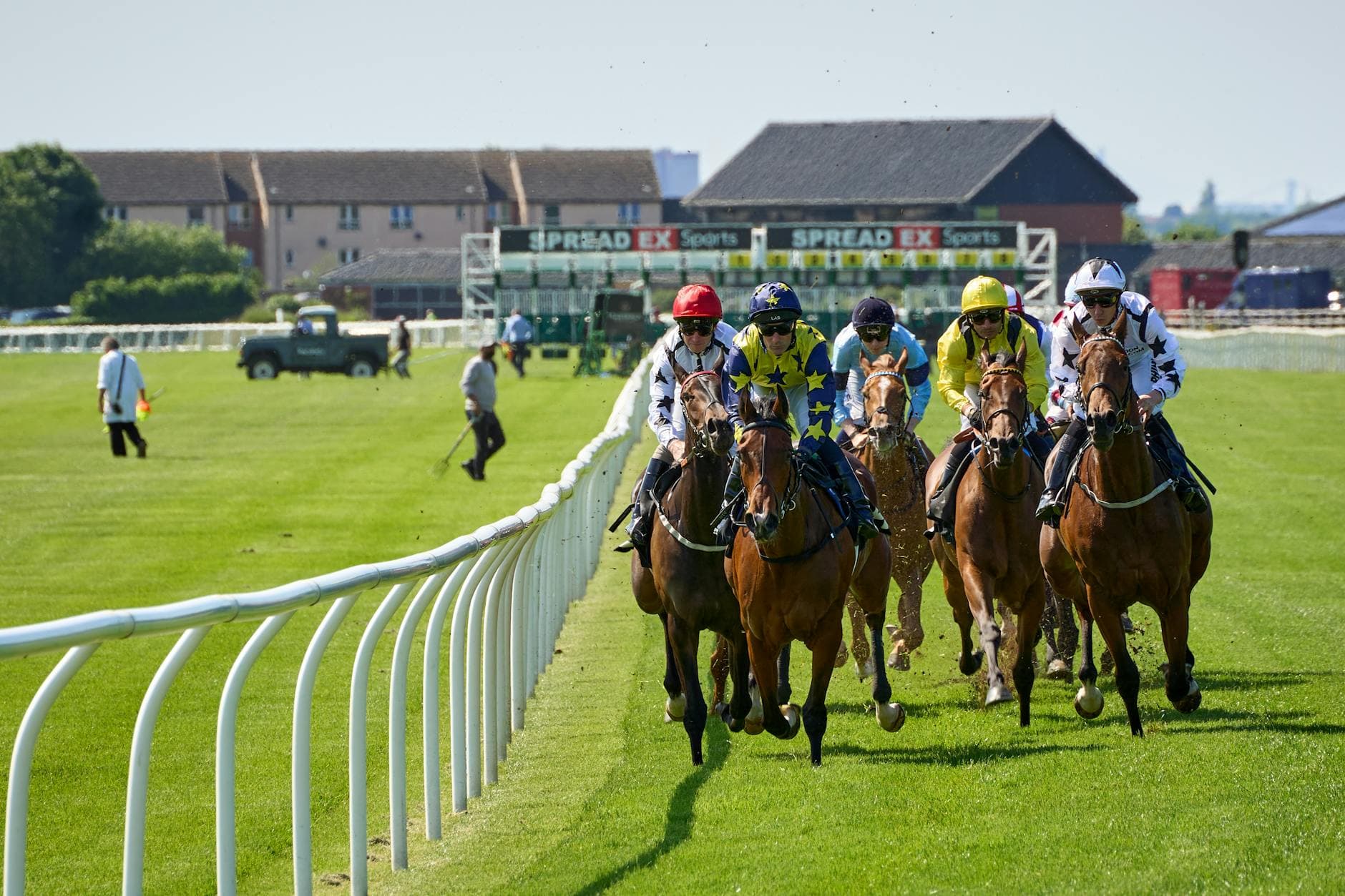
Musselburgh Racecourse has a stated capacity of around 5,000 racegoers, though the New Year's Day meeting regularly attracts closer to 8,000. The compact site layout means that all parts of the course are accessible on foot within a few minutes, and the flat linksland setting makes navigation straightforward. The facilities are appropriate for a mid-tier racecourse with strong local attendances and a clear identity as a community venue serving Edinburgh and East Lothian.
Enclosures and Grandstand
The main grandstand at Musselburgh provides covered seating and standing room for several hundred racegoers. The tiered viewing levels give clear sightlines over the finishing straight and home turn, which is important on a tight oval where the racing action passes in front of the stands at close range. Racegoers positioned on the upper tiers of the grandstand can observe most of the circuit, including the far side of the track where horses pass on the back straight.
On major fixture days — particularly the Scottish Sprint Cup and the New Year's Day meeting — the course sets up additional marquee structures in the infield and around the perimeter of the main enclosure. These provide overflow capacity and additional catering points, effectively expanding the usable footprint of the course during peak attendance periods. The informal, friendly character of the venue is consistently cited by regular attendees as one of its strengths; this is not a course where formality or rigid enclosure hierarchies define the experience.
The parade ring is in front of the main grandstand, giving racegoers easy access to view the horses before each race. The proximity of the parade ring to the grandstand means that spectators can move quickly between viewing the horses, placing bets, and returning to their viewing position without missing the start.
Hospitality
Musselburgh offers a range of hospitality packages covering private dining, restaurant tables, and premium viewing areas. The hospitality packages vary by fixture and typically include a table with a meal service, a racecard, a reserved viewing area, and inclusion in pre-race paddock tours or raceday programmes. Corporate hospitality for groups is available with advance booking, and the New Year's Day meeting has dedicated corporate and premium packages that sell out several months in advance.
For private groups of 10 or more, the course can arrange bespoke packages that combine dining, a private bar, and additional raceday extras. The management team handles group enquiries directly, and the course website carries current hospitality options with pricing. The scale of the hospitality provision is proportionate to the venue's capacity — Musselburgh does not offer the elaborate multi-tier hospitality infrastructure of a Cheltenham or an Epsom, but the packages available are appropriate for the setting and well-regarded by the groups who use them.
Food and Drink
Catering at Musselburgh covers a range from quick-service counters to sit-down restaurant dining within the hospitality areas. The main public enclosures have a standard selection of race-day food — burgers, fish and chips, sandwiches, hot drinks — served from kiosks and counters positioned around the perimeter of the grandstand and along the track rail. The bars offer a standard selection of lagers, ales, wines, and spirits, with soft drink options available throughout.
On New Year's Day, the catering operation is substantially expanded. Multiple marquees add capacity, and the food offering is broadened to match the festive character of the occasion. Early arrival on New Year's Day is advisable: the queues for catering and bars at peak periods before the feature races can be significant when 7,000 or 8,000 people are attending.
During summer evening meetings, a more casual food-and-drink atmosphere prevails. Picnics are permitted in designated areas, and the relaxed, social character of the evening fixture is well-suited to groups arriving from Edinburgh after work or earlier in the afternoon.
Accessibility and Practical Facilities
Musselburgh is accessible to racegoers with disabilities. Dedicated parking spaces are available close to the main entrance, and the flat linksland site means there are no significant gradients to navigate within the course. Viewing areas with level access are positioned along the track rail, and accessible toilets are available within the main enclosure.
Toilets are distributed across the site, with additional temporary facilities brought in on busy fixture days. Cash machines are available on site, and card payments are accepted at most catering and bar outlets. Mobile signal is generally adequate for the East Lothian location, though at very busy events some users may experience reduced data speeds.
The course website at musselburgh-racecourse.co.uk carries up-to-date information on opening times, disabled access arrangements, and any temporary changes to facilities for specific meetings.
Takeaway: Musselburgh's facilities are well-matched to its capacity and its character as an accessible, community-facing racecourse. The compact site, combined with the flat linksland setting, makes it easy to navigate and enjoy whether attending for the first time or returning regularly.
Getting There
Musselburgh Racecourse is located at Linkfield Road, Musselburgh, East Lothian, postcode EH21 7RG. The course is six miles east of Edinburgh city centre, easily reachable by train, bus, or car from the capital. The combination of rail access, frequent bus services, and straightforward road routes makes Musselburgh one of the most accessible racecourses in Scotland.
By Train
Musselburgh station is on the Edinburgh Waverley to North Berwick line, operated by ScotRail. Direct trains run frequently throughout the day, and the journey from Edinburgh Waverley takes approximately 10 minutes. From Musselburgh station, the racecourse is a 15-to-20-minute walk along Linkfield Road. The walk is flat and straightforward, following the main road through the town to the Links.
On busy fixture days, particularly the New Year's Day meeting and the Scottish Sprint Cup, trains from Edinburgh fill up quickly. Racegoers travelling by train on high-attendance days should allow extra time at Edinburgh Waverley and consider booking a seat on ScotRail services where available. For the return journey after racing, taxis from the course to Musselburgh station are an alternative to walking, and pre-booking a taxi is advisable on the busiest days.
Edinburgh Waverley is the main terminus and is connected to Glasgow Queen Street and Glasgow Central by regular ScotRail services, making Musselburgh accessible on the same day from Glasgow with a change at Edinburgh.
By Bus
Lothian Buses operate regular services between Edinburgh city centre and Musselburgh. The X5 and several other routes serve the town, with stops accessible on or near Linkfield Road. Buses run throughout the day and into the evening, making them a practical option for racegoers who prefer not to drive. On major race days, the course website and local travel information services publish details of any supplementary race-day bus services operating between Edinburgh and the racecourse.
Bus journey times from Edinburgh city centre vary between 25 and 45 minutes depending on traffic and the specific route taken. Services are generally reliable, but racegoers should check the Lothian Buses website or the Traveline Scotland journey planner for current timetables and any service alterations on specific dates.
By Car
From Edinburgh city centre, the most direct route to Musselburgh is via the A1 heading east. The course is well-signposted from the A1 and the Musselburgh town approaches. The journey by car from Edinburgh city centre takes approximately 15 minutes in normal traffic, though this can extend on busy fixture days when there is congestion around the course entrance.
Free on-course parking is available at Musselburgh Racecourse. The parking areas are on the Links adjacent to the course and are accessible from Linkfield Road. On the New Year's Day meeting and the Scottish Sprint Cup, the car parks fill quickly. Early arrival — at least an hour before the first race — is advisable to secure parking close to the entrance. Overflow parking may be directed to nearby areas with a short walk to the course.
For those travelling from further afield, the A1 connects Edinburgh to Newcastle and the rest of the east coast of England, making Musselburgh directly accessible from Berwick-upon-Tweed (approximately 55 miles), Newcastle (approximately 110 miles), and Northumberland. Drivers from the west of Scotland reach Musselburgh via the M8 to Edinburgh and then the A1 east.
Combining with Edinburgh
Edinburgh is one of the most visited cities in Britain, and Musselburgh's proximity to the capital makes the two natural companions for a racing visit. Edinburgh Castle, the Royal Mile, Arthur's Seat, and the National Museum of Scotland are all within 30 minutes of the racecourse by public transport. The Scottish National Gallery and the Palace of Holyroodhouse are other major attractions within easy reach.
For racegoers planning an overnight stay, Edinburgh has an extensive range of accommodation at all price points, from budget hostels in the Old Town to large hotels along Princes Street. Musselburgh itself has a small number of hotels and guest houses for those who prefer to stay closer to the course. For major fixtures, accommodation in Edinburgh should be booked well in advance, particularly for the New Year's Day meeting when the city fills quickly around 1 January.
The course is also within practical driving distance of Hamilton Park (approximately 40 miles west) and Kelso (approximately 45 miles south), which makes Musselburgh a natural base for Scottish racing tours covering multiple venues.
Frequently Asked Questions
History of Musselburgh Racecourse
History of Musselburgh Racecourse
Origins on the Links
Racing at Musselburgh has its roots in the early nineteenth century, with the current course on Musselburgh Links established in 1816. The town of Musselburgh lies six miles east of Edinburgh on the southern shore of the Firth of Forth, and its flat coastal plain — the Links — had long been used for outdoor recreation before horse racing was formalised there. The same turf carries the distinction of hosting golf since at least 1672, giving the Links a sporting heritage that predates the formation of most British racecourses by a century or more.
The choice of the Links for racing was not arbitrary. The flat, well-drained grassland offered conditions that could carry horse racing through the spring and summer seasons without excessive ground preparation, and the proximity to Edinburgh — then one of the most prosperous cities in Britain and Ireland — provided a large potential audience of wealthy patrons, merchants, and military officers. Edinburgh's New Town development, completed in stages through the late eighteenth and early nineteenth centuries, had by 1816 generated a substantial professional and aristocratic population with disposable income and an appetite for outdoor entertainment.
The Edinburgh Racecourse Era
For most of its history, Musselburgh operated under the name Edinburgh Racecourse. This was a deliberate choice to associate the course with the prestige and commercial weight of the capital rather than with the smaller town of Musselburgh itself. The name Edinburgh Racecourse persisted until 1996, when the decision was made to rename the venue Musselburgh Racecourse and align the brand more closely with its actual geographical setting and community identity.
During the Edinburgh Racecourse era, the course was a regular fixture on the northern racing circuit, attracting fields from English as well as Scottish trainers. Scotland's racing programme in the nineteenth and early twentieth centuries was less developed than it is today, and Musselburgh competed for fixture dates and prestige with Ayr — the other main Scottish flat venue — as well as with northern English tracks accessible to Scottish trainers and horses.
National Hunt Comes to Musselburgh
The introduction of National Hunt racing at Musselburgh added a second dimension to the course's programme and extended the racing calendar through the winter months. The dual-purpose configuration, which now sees approximately 30 fixtures per year split between flat and jumps, developed over several decades as the course sought to maximise use of its facilities and income across the calendar year.
The New Year's Day meeting became established as a jumps fixture at some point in the mid-to-late twentieth century and gradually grew in scale and cultural significance until it became the institution it is today. The 1 January fixture draws on the energy of the Hogmanay celebrations in Edinburgh and across Scotland to create an event that is as much a social occasion as a racing card. The meeting has become Scotland's largest sporting event on the new year date, and its crowds regularly exceed 7,000 racegoers.
The Jockey Club Relationship and Modern Development
Musselburgh's relationship with Jockey Club Racecourses brought it into alignment with one of the largest operators in British racing. The Jockey Club's portfolio includes Cheltenham, Newmarket, Epsom Downs, Sandown Park, and a further 10 venues, and the operational standards and investment capacity of the group have informed development at Musselburgh over recent years.
The local management structure retains a strong East Lothian character. East Lothian Council and the Lothians Racing Syndicate maintain involvement in the course's governance, reflecting its status as a community asset that serves the town of Musselburgh and the wider Edinburgh region. This combination of national group backing and local governance is unusual in British racing, where most courses are either fully independent or fully integrated within one of the large groups.
Renaming and the Modern Identity
The decision to rename the course Musselburgh Racecourse in 1996 was part of a broader effort to sharpen the venue's identity and build a distinctive brand. The name Musselburgh is now strongly associated with the course's two defining fixtures — the Scottish Sprint Cup and the New Year's Day meeting — and carries a clear geographical identity that Edinburgh Racecourse, despite its prestige implications, could not offer with equal clarity.
The course continued to invest in its programme following the rename, developing listed-race status for the Scottish Sprint Cup and building the New Year fixture into a full entertainment event rather than simply a day's racing. The dual approach — serious flat racing and competitive NH jumping — gives Musselburgh a rounded programme calendar and a broad appeal to racegoers from across Scotland and northern England.
Musselburgh in the 2020s is a well-attended, commercially active racecourse with a secure position in the Scottish racing calendar. Its 1816 origins place it among the oldest active racing venues in Britain, and the continued presence of golf on the same Links turf maintains a connection to the sporting heritage of the site that stretches back more than three centuries.
The Course Within Scottish Racing
Scottish racing as a whole has a smaller footprint than English racing. The handful of active Scottish racecourses — Musselburgh, Ayr, Hamilton Park, Kelso, and Perth — collectively represent a tightly-knit regional circuit where trainers, jockeys, and horses compete regularly against one another throughout the season. Musselburgh sits at the eastern end of this circuit, drawing horses from Edinburgh's hinterland as well as from the Scottish Borders and from northern England.
Ayr has historically been regarded as Scotland's premium flat racing venue, home to the Scottish Champions Day in September and the Western Meeting. Musselburgh offers a different proposition — a busy, accessible, dual-purpose course rather than a prestige-meeting venue. The division of roles between the two has suited both; Ayr holds the marquee flat occasions, while Musselburgh provides the volume and the year-round programme that keeps Scottish racing active from January to December.
Over the course of its existence since 1816, Musselburgh has outlasted several other Scottish racecourses that opened, operated for a period, and then closed as the industry consolidated. The course's survival through economic downturns, two world wars, and the gradual rationalisation of the British racing programme owes much to its location beside one of the most densely populated parts of Scotland and to the consistent demand from Edinburgh racegoers for a local track. The 1816 start date is not simply a historical curiosity — it is evidence of a continuous relationship between the town and the turf that has sustained the course through two centuries of change.
Famous Moments
Famous Moments at Musselburgh
The New Year Record Crowds
The New Year's Day meeting has produced the most consistently attended race days in Musselburgh's modern history, and its crowd figures represent some of the highest single-day attendances of any racecourse in Scotland. Attendances regularly reaching 7,000 and 8,000 on 1 January are a modern phenomenon — the meeting grew into its current scale gradually from the 1980s and 1990s onwards as the New Year Day fixture became an established part of the Scottish festive calendar.
The meeting's growth coincided with broader changes in Scottish sporting culture and an increasing appetite among Edinburgh racegoers for an outdoor, social event on the first day of the new year. The combination of competitive National Hunt racing with live music, Highland dancing, and an expanded food-and-drink offering transformed what had been a straightforward winter fixture into something more akin to a festival with racing attached. The crowd figures that resulted placed Musselburgh in the same bracket as some considerably larger English courses for single-day attendances on this specific date.
The Scottish Sprint Cup as a Listed Race
The elevation of the Scottish Sprint Cup to listed status was a milestone in Musselburgh's flat racing programme. Listed races occupy a specific position in British racing's class hierarchy — below Group 1, 2, and 3 but above standard handicap and conditions races. Achieving listed status for the Sprint Cup meant that the race could attract horses of a higher calibre than a standard handicap would draw, and the oversubscription of the race at most declaration stages is evidence that the listed designation carries real pulling power.
The ballot for the Sprint Cup, which each year removes several horses from the maximum permitted field, has itself become a notable feature of the fixture. The consolation sprint run on the same afternoon ensures that horses removed from the main race have somewhere to go, and it provides an additional competitive sprint handicap for punters to assess. This twin-sprint format, driven by the depth of the field rather than by programme planning, is unusual on the British calendar and gives the June meeting a distinctive character.
Lucinda Russell's Dominance of the Winter Programme
No account of Musselburgh's recent history is complete without acknowledging Lucinda Russell's contribution to the National Hunt programme. Based at Arlary House Stables in Kinross, approximately 20 miles from Musselburgh, Russell has been the most successful NH trainer in this part of Scotland over the past two decades. Her string targets Musselburgh's winter fixtures consistently, and her detailed knowledge of the course's requirements — the tight bends, the fair fences, the going tendencies in East Lothian winters — gives her runners a practical advantage over horses arriving from further afield.
Russell is best known nationally for training One For Arthur, the horse that won the 2017 Grand National at Aintree under rider Derek Fox. That win was one of the most celebrated moments in Scottish racing history and brought international attention to a training operation that had long been producing competitive horses on the Scottish NH circuit. At Musselburgh specifically, Russell's seasonal winner tallies are routinely among the highest of any trainer at the course.
The Edinburgh Connection Through the Years
The course's historical identity as Edinburgh Racecourse connected it to some of the most significant periods in Scottish and British cultural life. Edinburgh's status as the Athens of the North during the late eighteenth and early nineteenth centuries — the era of the Scottish Enlightenment, when philosophers, scientists, and writers gathered in the city — coincided with the early decades of organised racing at Musselburgh. While the philosophers themselves may not have attended in numbers, the social world that produced them was the same world that provided the patrons and spectators for early Musselburgh racing.
The renaming to Musselburgh Racecourse in 1996 cut the formal tie with Edinburgh in name, but the Edinburgh connection in practice remains as strong as ever. A significant proportion of racegoers at every Musselburgh meeting travel from Edinburgh, and the course's marketing consistently positions it as Edinburgh's racecourse. The six-mile gap between the two has never been an obstacle.
Record Attendances and Looking Forward
The modern Musselburgh record for single-day attendance on the New Year meeting, reported at close to 8,000 in peak years, stands as the high-water mark for crowd-pulling at the course. Sustaining and building on these numbers within the constraints of a 5,000-capacity venue requires careful management of temporary structures and the expansion of the site on the day, and the course has developed considerable expertise in this logistics challenge.
For the flat programme, the Scottish Sprint Cup continues to be the focal point of external media attention. When well-known sprint trainers from England enter horses for the race, coverage in the national racing press follows, placing Musselburgh in front of audiences well beyond its regular Scottish and northern English racegoing base.
Betting Guide
Betting at Musselburgh
Understanding the Course Before You Bet
Musselburgh rewards bettors who take the time to understand what the course configuration actually means for race outcomes. The tight right-handed oval, the short run-in, and the draw bias in sprints are not abstract characteristics — they directly influence which types of horse win at this track with a frequency that exceeds chance. Treating Musselburgh as a generic flat or jumps course and applying standard betting approaches will miss these course-specific factors.
The starting point for any Musselburgh bet is the distance and the draw. In flat races over five furlongs and five furlongs and one hundred yards, the draw is the single most important pre-race factor after outright ability. Low-drawn horses in stalls one through to approximately stall seven have a structural advantage on the inside line into the first bend. This advantage does not guarantee a win — a well-drawn moderate horse will not beat a poorly-drawn top-class horse — but in close contests where several horses are evenly matched on form, the draw is often the deciding factor.
Over seven furlongs and beyond, the draw effect diminishes substantially. Horses have more time to settle and find their position, and the physical advantage of the inner line on the first bend becomes less significant relative to the overall distance of the race. At one mile four furlongs, the draw is not a material factor in most circumstances.
Key Trainer Statistics
Trainer form at a specific course is one of the most reliable data points in racing betting analysis. At Musselburgh, three trainers stand out on the flat for their consistent strike rates: Keith Dalgleish, Jim Goldie, and Linda Perratt.
Keith Dalgleish, who trains at Carluke in South Lanarkshire approximately 35 miles from Musselburgh, is the leading local flat trainer for the course. His horses are well-prepared for the tight oval and the sprint distances, and his familiarity with the track means that his runners are almost never unsuited by the course configuration. Dalgleish's strike rate at Musselburgh in flat sprints is consistently one of the highest of any trainer at the course.
Jim Goldie, based at Uplawmoor in East Renfrewshire approximately 45 miles away, is a similarly established Musselburgh trainer with a long record at the course. Goldie targets sprint handicaps and takes the Scottish Sprint Cup meeting seriously, and his runners on both the main race and the consolation sprint are worth including in any analysis of the meeting.
For National Hunt, Lucinda Russell (Kinross, 20 miles) is the dominant local handler. Her seasonal strike rate at Musselburgh is among the highest in the yard's entire record. Donald McCain also targets Scottish NH fixtures from his Cheshire base and has a good record at the course in handicap chases.
Front-Running and Prominent Riding
The short run-in at Musselburgh — approximately two furlongs from the home turn to the line — creates structural value in horses ridden to go forward. A horse that reaches the final bend in a prominent position is truly difficult to pass in the distance that remains. This is not simply a pace-scenario effect; it is a course-geometry effect. Even a moderately-paced race produces a front-running bias if the run-in is short enough to prevent a sustained late challenge from developing.
When selecting at Musselburgh, horses with a high front-running or prominent-racing profile in their form — indicated by the position-at-turn figure in detailed form analysis — are worth rating slightly more highly than their raw ratings suggest. Conversely, hold-up horses that rely on finishing fast from the rear of the field are structurally disadvantaged, and a strong recent form line for a confirmed hold-up horse may not translate if the course configuration works against the running style.
Going Strategy
Going at Musselburgh creates a consistent split between flat and jumps conditions. In the flat season, good to firm and good are the most common surfaces, and the course's form is most reliable in these conditions. When the going reaches good to soft or soft in the autumn, some horses that have been running on quicker surfaces through the summer find the conditions less suited to them. Horses with proven soft-ground form — form figures on good to soft or soft — are worth identifying in autumn and spring flat fixtures.
For National Hunt racing through the winter, soft or good to soft is the default. Heavy ground does occur and can arrive quickly after rain in East Lothian. When the going is declared heavy, the form becomes less reliable and the importance of basic fitness and class increases relative to speed-based assessments. In truly heavy going, the smallest, lightest horses tend to have a going advantage that the form figures alone may not capture.
Responsible Betting
Betting is entertainment. No analysis of draw bias, trainer statistics, or going preferences guarantees a winning bet — these are factors that adjust probability, not certainty. Set a budget for each race day, treat losses as the cost of entertainment, and never increase stakes to recover losses. The Scottish Sprint Cup and the New Year meeting are among the most competitive racing occasions in Scotland, and the fields at these fixtures are assembled by professional trainers who would not enter a horse they thought had no chance.
Please gamble responsibly. If you feel you may have a problem with gambling, visit BeGambleAware.org or call the National Gambling Helpline on 0808 8020 133.
Atmosphere & Planning Your Visit
Atmosphere and Planning Your Visit
What to Expect on Arrival
Musselburgh has the feel of a racecourse that knows its audience. The racegoers who attend regularly — many of them from Edinburgh and East Lothian, some arriving by train from Glasgow — are knowledgeable about what they are there to see. There is none of the first-time awkwardness that can characterise some larger southern English venues, where the social complexity of enclosures and dress codes can be distracting. Musselburgh is informal, well-organised, and almost entirely focused on the racing.
Arriving from Musselburgh station on a busy fixture day, the walk along Linkfield Road to the course gives a clear sense of the town's relationship with racing. The Links stretch away to the north, flat and open, with the Firth of Forth visible beyond the golf course that shares the turf with the racecourse. On the New Year's Day meeting, racegoers are walking this route from mid-morning, some still celebrating from the night before, others wrapped against the East Lothian January wind and firmly focused on the card.
The New Year Experience
New Year's Day at Musselburgh is one of the most singular racing experiences in Britain. The 7,000 or 8,000 people who attend are there for reasons that go beyond a simple day at the races. For many Edinburgh families, attending the New Year meeting is a fixture in the seasonal calendar as established as the races themselves. Children who attended with their parents twenty years ago return now as adults with their own children. The music between races, the Highland dancing, and the sheer scale of the crowd create an atmosphere that is not replicated at any other fixture on the course's calendar.
A practical word: dress warmly. Musselburgh on 1 January is exposed and cold, and the easterly wind off the Firth can make the temperature feel several degrees lower than the forecast suggests. Layering is strongly recommended. The main grandstand provides shelter, but the queue times for food and drink on New Year's Day can be substantial, and racegoers who spend time outside the grandstand will benefit from adequate clothing.
Planning a Standard Race Day
For standard flat or jumps fixtures outside the two headline meetings, Musselburgh offers a relaxed, enjoyable day without the crowd pressures of New Year or the Sprint Cup. Weekday meetings in particular are well-suited to racegoers who want competitive racing without a crush. The compact site means you see all the action clearly, and the short distances between the parade ring, the rail, and the catering outlets make the day easy to manage.
Summer evening meetings run from mid-June to late July, and these are among the best-value experiences at the course. The long Scottish summer evenings allow racing to run late into the night under natural light, and the relaxed social character of the evening fixture — picnics permitted, atmosphere informal — attracts a different crowd from the weekend afternoon race-goer. These meetings are particularly popular with Edinburgh visitors who can travel out from the city after work and return the same evening.
Nearby Attractions and Extending Your Trip
Edinburgh's concentration of cultural and historic attractions makes extending a Musselburgh race day into a longer visit straightforward. Edinburgh Castle, open daily from 9:30am, is 25 minutes from Musselburgh by bus or train and is the most-visited paid attraction in Scotland. The Palace of Holyroodhouse at the foot of the Royal Mile is the official Scottish residence of the Crown and is open to visitors when the Royal Family is not in residence. Arthur's Seat, the ancient volcanic hill that rises above Holyrood Park, is accessible by foot from the Palace and offers panoramic views across the city and the Firth of Forth.
For racegoers combining a visit to Musselburgh with a broader Scottish racing trip, Kelso in the Scottish Borders is approximately 45 miles south, and Hamilton Park is approximately 40 miles to the west. Perth is approximately 45 miles to the north via the M90. A three-course Scottish racing itinerary, including Musselburgh, can be completed in a long weekend based in Edinburgh.
More guides for this course
Share this article
More about this racecourse
All Musselburgh guides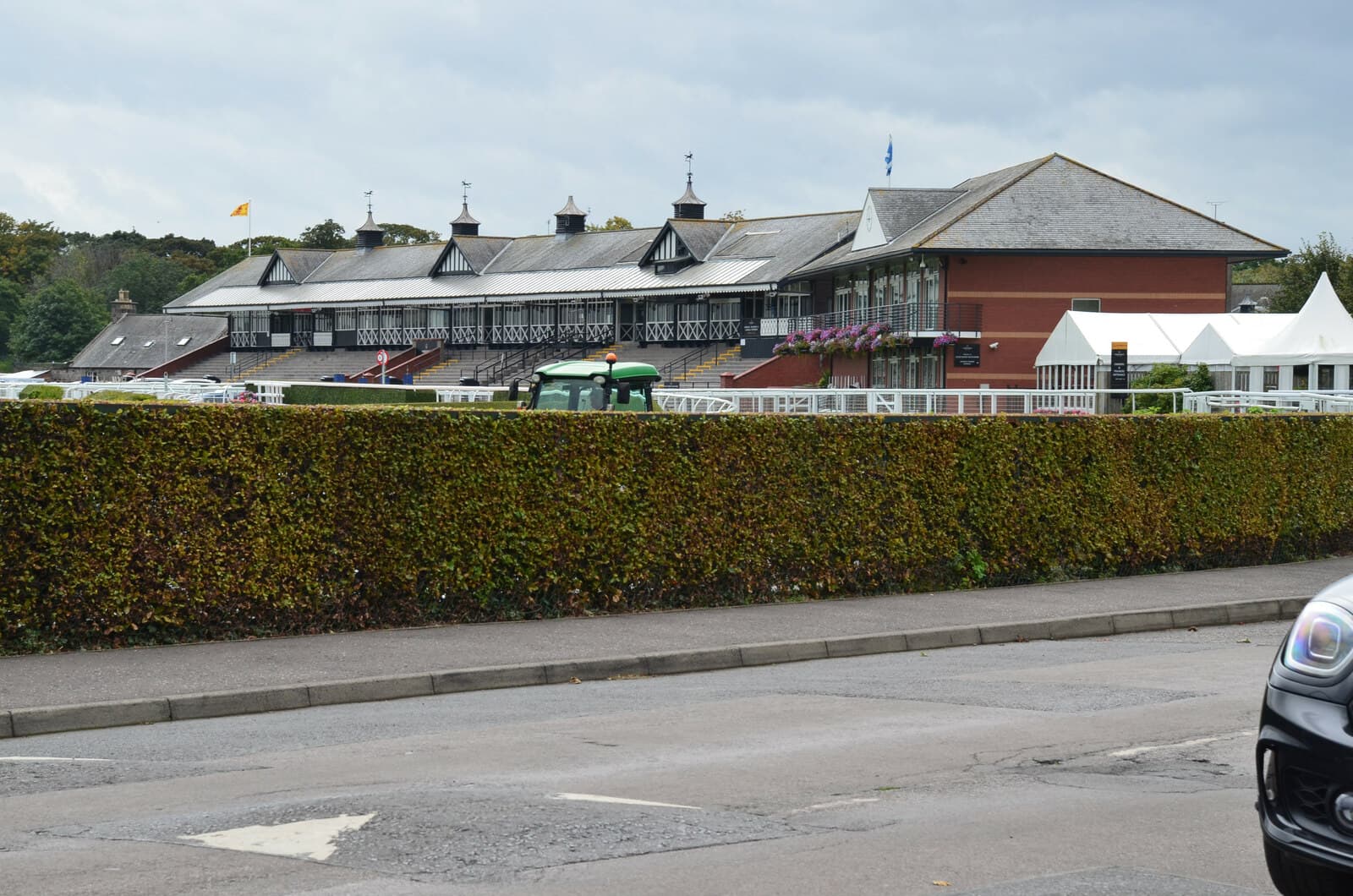
A Day Out at Musselburgh Racecourse
A day at Musselburgh — getting there, what to wear, enclosures, food and drink, and insider tips for Scotland's dual-purpose course on Edinburgh's doorstep.
Read moreMusselburgh Festival Guide
Your complete guide to Musselburgh Racecourse — the Scottish Sprint Cup, the New Year's Day fixture and what makes this East Lothian track Edinburgh's racing venue.
Read more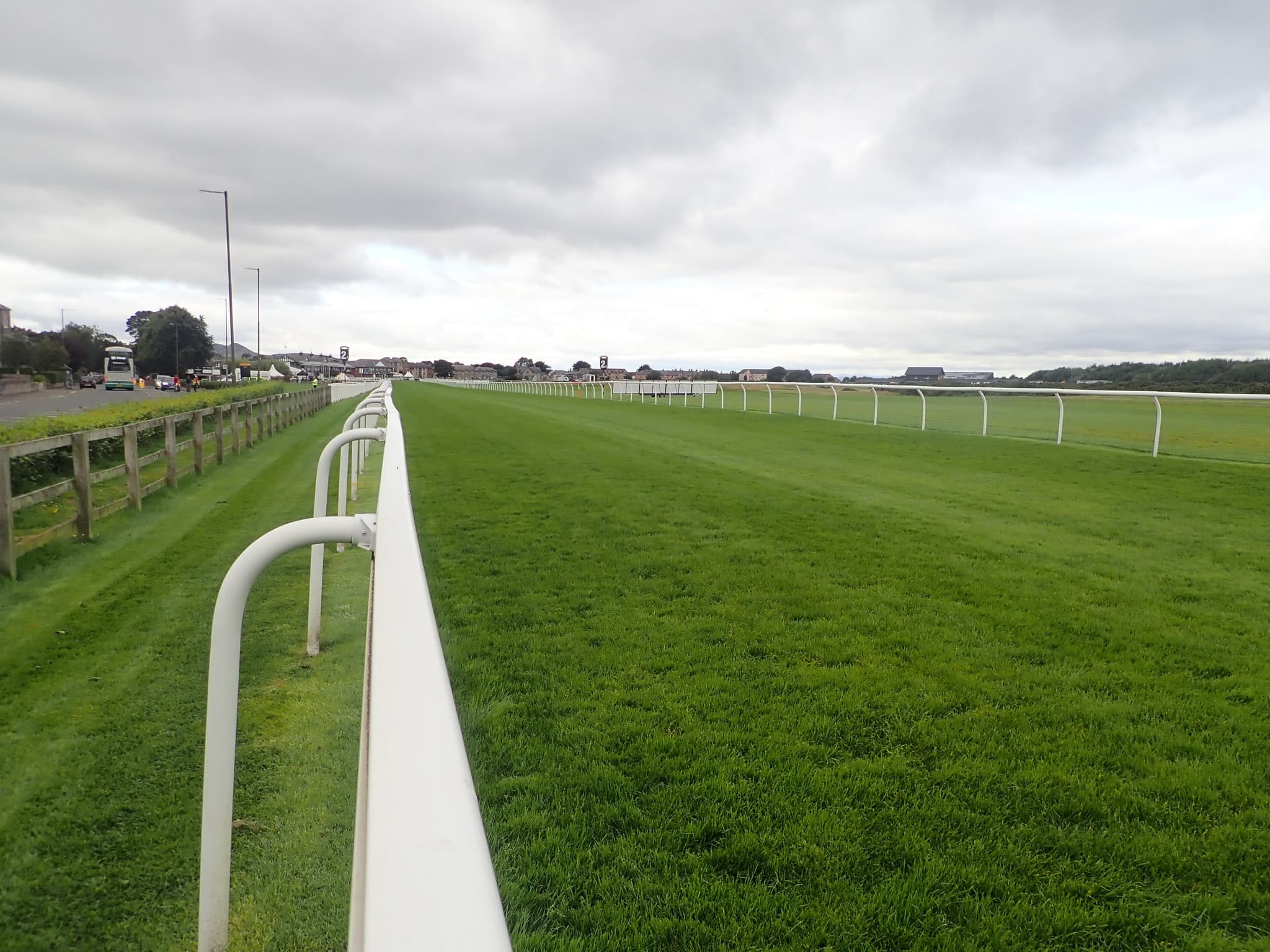
Musselburgh Racing History: 200 Years from Leith Sands
Discover how Musselburgh evolved from Leith sands racing in the 1800s to Scotland's premier dual-purpose course at Edinburgh's doorstep.
Read morePhotos on this page are used under Creative Commons licences. Titles, sources and licence links for each one are on our image credits page.
Research the field with the AI Race Predictor
Our model publishes calibrated win-probability estimates for UK races — a second opinion to understand a race, not tips. It's open about its record: it doesn't beat the market, and we show exactly how it does.
Work it out & learn the basics
Gamble Responsibly
Gambling should be entertaining and not seen as a way to make money. Never bet more than you can afford to lose. If you or someone you know has a gambling problem, help and support is available.