
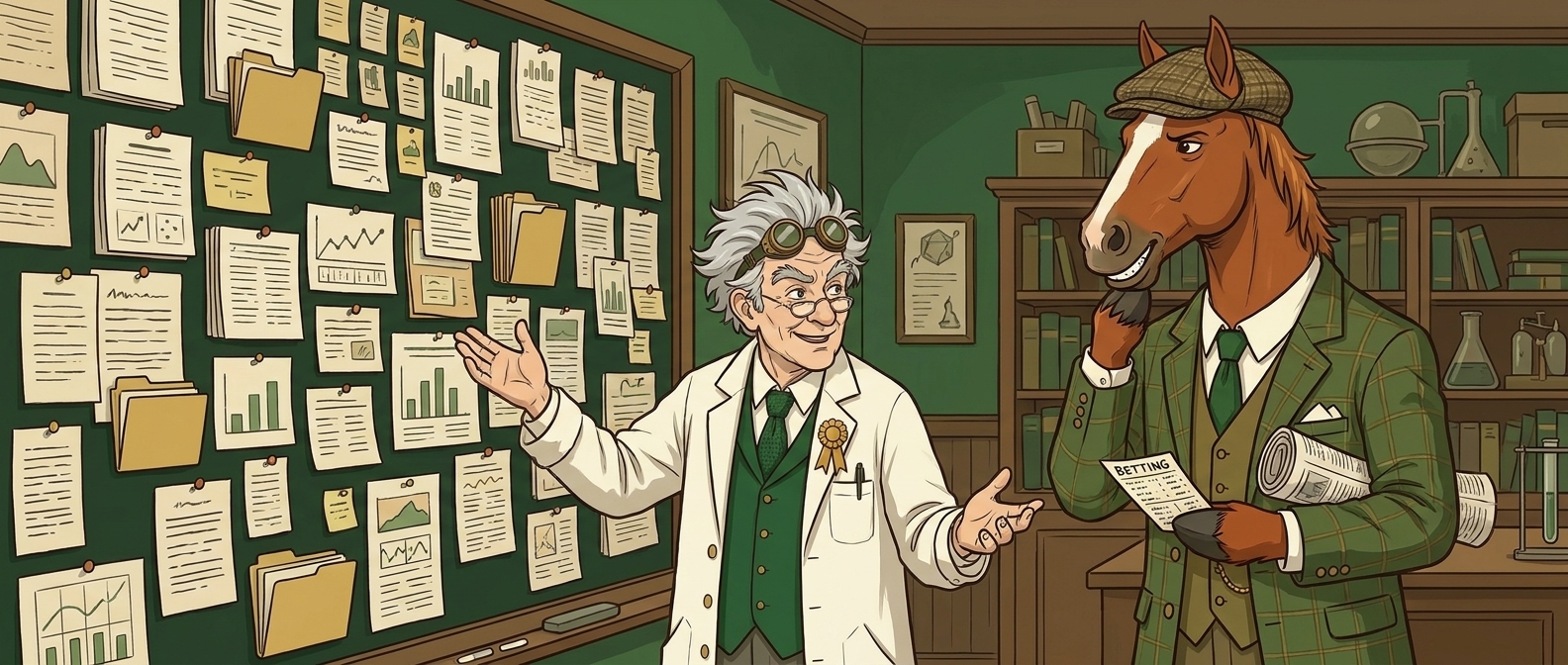
The question
Everyone has watched a 100/1 shot flash past the post and felt the same two things at once: disbelief, and a small voice asking why they did not have a fiver on it. Pascal hears that voice all day. "Someone has to win it," he says, waving a betting slip, "and look at the price. All that upside for next to nothing down. How often can it really be, once a month?"
It is a fair question, and it is the one this page answers properly. Not with a memorable anecdote about the day a no-hoper bolted up, but with the cold rate across thousands of real races. How often does a horse the bookmaker rates at 100/1 actually win? And while we are at it, how often does a 50/1 shot win, or a 20/1, or an even-money favourite? If we line up the whole price ladder from the longest outsider to the shortest favourite, what does the win rate really do?
The reason the question matters is that the answer tells you whether the value Pascal is chasing actually exists. The folk theory is seductive: the crowd piles onto favourites and shortens them to poor value, so the value must be hiding at the long end of the book where nobody is looking. Back the prices everyone else is too scared to take, the thinking goes, and one big result squares the season.
Professor Furlong has heard it a thousand times, and he does not argue with the romance. He just pulls the numbers. We took every priced runner with a known finishing position over nearly three years of British racing and sorted them into price bands, then asked two simple things of each band: how often did it win, and what would backing all of it have returned. No tips, no system to sell. Just the rate.
The answer, across the whole ladder
Here is the whole ladder, read live from the data, with nothing rounded away. The table below shows every Starting-Price band, how many runners it held, how often it actually won, what the price implied it should win, and what backing all of it returned to SP.
Scope. UK racing as scraped via Sporting Life, 2023-10-01 to 2026-06-18. NH + Flat combined. No separate country field, so a small number of Irish fixtures carried by the feed may be included. Strike price = SP (starting price); BSP was not available for this window. That is 28,175 races and 218,437 priced runners, banded by Starting Price. Win % is winners ÷ runners in the band; ROI is a flat 1-point level stake to SP. This is research into how the market prices horses, not a tip. What it shows is where the market is sharp and where it is loose, which is the difference between paying a little over the odds and paying a lot.
| Price band | Runners | Won | Actual win % | Implied win % | ROI to SP |
|---|---|---|---|---|---|
| 100/1+ | 10,941 | 28 | 0.26% | 0.69% | −62.7% |
| 66/1-99/1 | 7,234 | 56 | 0.77% | 1.4% | −45.0% |
| 50/1-65/1 | 5,299 | 52 | 0.98% | 2.0% | −50.0% |
| 33/1-49/1 | 13,100 | 247 | 1.9% | 2.7% | −30.9% |
| 20/1-32/1 | 23,057 | 716 | 3.1% | 4.1% | −23.8% |
| 14/1-19/1 | 21,778 | 1,071 | 4.9% | 6.0% | −18.6% |
| 10/1-13/1 | 23,578 | 1,635 | 6.9% | 8.3% | −16.5% |
| 7/1-9/1 | 27,314 | 2,639 | 9.7% | 11% | −13.5% |
| 5/1-6/1 | 24,726 | 3,341 | 14% | 15% | −9.9% |
| 3/1-4/1 | 32,326 | 6,221 | 19% | 21% | −9.8% |
| Evens-2/1 | 24,757 | 8,025 | 32% | 34% | −5.8% |
| Odds-on (under evens) | 4,327 | 2,646 | 61% | 63% | −2.5% |
Method: Every priced, finishing-position-known runner banded by SP. Win% = winners/runners. ROI = flat 1pt level stake to SP, non-winners lose the stake (fallers/pulled-up counted as losers, not filtered). Dataset generated 2026-06-18; covers 2023-10-01 to 2026-06-18. Returns are to industry SP, not Betfair SP. An exchange backer would usually have got a bigger price, but the favourite-longshot bias is why the price is fat in the first place, so a better price at the worst end of the book narrows the loss, it does not reverse it.
Start at the top. A horse priced 100/1 or bigger won about 0.26% of the time, which is roughly 1 in 391 runs. In the whole sample, out of 10,941 runners at those prices, just 28 won. That is the honest answer to the headline question, and it is a long way short of "once a month". Drop to the 66/1 to 99/1 band and the win rate roughly trebles to about 0.77%, still under one in a hundred. The 50/1 to 65/1 band wins about 0.98%, and the 33/1 to 49/1 band about 1.89%. You have to come a long way down the book before a band wins even one race in twenty.
Now read the win rate the other way, from the bottom up, and it climbs exactly as you would expect: a 5/1 to 6/1 shot wins about 13.5% of the time, an even-money to 2/1 shot about 32.4%, and an odds-on favourite about 61.2%. The market clearly knows roughly what it is doing. Longer prices win less often, in a smooth, orderly curve, which is the first thing the data settles: the price is a real signal, not noise.
But look at the last column, the ROI. Every single band loses money. Not one is close to break-even. The odds-on band loses the least, about 2.5p in the pound, and the loss grows steadily as the price lengthens until the 100/1+ band is bleeding 62.7p in every pound staked. So the win rate falls with price, and the cost of backing rises with price, and the two together are the whole story of this page. The question was how often a 100/1 horse wins. The more useful answer is that however rarely it wins, you still lose by backing it, and you lose more the further out you go.
The favourite-longshot bias, explained
There is a name for the pattern in that table, and it is one of the oldest findings in the study of betting markets: the favourite-longshot bias. In plain terms, longshots are over-bet and favourites are under-bet, relative to how often each actually wins. People consistently pay too much for a big price and too little for a short one.
You can see it directly in the chart above. For every band, the gold "actually won" bar sits below the muted "implied" bar, because every band carries some bookmaker margin. That is the overround at work, the built-in edge that makes a book add up to more than 100%. But the gap is not the same size everywhere. At the favourite end it is narrow: an odds-on shot's implied chance of about 62.6% sits only a couple of points above its real 61.2% win rate. At the longshot end the gap yawns open. A 100/1+ runner's price implies it should win about 0.69% of the time, but it actually wins about 0.26%. The price is not just shaded, it is roughly two and a half times too short for reality.
That is why the ROI collapses as the price lengthens. The bookmaker does not spread its margin evenly across the card. It loads the heaviest padding onto the longest prices, precisely because that is where punters are least price-sensitive. Nobody quibbles over whether a no-hoper should be 80/1 or 100/1, so the layer can be generous with itself there and the backer never notices. A 5/1 shot, by contrast, is scrutinised by everyone, so the margin on it has to stay tight or the money goes elsewhere.
So the contrarian theory has the market exactly backwards. The long end of the book is not where value has been left lying around for the brave. It is where the worst value on the entire card is deliberately concentrated. This is the same drag that sinks backing the outsider in every race, only here you can watch it build band by band rather than at a single extreme. If you want the mechanics of how a price turns into an implied chance in the first place, the understanding odds primer walks through it.

How we measured it
The figures above are not a model and not a tip. They are a straight count over real results, and it is worth being clear about exactly what is in the sample so you can judge the scope for yourself.
We took every priced runner with a known finishing position in British racing as scraped via Sporting Life, from 1 October 2023 to 18 June 2026. That is 28,175 races and 218,437 individual runs. Both codes are in there, Flat and National Hunt together, because the bias shows up in both. There is no separate country field in the feed, so a small number of Irish fixtures carried through the wire may be included, which is why we describe the set as British racing rather than claiming it is purely GB to the last race. The strike price throughout is the industry Starting Price; Betfair SP was not available for this window.
Each runner was dropped into a price band by its SP, and for each band we counted the runners and the winners, then computed two rates. The actual win rate is simply winners divided by runners. The implied win rate is the average of what each runner's price said its chance was, before the bookmaker margin is stripped out, which is why every band's implied rate sits a little above its actual rate. The ROI is a flat one-point level stake to SP across the band: winners are paid at their odds, and everything else loses the stake. Fallers and pulled-up horses are counted as losers, not quietly filtered out, because a punter's stake is gone whether the horse falls or finishes last.
A couple of honest caveats. The longest bands are small: the 50/1-plus groups hold a few thousand runners but only a few dozen winners each, so the precise win percentage there carries real sampling noise. The direction is rock solid, the second decimal place is not. And because everything is settled to SP with no commission, this is already a kinder measure than a real punter taking real prices would get. Every assumption we made tilts the result towards the backer, and the backer still loses in every band. The full method on how we settle a bet is on the Lab methodology page.
Why the market is efficient at the extremes
The deeper lesson in this table is not that longshots lose. It is how good the market is at pricing them. Look again at the win-rate column on its own, ignoring the ROI. It runs in an almost perfectly orderly staircase from 0.26% at 100/1+ up to 61.2% at odds-on, with every band in its proper place. A crowd of strangers, betting their own money, has collectively sorted tens of thousands of horses into the right rough order of likelihood. That is not luck. That is a market doing its job.
This is why the extremes are the hardest place to find an edge, not the easiest. The intuition that the favourite is "obvious" and therefore poor value, while the longshot is "overlooked" and therefore rich value, gets it backwards. The odds-on favourites are the most efficiently priced band on the whole page, losing only about 2.5p in the pound, because they attract the most money and the most scrutiny. Every sharp opinion in the country is already in that price. The 100/1 shot, far from being a hidden gem, is the one band nobody bothers to argue about, which is exactly why the bookmaker can afford to make it the worst value on the card.
Professor Furlong's point is that this is the same wall the Stablebet model runs into. The model reads a horse's own form, the conditions, the weather, everything except the market price, and it still cannot consistently beat the Starting Price, because the price already contains the wisdom of everyone who has bet into it. If you want to see how every betting system built on these ideas actually fares once you put real money through it, the Betting Systems Leaderboard ranks them, and not one of them wins.
So the honest framing is not "avoid longshots". It is "the market is efficient enough at both ends that there is no free band to back". Pascal's instinct that value lives at the long end is the most natural mistake in betting, and the data is the gentlest possible way to show that it is a mistake. The price you are being offered on the 100/1 shot is not a gift the bookmaker forgot to take back. It is the part of the book where it makes the most.
The takeaway
So, how often does a 100/1 horse win? About 0.26% of the time, roughly 1 in 391. Big-priced winners are real, and they are wonderful, and that is precisely why you remember them: they are rare enough to be a story. The day-to-day rate is a fraction of one percent, and backing every 100/1+ runner over thousands of races loses 62.7p in every pound.
The wider takeaway is the shape of the whole ladder, not the single number. Win rate falls smoothly as the price lengthens, and the cost of backing rises just as smoothly, because the favourite-longshot bias loads the heaviest margin onto the longest prices. There is no band you can back blindly and profit, from the odds-on favourite that loses the least to the 100/1 shot that loses the most. The value Pascal goes looking for at the long end of the book is not there, and the reason it is not there is that the market has already priced everything the crowd knows.
None of this is advice to bet, on longshots or anything else. It is the opposite of a tipping page. The point of the Lab is to show, with the actual numbers, why the bookmaker's book is so hard to beat, so that you can see exactly where your money goes when you take a fat price. If a 0.26% chance still appeals for the fun of it, that is your call, but bet it as entertainment with money you can lose, never as a value play, and check the BeGambleAware tools if it ever stops being fun.
Pascal, predictably, is unmoved. "But it only takes one," he says, folding the slip into his pocket for the next race. Professor Furlong does not even look up from the ledger. "It does," he says. "About once every three hundred and ninety-one tries. And the three hundred and ninety losers in between are how the bookmaker pays for the lights." The next experiment asks whether each-waying that big price softens the blow. It does not.