Founder & Editor · Last reviewed 2026-07-13
Racing has been part of life at Powerstown Park since 1856, which makes Clonmel one of the longer-running fixtures on the Irish map. The course sits in the Suir Valley on the edge of Clonmel, about two kilometres from the town centre, and it has staged racing on the same wooded parkland for over 150 years. That kind of continuity is the thread running through this whole story.
Clonmel is a dual-code track, hosting both National Hunt and Flat racing on turf, with no all-weather surface. It is one of three racecourses in County Tipperary and the only one that races throughout the year, working its way through 12 meetings under both codes. The circuit is a right-handed, undulating oval of about a mile and a quarter, and its stiff uphill finish has shaped the kind of horse that wins here for generations.
Most of what people know about Clonmel's history runs through its jumps racing, and in particular through the Clonmel Oil Chase, the Grade 2 steeplechase that has been the highlight of the year since the early 1990s. Two horses above all others gave the place its reputation: Dorans Pride, who won the feature four years running, and Beef Or Salmon, who cut his teeth here before becoming one of Ireland's best-loved chasers.
This article traces that history in order. It covers:
Racing at Powerstown Park
The official founding date at Clonmel is 1856, the year the course gives as its establishment at Powerstown Park. Racing has run on the site ever since, which puts more than 150 years of organised sport on the same ground in the Suir Valley.
There are hints that horses were being raced around Powerstown before the enclosed course took shape. One account has racing at Powerstown Park going back to the early part of the 19th century, on what was then an unenclosed course. That earlier picture is harder to pin down than the 1856 date, so it is best treated as background rather than a firm first-meeting record. What is certain is that by the middle of the 19th century Clonmel had a settled home for its racing, and it has kept it.
The setting did a lot to shape the character of the place. Powerstown Park lies in 160 acres of mature trees and shrubs on the edge of Clonmel, in the valley of the River Suir. The land is not flat. The circuit runs uphill for its first part, then swings into a long downhill run to the home straight, before the ground climbs again to give a stiff uphill finish. That undulation is the single most important fact about the course, because it decides which horses handle Clonmel and which do not.
From the start this was turf racing, and it has stayed that way. There is no all-weather track. The course grew into a dual-code venue, staging both National Hunt and Flat fixtures, though its identity has always leaned towards jumps. Over time Clonmel settled into a pattern of year-round racing, the only track in County Tipperary to do so, and it now runs 12 meetings a year under both sets of rules.
The deeper redevelopment history, the dates and costs of particular stands or improvements, is not recorded in any reliable public source, so this account stops at what can be stood behind: a course founded in 1856 and racing continuously since.
The Oil Chase and the Modern Card
The event that shaped modern Clonmel is the Oil Chase. It began in 1992 as the Morris Oil Chase, run over three miles in December and named for the Morris Oil business. The same meeting still carries that name in its mares' race, the T.A. Morris Memorial.
The race changed shape quickly. In 1994 it was cut by half a mile to around two and a half miles and moved to November, where it has stayed. It was given Grade 3 status in 1995 and promoted to Grade 2 the following year. In 2003 it was run for the first time under its present title, the Clonmel Oil Chase, when the Clonmel Oil Company took over as sponsor. That partnership has held ever since. In 2020 the racecourse described the meeting as marking the eighteenth consecutive year of Clonmel Oil backing, which lines up with the 2003 start.
The main dates read like this:
| Year | Milestone |
|---|---|
| 1856 | Course established at Powerstown Park |
| 1992 | First running of the Morris Oil Chase, over 3m in December |
| 1994 | Cut to about 2m4f and moved to November |
| 1995 | Upgraded to Grade 3 |
| 1996 | Promoted to Grade 2 |
| 2003 | First run as the Clonmel Oil Chase under Clonmel Oil sponsorship |
The distance quoted for the feature varies a little from one year to the next, listed anywhere from 2m4f51y to 2m4f171y depending on which chase course is used, so it is fairest to call it about two and a half miles. The prize fund grew over the years, reaching 60,000 euro added by 2025, with 36,000 euro going to the winner.
The Oil Chase does not stand alone on the card. The T.A. Morris Memorial Irish EBF Mares Steeplechase, a Listed race over the same course and distance, was first run in 2004 and shares the November feature day. Earlier in the year, in February, the course stages the Powerstown Novice Hurdle over three miles, a race first run in 2003 that was promoted to Grade 3 in 2013 and has run under Mercedes-Benz sponsorship. Willie Mullins trained four winners of it in a row between 2013 and 2016.
Between them these three races give Clonmel a genuine graded programme, unusual for a provincial Irish track, and they are the backbone of its standing in the National Hunt calendar.
The Great Horses of Clonmel
Two horses gave Clonmel its place in racing memory, and both came from the same stable.
Dorans Pride
No horse is more closely tied to Clonmel than Dorans Pride. A chestnut gelding trained by Michael Hourigan, he won the Oil Chase four years running, in 1997, 1998, 1999 and 2000, a record for the race that still stands. He started odds-on for all four and became a huge favourite with the Clonmel crowds, who came out in numbers to watch him.
The first of the four set the tone. In 1997 he beat Imperial Call, the 1996 Cheltenham Gold Cup winner, by nine lengths at 1/2 under Richard Dunwoody. A year later, again under Dunwoody and this time at 1/5, he won by a distance recorded as 35 lengths or more, the most emphatic of his Clonmel victories. Paddy Hourigan took the ride for the last two, in 1999 and 2000, both at short odds. Beating a reigning Gold Cup winner in the first leg gave the sequence its weight, and the four wins made the race synonymous with him.
Dorans Pride was far more than a Clonmel specialist. He won the 1995 Stayers' Hurdle at the Cheltenham Festival, the performance many remember him best for, and matured into one of Ireland's leading staying chasers of the late 1990s, placing third in both the 1997 and 1998 Cheltenham Gold Cups. His story ended in sorrow. On 13 March 2003, Gold Cup day at Cheltenham, the 14-year-old fell in the Christie's Foxhunter Chase and was put down after breaking a hind leg. His trainer later called it the hardest day he ever had with horses. A staying novice hurdle at Limerick, first run that same year, was named the Dorans Pride Novice Hurdle in his memory.
Beef Or Salmon
Beef Or Salmon began at Clonmel too. Another chestnut gelding from the Hourigan yard, he announced himself with a bumper win at the course by 15 lengths on 25 November 2001, going off the 6/4 favourite. A year later Hourigan took an audacious step, sending the novice straight over fences in the 2002 Morris Oil Chase against a field of seasoned chasers. He won it impressively under Paul Carberry at 7/2 on heavy ground, launching a season that would bring the Ericsson Chase and the Irish Hennessy Gold Cup.
He went on to become a ten-time Grade 1 winner and one of the best-loved horses in Ireland, though the Cheltenham Festival always eluded him. In retirement he has lived among the Living Legends at the Irish National Stud in Co. Kildare.
The rest of the roll
Clonmel's feature race has drawn Gold Cup and Champion Chase horses across its history. Imperial Call, the 1996 Gold Cup winner, took the race in 1995. War Of Attrition won here in 2005, the season before his own Gold Cup. Edredon Bleu, a Champion Chase winner, landed the 2003 renewal aged 11 for Henrietta Knight and Jim Culloty, and Sizing Europe, another Champion Chase winner, won at 1/7 in 2012. More recently the race has been dominated by the top Willie Mullins chasers, among them Douvan in 2019 and Allaho in 2023. Tiger Roll, later a dual Grand National winner, ran in the 2017 running, which went to Alpha Des Obeaux.
The People Behind the Course
The people who shaped Clonmel's history fall into two groups: the horsemen who won its big races, and the officials and sponsors who kept the show on the road.
The trainers and jockeys
Michael Hourigan, from Lisaleen near Adare in Co. Limerick, is the trainer most bound up with Clonmel's golden period. Both Dorans Pride and Beef Or Salmon came from his yard, and between them they gave the course its two defining stories, one built on four straight wins in the feature, the other on a first bumper success and an audacious debut over fences.
The modern era belongs to Willie Mullins. He has won the Oil Chase ten times, all of them since 2013, a run that has turned the feature into something close to a home fixture for his stable. Paul Townend, his stable jockey, has ridden seven of those winners. Other names have broken through in that period, most notably Mouse Morris, who won the race three times across the decades and took a popular 2017 renewal with Alpha Des Obeaux. Noel Meade and E.J. O'Grady have also trained multiple winners.
Among the earlier riders, Richard Dunwoody partnered Dorans Pride to his first two Oil Chase wins, and Paddy Hourigan rode the last two.
The officials and sponsors
DJ Histon, a native of Adare in Co. Limerick, has managed Powerstown Park for many years and was confirmed as incoming chairman of the Association of Irish Racecourses, taking up that role in December 2026.
Lorcan Wyer, a top National Hunt jockey in his day, served as Clerk of the Course at Clonmel from December 2003 until 2025, a 22-year stint, before moving to an indoor role within the racing authorities.
The Clonmel Oil Company, led by Sean Connolly, has sponsored the flagship chase since 2003, more than two decades of backing, and treats the day as a family and customer occasion. That long relationship between a local firm and the course it supports is a large part of why the feature has kept its standing.
Records and Statistics
Clonmel does not publish certified all-time standard times by distance, so there is no official course record book to quote from. The best available reference is a recent-years top-times table, which records marks such as Saint Sam's 5m 7s over 2m4f171y on the chase course in November 2024, and Franciscan Rock's 6m 9s over three miles in December 2024. These are recent bests rather than certified all-time records, and biggest winning margins are not centrally published, so this section stops where the record stops.
For the Oil Chase itself, winning times swing widely with the going. The fastest recent winner across a 20-renewal sample was Arvika Ligeonniere in 4:54.80 in 2013, and the slowest was Allaho in 6:05.90 on heavy ground in 2023.
The clearest records at Clonmel are the ones the roll of honour keeps:
| Record | Holder | Detail |
|---|---|---|
| Most Oil Chase wins, horse | Dorans Pride | 4 (1997 to 2000) |
| Most Oil Chase wins, trainer | Willie Mullins | 10 (all since 2013) |
| Most Oil Chase wins, jockey | Paul Townend | 7 |
| Course record times | n/a | Not published as certified all-time marks |
| Biggest winning margins | n/a | Not centrally published |
Willie Mullins has been exceptionally strong in chases at Clonmel, with one three-year sample showing an 11-from-19 record. That is a description of past results, not a betting angle. Across racing as a whole, backing favourites loses money to starting price over time, and no system built on the favourite or on any single track pattern makes a profit in the long run.
Powerstown Park and Its Place in Clonmel
Powerstown Park is a green, wooded sort of place. Its 160 acres of mature trees and shrubs sit in the Suir Valley on the edge of Clonmel, close to St Patrick's Well and Marlfield, and viewing across the undulating circuit is one of the things regulars mention first. It is a provincial track that races the year round, and the feel of a day here owes as much to that setting as to any single fixture.
The busiest week of the Clonmel year is not, strictly, a race meeting at all. Each February the Irish Coursing Club stages its National Meeting in the centre of the track, a three-day hare coursing festival that draws large crowds. One report put the total attendance across the three days at around 30,000, which makes it one of the town's biggest annual gatherings. It shares the venue with, rather than being part of, the racing programme.
The racing calendar has its own rhythm. The Oil Chase in November is the feature of the year and the day the biggest crowd comes for the jumping. Early June brings a Ladies' Day, which encourages formal wear and fashion in the way Irish provincial meetings tend to, and the summer months add well-attended evening fixtures. Masterchefs Hospitality handles the catering across the season.
The Oil Chase day carries a particular character. The Clonmel Oil Company has treated it as a family and customer occasion for more than twenty years, and the long tie between a local firm and its home course gives the fixture a settled, familiar feel. For a track its size, that continuity, and the run of great chasers who have won here, is what sets a day at Powerstown Park apart.
Clonmel Today
Clonmel today combines its historic wooded parkland setting with modern raceday facilities. The course is operated by Clonmel Races, trading as Powerstown Park Ltd, at Davis Road on the edge of the town, and it is affiliated to Horse Racing Ireland and the Association of Irish Racecourses. Whether Horse Racing Ireland owns the freehold directly is not confirmed in any public source, so it is left open here rather than guessed at.
The dated redevelopment history, the costs and opening dates of particular stands or improvements, is not recorded in any reliable public source. Rather than invent a figure, this account leaves that gap where it is. What can be said is that the course has kept racing continuously on the same ground since 1856 and now runs a full year-round programme.
That programme is the clearest sign of the course's standing. Clonmel is one of three racecourses in County Tipperary and the only one that races throughout the year, working through 12 meetings under both National Hunt and Flat rules. For a provincial track, holding a graded jumps programme built around the Grade 2 Oil Chase, the Listed T.A. Morris Memorial Mares Chase and the Grade 3 Powerstown Novice Hurdle is a genuine mark of quality.
The course has also broadened its reach on screen. Racing at Clonmel is covered in Ireland and the UK by Racing TV, which holds the Irish media rights, and the Oil Chase has additionally been carried on ITV4 since 2020, extending free-to-air coverage for the feature day.
The management has kept its continuity too. DJ Histon has run Powerstown Park for many years and, from December 2026, chairs the Association of Irish Racecourses, a role that speaks to the course's place within the wider Irish racing structure.
Frequently Asked Questions
Share this article
More about this racecourse
All clonmel guides
Clonmel Racecourse: The Complete Guide
Clonmel Racecourse in Co. Tipperary: the dual-code Powerstown Park track and its Grade 2 Oil Chase, plus tickets, travel and how to visit.
Read more
Dorans Pride at Clonmel: The Complete Story
How Dorans Pride won the Clonmel Oil Chase four years running, from 1997 to 2000, and made the Tipperary track's Grade 2 feature his own.
Read more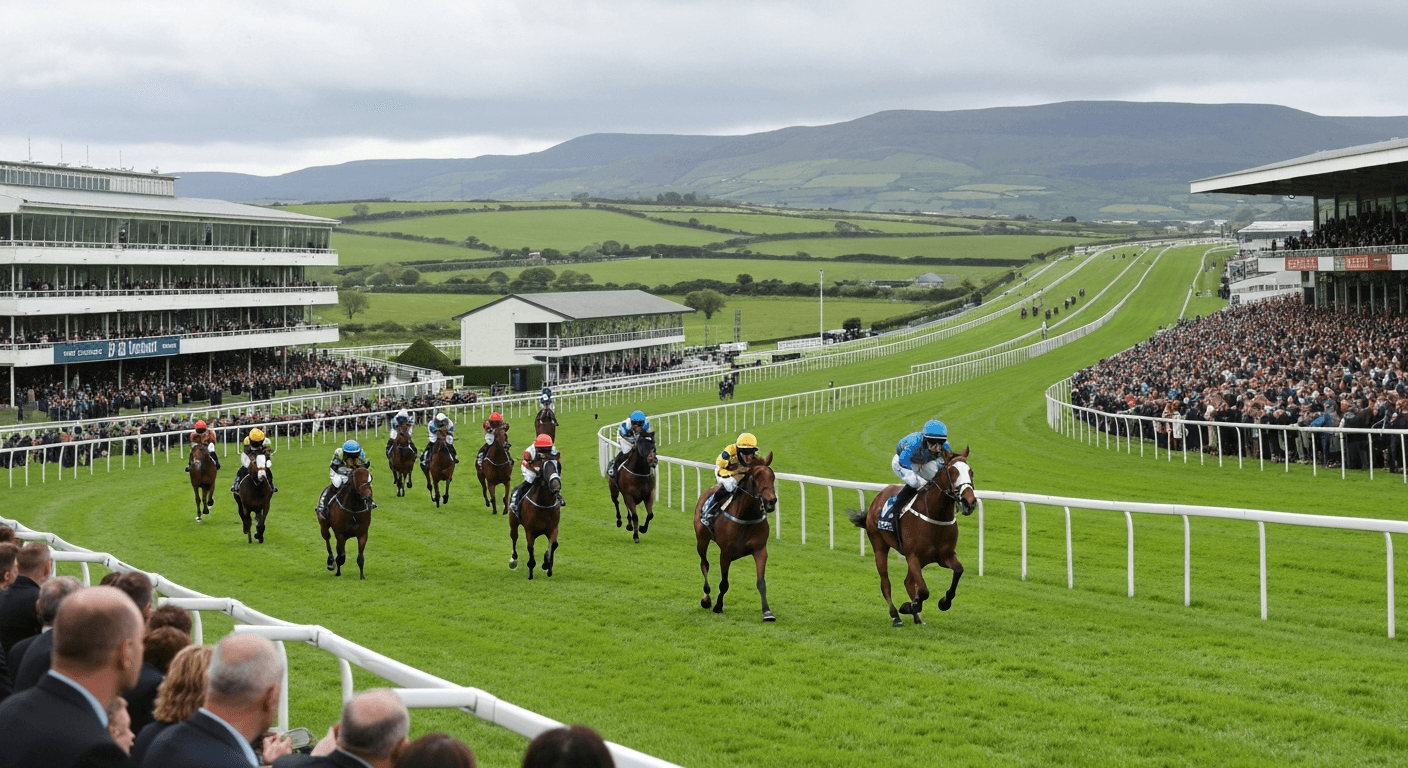
Clonmel Oil Chase Day at Clonmel: The Complete Guide
Clonmel Oil Chase Day at Powerstown Park: the Grade 2 Clonmel Oil Chase, its roll of honour, Dorans Pride's four in a row, and how to follow the day.
Read moreGamble Responsibly
Gambling should be entertaining and not seen as a way to make money. Never bet more than you can afford to lose. If you or someone you know has a gambling problem, help and support is available.