
Founder & Editor · Last reviewed 2026-07-08
Introduction
Fairyhouse Racecourse is a turf horse-racing venue in the parish of Ratoath, County Meath, in the Republic of Ireland. It is best known as the home of the Irish Grand National, run every Easter Monday, and it should not be confused with Northern Ireland courses such as Down Royal or Downpatrick. Fairyhouse sits firmly in the Republic, in Co. Meath, on the R155 regional road about 3km off the N3/M3 and roughly 23 to 25km (about 12 to 15 miles) north-west of Dublin city centre, a similar distance from Dublin Airport.
The full address is Fairyhouse Road, Ballybin, Ratoath, Co. Meath, Ireland, with Eircode A85 XK30. The course is owned by Horse Racing Ireland (HRI) and operated through its subsidiary HRI Racecourses Ltd, the arm of HRI that also runs Leopardstown, Navan and Tipperary. Fairyhouse passed into HRI hands in 2007, after the previous operator, Fairyhouse Club Ltd, ran into financial difficulty.
This is a dual-code track. National Hunt (jumps) is the primary business, run through the autumn-to-spring season, supplemented by a small number of Flat fixtures in spring and summer. The surface is turf only, with no all-weather track. Fairyhouse stages around 20 to 21 fixtures per year (sources vary between "over 20" and "approx. 21"), with August generally the only month without racing. You can read the full layout in The track and Course map.
The site's racing story runs back to 1848, when the first meeting here was a point-to-point run by the Ward Union Hunt, the historical body from which the course grew. The venue developed into a full National Hunt racecourse within a decade, and in 1870 it staged the first Irish Grand National, won by the grey gelding Sir Robert Peel for 167 sovereigns. That race quickly became Ireland's most valuable and prestigious steeplechase and, run over about 3 miles 5 furlongs and 24 fences on Easter Monday, remains the centrepiece of the course's calendar. More on the origins is in History.
Beyond the National, Fairyhouse anchors two festivals. The Easter Festival, culminating on Easter Monday, is one of the biggest crowd events in Irish racing and has long carried the nickname the "Dubs' Day Out" for the Dublin crowds it draws. The December Winter Festival, home to the Grade 1 Hatton's Grace Hurdle and Drinmore Novice Chase, now rivals Easter for quality. Both are covered in Festivals.
The remainder of this guide covers the track and racing in depth, alongside everything you need for a visit. Use the links below to jump to any section.
Where to Bet
Place your bets with a trusted, licensed bookmaker.

Promo code BETFRED50. New customers only. Register, deposit with a Debit Card, and place a first bet of £10+ at Evens (2.0)+ on Sports, to be settled within 7 days, to get £30 in Sports Free Bets and £20 in Bet Builder Free Bets within 24 hours of settlement. 7-day expiry. Eligibility & payment exclusions apply. Full T&Cs apply. Take Time to Think. BeGambleAware.org. 18+. Full T&Cs.

Promo code R30. New UK customers only, 18+. Register, deposit £10 or more, then place a £10 single cash bet at odds of 1/2 (1.5) or greater on any sports market (excluding Virtuals). Once the qualifying bet settles you get £30 in Free Bets (3 x £10) — the qualifying bet can win or lose. Free Bets are valid on any sports market excluding Virtuals, expire in 7 days, are non-withdrawable and must be used in full. Excluded deposit methods apply (including PayPal, Apple Pay, Skrill and NETELLER). Named bets such as Lucky 15 do not qualify. If you cash out the qualifying bet, or it is voided, you are no longer eligible for the offer. Ends 31.12.26. Full T&Cs apply. Please gamble responsibly. BeGambleAware.org. 18+. Full T&Cs.

Promo code BET40GET20. New UK customers, 18+. Register with the code and place a first bet of £40 or more at Evens (2.0) or greater. Receive 2 × £10 free bets: the first credited automatically once the qualifying bet settles, the second 24 hours later. Free bets must be placed at minimum odds of 4/1 (5.0), expire 24 hours after credit, and the free-bet stake is not returned with winnings. Debit card deposits only. Take Time to Think. BeGambleAware.org. 18+. T&Cs apply. Full T&Cs.

50% of your first-day net losses refunded as a free bet, capped at £25. New UK customers aged 18+ only. To qualify, deposit and place a first bet of £10 or more on any sport at minimum odds of evens (2.00), then place at least two further bets on different events, each worth at least 50% of your largest bet, all at evens (2.00) or greater. Losses are counted from your first settled bet until 23:59 the same day. Place a qualifying £10+ bet and you are guaranteed at least a £5 free bet. Bets placed at SP, void bets, cashed-out bets and bets struck with free bets do not count towards the offer. The free bet is credited the day after your qualifying bets settle and must be used within 7 days, after which it expires. It can be used at odds from 1/4 (1.25) up to 250/1 on singles and straight accumulators, but not on Trixie, Patent or Yankee style multiples. Free-bet stake is not returned with winnings. One offer per person, household, address, IP address and device. E-wallet deposits may not qualify, so check the cashier before depositing. Customers registered with GAMSTOP cannot claim. KYC identity verification must be completed before the free bet is credited. Take Time to Think. BeGambleAware.org. 18+. T&Cs apply. Full T&Cs.

New customers, 18+. Choose the sports bonus at sign-up, make a first deposit and receive a 100% bonus up to £50 in your Sports Bonus balance. To convert the bonus to cash, wager it 10x within 30 days. Single bets below Evens (2.00) do not qualify; accumulators do not qualify if any selection is below 1/2 (1.50). Virtual Sports, voided, cancelled, drawn, cashed-out and free-bet wagers do not count towards wagering. Only the first settled bet per event counts. Withdrawing before the wagering requirement is met forfeits the bonus balance including bonus winnings. Real-money funds are used before bonus funds. Deposits via Skrill or Neteller are not eligible. Not valid in conjunction with other promotions. Odds, bet and payment limits apply. 10bet general and promotion T&Cs apply. BeGambleAware.org. 18+. Full T&Cs.

New customers in Great Britain and Republic of Ireland, 18+. Place a £10 fixed-odds qualifying bet at minimum odds of 1/2 (1.50) — single or each-way (only the win part counts), pre-event or in-play, not cashed out early, within 28 days of opening the account. Receive up to £60 in bonuses credited over three days: 3 × £10 fixed-odds free bets (the first on settlement, then 24 and 48 hours later) plus 3 × £5 Total Goals FOOTBALL spread bets, 3 × £5 racing Winning Favourites spread bets and a £1 racing Race Index spread bet (the spread bets need a full spread-betting account). Free-bet stakes not returned with winnings; free bets valid 28 days from issue. IMPORTANT: the £5 credits are SPREAD bets — sports spread betting carries the risk that losses can exceed your stake. Sports spread-betting customers do not have Financial Ombudsman or FSCS recourse. Take Time to Think. BeGambleAware.org. 18+. T&Cs apply. Full T&Cs.

Promo code WELCOME15, entered under My Bonuses after registering. New UK customers, 18+. Place a first qualifying bet of at least £10 from your cash balance at odds of evens (2.0) or greater within 7 days of opening the account. Once the qualifying bet fully settles you receive £15 in free bets, credited as 3 x £5 tokens with set uses: one £5 accumulator free bet (minimum 4 legs, each leg at 2/5 or bigger), one £5 sports free bet (any market at evens or bigger) and one £5 Sub Cover free bet (selected football player markets at evens or bigger). Free-bet stakes are not returned with winnings. Free bets expire 7 days after they are credited. Void, cashed-out and partially cashed-out bets do not qualify. One offer per customer. Confirm the current terms on BetGoodwin's own welcome-offer page before claiming. Take Time to Think. BeGambleAware.org. 18+. T&Cs apply. Full T&Cs.

New UK customers, 18+. Minimum deposit £10. Place a £10 qualifying single at minimum odds of 1/2 (1.50), settled within 14 days. Receive £30 in free bets (stake not returned), split £20 for sportsbook use (2 x £10) and £10 for Bet Builder only (2 x £5); Bet Builder does not cover horse racing. Free bets must be accepted within 7 days and expire 7 days after acceptance. No promo code required. Best Odds Guaranteed on UK & Irish racing, subject to having staked over £25 in the previous seven days. Operated by LiveScore Betting and Gaming (Gibraltar) Ltd, UKGC 56859. Confirm the current terms on LiveScore Bet's own promotions page before claiming. Take Time to Think. BeGambleAware.org. 18+. T&Cs apply. Full T&Cs.
18+. BeGambleAware.org
The Track
The Track
Fairyhouse is a right-handed, turf-only circuit in Ratoath, County Meath, and one of the widest galloping tracks in Ireland. There is no all-weather surface here; every fixture, jumps or Flat, is run on grass. Picture the layout as a broad, roughly square or oblong loop of about a mile and three-quarters, run clockwise, with a steady rise on the far side, a descent down the back straight, and a slightly uphill run to the line. It is the sort of track that rewards a strong-travelling, relentless galloper.
Shape, size and the wide ground
The rules circuit measures about 1 mile 6 furlongs a lap. Several sources give the figure more precisely as 1m 6½f, and Horse Racing Ireland and the course itself describe "one mile and six furlong"; the common shorthand is "about a mile and three-quarters" round. What sets Fairyhouse apart is not the length but the width. The running rail sits on a track around 200 yards wide, which lets the groundstaff move the rails and present fresh, unraced ground for each day of a multi-day festival. That is a real advantage over the big spring and winter meetings, when three cards in a weekend would otherwise chew up the same strip of turf.
The circuit is genuinely undulating rather than flat. From the stands the track climbs steadily on the far side to its highest point, a rise known as Ballyhack, before dropping away down the back straight and rising again for the finish. The home straight is about 2½ to 3 furlongs and is slightly uphill, so horses are asked a stamina question right at the end. For how this plays out race by race, see The Races; for a plan of the loop, the obstacles and the enclosures, see Course Map.
The run-in (as reported)
The length of the run-in from the final fence is one point on which the sources genuinely disagree, so we report it as reported rather than pick a winner. One account describes a relatively short run-in of about a furlong, the implication being that a horse does not want to be too far back at the last despite the climb to the line. Another records irishracing.com giving "almost 3 furlongs" while At The Races gives "around a furlong." Those are very different pictures of the closing stages, and no single authoritative figure reconciles them, so treat the run-in as somewhere in that reported range rather than a settled number.
Fences and hurdles (as reported)
Fairyhouse runs two obstacle courses: an outer chase course and an inner hurdle course. The chase fences are widely rated among the stiffest and fairest in Ireland, a stern test for novices and for chancy jumpers, and accurate jumping counts for a lot here. On the number of obstacles the sources again split, and we report the counts as reported:
- Chase course: most guides (irishracing.com, At The Races and gg.co.uk) give eleven fences to a circuit; one source (racingsight.co.uk) gives twelve.
- Hurdle (inner) course: one source gives seven flights to a circuit, another gives eight. This is unresolved.
Two race-specific figures are firmer and worth holding onto. The Hatton's Grace Hurdle over 2m4f is run over 12 hurdles, and the Irish Grand National, over about 3m5f, is two full circuits taking in 24 fences. Those are the fixed obstacle counts for the two feature races even where the per-circuit totals are disputed.
Point-to-point course
Sitting inside the rules track is a separate point-to-point course. It is just over a mile round, has five fences, and is sharper than the main circuit. It is a nod to the venue's roots: Fairyhouse grew from a Ward Union Hunt point-to-point first run on the site in 1848, the hunt held fixtures here for decades, the last Ward Union meeting was in 1995, and point-to-pointing returned in 2014.
How the track rides
Over jumps, Fairyhouse has a reputation as a fair, galloping track with few hard-luck stories; the course guides repeatedly note you can come from any position. Front-runners nonetheless hold a solid record in the big-field handicap chases, and stamina and clean jumping are always at a premium on those stiff fences. On the Flat, the short run-in after the final bend favours prominently ridden horses. There is no strong overall draw bias and no 5f races are staged; over 6f and 7f a low or inside draw is generally seen as a slight advantage, though analysts stress that a fast break matters more than the number, and a slow-starting hold-up horse drawn low can be trapped on the rail. None of that should be read as a betting edge; running-style and draw notes describe past patterns, not profitable angles, and are covered in Form and Betting.
Ground
Because the track can be heavily affected by wet weather, the National Hunt winter and Easter meetings frequently ride soft or heavy, and going through the season is predominantly soft to yielding. On the worst days the course protects itself: for the officially heavy 2024 Easter Festival it cut maximum fields in non-graded races from 25 to 20 to spare the ground for the feature races. The 2026 Irish Grand National was run on yielding to soft. Selective watering is used only for the small number of summer Flat fixtures. Wet weather has historically caused abandonments, so festival plans are always weather-dependent.
Track at a glance
| Feature | Detail (as reported) |
|---|---|
| Orientation | Right-handed (clockwise), turf only, no all-weather |
| Shape | Broad square/oblong loop, wide and galloping |
| Circuit length | About 1m 6f (some sources 1m 6½f) |
| Track width | About 200 yards (fresh ground each festival day) |
| Home straight | About 2½ to 3 furlongs, slightly uphill |
| Run-in from last | Conflicting: about a furlong, versus almost three furlongs (irishracing.com) |
| Chase fences per circuit | Eleven (most sources); twelve (racingsight.co.uk) |
| Hurdle flights per circuit | Seven or eight (sources conflict) |
| Highest point | Ballyhack, on the far side |
| Point-to-point course | Inner, just over 1 mile, five fences, sharper than the main track |
| Irish Grand National | About 3m5f, two circuits, 24 fences |
| Hatton's Grace Hurdle | 2m4f over 12 hurdles |
| Typical going (NH season) | Predominantly soft to yielding; can ride heavy |
The Course Map
Course map and layout
Fairyhouse is laid out as one broadly square, oblong circuit of about 1 mile 6 furlongs, run right-handed (clockwise), with the enclosures, grandstands and parade ring gathered along the home side and the racing loop stretching out in front of them. The track is wide, roughly 200 yards across, which lets the groundstaff move the running rail day to day and present fresh ground for each afternoon of a multi-day festival. For a fuller read on the shape of the loop, its undulations and the going, see the track.
Standing in the enclosure, you look out across the parade ring to the racing surface, with the winning post set on the home straight to your right as the field turns for home. That home straight runs about 2½ to 3 furlongs and climbs slightly all the way to the line, so the finish is uphill. How much ground is left after the final obstacle is one of the course's genuinely disputed measurements: some sources put the run-in from the last fence at little more than a furlong, while irishracing.com records almost 3 furlongs. Because that gap is unresolved in the research, treat any single run-in figure with caution rather than as settled fact.
The two grandstands anchor the layout. The Powers Gold Label Stand and the Jameson Stand, both delivered in the 1999 redevelopment, are today branded as the Grand National Stand and the Ballyhack Stand, with private suites sitting at the top of each. General admission covers the enclosure and both stands, giving most racegoers a clear view down onto the parade ring and across to the finish. The Bobbyjo Bistro overlooks the parade ring from the first floor of the grandstand, and the Suite Level Restaurant looks straight down the finish line from the second floor. The enclosures, stands and the viewing they offer are covered in detail in enclosures and stands.
Two obstacle courses share the circuit. The chase course carries eleven fences to a lap on most guides (a single source says twelve) and is rated among the stiffer, fairer tests in Ireland. The inner hurdle track is described as having seven flights per lap in one run and eight in the other, so the exact flight count is not firmly established. Inside both sits a separate point-to-point course, just over a mile round with five fences, sharper than the rules track. The Irish Grand National covers two full circuits and 24 fences.
Immediately adjacent, on the same Fairyhouse Road and under its own Eircode (A85 VY48), stands the Tattersalls Ireland bloodstock sales complex, a leading Flat and National Hunt auction venue that shares the site's setting in the Meath countryside north-west of Dublin. Getting to the course itself is covered in getting there.
The Races
The Races
Fairyhouse is a dual-code course, but its reputation rests almost entirely on jumping. One handicap chase towers over the calendar, the Irish Grand National, run every Easter Monday and the reason tens of thousands make the trip out to Ratoath. Around it sits a serious body of Graded action: Grade 1 features at the late-November Winter Festival, two more Grade 1s on Easter Sunday, and a single Flat Group race in high summer. This section covers the marquee contests and their rolls of honour. For where these races sit across the season, see Signature festivals and meetings; for the trends behind the betting, see Form and betting.
The headline races at a glance:
| Race | Code | Distance | Age | When |
|---|---|---|---|---|
| Irish Grand National | Premier handicap chase (Grade A) | 3m5f, 24 fences | 5yo+ | Easter Monday |
| Hatton's Grace Hurdle | Grade 1 hurdle | 2m4f, 12 hurdles | 4yo+ | Winter Festival (Sun) |
| Drinmore Novice Chase | Grade 1 novice chase | 2m4f, 16 fences | 4yo+ | Winter Festival (Sun) |
| Royal Bond Novice Hurdle | Grade 2 novice hurdle | c.2m | 4yo+ | Winter Festival (Sun) |
| Brownstown Stakes | Flat Group 3 (fillies and mares) | 7f | 3yo+ | Late Jun / early Jul |
The Irish Grand National
The Irish Grand National is Ireland's most valuable and most prestigious steeplechase, and the centrepiece of the Easter Festival. It is a premier handicap (a Grade A handicap, sometimes tagged Grade 3 in the international Pattern), not a Graded or Pattern race in the Group sense. It is run over about 3 miles 5 furlongs (5,834 metres) and 24 fences, for horses aged five and older, and is capped at a maximum of 30 runners. First run in 1870, when the grey gelding Sir Robert Peel won for connections who received 167 sovereigns, the distance was 3m4f until 1991, when it lengthened to 3m5f. The race was not run in 1919 (War of Independence), 1941 (foot-and-mouth) or 2020 (COVID-19).
BoyleSports has sponsored the race since 2014; before that it ran under Irish Distillers whiskey brands (Powers, Jameson) up to 2010, then Ladbrokes from 2011 to 2013. The total fund was nearly doubled to around €500,000 in 2017 and stood at €500,000 for the 2026 running. The winner's exact share varies by year and by source (the 2025 entries release cited €270,000, and HRI's official 2026 Facts sheet gives €275,000), so we do not assert a single figure across years.
The 2026 running went to Soldier In Milan, a 6/1 favourite, who won by 16 lengths for trainer Emmet Mullins and jockey Donagh Meyler, leading from the back straight after long-time leader Monbeg Genius weakened. It was just the seven-year-old's fifth start under rules, gave owner Paul Byrne his first-ever runner in the race, and a first Irish Grand National for Emmet Mullins. Showurappreciation was second and The Enabler third.
Recent winners:
| Year | Winner | SP | Jockey | Trainer |
|---|---|---|---|---|
| 2026 | Soldier In Milan | 6/1 fav | Donagh Meyler | Emmet Mullins |
| 2025 | Haiti Couleurs | 13/2 | Sean Bowen | Rebecca Curtis |
| 2024 | Intense Raffles | 13/2 | J. J. Slevin | Thomas Gibney |
| 2023 | I Am Maximus | 8/1 | Paul Townend | Willie Mullins |
| 2022 | Lord Lariat | 40/1 | P. J. O'Hanlon | Dermot A. McLoughlin |
| 2021 | Freewheelin Dylan | 150/1 | Ricky Doyle | Dermot A. McLoughlin |
| 2020 | No race (COVID-19) | n/a | n/a | n/a |
| 2019 | Burrows Saint | 6/1 fav | Ruby Walsh | Willie Mullins |
| 2018 | General Principle | 20/1 | J. J. Slevin | Gordon Elliott |
| 2017 | Our Duke | 9/2 fav | Robbie Power | Jessica Harrington |
Freewheelin Dylan's 150/1 win in 2021, run behind closed doors, remains the longest-priced success in the race's history.
The history runs deep. Arkle won in 1964 carrying 12st (12-0) under Pat Taaffe for Tom Dreaper; his stablemate Flyingbolt followed in 1966. Brown Lad is the only three-time winner (1975, 1976, 1978), carrying 12st 2lb, and the most successful horse in the race's history. Desert Orchid carried top weight to victory in 1990. Bobbyjo (1998) and Numbersixvalverde (2005) both went on to win at Aintree. Ann Ferris (Bentom Boy, 1984) was the first woman to ride the winner, followed by Nina Carberry (Organisedconfusion, 2011) and Katie Walsh (Thunder And Roses, 2015). General Principle won in 2018 for Gordon Elliott; note that the source material carries an unresolved internal inconsistency over Tiger Roll's Irish Grand National year(s), so we do not assert Tiger Roll as a winner here.
Tom Dreaper is the leading trainer with 10 wins, including seven in a row from 1960 to 1966; his son Jim Dreaper added four, so father and son trained 14 winners between them. Pat Taaffe is the leading rider with six. Willie Mullins (Burrows Saint 2019, I Am Maximus 2023) and Gordon Elliott are the modern powers.
The Winter Festival Grade 1s
The Winter Festival is a two-day meeting in late November, with the Grade 1 action on the Sunday. It is Ireland's premier pre-Christmas jumps card and a key trial stage for Cheltenham, Punchestown and Aintree. Three feature races headline the Sunday, sponsored by BAR 1 Betting.
Hatton's Grace Hurdle (Grade 1). About 2m4f over 12 hurdles, for horses aged four and older, established in 1994 and Grade 1 throughout. It is named after the three-time Champion Hurdle winner trained by Vincent O'Brien, and it regularly funnels winners on to Champion or Stayers' Hurdle glory at Cheltenham. The total fund was around €120,000 in 2025, with €72,000 to the winner. Teahupoo beat Ballyburn by a nose in 2025 to become the fifth three-time winner, after Limestone Lad, Solerina, Apple's Jade and Honeysuckle. Jack Kennedy is the leading rider with five; James Bowe and Gordon Elliott share the trainer lead on six.
| Year | Winner | SP | Jockey | Trainer |
|---|---|---|---|---|
| 2025 | Teahupoo | evens fav | Jack Kennedy | Gordon Elliott |
| 2024 | Lossiemouth | n/a | Paul Townend | Willie Mullins |
| 2023 | Teahupoo | n/a | Jack Kennedy | Gordon Elliott |
| 2022 | Teahupoo | 20/1 | Jack Kennedy | Gordon Elliott |
| 2021 | Honeysuckle | n/a | Rachael Blackmore | Henry de Bromhead |
| 2020 | Honeysuckle | n/a | Rachael Blackmore | Henry de Bromhead |
Drinmore Novice Chase (Grade 1). A novice chase over about 2m4f and 16 fences, for horses aged four and older, first run in its present Grade 1 form in 1994. The prize fund is around €120,000. It has launched top-class chasers including Don Cossack (2013), later a Cheltenham Gold Cup winner. Gordon Elliott is the record-holder with nine wins; Jack Kennedy leads the jockeys with three. Romeo Coolio's eight-length win in 2025 brought up 50 Grade 1 wins for Kennedy.
| Year | Winner | SP | Jockey | Trainer |
|---|---|---|---|---|
| 2025 | Romeo Coolio | 8/15 fav | Jack Kennedy | Gordon Elliott |
| 2024 | Croke Park | 22/1 | Sam Ewing | Gordon Elliott |
| 2023 | I Am Maximus | 11/1 | Jody McGarvey | Willie Mullins |
| 2022 | Mighty Potter | 3/1 | Jack Kennedy | Gordon Elliott |
| 2021 | Beacon Edge | 7/2 | D. F. O'Regan | Noel Meade |
| 2020 | Envoi Allen | 2/11 fav | Jack Kennedy | Gordon Elliott |
Royal Bond Novice Hurdle (now Grade 2). A novice hurdle over about 2 miles, for horses aged four and older, established in 1994 and named after the Arthur Moore-trained Royal Bond. Important to note: it held Grade 1 status from 1994 until 2023, when it was downgraded to Grade 2 in an HRI jumps-programme revamp, so it is no longer one of the course's Grade 1s. Its roll of honour includes Istabraq, Hurricane Fly (2008) and Marine Nationale (2022). Willie Mullins is the leading trainer with nine wins; Danny Mullins is the leading recent rider with four.
| Year | Winner | SP | Jockey | Trainer |
|---|---|---|---|---|
| 2025 | Koktail Brut | 8/13 | Jack Kennedy | Gordon Elliott |
| 2024 | Tounsivator | n/a | Danny Mullins | Willie Mullins |
| 2023 | Farren Glory | n/a | Jack Kennedy | Gordon Elliott |
| 2022 | Marine Nationale | 11/2 | Michael O'Sullivan | Barry Connell |
| 2021 | Statuaire | n/a | Danny Mullins | Willie Mullins |
| 2020 | Ballyadam | n/a | Jack Kennedy | Gordon Elliott |
Easter Sunday adds two further Grade 1s, the WillowWarm Gold Cup (a 2m4f novice chase) and the Irish Stallion Farms EBF Mares Novice Hurdle, renamed in honour of Honeysuckle; both are covered under Signature festivals and meetings.
The Flat: Brownstown Stakes
Fairyhouse is chiefly a jumps venue, but it stages one Flat Group race a year. The Brownstown Stakes is a Group 3 over 7 furlongs for fillies and mares aged three and older, run in late June or early July. It was promoted to Group 3 and cut to 7f in 2003, and moved from Leopardstown to Fairyhouse in 2009. Past winners include the subsequent Group 1 winners Emulous and Fiesolana. It is supported on the summer Flat cards by Listed contests including the Belgrave Stakes and the Ballyhane Blenheim Stakes, though the exact black-type roster shifts year to year.
A closing honesty note that applies across every race above: over time, backing favourites loses money to starting price, and no bet type, selection method or favourite is profitable as a rule. The Irish Grand National in particular is a low-strike-rate race for market leaders, with only about three winning favourites in the 22 renewals before 2026. Read Form and betting for the observed trends, presented as history rather than advice.
Records and Stats
Records and stats
Fairyhouse is a place where the numbers come with an honest health warning. Unlike some tracks, it keeps no published all-time "course record" board, so the figures below are a mix of verified attendance data, leading-connection tallies and single-race times, each labelled for what it is.
Course records and standard times
There is no authoritative, published course-record board at Fairyhouse, and no curated all-time fastest-time standard was located for the course or for any individual distance. Standard times, in the formal sense, are effectively unpublished here. Winning times are reported race by race by the Racing Post, Sporting Life and others, but a single renewal on a given day's ground is not a record.
Two recent times give a sense of scale on testing ground rather than any benchmark. The 2025 Irish Grand National (Haiti Couleurs) was run in 8 minutes 11.80 seconds, per Horse Racing Ireland's official Irish Grand National Facts 2026, and the 2026 Bobbyjo Chase (3m2f, heavy) in 7 minutes 25.80 seconds. Because the National's distance changed from 3m4f to 3m5f in 1991, and because times swing wildly with the going, cross-era comparison is not meaningful. Treat anything presented elsewhere as a Fairyhouse "course record" with caution.
Attendance and crowds
The Easter Festival, culminating in the Irish Grand National on Easter Monday, is one of the biggest crowd events in Irish racing, long nicknamed the "Dubs' Day Out."
| Metric | Figure | Source note |
|---|---|---|
| Irish Grand National day crowd, 2026 | 18,753 | HRI press office |
| Three-day Easter Festival total, 2026 | 34,985 | HRI press office |
| Irish Grand National peak TV audience, 2025 | 333,000 (RTÉ) | HRI Irish GN Facts 2026 |
| Comfortable capacity | approx. 16,000 | Aggregator figure (secondary), not course-published |
The capacity figure comes from a single aggregator listing rather than a course-published number, so it is best read as an estimate. Specific verified single-day and festival-total attendance records for years before 2026 were not located, so no historical peak is claimed here. For the festival context behind these crowds, see Signature festivals and meetings.
Leading connections in the feature races
The record books at Fairyhouse are dominated by two modern powerhouses at the Winter Festival and by long-standing families in the Irish Grand National.
| Race | Category | Leader | Tally |
|---|---|---|---|
| Irish Grand National | Trainer | Tom Dreaper | 10 wins |
| Irish Grand National | Jockey | Pat Taaffe | 6 wins |
| Irish Grand National | Most wins by a horse | Brown Lad (1975, 1976, 1978) | 3 wins |
| Drinmore Novice Chase | Trainer | Gordon Elliott | 9 wins |
| Hatton's Grace Hurdle | Jockey | Jack Kennedy | 5 wins |
| Hatton's Grace Hurdle | Trainer | James Bowe / Gordon Elliott | 6 wins each |
| Royal Bond Novice Hurdle | Trainer | Willie Mullins | 9 wins |
| WillowWarm Gold Cup | Trainer | Willie Mullins | 6 of 7 to 2025 |
Tom Dreaper's National haul included seven in a row from 1960 to 1966; his son Jim added four more, so father and son trained 14 Irish Grand National winners between them. At the Winter Festival, Gordon Elliott's nine Drinmores run from Jessies Dream (2010) to Romeo Coolio (2025), while Willie Mullins holds nine Royal Bonds. Jack Kennedy is the standout Winter Festival rider, with five Hatton's Grace wins and three Drinmores.
Notable extremes
- Longest-priced National winner: Freewheelin Dylan at 150/1 in 2021, run behind closed doors, remains the longest-priced winner in the race's history.
- Weight-carrying feats: Brown Lad carried 12st 2lb to victory; Arkle carried 12st in 1964; Flashing Steel (1995) was the last top-weight winner, also under 12st.
- Field attrition: The National is capped at 30 runners and regularly fills it; in 2025 only 15 of the 30 completed on soft-to-heavy ground.
- Founding value: The inaugural 1870 winner, Sir Robert Peel, earned his connections 167 sovereigns; the fund reached around €500,000 by 2026.
For how these patterns feed into course-and-distance analysis, see Form and betting. None of the above implies any bet type or selection is profitable; over time, backing favourites loses money to starting price, and the National is a notably low-strike-rate race for the market leader.
History
History
Fairyhouse traces its racing back to 1848, and that founding year still appears in the course's modern branding. The first meeting on the present site in the parish of Ratoath, County Meath, was not a race under Rules at all but a point-to-point run by the Ward Union Hunt. According to the research, the gentlemen of the Ward Union Hunt transferred their fixture from nearby Ashbourne to the site, having recognised its potential. The move proved shrewd: within a few years the meeting was attracting large fields and crowds, and within a decade the venue had grown from a hunt point-to-point into a full National Hunt racecourse. For much of its later life the course kept those roots alive, hosting Fingal and Ward Union point-to-points for decades, with the last Ward Union fixture staged there in 1995. Point-to-pointing returned to the venue in 2014.
The first Irish Grand National, 1870
Fairyhouse's defining moment came in 1870, when the course staged the inaugural Irish Grand National. The first running was won by a grey gelding named Sir Robert Peel, whose connections collected 167 sovereigns. The race quickly established itself as Ireland's most valuable and prestigious steeplechase, a position it has never surrendered. In the early decades it was frequently won by Curragh-trained horses, with ten such winners recorded by 1882. The wider Irish steeplechasing tradition had roots at the Curragh before settling at Fairyhouse, and the Irish National Hunt Steeplechase Committee that helped codify the sport was formed a year before the first National, in 1869. From the outset the Easter Monday running drew large Dublin crowds, and over time it earned its enduring nickname, the "Dubs' Day Out". You can read more about the race itself in the-races.
Great names and the Dreaper era
Fairyhouse's history is inseparable from a handful of extraordinary horses and horsemen. In 1929 Alike won the National under Frank Wise, a remarkable rider who had lost three fingers and rode with a wooden leg, beating a field of 65 rivals. The middle of the twentieth century belonged to trainer Tom Dreaper, whose stable took ten Irish Grand Nationals between 1942 and 1966, including seven in a row. Dreaper's roll of honour reads like a history of Irish jumping in itself, from Prince Regent in 1942 through to Arkle, who carried twelve stone to victory in 1964. Much of that success came in partnership with jockey Pat Taaffe, the race's most successful rider with six wins. The course honours this heritage directly: the wind vane above the entrance depicts Arkle. More on these horses appears in legends.
Ownership and modernisation
For much of the modern era the racecourse was owned and operated by Fairyhouse Club Ltd. In 2007, after the operator ran into financial difficulty, the course passed to Horse Racing Ireland, the state body that also runs Leopardstown, Navan and Tipperary, and it is now operated through HRI Racecourses Ltd. The transfer brought Fairyhouse firmly into public hands and aligned it with a group of the country's leading tracks.
The most significant physical modernisation of recent decades came in 1999, when the Powers Gold Label Stand was newly built and the Jameson Stand was refurbished and reopened. HRI describes this as a key modernisation of the venue. Track foreman Noel Fanning recalled the new stands as "a huge, great, adjustment to Fairyhouse". The exact capital cost of the 1999 project could not be verified against an authoritative source, so no figure is given here; briefs that refer to a redevelopment "around 2000" appear to describe the same 1999 work rather than a separate scheme. No major grandstand rebuild specific to Fairyhouse was identified across the 2010s and 2020s. In May 2024 HRI launched a sector-wide, roughly one-million-euro Equine Care Racecourse Capital Development Scheme covering safety items such as white obstacle markers and non-birch hurdles across Irish jumps tracks, but that was an industry programme rather than a Fairyhouse grandstand project.
Away from racing, the site has hosted other events over the years. Between 2000 and 2002 it staged the Witnness music festival for three consecutive years, alongside regular markets and other gatherings, underlining its role as a large open venue on the edge of Dublin.
Two festivals, one heritage
A further landmark came in 2017, when the Irish Grand National prize fund was nearly doubled to around 500,000 euro, confirming the race's standing at the top of the Irish jumps calendar. Over the same period the December Winter Festival, built around the Grade 1 Hatton's Grace Hurdle and Drinmore Novice Chase, grew in quality until it now rivals Easter for the strength of its racing. Taken together, the two festivals give Fairyhouse two anchor points in the season, one at the heart of winter and one at Easter, both descended in an unbroken line from that first Ward Union point-to-point in 1848. The story of those meetings continues in festivals.
The Legends
Legends of Fairyhouse
Fairyhouse has been the stage for some of the greatest names in Irish jump racing, and the roll of honour reads like a history of the sport itself. The course's own wind vane above the entrance depicts Arkle, and it is a fitting choice. Widely regarded as the greatest steeplechaser of all time and the highest-rated chaser Timeform has ever assessed, Arkle won the Irish Grand National in 1964, carrying 12st (12-0) under Pat Taaffe for trainer Tom Dreaper. He had already taken the 1963 Power's Gold Cup here, the race now run as the WillowWarm Gold Cup, on his way to three Cheltenham Gold Cups. His stablemate Flyingbolt, rated by Timeform as the second-best chaser of all time, won the 1966 Irish National for the same Dreaper and Taaffe partnership.
The Dreaper family, from their nearby yard, dominated the Irish Grand National like no other. Tom Dreaper trained ten winners, including seven in a row from 1960 to 1966, a run that took in Prince Regent (1942, later the 1946 Cheltenham Gold Cup winner) as well as Arkle and Flyingbolt. His son Jim added four more, three of them with Brown Lad. Between father and son they trained fourteen Irish Grand National winners. Pat Taaffe remains the race's leading jockey with six victories and is forever linked with Arkle.
Brown Lad is the true Fairyhouse course specialist. He is the only three-time winner of the Irish Grand National, taking it in 1975, 1976 and 1978 for Jim Dreaper and carrying 12st 2lb, which makes him the most successful horse in the race's long history. He is celebrated at courses across Ireland, though it is worth clearing up a common confusion: the Brown Lad Handicap Hurdle named in his honour is run at Naas in November, not at Fairyhouse, so do not look for it on the Easter Festival card.
Fairyhouse has also been a launchpad for Aintree glory. Rhyme 'n' Reason won the 1985 Irish National before landing the 1988 Aintree Grand National. Bobbyjo, trained by Tommy Carberry and ridden by his son Paul, won here in 1998 and at Aintree in 1999; the Bobbyjo Bistro and the February Bobbyjo Chase both carry his name. Numbersixvalverde followed the same path, winning at Fairyhouse in 2005 and Aintree in 2006, and in the modern era I Am Maximus took the 2023 Irish National for Willie Mullins before winning at Aintree in 2024. The grey Desert Orchid produced one of the race's most memorable performances, carrying top weight to victory in 1990 under Richard Dunwoody. For the neighbouring festivals these names sit alongside, see the festivals section; for the wider list of records they set, see records and stats.
The hurdling greats are just as storied. The Hatton's Grace Hurdle is named after Hatton's Grace, the triple Champion Hurdle winner trained by Vincent O'Brien, and its winners have gone on to define generations. Istabraq won it in 1997 and 1998 for Aidan O'Brien en route to three Champion Hurdles, and Hurricane Fly followed in 2010 for Willie Mullins. Apple's Jade took three in a row from 2016 to 2018 for Gordon Elliott, and Honeysuckle matched that from 2019 to 2021 for Henry de Bromhead. Teahupoo then won three renewals of his own, in 2022, 2023 and 2025 for Elliott and Jack Kennedy.
No account of Fairyhouse's legends is complete without Rachael Blackmore, who retired on 12 May 2025 with 575 career winners. She was the first woman to win the Aintree Grand National, in 2021, and the first to win the Cheltenham Gold Cup, in 2022. Fairyhouse holds a special place in her story: her first Grade 1 win in Ireland came here, on Honeysuckle in the Mares Novice Hurdle on Easter Sunday, 21 April 2019. Together she and Honeysuckle also won those three straight Hatton's Grace Hurdles, and the Easter Sunday mares' Grade 1 is now named in Honeysuckle's honour. The families of Irish racing, the Carberrys, the Walshes and the Geraghtys, are woven through the National's history, and the modern era belongs to Willie Mullins and Gordon Elliott, whose horses dominate both festivals. It is a lineage of champions that few courses anywhere can match.
The Festivals
Festivals: Easter and Winter
Fairyhouse's calendar of roughly 20 to 21 fixtures builds towards two showpiece meetings that between them carry most of the course's Grade 1 racing: the Easter Festival, crowned by the Irish Grand National on Easter Monday, and the late-November Winter Festival. Together they draw the biggest crowds and the best jumpers in Ireland, with quality horses often arriving off the back of, or on their way to, Cheltenham, Aintree and Punchestown. For a race-by-race look at the individual contests, see the races; for the running-style and going patterns that shape them, see form and betting.
The Easter Festival
The BoyleSports Irish Grand National Festival is a three-day Easter bank-holiday meeting and one of the biggest crowd events in Irish racing, long nicknamed the "Dubs' Day Out" for the Dublin crowds it pulls. In 2026 it ran Saturday 4 to Monday 6 April, with over €1.25 million in prize money across the three days. For 2027, fairyhouse.ie lists the festival as Saturday 27 to Monday 29 March 2027.
- Day 1, Style Day / Ladies Day (Saturday): style awards, prizes and live music open the festival. Dressing up is encouraged, though there is no strict dress code across the general enclosures.
- Day 2, Gold Cup and Family Fun Day (Easter Sunday): two Grade 1s headline, the WillowWarm Gold Cup (a novice chase over about 2m4f) and the Irish Stallion Farms EBF (Honeysuckle) Mares Novice Hurdle, alongside a €100,000 Tattersalls bumper. Free children's entertainment includes an Easter bonnet competition.
- Day 3, Irish Grand National Day (Easter Monday): the €500,000 Irish Grand National, run over about 3 miles 5 furlongs and 24 fences for horses aged five and older, with a scheduled off-time around 5pm. The 2026 running drew a crowd of 18,753 (HRI press office), part of a three-day festival total of 34,985.
The 2026 Irish Grand National went to Soldier In Milan (6/1 favourite, Emmet Mullins/Donagh Meyler), who led from the back straight to win by 16 lengths; the 2025 winner was Haiti Couleurs (13/2). The "Dunboyne Castle & Spa Most Stylish Lady" competition runs on Irish Grand National day, and the festival carries live music across all three afternoons.
The Winter Festival
The Fairyhouse Winter Festival is a two-day meeting in late November, sponsored by BAR 1 Betting (formerly Bar One Racing, whose association with the course dates to 2006). It is widely regarded as Ireland's premier pre-Christmas jumps meeting and a key trial stage for the spring festivals. The 2025 renewal ran Saturday 29 to Sunday 30 November 2025; the 2026 dates are Saturday 28 to Sunday 29 November 2026.
- Saturday: the supporting card features the Grade 3 Mullinam Hurdle and a Listed contest, worth about €173,000 on the day.
- Sunday (feature day): the meeting's three headline races. Two are Grade 1, the Hatton's Grace Hurdle (about 2m4f, over 4yo+) and the Drinmore Novice Chase (about 2m4f, 16 fences). The Royal Bond Novice Hurdle (about 2 miles) was a Grade 1 from its establishment in 1994 until it was downgraded to Grade 2 in a 2023 HRI programme revamp. Alongside a Listed handicap hurdle, the Sunday card is worth close to €500,000.
The Winter Festival Grade 1s are dominated by two yards. Gordon Elliott is the record-holder in both the Drinmore (nine wins) and the Hatton's Grace (six), while Willie Mullins leads the Royal Bond roll of honour with nine wins. Jack Kennedy is the standout Winter Festival rider, with five Hatton's Grace and three Drinmore victories. Recent Hatton's Grace history has been shaped by serial winners: Apple's Jade (2016 to 2018), Honeysuckle (2019 to 2021) and Teahupoo (2022, 2023 and 2025). Live music plays in the festival marquee after racing.
At a glance
| Feature | Easter Festival | Winter Festival |
|---|---|---|
| Sponsor | BoyleSports | BAR 1 Betting |
| Length | 3 days (Sat to Easter Mon) | 2 days (Sat and Sun) |
| 2026 dates | Sat 4 to Mon 6 April | Sat 28 to Sun 29 November |
| 2027 dates | Sat 27 to Mon 29 March | n/a |
| Feature race | Irish Grand National (Easter Monday) | Sunday Grade 1 treble |
| Grade 1 races | WillowWarm Gold Cup; Honeysuckle Mares Novice Hurdle | Hatton's Grace Hurdle; Drinmore Novice Chase |
| Other headline race | n/a | Royal Bond Novice Hurdle (Grade 2 since 2023) |
| Feature prize fund | €500,000 (Irish Grand National) | close to €500,000 on Sunday |
| Festival prize money | over €1.25 million across 3 days | n/a |
| 2026 crowd | 18,753 on Irish Grand National day (34,985 over 3 days) | n/a |
| Most recent feature winner | Soldier In Milan (6/1 fav, 2026) | Teahupoo, Hatton's Grace (evens fav, 2025) |
Prize funds are reported per meeting and per race; where the dossier records only a total or approximate fund, the figures above follow it rather than inventing precise per-position values. As always, big fields and testing winter and spring ground make these among the toughest staying tests in the calendar, and no meeting, race or bet type is profitable to back as a rule.
Form and Betting
Form and Betting
The single most useful thing to understand about betting at Fairyhouse is also the simplest: over time, the market wins and favourites lose to starting price. Across a multi-year sample of racing at the course, backing the favourite in every race returned a loss to level stakes. This is not a Fairyhouse quirk, it is how the betting market is built, and no bet type, selection method or favourite is profitable as a rule. The numbers below describe what has happened, not what will happen, and they carry no advice or system.
What the favourite sample shows
The figures come from our own settled database of racing at Fairyhouse, covering 446 races and 5,100 runners between 2 October 2023 and 12 June 2026. Favourites are settled to Starting Price at level stakes; there is no Betfair SP for Irish racing, joint-favourites are split, and fallers and pulled-up horses settle as losses.
| Measure | Value |
|---|---|
| Races in sample | 446 |
| Runners in sample | 5,100 |
| Date window | 2 Oct 2023 to 12 Jun 2026 |
| Favourite strike rate | 31.8% |
| Favourite ROI (level stakes, to SP) | -24.27% |
| 95% confidence interval | -35.19% to -12.64% |
| Reliably losing | Yes |
Read that carefully. Favourites win close to a third of races here, which feels frequent, yet a level stake on every one of them still lost about 24p in the pound over the sample. The strike rate is high; the return is negative. That gap is the bookmaker's margin doing its job.
One honest caveat: the return on investment carries a wide confidence interval, roughly -35% to -13%. Per-course samples are noisy, so the precise -24.27% figure should be read as "clearly losing" rather than an exact number. What matters is that the entire interval sits below zero, so this is a genuine loss signal, not a fluke of a small sample.
Going, field size and race mix
Fairyhouse is a wet-weather course and the ground reflects it. Across the sample, the most common goings were Good (108 races, 24.2%), Soft (89, 20.0%) and Heavy (79, 17.7%), with Yielding, Yielding to Soft and Soft to Heavy making up much of the rest. Testing winter and early-spring ground is the norm, not the exception, as covered in The Track.
Field sizes averaged 11.4 runners (median 11), ranging from 3 to a full 30, the latter being the capped Irish Grand National described in The Races. The race mix in the sample was 199 hurdles, 136 Flat races, 108 chases and 3 National Hunt Flat (bumper) races, confirming Fairyhouse as chiefly a jumps venue with a summer Flat programme.
Draw (Flat only)
The draw is a minor factor here and no 5f races are staged. In the sample, the win rates by draw band were:
| Draw band | Runners | Win rate |
|---|---|---|
| Low | 424 | 9.7% |
| Mid | 367 | 6.3% |
| High | 392 | 8.4% |
Low draws edged the others, consistent with the general observation that on 6f and 7f trips a low, inside berth is a slight advantage for a prominent racer. The effect is not dramatic. Analysts stress that pace from the stalls matters more than the number, and a slow-starting hold-up horse drawn low can be trapped on the rail.
Observed jumps and handicap patterns
Over the jumps the track is regarded as fair. Winners come from the front and from off the pace, with front-runners holding a solid record in larger-field handicap chases, while stamina and accurate jumping are at a premium given the stiff fences. The Irish Grand National is a notably low-strike race for favourites: there were only about three winning favourites in the 22 renewals before 2026 (Soldier In Milan added another as a 6/1 favourite in 2026). Recent-trend analyses note an average winning SP around 23/1 and double-figure prices dominating, with Freewheelin Dylan's 150/1 in 2021 the longest-priced winner ever. These are historical descriptions, not predictions. For the race roll of honour, see Records and Stats.
Responsible gambling
Betting should be fun, never a way to make money. The figures on this page show a clear, reliable loss to backing favourites at Fairyhouse, and the same holds true across racing generally. Only ever stake what you can afford to lose, set a limit before you start and treat any winnings as a bonus rather than an expectation. If gambling is no longer enjoyable, or you are worried about your own or someone else's betting, free and confidential help is available.
- Set a budget and stick to it. Decide your limit before racing starts.
- Never chase losses. A losing run is not a reason to bet more.
- Take a break. Deposit limits and self-exclusion tools are offered by every licensed operator.
For free, confidential support, visit BeGambleAware.org or call the National Gambling Helpline on 0808 8020 133. You must be 18 or over to bet. When the fun stops, stop.
Planning a Visit
Visiting Fairyhouse
Fairyhouse sits in the parish of Ratoath, County Meath, at Fairyhouse Road, Ballybin, Ratoath (Eircode A85 XK30), roughly 23 to 25km north-west of Dublin city centre and a similar distance from Dublin Airport. It is an easy day out from the capital, which is exactly why Irish Grand National Day on Easter Monday earned its nickname, the "Dubs' Day Out". This section pulls together the practical anchors for a first visit; the fuller detail lives in the sections it points to.
For planning your arrival, the quickest route by car is the M3 towards Navan, leaving at Exit 5 for Ratoath and Fairyhouse, then onto the R155 for about two miles, with the course on the right. On-site car parking is free, including around ten wheelchair spaces, and EV chargers are available. The 105 Bus Eireann service stops outside the racecourse, and the nearest rail station is M3 Parkway (about 7km away) on the direct line from Dublin Connolly, with a complimentary shuttle bus laid on for the Easter and Winter Festivals. Because the course is rural, walking to and from the venue is not advised. Full route notes, festival buses and helicopter arrangements are covered in Getting there.
For tickets, the course has two main grandstands, currently branded the Grand National Stand and the Ballyhack Stand (the former Powers Gold Label and Jameson stands, opened or refurbished in 1999). General admission covers the enclosure and both stands. For ordinary meetings, general admission has been about 12 euro online, rising to roughly 15 euro on the gate, with concessions for OAPs and students and free entry for children. Festival days carry a premium and prices differ across the source guides, so treat any single figure as an ESTIMATE and confirm current rates with the course before you travel. Enclosure and hospitality detail, including the Bobbyjo Bistro, is set out in Enclosures and stands.
On dress, there is no strict code overall. Smart casual is encouraged in the Bobbyjo Bistro and the private suites, with no strict policy in the general enclosures. Easter Saturday is the day to dress up, with style awards and the "Dunboyne Castle and Spa Most Stylish Lady" competition running on Irish Grand National Day.
On accessibility, Fairyhouse provides step-free entrances and exits, lifts, ramps and accessible toilets throughout the venue, plus around ten accessible parking bays and on-site first-aid support. Specific details on accessible viewing areas, assistance-dog and carer ticket policies were not fully verified in our research and should be checked on the fairyhouse.ie accessibility page. The venue admits under-16s free and offers a playground and Kids Club, so it is a genuinely family-friendly day out.
Getting There
Getting There
Fairyhouse sits in the parish of Ratoath, County Meath, roughly 23 to 25km (about 12 to 15 miles) north-west of Dublin city centre, with the entrance on the R155 regional road about 3km off the N3/M3. Horse Racing Ireland quotes the trip from the city as around 23km, which typically takes about 30 minutes in normal conditions. The venue is rural, so plan your approach in advance and allow extra time on busy racedays, when the roads around Ratoath fill up before the first race.
By road
The main route from Dublin city centre is the N3/M3 towards Navan. Stay on the M3 and take Exit 5, signposted for Ratoath and Fairyhouse, then follow the signs onto the R155 for about 2 miles, with the course on your right. An alternative approach runs via the N2 through Ratoath and onto the same R155. Dublin Airport lies a similar distance away, and most sources put it at roughly 20 to 35 minutes by road depending on traffic and your exact route. Because the course is not walkable from any nearby town, driving or an organised bus is the practical choice for most visitors.
Parking
On-site car parking is free, which is a genuine convenience given the size of the festival crowds (the 2026 Irish Grand National drew 18,753 on Easter Monday). Around 10 wheelchair spaces are set aside in the free car park, and members get reserved parking closer to the stands. Electric-vehicle chargers are available on site. As above, walking to and from the venue is not advised because of the rural setting, so aim to arrive with the car parked well before racing starts on the bigger days.
By bus
The 105 Bus Éireann service stops right outside the racecourse, giving a scheduled public-transport option on ordinary days. On some racedays a special Bus Éireann service runs from Dublin's central bus station, departing about 90 minutes before the first race and returning after the last, which removes the parking question entirely. For the Easter and Winter festivals, additional return buses run from points including Wellington Quay and Navan Racecourse, so it is worth checking the festival travel arrangements before you set off.
By train
The nearest railway station is M3 Parkway, about 7km from the course, on a direct line to and from Dublin Connolly. There is no station at the racecourse itself, but for the Easter and Winter festivals a complimentary shuttle bus runs from M3 Parkway to the gate, making the train a viable park-and-ride style option on the biggest days. Outside festival dates you would need a taxi or lift for the final stretch from the station.
By air and helicopter
Dublin Airport, roughly 20 to 35 minutes away by road, is the obvious arrival point for visitors travelling from further afield. Helicopter access is used on major festival days; if you intend to arrive that way, confirm the arrangements directly with the course beforehand.
Whichever way you travel, the free parking and the festival buses make Fairyhouse straightforward to reach for a jumps venue so close to Dublin. Once you arrive, see Enclosures and Stands for admission and the two grandstands, and Nearby for hotels within easy reach along these same roads.
Tickets and Enclosures
Enclosures and Stands
Fairyhouse keeps its layout refreshingly simple. There are two main grandstands, the Powers Gold Label Stand and the Jameson Stand, both opened or refurbished in the 1999 redevelopment and now carried in the course's branding as the Grand National Stand and the Ballyhack Stand. Unlike many British tracks, Fairyhouse does not split racegoers across a tiered ring of separate enclosures. General admission covers the enclosure and gives you access to both grandstands, so a standard ticket lets you move freely between the two stands, the parade ring and the trackside viewing. Lifts, ramps and disabled facilities run through the buildings, and the private suites sit at the top of both grandstands.
Admission and what a ticket covers
Because there is effectively one general enclosure, choosing your ticket is more about hospitality than about which part of the course you can stand in. For an ordinary meeting, general admission has been around €12 online, rising to roughly €15 on the gate, with a concession near €10 for OAPs and students. All these figures are indicative and drawn from secondary guides, so treat them as a guide rather than a quote and confirm the current rate with the course before you travel. Festival days carry a clear premium: early Easter Festival days have been listed around €20, climbing towards €30 for Irish Grand National Day, and one 2027 festival adult listing appeared as high as €45.
Children's admission is worth checking directly, because the sources genuinely conflict. Some list under-18s (or under-16s) as free, which is how the course markets itself as family-friendly; others record teens aged 13 to 17 paying around €5. We cannot reconcile the two honestly, so if you are bringing older children, ask the course what applies on your specific date rather than relying on a single figure here.
Suites, restaurants and hospitality
The premium spaces are where Fairyhouse invests its character. The Bobbyjo Bistro, named after the horse that won the 1998 Irish Grand National and the 1999 Aintree Grand National, is a premium restaurant on the first floor of the grandstand, looking out over the parade ring. Its hospitality packages bundle dining with admission, and it is popular enough to sell out for the big meetings, so book well in advance. Prices here are indicative and the sources differ: one puts the standard Bobbyjo Bistro package around €65 per adult at ordinary meetings, while the official guest partner has listed restaurant packages from about €99 per guest, so read any figure as a starting band, not a fixed rate.
A floor up, the Suite Level Restaurant sits on the second floor overlooking the finish line, with its own private balcony, a strong vantage point for the run to the line on National day. Private suites at the top of both stands host groups of roughly 10 to 100 people and have been listed from around €195 per guest, again indicatively. A "General+" hospitality ticket has also appeared at about €25 for those wanting a step up from standard admission without a full dining package. Smart casual is encouraged in the Bobbyjo Bistro and the suites, though the general enclosures carry no strict dress code.
For the food stalls, bars and the festival marquee that sit alongside these premium rooms, see Food, bars and hospitality. For group bookings and the suites as event spaces, see Capacity and venue hire. Given how much of the pricing above is indicative or comes from prior-year guides, the sensible move is always to confirm current admission and hospitality rates with the course directly before you commit.
Food, Drink and Facilities
Food, Bars and Hospitality
Fairyhouse pairs a small number of named sit-down venues with a spread of casual bars and food stalls, so you can eat as formally or as informally as the day suits.
The Bobbyjo Bistro
The flagship dining room is the Bobbyjo Bistro, a premium restaurant on the first floor of the grandstand that looks out over the parade ring, the perfect vantage point for weighing up the runners as they walk round before a race. It is named after Bobbyjo, the horse that won the 1998 Irish Grand National for trainer Tommy Carberry and his son Paul in the saddle, before landing the 1999 Aintree Grand National (see the Legends section). The bistro is a sizeable room, seating up to around 300 guests. Smart casual dress is encouraged here rather than strictly enforced. It is the venue most likely to sell out on the big days, so if you want a table for the Easter Festival or the Winter Festival, book well ahead.
Hospitality prices for the bistro vary between sources and by year, so treat any figure as a guide and confirm with the course. Published estimates have ranged from around €65 for an adult package at an ordinary meeting to roughly €99 per guest via the official hospitality partner. A packaged ticket includes both dining and admission. More detail on how hospitality bundles fit alongside general admission is covered in Enclosures and Stands.
Suite Level Restaurant and private suites
One floor up, the Suite Level Restaurant sits on the second floor of the grandstand and overlooks the finish line, with its own private balcony, a strong spot for watching horses battle up the slightly uphill run to the post. Private suites at the top of both grandstands cater for groups of roughly 10 to 100 guests, making them a natural choice for corporate parties or larger celebrations. Suite hospitality has been quoted from around €195 per guest, again as an estimate to check directly rather than a fixed rate.
Bars, food stalls and the festival marquee
Away from the restaurants, the enclosures carry multiple bars and a range of food stalls serving quick, casual fare, so there is no need to book a table simply to get fed and watered. On the showpiece meetings a festival marquee hosts live music, keeping the party going after the last race, which is a big part of Fairyhouse's Easter and Winter Festival atmosphere.
A note on older listings: names such as a separate "Bobbyjo Bar", a "Solerina self-service restaurant" and an "Arkle Room" appear in some secondary guides, but these could not be confirmed on the current official listings and are not stated here as fact. Always check fairyhouse.ie for the exact venues open on your chosen fixture, as the catering line-up shifts between ordinary meetings and the big festivals.
What to Wear
What to wear
Fairyhouse keeps things refreshingly relaxed. There is no strict dress code across the course as a whole, and no formal policy is enforced in the general enclosures, so most racegoers turn up in comfortable, sensible clothes rather than anything approaching black tie. That easy-going attitude is part of the appeal, especially on the big Easter Monday crowd day, when the emphasis is far more on enjoying the racing than on what you happen to be wearing.
Where a little more effort is expected, it is only ever "smart casual" rather than anything stricter. The Bobbyjo Bistro and the private suites encourage smart-casual attire, so if you have booked a hospitality package it is worth dressing up a notch. There is no requirement for a jacket and tie, and nothing in the merged research suggests trainers or jeans are turned away, but a smarter outfit sits more naturally in the restaurant and suite areas than beachwear or sportswear would. If you are planning a hospitality day, see the food, bars and hospitality section for what each package includes.
The one time dressing up genuinely comes into its own is during the Easter Festival. The Saturday is billed as Style Day, or Ladies Day, with style awards, prizes and live music, and it draws a well-turned-out crowd who make an occasion of it. On Irish Grand National day itself, the "Dunboyne Castle & Spa Most Stylish Lady" competition runs, so many visitors choose to dress smartly for the centrepiece fixture even though they are under no obligation to. More on the festival programme is covered in the festivals section.
Whatever you wear, plan for the weather and the ground. Fairyhouse is an outdoor turf course that is often raced on soft or heavy going through the National Hunt winter and at Easter, and wet weather is common, so sturdy footwear and a warm, waterproof layer will serve you far better than heels sinking into damp grass. Comfort and cover come first; style is entirely optional.
Capacity and Venue Hire
Capacity and venue hire
Fairyhouse is one of the biggest crowd venues in Irish racing, and the Easter Festival, culminating in the Irish Grand National on Easter Monday, is its showpiece. The meeting has long been nicknamed the "Dubs' Day Out" for the Dublin crowds it pulls in. On the busiest days tens of thousands pass through the gates across the three-day festival, and the figures below give a sense of the scale.
How many people can Fairyhouse hold?
There is no course-published comfortable capacity for Fairyhouse. The widely quoted figure of around 16,000 racegoers comes from an aggregator listing (Koobit), so it should be treated as a secondary estimate rather than an official number. Notably, the confirmed 2026 Irish Grand National day crowd of 18,753 (from the Horse Racing Ireland press office) sits well above that estimate, which is a further reason not to lean on the 16,000 figure as a hard ceiling. On the biggest days the wide, galloping circuit, two grandstands and large outdoor areas comfortably absorb a festival crowd.
The table below sets out the scale figures that are on the record, with each labelled by source and status.
| Measure | Figure | Source and status |
|---|---|---|
| Comfortable capacity | around 16,000 | Koobit aggregator listing; secondary ESTIMATE, not course-published |
| 2026 Irish Grand National day crowd | 18,753 | HRI press office; confirmed |
| 2026 Easter Festival three-day total | 34,985 | HRI press office; confirmed |
| 2025 Irish Grand National TV peak (RTÉ) | 333,000 | HRI "Irish Grand National Facts 2026"; confirmed |
| Pre-2026 single-day / festival attendance records | n/a | Not located from an authoritative source |
Verified single-day and festival-total attendance records for Fairyhouse before 2026 were not found in research, so the 2026 numbers above are the firmest crowd figures available. For how the site is laid out to handle these crowds, see the enclosures and stands section.
Hiring Fairyhouse
Fairyhouse is owned by Horse Racing Ireland and run through its subsidiary HRI Racecourses Ltd, and the venue hosts private and corporate events alongside its racing calendar. The two grandstands carry private suites at the top of both stands, which host groups of roughly 10 to 100 guests, making them suitable for corporate hospitality, parties and meetings on both raceday and non-raceday occasions. The Bobbyjo Bistro, a premium first-floor restaurant overlooking the parade ring, seats up to around 300 (per one of the research runs) and is a natural room for larger private dining.
Beyond raceday hospitality, the site has a history of hosting large-scale events: it staged the Witnness music festival for three consecutive years from 2000 to 2002, alongside regular markets and other gatherings, which shows the grounds can handle sizeable non-racing crowds. For the full food, dining and suite line-up, see food, bars and hospitality.
Published pricing for private hire is limited, and the official site directs many hospitality and event bookings to its team rather than listing all rates. Anyone planning an event or a suite booking should contact the racecourse directly on +353 (0)1 825 6167 or via info@fairyhouse.ie to confirm current availability and prices.
The Atmosphere and What Fairyhouse Means
Atmosphere and Culture
Few days in the Irish sporting calendar carry the sense of ritual that Easter Monday does at Fairyhouse. The Irish Grand National has been run here every Easter Monday since 1870, and over more than a century and a half it has grown into a Dublin institution, nicknamed the "Dubs' Day Out" for the city crowds it draws the short 23 to 25km north-west from the capital. The pull is generational: families come back year after year, and the bank-holiday timing turns raceday into an outing as much as a betting occasion. The scale is real rather than nostalgic. The 2026 running drew 18,753 people on Irish Grand National day alone and 34,985 across the three-day festival, while the 2025 race reached a peak television audience of 333,000 on RTÉ, the sort of national reach that puts the fixture well beyond the on-course crowd.
The setting shapes the mood. Fairyhouse sits in the parish of Ratoath in County Meath, in the heart of the Boyne Valley, a wide, green, unhurried corner of the Republic whose landmarks, Newgrange, Slane and Trim, speak to a much older Ireland than the racing itself. The course reflects that broad, galloping country: a wide right-handed turf circuit with room for tens of thousands and a relaxed, unstuffy tone. Even at the showpiece meeting the dress code stays informal, with smart casual encouraged in the Bobbyjo Bistro and suites rather than enforced across the enclosures, and the festival leans into celebration with a Style Day, a Most Stylish Lady competition and live music from Irish acts after racing. The venue wears its heritage openly: the wind vane above the entrance depicts Arkle, the 1964 Irish Grand National winner, and the founding year of 1848 features in the modern branding. For more on the festival programme itself, see Festivals.
Racing and bloodstock sit side by side here in a way that few courses can match. The Tattersalls Ireland sales complex is right next door on Fairyhouse Road, a leading Flat and National Hunt auction venue, so the animals sold in one ring can be seen tested in the next field over. That closeness helps explain why Fairyhouse feels woven into the trade of Irish jumping rather than set apart from it.
The course also holds a particular place in the story of Rachael Blackmore, the trailblazing jockey who became the first woman to win the Aintree Grand National in 2021 and the Cheltenham Gold Cup in 2022. Her first Grade 1 win in Ireland came at Fairyhouse, aboard Honeysuckle on Easter Sunday, 21 April 2019, and the Easter Sunday mares' Grade 1 is now named in Honeysuckle's honour. Blackmore retired on 12 May 2025 with 575 career winners, and that Fairyhouse breakthrough remains a landmark in a career that reshaped what was thought possible. For her fuller record on the track, see Legends.
Accessibility
Accessibility
Fairyhouse publishes a dedicated Accessibility page on fairyhouse.ie, and the practical provision confirmed from that page and from third-party venue listings covers the essentials a disabled racegoer needs to plan a day.
Parking is the natural starting point. The on-site car park is free, and it sets aside around ten wheelchair-accessible spaces. Because the course sits in a rural setting off the R155, walking to and from the venue is not advised, so arriving by car and using those marked bays, or being dropped near the entrance, is the sensible approach. Members also receive reserved parking. If you are planning your journey in more detail, see getting there for road, bus and train options, including the complimentary festival shuttle from M3 Parkway.
Once inside, the entrances and exits are accessible, and the venue provides lifts, ramps and disabled facilities across both grandstands, which in the current branding are the Grand National Stand and the Ballyhack Stand. General admission covers the enclosure and both stands, so step-free routes reach the main viewing and betting areas rather than being confined to a single zone. Accessible toilet facilities are provided throughout the venue. On-site first-aid support is available on racedays, and staff can be asked for assistance if you need help finding a lift, a suitable viewing spot or the nearest accessible facility. For where these sit within the layout, the enclosures and stands section maps the two grandstands.
It is worth being honest about what the official page does not spell out. Several specifics that many racegoers rely on are not published in verifiable detail: whether there are designated accessible viewing platforms or raised areas, the assistance-dog policy, any carer or companion ticket concession, and any sensory or additional mobility provision. None of these could be confirmed from independent sources, so we do not state them as fact here. If any of these apply to your visit, contact the course directly on +353 (0)1 825 6167 or info@fairyhouse.ie before booking, and confirm the current position against the fairyhouse.ie accessibility page, which is the authoritative source and may carry arrangements specific to the festival days.
Where to Stay and Nearby
Nearby: where to stay and the wider Boyne Valley
Fairyhouse sits in the Boyne Valley region of County Meath, next to the village of Ratoath, which makes it an easy base for a race-and-stay weekend rather than a day trip alone. Dublin city and the airport hotels are both within comfortable reach, and the course promotes "Race and Stay" packages that bundle accommodation, admission and transport into one booking. For getting to the track itself from any of these bases, see getting there.
Two hotels feature most prominently in the local listings. Dunboyne Castle Hotel & Spa, in nearby Dunboyne, is roughly 15 to 20 minutes from the course, with 145 rooms set on 21 acres and a spa and thermal suite. It also lends its name to the "Dunboyne Castle & Spa Most Stylish Lady" competition that runs on Irish Grand National day, so it is woven into the Easter Festival itself as well as being a place to sleep; more on that in what to wear. The Pillo Hotel & Spa in Ashbourne is closer still, about 10 minutes away, with 148 rooms and roughly 20 minutes onward to Dublin Airport. Beyond those, listings point to Carton House at Maynooth, Bellinter House near Navan, and the Station House Hotel at Kilmessan, which is handy for Navan, Dunshaughlin and Trim.
Right beside the racecourse on Fairyhouse Road is the Tattersalls Ireland bloodstock sales complex (Eircode A85 VY48), a leading Flat and National Hunt auction venue, so a Fairyhouse visit can double as a look at the sales ring. The wider Boyne Valley offers plenty more to fill a weekend, with Slane, the medieval town of Trim, and the Newgrange passage tomb all within the area. Confirm current room rates and package details directly, as prices shift by season and by festival demand.
Frequently Asked Questions
Share this article
More about this racecourse
All fairyhouse guides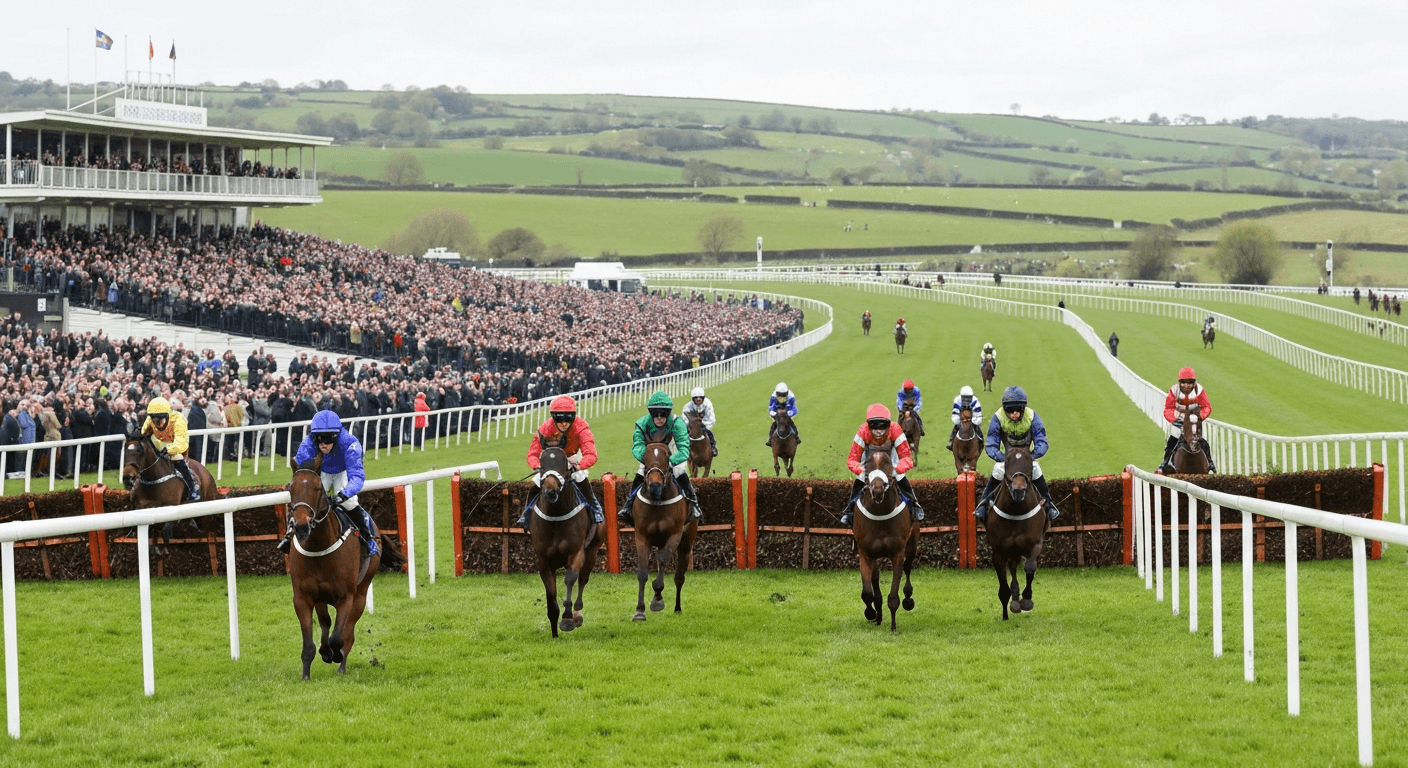
Irish Grand National Winners: The Full Roll of Honour (1970-2026)
Every Irish Grand National winner since 1970 - horse, age, starting price, jockey and trainer - with the trends that emerge across the full roll of honour. Source-verified.
Read moreThe History of Fairyhouse
How a Ward Union hunt meeting in Co. Meath grew into the home of the Irish Grand National, from Sir Robert Peel in 1870 to the modern Easter and Winter Festivals.
Read moreThe Irish Grand National: Race Guide
A full guide to the Irish Grand National at Fairyhouse on Easter Monday: the handicap chase, its 1870 origins, great winners and how to watch.
Read moreResearch the field with the AI Race Predictor
Our model publishes calibrated win-probability estimates for UK races — a second opinion to understand a race, not tips. It's open about its record: it doesn't beat the market, and we show exactly how it does.
Work it out & learn the basics
Gamble Responsibly
Gambling should be entertaining and not seen as a way to make money. Never bet more than you can afford to lose. If you or someone you know has a gambling problem, help and support is available.